Posted on

How A Doll’s House Part 2 and Brett Kavanaugh Taught An Actor How To Listen

sarah-durn-dolls-house-kavanaugh


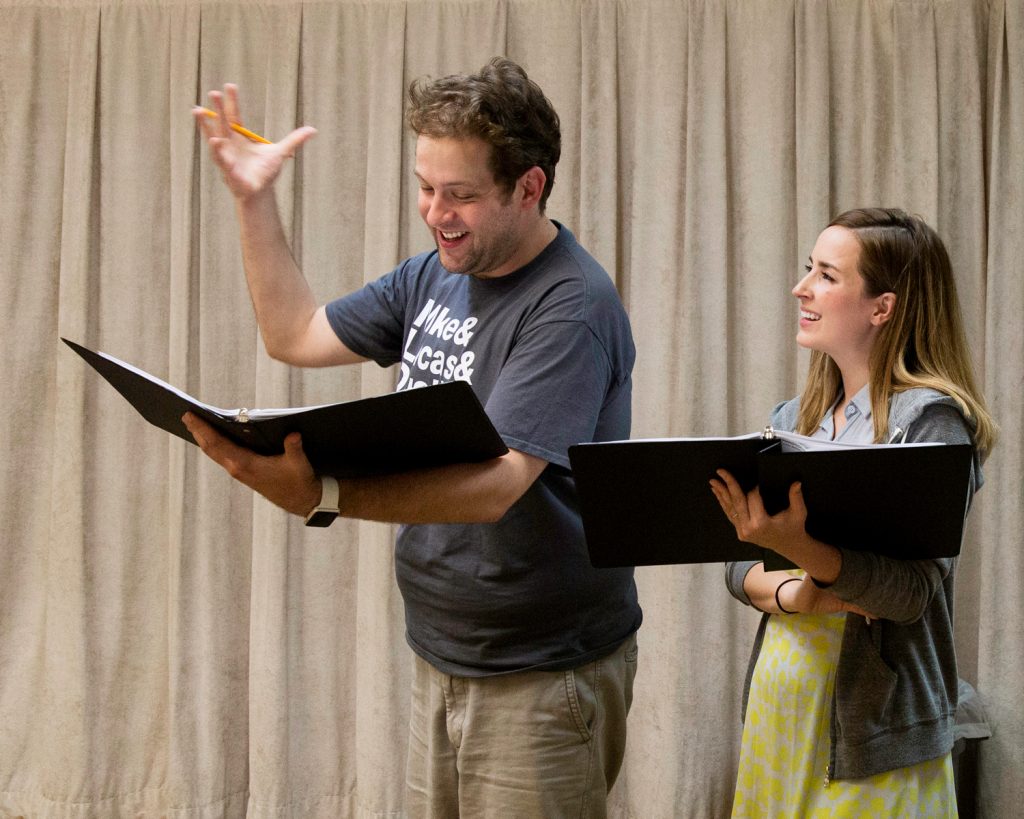
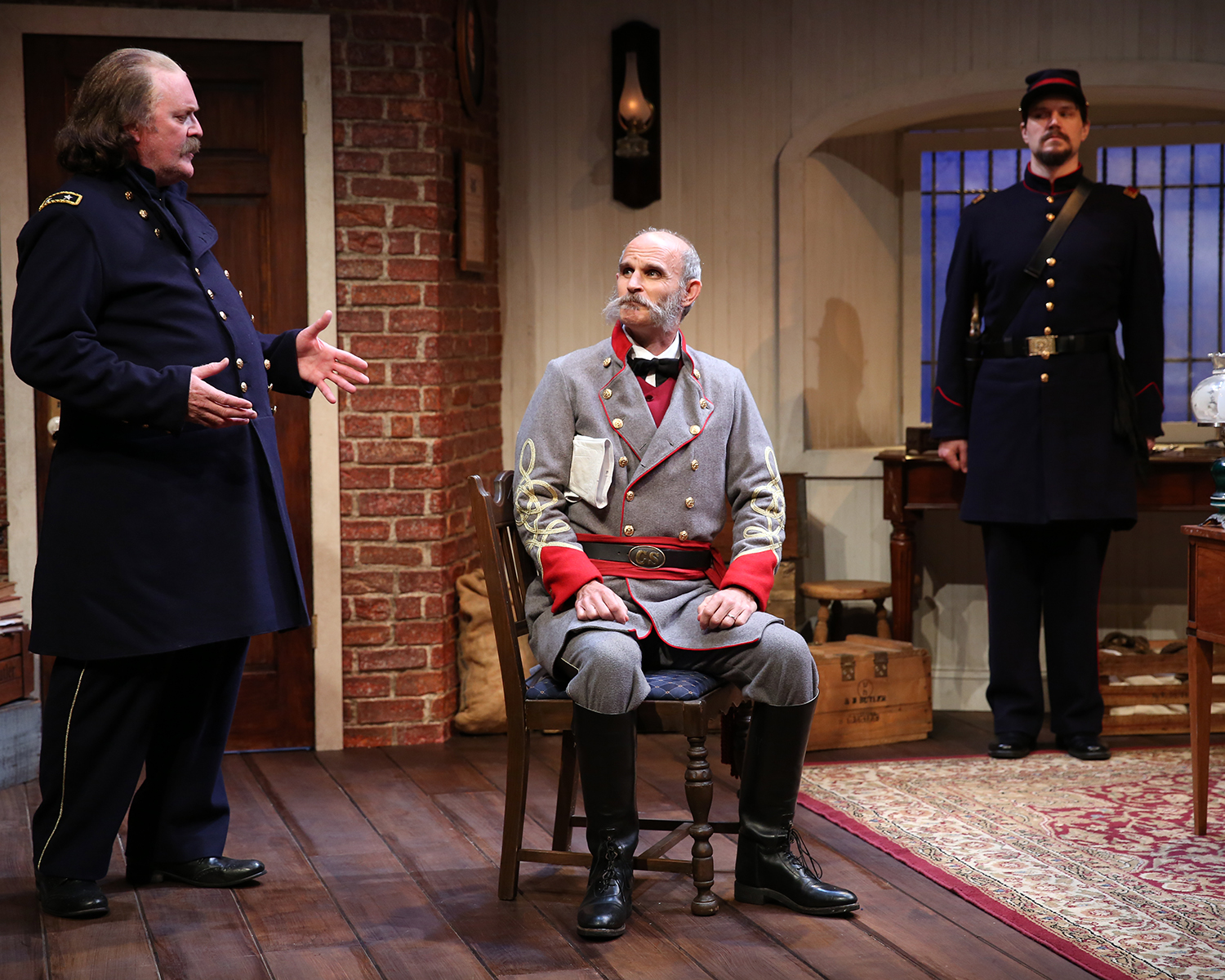
American Theatre Magazine recently announced that Lucas Hnath’s A Doll’s House Part 2 is the most produced play this year. It will be staged at 27 theaters nationwide during the 2018-19 season. I am an actor who is performing in one of those productions as Emmy, the daughter Nora left behind.
 

Nora returns in Hnath’s sequel because of a judge’s threats to expose her as a married woman. But, as we began previews, we were discussing a very different judge in the dressing rooms— Judge Brett Kavanaugh. And, suddenly our play was made viscerally relevant. There was something uncanny in listening to Dr. Christine Blasey Ford’s and Judge Kavanaugh’s hearings, to watch this very different kind of performance unfold, one with real, political stakes.
 

A Doll’s House Part 2 and the Ford/Kavanaugh hearings share a structure. During the hearings, Dr. Ford made an argument, and Kavanaugh countered. In Dolls, Nora makes an argument— that marriage will become obsolete, that we’d be happier without it— and the other characters counter. Hnath explained in an interview with the Chautauqua Institute’s Andrew Borba that this is how he builds all of his plays—an argument followed by a series of counter-arguments.
 

But, what happens in A Doll’s House Part 2 and not in Dr. Ford and Judge Kavanaugh’s hearings is the space to see the people beneath the arguments, to create the space for empathy. Politics and political news coverage is often so reductive, that there’s no space to see the people beneath the extracted quote and no time for empathy. Following the hearings, it was a terrifying thing to see how the right and left could translate the same words so differently. The New York Times called Kavanaugh’s testimony “aggressive, tearful, and partisan.” Trump praised Kavanaugh calling his same words “powerful, honest, and riveting.” Just like that five hours of testimony is reduced to a Tweet, a person reduced to a few adjectives.
 

My favorite line in A Doll’s House Part 2 comes near the end when Torvald says, “I don’t know. It’s just so hard… all of this. Being with people.” After so much of the play is people making arguments and taking sides, this one hesitant line from Torvald beautifully reduces what all plays, all politics, all life is really about— figuring out how to be with people.
 

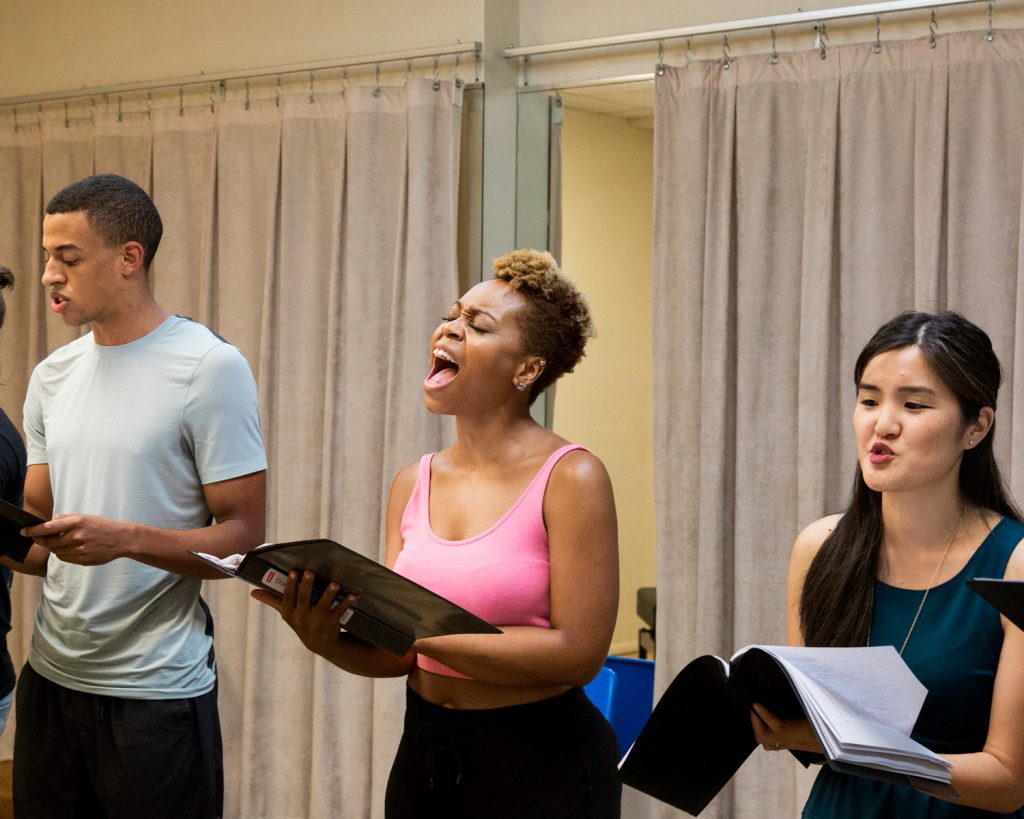
To be an actor is to practice listening. There are always moments up on stage where my mind wanders, where I’m pulled out of the scene because I’m thinking about so-and-so in the audience or how I just messed up that line or how I really need to do laundry. My work as an actor is to bring myself back to the moment, to the present, to listen to my scene partner. Even when I’m speaking, I’m listening to my scene partner’s facial and body expressions. It’s in the moments when I stop listening that my mind gets away from me. But, in the moments when I’m listening completely, I can feel myself tune to that other person, like two violins finding a root note. To be an actor is ultimately to practice how to do this, how to listen. To be an actor is to practice how to be with people.
 

We, as a society, must learn again to listen to one another, to tune ourselves to each other so that we can find the truth even in incongruent notes. We must learn again how to be with each other. We must listen especially to those voices that have gone unheard for so long. We must listen to survivors, to people of color, to immigrants, to women. We must listen to our annoying uncles and neighbors. We must listen to them more keenly than we listen to the friends and family we already agree with.
 

In her testimony, Ford said that her speaking was an act of civic duty, to inform senators about the character of a man they were considering for the highest court in the land. The same civic duty motivates Nora. Nora is striving to create a better world, a world with no more “bad rules,” a world where her words as a woman matter. She is asking to be heard.
 

Today is election day, and we find a record number of women running for office. #MeToo has rocked Hollywood, tech, journalism, and politics. Just over a week ago, words taken from Dr. Ford’s testimony were found spray-painted across the entrance of Yale’s Law School. Dr. Ford, Nora, #MeToo, the 256 women running for office— all seem to be asking for one thing, to be heard.
 

I worry though that we haven’t taught people how to listen. In our increasingly divisive news cycles, we’re being taught to ridicule the other side. Politicians are being asked to become agenda spokespeople, rather than just people. We demand that our politicians never fail, never stray from their ideals. There’s no room for empathy, for understanding because we never allow a politician to tell their true story, to show their humanity. Instead, we allow them to put on a mask of perfection.
 

But, there can’t be any room for growth when we’re so tied to our ideas. Nora, in time, comes to listen, really listen to the other characters as they challenge her opinions one by one. And, it’s only after she listens to all of their counter-arguments that she’s able to strengthen her own ideas and her resolve to continue fighting for what she believes is right.
 

Just as acting has taught me and continues to teach me how to listen, so too does being in the audience. As audience members, we sit there in a darkened room, suspending our lives for those a hundred or so minutes, and we listen. We tune ourselves to these other lives. And, if the story works, we come to recognize that this character is just like us, just another person striving to be and do better.
 

We all are learning, that simple act of, how to be with people. And, we cannot learn how to do that without listening. Whether we’re a United States senator or a character from an Ibsen play, we must create the space to listen to one another, because it’s the only way we can grow together. It’s the only path to empathy.


 Sarah Durn is an actor, writer, and maker based in New Orleans, LA.

Posted on

In Process: The White Dress

The White Dress


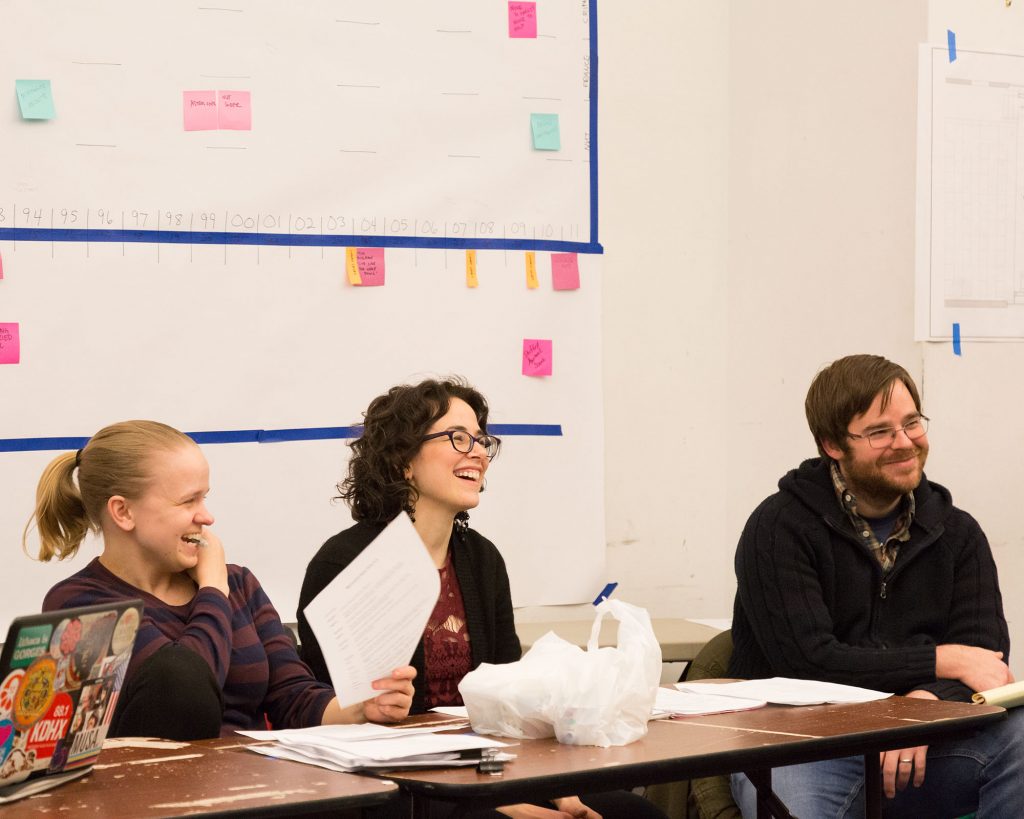
I am a guest at the first rehearsal of The White Dress—a new play by Roger Mason, directed and choreographed by Adin Walker, which will be presented at The American Theatre of Actors from November 2nd through November 5th. The play follows Jonathan, a young person navigating their gender identity—with a vivid, dynamic ensemble accompanying and guiding him along. Everyone is on a journey; each character is navigating their own path to self-discovery.
 

It’s time to meet each other. The rest of the team, in the basement of the South Oxford Space, talks to Roger, who is in Los Angeles. He is on speaker, being passed from person to person on someone’s phone, which somehow makes him larger than life. He is infectiously enthusiastic. We all go around the room, introduce ourselves, share our pronouns, and share stories of our first encounters with our identities—as a room, we once threw up out of physical attraction, we were once called a racial slur immediately after learning about slavery, we once demanded the right to play the flute as a child.
 

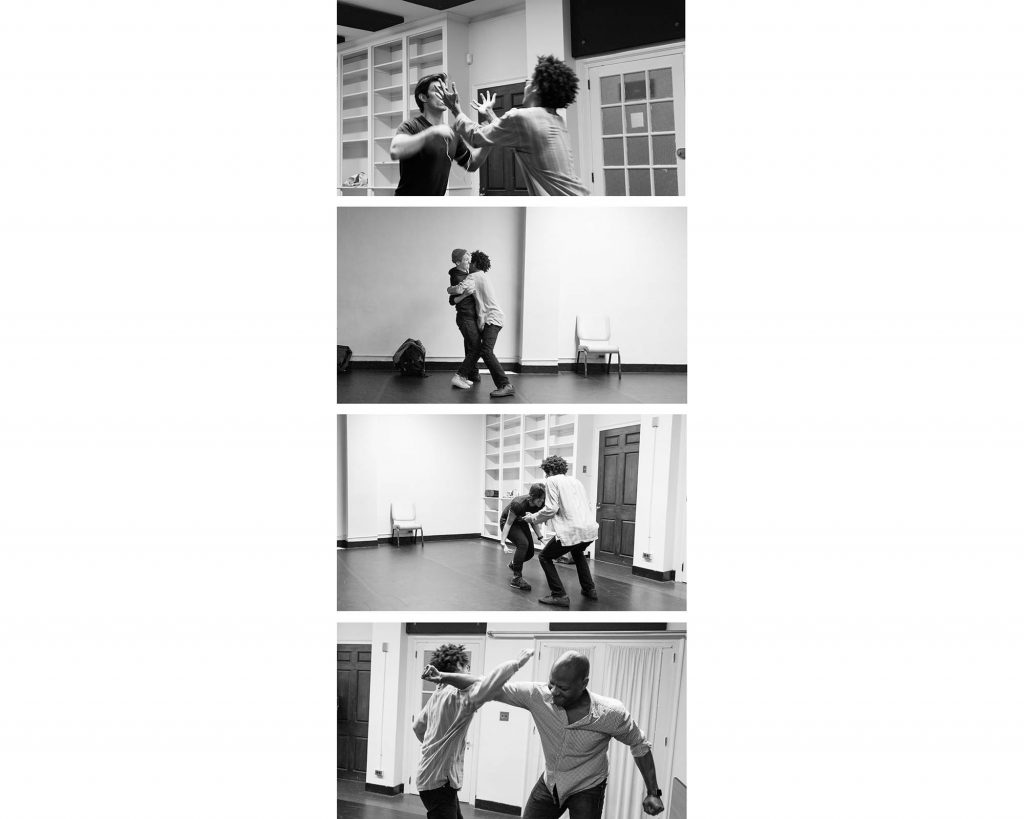
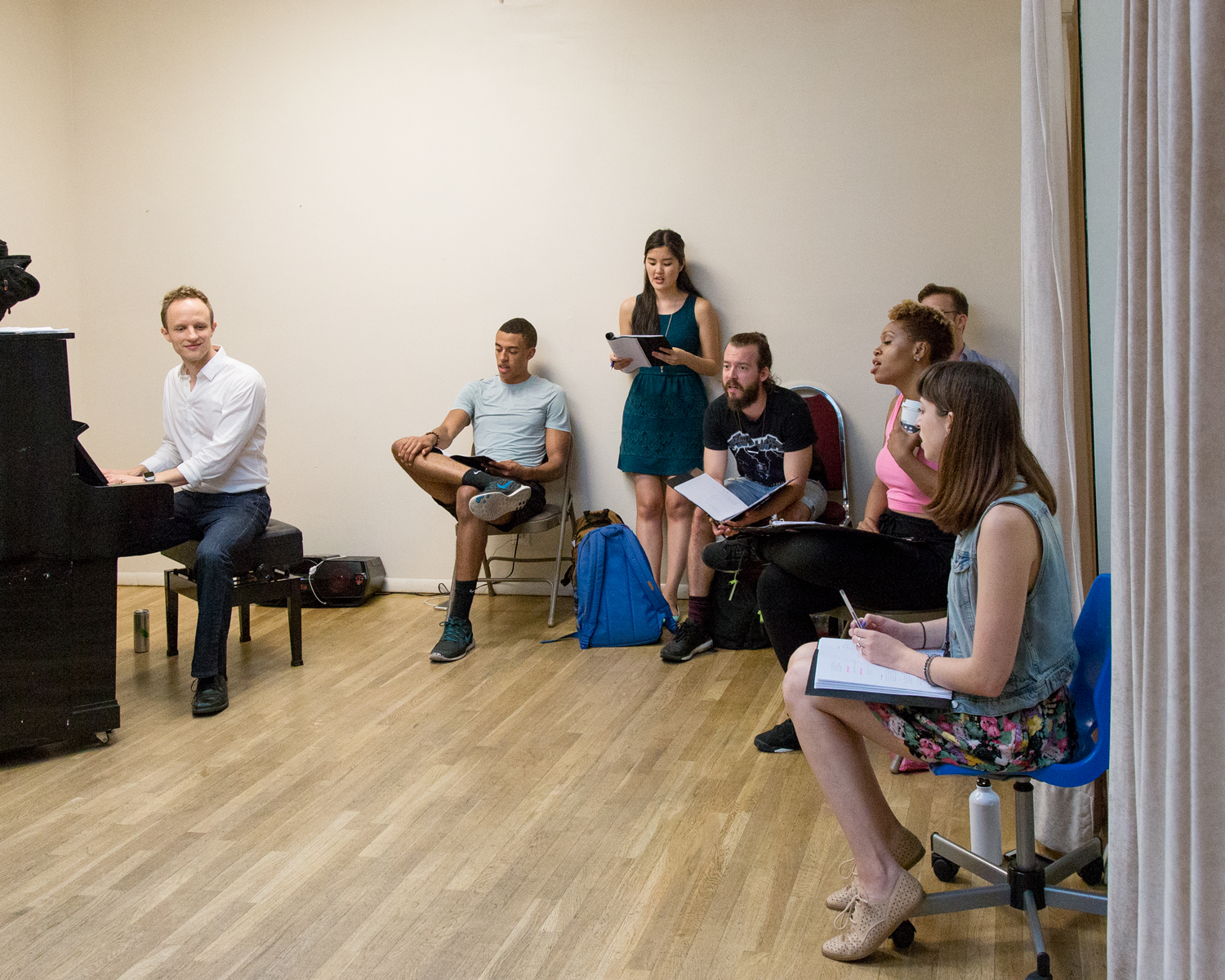
They start with a read-through around the table—a new draft, with a few surprises in it. But it’s clear that this is a process that will really begin in the bodies of the actors. This process will begin with movement, with establishing a gestural vocabulary that will inform the text. They read the play without its stage directions—I have no script to consider, so I focus on the language itself and I close my eyes a few times. Expressions of love and recklessness run throughout—lines like “Remember when you didn’t give a damn?” stick with me. On identity— “Did you put them on? Then they’re yours.” We hear Charles Inniss (the sound designer) play a theme for Jonathan. Serafina Bush (the costume designer) shows us an array of wild and fabulous reference images. The square space between the rectangular tables is full of possibility.
 

The next time I’m in the room, they’ve spent almost a week with the piece. I walk in and Mayfield Brooks (the movement dramaturg) and Michelle Vergara Moore (playing Hazel, Jonathan’s mother) are working on a movement piece together. Mayfield tells Michelle that they are making a “score, pattern, structure.” They are working with a silk jacket. Mayfield works like the conductor of an orchestra—if conductors of orchestras gave their entire bodies to their performance.
 

With their own movements as well as their words, they encourage Michelle to follow her actions through to their natural conclusions—“Do that whole thing again, but have a pathway.” The philosophy of movement in this piece, as Adin describes it, is to explore how each character is “carrying the identities and signifiers that are inscribed onto their bodies.” Michelle is learning the language of her character’s body—they talk about the dance she is doing as if it is an internal monologue: there is a moment of remembering, there is a moment of release.
 

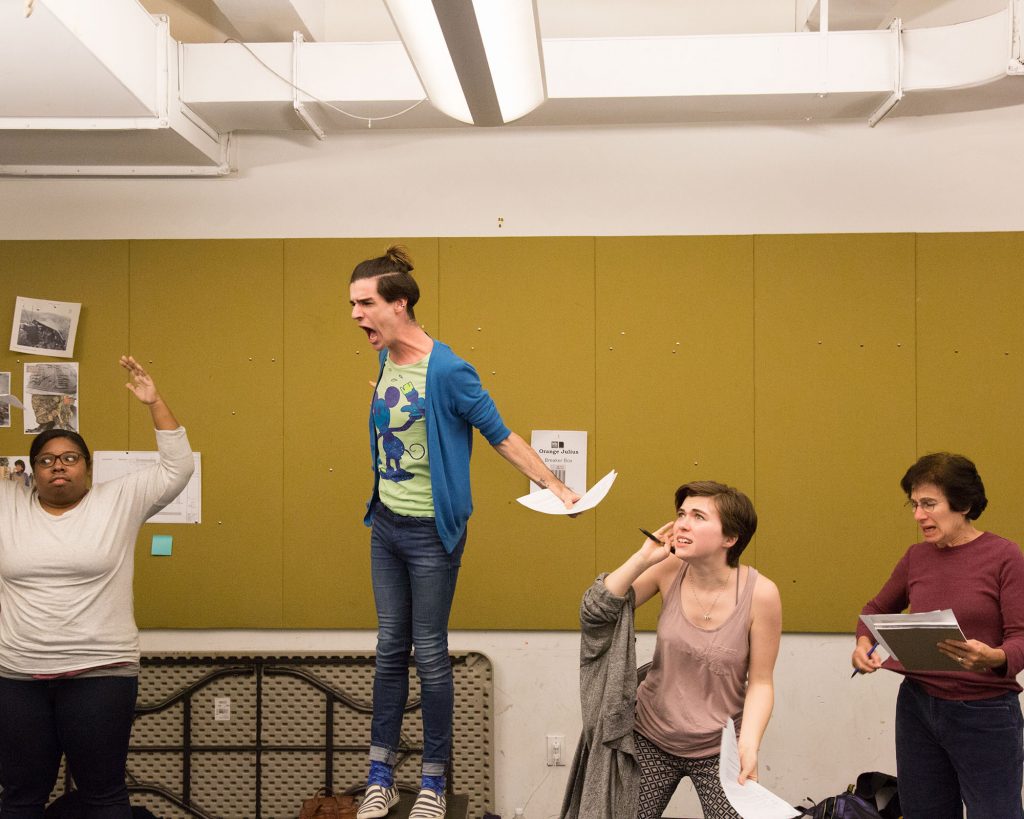
The rest of rehearsal is devoted to first attempts. Izzy Castaldi and Stanley Mathabane track their teenage characters’ relationship through a few different moments: they experiment with a sleepover scene, a nosebleed moment, a kiss where lips don’t touch. Adin wonders if the entire show could be done without using a single chair. They decide to try the scene at hand without chairs. This is the time to try things, after all—and I look forward to witnessing the decisions they make.


***


The White Dress is playing at The John Cullum Theatre at the American Theatre of Actors on November 2 to November 5, 2017. Tickets can be purchased at thewhitedressplay.com/.

Posted on

Reconciling My Filipino-American Identity

Shea Renne


I was born in Quezon City in the Philippines on September 30, 1991. Soon after, I was put up for adoption. My 18 year-old birth mother didn’t have the resources to take care of a baby at her young age. For reasons unknown to me, my birth father was out of the picture. But I was loved. I have to believe it. I believe with my whole heart that I was given up for adoption because she, my birth mother, wanted me to have a better life than she knew she could provide.
 

Seven months later, I was flown from the Philippines to Ann Arbor, Michigan. To this day, my adoptive parents are MY PARENTS. There were times growing up when I was confused, sure, but no doubt about it, I belonged with them. My family is my family. My mom is my best friend. We are soul mates. Anyone who knows us can attest to that. That being said, I was certainly curious. I have a strange obsession with meeting my friend’s parents because I’m fascinated at how similar they are, not just in personalities, but also in physical features. You look so much like your mom! You’re twins! You’re definitely a combination of your mom and dad.
 

Growing up in a predominately Caucasian town in Michigan gave me a very small window to the world. My parents did their best to introduce me to my Filipino culture, but I avoided it. In school, I became known as “the whitest Asian you’ll ever meet.” I thrived on it. I laughed about it. But now, being in the Filipino musical, Here Lies Love, I’m immersed in my culture, and I’m slowly but surely embracing it. I feel like I’m in a whole new world, and I’m embarrassed at how I pushed it away for so long, until now.
 

Here Lies Love is one of my most proud theater opportunities to date. Being in a predominantly Filipino-American show is unlike any other show I’ve ever been in. I learn new things every day from my cast, whether it be phrases in Tagalog, or new Filipino foods. (During my Broadway debut in Allegiance, I had my first lumpia and nearly fainted — It was so good, I had 10). In the dressing room, I hear stories of Filipino families and their distinct habits, and how my friends were raised. Of course, Allegiance consisted of mostly Asian Americans, but somehow, being a Filipina in a show that tells a piece of Philippine history changes my perspective of my culture. We are family here. I can’t begin to explain the connection I feel with these cast members. Maybe it’s because they’re just really great people, but something about being among other Filipinos makes me feel at home.
 

A few days ago, my castmate and friend, Janelle Velasquez, was talking about how she bought a DNA test called 23andMe. You spit in a tube, receive your ancestry composition, and have an option to connect with people who share DNA with you. My heart and my brain told me: I needed to do this too.
 

I have been considering doing a DNA test for years, but something always held me back. Was I ready? How would I react? How would my parents handle it? I kept putting it off. In my early teens, I told my parents that I wanted to find my birth parents when I was 18 and could legally investigate. I finally turned 18 years old, but I told myself I couldn’t follow through with my plans because I was too busy with college, etc. The truth was, I wasn’t ready emotionally.
 

Now I’m 25 years old. A few days ago, I bought myself a DNA test and told my mom. We cried together on the phone. I told her she is my mom and my only real mom, but that I needed to do this for myself. I told her my curiosity was starting to break me down. Although she was of course emotional, she trusts me and is as supportive as can be.
 

I want to thank Here Lies Love for giving me the courage to take the steps to know myself better. The DNA test may not prove much, but this experience has shown me that there is so much more to who I am than I thought. Here Lies Love has opened up my heart and my mind. I don’t know if I would have ever gained this newfound perspective if it weren’t for this show. I will forever be grateful.
 

The universe works in mysterious ways. I truly believe everything happens for a reason. I was given up for adoption so that I could be with my family in the United States. And in being in the United States, I have found my passion and love for the theater. My parents have given me every resource possible for me to chase my dreams of being onstage. I am so lucky to represent Asian Americans and Pacific Islanders in this business. Before I graduated from the University of Michigan, I was one of those actors who shied away from roles because of excuses such as, “I’m not white,” and “They won’t cast an Asian for that role.” A dear director and friend, Jen Waldman, was the person who helped me to believe that I can be whatever damn role I want to be if I work hard for it, and that I shouldn’t let my being Filipina take me away from that. I’m so proud to be a part of the AAPI community and I hope that this inspires young actors to chase their dreams, regardless of their color or nationality.


 Shea RenneShea Renne is an actress based in New York City. She is currently in Here Lies Love at the Seattle Repertory Theatre. Other credits include: Broadway: Allegiance (Betsy Tanaka). Regional: Spring Awakening (Ilse, The Hangar Theatre), Seussical The Musical (Bird Girl, The St. Louis Muny), West Side Story (Rosalia, Music Theatre Wichita), South Pacific (Liat, MTW) Footloose (Urleen, Fulton Theatre). She is a proud member of the Actors’ Equity Association and graduate of the University of Michigan.

Posted on

NYFA Hall of Fame 2017

Lynn Nottage, NYFA


I saw Sweat at the Public Theater the day after the presidential election, and I have never had a more politically timely experience of theater in my many years in New York theater. Months later, I took my NYU students to see the show on Broadway and then had the fortune of introducing them to Lynn Nottage at a preview of Venus at Signature theatre; she was her usual kind and generous self, a little shy and a little quiet too. It’s a wonder how playwrights with such important voices on stage are at times the quietest in person. Then again, when you’re in dialogue with the forces that shape the economic, social, and racial realities of this country’s working class, as she is in Sweat, perhaps you commit the best of your mind to that conversation. What I hope my students take away from Sweat is that we must enter the conversation and confront these forces. Some may call this “resistance” and in a society that may have been rather apathetic, perhaps any kind of civic engagement is a “revolution.” I’m not sure that I am one of those people, but I was impressed by how Sweat speaks to our times and am happy to share this Stage & Candor exclusive with our readers, Lynn Nottages’s remarks from her induction into the NYFA Hall of Fame Benefit Lifetime Achievement Award acceptance speech. Check it out below.


“Twenty two years ago, before my very first writing commission, before my very first production of a play in New York, before I had an inkling that I was going to forge a life in theater in New York, I received a NYFA grant. It was the first grant I ever received. And it was really the first substantial thing and the first time that anyone said that ‘you can be a writer.’ And it pumped up my ego just enough to contemplate a life in theater so I thank you for that. It was unexpected and it resuscitated all of my creative impulses. It was 1994, I’d just gotten married and spent a lot of money on that wedding, and recently left a full time job and was trying to figure out how to forge a life in an industry that really didn’t seem to want me at all. And I was temping at a pharmaceutical company…has anyone ever temped at a pharmaceutical company? [laughter from crowd] So you know how that was…where people literally treated me like fly paper. And the only consolation was that at night, I got to go into the supply closet and get reams of paper and supplies that I would horde and stack in my apartment. [more crowd laughter] But, I was writing plays and I was using that paper and commiserating with friends and feeling that I’d made this awful mistake that I’d left my full time job. And then, I got a letter in the mail–you guys remember when you used to get letters in the mail–and they arrive in those sort of off-white envelopes and usually those off-white envelopes meant that you’d won a prize or most often for us writers it was rejection letters. And, um, this time it was from NYFA, which formalized literally the beginning of my writing career in New York. Periodically artists and ideas come under siege, and I’m so grateful that there’s an organization that recognizes the totality of who we are as artists and doesn’t restrict our craft. And doesn’t sort of demand that we sort of conform to anything…they just give us grants and let us write what we want to write. I think that that’s a really beautiful thing, and a very rare thing. And as writers we so often face criticism, and we face rejection, and we face exclusion, and we face a multitude of these very visible barriers but more often very invisible barriers. And so we need those bursts of encouragement and support to get us through our days. And that letter I have to say is just that burst of encouragement that really gave me life at a moment when I needed life, and pushed me forward at a time when I really needed to be pushed forward. And I have to say that that’s true and it’s not hyperbole. And I thank you for also having the very easiest grant to write [cheers and applause from audience]. It’s such an artist-friendly application and we fill out those applications that make us jump through hoops and it’s such a blessing to have an application where you can write a paragraph, send in your resume, send in a sample of writing, and then god forbid you get a grant six months later. And so, a NYFA grant is wonderful because it asks the artists not to change their impulses and shift who they are, but merely to continue do what you do. But mostly I have to thank my husband, who in 1994 was the person who said ‘you should apply for this grant’ and is the person who continues to push me. So thank you.”

Posted on

Giving Voice to the Body: The Cast of ReconFIGUREd

ReconFIGUREd


Honest Accomplice Theatre tells stories that are rarely brought to light: those that are silenced, pushed aside, or deemed too “fringe” for mainstream theater. Working with an ensemble of artists, the company works to bring these topics into the light; to create dialogue about the things we don’t see onstage when it comes to the lives of female-identified and trans people.
 

ReconFIGUREd, the company’s latest piece, is a heart-warming devised work about the experience of living in our bodies, and how it feels to inhabit the female and trans identity. We spoke with members of the cast about their process, their characters, and why theater matters.


ReconFIGUREd
 

Helen Schultz: How did you get involved with HAT/ReconFIGUREd?
 

Seth Day (He/Him/His): It’s actually a funny story! Although I had some theater experience growing up, I’m not an actor by trade. I wasn’t actively searching for acting gigs, but I’m a member of this Facebook group that is a forum to share queer-friendly employment opportunities, and I saw the casting call for ReconFIGUREd and thought, “Why not!?” To be honest, I almost chickened out of the audition, but the project seemed so important to me. The subject matter of the show is what really piqued my interest. It was the first time I had seen a casting call that was genuinely interested in the trans experience.
 

HS: Tell me about your character and creative/design role.
 

SD: I’m one of the two actors playing Luke, a trans guy in the first year of his transition, who struggles with feeling the need to perform toxic masculinity in order to be seen as male. He also has some family drama going on and has to balance that with dealing with his masculinity issues. It’s very exciting for me as a transperson to get to play a trans character, and to put a story on stage that feels more authentic than other trans representations in the media.
 

I’m also the prop designer, which was a first for me and a fun challenge! I really tried to give attention to detail to each and every prop in a way that each prop adds something to the story.
 

HS: Why do you think theater is such a powerful medium for telling this kind of story and to help change people’s minds and erase some of the stigmas associated with current identity/body politics?
 

SD: Generally when people see theater it’s for enjoyment, so I think when we go see a show, we let our guard down. If I were to walk up to someone and try to engage in a conversation about the body or gender or any sensitive topic, I think they’d probably be a little guarded. But when we let our guard down and are open, theater can really change us.
 

HS: Tell me about one of the scenes in the play.
 

SD: There is a power ballad sung from the last remaining estrogen in a menopausal body. What more do you need?
 

HS: Tell me about a moment in the development process that surprised or stuck out to you.
 

SD: At the beginning of each devising session, we would go around and introduce our name and pronouns (as these are things that can change!). And one session, one of the ensemble members asked us to use a pronoun I had never even heard of before, which was a really humbling moment for me. Sometimes I think just because I’m trans, I know all there is to know about gender, but that was a great reminder that we all have room to grow and learn!
 

HS: What is one thing you hope people take away from this piece?
 

SD: I suppose I don’t really care what people take away from the show as long as they’re still thinking after it’s over. My hope is that the show starts a conversation!
 

HS: What makes this show unique?
 

SD: I think one of the most unique aspects of this show is its honesty. That and the fact that about a third of the cast is trans! Which is just amazing.


ReconFIGUREd
 

Helen Schultz: How did you get involved with ReconFIGUREd?
 

Jo’Lisa Jones (She/Her/Hers): I saw a posting to audition for the devising portion, not realizing that a friend of mine had actually worked for HAT previously and gave them glowing reviews, so I knew I should go for it! The reason I first wanted to get involved was because I feel like seldom do women and trans folk have an opportunity to truly discuss and express what our bodies go through. I also wanted to share and relate my experiences with other people so that others feel comfortable to speak up and so that I could find some camaraderie.
 

HS: Tell me about your character.
 

JJ: My character’s name is Fiona, and she works in a women’s health clinic that also performs abortions. Despite having fertility issues, she gets pregnant, only to suffer a miscarriage. This character is loosely related to a short movement piece that I created about having an invisible illness, as I have PCOS [Polycystic Ovary Syndrome] and can potentially have fertility issues, so this character is very near and dear to my heart.
 

HS: Why do you think theater is such a powerful medium for telling this kind of story? How does it help change people’s minds and erase some of the stigmas associated with current identity/body politics?
 

JJ: I think it’s a fun way to be educated. You are moved by the characters and gain new perspectives on what others may be going through. People want to have fun, and I think ReconFIGUREd is a really fun show that has a beautifully crafted undercurrent of truth telling and insight – and other times we just let it all hang out because that’s appropriate too!
 

HS: Tell me about a moment in the development process that surprised or stuck out to you.
 

JJ: I think the strongest moment in the development process that stuck out was the day we were embodying mental illness and addictions. It was truly enlightening to me. I have been very fortunate to not suffer from either and, although I may logically understand both, I don’t always physically or emotionally understand what’s happening. It finally clicked that day because, rather than having a verbal scene, I got to see how it wears on the body, and that really struck a cord with me.


ReconFIGUREd
 

Helen Schultz: How did you get involved with HAT/ReconFIGUREd?
 

Jordan Ho (Xe/Xem/Xyr or She/Her/Hers): I started working with HAT in 2015 for the Tank run of The Birds and the Bees: Unabridged and I have been with them ever since. I stayed because this company is like home to me.
 

HS: Tell me about your character.
 

JH: I devised the role of Melanie in the show with castmate Holly Samson. There are many facets to Melanie: having a trans brother and a mother who works in an abortion clinic, on top of figuring out her race, ethnic identity, and coping with mental illness. It’s been a joy getting to create Melanie, and I hope anyone else who is suffering can find comfort in her arc.
 

HS: Why do you think theater is such a powerful medium for telling this kind of story? How does it help change people’s minds and erase some of the stigmas associated with current identity/body politics?
 

JH: When talking about the body academically, it’s easy to desensitize ourselves from actually addressing the issues. Not to say that literature and news articles are telling lies, but written word automatically makes these concepts abstract and not attached to our physical forms. And even if these concepts do manifest inside our bones, the natural next step is to act, which is why we do theater. I think there will be something powerful about seeing actual bodies tell the stories about how we carry and take care of our vessels.
 

HS: Tell me about one of the scenes in the play.
 

JH: There happens to be a musical number called “Gemme Femmes” that is horrifyingly entertaining. I grew up watching shows like Sailor Moon, The Winx Club, and Mew Mew Power, so I have a strong affinity to girl-power television. That being said, it is so, so interesting looking back and seeing just the opening intros and seeing these shallow molds of femininity veiled under the guise of being a cute television show for kids.
 

HS: Tell me about a moment in the development process that surprised or stuck out to you.
 

JH: Honestly, I was most surprised when we learned our character tracks and who was paired with whom. I’m a trans gender fluid actrex, so I just assumed that I would be assigned a trans character. But when I heard that I would be working with Holly to devise the role of a cisgender woman, I was really struck for a moment. And then I had a creative epiphany: because if Hollywood is so dead set on allowing cis people to play trans characters, then why can’t a trans person play a cis character? I will never forget this moment because it gave me such clarity that trans artists are capable of anything. Creating this role has helped me reclaim my femininity, and I’m so glad that Maggie, Rachel, and Holly have trusted me in this creation process.


ReconFIGUREd
 

Helen Schultz: How did you get involved with HAT/ReconFIGUREd?
 

Simona Berman (She/Her/Hers): I came on board this year for ReconFIGUREd and am outrageously happy to now be in the company.
 

HS: Why do you think theater is such a powerful medium for telling this kind of story? How does it help change people’s minds and erase some of the stigmas associated with current identity/body politics?
 

​”​And i said to my body. softly. ‘I want to be your friend.’ it took a long breath. and replied ‘i have been waiting my whole life for this.'”​

When I first read this quote by Nayyirah Waheed, I literally took a deep breath as I was reading, unconsciously wrapped my arms around my body, and started to cry. Or at least dry heave a bit, because I stopped myself from crying long ago when I was bullied growing up and didn’t want to give the bullies anymore fodder for their fire. Much of that bullying was a catalyst in my long continuous battle with my body. Along with a few eating disorders, I also struggle with body dysmorphia: where I look in the mirror and see my arm and where the large muscle from doing gymnastics meets my large breast it triggers my brain to see my body as one big armbreast – much bigger than it actually is.
 

That quote by Nayyirah took me out of my head and separated me from my body and gave my body its own persona, arousing empathy in me for my body. As a self-hating Empath, it is easier for me to be moved to action by others, not so much for myself. I suddenly saw my body as a scared little girl, who opened her arms wide and said, “Please love me, I beg of you!” The quote made me want to take care of that little girl that is my body. This was easier for me to process as opposed to trying to just love me for me.
 

That’s what theater does for certain issues, such as the ones we tackle in ReconFIGUREd. Theater takes an issue and initiates awareness for someone to be able to see outside of themselves. For an audience, if they connect deeply to the story as if it was theirs personally, theater allows for aesthetic distance where the story becomes a safe friend that might help someone feel less alone or less awkward. It also opens up whole new worlds for people who can’t relate at all to the story personally, but being able to see, hear, feel the story played out can now evoke empathy for the characters. Or at least a better understanding, as opposed to just hearing about it or reading about it in a random story.


ReconFIGUREd
 

Helen Schultz: How did you get involved with HAT/ReconFIGUREd?
 

Holly Sansom (She/Her/Hers): I started working with Maggie and Rachel before the Honest Accomplice Theatre company was created, back in 2012. I was an original ensemble member and deviser for the show The Birds and the Bees: Unabridged. When HAT was formed in 2014, I came on as the General Manager as well.
 

HS: Tell me about your character.
 

Holly: I share the role of Melanie with Mx. Jordan Ho. Melanie is a cis woman thinking about her identity as a biracial person in America. She is also dealing with mental illness and how these aspects of her body affect her relationship with the world and the people in her life.


ReconFIGUREd
 

Helen Schultz: How and when did you get involved with HAT/ReconFIGUREd?
 

Jesse Geguzis (Squee/Squer/Squem): I had auditioned for the previous project and then I was asked to be a part of this project about a year ago.
 

HS: Tell me about your character.
 

JG: Luke is a young trans guy in college and struggling to be comfortable in his new body with old friends and family of origin.
 

HS: Why do you think theater is such a powerful medium for telling this kind of story? How does it help change people’s minds and erase some of the stigmas associated with current identity/body politics?
 

JG: I think theater can change the world. Everyone involved in this project is throwing their energy at creating change. I think visual mediums are the strongest vehicle to get into folks’ heads and leave them starting to change their thinking. It plants a seed. This company is gardening a new world by telling new non-heteronormative narratives.
 

HS: Tell me about one of the scenes in the play.
 

JG: My favorite scene is with my character, Luke, and his sister Melanie, fighting and trying to find common ground around identity struggles. The whole scene takes place with both characters wearing the same giant shirt, as a punishment for fighting by their mother.
 

HS: What is one thing you hope people take away from this piece?
 

JG: I hope people leave thinking about how to open up their minds more and more every day.
 

HS: What makes this show unique?
 

JG: It’s a company of only female and trans-identified folks.


reconFIGUREd
 

Helen Schultz: How and when did you get involved with HAT/ ReconFIGUREd?
 

Kat Swanson (She/Her/Hers): I was lucky enough to be involved with HAT early through some of the first Birds and the Bees workshops, which I heard about through Rachel while working with her on another project. I remember being so struck by the questions being asked and by the process. I tried to be involved in whatever way I could from there. I helped out a bit with general support on one of the Birds and the Bees productions, and finally had the chance to be involved from the beginning of this project.
 
 
HS: Tell me about your character.
 

KS: My character is a struggling single mother named Donna. She has an eight-year-old daughter named Ari – short for Ariel – who she’s supporting on her own (the father has been out of the picture for some time now), which creates a lot of financial hardships. She also grapples with lack of self-love, binge eating disorder (BED), and back pain, partially caused by having larger breasts. Donna suffers from the classic single-parent time versus money dilemma: how can she be a good mother to Ari when all she has time to focus on is the next step, the next place to be, the next bill to pay? She’s in survival mode and is realizing the negative impact on her growing daughter.
 

HS: Why do you think theater is such a powerful medium for telling this kind of story and to help change people’s minds and erase some of the stigmas associated with current identity/body politics?
 

KS: I really think that seeing is believing and feeling is understanding. People who aren’t trans or women or disabled and so on don’t really know what gaps exist in their understanding. When you don’t live it, you just don’t know. You can read an article or catch on to all the political and social media buzzwords and think you know something, but you just don’t. People are often afraid to admit, even to themselves, that they don’t understand.
 

Theater is such a unique art form in how it is able to combine all the other art forms to create a true, visceral experience. It is able to make the audience see and feel and have at least the opportunity to start to know. By attending and really opening yourself up to a play that portrays an experience that is not your own, you get a chance to empathize with other people. That empathy, especially when it occurs on a large scale, is – I think – what really has the power to make a difference in people and society as a whole.
 
 
HS: Tell me about one of the scenes in the play.
 

KS: Ooph – tough question! There are so many excellent ones. My favorite scene is one that portrays caretaking for a character whose mobility has been severely impacted by her battle with cancer. It’s really loaded – the daughter is getting ready herself and is helping her mother get ready for the day at the same time. The scene is great because the dialogue is very normal but also tells so much in so little. I think it’s something a lot of families can relate to, [regardless of the] situation they’re in. It hit a chord with me because my mom has been wheelchair-bound her entire life, but growing up, I realized that no one really understood what that meant for her day-to-day life. They had this general, blind pity and were usually kind – all good things – but they had no idea what it took for her just to get out of bed, to use the bathroom, things that able-bodied folk, myself included, often take for granted. I cried when I saw it because it just hit home so hard. I hope it makes able-bodied folks happy to be in their bodies to some degree, and also helps people who are in a similar position as this character for whatever reason feel more understood and represented onstage.
 

HS: Tell me about a moment in the development process that surprised you or stuck out to you.
 

KS: I didn’t realize how tough the development process could be. For a while, I thought I was the only one who was in rehearsal feeling as though I didn’t belong there, like I didn’t have anything to contribute. To Maggie and Rachel’s credit, things kept moving forward because they heard these concerns from several folks in the room and implemented things like a “question box”. [The idea of the box is] to try and help the cast understand each other better, and also understand what they each brought to the room – all while taking the “educator” responsibility on themselves. [Because of that], folks who are often put into that position involuntarily in their day-to-day lives didn’t have to take that role on here. It became such a safe space to discuss really challenging issues with lots of differing viewpoints. While it was tough, the end result and the value of realizing that kind of space is possible was immeasurable to me.
 

As for a specific moment… picking one, I guess I was really surprised to realize that a lot of people don’t view their periods as a negative thing. For some it’s culturally celebrated, for others it’s empowering and magical – it opened my mind because for me, my period had just always been a monthly “Congrats, you’re not pregnant!” notification and a frustrating, painful, messy pain-in-the-ass. It’s hard to explain, but it was a really memorable rehearsal.
 

HS: What is one thing you hope people take away from this piece?
 

KS: I hope people take away a new appreciation for the complexity of a person’s agency over their body, as well as the wide variety of experiences that are different from their own. I hope they see and appreciate something new, and I hope they ask questions and start talking about things they’ve been silent about before.
 

HS: What makes this show unique?
 

KS: It’s people and it’s honesty.


***


ReconFIGUREd is playing at The Tank on January 6 to January 15, 2017. Tickets can be purchased at http://thetanknyc.org. For $10 tickets, use code HATBODY.

Posted on

Advocating for Inclusion in Post 11/9 America

Christine Toy Johnson


I’ve been thinking a lot about how we are starting to look at the world as “pre 11/9” and “post 11/9.” That’s not a typo, and is in no way meant to disrespect references to the devastating tragedies that happened in America on September 11, 2001. But I do believe that November 9, 2016 is a date on which many Americans – no matter how they voted in the presidential election the day before – saw a seismic shift in the way certain citizens found permission to express themselves. This, in turn, has created a seismic shift in our understanding of the world in which we have always lived, but are perhaps seeing through a pair of newly shattered glasses.
 

It seems that for some people who have been harboring years, decades, and perhaps generations of hatred and fear towards those who do not look like them or worship like them or speak like them (just to begin), the election has sanctioned expressing their preferred worldview in new and bold ways. Words and actions indicate that some now feel profoundly entitled to demonize (with a certain kind of giddiness) entire populations of other human beings who have been living, working, voting, and paying taxes amongst them. Turning their backs on the principles with which this country was founded, they seem to be intent on rewriting the narrative to say: “Give us your tired, your poor, your huddled masses yearning to breathe free – but not you, you, and certainly not you.”
 

Can the arts influence a wider worldview? The tip of the iceberg of this debate is reflected in the response to the whole Hamilton/Mike Pence situation (if you were hiding under your covers that weekend, here is a link to the New York Times article about it). The incident spurred comments suggesting (among other things) that the show, which casts our founding fathers with people of color to make a statement on the role immigrants had in the forming of the U.S.A, “erases white culture,” but that’s a whole other discussion.
 

What I’d like to talk about here might seem like a simplistic assessment of some of the ways I think the arts can influence a worldview that is diverse, equitable, and inclusive. But it seems to me that the spate of hate crimes that have been occurring post 11/9 are as huge a flashing sign as any that we need to do better in how we reflect the world and our individual diversity on our stages and screens, in the media and in popular culture.
 

Now to be crystal clear: I am not equating in any way, shape or form the arts and media’s portrayal of our gorgeous tapestry to the kind of prejudice we’re seeing across the country right now. And I’m not naïve enough to think that expanding this portrayal could heal the giant schism that is at the heart of our national divide all by itself. But I think it can absolutely play a part. And we need to do better.
 

When journalist Roland Martin recently interviewed Richard Spencer (president of an “alt-right” organization with the seemingly innocuous name of “The National Policy Institute”) about his view of post 11/9 America, Mr. Spencer claimed supremacy founded on an assertion that Europeans invented everything in civilization (no, really, he said this – watch this lengthy but illuminating interview). This, he believes, is why white people deserve to be compensated with all of the opportunities that America has to offer. When Mr. Martin asked if he had ever heard about the pyramids built by the Egyptians, for example (never mind gunpowder, paper, the compass, and printing – all contributed by the Chinese – and other life altering inventions by other cultures), Mr. Spencer countered that “Egyptians are white.” Now, clearly he needs a history lesson. But it could also be argued that the plethora of media images on stage and screen (see “Aida,” “Cleopatra,” “Exodus,” “The Ten Commandments,” etc.) help to tell him that this is so. In addition, the more we (women, Muslims, Asian Americans, African Americans, LGBTQ Americans, people with disabilities, Latino/a, etc.) are viewed as “other” in the media and not portrayed with authenticity or accuracy or sheer inclusion of our stories, the more people who have this kind of skewed view of the world and/or have no contact with actual living humans who are women, Muslim, Asian American, African American, LGBTQ, Latino/a and/or have a disability etc can choose to believe that these images and portrayals reflect the truth of our American landscape. The more we are seen as “other” in the media and the American theater, the more we are seen as “other” in the theater of American culture.
 

In June of 2015, I had the privilege of addressing members of FIA (The International Federation of Actors) about the global impact of diversity on our stages. FIA is made up of performers’ trade unions, guilds and professional associations from more than 60 countries around the world – and as national chair of the Equal Employment Opportunity Committee at Actors’ Equity Association, I had been invited to participate in the conference along with other elected leaders of the union and executive staff. What moved me most, without a doubt, was to see the shared passions that we had for making theater, and the ways in which our commonalities were made more textured and beautifully complex by our differences.
 

When I addressed the delegates, I pointed out that the bridges we were building there and the ways our global perspective had expanded by getting to know each other just over a few short days were prime examples of why inclusion is vital. Without it, you would miss out on a whole lot. I noted how we began introductions to each other by asking what country we were from and whom we represented – but after that, all that mattered was how we connected on a human level: what we cared about, what we were fighting for, and how we were effecting change. And that phenomenon – connecting on a human level once you get a glimpse into someone’s life; someone who might literally live around the world from you, or not even speak the same language as you, or look anything like you — that phenomenon of connecting on a human level is at the heart of how I believe the theater can unite us. It’s a spectacular and singular opportunity. And one that can never be underestimated.
 

I asked them to imagine if the conference delegates had been chosen based solely on the color of our eyes – nothing to do with individual qualities, skills, contributions, or achievements – but only on the color of our eyes. That would be ridiculous. But that’s how many of us feel when we are evaluated or excluded from even having the chance to audition for a role whose cultural specificity is not germane to the story. That’s how we feel when we are excluded based solely on the color of our skin or the shape of our eyes. That’s how we feel when we are told to “go back to where you came from,” based not on actual knowledge of who we are and where we actually did come from, but based on an assumption that our “otherness” makes us “less than” and therefore unworthy to be considered “American.”
 

It seems that this is what is at the core of today’s fractured discourse: the unwillingness to connect on a human level, but rather responding to fear and perceived threats to the status quo. The outright dismissal of individualism, the blanket assumptions attached to race, gender, religious beliefs, presence or absence of a disability, sexual preference, gender identity, and so on, and the belief that the mere existence of entire populations of people can only lead to lack – all add up to form a vicious circle of fear and hate, hate and fear.
 

I acknowledge that this assessment requires me to try to connect on a human level with those who threaten Muslim citizens living in their neighborhoods, those who vandalize synagogues with swastikas, those who beat up LGBTQ Americans for being LGBT or Q, those who tell children they’ll be deported, those who would have me banished from the only country I’ve ever called home, etc. I’m still working on wrapping my head around that one. To follow this line of thinking, I cannot in good faith condemn these people without getting to know them either. But as we disagree, fundamentally, on how to treat one another, I admit that this is a more difficult task than I can currently handle.
 

Still, I contend that now more than ever, we need to find ways to go further in expanding perceptions of who we are and what we can do. At my core, I’ve always firmly believed that the media and media images can help do this. When we find more substantive ways to stop defining our storytellers only by the color of their skin, their presence of a disability, gender, age, creed, sexual identity, etc. and look more at our individual qualities and skills, perhaps we can help to penetrate the national psyche with our individual and then collective humanity, as expressed through our art. Can this really make a dent in the National Hate? Honestly, I don’t know anymore. But I think we have to try. And try harder.
 

The gross display of man’s inhumanity to man over the past few weeks has made me go through the seven stages of grief for my advocacy work – yet I have also been buoyed and inspired by the compassion and empathy of artists. We cannot capitulate and make hate the new normal. We cannot. This is not a statement in favor of “political correctness.” This is a statement in favor of civility and kindness, an appeal to uplift our better angels with the help of the images and stories we share in the arts and media.
 

We must be even louder than those who scream at us to “go back to where we came from.” Because where I really want to go is a place where our open, creative hearts can beat freely and express the many layers of our diverse humanity – with an expectation of celebration, not annihilation. A place where we can help keep the world we want to live in from being bullied to death. I hope we can.


 Christine Toy JohnsonCHRISTINE TOY JOHNSON is an award-winning writer, actor, filmmaker, director and advocate for inclusion. Her plays and musicals have been developed and produced at such places as the Roundabout Theatre Company, The O’Neill Theater Center, The Meryl Streep/IRIS Writers Lab, Crossroads Theatre, The Barrow Group, Prospect Theater Company, CAP21, The Weston Playhouse, Gorilla Rep, Leviathan Lab and Village Theatre. A collection of her written work is included in the Library of Congress Asian Pacific American Performing Arts Collection.
As a performer, she has been breaking the color barrier in non-traditionally cast roles for over 25 years, and has been featured extensively on Broadway, off-Broadway, in regional theatres across the country, in film, television, and concerts worldwide.
Christine is a proud member of the elected leaderships of both the Dramatists Guild (also serving on the Publications Committee) and Actors’ Equity Association (also serving as National chair of the Equal Employment Opportunity Committee and National chair of the Equity News Advisory Committee), an alumna of the BMI Lehman Engel Musical Theatre Writing Workshop, a founding member of AAPAC (Asian American Performers Action Coalition), a board member of Alliance for Inclusion in the Arts and founder of The Asian American Composers & Lyricists Project. She is a graduate of Sarah Lawrence College and the Certificate of Screenwriting Program at NYU.
She was honored by the JACL (the nation’s largest and oldest Asian American civil rights organization) in 2010 for “exemplary leadership and dedication”, the “Wai Look Award for Service in the Arts” from the Asian American Arts Alliance in 2012, and the Rosetta LeNoire Award for “outstanding contributions to the universality of the human spirit” from Actors’ Equity Association, in 2013. For more information, please visit www.christinetoyjohnson.com. Twitter: @CToyJ.

Posted on

Trick… or Trans?

Pooya Mohseni


A few weeks ago I was asked to be a panelist at Samuel French’s #Identityweek panel for a discussion regarding transgender visibility both on stage and off. The discussion covered a gamut, from the evolution of trans characters, the growing visibility of trans performers as well as writers, designers and so on. As the night went on and I listened to other stories that were being told by my trans siblings, I realized that as different as we are, we had one thing in common: the feeling of awkwardness around cisgender (non-trans) people who think they understand our journey and want to retell our stories – and then fail miserably. Don’t get me wrong, I love the idea of people being interested in telling stories about my community. But, for the same reason I don’t write about slavery, the Holocaust, or uterine cancer without conducting proper research/interviewing people who have first hand experience of these topics, I feel offended when someone else tries to tell me what my experience as a transgender woman must have been like. They expect me to swallow their falsehood – whether it’s a blog, a movie, or political rhetoric – and be grateful that they even acknowledge my existence. I cannot and will not stand for it. I, and many like me, have put up with this for a long time, but no more!
 

Then I thought maybe we, the trans community, should tell our own stories. But who? Me?
 

Who the fuck am I to write about this? Well, if not me, then who? I may not be the best choice, but I have seen eye opening things in my community and I need to tell the rest of the world what I’ve seen…
 

The stereotypical lying, tricking transgender – who is possibly a street hooker – does exist, as do all stereotypes, but is as true as almost all other generalizations; it does not acknowledge a whole community. As a trans woman, I admit that there is some truth to the fact that the trans community – especially the trans-feminine community – has higher numbers of sex workers per capita than their cisgender/non-trans counterparts and maybe even the gay community. But, do we ever wonder why?
 
Do we ever wonder where the myth of the lying, cheating, manipulative Tranny prostitute who is out to trick the unsuspecting straight man comes from? Most of us don’t think about why there are so many trans women who turn tricks to make a living – why they would give unprotected blowjobs in back alleys and get propositioned in the least humane way by people who, on the surface, seem respectable and “normal,” but in secret, drool over the idea of being with a “chick with a dick.” We don’t ask why because we don’t really care enough to want to be bothered by the route of this issue. In the same vein, we blame rape on what the victim was wearing, or what she/he/they was drinking, or where they were walking. The perils of the trans community are looked at as our punishment for being freaks. We are disowned, thrown out, bullied, fired, refused proper healthcare, raped, assaulted and killed…because we asked for it!? I was born into an educated, reasonably progressive, middle class Iranian family. I had no confusion about my gender since as long as I can remember, nor do I think it was any real secret to my immediate family, even though they couldn’t come to terms with it until they had to. By the time I hit puberty and started having questions about love, attraction, and gender, I realized I had no place in the world around me. I would be safer if I didn’t speak. I would be left alone if I stayed in the dark. I would be better off if I were invisible.
 

Have you ever felt invisible? Have you ever wanted to feel invisible? Did it feel good? Did you enjoy it? No. I would bet that the thing that made you want to disappear was a painful and traumatic experience, one that you probably would never want to repeat and would like to forget at some point. This is how most LGBT youth, especially the transgender population, feel most of their lives: at school, on the street, at home…
 

We wake up to fear most of our lives – fear being hurt physically, emotionally, economically, and spiritually. We are afraid of being beaten by our families, harassed by classmates or even killed by a total stranger, for no reason other than the fact that we are transgender. When we do decide to step up to our truth and be open with the world, we risk losing our homes, our families, our jobs, and our lives. We look for warmth and safety wherever we can find them. They say “beggars can’t be choosers,” so let me tell you a little story:
 

When I was 16, my parents became familiar with the term “gender identity disorder” – now referred to as gender dysphoria – for the first time from a therapist that diagnosed my gender variance. I was depressed, couldn’t sleep, didn’t eat. I was bullied at school. Boys would offer me “protection” at school in return for “favors.” At home, I felt like an unwanted guest. My parents couldn’t look at me or speak to me, let alone ask me how I felt. Don’t get me wrong, I love my mom and my late dad, but the truth is they didn’t know what to do. Their culture had not prepared them to deal with a transgender child. To them, I was sick, and they looked high and low to find a cure; I was the guinea pig of this “conversion” therapy. It was mental and emotional torture, as anyone who has suffered such treatment would agree. I looked for affection anywhere I could find it, and I found it in the worst places. I got in cars with strangers. I went to parties. I got handed from person to person and I, at the age of 17, thought those people cared about me. Maybe some of them did, but the majority didn’t. I got offered money, which I had no use for at the time, so I refused, but it gave me a sense of power, control, and worth that I had no prior experience of. IT FELT GOOD! It felt great to be wanted.
 

That’s just a small part of my story, and I was one of the lucky ones. Even though my parents couldn’t talk to me, hug me, or tell me that it’s going to be okay, they didn’t throw me out and I didn’t have to run away from home. Many LGBT youth are not so lucky. In my 20-year journey of transitioning in New York City and seeing people’s attitudes change, I have seen many trans and queer youth who didn’t have a voice. These kids may not have had the education to verbalize their pain, but their pain was real and their pain would be unbearable for most heteronormative people to live through one day of their lives, let alone a lifetime. I saw kids who were thrown out of their front door with nothing more than the clothes on their back. I met queer youth of color who lived in group homes that were LGBTQ friendly and still suffered harassment. I encountered beautiful souls who engaged in unprotected sex with strangers in back alleys just to barely make ends meet or to buy their hormones illegally from some shady street dealer. I have known at least six or more trans women at different stages of transition who were escorts at some point in their lives, two of whom are now dead.
 

Pre-op transgender women are much more sought after by straight men than post-op Trans women. We are the golden idols of the human gender spectrum: worshiped in secret, vilified in the open.
 

Why are so many members of my community escorts and prostitutes? Plain and simple: we need it emotionally. We need to feel wanted and desired. We need to feel that we exist. We need to feel that somewhere in this world, someone wants us.
 

We need it financially. We were mostly let go of by our families and our communities. We have no ideas as to how we are suppose to prepare ourselves for the work force. We have no idea how we are suppose to pay for our meds, our therapy, or our gender-affirming surgeries, since until not too long ago, most transgender health needs were not covered by most insurances.
 

We DO NOT see ourselves represented. During my 19 years in New York City, I have only seen three individuals that I could discern were trans who were working behind a counter at a coffee shop, a bank, or any other store. I acknowledge that in stores which cater to the LGBT community, or areas that are more trans- and gay-friendly, the number of trans employees may be higher, but not enough to offer jobs to a greater portion of my disenfranchised community.
 

To add insult to injury, most of us in the LGBT community are never told, “You are worthy of love and respect.” We are told, “It is your choice,” “You are asking for it,” “God hates you,” and “You are sick.” We hear such hate so often that we begin to believe it. It becomes our inner punisher – so much so that even if no one else is around to harass us, we have our inner voice to beat us down. We carry shame because we have disappointed our loved ones: shame, guilt, doubt, and self-hate are very familiar feelings to us, not because we have done anything wrong, but only because we are different. We are openly and unapologetically ridiculed and vilified as pedophiles by the right, and shunned as frauds by radical feminists. Very few people, until recently, have stood up for our rights. In such a world where over 40% of trans youth have tried to commit suicide at some point, where transgender women showing up dead is rarely headline news, where a trans sex worker getting killed is just another “well, that was to be expected,” is it hard to imagine why the transgender community has such high percentage of sex workers? You may not like it. You may judge it. You may even condemn it. But it does not change the harsh truth my community lives through every day.
 

So, next time you want to judge my community for not being open enough, truthful enough, or worthy enough of your respect and compassion, ask yourself: what have you done to deserve that truth? Did you make us feel loved and safe, so we could tell you who we are? Did you help build our self-esteem so that we could also contribute to our society as others do? Did you at least give us the courtesy of respecting our gender and identity? If so, we are thankful for your humanity. If not, you deserve no respect or truth from anyone, because WE DON’T OWE ANYONE ANYTHING! We are part of the human race, just like anyone else. We exist, we love, we hurt and we learn. If you teach us love, we will love back. But if you teach us fear and hate, we will inevitably hide and lie. The choice is yours.
 

With much love, Pooya, your unicorn princess. 


 Privilege PassingI am an Iranian/American actress, born and raised in Tehran, Iran. I moved to New York in my teens, where I discovered my love of acting and story telling. I am a graduate from the esteemed Maggie Flanigan Studio. I continue building my resume of a variety of characters from weak to strong, while exploring their humanity and fragility. I am fluent in Persian/Farsi and a transgender advocate, as well as a voice for immigrant issues and women’s issues. I am also involved in writing and co-writing original LGBT stories to shed light on an otherwise under represented community.

Posted on

Children & Art

SPACE on Ryder Farm Family Residency


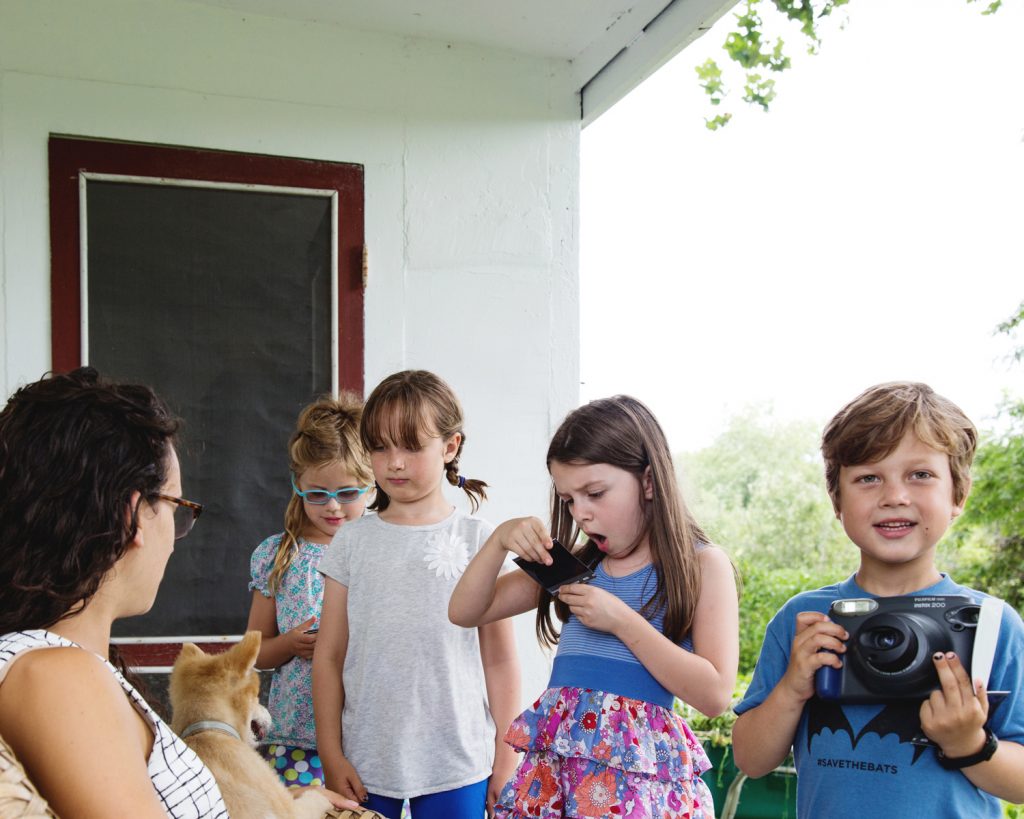
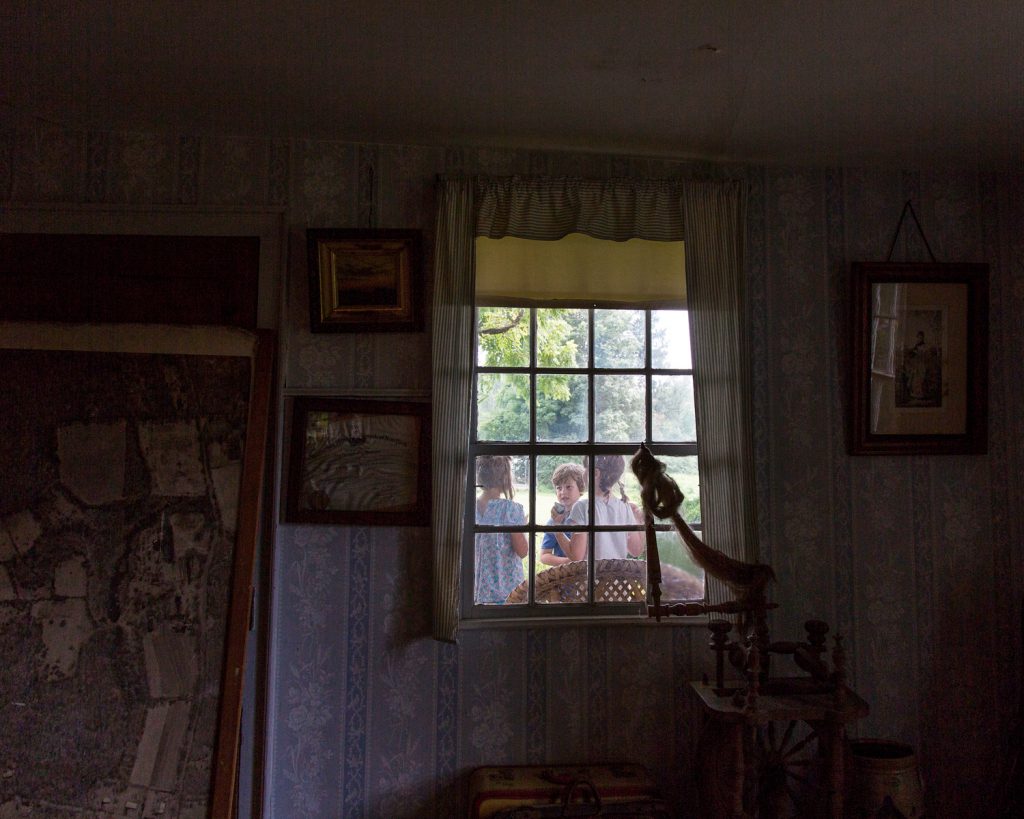
Very few writers’ retreats or artist residencies consider working mothers or single parents when it comes to programming. Enter Emily Simoness, co-founder and executive director of SPACE on Ryder Farm, who identified the issue and got to work. She created a first-of-its-kind family retreat, developed in conjunction with The Lilly Awards, aimed at supporting working parents and their children by providing a space for the artists to create, while also providing a creative and nature-focused program for the artists’ children.
 

We visited the farm during the week-long Family Residency program and sat down with Emily to learn about the development of the program. We also sat down with two of this year’s participating artists, Georgia Stitt and Deepa Purohit, to learn more about this unique and vital program.


SPACE on Ryder Farm Family Residency
 

Gina Rattan: How did the family residency come about?
 

Emily Simoness: In 2014, there was a playwright and a designer who asked if they could bring their kids. Christine Jones, the designer, was curious if she could bring her two boys up with their sitter, and then Sarah Gancher was curious if her son could come up and we made allowances in both instances because it just felt like we should try to make that work.
 

GR: How did the Lillys get involved?
 

ES: I somehow got wind that the Lillys were super interested in an initiative like this, so we connected and one of the great benefits of SPACE is that we’re still young and nimble. SPACE is not super bureaucratic or institutionalized. We’re able to pivot in a shorter time than an institution that plans two years in advance. As long as the insurance is good, and we are able to fund the program, we’re able to execute. So I said let’s do it this summer. That was last year, 2015, and we invited six women and their kids and it was good and productive. The kids had programming with Megan Cramer, who’s a really extraordinary educator and if it wasn’t for her I don’t think I would have felt comfortable doing this because I want to make sure the kids have great experiences. The kids had their special time and programming, the parents had time to work on their craft and we all came together for the three meals, and it was a total win. So we opened it up for applications this year.
 

GR: So it was a test run last summer where you knew the people and could see how it went?
 

ES: Exactly. I was overwhelmed with the amount of applications, and the level of applications this year. It was articulated in a lot of these applications that I haven’t applied for an opportunity like this in a year or four years or seven years because I didn’t feel invited, or I didn’t feel like I could bring my kid, or I have to choose between my child and my work…all the different reasons that we make the choices that we make.
 

GR: Were they mostly female applicants?
 

ES: 99% Female. I felt like I was reading these years of deferred applications, one after the other. It was really hard to pick. We’re contemplating next year doing two weeks just because the need is so strong. It’s also nice in that when there are kids in residence you get up earlier, you have dinner earlier, you go to bed earlier. Everything’s more civilized. It’s not debaucherous. We were leaving dinner yesterday and I was taking a couple of the staff to Trader Joe’s to get food or something and it’s still light outside. It’s nice. And it’s so clear that the demand is high, it’s so obvious that this should be a thing.
 

GR: Is it more costly for you because you have to put together programming for the kids?
 

ES: Yeah.
 

GR: So you have to hire more staff.
 

ES: There are more people here. Because typically we don’t double-up in rooms – there are double beds in rooms but we don’t double the occupancy in a lot of them, but with the kids we do. So it’s just a bigger number of people, the childcare is really significant.
 

GR: So who comes to do that?
 

ES: The child care?
 

GR: Yeah.
 

ES: Megan Cramer was at the 52nd Street Project forever. She now works at a school in Atlanta. She’s this amazing educator. Then there are individuals that work with her, Michael Calciano, who was a former SPACE intern, he’s an actor and he works a lot with kids, and then there’s Lindsay Torrey who’s been at the 52nd Street Project who also is an actor and works a lot with kids. They’re the same team that did it last year, so it’s been really nice to have them back.
 

GR: So it’s an arts camp?
 

ES: Yeah. Art and farm camp. At 4pm, Alan Ryder, who is my cousin and has the eight sheep on the farm, is going to come and show the kids the sheep. Which is adorable.
 

GR: They’re gonna love that. They were running after them earlier.


SPACE on Ryder Farm Family Residency
 

Michelle Tse: You’re a board member of The Lilly Awards, where the idea for this program came about and was developed with Emily and SPACE. I know Julia Jordan was up here last year testing this out. Tell me more.
 

Georgia Stitt: Julia and Pia [Scala-Zankel] came up last year for the pilot program of this retreat. The idea for this whole thing was born at a Lilly board meeting. We were sitting around talking about the challenges of mid-career women writers and we all identified with the same problems. All of us in our 30s and 40s with kids confessed we had not applied to writers’ retreats for a decade. There comes a point where the thought of leaving your kids for a week or two or three to go work on your art feels, in a way, self-indulgent, and it’s more than your family can handle. So we all stopped applying because it didn’t seem practical to go.
 

MT: Unless it somehow fits in perfectly with a school break.
 

GS: Certainly during the school year it’s hard, and then during the summer – I mean, I’ve certainly done it before, where I leave my husband in charge of the kids, but we wind up paying so much in babysitters and hiring other people to fill the second parent role – it’s just this hardship that the whole family absorbs.
 

MT: And perhaps dads don’t get as much flack for it.
 

GS: Culturally, it’s less of an issue for dads. I’m not saying there aren’t stay-at-home dads who don’t feel all the same challenges, but culturally, nobody blinks when a dad goes away for a week to work on something. When the mom goes away, the question is always, Where are your kids? Who’s taking care of your kids? My husband doesn’t get asked that.
 

MT: Right. So this idea was born…
 

GS: So at this board meeting, we were talking about how many of us had not applied to retreats in a long time. There’s that idea in the corporate world that men make deals on the golf course and women usually aren’t invited to participate. I think it’s changing in some ways and not changing in other ways. But this, the writers’ retreat, is our industry’s golf course, in a way – you meet other writers, you form collaborations, you have this structured but unlimited time to produce your work.
 

MT: And a welcomed break from the city.
 

GS: I think all of us in that room said, it’d be different if we could bring our kids with us, but that just seemed so unrealistic. So Marsha [Norman], Julia, and Pia, and the whole team just started running with… well, why is it unrealistic?
 

MT: Little did you all know, it was very realistic.
 

GS: Some of the first family-friendly ideas we had were more about taking a pre-existing place like Williamstown or Sundance, partner with a day camp in the area, and perhaps we could provide funding for it. For example, if you go to Williamstown, you could send your kids to the day camp right next door. Out of that idea sprang this idea. Emily stepped up and said, let’s try it!
 

MT: It’s always such a blessing to have that one person believe in trying.
 

GS: Julia said [during the pilot program last summer] that everyone had been productive and the kids had a good time, and it was everything it was supposed to be. So we did it again. This is the first year we had open submissions from the writing community at large.
 

MT: So you applied through that open submission process?
 

GS: Yes. I’m here as both an artist and as a representative of the Lillys to keep an eye on the retreat to see how it’s going. But in the future, our hope is that no one from the Lillys has to come, that it’s for other artists.
 

SPACE on Ryder Farm Family Residency
 

MT: What are you working on this week?
 

GS: I have two projects that I’m trying to get progress made here. I’m working on The Snow Child for Arena Stage, which is mostly done but I’m doing a lot of editing and shaping work on it. Next week, I’m going to Rhinebeck Writers Retreat with Hunter Foster. He and I are working on a brand new show, so I’m trying to generate some content for that while I’m here.
 

MT: Has it been a productive week so far?
 

GS: For me, I’ve been very productive. I came up with a huge to-do list of tasks – compositional and organizational – that I need to get done, and I’m just knocking through them. I hear the kids running around – they’ve been at the lake, they have their grilled cheese sandwiches and their apple slices for snacks…
 

MT: …and they’re having a dress-up class right now!
 

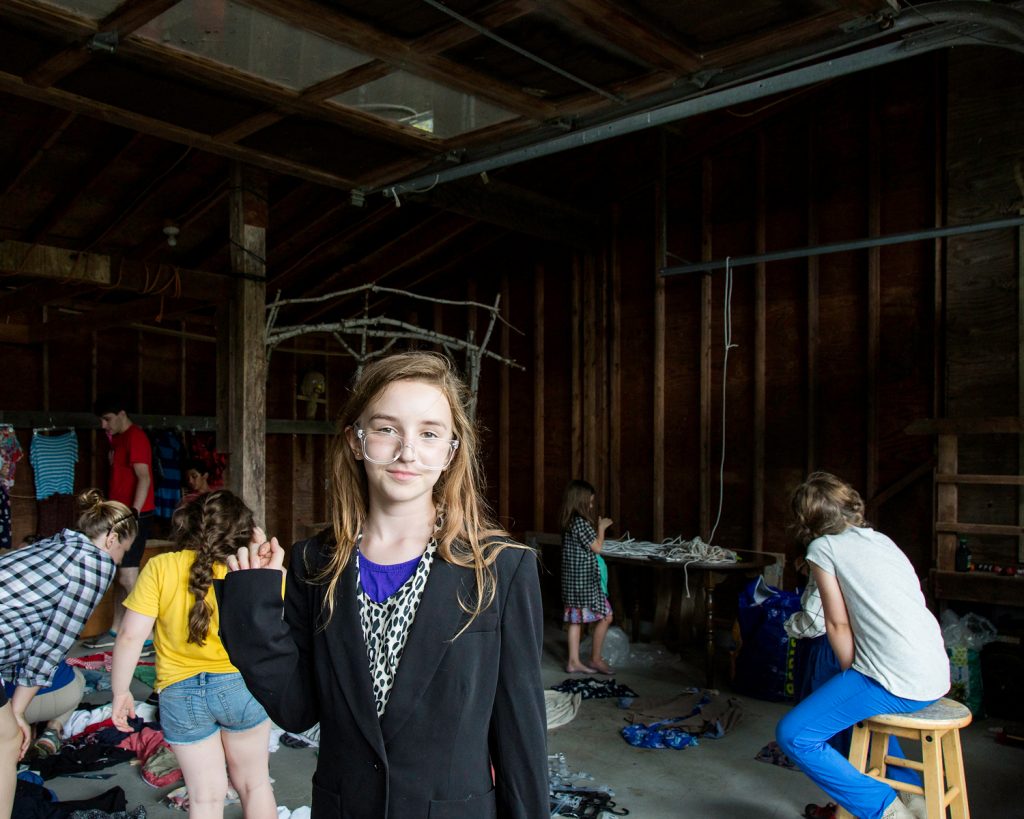
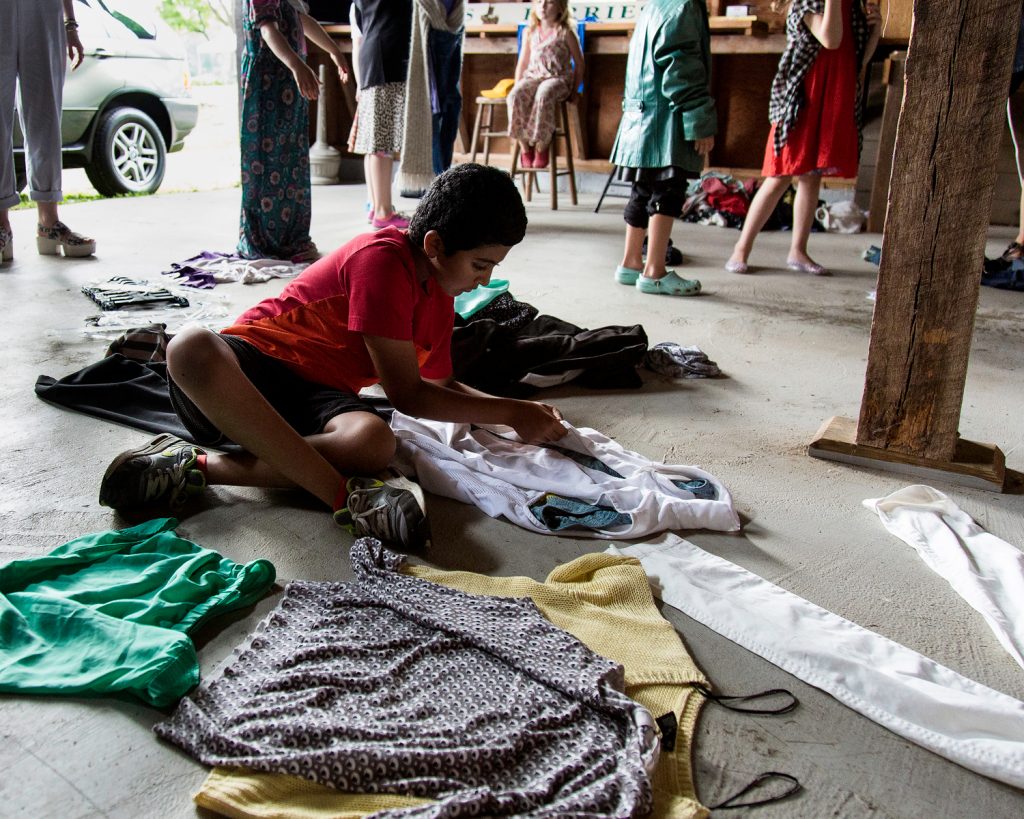
GS: Yeah! There are all sorts of projects. The dress-up party is part of Louisa [Thompson]’s project. She’s a set designer and she develops children’s theater. The dressing-up has to do with helping kids identify when clothes become costumes, when they’re not just clothes, and when they’re a part of a character. She brought in a lot of costumes and is helping them build and imagine characters.
 

MT: We peeked in earlier. The kids are having a ball. It’s like summer camp except mom is an earshot away.
 

GS: Yeah. Earlier today, we finished lunch, and my youngest was on the hammock and she hurt her finger. She’s six years old, so she came to me crying. I said, come sit with me on the bed and we snuggled for ten minutes, and then she went on her way. Those are the things you miss when you’re not around. Somebody else would’ve comforted her, and she would’ve been fine, but being able to be her mother shouldn’t have to stop just because I’m working.
 

MT: That’s fantastic.
 

GS: I’m also less worried about my kids than I would be if I’d left them in the city. Everything for them stops at 6pm here. We have dinner at six, then if the adults still have the energy, they can return to work at nine or so. I guess that break wouldn’t happen if the kids weren’t here…
 

MT: But that’s the trade off, and your kids are here!
 

GS: Right.
 

MT: Wait, hold on – 6pm dinner?
 

GS: Well, I was here at Ryder Farm once before, and it was a very grown up experience. Meals were all later – that was an adjustment we made yesterday. Dinner on the first night was at seven and all the moms were like, umm…this is going to be hard.
 

MT: So they made it earlier.
 

GS: Yeah. All the meals are about half an hour or even an hour earlier than Ryder Farm usually does them. Breakfast here is usually at 9, and we’ve been doing it at 8, 8:30. Dinner is usually at 7 and we’ve been doing it at 6, because the kids are hungry and they don’t want to wait!
 

MT: And I’m sure the menu is different.
 

GS: Yes, yesterday we had a beautiful garden salad and stuffed baked potatoes, and the kids were like [mimics their blank stare]. So today they did grilled cheese and potato chips.
 

MT: Everyone likes grilled cheese and chips. And it’s so nice to be out of the city.
 

GS: Yeah, I don’t think the kids realize what a treat this is. They’re having a great time, but I don’t think they realize what a big deal this is. They are city kids out of the city, though. They’re scared of the crickets.
 

MT: Of course.
 

GS: They were like, “Mom, I can’t sleep! There’s a bug! I can hear it!” I said, “Yes, it’s outside.” There was one bug that was closer so they could hear the buzzing by their window even though it was outside.
 

MT: But they seem to be loving it here. They’ve got so many activities planned.
 

GS: Yeah, they’ve planned great things for them. Some of it is creative work, where the kids can create characters, write a play or songs, write a poem – some sort of creative element. This is in addition to things like swimming, and harvesting from the garden what we’re going to eat for dinner.
 

MT: That’s amazing. I’m jealous.
 

GS: Today, when they were out at the lake, they collected snails in a pail… I imagine they’ll return them. My kid said they saw flying fish. They’re kind of having guided nature time, which is good.
 

MT: Getting down and dirty with nature.
 

GS: Last night they took their baths and they’re just filthy. Filthy with farm, not filthy with New York City.
 

MT: Clean dirt. Not city dirt.
 

GS: Yes, it’s just dirt. Not smog and pollution.
 

[Georgia’s daughter walks in with one of her teachers.]
 

GS: Come sit.
 

MT: Honey, did you name your characters?
 

S. Brown: Yep. One’s Magnificent and one’s Maleficent. They’re sisters. I mean twins.
 

GS: And one’s good, one’s bad?
 

SB: Nope.
 

[Everyone laughs.]
 

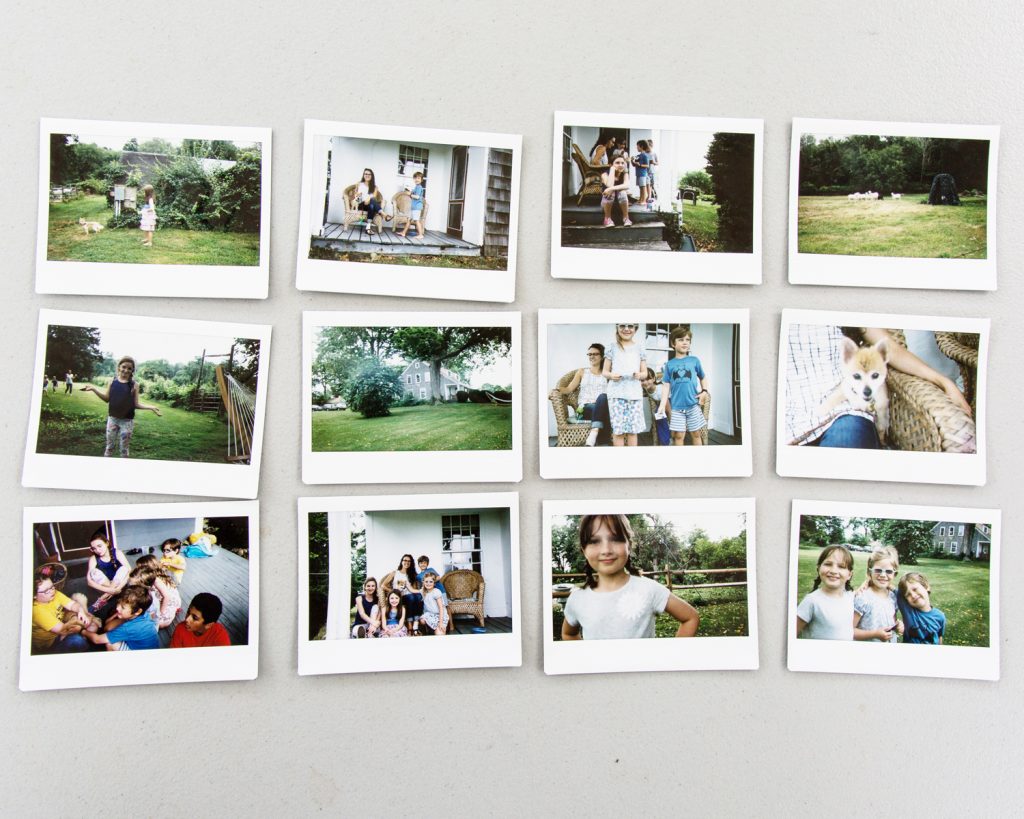
MT: By the way, you’re a really good photographer.
 

GS: She loves taking pictures.
 

MT: I left the camera in there for you if you want to take more pictures.
 

SB: I know. I’m going to go check out the puppy.


SPACE on Ryder Farm Family Residency
 

Michelle Tse: How did you hear about SPACE?
 

Deepa Purohit: I applied last year, when a friend of mine told me about it. I’m coming back here for a week on my own in September and she’s coming too. Her name is Monet Hurst-Mendoza. She’s also a writer and we actually were in the theater company I started together. We’re pretty close colleagues and she had mentioned it and so I looked it up and thought, this looks kind of cool.
 

MT: Was it the working farm program?
 

DP: I applied to the working farm but when I was applying I was like, Can I really be away for five weeks? It wasn’t a problem because I didn’t get into it, but they offered me a week residency, which I said yes to. I had never been on an actual retreat before, so that was my first writers’ retreat ever, and that was last July.
 

MT: Did it change your habits of working since it was your first retreat?
 

DP: It was great because I have never had the time to sit every day and have a routine for writing, so there were actually a few things routine-wise that I actually kept from that time. I mean, clearly I’m not able to write for eight hours a day because I work a couple other jobs to help pay the bills, but key routines have increased the amount of time I’m writing and my efficiency.
 

MT: That’s awesome. How did you hear about the Family Residency program?
 

DP: My husband was in this play Dry Powder that Sarah Burgess wrote here and these guys had a fundraiser. They asked him to join Sarah at the fundraiser for SPACE and asked if we would both come. Emily asked if I wanted to apply for the Family Residency and I said I was thinking about it. I applied and got in. I was considering it, initially, before she asked me, but I just wasn’t sure what my son’s schedule was going to be and when his camps were going to run. But that prompt pushed me to apply. The more I thought about it…I haven’t sent my son to sleepaway camp. I’m not that interested in being apart from him, so this is great. It’s a great opportunity.
 

MT: And the kids have their own schedule and their own classes.
 

DP: Yeah exactly, and it’s nice because I’m not the kind of mom that needs to be in all day activities. I like spending time with him, I like having our evenings and our meals, but I like him doing his thing.
 

SPACE on Ryder Farm Family Residency
 

MT: What are you working on this week?
 

DP: I’m working on a piece that I worked on last year here. It’s a very personal piece in that…I met a woman ten years ago who turned eighty this year. She’s a good friend of mine, and even a better friend now after going through this process, and she’s a Sri Lankan woman who left Sri Lanka in the 1950s, when she was about eighteen. She moved to London and hopped into the jazz scene. She was a really talented singer and piano player, and she kind of, in some ways, fell into and in some ways found her way into jazz, because her father was very passionate about jazz.
 

MT: I already want to see this story. What’s her name?
 

DP: Yolande Bavan. She comes from a very specific community in Sri Lanka called the Burgher community, and they’re a very mixed race group of people – they’re a mix of Tamils and Sinhalese and Dutch and Portuguese, but there’s a very European feel to their culture. When the British were there, the Burghers were actually highly educated, they were sort of that class of people that ran a lot of different sectors. Suddenly the British left and the Sinhalese took over and a lot of them left. They moved and migrated because a lot of them were worried about their status in the country so they moved to Australia and England. Some stayed, but she ended up leaving around that time because her father said, you should go to England; there’s nothing here for you here, really.
 

MT: Wow.
 

DP: She went to England in 1954 and she just found her way into the jazz scene. She had been listening to jazz music a lot in Sri Lanka – she would tell these stories about her dad who would get these guys, these Americans, who would come to the docks in Colombo and they’d have all these jazz records. He’d go down to the docks and trade jazz records. He introduced her to Duke Ellington and all the people who were not doing Dixieland because at that time, Dixieland was really big. They were moving into bebop and stuff like Count Basie, that were really going into this complex jazz stuff so she got really into that.
 

MT: So she found her art and stuck with it.
 

DP: She started acting in theater and TV and then she was, in her eyes, plucked. She ended up having this range and this ability to hear music and mimic it right away, is the short story of her coming to the States.
 

MT: Why tell her story?
 

DP: Her story is really interesting and the reason I’m drawn to it is because, number one, when she was doing readings and things for me, she was in her 70s playing all the mom roles in my plays. She started to tell me about her life and I was like, who’s going to tell her story? She’s been around some really famous people – she was a protege of Billie Holiday’s, she knew Sarah Vaughan and Joe Williams, these big people – and in the jazz circles some people know her name but beyond that not really, and in the Sri Lankan world, definitely, she’s gone back and given concerts and things and I thought, I’m going to tell her story. But it’s not going to be a bio-play, it’s gonna be something cooler.
 

MT: Of course.
 

DP: So the last three years I’ve been doing interviews with her, taping them, transcribing them, writing drafts of the play, and really trying to find: what is the play? What is the story? Last summer when I was here, I was in a real block, and a friend who was here, who I met here at the farm, is an Australian playwright – she’s actually based in London now – she said, “You know what, it really sounds like you need to get Yolande, you, and the play in a room and do this exercise and just write, see what they all say to each other.” I thought, I’ll try whatever, I’m so blocked with this. I had so much material and I didn’t know what to do with it. I got them in the room and I wrote crazy amounts of material and created a play that was about creating this play and our relationship.
 

MT: How has the piece progressed?
 

DP: I did a reading of it in the fall of last year, and she was in it, because the whole thing was that I want her to be in what I’m writing. It was a very bizarre, meta-experience because a lot of it is about our tussles and differences around it and what we wanted this thing to be. A lot of the writing came from conversations out of which tension came, and both of us are non-confrontational, so there were very interesting dynamics. She did the reading full-heartedly and was amazing in it. It was a first-draft play and had a lot of flaws and I was ready to rewrite, and in the meantime, one of my friends said, “You need to take a break from the play and then go back to it.” And I thought, no, I can’t, she’s turning eighty. I need her to be in this play.
 

MT: I get that though, sometimes you need a mental break.
 

DP: I did take a break. I wrote another piece and came back to this, this summer. And as I came back to it, I realized, oh my god I’m in another block. I was having a lot of conversations with her and she was asking, what’s this play going to be? And I was not giving her the answer because I didn’t know. She had very much been saying she wanted to do a play with songs about her life, people tell me I should write a book. And I’m not going to be that person. Even though I have all the material, I don’t want to write that book. So there was a lot of that dynamic going on, and I thought, I can’t do this. I’m just going to write what she wants.
 

So I’m writing a cabaret of songs and her telling her story, directly addressing the audience, which is something I never wanted to do – totally traditional, whatever. I started doing that this summer through a class I was taking, and every time I walked into the class I would be like [sighs]. I was stuck again. So I thought, let’s trying having this conversation again. I brought a scene into class that was me and her having conversation, and everybody was like, whoa, that is really interesting. So now I’m back in that place, but I think I’m taking everything that I learned with me over the last three years.
 

MT: So the piece is taking on a new form.
 

DP: I kind of don’t trust myself at this point, because I’ve felt like this four times, but I think this is part of the process to write a play about a person you’re close to, who’s alive, who you’re interacting with all the time – we’re kind of codependent. She’s a bull and she’s been through a ton in her life and that is the honor that I want to bestow on the stage, not only the flaws between us.
 

MT: How has your personal relationship informed and shifted the piece?
 

DP: There are two things that happened. She took a fall about four years ago, onstage. It was a plebeian kind of fall where she missed her mark onstage and she fell backwards and missed a chair. So she went on with the show and the rest of the run but what happened in that fall was that she had crushed her entire coccyx and so she was in excruciating pain and then had to have a nine-hour surgery to reassemble her back. So for the last four years she’s been in recovery for that and she’s a woman that’s a mover and a shaker. She’s tiny, she’s always on the move – her life has always been on the move. She’s crossed oceans, and I think I realized for the first time this last summer was, oh that’s what these few years have been about, being still.
 

Around the time she took that fall, my father passed away. He had been sick for a couple of years. I think we met at a time where we were both facing mortality in a different way. The other piece is that I’m officially realizing I’m in middle-age. That’s also about looking on the horizon thinking I’m not thirty-something and I have forever to do something, and what does that mean for me as an artist when I’ve spent the last fifteen years struggling to even define myself as an artist? I was an actor and I still do act. I wonder if I’ll act again. I write – I’m really just emerging as a writer in middle age – not really having done a lot of writing that prior to it…so there are a lot of issues around mortality for both of us that are really different. So I do imagine this piece like we’re looking in the mirror, but the mirror is open and we’re looking really at each other.
 

MT: And it must be interesting to explore mortality in a place that is as old as this. The farm and its structures are older than the town, but everywhere you look, new life is growing around you.
 

DP: Yeah, this house is interesting. There’s all these artifacts from all these different times. I don’t necessarily want to walk through this house because I don’t relate to it culturally, because there are all these pictures, of white people, and there’s this feeling of it being an American place, and I don’t have a legacy in that way in the United States.
 

MT: As an immigrant, I get that.
 

DP: If I were to walk into a stone house that was only cooled by the fact that it’s stone, and it’s concrete and people are lying their mats on the floor or they have beds or whatever, that seems more a part of my past and time. Where Yolande is interesting because she’s got so much European culture in her blood, this house would actually be quite evocative for her, even though she’s coming from a South Asian country. A lot of her life has been as an outsider, even within her own country in so many different ways. As a woman…what woman in the 1950s was leaving her country, not getting married, and going to sing jazz?
 

MT: Unheard of, especially in Asia.
 

DP: All these women who were in school with her were getting married, cooking curries and having kids, and that wasn’t her. So there’s a real trailblazer aspect to her and her story and I stand on her shoulders. So many of us do. And there are lots of people like her but this story is unheard.
 

In the Asian community, there are so many people whose shoulders we stand on but we don’t even know unless we really ask. And I would say, for me, I’ve taken it for granted, but every time I look at the material or go back to listen to her interviews…she’s like a regular person to me and we have a regular relationship that’s fraught with love and annoyances or whatever but then I’ll listen to these things and I’ll just be like…holy shit. This woman is on her own, just trailblazing, even now at the age of 80.

Posted on

Writing While Asian

Timothy Huang


“Dear Mr. Huang,” the email usually reads. “I was recently at your show at [insert venue here] and really enjoyed your work. I was wondering if we could have a meeting. I’m a [lyricist/librettist] in need of a composer and I’m working on a show that I think is right up your alley…” My eyes roll. This email/facebook message/tweet always seems to find its way to me – no matter where I run, no matter what disguise I’m wearing, or what wooden barrel I’m hiding in. And it is always awkward.
 

With the exception of one single time (hey, Marlo), what happens next is always the same: I take the meeting, the person has little if any idea what is actually “up my alley,” and instead is actually just a Caucasian person who wants to write about China but feels the need for some kind of political cover. And it breaks my heart. For so many reasons, none of which are what you probably think.
 

I’ve written about this before, but in order to really appreciate the cognitive dissonance, let’s talk about a few givens:
 

1. We live in a time where plays and musicals that aren’t about race can and should be cast color-consciously – aware and reflective of the diversity of contemporary audiences. This is a step forward.
2. We also live in a time where the playing field is still uneven. Characters within produced shows still largely reflect a heteronormative, Caucasian, male perspective. (This isn’t a bad thing, per se; it points to a deeper institutional exclusivity that’s a different discussion altogether – see below about the tail-eating snake.)
3. Because of this, when shows are written specifically for characters of color (or for that matter, of any diversity), we should always make our best efforts to cast them “traditionally” diversely.
 

So why is it, you ask, that if we adhere to this type of awareness in the casting of the show we should be blind in the creating of it? Isn’t the telling of a story as much about the author as the subject? I for one have seen countless shows about Asians written by non-Asians that were at best ill-considered, at worst offensive. Why shouldn’t all shows about Chinese things be written by someone who was culturally Chinese?
 

The short answer is, “Because if I want to write about #BlackLivesMatter, I shouldn’t have to be Black to write about it.” Nobody has the corner market on telling stories about other people or cultures. Period. What we do have (and this is part of the longer answer, so pay attention), is a responsibility to represent those other people and cultures as if they were our own – with the highest of standards and greatest integrity, with twice as much research and twice as much oversight.
 

During the writing of my full length Peter and the Wall, (which involves an American man who must travel to Japan to locate and identify the body of his deceased husband) it wasn’t just researching Gay culture in Japan, or government procedure for transporting a dead American citizen, though it was that as well. It was enlisting the help of three different Japanese and Japanese-American translators to get confirmation of pronunciation, and then scansion (some words “sing” differently than they “speak.” And sometimes my very American ideas “did not exist in Japanese thought.”) Then, when we got into workshop, it was things like “‘a concierge would never be this impolite’ vs. ‘But I need her to be the bad guy in this scene so he can be the good guy. How do I achieve that?’” It was, in short, a monumental pain in the ass. And it cost me many beers and favors. But each time, it was me with an idea and context, and frequently a finished execution being asked to modify. It was never “You do it. Whatever you do is okay because your last name is Matsui.” And it certainly wasn’t “I’ll just hire a Japanese director.” (Though if you’re out there and interested, give me a call.)
 

And here’s where the heartbreak comes. More often than not the shows I’ve been asked to co-write were born from a desire to exoticize, or otherwise re-appropriate Chinese culture and not, say, add a meaningful or deeper understanding therein. At the ground floor, if there isn’t a dramatic need for you to set a show “in an exotic locale” you’re fetishizing. If writing as an outsider is research and oversight, then hiring an insider is circumventing the former with the latter. These were never my stories to tell, yet embedded within the offers to co-write them was a tacit expectation that not only would I do the homework, but I would in part be the homework.
 

Now, let’s not talk about how the color of my skin doesn’t qualify me to write for the Erhu or Pipa any more than it qualifies me to write you a doctor’s note. My ethnicity is not a permission slip. The writers I have encountered were either unaware of their own responsibility, or just lazy. No middle ground. Either way, the eyes roll, the heart breaks.
 

But the good news is this isn’t where the story ends; it’s where it begins. Firstly, these invitations always come from decent if misguided intentions and any time there’s curiosity, there’s also room for recognition. I have a list of questions I always ask writers in this situation about why this story, why you, why me. Even if I know I want to decline the invitation, I take the opportunity to share the questions. Curiosity begets recognition begets responsibility. Secondly, that same curiosity manifests in general audiences as a desire to see what my former grad school professor and good friend Robert Lee, calls the “Third Generation [Asian-American] Show” to enter the conversation. These are shows where the ethnicity or self-identity of a character, while deliberate, takes a back seat to larger thematic ideas within the narrative: A Chinese-American protagonist, for example, whose journey is not about struggling to understand her first generation parents, but instead, must come to terms with her best friend who is in love with her. In this story, she is allowed to be Chinese American because such things exist.
 

And such things do. Just off the top of my head I can count fifteen plays and musicals that follow the Third Generation Rule (twelve if I’m not including my own work). These types of shows have existed for years. And while they have been produced on smaller scales, off-radar, their emergence into the mainstream is helping to dismantle snake that eats its own tail mentality: no one will produce stories like this because they don’t resonate with audiences, because no one will produce stories like this…. lather, rinse, repeat. Imagine then, what a difficult and monochromatic world it would be if the advent of these kinds of stories were coupled with the expectation that they be written only by people who had first-hand knowledge of that experience. The skin may be different, but it’s still the same snake eating the same tail.
 

Like the lyric says: Art isn’t easy. But it isn’t meant to be, and we won’t always get it right. My list of questions changes frequently because nuance is hard. But as excruciating as these conversations can be, they are always necessary for quality work. They may not yield bars of music, or fancy lyrics, but they are the telltale signs of marginalized stories coming into the mainstream. And that is not a bad thing at all. Curiosity begets recognition, begets responsibility.


 Timothy HuangTimothy Huang is a New York based writer of new musical theater. His full length musical Costs of Living was the recipient of the 2015 New American Musical Award, and the 2015 Richard Rodgers Award. Other works include Peter and the Wall (2013 Rhinebeck Retreat), And the Earth Moved, (CAP21) Death and Lucky (MacDowell Fellowship), the song cycle LINES (NYMF), A Relative Relationship (Winner, Best Musical, 2013 SoundBites Festival) and Missing Karma (2016 Samuel French OOB Short Play Festival). He is the creator of the one person musical The View From Here (cast album available wherever digital music is sold) and was a 2012 Dramatists Guild Fellow. He is also the recipient of the 2013 Jerry Harrington Award, a Fred Ebb Award Finalist and a two time Jonathan Larson Grant finalist. His song Everything I Do, You Do (with co-lyricist Sara Wordsworth) was recorded by Sutton Foster for the charity album Over the Moon: The Broadway Lullaby Project. To see a website made before the advent of smart phones, please visit www.TimothyHuang.net

Posted on

What’s That You Hear?

Brian Quijada


We asked Brian Quijada to tell us about the technology he uses during his one man show, Where Did We Sit On The Bus?, now playing at Ensemble Studio Theatre. Read our conversation with Brian here.


Brian Quijada
 

1.   There’s two harmonicas and a MPK mini, which is how I finger drum and how I play piano in the show.
 

2.   This is an electric ukelele. A lot of people are like, “that’s a weird looking small guitar.” It isn’t.
 

3.   I have an iPod touch that works as a remote control to operate my iPad when I’m not near it, via bluetooth.
 

4.   I have eight applications running at once [on my iPad] – everywhere from a voice modulator to the app that programs things, to the actual looping application, called Loopy HD. It is $8 and the most incredible $8 I’ve ever spent in my life.
 

5.   It’s all hooked up into the house through this Apogee Duet. This is the thing that’s kind of like the brain right here. It’s what everything plugs into, including the iPad, which is the other brain that actually controls all the applications running.


Where Did We Sit On The Bus? is now playing at Ensemble Studio Theatre through October 9th. Tickets can be purchased at ensemblestudiotheatre.org.

Posted on

Making Depression Sing: The Cast of We Have Apples on Mental Health

We Have Apples


Do you have apples? In America, over 50 million people do and Rachel Griffin’s new musical is giving voice, and music, to their suffering. The fruit in question in We Have Apples represents mental health, and recent estimates suggest that nearly 1 in 5 people have some form of mental illness. Those statistics beg the question…why aren’t we doing anything to remedy inadequate, cold, and confusing maze that they have to navigate to receive any kind of care? Enter We Have Apples. The musical centers around Jane, who suffers from anxiety and depression, as she enters a psych ward, and finds herself surrounded by people who also have apples, all different, destructive, and beautiful, like hers.
 

We were given the opportunity to sit in on a rehearsal the week before their concert, which premieres tonight at 54 Below, and talk to creator Rachel Griffin and the cast about their message, their experiences, and their goals; to help audiences empathize and learn about one of the most misunderstood issues in our country with authenticity, humor, and boundless imagination.


We Have Apples
 

Kelly Wallace: You’ve had a lot of experience as a songwriter before, but this is your first musical. Why did you want to use this medium for this story?
 

Rachel Griffin: Theater gives me the ability to share a story about mental illness that starts with debilitation and suffering and ends with triumph and recovery. I think we need more stories that show that a mental health diagnosis does not mean you are doomed. I wanted to show a bunch of characters that have mental illness but are not defined by it. They are a professor, a med student, a creative writer, a musician, etc. By the end of the show, you want to be friends with them. You respect them and admire their strength. You also see how stigma and crappy healthcare affect them. Hopefully their stories will foster action and compassion!  
I didn’t think about writing theater until I met my husband, who is the associate music director of Aladdin and a musical theater composer. All the shows we saw together and his projects got me really excited about the power storytelling and theater. I noticed how theater can reach people and awaken something in them that might fail to awaken through other methods. Without being preachy, you can preach! 
I really care about mental healthcare reform and de-stigmatizing mental illness. I’m not going to run for office or work in healthcare, but I can use creativity and music to help. I started writing this show on my iPhone and I was writing it out of frustration with my own mental healthcare experiences and the stigma I faced and saw others face. I was afraid to let the show out of my iPhone because I knew if I shared it then people would probably figure I had a mental health condition. Then it dawned on me that stigma was stopping me from sharing it. Stigma is powerful. I realized if what I was writing could help people, it was worth being vulnerable. I think writing about what we fear can lead to our best writing. I still resist it, but I want to be brave. We have this one life, I think it’s important to remember that and be bold and as fearless as possible with our writing. It still scares me, though!
 

KW: As you said, it is so personal. Did you find the editing and cutting process was hard for you because of how close to home the story is?
 

RG: Yeah! Once in awhile someone says, “You know, I don’t think this part is realistic,” and it’s literally something that I’ve experienced in real life with the mental health care system. It’s so bad that people don’t believe it as fiction. That’s crazy! As some of my mentors have recommended, like Larry O’Keefe and Michael Korie, sometimes I make a change someone suggests, but I make it in a way that makes sense to me but might not be exactly what they thought was right. I love that theater is collaborative. I love when an actor will email me and say, you know, I don’t think my character would say exactly that, what do you think about this? Just to take that in and be like, you know, let me think about that. It’s been incredible, because composing can be kind of lonely. So with theater, you have this community. I feel extremely blessed to have the people we do involved with this show because they bring so much. One mind alone is so much less powerful than a bunch of different perspectives.
 

KW: When did you decide to have Depression be a physical presence onstage as a person?
 

RG: It wasn’t in the first draft. The show is based on a short story I wrote in undergrad about a girl in therapy. In the short story her thoughts were shouted in capitals. We all have that voice in our head, whether we have depression or not, that says you’re not good enough. We all have that fight or flight reflex that we don’t need going off all the time anymore, because a lion isn’t going to jump out at us. I don’t think we talk about that voice too much, I don’t think we talk about those weird or scary thoughts. I thought it would be cool to have a character who was saying those things so the audience can realize that other people have those thoughts, too. I played with the idea of having an offstage voice say it and then moved to having a character. I like that the character, at first was one-sided and was just the darkness, and then I was like, I couldn’t write this show if I didn’t have the imagination I have. Having such a vivid imagination can look like anxiety, racing thoughts.. but it also can look like creativity and music and empathy.. so depression and anxiety and mental illness have beauty in them, and that’s something I’ve always wanted to show. A lot of media show only the bad stuff, which we need and we need to see the struggle that is a reality for many, but we also need the beauty, the hope, the brilliance. So, I thought, maybe I could also make this character be the source of imagination and have that there too. It’s been cool too, because a lot of people’s favorite character in the piece is Depression and I’m like, oh, I thought everybody would hate her! She’s the antagonist. And I’ve had people come up after presentations and say, “I just love Depression!” And I’m like…”Okay!” That’s… great!
 

KW: What do you hope that audiences take from the show? When someone comes to see this, what do you want them to leave with?
 

RG: I want them to see that people with mental health conditions are their doctors, their friends, their teachers, people they admire. I want people to realize mental healthcare is inadequate and inaccessible and that causes suicide. I want people to see how isolating it is to have people respond with silence and shame to an illness. When a friend of the family is in the hospital with a physical illness, people bring pies and cards. When they are there for a mental illness, people disappear.  
We can’t have all the shame and the silence, because it really does corrode the human spirit. People really lose lives because of it. We need to talk about it in the open so it evolves to not be so uncomfortable. Mental health should be taught in schools along with physical health in health class. I think many teenagers think their pain is permanent. They need to be aware of symptoms, treatments, and stories of hope.


We Have Apples
 

Kelly Wallace: Tell me about your character.
 

Hannah Elless: I play Jane and she is a young woman that is aspiring to go to college and all the normal things that a young woman aspires to. She’s a writer, she’s creative, she really has a lot of great energy and yet she has this duality about her that she’s constantly coming to terms with. In the show, they call that character Depression, which is personified by Emily, who plays Depression. So it’s pretty interesting to have that, since the audience can see both of these characters having a conversation with each other, when in reality it’s Jane having a conversation in her mind and fighting, sometimes fighting and sometimes agreeing. That’s what’s lovely about the show. We’re looking at Depression not as an enemy but as sort of a friend in a way. Maybe a friend that doesn’t always help you make good choices, but we’re definitely looking at it as part of who Jane is inherently, and not something that she despises, but something she’s constantly trying to reconcile within herself.
 

KW: How has working on this piece changed or informed your views on mental illness?
 

HE: I just think it’s so important that we’re having a dialogue about mental health and putting it into a musical is so smart. What the writers have done to bring this to the surface of everybody’s minds is really commendable. I think my viewpoint has changed in a great way. Being able to work with this company, and explore who Jane is – I think the point is that as an actor you always want to play these great roles and the point of Jane is that she’s just a normal girl. That’s what surprised me the most, reading through her character and her songs and her singing. She wants all the things any girl wants. So there’s something different and lovely about her, but there’s also something so normal and relatable because she’s just a girl.
 

KW: Why do you think theater is such a powerful medium for telling this kind of story and to help change people’s minds and erase some of the stigmas associated with mental illness?
 

HE: I think it’s because when you sit through this show, you feel like you really know these people. After sitting through a concert or a full production of this hopefully someday, you really feel like you know Jane. You feel like you know Avery and Charlie and Alex and all these characters and by the end of the show they’re your neighbors, your brother, your sister, your mom, your dad…you start relating to these people and realize they’re people in your life. It makes it really safe to talk about mental illness in a way that’s funny and heartbreaking and completely serious sometimes. They hit all spectrums of the emotional journey. That’s what is great about this show too. They let you laugh and they let you cry and there’s no right or wrong, it’s just exploring who these people are and their specific journeys in life.


We Have Apples
 

Kelly Wallace: Tell me about your character.
 

Emily Nash:  I play Depression, who is the personification of Jane’s mental illness. It’s kind of larger than that; it also embodies her OCD, her anxiety, but also her creativity and her protection. So, it’s all of the good and bad aspects that come from mental illness. So, I’m the personification of all of that, and I appear as a person, but I’m really just a figment, not of her imagination, but of what’s going on in her mind. You’re seeing everything from the inside out, which I think is really cool. I love this role; I think it’s really great to get the chance to play this.
 

KW: How has working on this piece changed or informed your views on mental illness?
 

EN: I’ve always been passionate about the topic. I actually just lost my grandmother to depression a few weeks ago, so it feels especially powerful now to be working on this. I feel like I’m giving voice to her story in a way that…it feels great to have ownership of that story. I myself have struggled with anxiety my whole life, just generalized anxiety, which has at times manifested itself in depressive episodes. So, definitely not to the extent that Jane experiences it in the show, but I so relate. Singing a song about having a panic attack? That’s not something I have to get into someone else’s shoes and figure out what that feels like. I know what that feels like.
 

KW: Why do you think theater is such a powerful medium for telling this kind of story and to help change people’s minds and erase some of the stigmas associated with mental illness?
 

EN: It’s the best medium because we’re getting people in a room together talking about this. We’re not hiding behind a movie screen, this is live and in the flesh. People are going to respond in different ways, but I just really hope that people will grow to become more vocal about this and not stay silent, because it is something that plagues so many people.


We Have Apples
 

Kelly Wallace: Tell me about your character.
 

Meagan Hodson: I’m playing Charlie. Her illness has evolved with the character. I used to be Martha and she was older, so she’s evolved back into a twenty-something. She’s relatively new to the psych ward because she has just been turned down with all her cries for help and not getting what she needed, so she did something drastic and hurt herself to finally get admitted. And then, I think, a couple weeks passed by and the insurance company said, “Alright, you’re good, you’re fine, you’re free to go.” She’s not ready, and she’s terrified, and she ends her life. Which is hard, and it’s that one character. Unfortunately, it feels very necessary. It’s such a, not common, but it is an outcome that happens. It’s the reality of it. Not to make it a statement, but to make it realistic. That’s something they’re trying to combat, trying to get better, and sometimes it doesn’t work out.
 

KW: How has working on this piece changed or informed your views on mental illness?
 

MH: I think it really opened my eyes a little bit more to how much stigma there is. Because, I think growing up, we don’t have as much interaction with people, or if we do, it’s a little more quiet. There’s a separation. But I never realized there was a huge discriminatory element to it until I really thought about it. There’s not a lot of talk about it in the media. And more people are coming out and talking about it, which is such a big deal, but it shouldn’t be such a big deal. It should be common place.
 

KW: Why do you think theater is such a powerful medium for telling this kind of story and to help change people’s minds and erase some of the stigmas associated with mental illness?
 

MH: Well, I really love theater for social change, just because I think you can say things without it being so direct. It seems more of an artistic way to present it, but it still can be very real and start conversations. So you don’t feel like you’re being lectured the whole time; you’re immersing yourself into a story and a character and then you realize that really says something to you personally as well, or about someone you know. There’s that wall that helps to ease into that for other people.


We Have Apples
 

Kelly Wallace: Tell me about your character.
 

Andrew Kober: I play a character named Alex, he’s manic. He’s sort of the bright shining face of the psych ward. He’s excited about everything that happens there. He’s a source for positivity and ultimately for organization and his illness manifests itself in a way that can be a positive influence on the rest of the ward. Does that sound like an intelligent answer? I’m faking it.
 

KW: It does! How has working on this piece changed or informed your views on mental illness?
 

AK: Rarely do you see stories where people with different mental illnesses co-exist in this way. I mean, there’s really, at least in this kind of condensed version of it…yes, it’s about one character’s struggle, but it’s about all sorts of backgrounds coming together to support the storytelling. What it’s done for me more than anything, is to say that everyone has a story to tell. It’s a great reminder that there is absolutely no story that is not worth telling, exploring, delving into. There is absolutely something theatrical and beautiful to be mined in anyone’s experience and their journey.
 

KW: Why do you think theater is such a powerful medium for telling this kind of story and to help change people’s minds and erase some of the stigmas associated with mental illness?
 

AK: I’ll tell you why. For lack of a better way of putting it, you can’t leave. It’s there. It’s in front of you. It’s live, happening in front of your face. You can’t disconnect from it in the way that you can with some other art forms. Social constructs say you can’t check your phone in the middle of it, you can’t run to the bathroom in the middle of it. You’re there, and it’s happening to humans in front of your human eyes. I think that adds an immediacy and raises the stakes to the conversation.


We Have Apples
 

Kelly Wallace: Tell me about your character.
 

Tamika Lawrence: I play Avery, she’s one of the patients in the ward. She’s there because she’s been dealing with a lot of body issues and with bulimia.
 

KW: How has working on this piece changed or informed your views on mental illness?
 

TL: It hasn’t, actually, because I am pretty familiar with a little bit of it because I think living in the city and being around so many people who don’t have access to mental care in this country makes you aware. Doing research and also, you know, being here makes you invest in things like therapy, just to stay healthy and take care of yourself. But I’m very happy that she’s doing this piece to bring awareness to all of this, because a lot of people don’t have that experience.
 

KW: Why do you think theater is such a powerful medium for telling this kind of story and to help change people’s minds and erase some of the stigmas associated with mental illness?
 

TL: I think because theater is accessible; theater is enjoyable. For issues that might be hard, such as mental illness, or even politics, things that are hot button topics, I think theater helps to build the conversation on both sides. Whether you agree with what’s being presented or not, I think it helps to make it palatable.


We Have Apples
 

Kelly Wallace: Tell me about your character.
 

Brian Graziani: I play Jonah. Rachel just incorporated Jonah into the show recently, so I’ve had a lot of wiggle room to do whatever I want. I chose me – there’s not really a single difference between the two of us.
 

KW: How has working on this piece changed or informed your views on mental illness?
 

BG: You know, this is my fourth time doing the show in various stages. I realized doing it the first time that I suffer from a mental illness. It wasn’t until that first scene, seeing the way that depression is personified, it’s very jarring. It was very eye-opening in regards to some of the trials and tribulations I’ve been through myself and how I cope with them, especially those little voices we all hear. I went from there and was diagnosed with depression, so this changed my life.
 

KW: And why theater? Why is this such a powerful medium for changing people’s’ minds and getting them to really think about this issue?
 

BG: I think art in general, especially onscreen or onstage, is just a very passive way of communicating about social issues. It feels less preachy, because we’re invested in a story. We’re looking at a person, rather than a direct lecture on how we cope with an issue. It’s not a political statement, you think, but then subconsciously, hopefully, the piece teaches us something and gives us some shape of life and some taste of this heightened version of reality. I would like to think that’s what this piece and theater in general can do.


We Have Apples
 

Kelly Wallace: Tell me about your character.
 

Michael Winther: My character’s name is Bill, and he has a really beautiful song about losing his wife and kids. This is one of those things where it’s like SWAT Team theater, where you sweep in and do this for creatives so they can see what they have. Being on both sides of that, because I’ve worked as a writer on my own stuff as well, I always love to do it as much as I can.
 

KW: How has working on this piece changed or informed your views on mental illness?
 

MW: It’s a bit of an anthology kind of piece. Everyone has their stories. I definitely have history of mental illness in my family; I had a cousin who was undiagnosed on the spectrum and schizophrenia and he ended up dying very young. He was like 40. He had another brother, my other cousin, who committed suicide. There’s a lot of that on my mother’s side of the family. I think everybody has some kind of personal experience with this. With a piece like this, you start talking about it and like many things, you think you’re the only one or it’s unusual, because we don’t talk about it. It’s important to talk about. The country in general, and the United States in general, is moving towards having less shame about mental illness, I hope.

 
KW: Why do you think theater is such a powerful medium for telling this kind of story and to help change people’s’ minds and erase some of the stigmas associated with mental illness?
 

MW: It’s the reason why I wanted to go out on tour with a show like Fun Home. Like this, it’s about an issue that matters and there’s something about your having an encounter with an actual person. You have to show up as an audience member, especially in musical theater, the voice literally hits your body. I think it’s a really great thing to try and find a way to tell this story about mental illness and depression with music. Non-musical theater people always scoff, “You’re going to make a musical out of that?” But it’s the same thing with Hamilton. At first, you’re like, “Really? That? I can’t believe it.” But it’s those shows that – not all of them break through – but when all the pieces work together, it’s transcendent. It transforms people in a non-intellectual way, which is I think what we all want to do. At least for me, that’s what I care about. It’s great to see a lot of musicals now that tackle weightier issues, which doesn’t mean they’re downers, like Evan Hansen, they just have a mission along with the story they’re telling. Even if you look back…The King and I, Oklahoma, Carousel…they have some really heavy stuff in it. There’s a bit of that in musical theater, always. I did Mamma Mia on Broadway the year of the Republican National Convention and it was on the list of “approved shows” to go see, until an advance person came to see it and they’re like, “There’s a story about an unwed mother and there’s a gay guy in this, this is no longer on the Republican okay list.” So the delegates knew what was “okay” to see. Things have changed a lot since then, of course. So we were shocked. There would be these Republicans who would come and say things like, “Don’t tell anybody I’m here but we really had a great time.” You’re like, really? This show? We live in a bubble in New York and we think, oh, this is no big deal.


We Have Apples
 

Kelly Wallace: Tell me about your character.
 

Coleman Hemsath: Orien is his name. So he is not really in the whole psych ward at all, he is the son of the guy who runs it. He’s on the outside looking in at all the “crazies,” even though he really relates to them. He relates to the main character because they both are very out of touch with modern-day things and ways to connect. They connect when they’re both like, “Wow, we don’t get anything; wow, we’re the same person because we don’t understand anything in the real world.” So even though he’s from the outside looking in, he’s still a part of that whole idea that he feels like an outcast.
 

KW: How has working on this piece changed or informed your views on mental illness?
 

CH: I’ve never really thought about the inner workings of a psych ward or how people interact with other people who are in the psych ward at the same time. I think it’s really cool that you get to see that, you get to hear people communicate, and you see this girl start at the beginning and go through this whole journey. It’s really terrible at the end when people leave in all this debt or leave without a plan on what to do, it’s very eye-opening and things that I’d never even thought about before. If you do have exposure to that environment, people don’t always want to talk about it. I feel like this is great, because it makes more people able to talk about it, since I feel like it touches a lot of people’s families.
 

KW: Why do you think theater is such a powerful medium for telling this kind of story and to help change people’s minds and erase some of the stigmas associated with mental illness?
 

CH: I think theater in general makes people talk, even with uncomfortable topics such as this. So therefore, I think this gives people the opportunity to bring it up. You generally won’t just sit down with someone and say, “Hey, let’s talk about mental illness.” This, seeing the show or watching the YouTube video, will give them the springboard to start talking about it if it’s a conversation they want to have.


Posted on

Butler

Butler


Playwright Richard Strand’s Butler is an outstanding, captivating, important play about race relations – part historical drama and part biography. In wake of the 2016 summer shootings in Louisiana, Minnesota, Dallas, and elsewhere, the issues debated in Butler about Black equality are extremely timely.
 

A simple act of defiance or a “why not?” decision can be a catalyst for change. For example, on December 1, 1955 in Montgomery, Alabama, African American civil rights activist Rosa Parks challenged a bus driver, refusing to give up her seat to a white man, thereby making a stand against an unjust segregation law. And, on November 9, 1989, a Berlin checkpoint captain, Harald Jäger, decided to open the Berlin Wall gates, effectively ending the Cold War.
 

In Butler, the play focuses on such a moment in history — another catalyst — a moment that helped enact a sea change for racial equality. On May 23, 1861 at Fort Monroe, Virginia, three courageous fugitive slaves – Shepard Mallory, Frank Baker and James Townsend – and a shrewd politic Major General Benjamin Franklin Butler worked in tandem in unexpected ways to set in motion the Emancipation Proclamation of 1862.
 

Fort Monroe, Virginia is central in the momentous events, which altered history for people of color – actually two specific histories. Ironically, in August 1619, this exact location was where the first Africans (20 African captives) set foot on the North American continent and where slavery first was established. Almost 250 years later, the Union-held Virginia Fort Monroe was where the three refugee slaves sought sanctuary from the Confederacy. They escaped from the Confederate-held post of Big Bethel, Virginia, eight miles away.
 

A key event to these Virginia locations being pivotal was the Confederacy Act the day before (May 22, 1861). Virginia seceded from the Union and became essentially a “foreign country.” Laws particular to the United States of America no longer applied to the Confederate States, including The Fugitive Slave Act of 1850. Butler, both a military man and lawyer in civil life, recognized the judicial loophole and took action to establish a way and means by which slaves did not have to be returned to the Confederacy and their “owners,” and, in fact, could become part of the Union army.
 

Butler is not just a story about one man, but two – Benjamin Butler (Ames Adamson) and Shepard Mallory (John G. Williams). However important the other two slaves who sought asylum were, their contributions are back-story in the play, and the other two slaves are never seen. It is through Butler’s and Mallory’s meetings, conversations and decisions that caused the dominos to fall and change history.
 

Besides Butler and Mallory, Union Lt. Kelly (Benjamin Sterling) and Confederate Major Cary (David Stiller) are an integral part of the drama. Joseph Discher (Director) has inspired exceptional performances from all four actors, each channeling their characters in distinct ways.
 

The two main actors, Butler and Mallory, square off against each other in an admirable battle of wits, circling each other with one rhetoric jab after another. Butler has never had a conversation with a black man. Mallory, a learned man, surprises Butler with his eruditeness. Butler becomes more and more intrigued by Mallory’s knowledge of and use of words. Butler is an absorbing boxing match on which historical revisions are not based on rabbit punches, but verbal feints.
 

Butler, a lawyer and aspiring politician, weighs words more carefully than most military men. The opening scene of the play establishes how words and their importance come into play. Butler demands that words be precise. Astonished is different from being surprised. A request is considered being polite; a demand is not. Butler takes offense at having demands made of him.
 

Butler
 

I spoke with Ames Adamson and John G. Williams about the moment in the play that stands out to them the most:
 

Ames Adamson (Butler): “Mallory’s entrance into Butler’s office and Mallory and Butler regarding each other. Butler has never been confronted by a slave before. I am sure Butler has seen them, but not in such close proximity as a man. And Mallory is standing almost exactly as Butler is standing. And looking Butler straight in the eye. Mallory and Butler regard each other. And I think that’s a very powerful moment. And then Mallory, of course, tells what’s happened to him. But when Mallory shows Butler the scars on his back, Butler sees that this is a “man,” a human who has been tortured. And that sets the dominos falling.”
 

John Williams (Mallory): “In piggy-backing on what Ames just said, for me, a significant moment for my character [Mallory] in his journey he takes throughout the play is the line, ‘You find me interesting, don’t you?’ The line comes at the same scene that Ames just referred to … I feel that Mallory has been waiting his whole life to give a confession about the person that he is. And, he has found a willing listener. Someone who wants to know him. The way that [Butler] takes that in and says ‘thank you.’ It’s sort of weighted. Nobody has ever found [Mallory] interesting before. He knows that he is interesting but nobody has ever seen it. And Butler sees it. From that point on Mallory feels he can work with [Butler].”
 

Strand structures their discussions with comedic panache – ping pong exchanges with each trying to one up the other. Discher directs their back and forth debates with fast-paced humor. Discher carefully choreographs their meetings of mind and quick witted conversations so that they escalate into a growing trust of each other and camaraderie.
 

Adamson portrays Butler as a man not to be toyed – brazen, confident, with a tad of hubris. Adamson highlights Butler’s pride in securing a military general’s commission, but also aptly conveys his assuredness and his abilities as a canny attorney.
 

Williams’ Mallory counters Butler effectively, depicting Mallory as a complex, quick-change artist, who can easily swing between being impertinent, cocksure, guarded, hotheaded, and clever – at a moment’s notice. Mallory gets away (except in one instance) with slyly making sport of Butler, without crossing the line.
 

As their guarded relationship grows into mutual respect, Butler comments: “You are a collection of contradictions. You’re brash but wary. I don’t even know how it’s possible to be both of those things at once. You seem, I don’t know, scared and overly confident at the same time. You’re humble and arrogant at once. It’s quite remarkable.”
 

Mallory recognizes first how ”not unlike” they are, when he proclaims: “It’s because I remind you of you. It’s because I’m just like you.”
 

And, it is Mallory who maintains, and even plants a seed with Butler: “I heard a good lawyer can always use convoluted reasoning to find a loophole.”
 

Butler10
 

Butler’s right-hand is Lt. Kelly, who shifts from being on the fence as to what to do about Mallory to taking Mallory’s side. Benjamin Sterling subtly captures Lt. Kelly’s belief shift in whether or not to like this Black man, to changing his opinion and to trying to champion him. Sterling maintains the air of puzzled complaisance as his change towards Mallory evolves.
 

David Stiller takes on the difficult role of the Confederate Major Cary – conveying both superciliousness and ignorance.
 

As Butler comes to like Mallory, Butler grudgingly begins to agree there may be ways to bend the law in Mallory’s favor, and Butler devises a way to shrewdly use language in the service of justice.
 

A pivotal plot point occurs when Confederate Major Cary confronts Butler and reads a document drafted by his superior, Confederate Colonel Charles Mallory:
 

“You have, in your possession, property belonging to Colonel Charles Mallory of the Sovereign State of Virginia. Specifically, you are sheltering three runaway slaves: Shepard Mallory, Frank Baker and James Townsend. We ‘demand’ that you release those slaves to the custody of Major John B. Cary, also of of the Sovereign State of Virginia, as is appropriate under the Constitution of the United States, and the universal Articles of War. If you refuse our ‘demand,’ we will have no choice but to consider you no more than a common thief and we will take appropriate measures in response.”
 

When Cary reads the document, his usage of the word, “demand,” triggers an aha moment for Butler. He sees a way out for Mallory and the other slaves, where Butler is not obligated to return them to the Confederacy. Butler realizes the slaves are ‘contraband.’
 

Butler (addressing Cary) in the play: “Nothing in either document (the Constitution and The Fugitive Slave Act) requires me to return a runaway slave to a foreign country. Yesterday, I’d have been obliged to return these three men to the state of Virginia. But since yesterday Virginia has claimed to be no longer a part of the United States …. The three slaves you speak of – the property you allude to – they were being used by you to build fortifications. They are, therefore, contraband …. which I can impound according to the Articles of War.”
 

The playwright, Richard Strand, gives the words “demand” and “contraband” weight – shifting the balance for Butler to be able to help Mallory.
 

Strand researched the Civil War extensively and stated that he came to know about Butler and his relationship to the fugitive slaves by way of reading a biography about Abraham Lincoln. However, Strand discovered Mallory and the other slaves’ contributions to history as but a footnote in the Lincoln biography he read. Strand felt impassioned to render Mallory’s and Butler’s story; their relationship deserved much more consideration.
 

Strand was unable to find out much about what became of Mallory or the others after 1861. But, Butler lived on to become both famous, as well as notorious. Among Butler’s accomplishments was his appointment of the first woman to a political office in his home state of Massachusetts— Clara Barton, the pioneering nurse who founded the American Red Cross.
 

However, according to Ames Adamson’s research, Butler was not highly regarded in New Orleans, when the city was under his command in 1862. Butler made hard choices to save New Orleans from the yellow fever epidemic. He was hated for his strict quarantines and his serve measures for garbage disposal, and became known as the “Beast of New Orleans.” Butler’s unpopularity reached such heights that he was ridiculed in the most outrageous way — his image was stamped into the bottom of chamber pots (which can still be procured on eBay today).
 

Terry Gilliam too has immortalized Benjamin Franklin Butler in his opening title sequence of the British TV series, Monty Python’s Flying Circus. After Gilliam announces: “Now for something completely different,” Butler’s photo pops up over the TV series title, whereby a large foot stomps on him. Butler’s feats of accomplishment in public policy are legendary today despite his notoriety.
 

Kudos to Richard Strand, the actors and production designers in portraying an historic event that might have been left obscured. Butler is Strand’s tribute to the two catalysts that largely caused the Emancipation Proclamation of 1862 to be enacted — Shepard Mallory’s act of defiance and Benjamin Franklin Butler’s “why not?” decision.
 

Butler (through August 28, 2016)
Produced by New Jersey Repertory Company (Artistic Director SuzAnne Barabas, Executive Producer Gabor Barabas) by special arrangement with Eric Falkenstein, Czekaj Artistic Productions, Ken Wirth, and Jamie deRoy/Catherine Adler at 59E59 Theaters, 59 East 59th Street, between Park and Madison Avenues, in Manhattan
For tickets, call Ticket Central at 212-279-4200 or visit http://www.59e59.org
Running time: two hours with one intermission
 

Posted on

Acting While Asian

Ann Harada


Being an actor is not particularly fun except when you’re working, but it is very difficult to be taken seriously when you complain about being an actor because it is so obviously a conscious choice to be one. Absolutely no one is encouraged to be an actor, so, if you are one, you have done so against conventional wisdom and deserve whatever hardships come with the profession. Now multiply that premise by about a thousand if you are an actor of color.
 

On top of the dearth of roles for Asian actors, I was a young Asian character actress, so I was practically unusable. And by “character actress,” I mean “not conventionally attractive,” so I would never be cast in shows like Miss Saigon or The King and I because I didn’t fit the mold of what Asian women were supposed to look like: slim, beautiful, and graceful. I remember auditioning to replace Mia Korf in the 1988 off-Broadway production of Godspell and absolutely nailing the callback, only to be told I wasn’t cast because I wouldn’t fit her costume. Hilariously, I recently met one of the producers of that show, who insisted I had been cast in Godspell. I replied that I had not. “Well, if it wasn’t you, who was it?” “You hired Elizabeth Kubota,” I answered, almost instantly. I have not thought about this incident in years and was amazed how quickly it all came back to my mind. Maybe I haven’t dealt with rejection very well after all. I also didn’t fit the costume when I auditioned to replace Cathy Foy as Chah Li in Song of Singapore. Of course, that character demanded an element of glamour, not something I usually project. I did get to play Bloody Mary a couple of times!
 

I was born and raised in Hawaii, and when I was growing up, it didn’t occur to me that being Asian might be a liability when it came to casting. All the plays I ever saw in high school or in the community theaters cast the best actor available for the role regardless of race. At that time, I never thought I’d ever be trying to act professionally. And I probably would never have had the guts to try if it weren’t for the encouragement of a Broadway veteran, Roger Minami, who performed the iconic “Arthur in the Afternoon” number with Liza Minnelli in The Act. For some reason Roger attended a performance of A Funny Thing Happened on the Way to the Forum at my local community theater when I was playing Philia, and told me that I had talent and could do it professionally. He was an Asian in musical theater and so was I! And he had worked with the best! Not that I want to put all the blame for my career at his doorstep, but it was reassuring. When I meet young Asian theater fans at a stage door, they have the same look in their eyes as I did….”you did it, maybe I can too.”
 

I have been terrifically lucky to have been offered many jobs that fall under the concept of non-traditional casting. I can’t stress enough that non-traditional casting only goes one way. It’s only supposed to enable minority actors to play traditionally white roles, not vice versa. White actors have always had more opportunities than the rest of us. They don’t need to play roles designated for people of color. I played one of the stepsisters in Cinderella on Broadway; I played the mom who vomits in God of Carnage at George Street Playhouse; I was Zerbinette in Scapin at Portland Stage; I played Ms. Darbus the drama teacher in High School Musical, Maggie Jones in 42nd Street, and Rosie in Mamma Mia – all at the MUNY. I like to think that the directors and producers of these shows managed to see my soul as well as my face when they cast me. Not that I’m ashamed of my face, but it’s nice to know I’m not just being cast on the basis of it. However, some of the most precious memories of my career occurred when I was cast traditionally as Pitti-Sing in Mikado, Inc. at Papermill Playhouse, Comrade Chin in M. Butterfly on Broadway, and Christmas Eve in Avenue Q. At least in the first two shows, it was a comfort to experience a cast full of other Asian actors, a built-in family of peers and confidantes. To finally belong, with all of the baggage that word entails.
 

I know things are getting better for actors of Asian descent. I know efforts are being made to increase diversity in casting and that awareness is being raised in regards to yellowface and race-specific casting. I know this because I hear white actors complaining that they are losing roles “because of diversity.” I also know this because black actors have made it a point to come up to me and say, “Wow, I thought we had it bad, but you guys REALLY don’t have many opportunities.” There are so many horrible inequalities in this world, casting almost seems irrelevant. But I do believe the more faces of color on our stages and screens there are, the more people will understand the importance and relevance of inclusivity in both art and in daily life. And they will be better able to identify with us, get involved in our stories, and empathize with our feelings because we are a part of their world. 


 Ann HaradaANN HARADA is best known for playing Christmas Eve in the Broadway and West End productions of AVENUE Q and stepsister Charlotte in RODGERS + HAMMERSTEIN’S CINDERELLA. Other Bway: Madame Thenardier in LES MISERABLES (revival), 9 TO 5, SEUSSICAL, and M. BUTTERFLY. She performed her solo concert in Lincoln Center’s American Songbook series in 2014. Film: SISTERS, TROUBLE, YOUTH IN OREGON, ADMISSION, HOPE SPRINGS, FEEL, HAPPINESS. TV includes: SMASH (recurring as Linda, the Stage Manager), LIPSTICK JUNGLE, 30 ROCK, DOUBT, THE GOOD WIFE, HOUSE OF CARDS, MASTER OF NONE, THE JIM GAFFIGAN SHOW (recurring as Stevie, Jim’s clueless agent).

Posted on

Are The #TonySoDiverse?

#TonySoDiverse


The Tony Awards are a celebration of a tiny fraction of what’s happening in American Theater, and this year’s event was full of love in the wake of the Orlando Shooting.
 

At the 70th Annual Tony Awards, host James Corden said, “The Tonys are like the Oscars but with diversity.” It got us wondering: if Broadway is a representation of what’s happening in theater in the United States right now, who is being represented? Are the #TonySoDiverse?
 

To learn more about who is being produced across America, check out The Lilly Awards and The Dramatist Guild‘s The Count. To learn more about who designs and directs in League of Resident Theatres (LORT), check out Porsche McGovern‘s project.
 

Click here to download our Tony Statistics.


Posted on

Can Playwriting Be Taught?

Playwriting Be Taught


Originally published by The Dramatist Guild
Keynote address from the Southeasern Theater Conference, 2006


The age-old answer to this question was always “”No, playwriting cannot be taught.” And like other age-old answers – abstinence is the only way, father knows best, etc – it was not true at all, but did serve a certain purpose, which was to keep young people from trying stuff the grayhairs wanted to keep for themselves, or knew to be fraught with peril. The “answer” also kept the grayhairs from having to learn how to teach playwriting, or from having to answer any number of other questions that would come up in a playwriting class, such as why can a good writer write so many bad plays, or why are Shakespeare and Sherlock Holmes so popular when the plays by or about them are always so long.
 

The real answer to the age-old question is simple enough. Some aspects of playwriting can be taught, and some cannot. But that is true of everything. You can teach someone the rules of writing a haiku, but you cannot teach them to write one that will make you cry. You can teach people how to improve the odds of having better sex through cool techniques and secret knowledge, but that doesn’t mean that in practice, they will actually have better sex, there being so many other factors involved. And so it is with playwriting.
 

There are things about playwriting that can be taught. Christopher Durang and I have been working up at Juilliard for the last thirteen years discovering many of them. Much of what I will say here, is knowledge we came upon together. There are also things about playwriting that cannot be taught, and there is some common wisdom about plays that cannot be counted on to be true. So here we go.


WHAT CAN BE TAUGHT
 

1. You can teach young playwrights what the audience expects.
 

There are things audience members want when they come to the theater. In general, they want to care about a character, see the trouble that character is in, and watch while that character figures out what to do about it.
 

Very early in the play, say on page 8, people in the audience also want to know when they can go home, what is at stake here –Which brother will get the piano? Will the girl actually kill herself? What will the Sphinx-dispatching hero do when he learns he’s just married his mother? The audience wants to know what it’s waiting for, why are you telling this story, what do you want from them? They are like a jury, they need to know what the person is accused of so they can know how to listen to the information, render a judgment, and be dismissed. They also need that information delivered to them in a way that they can process it, but that’s a longer discussion.
 

In the first ten minutes, people in the audience want to know where they are, where they are going, who is related to whom, and how things work here – kind of like what you want when you get on a plane, arrive at a wedding, or wake up in some strange bed without knowing how you got there.
 

And finally, the audience expects the playwright to pay off on the promises you made them in the first ten minutes. If you say you are here to decide who gets the piano, somebody better damn well get the thing by the end. No amount of pretty writing or character development will save you from the wrath of the audience if whatever was at stake, isn’t resolved. Is the marriage over or not? Is the father revenged or not? Do the sisters get to Moscow or not?
 

The chaos that interrupted the order at the beginning of the play, must be dealt with, and the order, even if it’s a new order, must return. That is what the audience has come to see, the return of order. The old version of this old rule was Get the main character up in the tree, throw rocks at him, and get him down. You could do a lot worse than just remembering this one rule.
 

2. You can teach playwrights how to write the various types of scenes that are useful in plays.
 

Writers can easily learn that an argument is the best way to cover exposition. Writers can learn that a long monologue is usually just you the writer talking to yourself, which is not a bad thing to do as an exercise, but in the actual play, it’s better when you let the characters talk to each other. Writers can learn how to make the characters sound different from each other. (Take away all the names, give the play to somebody else, and see if they know who is talking.) Writers can learn how to make the audience know the end is coming, wait for it, wait for it, and then give it to them. (see the sex reference at the beginning) And writers can learn how to write a love scene, which all good plays must have, almost without exception.
 

It is also important for playwrights to learn to write a good opening scene (say what’s at stake, who’s in this and where you are), a good end of the first act (state the question the audience should talk about during intermission), a good opening of the second act (remind the audience where you are without making them feel stupid), a good climactic scenery-chewing, hair-pulling fight, (so you’ll interest good actors and get your play on) and a satisfying final scene (so the audience will go out and call their friends and tell them to come see your show)
 

Figuring out where and when to use these scenes is not so hard. Read The Cat in the Hat and look at what happens moment to moment. It’s the golden guide to writing plays.
 

3. You can teach playwrights how to recognize a good subject for a play.
 

Most troubled plays go wrong right at the beginning, in the choice of subject. This is the unrecoverable mistake. If I gave ten people twenty ideas for plays, it would only take them two minutes of conversation or voting to decide which two plays they would be most inclined to see. I don’t know why this is, but it is. Audiences are not equally interested in all subjects, and nothing will compel them to be interested in something they don’t care about. For example, audiences hate plays about how hard it is to be a writer. They just don’t care.
 

Audiences very much like stories of love and justice, both of which involve seeking and finding. But it’s worse than that. I actually think that the only thing an audience wants to see is a search. If a play can be reduced to the search for x, it has a chance, no matter what X is. I can’t believe it’s that simple, but I believe that it is. Try it. Go through the plays you love, and see if they can’t be reduced to the search for x. Hamlet, A Doll’s House, True West, Lear, The Faith Healer, Sideman, Rabbit Hole, Our Town, West Side Story, Proof, they are all searches. We love to see what happens when somebody wants something enough to go looking for it. We want to see what happens, we want to experience the consequences of desire. Why? Because we all want things, that’s why. (The scientists are now saying that we’re humans precisely because we developed the ability to want things.) And plays are about humans at their most basic.
 

So write about somebody wanting something. But you have to choose a search that you know about personally. You can’t write somebody else looking for something they want. That old rule about writing about what you know? It’s not a bad rule, it’s just not active enough. Write about what you want, and what would happen to you if you went looking for it. Or if all else fails, pick some time when you really afraid and write about that.


WHAT CANNOT BE TAUGHT
 

1. Voice cannot be taught
 

Real playwrights just naturally listen to how people talk. And this is good, because it is very hard to teach someone how to create the impression of real speech onstage. Stage talk isn’t actually real, but it sounds real. It’s something slightly larger than real talk in size and quality, which if delivered well by an actor, will shrink slightly on its way out to the audience, and then strike them as perfectly natural once they hear it. It is also difficult to teach people how to listen to their characters as they write them, so they can draw clues from those characters as if they were real people. There are also verbal rhythms that work well on the stage, and some that don’t. Real playwrights know these instinctively, and are musical in their souls, and the sentences they write just sound good from the stage. This is the famous ear for dialogue you hear about. If the audience detects something false in the way a character is talking, you will lose them. Characters must pass a certain “reality” test that the audience administers. You wouldn’t put a robotic dog in a dog show and expect to win a prize. Ditto for playwriting.
 

And it goes without saying that you can’t have a play where all the characters have the same voice, and thus are the same person, (the author) but have different names. This we call laziness and vanity.
 

The same is also true of gender differences in language, but that’s a longer conversation. But the short version is if you want to write two men in a marriage, write two men. Don’t give one of them a woman’s name and hope no one will notice. Men and women speak very different languages. And women in the audience notice this.
 

2. Observation cannot be taught.
 

If a writer cannot observe what happens around him/her, and write about it with some compassion, then he/she should go into journalism. The theater depends on subjectivity, not objectivity. And you need to be able to write all the characters with the same degree of compassion. Demonizing people is the province of politics, not theater.
 

3. A sense of theatricality cannot be taught.
 

Plays are about conflict. We come to plays to see things happen. Plays must contain mistakes, surprises, reversals, murders, betrayals, fights, overheard conversations, secrets, in short, dramatic action. Plays are not conversations. If something doesn’t happen, it’s not a play. Or it’s not a play that’s going to find much of an audience anyway. Because so many young writers spend their lives listening to readings, they begin to think that a play is the stuff people say to each other while sitting in a line of chairs. But it is not. Nor is a play a string of unrelated events, even if they are killings, murders, fights, etc. A play is a series of events arising naturally from the situation the hero is in, and what he/she does about it.
 

There are other things that cannot be taught, and other things that cannot be counted on to be true (the main one being that you can read a play and know what it is), but this seems like enough for now. I have only one warning, in conclusion.
 

Once before, I wrote an article like this, proclaiming some things to be true, and one person actually resigned from the Guild because I had made such pronouncements about such a personal art. Well. I am doing it again, playing my dogmatic role, just for the purpose of stating, more or less, where the boundaries are in the writing of plays. Once you know these fundamentals, then if you want to duck under the fence and ski the fresh powder on a slope no one has ever tried, please do. Break the rules all you want. Just know that if you get lost, it’s the dreary old rules that will get you back on course and back down to the lodge in time for drinks. See you there.


Stage-&-Candor_Marsha-Norman_BioMarsha Norman won a Pulitzer for her play ‘night, Mother, a Tony for The Secret Garden on Broadway and a Tony nomination for her book for The Color Purple.
 

Ms. Norman is co-chair of Playwriting at Julliard and serves on the Steering Committee of the Dramatists Guild. She has numerous film and TV credits, as well as a Peabody for her work in TV. She has won numerous awards including the Inge Lifetime Achievement in Playwriting. She is also Presiden of the Lilly Awards Foundation, a non-profit honoring women in theater and working for gender parity nationwide.

Posted on

Chimerica: Theater’s Role in Preserving History

Chimerica


Chimerica


Do you recognize the Tank Man photo? If you don’t, you’re not alone. Chinese history isn’t something that American schooling teaches about. Even some of the cast of Lucy Kirkwood’s Chimerica (playing now through July 31st at Timeline Theatre Company) didn’t have much familiarity with the now-iconic photograph taken during the Tiananmen Square protests in 1989. What happened after the photo was taken is anybody’s guess, there isn’t any definitive information on what happened to “the Tank Man.” That’s where Lucy Kirkwood comes in, demonstrating a masterful command of crafting an alternate history, and brings us Chimerica. The play is set 20 years after the protest, focusing on a photojournalist who is trying to uncover the identity of the man in the photograph, and the deeply felt relationship with his friend Zhang, who is still living in China. I spoke to several members of the cast and Artistic Director of Timeline Theatre, PJ Powers, about the show and their connection to it.
 

With performers that represent such a wide range of ages, their experiences with the photo and the protests themselves were varied. Wai Yim, who plays several roles including that of a Chinese soldier, recalls, “I remember that I saw [the Tank Man photograph] when I was in Hong Kong; I’m originally from Hong Kong and I saw it right after the massacre. I was so young then, I mostly remember snapshots of famous photos. I remember the burning rubbish, I remember people running, and I remember the Tank Man.” Yim moved to America in 1996, when Hong Kong was returning back to China from England, because his family did not want to risk life in a communist country. Christine Bunuan remembers seeing the photo when she was younger too but the show gave her the opportunity to engage with it more fully. She said, “It had the most impact on me when I auditioned for this play. Even more so when we started rehearsals and we got all the video – I’d never seen the video, it knocked the wind out of me. It punched me in the stomach to actually see the images of those who were killed when all they were trying to do was fight for what they believed in.” Cheryl Hamada knew the Tank Man photo well, it was ingrained in her growing up, but she wasn’t as familiar with the poster that her character, Ming Xiaoli, posed for in the play. “One of my characters is a dying woman,” she said, “and she talks about being in a Chinese propaganda poster. They brought some of the posters in…it was an interesting part of the history that I didn’t know about.”
 

In the rehearsal process, it was important to Timeline and director Nick Bowling to give the cast all the information they needed to understand the world of the show and begin to define their characters. The show mentions the fact that many people – especially those of the newer generation – may not even have seen the photo before, might not know anything about Tiananmen Square. Lucy Kirkwood’s script connects the larger political movement to an incredibly personal story in a way that will bring it to life for the unfamiliar and give new context and meaning to a familiar event to those who remember it well, like Yim: “Even though it’s about China and America, there’s the personal relationship, how one person struggled to achieve something at all costs. What is right and wrong, who’s a hero and who is not…the show is about humanity, still, no matter what.” Dan Lin, who plays the younger Zhang Lin among other characters, said the conversation began on the very first day of rehearsal, “Nick held up the photo and asked us to go around and say what the picture meant to us. People said things like justice, protest…I said, ‘wrong place, right time.’”
 

The historical significance of the show is conspicuous, but the significance of the production offstage isn’t lost on the company either. Artistic Director PJ Powers found the epic nature of the play, the global perspective, and the diversity of it incredibly appealing; he fought for two years to obtain the rights to do the show at Timeline. “I just want to shout from the rooftops that plays like this deserve championing. We read the play and we were like, …’This scares the fuck out of us. Let’s do it.’” Lin said that the opportunity to play parts that weren’t one-dimensional was one of the things he loved most about the show. “As a working minority actor,” he says, “I hope things like this come around more often. Juicy roles, well-rounded people with baggage and lives and perspectives – people you can identify with. I don’t feel any of my characters are caricatures in any way. That’s something I treasure.” Still, there is a lot of progress yet to be made in the theater industry, he admits, “I’d love to be able to play a Chinese-American one day. It’d be good to be me, to represent myself and people like me onstage. That would be really exciting.”
 

Chimerica is playing at the Timeline Theatre Company now through July 31st. Tickets can be purchased at timelinetheatre.com.

Posted on

Tug of War: Come on Back to the War

Tug Of War


It seems like every politician has put Hamilton on their must-see list, and rightfully so, but truly, they should all be required to experience Tug of War: Foreign Fire at Chicago Shakespeare Theatre. Foreign Fire is the first in a two-part adaptation of Shakespeare’s histories, the passion project and brainchild of Artistic Director Barbara Gaines. If you think you know what six hours of Shakespeare feels like, you haven’t seen Tug of War. And in a world where the definition of warfare is constantly changing, where two armies don’t meet on the field anymore, and where the United States of America has escaped the monarchal system, what do these kings have to teach us? As it turns out, quite a lot.
 

Tug of War plays out as the French and the English spend decades entangled in a bloody political feud, as kings come and go. The show first introduces us to Edward III and his thirst to claim the French throne that he believes is his birthright, then to his grandson, Henry V, rousing his comrades with grand speeches, and then failing to find words to win the heart of the French Princess Katherine, and finally, to their infant son, Henry VI, who sets off yet another series of war games because he is too young to assume the throne. The production is scored to the heavy drumbeat of rock music, sampling everything from Pink to Pink Floyd, which only adds to the urgency and contemporary feel of this play that begins in the 14th century.
 

This is more than Shakespearean Game of Thrones, though the comparisons are certainly apt. Tug of War is, at its core, a journey through generations embroiled in the futility and fatigue of endless conflict over invisible lines on a map. It’s a story of a perpetual power struggle, of men cutting the head of a Hydra over and over again, and being shocked when two grew back in its place. This notion that changing one leader for another will somehow change the nature of power and the need to fight to keep it still plagues American policy today. Just in the past 15 years, we’ve engaged in military action to overthrow foreign dictators in Iraq, Libya, Egypt, and now Syria may be next. But there was no peace to be had after these efforts. We created new enemies, new alliances, and supplied weapons to new rebel groups, but we’ve stayed engaged in the oldest, deadliest game in the world: war.
 

The show doesn’t necessarily advocate against interventionism, to the contrary, the show illustrates that we very clearly live in a world where the lines that divide us are mostly imaginary and that peace is fragile and always in danger of collapse. Moreover, it reveals that the motivations that take us to war, the things that weigh on the minds of those who decide what battles we will fight, are sometimes more personal than political. Henry V fights bitterly to finish the battle his grandfather started and take back control of France and immediately, you can’t help but think about President George W. Bush, taking us to war in Iraq, some would say motivated by the need for revenge on behalf of his father’s failure to take out Saddam Hussein during the Gulf War. Even without the context of a debt to settle, the need to be perceived as strong on behalf of the populace haunts all of our leaders, whether it be 700 years ago, or right now. For the first time ever, as of December 2015, a CNN poll showed that the majority of Americans, 53%, believed that we should send troops into Syria. Depending on the outcome of this election, we may be looking at yet another exercise in violently replacing a dictatorial leader and hoping that the results will be different this time, in the face of all evidence to the contrary.
 

Tug of War also gives voice to the personal, internal struggles of some of history’s most enduring figures. One of the most moving parts of the production comes when Joan la Pucelle (played dazzlingly and with fierce strength by Heidi Kettenring), is captured after spending a captivating two acts fighting off men who believe themselves to be stronger than her and outwitting even the French king. She pleads for her life with her captors, first insisting on her maidenhood, then invoking a pregnancy to try to stop her inevitable execution, all but begging, frantic and trapped, but never defeated. She is taken away to eventually be burned at the stake, the symbolism of defeating “The Maid of Orléans” is much more important than considering Joan’s humanity, even for a moment. From the iconic, like Joan, down to the unnamed soldiers, who all feel deeply connected due to the double, triple, and quadruple casting, Tug of War brilliantly takes us through war on a macro and micro level, all at once.
 

After six hours of the epic saga, engaging and thrilling enough that I could’ve watched another six, the show ends with a musical tease, courtesy of Leonard Cohen. The cast sings “come on back to the war,” and I want to, but only in the fictional castle Barbara Gaines has built at Chicago Shakespeare Theatre.
 

Tug of War: Civil Strife begins performances at Chicago Shakespeare Theatre on September 14th. Tickets can be purchased at chicagoshakes.com.
 

Posted on

Creating Characters with Mental Illness Who Aren’t “Crazy”

creating characters mental illness crazy rachel griffin


When people ask me why I’m writing a whole musical by myself, the answer isn’t, “frustration,” it’s “passion.” My passion is huge. It’s a T-Rex. It’s a caffeinated T-Rex. That being said, frustration does play a role and fuels me as well. It’s a smaller dinosaur. But it’s still a dinosaur.
 

I am frustrated by the portrayals of people with mental illness in the media. The stereotypes, dated language, and misinformation make me cringe. They are the violent criminals, pill-downing zombies, the men in the basement who collect troll doll hair. (Well, I kind of like the troll guy.) These are not people with mental health conditions, they are caricatures of mental illnesses.
 

Besides being wrong, these portrayals also lead to a misinformed public who are then uncomfortable with conversations about mental illness or even people with mental illness. They lead to unnecessary shame, guilt and embarrassment in people with the conditions. (The last thing they need on top of chronic pain!) After a piece I wrote in the Huffington Post “5 Reasons Why I’m Not Ashamed of My Mental Health Condition” went viral, I realized just how prevalent the shame is and that is why I started the #ImNotAshamed movement. The media creating a culture of shame around mental illness is lethal and we have a responsibility to future generations to change this.
 

These stereotypes affect people like me in my daily life. Someone commented on a piece I wrote on the huff post that I must be wild in bed. A gal I know told her friend she was bipolar and the friend said she’d have to “hide the knives” when they were around.
 

Don’t get me wrong, there are wonderful portrayals that have opened doors, and moved people and changed hearts. I’m so thankful for those. They show that mental illness is just that– an illness. “Crazy” does not describe anyone suffering from a mental health condition.
 

Though I have enjoyed and have been touched by some portrayals of mental illness in theater and in the media, I haven’t seen anything at all like my own experience. That is one of the many reasons I felt moved to write We Have Apples. I was debilitated by depression, anxiety, and OCD. It was scary. Finding the right treatment was a nightmare. But my life now is not one of debilitation but one of triumph. I am graduating with a masters from NYU with a 3.9 GPA. I’m marrying my best friend this summer. I’m developing a musical in NYC and helping people through the #imnotashamed campaign. I have gifts and talents I feel I wouldn’t have had without the brain differences and I have gained so much strength and grown more compassionate because of them as well. Having anxiety, I picture things going wrong in the wackiest ways. It sucks. But I also imagined this whole musical. And that’s awesome.
 

Also, for the writing of We Have Apples, I’m not guessing what it’s like to try to navigate awful mental health care, to go into debt paying for it, to sit on the phone with an insurance company’s terrible waiting music (can’t they get better tunes with all that money?) for an hour and then be told they are denying the claims. I’m not guessing what it’s like to be stigmatized. I know.
 

I’m excited that in We Have Apples I’m showing the pain and struggle, but also the possibility of triumph and transformation. I’m showing many varied faces of mental illness. The characters in the show are people with enormous compassion, wonderful gifts and talents, that also happen to have mental illnesses. You will want to be BFFs with them. The protagonist, Jane, has a mental illness, but she also has aspirations to be a writer and to go to college. Spoiler alert: she’s not saved by a dude. Yes!
 

What I love about the creative process is it can help us turn negative feelings into something beautiful. Negative feelings are energy we can convert to art. We can do an evil laugh (muahahaha) when someone treats us terribly and be like “I’m going to write you into my show!” I’ve tried with this piece to turn frustration into something more beautiful. The dinosaurs in my head are starting to dance. 


 Stage-&-Candor Rachel Griffin BioRachel Griffin is a 2015-2016 Dramatists Guild Fellow whose compositions have been showcased at 54 Below, 47th St Theatre, the Musical Theatre Factory, Alice Tully Hall at Lincoln Center, the New Light Theatre Project, Rockwood Music Hall, The Living Room, and Hotel Cafe. She has won two National songwriting contests, the NPR Historic Songwriting Contest and the American Idol Underground Songwriting Contest. Griffin’s work has been featured in The Washington Post, The Huffington Post, The Mighty, PBS News Hour chats, Art With Impact and on CBS News. She has created several viral videos, blogs, and the viral Twitter campaign #imnotashamed. She is writing full length musical about mental health that can be found at www.wehaveapples.com.

Posted on

The 7th Annual Lilly Awards – Theater & Activism


The Lilly Awards took place on Monday, May 23rd at Pershing Square Signature Center, honoring extraordinary women artists by promoting gender parity at all levels of theatrical production. This year’s festivities focused on activism, and brought out some of the best and brightest. We had to write out some of the pearls, so the words and deeds of these amazing women can continue to be shared. It was important to see a room full of women celebrating one another; sharing the seeds of these ideas – long-timecoming though they are – is how to push this movement forward.


http://video.irishtimes.com/services/player/bcpid1849334937001?bckey=AQ~~,AAABogn1yyk~,LkRilRH4kedNk-13aFn_KvUuwIQyITxo&bctid=4609036523001

The ceremony started off with a video from Waking The Feminists, who protested in front of The Abbey Theatre. Despite The Abbey being a publicly funded entity in a country with at least 50% females, only one of the ten announced plays was written by a female playwright.


2016 Lilly Awards_Emma Pratte_001
Zoe Sarnak, Georgia Stitt, Amanda Green, and Rebecca Naomi Jones opened the show with “It’s Lilly Time Again,” to the tune of Bob Dylan’s “Blowing in the Wind.”
 
“How many great plays must one woman write
Before she’s as good as a man
Yes and if she directs
But she seldom gets hired
Well if that’s just part of God’s plan
Yes and how can a girl dream of lighting a show
When nobody shows her she can
 
That’s why my friend
It’s Lilly time again
That’s why it’s Lilly time again
 
How much more dough must a man get to make
Before someone calls it unfair
 
Yes and how many gigs must a mother turn down
When theaters won’t help with childcare?
Yes and how many slaps must she take on the ass
When she’d like to complain but won’t dare?
 
For the rights women fought for in decades gone by
Our debts can never be repaid
(Thank you Gloria Steinem!)
 
In the sixties we march and decisions were passed
And we cheered for the progress we made
 
Yes and how many times must we fight for this shit
So they don’t overturn Roe V Wade
(Roe V Wade!)
 
That’s why my friend
It’s Lilly time again
That’s why it’s Lilly time again”


2016 Lilly Awards_Emma Pratte_003
Sarah Durcan and Lisa Tierney Keogh of the Waking The Feminists movement accepted the first ever International Lilly Award. Sarah Durcan and Lisa Tierney Keogh of the Waking The Feminists movement accepted the first ever International Lilly Award.


“…Six months ago, I didn’t know what a hashtag was. I thought Twitter was a weird foreign land where people wrote fortune cookie length brain vomit and Facebook was a place I could post videos of cats attacking toddlers. I never in my wildest dreams imagined that [Twitter] could be used to mobilize an entire movement for equality.
 
Waking The Feminists has awakened a force in Ireland that is spreading globally. Joining hands with the Lilly Awards and the phenomenal work you are doing has been exhilarating. To be part of the ruckus in our corner of the world is personally one of the most rewarding and inspiring experiences of my life…I would like to thank all of you here tonight for not being quiet the next time you see inequality in your theater, in your rehearsal room, or on your set. Thank you for calling it out. Thank you for being the rising tide that is lifting the boats.” – Lisa Tierney Keogh


“…Waking The Feminists’ aim is simple: equality for women in Irish theater. We understand the causes are structural and systemic. The theater community is small but its reach is wide. We hope that what we will achieve will have impact around the world. These two great theatrical islands of ours coexist in a global community, connected together, and we will achieve gender equality faster by working together. Everyone at every level in the theater needs to engage with this movement. We are working with our own sector in Ireland to create policies and from those policies we must see action and from those actions we must see results. Sooner rather than later. Our deadline is five years to achieve full gender equality. Looking out from The Abbey stage that day, I was shocked by the depth of feeling, by the anger expressed with such dignity, by the sheer number of women of all ages who are affected by gender inequality…I was furious at the realization of what we had all lost and what we all continue to lose, artists and audiences alike. Anger burns short but determination burns long and the core group of Waking The Feminists working week on week to drive the campaign is fueled by that determination. Women of the theater whether in Ballinagh, Baltimore, or Berlin will no longer fade into the wings. We will no longer be told, ‘wait,’ ‘not ready,’ ‘not good enough,’ ‘not yet.’ We will not wait. Our audiences will not wait. The time for action, the time for equality is now.” – Sarah Durcan


2016 Lilly Awards_Emma Pratte_013
The cast of Eclipsed (Zainah Jah, Pascale Armand, Saycon Sengbloh, Akousa Busia, and Lupita Nyong’o) presents playwright, actor, and founder of Almasi Arts Danai Gurira with the Lilly Award in Playwriting. The women lit up the stage with language and feeling about Danai’s activism, not only in her plays, but also with Girl Be Heard in the United States and in Zimbabwe, where she grew up. “Danai has worked tirelessly to make sure we never forget abducted girls all over the world,” said Akousa Busia. Though two girls have been found, “over 200 girls kidnapped by the Boko Haram are still missing.”
 
 
2016 Lilly Awards_Emma Pratte_016
Danai spoke of staying in the moment, and using the outrage and anger she felt from the Waking The Feminists video to fuel her writing. She brought along two young women, Ebony and Imani, from Girl Be Heard, and gave beautiful advice to young playwrights, encouraging them to keep writing and telling their stories.


“…I remember coming to the Lilly Awards its inaugural year, 7 years ago… Sarah Ruhl was introduced to me and she told me she had just read my play Eclipsed. She told me how she thought it was beautiful and powerful, and important. At the time, I didn’t know that the world thought that way about the work or the effort. I remember being filled with so much hope, inspiration, and fuel to know I was on the right track and I was doing the right thing, even though the world might not tell you so all the time. So what I’ve realized lately is that the spirit of what I feel in me as I’ve been walking through this road with these plays, is that of making sure, as Sarah did that day, that those coming behind me are validated. That those girls coming up behind me that might not know what AD will pick up the phone, or pick up their script. Or those girls who might not know where they’re going to get their next job from or how they’re going to get around that male in front of them who keeps stopping them from getting to their destiny.
I really want to speak to those girls who are coming up behind me, as a way of doing what I think The Lilly Awards does so well, which is really making sure we know we are important, we are vital, we are crucial, we are here…
 
The first thing, young female artist: Have a vision. Identify your outreach. The lack that is unjustifiable in what narratives are yet to be told. Embrace that burden on your heart to get that story to be told. That burden is a blessing. Then get to work. No excuses. No one in the world can do what you can do. Tell the story the way only you can tell it and don’t deprive the world of your uniqueness.
 
This is a big one: Go where you are loved. How many times did I have to learn that? And how often do I meet other young writers who speak about how this avenue and this artistic director and this agent didn’t see something through, didn’t respond the way they hoped and desired.
Don’t let disappointment stop you. Go where you are loved, where your voice is embraced and your vision is respected, it may not be where you expect it or where you had hoped, but it may just be where you grow and are nurtured as an artist. It may just be where your breakthrough comes to pass. Don’t let disappointment take hold. It is really asinine to creativity – it’s poison to your creativity, rather. Stick to your vision and trust the right words will emerge if you keep doing your thing and putting yourself out there.
 
And lastly, be a finisher. Get it done. All the way. Embrace the right collaborators and Get. It. Done. It’s not for you – it’s for all those other young female writers who will be less than inspired by your product. It’s for all the women you will employ. It’s for those whose light will shine as a result of the excellency you pursued when you put those words on the page. And it’s for the legacy you assisted in building that annihilates the concept that women’s concepts are weak, rare, or unprofitable.
 
So, to the young women writers and creators in this room, I speak over you the same validation Sarah [Ruhl] gave me that day and I so look forward to continuing to celebrate you.” – Danai Gurira


2016 Lilly Awards_Emma Pratte_020
Director and Artistic Director of A.R.T Diane Paulus presented Jessie Mueller with the Lilly Award in Acting. The team of Waitress made history earlier this year by having an all-female creative team.


“Jessie Mueller has brought us the stories of two astonishing women in the last five years: Carole King and Adrienne Shelly. The Lillys are proud to recognize the clarity and boldness of her work bringing these pioneers, these women warriors onto the Broadway stage. Adrienne Shelly’s 2000 film Waitress tells the story of Jenna, a working-class waitress and expert pie-maker, stuck in a loveless marriage who finally finds the courage to free herself from an abusive relationship. The story of a woman overcoming domestic violence is a vital and pressing one that affects millions of people each year. According to the National Coalition Against Domestic Violence, one-in-three women and one-in-four [men] in the United States have been physically abused by an intimate partner. The cover of the Arts & Leisure Section two weeks ago was an article entitled The Year Broadway Broke Through, in which New York Times’ theater critics Ben Brantley and Charles Isherwood and editor Scott Heller discussed how it was a strikingly diverse, unusually urgent season. Sexual and domestic violence must not be urgent issues, since in their discussion, there was not one mention of this theme that has been an integral part of our Broadway season of this year, exhibited in many productions including The Color Purple, Eclipsed, Spring Awakening, Bright Star, Blackbird, and Waitress. Furthermore, of the artists working on Broadway this season, their conversation cites ten male artists by name – directors, writers, actors, choreographers – in contrast to only one female artist who is mentioned by name. OK, she’s fierce, Audra McDonald. Female artists are significantly underrepresented on Broadway and female stories are quick to be brushed under the rug by the media. It’s time that we recognize the incredible artists, many of whom are in the room tonight, who are telling these stories in impactful ways. In the opening weekend of Waitress, we found a note pinned to the wall in the lobby installation of the Brooks Atkinson Theatre. It read: “Thank you for saving my life. I left my abusive relationship because of this show.” This was because of your performance, Jessie. You have brought this human story to life with stunning urgency and beautiful authenticity, true to the messiness we all experience in life. The Lilly Awards are grateful for the continuing grace and power of Jessie Mueller’s work on the American stage. ” – Diane Paulus


2016 Lilly Awards_Emma Pratte_021

“I’m really sick of wearing dresses and heels. I’m so humbled. I feel like I have no right to be up here with all the people that are out here and the work that’s being done. I’ve never thought of myself as a feminist or doing anything feminine, and I’m not very good with words which is why I guess I like to pretend to be other people…but I am floored by the response of people who have seen Waitress and the note Diane read. We got to work with a wonderful organization while we were rehearsing through Mt. Sinai Hospital, SAVI, doing sexual violence and assault intervention. They have a team of volunteers. If you have a problem, they can meet you on the street corner. You can say, I have a bag; I just left my home. They work with people that come into emergency rooms, with people who have experienced sexual violence, because a lot of the doctors aren’t equipped to help them with their heads and their hearts at that moment, and these people come in and they save people. The theater is there to help and to heal and everyone’s stories deserve to be heard. Women’s stories can help and heal just as much as men’s. ” – Jessie Mueller


2016 Lilly Awards_Emma Pratte_022
Actor, director, activist, and founder of Blind Spot Russell G Jones presented Kate Whoriskey with the Lilly Award in Directing. Jones was relieved that Whoriskey was finally getting the recognition she deserved for years.


“Directors do not just stand around telling actors where to stand. Directors help writers to see what they have written, they help actors to understand what they’re meant to play, and they help the entire team grasp what we all as one soul want to bring to the audience. Kate Whoriskey is an official, major presence in the world of directing. From Shakespeare to the work of Lynn Nottage, she has brought audiences into close contact with people they would otherwise not even know existed on this planet. It’s as if she’s determined to get American audiences aware of the world. She has been doing this for a long time, and I’m glad to see that she’s getting a little respect because she’s the one.
 
She got a note here from Lynn Nottage, which says, ‘I wish I could be there to fetch you, Kate. Thank you for being such a dear friend, trusted collaborator, and my sister in this artistic marathon. As a director, I appreciate that you bring great clarity and vision to all your projects, and I apologize for dragging you to unusual corners in this creative universe to find inspiration, but I thank you for being so game. You dive into your work with all your heart, and you’re always willing to wade into dark and unruly territory to find truth and beauty, even in the most mundane of moments. Boston tough, uncompromising and generous, you make your collaborators feel safe and cared for as artists, and I feel eternally thankful that our paths crossed at just the right moment in our creative lives. It would’ve been tough finding my way through the thicket without your support. Congratulations, a well deserved honor for a director.'” – Russell G Jones


2016 Lilly Awards_Emma Pratte_026

“…It’s wonderful to be in a room with people who formed this community. I want to have a little conversation with all of you about the nature of community and what women can do for each other. In 2008, I had one of the most difficult conversations I ever had with Lynn Nottage. I took her out to dinner, and I knew I had to tell her something that I felt like would end our working relationship. We agreed to meet uptown, and we spent the time between appetizers and desserts talking about anything that I could think of that was not the subject at hand. [Lynn Nottage] then starts to drive the conversation to notes on Ruined and I stopped her, and I said, ‘Lynn-‘ she said, ‘No, no, no.’ You have to understand that we’ve been working on Ruined for 5 years, and we had travelled to Uganda, and we had done endless workshops and I had to tell her that I couldn’t do it. I blurted out, ‘Lynn, I’m pregnant. The baby is due 5 weeks before we start rehearsal, I can’t.’ She stopped me, interrupted, and says, ‘Well, congratulations. Welcome to the world of working mothers.’ I got home to my husband, and he asked how it went, knowing it was an emotional time for me. I dumbfoundedly said, ‘Well, I think I’m still doing it.’ When I look back over the last decade, I recognize what a defining moment that was for me. In some ways, Lynn made clear that who we love, who we make our family, and what we say on stage is all of a piece. We are responsible to those we love, and responsibility translates to who and what we see on stage. Getting this award is now significant to me, and in this election process where floodgates of hate speech are being unleashed, I’m honored to be a part of a community that is in pursuit of strengthening the underrepresented voice, diminishing the hardening of our culture, and deepening the sense of empathy.” – Kate Whoriskey


2016 Lilly Awards_Emma Pratte_027
Vice President Julia Jordan introduced Emily Simoness from SPACE on Ryder Farm – a program in its second year of partnership with The Lilly Awards that brings child care to writers’ retreats. Most retreats and workshops do not accommodate families, making it difficult for working mothers to afford the same opportunities as their male counterparts. This year’s residency awardees include Beth Nixon, Deepa Purohit, Sarah Ruhl, Georgia Stitt, Louisa Thompson Pregerson, and their children.
 

“Last year, The Lilly Awards began to roll out a childcare initiative. A model camp where women who are both writers and mothers could bring their families and actually get work done and have happy children. We are determined that one day, every colony, play lab, and theater will have a child care policy, so that never again will a woman writer have to choose between advancing her work and taking care of her children.” – Julia Jordan


2016 Lilly Awards_Emma Pratte_029

“…For those of you who don’t know, we are an artist-in-residency program housed on an organic farm an hour north of New York City. Last year, we had the supreme pleasure of partnering with The Lillys on our first ever family residency that aims to 1) give working moms the time and space to work on their art; 2) give their kids time and space to be outdoors, play with other kids, and be supervised by some education professionals; and 3) to have time to be together as a family. It went swimmingly…One of the pervasive threads was this notion that ‘Well, I haven’t applied for an opportunity like this in 3 years, or 5, or 7 years,’ because ‘I’m a mom’, or because ‘I thought I wasn’t invited.’ We’re here to say that that’s not what you need to do going forward. If I could take those applications and make a coffee table book about why this is so important, I would.” – Emily Simoness


2016 Lilly Awards_Emma Pratte_033
Director of Outreach and Leah Ryan Fund Board Member Cusi Cram presented Genne Murphy with the Leah Ryan Prize. She spoke about her late friend Leah Ryan, and her wish to help writers in any way she, her friends, and her family could.
 

“…To my mind Leah embodied what it means to be a modern woman of letters. She was infinitely curious and brave in her work and how she chose to live her life. When she died of leukemia in 2008, her friends and family created a foundation to honor her work and her extraordinarily generous spirit. Each year we award an emerging female playwright with $2,500 and a professional reading of their play. Since the theme of this year’s award is advocacy and activism, I would encourage you all to think about how you can be actively generous to one another in both ways large and small.
 
I am thrilled to present the Leah Ryan Prize to Genne Murphy for her wildly original and theatrical play, Giantess. It is a play about complicated bodies, choices, and leaps of understanding we make when we love someone who is seemingly very different from us. Genne has a truly original and fresh voice and I want to see her plays living and breathing on stages all around the country.” – Cusi Cram


“Like many women playwrights, I have struggled with the not unreasonable fear that my plays might not find a place onstage in the American Theater. At times it’s been hard to quell these fears when writing to keep pushing forward an idea, a character, a world. As an early career writer, I realize it is critical to find real allies and collaborators and I feel so lucky to be connected with the Leah Ryan Fund and for your support and your guidance moving forward […] I also would like to acknowledge those who helped get me here. Philadelphia Young Playwrights, or PYP, is an arts organization – a very dynamic one – in my home city. I wrote my first play for PYP when I was in high school and PYP helped to shape my understanding of theater as an art form that is evocative and deeply human and one that has the potential to engage audiences and communities together in their ideas. I would also like to thank my family – both the family I was born into and my queer family for their love, support, and smart council. You’ve helped to shape my brain, my heart, my spirit, and you’ve encouraged me to engage both the political and the personal in my work. And thanks also to all the teachers in my life. My recent mentors, Jeanie O’Hare and Sarah Ruhl, as well as my college and high school writing teachers, Anton Dudley and Ms. Schroeder, and also my second grade teacher, Teacher Penny, who told me not to worry about my terrible handwriting or my inventive spelling and just to write. I am also the daughter of two very amazing teachers…I am grateful for your faith in me and for your love. ” – Genne Murphy


2016 Lilly Awards_Emma Pratte_040
Howard McGillin presented Martha Plimpton with the Award for Speaking Truth to Power.
 

“Martha Plimpton has been politically active since she was a teenager, marching for women’s reproductive freedom in the 80s, in the 90s, and now. Even now, when the battle is far from over. She has lobbied Congress on behalf of Planned Parenthood and has spoken out for women’s reproductive rights at campuses and rallies all across this country, and I believe she will keep doing this for as long as it takes, goddamnit. When Amanda Green asked me to present this award, I was so delighted and honored to be asked. I’ve known Martha for about fifteen years; we’ve been good friends, shared a lot of birthdays and holidays together, and I know her not only to be an artist of singular quality but also ridiculously funny – her wit and her passion for the world we live in and the causes that are dedicated to making it a better place make her a role model for us all.” – Howard McGillin


2016 Lilly Awards_Emma Pratte_044

“I’m really astonished to be in all these people’s company, some of whom I know, many of whom I don’t, but all of whom I respect and admire and am completely in awe of – some of you I have worked with and some of you I hope to work with, many of you, all of you, if you’ll have me, cause it’s hard out there for a chick.
 
In this particular election year, regardless of where each of us may stand politically, though in this room I have a feeling we’re pretty safe […] I think it’s safe to say that issues of representation and visibility are a central theme in the public discussion over who it is we feel should lead us, who it is we should feel silenced or marginalized by, and how it is that we should go about making our voices heard. Representation of diverse voices in the arts, in culture, and in political and social life is essential to influencing the course we take, not just in this election but in life in general. The stakes are incredibly high for all of us, but particularly for women, people of color, immigrants and refugees, children, LGBTQ Americans and other members of our society whose most basic interests of survival and of equality are under direct and constant threat pretty much daily around the world and unfortunately here at home as well. The voices of women of diverse experiences are necessary to telling these stories and bringing them to the attention of the nation. They develop our understanding of human nature and life and they bring us closer to the empathic and intelligent society we all seek to live in. We can’t afford not to listen to them, to amplify them and to celebrate the courage to do what it takes, what so few others are willing to do, which is to tell the stories without traditionally accepted paths to power.
 
I am astonished and inspired by the creativity and courage of all the women here today and I do take a lesson from each of them – that every heart and mind is capable of reaching into every other heart and mind, those of strangers, and altering, even if only for a moment, the trajectory of a single life. And that is no small accomplishment. It is everything. All each of us has is one voice and this moment. Only this moment. This moment alone which is in fact vast, eternal, and encompasses all of creation.
 
In the advocacy work that we do for the abortion rights organization A is For, we are doing our part to amplify the voices of those who have been silenced and shamed for making choices of their own conscience. From the Rio Grande Valley to the Mississippi Delta to the prisons of El Salvador, where women risk imprisonment for up to forty years for the crime of miscarriage, these voices of the women most severely affected by abortion restrictions and prohibitions are rarely heard. It is our duty to give them a platform, a place to speak out, and in some cases to speak out in their names when there is no other option, so that everyone will know the depth and the truth of their humanity, their dignity, their strength, and their right to live their lives as they see fit. I so appreciate everyone here who is dedicated to this mission of celebrating and encouraging women to speak up, to write from their own experiences, and to share those experiences with an audience that is truly hungry for more.” – Martha Plimpton


2016 Lilly Awards_Emma Pratte_045

“In the words of Lorraine Hansberry, the thing that makes you exceptional, if you are at all, is inevitably that which must also make you lonely. Well, the Lillys are doing their part to make each of us feel a little less lonely, a little more heard, and a great deal more prepared to keep on going.” – Martha Plimpton


2016 Lilly Awards_Emma Pratte_050
Marsha Norman introduced this year’s Miss Lilly Awardee, Norbert Leo Butz. “Sometimes when something awful happens, you see someone set a heroic example.” She honors Norbert Leo Butz with the words: “a man who fights for women is a real man.”
 

Norbert Leo Butz received the Miss Lilly Award for his work with Rachel Ebeling to create The Angel Band Project, a music-based organization dedicated to breaking the silence and providing support for rape survivors.
 

He began his address by saying, “my name is Norbert and I’m a feminist. As honored as I am to be receiving this award, as badly as we need this $5,000, I wish to God, if I have to speak the truth, that I weren’t here tonight. The circumstances that brought me to this podium tonight are unspeakable.”
 

He spoke about losing his sister to a sexual assault hate crime, and the movement to change the culture of violence against women.
 

“This event, the loss of my sister, meant the loss of many things in my life. It’s the nature of sexual violence, these crimes, their far-reaching implications and why we must fight to eradicate crimes against women […] My girls were 13 and 11 when their beloved aunt was taken in their teenage years. They have both suffered through eating disorders, self-harm, and drug issues…within a year I had to seek help because I was drinking myself into a stupor every night, unable to deal with my own trauma. At Teresa’s funeral…we sang. No one could speak. All we did was weep and we sang. We were able to get out these hymns that we’d grown up singing.
Rachel Ebeling had been best friends with Teresa since they were in kindergarten. She and her best friend had a vision after the memorial service of having another memorial service in Seattle where we got out guitars and sang and this amazing thing started happening. People started talking about the event, people started expressing their grief, people started coming together. Rachel proposed the idea of the Angel Band Project and amazing things have started to happen…Not long after my sister died, two interesting events happened in my life. My wife, was a wonderful ingenue and then she started playing moms the way you ladies do at 33, starting to play moms of teenage girls, and then did three roles on three procedurals in which she played moms and then corpses. My wife played three corpses on television before she went into semi-retirement. I was given two scripts that pilot season after Teresa died, one was to participate in a sexual crime against a woman, another to investigate one. Both of my daughters came home from their high school cafeteria saying they couldn’t eat in the cafeteria, they were being too harassed by the boys in their public high school. What the fuck is going on here? And how was I blind to this my whole life? And then it dawned on me. Women have known this all along, right? I was just getting a glimpse into the world and I was horrified by what I saw.” – Norbert Leo Butz


“…He represents the men in this because we cannot stop violence against women until the men start stepping up. All of these wonderful women here are using their voices and it’s so important…and for the young people here – your voices matter the most.” –Rachel Ebeling


2016 Lilly Awards_Emma Pratte_054
Playwright Neena Beber introduced recipient of the Stacey Mindich Go Write A Play Award, Rehana Lew Mirza.
 

“The Stacey Mindich Prize is not just $25,000, it’s an invitation into a group of writers whom Stacey has commanded to go write a play. Someone out there cares and will feed you. Stacey gathers everyone who’s won into her vision of, as Gloria Steinem says, I like to quote, “women who are all linked, not ranked.” This year’s winner is Rehana Lew Mirza. Rehana has had readings everywhere, established Asian American companies everywhere, received awards from everyone, has an MFA in Revolution from Columbia – wait I’m sorry, an MFA in Playwriting from Columbia. She was a co-founder of the Ma-Yi Writers Lab and is a brand new mom. Her baby is one month old, and one thing Stacey wanted to make clear is that writers are moms, [moms] are writers.” – Neena Beber


2016 Lilly Awards_Emma Pratte_055

“When I got the news about this award, I was sitting with my one month old child. One of us was curled up in fetal position; the other was crying that their career was over. We live in a two-playwright household, and my husband, Mike Lew, and I would often joke that we’re doubly fucked: Double the rejections, half the bank account. As the woman, apparently I get â…” of those rejections, and â…“ of the bank account. It’s easy to feel forgotten as a woman of color in the theater, and in a year where politicians are spinning hateful narratives about Muslims and POC’s, it’s easy to feel not just forgotten, but downright unwelcome. So I try to address some of that in my plays, but what I can address is trying to survive in this industry with a baby. When we started this family, I was worried people would assume I’d give up writing for the baby, or that when I’m accompanying Mike to his productions, the theaters would mistake me for the nanny, instead of acknowledge me as a playwright.”

 
She addressed her month-old son, saying:

“You are in a room filled with game-changers, people who understand the power of storytelling and are working to show the full breadth of the human experience, who are making room for complex identities. I want you to be as thankful and grateful to them as I am, especially to the Lillys for creating a different narrative, for firmly saying: We hear you, we see you, you are welcome here.” – Rehana Lew Mirza


2016 Lilly Awards_Emma Pratte_065
Candis Jones was the Recipient of the New York Women’s Foundation Directing Apprenticeship Award. The award comes with a $15,000 check and an apprenticeship with Rachel Chavkin. Candis is a director and founder of Theater YinYin. She speaks candidly about the “badassery” she is a part of in this room. She thanks the Lillys for believing in her and “for teaching young women to believe in themselves.”
 

“I regard the theater as an act of faith, where we ask audiences to believe in the unseen and the theatricality of magic.” – Candis Jones


2016 Lilly Awards_Emma Pratte_067
Legendary producer Daryl Roth announces that from this point forward the home for the annual presentation of the Daryl Roth Creative Spirit Award will be at the Lilly Awards, dedicated to apprenticeship for women in tech or design.
 

“It feels to me that this is the right place to dedicate this award. It will honor emerging women of any age, with the incentive of financial support to nurture her creative spirit in the field of theater design – sets, costume, lighting, or sound. This woman will have the opportunity to work with an accomplished mentor in her chosen field, and together they will create a year long apprenticeship, where she can assist on three professional productions. It’s my hope that more women will think about careers in all areas of theater design, and know that we’re here to encourage them, and help sustain them, and offer an open door to the myriad possibilities available. While my heart is with writers, and directors, and actors, I feel this is a really wonderful area that we have to commit to and support, and so it will be my pleasure to begin doing that, next year.” – Daryl Roth


2016 Lilly Awards_Emma Pratte_071
Playwright and member of the Dramatist’s Guild Council Lloyd Suh presented Mia Katigbak with the Lilly Award in Trailblazing. He eloquently described her as “not only one of the greatest actors in the world, but the Godmother of the movement of Asian American culture.”
 

“When Mia Katigbak was at Barnard, she performed in the only roles that were deemed appropriate for her: maids and hookers. One day she was invited to play the harpsichord in a Moliere play. She thought ‘oh good, they see me.’ But no, she had to play her harpsichord from behind the curtain, because the director said there were no Asians in France at that time. There are too many stories like this that happen, even today. But now, when aspiring Asian American artists look to the stage for a reflection of themselves, when they look for their roles and their role models, they can see Mia, because she ripped that curtain down and she set it on fire. As the founder and artistic director of NAATCO, the National Asian American Theater Company, she has produced over 25 years of visionary and revolutionary work that has nurtured generations of Asian American artists. She is not only one of the greatest actors in the world, but she is godmother to a revolution, and a leading figure in the cultural history of Asian America, and she is one of the most important people in my life.” – Lloyd Suh


2016 Lilly Awards_Emma Pratte_075
Mia Katigbak thanked many women including Lear Debessonet, Kate Whoriskey, Sarah Benson and others who made space for her to play roles outside of the Asian female stereotypes and came to thank her mother, present in the audience, whose unwavering faith has been her guiding light.
 

“[This] has great meaning, especially coming at this sometimes perplexing time of my life. For the past 25 years, NAATCO has been working towards the improvement of Asian American representation in the theater, so that we are insignificant, central, multi-faceted, complex, non-stereotypical roles on our stages. I know that change often happens in painfully slow increments, but I believe that we’re seeing some progress. But for the past five years, there seems to be a huge backslide – an uptick in what I call irresponsible and careless casting when it comes to Asian Americans in theater and in film. Instances of exclusion and yellowface, which to me, point to a severe backlash to our endeavors for equity and diversification, to our efforts to present onstage the accurate picture of what America looks like today. These events will sometimes burden my heart and deflate my spirits. And yet, congruently, I have been given the opportunities outside of NAATCO to portray just the kinds of characters that I advocate for Asian American actors. Almost all of these opportunities have been made possible by women. My recent bout of good fortune came about three years ago, when Melanie Joseph and Lear Debessonet cast me as a God in [Good Person of] Szechwan. And then Maria Striar, Becky Stafford, Portia Krieger […]Then with Kate Ryan, the owner of a card and gift shop somewhere in New Hampshire, without having to explain how an Asian American got there. Next, Kate Benson and Susan Bernfield made me the matriarch of four generations of the most diverse family I’ve ever had the crazy fun to do on stage. Lisa McNulty joined in the fun in the remounting of A Beautiful Day in November [on the Banks of the Greatest of the Great Lakes]. Lisa, Sarah Ruhl, and Kate Whoriskey gave me the most wonderful gift of portraying Elizabeth Bishop. A few months ago, Clare Barron convinced me to play one of her alter egos in I’ll Never Love Again.
 
I implore everyone who is here tonight to get on this bandwagon, band-truck, band-cruiser, or band-jumbo jet. I promise it will catapult the American theater to the 21st century. ” – Mia Katigbak


2016 Lilly Awards_Emma Pratte_078
Gloria Steinem took the stage to present the Lilly Award in Activism to Kathy Najimy, but not before giving high praise to The Lilly Awards. “Can we give The Lilly Awards an award?”
 
“This is the ultimate campfire,” Gloria said, “that’s really what we’re doing here, right? Sitting around the campfire telling stories for the last hundred thousand years and unfortunately, some folks have been excluded from the campfire and you are making it complete and I am grateful to you.”
 
 
2016 Lilly Awards_Emma Pratte_088
She describes Kathy as someone who “knew what mattered and got involved.”
 

“I challenge all of you to become activists and advocates for the things that matter to us and to be inspired by Kathy in this. [Her activism is] not only reflected in the producing, writing, directing, all of it, but in the help, the support, the innovation, and the kindness she gives to everyone else…And I want to say one thing about laughter because I think we don’t give it its due. I figured out a couple of years ago: it is the only free emotion. You can compel fear, as we know. You can even compel love – if someone is isolated and dependant long enough they become enmeshed with their captor. But you can’t compel love or laughter. It happens when two things come together and make a third. It happens when you learn something; it’s an orgasm of the mind. It’s a moment of freedom. In Native American and I’m sure other first cultures, there is a God of Laughter, because it is the path into the unknown. They say you cannot pray before you have laughed. Kathy brings us freedom in everything she does, especially in her inspiration of laughter.” – Gloria Steinem


2016 Lilly Awards_Emma Pratte_091
Kathy was true to Gloria’s words, inspiring both laughter and awe throughout her speech. She honors the other awardees, Gloria, the Lillys, and her daughter with her generous, honest, and witty words. She compels us all to keep going, saying: “to believe we might be able to make a difference simply gets us through the fucking day.”
 

“…I’ll tell you what A is for. A is for ‘Are you fucking kidding me?’ To have the courage to say any tiny public opinion is unheard of, let alone be the glooming voice of reproductive rights. This woman is on network TV! She even had the word ‘abortion’ printed on a dress! And she just got picked up for a second season!” – Kathy Najimy on Martha Plimpton


“I was doing a colonic the other day, and between kegels, I was thinking about what really is an activist. After my third release, I said to my colon therapist, ‘so, Svetlana, maybe an activist is someone who just improves the little space that they take up before they split.’ I’m not sure exactly when my activism started, maybe when I refused to take off my ‘Legalize Weed’ button when I got kicked out of junior theater for it. The crazy thing is, I’ve never smoked pot. Or maybe it was when I got them to let women wear pants and change the dress code. Activism is a way to temporarily mute the hideous voices screaming out in your gut at the state of things. It quiets the rage for just a minute – rage of suffering, abuse, violence, rape, inequality, racism, shame, poverty, war, misogyny, homophobia, and hate – the things that just shred our insides. When I see Donald Trump’s face on my AOL feed page, I do one of two things: I either inhale a brownie, or I plan a rally. To believe we might be able to make a difference simply helps us get through the fucking day. Activism [also] means we make a play, a dance, a poem, direct a film, write a book, a speech, a TV show, a song, or in some rare chance we get to perform or create something that leaves this place where we stand a little bit better, a little bit fairer, and a little bit more fun. If we get the chance to even jostle an opinion or an audience to do any of these, that’s a really good day for me. If I get to watch three Wheel of Fortunes in a row, have a bubble tea, and get a grand Lilly prize from Gloria Steinem, it’s a really good day for me.” – Kathy Najimy


2016 Lilly Awards_Emma Pratte_099
The show ended with a closing number from Zoe Sarnak, Georgia Stitt, Amanda Green, and Rebecca Naomi Jones singing “This Stage is Your Stage” to the tune of Woody Guthrie’s “This Land is Your Land.”

“As I went looking through the theater season
I saw no women
And I saw no reason
For the lack of balance
With the wealth of talent
This stage belongs to you and me

This stage is your stage
This stage is my stage
From sets and lighting
To the final script page
From the streets of Ireland
To Manhattan Island
This stage belongs to you and me

If you’re ingenue-ish
If you’re male and Jewish
Christian and Caucasian
Not trans or Asian
Then you might belong here
But there’s something wrong here
This stage belongs to you and me”


The event was produced by Tessa LaNeve and Chelsea Marcantel, and co-produced by Amanda Green. To learn more about The Lilly Awards, click here.
 
Red Carpet photo by Zach Ranson.

Posted on

Reflections on the Chicago Spring Season

Chicago Spring


Stage & Candor_Hazel


Hazel
March 31 – May 29, 2016 at the Dury Lane Theatre
Book by Lissa Levin; Lyrics by Chuck Steffan; Music by Ron Abel; Directed and Choreographed by Joshua Bergasse
Photo: Brett Beiner

 
Hazel Burke could easily run a small country with efficiency, grace, and a sense of humor. But in the world of the early 1960s, we meet her as the maid to the Baxter family, at a time where wearing pants is enough to make George Baxter do a double-take at his wife. The show gives us a snapshot of the world as it was –still in the midst of the space-race, on the precipice of drastic change and progress. The new musical, with a sharp book by Lissa Levin, period-appropriate music by George Abel, and lyrics by Chuck Steffan, takes on a myriad of serious issues such as changes in the traditional, Leave it to Beaver world of the 50s; women beginning to enter the workforce; inequalities in class structure and economic status; and the choice women felt forced to make between their careers and their families, to name a few. In our political landscape, these conversations still feel unfortunately relevant.
 
But with Hazel as our guide and North Star, we trust that things truly will change. She handles all manner of crisis and conflict, and remains warm-hearted and convinced of the romantic notion that there is a solution for all problems. In a serious world, a visit with Hazel feels like salve on a wound. It’s impossible not to leave with a smile on your face; her optimism is so contagious and catching. We all need a little help, and thank goodness Hazel is here to lend a hand.


Stage & Candor_Dreamgirls


Dreamgirls
April 8 – May 22, 2016 at Porchlight Music Theater
Book and Lyrics by Tom Eyen; Music by Henry Kreger; Directed and Choreographed by Brenda Didier
Photo: Kelsey Jorissen

 
You don’t necessarily think of Dreamgirls as a show about race. Truthfully, I can’t say that I did either, until I saw Porchlight Music Theatre’s production. One of the biggest laughs of the night was during the cartoonishly neutered recreation of “Cadillac Car” by a white artist, immediately following the electric version performed by Jimmy Early and the Dreams. It’s a little less funny when you start to think about how many white artists built castles with the money they made stealing from black culture.
 
The show is a glorious celebration of music, full of exuberant numbers that shake the walls, sung in impressively tight, perfect harmony. It is also an indictment of an industry that demands endless negotiations between artist and audience, driven by the sinister motive of a white-dominated world’s discomfort with black artists. Instead of seeming like the temper-tantrum of a fading star, Eric Lewis performs Jimmy’s Rap like an explosion of soul that had been building underneath all the desperate attempts to whitewash his aesthetic to get him jobs at the lounges where “even Sammy Davis Jr.” couldn’t perform. It makes you wish that was a piece of the narrative that had stayed in the 60s.


Stage & Candor_The Woen of Lockerbie


The Women of Lockerbie
April 7 – May 8, 2016, Presented by AstonRep Theatre Company at the West Stage at the Raven Theatre Complex
Written by Deborah Brevoort; Directed by Robert Tobin
Photo: Emily Schwartz

 
Revisiting the bombing of Pan Am 103 over Lockerbie, Scotland has a great deal of historical weight in a post-9/11 world. But what The Women of Lockerbie does so brilliantly is marry the importance of the facts of the tragedy to the personal grief of the women at the heart of the show. Sometimes it’s tempting, even easy, to talk about things like this in abstractions. It’s easy to condemn an ideology, an act of violence. It’s harder to get past the platitudes and let people be broken in front of us. Amy and Bill Livingston lost their son in the bombing and have returned to Lockerbie –Amy searching endlessly for some physical, tangible piece of her child to cling to in the absence of his body. She is embraced and aided by the women of the town, even when she doesn’t want to be.
 
It is a show that celebrates the sometimes seemingly small, everyday acts of compassion. The women of Lockerbie are fighting to gain access to the recovered clothes of the victims from the government, so that they may be washed and returned to their families. I don’t think a group of people has ever wept so much watching someone do laundry. That’s the beauty of the show –sometimes there are events that are so earth-shaking they defy human comprehension; they feel completely outside our ability to heal. And it’s true that we may not be able to heal everything, but we can still, always, do something.


Stage & Candor_Dry Land


Dry Land
April 28 – May 28, 2016 at The Rivendell Theatre Ensemble
Written by Ruby Rae Spiegel; Directed by Hallie Gordon
Photo: Michael Brosilow

 
You know these people. You went to school with Amy and Ester. You’ve watched someone like Amy try so desperately to prove how little she cares, hurting anyone who comes close to making her feel like a girl when she wants so badly to be a woman. You’ve watched someone like Ester follow her around, accepting any table scrap of friendship that she can pick up off the ground. What you probably haven’t seen is those same girls you know doing shots, or Amy begging Ester to punch her in the stomach harder and harder and harder, praying that these actions will terminate her unplanned pregnancy.
 
Ruby Rae Spiegel doesn’t let anyone off the hook, including the audience, in her hyper-realistic depiction of teen pregnancy, female friendship, and the many ways that young girls are expected to be women well before they’re prepared for it. In one of the most unexpectedly affecting exchanges of the night, Amy is telling dark jokes about her situation and says to Ester: “What do you call a black woman who’s had 9 abortions? A crime fighter.” The audience at the performance I saw giggled uncomfortably, unsure if they were being given permission to laugh. Ester sat on the chlorine-soaked floor of the locker room in silence. “It’s not funny?” Amy asks. “No.” “Why? Because it’s racist?” “Yeah.” There is such a profound bravery that needs to be exhibited more in today’s world in Ester’s simple decision not to laugh to make Amy comfortable. What would happen in a world where we all stopped laughing to make other people feel comfortable?

Posted on

Hazel, A Musical Maid in America

Lissa Levin


What is the specific challenge of basing a musical on an everyday housekeeper? As a writer who doesn’t cook and has never cleaned a window without making it look worse, the answer is clear. But although Google Chrome can provide no end of housekeeping tips, there is no website, no YouTube tutorial on how to take HAZEL, a housekeeper character in a sixties tv series, based on a 1940’s Saturday Evening Post cartoon, and turn her and her world into a musical for 2016 audiences. But if there were a tutorial…
 

Step One. Getting Started. Examine your source materials.
 

Hazel is not your everyday maid. But she is a maid named Hazel. A lead character with a name from another time (although it’s making a comeback), whose occupation’s title is from another time. How do you feature a female character in a subservient role during a time when Hillary Clinton is running for president?
 

Step Two. Compare Hazel and Hillary Clinton.
 

As it turns out, the similarities are uncanny. Both are servants; one just happens to be public. Hazel serves the Baxter family – conservative, George; his evolving sixties wife, Dorothy, and their intense, impulsive eight year old son, Harold. Hillary serves the interests of not one, but many American families. Both assess what a family needs to feel safe, secure, to be well-fed, healthy. Both are committed problem solvers. Once they identify and address a problem, both are very opinionated about the subject. Both share their opinions with others. Repeatedly. Whether others want to hear it or not. Both wear iconic uniforms reflective of their line of work. Whether a power suit and pearls or a maid’s apron and hat; whether chosen to convey command or for its wash n’ wear capabilities, both women dress for success. Both are emblems of feminism. Running for the ultimate position of executive power, a two hundred year old male-only institution, ain’t the only way to wave your flag. Hazel, too, walks the walk. Never married, fiercely independent, she leads by example, by being true to herself, not driven by other people’s expectations of her as a woman or a domestic, unapologetic for her beliefs or opinions, and not to serve a cause or run a race. It is simply who she is. In so doing, she actually serves as an inspiration and role model for the very wife and mother for whom she works. Plus, she runs a household, traditionally a wife or mother’s domain, and gets paid for it. And in no way did she rely on a husband to get the job. In a death match, Hazel would beat Hillary, hands down. So the character is more than relevant to our times, but is her time relevant to our own, and to its audiences?
 

Step Three. Compare 2016 with 1965.
 

Take, for example, America’s awareness that it’s no longer number one: that other countries are pulling ahead in science and technology, the issues of equal pay and reproductive rights for women, the fear by many that foreigners pose a threat to our shores, or could trigger nuclear war. And now let’s look at 2016. HAZEL, the musical is set in the 1960s not only because the TV series was, (because there are those of you who don’t remember the TV series, let alone network TV) but because the U.S. was suffering a bruised ego not unlike today. Russia had beaten us getting a satellite in space and a man in space, and while we feared we were losing our innovative footing, we also feared a Russian spacecraft not just beating us to the moon, but being able to reach us with a nuclear payload. Our national psychology then as now makes George Baxter as a charmingly competitive, paranoid alpha male relatable and/or recognizable. But while the U.S. was lagging in the Space Race, it was a leader in social and political change – that certainly shaped Hillary Clinton’s future, my future as a comedy writer, and informs the characters and storylines in HAZEL, the musical. For example, a plot wherein the open-minded housekeeper is hired by and runs interference between George and Dorothy Baxter, who grapple with the early burgeoning of feminism and their gender roles as Dorothy decides to return to work. And who don’t necessarily agree on the upbringing of young, impressionable loose-canon Harold Baxter. Paranoia, bruised egos, men behaving badly, conflicted women, battles of the sexes, family dysfunction – do they ever go out of style as fodder for comedy? Particularly when your star is also the observer who comments on them?
 

Step Five. See Step Two.
 

Hilary will never be as funny as Hazel. Because as a politician, she can never be as unflinchingly honest. She can never say what she or what everybody else is really thinking. But Hazel never censors herself. She calls it as she sees it. And as a daily witness and window on to one American family, she sees everything. And comments on it. The dysfunction, the secrets, the clutter. Her charm being, as it was in the TV series and the original cartoon, that she’s as savvy as she is innocent, as wise as she is uneducated. In dialogue or lyric, her perceptions are sophisticated but never her expression of them. “To thine own self be true” in Hazel-speak becomes “A toaster wasn’t meant to bake a chicken.”
 

Step Six. Yes, but does it sing?
 

Unlike Mame, Dolly, or Mama Rose, Hazel is not larger than life, a lead character staple in a musical. But her heart is. Her humanity. Her sense of dignity. Her sense of self. As a housekeeper, Hazel’s station in life may be considered low, but she sees it as a calling. Such character deserves a larger than life talent; say, Klea Blackhurst. A simple maid with a power belt? In a big show with a varied score and dynamic choreography? You can’t help but root for her, and that reaction is what musical theater is all about. In fact, Hazel is pretty much classic musical theater personified: she is funny, charming, optimistic, joyous, and life affirming. Not only relevant to our times, but the answer to our times. 


 Stage-&-Candor_Lissa-Levin_BioLissa Levin is the recipient of the prestigious Kleban Award for her libretto for Twist Of Fate; composer, Ron Abel. The musical comedy won L.A. Weekly’s Musical of the Year and two L.A. Drama Critics Circle Awards, and a Los Angeles Ovation Award nomination for Best Musical. Her play, Sex And Education, first presented at the Kennedy Center’s Page-to-Stage Festival, (New York premiere, Penguin Rep), opens in spring of 2016 at the Laguna Playhouse. She also penned book and lyrics for Jewsical, The Low Bar Mitzvah; Hot Blooded, A Vampire in Rio; and the play, What Would Jesus Do? A twenty-five year veteran of television as a writer producer, Levin’s credits include the Emmy Award winning Mad About You and Cheers; Wkrp In Cincinnati, Family Ties, Brothers, Complete Savages (with Keith Carradine), Thunder Alley (with Ed Asner) and Gloria (with Sally Struthers), amongst many others. Her essay, Pisser, a rant about insufficient stalls in women’s restrooms in theaters, was published by Random House in an anthology of noted female humorists: Life’s A Stitch; later transformed into a theatrical revue co-produced by Levin, a staunch activist, benefiting breast cancer research.

Posted on

The Privilege of Passing

Privilege Passing


Passing, passing, passing, passing… what does it mean to us? We try to pass tests in class, we try to pass entrance exams to universities, and we try to pass interviews to jobs.
 

These are all valid examples of passing, but they all have one thing in common: they are about what you do and how well you do it, not who you are… but there also exists a different kind of passing.
 

A kind of passing that has to do with who you are, so you really can’t do much about it. You either are what “they” (whoever they may be) want, like, desire and approve of – or not.
 

Throughout history, women have tried to pass as men in order to have access to education or be able to fight in wars… people of color have tried to pass as “white” so they could live in certain neighborhoods, go to certain schools, get certain jobs, be allowed in certain circles and so on.
 

This passing is about exclusivity, or inclusivity, depending on how you look at it:
 

In a society where women were not allowed higher education and books and scientific/religious gatherings were exclusive to men, women tried to “pass” as men, so they could educate themselves. During the late 1800s and early 1900s, when African American individuals who looked “white” enough and had enough guts to pass as non-black tried their luck and went to those schools and moved into those “white” neighborhoods so they could have the same privileges and opportunities that were afforded to their Caucasian counterparts.
 

But, since the growth of the Civil Rights movement and the push to create equal opportunities for all Americans – of all colors, nationalities and genders – regardless of its shortcomings and hurdles, the need to “pass” has decreased. Still, the movement towards inclusivity has its barriers: Federal regulations vs state law; culture, education, ignorance, history, religion, prejudice. One of the most unfortunate barriers is our own feelings. Our innate fears and insecurities can turn into a desire to be superior and exclude other groups of citizens from our oneness. This can be seen in regards to religion, race, class and EVEN within fractions of the same religion or group.
 

This brings me to the use of the term “passing” within the Transgender community. The “T”!
 

The last frontier of the Lesbian, Gay, Bisexual, Asexual, Transgender family! We are all one large colorful family, but as I said before, there are many innate elements in us that prevent us from celebrating our similarities, and push us to focus on how we are different from one another and what that means to us.
 

If you are a religious zealot, everyone who does not follow your religion becomes a sinner and automatically drops to the depths of hell and whatever horrible things happen to them is less than they deserve… If you’re a race supremacist, whoever is not your race is inferior to you, and again, whatever happens to them is what they had coming to them. Right?
 

When it comes to issues of sexuality and gender variance, most of us grew up in societies that had very strict binary and black and white ideas about the human body and different forms of intimacy. This does not allow the inclusion of people who are not straight, who are not 100% men or women, who are genderqueer, who are trans or who don’t know where they fall on the spectrum yet, or ever!
 

This lack of knowledge, this sexual and gender ignorance prompts and nurtures ignorance! Statements like “the gays are coming for your kids” or “transgender people are grown men who dress in women’s clothes to do…” come out of that ignorance! I want to clarify that while ignorance is not knowing something, and we all have ignorance of some kind, prejudice is believing that anything other than what you know and believe is wrong. Sometimes it is and sometimes it is not, but if you’re not open to changing your mind on something, even if the evidence says otherwise, then yes, you are prejudiced!
 

Transgender people, if they were fortunate enough, as I was, passed for decades, if not centuries, to SURVIVE: To enter schools without being bullied or bashed. To eat at restaurants without being gawked at like aliens. To get jobs without being disqualified just because they “looked different.” To walk down the street, or stand at a bus stop without someone yelling at you, following you, or in some cases, beating you death, for no reason, other than the fact that you are different.
 

When in 2016, we are still debating whether or not trans people can use a certain bathroom because there are people who feel that trans women are just pedophiles in dresses, while hardcore feminists don’t want to include trans women as “women,” while some gay activists try to separate themselves from the trans community because “transgender people are trying to conform to the heteronormative majority”… while all of this is going on, do you wonder why 1 out of 2.5 trans youth has tried to commit suicide at some point?
 

Yes! We are different! We are all different: Women, men, black, fat, white, thin, yellow, red, tall, gay, trans, lesbian, cis and so on… but we are also very much the same. We hurt when we are not loved. We smile when we are embraced. We bleed when we are bashed and we like to be close to those we care about, and sometimes we even share our hearts with other living things.
These are our rights as humans. These are our gifts as living beings. Not just the privilege for some. Not just the privilege that should be acquired through “passing.” But the divine rights that are afforded to us – to all of us – because we, humans, plants, and all life, exist.
 

We all deserve this privilege of respect, dignity, and humanity… a privilege, without passing. 


 Privilege PassingI am an Iranian/American actress, born and raised in Tehran, Iran. I moved to New York in my teens, where I discovered my love of acting and story telling. I am a graduate from the esteemed Maggie Flanigan Studio. I continue building my resume of a variety of characters from weak to strong, while exploring their humanity and fragility. I am fluent in Persian/Farsi and a transgender advocate, as well as a voice for immigrant issues and women’s issues. I am also involved in writing and co-writing original LGBT stories to shed light on an otherwise under represented community.
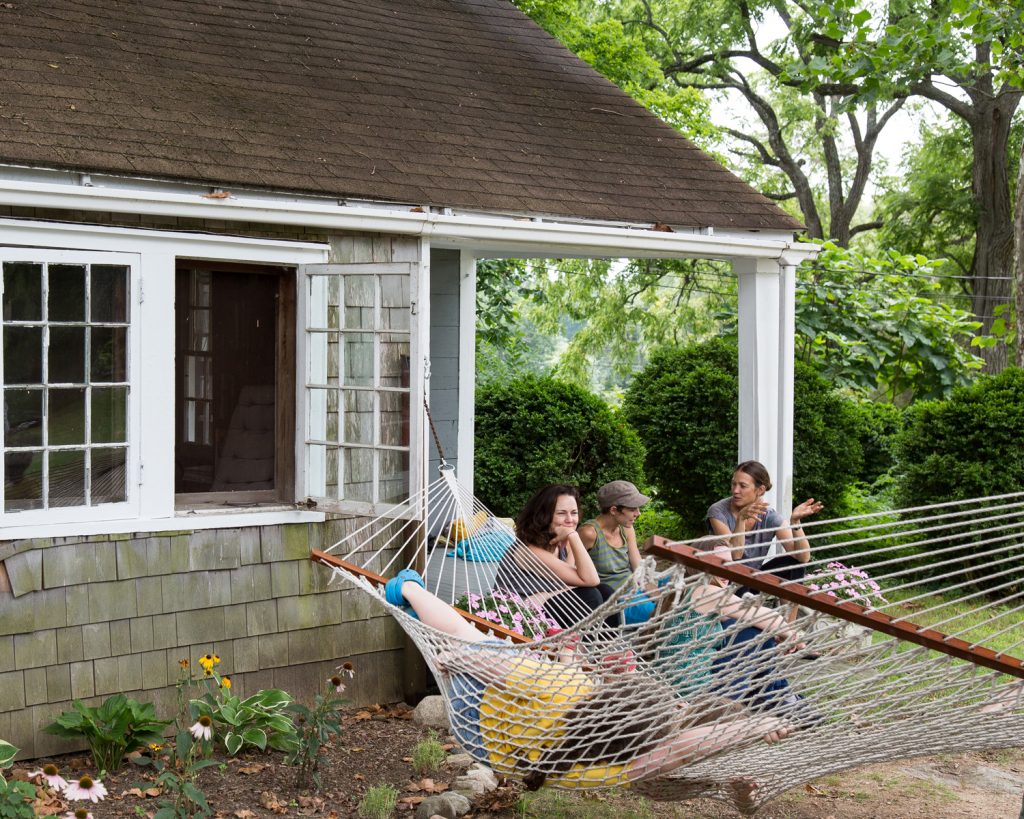
Posted on

Play Like a Man

Georgia Stitt


About twenty years ago, the first composer to hire me for a professional job said to me, “I like the way you play the piano. You play like a man.”
 

At the time I was thrilled. Enormously flattered. I knew what he meant. He meant I was strong, that I attacked the keys with passion and energy, that I could be loud, that I had command of the instrument. I immediately drew a picture in my head of the kind of “girly” piano player he meant and I was glad I was not one of them. Those girls are afraid to dig in and play with their muscles. Their fingers lightly dust the keys. They play fluidly, yes, but gently, as if they are hoping you don’t really notice them.
 

One of the most visceral memories I have from growing up in the South is the sound of my mother’s voice correcting me. “Georgia, that’s not ladylike.” It might have referred to the way I was sitting or the way I was eating or something impolite I was saying about someone else. But “ladylike” meant “elegant,” “mannered,” and “appropriate.” It did not mean “ferocious.”
 

That composer who gave me my first job remains a friend of mine and he’s anything but sexist. The concept, however, that playing like a man is better than playing like a woman, has burned itself into my brain and I am only now starting to become aware of its implications. As the years have gone by, I’ve revisited his words a lot, and I have come to understand that that composer’s bias echoes my own. Clearly he didn’t create a bias in me, but he seems to have called it to the surface and forced me to name it.
 

To be honest, my friend the composer is a pretty aggressive pianist himself, and he writes bombastic solo lines and chords so big that I have to stretch my hands out to play them. I think it’s possible that what he meant to say was, “I like the way you play the piano, because you play like ME.” That would have been a great compliment. But that’s not what he said, and his chosen words have lived on in my psyche. Here’s how they manifest: I am constantly fighting against the bias that men are better musicians than women. I fight it prominently out in the world, I fight it quietly among my peers, and I even fight it, secretly, in myself.
 

Is it possible for a woman to be biased against women? Seems illogical. In fact, I think in many cases I actually prefer working with women. Let’s make a bunch of generalizations that are basically true: women listen. They multi-task. They have easy access to their empathy. But consider this: if someone submits to me a list of ten composers I don’t know, I look at the men’s names and wonder why I haven’t heard of them. Who are these guys? Where did they go to school? How did they get on this list? What scores have they written, and have I ever heard their music? If there are women’s names on the list– and that’s a big if– I’ll look at their credits and their references, and then I’ll think, “Huh. Prove it.”
 

What is that? What makes the first-response noise in my brain beep those words out at me? A fellow female composer once remarked that she didn’t understand why we composers were such a back-stabby lot of egoists. “After all,” she said, and I remember it clear as day, “there’s room for all of us to succeed.” But that’s the million-dollar question, isn’t it? Is there room for all of us to succeed? What if there isn’t?
 

In the last few years The Lilly Awards Foundation (of which I am a Board Member) has sponsored The Count, a statistical analysis of who’s getting produced in American theater. The shocking national average is that only 22% of the theater made in this country is made by women. So that means that on every list of ten theater composers who are up for a job, roughly two of them will be female. I’m the female composer who plays piano like a man. But if that’s what you’re looking for, you could also just hire a man.
 

No wonder we are competitive! On that particular list, it’s nearly impossible for someone like me to be viewed as a “composer.” I’m a “female composer,” and as such, a novelty. A statistic. A risk, even. You might have also noticed in our national theater the dearth of black composers or Asian-American composers. According to The Count, white males create nearly 63% of the theater in this country, which means the rest of us are fighting to fill those 3 to 4 available spots on any given list of ten.
 

I’m not anti-establishment. I’m not anti-men. I’m not anti-white-men. But that majority of not-me kinds of people does have a tendency to make actual-me invisible. The fear of being invisible is a constant truth in the ambitious person’s life. Let’s be honest: the only thing worse than getting a bad review is getting a review where your work isn’t even noticed. Maybe that fear of invisibility is why I play the piano so loudly, so aggressively, so “like a man.” It’s okay. I’ve been at this long enough that I know I don’t REALLY play like a man. I play like a woman, and I write like a woman, and I think like a woman and I maneuver my way through this business like a woman. But I’m still working on the part where I worry that you’ll find me un-ladylike.
 

I want to redefine that word. In fact, I want to admit, to myself and to my poor mother who certainly never meant any offense, that I don’t give a shit about being ladylike. But that, in itself, is unladylike. And to the best of my knowledge, there’s no (positive) word that describes a woman who is strong, ambitious, visible, commanding AND polite. The only word I can come up with is “ballsy,” and I actually can’t be that.
 

Until we change the language, how can we expect to change the culture? A woman I greatly admire told me recently that the trick to raising daughters was to get them through college without breaking their spirit. I think about it all the time. I try to teach my daughters manners without requiring them to be “ladylike.” If I had a son I’d want him to have manners, too. And if these children of mine were pianists, I’d want my daughters to play boldly just as much as I’d want my sons to play sensitively. What’s the word for that? 


 Stage-Candor_Georgia-Stitt_BioGeorgia Stitt (composer/lyricist) is currently writing the musicals Snow Child for Arena Stage (Washington, DC) and Big Red Sun for 11th Hour Theatre (Philadelphia). Other shows include Tempest Rock with Hunter Foster, The Danger Year, Mosaic and the commissioned children’s musical Samantha Space, Ace Detective, co-written with Lisa Diana Shapiro for TADA Youth Theater in NYC. Georgia has released three albums of her music: This Ordinary Thursday, Alphabet City Cycle and My Lifelong Love. She music directs concerts and recordings for singers like Laura Benanti, Kate Baldwin, Elena Shaddow, Susan Egan and Robert Creighton, and she writes quite a bit of choral music, including an upcoming oratorio for Tituss Burgess. www.georgiastitt.com

Posted on

Approaching Race in The Adding Machine


Our production was probably miscast from the start. The Adding Machine, as it exists in our musical form, is a surrealistic expression of Mr. Zero’s journey that, loosely, takes place in the 1920s. The production was cast with an eye towards inclusivity and color-blindness with two Black men, one Black woman, and a Latino man participating in a show that lives in the mind of a racist White man. Along with three White women and another White man, we become the boss who fires him, the friends who ignore him, and the machinations of his destruction. We are a Benetton ad set in a polarized time.
 

That show, as I have described above, is possible. It could be compelling and beautiful while examining the role of race in America’s past and present. The problem is that The Adding Machine, as written, was, seemingly, not thought of with these issues in mind. It’s inhabitants hurl epithets around the stage in a stylized musical sequence that is an apparent send-up of American White nationalism in an age of discrimination. But, when you add minority bodies to that mix, the message becomes muddled.
 

None of this is an indictment of the actors on our stage. I could not have asked for a more talented, enthusiastic, and collaborative group to have the honor of taking the stage with every night. Everyone on that stage deserves their spot and more and has poured themselves into this production. The issue is how do we address this racism in an era of inclusivity?
 

Before I even auditioned, I asked the director about the racism in the show and how it would be approached. He responded with an enthusiastic desire to tackle race as presented in the script. I accepted his explanations with measured skepticism – I am, truthfully, jaded by years of experiencing people talking inclusivity, while not doing the real work of examining race.
 

Come a few weeks before rehearsals start, I am surprised by two emails. The first one is addressed to the cast, welcoming us; I’m immediately struck by the diversity. The second is a personal e-mail from our director asking to have a meeting on race in the piece: Wait, is he actually following through?
 

We meet, and one of the first things he does is apologize for asking me to be the voice on minorities and race. Maybe he does get it . I respond that, being so outspoken on race issues, I’ve come to expect and embrace it: anything I can do to help promote better understanding of marginalized voices. He then asks the exact same question that popped into my head upon reception of the cast list: How do we approach this racist world with a multi-racial cast? It’s not inherent in the script so, what do we do? We speak for three hours, weaving in and out of the topic of race in the show, the current state of the world, and politics at large. I leave encouraged.
 

First rehearsal – The director gives a speech about how the overt racism in the piece, while being a function of the time period, is a reminder of Mr. Zero’s dysfunction in the world and another manifestation of his ugliness. We’re told we will lean-into the racism while honoring our relationships to race as the actors playing the parts, the characters within the story, and as an audience viewing the racism.
 

Four weeks into rehearsal – We are tackling the most difficult sequence, racially: A list of slurs spoke-sung by the ensemble while in lock-step. I’m sitting on the side of the room, uninvolved in the sequence. The director walks over and asks what I think, given our earlier conversations and his stated intentions. I give feedback, we discuss, and he immediately starts working to address the more problematic aspects of the scene’s possible impact.
 

Tech – We’ve had a few audiences, and are working on that same sequence in a post-show rehearsal. If you’ve never been in a technical rehearsal, time is incredibly limited. You triage which issues are the most glaring. The director stops running the sequence to hold a 30 minute discussion about everyone involved in the scene’s opinion on what they’re being asked to do personally, creatively, and technically. In doing so, he, whether conscious of the impact or not, acknowledged that conversations about race are just as important as every other aspect of a show.
 

We’ve opened now. There are no more rehearsals. Reviews have poured in and they have been glowing. The show is a critical success. But, where did we land racially? Honestly, I don’t know. I’ve had friends of color ask me about it. I don’t think it’s perfect. I’m not even sure that it’s good. I don’t know that there was a way to achieve the sweet spot we desired given the racial make up of the cast.
 

What I do know is that I can, confidently, respond that it was addressed. I can say that it was a true collaboration and that the multitude of our experiences and perspectives were valued throughout the process. While I have to limit details about the depth of our conversations here for brevity, I can tell those who ask that, while we may not have gotten to the perfect choice, the conversations were valuable, respectful, and consistently held – This is not something I can say, with conviction, about many processes I have been a part of.
 

I’m not sure there is a “right” perspective on race on stage. What I am sure of is that, in a medium where our bodies are our instruments, candid, honest, and open conversation about what is being perceived is a huge step towards true diversity and inclusion. Start by asking questions and truly listening to the answers as equals. Theater is a community; we succeed, most, when we remember that.  


 Stage-&-Candor_Bear-Bellinger_BioBear Bellinger is an actor, writer, singer, bartender, activist, and all-around trouble maker based in Chicago.
 

He has been seen on stage with The Hypocrites, Court Theatre, Paramount Theatre, The Inconvenience, and Chicago Children’s Theatre among many others. And, his words have graced such prestigious spaces as Vox First Person, The RedEye, and his Facebook page. If you would like to follow more of what he has to say, you can follow him on Facebook under his name or on twitter: @lifeofablacktor.

Posted on

On Playwriting


Originally published in The Dramatist


What are we doing when we write for the stage? Are we entertaining ourselves? Entertaining others? Having our say? Trying to make a living? Trying to make a point? Furthering the art form? Joining the dialogue? Trying to save the ship? Trying to sink the ship? Getting even? Getting ahead? Keeping our career alive? Completing a commission? What?
 

We’ve all written for all of these reasons from time to time. We’ve all needed what only the theater has to give, and we’ve all offered our hearts up to the gods in the hope of getting a place at the playwrights’ table. And we have all been hurt. We have all heard
 

“No, you can’t sit here. You’re not ready.”
“Yes, you can sit here, but we’re not going to feed you.”
“Are you crazy? People like you can’t sit here.”
“OK, you can sit here, but just til the new you comes in.”
“No, you write for TV, you can’t sit here.”
“Yes, you can sit here. But just til your next show opens.”


If you are reading this magazine, you know that it hurts to write for the theater. But you also know that hurt is not just what artists go through. Hurt is the human condition. Fortunately, hurt is not the only human condition. Humans also feel hope and love and fear and confusion and power and glory. They experience frustration and defeat and triumph. They long for the wrong person, they make bargains with the devil, they take things that don’t belong to them, they have fatal flaws and outrageous fortune, they make the same mistake again and again, and sometimes they learn things. Especially in musicals, people learn things. What we need to do, as playwrights, librettists and composers, is not try for a seat at the table, we just need to say what it has felt like to be a lone, living human in our time. The playwrights who convey the human condition, who chart the desperate path of one human toward one goal, those are the playwrights we treasure. The plays that tell the stories we need to hear, because we are traveling the same road, those are the plays that survive.
 

We all want to write these plays that don’t go back in the drawer, that have a life of their own. Like Dr. Frankenstein, we all want to create the monster that gets up off the table and walks out into the night looking for love. But how do we do that? If we were going up a big mountain, a trusted guide would tell us what to wear, what to take in our pack, and when to stop and rest. Listening to this good guide could improve our chances of getting to the summit and back, save us time and even save our lives, maybe.
 

So what are the ropes of the playwrights’ life, the signposts, the signals, the ways to get on the right path and stay there. This whole issue is a collection of them, from some of the finest guides we have, people who have spent their lives watching people go up the big mountain. But I want to talk a little about SUBJECT, because in my experience, choosing the wrong subject is the mistake you don’t recover from, it’s the beginner’s mistake that anybody can make any time. So what is a good subject for a play? Arthur Miller said the only subject was, how does a man make of the world, a home. But what does that mean?
 

When I was first starting to write, Jon Jory asked me what I wanted to write about. I said I didn’t know, I just knew I belonged in the theater. And then he gave me this advice. “Go back to a time when you were really scared and write about that. Being afraid makes you remember details, and details convince people a story is real. And chances are, if you were scared by this, other people will be scared of it too, and that will make them pay attention.” The play I wrote after that advice was Getting Out, based on a violent girl I met when I worked in a state mental hospital. It launched my career and is still the most performed of all my plays. All my students have heard this advice. David Lindsay-Abaire has credited this advice with giving him the subject for Rabbit Hole. I heard Toni Morrison say the same thing once. She said, “Dread is what keep people turning the pages.” Clearly, fear of something is a great subject.
 

At this point, we could go through all the great plays and musicals and reduce them to what all the great characters were afraid of. That might feel trivial, but Hamlet is afraid of what will happen if he doesn’t discover who killed his father. Nora is afraid of what will happen to her if she keeps living in Torvald’s house. Lear is afraid his girls don’t love him, Oedipus is afraid more people will die if the curse is not lifted. Masha is afraid of not getting to Moscow, Juliet is afraid she won’t get Romeo, Curly is afraid Judd will take his girl, Maria is afraid to leave the convent, etc etc. But a better use of our time is thinking about fear, and how we are pulled to edge of our seats when we have some form of it on the stage.
 

One thing I know for absolute certain, it isn’t enough just to have the fear by itself. I was recently onboard a whale-watching expedition north of Iceland. I was so afraid of drowning that I wore a huge blue moonsuit, an orange raincoat, a life preserver, two sets of gloves, and three hats. I never stood up, not once. Because the sea was so rough, I held onto my seat and kept my eyes shut the whole trip. What I was hoping for the whole time was some relief from this fear, but it never came. Only when the boat docked was I free to leave, and I got out of there as fast as I could. If this had been a play, I would have been furious at the playwright for trapping me and torturing me like this.
 

The point here is that your character needs some action she can take to overcome her fear and save herself. We come to the theater to see what people do when they get in trouble, almost any kind of trouble. We want to see this because we may find ourselves in that same trouble someday. For all of our time on earth, we have gathered around our tribal fires at night to listen to stories. But they are not the stories of what made our people happy. They are the stories of how our people survived their difficulties. Maybe this is why we know so little about being happy, because we see so few stories about how people do it. But we have survived as a species because we have told stories about how people have solved their problems, conquered their fears and got where they were going. Or not.
 

So now. This is your guide speaking. If you know a story about a brave human in big trouble, write that. Write how the trouble started, what the person did, and how it turned out. Little troubles, for example, troubles that will solve themselves just by the person growing up, you don’t need to waste your time on those. Write about greed, revenge, rage, betrayal, guilt, adultery, and murder. When writing about softer troubles such as injustice, loss, humiliation, incapacity, aging, sadness and being misunderstood, just be sure to attach them to one of the more active troubles. Attach betrayal to loss and you have a play. Attach adultery to aging and you have a play. And let fear drive the whole thing. An aging woman is afraid her husband is having an affair, so she plots to kill him. Just kidding, but you see what I mean. We know we would watch that story, as stupid as it is in sentence form. Then you just add your great dialogue and your fabulous scenes and you’re done. Haha.
 

Seriously, what we are doing when we write for the stage is telling stories people need to see. We do it for the same reason we put up stop signs, because it is important, for some reason, for people to stop at this place and look around. Our place at the playwrights’ table is determined by how many people remember the stories we tell, and people remember the stories they feel they will need someday. Just like life. Urgency is the key to a good story, fear is the force that keeps it moving. The good news is that humans are so hungry for stories that our brains invent them even when we are asleep. So they need us. It is a great privilege to be a storyteller. And if it hurts, it hurts. We can take it.


Stage-&-Candor_Marsha-Norman_BioMarsha Norman won a Pulitzer for her play ‘night, Mother, a Tony for The Secret Garden on Broadway and a Tony nomination for her book for The Color Purple.
 

Ms. Norman is co-chair of Playwriting at Julliard and serves on the Steering Committee of the Dramatists Guild. She has numerous film and TV credits, as well as a Peabody for her work in TV. She has won numerous awards including the Inge Lifetime Achievement in Playwriting. She is also Presiden of the Lilly Awards Foundation, a non-profit honoring women in theater and working for gender parity nationwide.

Posted on

Reflections on the Chicago Spring Season

Chicago Spring

Stage & Candor_Carlyle


Carlyle
April 2 – May 1, 2016 in the Owen, at Goodman Theatre
Written by Thomas Bradshaw; Directed by Benjamin Kamine
Photo: Liz Lauren

 
Enter Carlyle, the hour-and-fifteen minute personal travelogue of the self-described “political unicorn”, a Harvard-educated black Republican whose personal hero is Clarence Thomas. The Goodman Theatre has become host to biographical play about the life of Carlyle Meyers, played by Carlyle Meyers (played by James Earl Jones II with smooth charm and a winning smile that would sell even the most liberal on entertaining a tax cut or two). The show is one of the most relevant satires of the decade, but Carlyle is no joke. At the performance I attended, a discussion ensued between a young black woman made a comment about two side-characters, Shaniqua and Tyrone (Charlette Speigner and Levenix Riddle, respectively), who are Carlyle’s schoolmates, and are worried he just isn’t black enough. She asked Mr. Jones about the fact that in the show, Tyrone is expelled for having weed, and isn’t that a retread of a lazy stereotype? Mr. Jones took her point thoughtfully, and then responded, “It also tells me that we still have police looking for weed in black kids lockers.” Before you can even finish calling something a stereotype, Bradsaw expertly breaks it. The play, in a very real way, ask the audience to define what blackness means to them, and then look in the mirror and wonder where you learned your answer.


Stage & Candor_Hillary and Clinton


Hillary and Clinton
April 1 – May 1, 2016 at Victory Gardens Theater
Written by Lucas Hnath; Directed by Chay Yew

 
Hillary & Clinton (pristinely directed by Chay Yew) at Victory Gardens takes us to another world too, though this time they ask a little more politely. Where The Realm drops you right into a different place in time, playwright Lucas Hnath instead asks us to imagine a world very much like our own, and a time very much like our own, and a woman very much like a one Hillary Rodham Clinton. It’s the thick of a tough primary campaign and Hillary is about to lose New Hampshire. and that’s when we meet her. We explore this other Hillary as she is crafted with expert grace by Cheryl Lynn Bruce. This Hillary has been in the battlefield for a long time and is struggling with the impossible challenge of trying to cram that lifetime of experience into a hashtag, which has somehow become a necessary part of campaigning to run the free world. I felt a tightness in my chest as we, as an audience, become witness once again to the humiliating parade of false accusations of sexist critique we’ve subject Hillary Clinton to over the past two decades, and a burning frustration at the constant hemming and hawing about her needing a more “presidential narrative”. At times I was sure I was hearing the CNN commentary echoed across Chicago from my apartment. And then Bill Clinton (John Apicella) says it, “You’re Hillary. Not Hillary Clinton. You’re just Hillary. That’s your story.” I’d punch a ballot for that.


Stage & Candor_The Realm


The Realm
April 14 – May 8, 2016 at The Side Project Theatre, presented by The Other Theatre Co.
Written by Sarah Myers; Directed by Kelly Howe
Photo: Ashlee Estabrook

 
Words make worlds. I heard the phase at The Other Theatre Company’s The Realm. In the cacophony of platitudes and instructions, the awesome chaos of having visual and aural information jackhammered into all of my sense receptors, one clear phrase stuck in my brain. And it wasn’t until I stepped out of the fascinating fun house that Sarah Myers’ created in The Realm, that the three word phrase was finally alone in my mind so I could chew on it a little more. In The Realm, resources are short and are almost entirely under the Realm’s control. This allowed them to rise, with their motionless and incisive ideas for curbing overuse of resources and overpopulation. Our guide is Kansas (played by Esme Perez), whose name is not really Kansas, a teenage girl who is “immune” and thus, isn’t losing her vocabulary or free will the way that those around her are. We know there’s a dark, hard underbelly beneath the primary-color red paint that covers the set, but this story isn’t a story of conquering worlds, it’s a story of defining your own.