Posted on

Trick… or Trans?

Pooya Mohseni


A few weeks ago I was asked to be a panelist at Samuel French’s #Identityweek panel for a discussion regarding transgender visibility both on stage and off. The discussion covered a gamut, from the evolution of trans characters, the growing visibility of trans performers as well as writers, designers and so on. As the night went on and I listened to other stories that were being told by my trans siblings, I realized that as different as we are, we had one thing in common: the feeling of awkwardness around cisgender (non-trans) people who think they understand our journey and want to retell our stories – and then fail miserably. Don’t get me wrong, I love the idea of people being interested in telling stories about my community. But, for the same reason I don’t write about slavery, the Holocaust, or uterine cancer without conducting proper research/interviewing people who have first hand experience of these topics, I feel offended when someone else tries to tell me what my experience as a transgender woman must have been like. They expect me to swallow their falsehood – whether it’s a blog, a movie, or political rhetoric – and be grateful that they even acknowledge my existence. I cannot and will not stand for it. I, and many like me, have put up with this for a long time, but no more!
 

Then I thought maybe we, the trans community, should tell our own stories. But who? Me?
 

Who the fuck am I to write about this? Well, if not me, then who? I may not be the best choice, but I have seen eye opening things in my community and I need to tell the rest of the world what I’ve seen…
 

The stereotypical lying, tricking transgender – who is possibly a street hooker – does exist, as do all stereotypes, but is as true as almost all other generalizations; it does not acknowledge a whole community. As a trans woman, I admit that there is some truth to the fact that the trans community – especially the trans-feminine community – has higher numbers of sex workers per capita than their cisgender/non-trans counterparts and maybe even the gay community. But, do we ever wonder why?
 
Do we ever wonder where the myth of the lying, cheating, manipulative Tranny prostitute who is out to trick the unsuspecting straight man comes from? Most of us don’t think about why there are so many trans women who turn tricks to make a living – why they would give unprotected blowjobs in back alleys and get propositioned in the least humane way by people who, on the surface, seem respectable and “normal,” but in secret, drool over the idea of being with a “chick with a dick.” We don’t ask why because we don’t really care enough to want to be bothered by the route of this issue. In the same vein, we blame rape on what the victim was wearing, or what she/he/they was drinking, or where they were walking. The perils of the trans community are looked at as our punishment for being freaks. We are disowned, thrown out, bullied, fired, refused proper healthcare, raped, assaulted and killed…because we asked for it!? I was born into an educated, reasonably progressive, middle class Iranian family. I had no confusion about my gender since as long as I can remember, nor do I think it was any real secret to my immediate family, even though they couldn’t come to terms with it until they had to. By the time I hit puberty and started having questions about love, attraction, and gender, I realized I had no place in the world around me. I would be safer if I didn’t speak. I would be left alone if I stayed in the dark. I would be better off if I were invisible.
 

Have you ever felt invisible? Have you ever wanted to feel invisible? Did it feel good? Did you enjoy it? No. I would bet that the thing that made you want to disappear was a painful and traumatic experience, one that you probably would never want to repeat and would like to forget at some point. This is how most LGBT youth, especially the transgender population, feel most of their lives: at school, on the street, at home…
 

We wake up to fear most of our lives – fear being hurt physically, emotionally, economically, and spiritually. We are afraid of being beaten by our families, harassed by classmates or even killed by a total stranger, for no reason other than the fact that we are transgender. When we do decide to step up to our truth and be open with the world, we risk losing our homes, our families, our jobs, and our lives. We look for warmth and safety wherever we can find them. They say “beggars can’t be choosers,” so let me tell you a little story:
 

When I was 16, my parents became familiar with the term “gender identity disorder” – now referred to as gender dysphoria – for the first time from a therapist that diagnosed my gender variance. I was depressed, couldn’t sleep, didn’t eat. I was bullied at school. Boys would offer me “protection” at school in return for “favors.” At home, I felt like an unwanted guest. My parents couldn’t look at me or speak to me, let alone ask me how I felt. Don’t get me wrong, I love my mom and my late dad, but the truth is they didn’t know what to do. Their culture had not prepared them to deal with a transgender child. To them, I was sick, and they looked high and low to find a cure; I was the guinea pig of this “conversion” therapy. It was mental and emotional torture, as anyone who has suffered such treatment would agree. I looked for affection anywhere I could find it, and I found it in the worst places. I got in cars with strangers. I went to parties. I got handed from person to person and I, at the age of 17, thought those people cared about me. Maybe some of them did, but the majority didn’t. I got offered money, which I had no use for at the time, so I refused, but it gave me a sense of power, control, and worth that I had no prior experience of. IT FELT GOOD! It felt great to be wanted.
 

That’s just a small part of my story, and I was one of the lucky ones. Even though my parents couldn’t talk to me, hug me, or tell me that it’s going to be okay, they didn’t throw me out and I didn’t have to run away from home. Many LGBT youth are not so lucky. In my 20-year journey of transitioning in New York City and seeing people’s attitudes change, I have seen many trans and queer youth who didn’t have a voice. These kids may not have had the education to verbalize their pain, but their pain was real and their pain would be unbearable for most heteronormative people to live through one day of their lives, let alone a lifetime. I saw kids who were thrown out of their front door with nothing more than the clothes on their back. I met queer youth of color who lived in group homes that were LGBTQ friendly and still suffered harassment. I encountered beautiful souls who engaged in unprotected sex with strangers in back alleys just to barely make ends meet or to buy their hormones illegally from some shady street dealer. I have known at least six or more trans women at different stages of transition who were escorts at some point in their lives, two of whom are now dead.
 

Pre-op transgender women are much more sought after by straight men than post-op Trans women. We are the golden idols of the human gender spectrum: worshiped in secret, vilified in the open.
 

Why are so many members of my community escorts and prostitutes? Plain and simple: we need it emotionally. We need to feel wanted and desired. We need to feel that we exist. We need to feel that somewhere in this world, someone wants us.
 

We need it financially. We were mostly let go of by our families and our communities. We have no ideas as to how we are suppose to prepare ourselves for the work force. We have no idea how we are suppose to pay for our meds, our therapy, or our gender-affirming surgeries, since until not too long ago, most transgender health needs were not covered by most insurances.
 

We DO NOT see ourselves represented. During my 19 years in New York City, I have only seen three individuals that I could discern were trans who were working behind a counter at a coffee shop, a bank, or any other store. I acknowledge that in stores which cater to the LGBT community, or areas that are more trans- and gay-friendly, the number of trans employees may be higher, but not enough to offer jobs to a greater portion of my disenfranchised community.
 

To add insult to injury, most of us in the LGBT community are never told, “You are worthy of love and respect.” We are told, “It is your choice,” “You are asking for it,” “God hates you,” and “You are sick.” We hear such hate so often that we begin to believe it. It becomes our inner punisher – so much so that even if no one else is around to harass us, we have our inner voice to beat us down. We carry shame because we have disappointed our loved ones: shame, guilt, doubt, and self-hate are very familiar feelings to us, not because we have done anything wrong, but only because we are different. We are openly and unapologetically ridiculed and vilified as pedophiles by the right, and shunned as frauds by radical feminists. Very few people, until recently, have stood up for our rights. In such a world where over 40% of trans youth have tried to commit suicide at some point, where transgender women showing up dead is rarely headline news, where a trans sex worker getting killed is just another “well, that was to be expected,” is it hard to imagine why the transgender community has such high percentage of sex workers? You may not like it. You may judge it. You may even condemn it. But it does not change the harsh truth my community lives through every day.
 

So, next time you want to judge my community for not being open enough, truthful enough, or worthy enough of your respect and compassion, ask yourself: what have you done to deserve that truth? Did you make us feel loved and safe, so we could tell you who we are? Did you help build our self-esteem so that we could also contribute to our society as others do? Did you at least give us the courtesy of respecting our gender and identity? If so, we are thankful for your humanity. If not, you deserve no respect or truth from anyone, because WE DON’T OWE ANYONE ANYTHING! We are part of the human race, just like anyone else. We exist, we love, we hurt and we learn. If you teach us love, we will love back. But if you teach us fear and hate, we will inevitably hide and lie. The choice is yours.
 

With much love, Pooya, your unicorn princess. 


 Privilege PassingI am an Iranian/American actress, born and raised in Tehran, Iran. I moved to New York in my teens, where I discovered my love of acting and story telling. I am a graduate from the esteemed Maggie Flanigan Studio. I continue building my resume of a variety of characters from weak to strong, while exploring their humanity and fragility. I am fluent in Persian/Farsi and a transgender advocate, as well as a voice for immigrant issues and women’s issues. I am also involved in writing and co-writing original LGBT stories to shed light on an otherwise under represented community.

Posted on

A Conversation with Tom Phelan

Tom Phelan


A year ago, Taylor Mac’s Hir became the buzziest show off-Broadway: extensions, sold-out runs at Playwrights Horizons, and Critics’ Picks from virtually every publication in New York. At the center of it all: a TV actor who had made history playing a transgender teen on ABC Family’s The Fosters. Tom Phelan would again make history by playing the genderqueer Max – a young person whose preferred pronoun, “hir,” inspired the title of the new American classic.
 

A year later, Tom is no longer onstage at the Peter Jay Sharp. These days, he’s a college student by day, working actor by night. And, of course, a rabid fan of theater. We sat down to talk with him about the historical resonance of Hir, the power of unlikable marginalized characters, and his hopes for the future of a more empathetic theater.


Helen Schultz: How did you discover the role in Hir?
 

Tom Phelan: I got an email from the team and a message on Twitter. It was the most gobbledigook, millennial casting process ever. They asked me to put myself on tape, so I did my audition in my high school auditorium, and had my high school drama teacher be my reader. I practiced for days with my dad going back and forth, doing it over and over. I happened to be in New York because I was auditioning for Juilliard, and they were like hey – can you come in and do it with us? I went into the room and it was Taylor [Mac], Niegel [Smith], and Bailey [Koch] and one other casting person. I freak out and I do it and I don’t remember a second of it and I leave. I’m shaking and I call my mom and I’m going to Chipotle because I haven’t eaten, and then they call me back and they say, hey, can you come back? We need you for one more thing! Niegel had been giving me these notes, and I was kinda getting it but I wasn’t quite there, and I walked out feeling a little weird about it, and they called me back, and I finally got it, and I walked out and it was just the craziest thing that’s ever happened. Off-Broadway was the dream of all dreams and I don’t know…I just love theater so much, and for it to be Playwrights Horizons, and for it to be Hir, a play that I literally read in American Theatre Magazine and was like, oh! I’ll see that when that comes out! It was the craziest thing.
 

HS: Did they give you sides to read from?
 

TP: It was about four pages of sides, and they didn’t change at all from audition to the show.
 

HS: What was it like to go into a play that you loved so much, and so wanted to be a part of? And being DM’d on Twitter about being in a show you’d dreamed of being in?
 

TP: It was crazy. It was the first time I’d done a project that I cared so, so, so deeply about, which radically changed the experience. It made it so much more difficult to work on, honestly, because I cared so much about how it turned out, and I knew that I could sink the play. It’s a pretty evenly-balanced play in terms of how much every character gets to play and be, and I really wanted to do justice to Taylor’s play. The pressure was on.
 

HS: And you got to work with so many incredible actors.
 

TP: You should’ve seen me when I found out Kristine Nielsen was going to be my mom. I hit the floor. I dropped. Just the talent and the level of expertise – I was so daunted and so terrified and felt so horrible after so many rehearsals…but I learned so much. I can’t imagine ever touching an experience like that.
 

HS: Did you see something on Backstage at all? I know that Hir lead to a real rethinking of their casting calls, and the binary in so many casting notices.
 

TP: No. And I wasn’t even looking at the time – I was in high school, taking Calc AP and freaking out. They reached out to me.
 

Tom Phelan
 

HS: Had you wrapped The Fosters by then?
 

TP: I had, I think so. The last thing I shot was on my high school graduation day. I couldn’t make it – “I’m sorry, I’m working!” They were like we might bring you back, and they’re always sort of “maybe.”
 

HS: That’s amazing to have both of those experiences at the same time – filming a TV show and living your life in high school. Were you doing school plays and amateur stuff as well?
 

TP: Oh yes. Oh god… what’s the worst thing I did in high school? [Laughs] I was in a production of In The Heights – #InTheWhites – as my high school was predominantly white. That was very shameful and it was horrible. It was horrible. I was in School for Scandal; I was in Sweeney Todd as Beggar Woman as a freshman. I did this play by Richard Greenberg, this short play, that originally starred David Hyde Pierce, Patricia Clarkson, and Philip Seymour Hoffman, and I was Philip Seymour Hoffman. And that really solidified “this is my type, this is how I’m typecast, as a Philip Seymour Hoffman.” It was about a troll, and I played a troll, and I was like, this is it! This is who I am! Finally! [Laughs]
 

HS: Was it a magnet school?
 

TP: I went to an off-set of Cal Tech, which was an offset of the university, but they just happened to have a really great theater program.
 

HS: They were cool with you doing stuff outside of school?
 

TP: Yes!
 

HS: And now you’re in college and living that life! Do you think you’re going to work during your studies, or take some time off?
 

TP: I’m really going to try to! I have a reading tomorrow actually, whcih is awesome. Other than that, I’m going out on calls and, you know, the grind.
 

HS: Do you ever find it hard to balance all that?
 

TP: Telling my professors that I was going to miss my first day of classes because of a reading was not a fun task.
 

HS: I’m sure that they knew that going in, having accepted you as a student and as an actor. What work inspires you, and what are you most looking forward to this season?
 

TP: I have a list on my phone! I bought a subscription to the Signature, because their season is unbelievably exciting. All the Suzan-Lori Parks, the new Annie Baker, Will Eno, new BJJ, it’s going to be amazing. Obviously I’m excited for Taylor’s play – tickets are a lot. But I’m going to see if I can get my dad to go see it and ride his coattails and hook on.
 

HS: And the new Sondheim!
 

TP: Yes!
 

Tom Phelan
 

HS: Something that we really believe in at Stage & Candor is that theater is all about empathy. Hir feels that way too. They’re not the sort of characters you’d meet, point-blank – they’re so isolated. The entire play takes place in their home, this sort of world of their own creation. They don’t really leave their house. Could you talk about the process of that show, and a moment of empathy you’ve had as an audience member or an artist?
 

TP: I feel like I so often enter a room with hostility, and entering a rehearsal room, that’s not something you can do. The play really taught me a lot about that and not assuming anything about anyone. I think that identify politics is a little bit deaf, and I think… I think approaching people as human beings is the first thing you should do.
 

The play itself, everything I think about it, it just breaks me. It’s really, really brutal. Everyday it would shift and I would feel more for a different character. I would get so angry at the audience – the audience a lot of times would come out really hating Paige. I remember feeling so much anger about that, and being so furious that they refused to consider it from her angle. We had a lot of audience talkbacks that were horrible in that way.
 

HS: What do you think that’s a product of? Misogyny?
 

TP: Absolutely misogyny. A misplaced…I think people assume that because there’s a Capital T Trans Character that they are infallible and that they are, I don’t know, the “good ones.” It’s good representation, whatever that means, to have a perfect model of a trans character. I think a lot of times the audience would be l really feeling for Max when they should be feeling for everyone in the play. I just love the play so much, I love it so much.
 

HS: So much of that play is about misogyny – not just gender, but the idea of dismantling patriarchy from a very female perspective. The mother really is the one driving the action.
 

TP: Dream. That’s crazy. I read this interview with her where Young Jean Lee was like, I wanted to write a play. I went to my students and I asked them all, what do you think? How can a straight white man be a good person? She asked them all and then she wrote a play about that person, who would listen and didn’t speak over people and did all these things their students said they wanted. [Editor’s note: Straight White Men.] He was a loser and no one liked him. And I think that’s so fascinating, that the idea of the person we believe these dominant people should be is not actually what we want them to be.
 

HS: There’s definitely a parallel between that character and the dad in Hir. It’s sort of this immobilized person.
 

TP: You think you want that but ultimately that’s not what you want, and also incredibly dehumanizing and horrible. People are people, people aren’t monoliths. They’re not representative of their group.
 

HS: Your character really has the button at the end of the play – hir goes and forgives everyone and offers a way forward, this new cycle.
 

TP: It was a lot. It was a lot. I don’t know. Theater’s the best. Getting to do that play for so long and become a family with those people was transcendent. Like, just amazing.
 

HS: And it really started so many conversations about casting. What really sort of baffles me is that there’s so few plays about the LGBT experience, especially the “T,” and TV is blowing up with stories about queer people. It was really interesting for me to go on Instagram and go through and see these kids who are like 11 and are like, correcting each other and saying, No, you should ask somebody’s preferred pronouns and not assume, because of The Fosters.
 

TP: It’s really crazy, it’s really cool. TV is the new frontier and, I dunno, you just hope that it allows…I think there’s a lot more room for nuance in theater. Not to generalize, but I think theater oftentimes is just smarter and more thought-through. Just for the fact that these opportunities are opening up for all these actors is fantastic. It’s really great, the fact that people are finally being paid to do this. That’s a step forward.
 

Tom Phelan
 

HS: And you were involved on the new series, Doubt.
 

TP: Yeah, my parents created Doubt and I worked as a PA over the summer. I got lunches and printed out scripts and collated. It was the best job I’ve ever had. I love and trust my parents and I think it’s going to be a really good show.
 

HS: I’m so excited to see that Laverne Cox is just everywhere.
 

TP: Thank god!
 

HS: I was so upset that she wasn’t on the last season. Don’t keep her locked up, she’s the best part of the show.
 

TP: Honestly. She’s deserves all the opportunities in the world. Seeing her face on a bus is going to be mind-boggling.
 

HS: Was it at all strange to see yourself with ABC Family and The Fosters blowing up? You received a ton of press for you and your character, Cole.
 

TP: It was really weird. But it was really cool and I’m so lucky that I got to do that. I’m so glad that weird, awful, in-between part of my teen years is so well-documented. It’s amazing to see me in between figuring things out. It’s embarrassing but great. Nobody wants to be documented that well at 16.
 

HS: Your character now has so much weight too. It’s really very interesting to see how much backstory and importance is packed into a small character.
 

TP: They devoted a lot of time to Cole, which was really cool. I’m just so lucky that I got to be…I think there was, the pre-requisite capital T trans storyline, but after that I got to have a love interest, and be funny, and have fun, and have friends, and go to the beach. That’s the sort of story I think is the most important. Just normal people, doing people things.
 

Tom Phelan
 

HS: Where do you think it goes next? How do we start to create trans characters that just…are, you know?
 

TP: That’s something I think that Doubt is doing pretty well. Literally in the pilot there’s one or two lines about her being trans and it’s just a huge deal. I think a lot of that stems from having a trans writer on staff whose name is Imogen Binnie – she wrote a novel called Nevada that is mind-blowing. She’s the greatest. Obviously, having trans storylines about being trans is important because that’s just a fundamental part of our lives but having that be the smallest piece of the pie in storylines about losing your lottery receipt and taking your dog to doggy day care…I think that’s great.
 

HS: I thought it was interesting, what you said about likable characters. Because now, Shakina [Nayfack] is on Difficult People and she’s just an awful character.
 

TP: Oh my god, those scenes…I look forward to them so much. The scenes with Cole Escola and Shakina and Derrick Baskin, who is amazing…But I think it is really interesting in that being unlikable is something we’ve talked about with women, but not necessarily with POC or trans people and all these other groups that when they’re put into a story, have to be representative and perfect.
 

It’s so uninteresting. It’s so, so, so, so boring and un-nuanced. I mean, take it if it pays well but it’s not a story that I want to tell. And it’s not a story for people like me. It’s for other people; it’s for a different audience. And I think considering who you’re aiming your media for is really important.
 

Michelle Tse: Do you think that contributes to education of the general public?
 

TP: I think it does. I think people try their best and they mean well and they want to spread the word and get these issues out there, but it’s so often second hand information through a friend of a friend or through a fact page on Wikipedia. I don’t know. It’s just boring.
 

HS: And at the same time, I feel like there’s been…something that Black Lives Matter talks about a lot is that you need to educate yourself. It’s not the job of marginalized folks to do that for you. Do you feel similarly?
 

TP: There is just a huge pressure to be vulnerable and educate people using your own personal pain. That’s so coercive and awful. There’s pressure to put myself on display, and so often it’s unpaid and just expected of me no matter what. Expect people to educate you if you’re paying them to educate you. Other than that, do it yourself.
 

HS: You love Sondheim a lot. Talk about that, because I feel like Sondheim isn’t someone we talk about much anymore, now that we’re in the Lin era.
 

TP: I have been in love with him. I listened to Assassins for the first time, it was the first Sondheim musical I ever listened to. I was in 7th grade, and I only listened to it because I was infatuated with Neil Patrick Harris and I got the revival cast recording for all of his songs and I was like, I actually like this, let’s listen to the whole thing. His work…I could try to pinpoint exactly what it is but it moves me so much, more than anything else. I think Sunday in the Park with George is the most…
 

HS: There are no words, honestly.
 

TP: It’s the best musical.
 

MT: Especially since it’s art, visually…
 

HS: It’s hard to articulate it in words. It’s theater.
 

TP: I know.
 

Tom Phelan
 

HS: I was listening to the new Carly Rae CD…
 

TP: Stop it. Stop it. Stop it. Emotion Side B…queen of everything. It’s so good. I keep telling my friends to listen to it and they’re like, mmm, okay. But I’m like, you don’t understand. It’s the best pop album ever written.
 

HS: Sondheim and Carly Rae.
 

TP: I’m not kidding all I’ve been listening to is Carly Rae, a little bit of Sondheim, Crazy Ex-Girlfriend, that’s it.
 

HS: Donna Lynne Champlin…did you run into her at all when she was working on The Qualms at Playwrights Horizons?
 

TP: Oh my god, no, but what an amazing, amazing person. I will go down with character actors until the day I die.
 

HS: In a lot of ways, I feel like TV is becoming what I want theater to be: a much more accepting, rich representation of all of these people whose stories we very rarely see in the mainstream.
 

TP: Me too, but I hope TV becomes more like theater. I was watching Horace and Pete, which failed in a lot of ways but was also incredible in a lot of ways, and seeing Annie Baker’s little touch on that, how she influenced it, was really cool. I think it accomplished a lot more depth than I’ve ever seen in TV. I hope the two can influence each other.
 

HS: Is there anyone on Doubt or on The Fosters who is a playwright on the writing teams?
 

TP: That’s such a good question…no. We have a lot of lawyers. One lawyer who is very New York and into the playwriting scene. We have a folk musician on the writing staff who is just a really good writer. A woman who went to Columbia and is really cool. It’s a diverse little room.
 

HS: It’s so interesting now that so many people we’ve talked to write for TV too, because it’s sort of the way to make a living. It’s usurping all our writers.
 

TP: I know. Literally.
 

MT: Playwrights know character development. They know how to do it and fit it into two-and-a-half hours, so imagine what they could do with 13 or 22 episodes.
 

TP: I do die a little bit whenever another one bites the dust and then gets taken away.
 

HS: Yeah. I mean, Jordan Harrison is on Orange is the New Black now.
 

MT: Hilary Bettis is at The Americans. Tanya Barfield is there too, I think. Carla Ching is at I Love Dick. Oh, there are so many. David Henry Hwang is working on The Affair…
 

TP: He is doing a lot. He’s head of the American Theatre Wing too?
 

MT: Yeah he’s the Chair. I believe ATW just started a diversity committee last year.
 

TP: Good for them, that’s awesome.
 

HS: It’s interesting. Sometimes I worry about diversity in theater because TV is producing so much and they can pay so much more…It’s like, you don’t say no to writing for Netflix, and when you’ve been standing outside in the theater world banging on the door for 20 years…
 

TP: You just hope that companies like Playwrights and The Public are able to work with enough money and really finance these playwrights and get them developing.
 

HS: It makes me so sad that Playwrights is the first company to offer even half of healthcare.
 

TP: And the amazing thing was that they paid Taylor to be in rehearsal every single day, which was really important. It was such a boon to us.


Tom Phelan made headlines becoming the first transgender teen actor to portray a transgender teen on a major network show, ABC Family’s groundbreaking series “The Fosters.” Credits with Pasadena’s Theatre 360 include Hair, Spring Awakening, The Authors’ Voice and School for Scandal. Hir is Tom’s Playwrights Horizons and New York stage debut.

Posted on

Line, Please!?

line please


Hi, I’m Liz and I’ll be offering you advice on navigating the tricky situations that can come from working in or being a fan of theater.
I’ve been doing it out on my blog, fyeahgreatplays.com, for a while now, so it seemed only natural to migrate here in a more official Advice Columnist capacity. I’ve freelanced as a stage manager around New York as well as regionally, I’m a member of Actor’s Equity and a total contract junkie, and I occasionally cohost a podcast on theater and performance (Maxamoo).
 

To submit a question, email lineplease@stageandcandor.wpcomstaging.com.


Dear Liz,
 

To whom does the armrest belong?! – We’ve all been there…Get to the theater early and get comfortable…The second we move our arm the person next to us snatches the armrest…Or someone of larger frame or stature spreads out onto our armrest…And you’re sitting next to a couple who should share the armrest between them but they insist on using yours! I need to know who has the right of way! To whom does the armrest belong at the theater?!


Ahh, the question of the ages.
 

I feel like the answer is more cut-and-dry in an airplane. The poor middle-seated person, unable to lean against the window or stretch out into the aisle, gets both middle armrests. It’s the least you can do. But in the theater, nearly everyone has to share an armrest!
 

I asked a lot of frequent theatergoers this question and lots of them said the armrest goes to the person who stakes claim to the armrest first. But I also think it’s a jerk move to claim both armrests when they are nearly all shared. Also, if you get to the theater early enough to claim your armrest, you’ll likely sit and stand a few times to let other people into the aisle, and what are you going to do, race to sit down before the person next to you does and throw your elbows down?
 

I think the fairest way is for all of us civilized theatergoing folk to collectively agree: Everyone gets ONE armrest. The lucky aisled patron in A101 takes the aisle armrest as a courtesy (they already get the legroom). The person in A102 takes whichever armrest they’d like. The person in A103 takes the leftover armrest, as does the person in A104, so on and so forth. I’m sure somewhere in there will be a person who doesn’t use the armrest (me, for example) and the process can repeat itself.
 

Look, I’m not a mathematician.
 

If you really must have arms resting on both sides, there’s the option where one person gets the front half and one gets the back half. That can be difficult to maneuver, especially in the dark, and how much you enjoy touching strangers. But until I can hold the Global Audience Summit and set rules for this (as well as for food and drink that should and should not be allowed in the theater), I think we have to just try to deal with it as politely as possible.

Posted on

A Conversation with the cast of Julius Caesar

Julius Ceasar


The production of Julius Caesar currently playing at Writers Theatre is, in many ways, feels like a 105-minute meditation on ambition and the nature of power. And though Caesar’s reign came well before the eventual collapse of the Roman Empire, it’s hard not to remember the fate of the ancient world’s biggest superpower as the projections onstage light up with the hashtag #MakeRomeGreatAgain. The words may have been written in the late 16th Century, but juxtaposed with the imagery of a rabid mob clamoring angrily for the complete destruction of its political enemies feel just a little too familiar. This Caesar is unapologetic about its modernity, and doesn’t waste time condescending to its audience by over-explaining its message.
 

I sat down with some of the cast to talk about the show’s point of view, which instead of transporting us to Rome, reminds us that we are all, in many ways, Roman…even today.


Kelly Wallace: So this is a very non-traditional production of Julius Caesar. When you first got the script and saw how modern and political the themes and undertones would be, what did you think? How did you react to that?
 

Arya Daire (Portia/Decia/Soothsayer): For me, when I got the script…I haven’t done Julius Caesar before and I hadn’t read it in a long time. I got the eight sides and I saw our current political climate reflected in it, and that was the vibe I had with Michael Halberstam, our co-director, when I went in to audition. It was informed by a lot of current events, especially the omens, were very reflective of our current politics all over the world and that’s all I saw. I think the casting itself was a broader pool, but it wasn’t set that it would be this way. I don’t think it was predetermined with minority reflection in it in advance from the start.
 

Madrid St. Angelo (Julius Caesar): Julius Caesar is one of Shakespeare’s greatest plays. I was familiar with it and have seen productions of it throughout my life. When I was invited to audition for it, and especially the opportunity to work with Michael and Writers Theatre, there was no question. It’s a great role and I would’ve played him in any way that they’d chosen to depict him or portray him.
 

As far as reading the script, I really appreciated the stripped down adaptation and I thought it gave a great deal of focus to this idea of ambition and how ambition can trickle down and infect an entire population of people. I personally saw that parallel in the political climate, not that it was told to me, but I saw the emphasis on the relationship between Brutus and Cassius and the central characters’ obsession with power and how it spreads to the entire city and the people.
 

Kelly: It almost reminded me of something like Hamilton, in the sense that it takes historical figures or characters that we’ve seen in history books and have pre-determined ideas about and what they look like, and flips that on its head. What do you think it does to open up the show, if you remove that visual barrier?
 

Madrid: This is something I think Lin-Manuel Miranda has done incredibly well in Hamilton. It’s an indictment on our education system here in America. We learn very little about our political leaders from the past, in particular Hamilton. What we know and what we think about him is so small when you actually look at the history, where he came from, the world he lived in, what his upbringing was…it was completely multi-ethnic. It was a very dark-skinned world, not a white-washed world like we see in our history books. Lin was super smart in trying to cast and write the show with people of color, and give us the world that Hamilton lived in prior to his coming to America and studying in American schools. The world he came from was slaves and Dominicans and blacks.
 

Arya: And contemporary casting isn’t always accurate anyway. We’re all aware of it. Sometimes you see, in plays with all-caucasian casts, a mother and a daughter cast who look nothing alike, even though they’re both caucasian. Even if there’s no way this daughter came from this mother, the fact that they’re both caucasian makes it okay. When there are works done about Ancient Egypt, Cleopatra is often white and the Egyptians are played by Caucasian actors. When you read about the history, that’s not very accurate.
 

Kelly: When you think of Rome, it was in a lot of ways the melting pot of its time.
 

Madrid: It was a multi-cultural epicenter.
 

Arya: We’re used to that kind of casting that isn’t necessarily accurate and correct. We’re just used to it so we accept it as “correct.”
 

Madrid: I think that somehow, theater-makers believed for a long time that it was a safer bet to cast “traditionally” to make it palatable for the audience. It’s like…oh my god, girls, hide your gold, there’s some dark people coming onstage! I think what Michael’s doing with this production is painting Rome in a very authentic manner, and hopefully, if somebody says God, Caesar looks like Che Guevara, or ask why there’s a Latino Caesar, they move beyond that and we draw them into the world that we’re crafting and they get the story and start to see that the world is multi-faceted and multi-colored.
 

Kelly: Would you say that’s something you really want people to focus on in this? That they leave the show realizing that their mental picture of that character doesn’t mean much other than it was their pre-conception? I think about young people seeing something like this…all they know is mostly multi-cultural interpretation, which is incredibly valuable. 
 

Julian Parker (Caska/Cobbler): I spent most of my process trying to convince myself that this was a reality that I could accept. I was fortunate enough to have a mother who is an English teacher and I was always the…not that I loved school, but I loved English and History. My first experience with Julius Caesar was in sixth grade and nobody wanted to read any parts, so I was the only one doing all of them. I love language and finding that balance between finding my voice through a culture where I don’t have many representations of people that look like me with my age, speaking the words I do.
 

I spent a lot of my time trying to convince myself that I didn’t need to speak how I’ve been told people speak from this time and to use my own voice. I realized it today when we had the high school kids. It was a real pleasure to have them, and they’re much closer to where I’m from at least, even in hue. It made me want to make sure that this shit was understood and –I hate to use the word but – to represent. This table in this room is beautiful. This is what it should look like. We have so many different voices at this table alone. So most of it was about myself, and any time I became hesitant, I looked around and I was constantly reaffirmed by my castmates, who also may have had a similar plight.
 

Arya: Also, the thing about doing Shakespeare is, you can take as many classes as you want, or as many monologues as you want, but the fact is minorities are not often in the productions.
 

Madrid: Or it’s only in minor roles.
 

Arya: Right, and because of that, you don’t get that mastery and fluidity in the language. The only way to get it is to do it night after night in front of an audience. I was so nervous with this text, it took me a long time to relax. Maybe a week or two ago, I hit a point where I was happy with what was happening. The language started to pull me and I understood what people meant in those books when they talk about acting Shakespeare. I would’ve never been able to reach that understanding if we hadn’t been given an opportunity to actually play it. If theater companies say they want to encourage diversity in casting, there’s just one way: You just do it. You don’t talk about it anymore. Talking has happened enough, and it’s time to just do it, and Michael is just doing it. He just said, the people who came in for these roles were the best. We need that kind of acknowledgment and we all earned our spots here in this production.
 

Kelly: Yes, how often do we use “the best person for the role” and they mean who’s the best white person?
 

Arya: It’s very coded language.
 

Madrid: This time apparently it was the best faggot for the role.
 

Julius Caesar
 

[Everyone Laughs]
 

Kelly: We’ve seen it a lot in Chicago recently too. First at the Marriott for Evita, and now with In the Heights. Those were more conversational exchanges, not necessarily any concrete action. But this is a choice, this is an action. This is in front of an audience every night, it’s not a conversation about how we could do that.
 

Arya: Exactly.
 

Madrid: I don’t want to monopolize the conversation, but I want to say that on the hand of diversity in casting: just do it. A lot of people have their hearts in the right place, but aren’t at the place where Michael and Writers Theatre are at. It could be all of Michael’s experience as a man and an artistic director and an actor, where they’re actually laboring over the conversation pre-casting. They’re saying, can this role be portrayed this way, that way, and the other way? In a recent interview, Michael talked about Octavius and Cinna. Is it possible to cast that person and have one actor play both? Is that person, given the sexual ambiguity of Octavius historically, cast as a woman? Can we cast a man? Can we cast a trans-person? They’re advancing the conversation and pushing the envelope before they go into casting. Not enough Artistic Directors are doing that. They’ve never thought to. You can’t have a casting call and say we’re going to bring in 500 Latinos or 500 “ethnic people.”
 

Arya: It really was like that. There were all kinds of people at the audition for this production, caucasian included, and he really made an emphatic point to say that the person who got the role was the best, regardless [of identity]. It wasn’t based on trying for anything specific thing.
 

Kelly: Syd, do you feel that being trans has really informed your work here playing Octavius?
 

Sydney Germaine (Octavius/Cinna): Yes, absolutely. Originally, I was called in for Calphurnia and Octavius and that was really interesting. I was excited, because those are two very different characters who could be grouped that way. Something I had to get over in playing Octavius was, historically, as far as we know, Octavius was a cis male.I started trying to put on some very masculine things that may not have been right or authentic. In my everyday life, I always am having to “put on” something to be a little more presentable to people. There’s some stuff I do in my everyday life that I do onstage, but I had to realize that whatever I am is fine. That’s who the person is onstage. It’s not a trans person playing a male character. It’s, this kind of person is playing this kind of person and that’s how it is. I’ve never been able to do that onstage. I’ve always played characters who are very clearly a man or a woman, without ambiguity, which is something I deal with in my everyday life. People don’t get how to deal with what’s going on, they have to choose one or the other. Does that make sense? There’s a parallel between figuring out things onstage and figuring out things in my personal life. It’s informed and helped me in my personal life.
 

Kelly: It makes sense, and Octavius is figuring himself out too at this point in history.
 

Sydney: Right! It was also just exciting to me to be called in for a Shakespeare character who was very clearly a male, because I medically transitioned and stopped hormone therapy a few years ago because I was like, Fuck it, I don’t want to do that anymore, I’m beyond whatever this thing is. That has resulted in a lot of people reading me as female, which is what I don’t identify as, and no one had given me the opportunity yet to come in and read for a character that is traditionally cast a male. That was really, really cool to me.
 

Kelly: Performing Julius Caesar in this way, in this political moment, is fascinating. In the playbill, someone said something to the effect of that if you want to see more of this world, just turn on CNN when you get home. What is that like for you, to know you’re performing this show in a context that’s ever-evolving? You do this during the day, and go home and live it at night.
 

Sydney: I started thinking about it, even in regard to the Senators onstage today, there’s so much about this mob mentality and so much of that happening on social media. I see all these very blanket statements where people are grouping together and getting very excited or very upset about stuff and it’s all very polarized. All of that, onstage, is reflecting what I see in real life. It’s made me more aware of when am I doing that? When am I not doing my research on something and how easy is it to let myself get worked up and out of control?
 

Arya: Or just being carried along by a current opinion.
 

Julian: There are small things that are very touchy in the show, that came as a surprise. We spend so much time at the table, contextualizing and over-contextualizing, and then we finally get on our feet and we’re feeling it out. A couple weeks ago, [we were doing] something that we had been doing forever: at the very top of the show, a gun was pointed at me onstage, but in lieu of what had happened the night before in the news, I saw the other actor realize at the same time I did, that this is potentially bigger than us, even in that small moment that’s going to end in a paragraph. It can cause you to drift in a place where you have to force even your ego to override whatever’s going on with you internally. That freaked me the hell out. Something else that I saw was that we did a really good job of trying to create a culture in the room that was as nonpartisan as possible in order to stick to the work, although we did have a theme of wanting Caesar to represent a hybrid of Trump/Bernie Sanders…
 

Kelly: You even use the hashtags on the projections, like #MakeRomeGreatAgain, which is a pretty explicit reference…
 

Julian: Right, right, right. I allowed myself to dismiss that idea in the marketplace scene…where [Julius Caesar] is laying on the ground for what must be at least thirty minutes; I can’t imagine what he’s thinking under there. Something really intimate happened where he was under the cloak and I could see the brown of his skin on his calf and I don’t associate that skin tone with Bernie or Trump and now I see Barack. Now I see people that killed a brown man based on what he achieved and off of what they fear him to do based off of some social science of people who historically don’t look anything like him. So it’s a completely different variable and you’ve taken it into your hands, literally, to murder someone. Some nights I’m like, wow, we kill somebody every night, in one of the most tragic ways possible. We know this man, we’re close enough to stab him in the back, and we kill this man on the ground based off a fear of what he could potentially do, which is bullshit. It messed me up. I see somebody that looks like me on the ground. I wouldn’t have been able or allowed to have that in my brain if this hadn’t been cast in the way that it was.
 

Arya: History repeats itself. This was written how long ago and we always consider ourselves very highly evolved. Every generation considers itself more evolved or civilized than the ones that came before it. But…are we really?
 

Madrid: And there are more ways than one to kill somebody. In one way, we’ve been killing Barack Obama for eight years. We’ve been killing Hillary Clinton for thirty years. The media encourages it. We actually have candidates implying that somebody should shoot this person, and you have somebody saying here’s a President who wasn’t even born in this country and amassing an incredible amount of hate towards someone. That’s another way of killing any good that they might do, be it out of fear, jealousy, or envy. When I think of Caesar, I heard the Trump allegory and the parallels that were being talked about when we were working in the script. I always liked Caesar, and I try not to judge the characters that I play going in. I was able to separate Caesar, the way he is with his wife in the play, versus this idea of ambition and how ambition can spiral out of control and blind you to everything. It blinds you to decency, and general good-doing. It catapults you somewhere else. People can love it, hate it, want to bury it, want to kill it, and I think that’s what happens.
 

Julian: That’s so interesting. I believe there’s a lot in the show that revolves around ambition. You could play a drinking game with how many times we’ve mentioned it. I also think that it can even be about reform versus tradition. And I think, again, with Caesar in this adaptation, we or at least I, see a man who sees what the people need. Who’s to say that Rome doesn’t need a fucking dictator right now? It could’ve been like the one dictator that did it right. It’s reform versus tradition. We have a Republic who insists to keep it how it was, versus the new. That is the crux of the play and what’s driving it, and how quickly it all falls apart. You see at the beginning of the prologue we created, and the beginning of a hint of what a Democracy should look like, it’s like 12 Angry Men almost. Then you see it again at Portia’s house. That’s the moment where I think it would be like a back room, where they’re actually trying to fight this out. They don’t all agree. You get to see the Republic they set up, that they understand, and the workings of that, and then you see it all fall apart immediately after they stab and kill him. People decide this maybe wasn’t a good idea.
 

Sydney: When we leave the house, at the end of the scene, it’s not settled. We were talking about this in rehearsals, but they didn’t have an exit plan.
 

Julian: And Cassius is a dictator!
 

Arya: The ideas are connected, the ambition informs the reform versus tradition. We don’t reform unless ambition informs that wish to better what comes before. Ambition runs everything. Ambition informs a lot of the honor that Caesar stands on, but it’s also ambition to kill your best friend.
 

Julius Caesar
 

Kelly: This is fascinating…Julian, since you brought it up, I’d love to know what’s the crux of the piece for all of you.
 

Madrid: I would like to believe that it has to do with love. Love of country can take you in directions that are both good or bad. Everyone clearly loves Rome – I think Caesar loves his country, I think Brutus does, I think Cassius loves Rome. But I think that when you add the ambition to that, like they say money is the root of all evil, ambition can take you in directions that ultimately result in your own demise. At the end everyone’s dead.
 

Arya: For me, the crux of it…I always go with psychological things to help me understand plays I work on. Every character in the play has certain traits about themselves that they value and certain other traits about themselves that they try and silence. Using Brutus as an example, he values honor, virtue, nobility, but he doesn’t listen to his emotional self, which is kicking underneath very hard. The harder it kicks, the more brutal his words become to suppress it. He’s not respecting that other part of himself. All characters in the play have this duality. The reason I think of it this way is I do that a lot in my own life. I don’t respect my emotional side, I always think the logical, rational thing has to happen. And if I cave to the emotional side, it’s weak. So, in the play, that’s the crux of it. That’s where I see the human in all of the characters.
 

Christine Bunuan (Calphurnia/Metella Cimber): I feel like for the characters that I play, it’s coming from a place of love and maybe righteousness, and a protection. I feel like that’s where I’m coming from. Metella loves her brother and is trying to find a way to protect him and bring him back because what was done to him was not right and she is fighting for him. And Calphurnia absolutely loves her husband and the last thing on earth that she wants to do is lose him and it’s just horrifying. I mean, I’m married, so the thought of losing my own husband is awful. If the only way I could protect him was to keep him in the house for just that one day, then…I would do everything that I could to keep him in the house. I actually come from a very emotional place. This play has touched a lot of emotional things in my life, because I also don’t normally get to play roles like this. I play funny, quirky roles. So to play a woman like Calphurnia has been very rewarding and has allowed me to be the strong person that I am in my life and to represent her onstage.
 

Kelly: What do you think about the diversity of theater here in Chicago? You have a lot of theater, from the storefronts to the bigger theaters like this one…
 

Madrid: People should keep in mind, about storefront theater, that you’re talking about a city that has over 300 non-equity theater companies. You’re talking about a lot of actors getting work, but not making any money. Here, we’re working at a theater that pays actors really well. Is there the opportunity to take this elsewhere? Sure, but not making what we’re making here. Money is a factor.
 

Kelly: What do you think is so different out here versus other cities?
 

Julian: I think it’s all about the handshake here. It’s very much rooted in a complete open-door policy. You can meet anybody from the Artistic Director all the way down the ladder. Through my non-profit, Definition Theatre Company, I truly believe it’s all about the handshake here and relationships, more than anywhere else. If you do good work and want to do good work, people will link you in. There’s so much shit happening here all the time. As far as representation goes, I think Chicago is doing much better in the theater scene, but it’s still a huge gap of what should and could be. I know I’m preaching to the choir, but it starts with representation from a young age, in the classrooms. That’s why those performances are the most important.
 

I was almost a manager at Hollister. I didn’t know where I was going, I was out in Northbrook trying on clothes and they signed me up to be a manager. But what I learned from it is that they put you in the front of the store wearing the clothes. If I’m the only one who wears that, it’s like, oh, somebody looks like me wears that! So you have to get in the schools and get these kids to know. There’s such a push to have all-black or all-lady administration on both sides of the table. If they don’t know that’s even an option, all we’re doing is twiddling our thumbs that we can’t find them because we never showed them it was cool, or a trustful place to go, or that you could accrue cash from it too.
 

Kelly: I think it’s really moving for people to see people who look like them. It shows them that they can do it too, whatever it is.
 

Sydney: The first time I saw someone onstage who was like me was three years ago and a thing happened to me where I was like oh…OH. It’s okay. You can be different. I am still very impacted by that.
 

Christine: Performing is a part of my culture. People start singing karaoke when they come out of the womb and they all start dancing and stuff. So I was trying to think back about when it did affect me. My mother always encouraged me to sing as a child, then I did see somebody doing a talent show, and she was Asian. So I never necessarily believed I couldn’t do it, because I saw other kids. Sometimes I think that talking too much can actually separate us. I didn’t see colors, really, until I came to Chicago and not really until I’d graduated from school, because I was told that I was Asian. I would see auditions and I would just go in because I “didn’t know any better,” but it wasn’t until everyone started talking about diversity that it actually made me fearful of it. Then I started to only go in for Asian roles, and I put myself in a little box and started to live in fear. A few years ago, I saw I put myself in my own box. Some people do need to see someone like them in order to know that they can do that too, but it’s also on us to be like, well, this is what I want to do, so I’m just going to do it anyway. If it’s in you, the worst that someone can ever say is no. So go try again.
 

Kelly: The last thing I want to pose to all of you is…what do you hope people take from this? When someone leaves the theater, what do you want them to have that they didn’t have before the show started?
 

Madrid: A) An appreciation for the language, B) I hope that the story inspires them to have a real conversation amongst themselves.
 

Sydney: And an understanding that the ideas that they have about what casting should be is not…
 

Arya: It’s not set in stone.
 

Sydney: Yeah, I think especially a lot of the people in this area –and I don’t want to make assumptions –but a lot of people have a certain idea and I want it to be shattered.
 

Christine: What’s fascinating is they did a reading with the Chicago Inclusion Project of Saint Joan, and [Michael Halberstam] presented a very diverse cast, and asked the question to the audience, did it throw you to actually see this diversity onstage? And one woman raised her hand and said she thought about it for a moment, but that’s it.
 

I think it is important for Artistic Directors to understand. Michael is one of the rare ADs who actually understands the complexity. When he did present this show to his audience, he was like, did this change the story in any way? And the audience said no, not at all. It’s our responsibility as artists to give our audiences more credit, that they are smarter than what we think they are. So the door’s open, and it’s going to be a different world.

Posted on

Children & Art

SPACE on Ryder Farm Family Residency


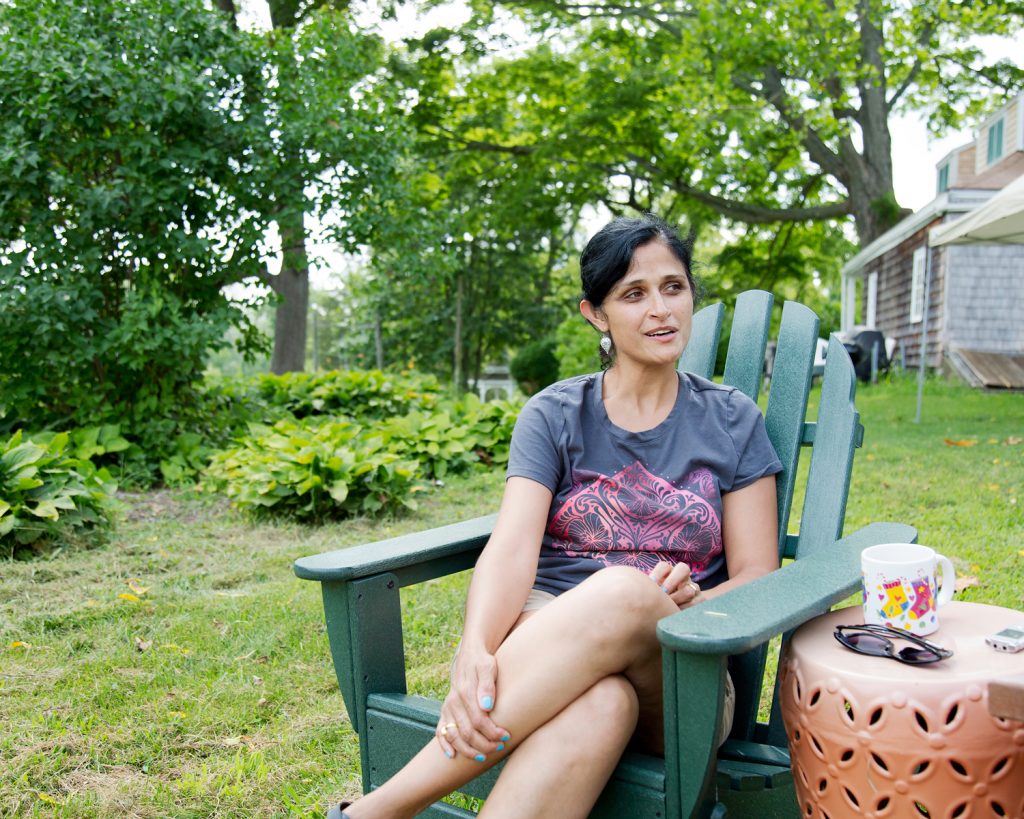
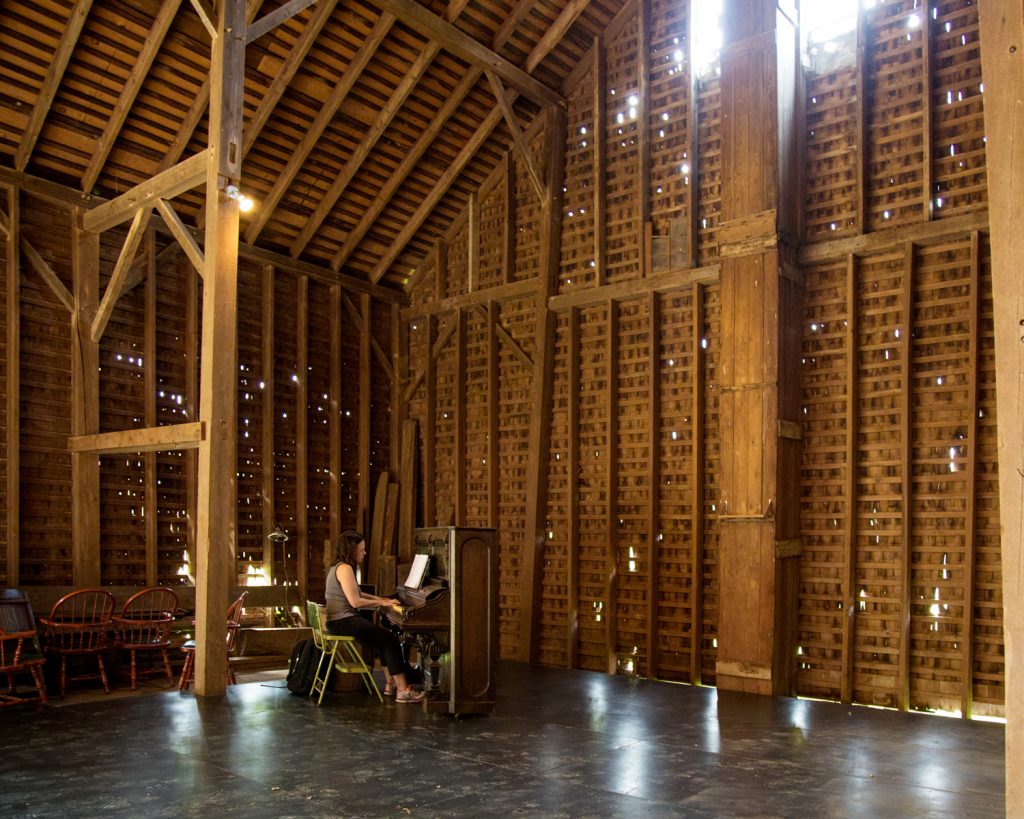
Very few writers’ retreats or artist residencies consider working mothers or single parents when it comes to programming. Enter Emily Simoness, co-founder and executive director of SPACE on Ryder Farm, who identified the issue and got to work. She created a first-of-its-kind family retreat, developed in conjunction with The Lilly Awards, aimed at supporting working parents and their children by providing a space for the artists to create, while also providing a creative and nature-focused program for the artists’ children.
 

We visited the farm during the week-long Family Residency program and sat down with Emily to learn about the development of the program. We also sat down with two of this year’s participating artists, Georgia Stitt and Deepa Purohit, to learn more about this unique and vital program.


SPACE on Ryder Farm Family Residency
 

Gina Rattan: How did the family residency come about?
 

Emily Simoness: In 2014, there was a playwright and a designer who asked if they could bring their kids. Christine Jones, the designer, was curious if she could bring her two boys up with their sitter, and then Sarah Gancher was curious if her son could come up and we made allowances in both instances because it just felt like we should try to make that work.
 

GR: How did the Lillys get involved?
 

ES: I somehow got wind that the Lillys were super interested in an initiative like this, so we connected and one of the great benefits of SPACE is that we’re still young and nimble. SPACE is not super bureaucratic or institutionalized. We’re able to pivot in a shorter time than an institution that plans two years in advance. As long as the insurance is good, and we are able to fund the program, we’re able to execute. So I said let’s do it this summer. That was last year, 2015, and we invited six women and their kids and it was good and productive. The kids had programming with Megan Cramer, who’s a really extraordinary educator and if it wasn’t for her I don’t think I would have felt comfortable doing this because I want to make sure the kids have great experiences. The kids had their special time and programming, the parents had time to work on their craft and we all came together for the three meals, and it was a total win. So we opened it up for applications this year.
 

GR: So it was a test run last summer where you knew the people and could see how it went?
 

ES: Exactly. I was overwhelmed with the amount of applications, and the level of applications this year. It was articulated in a lot of these applications that I haven’t applied for an opportunity like this in a year or four years or seven years because I didn’t feel invited, or I didn’t feel like I could bring my kid, or I have to choose between my child and my work…all the different reasons that we make the choices that we make.
 

GR: Were they mostly female applicants?
 

ES: 99% Female. I felt like I was reading these years of deferred applications, one after the other. It was really hard to pick. We’re contemplating next year doing two weeks just because the need is so strong. It’s also nice in that when there are kids in residence you get up earlier, you have dinner earlier, you go to bed earlier. Everything’s more civilized. It’s not debaucherous. We were leaving dinner yesterday and I was taking a couple of the staff to Trader Joe’s to get food or something and it’s still light outside. It’s nice. And it’s so clear that the demand is high, it’s so obvious that this should be a thing.
 

GR: Is it more costly for you because you have to put together programming for the kids?
 

ES: Yeah.
 

GR: So you have to hire more staff.
 

ES: There are more people here. Because typically we don’t double-up in rooms – there are double beds in rooms but we don’t double the occupancy in a lot of them, but with the kids we do. So it’s just a bigger number of people, the childcare is really significant.
 

GR: So who comes to do that?
 

ES: The child care?
 

GR: Yeah.
 

ES: Megan Cramer was at the 52nd Street Project forever. She now works at a school in Atlanta. She’s this amazing educator. Then there are individuals that work with her, Michael Calciano, who was a former SPACE intern, he’s an actor and he works a lot with kids, and then there’s Lindsay Torrey who’s been at the 52nd Street Project who also is an actor and works a lot with kids. They’re the same team that did it last year, so it’s been really nice to have them back.
 

GR: So it’s an arts camp?
 

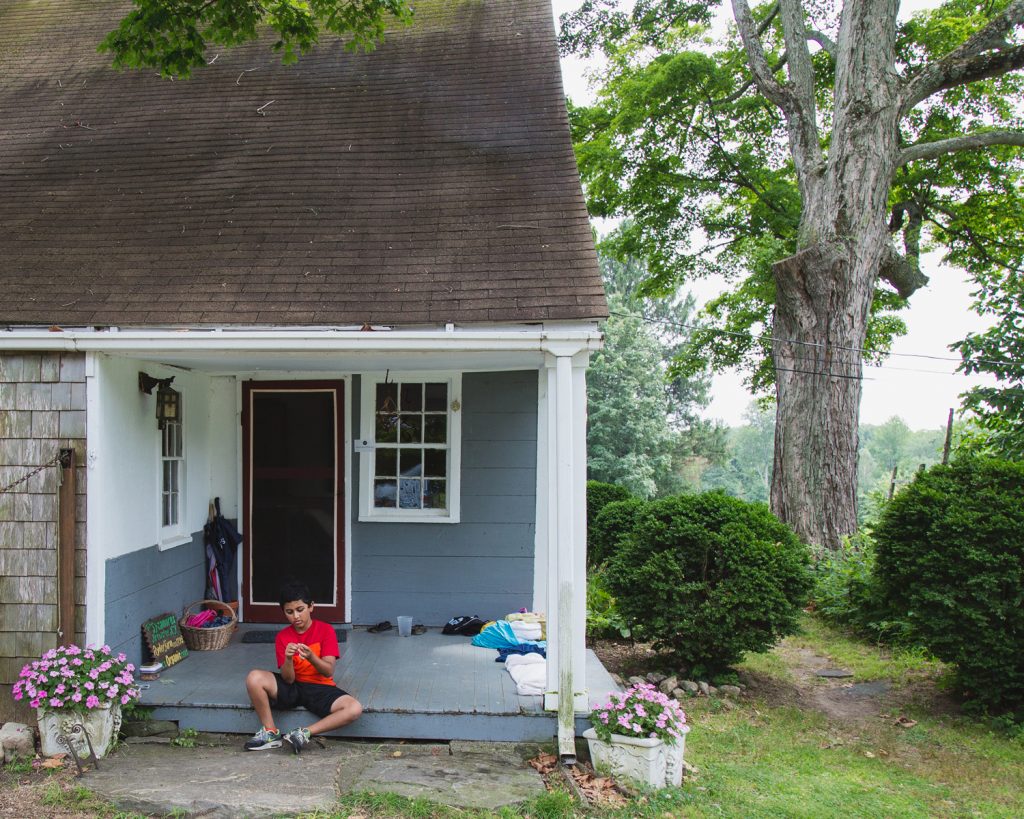
ES: Yeah. Art and farm camp. At 4pm, Alan Ryder, who is my cousin and has the eight sheep on the farm, is going to come and show the kids the sheep. Which is adorable.
 

GR: They’re gonna love that. They were running after them earlier.


SPACE on Ryder Farm Family Residency
 

Michelle Tse: You’re a board member of The Lilly Awards, where the idea for this program came about and was developed with Emily and SPACE. I know Julia Jordan was up here last year testing this out. Tell me more.
 

Georgia Stitt: Julia and Pia [Scala-Zankel] came up last year for the pilot program of this retreat. The idea for this whole thing was born at a Lilly board meeting. We were sitting around talking about the challenges of mid-career women writers and we all identified with the same problems. All of us in our 30s and 40s with kids confessed we had not applied to writers’ retreats for a decade. There comes a point where the thought of leaving your kids for a week or two or three to go work on your art feels, in a way, self-indulgent, and it’s more than your family can handle. So we all stopped applying because it didn’t seem practical to go.
 

MT: Unless it somehow fits in perfectly with a school break.
 

GS: Certainly during the school year it’s hard, and then during the summer – I mean, I’ve certainly done it before, where I leave my husband in charge of the kids, but we wind up paying so much in babysitters and hiring other people to fill the second parent role – it’s just this hardship that the whole family absorbs.
 

MT: And perhaps dads don’t get as much flack for it.
 

GS: Culturally, it’s less of an issue for dads. I’m not saying there aren’t stay-at-home dads who don’t feel all the same challenges, but culturally, nobody blinks when a dad goes away for a week to work on something. When the mom goes away, the question is always, Where are your kids? Who’s taking care of your kids? My husband doesn’t get asked that.
 

MT: Right. So this idea was born…
 

GS: So at this board meeting, we were talking about how many of us had not applied to retreats in a long time. There’s that idea in the corporate world that men make deals on the golf course and women usually aren’t invited to participate. I think it’s changing in some ways and not changing in other ways. But this, the writers’ retreat, is our industry’s golf course, in a way – you meet other writers, you form collaborations, you have this structured but unlimited time to produce your work.
 

MT: And a welcomed break from the city.
 

GS: I think all of us in that room said, it’d be different if we could bring our kids with us, but that just seemed so unrealistic. So Marsha [Norman], Julia, and Pia, and the whole team just started running with… well, why is it unrealistic?
 

MT: Little did you all know, it was very realistic.
 

GS: Some of the first family-friendly ideas we had were more about taking a pre-existing place like Williamstown or Sundance, partner with a day camp in the area, and perhaps we could provide funding for it. For example, if you go to Williamstown, you could send your kids to the day camp right next door. Out of that idea sprang this idea. Emily stepped up and said, let’s try it!
 

MT: It’s always such a blessing to have that one person believe in trying.
 

GS: Julia said [during the pilot program last summer] that everyone had been productive and the kids had a good time, and it was everything it was supposed to be. So we did it again. This is the first year we had open submissions from the writing community at large.
 

MT: So you applied through that open submission process?
 

GS: Yes. I’m here as both an artist and as a representative of the Lillys to keep an eye on the retreat to see how it’s going. But in the future, our hope is that no one from the Lillys has to come, that it’s for other artists.
 

SPACE on Ryder Farm Family Residency
 

MT: What are you working on this week?
 

GS: I have two projects that I’m trying to get progress made here. I’m working on The Snow Child for Arena Stage, which is mostly done but I’m doing a lot of editing and shaping work on it. Next week, I’m going to Rhinebeck Writers Retreat with Hunter Foster. He and I are working on a brand new show, so I’m trying to generate some content for that while I’m here.
 

MT: Has it been a productive week so far?
 

GS: For me, I’ve been very productive. I came up with a huge to-do list of tasks – compositional and organizational – that I need to get done, and I’m just knocking through them. I hear the kids running around – they’ve been at the lake, they have their grilled cheese sandwiches and their apple slices for snacks…
 

MT: …and they’re having a dress-up class right now!
 

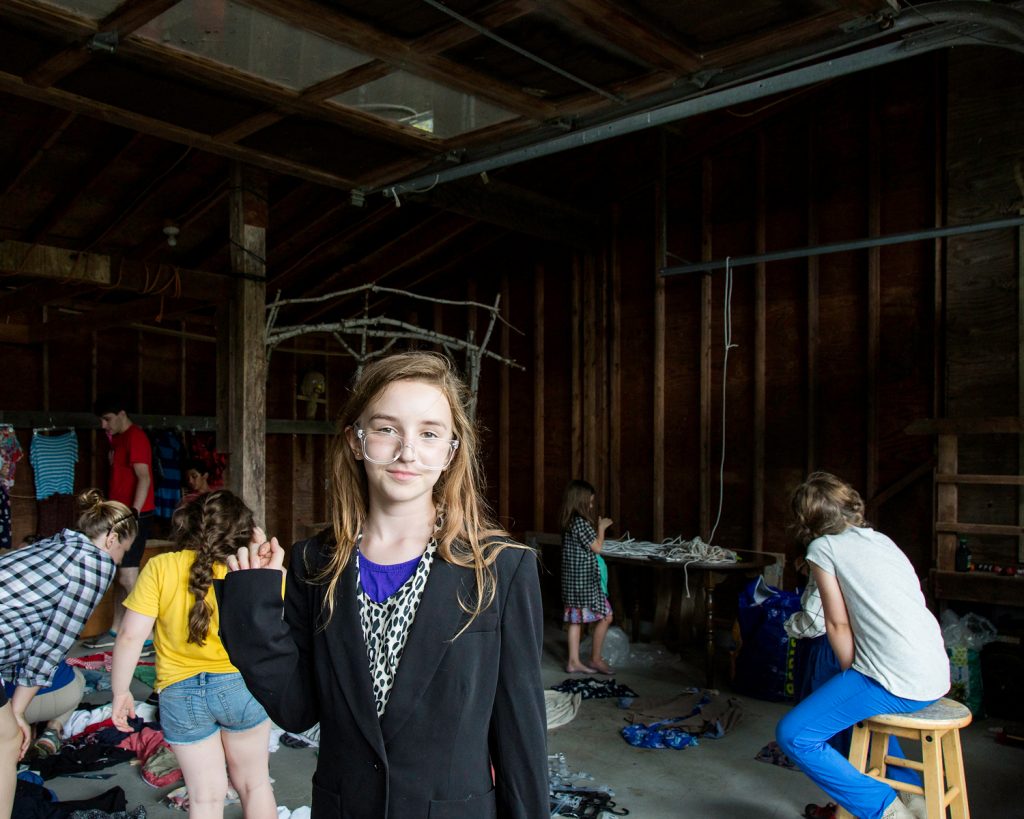
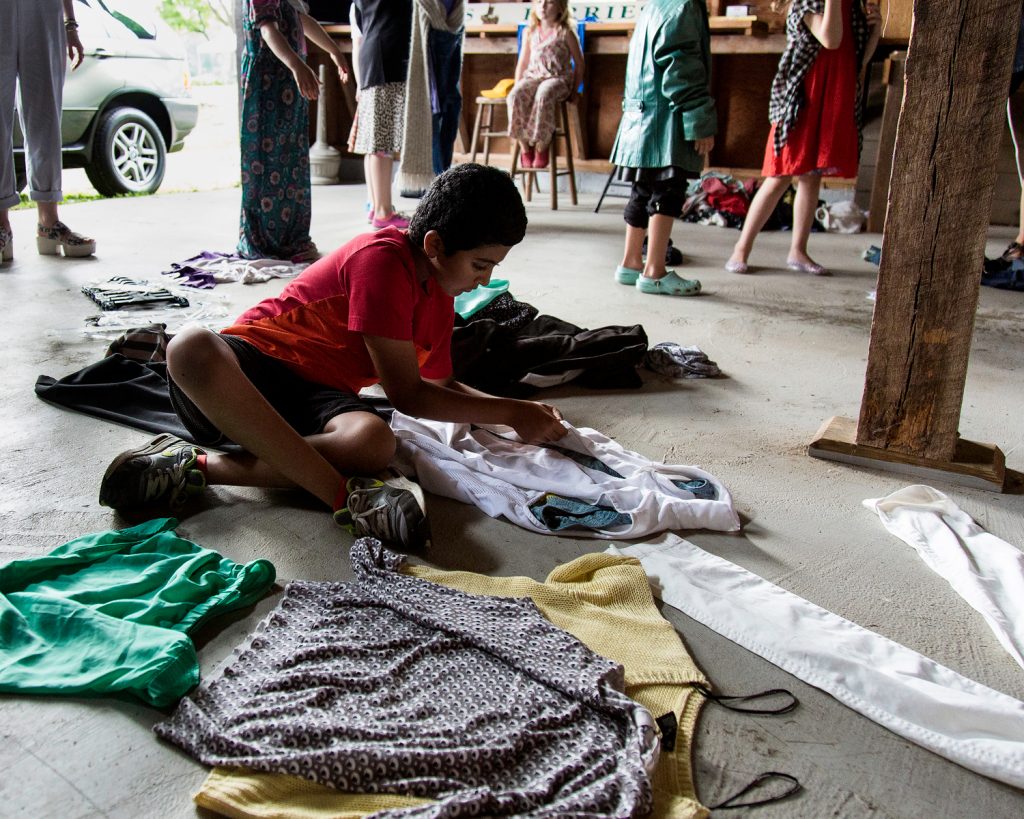
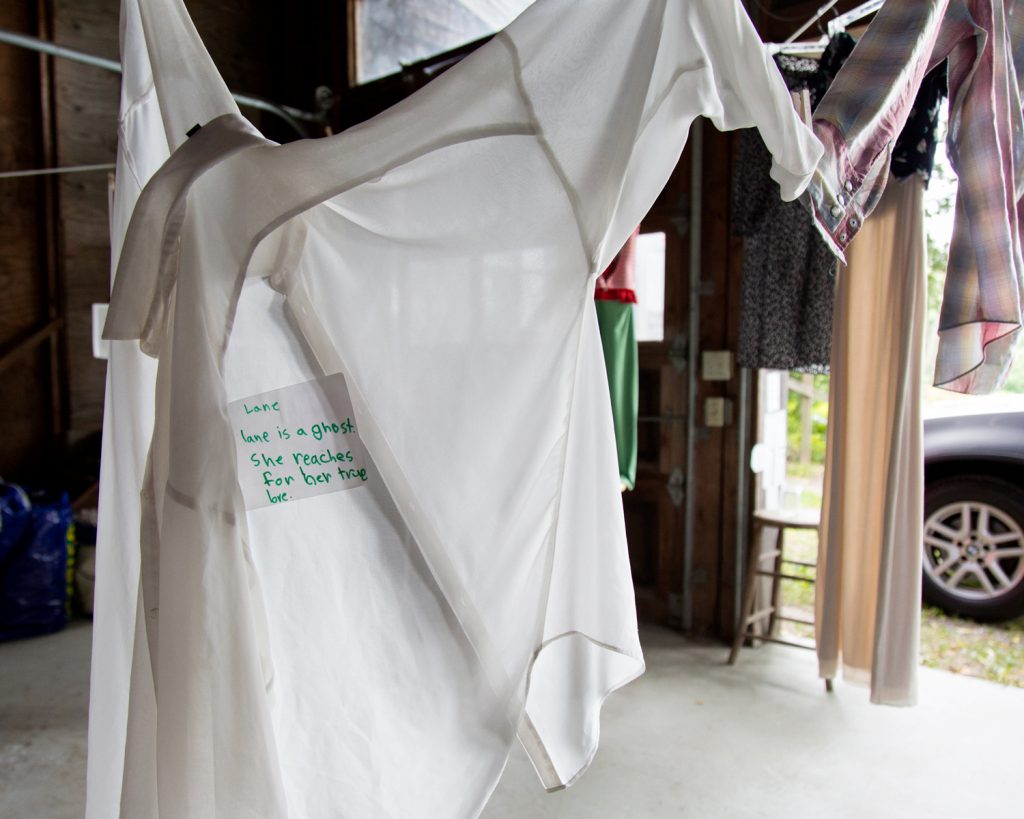
GS: Yeah! There are all sorts of projects. The dress-up party is part of Louisa [Thompson]’s project. She’s a set designer and she develops children’s theater. The dressing-up has to do with helping kids identify when clothes become costumes, when they’re not just clothes, and when they’re a part of a character. She brought in a lot of costumes and is helping them build and imagine characters.
 

MT: We peeked in earlier. The kids are having a ball. It’s like summer camp except mom is an earshot away.
 

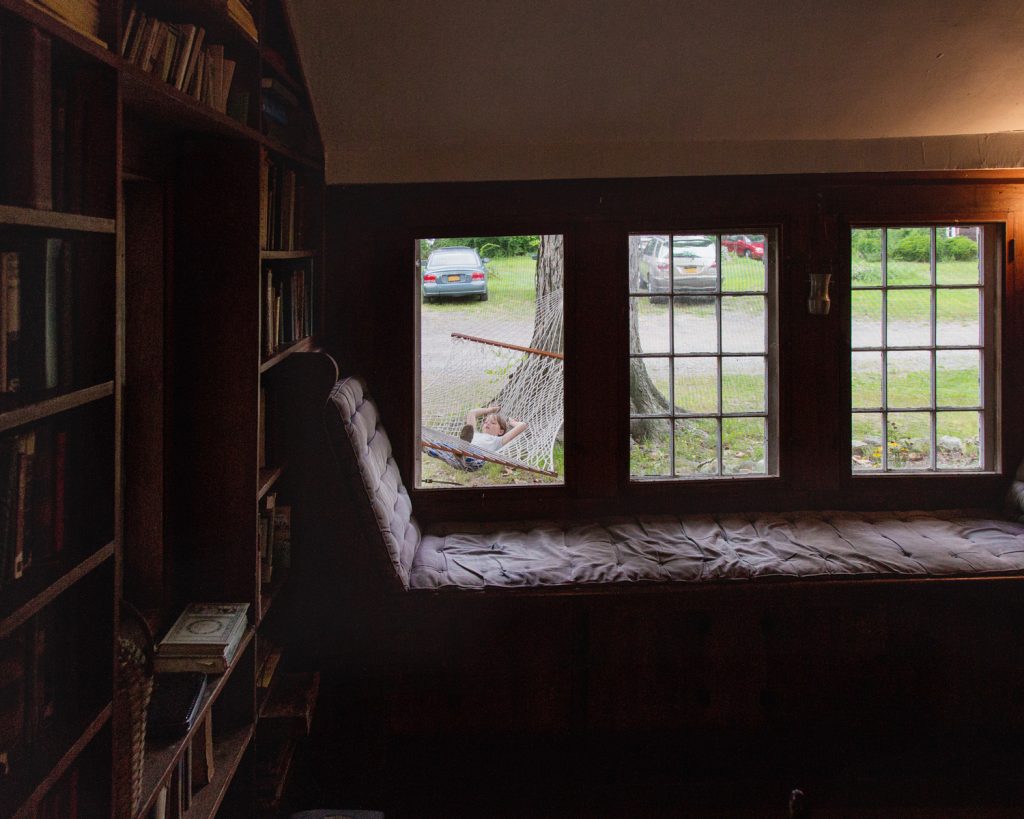
GS: Yeah. Earlier today, we finished lunch, and my youngest was on the hammock and she hurt her finger. She’s six years old, so she came to me crying. I said, come sit with me on the bed and we snuggled for ten minutes, and then she went on her way. Those are the things you miss when you’re not around. Somebody else would’ve comforted her, and she would’ve been fine, but being able to be her mother shouldn’t have to stop just because I’m working.
 

MT: That’s fantastic.
 

GS: I’m also less worried about my kids than I would be if I’d left them in the city. Everything for them stops at 6pm here. We have dinner at six, then if the adults still have the energy, they can return to work at nine or so. I guess that break wouldn’t happen if the kids weren’t here…
 

MT: But that’s the trade off, and your kids are here!
 

GS: Right.
 

MT: Wait, hold on – 6pm dinner?
 

GS: Well, I was here at Ryder Farm once before, and it was a very grown up experience. Meals were all later – that was an adjustment we made yesterday. Dinner on the first night was at seven and all the moms were like, umm…this is going to be hard.
 

MT: So they made it earlier.
 

GS: Yeah. All the meals are about half an hour or even an hour earlier than Ryder Farm usually does them. Breakfast here is usually at 9, and we’ve been doing it at 8, 8:30. Dinner is usually at 7 and we’ve been doing it at 6, because the kids are hungry and they don’t want to wait!
 

MT: And I’m sure the menu is different.
 

GS: Yes, yesterday we had a beautiful garden salad and stuffed baked potatoes, and the kids were like [mimics their blank stare]. So today they did grilled cheese and potato chips.
 

MT: Everyone likes grilled cheese and chips. And it’s so nice to be out of the city.
 

GS: Yeah, I don’t think the kids realize what a treat this is. They’re having a great time, but I don’t think they realize what a big deal this is. They are city kids out of the city, though. They’re scared of the crickets.
 

MT: Of course.
 

GS: They were like, “Mom, I can’t sleep! There’s a bug! I can hear it!” I said, “Yes, it’s outside.” There was one bug that was closer so they could hear the buzzing by their window even though it was outside.
 

MT: But they seem to be loving it here. They’ve got so many activities planned.
 

GS: Yeah, they’ve planned great things for them. Some of it is creative work, where the kids can create characters, write a play or songs, write a poem – some sort of creative element. This is in addition to things like swimming, and harvesting from the garden what we’re going to eat for dinner.
 

MT: That’s amazing. I’m jealous.
 

GS: Today, when they were out at the lake, they collected snails in a pail… I imagine they’ll return them. My kid said they saw flying fish. They’re kind of having guided nature time, which is good.
 

MT: Getting down and dirty with nature.
 

GS: Last night they took their baths and they’re just filthy. Filthy with farm, not filthy with New York City.
 

MT: Clean dirt. Not city dirt.
 

GS: Yes, it’s just dirt. Not smog and pollution.
 

[Georgia’s daughter walks in with one of her teachers.]
 

GS: Come sit.
 

MT: Honey, did you name your characters?
 

S. Brown: Yep. One’s Magnificent and one’s Maleficent. They’re sisters. I mean twins.
 

GS: And one’s good, one’s bad?
 

SB: Nope.
 

[Everyone laughs.]
 

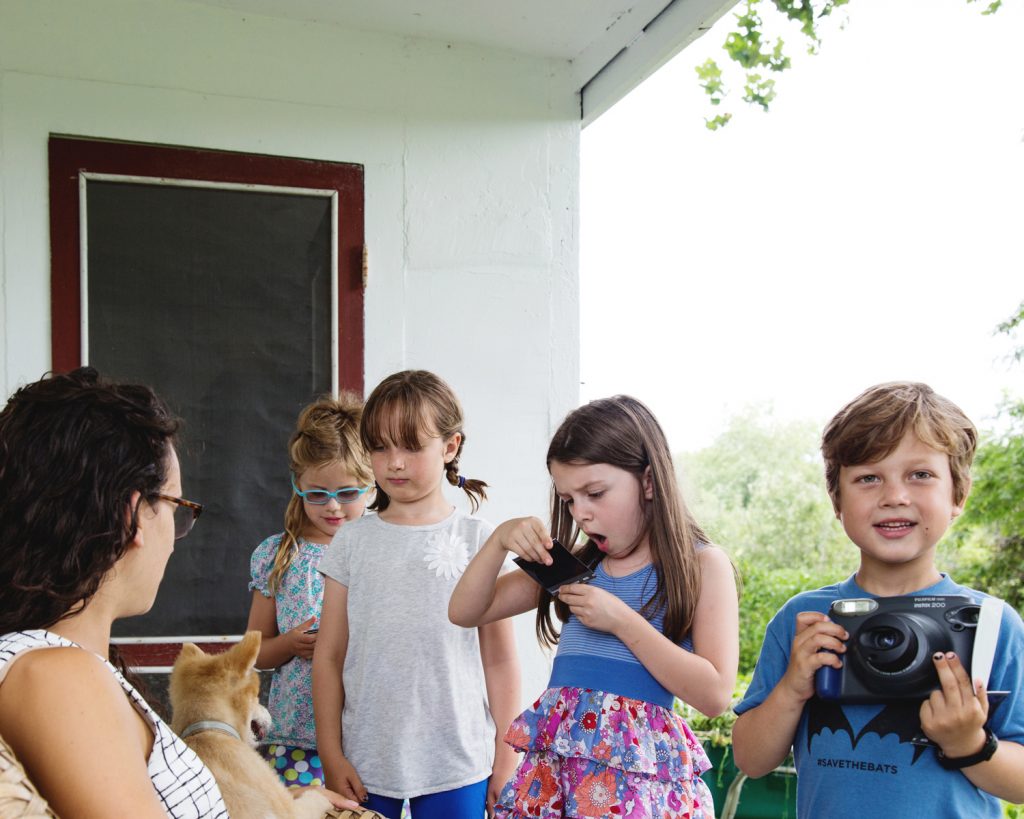
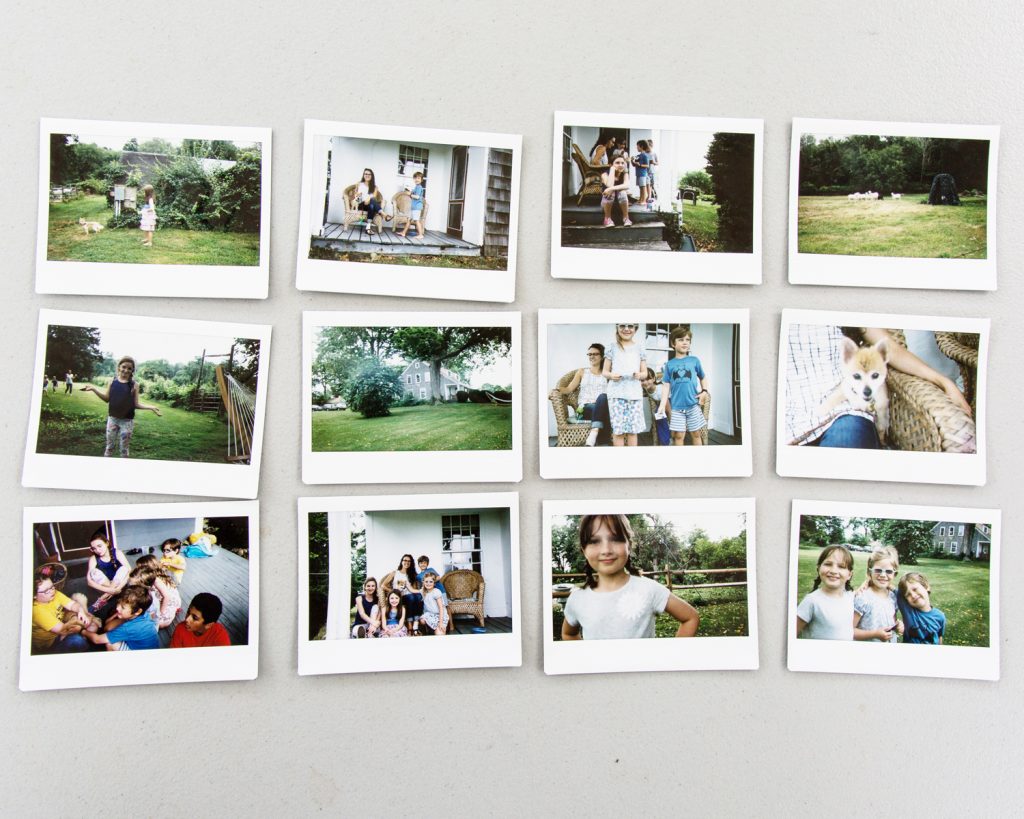
MT: By the way, you’re a really good photographer.
 

GS: She loves taking pictures.
 

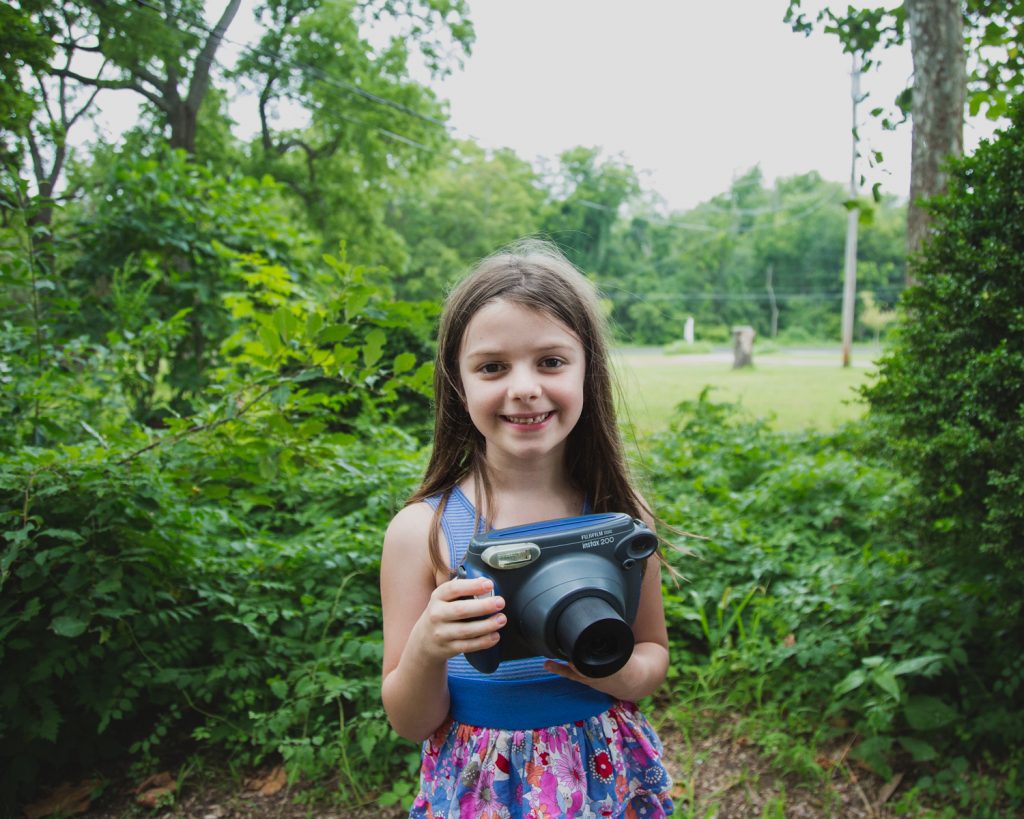
MT: I left the camera in there for you if you want to take more pictures.
 

SB: I know. I’m going to go check out the puppy.


SPACE on Ryder Farm Family Residency
 

Michelle Tse: How did you hear about SPACE?
 

Deepa Purohit: I applied last year, when a friend of mine told me about it. I’m coming back here for a week on my own in September and she’s coming too. Her name is Monet Hurst-Mendoza. She’s also a writer and we actually were in the theater company I started together. We’re pretty close colleagues and she had mentioned it and so I looked it up and thought, this looks kind of cool.
 

MT: Was it the working farm program?
 

DP: I applied to the working farm but when I was applying I was like, Can I really be away for five weeks? It wasn’t a problem because I didn’t get into it, but they offered me a week residency, which I said yes to. I had never been on an actual retreat before, so that was my first writers’ retreat ever, and that was last July.
 

MT: Did it change your habits of working since it was your first retreat?
 

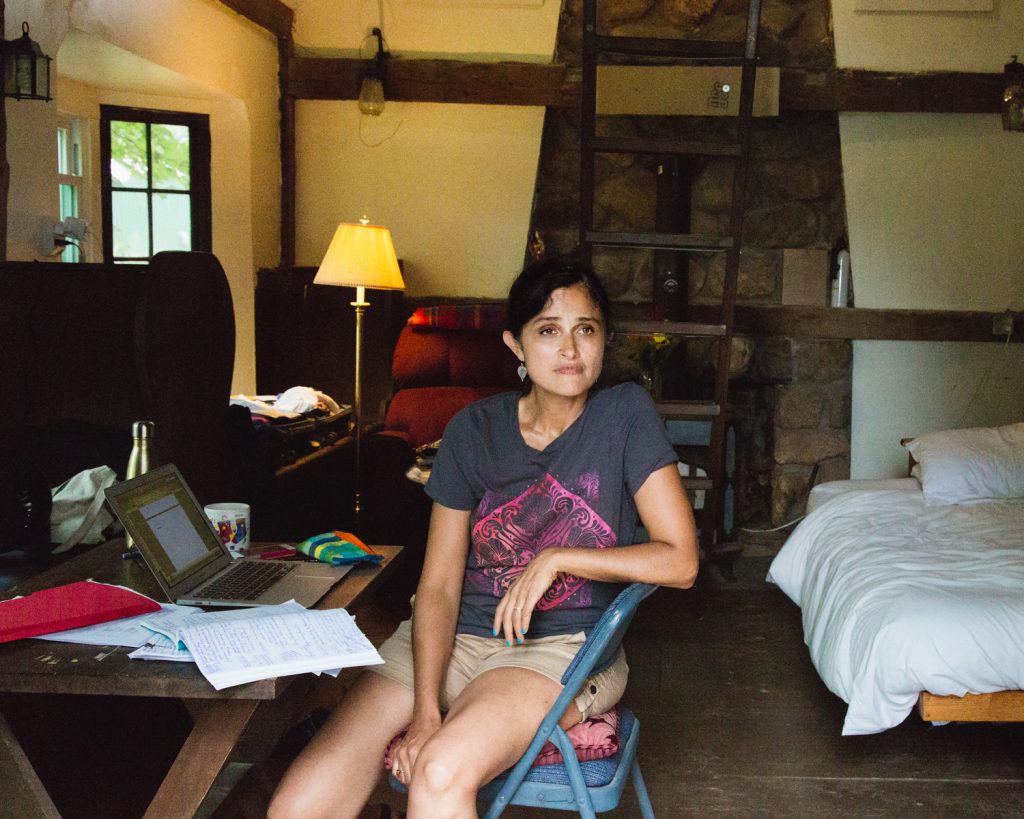
DP: It was great because I have never had the time to sit every day and have a routine for writing, so there were actually a few things routine-wise that I actually kept from that time. I mean, clearly I’m not able to write for eight hours a day because I work a couple other jobs to help pay the bills, but key routines have increased the amount of time I’m writing and my efficiency.
 

MT: That’s awesome. How did you hear about the Family Residency program?
 

DP: My husband was in this play Dry Powder that Sarah Burgess wrote here and these guys had a fundraiser. They asked him to join Sarah at the fundraiser for SPACE and asked if we would both come. Emily asked if I wanted to apply for the Family Residency and I said I was thinking about it. I applied and got in. I was considering it, initially, before she asked me, but I just wasn’t sure what my son’s schedule was going to be and when his camps were going to run. But that prompt pushed me to apply. The more I thought about it…I haven’t sent my son to sleepaway camp. I’m not that interested in being apart from him, so this is great. It’s a great opportunity.
 

MT: And the kids have their own schedule and their own classes.
 

DP: Yeah exactly, and it’s nice because I’m not the kind of mom that needs to be in all day activities. I like spending time with him, I like having our evenings and our meals, but I like him doing his thing.
 

SPACE on Ryder Farm Family Residency
 

MT: What are you working on this week?
 

DP: I’m working on a piece that I worked on last year here. It’s a very personal piece in that…I met a woman ten years ago who turned eighty this year. She’s a good friend of mine, and even a better friend now after going through this process, and she’s a Sri Lankan woman who left Sri Lanka in the 1950s, when she was about eighteen. She moved to London and hopped into the jazz scene. She was a really talented singer and piano player, and she kind of, in some ways, fell into and in some ways found her way into jazz, because her father was very passionate about jazz.
 

MT: I already want to see this story. What’s her name?
 

DP: Yolande Bavan. She comes from a very specific community in Sri Lanka called the Burgher community, and they’re a very mixed race group of people – they’re a mix of Tamils and Sinhalese and Dutch and Portuguese, but there’s a very European feel to their culture. When the British were there, the Burghers were actually highly educated, they were sort of that class of people that ran a lot of different sectors. Suddenly the British left and the Sinhalese took over and a lot of them left. They moved and migrated because a lot of them were worried about their status in the country so they moved to Australia and England. Some stayed, but she ended up leaving around that time because her father said, you should go to England; there’s nothing here for you here, really.
 

MT: Wow.
 

DP: She went to England in 1954 and she just found her way into the jazz scene. She had been listening to jazz music a lot in Sri Lanka – she would tell these stories about her dad who would get these guys, these Americans, who would come to the docks in Colombo and they’d have all these jazz records. He’d go down to the docks and trade jazz records. He introduced her to Duke Ellington and all the people who were not doing Dixieland because at that time, Dixieland was really big. They were moving into bebop and stuff like Count Basie, that were really going into this complex jazz stuff so she got really into that.
 

MT: So she found her art and stuck with it.
 

DP: She started acting in theater and TV and then she was, in her eyes, plucked. She ended up having this range and this ability to hear music and mimic it right away, is the short story of her coming to the States.
 

MT: Why tell her story?
 

DP: Her story is really interesting and the reason I’m drawn to it is because, number one, when she was doing readings and things for me, she was in her 70s playing all the mom roles in my plays. She started to tell me about her life and I was like, who’s going to tell her story? She’s been around some really famous people – she was a protege of Billie Holiday’s, she knew Sarah Vaughan and Joe Williams, these big people – and in the jazz circles some people know her name but beyond that not really, and in the Sri Lankan world, definitely, she’s gone back and given concerts and things and I thought, I’m going to tell her story. But it’s not going to be a bio-play, it’s gonna be something cooler.
 

MT: Of course.
 

DP: So the last three years I’ve been doing interviews with her, taping them, transcribing them, writing drafts of the play, and really trying to find: what is the play? What is the story? Last summer when I was here, I was in a real block, and a friend who was here, who I met here at the farm, is an Australian playwright – she’s actually based in London now – she said, “You know what, it really sounds like you need to get Yolande, you, and the play in a room and do this exercise and just write, see what they all say to each other.” I thought, I’ll try whatever, I’m so blocked with this. I had so much material and I didn’t know what to do with it. I got them in the room and I wrote crazy amounts of material and created a play that was about creating this play and our relationship.
 

MT: How has the piece progressed?
 

DP: I did a reading of it in the fall of last year, and she was in it, because the whole thing was that I want her to be in what I’m writing. It was a very bizarre, meta-experience because a lot of it is about our tussles and differences around it and what we wanted this thing to be. A lot of the writing came from conversations out of which tension came, and both of us are non-confrontational, so there were very interesting dynamics. She did the reading full-heartedly and was amazing in it. It was a first-draft play and had a lot of flaws and I was ready to rewrite, and in the meantime, one of my friends said, “You need to take a break from the play and then go back to it.” And I thought, no, I can’t, she’s turning eighty. I need her to be in this play.
 

MT: I get that though, sometimes you need a mental break.
 

DP: I did take a break. I wrote another piece and came back to this, this summer. And as I came back to it, I realized, oh my god I’m in another block. I was having a lot of conversations with her and she was asking, what’s this play going to be? And I was not giving her the answer because I didn’t know. She had very much been saying she wanted to do a play with songs about her life, people tell me I should write a book. And I’m not going to be that person. Even though I have all the material, I don’t want to write that book. So there was a lot of that dynamic going on, and I thought, I can’t do this. I’m just going to write what she wants.
 

So I’m writing a cabaret of songs and her telling her story, directly addressing the audience, which is something I never wanted to do – totally traditional, whatever. I started doing that this summer through a class I was taking, and every time I walked into the class I would be like [sighs]. I was stuck again. So I thought, let’s trying having this conversation again. I brought a scene into class that was me and her having conversation, and everybody was like, whoa, that is really interesting. So now I’m back in that place, but I think I’m taking everything that I learned with me over the last three years.
 

MT: So the piece is taking on a new form.
 

DP: I kind of don’t trust myself at this point, because I’ve felt like this four times, but I think this is part of the process to write a play about a person you’re close to, who’s alive, who you’re interacting with all the time – we’re kind of codependent. She’s a bull and she’s been through a ton in her life and that is the honor that I want to bestow on the stage, not only the flaws between us.
 

MT: How has your personal relationship informed and shifted the piece?
 

DP: There are two things that happened. She took a fall about four years ago, onstage. It was a plebeian kind of fall where she missed her mark onstage and she fell backwards and missed a chair. So she went on with the show and the rest of the run but what happened in that fall was that she had crushed her entire coccyx and so she was in excruciating pain and then had to have a nine-hour surgery to reassemble her back. So for the last four years she’s been in recovery for that and she’s a woman that’s a mover and a shaker. She’s tiny, she’s always on the move – her life has always been on the move. She’s crossed oceans, and I think I realized for the first time this last summer was, oh that’s what these few years have been about, being still.
 

Around the time she took that fall, my father passed away. He had been sick for a couple of years. I think we met at a time where we were both facing mortality in a different way. The other piece is that I’m officially realizing I’m in middle-age. That’s also about looking on the horizon thinking I’m not thirty-something and I have forever to do something, and what does that mean for me as an artist when I’ve spent the last fifteen years struggling to even define myself as an artist? I was an actor and I still do act. I wonder if I’ll act again. I write – I’m really just emerging as a writer in middle age – not really having done a lot of writing that prior to it…so there are a lot of issues around mortality for both of us that are really different. So I do imagine this piece like we’re looking in the mirror, but the mirror is open and we’re looking really at each other.
 

MT: And it must be interesting to explore mortality in a place that is as old as this. The farm and its structures are older than the town, but everywhere you look, new life is growing around you.
 

DP: Yeah, this house is interesting. There’s all these artifacts from all these different times. I don’t necessarily want to walk through this house because I don’t relate to it culturally, because there are all these pictures, of white people, and there’s this feeling of it being an American place, and I don’t have a legacy in that way in the United States.
 

MT: As an immigrant, I get that.
 

DP: If I were to walk into a stone house that was only cooled by the fact that it’s stone, and it’s concrete and people are lying their mats on the floor or they have beds or whatever, that seems more a part of my past and time. Where Yolande is interesting because she’s got so much European culture in her blood, this house would actually be quite evocative for her, even though she’s coming from a South Asian country. A lot of her life has been as an outsider, even within her own country in so many different ways. As a woman…what woman in the 1950s was leaving her country, not getting married, and going to sing jazz?
 

MT: Unheard of, especially in Asia.
 

DP: All these women who were in school with her were getting married, cooking curries and having kids, and that wasn’t her. So there’s a real trailblazer aspect to her and her story and I stand on her shoulders. So many of us do. And there are lots of people like her but this story is unheard.
 

In the Asian community, there are so many people whose shoulders we stand on but we don’t even know unless we really ask. And I would say, for me, I’ve taken it for granted, but every time I look at the material or go back to listen to her interviews…she’s like a regular person to me and we have a regular relationship that’s fraught with love and annoyances or whatever but then I’ll listen to these things and I’ll just be like…holy shit. This woman is on her own, just trailblazing, even now at the age of 80.

Posted on

A Conversation with Emily Simoness

Emily Simoness SPACE on Ryder Farm

 
Emily Simoness and I met seven years ago on a blustery January morning. Emily was an actor and I was working at Disney Theatricals. It was 6:45am in Harlem; we were stationed outside of the Apollo Theater, registering legions of hopeful young Simbas and Nalas for an open call of The Lion King. As is customary among chilly compatriots working an open call, Emily and I stole time to make small talk. Warming on our hands on dunkin donuts coffee, we discussed, among many usual topics, our aspirations to make a lasting impact in the industry in the interest of new, exciting, and vital work. We spent a harried day freezing and thawing our fascia all for the sake of the dreams of these little ones — and a paycheck from doing work in the biz.
 

After spending the day with Emily I was struck by two wonderful things about her: she was confident and powerful in a warm way. She has nothing to prove – she knew she had a place at the table just by virtue of her passion for art and artists. She’s not arrogant. She knows she can make a difference, and does. She sees you. She listens attentively without waiting for her turn to speak. Okay, so maybe this is more than two things. If you don’t know her, you don’t know it’s hard to just pick two. And if you don’t know me you don’t know that I say “just two little things” which eventually leads to an effusively extended list.
 

When Emily created a space for artists I wasn’t surprised. But, SPACE?! Who knew the woman had a three hundred year connection to a farm in upstate New York? I don’t know that for much of her life even Emily knew. I love visiting the farm. Everyone you encounter looks well fed and contemplative and yes, they really are all theater artists. They’re well fed, nurtured by nature, and trusted to do their work. Emily’s leadership on the farm is apparent not only in her involvement but also in her delegation. She trusts those she’s hired to be ambassadors of the SPACE mission – let the people do the work in the most beautiful place with the confidence and validation that just being at SPACE is enough.
 

What follows is the transcript of what always proves to be an enlightening conversation with a very real, very honest, and very special person. Emily, thank you for the space. From all of us.


Gina Rattan: So is Ryder Farm your mom’s side or dad’s side of the family?
 

Emily Simoness: My mom’s.
 

GR: Was she ever out here?
 

ES: She was born in upstate New York, but she never visited the farm until I visited the farm. So her father, my grandfather, had been here a lot but she had never visited. So it really wasn’t until…she told me tales of it when I was a kid, and one of my aunts had visited a few times, so she told me about it. Now they come and visit. My branch of the tree was sort of far flung – my grandparents moved them all to Wisconsin and they weren’t really involved – and now they’ve come back, which is cool.
 

Emily Simoness SPACE on Ryder Farm
 

GR: It’s cool that it skipped one generation in your family and has now come back. What brought you here in the first place?
 

ES: That’s the part I still don’t know. I had heard about it as a kid. We would get like a yearly letter from the corporation which owns the land, which is comprised of 87 family members, and I remember getting that letter and I remember hearing about it and then I honestly don’t know what made me cold call Betsey Ryder, who is my fourth cousin once removed. I called and said, “I’m Emily, I’m related to you, can I come and check out the farm?” And she was like, sure. But I don’t know what made me curious.. I was an actress, I was bored, I was curious, and the farm seemed so groovy. That’s the part that like…I don’t really believe in God, but…destiny or something. It’s weird. It was great timing. It’s very clear to me why I stayed, but why I went in the first place? I don’t know.
 

GR: So, now the dream has been realized, right? This incredible place exists, you have a phenomenal team, and really well-developed programming. Is your ultimate goal achieved?
 

ES: Right now, because this 1795 homestead is not insulated, we’re limited with the time we can be here because the winters are not bearable. One of the things I’m interested in is getting the place (buildings) online for the whole year, what that would look like, and what that would necessitate. It’s something I really have my mind on.
 

In terms of the first six years, I do feel like it’s been a test kitchen. It’s been great, and successful – we’ve tried a lot of different things. We started out with just a general residency, which meant that any individual artist or artistic organization could apply with a project. Now we have the Family Residency and the Creative Solutions Symposium, which is for those working in the social justice space and are looking at creative solutions for their organization’s mandates. We have The Working Farm, which is where seven or eight playwrights come up for five weeks and they all work on a play. Additionally, we support a bunch of institutions, and they come up and either work on strategic planning or workshop plays for their next season. We also just hosted a week of social justice activists, their guiding question was how to combat racial inequity. I would say 80% of our constituents are theater artists, and the other 20% sort of wax and wane between activists and dancers and some visual artists, musicians, and filmmakers. Next year, we’re really going to clarify the communities we’re serving are and why; who’s primary and who is secondary.
 

GR: What’s down the road in the immediate future?
 

ES: We’re also on the brink of a capital campaign. We’ve done what we can do with the existing physical plant. We’ve rehabilitated these structures and started renting them; the outdoor stage was built – there’s now a stage in the barn – and there’s now a dock on the lake. We’ve converted a chicken coop to an artist studio. There isn’t any other existing structure that we can do anything with. We’ve had some informal performances in the barn, and I really think having a barn-like structure, whether it’s the existing one or a new one, would allow us to have rehearsals and workshops and present shows and hold conferences for farmers. Part of what I’m trying to sort out is what the earned revenue engine is of this place, from a business standpoint. A commercial kitchen is on my mind, because that would allow us to take our farm-to-table dinner situation to the next level. And then, ultimately – and this is down the road – really looking to have a different housing set-up with artists and farmers. This house – which is called The Sycamores, and was built in 1795 – ultimately probably wants to be the show piece and a love letter to the family, so [I want] to preserve the house.
 

Emily Simoness SPACE on Ryder Farm
 

GR: Did you ever think you were going to be here, at this time, looking at all of these past and future endeavors? It’s really remarkable what you’ve all accomplished.
 

ES: No, fuck no. Thank you, and no. No way. I did not grow up in a rural setting so that wasn’t ever anything I saw for myself. There’s always so many new challenges here. The minute you figure out how to get your 501(c)(3) non-profit status and [figure out] what that even means, and what a board of a non-profit means, and all of those things…the minute you sort all that out, you have to hire staff and understand what that means, both from a person-to-person place and also a legality place. And then the minute you figure that out, you have to start working with building inspectors about what compliance looks like, in terms of buildings. It’s just a lot of different areas of learning. I think that’s been good for my temperament.
 

GR: Because there’s enough variety.
 

ES: Yeah. I’m trying to learn now what a conservation easement would mean. I don’t know a lot about that. Learning how people organize around that, and what a winning application would look like, and how that differs from a winning application from the NEA.
 

GR: What is a conservation easement?
 

ES: There are a bunch of different kinds of easements, but essentially it would ensure the land’s safety and security from development. So essentially, you apply to the state…well, you first get an appraisal on the land, and the appraisers tell you what it’s worth. Then you apply to the state and if you win, the state puts up 75% of the appraised value of the land, and 25% in matching funds is secured for the rest of the appraised value. So Ryder Farm would get paid a nice sum of money in exchange for agreeing to never develop the land, which is funny, because if you had said to me seven years ago that land conservation was of interest, I wouldn’t have even known what that meant.
 

GR: Or why it would be important.
 

ES: Right. It factors in hugely to me, because our artistic mission is a big one, but there’s also the mission of this family and keeping this land. I guess that’s another question. What’s next? Ultimately, I’ve got this thing in my craw about saving family farms through art, which sounds crazy. When I first said this to my mom, she was like, “So you’re putting a church on a farm?” But I do think that if a template can be created here, who knows? You might be able to take that to other places.
 

GR: Saving family farms through art, meaning people setting up similar things to this because it revitalizes everything?
 

ES: Yeah, basically learning from what we have done at Ryder and seeing what the components are that we can take forward into the next venture that would yield a similar result.
 

Emily Simoness SPACE on Ryder Farm
 

GR: Does this help make money for the farm? Or is not really about money?
 

ES: I think it’s more about reviving. This makes money because [SPACE] pays rent on the structures we use, thus we created revenue streams through rent. There are a lot of ways to skin that cat, but it might be a viable model. We’ve got a lot of work to do still.
 

GR: This seems like a place where no matter who comes here, they’re profoundly impacted by it and want to be around here. There’s something that’s revitalizing about the place. What a wonderful lifecycle for the artist to give back to the farm and continue to engage.
 

ES: Exactly. And I guess a question I have is, was SPACE a fluke? I doubt it. I’m sure there are other places like this that could use a similar model.
 

GR: Oh, especially being able to get out of the city and into a different place. It has been inspiring for artists of many generations, retreating to nature and the country and all of that…but something you guys do that’s unique is that the whole experience is very home-y. Everyone eats meals together that are cooked fresh in the kitchen with ingredients from the farm.
 

ES: Being in someone’s home is different than being in a dorm. Having your rehearsal studio be a barn or a chicken coop is different than being in a fluorescent-lighted, mirrored space. Actually, a lot of the feedback we’ve gotten, is that there’s something about the wildness of the land and imperfect nature of these homes that lets people feel like it doesn’t have to be so perfect, you know? The pressure is off. In the beginning we said – and it’s on the website still – that this is “your artistic home away from home.” It really does feel like a home. It wasn’t by design because we’re using what was here, but it certainly has been leaned into.
 

GR: Feeling at home and releasing your non-fluorescent work are correlated.
 

Emily Simoness SPACE on Ryder Farm
 

ES: At the beginning, the intention was to paint a wall or fix a ceiling so we could inhabit it. It wasn’t much beyond that. The fact that there’s a guy gardening there [points to the field] is hilarious to me, because for four years we didn’t even look at the land – I couldn’t take that on. I couldn’t focus on how to spackle a wall and how to erect a loft in the corn crib and how to insulate a structure and also look at manicuring the hedges.
 

GR: I like that idea; that being in a space that’s not perfect allows you to take the pressure off of yourself, or allows you to focus more on the process. This house is keeping me dry in the rain, it doesn’t have to be fabulous, so what’s the purpose of what I’m working on now?
 

ES: Right, which like, when we do “improve” the things here, it wants to be in line with this sentiment. I never want to get too fancy, because that’s just not what this is. I love the idea that people came to Taylor Mac’s performance here and used a port-a-potty.
 

GR: That’s the gig.
 

ES: That’s what this is, and most people are pretty great about that.
 

GR: In a way, it attracts a good fit artist-wise.
 

ES: That’s true. And I take that really seriously. That’s one thing I’ve really learned about this – managing expectations. In a lot of ways, this is a hospitality job. It’s really important for people to feel safe and comfortable. They know what they’re getting into and what it’s going to look like and I think that’s a part of feeling safe. They need to feel safe to be creative. It can be dangerous too, but there needs to be a container for it. There are so many variables here, like the weather…
 

GR: There are bugs, there are raccoons…
 

ES: Yeah, it’s like, really freakin’ old. That’s why the days are grounded in the three meals, so there’s some sort of grounding or common denominator.
 

GR: Well, yeah, it allows it to be a cohesive experience. Is it worth complaining about something when you have this beautiful meal in front of you and you’re all working away?
 

ES: The staffing has been a huge part of it, too. At the very beginning, it was like ten of us who were hardy and down and it was a totally different thing. There was no evidence that what you and I are talking about right now [SPACE] was ever going to exist. And then it was like I was on a life raft for a very long time with various founders who would come in for short spurts or we’d cobble together a little bit of money and hire a contractor for a stint, and then in the last two-and-a-half years we’ve really had people who get up in the morning and think about the organization like I do, because they’re paid to. That’s a radically different thing, and there’s so much responsibility that comes with that too.
 

GR: Well, it must’ve changed a lot for you to have full time support.
 

ES: Right, the fact that Maggie [SPACE’s Company Manager] was able to take you guys down to the lake, and that there are three contractors with the kids who are in residency with their moms, that’s the only way we can do this. I was never going to run this Family Residency program if SPACE didn’t have this kind of professional oversight. I would say that is the number one thing that has changed since the beginning. I mean, time is this crazy thing, because you’re like…could [SPACE] happen? Will all the things I want in terms of the buildings and the programs and the infrastructure come to fruition? Something that I can point to is staffing. It’s alleviated the strain and made us able to do more things and helped us serve people more deeply.
 

GR: I imagine, too, that every year you do it, the more you realize is possible, because you accomplish this, this year and then next year…
 

ES: That’s a big thrill of it too.
 

GR: Wanting more.
 

ES: There’s so much responsibility to do what I see as the right thing for now. But also…I’m seventh generation of this family. I want the place (the farm) to still be flexible enough so that the version of me 140 years from now could have some amazing idea that isn’t this idea. [Emily points down towards the road] You know, there used to be a tennis court over there. There was an apple orchard over there for a long time. Towards the back of the property, at the lake, is a forest, but 40 years ago it wasn’t a forest, it was pasture, which is crazy. I find myself constantly trying to zoom out, and that’s challenging.
 

Emily Simoness SPACE on Ryder Farm
 

GR: Right, what allows you to be here today is that legacy and then you are also realizing that you’re a part of someone else’s legacy in doing it. I wonder then what it would be like to make those decisions and go, “Okay, we don’t want this to be a prohibitive choice”…it would be so interesting to see how your relatives in the past made those decisions and what plays into it historically, because some of it is out of necessity, of course. You build this and that and build a forest or an apple orchard because it was time to do that.
 

ES: That’s what’s so crazy about it. Different iterations.
 

GR: I have a question for you about transitioning from being a freelance actor – which you were for years in New York – to doing this. In some ways you’re using similar skills – having to be bright, resourceful, and excellent at dealing with people, but in a very different way. That’s a huge transition. What was that like? Did you have regrets?
 

ES: It was hard. When I first came here, [SPACE on Ryder Farm] was a hobby. It was not a salary, it wasn’t even a thing…it was just this crazy notion that was distracting at a time when I needed a lot of distraction.
 

GR: Because you were unhappy?
 

ES: Yeah. I have tremendous respect for actors. My husband [Michael Chernus] is an actor, but it was such an unrelentingly hard profession for me. For Michael, [SPACE] would be unrelentingly difficult. I really believe that it’s all going to be hard, it just depends on what you’re built for and what you want to do. Anything worth doing is going to be hard. When I was an actor, I hated not being able to get up in the morning and have a thing I was doing. I hated waiting for other people’s permission and invitation.
 

I landed here in 2009 and I would say I really stopped acting in 2012. So for three years, I was still identifying as an actress. SPACE was a hobby on the side, and then all of a sudden – not all of a sudden, a couple mornings in a row, a couple of weeks in a row, and then for a couple months in a row – I realized, I am only thinking about Ryder Farm. I’m never thinking about being an actor. Right around the time that I started making the decision [to focus on SPACE] is when things really started to kick in for me. It was hard in some ways. Acting was my life. I went to conservatory and failure is not something that I had a good time with. Not to say that I was a failure, but my time acting was incomplete for sure. What I set out to do, I didn’t do as an actor, but I also didn’t want to be an actor anymore.
 

GR: Being a super successful working actor didn’t happen right away for you but you found something else that had a greater number of elements of what you were interested in.
 

ES: In a lot of ways, thank God success in acting didn’t happen right away, because we probably wouldn’t be standing here. At the beginning of SPACE, the concept appealed to so many actors. It’s such a tactile thing. It’s making something. There were walls to paint.
 

GR: Like, oh look I painted that, it’s done, it’s accomplished.
 

ES: Right, it’s really good for people. Something I really try to instill in the interns, the ones who are actors, is to figure out what you’re doing between acting jobs that is meaningful and uses your skills.


Posted on

Writing While Asian

Timothy Huang


“Dear Mr. Huang,” the email usually reads. “I was recently at your show at [insert venue here] and really enjoyed your work. I was wondering if we could have a meeting. I’m a [lyricist/librettist] in need of a composer and I’m working on a show that I think is right up your alley…” My eyes roll. This email/facebook message/tweet always seems to find its way to me – no matter where I run, no matter what disguise I’m wearing, or what wooden barrel I’m hiding in. And it is always awkward.
 

With the exception of one single time (hey, Marlo), what happens next is always the same: I take the meeting, the person has little if any idea what is actually “up my alley,” and instead is actually just a Caucasian person who wants to write about China but feels the need for some kind of political cover. And it breaks my heart. For so many reasons, none of which are what you probably think.
 

I’ve written about this before, but in order to really appreciate the cognitive dissonance, let’s talk about a few givens:
 

1. We live in a time where plays and musicals that aren’t about race can and should be cast color-consciously – aware and reflective of the diversity of contemporary audiences. This is a step forward.
2. We also live in a time where the playing field is still uneven. Characters within produced shows still largely reflect a heteronormative, Caucasian, male perspective. (This isn’t a bad thing, per se; it points to a deeper institutional exclusivity that’s a different discussion altogether – see below about the tail-eating snake.)
3. Because of this, when shows are written specifically for characters of color (or for that matter, of any diversity), we should always make our best efforts to cast them “traditionally” diversely.
 

So why is it, you ask, that if we adhere to this type of awareness in the casting of the show we should be blind in the creating of it? Isn’t the telling of a story as much about the author as the subject? I for one have seen countless shows about Asians written by non-Asians that were at best ill-considered, at worst offensive. Why shouldn’t all shows about Chinese things be written by someone who was culturally Chinese?
 

The short answer is, “Because if I want to write about #BlackLivesMatter, I shouldn’t have to be Black to write about it.” Nobody has the corner market on telling stories about other people or cultures. Period. What we do have (and this is part of the longer answer, so pay attention), is a responsibility to represent those other people and cultures as if they were our own – with the highest of standards and greatest integrity, with twice as much research and twice as much oversight.
 

During the writing of my full length Peter and the Wall, (which involves an American man who must travel to Japan to locate and identify the body of his deceased husband) it wasn’t just researching Gay culture in Japan, or government procedure for transporting a dead American citizen, though it was that as well. It was enlisting the help of three different Japanese and Japanese-American translators to get confirmation of pronunciation, and then scansion (some words “sing” differently than they “speak.” And sometimes my very American ideas “did not exist in Japanese thought.”) Then, when we got into workshop, it was things like “‘a concierge would never be this impolite’ vs. ‘But I need her to be the bad guy in this scene so he can be the good guy. How do I achieve that?’” It was, in short, a monumental pain in the ass. And it cost me many beers and favors. But each time, it was me with an idea and context, and frequently a finished execution being asked to modify. It was never “You do it. Whatever you do is okay because your last name is Matsui.” And it certainly wasn’t “I’ll just hire a Japanese director.” (Though if you’re out there and interested, give me a call.)
 

And here’s where the heartbreak comes. More often than not the shows I’ve been asked to co-write were born from a desire to exoticize, or otherwise re-appropriate Chinese culture and not, say, add a meaningful or deeper understanding therein. At the ground floor, if there isn’t a dramatic need for you to set a show “in an exotic locale” you’re fetishizing. If writing as an outsider is research and oversight, then hiring an insider is circumventing the former with the latter. These were never my stories to tell, yet embedded within the offers to co-write them was a tacit expectation that not only would I do the homework, but I would in part be the homework.
 

Now, let’s not talk about how the color of my skin doesn’t qualify me to write for the Erhu or Pipa any more than it qualifies me to write you a doctor’s note. My ethnicity is not a permission slip. The writers I have encountered were either unaware of their own responsibility, or just lazy. No middle ground. Either way, the eyes roll, the heart breaks.
 

But the good news is this isn’t where the story ends; it’s where it begins. Firstly, these invitations always come from decent if misguided intentions and any time there’s curiosity, there’s also room for recognition. I have a list of questions I always ask writers in this situation about why this story, why you, why me. Even if I know I want to decline the invitation, I take the opportunity to share the questions. Curiosity begets recognition begets responsibility. Secondly, that same curiosity manifests in general audiences as a desire to see what my former grad school professor and good friend Robert Lee, calls the “Third Generation [Asian-American] Show” to enter the conversation. These are shows where the ethnicity or self-identity of a character, while deliberate, takes a back seat to larger thematic ideas within the narrative: A Chinese-American protagonist, for example, whose journey is not about struggling to understand her first generation parents, but instead, must come to terms with her best friend who is in love with her. In this story, she is allowed to be Chinese American because such things exist.
 

And such things do. Just off the top of my head I can count fifteen plays and musicals that follow the Third Generation Rule (twelve if I’m not including my own work). These types of shows have existed for years. And while they have been produced on smaller scales, off-radar, their emergence into the mainstream is helping to dismantle snake that eats its own tail mentality: no one will produce stories like this because they don’t resonate with audiences, because no one will produce stories like this…. lather, rinse, repeat. Imagine then, what a difficult and monochromatic world it would be if the advent of these kinds of stories were coupled with the expectation that they be written only by people who had first-hand knowledge of that experience. The skin may be different, but it’s still the same snake eating the same tail.
 

Like the lyric says: Art isn’t easy. But it isn’t meant to be, and we won’t always get it right. My list of questions changes frequently because nuance is hard. But as excruciating as these conversations can be, they are always necessary for quality work. They may not yield bars of music, or fancy lyrics, but they are the telltale signs of marginalized stories coming into the mainstream. And that is not a bad thing at all. Curiosity begets recognition, begets responsibility.


 Timothy HuangTimothy Huang is a New York based writer of new musical theater. His full length musical Costs of Living was the recipient of the 2015 New American Musical Award, and the 2015 Richard Rodgers Award. Other works include Peter and the Wall (2013 Rhinebeck Retreat), And the Earth Moved, (CAP21) Death and Lucky (MacDowell Fellowship), the song cycle LINES (NYMF), A Relative Relationship (Winner, Best Musical, 2013 SoundBites Festival) and Missing Karma (2016 Samuel French OOB Short Play Festival). He is the creator of the one person musical The View From Here (cast album available wherever digital music is sold) and was a 2012 Dramatists Guild Fellow. He is also the recipient of the 2013 Jerry Harrington Award, a Fred Ebb Award Finalist and a two time Jonathan Larson Grant finalist. His song Everything I Do, You Do (with co-lyricist Sara Wordsworth) was recorded by Sutton Foster for the charity album Over the Moon: The Broadway Lullaby Project. To see a website made before the advent of smart phones, please visit www.TimothyHuang.net

Posted on

A Conversation with Lyndsay Magid & Josh Aviner

Lyndsay Magid & Josh Aviner


Walking into the studio where producer Lyndsay Magid and director Josh Aviner are rehearsing is like walking into EDM slumber party fever dream. As they tell the story, the performers walk the line between precision and wild abandon. We sat down with Lyndsay and Josh to talk about their dazzling hybrid of dance-circus-storytelling, SLUMBER, premiering at House of Yes.


Corey Ruzicano: I would love to start by talking about the language of circus. How does the cirque vocabulary add to or shift the process and limits of storytelling?
 

Josh Aviner: I think circus traditionally is very trick-based. Most different cirque disciplines have a series of tricks that you learn and do. In the last thirty years, a lot of circus schools have been focusing less on the trick and more on the over-the-top physicality stuff you might see at Streb. It’s closer to dance, but still circus-esque. A challenge for us is picking what tricks we think enhance the storytelling and which are just too “show-biz-y” to use. It’s a balance between, okay that trick looks like you’re choking her and is also a really impressive circus trick, versus, that one looks too much like a style, like it belongs on a more old school style show. It’s important to be familiar with the vocabulary, seeing a lot of different acts, and being able to say, out of the thirty tricks you can do, which are the fifteen that work best for what we’re doing, and then using Keone and Mari [Madrid, choreographers] to fill in the gaps to make the tricks look a little less like tricks and a little more like acting moments.
 

Lyndsay Magid: Something that’s been really interesting is that most circus performers come with a specific act and then there’s a process of restructuring it so it has the feeling of the song and the moment of the show, which is different than a traditional circus show where they just book the act.
 

JA: They already come with a song.
 

LM: They come with the song, they come with the act, that’s what you get. With this it’s: let’s deconstruct your act and mold it to fit the dynamics of the moment.
 

JA: That’s the fun part.
 

CR: I would love to hear more about what are the things that you love about doing this? As a pair you have such compatible backgrounds for this kind of work –what is it like working on a project where you’re both coming at it from such different angles?
 

LM: Well, I’m like, what’s the story? Who are you? What is their connection to each other? Because I’m a musical theater girl. Make me feel something. And Josh is like, I want to feel something but I want to be wowed.
 

JA: What’s special about circus, at least to me, is that in-the-moment, visceral reaction. When you see someone drop from fifteen feet and all you know is that the only thing catching them is their own hands, that gives you a gasp you can’t really get in another medium. So the tricky part is tying what’s best about circus and what’s best about theater, and now that we have Keone and Mari here, what’s best about dance. What’s interesting about adding dance is that it’s this level of precision that theater and circus don’t really have. Theater often, with the exception of Curious Incident, isn’t so specifically choreographed. Circus isn’t choreographed at all – it’s athletic, it’s a trick and then another trick. Having Keone and Mari has been so helpful because they point out that we can take all of these little moments in between and just by moving your hand in this direction you can add a whole meaning to it without text. And that’s been my favorite part.
 

We’ve been working on this contortion number with Olga, where the premise is that she’s coming back from being almost dead. Usually a contortion number is just picking the trick sequences and now that we have the song, we have all this cool movement you can do within a trick with your free hand or your free foot or leg or head, to make it way more creepy and make the character way more clear. So that kind of collaboration, taking what the artist brings to it, has been the most fun part.
 

LM: It’s almost like the dance is the bridge between these two worlds, it’s connecting it. When we started, I knew it would be additive, but I didn’t think it would be so connecting of the two. It’s so cool because we have the dancers and we have the circus performers, and both groups keep saying, I feel so out of my element. It’s not a circus show, it’s not a dance show.
 

Lyndsay Magid & Josh Aviner
 

CR: Absolutely. What’s it like when all these people who speak different languages get in a room together?
 

LM: It’s awesome. I think a lot of people would think it’d be hard, building a show with so many different vocabularies, but everyone is so game to do it. It’s funny, we’re doing lift and the dancers are trying to figure out how to do it, and the circus performers get it in one go, and then they’re doing a section where they’re dancing in counts and that’s easy for the dancers, but it’s so different from circus. So it’s really cool to see the different skills, it’s what makes it a show I’ve never seen before, it’s a whole new genre.
 

JA: All the numbers that we’re making are ensemble numbers, and usually when you’re seeing a circus show, you see a Chinese pole act, there’s a sort of lamppost looking thing. If you’re doing an ensemble piece in circus, you have a bunch of people coming down and doing flips and things, but now that we have all these dancers we can do all these things with dance that match – like, as he drops, what kind of dance movements can we do that a typical circus performer wouldn’t have the physical awareness to be able to do? We picked Keone and Mari when we were looking around, because they do this very close storytelling thing that we really want to do and because we thought our languages were similar.
 

CR: In that vein, what has it been like cultivating these different creative partnerships, both with each other and with the community? How and with whom do you collaborate? What’s your recipe for success?
 

JA: Well, I think I have a recipe for collaboration, not necessarily for success. I think it’s being super, super open, to start with. Not taking anything personally if someone throws up an idea that’s different from your idea. And I think listening, particularly for me as the director and Lyndsay as the producer, it’s really about getting everybody’s thoughts on how they imagined it, because usually that’s so much better than I imagined it in my head alone. I feel like if we let everybody bring to the table what we hired them for, why we wanted to work with them in the first place, I think that’s really key. Listening.
 

LM: Yeah, not treating any idea like it’s precious. Being open, knowing that ideas can come from anywhere; I think that’s really important way to think about the process. My idea isn’t the right idea, it’s just an idea. It’s how we go about it, even with each other when we’re talking about something. It’s like, well I have an idea, so we just start with that, and then it usually ends up a totally different idea, but if you’re not open to it, it can never get to that other place.
 

JA: Circus is also a little bit different from theater in that there’s no playwright. The job of the director is mostly to come up with the concept for each of the scenes. Circus community doesn’t call the rehearsal period rehearsal, they call it creation, because so much that actually needs to be created in that period that typically the playwright would probably have created prior to, that would map out the beginning, middle, end of the scene. With circus, it’s like we know we need to hit this trick and this trick and we have to get to the finale trick at this musical cue, and I want to use you guys…and there’s no way to really script that.
 

CR: Do you guys use text in this piece?
 

JA: We do. We have two characters who have pre-scripted text and there’s about ten minutes of talking in the show – some of it is improv, some of it is set. We do acknowledge the audience is there, so some of it, who’s in the audience that day will determine what we talk about.
 

CR: That’s so cool. I ask because I remember reading this article on HowlRound while Les 7 Doigts de la Main were doing their show Traces at ArtsEmerson, about how the use of spoken text in circus was so form-breaking and shocking for a lot of people, that it’s a different practice with a different set of rules. So I think it’s so cool to hear about how you’re taking this rulebook and reframing it for what you want to make and do.
 

JA: Oh yeah, we’ve definitely been inspired by 7 Fingers. Gypsy [Snider], one of the co-founders who directs many of their shows, was actually very helpful in getting two of our circus performers. We called her and said, we need a contortionist and we need someone who can do Chinese pole, and she was like, I have the people for you. It’s so great to be able to all help each other out and it’s a pretty small community, you get to know everybody pretty quickly.
 

CR: Of course, I’m sure there aren’t very many performers who can do all those things. How do you see horror and circus being used as a lens for autobiography?
 

JA: That’s a good question. I think the tricky part about circus is being very specific. It’s hard to hit or talk about specific themes. In a play, you’re talking, so you can talk about things, about what you want to artistically say. I think the purpose of circus is to give you emotion, and we’re trying to use the text to get you the ideas, that hopefully over the show, the music, the dance, the circus, has put you in the right kind of mood to be receptive to the little bit of talking they have, to what the motivation is behind the show, why we’re here doing what we’re doing.
 

LM: I also think the idea, when you see horror, that person doing the horrific acts has a very strong motivation, and that motivation is clear to see when you go see horror.
 

JA: And the way in which we’re treating horror less like slasher film and more like a Quentin Tarantino movie: lots of thriller, blood, action, but it’s not just gore.
 

LM: Exactly, and I think it helps that it’s horror because this character with the motivation, we follow her through the whole show and she has a very strong point of view and a very strong point to her actions, so it’s a really easy story to follow. I think sometimes with contemporary circus, you get the idea or theme of the show but it’s hard to follow the actual story; whereas with this I understand what’s happening to these people, especially with the talking, it clarifies exactly what’s happening. You get the story and you get the visceral motivation.
 

JA: The most important thing is character, so with all of the physicality, with your dance, how can we be really clear about how everyone is related together, who’s the one who’s not cool, who’s the one who’s super cool, who has a crush on whom, who’s angry at whom? Without words you have to get that all across, but if you manage to do that, then you can get the audience aligned with the performers the way you would in a play.
 

Lyndsay Magid & Josh Aviner
 

CR: What about fear is compelling for the act of storytelling, especially when there’s a choice involved?
 

JA: Circus is very fear-based I think. You can imagine someone walking a wire or doing an aerial act and the danger is just real, and therefore the fear is real.
 

LM: I mean, they train lots and lots and lots of years. It’d be different if, say, I decided to get up there and do it.
 

CR: Oh yeah, me too.
 

JA: Of course, but fear is still really tied to circus. Even the best acting moments…you could have Meryl Streep stabbing Al Pacino on stage, and at the end of the day, you know it’s all fake. With circus, if you mess up, the danger is real.
 

LM: I really want to see that show.
 

CR: Well, there you go, that’s your next project!
 

JA: Definitely. And that’s what makes fear such a fun thing to play with. Our performers totally know what they’re doing, but maybe to the audience there is a question of whether or not they’re in control of what they’re doing.
 

LM: It’s new every time – even though I know exactly what trick he’s doing, I know the setup, I still gasp. As an audience member, it is really fun to feel that real, urgent sense of fear.
 

CR: And it’s so interesting to juxtapose the manufactured horror-fear with the very real physical fear.
 

JA: Yes, exactly. Nailed it.
 

CR: Oh amazing, I passed the test. So why Brooklyn? Why New York? How does circus relate to place?
 

LM: Well, we both live in Brooklyn. We’ve lived in New York for the past seven or eight years, my formative understanding of the field is what it’s like to be part of the field in New York. I spent a lot of time in commercial theater and Broadway and I loved the community. Meeting Josh three years ago at Columbia and talking about where New York fits in this greater scheme of circus…it’s a pretty small community here. And it’s such a hub for all other art forms that it’s strange that circus is so underrepresented here.
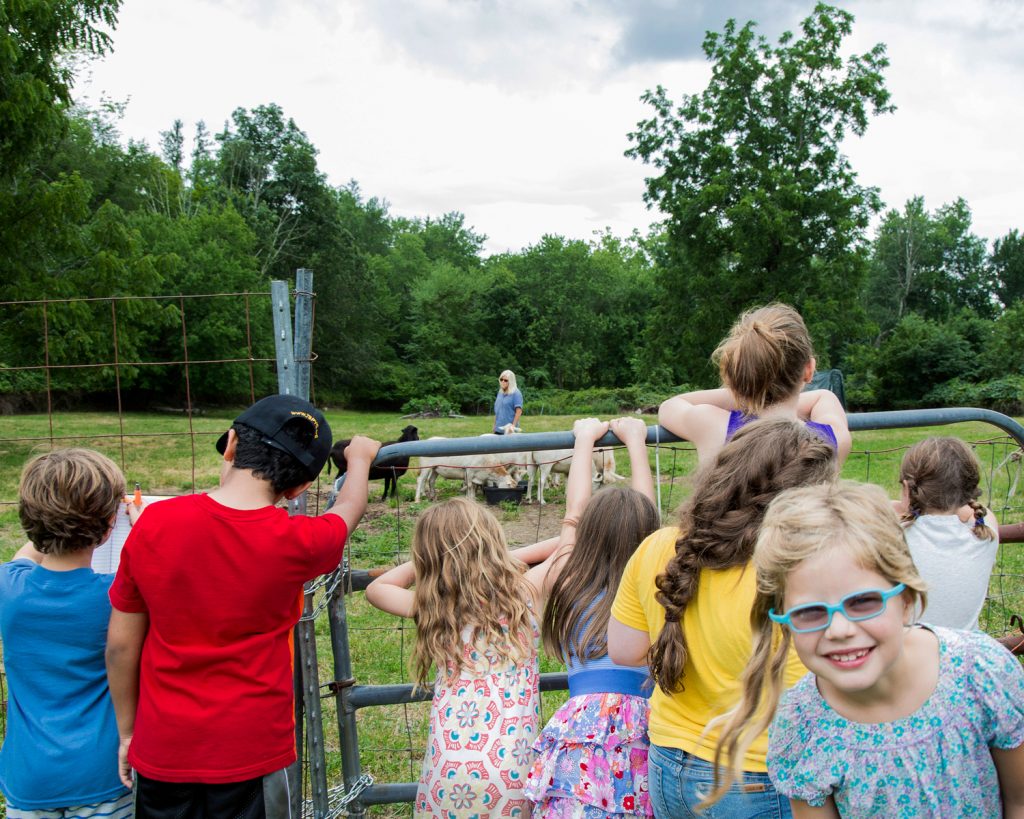
 

JA: But the thing about New York circus is that it seems inherently a little more theatrical because it’s in a very theatrical city, and there are other cities like Montreal or Chicago or Las Vegas, where it’s a little more traditional show-biz-y, and not in a bad way, it’s just more presentational. And because we’re in New York and there’s less circus, the circus that does exist seems to pull a lot from the theater and from the dance community and so I think we both realized that and thought, oh, we really really commit to that and really pull from theater and really pull from dance and try to make something that New York audiences will like.
 

LM: And we also both felt strongly that we wanted to stay in New York and create this new voice of our voices in circus and what the future of the American contemporary circus is and can be, because there’s a lot of people doing it that I really admire, and so in trying to create our own voice, doing it in Brooklyn felt like the most authentic place to start.
 

JA: And then we can tour it.
 

Lyndsay Magid & Josh Aviner
 

CR: How does audience engagement differ for this kind of art? How has the development of your podcast informed your work?
 

JA: Oh man the podcast has been so awesome, because when we started it, I think the idea was, it doesn’t really matter who listens because we’re just going to get to talk to all these amazing people we admire. They come over to our house and have beer and hang out and we chat, but we never really get into it in the way you sometimes do in an interview. And after the podcast we felt like all these amazing people give these snippets of advice and things that have worked for them, that we’re trying to absorb as much as we can. As to how we’re trying to work with the audience in this show, we start off with the audience thinking that there’s a fourth wall and there are all these perceptions that get shattered pretty quickly.
 

LM: It’s an immersive show in that you’re actually inside of this environment of the world. It’s not invasive in that you have to participate.
 

JA: It comes to you.
 

CR: What is the role of technology in the conversation – both of making the art and producing or communicating it?
 

LM: Well we found Keone and Mari on YouTube. Their career started through YouTube.
 

JA: And the internet is so amazing in terms of casting. Circus performers are spread all over the world, and sometimes you’re hiring people from Mongolia or Russia or Australia, and that’s pretty normal just because there aren’t that many people who can do all that stuff, so you have to find them wherever you can. And the internet is the number one way to find them, and then you try to go see and meet them in person. But that casting is pretty key for the conception of the project, but other than that this is a pretty low-tech show. The blood effects have a little tech in them but pretty much everything else is done by hand, old school ropes and pulleys.
 

LM: And as far as the audience using their cell phones, the good thing about circus and being in the space we’re in, we don’t care if you post a photo.
 

JA: As long as you use the right hashtag.
 

LM: Yeah, we’re lucky in that sense that it’s not destructive to the show, it’s additive in a way. Just no flash. Other than that it’s a pretty low-tech show, which is nice.
 

JA: The more tech, the more things can go wrong.
 

CR: Definitely, there’s already a lot of fear involved. When you feel stuck, what do you do? To whom do you turn?
 

JA: One another.
 

CR: That’s awesome – do you have pieces or places you look to for inspiration, or heroes that you draw from?
 

JA: Oh absolutely. Sort of all over the place. Artistically, 7 Fingers and James Thiérrée, Charlie Chaplin’s grandson, who has a lot of shows that come to BAM, and frankly Cirque du Soleil have been huge influences in shaping what I like and got me excited abou circus in the first place. Whenever we’re stuck, Lyndsay and I sit in our apartment and we just talk it out.
 

LM: And coming from musical theater, I love contemporary musical theater songs. I think they’re great at telling a song telling a specific story and I love listening to the builds of those songs. I worked at Atlantic Theater Company for a while and the Managing Director there, Jeff Lawson, I call him my theater dad. He’s really great at being part of the theater world but also understanding what we’re doing.
 

JA: And both our dad’s are entrepreneurs, totally self-made people, so whenever we have a real legal problem like, oh man this contract totally blew up in my face and it has nothing to do with theater, it’s nice to have parents who have that business background and have been through that struggle.
 

LM: Because that stuff is a struggle.
 

Lyndsay Magid & Josh Aviner
 

CR: My last question is, what’s the best piece of advice you’ve ever gotten?
 

LM: The best piece of advice I’ve actually ever gotten has nothing to do with anything, but I was an actor at one point and studied at BADA in Oxford, and Alan Rickman came and taught class and someone had said, you always play the villain – and I think this is really pertinent to this show – and he said, I never think of myself as the villain. The villain never sees themself as the villain. They want whatever they want more than anyone else and they’ll do whatever it takes to get it. And I just thought, that’s so smart and it’s so relevant to this show with a character who wants what she wants more than anybody else.
 

JA: Mine’s more circus-y but Paul Binder, the founder of Big Apple Circus, told me this thing about working with collaborators which is that, you know you have a good or bad collaborator if, when you tell them you don’t know about an idea, they get very defensive. Because people who are genuinely creative are open to new ideas and coming up with more things. But if someone is so defensive and fights so hard for their idea it’s because they’re worried they won’t have more. And even though that sounds like something you would use as a template to hire people, it’s actually great internal advice: don’t fight so hard for that one idea, you’ll have more, be in a place where you can let them go, be confident enough that you’ll think of new ones. And if you go into that, you will be in a place to be a good collaborator.