Posted on

Chimerica: Theater’s Role in Preserving History

Chimerica


Chimerica


Do you recognize the Tank Man photo? If you don’t, you’re not alone. Chinese history isn’t something that American schooling teaches about. Even some of the cast of Lucy Kirkwood’s Chimerica (playing now through July 31st at Timeline Theatre Company) didn’t have much familiarity with the now-iconic photograph taken during the Tiananmen Square protests in 1989. What happened after the photo was taken is anybody’s guess, there isn’t any definitive information on what happened to “the Tank Man.” That’s where Lucy Kirkwood comes in, demonstrating a masterful command of crafting an alternate history, and brings us Chimerica. The play is set 20 years after the protest, focusing on a photojournalist who is trying to uncover the identity of the man in the photograph, and the deeply felt relationship with his friend Zhang, who is still living in China. I spoke to several members of the cast and Artistic Director of Timeline Theatre, PJ Powers, about the show and their connection to it.
 

With performers that represent such a wide range of ages, their experiences with the photo and the protests themselves were varied. Wai Yim, who plays several roles including that of a Chinese soldier, recalls, “I remember that I saw [the Tank Man photograph] when I was in Hong Kong; I’m originally from Hong Kong and I saw it right after the massacre. I was so young then, I mostly remember snapshots of famous photos. I remember the burning rubbish, I remember people running, and I remember the Tank Man.” Yim moved to America in 1996, when Hong Kong was returning back to China from England, because his family did not want to risk life in a communist country. Christine Bunuan remembers seeing the photo when she was younger too but the show gave her the opportunity to engage with it more fully. She said, “It had the most impact on me when I auditioned for this play. Even more so when we started rehearsals and we got all the video – I’d never seen the video, it knocked the wind out of me. It punched me in the stomach to actually see the images of those who were killed when all they were trying to do was fight for what they believed in.” Cheryl Hamada knew the Tank Man photo well, it was ingrained in her growing up, but she wasn’t as familiar with the poster that her character, Ming Xiaoli, posed for in the play. “One of my characters is a dying woman,” she said, “and she talks about being in a Chinese propaganda poster. They brought some of the posters in…it was an interesting part of the history that I didn’t know about.”
 

In the rehearsal process, it was important to Timeline and director Nick Bowling to give the cast all the information they needed to understand the world of the show and begin to define their characters. The show mentions the fact that many people – especially those of the newer generation – may not even have seen the photo before, might not know anything about Tiananmen Square. Lucy Kirkwood’s script connects the larger political movement to an incredibly personal story in a way that will bring it to life for the unfamiliar and give new context and meaning to a familiar event to those who remember it well, like Yim: “Even though it’s about China and America, there’s the personal relationship, how one person struggled to achieve something at all costs. What is right and wrong, who’s a hero and who is not…the show is about humanity, still, no matter what.” Dan Lin, who plays the younger Zhang Lin among other characters, said the conversation began on the very first day of rehearsal, “Nick held up the photo and asked us to go around and say what the picture meant to us. People said things like justice, protest…I said, ‘wrong place, right time.’”
 

The historical significance of the show is conspicuous, but the significance of the production offstage isn’t lost on the company either. Artistic Director PJ Powers found the epic nature of the play, the global perspective, and the diversity of it incredibly appealing; he fought for two years to obtain the rights to do the show at Timeline. “I just want to shout from the rooftops that plays like this deserve championing. We read the play and we were like, …’This scares the fuck out of us. Let’s do it.’” Lin said that the opportunity to play parts that weren’t one-dimensional was one of the things he loved most about the show. “As a working minority actor,” he says, “I hope things like this come around more often. Juicy roles, well-rounded people with baggage and lives and perspectives – people you can identify with. I don’t feel any of my characters are caricatures in any way. That’s something I treasure.” Still, there is a lot of progress yet to be made in the theater industry, he admits, “I’d love to be able to play a Chinese-American one day. It’d be good to be me, to represent myself and people like me onstage. That would be really exciting.”
 

Chimerica is playing at the Timeline Theatre Company now through July 31st. Tickets can be purchased at timelinetheatre.com.

Posted on

Line, Please!?

line, please!?


Hi, I’m Liz and I’ll be offering you advice on navigating the tricky situations that can come from working in or being a fan of theater.
I’ve been doing it out on my blog, fyeahgreatplays.com, for a while now, so it seemed only natural to migrate here in a more official Advice Columnist capacity. I’ve freelanced as a stage manager around New York as well as regionally, I’m a member of Actor’s Equity and a total contract junkie, and I occasionally cohost a podcast on theater and performance (Maxamoo).
 

To submit a question, email lineplease@stageandcandor.wpcomstaging.com.


Dear Liz,
 

I’m assuming you’ve seen the Chicago Reader article about Profiles Theatre, and I’d love to get your thoughts on it. My whole (Chicago-centric) Facebook feed is devastated and galvanized by it. What can we do in our theaters to keep this from happening again? Education and empowerment = everything!
 

-Katie


Hi Katie,
 

The whole Profiles expose, which revealed systematic enabling and abuse of power within the Chicago theater scene, saddened me but ultimately wasn’t surprising. I’ve seen many people allowed into positions of power despite their abusive tendencies because of their real or perceived talent. If an employee at a bank, for example, continually coerced or harassed a coworker, presumably the employee would be able to take it to HR and have the bully dealt with. However, theater as a creative art isn’t always held to the same standard, and union productions less so. Cast and crew spend long hours together, both on and off the clock, which can make the environment seem more casual; less like a job and more like-minded people hanging out together. I think this makes it even harder to stand up and call harassment out.
 

What this means is we have to look out for not only ourselves but for each other. Chicago’s theater community has developed Not In Our House, a code of conduct for non-Equity that seeks to ensure safe creative spaces. Not allowing auditions to go longer than 3 hours or after 11 PM, required access to water and ventilation, and notification of potential stage violence in the audition process are some of the ways they are working to assure regulations in the workplace. They also clearly spell out the path of reporting an issue through the chain of command in case something does happen. I’d highly recommend looking to their code of conduct if you’d like to build your own in your community.
 

Actor’s Equity also recently released a Harassment Code of Conduct in light of actor Marin Ireland’s article about her personal experience with abuse within the Wooster Group. It’s less a series of rules and more publicly pledging to take stronger action on harassment and abuse in the theater community. They encourage you to bring any instances of misconduct to your stage manager, or directly to the AEA office. Speaking from personal experience, I’ve called Equity twice with questions regarding harassment in the workplace and found them quite helpful.
 

If you’re uncomfortable bringing the issue to Actors Equity, you can meet, call, or even Skype with The Actors Fund for free to speak confidentially with a professional who can assist with counseling and helping you determine your options moving forward. Theater companies can be our friends, family, and home; take care of each other.

Posted on

A Conversation with Gabriela Ortega


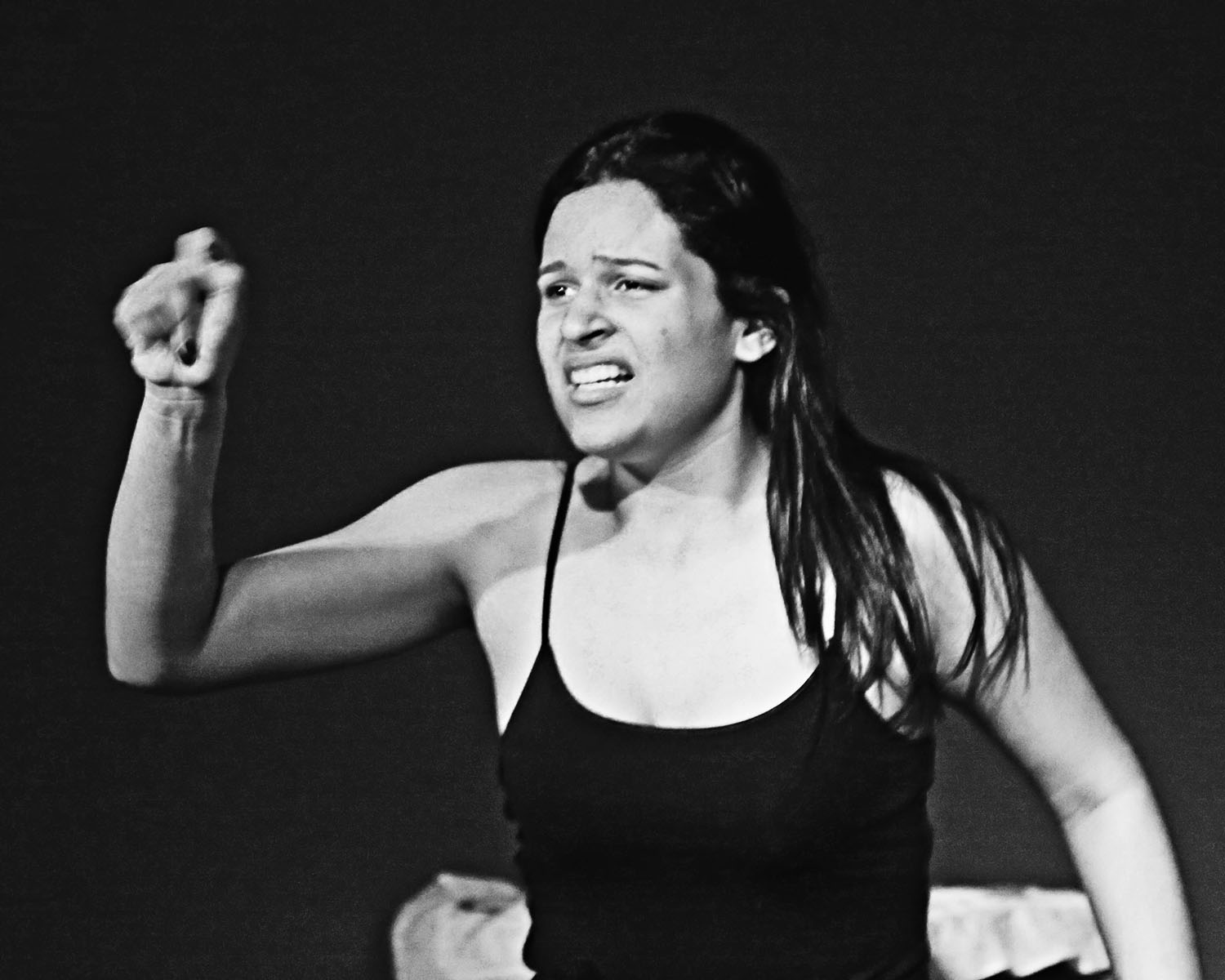
Though New York still has yet to embark on its Fringe Season, the Pacific coast is already underway. The Hollywood Fringe Festival provides a platform for developing artists in the Los Angeles area to bring their work to an audience hungry for new voices – a mission that is furthered by the Hollywood Fringe Festival Scholarship, which was awarded to five productions that “features the participation of ethnically diverse artists; the production will enrich audience experience through the presentation of unique, underrepresented themes…” One recipient of the first inaugural scholarship is Gabriela Ortega, a native of the Dominican Republic and BFA Acting student at University of Southern California who has written, produced, and stars in a one-woman show entitled Las Garcia, currently running at the 2016 Hollywood Fringe Festival. In this conversation, we discuss the process of writing a solo performance piece, fighting for your space, embodying personal history in your work, and how Disney Movies can make a difference in a person’s life.


Alicia Carroll: If you could, start by telling me a little about the production you have created!
 

Gabriela Ortega: Well, the production that I am doing at the Hollywood Fringe Festival is called Las Garcia. It’s a solo performance inspired by my heritage in Santo Domingo, Dominican Republic. I wanted to write a show about how I felt when I moved to the States, which was sort of split in two because I felt like I was drawing inspiration from this place that I left. So it was sort of like the representation of discovering myself as a Latina in [another] country rather than my town. But I didn’t want to write it just about me, and I wanted it to be more universal. The story came to me in different pieces, and basically what it is right now – it follows two women of the same bloodline from different generations. One is in 1960s Dominican Republic, and one is in 2016, or present day, in Los Angeles. They both are struggling with a literal war in DR and the other is struggling with a war against herself. It’s a coming of age about how generations pass on that culture, and sort of my coming of age -which is kind of half true, half not – but because it’s part of the creative process, I was able to draw from my experience and my imagination. So it was kind of fun to have those two aspects of storytelling.
 

AC: How was it moving to the United States from The Dominican Republic?
 

GO: I came to the US at 17 to start college. I had visited the US multiple times before I got to go school at USC [University of Southern California] for acting. I had done a few summer programs and I sort of got my feet wet in terms of what it was to get a degree in acting. I wasn’t sure what four years of that was going to be. So I moved here and USC was kind of a reach school for me; I didn’t think I was going to get in. So when I did get in, I was like, “of course I’m coming here.” But I’d never visited California, nor the school. So, I kind of thought, “Ok, I am going to wing it and go to this place” and it was really shocking to me to see how independent people are here, you know? You move out of your house when you get married in Dominican Republic, or at least when you had a really steady job. I mean, my sister moved out of the house at 28, when she was about to get married and she had a full-time job – like a whole career, and an MFA everything – and it’s just how we do it there. You don’t have dorms or roommates; you just live in your house and commute to school. And everything just stays like that, you go to school with the same people you’ve known since you were three, and I came here and there were so many people from so many places, and so many languages, and so many…labels and perceptions. And the most amazing thing was, I think, being identified as a Latina for the first time in my life because I didn’t really have to deal with that back home, you know. Because we were all Dominicans, we were all there. There were people who were black, or white, or sort of in between, like my color, and that’s just how it was. But, here, you have “what are you?” “Are you mixed?” “Are you ethnically ambiguous?” “Are you Middle Eastern?”… and it was really shocking. It took me leaving my country in order to realize what it really meant to be a Latino woman. So, it was kind of this whole new discovery, which was both scary and exciting.
 

AC: And so now are you the only person in your family who has left the Dominican Republic for an extended period of time?
 

GO: My sister went to grad school. She went to Georgetown for Law, and that was only a year. And then some of my cousins have gone to grad school – that’s usually how you do it; you go to grad school. But for undergraduate, I actually moved here and lived here – for sure, I am probably the only one. I have family in the States like in New York and stuff, but they moved there when they were really young, so they were already there, but definitely even in my close friend group, I was probably the only person who left. And not only left, but also pursued a creative career. A lot of my friends and family members are lawyers or doctors or architects and…not something that necessarily has to do with the arts – or the performing arts I would say.
 

AC: So I know something I have talked about – and we have probably discussed in the past – is the privilege of being able to study the arts. How has going to school for Theater, and the relationship between you and your family and the “lawyer-doctor tradition” – because it’s the same in my family I am the only one. So how does that dynamic work, or how do they view your studies?
 

GO: Well, I am very persistent. I have always had an affinity towards the arts. Like I started painting early on, so they thought I have always been creative. And I talk a lot and I wanted to be a comedian when I was little. So not that they didn’t take it seriously in my young age, but they just thought it would develop into something else. So in high school I thought I was going to be a lawyer because, honestly, I was more ignorant than that. Because I had been taking classes as an extracurricular program outside of school, in acting and theater. But I didn’t know you could major in this. I thought if by the time you were 14 if you weren’t on Disney Channel, you were done. So I thought, “Well, I am not Hannah Montana, that means I am going to be a lawyer.” So realizing how young I was and how much more there is to the arts was so crazy – like I went to a camp at AADA when I was a junior. And then things started changing because some of the kids there, in New York, they were like, “I go to a performing arts high school” and I said, “What is that?” Then, I started doing the research. I think once I started taking it seriously and saying, “Okay, I gotta find a way to get myself there. I gotta get my grades up. I’ve gotta get good scores on the SATs, I gotta get extracurriculars, and my essays and everything. My parents started to say, “Oh, she’s actually serious about this” and, I mean getting into USC helped, but I guess my commitment to doing this really opened their eyes to like, “Well maybe, that is what she does” and, you know, I always believed that they were supportive, but as soon as I started seeing a little bit of a result and me getting it together and going for it, they were like, “Let’s let her do this and support her fully.” And now, they’re not anything but excited, you know? And they have faith that this is what I came into this world to do, and that is not, honestly, a privilege that a lot of people share, but it’s not something I am going to take for granted you know? It sort of opens your eyes when you study theater. It makes you a better person because you start seeing different perspectives.Just being able to learn about other people’s stories, and maybe sometimes you shut up and listen and see what the other person is about before coming in with your own perspective. That has definitely helped me, at least.
 

990A8642
 

AC: Well, speaking of other people’s stories, did you see yourself in the media or culture you consumed when you were little? Growing up with television, you mentioned Disney Channel and stuff; how did that affect you?
 

GO: I think now I am realizing stuff, looking back. Because I remember when I would dress up for Halloween, I wanted to be Little Mermaid but people would be like, “You’re not a redhead,” and stuff like that. You know the little things that you realize – like I was almost always a pumpkin or a random witch. [Laughs] My mom would joke around, “You’re going to be a pumpkin this year” like, thanks, Mom. So it was always a pumpkin or something. I was thinking, you know what changed for me? What you just asked made me be like, “Of course, this made me see those things differently, High School Musical. A girl named Gabriella, and Vanessa Hudgens cast, she looks a little bit Hispanic, I don’t know if she has any [in her heritage]. But when I saw her in that musical, I was like, “She has my name, and she can sing and she is doing it.” And I saw the staged version in the Dominican Republic – the girl that played her in the DR, she was Dominican, and she looked like me too, and I was with my cousin and it was the first musical that I saw…and I was like, “I wanna do this.” And after that I started taking acting classes, to be honest. It was really astonishing to me that someone could have my name and be up there and do that.
 

AC: Wow, that’s so true; I understand. For Las Garcia, how does it embody your experience and how does it portray history? It’s two characters, but obviously a solo show, so how do you think each character reflects you and reflects the history after writing it?
 

GO: It reflects the history because – sister here had to do some research. It was going back and reading all these stories about our dictatorship in the 1930s and the 30 years of oppression and the women, and my own family. It was calling up my mom and my sister in the middle of the night and asking, “Could you tell me what were you doing around this time,” and putting the pieces together – how can I create this character, this woman? The character in the 1960s is a singer and she has this larger than life personality. I wanted to challenge this perception that people have of Latinos: like the Sofia Vergara, over-the-top accent, and that only means you’re funny, and you have big boobs. And, I mean, I love her, but people think that’s the only thing. And I wondered how can I have something like that, but challenges us to flip the coin. And how could I have a woman – she could be a delinquent. She could be a fighter on her own terms. She could be a singer. She could be fighting a war we didn’t even know about. And she has a thick accent and moves her hips and sings, but she’s so much more than that. And I wanted to make these characters different than just a stereotype you know?
 
And it reflects me because…I am the 1%. I’m the exception,you know? I am lucky enough to go to school for theater, to have an education, to have a different perspective and to be in the arts. And back home, a lot of them cannot necessarily do that, so I, as a Latina, have privilege. We have this character in the play that is a version of me and what was really most interesting about it was really exploring my own dark sides and the things that sometimes I don’t want to talk about. And how do I not make that indulgent, and how can I make that relatable? It’s really when you look at your story, and you don’t judge it, and you talk to the truth that… and in this play I am talking about growing up with nannies and I’m addressing that privilege – I mean, there’s a line in the play that goes:
 

“Look around, there are 101 paintings in this house. I know that because I have the privilege of being bored. So bored, that I counted them.”


I’m looking into the privilege that I have and the disadvantage that I have as a latino woman, putting those two together and seeing which one ends up on top. But the reality is that they’re both part of me and I can’t just bring you a story about how sad it is to be a latino, or how lucky I am to have everything I have. But I can bring you a story about how I was at times inside a bubble and how I had to see past myself, and grow up. I mean, we’re not all perfect you know? We all have lightness and darkness about ourselves, you know? It was very scary to tap into that. And then have people read the script and be like, “You’re afraid of this line, that’s why you’re paraphrasing. You’re subconsciously moving away from it,” and realize, “Oh, you’re finding subtext in something I wrote.” It’s been really an interesting experience, doing this type of work. It’s like driving a car in the middle of a raid and you can’t stop because you have to get to the finish line. It’s just you.
 

AC: What made you choose to make it a solo show versus having a partner on stage?
 

GO: I wanted to challenge myself – well, first of all, it’s cheap [laughs] – but also it’s my own past and my own story. But, I will say that the best discovery in the solo work, is that it truly is the story about women, and the women in my family so it should be played by a woman. And they’re related, so the fact that it’s me, you know, I am able to play into that and you can see the different generations without needing the male characters to come up. I wanted to make it a solo show because I wanted you to see the women and the generational aspects of it. And I think it could extend to a play, I mean, I believe in the story so much, I would love to see if I could turn it into a script for a film because I think there is some cinematic quality to it. But I really think of it as a first step; I think a solo show was the way to go because of that. We don’t see stories about women often…so you gotta force yourself to make it about the women because you’re a woman and you’re doing it on your own, you know? So it really challenged me to enhance these two female characters beyond a box, beyond the stereotype, or beyond a circumstance.
 

AC: Something that I don’t think writers get asked often enough, so as a playwright, if it were to get published right now and the rights were to become available, what do you hope for people to take away from the play, at its core? And what do you hope for potential future productions of the work? Especially something so personal and intimate. Like eventually some high school is going to do Hamilton – is there anything you’d nervous for?
 

GO: First of all, the only man who could play it is Lin-Manuel Miranda. [Laughs] Maybe Leslie [Odom Jr.] who knows? I mean, I think the show should be played by a woman…I think that there is a specific song in, it it’s called “Dondé es?” It’s sort of a theme in the show of “Where is your life hiding” I would like that song to be in it, as a guiding tool. I wouldn’t be opposed to – I wrote the whole thing as if it were a script, like the scenes between men and women, they are written as dialogue [as opposed to monologue] so I’d be interested in seeing it developed into a play opposed to a solo show; I would like to give people the chance to work with it and workshop it whatever way they would like, but definitely keeping mind the people and their ethnicities – because so many shows take advantage of that…because they think that “yes art is for everyone,” but there are certain stories that may need to be told by the people who can really tell them, and can give them justice.
 

AC: Yes, I completely agree. Interesting. Well, also, congrats on the Fringe scholarship!
 

GO: Thank you.
 

AC: What does it mean to you, that you received the scholarship? And what do you think it will give you in terms of furthering your audience and telling your story?
 

GO: I think it means a welcome to me and as a reminder that we are here. And the fact that we got that scholarship is nothing to be cocky about, or to be to think “oh, we got somewhere” – no, it’s actually challenging us to tell this story to the best of our ability, and my ability. And Fringe is such a wonderful platform to workshop new work because it really is a very supportive community; everybody wants to see each other’s shows. It is a competition in the way that there are awards and stuff, but at its core it’s an opportunity for everyone who’s an artist in Los Angeles and wants to create new work and be bold and wants to put up things at no budget pretty much to have that opportunity and to showcase their work. And to me, this is my coming out party as a writer and a performer and to me that scholarship is me saying I will not conform, and I will write my own work and I will star in it and produce it and I will wear all the hats, and I am a woman and I’m Hispanic and I’m here. And I won’t let anyone or anything that believes I don’t fit in this medium – or that I’m too this or too that for this art form tell me I don’t belong. So, I am happy that the Fringe Festival community sees that and is encouraging that and are hungry for stories that are different. It’s the first year that they’re doing this scholarship and the five people who won are all people of color and women, three of them I think are written, directed, and starring women. And I think that’s telling of what people are hungry for and the stories they want to hear.
 

IMG_6240
 

AC: Are there any last thoughts you’d like to get into the universe, or anything you’d like to say?
 

GO: Thank you, first of all, for reaching out to me and thank you for your support. For anyone that will read this and is a young artist or woman or girl who thinks they are too young to do something, don’t. Because honestly, if you look for space and if you fight for that space, the doors will open and people will come support you and people will be with you. The amount of gratitude I have for so many people who have reached out to me and offered their help and their services for me to create this piece of theater really gave me hope as to what I can do in the future and – you just gotta ask sometimes, you know? And just really fight for and go for it without judgment. So, I really encourage people to try this type of work and just get out there and figure it out.
 

AC: Absolutely. Awesome, well, thank you so much for speaking with us. And break a leg on your premiere!
 

GO: Thank you, thank you. I am trying to get it to New York, hopefully I can get it into the United Solo Festival. So, we will keep in touch, because I really want to travel with it. Thanks again, I really appreciate it.
 

AC: Yes of course, keep us posted!


Gabriela was born and raised in the Dominican Republic and is an LA based Actress, writer and Spoken word poet. She is currently pursuing a Bachelor of Fine Arts in Acting at the University of Southern California.A proud Latina, Feminist and above all: a collaborator, Gabriela is thrilled to be returning to the Hollywood Fringe in 2016 with her own show. She is excited to bring her stories to life in her show inspired by her heritage and life in Santo Domingo. In 2014, Gabriela helped develop “The New Artist’s Festival” at the 13th Street Repertory Company in NYC. As part of the festival, she helped produce 7 original one-act plays (2 which she directed, 1 which she wrote), as well as two MainStage productions (Rabbit Hole, Dark Play/Stories for Boys). Some of her most recent roles include: HOMEFREE by Lisa Loomer at The Road*, SPIT! at HFF15, The House of Bernarda Alba with the Bilingual Foundation of The Arts (Magdalena), Grey Street, The Musical (Off-Broadway Workshop, Ensemble) and Blossoming readings with The Vagrancy. USC: Breath, Boom (Angel)**, Camille (Prudence), Marisol (Ensemble), Anna in the Tropics (Conchita), What We’re Up Against and other short plays (Lorna/Annie), Disappearing Act by Lena Ford (USC workshop/ Millie)
*WINNER: Noho Fringe Festival Best play/Best Ensemble
**WINNER: Aileen Stanley Memorial Award for excellence in Acting
Las Garcia (my solo show) won one of the 5 “2016 Fringe Scholarships”
webpage: www.ortegart.com
manager: Nick Campbell
Velocity entertainment partners
nick@velocity-ent.com

Posted on

A Conversation with Winter Miller


Winter Miller’s ferocious, forward-facing energy is contagious. In her words, in her work, in her sense of humor, she champions action and raises vital, challenging questions. Especially in a week like this one where fear and darkness feel paralyzing, speaking with Winter Miller calls me to action, to open up the conversations that are uncomfortable, to ask the questions that prompt complicated answers, if there are any answers to be had. Her upcoming piece, Spare Rib, hosted by Gloria Steinem and friends, and directed by Adrienne Campbell-Holt, is a fundraising celebration honoring the legacy of Dr. Willie Parker and broadening the rhetoric around female reproductive rights.


Corey Ruzicano: I’m so excited to hear about your new project – maybe we should start there. Will you tell me about Spare Rib?
 

Winter Miller: Yeah, I can talk a little bit about process. First of all, the place of inspiration came from an intellectual idea, but out of urgency. Just thinking about how, in this country, we don’t have a way to talk about abortion beyond the semantics of pro-life/pro-choice, this is a fetus, this is a baby. We got really stuck in what those labels meant and the consequence was that our access to reproductive freedom has been chiseled away and is in deep danger of not being accessible to people who need it. That’s how it is. There are not enough clinics. Rhetoric got in the way of a movement for equality. And I was thinking about how the way the gay rights movement moved ahead was by being about pro-love and pro-family and that if we could say the same thing about abortion – that it is pro-love and pro-family because it allows us to choose the kind of family we want and to be able to love and care for them as we are able without stigma or shame, whatever that decision is. That debate had sort of been snatched from liberals by the Christian Right and the consequences of that are dire. So the inciting action of this was: how could I write a play that could be about the subject of abortion but could involve us in such a way that we could show up with whatever beliefs we had and come away with a broader understanding?
 

CR: Yeah, absolutely.
 

WM: So it’s not just about–
 

CR: –that binary.
 

WM: Yes, exactly. I think what I try to do with all my work is to get out of the binary.
 

CR: And I think that’s something that’s so particularly enlarging for me about this piece is that it expands that single-story narrative model. Because that single narrative is so seductive, we as humans are so compelled and attach so easily to that protagonist, part-for-whole structure. It’s so exciting to have a piece that’s really a quilt or a community of stories that are all confronting the same thing. And being able to talk about the way we talk about these different issues and open up the rhetoric is revolutionary.
 

WM: Well what’s challenging – what’s exciting, I’ll say that – is that this is a play with multiple narratives. There’s not one protagonist and we’re time-hopping throughout history. We’re time-bending and gender-bending and genre-bending. The play invites you to engage with it in kind of a Coney Island way. Welcome to the amusement park, get on whatever ride you want and some are going to scare you, some will make you howl with laughter, and – probably not that many rides make you cry – but some of this will make you cry. There is humor, you have to have levity with the deeply true.
 

CR: Yeah, totally. I’m always so fascinated with the different lenses and openings and ways in that writers provide audiences with, especially when the subject matter is something that every human body has to engage with, and I think humor is an incredible tool.
 

WM: Yeah, I’ve not written a play without it. I don’t exist without it.
 

CR: That’s really useful and important. Are there places that you’ve drawn inspiration from, in the realm of humor or beyond?
 

WM: There are different kinds of humor that I connect with. I like silliness. I like wordplay. I also like the juxtaposition of two ideas that don’t belong together. There’s a scene in the play where all these different women from different times and different eras are sitting around and it’s somewhere between a consciousness raising and an AA meeting and at the end of an introductory speech about herself, one of the characters says, oh is there reindeer milk? Like is there cream or milk, but it’s particular to the goofiness of time-hopping. It’s unexpected and probably many people will breeze right by it, but I giggle every time I hear it. I don’t know, is there reindeer milk? What would that be?
 

CR: Maybe.
 

WM: Most everything in my play is fact-checked, but I have not fact-checked whether or not there is reindeer milk.
 

CR: Well, it’s nice to have questions like that in there, more full of whimsy–
 

WM: Yes, there’s definitely room for whimsy. In researching the play I visited Schlesinger Library at Radcliffe and they have vast archives of first-person accounts of feminists and abortion providers and I read through a bunch of those accounts just to get a deeper knowledge. I spent a weekend in Michigan with these women who do really thoughtful work around de-stigmatizing what it is to be an abortion provider. They invited me to come and pitch creative ideas to them and part of that was spent at a Planned Parenthood shadowing one of the doctors but also several patients as they came in. I didn’t know the steps that people go through when they arrive at a clinic, and I followed a young woman throughout her visit.
 

CR: Could you talk a little more about what that was like?
 

WM: What struck me is just the precision and skill of someone who does her job well and has experience. When I walk down the street and see sanitation workers and watch the way they arc the trash perfectly into the back of the truck, I’m looking at skill and experience and athleticism, and I marvel at it. It’s the same thing with watching this doctor perform an abortion. I’m not sure the words to describe it. I was seeing experience and prowess and grace. I thought, of course, she’s skilled at this. But I haven’t sat in on anyone else’s dental or doctor appointment to see what anyone else’s experience looks like outside of myself as the patient, so I’m sure I would experience much of what doctors do, to be like that. It was impressive. This is something that this doctor has done over and over again and she’s good at it; the same way that the sanitation workers perfectly arc the trash.
 

CR: Yeah, there’s a procedure and precision to it.
 

WM: I sat on the other side as someone got an ultrasound to make sure that she was pregnant. I watched as someone was given a medical abortion, the pills that you take. You take some in the office and you take some at home later. The conversation is all very straightforward. This is what this does and this is what this does. It’s not particularly dramatic. Then I watched some surgical abortions and it was something that I had never seen. At the end of it, there is what’s been removed, blood and organs and the tiny beginnings of what will become a person. The doctor sifts through it to make sure they’ve gotten everything out; she’s looking for two hands, two feet. And that’s a fact. You can’t hide from the truth of what you see at fourteen weeks, but that doesn’t make it a person with any kind of rights that should supercede those of a woman. Women are not incubators, we have a choice. What is inside is something that is alive in as much as it is growing, just like a plant is alive and growing, but it’s not a person. It does not have personhood. It has been scientifically proven a fetus is not a thinking or feeling being.
 

CR: And I wonder how your connection with these different organizations changed the way you’re looking to tell this story? How do these different connections and conversations impact the way you’re trying to tell these many narratives?
 

WM: Any time that you see something that is new to you, it has an effect on the totality of the play. For instance, when I wrote In Darfur, I’d read many, many things and I’d heard many first- and second-hand accounts, and I’d looked at many photographs – things the general public wasn’t seeing but I was seeing because I was working with Nicholas Kristof at the New York Times – but I still felt I have to go to Darfur to see what I don’t know. You don’t know what you don’t know until you know more. I wanted to know: what is the ground like? What is the dust like? What does the terrain feel like; what does it smell like? All that stuff you can’t get from news accounts and things people don’t include in their stories because they’re it’s unremarkable to them. You don’t know the smell of blood until you smell it. That’s just how it is. You’re taking someone else’s word for it unless you’re seeing something or hearing something firsthand, and that matters to me.
 

CR: So this project is about to have a public showing?
 

WM: We’re just doing Act I. It’s a big play. I just keep slicing it down.
 

CR: That sounds so hard – it’s scope is so multivalent; it would be so hard to make it shorter!
 

WM: Yeah, it is. I think, Oh I want to include that. But there’s great discipline in cutting. One of the nice things about this upcoming reading is that it’s a chance for more discipline. I know that the length of this first act needs to be an hour, so knowing that I’m just choosing even more specifically what needs to be included and what doesn’t. You can fall in love with characters and then realize they have to go. I tell that to all of my students, so I have to take my own medicine.
 

CR: Always hard to kill your darlings. In a perfect world, what action steps does this play want us to take away?
 

WM: It’s broad. First of all, I hope that we open up for a greater dialogue about abortion. There are so many people that don’t know that their partners or sisters or friends or mothers have had abortions. It’s not something to be ashamed of, so I’d like to decrease the stigma so people can actually think: can I choose this for myself without fear of being judged? Can I talk about this without being slut-shamed or called a murderer? We have to make room for people to be able to say, “I had an abortion and it was really painful emotionally.” But there also has to be room to say, “I had an abortion and it was not a big deal and such a great relief.” We have to have room for the vast experiences in the way that we might talk about going to the dentist: “I had a tooth pulled but it was fine,” or, “I had a tooth pulled and it was upsetting.” Not to make light of when people have emotional thoughts about something, but to actually say let’s not project onto people what we think they might feel.
 

CR: Bodies have responses and you have to be able to talk about them without fear of being reduced.
 

WM: Or being stigmatized. I want to create a space where people feel included. I want to have a way of helping to create more community for people who are abortion providers. Because there’s an idea that they’re either killers or heroes, and they’re people doing their job. Some of them have a real attachment to the mission, for others it’s their job and they think it’s what needs to happen. But they can’t talk about that in front of many people without fear of how they’ll be responded to. That’s isolating. How many people are comfortable coming out as abortion providers in environments that are hostile to them? Not to mention the number of people that harass and threaten and in some cases murder abortion providers. So I think that we as a society could be less binary about heroes or killers and just say they’re people and this is the job they do. That would be less isolating and more people would be willing to provide abortions. It’s an area where we need skilled workers and access.I hope the play will galvanize people to stand up for reproductive freedom, regardless of what their personal choice is, that they would stand up and say that each person deserves their own choice. We’re dealing with issues of privilege – who has access to clinics, who has money, who can afford childcare for their already existing children, who has the ability to get time off work… We have to make sure that reproductive freedom is truly free, that it’s accessible, so that people can choose their families.
 

CR: Yeah, and that bottom line people should have control over their own body without jurisdiction from any of the systems that are at play.
 

WM: Yes. The parental consent laws are terrible. They leave young women with the option of a judge deciding their fate if they can’t tell their parents. Not only that, there are so many instances that are tied to incest or rape and it forces people to have to confront people in environments that may not be safe if they want to have an abortion. We have to do better at supporting reproductive freedom, whether or not we ourselves need it.
 

CR: Of course. Are there any other resources or things that are happening in the conversation that we should know about?
 

WM: Sure. I think campaigns like Shout Your Abortion – people underestimate how important that is. I think the organization that Martha Plimpton founded, A is For, is important because this is how we create acceptance and tolerance and support for something that is legally a fundamental right. But also I am inspired by Dr. Willie Parker, his life story and his mission are of great interest to me and I want more people to know about him. We need more Dr. Willie Parkers. I’m excited to hold this event to honor him and I hope we raise substantial funds for the National Network of Abortion Funders, they help they help provide money for people who cannot afford travel their abortion, to pay for what they need. With waiting periods, people have to factor in a place to stay – they have to take a bus, whatever it is; it’s doubly and triply expensive based on legislation that exists to prevent people from getting abortions. So this fund is allocated directly to people that need it. I think it’s great to that we all stand with Planned Parenthood, but it’s also important to stand with the clinics and the funders that are directly involved with making reproductive freedom a reality. Watch the movie Trapped – it’ll be on PBS – and see the sacrifices people are making; what they’re up against to keep these clinics open and for people to get their abortion. I’m so inspired by Dr. Willie Parker and I’m excited to hold this event to honor him. Two-thirds of the proceeds of this event will go to supporting the NAAF in the areas where Dr. Parker worked in the Southeast. The other third goes towards whatever the next Spare Rib event will be so we continue to grow. It’s not so difficult to arrange an abortion in New York City. It is in much of Mississippi, Alabama, Texas, and I could go on. But this is where we as a community help out the people who need it. This is sisterhood, this is brotherhood. Reproductive freedom affects all of us.


For more information visit Winter’s website. Ticket information can be found here. For those unable to attend but would like to contribute can do so here, even after the event has passed. For more information contact spareribtheplay@gmail.com  


Winter Miller is an award-winning playwright and founding member of the Obie-recognized collective 13 Playwrights. She is best known for her drama IN DARFUR which premiered at The Public Theater, followed by a standing room only performance at their 1800-seat Delacorte Theater in Central Park, a first for a play by a woman.

Posted on

Tug of War: Come on Back to the War

Tug Of War


It seems like every politician has put Hamilton on their must-see list, and rightfully so, but truly, they should all be required to experience Tug of War: Foreign Fire at Chicago Shakespeare Theatre. Foreign Fire is the first in a two-part adaptation of Shakespeare’s histories, the passion project and brainchild of Artistic Director Barbara Gaines. If you think you know what six hours of Shakespeare feels like, you haven’t seen Tug of War. And in a world where the definition of warfare is constantly changing, where two armies don’t meet on the field anymore, and where the United States of America has escaped the monarchal system, what do these kings have to teach us? As it turns out, quite a lot.
 

Tug of War plays out as the French and the English spend decades entangled in a bloody political feud, as kings come and go. The show first introduces us to Edward III and his thirst to claim the French throne that he believes is his birthright, then to his grandson, Henry V, rousing his comrades with grand speeches, and then failing to find words to win the heart of the French Princess Katherine, and finally, to their infant son, Henry VI, who sets off yet another series of war games because he is too young to assume the throne. The production is scored to the heavy drumbeat of rock music, sampling everything from Pink to Pink Floyd, which only adds to the urgency and contemporary feel of this play that begins in the 14th century.
 

This is more than Shakespearean Game of Thrones, though the comparisons are certainly apt. Tug of War is, at its core, a journey through generations embroiled in the futility and fatigue of endless conflict over invisible lines on a map. It’s a story of a perpetual power struggle, of men cutting the head of a Hydra over and over again, and being shocked when two grew back in its place. This notion that changing one leader for another will somehow change the nature of power and the need to fight to keep it still plagues American policy today. Just in the past 15 years, we’ve engaged in military action to overthrow foreign dictators in Iraq, Libya, Egypt, and now Syria may be next. But there was no peace to be had after these efforts. We created new enemies, new alliances, and supplied weapons to new rebel groups, but we’ve stayed engaged in the oldest, deadliest game in the world: war.
 

The show doesn’t necessarily advocate against interventionism, to the contrary, the show illustrates that we very clearly live in a world where the lines that divide us are mostly imaginary and that peace is fragile and always in danger of collapse. Moreover, it reveals that the motivations that take us to war, the things that weigh on the minds of those who decide what battles we will fight, are sometimes more personal than political. Henry V fights bitterly to finish the battle his grandfather started and take back control of France and immediately, you can’t help but think about President George W. Bush, taking us to war in Iraq, some would say motivated by the need for revenge on behalf of his father’s failure to take out Saddam Hussein during the Gulf War. Even without the context of a debt to settle, the need to be perceived as strong on behalf of the populace haunts all of our leaders, whether it be 700 years ago, or right now. For the first time ever, as of December 2015, a CNN poll showed that the majority of Americans, 53%, believed that we should send troops into Syria. Depending on the outcome of this election, we may be looking at yet another exercise in violently replacing a dictatorial leader and hoping that the results will be different this time, in the face of all evidence to the contrary.
 

Tug of War also gives voice to the personal, internal struggles of some of history’s most enduring figures. One of the most moving parts of the production comes when Joan la Pucelle (played dazzlingly and with fierce strength by Heidi Kettenring), is captured after spending a captivating two acts fighting off men who believe themselves to be stronger than her and outwitting even the French king. She pleads for her life with her captors, first insisting on her maidenhood, then invoking a pregnancy to try to stop her inevitable execution, all but begging, frantic and trapped, but never defeated. She is taken away to eventually be burned at the stake, the symbolism of defeating “The Maid of Orléans” is much more important than considering Joan’s humanity, even for a moment. From the iconic, like Joan, down to the unnamed soldiers, who all feel deeply connected due to the double, triple, and quadruple casting, Tug of War brilliantly takes us through war on a macro and micro level, all at once.
 

After six hours of the epic saga, engaging and thrilling enough that I could’ve watched another six, the show ends with a musical tease, courtesy of Leonard Cohen. The cast sings “come on back to the war,” and I want to, but only in the fictional castle Barbara Gaines has built at Chicago Shakespeare Theatre.
 

Tug of War: Civil Strife begins performances at Chicago Shakespeare Theatre on September 14th. Tickets can be purchased at chicagoshakes.com.
 

Posted on

A Conversation with Leah Nanako Winkler


Meeting Leah Nanako Winkler in a coffee shop is something everyone should do. Her imaginative character and insurgent passion for art, story, and equity leave her listeners not only more informed but somehow more hopeful for change. Whether it’s at Pret A Manger or in the studio of EST, Leah’s work and words light up the room.


Corey Ruzicano: I loved hearing you talk about the idea of “home,” those you’re born into and those you create. I would love to hear more about your search for home and how the shaping of your identity has played into that.
 

Leah Nanako Winkler: I moved from Japan when I was a child. There, I was known as “the white girl,” as in I look pretty white, especially to a really homogenous race. There weren’t that many HAPAs. I was actually a child model.
 

CR: Oh wow, what did you model?
 

LNW: I modeled for this clothing magazine called Samantha and it was really fun. Then, when we moved to Kentucky that life was taken away from me, and I had an identity crisis. I went from being viewed as an American in Japan to being viewed as a Japanese person in America, even though I didn’t know the language. I think it made me internalize a lot of feelings, and I grew changed from being a very outgoing child to a very shy and reserved child. I didn’t really have any creative or emotional outlet to express these feelings, until I found theater. I had a an exceptional drama teacher. Theater really kept me out of trouble. It let me go to college.
 

CR: Yeah, one good teacher really can change everything.
 

LNW: She helped me find a home in the theater. Hiro [from Kentucky] is actually kind of a bizarro world version of me. I don’t imagine her as a theater kid at all-but I did try to transport the passion I have for the arts into her passion for her amazing job in marketing and making a life for herself in New York City.
 

CR: Of course, and that idea to belong, too, can be anything. I do think theater has some special powers, but I think when you decide to devote yourself to a place, that can matter just as much. I really enjoyed that about the play, the passion that some characters had for Kentucky, as well as this desire to leave and get out. I think that’s so human and so relatable, and I have such a different background but I think those feelings are every bit as relatable. Having a vehicle, especially something like art or storytelling that includes this constant search for identity and re-examination of the self, allows you to move through the world in a way that brings home with you.
 

LNW: I define “home” as anywhere that you can be free to really express yourself. I wanted to stay away from expressing the stereotypes because a lot of people are really happy in Kentucky. All my friends who stayed aren’t jealous of me or wishing that they’d gotten out. It’s “oh, you have a play? Cool, I have a baby.
 

Stage-&-Candor_Leah-Nanako-Winkler_Emma-Pratte_3BW
 

CR: Absolutely. And I think it’s really important because there are two, probably more, stereotypes of the South. Often it’s either the romantic, small town, everybody knows you or it’s this backwater white supremacist Hicksville everyone is trying to get out of. And I thought your play did a really good job of trying to straddle such a complex thing. In a show with so many perspectives, and different characters from different places, how have you struck that balance of developing and listening to each character and their voice?
 

LNW: I think theater makes you a really empathetic person.
 

CR: I hope.
 

LNW: Exactly, I hope. As a writer it’s been really important that I participated in various aspects of theater growing up because it teaches you to listen to people, be inquisitive and not judge. In my work, I like presenting various perspectives, sometimes through stereotypes and then breaking it to help dismantle preconceived notions that both I and the audience may have had. This was especially true with Kentucky.
 

CR: It’s almost more building a muscle than trying to balance an equation. How have audiences reacted to such different perspectives or if you see alignments start to form?
 

LNW: Everyone has a different opinion about my writing, and it’s been like that since I’ve been active here, which is actually about nine years.
 

CR: Congratulations!
 

LNW: Thank you! But this is my first produced play. I’ve been a self-producing playwright for years. I’ve always known that my writing is not for everyone.
 

CR: Nothing can be.
 

LNW: Commercial theater people think my writing is experimental. Experimental theater people think it’s commercial. Some critics say I write cartoons or too long monologues. But the people that get it, love it. I just try to be as honest as possible.
 

CR: And the truth is weird.
 

LNW: One night they love it and the next night someone walks out.
 

CR: Wow, well I certainly know which camp I’m in. I wonder if you could talk a little bit about what it means to be an artist in the United States. What is the American Theater to you, and how has that affected your writing process as you’ve grown up?
 

LNW: I made my first play in New York at the Brick Theater where I did all the scene changes myself and there were like six people in the audience because nobody knew who I was. But I still had a blast because it’s a great place- and there is a compulsive part of who I am that needs to do theater. I think theater artists in the United States need this compulsion to keep going because trying to carve out a career in this industry can often be challenging. That being said- it’s a really exciting time to be in American Theater right now. There are a lot of conversations being had about diversity and inclusion and it’s finally, finally acceptable to talk about race and class. I remember even five years ago getting crucified for talking about those issues under the guise of a science fiction parody called, “ Flying Snakes in 3D!!!” [Co-written with Teddy Nicholas] People got so upset about that show! They were like, “How dare you say that people in the theater are independently wealthy. How dare you say everyone is white.
 

CR: Wow. How dare you, Leah?
 

LNW: I know, it sounds so crazy now, but it wasn’t that long ago. This journalist, who shall remain unnamed, wrote a long, long tirade on facebook saying [essentially] “Why don’t we stop blaming the white man for our problems, you should just work harder.” And I got really mad because they didn’t even come see the show! Then it kind of became this whole big thing, and I got invited to give a manifesto about race and class at the Prelude Festival and ever since some people have assumed I’m an extremely angry person. But I’m not. I just grew up with stories that weren’t predominantly white. So, I kind of went through a culture shock when I started trying to make work here–
 

CR: Here, that we think of as the cultural hub of American Theater–
 

LNW: Yes! I didn’t really start thinking about the lack of diversity in theater in a serious way until I started doing theater here, and my way of processing it was writing about it. It was so shocking to me at the time.
 

CR: I wonder if, after these couple of years of really having to assess what the state of this place is, you have any action steps for yourself and your work moving forward?
 

LNW: Lately I’ve learned that audiences respond better to my work when I write actively and authentically. I’m less interested in making a play with criticism being the baseline and more willing to tell the stories that are often under-represented in a funny, engaging way.
 

Stage-&-Candor_Leah Nanako Winkler_Emma Pratte_4BW
 

CR: Definitely. Do you have any advice to the younger playwrights coming up, both to those who have those diverse perspectives and to those that don’t? How do you tell stories responsibly in this world we live in right now?
 

LNW: It’s a learning process, right? I have a hard time writing outside of my identity.
 

CR: But you did it in this piece…
 

LNW: Well actually, on the page many characters in Kentucky can be played by any race. So maybe the answer is not to write for specific races because then they become beholden to that, their sole characteristic becomes about that. I don’t go around saying, hi, I’m half-Asian, let’s talk about it. White people definitely don’t say, hi, I’m white. Who am I to give advice because we’re all still trying to figure it out, but I think thinking outside the box when it comes to casting is key. I fundamentally believe that the everyman can be any race, the romantic lead can be any race. Same goes for the hero. I think it’s important to visually reflect the world we live in and while also checking my own biases. You grow up with these notions that the blonde, white girl is the “every girl.” And I’m not sick of seeing that, I love Reese Witherspoon movies, but I think that if you trust your audience, it doesn’t make that big of a difference if you put Sandra Oh in that role. People will come.
 

CR: Absolutely. We’ve been talking about the whitewashedout hashtag that was trending for a while, and when it was really popular Sarah Kuhn, who’s a HAPA writer, tweeted: “whitewashedout meant it took years for me to realize writing an Asian protag was possible, I cast myself as the sidekick in my own story.” And I wonder what, if any, resonance that statement has for you?
 

LNW: That’s actually the first time I’ve heard that statement. I had to take a break from the online activism world when a blog I wrote went semi-viral, and I got a lot of hate mail for it; and any time I tweet about anything Asian-related, those trolls come back. I love the whitewashedout movement, I just decided to take a step back and work on my play, but then I got complaints from people on twitter saying, why aren’t you a part of the whitewashedout movement?
 

CR: You really can’t win.
 

LNW: But taking in that statement now- I can relate. Growing up, white girls told me I could only play Pocahontas when we’re playing Disney princesses and -this is specifically for mixed races; I can only speak about being biracial, but I didn’t have a vocabulary to identify myself until I was twenty-one. Because I was white in Japan, and Japanese in America, it was like: you’re not white enough. I think it’s another reason I feel so at home in New York, because I really feel like I was able to find my identity here. I remember there was this exhibition at NYU with the APA Institute called Part Asian, One 100% HAPA by Kip Fullbeck. It was just a room filled with photographs of the faces of mixed race people. Until then I didn’t know about the artist, I didn’t know about any community, I thought we were just supposed to choose one side. All my life people have asked, “Do you feel more Japanese or do you feel more American?” It wasn’t until I saw that exhibition I was able to say, “I’m both and that’s OK.” I still think that there isn’t a lot of art out there that speaks to the mixed race- and maybe that’s because we’re still talking through the definition of diversity as one race against the other. In order to have the hapa conversation we need to be able to have the Asian conversation first. And people still don’t know what Asian American performers can actually do. For example- people still tell me Asians can’t sing.
 

CR: They do?
 

LNW: Yeah! But when we were casting an Asian American triple threat for Kentucky, we saw so many girls who were AMAZING. It really blew my mind when we had these open calls because I have my own list of nearly 200 Asian American performers and we saw girl after girl that I’d never heard of. When casting Asian roles I often have to come up with my own list because many theaters claim to not know many.
 

CR: Two hundred sounds like a lot, but it’s actually a tiny little fraction.
 

LNW: And there still aren’t that many roles that are specifically Asian American and a lot of my Asian American actor friends go in for the same roles even though they’re totally different types. It’s like getting Susan Sarandon and Emma Stone because they both have red hair to go in for the same part. The only type that these girls are , is Asian, whereas the white girls are broken down in so many more specific ways. Asian is still seen as a full characteristic. So what I’ve been trying to do is, not writing specifically for any race, and just casting outside of the traditional box. For example, I just wrote a two person play about sex that doesn’t have race as a central theme- but the casting criteria is that the actors be different ethnicities from each other. I’m less interested in blantantly commenting right now and more interested in showing.
 

CR: Yes, absolutely, and I’m excited about the way you talk about building vocabulary around these things.
 

LNW: It’s hard!
 

CR: It’s really hard, and it’s so easy to use language as a scapegoat – not having the language to have the uncomfortable conversation, when the conversation will always be uncomfortable. But, I do really believe in the power of language, and I think giving people literacy around these things is actually at the heart of this movement.
 

LNW: Yeah, I get the feeling that this movement isn’t about confrontation. It’s less about saying, “Fuck you.” I’ve learned the hard way that people shut down pretty quickly.
 

CR: You can only digest so much shame.
 

LNW: There’s a lot of fragility among white people. I think with theater culture, because a lot of people grew up a certain way, and it’s so free and it’s so fun that I think if you’re a trust fund person, of course you’re going to get defensive. That was a learning curve for me. I was misunderstood when I wasn’t careful of that fragility, I realized I have to be an adult. To be effective, there’s a way to do it. Shonda Rhimes is really great at it.
 

Stage-&-Candor_Leah Nanako Winkler_Emma Pratte_5
 

CR: Yes, that’s a great example. Do you have a question that you’re grappling with right now? And how are you using art to help you ask that question?
 

LNW: I have no idea what is going to happen. I quit my job to do this play. I could afford to self produce because I had a really good job and then when the show started, I quit and in order to be able to pay rent I moved upstate. So I’ve been couch-surfing and I’m just at the point where I’m wondering: how am I going to live? What’s the best way to sustain myself as an artist? My whole life is a big question mark right now.
 

CR: Totally. But I’m so, so glad to hear you say the theater world is so fun.
 

LNW: Oh my god, yeah.
 

CR: I don’t know if people say that, that often.
 

LNW: I love it. I wish I could do this all the time. It’s a gift to have a production. I literally had the time of my life. The fact that they put sixteen diverse actors on stage to tell a story that deals with some big questions – that means things are changing. And we had fun.
 

CR: We had fun, too. 


Leah Nanako Winkler is from Kamakura, Japan and Lexington, Kentucky. Her other plays incluse Death for Sydney Black (terraNova Collective), Double Suicide At Ueno Park!!! (EST Marathon), and more. She was a winner of the 2015 Samuel French OOB Festical, 2016 Susan Smith Blackburn Nominee, member of Youngblood, and the Dorothy Stelsin New American Writers Group at Primary Stages. Pending MFA at Brooklyn College. Learn more at www.leahwinkler.org.

Posted on

Creating Characters with Mental Illness Who Aren’t “Crazy”

creating characters mental illness crazy rachel griffin


When people ask me why I’m writing a whole musical by myself, the answer isn’t, “frustration,” it’s “passion.” My passion is huge. It’s a T-Rex. It’s a caffeinated T-Rex. That being said, frustration does play a role and fuels me as well. It’s a smaller dinosaur. But it’s still a dinosaur.
 

I am frustrated by the portrayals of people with mental illness in the media. The stereotypes, dated language, and misinformation make me cringe. They are the violent criminals, pill-downing zombies, the men in the basement who collect troll doll hair. (Well, I kind of like the troll guy.) These are not people with mental health conditions, they are caricatures of mental illnesses.
 

Besides being wrong, these portrayals also lead to a misinformed public who are then uncomfortable with conversations about mental illness or even people with mental illness. They lead to unnecessary shame, guilt and embarrassment in people with the conditions. (The last thing they need on top of chronic pain!) After a piece I wrote in the Huffington Post “5 Reasons Why I’m Not Ashamed of My Mental Health Condition” went viral, I realized just how prevalent the shame is and that is why I started the #ImNotAshamed movement. The media creating a culture of shame around mental illness is lethal and we have a responsibility to future generations to change this.
 

These stereotypes affect people like me in my daily life. Someone commented on a piece I wrote on the huff post that I must be wild in bed. A gal I know told her friend she was bipolar and the friend said she’d have to “hide the knives” when they were around.
 

Don’t get me wrong, there are wonderful portrayals that have opened doors, and moved people and changed hearts. I’m so thankful for those. They show that mental illness is just that– an illness. “Crazy” does not describe anyone suffering from a mental health condition.
 

Though I have enjoyed and have been touched by some portrayals of mental illness in theater and in the media, I haven’t seen anything at all like my own experience. That is one of the many reasons I felt moved to write We Have Apples. I was debilitated by depression, anxiety, and OCD. It was scary. Finding the right treatment was a nightmare. But my life now is not one of debilitation but one of triumph. I am graduating with a masters from NYU with a 3.9 GPA. I’m marrying my best friend this summer. I’m developing a musical in NYC and helping people through the #imnotashamed campaign. I have gifts and talents I feel I wouldn’t have had without the brain differences and I have gained so much strength and grown more compassionate because of them as well. Having anxiety, I picture things going wrong in the wackiest ways. It sucks. But I also imagined this whole musical. And that’s awesome.
 

Also, for the writing of We Have Apples, I’m not guessing what it’s like to try to navigate awful mental health care, to go into debt paying for it, to sit on the phone with an insurance company’s terrible waiting music (can’t they get better tunes with all that money?) for an hour and then be told they are denying the claims. I’m not guessing what it’s like to be stigmatized. I know.
 

I’m excited that in We Have Apples I’m showing the pain and struggle, but also the possibility of triumph and transformation. I’m showing many varied faces of mental illness. The characters in the show are people with enormous compassion, wonderful gifts and talents, that also happen to have mental illnesses. You will want to be BFFs with them. The protagonist, Jane, has a mental illness, but she also has aspirations to be a writer and to go to college. Spoiler alert: she’s not saved by a dude. Yes!
 

What I love about the creative process is it can help us turn negative feelings into something beautiful. Negative feelings are energy we can convert to art. We can do an evil laugh (muahahaha) when someone treats us terribly and be like “I’m going to write you into my show!” I’ve tried with this piece to turn frustration into something more beautiful. The dinosaurs in my head are starting to dance. 


 Stage-&-Candor Rachel Griffin BioRachel Griffin is a 2015-2016 Dramatists Guild Fellow whose compositions have been showcased at 54 Below, 47th St Theatre, the Musical Theatre Factory, Alice Tully Hall at Lincoln Center, the New Light Theatre Project, Rockwood Music Hall, The Living Room, and Hotel Cafe. She has won two National songwriting contests, the NPR Historic Songwriting Contest and the American Idol Underground Songwriting Contest. Griffin’s work has been featured in The Washington Post, The Huffington Post, The Mighty, PBS News Hour chats, Art With Impact and on CBS News. She has created several viral videos, blogs, and the viral Twitter campaign #imnotashamed. She is writing full length musical about mental health that can be found at www.wehaveapples.com.

Posted on

Chasing Stages

chasing stages


I’ve been involved in theater since 2006. I became brave enough to pursue it professionally when I graduated college at Minnesota State University Moorhead and then enrolled in graduate school at Mason Gross School of the Arts (Rutgers University). Since 2012, I’ve been designing professionally as well as snagging some artistically quirky side jobs. I’m very proud of the work I’ve done, but I recognize that I also have more to learn and I’m hoping this column will allow me to pass along what I know while also sharing my current creative challenges.


Design for the stage, in this case set design, is the process that takes us from the words in a script to a physical experience in a theater. The phrase “page to stage” is often used to describe this journey. I hesitated to use the term “journey” simply because the term is clichéd… spiritual journey…. fitness journey …..creative journey…..2016 Dodge Journey. However, there is no better way to describe what happens between the first design meeting and opening night.
 

Even if the play has been done 1000 times, each production is unique. Telling the story changes everyone involved. You end in a different place than where you started, and therefore design is truly an emotional, intellectual, and (given that you may travel for tech rehearsal) very often a literal journey.
 

For new designers, this journey can easily turn into an acid trip of conceptual and technical demands. However – if up for the challenge – you can create something truly beautiful by working collaboratively, and be a part of something bigger than you could ever accomplish on your own.
 

For those of you considering a career in set design, it will be important to develop a production process. Remember, there are infinite ways to approach design. Many designers use similar processes while others do things differently – which is fine. Most importantly, set designers must clearly communicate their ideas to the director, other designers (costumes, lights, sound, projection, ect.), and technicians within the established deadlines. As you learn, focus on developing your own process and professional skill set. Your process is your recipe; the skill set is your kitchen. You will use these two things in every design that you whip up.


1. Understand the Script:
Thoroughly understand the story. Read the play once with no agenda. Keeping a clear mind can be difficult, but a solid first impression of the story will help you filter your design choices. Most writers are concerned with ideas, not the exact placement of the couch on stage. Don’t worry about those things yet. Story first…furniture later.
 
In addition to the script, read about the playwright, setting, time period, and history of the play itself. If the script is challenging, this will help you find your footing.
 
While designing my first show, Fen by Caryl Churchill, I was staying with my sister, and was eager to jump into my first realized design. Always the good student, I found the play on a dusty corner shelf of the empty university library. No one had checked it out since 1993. Alone on the fourth floor between the stacks, I read the play. Then I panicked. I went back to my sister’s apartment, ugly cried and drank all her wine. Sometimes it takes more than a skim through to really know the play. Once I read a few books about Caryl Churchill and what she was about, the play clicked and I was ready to discuss ideas with the director.
 
Dos: Read the play multiple times and gather good research.
 
Don’ts: Drink all of your sister’s Arbor Mist. This is a procrastination technique that could have given me diabetes. (The best way to cure dread is to move forward and do something useful, even if it’s small, like reading more books.)


2. List the set requirements
Strap in! Now it’s time for furniture! This part is every type “A” personality’s fantasy. You finally get to focus on the details! Go through the script again, this time through the lens of a scenic designer and write down what is required to make the play work. I like to organize the requirements by acts, scenes, or locations.
 
Keep this list broad at first. Does the play mention things like an upstairs? Do you need a phone? Is there a bar? What about doors? Does anything happen outside? What time of day is it in Act 2? What season are they in? Once you organize the major requirements, start a props list. Make a list of mentioned set pieces and how the characters interact with them.
 
Dos: Highlight requirements in the script, make lists, start a folder on your computer, or make a physical binder.
 
Don’ts: Skip this part and accidently forget to design a scene. Try explaining that to a director.


Stage & Candor_Gennie Neuman_1
3. Set up a meeting with the director
Chat with your director after you’ve done the script work. The director guides the production conceptually and ensures the actors are on the right track (by the way, this is a whole different article). In a formal process, this meeting may be scheduled, but usually it’s up to the two of you to connect. Send a friendly email reminder. The sooner you get started, the better.
 
Listen well and ask the director questions. S/he may have a lot of ideas about the concept or s/he may be just getting started. Be accepting of new ideas, ask clarifying questions, and have a voice. If the other designers are present, bounce some ideas off of them. This is the fun part – the time to dream! So start dreaming and get to work!


Stage & Candor_Gennie Neuman_2
4. Gather image research and start sketching
Now that you have a solid direction, research images. This can be anything that will help form your design. Set designers collage shamelessly. There is no such thing as a new idea; you can only make new juxtapositions. Some typical sources are art history, decor magazines from the period, architectural references, illustrations, advertisements…the list goes on and on. The internet really comes in handy. I like using Google Images, Corbis, and New York Image Library, but print references are also good resources that you shouldn’t overlook. Art libraries are a wealth of unique historical images that other people haven’t found by using the same generic keyword. Once images are gathered, examine everything overall to create an atmosphere. This stage is intuitive and poetic – some images may be emotionally-driven while others may be historical references, but everything you pull needs to advance the story and tell your audience what kind of world the play lives in.
 
You may be curious, but don’t look at photos of other productions of the same play. This is like a song writer trying to compose a new love ballade when Whitney’s version of I Will Always Love You is playing in the background. No good will come from this.
 
Once an atmosphere is established, begin sketching thumbnails to weave the emotional and physical elements. I draw small so I don’t commit to an idea simply because the drawing is nice. Make multiple thumbnail sketches then enlarge two or three for the director.
 
Now the director can review the images and sketches and discern if the design is headed in the right direction. Don’t take it personally if you need to start over. Change is a part of life. If the director loves what you did, totally take that personally because you’re awesome!
 
Dos: Collect lots of images and make several sketches.
 
Don’ts: Cling to just one sketch and limit your director’s options.


Stage & Candor_Gennie Neuman_3
5. Models and drafting
Articles about set designers usually feature the designer standing in front of his/her model looking stylish or posing “in-process” while drawing at a drafting table. There is nothing particularly wrong with this, but there’s more to a design process than these two stages. We’ve reached the cream filling stage of design, the part everyone looks forward to – the scale model! However, nobody takes ownership of the constant emailing and choppy skype calls needed to plan the design.
 
Although models can be beautiful, they are essentially communication tools. Set designers in the United States do most of their work in half-inch or quarter-inch scale (about half the size of a doll’s house”¦then half of that). First, make a box that resembles the theater’s architecture in scale. Most set designers will then build a white model, which is a quick way to determine if an idea will work within the context of the theater space. On clean white paper, walls are taped together, rough platforming is made, and tiny paper furniture are used to start defining the playing space. This will help you decide if your brilliant sketch was indeed brilliant, or if it will be a disaster in real space. The technical staff usually doesn’t see the white model. This is a quick way to help the designer and the director make important choices. After the director approves the white model, add the details and begin working in color.
 
Color brings personality to the design. It’s the strongest element of art with the strongest psychological impact. Color is a true diva, and that’s why it’s brought in last. Color does, however, distract from the space, form, and texture, so make sure those elements are going in the right direction in your white model first.
 
To make a color model, I take scale drawings from my drafting software and export them into Photoshop. I then digitally paint the drawings, print the drawings, glue them to illustration board, cut them out, and put them together. Models answer a lot of questions for the whole creative team. They are especially necessary when the designer is not on site, and they are tremendously useful to actors in rehearsal. They can speak in three dimensions, unlike sketches and computer renderings.
 
Once the model is finished and approved, you and your brilliant idea can go public. The drafting package is the scale drawings the technical staff uses to make the set. Although drafting comes easily to some, it is still an acquired skill. The best way to learn is to take a class with someone using technical drafting in the same context, or assist another designer. You can also find a helpful books or online tutorials to help you get started.


Stage & Candor_Gennie Neuman_4
6. Communication!
The best way to communicate your set to the technical director, props master, and paint charge is to finish your model, paint elevations, and drafting on time. This is easier said than done, but it is the best way to ensure that your ideas will be taken seriously and completed at the highest level of craftsmanship. Visit key rehearsals and pass along changes to the art departments. Theater is in a constant state of change and that’s what makes it exciting! The scenic departments take great pride in their crafts. They are your most helpful allies so give them respect and be responsive to questions and feedback. You will likely need to scale back part of your design to make something more doable. When these discussions happen, go back to your requirements and core concept. As the designer, people look to you to discern what is needed to visually tell the story. Make sure cuts are not part of the set’s essential concept or the story’s plot. Suggest other ways to work with the constraints of the situation. This is where experience with stagecraft will serve you well. Always strive for a finished look but meet people halfway when possible.
 
Dos: Finish your materials and answer your phone.
 
Don’ts: Be a mysterious and unavailable (help the whole team make good choices about the final design).


Stage & Candor_Gennie Neuman_7
7. Tech rehearsals!
Technical rehearsals are the last few rehearsals designated to fix the technical elements (set, sound, lights, etc.). Tech is stressful, but seeing all the elements come together is very rewarding. For set designers, it’s a time for final touches, working out scene shifts, and making sure things are finished well. In smaller theaters, set designers may need to complete the final touches on their own. It’s a luxury to have a full set department, so use their powers wisely when you have them.
 
While most of the set designer’s work is complete, designers working on lights, sound, and projection do the majority of their work during this time. As these individuals add layers to the production, conversation in meetings becomes less about the set and more about other production elements and the actors.
 
Dos: Go to tech rehearsals. Be available to help and discuss issues that arise.
 
Don’ts: Disappear for a long time. (Many busy set designers will send a capable assistant in their place if they need to leave tech, and that’s responsible. However, try to be there. No one knows your design better than you.)


8. Opening Night!
Enjoy the show”¦you and your collaborators have earned it. A good show is worth celebrating. Write thank you notes to everyone who helped you!

 
Stage & Candor_Gennie Neuman_8
9. New Beginnings
When you’ve completed a project, it’s time to start the process all over again with a new one!