Posted on

A Conversation with Joe Breen

Joe Breen


On a breezy evening in Hell’s Kitchen, I met up with my tall, well-spoken and charming friend Joe Breen, a NYC based playwright whose latest play, All My Love, Kate, is being presented as part of this year’s ESPA Drills at Primary Stages. It tells the love story of two men whose relationship is challenged when one of them enlists to fight in World War II. I attended an early reading of the play last year, and found it to be deeply moving, surprisingly funny, politically relevant, and full of sharp, witty dialogues. I sat down with Joe over wine and hummus for a long and engaging conversation about his play, the things they don’t teach you about World War II, the LGBT community, authentic representation in the arts, and our mutual obsession for musical theater.


Margarita Javier: Tell us a little about yourself, your background, and where you come from.
 

Joe Breen: I grew up in Western Massachusetts, in the Berkshires. I was exposed to a lot of great theater out there. I moved to New York City in 2002 as an actor, singer, and dancer in the musical-theater world. Somewhere along the line, I started writing.
 

MJ: Why do you write?
 

JB: It was something that I never really put much thought into; it was something that I always just did. A lot of times, it would be something you could do at 3 o’clock in the morning, or in between acting jobs. It was something I did for fun, but I never thought much about doing anything with. And then, within the past few years, I really started taking it very seriously and looking at what I was doing. And here I am.
 

MJ: Why did you suddenly start taking it seriously?
 

JB: Once I made the decision to stop performing, I decided to go back to school. While I was in school, the academic part of my brain was being stimulated in a way that it never had before. I didn’t go right to college after high school. The artistic side of myself was not being fed at all. So I found myself writing to fulfill that, and the more I wrote, the more I actually started believing in it and wanting to do something with it.
 

MJ: What kind of stuff were you writing? Was it always theater or did you write anything else?
 

JB: I used to write a lot of short plays. I wrote some screenplays in my early 20s. I wrote a novel—an unpublished novel. And then a play that I had started over 10 years ago, which I had worked on on and off, I really started focusing on getting that finished and getting it where I wanted it to be. I felt the drive to create something. I started to realize that I got much more fulfillment out of writing something and creating something, and creating a world, than I did in actually performing. That was a big sort of “Aha!” moment to me.
 

MJ: You mentioned a play that you had been working on for 10 years. What was that?
 

JB: It’s called The Hands that Hold Us. It was a finalist for the Princess Grace Playwriting Fellowship last year. And then it was selected as part of Capital Repertory Theatre’s NEXT ACT! New Play Summit. There were four plays chosen to get staged readings, which took place last October.
 

MJ: It’s amazing that you just decided to do this seriously and already you’re a finalist for awards and getting staged readings.
 

JB: It was. And I have to give a lot of credit to a company called The Bechdel Project which produced the first table read. I sent the play to a friend of mine, Maria Maloney, who’s one of the founders of the company. And she said, “Let’s hear this out loud!”
 

MJ: Why theater specifically? What draws you to theater as an art form?
 

JB: As far as writing for theater, I think it’s because theater is where I’m the most comfortable.
 

MJ: Why?
 

JB: Because I know it. It’s something I’ve always done. As a kid, I was in productions of The Music Man and Mame—you know, community theater.
 

MJ: So you fell in love with it as a young kid.
 

JB: Yeah. And as I evolved and became a professional actor, writing theater seemed like the natural next step.
 

MJ: Who and what would you say are your artistic influences? Who are your favorite writers, favorite playwrights, and favorite pieces of theater?
 

JB: I’m not gonna lie; I’m a big musical-theater dork. So when I’m asked, “What are your favorite productions?” I sit there and name a bunch of classic musicals.
 

MJ: Like what?
 

JB: Man of La Mancha, A Little Night Music … I love Sunday in the Park with George. Most recently, Bandstand. I have to plug Bandstand, one of the greatest things I’ve seen in a long time. I also loved The Visit.
 

MJ: An underrated masterpiece!
 

JB: Yes. That’s where my heart is.
 

MJ: But you mostly write straight theater.
 

JB: Yes, I only write straight theater. When it comes to playwrights, I love Tennessee Williams. I love Eugene O’Neill. Sort of the big classic Americana plays.
 

MJ: I’m also a big theater lover, and I sometimes go see a piece of theater that makes me go, “Yes! This is why I want to work in theater!” Have you had moments like that? What’s the earliest experience you had where you were like, “This is what I want to do”?
 

JB: I grew up watching a lot of old musical films. Also, growing up in the Berkshires, we had Williamstown Theatre Festival, Berkshire Theatre Festival, and Barrington Stage Company. In the summer, there would be summer stock—The Mac-Haydn Theatre which is a small summer-stock theater that only does musicals. Because that was my big love, my uncle, who also loved musicals, had season subscriptions, and brought me all summer long to Mac-Haydn Theatre. When you see a production of The King and I on a tiny, round stage and Anna’s in a hoop skirt, there’s no room for anyone else. And in my head as a kid, not being able to separate or see the difference between that and Yul Brynner and Deborah Kerr in the film—there’s something magical about that.
 

Joe Breen
 

MJ: Tell us about Primary Stages and ESPA. How did you become involved with them?
 

JB: Kimberly Faith Hickman, one of the founding members of the Bechdel Project, was an assistant director at MTC for Of Good Stock, written by Melissa Ross. Kimberly had said that The Hands That Hold Us reminded her a lot of Ross’s style, so she connected us through email. Ross and I had a little back and forth over email; I was asking for advice because, like I said, I was very new to this. I’d had some short plays produced over the years, but never a full length play. I was very much out to sea. With the short plays, you can enter them to random festivals here and there. But when suddenly you have a large two-hour-plus play, it’s different. So Melissa, who actually teaches at ESPA, suggested I take a class there. She said they have a lot of amazing instructors, so I signed up for a first draft class with Bess Wohl who wrote Small Mouth Sounds, and that’s where I really started working on All My Love, Kate.
 

MJ: And All My Love, Kate is being featured as part of this year’s ESPA Drills. How did that come about?
 

JB: The ESPA Drills happen every year, and the rules are, in order to submit, it has to be a full-length finished play that has been developed in some way at Primary Stages. Over the span of a year, I had taken four classes there and had worked on All My Love, Kate. So I submitted it—it’s a blind submission process—and they got back to me and said I was a semi-finalist, then a finalist, and then I was one of the four plays chosen.
 

MJ: So yours is one of only four plays chosen. Do you know anything about the other playwrights in the series: Liz Appel, Jacqueline Bircher, and Daniel Loeser?
 

JB: Yes. Primary Stages ESPA sent us to a house in the Catskills on a retreat and I was very nervous because you know there’s always one person—especially when you get a group of artists together—there’s always going to be that one person that makes you want to bash your head against the wall. But there was not. Other than the four of us, there was Sarah Matteucci, the Associate Director of Education of ESPA, and playwright Crystal Skillman, who was our faculty advisor. The four of us connected so quickly. We’re very different people, very different writers, with very different processes, very different styles. The four plays are very different, but we’re all very supportive of each other. I know that sounds ridiculous, people say that all the time, but it really is true. We keep saying we were shocked at how well we jelled, being as different as we all are.
 

MJ: So, All My Love, Kate. What is it about? What was the inspiration? How did you come up with it?

JB: At the core, it is a love story. It takes place in the 1940s right before and during World War II. It’s about two men—they live together, they have a life together, they’re in a committed relationship. Then the war happens and one of them joins the Air Corps in a station in the Philippines. That’s the basic plot. It’s about two men who want to be together, but can’t. But on a larger scale, what I hope that I’m doing is examining the idea of what it means to be an American, what it means to be a patriot, and whether or not you can be those things if you don’t fit into the definition that has been set up by the government, by the country, by society.
 

MJ: Right, how do people who don’t conform to heteronormative standards fit into the narrative of American history?
 

JB: In the ‘40s it was a different mindset when talking about war. Nowadays, many of us look at war in a very cynical light. In the ‘40s, when America went to war, if you were a man, you joined up. You didn’t question it. You just did. And to be an American hero—a male American hero—you went to war, you fought for your country, you put your life on the line. And as for women—gender roles blurred a little bit in the ‘40s for women. Because suddenly they were allowed to go to the workforce to replace the men who were fighting. Various branches of the military had all-female divisions. The women, they had secretarial jobs, they worked the radios, they did things that were not combative, but the women were fighting for the country all the same. It all leads to the inspiration of my play—and it’s the women who were at home, who didn’t join the ranks, who didn’t necessarily go to the factories—they had their own part to play, too. To be an American hero as a woman meant to sacrifice your husband, your brother, your son. And if they died, then you suddenly became part of a group that was called the Gold Star Wives. And they were held up almost with reverence, almost like the Virgin Mary, because of all they had sacrificed. There’s actually a song in Bandstand (to bring it back), “Who I Was,” that Laura Osnes sings about what her life was like before she became a Gold Star widow. And so that whole idea of these women in a way being glorified for sacrificing the men in their lives, I started to wonder how many Gold Star men and women there were who went unacknowledged, because at that time men and women who were gay in the military service could not admit to having those loves at home, could not tell you, they couldn’t even admit who was waiting for them at home.
 

MJ: Why was that important for you to explore?
 

JB: In many ways, I think we as an LGBT community take for granted—I mean, this is such an old, gay man way of like, “Oh if the kids only knew!”—but we take for granted, especially in this city, the freedoms and the rights that we have. Don’t Ask Don’t Tell has been overturned; that’s amazing. But now we’re in the process of our President saying that Trans soldiers are not allowed to fight, cannot be a part of the military, cannot voluntarily fight and die for their country. I started writing this play before that happened, but it’s taken on a very interesting timeliness, which surprised me, because my writing tends to be a throwback when it comes to “queer theater”—and I hate that term.
 

MJ: Why do you hate that term?
 

JB: I find it reductive. Because as soon as a play—not even a play, but a film, a novel, anything—if the voice that is highlighted is a gay character, a black character, an Asian character, or a Latino character, it suddenly becomes “a gay play,” “a black play,” etc. And there’s this weight and this extra expectation that is placed on them. And I think as gay writers, as far as theater goes, what we write has tended to be very timely. It talks about a specific experience in a point in time. You look at Tennessee Williams, he was writing gay men. They were self-hating closeted Southern gay men. But at the time, that was a very true experience for the average gay man. Now we look at Tennessee Williams’ plays as period pieces. We then moved on to Angels in America and Torch Song Trilogy, or Torch Song as it’s called now, which I cannot wait for. And those plays were very specific to the gay experience of those times. Very of the time—what the gay community was dealing with in that moment. Although, if you look at Torch Song, a character in that wants to get married and have children, which was very forward-thinking. We weren’t, I don’t think, actively fighting for marriage equality when that play was written.
 

MJ: I think the LGBT community was, but it wasn’t at the forefront of the narrative.
 

JB: Right, there were other battles to fight. But now when those plays are done, they’re looked at as period pieces. Now we have plays like Dada Woof Papa Hot, by Peter Parnell, which explored the idea of Ok, we can get married and have kids and a house; we can be out and proud. But then what? What happens to the community that we built and the community that kept us safe for so many years? What does it evolve us into?
 

MJ: Funny you mention that, because I was going to ask you about the changing landscape of theater that deals with LGBT issues. There was a piece in the New York Times when Dada Woof Papa Hot came out about the changing landscape of LGBT theater.
 

JB: I remember that!
 

MJ: It was about that play as well as Steve by Mark Gerrard, at Signature, and it was about how now that we have marriage equality, what are these new-wave LGBT plays talking about? They interviewed Craig Lucas, and he actually said that he wouldn’t bet on “a whole bunch of plays celebrating our achievements only because we don’t know how long those achievements are going to last.” This was in 2015. Now, after the 2016 election, we’re realizing that Lucas was right; all of these things that we were celebrating may not be as secure as we thought they were. Suddenly, we realize we’re not past these issues yet. I was thinking about how supposedly we’re past talking about the AIDS crisis in theater, and just recently Michael Friedman died of AIDS complications. So these things that we had supposedly moved past from, we haven’t. You mentioned revivals of Torch Song and Angels in America, which is coming to Broadway next year, and suddenly we’re realizing, yes they’re period pieces, but they’re still incredibly relevant.
 

JB: Much to our surprise.
 

MJ: So I wonder: As a gay writer, are you consciously writing as part of this history and do you have anything to contribute to the new wave of LGBT plays?
 

JB: It’s interesting because one of the questions I always hate as a writer is when someone asks “Why are you writing this? What do you want the audience to take away from this? What are you saying?”
 

Joe Breen
 

MJ: By the way, why are you writing this? What do you want the audience to take away from this? What are you saying?
 

JB: [laughs] Well that’s a three-part question. When I started writing this play, I just started writing a story that happens to take place in the 1940s, a very interesting point in history. And the play just happens to be about two men. Well no, I guess I can’t say that it “just happens” to be that way, because I made the decision to write it about two men because of the whole question of how many Gold Star widows were men. See, I am in awe of writers who can look at something, one of the great topics and say, “I’m going to write a play about that. I’m going to write of today and now,” and have something to say about that. Because if I tried to do that, I’d be afraid it would come across as too heavy-handed.
 

MJ: I know what you mean, but I’ve spoken to a lot of writers and I feel like most come at it from a very personal standpoint; I don’t think it’s always wanting to make a political statement. I think for most writers, it’s a very personal experience and then you can extrapolate any kind of political message from that.
 

JB: I guess that’s what I was trying to get to. When someone says, “What do you want people to take away from this?” I never know; I don’t know what I want people to take away from this. My last play, The Hands That Hold Us, is about Alice, a 25-year-old woman who, during her third bout of cancer, chooses to forego treatment, much to the chagrin of her family. Now, while writing and working on that, a lot of people asked me, “Are you saying that people should have the right to kill themselves? Don’t they have a responsibility to their family to fight?” And I never knew what to say to that. Because when it comes to the character of Alice, I still don’t know if I agree that what she did is right. I don’t know if I would do that. So I guess what I’m saying is it’s up to the audiences, to people like you, to go see the play and walk away and draw your own meaning and conclusions. Because one person could go to this play and say “Oh, he’s showing us why gays should be open in the military” but then someone else could say “My God, he’s showing us why gays shouldn’t be open in the military.” It’s subjective; all art is such a subjective thing.
 

MJ: Your play is fiction, but it does take place during World War II. During the process of writing, did you do any research? Was historical accuracy important? Did you come across any real life stories that may have inspired your characters?
 

JB: When I first started going down this road, I knew that gay people were out there in the world during this period; although, what’s interesting is that even during readings, I’ve had people in the room who are gay and have asked me, “Well, were people living together as actual couples then?” Well, it didn’t just suddenly happen after 1981! But there aren’t a lot of examples of that. It wasn’t in the media; it’s not in films. But a very important book that I came across is called Coming Out Under Fire: The History of Gay Men and Women in World War II by Allan Bérubé. And it’s focused on men and women who joined the US military. There’s also a documentary which is wonderful. The documentary came out as a response to Don’t Ask Don’t Tell being put into effect. And they talk firsthand to the gays and lesbians who were there. And amazingly, a lot of them in the documentary wouldn’t go on camera, even though they were lending their voices. They were shown in shadows. Even then, it would’ve been the ‘90s, these are World War II vets that lived—if not openly—lived as gay and lesbian women with partners. And they still had that fear of letting that be known. I also did a lot of reading into various battles, trying to get a general sense of the things we didn’t learn in history class. I was doing reading on the fall of Bataan and the Bataan Death March. I was very intrigued by this group of soldiers because within seven hours of Pearl Harbor being hit, the Philippines was hit. We weren’t at war yet, officially. The military people in the Philippines, both American and Filipino, hadn’t even heard about Pearl Harbor yet. So within seven hours, the Japanese Imperial army bombed Manila, which became the Battle of Bataan. Ultimately, Japan won the battle and in what was a truly horrific war crime, this group of soldiers was marched over I think six days, 60-plus miles, no water, no food, and something like 70,000 American and Filipino POWs. What fascinated me about this group of people that was involved in the Bataan Death March, is that they were among the first soldiers to be captured during World War II and one of the last to be released. They were shuttled from a few different countries, shuttled from different camps; so much so, that the military and the government lost track of them. Many of their families were told that they were presumed dead. And then suddenly, World War II ends and all these soldiers are coming back saying, “I’m not dead.” So I was very fascinated by that. Which actually leads me to one of the biggest struggles I’ve had in writing this play. It’s a Japanese character named Toshio, who is a soldier in the Imperial Japanese Army. And the reason I’ve struggled so much with him is because, from the very beginning, I have been hyper-aware of being a white man writing a person of color, who, historically in this moment of time, was considered and will be considered the “villain.”
 

MJ: Right because at the time Japan was the enemy of the United States.
 

JB: Right. And the worst thing you can say to a liberal white person is that they’re racist, you know? We’re terrified of that! [laughs] So, I have this Japanese character, who, in my efforts to want to make him three-dimensional, I was afraid to commit to the parts of him that would be perceived by audiences as being offensive. I had a reading this spring and, historically in the ‘40s, Americans called Japanese people “Japs.” It wasn’t even in their minds that it was a derogatory term, if they wanted to be derogatory they would use something else. This was just what they were. So I have a character in the play that represents very much the heteronormative, white-America good ol’ boy. And that is how he refers to Japanese people. After the reading, during the feedback session, another playwright in the room, a white liberal man, said he was very offended by the use of the word “Jap.” And he thought it was too much, and it really took him out of it. And so, of course, my white liberal Spidey senses started tingling, thinking, “Oh God, what have I done?” But in the room were two Asian actors—one Filipino, one Cambodian. And both of them stood up and said, “Oh no, that’s not offensive at all; it’s very valid. It rings true to me.”
 

MJ: Because it’s being said by a racist character.
 

JB: Exactly. So that was interesting. Flash forward a year later, just recently, I’m still struggling with this character. And one night before a reading, I made a very bold choice, and had him do something that I was very uncomfortable with. The next day, when that part came up in the play, there was an audible gasp. And during the feedback session, those white liberals of us in the room were like, “Oh that was so shocking! We’re afraid of what that’s going to make Toshio look like.” But the Japanese actor in the room said, “No, he’s a trained soldier. That is exactly what he would have done in that scenario.” So it’s a very hard thing to write an “other” to myself, because we handle those characters with kid gloves, and risk making them, for lack of a better term, an “Uncle Tom” character.
 

MJ: It’s interesting because I think a problem not just in theater, but in any kind of artistic representation—when it specifically comes to white people writing people of color, especially white liberals writing people of color—there’s a tendency to idealize.
 

JB: So that we can say, “See? They weren’t all bad!”
 

MJ: Right. And in this overt effort to not be offensive, it creates a stereotype in itself. It’s interesting that you’re so hyper-aware of that.
 

JB: I’m very fortunate that I have very outspoken people of color in my life that will call me out on things like that. And they make me aware of my white guilt. [laughs]
 

MJ: So when writing for Toshio, have you done any research? How do you approach being authentic to a Japanese character, apart from your liberal guilt?
 

JB: Something I feel very strongly about, and it’s something that’s unfortunately not feasible for the reading, is I want all of Toshio’s dialogue to be in Japanese. I don’t speak Japanese, I’m writing all of his dialogue in English with the intention of it being translated. For the purposes of a staged reading, there’s not going to be projections of his lines.
 

MJ: But your intent is for the character to only speak Japanese.
 

JB: Right.
 

MJ: Do you want it translated for the audience?
 

JB: I’ve gone back and forth. Initially, I wanted the English speaking audience to be as clueless to what he’s saying as the American characters in the play. But I think feasibly down the road, when it came to a full production, I would want to do the tried and true projections of the translations. But for the purposes of this reading, Toshio will be reading his lines in English, just so everyone in the theater can understand what is happening. But that is something I feel very strongly about. I want him to speak Japanese. I’ve also done research into the treatment of homosexuality both in Japan and in the Japanese military. Which surprisingly, within the world of the military, was much more accepting because in the American military, if you were outed as gay, or you outed yourself, it was an automatic dismissal—dishonorable discharge. There were no rules about that in the Japanese military at the time because it almost wasn’t acknowledged that it was a thing. But openly, the male soldiers were having sex with each other, but it was almost seen as a necessary evil. But it wasn’t thought about as anything more than that. It’s hard to find testimonies and documentation of gay Japanese people from the ‘40s because it wasn’t acknowledged. But, of course, there were! So I’ve tried to piece together as many things as I could find, and then of course, at a certain point, you have to let that go and write for the story you’re creating.
 

MJ: One of my earliest memories as a theatergoer was going to see A Chorus Line as a little girl with my parents and sister. I’m from Puerto Rico, and we were on a trip to New York. This was in the ‘80s, I’m aging myself, but I was young. And, like yourself, I’ve been an avid theatergoer all my life. And I have this vivid memory of seeing this Puerto Rican woman character in this play on Broadway.
 

JB: Diana Morales!
 

MJ: Diana Morales! And she was talking about being from San Juan, and I had this immense feeling of recognition and just wanting to root for her that was very foreign to me. I wasn’t used to seeing myself represented in that way. Anyone who is in some way outside the norm, it’s very rare to see ourselves represented in the media. Especially represented accurately. And this was very authentic and true to my real experience.
 

JB: Because that came from the testimony of a real Puerto Rican.
 

Joe Breen
 

MJ: Right, Priscilla Lopez. It was actually her real story and it was vivid. And I had never seen that on a Broadway stage. I’m wondering if you’ve ever had that experience. Of seeing yourself as a gay man recognized?
 

JB: Growing up in the ‘90s, I was still trying to figure out what it was that made me different. I came out to my parents on my 16th birthday, but prior to that, I didn’t know what it was that was different about me. But the first one that I can remember—and what’s interesting is I couldn’t even identify it at the time—where I was like, “Oh! That’s me!” was Rickie in My So-Called Life. I was just like, Wow, he’s hanging out with Claire Danes and combing her hair; hanging out in the girls’ bathroom—all the things that I wanted to do.
 

MJ: And the character doesn’t even acknowledge he’s gay until one of the very last episodes.
 

JB: Right. I didn’t have the self-awareness to realize, “That is it. That is who I am.” But I remember being fascinated by him. To parallel your musical theater story, one of the first gay characters I remember in a musical is Molina from Kiss of the Spider Woman. I remember being in my room singing along with Chita Rivera and Brent Carver, but again, not understanding that what I was seeing in Molina was myself. And that my reverence for Chita Rivera was the same as his reverence for Aurora. I didn’t have that. But I was still doing it.
 

MJ: You still felt that connection, even if you couldn’t identify it.
 

JB: I imagine for you it’s a very visual thing; you’re like, “Oh! There I am.”
 

MJ: Yes, it’s very visual.
 

JB: For me it was an emotional connection without understanding what that was.
 

MJ: There are some writers and artists in the LGBT community who talk about the dangers of what they call “queer assimilation” as a way of finding acceptance in a heteronormative society. Even the idea of marriage as a way of normalizing these relationships, letting straight people know, “We’re just like you” in order to gain acceptance. But some artists believe it’s at the cost of losing this culture that was always in the fringes, this otherness that they’re very proud of. That’s a complicated issue and has many sides, but I was just wondering how do you personally feel about that?
 

JB: I am a gay man who has always wanted to get married. I’ve had other gay men look at me and say, “That’s just because you grew up wanting to be straight, wanting to be Meg Ryan in When Harry Met Sally.” Is that valid? Perhaps. But for whatever reason, I’m someone who very much believes in the institution of marriage, not in a religious or even political or financial way, but to me there’s something very powerful about being able to say, “You are the one for me; I am committing to you.” At the expense of not being able to go to a bar and hook up with anyone I see. To me, there’s something very special about that. Now, that’s not to say that I think that marriages last forever and that there’s one person for everyone. I’m not saying that. But for me personally, I’m someone who finds that to be a very special thing. There’s a play Off-Broadway right now, Afterglow, I have not seen it but my understanding is that it’s about a committed, married, same-sex couple who’s exploring the idea of polygamy, or at least an open marriage. ‘Cause it’s saying, We have this connection, but do we have to play by “heteronormative rules”? So when it comes to the question of gay marriage as falling into queer assimilation, I would say it doesn’t have to be, because you can make up your own rules. And it’s not just for gay people, straight people, too. No one’s saying what the rules of your marriage have to be. I feel like if there is a couple who has committed to having a life together and raising a family together but they choose to have an open marriage, it’s certainly not my place and I should never tell them they’re doing it wrong. But on that same token, if I choose to have a monogamous relationship, I think it’s dangerous for someone to turn around and say I’m doing it wrong because I’m trying to assimilate.
 

MJ: Of course, I mean there have been monogamous same sex relationships throughout history.
 

JB: Right, and I get how people are equating —I also don’t like the term “gay marriage.” Marriage equality— equating marriage equality to assimilation, I get it. But fighting against that is, I think, dangerous because to be gay does not necessarily mean to be a polyamorous person. A lot of people rope that into part of our culture, but I don’t see that as a cultural choice, I think that’s just a sexual choice.
 

MJ: Authentic representation in the arts has become a hot-button issue lately. Mostly when it comes up, we’re talking about people of color, but it’s been used to included the Trans community—Trans characters should be played by Trans actors—and we’re starting to see greater representation of disabled actors playing disabled roles that had traditionally been portrayed by able-bodied actors.
 

JB: Like the autistic actor who’s doing The Curious Incident of the Dog in the Night-Time.
 

MJ: Right, or the Deaf West Theatre production of Spring Awakening, or The Cost of Living, for which the playwright Martyna Majok has specified that the disabled characters must be played by disabled actors. There’s a push for more authentic representation in the sense not just of how it’s written, but how it’s portrayed. It’s partly for authenticity, but also partly to give participation to performers who are in some way marginalized. But this discussion doesn’t usually extend to the gay, lesbian, and bisexual communities. We have a lot of prominent gay roles being portrayed by straight actors; straight playwrights write gay themes. I don’t know if there’s a right or wrong answer to that, but I was just wondering if you personally have an opinion on it.
 

JB: My view on that has evolved. But it’s a double edged sword because there remain a lot of actors who are in the closet. There are actors who will not come out for fear of losing their career. There are actors who have come out and lost their career. On the other hand, there are actors who have come out and have an amazing career: Michael Urie, for example. In one respect, if I say that gay characters should be played by gay actors, that lends credence to people saying, “Gay actors can’t play straight characters.” But with all of that said, for the past year, I’ve had a lot of readings of this play. And I had an actor, who throughout the entire process was reading the role of Danny, the character who stays in the States while his partner is overseas. And he’s a fantastic actor, but he’s straight. Now that’s something that in the earlier readings never occurred to me, until we did a reading and I wanted to mix up the voices. And I had a bunch of actors who had never read any of the roles, and I had a gay actor play that role. And suddenly something clicked in me. And it’s not that what he was doing was better than what the initial actor was doing. But it was still something that I thought, “Oh! This is right.” So moving forward, do I want to pull an Edward Albee and say, “No! Only gay actors can play my characters!”? No, I’m not going to say that. If Colin Firth wants to play one of my gay characters, please, by all means! [laughs] But I will say there is something when I’m sitting in that room—and not to take away from that straight actor who had been reading Danny so beautifully for a year—but there is something emotional for me to be watching a gay man read my words. Truth is a hard thing to get at.
 

Joe Breen
 

MJ: Going back to the discussion we had about the character of Toshio, in terms of authentic representation, how was that approached in the casting?
 

JB: Toshio was the last one to be cast in the reading, because Sara Matteucci felt very strongly that he not just be an Asian actor. She wanted a Japanese actor. During the table reads, I’ve had a Cambodian actor, at one point Sara read it herself, but for the reading itself she wanted a Japanese actor. And I get it. And I’ll be honest, I didn’t think about that until she brought it up, and then as soon as she said it I thought, “Oh, absolutely.”
 

MJ: When is the reading?
 

JB: Tuesday October 3rd at 6:30 PM at the Cherry Lane Theater. It’s free!
 

MJ: What are your future hopes for this play?
 

JB: Broadway!
 

MJ: No, honestly. I don’t think Broadway is the end goal for everybody.
 

JB: For me, Broadway will always be the end goal. [laughs] I just want it to have a life, whatever that means, because I’ve fallen in love with all of these characters. I have had fights with these characters and hated them all at different points like a crazy person, but ultimately I love these characters and I love the story that I’m telling. I want people to meet my characters.
 

MJ: Are you working on something new?
 

JB: [laughs] “That is not like you George!” Well played. Now that you ask me, I have a very rough draft of a first act of another play that is about a female painter during the expressionist movement and a woman’s place in the art world.
 

MJ: Assuming you make it, Joe Breen plays being performed all over the country and studied in classrooms—what do you think they would say is the unifying thread of your work? What will your work be remembered for?
 

JB: Oy. [laughs] Aside from there being a gay character in all of them, I think the common thread in my plays is—this sounds so corny—but relationships between people, whether it be romantic, siblings, or friendship. They’re all about love. Oh god, that’s awful! I sound like the end of Love Actually. “Love is all around.” But yes, truthfully, all my plays are about love. The primary passion in your life, whatever it is that makes you tick, be it romantic, or artistic, or familial.
 

MJ: And what is the primary passion in your life?
 

JB: My ultimate goal is to be able to relax. To be able to breathe. [laughs]


Joe Breen is a New York-based playwright, whose work has been seen at The Bechdel Project, Theatre in Asylum, The Boston Center For The Arts, and as part of the Primary Stages ESPA Detention Series. His play, The Hands That Hold Us, was a 2016 finalist for The Princess Grace Awards Playwriting Fellowship through New Dramatists, and winner of the 2016 NEXT ACT! New Play Summit at Capital Repertory Theatre in Albany, NY. He is a member of the Dramatists Guild of America, and resides in Manhattan with his boyfriend and two geriatric Brussels Griffons.

Posted on

NYFA Hall of Fame 2017

Lynn Nottage, NYFA


I saw Sweat at the Public Theater the day after the presidential election, and I have never had a more politically timely experience of theater in my many years in New York theater. Months later, I took my NYU students to see the show on Broadway and then had the fortune of introducing them to Lynn Nottage at a preview of Venus at Signature theatre; she was her usual kind and generous self, a little shy and a little quiet too. It’s a wonder how playwrights with such important voices on stage are at times the quietest in person. Then again, when you’re in dialogue with the forces that shape the economic, social, and racial realities of this country’s working class, as she is in Sweat, perhaps you commit the best of your mind to that conversation. What I hope my students take away from Sweat is that we must enter the conversation and confront these forces. Some may call this “resistance” and in a society that may have been rather apathetic, perhaps any kind of civic engagement is a “revolution.” I’m not sure that I am one of those people, but I was impressed by how Sweat speaks to our times and am happy to share this Stage & Candor exclusive with our readers, Lynn Nottages’s remarks from her induction into the NYFA Hall of Fame Benefit Lifetime Achievement Award acceptance speech. Check it out below.


“Twenty two years ago, before my very first writing commission, before my very first production of a play in New York, before I had an inkling that I was going to forge a life in theater in New York, I received a NYFA grant. It was the first grant I ever received. And it was really the first substantial thing and the first time that anyone said that ‘you can be a writer.’ And it pumped up my ego just enough to contemplate a life in theater so I thank you for that. It was unexpected and it resuscitated all of my creative impulses. It was 1994, I’d just gotten married and spent a lot of money on that wedding, and recently left a full time job and was trying to figure out how to forge a life in an industry that really didn’t seem to want me at all. And I was temping at a pharmaceutical company…has anyone ever temped at a pharmaceutical company? [laughter from crowd] So you know how that was…where people literally treated me like fly paper. And the only consolation was that at night, I got to go into the supply closet and get reams of paper and supplies that I would horde and stack in my apartment. [more crowd laughter] But, I was writing plays and I was using that paper and commiserating with friends and feeling that I’d made this awful mistake that I’d left my full time job. And then, I got a letter in the mail–you guys remember when you used to get letters in the mail–and they arrive in those sort of off-white envelopes and usually those off-white envelopes meant that you’d won a prize or most often for us writers it was rejection letters. And, um, this time it was from NYFA, which formalized literally the beginning of my writing career in New York. Periodically artists and ideas come under siege, and I’m so grateful that there’s an organization that recognizes the totality of who we are as artists and doesn’t restrict our craft. And doesn’t sort of demand that we sort of conform to anything…they just give us grants and let us write what we want to write. I think that that’s a really beautiful thing, and a very rare thing. And as writers we so often face criticism, and we face rejection, and we face exclusion, and we face a multitude of these very visible barriers but more often very invisible barriers. And so we need those bursts of encouragement and support to get us through our days. And that letter I have to say is just that burst of encouragement that really gave me life at a moment when I needed life, and pushed me forward at a time when I really needed to be pushed forward. And I have to say that that’s true and it’s not hyperbole. And I thank you for also having the very easiest grant to write [cheers and applause from audience]. It’s such an artist-friendly application and we fill out those applications that make us jump through hoops and it’s such a blessing to have an application where you can write a paragraph, send in your resume, send in a sample of writing, and then god forbid you get a grant six months later. And so, a NYFA grant is wonderful because it asks the artists not to change their impulses and shift who they are, but merely to continue do what you do. But mostly I have to thank my husband, who in 1994 was the person who said ‘you should apply for this grant’ and is the person who continues to push me. So thank you.”

Posted on

A Conversation with Mfoniso Udofia & Ed Sylvanus Iskandar

Mfoniso Udofia & Ed Sylvanus Iskandar


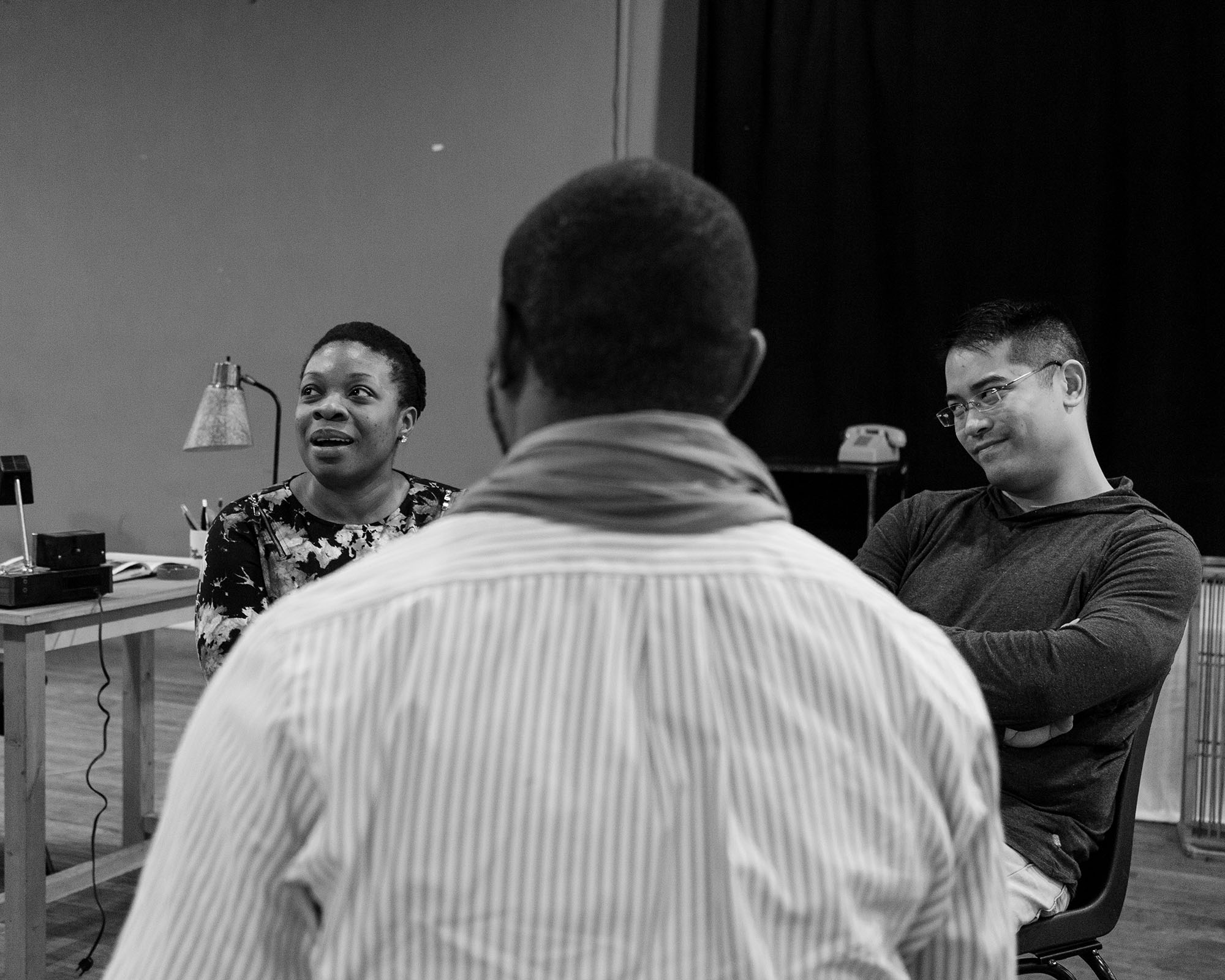
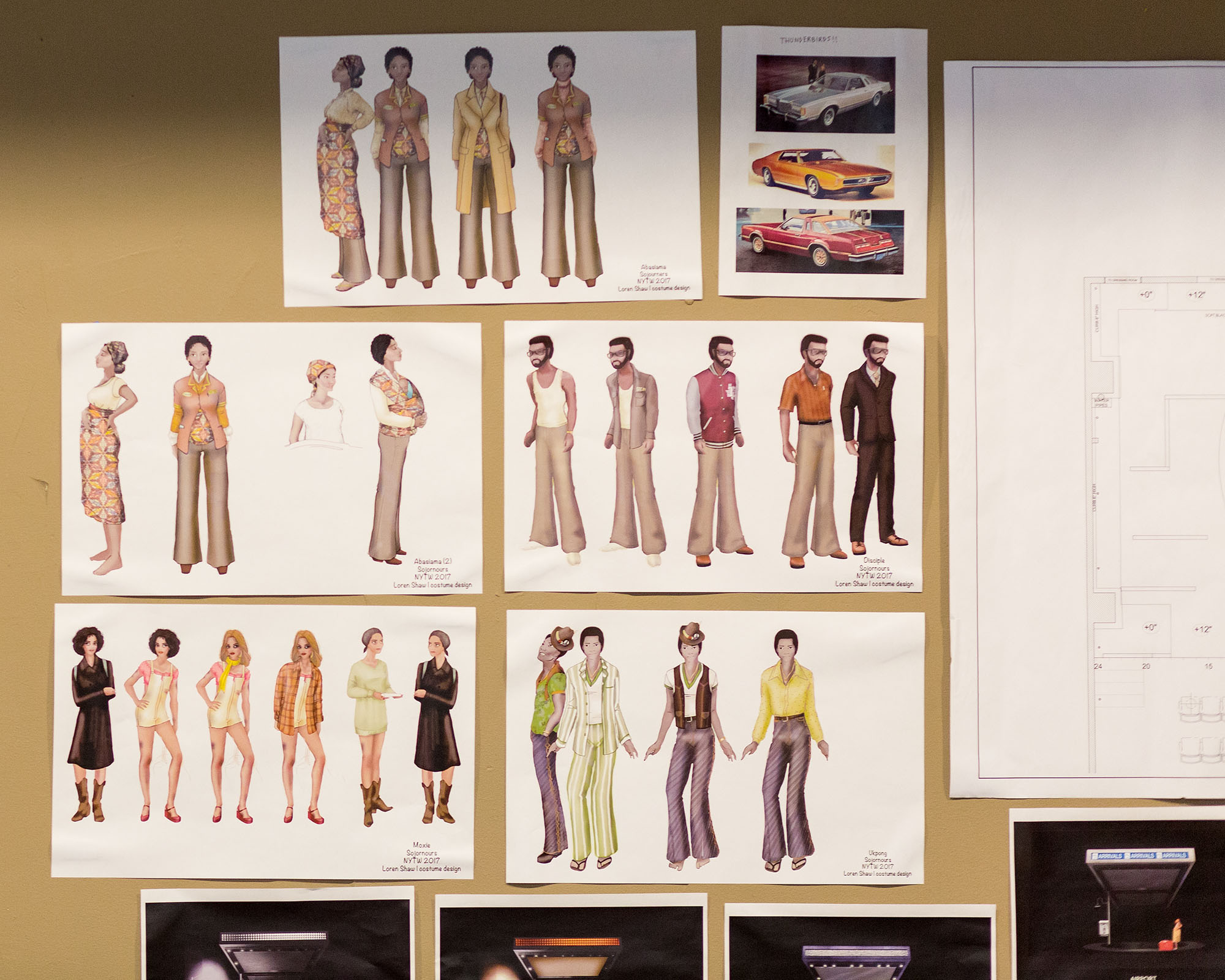
Mfoniso Udofia and Ed Sylvanus Iskandar are the latest dynamite duo to take over New York Theater Workshop, and this time with two plays, Sojourners and Her Portmanteau, two plays in a nine-play cycle Udofia is writing. We sat down with these dynamic, emerging, and important voices in contemporary American theater to talk about time, family, immigration, and history – all essential themes to the play and their overall work.


Darrel Alejandro Holnes: Thank you for sitting down with me.
 

Ed Sylvanus Iskandar: Oh, thank you!
 

DAH: And thank you for having me sit in on your rehearsal today. That was a really great opportunity and privilege. A lot of my first questions are in response to what I saw here in this brief scene that was rehearsed for the last hour. And my first questions is – both of you feel free to jump in – family is essential to the play, so what role does your family play in your process: inspiration, support, obstacle, all of the above?
 

[Ed and Mfoniso laugh]
 

ESI: I think because I left home when I was seven to go to boarding school I have been on a fairly consistent life-long journey in terms of defining and redefining for myself what “family” actually means. And family is…not special for me anymore. I still say I go home to Indonesia because my parents are still there, the home I grew up in is still standing, but I think when I say “family” now it feels like it’s about a community of people that I have been lucky enough to be accepted by. And that includes my biological family, but that seems to define for me not only a space emotionally in my life, but also the way I like to work and the kind of work I like to do with an audience watching. Which is really, I think, more than anything driven by the ability to further social connections – real ones. It’s how I conduct my rehearsal process. It’s how I like to let my companies and my car spawn – I’m constantly cooking. I can’t help it. It’s my nervous tick. It’s not a nervous tick. It’s a thing I like to do in order to keep myself grounded. This is actually kind of amazing here because I love working at New York Theater Workshop. There’s a little kitchen that just feels like a home. I really can settle into the rehearsal process in the way that you normally can’t in self-rented or borrowed rehearsal space. What the general managers do, which is really so amazing, is they literally give you the third floor. And you can figure out a way to make it work. And I do think with a play like that and a process like this – two plays together – that my job is to make family out of the people that are most regularly in the room, and to incorporate the designers who will now start to come in and join us in tech. And you know, I’ve come to the realization that once the play opens my job is actually over. And my real job is about making sure that whatever we’ve built together has a foundation to continue.
 

DAH: Like a family?
 

ESI: Yes.
 

Mfoniso Udofia & Ed Sylvanus Iskandar
 

DAH: Beautiful! And you, Mfoniso?
 

Mfoniso Udofia: I write about immigrants, also I’m the child of immigrants. My family’s been instrumental, at least for me, for the creation of these plays. In that my mother has become my biggest champion. When you talk about the child of immigrants and what trajectory is, there’s so many hopes and dreams. My mother looked at me and she was like, You are going to be a lawyer! Propah! You go do that. And so it was a huge thing when all of a sudden I was like, Mommy I’m an artist, and she’s like, No you’re not. At all. And so to turn around because family for me – it’s not as if I have much spread, you know, it’s quite localized. What my mom thinks, what my father thinks, what my brother, my sister – they’re my people here. So there are not many other people. So when my mother turned around and said, “Aye, daughter you’re an artist” it’s like breathing. And so it makes creating these plays…I mean creation in general is plot. So to have that family support, especially when I was wondering for the longest time if I would get it, is incredible for me. And then yes to what Ed said, you’re also building family. But I’m so lucky to have biological family to go, Oh yes, this is a good thing. as I’m building family and being in relation to some incredible artists, some geniuses in their own right. You know? I also have the core support that I find I need in order to write plays about families.
 

DAH: Sure, sure. And that’s a beautiful thing. Also beautiful, yet just as complicated, is how, in the scene that I observed, love seems to be defined as “mountains of desire, bitter river of burden.” Can you explain what this line means and how that works through the play?
 

MU: “Mountains of desire and a bitter, bitter river.”
 

DAH: Yes, that’s quite a line. Care to elaborate?
 

MU: I’m not sure, and this is where I get … Am I gonna say this? Yea. Sometimes I think American Western love is illogical [laughs]. It’s extraordinarily romantic, and this kind of straight thing. Maybe I’ve watched too many romantic comedies. I probably did and then I went, Ooo this is what love is. And then I was in the middle of it going, This is not love! I don’t know what that thing was. I think love is complicated – is an action, actually. It’s not this thing that just falls on you. And if it does, it doesn’t stay a thing that just falls on you. So, there is, there can be love and burden. I don’t know that it is necessarily a terrible thing. It doesn’t have to be. It doesn’t also have to be a thing that you…You know, you can look at that kind of love, you can go, I choose this. I want it. I walk into it. Or you can look at that and you can be like, I don’t. I can’t do that for now. Because the love I have of myself or my own desire won’t let me carry the burden of the love that I might have for you – it’s complicated. That line of love is complicated and purposefully convoluted. And love and desire, duty and birth date, they went through all my plays and they live side-by-side, because I don’t know if I…I think as an artist myself I’m trying to figure out exactly what the natures of love are. And at any given point, even in my relationship with Ed and relationship with the actors and my relationship with any production company, love is always changing. You know what I mean? So I’m not into the purest feeling of it. And so depending on where you are I think you will hear that line differently.
 

DAH: Interesting. And Ed, in your vision, of this play and of both plays, how do you see the characters negotiating desire and burden. How do you see those themes working throughout the play?
 

ESI: They’re not separate. It’s two flipped sides of the same coin, which is also how I think of both plays. I don’t think of them as two separate plays at all because I think the expression of love causes burden. And I think if love is going to be worth anything, it’s going to require that amount of work. I think that…Yes, I think I can say the experience of working on both plays and getting to know Mfoniso as a collaborator, it’s an amazing thing because I find myself challenging my own definition of what love means from the assumption of what I think I’ve given, and continue to find more that I’ve assumed – that I then need to ingest and choose to give more of, in order to actually continue deepening and building. And I can say that that’s probably the most full love I have given an experience. Because the journey of it has been so full and it’s been so expansive.
 

DAH: I love that word that you used, “journey.” Can you tell us a little about the journey of all nine plays?
 

MU: [laughing] How much time do we have?
 

Mfoniso Udofia & Ed Sylvanus Iskandar
 

DAH: Can you discuss how what people will see in these two plays are paintings that are part of a larger picture?
 

MU: So when I started writing, the first play I ever wrote was The Grove – it’s the youngest play and I was writing about the eldest daughter, some immigrants…And she was in the middle of figuring out what identity and duty and love, you know, where those things shred up against each other. Then I realized that in order to understand Mac you have to actually understand from whence she came. And so then from there came, what is now known as Sojourners, which was first called Towards because I knew I going towards something, but I didn’t know what,so that was the title of it. The Grove, then Towards, and then to understand the parents I had to understand the revolution in country and that’s where you get something like runboyrun – which goes back and forth between the Nigerian homeland and now the American resettlement place that they are in. Then from there came my number of nine, which will be five interior plays that follow Abasiama and Disciple Uffat, and the last four are gonna be love plays which follow their children as first generation youth in America or discovering what blackness is without a certain kind of historicity attached to it. Technically these could go on forever, they’re not. I’m gonna end it at nine. A promise that I’ve given to myself that it has to end at nine, but as I’m writing I’m discovering how concerned I am with lineage and I do think that that is something of a very immigrant mentality too. Like now that I’m here, what does “forward” actually mean on soil that is not my historical soil. So I don’t know if that explains the question, but that is at least the scope of the project.
 

DAH: Yeah. And I think that’s definitely what people need. I’m also an immigrant. So I absolutely understand what you’re saying about lineage. And in thinking about that I recall how the character played by Chinasa has a line about the baby’s name and time. Time must certainly play an important role in this play and in any sort of nine-part series, as you just explained,, that follows this family over generations. Why write about time? And let’s broaden that and also say, why write about lineage? Why bring that to the contemporary American stage?
 

MU: It was particularly important for me to write about West African, Nigerian, Ibibio, migration here and what lineage is. In my culture you actually count where you’re from, you hold it. You come from compound culture. You know your grandparents, you know the history of your great-grandparents, and your great-great – which is very, very, very different somehow, than what I find happening here, and I think we might be in the middle of a change. It’s like more 32-year-olds are staying at home with mom, you know. There’s a shift starting to happen. However, we don’t build community and lineage that way here. I see my people from home being able to count their history. Lineage is important for me, because when you come from that culture and you come into this culture, what do you retain and how? It’s as simple as, in one of the plays, Abasiama and Upem, you know, they’re fighting to figure out how to make fufu here. And they’re going to get products that are not yam in order to do it. So it’s fighting to figure out: How do I make lineage here now that it’s different than the way it was back home and I’m not going back home?
 

DAH: Are those some of the struggles you’ve faced?
 

MU: It’s some of the struggles that I’ve watched my people face. And yes, I can implicate myself here and I am interested in this because I have heard the stories of grandmothers and great-grands and my great-great who is this Big Man. And I wanna be able to pass some of that to my children as well, so I want to answer the question, what is that new tradition that I need to make here, in a different space, for me to carry on that culture?
 

Mfoniso Udofia & Ed Sylvanus Iskandar
 

DAH: And is that something that resonates with you Ed, as to why you were drawn to these projects? Is it also something that you can relate to personally?
 

ESI: What specifically?
 

DAH: This idea of time, lineage, and how it’s negotiated between the characters – what we carry maybe, from one generation to the next.
 

ESI: Yes and no. Because my relationship to time and lineage is very different for all the reasons we chose to work together. I am an incredibly linear person and everything about how I negotiate achievement, finishing, and construction is linear and very logical. And one of the very first things Mfoniso said – I’m paraphrasing – to me in one of our earlier conversations, before we committed to this play together, is the notion that for her time is a spiral and time is relative and your experience of time is completely insular and about how it is you understanding how to listen to yourself and how to contextualize yourself within the definitions of time of those around you. And I can relate to that very deeply. Although it still is interesting because it’s not necessarily natural in my thinking process. But I came to the scene in New York and created many long-form pieces, which is something I’m very interested in. The average run time with a show I’ve done in New York is typically six-plus hours. And I learned over the process of making those plays that an audience’s experience of six hours does not mean the same thing as an actual experience of six hours depending, of course, on your choice of activity within those. To be even more simplistic in that particular analogy, I have sat and watched plays that are sixty minutes that felt much longer and ones that are six hours that can speed by. So that is, I think, where we connect. And it’s also where we differ because my natural instincts normally take me to a place where I want to move forward when Mfoniso is still in a place of thought. And I think that is both our strength and our challenge. And we’re guilty of it in this relationship together.
 

DAH: Considering what we’ve just discussed, what do you hope the audience walks away with after seeing these plays? And I’m sure the list of things is endless, but specifically thinking about time, lineage, maybe time as a spiral, as linear – what are you hoping they walk away with at the end of the day?
 

MU: Multitiered. These plays aren’t just about time and lineage. The subject is something a bit more political. I hope that the audience walks away with a more nuanced imagination regarding the lives immigrant bodies lead on American soil. I also hope that people walk away a little shaken by how quick they are to potentially judge and assess someone’s motivation when they are within that struggle. Like the pairing of Sojourners and Her Portmanteau. Some of the weeping I’ve seen people do about what Abasiama does at the end of that play without understanding what Abasiama is going through to then maybe come back in Her Portmanteau and get even more information. Perhaps we can nuance-out what bodies of color do in moments of struggle. I hope that people will actually get up and go out and read some books. Because people don’t read books.
 

DAH: A couple titles?
 

Mfoniso Udofia & Ed Sylvanus Iskandar
 

MU: Ben Okri’s The Famished Road, Chinua Achebe’s There Was A Country and Things Fall Apart, Helen Oyeyemi’s Icarus Girl and the way in which she’s constructing fairy tale stories from other mythologies, which is part of what’s happening here as well. And then even just researching: exactly where is Nigeria? Where are the Ibibio people? Do I know these people? And why haven’t I even thought to think and ask about who and what and where they were? So, those are some of my hopes.
 

[Everyone laughs]
 

DAH: So, Chinese-Indonesian director with American training, Nigerian-American playwright, is the global perspective an American perspective? This should be a prompt for you to discuss trends in contemporary American theater, perspectives in a contemporary American theater, and what it means to have creators – playwright and director – with these different backgrounds in that space.
 

MU: Do you want to go first before I go? This is a complicated one.
 

ESI: I could try. I might be better able to answer this question by posing a response to the previous one. I’ve been thinking, a lot in the past two weeks especially, about the gift of being able to work on Sojourners a second time. It’s something that I have not had a great deal of experience in doing – having an opportunity to revisit and build upon and advance from and learn through. And what’s most interesting to me is in this second attempt at turning the story of Sojourners, is I find myself continuously letting go everything I imposed upon the play. And I find myself reaffirming the nuance in the text and the nuance in the stage direction.
 

That I was not able to fully comprehend the last time. Which also reveals a level of re-commitment and reveals an actual trust in what’s on the page that I feel I did not have the first time. Because my response to the play initially was, Surely this is a Nigerian A Doll’s House [by Henrik Ibsen], because my cultural framing is Western. And I feel the conversation I had with the play initially, even though I fully believed that I had advanced beyond the conversation that I actually did have was about trying to figure out how it fit within a Western construction. I honored it’s variation, I honored it’s uniqueness, but I do think my basic map in my head, or through my gut, was in comparison to linearity and a Western dramaturgy I have become used to, not just because of training, but because of the way a play looks on the page.
 

And what I feel the gain of this experience has been for me is, a further understanding of A) the basic truth that when we need to write something that it’s all intentional – which is something I fully love so much. And there I think she is similar to Ibsen. You ignore a stage direction and a word or a punctuation mark at your peril. And B) I also then fully understand that the play can only fully do its work and and fully realize its impact if it’s staged from the perspective of that trust.
 

It’s not that I didn’t believe I trusted the play last time. I would never sign on to a play that I don’t trust, or a voice that I don’t trust or a person I don’t trust. But it’s a higher level of trust that I’ve developed in the interim. And it is linked to what I now understand I can be more intentional about on the stage. And I find everything is stripped down in a gorgeous way. There’s just less of everything. There’s less space. I think I’m trying to make, in between scenes, to try and foreground story that is always useful, but may not be necessary because I was afraid that the story that’s in the text, wasn’t enough. And I find myself doing less in the scenes themselves – in a fairly radical way.
 

The scene that you experienced watching in rehearsal, previously does not look a thing like that. It has changed from a scene about a woman moving within her home and negotiating how it is to leave the door, to a scene in which this woman has no inkling to the choice that would take her to the door at all. And so has become a scene in which it’s two people on a couch. And that is also I think the right way to frame what I now believe fundamentally is my job, which is to construct every scene in such a way that the audience can listen.
 

The text is so rich it is outrageous how much work I have to do before rehearsing to actually get fully on top of it. And I suddenly realize that is also the level of attention I’m asking for from an audience. So if I’m not allowing them to tune into the auditory context of the physical picture, I’ve not done my job. I’ve created, successfully, distractions rather than amplifications, which was my original intention. So I do believe my intentions have always been sincere, but I do know how much I have learned.
 

Mfoniso Udofia & Ed Sylvanus Iskandar
 

DAH: Mfoniso, sometimes people say that the United States is a nation of immigrants. This play, and also our conversation so far has also discussed the idea of immigration and what that means and what those stories are. So my question to you now is, is the immigrant story inherently an American story? And is the American story essentially an immigrant story? Are Sojourners and Her Portmanteau inherently American stories?
 

MU: Am I gonna say some of these stigmas out loud? Yes. America has some work to do. And I do think yes, America is a country chocked full of immigrants that after maybe the third or fourth generation develop the worst case of amnesia and forget. And then we’re somehow cycling from an immigrant nation to a violently xenophobic one within the same – it’s a vicious spiral that is almost nonsensical. What kind of peculiar American amnesia is this? And so it’s like we have to constantly teach ourselves to remember, which is part of the plays, what it is to remember to not forget. Because we are a country of immigrants and that makes us special.
 

Ed’s sight is different than my sight; it’s different than your sight; and the way I look at the story is different than the way Ed will, or the way somebody else will. And as a nation of immigrants, we also have to be a nation of plural ideology. And that’s what I feel like America doesn’t do very well. There’s something else that happens as amnesia trips us up and then we become set in this weird non-porose American way. And so we should be. We are a nation of immigrants.
 

And it becomes a real issue for me when I don’t understand why I’m not seeing more plural stories on the American stage. Why me and Ed together – myself creating this play, and Ed setting it up from page to stage is just this radical, amazing thing. When actually that’s the thing. And why haven’t we been taught earlier how we shred up against each other? That our gazes are different? Why is this learning happening in what feels like a very singular narrow way? Why isn’t this the American theater normative, if we are a nation of immigrants and if theater is a representational art form – which we claim theater to be – because what Ed is talking about is true and is particularly salient in our case. There are two different gazes; we have read two different cannons; we have two different histories, none of them – I don’t know that we should be ascribing value to one over the other, but my sight is critically different than Ed’s sight. So the way in which we work together, that is the American theater. But by God, we’re taking photos of it and putting it in an exhibit and going, Look at this beautiful wonderful thing, when it should be the thing!
 

DAH: When it should be the norm.
 

MU: Right.
 

DAH: Right. Last question. I teach dramatic writing at NYU and I always end interviews by asking theater-makers what advice they have for young theater-makers: so student directors, student playwrights, you know. And not just students formally enrolled in the university, but anyone who’s just starting out and in this field and in this industry. Any tips? What do you wish someone had told you ten years ago?
 

ESI: I would say don’t do it unless you must because the theater is far too important a space to be met by anything less than a total commitment of your life. To squander even a single person’s gamble that night, on purchasing a ticket, only to be met by incompetence is the only real crime I can imagine an artist can commit.
 

MU: I second that. I tell some of my students to rigorously pursue their inherent, innate, illogical – the way I write plays, the way I construct plays, makes some people discomforted, some people…There’s a range of emotions when people first meet my play. But I had to. It’s been seven years now. The rigor that’s involved in the playwriting, and then the trying it out and teaching people and then knowing that it works, and then the rigor it’s advocating against a new – I shouldn’t say “new” because then it makes me like, like I was birthed now and there are other people who write like me. The rigor of the education and the teaching into and then the standing behind your work when people might not be able to see through it is a real skillset. And I say “rigor” because there are some students who are like, I did this new thing. It’s great. But they haven’t practiced it and gone through the steps to go, No, does it really work? How do I stand by it? I’m not saying just pursue your illogical passions – it’s like, do so rigorously. And perhaps it’s not illogical, pursue whatever is inherent in you. And I think the keyword is “rigor.” I don’t know that I’d be anywhere without it and I don’t know many artists who are. With the artists that I love, I think about their longevity, the span of their careers. There is rigor attached to it.
 

DAH: Excellent. So previews begin April 22nd and the play opens May 7th. I will be there. Thank you so much!
 

MU & ESI: Thank you!


Mfoniso Udofia, a first generation Nigerian-American storyteller and educator, attended Wellesley College and obtained her MFA from ACT. She co-pioneered the youth initiative, The Nia Project, providing artistic outlets for youth residing in Bayview/Huntspoint. Mfoniso’s Ufot Family Cycle plays, Sojourners and Her Portmanteau, will be produced this coming Spring 2017 as part of New York Theatre Workshop’s season. She is also Playwrights Realm’s 2015-16 Page One Playwright and in Winter 2016 they produced the World Premiere of Sojourners. In Spring 2016, The Magic Theater in San Francisco produced the West Coast Premiere of Sojourners and the World Premiere of the third installation in the Ufot Family Cycle, runboyrun. Mfoniso is currently working on Oregon Shakespeare Festival’s Play On! commission translating Shakespeare’s, Othello. She’s also the Artistic Director of the NOW AFRICA: Playwrights Festival and a proud member of New Dramatists class of 2023. Mfoniso’s plays have been developed, presented and/or produced by Playwrights Realm, The Magic Theatre, Dr. Barbara Ann Teer’s National Black Theatre, Hedgebrook, Sundance Theatre Lab, Space on Ryder Farm, NNPN and New Play Showcase, Makehouse, Soul Productions, terraNOVA, I73, The New Black Fest, Rising Circle’s INKTank, At Hand Theatre Company, The Standard Collective, American Slavery Project, Liberation Theatre Company and more. Mfoniso was a finalist for the 2015 PoNY Prize, the Eugene O’Neill NPC, Bay Area Playwrights Festival, Many Voices Fellowship, Page73 Development Programs, Jerome Fellowship, NYTW’s 2050 Fellowship and Lark Playwrights’ Week.
 

Ed Sylvanus Iskandar has directed over 150 productions globally. NEW YORK: The Mysteries, Restoration Comedy, and These Seven Sicknesses (all NYT Critics’ Picks, The Flea Theater); The Red Umbrella (Drama League); The Golden Dragon (The Play Company at the New Ohio Theatre). REGIONAL: Head Over Heels (Oregon Shakespeare Festival), Don Juan, Translations, and The Collection (Stanford Repertory Theatre); Homemade Fusion (Pittsburgh CLO); Don Carlos, Brand and Miss Julie (CMU); The Dumb Waiter, No Exit, Death and the Maiden and Sexual Perversity in Chicago (Edinburgh Fringe Festival). INTERNATIONAL: Venus in Fur (Singapore); Memphis (Japan) OTHER: As Founding Artistic Director of invite-only NYC collective Exit, Pursued By a Bear (EPBB), Ed has served over 12,000 free home-cooked meals and shared 150 priceless nights of theater over the course of staging 8 Labs and 40 Salons, including NY or world premieres of The Further Adventures of Hedda Gabler, Arok of Java, and the musical Dani Girl, alongside new versions of Don Carlos, The Master Builder, and King Lear. Restoration Comedy and These Seven Sicknesses both began their NYC lives as EPBB Labs, later transferring to critical acclaim as productions at The Flea. EPBB fulfills a vision of theater that deepens the audience’s ability to engage by creating empathy for the human effort behind the art. Ed’s body of work with EPBB was honored with the 2013 National Theatre Conference Emerging Professional Award, conferred by Bill Rauch (Artistic Director of the Oregon Shakespeare Festival).

Posted on 1 Comment

A Conversation with Hilary Bettis

Hilary Bettis


Earlier this year, The Sol Project was announced as a new initiative to raise visibility of Latina/o voices in the theatrical landscape. To kick off this venture, The Sol Project is collaborating with New Georges to present a brand new production of accomplished playwright Hilary Bettis’ Alligator, which opens on December 4 and runs through December 18 at the A.R.T./New York Theatres. I sat down with the smart, funny, charming, and wittily self-deprecating Hilary over hot tea on a rainy day in Williamsburg, where we chatted, among other things, about her play, her creative process, the current political climate, and the complicated nature of her personal cultural identity. I also attempted to get her to spill some spoilers for the upcoming season of FX’s The Americans, for which she is a staff writer.


Margarita Javier: The first thing I wanted to ask you is about The Sol Project. I’m very excited about it. How did you become involved with them?
 

Hilary Bettis: It’s one of those things that happened organically. Elena Araoz, who’s directing, has been a longtime friend of mine. We’ve done lots of readings and workshops together over the past four or five years. She actually directed a reading of [Alligator] in 2012, and that’s how she and I met. She was part of the founding members of [The Sol Project], and this was one of the plays that they had been considering. New Georges – who I also had a relationship with and had done a lot of workshops with for this play years ago as well – ended up being the first producers. I got a phone call one day from Susan [Bernfield] and Jacob [Padrón] and they were like, Hey! We’re gonna do your play!
 

MJ: That’s amazing. And it’s been a good experience so far?
 

HB: Yeah! It’s been a great experience. There’s been bumps in the road, because The Sol Project is new and they’re trying to figure out how they produce together. This is the biggest play that New Georges has ever done, on top of the first play in the A.R.T./New York space that’s still literally under construction. We just figured out how to have heat in the theater two days ago. It’s the first production that Elena and I have done together, so we’re trying to figure out what that relationship is, how we work together, and how we communicate. It seems so easy in theory, and then you’re in the thick of it and you’re like, Oh, we didn’t talk about this, or maybe we should talk about this, or maybe we should approach it this way. It’s actually really exciting, despite the stress and the lack of sleep that I’ve gotten throughout this process.
 

MJ:Tell me about the play, Alligator. What is it about, where did the idea come from?
 

HB: It’s this crazy, messy, chaotic, bloody, ensemble-driven play that I wrote when I was going through a lot of shit in my own personal life, like taking care of a friend who was dying of cancer and living with my alcoholic ex-boyfriend – a lot of a lot of a lot of a lot of chaos. That play came in like a fever dream; it sort of vomited out one night. It was very instinctual. I’ve never written anything quite like that since in that way, and I think it came out of trying to survive my life at that time and find meaning in this messy chaos with all these people that are literally wrestling life and death demons, including myself. It’s set in the Everglades. It’s in a really small rural town and it’s about all of these teenagers, and they’re trying to figure out how they fit into the world and trying to figure out how to love and be loved, but none of them have the tools or even know what that really means. It’s like a collision of pain and how these seemingly innocent interactions translate into this bigger destruction of this community.
 

MJ: Why the Everglades?
 

HB: I like to write about places that I’ve never been and I get really excited about, and I think for a long time it was because I was so poor and couldn’t actually travel. I wanted to see the world.
 

MJ: So you could write it.
 

HB: Yeah, and when you have an excuse to just dig and research and let your mind go on crazy tangents. I love being able to do that, but I also think there’s something really interesting about it, because you don’t have the familiarity of that place. In some ways, you can have a bigger perspective of it if you really do your homework. In all of my plays, place is always the number one character. All of who we are as people, the choices that we make, the decisions that we have to make, come from our environment and surviving our environment. The Everglades in particular is this messy, swampy, isolated part of the world that you really have to understand how to fight to survive in because everything in there is trying to kill you. It takes a certain type of person in and of itself just to be able to live in that environment, and that becomes a metaphor for these deeper struggles.
 

Hilary Bettis
 

MJ: Why do you write? Out of all the things you could be, why a writer?
 

HB: Oh man, I don’t know. Insanity? [laughs] Writing is really a byproduct of surviving my own life, you know? My family moved a lot when I was growing up and we didn’t have a lot of money – and I was the oldest, the only girl, and I was “the new kid” every two years. I saw a lot of violence and sexual abuse and all kinds of shit when I was growing up. We never lived in a community long enough to really get to know a community. My parents both worked 60-hour work weeks, and so we would end up just having to learn how to survive and navigate people with our instincts. And sometimes that was good and sometimes it wasn’t good. Being the only girl on top of that, writing was a thing that I did to deal with life and deal with feelings, and it was the only place I felt safe because you can say the most poetic thing or the most horrible thing, and you can rip it up and burn it or you can show the world. There’s a sense of empowerment that I never felt in any other aspects of my life.
 

I never actually wanted to be a writer. I wanted to be a veterinarian and then I probably wanted to be an actress. I moved to LA a week out of high school to escape this very small, rural, conservative Minnesota town that we’d moved to when I was 15. I ended up homeless in LA. My first job was cocktailing at a strip club when I was 17 years old. I saw the greatness and the rottenness of that world and also the complicated humanity. You know, people don’t lose their dignity just because they make hard choices for survival, and I think that it’s so easy to place moral judgment on people when we have food and shelter and water, you know? I was going out for terrible, terrible acting roles, and reading scripts where women were non-existent – they weren’t human, they were body parts. My 17/18-year-old brain was like, Well, I’ve lived in six different states at this point and I’ve been through so much shit and survived so much shit. I’ve had my big existential crisis over religion; I’ve seen people die when I’ve lived. Why is it that nobody writes people like me? I can’t be the only one in the world, you know? And so I think asking that question started this career path that has been – I mean, I’ve been really blessed. I have this sort of beautiful, lovely career that I never thought would happen to someone like me.
 

MJ: As a woman playwright, how has your experience been in the theater community or in television? Given the fact that it is – some would say and I would agree – harder for women to make it in these environments. Do you feel that pressure at all, or are you fighting to get more representation for women – is that a struggle?
 

HB: Yes. Especially in the TV world where people are really starting to recognize the importance of diversity. In some ways, I think that I’ve had doors opened that even three or four years ago women trying to break into TV didn’t have. I think it’s harder in theater for women than TV really, truly. Truly. In TV there’s a lot of turnover and executives tend to be younger. Everybody wants who the next up-and-coming voices are, and so they’re really excited to at least read your work. In theater I feel, you know, artistic directors who have been in the same position for 20 or 30 years feel very much a generation behind in their tastes, and I think there’s a lot of subconscious biases in there. They look at young women playwrights and it’s like, Oh well, you are a niche market, you cannot be mainstream. Whereas you can be a straight white male writer and, you know. I watch my classmates out of Juilliard, and hands down the guys always had it very easy in a way that it wasn’t for the girls.
 

MJ: You look at representation right now, and there’s not that many plays being produced or written by women happening in New York, or women directed plays, but there’s so much talent out there. What can be done about that?
 

HB: Really, I think that women need to be in positions of power and leadership. I think that it’s not enough unfortunately and I wish it were, but it’s not enough just to write a play. It’s not enough just to want to be a director. You have to also be an advocate, not just for your work, but for your career. You have to be an advocate for other women, and you have to really think in versatile terms. What I am really consistently learning in my career is that if I really want to protect the things that I write, and protect the female characters that I write from becoming stock characters, gratuitous, or objectified. Then I need to learn how to produce and I need to learn the business side of things.
 

MJ: I’ve read a lot about you, and I know that a recurring theme in your work is identity.You’ve talked about your desire to reclaim your Mexican identity and that’s reflected in your work. That’s a very conflicting thing: not quite fitting in, not quite knowing. I identify because I’m Puerto Rican but don’t fit into a stereotypical look, so I understand the conflict that comes from that, but being part of The Sol Project, and the fact that it is something that recurs in your plays, how do you feel about your identity or wanting to reclaim that side of yourself?
 

HB: God, yeah, I feel like it’s gonna be something that is always gonna be – I don’t think I’ll ever have a definitive answer. I think it’s always going to be evolving as I evolve and the world evolves. Growing up, we mostly lived in really rural parts of the country that were really, really white. My brothers and I were always the most ethnic kids at our school, and I never thought about that as a hindrance to my opportunity in the world. My grandfather had experienced it – I mean, his whole life was fighting against prejudice – and he really felt that he was deeply held back and denied opportunities in his life because he was Mexican.
 

I think in order to protect us from that, he really deeply advocated for us being as American as possible and not learning Spanish.He didn’t speak Spanish around us. When my mother was pregnant with me, his biggest fear was that I would be dark and I would look too Mexican and I would have to deal with the same prejudices he dealt with, and so for me in some ways… I mean, yes, there are a lot of prejudices in the world, especially with Donald Trump in power now and it’s really, really scary. It’s really scary. But part of reclaiming that side of my family is giving dignity and honor to my grandfather’s life and his struggles, and it’s a complicated thing, right? My entire life people have told me that I don’t fit into any community. When I moved to LA and met a lot of Chicanos, they were like, Oh, you’re a white girl, you’re not Mexican at all. And yet being in rural white communities in the Midwest, I was always Latina. And so it’s been a strange thing. Am I allowed to claim? I struggle with it. I actually struggle with whether or not I’m allowed to claim that part of my identity, and yet it’s my blood and my DNA.
 

MJ: Absolutely. And I understand where the dissent comes from because I do feel very protective about portrayals of Puerto Ricans specifically, and I do have that same struggle where I’m like, Well, you’re only ¼ Puerto Rican. I don’t know if you’re qualified to represent us. But at the same time, why create that conflict? It’s really complicated.
 

HB: It’s really complicated and I would never claim to be able to speak for Mexican culture. I’m an American. I was born in America. I speak a little Spanish, but it’s not great. I don’t know what life is like to be Mexican in Mexico. I don’t really know what life is like really to come to this country as an immigrant from Mexico. It’s a complicated thing, but at the same time, it’s also part of my own family identity.
 

MJ: I think it’s admirable because it’s so easy to give into not claiming that, because doing so makes it harder. If you are ethnic, it is harder in this country, and there’s this constant struggle to want to assimilate. I think it’s admirable of you to want to claim that part of yourself because it would be easy to just be like, No, I’m just American. That path would be easier, I think, than saying, No, I want to talk about this. I think it’s important to do so.
 

HB: Well, I really appreciate that. I really do.
 

Hilary Bettis
 

MJ: So you mentioned Donald Trump. And I wanted to bring it up, especially since somewhat recently Vice President-elect Mike Pence went to see Hamilton, and it became this big thing where suddenly the president-elect was launching an attack against the theater community, and I was just wondering if you have any thoughts about that.
 

HB: I mean it’s scary, right? On the surface, it’s like, Oh, you know, he’s crazy and his ego was hurt, and it’s just somebody complaining on Twitter and it’s harmless. But the reality is that those are the beginning steps towards really taking away some of our basic fundamental rights in this country. And it’s not really even about theater – it’s about freedom of speech; it’s about being able to be safe in this world and say things that might not always be popular, be able to talk about and give voice to marginalized communities, and be able call into question the people that are in power and the way that we always have… That’s one of the foundations of our country. I think we have to be very vigilant about it, especially as artists. Our purpose in this world really is to call into question the world around us and make people uncomfortable.
 

MJ: Absolutely, and it’s about challenging ideas and theater has always been challenging and arts have always been challenging.
 

HB: Yeah, and it should be! We’re doing our jobs.
 

MJ: What is the intended audience for your plays when you’re writing?
 

HB: I know that my plays are probably never gonna be at places like MTC. Especially with Alligator, I wanted to write plays that my friends would go see. My friends who weren’t in theater. I wanted to write things that I would want to go see and I also wanna write things that ask really uncomfortable questions. I know that that’s not always popular, and people want to go to the theater to escape and you have to have money, really, to see theater, for most people. Many of them will walk out of my plays, and that’s fine. But the ones that stay, I want plays that are really gonna make people think, and make me think as the writer too. I mean, it’s not just about, Oh, I’m gonna use this as a soap box. It’s just as much about, These are the things that I also struggle with or the hypocrisy that I see in myself, and let’s talk about it. Let’s not pretend that we’re better, or that these things don’t exist.
 

MJ: So why theater specifically? What drew you to theater?
 

HB: You know, I think part of it is just always being a new kid and never having friends growing up, and really yearning for a community. My dad’s a Methodist minister, and so the church was a big part of my childhood and my father’s very poetic and he loves to tell stories. I think part of it was growing up watching my father write beautiful sermons, and the way that he could captivate a room of people. That’s what great theater does; it’s a shared experience. Especially in this day and age where we’re so addicted to technology, we’re having less and less human interaction, and our entertainment, our love lives, and our whole existence is us and a screen. Theater, I really and truly believe, is going to become more and more relevant because people are going to crave human connection in a way that I don’t think we quite understand yet, because of what technology is doing.
 

MJ: What are your theatrical influences, and who are your favorite playwrights? Or is there anything you’ve seen recently that you thought was great?
 

HB: Well, I haven’t seen anything recently because I’ve been so crazy [busy], but I have a very special place in my heart for Marsha Norman, of course. I fell in love with her work when I was 18 years old. To have gotten to study with her at Juilliard for two years and be… I actually talked to her on the phone today, and to have a relationship with her is incredible. I really love [Edward] Albee and Sam Shepard and Sarah Kane, and unapologetic writers, and I really love Westerns too. I love Cormac McCarthy and [Quentin] Tarantino and super masculine genres. I love to try to find a woman’s perspective in those worlds, and so I tend to write things that feel really gritty on the surface but have a lot of empathy and vulnerability underneath.
 

MJ: Have you ever had a great idea that you abandoned because it didn’t work?
 

HB: [laughs] Um, every day. I don’t know if any of them are great. I have ideas all the time. I have a lot of files on my computer that are false starts to things that seemed so cool and then five pages in you’re like, Oh, this is not a thing at all. I have a lot of those. A lot. And then I have these ideas that are like, Oh, that’s my magnum opus that I’m gonna write some day when I have the ability to. I think there are some things that I want to write that I just don’t have the craft yet. I haven’t written enough to be able to execute it.
 

MJ:You’re a staff writer for The Americans. I love that show. How did that gig happen?
 

HB: It’s such a good show! And it’s such a great culture. My bosses are amazing. They’re at the top of their field and their craft and are the nicest, most respectful, down to earth people, that also have families and lives and treat everyone with respect and value everybody’s opinions. To have that be your first TV job and to also really see that you can be successful in this career and you can write things that are of really high quality and you can still be a normal person and treat people well – I feel really blessed to have that be the place where I’m starting from. So yeah, they were looking for a writer for my position and read some of my plays and I went and met with them and then they hired me.
 

MJ: That’s amazing. They’re filming now, right?
 

HB: Yeah, it’s insanity. We finished the first two episodes. We have the producers’ cuts for those; we have the entire season broken; we have scripts through episode nine written and all the rest of the episodes are in process of being written right now. They’re like a machine, it’s insane.
 

MJ: Can you tease anything about the upcoming season?
 

HB: [laughs] It’s going to be awesome!
 

Hilary Bettis
 

MJ: I read that you have a development deal for a show called Finding Natalie?
 

HB: I have two! I have a project at the Weinstein Company with Alyssa Milano, who’s executive producer on it, and we’ve been working on that for about a year. Then Finding Natalie is a gritty hour drama about sex trafficking. It’s about a young Mexican girl whose sister is kidnapped by a sex trafficking cartel, and she gets herself kidnapped to find her sister, and so really it’s a love story at the heart of it about two sisters, and what family will do for each other and the things that we will endure for love, for real love, and having that juxtaposed against this brutal world. Our culture really associates sex with love and being wanted, and to be able to say that’s actually not at all, that what these sisters are willing to do for each other is real intimacy. It’s in the pretty early stages. I’m in the middle of writing the first draft of the pilot right now, so I’m sure that I’ll have hundreds and hundreds of drafts with all the network notes and things like that.
 

MJ: And there are a few movies you’ve done as well.
 

HB: I have. I’ve done a couple of short films, and produced, and I have a feature film project that I’m developing with some producers as well that’s in the super early stages. I don’t quite know what that will be yet.
 

MJ: Do you think you’ll continue to do theater?
 

HB: I have to do theater. I have to. I do, but it’s so damn hard to get a production. I see why so many playwrights that are like, I’m done with theater. I’m gonna write for TV. I get it. I totally, totally get it. You have to continue to write plays because you love writing plays, and you don’t care if they’ll sit in a desk drawer and never see the light of day and you’ll never be paid for it.
 

MJ: What advice would you have liked to have had when you were younger and deciding that you wanted to be writer?
 

HB: Don’t be so hard on yourself. Just write and let things be terrible. I think I had the impulse to write long before I really started doing it, and I think that I was really scared and didn’t think I had anything worth saying. I didn’t think that I was smart enough to be able to do it, and I meet a lot of people that say, “I just started writing” or “I want to be a writer” or “I want to write a play, how do you do it?” I think the biggest obstacle is fear. You have to take the pressure off yourself and give yourself permission to just be really terrible for awhile. Even when you learn how to write, the first draft of everything you write is going to be terrible. Giving yourself permission allows you to really trust your instincts and really conquer your fear. I think that more than anything is what prevents people from following their heart and saying the things they need to say. Also, learning how to protect and advocate for your work. Start in that place and really give yourself permission to be terrible.
 

MJ: Why should people come see Alligator?
 

HB: Yes, come see my show! Because, first of all, Elena has done an incredible job with the direction, and it’s messy and it’s bloody, and there’s an alligator onstage who also happens to be my boyfriend. There’s an actual alligator.
 

MJ: Well, I’ve heard so many wonderful things about it. I can’t wait to see it.
 

HB: Good! It’s so scary right now. The past week I’ve been like, Oh my god, I’m just gonna call everyone tomorrow and say this is terrible, let’s pull the plug, let’s pretend this never happened, let’s never talk about it again! Elena and I just sit in the corner ripping the whole thing apart and being like, Oh my god, what have we done? We’re both perfectionists.
 

MJ: I think if you get to a point where you’re entirely happy with what you’re doing, you’re doing something wrong. I think you always have to challenge yourself to be better.
 

HB: Yeah. Yeah! I hope you’re right!


Hilary Bettis writes for the theater, television and film. Her work includes: “Dolly Arkansas,” “Blood & Dust,” “The Ghosts of Lote Bravo,” “The History of American Pornography,” “Alligator,” “Dakota Atoll,” “Mexico” and “American Girls.” A two-time recipient of the Lecomte du Nouy Prize from Lincoln Center, she is a 2015 graduate of the Lila Acheson Wallace Playwright Fellowship at The Juilliard School.
 

Bettis has received many fellowships and residencies at the O’Neill National Playwrights Conference, York Theatre Workshop, SPACE at Ryder Farm, La Jolla Playhouse, New York Foundation for the Arts, Playwrights’ Week at The Lark, Audrey Residency at New Georges, Two River Theater, Great Plains Theatre Conference, The Kennedy Center/NNPN MFA Workshop and more.
 

As a screenwriter, Bettis has written and produced two short films, “B’Hurst” and “The Iron Warehouse,” which have screened at multiple film festivals across the globe. She lives in Brooklyn, New York, where she works as a staff writer for the TV series “The Americans” on FX.

Posted on

A Conversation with Nathan Alan Davis & Megan Sanberg-Zakian

Nathan Alan Davis & Megan Sandberg-Zakian


The story of Nat Turner is going viral these days as the United States continues to confront slavery’s legacy when we witness and respond to police brutality, mass incarceration, and more. Nat Turner’s story is also made current by the premiere of the film, Birth of a Nation by Nate Parker and by the premier of the play, Nat Turner in Jerusalem this season at the New York Theatre Workshop. Since Nat Turner is on everyone’s tongue and mind, I sat down with playwright, Nathan Alan Davis and director, Megan Sandberg-Zakian, the visionaries behind the play at New York Theatre Workshop, to talk to them about all things Nat Turner including their new play, and the continued fight for diversity and inclusion in contemporary American theatre. Here’s what we had to say.


Darrel Alejandro Holnes: Nathan, you’re making your New York debut with what feels like a very timely play. Is it true what they say, that timing is everything?
 

Nathan Alan Davis: Who says that?!
 

Megan Sandberg-Zakian: They!
 

[Everyone laughs]
 

NAD: I mean, yes, timing. I definitely feel like there are forces at work, besides myself, in terms of this play. The way that Megan, myself, Phillip [James Brannon, who plays Nat Turner], and Rowan [Vickers, who plays Thomas R. Gray and Guard], all came together – the way the theater came around to support us and the work has kept us together as a team to continue the process all the way to production. [This] has just been a dream come true. It’s allowed us to, as fully as possible, develop this story and get the play out. So much of the timing and those types of things are out of my control as an artist, so when it all falls into line, it’s a beautiful thing.
 

DAH: Why is Nat Turner in Jerusalem so timely? What does it mean to see the piece produced now as conversations around race in America continue to heat up?
 

MSZ: Well, one of the scholars who writes about Nat Turner – his name is Ken Greenberg – has said that the story of Nat Turner continually resurfaces. There have been these moments over the last couple hundred years where the story suddenly arrives back in the consciousness, and how we’re telling the story this time and why we’re telling the story now probably has a lot to do with where we are right now. So I think the questions that you just asked are the set of questions that we are hoping people will be in conversation about and around the play. Why do we need to hear this story right now? I actually think that in a way, that is what the play is about. The play isn’t about here’s the story, the play is about why do we need to be in a room together and engage with this story at this moment? So I don’t know that I have a really great answer. If I did, I could solve everything.
 

DAH: Thank you for your response.
 

MSZ: Partially, for me, the thing that feels really rich and activated right now, around this story, is the questions [raised] about how we view violence. What is the story we tell around violent acts? What is our understanding of the social violence that is shaping our daily lives and our awareness of it? What is our stake in maintaining ignorance about violence? – Ta-Nehisi Coates calls it “The Dream” – What is our stake in staying ignorant of these really violent social systems? Then, what is our response to violence that resists those systems? For me – for all of us – it’s been a very uncomfortable conversation. When you read about – as we did in development – the shooters in Baton Rouge and Dallas who are taking out cops with sniper rifles… to experience the coverage of those things, and see the families of those people whose lives were taken, our reaction, whether it’s grief or activism or sharing on social media – whatever it is – [must be to] then consider our ongoing reaction of, or ignorance of, or complicity in all of the other kinds of deaths that are going on all around us…
 

DAH: What are the other kinds? To name a few…
 

MSZ: All of the deaths related to poverty and disenfranchisement in this country; the deaths of people who aren’t receiving adequate healthcare; the deaths of people who are in dire types of housing situations; the deaths of people who are wrongfully incarcerated in a system that is strongly biased; and of course, the deaths of people all over this country, particularly black people, gunned down by our police forces. So, it’s really hard, as a human being and a progressive person, to say that the violent taking a human’s life is somehow necessary.
 
In the play, when I hear Thomas Gray talk about all of the people that were killed during Nat Turner’s “insurrection,” as it’s called by Thomas Gray, the lawyer character, when 75% of the deaths were women and children – small children, infants and babies – it’s very hard to hear. It’s very hard to listen to, you know? You think about describing the deaths of those 55 people, and then you think about if you had a play describing all of the violent deaths of people under the system of slavery, it would be a 15 year long play.
 

DAH: Yeah, or a 400 year long play.
 

NAD: It continues.
 

MSZ: It’s just very uncomfortable stuff to engage with. So coming back around to my answer to your question, I wonder if part of the reason that the story comes back is that somehow we’re at a place where we’re more motivated to tolerate that discomfort.
 

NAD: I remember Megan and I had a conversation on the phone after I’d written an initial draft of the play, which barely anybody had seen; it was kind of a dream state type of the play; it didn’t really have a lot of the plot elements that this play has now. Megan read it, and it wasn’t even a complete draft, but Megan was like “I’m really uncomfortable! This makes me feel bad!” And that was the main takeaway for me; this is hard stuff to think about, to process, and to look at. It was actually a very important part of the growth of the play for me. You write something, and you have a response…I had to take a breath and be like, yeah, the territory that this delves into is extremely difficult to handle and it asks so much of the artists who are involved in creating it and carrying it and sharing it. It asks us to give everything to it, to honor it in the right way, and to live in a place of discomfort, and to not hide from it. It’s been extremely challenging and also a rewarding part of this process, staying in that conversation.
 

Nathan Alan Davis & Megan Sandberg-Zakian
 

DAH: So a few of the words I’ve heard you both mention are: difficult, hard, complicated. I have not heard the word contentious, controversial. I’m wondering, is this play about controversy? Is this play a controversy?
 

NAD: I never looked at it that way, and I never defined it that way. I think when I approach a play or a piece of art, I’m not particularly thinking of it attempting to cause a controversy or attempting to respond to a controversy. To me, controversy kind of is in the realm of what people find aesthetically acceptable or what people find can or cannot be spoken, or should or should not be said. I’m not saying that…Megan mentioned, when the Nat Turner story does appear in our consciousness over and over again, controversy does erupt out of it. Probably the most famous example is the William Styron novel about Nat Turner, which caused a lot of controversy, because William Styron is a white author portraying Nat Turner, so there was backlash of that from black writers and scholars and people who just found that that wasn’t a fair or accurate depiction. So it happens. But looking at myself now, as an artist, I feel it is my responsibility to tell as much of the truth of the story as I could see. That means me looking inward, and looking outward, having conversations, and keeping the story moving forward. I think for all of us, we really want to honor the spirit of Nat Turner and the spirits of everybody who was involved in that insurrection, you know? Knowing that that is a real thing, and that this is a thing that happened, and that we just want to do our very best to bring as much light as we can to it. As one of many Nat Turner stories that will be told – I certainly don’t claim to be writing any sort of a definitive interpretation, I don’t think that exists, but we’re just really focused on doing our very best.
 

MSZ: I will say though, that we have a lot more information than William Styron did. I would say pretty much more than anyone else has had, in creating this story, just because there’s been a couple of books published recently and one in particular that is extremely exhaustive in terms of the research. I think that book was published after Nate Parker’s film was already happening. So I think once we read that book, by David Allmendinger, we felt a lot of responsibility not to actually have facts that we knew were wrong. For a play that’s very poetic, and is really an invented event, it’s very factually correct. I can only think of one thing in it that is tiny, that I know is not historically true.
 

DAH: And what is that?
 

MSZ: The lawyer character was disinherited by his father. His father made him the executor of his will where he was disinherited. In the play, the father also wills that lawyer a desk, to be the executor of the will on. I would say that was a poetic, dramatic underscore of that historical fact, but really, I don’t think there’s anything else. And I’ve been very, you know, nope, that’s not right, find another way to do that!
 

DAH: So historical accuracy was a priority for you guys?
 

MSZ: Oh yeah. I mean, it’s more like I don’t want the play to contain something that I know to be a historical inaccuracy. Although, I don’t think that it can be historically accurate, it is a crazy idea anyway.
 

NAD: It actually helps a lot, artistically. I think if I felt limited to “Oh, I can only have hard facts in the play,” or “you’ve got to make sure all the facts will tell the actual story,” that would be a problem. But when you actually get down to real specifics of the story – like if you find the historical truth – it actually brings a specificity to the play, which I think actually makes it more poetic. You also just have to realize these were real people, living real lives, with real problems, who did real things. It’s not this portrait of a distant past.
 

MSZ: Every single new fact that we’ve found, has been like oh, shit! It feels like it drops you deeper and deeper into the truth of what the story was and why we need to tell it. It’s like there’s no inconvenient facts for this play… This is what we do all day, except you guys are not usually here.
 

[Everyone laughs]
 

Nathan Alan Davis & Megan Sandberg-Zakian
 

DAH: You mentioned William Styron and the controversy of who gets to tell Nat Turner’s story. Nathan, can you speak a little to the politics of racial identity and authorship?
 

NAD: Wow, that’s a big question.
 

DAH: I can point the question more if you want me to.
 

NAD: Please do, and I’ll either take the small point or the larger point.
 

DAH: In what ways does your personal experience of race inform your writing of the play, and what kind of responsibility does your unique experience as a person of color give you in telling stories with characters of color?
 

NAD: I guess the first part is that, in every way, being black in America yields full-time internal conflict. What does this country mean to you? How do I reconcile being part of this society? I think that the internal conflict and questioning, naturally, makes its way into all aspects of my life, especially the art that I create and the plays that I write. I don’t know that there is [a specific], identifiable way, it’s just a part of who I am, you know what I mean? The thing about responsibility is a big question because I think one of the biggest difficulties, being a person of any marginalized community, is that you feel the need to represent everybody in your group every time you have a platform, every time you have a chance to speak up. You feel that you’re not just speaking for yourself. I think on one hand, that’s just the truth, and I hope to embrace that responsibility. On the other hand, I need to find room for my own individual voice, my individuality. Who am I? What do I have to say? How do I do things as a person? I think oftentimes, if you get too caught up in representing, what does that mean? It doesn’t mean the same thing to me as everybody else. You can lose you own fire and your own artistic passion if you start to generalize your approach, because you’re repping a group. But at the same time, the need to rep the group is always present, you know? I think it’s a constant balancing act.
 

DAH: Megan, as a female-identifying director, can you speak to the absence of women in the show, and the ways in which their presence might be felt, whether it’s in the writing, or in any decisions you’ve made as the director?
 

MSZ: There’s a physical absence of women in the play. Women are talked about in the play, as the victims of murder, as mothers who die in childbirth or abandoned by their families – helpless victims. I think to some extent the play does a really great job of representing the 19th century view of women. The politics of the time, as we have them recorded, are very male. I am quite sure that there are lots of very interesting female viewpoints on this history that we just don’t have. That would be another really interesting play, but we unfortunately just don’t have it.
 

DAH: Are there any women referenced by the men who played an integral role in this particular history during its time? Someone we should all know about and have never heard of?
 

MSZ: The one woman that stood out to me in the research didn’t make it into the play at all. She was a woman named Elizabeth Harris, I think, who was a slave owning white woman whose house was deliberately skipped by the insurgents as a favor to one of the original core group. We don’t know why, we don’t have any other information on it, but the thing that we do know about her is that there’s a free black man who was living in the household of some of the white folks who were victims of the insurgency. Immediately following it, he sold himself back into slavery to this woman, Elizabeth, for $1, which to me is just the world’s craziest story. It makes you think about – as opposed to women as victims – women as protectors, and what women were actually doing at the time, in the context that they could, with whatever the oppressive and the unjust structures that were in place at that time. How were people resisting them? There isn’t anything about that in the play. The focus is on violent resistance and revolution.
 

DAH: That’s remarkable. She didn’t make it into your play, but has discovering her influenced how you think or dare I say fantasize about history at that time?
 

MSZ: My fantasy is that there were black women and white women – and women in between – who were finding ways to subvert this stuff everyday. But I think I kind of keep that narrative alive, because I need to, working on material that doesn’t really include us.
 

DAH: Would you say that intersectionality is a way for you look closely at mirrors that do not reflect your own face when you polish them? How is intersectionality at work when you work behind the scenes on this play?
 

MSZ: My assistant director is also a woman, a biracial woman, and it’s been incredibly important to have the directorial perspective of two intersectional women. Our design team is predominantly women, and our design team is very intersectional in terms of identity. That kind of multiplicity of holding of different identities and perspectives is incredibly helpful with this story. Working on a story like this, as a 21st century artist, I feel is an asset. If you are an artist that identifies as white working on this play, I think that it may be… More painful? Or harder. It’s like you get stuck in where the racial politics are now and then, somehow you can’t find your way out of it. Rebecca [Frank, assistant director] is black and Jewish; I’m Armenian and Jewish – there’s something about being able to breathe into owning parts of it and not owning other parts of it, and respect parts that I don’t understand. I think it gives it a little bit of the breath, and is maybe useful. As any human being, sometimes you just have to go, “This shit isn’t about me! And it’s okay that there’s a play that isn’t about women.” This play is very important. And it’s not about part of my own identity. It’s not about queerness, which is part of my identity. It’s really not about me or my identity, but in some ways, it really is.
 

Nathan Alan Davis & Megan Sandberg-Zakian
 

DAH: Hmm. Your answer makes me think, Is this history, her story, their story, is this our story?
 

NAD: Yes? I think what Megan said was really poignant – our ability to find ourselves in a story that is relatively narrow and limited in some ways, finding an expanse within that. One of the most beautiful things about this process for me… I think it’s sort of a mark of our maturity. There’s oftentimes talk in and around the theater and in general about who has the right to tell what story. I think those are always going to be ongoing negotiations that we should be involved in, but I feel like being able to collaborate with people who have widely diverse identities and represent the facets of life is so enriching. It’s shaped this production the way that it is. This play is this play because of the people doing it – I have no comparison, but I will say that the way that everybody has been together… Megan came in and said, “Okay, we’re going to pray together every day, we’re each going to bring our own version of prayer, whatever that means to us.” Everyday, somebody would come in, and bring some kind of offering – whether it was a poem, a prayer, or some spiritual practice – and we’d do it together, so we found this collective identity together. It has been really essential for us staying cohesive. Having that foundation has been so key.
 

MSZ: For me, the play is a kind of a dance between history and poetry. Even in just the physical design of it, there’s a kind of dance between the intimate and the epic, the physical shape of it, experience of both the elemental and the apocalyptic, the personal and the interpersonal. To me, that’s what it is – the relationship where you can hold history and watch it become something poetic that can help you come back to it and understand it better. For me, that’s what it is. I think it’s a story that is critically important to all of us, but I wouldn’t say that it is “our story.” I think that we have a responsibility to come together, live, in rooms that have a shared encounter around this story, but I don’t think it’s all of ours.
 

DAH: Megan you talk about how in a way, the play is a story of violence. Thinking about this play as a story of violence and as a story of all male characters, is the story of violence also a story of men?
 

NAD: Yes, very much so. I think one of the things that causes of violence is the imbalance between the masculine and the feminine aspects of society. I think our value of men and of masculinity and that as an ideal – or making everything revolve around it, marginalizing femininity and women and femininity in ourselves – I think this is one of the reasons why we have such imbalance and violence in society. I don’t know that I went into the play attempting to expose that thesis, but I think it’s very much a part of that world, and very much part of the fabric of the world we live in now, but certainly in a more obvious way, in the world of 1831.
 

DAH: Is it also a marginalizing of peace?
 

NAD: Yeah! That’s a great way to put it. I do think in some ways we don’t recognize the peace that we do have. It’s that old story of the more violent, the more extreme things that happen are going to get more attention. Certainly, we shouldn’t ignore [that]– when violence happens, it should be known – but marginalizing peace is an interesting way to look at it because do we honor the peacekeeping, not only of now, but of our history? There’s that book, A People’s History of the United States, that goes into stories of everyday people that often wouldn’t be told. It features more stories about women, of people working together for change than we usually get. To a certain extent, our obsession over the violence or the wrongs can drown out the goodness that’s happening. We have to know what’s working if you want to improve upon it. The play tries to hold some goodness in it, even though the situation and the events of the play are extremely violent. I do think it’s important to hold space for light to come in as well, and for there to be some sense of hope or a possibility of peace, even if it’s distant.
 

DAH: Can you talk a little bit about the poetry that’s in the play? Or perhaps, not “poetry” per se, but please speak about the lyrical language that’s in the play. What are some of your influences? Is the play’s language a mix of southern vernacular and biblical language? How have your aesthetics related to language come together when writing this play?
 

NAD: I do consider myself a poet at heart; I’m not a poet in practice, and I don’t write poems very often, but I’m always looking for and gravitating towards musicality in language and creating poetic images. That’s incredibly important for the kind of theater that I want to make. I think that the experience and the world that’s created in someone’s mind when they’re processing poetry, to co-create a picture, expand the person’s horizons, just by the way the words are put together, is incredibly important. A lot of it also comes from the actual document; “The Confessions of Nat Turner” by Thomas R Gray, is written in this lyrical, biblical, heightened style. When I read that, that sort of ignited me, reading the style of that document. I felt like it was a place where what I do, what I’m attracted to, and what the document has given me kind of met, and I retained some of that style throughout the play. I’m always thinking about language, poetry, hip-hop – I love Shakespeare, I love language, and always have.
 

DAH: Can you talk a little bit about Dontrell Who Kissed the Sea, and in what ways that play prepared you to write this one?
 

NAD: From the purely practical standpoint, that’s the play that helped me get engrossed into the profession. Dontrell was the play that I used to apply to the 2050 Fellowship here at New York Theatre Workshop. I also learned quite a bit from seeing Dontrell produced – it had a National New Play Network Rolling World Premiere, so several small productions in different places. It’s also how I met Megan. Megan directed the production in Cleveland, and I met her through that process. It certainly paved the way. I’d hope that every time I write a play I’d get a little bit more refined in my understanding of the craft, that I get wiser, but I also feel like every play is it’s own puzzle I have to solve, so I can’t necessarily take everything that I might have learned on Dontrell and just apply it to this. I think, everytime I write a play it forces me to grow and transform, and this is no exception.
 

DAH: A favorite moment of mine in the play was a scene where the two lead characters debate whether the lives of the slave owners’ children were more, less, or just as important as the lives of enslaved children. It made me think of the lyric, “I believe that children are the future” from Whitney Houston’s “Greatest Love of All” song. Does that ring true as a key value in Nat Turner in Jerusalem? Can you talk a bit more about the thinking behind that scene in particular?
 

NAD: Wow.
 

MSZ: I think you saw the second time that scene was ever performed, so we’re still working on it.
 

NAD: I mean, for me, I have three children, all girls, and that’s just such a huge part of who I am that it’s always with me. I think it makes its way into my writing in different ways. When I’m around these little people who are just giving this very innocent unfiltered perspective about life – I find constantly refreshing, at times scary, at times challenging. What our children say or do – they mimic and reflect us – they live in the world that we made. I think that that scene is too fresh for me to have perspective that is useful right now.
 

MSZ: I was laughing at directing that scene because we got the scene at night, and these amazing actors memorized it – they must stay up all night or something. We have this tiny little amount of time to rehearse it before they perform it that night, so for that particular performance that you saw, they just did it in rehearsal. The guys have already figured out that at the end of the scene, Thomas kind of collapses, and Nat displays an enormous amount of compassion towards him, and it just felt like such a powerful moment of this white fragility idea that people are talking about now. The white guy falls apart by being overwhelmed by the things in the world that are really hard in his life, and the fact that he’s being asked to come up to this larger truth and be part of the revolution and it’s just overwhelming and intense. The person that’s actually in the oppressed position, in this case actually getting executed momentarily, is required to step in and comfort him and provide compassion. Yet that’s the only way forward. That moment is so real to me. I think that what the rewrite did, which is the text that you’re talking about, provided Nat with some language to say what you feel, what you experience, the things that cause you pain and grief, you can have company in that. You can stand with the rest of humankind and be in the beloved community if you choose to stand with us. I mean this is the poison of privilege. It makes you alone. It doesn’t allow you to be connected with other people. It’s so clear now how much loss there is there. Also, when Nat stands up and says, “The signs of revolution will continue to come until injustice ceases,” that’s one of my favorite moments, and also one of the things we were talking about earlier about what’s so scary about the play. It really does feel like that.
 
One of the things I keep listening to over and over again as we were developing the play is the long outtake interview at the end of To Pimp A Butterfly, that long interview he does with Tupac, and Tupac is like, yeah you’re young, but you’ve got to do what you’ve got to do now before you turn 30 because the world beats brothers down once you turn 30. You have to make your mark. Kendrick is like, yeah, I mean, what do you see for my generation, because things are getting really scary. Tupac says, oh yeah, white America isn’t ready for us. They think that whatever the next thing is is just us looting TVs out of stores. But it’s going to be Nat Turner 1831 up in here.
 

Nathan Alan Davis & Megan Sandberg-Zakian
 

DAH: There’s this beautiful metaphor of crossing the river in the play, where Nat Turner discusses America coming to the river but not yet crossing it as a metaphor for this nation attempting to confront the horrors of slavery yet not engaging in true healing and reparations; thinking about diversity and inclusion in contemporary American Theater, have we come to the river, have we crossed it?
 

NAD: Wow. Great question.
 

MSZ: I don’t think that we cross the river. I think we go in the water. We get baptized, we come out, we go back in and get baptized again. I wish that everyone in the American Theater would let go of the idea that you could cross the river and come out of the other side and be like now we are diverse! That’s not a thing.
 

NAD: I’d answer just like Megan did. That was perfect. I do think that to some extent we look at it as a numbers game. We think if we check this box and that box, we’ve achieved. I do think assessment and numbers and important aspect of assessing progress, but they’re not the thing itself. The thing itself is a revolution of the mind and the reorientation of the way that we interact together, you know? It’s actually much harder and more painstaking, longer work. It’s not that it isn’t happening, but the question is where is it happening, and where isn’t it happening, and are we aware of that?
 

DAH: Any advice for young theater artists of color or who identify with a marginalized group?
 

NAD: I think the most important thing is to find a place where you have unquestioned support, where people know you and support you, and you feel as much as you can able to be yourself and grow. As a young artist, one of the difficulties I had was just being comfortable with my own skin – not that I’ve totally solved that in every way. I think especially for artists of color or marginalized groups, you often feel like you’re the person on the outside looking in, or you’re the odd person out. You just have to find that place where you’re you. People can hold you up and support you. You really have to believe in yourself, like authentically believe that you can do it, which is a very hard thing to do. I think maintaining a sort of somewhat irrational belief in yourself is a good thing, knowing that the mountain is really high, and if I just start climbing, I’m going to get there. There’s no guarantee that you’re going to be affirmed every step of the way, you have to cultivate that belief in yourself.


Nathan Alan Davis’ plays include Nat Turner in Jerusalem, Dontrell Who Kissed the Sea (NNPN Rolling World Premiere; Steinberg/ATCA New Play Citation), The Wind and the Breeze (Blue Ink Playwriting Award; Lorraine Hansberry Award) and The Refuge Plays Trilogy: Protect the Beautiful Place (L. Arnold Weissberger Award Finalist), Walking Man and Early’s House. His work has been produced or developed with New York Theatre Workshop, The Public Theatre, Rattlestick Playwrights Theatre, McCarter Theatre Center, New Neighborhood, Baltimore Center Stage, Merrimack Rep., The Kennedy Center, Theater Alliance, Skylight Theatre, Lower Depth Theatre Ensemble, Oregon Contemporary Theatre, Phoenix Theatre, Cleveland Public Theatre, The Source Festival, Chicago Dramatists and The New Harmony Project. He is a 2016 graduate Juilliard’s Lila Acheson Wallace American Playwrights Program and a recipient of NYTW’s 2050 Fellowship for 2015-16. MFA: Indiana University, BFA: University of Illinois.
 

Megan Sanberg-Zakian is a theater-maker based in Watertown, MA. She is a current recipient of the Princess Grace Foundation Theatre Fellowship, working with Merrimack Repertory Theatre in Lowell, MA, as their Director in Residence – nurturing, developing, and directing work that will premiere in MRT’s and other theatre’s upcoming seasons. Previously, Megan completed a TCG Future Leaders grant at Central Square Theater in Cambridge, MA, aimed at deepening the theater’s engagement with its community. In addition to her directing work, Megan is an activist and consultant supporting theaters to work towards inclusion and equity. She is a member of the Lincoln Center Theater Directors Lab, a Merrimack Repertory Theater “Artistic Patriot” and an Associate member of SDC. Megan is a graduate of Brown University and holds an MFA in Interdisciplinary Arts from Goddard College.