Posted on

A Conversation with Annie Dow & Eddie Martínez

Annie Dow Eddie Martínez


Within just a few years, Tanya Saracho has emerged as one of the most vibrant, creative, original, and, in many ways, important contemporary playwrights. Seeing her fantastic new play Fade, which is currently at the Cherry Lane as part of Primary Stages season, you understand why. In it, Lucía, an aspiring writer, crosses paths with Abel, a janitor in the building she now works in. The two bond over their shared Mexican background. Stereotypes and preconceptions are shattered as the two converse, and issues of class, culture, identity, and more are explored in depths rarely, if ever, seen onstage. We sat down with the two talented and engaging stars of Fade, Annie Dow and Eddie Martínez, to discuss their process and the play’s meaning and importance in this current political climate.


Margarita Javier: I really loved the play a lot, but first I wanted to know if you guys could talk a little about your background, where you’re from, how you got here.
 

Annie Dow: I’m from Monterrey, México, and I came here for college. I came here when I was 18. I grew up in Monterrey, doing my thing, doing theater stuff in my high school. So I caught the acting bug, I applied to NYU, got in.
 

MJ: Why did you want to go to NYU?
 

AD: Before acting was really in my head, I had this idea that I really wanted to go to a liberal arts college, one that had the trees and brownstones. I had this visual of what I really wanted. And then of course I applied to NYU that has basically no trees or brownstones, it’s just the park and that’s it (laughs). And I knew it’s a great theater program. I came to New York City for the first time when I was 15, and it was all Broadway and big eyes and “Oh my god, this is it! This is where I wanna be!” You know? So a few years later I was here.
 

MJ: How did you like it when you first moved here?
 

AD: You know, it’s weird because there was a lot of culture clash. I mean, I grew up speaking English at school and watching American TV, but there were a lot of little things that I didn’t know. Like saying, “Hi,” to people? Do you hug them? Do you kiss them? Do you handshake?
 

MJ: I had that too, because back in Puerto Rico we greet each other with a kiss on the cheek. But here they don’t do that.
 

AD: Right! And in groups of friends, or people you haven’t seen in a long time, it’s a big hug. Okay, great, but what do you do in the professional world, and what do you do on a date? It’s bizarre. ’Cause a handshake feels extremely cold, sometimes a little too cold for work, but then on a date kissing someone you just met on the cheek is weird. So that kind of stuff was a little disorienting at first. I was lucky enough that my program was very interested in the individual person’s perspective, so there was a lot of “Oh this is how you do it? Okay we’ll do that. And that’s how you do this other thing? Okay we’ll bring that in.” So it wasn’t like I had to shut down who I was or where I came from. I got to bring it to the table.
 

Annie Dow Eddie Martínez
 

Eddie Martínez: I was born and raised in Chicago, Illinois. My parents are both from El Salvador. They met in the early ’70s in Chicago. I started doing theater late, when I was 16 or 17, around junior year of high school. My guidance counselor was asking me “What do you want to do with yourself?” And I sort of always was into film, so I thought I wanted to be a filmmaker. I started talking about that and she told me about a summer program at Columbia College Chicago, which is like a liberal arts school in Chicago, and through that I did an acting class, ’cause it was a backup to some of the film classes which ended up being full. I did the acting class and caught the bug right there. Ended up going to Columbia for theater, and then I got involved in the sketch comedy improv scene at Second City in Chicago. I was part of the first all-minority sketch group. We called ourselves BrownCo, ’cause all the touring companies are GreenCo, RedCo, BlueCo, so we were like, “BrownCo!” (laughs). It was just a joke at first, but it stuck. And then I got involved with doing shows with Teatro Vista, which is, I think, the only Latino equity theater company in the Midwest. I worked with Steppenwolf out there, the Goodman, Lookingglass. So yeah, most of my work has been out in Chicago.
 

MJ: And what brought you to New York?
 

EM: This show. I’m still in Chicago. I’m here just for the three and a half months or whatever it’s been or it’s gonna be. I got involved with the show like three years ago. It was just a reading at the Goodman Theatre in downtown Chicago. I’ve known Tanya for 10 to 11 years. You know, she started out as a playwright in Chicago, she was an actress in Chicago, so we know a lot of the same people, and we worked at a lot of the same places. You know, we were the Latino theater community in Chicago. So through that she just reached out to me and was like, “You know, I think you’d be good for this part, do you want to do a reading for it?” And the show was only like 55 pages at the time. So we did a reading of it at the Goodman and then a year passed and that was it, I did the reading and that was that. And then the people at Denver Center wanted to maybe commission it and all that, so then we did the New Play Summit at the Denver Center, and I went to Denver for two weeks to do that. Through that they decided to produce the show and then I did it this time last year in Denver for the world premiere.
 

MJ: And Annie, how did you get involved with this show?
 

AD: Oh man, it was just a goodness of heart, a good friend. Cristina Nieves and I had worked on one of Tanya’s other plays in New Jersey and I didn’t get a chance to meet Tanya at all during that process. We weren’t too familiar with each other. And when Primary Stages picked up the show, Cristina told Tanya, “You have to meet her.” So you know, casting reached out and I actually ended up doing a reading before Eddie jumped on.
 

EM: Yeah, ’cause after Denver it was sort of up in the air. I wasn’t promised anything.
 

AD: I think Primary Stages did an original reading in October or something to see where the play was and what made it work and what didn’t etc. So I came in for that, and then we did that other reading in December? November?
 

EM: Early December.
 

AD: Yeah, and then it was like, “Okay now you’re doing the show.” Okay! So it was really just the power of community. I’m eternally thankful to her [Cristina] because I never would’ve been on anybody’s radar if it wasn’t for that.
 

MJ: I’m wondering about your process in approaching your characters, especially since I notice there are some similarities in yours and your characters’ backgrounds. So specifically for this play, but also when you have to play a Latino character in other projects, how do you approach that? Is making sure the accent is correct something that you focus on? What are your processes as actors?
 

EM: There are some parallels between me and Abel, but then there’s these huge differences that I can’t even relate to. But we’re both from blue-collar working-class communities, which is what I grew up in. I went to Catholic school for 13 years but it was still very much representative of Chicago; Latinos, Black, Asians, everybody. So I grew up with the American experience. Hip-hop culture was also something that influenced me a lot growing up, because there weren’t a lot of salvadoreños in Chicago, so they thought I was Mexican or Puerto Rican or Middle Eastern, you know. I heard everything. But approaching Abel, I think the first thing I did was just learn about El Sereno, Boyle Heights, the people out there and what they’re like. And the little differences because, yeah, it’s similar communities, but LA and Chicago are two different things. As far as accents or anything like that, I didn’t really focus on that too much. I thought about doing this sort of, you know, more like Chicano rounding everything out, that sort of thing, but I felt like I’ve met a lot of people out there that don’t speak that way, and I sort of wanted to represent that. You gotta find the right places where it comes out and where it’s just like, “I’m at work, and it’s standard American English.”
 

AD: For Lucía, it’s hard because biographically the main stats are all very similar, I think. I mean, I look the way I look, I have the name that I have. It has put me in a position of being able to “pass” for white a lot of the time, so it creates an interesting dynamic where I was never really tokenized. It would be one or the other. Like extremely, “Oh, you are Mexican, you are a foreigner. Tell us about your culture, let’s go have Cinco de Mayo.” It was kind of like that level of interest and specificity, which is to say not much. And then on the other hand it would be me finding myself in rooms of people having very candid conversations about race or class or whatever and forgetting who I was and where I came from. So having to kind of be in the position that Lucía is in, of, like, “Oh man, do I say something? Do I call these people out? Do I pick my battles? Where is the line? What responsibilities do I have to represent who we are and where we come from? Do I even have the authority to do that?” Those kinds of questions have been in my head for a while, and so when this play comes along, I’m like, “Oh, this is exactly it.” So preparing for this was a lot of grappling with those questions, asking friends, asking people who immigrated the way I did, which is basically through education and work. Do you speak in Spanish to your servers? Do you wait? And it raises a lot of questions, especially coming from a place where I was the majority. They’re hard to contend with and interesting and fascinating questions. For me it was mostly engaging with those questions in my own life and with my friends and life. So in terms of the externals it’s not like I had to do a lot of body work or had to put on a voice. I think the closest was to do a Mexico City accent which is not my…
 

EM: Differentiating that, because you wanted to get it authentic. I remember you talking about getting it right for the mexicanos who do come see this.
 

AD: Right. Because I can pull off a pretty good Mexican Monterrey fresa [upper class] accent, but I think that comes across as a little provincial to someone from Mexico City. And Tanya wanted something a little more Mexico City, so I had to do some research, watch some YouTube videos, talk to some people I know. So for me it was a lot more internal work. Then of course getting into what position do I have to put myself in, in relation to the world around me, and am I going to do the things Lucía does? I think in Lucía’s mind it’s a lot of, “It’s either me or him, and I have to choose me.”
 

Annie Dow Eddie Martínez
 

MJ: One of the things that resonated with me about this play is how it deals with authentic representation, of Latinos and, in this case specifically, Mexicans. The play does poke fun of it when they talk about the executives having created a “generic Latino” character, so I wanted to get your thoughts about authentic representation in general, what has your experience been, and how this play deals with that.
 

EM: Yeah. I think that there’s still a lot of work to do. I’m trying to think of what Latino shows are really out there right now.
 

AD: There’s that new Netflix one.
 

MJ: It’s really good, One Day at a Time. With Rita Moreno.
 

EM: Oh, yeah yeah! I haven’t gotten a chance to see it.
 

MJ: It’s about Cubans, and it’s really good.
 

EM: People are saying it’s a good representation.
 

MJ: It is, and they have Latino executives and writers.
 

EM: Yeah, I think that’s what it is, more than anything. Nothing’s going to change until Latinos are behind the scenes. Producing, show running. It’s why it’s exciting, this sort of position that Tanya’s in right now. She may be one of the pioneers of this, you know what I mean? ’Cause it’s 2017, but yet we’re still scratching the surface. I think there’s still a lot of the archetypes that have been out there, like when I audition for stuff it’s still very much the thug, the criminal, or the janitor. Why I said yes to this, why I was okay playing a janitor in this, is because it’s more than that, you know what I mean? But there’s definitely those parts out there. The “wise janitor,” you know? But I’ve also done stuff that had nothing to do with my race. I did a movie called The Dilemma, and I played an IT guy. And actually the part was originally written for, I think, an Indian guy. And I went in there and I didn’t try to do an accent or anything like that. ’Cause that’s a whole other thing that I’m having issues with now. Somebody asks me to audition for an Indian or Middle Eastern, and I’m not. So I’m kinda turning those things down now. With this particular part, I just went in and did my own thing and they ended up changing the character and made him Latino, and that worked. But that’s not always the case. And it was comedy. I think comedy, I think they say something in the play about where in comedy it’s okay and for other genres it’s not. So I think in the comedy world there seems to be a lot more diversity. I hate that word sometimes, but yeah. I’ve had voiceovers where I’m the voice of a taco, things like that. Which I’ve done. But, you know.
 

AD: Oh, yeah. Or like, “Selling that cerveza!”
 

EM: Yeah, that sort of thing. So there’s still a lot of work to do, but we’re still in a place where we need to make money. But I’m a lot more conscious of what I do, especially after doing this show. I think before maybe I would’ve been a little bit more open to doing things that, even though I didn’t agree with, I was like, “Well, I need the money!” But now with this show it’s like, no. You have to put your foot down at a certain point or it’s going to continue. I mean they’ll replace me, you know? It is what it is. But there’s still a lot of work to do.
 

AD: I think for me it’s almost kind of coming at it from the opposite experience. I’ve had casting directors tell me, almost in confidence, “Oh you’re so lucky you get to play white.” And because I came from a place where I was the majority, suddenly realizing, “Oh, there’s something wrong with who I am? Being white, playing white is better than Latina? What does that mean?” And then also on the other hand people being like, “Oh you’re not Latina enough to play a Latina.” And it’s like, “But I am Latina! Do you need my passport? It’s here!” So I’ve had a lot more fluidity in terms of the ethnicity that I play or the nationality that I play. I do think that Eddie has a point when he says that things change a lot when the artist gets to bring their own lives into it. So I’m looking into, like, Orange is the New Black, where you get to actually bring in your own experience. And the Latinas aren’t “Latinas,” they’re Dominican and some of them are Mexican, and that creates a thing. And the Asian girl, Soso [played by Kimiko Glenn], who’s very privileged, is different from the rest of the Asian people in prison. And I think that does something. If we can’t create our own material, then at least let us bring something of our background, of ourselves, because if you don’t have the experience to draw out a full-fledged character, which is okay, then at least let the actor bring something to the table, or hire writers that are doing that. Shows like How to Get Away With Murder having Karla Souza there, or watching Sara Ramirez when I was a little younger in Grey’s Anatomy was transformative for me, because I was like, “She’s me! She’s not this idea of what I’m supposed to be.” And learning to challenge people a little more on that when doing a commercial or when doing whatever it’s like, “Oh, do you mind if I try this? Or is this okay, can I try it?” And most of the time people are open. Or maybe I’ve been lucky enough that I’ve auditioned for the right projects. But we still have a long way to go, and I don’t know, there’s just something more colorful about differences.
 

EM: Again, a lot of shows, a lot of productions, I think, are trying to be better about stuff like that. I know a playwright here that I was hanging out with a week ago, and he’s a consultant on the show Power, and what they have him there for is basically to make sure that when Dominicans speak Spanish, they sound like Dominicans, and that the Mexicans sound like Mexicans. Because in so many shows in the past, somebody’s Mexican but they obviously sound Dominican, and we all know that, we catch that. Or somebody’s supposed to be Puerto Rican and they obviously sound Mexican. So they have him there and it’s a position now, and that is a good step.
 

AD: It’s like that show Narcos, I think, where it’s like the colors of the Latino rainbow, but they’re all supposed to be Colombian. And it’s like, “Great, this is showcasing Latino diversity this is awesome,” but…
 

EM: Some of them nail it. But some of them are obviously not Colombian.
 

AD: I’ve just always assumed that the drug trade is multicultural and that’s what we’re going to do.
 

EM: We’re ALL drug dealers! (Laughs.)
 

MJ: I think that speaks to the fact that there’s still a pervasive idea that audiences are mostly white. You know? Because they don’t notice those things. But there are audience members for whom it does matter. Like you wouldn’t have a British character speaking in an obvious American accent, they would never do that, but they still do it with Latinos or with Asians as well. And I think it’s important to keep in mind that not only do we want more diversity on screen, but for everyone to realize that the audience is diverse as well. Cater to all of us.
 

EM: It matters.
 

AD: And I think at the same time it’s important to talk about creating that diverse audience. So especially theaters in the city they’ll put on this great Latino play or this great Middle Eastern play, and then where are the audiences? A lot of the time there is no culture of going to the theater because the theater has not provided anything that is interesting to us, and has been to a certain degree unwelcoming. I mean, for some people it has been dangerous to go out and participate in community events like theatergoing. So being able to reach out to these communities and continue engaging them is, I think, very important. Because, I’m sure Eddie has felt this way, but the show is a completely different show depending on who’s in the audience. It’s incredible.
 

EM: Where we get the laughs changes based on who the audience is.
 

AD: Yeah, if the audiences are mostly white, English speakers, then it’s a serious drama. And if it’s Latinos, or even younger people, it’s an uproarious comedy. It’s so strange.
 

MJ: Yeah, I noticed that when my friend and I saw it, we were reacting differently than a lot of the people around us. And we were like, “Oh, that’s because our experience and understanding is different.”
 

AD: Right, and I can imagine it’s uncomfortable to not be in on the joke for once. You know? But I think that discomfort is — I mean, I’ve been feeling it my whole life.
 

EM: I think that’s the best thing about the show: whether you enjoy it or not, or whether you agree with these characters and the choices they make, it creates a conversation. I think that’s the best thing about it. We’re talking about things that make people uncomfortable. And we want people to go home and talk about these things. I wish we had talk backs after every show, just to really be able to hash things out. So people are walking away with a clear message of what the show is trying to say, ’cause it can be interpreted, I think, a lot of different ways.
 

AD: Yeah, I mean it depends on especially what Lucía does or doesn’t do in order to get ahead. I’m sure there are many different perspectives on that, and whether that is okay or whether it’s not okay.
 

EM: Like the guy I told you about who’s a DJ, and he brought a date and she was a mexicana — dark skinned from Chicago, who grew up in a rough neighborhood, her dad was in jail for 10 years, and she ran far away from that lifestyle. She moved out here, created this whole new life, and then she saw the show and she loved it and she was crying. And I was like, “But what did you take away from it?” And she was like, “That you have to sell out!” And I was like, “Noooooo!” And this is somebody that doesn’t go to the theater, you know what I mean? She’s from a different world. And I was like, “Nooooo! That is not! No!” But it made me worried. I think people that go to the theater, they get it. But somebody who doesn’t, I’m afraid — is that what they take away? I wouldn’t want that.
 

MJ: I do appreciate the complexity in this play though, that it doesn’t have a moral absolute. Especially when it comes to Lucía’s actions, I think it can be interpreted in different ways. Do you hate her or do you understand where she’s coming from? That’s something to be discussed. The play doesn’t lay it out, and I like that, because I’m tired of seeing things where the moral is very obvious, especially in the context of a Latino play, to have that complexity in it, I was blown away by it. I think that’s a good thing.
 

EM: And I can’t think of another play that really talks about the classism thing.
 

AD: The only other play I can think of is one of Tanya’s plays. She seems to be the only one who’s really talking about it. And it’s an issue that, at least in México, is not talked about to the degree that it should be. So it’s funny that now I’m here and now we’re talking about it.
 

EM: In México they’re just now acknowledging their African roots, within some of the people. And that’s huge.
 

AD: And it’s not like it was, and maybe I’m wrong about this, it was never a taboo, or a conscious shunning of all that, it was just kind of like a whitewash. Like it doesn’t exist, it doesn’t matter, it’s irrelevant, why should we care?
 

EM: Who did that benefit?
 

AD: Right. And it’s almost infuriating that it’s so passive. It’s not coming out of hatred — it seems to be coming out of ambivalence, which is worse to me. Like I just don’t care either way.
 

EM: Yeah, that is worse, absolutely.
 

MJ: Yeah, and I had never seen it addressed before in an English-language play, and to have that addressed to a presumably English-speaking audience is great, because Latinos are usually lumped in as just “Latinos,” and we have so much conflict with each other, not just cultures but also class. And it’s good to show that to people who may not understand. That might help create a better understanding, especially for the immigrants living here, that there are these issues that we’re grappling with. Within our communities there is so much conflict, and it was great seeing that represented onstage.
 

EM: Yeah, or like Afro-Latinos who come here to the US and have to assimilate into the black culture, ’cause, “Oh, that’s who I am, that’s who I have to be.” And black culture isn’t acknowledging that. So there’s that, too.
 

MJ: Right, where do I belong in this conversation?
 

EM: Exactly.
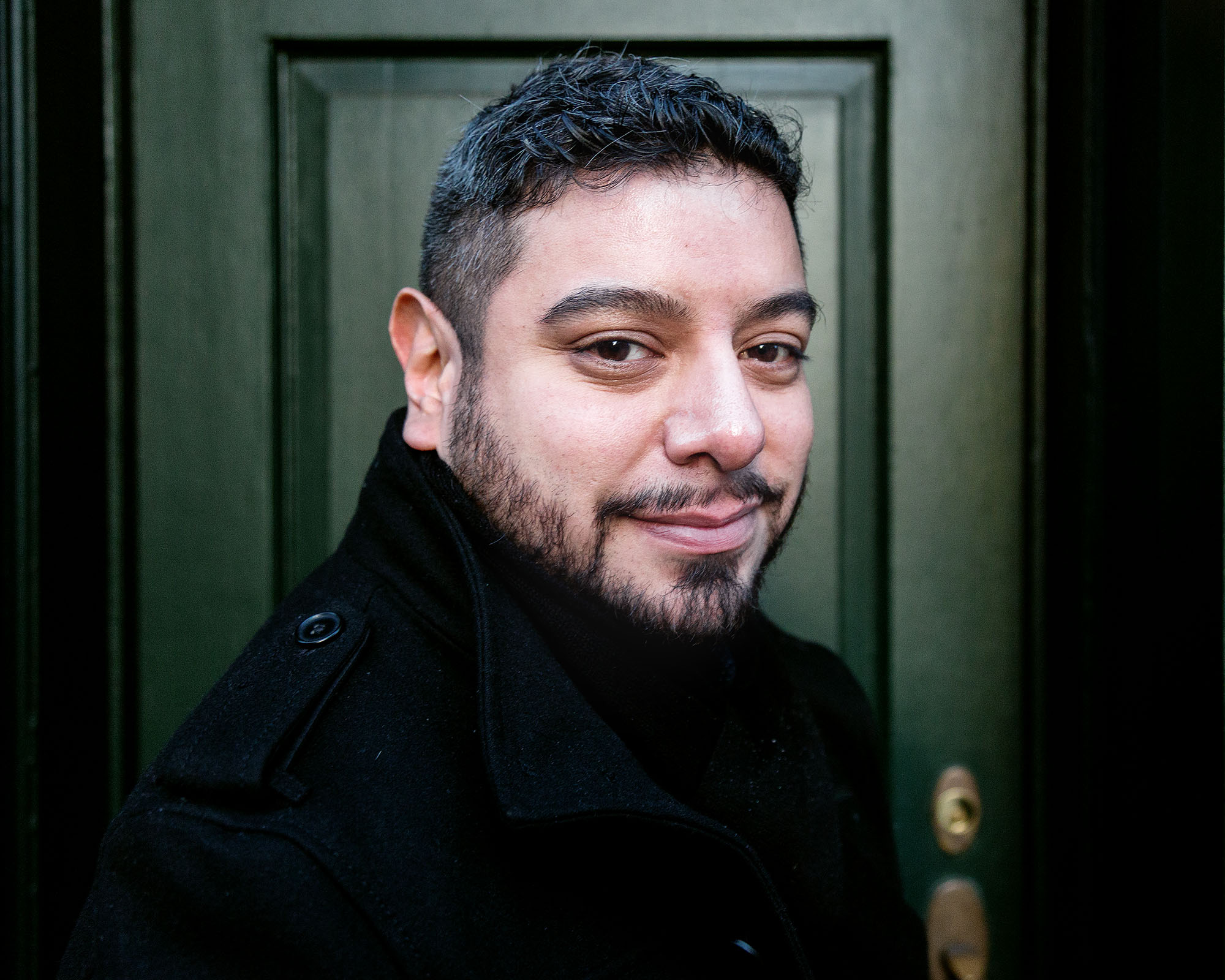
 

Annie Dow Eddie Martínez
 

MJ: Not that I want to get too political, but given the current political climate, especially all the talk about immigration and all the negative attention immigration issues are receiving: Do you feel any responsibility as artists, as actors, to address this in some way? To elevate the conversation? And how do you do so?
 

EM: Yes. How is what I’m still trying to figure out.
 

MJ: I think even what you were saying before about turning down certain roles is a choice to address that.
 

EM: Yeah. The last thing I turned down was something where I’d be playing a bay worker, the guys who line up at, like, The Home Depot waiting for work. There’s nothing wrong with that. Like, I want to put dignity into any role, I would play those parts, as long as there’s dignity. If you show how they really are, they’re hardworking, doing it for a reason. But in this movie it was more like the white-savior thing, and I see too much of that. So that was one thing that I turned down. So yeah in that way, I think, I can be active. But it’s also going to the protests, things like that, which we’ve been missing out on ’cause we’ve been in rehearsals. I think in time we’ll know where we can do things.
 

AD: I think for me the most important thing that I’ve sort of learned over the last couple of years is: What’s the conversation that we’re having? Who’s in charge of framing that? Because if you start engaging in a conversation in the terms that the other person is using, you’re already losing. You really have to reframe the whole thing. And so I think the conversation that this country has been having over immigration, over nationality, over national origin, over race, puts anybody who’s arguing for inclusivity or for a bit more of a cosmopolitan, a political, or an expansive approach at a disadvantage, until we figure out a way to reframe the conversation. A show like Hamilton is, I think, doing an incredible job, and even with that — I love me some Lin-Manuel Miranda — but couldn’t we have a female Hamilton?
 

MJ: He said we could, actually. He went on record and said he’d support women playing the Founding Fathers.
 

AD: Oh good! That’s something that I’m excited about, just being able to reframe it so we don’t have this idea of the past or even the present that is shaped by somebody else who might not have the best interests of everybody at heart. I think that’s the most important thing for me. So I think yeah, artists and journalists, anybody who’s in charge of painting a picture of something you can’t see because you’re not there, I think there’s a huge responsibility there and I think, in a way, both those communities are at fault for what’s happening. Because we’ve abdicated that responsibility.
 

EM: In brown and black communities too, we want people to take part in our struggle, our plight of immigration, etc., but our communities as well have to address the homophobia, the sexism, because those are huge problems among the straight males in the black and brown communities. Still very sexist, misogynist, homophobic.
 

AD: Looking at it in a real, in a very unfiltered way, makes a big difference. I think a lot of people who maybe have formed certain ideas of Muslim immigrants or Latino immigrants or whatever, those impressions are not because they have been in touch with somebody who has affected their lives in a negative way. Those impressions are there because somebody told them that’s the way it is. So how do you change that conversation? How do you start telling at least the truth?
 

EM: When people interact with each other, it’s amazing how a lot of that goes away. You know what I mean? Like a lot of the people who are racist, they’ve been in all white communities in, like, the South. And they don’t really interact with anyone else. And even if they do, they’ll say, “Oh but they’re different!” Why are they different? Because you know them! ’Cause you interact with them. ’Cause they’re not this stereotype that you see on TV or the media or whatever. It’s just about interaction.
 

MJ: Yeah, and I think also greater exposure in the media is important to that effect. Because if you live in a community where there aren’t any Latinos or black people etc., and all you see is what’s on the news or what’s in movies, that’s the idea you’re going to have. And if we start to reshape the ways we’re portrayed that might have a positive effect. It might already be happening.
 

AD: Right, and it should be a diversity of experience. There are also women like Lucía, who have an ability to blend in and coast through and maybe trample on others to get what she wants. So there’s that too. The Latino experience is extremely diverse, but we’re losing the conversation because it’s been framed as this one or the other thing.
 

EM: And it’s not.
 

AD: Right.
 

EM: Another thing we do is we stereotype poor white people, rural America, and I think we need to be better about that. Connecting with those people. ’Cause if we all get together? Forget about it. That’s what they don’t want in this country. They want to keep it separate. And they use race and religion and all these things because it’s important to a lot of these people. But really? If the poor and the black and brown and LGBTQ and the women and the poor white people that have been forgotten in this country got together? I got chills.
 

MJ: is there a line in the play that resonates with you?
 

EM: So many good ones! “The language of assholiness is universal.”
 

AD: I don’t know. Oh, man. I’ve suddenly forgotten all my lines. I think Lucía has a moment where she grapples with maybe not knowing what her artistic contribution should be, so she tells Abel, “I don’t know if I have anything left to say.” That resonates with me because in it is wrapped up not only whether she’s maybe going through some writer’s block or if she considers herself a hack or not, but also who she’s supposed to be and what she’s supposed to say to whom. I think it’s a big question for her, and sometimes it is for me too.
 

MJ: Who are your biggest influences as actors?
 

EM: An actor that I’ve always looked up to is Benicio del Toro. ¡Puertorriqueño! Yeah, man, that guy to me is it, because he can play anybody. It has a lot to do with the way he looks, but it’s also how seriously he takes what he does. I aspire to that.
 

AD: I really like old-timey movies. So I think Greta Garbo, everything she ever did, was insane. She basically invented acting on camera. And then Bette Davis. The first time I saw Jezebel, I was like, “Oh my god!” So yeah. Nobody alive matters! (Laughs.)
 

MJ: What is your dream role, if you have one? Regardless of ethnicity or gender or any other constrictions?
 

EM: I like Aaron the Moor in Titus. I don’t think I’d ever play it. Maybe!
 

MJ: Oh, that’s a good one! Have you done any Shakespeare?
 

EM: I did As You Like it, [at the Denver Center]. I played Corin, the shepherd.
 

AD: I think probably Juliet. I just don’t think Juliet is some star-struck swoony ingénue. She’s a rebel! She runs away and gets married to someone she just met! And she fights with the guy all the time!
 

EM: That’s a Latino relationship right there!
 

AD: (Laughs.) Yeah! And you don’t see that. So I’d love to do that. Also if somebody reads this and wants to let me audition for the role of Hamilton, I will take that!
 

MJ: So I did a little research and I saw that you, Annie, co-wrote a short film and you, Eddie, I saw you were working on a script. Do you have aspirations as writers as well as performers, and how’s that going?
 

AD: I definitely write. I go back and forth between deciding whether what I write is meant for my own personal enjoyment or whether it is something that I should make, and I think at this point, given where we are, I think it’s something I should make. So originally I was supposed to produce a web series, but then I booked this role, so I’m pushing it to spring. So I’m excited about that.
 

EM: You’re doing it!
 

AD: Yeah, yeah, yeah, definitely! This has been a pet project for a few years now so I’m excited to get it off the ground.
 

MJ: What’s it about?
 

AD: I think, I’m not 100 percent sure on the title, but I think it’s called Kink, and it’s about a young woman who decides that she wants to be an escort to provide kinky services and what that entails. So she, you know, lets people lick her toes or that sort of thing. Yeah. And what that journey is. She’s also somebody who maybe isn’t that comfortable with her own sexuality, so learning to deal with that.
 

EM: I have two or three ideas for scripts that I’ve been thinking about for two years, but I wrote one short film. It is done. I just haven’t shown it to anyone. I have Tanya and another friend that I keep on saying, “I’m going to send it to you guys! I’m going to send it to you guys!” It’s inspired by the neighborhood I grew up in and Catholic school and basketball, which was very important, the community got into it more than they probably should have. These were eighth graders playing, and I’m pretty sure they were gambling on the side, and people fixing games. Like this is an eighth grade game, but they were the priests, the altar men, the cops. Yeah so it’s about that but exaggerated a little. Elements of comedy. The main character’s just this kid who wants a pair of Reebok pumps, and he’s got these whole Payless-type shoes he’s had for five years, they’re two sizes too small, but he still brushes them with a toothbrush to clean, and it’s sort of what he decides to do to get the Reeboks and all these situations he ends up in.
 

Annie Dow Eddie Martínez
 

AD: Don’t you and I have a thing we’re going to work on now?
 

EM: Oh, yeah, what was that idea?
 

AD: We came up with something in the middle of rehearsal.
 

EM: And we were like, “We need to work on this.”
 

AD: What was it? It was like — oh what do you call those competitions?
 

EM: Oh, yeah, it was about in South Texas, at a grade school, a competition for El Grito, but how it’s all boys who compete in these competitions and there’s this little girl who wants to compete, but everyone’s like, “No, no, no, you don’t do that.”
 

AD: I think it’d be a short film. Just about that.
 

EM: I don’t even know, somebody was talking about it and we started riffing and then we were like, “We need to write it.” I know nothing about South Texas (laughs).
 

AD: That’s okay, I’ve been there (laughs).
 

MJ: You should definitely work together again because you have great chemistry onstage.
 

EM: Aw, thank you.
 

MJ: Finally, why should people come see this play?
 

EM: I think for the reason that we said earlier, about the conversation that can be had after seeing the show. Seeing something that you probably haven’t seen before about Latinos onstage, which is the classism. And it’s funny, it’s a good time! And it’s by one of the most important playwrights that we have right now, Tanya.
 

AD: Yeah. The same.


Annie Dow was born and raised in Monterrey, México. Regional credits include Much Ado About Nothing (Hero) with the Shakespeare Theatre Company in DC alongside Kathryn Meisle, Derek Smith, and Tony Plana; as well as the world premiere of Tanya Saracho’s Song For the Disappeared (Mila) with the Passage Theatre Company in New Jersey. In New York, she has participated in the development of new plays and musicals at CAP 21, Baryshnikov Arts Center, The New Victory Theater, Playwrights Realm, and The Lark. She has recently appeared onscreen in LMN’s I Love You…But I Lied, as well as Netflix’s “The OA” and “The Late Show with David Letterman.”  Annie is also a veteran commercial actor and voiceover artist, appearing in multiple national and regional ads in both English and Spanish. She earned her BFA in Drama and Psychology at NYU’s Tisch School of the Arts and is a proud member of AEA and SAG-AFTRA.
 

Eddie Martínez Chicago Theatre credits include: Parachute Men as Andrew (Teatro Vista), Big Lake Big City asStewart (Looking Glass Theatre), Our Lady of 121st Street asPinky (Steppenwolf Theatre Company). Denver Theatre credits: FADE as Abel (Denver Center Theater Company), As You Like It as Corin (Denver Center Theatre Company). Film & TV credits include “The Dilemma”, “The Break Up”, “Boss”, “Chicago Fire”, “Sense8’, and “Sirens”.

Posted on 1 Comment

A Conversation with Hilary Bettis

Hilary Bettis


Earlier this year, The Sol Project was announced as a new initiative to raise visibility of Latina/o voices in the theatrical landscape. To kick off this venture, The Sol Project is collaborating with New Georges to present a brand new production of accomplished playwright Hilary Bettis’ Alligator, which opens on December 4 and runs through December 18 at the A.R.T./New York Theatres. I sat down with the smart, funny, charming, and wittily self-deprecating Hilary over hot tea on a rainy day in Williamsburg, where we chatted, among other things, about her play, her creative process, the current political climate, and the complicated nature of her personal cultural identity. I also attempted to get her to spill some spoilers for the upcoming season of FX’s The Americans, for which she is a staff writer.


Margarita Javier: The first thing I wanted to ask you is about The Sol Project. I’m very excited about it. How did you become involved with them?
 

Hilary Bettis: It’s one of those things that happened organically. Elena Araoz, who’s directing, has been a longtime friend of mine. We’ve done lots of readings and workshops together over the past four or five years. She actually directed a reading of [Alligator] in 2012, and that’s how she and I met. She was part of the founding members of [The Sol Project], and this was one of the plays that they had been considering. New Georges – who I also had a relationship with and had done a lot of workshops with for this play years ago as well – ended up being the first producers. I got a phone call one day from Susan [Bernfield] and Jacob [Padrón] and they were like, Hey! We’re gonna do your play!
 

MJ: That’s amazing. And it’s been a good experience so far?
 

HB: Yeah! It’s been a great experience. There’s been bumps in the road, because The Sol Project is new and they’re trying to figure out how they produce together. This is the biggest play that New Georges has ever done, on top of the first play in the A.R.T./New York space that’s still literally under construction. We just figured out how to have heat in the theater two days ago. It’s the first production that Elena and I have done together, so we’re trying to figure out what that relationship is, how we work together, and how we communicate. It seems so easy in theory, and then you’re in the thick of it and you’re like, Oh, we didn’t talk about this, or maybe we should talk about this, or maybe we should approach it this way. It’s actually really exciting, despite the stress and the lack of sleep that I’ve gotten throughout this process.
 

MJ:Tell me about the play, Alligator. What is it about, where did the idea come from?
 

HB: It’s this crazy, messy, chaotic, bloody, ensemble-driven play that I wrote when I was going through a lot of shit in my own personal life, like taking care of a friend who was dying of cancer and living with my alcoholic ex-boyfriend – a lot of a lot of a lot of a lot of chaos. That play came in like a fever dream; it sort of vomited out one night. It was very instinctual. I’ve never written anything quite like that since in that way, and I think it came out of trying to survive my life at that time and find meaning in this messy chaos with all these people that are literally wrestling life and death demons, including myself. It’s set in the Everglades. It’s in a really small rural town and it’s about all of these teenagers, and they’re trying to figure out how they fit into the world and trying to figure out how to love and be loved, but none of them have the tools or even know what that really means. It’s like a collision of pain and how these seemingly innocent interactions translate into this bigger destruction of this community.
 

MJ: Why the Everglades?
 

HB: I like to write about places that I’ve never been and I get really excited about, and I think for a long time it was because I was so poor and couldn’t actually travel. I wanted to see the world.
 

MJ: So you could write it.
 

HB: Yeah, and when you have an excuse to just dig and research and let your mind go on crazy tangents. I love being able to do that, but I also think there’s something really interesting about it, because you don’t have the familiarity of that place. In some ways, you can have a bigger perspective of it if you really do your homework. In all of my plays, place is always the number one character. All of who we are as people, the choices that we make, the decisions that we have to make, come from our environment and surviving our environment. The Everglades in particular is this messy, swampy, isolated part of the world that you really have to understand how to fight to survive in because everything in there is trying to kill you. It takes a certain type of person in and of itself just to be able to live in that environment, and that becomes a metaphor for these deeper struggles.
 

Hilary Bettis
 

MJ: Why do you write? Out of all the things you could be, why a writer?
 

HB: Oh man, I don’t know. Insanity? [laughs] Writing is really a byproduct of surviving my own life, you know? My family moved a lot when I was growing up and we didn’t have a lot of money – and I was the oldest, the only girl, and I was “the new kid” every two years. I saw a lot of violence and sexual abuse and all kinds of shit when I was growing up. We never lived in a community long enough to really get to know a community. My parents both worked 60-hour work weeks, and so we would end up just having to learn how to survive and navigate people with our instincts. And sometimes that was good and sometimes it wasn’t good. Being the only girl on top of that, writing was a thing that I did to deal with life and deal with feelings, and it was the only place I felt safe because you can say the most poetic thing or the most horrible thing, and you can rip it up and burn it or you can show the world. There’s a sense of empowerment that I never felt in any other aspects of my life.
 

I never actually wanted to be a writer. I wanted to be a veterinarian and then I probably wanted to be an actress. I moved to LA a week out of high school to escape this very small, rural, conservative Minnesota town that we’d moved to when I was 15. I ended up homeless in LA. My first job was cocktailing at a strip club when I was 17 years old. I saw the greatness and the rottenness of that world and also the complicated humanity. You know, people don’t lose their dignity just because they make hard choices for survival, and I think that it’s so easy to place moral judgment on people when we have food and shelter and water, you know? I was going out for terrible, terrible acting roles, and reading scripts where women were non-existent – they weren’t human, they were body parts. My 17/18-year-old brain was like, Well, I’ve lived in six different states at this point and I’ve been through so much shit and survived so much shit. I’ve had my big existential crisis over religion; I’ve seen people die when I’ve lived. Why is it that nobody writes people like me? I can’t be the only one in the world, you know? And so I think asking that question started this career path that has been – I mean, I’ve been really blessed. I have this sort of beautiful, lovely career that I never thought would happen to someone like me.
 

MJ: As a woman playwright, how has your experience been in the theater community or in television? Given the fact that it is – some would say and I would agree – harder for women to make it in these environments. Do you feel that pressure at all, or are you fighting to get more representation for women – is that a struggle?
 

HB: Yes. Especially in the TV world where people are really starting to recognize the importance of diversity. In some ways, I think that I’ve had doors opened that even three or four years ago women trying to break into TV didn’t have. I think it’s harder in theater for women than TV really, truly. Truly. In TV there’s a lot of turnover and executives tend to be younger. Everybody wants who the next up-and-coming voices are, and so they’re really excited to at least read your work. In theater I feel, you know, artistic directors who have been in the same position for 20 or 30 years feel very much a generation behind in their tastes, and I think there’s a lot of subconscious biases in there. They look at young women playwrights and it’s like, Oh well, you are a niche market, you cannot be mainstream. Whereas you can be a straight white male writer and, you know. I watch my classmates out of Juilliard, and hands down the guys always had it very easy in a way that it wasn’t for the girls.
 

MJ: You look at representation right now, and there’s not that many plays being produced or written by women happening in New York, or women directed plays, but there’s so much talent out there. What can be done about that?
 

HB: Really, I think that women need to be in positions of power and leadership. I think that it’s not enough unfortunately and I wish it were, but it’s not enough just to write a play. It’s not enough just to want to be a director. You have to also be an advocate, not just for your work, but for your career. You have to be an advocate for other women, and you have to really think in versatile terms. What I am really consistently learning in my career is that if I really want to protect the things that I write, and protect the female characters that I write from becoming stock characters, gratuitous, or objectified. Then I need to learn how to produce and I need to learn the business side of things.
 

MJ: I’ve read a lot about you, and I know that a recurring theme in your work is identity.You’ve talked about your desire to reclaim your Mexican identity and that’s reflected in your work. That’s a very conflicting thing: not quite fitting in, not quite knowing. I identify because I’m Puerto Rican but don’t fit into a stereotypical look, so I understand the conflict that comes from that, but being part of The Sol Project, and the fact that it is something that recurs in your plays, how do you feel about your identity or wanting to reclaim that side of yourself?
 

HB: God, yeah, I feel like it’s gonna be something that is always gonna be – I don’t think I’ll ever have a definitive answer. I think it’s always going to be evolving as I evolve and the world evolves. Growing up, we mostly lived in really rural parts of the country that were really, really white. My brothers and I were always the most ethnic kids at our school, and I never thought about that as a hindrance to my opportunity in the world. My grandfather had experienced it – I mean, his whole life was fighting against prejudice – and he really felt that he was deeply held back and denied opportunities in his life because he was Mexican.
 

I think in order to protect us from that, he really deeply advocated for us being as American as possible and not learning Spanish.He didn’t speak Spanish around us. When my mother was pregnant with me, his biggest fear was that I would be dark and I would look too Mexican and I would have to deal with the same prejudices he dealt with, and so for me in some ways… I mean, yes, there are a lot of prejudices in the world, especially with Donald Trump in power now and it’s really, really scary. It’s really scary. But part of reclaiming that side of my family is giving dignity and honor to my grandfather’s life and his struggles, and it’s a complicated thing, right? My entire life people have told me that I don’t fit into any community. When I moved to LA and met a lot of Chicanos, they were like, Oh, you’re a white girl, you’re not Mexican at all. And yet being in rural white communities in the Midwest, I was always Latina. And so it’s been a strange thing. Am I allowed to claim? I struggle with it. I actually struggle with whether or not I’m allowed to claim that part of my identity, and yet it’s my blood and my DNA.
 

MJ: Absolutely. And I understand where the dissent comes from because I do feel very protective about portrayals of Puerto Ricans specifically, and I do have that same struggle where I’m like, Well, you’re only ¼ Puerto Rican. I don’t know if you’re qualified to represent us. But at the same time, why create that conflict? It’s really complicated.
 

HB: It’s really complicated and I would never claim to be able to speak for Mexican culture. I’m an American. I was born in America. I speak a little Spanish, but it’s not great. I don’t know what life is like to be Mexican in Mexico. I don’t really know what life is like really to come to this country as an immigrant from Mexico. It’s a complicated thing, but at the same time, it’s also part of my own family identity.
 

MJ: I think it’s admirable because it’s so easy to give into not claiming that, because doing so makes it harder. If you are ethnic, it is harder in this country, and there’s this constant struggle to want to assimilate. I think it’s admirable of you to want to claim that part of yourself because it would be easy to just be like, No, I’m just American. That path would be easier, I think, than saying, No, I want to talk about this. I think it’s important to do so.
 

HB: Well, I really appreciate that. I really do.
 

Hilary Bettis
 

MJ: So you mentioned Donald Trump. And I wanted to bring it up, especially since somewhat recently Vice President-elect Mike Pence went to see Hamilton, and it became this big thing where suddenly the president-elect was launching an attack against the theater community, and I was just wondering if you have any thoughts about that.
 

HB: I mean it’s scary, right? On the surface, it’s like, Oh, you know, he’s crazy and his ego was hurt, and it’s just somebody complaining on Twitter and it’s harmless. But the reality is that those are the beginning steps towards really taking away some of our basic fundamental rights in this country. And it’s not really even about theater – it’s about freedom of speech; it’s about being able to be safe in this world and say things that might not always be popular, be able to talk about and give voice to marginalized communities, and be able call into question the people that are in power and the way that we always have… That’s one of the foundations of our country. I think we have to be very vigilant about it, especially as artists. Our purpose in this world really is to call into question the world around us and make people uncomfortable.
 

MJ: Absolutely, and it’s about challenging ideas and theater has always been challenging and arts have always been challenging.
 

HB: Yeah, and it should be! We’re doing our jobs.
 

MJ: What is the intended audience for your plays when you’re writing?
 

HB: I know that my plays are probably never gonna be at places like MTC. Especially with Alligator, I wanted to write plays that my friends would go see. My friends who weren’t in theater. I wanted to write things that I would want to go see and I also wanna write things that ask really uncomfortable questions. I know that that’s not always popular, and people want to go to the theater to escape and you have to have money, really, to see theater, for most people. Many of them will walk out of my plays, and that’s fine. But the ones that stay, I want plays that are really gonna make people think, and make me think as the writer too. I mean, it’s not just about, Oh, I’m gonna use this as a soap box. It’s just as much about, These are the things that I also struggle with or the hypocrisy that I see in myself, and let’s talk about it. Let’s not pretend that we’re better, or that these things don’t exist.
 

MJ: So why theater specifically? What drew you to theater?
 

HB: You know, I think part of it is just always being a new kid and never having friends growing up, and really yearning for a community. My dad’s a Methodist minister, and so the church was a big part of my childhood and my father’s very poetic and he loves to tell stories. I think part of it was growing up watching my father write beautiful sermons, and the way that he could captivate a room of people. That’s what great theater does; it’s a shared experience. Especially in this day and age where we’re so addicted to technology, we’re having less and less human interaction, and our entertainment, our love lives, and our whole existence is us and a screen. Theater, I really and truly believe, is going to become more and more relevant because people are going to crave human connection in a way that I don’t think we quite understand yet, because of what technology is doing.
 

MJ: What are your theatrical influences, and who are your favorite playwrights? Or is there anything you’ve seen recently that you thought was great?
 

HB: Well, I haven’t seen anything recently because I’ve been so crazy [busy], but I have a very special place in my heart for Marsha Norman, of course. I fell in love with her work when I was 18 years old. To have gotten to study with her at Juilliard for two years and be… I actually talked to her on the phone today, and to have a relationship with her is incredible. I really love [Edward] Albee and Sam Shepard and Sarah Kane, and unapologetic writers, and I really love Westerns too. I love Cormac McCarthy and [Quentin] Tarantino and super masculine genres. I love to try to find a woman’s perspective in those worlds, and so I tend to write things that feel really gritty on the surface but have a lot of empathy and vulnerability underneath.
 

MJ: Have you ever had a great idea that you abandoned because it didn’t work?
 

HB: [laughs] Um, every day. I don’t know if any of them are great. I have ideas all the time. I have a lot of files on my computer that are false starts to things that seemed so cool and then five pages in you’re like, Oh, this is not a thing at all. I have a lot of those. A lot. And then I have these ideas that are like, Oh, that’s my magnum opus that I’m gonna write some day when I have the ability to. I think there are some things that I want to write that I just don’t have the craft yet. I haven’t written enough to be able to execute it.
 

MJ:You’re a staff writer for The Americans. I love that show. How did that gig happen?
 

HB: It’s such a good show! And it’s such a great culture. My bosses are amazing. They’re at the top of their field and their craft and are the nicest, most respectful, down to earth people, that also have families and lives and treat everyone with respect and value everybody’s opinions. To have that be your first TV job and to also really see that you can be successful in this career and you can write things that are of really high quality and you can still be a normal person and treat people well – I feel really blessed to have that be the place where I’m starting from. So yeah, they were looking for a writer for my position and read some of my plays and I went and met with them and then they hired me.
 

MJ: That’s amazing. They’re filming now, right?
 

HB: Yeah, it’s insanity. We finished the first two episodes. We have the producers’ cuts for those; we have the entire season broken; we have scripts through episode nine written and all the rest of the episodes are in process of being written right now. They’re like a machine, it’s insane.
 

MJ: Can you tease anything about the upcoming season?
 

HB: [laughs] It’s going to be awesome!
 

Hilary Bettis
 

MJ: I read that you have a development deal for a show called Finding Natalie?
 

HB: I have two! I have a project at the Weinstein Company with Alyssa Milano, who’s executive producer on it, and we’ve been working on that for about a year. Then Finding Natalie is a gritty hour drama about sex trafficking. It’s about a young Mexican girl whose sister is kidnapped by a sex trafficking cartel, and she gets herself kidnapped to find her sister, and so really it’s a love story at the heart of it about two sisters, and what family will do for each other and the things that we will endure for love, for real love, and having that juxtaposed against this brutal world. Our culture really associates sex with love and being wanted, and to be able to say that’s actually not at all, that what these sisters are willing to do for each other is real intimacy. It’s in the pretty early stages. I’m in the middle of writing the first draft of the pilot right now, so I’m sure that I’ll have hundreds and hundreds of drafts with all the network notes and things like that.
 

MJ: And there are a few movies you’ve done as well.
 

HB: I have. I’ve done a couple of short films, and produced, and I have a feature film project that I’m developing with some producers as well that’s in the super early stages. I don’t quite know what that will be yet.
 

MJ: Do you think you’ll continue to do theater?
 

HB: I have to do theater. I have to. I do, but it’s so damn hard to get a production. I see why so many playwrights that are like, I’m done with theater. I’m gonna write for TV. I get it. I totally, totally get it. You have to continue to write plays because you love writing plays, and you don’t care if they’ll sit in a desk drawer and never see the light of day and you’ll never be paid for it.
 

MJ: What advice would you have liked to have had when you were younger and deciding that you wanted to be writer?
 

HB: Don’t be so hard on yourself. Just write and let things be terrible. I think I had the impulse to write long before I really started doing it, and I think that I was really scared and didn’t think I had anything worth saying. I didn’t think that I was smart enough to be able to do it, and I meet a lot of people that say, “I just started writing” or “I want to be a writer” or “I want to write a play, how do you do it?” I think the biggest obstacle is fear. You have to take the pressure off yourself and give yourself permission to just be really terrible for awhile. Even when you learn how to write, the first draft of everything you write is going to be terrible. Giving yourself permission allows you to really trust your instincts and really conquer your fear. I think that more than anything is what prevents people from following their heart and saying the things they need to say. Also, learning how to protect and advocate for your work. Start in that place and really give yourself permission to be terrible.
 

MJ: Why should people come see Alligator?
 

HB: Yes, come see my show! Because, first of all, Elena has done an incredible job with the direction, and it’s messy and it’s bloody, and there’s an alligator onstage who also happens to be my boyfriend. There’s an actual alligator.
 

MJ: Well, I’ve heard so many wonderful things about it. I can’t wait to see it.
 

HB: Good! It’s so scary right now. The past week I’ve been like, Oh my god, I’m just gonna call everyone tomorrow and say this is terrible, let’s pull the plug, let’s pretend this never happened, let’s never talk about it again! Elena and I just sit in the corner ripping the whole thing apart and being like, Oh my god, what have we done? We’re both perfectionists.
 

MJ: I think if you get to a point where you’re entirely happy with what you’re doing, you’re doing something wrong. I think you always have to challenge yourself to be better.
 

HB: Yeah. Yeah! I hope you’re right!


Hilary Bettis writes for the theater, television and film. Her work includes: “Dolly Arkansas,” “Blood & Dust,” “The Ghosts of Lote Bravo,” “The History of American Pornography,” “Alligator,” “Dakota Atoll,” “Mexico” and “American Girls.” A two-time recipient of the Lecomte du Nouy Prize from Lincoln Center, she is a 2015 graduate of the Lila Acheson Wallace Playwright Fellowship at The Juilliard School.
 

Bettis has received many fellowships and residencies at the O’Neill National Playwrights Conference, York Theatre Workshop, SPACE at Ryder Farm, La Jolla Playhouse, New York Foundation for the Arts, Playwrights’ Week at The Lark, Audrey Residency at New Georges, Two River Theater, Great Plains Theatre Conference, The Kennedy Center/NNPN MFA Workshop and more.
 

As a screenwriter, Bettis has written and produced two short films, “B’Hurst” and “The Iron Warehouse,” which have screened at multiple film festivals across the globe. She lives in Brooklyn, New York, where she works as a staff writer for the TV series “The Americans” on FX.

Posted on

A Conversation with Ayodele Casel

Ayodele Casel


Ayodele Casel is one of those people you can point to and say, that is one of the most exceptional humans I know. Fierce and funny, disciplined and brave, Ayodele is quick-footed and lion-hearted as she takes on the world. Whether it’s on tap dancing, safety tips, how to play video games on her couch at home or active, hopeful ways to look at the world, she teaches me monumental new things with every conversation, class, or performance. Ayodele upholds a level of excellence across the board in art and in heart, a reminder of what we can all strive for.


Corey Ruzicano: You have this new, extraordinary piece coming up, so I wanted to start out by talking about storytelling. You’re a dancer and an educator and a leader and an actress and a photographer, you’re now running this space, Original Tap House, you’re bursting with talents, and I’m wondering how all these different roles inform one another, and how they’ve shaped the way you communicate and the way you tell your story.
 

Ayodele Casel: Thank you. Yeah, it’s such a great question because I’m not sure I’ve ever actually verbalized how they all intersect. I suppose that there is a throughline, right? There has to be. I was always into telling stories. I think kids are so naturally engaged with their imagination. I knew I wanted to be an actress since I was nine. I knew then: that’s what I wanted to do. So everything that I experienced from that point was with the knowledge that one day I was going to be an actress.
 

CR: That filter was always there?
 

AC: Exactly, it was always through that filter. If I played with my friends, I was practicing. If I watched a film I would think, how are they doing that? How does that work? I was always processing in that kind of a way. I was also a very introverted person, so I think it was also easy for me to kind of play and imagine and pretend in my own space and time. This is kind of related to the piece that I’m doing. When I was eighteen, I discovered classic films and I was really, really into them – analyzing who the directors were, what kind of stories they liked to tell, who they worked with consistently, what kind of storyteller was Hitchcock, what kind of films Cary Grant always did… and so I knew that who I was watching was masterful at what they were doing. I’d like to think that I had, at an early age, a sense for quality. When I started tap dancing in college, I was fortunate enough to meet someone who was an incredible tap dancer. I was fortunate to always have a high level of people around me and for some reason, I just always sought that. I always wanted to surround myself with the best. Having danced with some of, I feel like, the best tap dancers to grace the earth, you can’t help but be filled with that. It just happens naturally; their greatness rubs off on you. At least you hope it does. You know what’s good, there’s a high standard, a bar that you’re always reaching for. That discipline, you can’t escape that. I feel like I have carried that through every aspect of my life. When I became interested in photography, I wanted to look at the best images out there, the best photographers. Even with this space that Torya Beard and I have created here, we wanted to have an elegant space for artists to create. The through line would be integrity and quality, that’s what I’ve tried to draw through everything. But I think I may have lost what your initial question was about storytelling.
 

CR: Not at all. I’m really interested in this question of, how do you tell your own story? Especially for people who are used to expressing themselves through different lenses and with different mediums, how do those vocabularies start to inform the very nature of how you talk about yourself? And then I feel like there’s the tendency or the opportunity to step into the narrative you create for yourself, from that. When you have so many different intersecting interests, how do they come together and shape the way you communicate?
 

AC: You know, it’s so interesting because I feel like I have just recently tried to articulate my story. For many years, I was just dancing it. There are no words, and I was dancing for myself a lot of the time. And with acting, you’re saying words but they aren’t yours. Even now as I struggle to find the words…this piece has been a really great gift and tool for me. For so many years I had always either been acting or dancing and I wanted to combine the two.
 

I had actually explored doing my own show about fifteen years ago, and it was a concert, I had a ten-piece Latin band behind me, and basically I wanted to give voices to my influences. Like my grandfather, I grew up with him and I started listening to Latin music because of him and then I wanted to honor my great-grandmother, because I was so fortunate to know my great-grandparents. I had these really vivid memories of them and I loved their spirits, they were so humble, and I wanted to share that with people. Not a lot of people tell their story and I want to hear everybody’s story. I have wanted to also really give voice to these women tap dancers that I had done as much research as I could, because there’s such little information on them and I’ve had such a great career; I’ve been so blessed that sometimes I don’t think it’s fair. I don’t take it for granted that I’m so fortunate and I don’t like it when people just think they’re the origins of something. One of the things that I’m so connected to and proud of is that I am a part of a larger picture, not just of my family but of this art form, and I think that it’s important to honor the people that put in good blood, sweat, and tears before you so that you could safely step on the stage or express yourself or be recognized.
 

Ayodele Casel
 

CR: Absolutely. Your piece is called “While I Have the Floor.” What are some of the floors or platforms that have been given to you or that you’ve had to fight for along the way? How has artistic mentorship played a role in your life?
 

AC: I feel like it’s important to be very mindful of gratitude. Not always on purpose, but we take things for granted – where you live, being able-bodied, getting to go to college. My mom was really proud that I attended college because she didn’t get to go. For her to have given me that space and encouragement, and to have that vision for myself, right there, that’s one more leg up than what she had. It starts there. And actually, I started dancing in college, so really it was like a double blessing! To meet this guy who was a freshman who said, you like tap, I like tap, I’ll teach you for free. It was just a sharing, there’s no monetary value you can put on that. People take private lessons all the time, I give them all the time, but here I was and he was freely giving his knowledge and sharing his love with me, so that was another leg up for me. When I started tap dancing, there were women in my generation who wanted to dance, but I felt like they were very intimidated by the energy that the men were giving off. They were very confident and virtuosic in improv circles – and I just wanted to dance so badly it didn’t really matter to me. I didn’t see gender in that way, I just thought, we’re here, and I want to do that, so I’m gonna put myself in that circle. As far as having to fight for something, one of my favorite shows and influences was Bring in ‘da Noise, Bring in ‘da Funk. I was so inspired by that show and also so incredibly disheartened by the fact that there weren’t any female roles for tap dancers. Ann Duquesnay was the singer/actress, but the dancing was all done by men at the time and there were no conceivable openings for women. How do you react to that, if you don’t see yourself fitting in the picture? Do you quit? Do you say, screw it? I thought, I’m gonna make space. It didn’t deter me, I just kept dancing.
 

So when Savion [Glover] first created this group, Not Ordinary Tappers, which was my first big, professional group thing that I did, I was the only woman. That gave me a huge platform. At the time, it wasn’t like, I am woman, hear me roar, I stand for all women, watch out! I just was happy to be there. I didn’t realize it was a thing for me to be the only woman, until people would interview us or they would interview me and say, I didn’t even know women tap-danced. I thought, I get that my presence must feel like an anomaly, but surely I can’t be the only one that’s ever done this. There was Brenda Bufalino, she’s one of our pioneers, and Roxane Butterfly who’s maybe five years my senior, but in terms of that circle of men and people of color doing it…I was kind of alone, especially in New York, in this particular environment. So I thought, clearly there’s a platform here, for me to really speak on this. My first solo show, the one I was telling you about, I called out these same women that I’m calling out in this piece now. It was important to me then to say their names. Nobody was saying their names. The first time I saw Lois Bright, my jaw dropped to the ground, because we knew about Lon Chaney, and Chuck Greene, and Buster Brown, and Jimmy Slyde; they were all alive at that time, but nobody had ever said: Lois Bright, Juanita Pitts, Louise Madison, the Whitman Sisters. And I get it, I know that it comes up when it comes up and sometimes the focus just isn’t on any particular gender but I just thought, isn’t anyone talking about these women?
 

CR: Yeah, whose stories do you think we’re missing – either the stories that you name in this piece or stories you’ve encountered in life that you want to lift?
 

AC: I want to know so much about Lois Bright. Cholly Atkins writes in his book that she was a beautiful, wonderful dancer and his right-hand person for when he would choreograph. That’s a small piece of what we know of her and we know that she was gorgeous and an incredible, flashy, and athletic tap dancer because of the ONE dance clip in “Hi-De-Ho”. She was married to one of the brothers that she danced with and there isn’t much more on her. I don’t know when she started dancing, I don’t know why she quit. I just want to know and see so much more. Louise Madison, there’s just a small short paragraph on her in this dissertation I discovered by Cheryl Willis and it says that she could eat Gregory Hines alive.
 

CR: Wow, what a thing to be remembered by!
 

AC: I know, I was reading it and just thought, oh my god, where is she? Where’s the rest of it? They say she may have fallen in with drugs, and then she essentially just fell off the face of the earth.
 

CR: The way so many women’s stories do.
 

AC: Exactly. We know more about the Whitman Sisters because they were producers and they had their own show, their own Vaudeville act and they were very successful in that circuit, but there’s no footage on them, not in all my twenty plus years of dancing have I seen anything because it doesn’t exist. We’re missing all of their stories, we’re missing all of their voices and I don’t want to be that. I just feel like it would devolve dance and the lineage, so I just feel like it’s really important to write it down.
 

Ayodele Casel
 

CR: How does it change the relationship you have to what kind of story you want to leave behind?
 

AC: I’ll tell you, I’ve been wanting to do this kind of thing since the year 2000 and what really kind of woke me up was a tap history book that was recently published. There’s this section on me and as iI was reading it and its depiction of other women it wasn’t that I was expecting a full story, the book isn’t about me, it’s about a tap dance history, and I’m thankful to even be mentioned in the lineage, but what really bothered me about this particular version of my life that’s now in print forever and ever, amen, is that it reads: “and she stopped for two years.” Period. And then on to the next section. It’s three pages and it ends with that, and I just thought, oh my god this is not my story. This will not define me in print. God forbid something happens to me tomorrow and that’s what’s left. I don’t want to let other people define what that is, because I know what a loss it was to me not to have those other voices and stories of these other women.
 

CR: It’s that same need to “see it to be it” idea, what Jeanine Tesori said in her Tony speech, what we always talk about, how deeply important and revolutionary it is to see representations of people like you doing what you want to do, being who you want to be. Especially when you don’t fit into what’s been presented to you as the canon of whatever that field is, being yourself in that is a political act.
 

AC: Yeah, it absolutely is. I think that, that is one of the wonderful things that tap dance has given me: it teaches you to recognize your individuality from the get-go. In improvisation, you cannot be anybody else. If you aren’t being yourself, you aren’t being authentic, you aren’t being interesting, you aren’t honoring the dance that you’re doing, you aren’t honoring the art form and most importantly, you aren’t honoring yourself because we all have our own unique and wonderful point of view. If you’re paying attention, you learn very quickly to start honing some authenticity.
 

CR: And I love that word “attention” – you’ve said that before to me about making conscious choices about what you pay attention to –
 

AC: Yes, what you put your attention on grows stronger.
 

CR: Yes, I love that idea and that language.
 

AC: That’s how I try to live my life, very intentionally aware of your energy, your point of view, how you see things, positively or negatively, and if they’re negative, you’re going to attract a lot of crap in your life. When I was in my twenties, I read a book called The Four Agreements and it really changed my life because I thought, oh I don’t have to be mad at little things, I don’t have to take things personally. I really started to shift internally how I was reacting. I witnessed a lot of violence as a child and I wasn’t a violent kid, but…well, actually I was going to say that I wasn’t a violent kid, but I used to fight all the time! They used to call me Muhammad Ali, because I was constantly fighting boys, so actually, I was taking that out on the playground. But I was a very good student, I got straight A’s…
 

CR: And you were also in fight club.
 

AC: Yes!
 

CR: It’s so interesting, because female aggression is something that’s so little talked of and so seldom represented, especially for young women growing up.
 

AC: And it’s judged if it is.
 

CR: Right, it’s only the Wicked Stepmothers.
 

AC: Exactly. The book was life-changing because it felt like in my personal life I’d released a lot of tension of anger and lack of control, I felt much happier and at peace. If you cut me off while driving, clearly you’re having a bad day, that doesn’t reflect on me, but then I started to going to William Esper Acting Studio and doing Meisner work, and you have to take everything personally in your work. I realized, doing that training, that, though I’d become a more benevolent, graceful human, I wasn’t honoring the full spectrum of my feelings and emotions. When we’d be doing scene work and you’re supposed to really take in the other person and my partner would be dismissive, and just let it go and Bill Esper would say, how do you feel about it? And it took that for me to actually go back and honor and exercise the full spectrum of all my emotions. Maybe because I was a little bit older, I had the maturity to actually apply that concept into my life with me. I meet everybody now with as much positivity as I can muster, I’m very even-tempered, but I’m from the Bronx. I could beat you down if I wanted to. I don’t have to access that all the time, I cultivate a very peaceful existence because that is something great to put my attention on but I do think it’s important for young girls to know that it’s okay to have that strength. It’s really valuable because, for any human you’re going to face things, things that will want to beat you down, but especially for girls we are constantly judged for how we exhibit strength. She’s a bitch, why’s she so angry? We’re judged on a different scale but I say, don’t apologize for who you are.
 

Same thing for the presidential elections, I just find it so interesting that all of a sudden everyone cares so passionately about a candidate’s honesty and whether or not they lie – and I’m not saying that’s not an important thing on it’s own, but all of a sudden it’s her honesty and her purity that’s under scrutiny and I call hypocrisy.
 

CR: I can only imagine how many more hurdles she’s had to jump than her male counterparts – of course she’s more of a politician, she’s survived this long.
 

Ayodele Casel
 

AC: Yes, that’s the other thing, I read these comments that say: she just feels like “it’s her turn,” she just wants people to vote for her because “it’s her turn,” you know what? YES. It is her turn; she’s held just about every imaginable office. It just makes sense that if you start your life, just like I did at nine years old with the intent of being an actress and joining art programs and going to school for it and doing community theater, and training and this and that and the other thing, then now, yes. If I audition for something now, I want to get it because it’s my turn, I’ve been at this a long time. Don’t tell me that the audacity of me wanting it to be my turn is a bad thing. That double standard is killing me.
 

CR: It’s just equity versus equality, it’s not an equal chance at the goal if they playing fields up until that point haven’t been equal.
 

AC: And I believe the parallel to be absolutely true about tap dancing for men and women. How is that we had someone like Louise Madison, who had the reputation of being able to eat Gregory Hines alive, but we don’t know anything about her? And I get it, we’ve evolved, society has evolved, then in the fifties and the forties, it was different especially for a black woman, but let’s just call it what it is – there is a definite difference in how the genders have been treated. I’ve had such a breeze comparatively, it’s not a complaint because I’ve been so lucky and that’s not lost on me, however, even after I’d worked a lot, agents would call me and say, they’re looking for a tap dancer for a commercial…and I’d say, so, you called me…? And they’d say, well they want a man. They would call me to get the name of a male tap dancer. That was then and it’s gotten so much better, even from twenty years ago. I’m so happy to have witnessed the evolution of it, because, as I said, when I started there weren’t a lot of women getting in the ring with the fellas.
 

CR: Except for Muhammad Ali!
 

AC: Exactly, I was in there, and a lot of women tap dancers would tell me how momentous it was for them to see me up there because it would show them that they could do it. Now I’m looking at so many women flourish, Michelle Dorrance just won a MacArthur Genius Grant, there are so many female dancers who are working at high levels, so I hope that they are aware.
 

CR: And that their history begins to get chronicled in the way that it should.
 

AC: And then, only because I’m obsessed with it, that they then recognize that they’re standing on the shoulders of many, many others.
 

CR: Definitely, and with that in mind, how have you come to define the word “community” for yourself? Has that influenced the genesis of this Tap House you’re creating?
 

AC: Yeah, so many of my friends have been talking a lot lately about that idea of finding your tribe. Because sometimes you land in something that looks like a community and sounds like a community, talks like a community, but really is not a community. It’s really confusing, especially when you’re the newbie, but in my old, wise age.
 

You know, in July, when I was doing the piece at City Center, the reason I was so moved, that it had such an impact on me was because I think it was the first time in my entire career that I felt so supported by fellow artists and the people around me in these last few years. It’s the first time. It felt really good to have people genuinely cheering for you and encouraging you, being moved and expressing that freely, not withholding their compliments and experience, it was an incredible feeling.
 

CR: I wonder if that’s because of the people or because you’ve developed a sense of what you’re looking for, or both maybe.
 

AC: Yeah, I think it all goes back to that community. I got to a point where it’s not about what you have or your status in the field; I now try to keep people around who are great people. That wasn’t always the case. I was trying to fit the circle in the square or the square in the circle. There was a lot of conflict. I mean, I wasn’t fighting anymore! But when you grow up and you aren’t fighting anymore, if you haven’t resolved that way to deal with conflict then you do it internally. And I finally stopped doing that, I stopped trying to fit into people that weren’t my tribe. I’ve definitely cultivated that and I’m much happier for it.


CR: Absolutely, so then tell me about the Tap House! What are your dreams for this space?
 

AC: Yes, Original Tap House! Torya and I, my little lady love, several years ago we were walking – we used to live on the Upper West Side – so we would walk to the river and were talking about how we wanted to have a space, a building where artists could come to collaborate and make work, we wanted to commission work, we want them to take risks and, as a tap dancer, it’s really important to me to actually have space to rehearse, because in New York a lot of those spaces are closing down.
 

CR: Really?
 

AC: Yeah, we used to have Fazil’s – rest in peace Fazil’s, I love them so much – it was this rickety, rickety studio with holes everywhere but it was amazing. It had wood floors and when I first started it was eight dollars an hour and it was so cheap and there was no pretense. When you were going in there you were going in there to work, you weren’t going in there to get cast or get discovered or hob nob, you were there to work out yourself. Since that space closed, there have been others. We used to go to Chelsea Studios, but now they no longer accept tap dancers. So we’ve slowly and systematically been shut out of all rental and rehearsal spaces in New York City, and that pisses me off. I think if Gregory were alive, he would be banging down doors. It’s important to me for tap dancers to have a space to come and work and not be harassed – you’re tapping, you’re going to scuff the wood, that’s just what happens.
 

So Tap House is all of these things. It’s a space for artists to create, collaborate, in a space that is positive and not oppressive, and elegant at the same time. You should feel as free as possible to create. The big dream is the four-floor building, I have my sights set on one in particular, but we did not want to wait for that. So often we wait and tomorrow is not guaranteed, so what can we do now, while you’re still breathing? I’m a real believer that if I wake up and have breath in my body it’s another chance to do something great. So we thought, what can we do now? We don’t have the million dollar building and we don’t have the time to sit down and write grants which is a job in and of itself. So we thought, what we have now is this space. It’s kind of like the shell, like the body, what matters is what happens inside. Right now, this is the shell, but really what it is, is the program, the idea that you can come here, if you have a play that you’ve written and you’re too scared to invest five hundred dollars in a day to have a reading, you can come here, invite twenty people of your choosing, it looks great and you get to share something. And that is the environment we’re creating. Like when we had Johan Thomas come here, we presented this artist who’s been doing oil on canvas for many, many years, but only for himself because he was hesitant to share his art with the public. So over brunch Torya said why don’t you just present at Tap House? Get some cheese and grapes and wine and we’ll just do it. Just get the ball rolling.
 

CR: That’s what Van Gogh did.
 

AC: Yeah! So he committed to it! He was really nervous, and that’s real, it’s such a vulnerable position to be in. But he came here, forty-five people came, and he sold about eighty percent of his work that afternoon! He didn’t anticipate such interest and I feel like he released something in himself. That is what we want to do for artists. When you talk about opening up the floor, I feel like that is what Jeanine Tesori did for me. She said, you have this idea, here’s a platform for you to do it and I think it’s really important to have people support you in that way. So that kind of energy? That’s my community. If you’re on board with that, with helping us be the absolute best we can be while we’re on this earth, then I’m good with you.
 

Ayodele Casel


Ayodele Casel began her professional training at NYU Tisch and is a graduate of The William Esper Studio. Hailed by Gregory Hines as “one of the top young tap dancers in the world,” Ms. Casel has created commissions for Harlem Stage, the Apollo Theater’s Salon Series, and Lincoln Center. Ms. Casel co-choreographed and was featured on the PBS special The Rodgers & Hart Story. Other TV/Film: Third Watch, Law & Order, The Jamie Foxx Show, Bojangles, and Savion Glover’s Nu York. She has performed with Gregory Hines, Jazz Tap Ensemble, and American Tap Dance Orchestra. Ms. Casel was the only female in Savion Glover’s company NYOTs and recently performed in his work STePz. Ms. Casel is a founding director of Original Tap House and Operation:Tap. She is on the faculty of A BroaderWay, and LA DanceMagic. She has appeared on the cover of Dance Spirit, American Theatre, and The Village Voice.