Posted on

A Conversation with Joniece Abbott-Pratt, Juliana Canfield, Harriett D Foy, Marie Thomas, and Michelle Wilson

The House That Will Not Stand


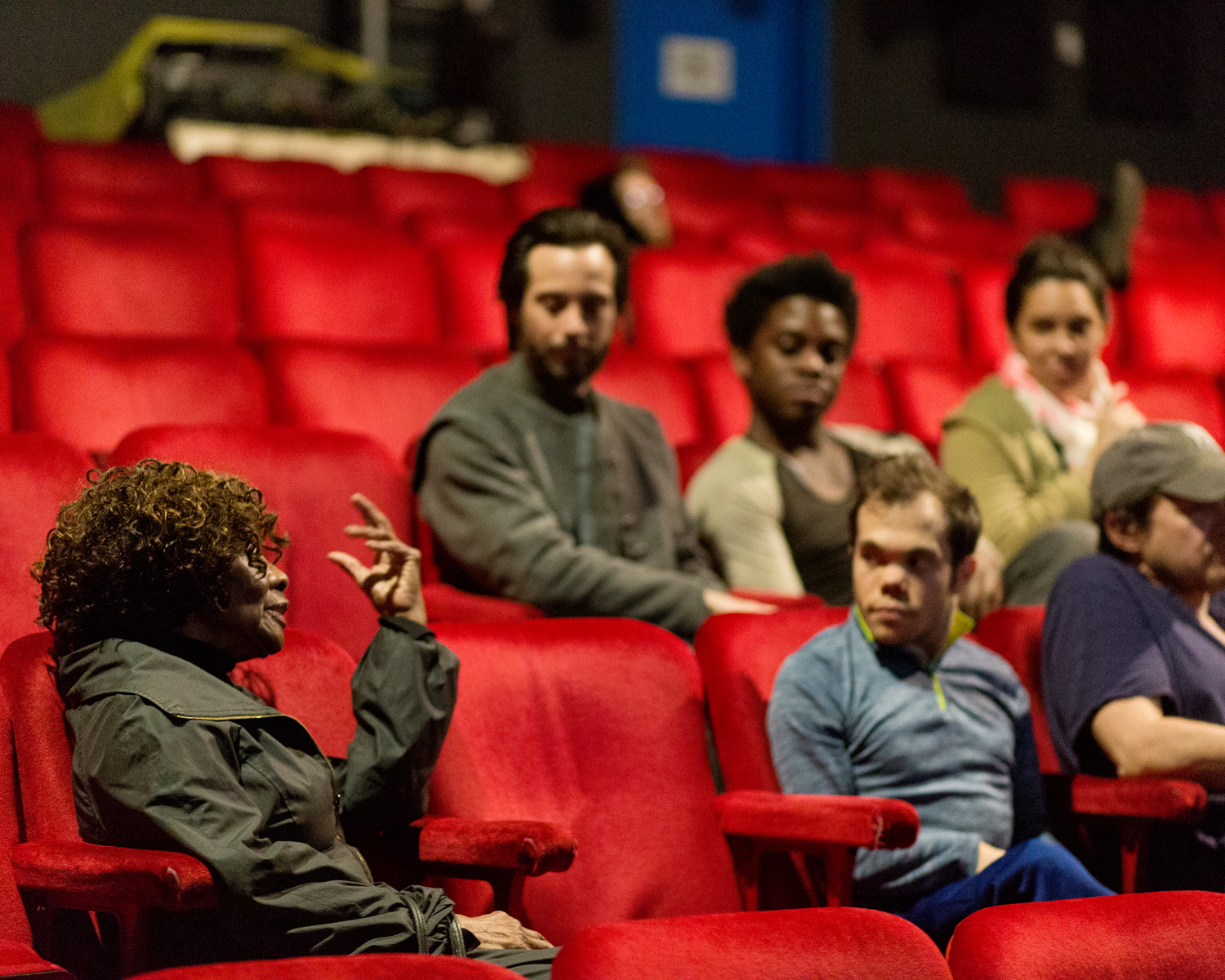
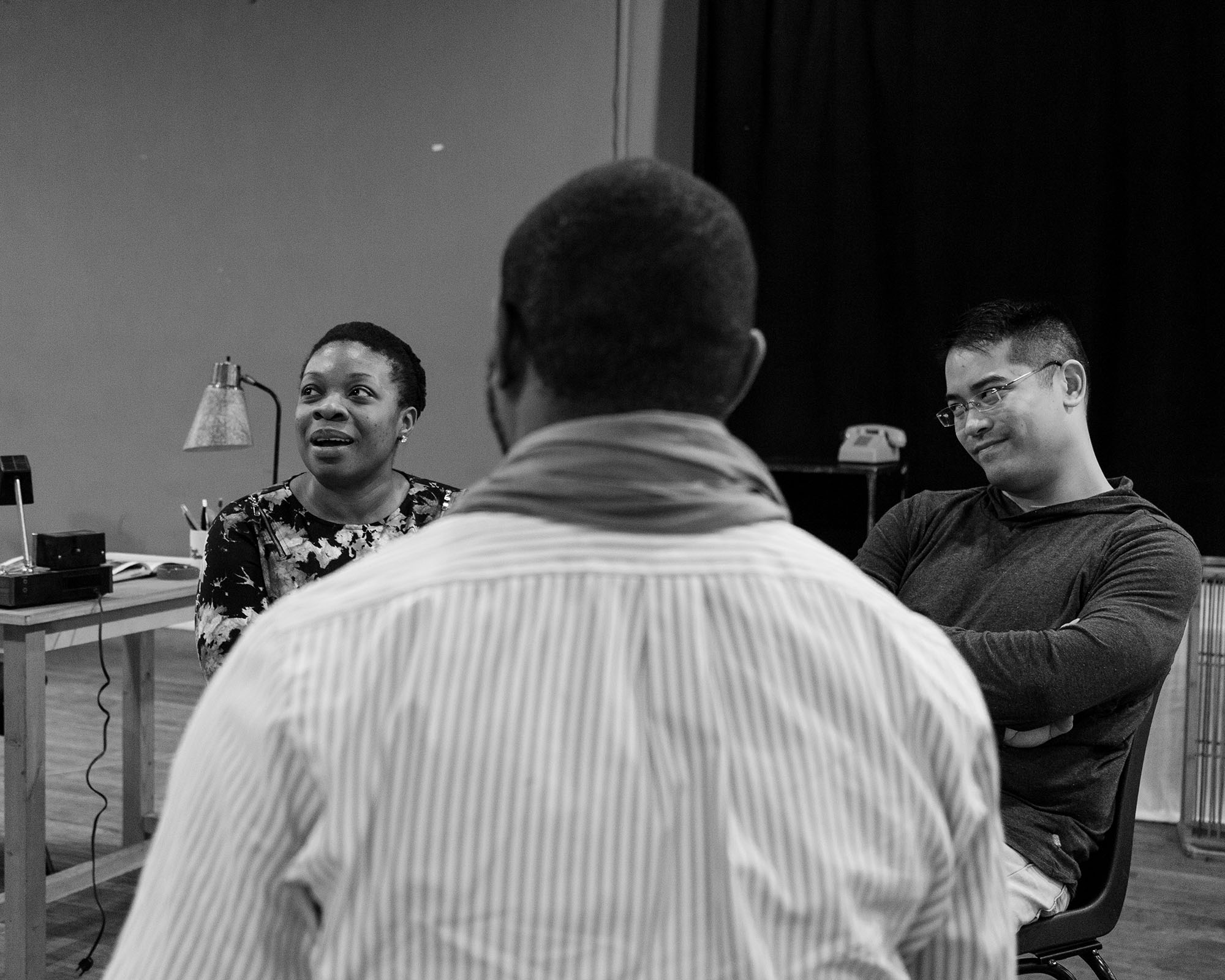
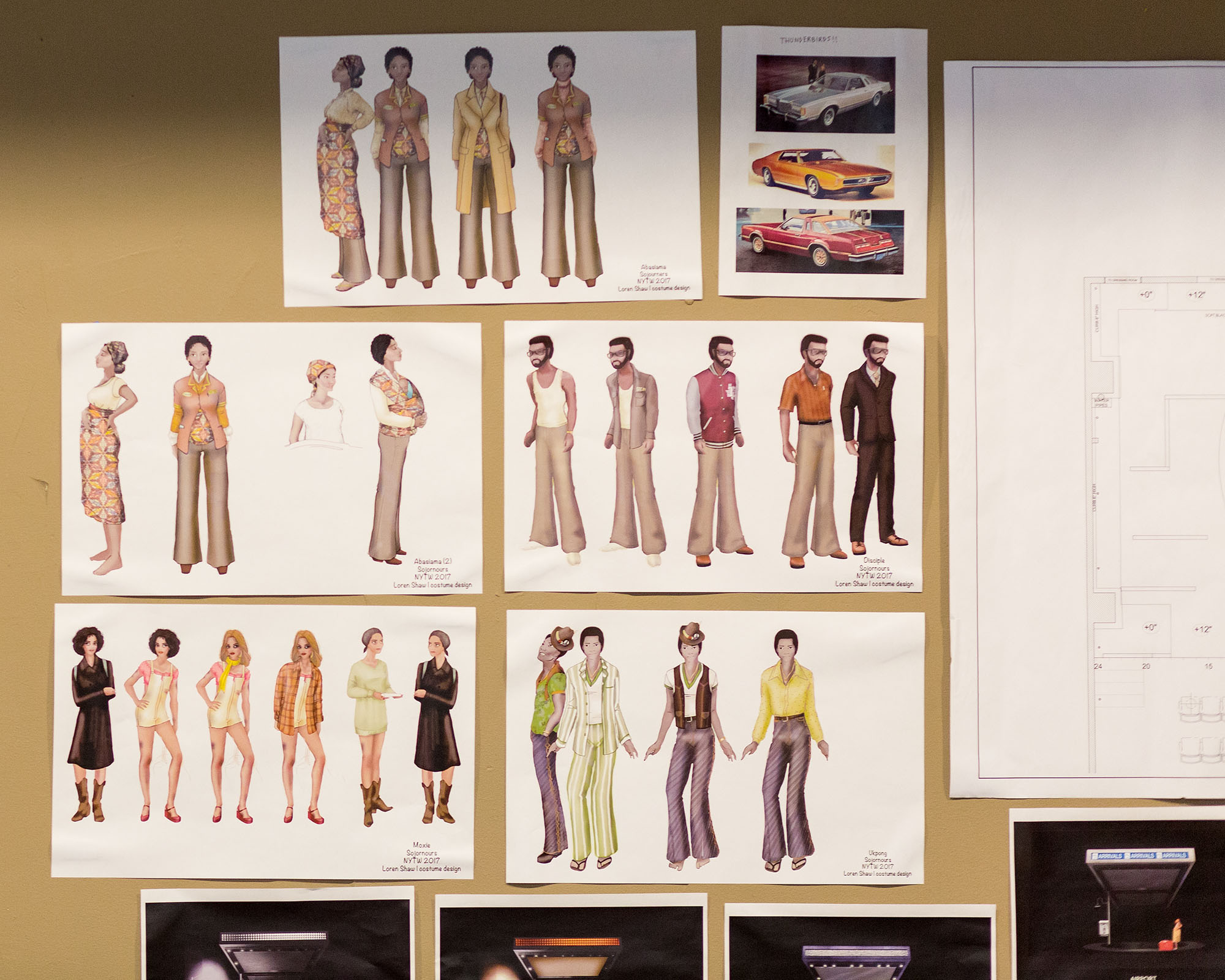
Marcus Gardley’s The House That Will Not Stand is an adaptation from Federico García Lorca´s seminal The House of Bernarda Alba inspired by real life stories of Creole women of color in New Orleans in the early 19th century who had, for a time, freedom and status allowed due to their romantic relationships with powerful white men. While covering somber topics like the evils of slavery, racism, and the patriarchy, the play is a joyous celebration of black women. It is running through August 19 at New York Theatre Workshop. We sat down with five of the talented women who make up this all female cast–Joniece Abbott-Pratt, Juliana Canfield, Harriett D Foy, Marie Thomas, and Michelle Wilson–to talk about the play and its resonance to contemporary audiences.


Margarita Javier: At the beginning of this play, Beartrice Albans, a Creole woman of color, is facing the death of her wealthy white lover, and her inheritance and what will happen to her three daughters is in question. What can you tell us about the character you play?
 

Joniece Abbott-Pratt: I play Odette. She’s the youngest of the three sisters and she is identified as the romantic, all heart. At first, life is great and things are beautiful. Even though the father just died, I think that she is able to find the beauty and joy and love in everyone around her, until her identity is questioned, which makes her question how she feels about everyone else around her. And then you get to see her transform into this other person who’s trying to, in stages, reclaim herself.
 

Marie Thomas: I play La Veuve, who is in many ways an antagonist to Beartrice. Nobody that’s hateful or a villain thinks that they are, except sometimes this character does. Quite frankly, I find her an interesting person in that she’s so very confident, except she’s not, because she’s been hurt and she’s been talked badly about by Beartrice. We learn later in the script that she did a number on Beartrice too, but she still holds some kind of vendetta and wants to see her hurt. The one quality that I admire is that she likes the girls and she doesn’t want the girls to be hurt. I’m enjoying playing this person because I just finished playing a lady who was 103 years old, and she was a lot different to this character. I have many sides to me that a lot of people have not seen because I’ve not been out here for a while. I took a leave of absence doing other things, but I’m enjoying the energy that I have to find once again to play these kinds of forthright, direct, aggressive kinds of people. The thing that interests me most at the very end is when she’s having a conversation with Beartrice. I think LaVeuve has some sympathy to what she’s going through, but I don’t have an opportunity to show that except to soften my last line to her and hope for the best. One dimensional characters don’t exist in life, you know, so I’m always trying to find the one place where she is a decent human being.
 

Juliana Canfield: I play Maude Lynn, the middle daughter. She’s the most invested in her Catholic faith. I think she uses her religious piety as a framework for her tendency to nag and to tattle and to worry. Those personal tendencies are very enmeshed with her religious fervor.
 

Michelle Wilson: I play Marie Josephine, Beartrice’s crazy sister in the attic. I think the question quickly becomes: How crazy is she? She’s passion and freedom. What do you do with a woman who doesn’t behave or follow the rules? She’s haunted. She’s haunted by her own inability to really break free. Why doesn’t she leave the house? Because it’s terrifying there. And so this cat and mouse game is a lot more satisfying when you have so much fear.
 

Margarita: Have you read The Madwoman in the Attic? It’s a feminist literary text, the title is based on Charlotte Bronte’s Jane Eyre. There’s a character who locks up his wife who was a Creole woman in the attic because she was supposedly insane, and it becomes a metaphor for men and the patriarchy trying to suppress women.
 

Michelle: It’s interesting because in this play, Beartrice does it. It’s hard at times to have empathy for her because she rules with such an iron fist. It feels like she’s just reinforcing the patriarchy when in truth, the play reveals that she’s just trying to protect everyone the only way she knows how.
 

Harriett D Foy: I play Makeda, the slave house servant to the house of Albans. She is the heartbeat of the house, she is caretaker, nurturer. She’s fighting with all her life to get her freedom; whatever she has to do, she’s going to get it. She’s a strong leader. She’s fun, she’s intense, she’s honest.
 

The House That Will Not Stand
 

Margarita: Coming into this play, I knew that it was an adaptation of Federico García Lorca’s The House of Bernarda Alba, which is a play I know very well. All your characters have a counterpart in that play, the plot is similar, there are a lot of thematic links. I’m curious about your level of knowledge of that play. Did you know it coming into this project? Have you read it?
 

Harriett: Yeah, I read it. I did a reading of another adaptation of this play a long time ago. I think this was just starting anew with hints of Lorca’s play, and we touched on it, but after that we just created this piece on its own.
 

Margarita: One of the links between the two plays is the patriarchy and the treatment of women. What I find interesting about this play is how there are all these different things that are very much of the era: there’s slavery, racism, the patriarchy. But you could set this play today and it would feel very current. I was wondering if you could talk about the way this play speaks to modern audiences and our current political discourse.
 

Juliana: One thing I love about the play is that yes, it deals with all of those troubling aspects of our history and our present. But I think Marcus has done a really incredible job of making the spirit of the play one that’s ultimately positive, and that refuses to buckle under those historical realities. I think that feels very resonant today. The whole Mahalee Congo sequence with Makeda and Marie: Josephine and Odette reminds me of this instagram trend of, you know, #blackgirlmagic, which feels like this reclaiming of all the different ways in which blackness and femininity can be beautiful and how there’s not just one way to be a black woman. I think that there’s a real resurgence of support for that multitudinous representation. That’s my favorite resonance in the play.
 

Michelle: The idea that it’s so difficult to protect your children in this society, you know? We’re watching babies be snatched from their mothers. What do black mothers have to tell their children before they go out of the house? My daughter attends Smith. She’s staying up there this summer to work in a lab and one of her fellow RAs, the police came in like What are you doing here? What is the message? That you’re a suspect in white spaces? You’re always just renting space in this world, right? I mean, the rules can change. You can be of a certain caste or class now and still, there is no safety because our thinking is so fear driven and power driven, and it’s exhausting. But I do love that there’s a sense of triumph in this play, that in spite of all of these dynamics–they’ll deal with the consequences and there will be consequences–but in spite of all that, their sparks have not been extinguished.
 

Margarita: Yeah, I agree. It felt very much like a love letter to black women and you can tell the author loves black women.
 

Michelle: That’s it, Marcus, he just loves us so fiercely in our individuality, you know? We’re not just this one type of woman. It’s really quite profound.
 

Margarita: I read in the program that many of the actors collaborated with Marcus on the development of the text. Can you elaborate?
 

Harriett: I’ve been involved since the first reading. Marcus is always open to hear how things flow in your mouth, or if you get to a certain passage and you’re having trouble getting it, he talks to you, you’ll listen, maybe fine tune it. The Mahalee Congo piece that Juliana: mentioned earlier wasn’t in the original version. We were working at New Dramatists and he said it came to him at night and he thought Makeda needed to say something else to Odette. It wasn’t so easy to wrap it up, so he brought it in and it was like five pages and I was like What is this? He said Just read it! So that’s what I did. We’ve always been in synch in terms of his language. He has a great ear. He’s very specific about his text, because it flows. You can’t adlib. It would mess it up.
 

Michelle: You can’t even change a word. You have to ride the words and there’s freedom in that.
 

Juliana: It’s like Shakespeare, can’t have one too many syllables.
 

Joniece: He’s a poet top to bottom.
 

Harriett: It’s poetry. Lush, dense, beautiful, sexy poetry.
 

Michelle: And Lileana is like, And keep it moving! [laughs] Because you’re languishing.
 

Harriett: And you have to have great breath control.
 

Joniece: That is so true. There’s moments when I’m like, Oh girl, you got to hold on to the breath, just to make it work, to make it land the way it needs to.
 

Marie: Sometimes you might mess up a line because you’re trying to breathe somewhere along the line.
 

The House That Will Not Stand
 

Margarita: You mentioned Lileana Blain-Cruz. How has it been working with her as a director?
 

Marie: I personally like it. I like her spirit, and I like the fact that she will tell you what’s good and then tell you what’s not in such a way so you don’t feel bad. An actor is a very sensitive human being. As much as we think we know things and we have great self esteem, there’s no such thing as paying your dues, or going “I got this now!”. Learning is continuous. On opening night, she was very complimentary, very kind, and we were walking up to the opening night party together, and I said I knew I had to learn the lines, but I had to learn them my way. I can’t just say words without some meaning behind them. So in the very early stages of our rehearsal, because my character opens the show, I felt uncomfortable a lot of times because I wasn’t sure where I was going. Lileana was very good at understanding and accepting that, and helping to bring it in. And then finally, you know, my organism stepped into it and then I could carry it from there. I like her spirit and I liked the fact that she will work until she gets it. And you might not like what you’re saying, you might not want to do it, but the director sees. We feel. And we have to go by what the director is doing.
 

Michelle: She’s sneaky like that though. She trusts the actor so much and she’ll almost let you wear yourself out with your idea.
 

Harriett: She creates a safe space–it’s fun, it’s open, you can try anything. She also loves music so that if we’re having a bad day, she’d put on some great music and we’ll just move about and we all come together spiritually and it’s like we’re on the same level.
 

Joniece: She has a very positive energy when she comes into the room. That’s always helpful and I appreciate it.
 

Margarita: Marcus also was inspired by stories from his family in New Orleans and the Plaçage system, which is not often spoken about. I was wondering if you could explain to our readers what that is.
 

Harriett: It was a common-law marriage between women of color and their white counterparts, who also had a household on the other side of town. It was a sort of business agreement, but yet there was love, at least in most cases. If the man had a lot of money, it was very beneficial to the woman of color. These women were pretty much money in this town, helping these men keep their businesses. But those arrangements were frowned upon by the Puritans when they started coming back. So it all was coming to a head at that night when the Louisiana Purchase was about to happen.
 

Michelle: It’s a caste system. And it’s an extra layer of caste system, because it was a contrast to the Puritans, who don’t own their sin. Do you know what I mean? They didn’t recognize their illegitimate children. They would sell them off.
 

Marie: A lot of the women from France couldn’t get to Louisiana because they were so delicate and many of them would die when they were traveling. The men would arrive, and here were these beautiful black women who were very attracted to these men. What was the thing Marcus said about the hair? White woman were very upset about the black women’s hair.
 

Michelle: It was so exotic.
 

Marie: So then they made them wear the hair wigs, they made it into a law. They even made the hair gear more exciting to look at.
 

Michelle: But everything has a cost. What I think is interesting about this and how it’s explored in the play is the question, what is freedom? If your freedom is dependent on how close you are to whiteness, is it really free? They’re free women of color, but they’re about to be stripped of their inheritance.
 

Margarita: And the play also explores internalized racism, like how the eldest daughter tells the younger sister that her darker skin is not attractive.
 

Michelle: We still have that.
 

Marie: We 100% really have that in the South. I grew up with that nonsense. My father used to say, when talking about hair “All hair is good as long as it covers the head”
 

Margarita: Luis Rafael Sánchez, a Puerto Rican author, wrote an essay about racism in Puerto Rico called Pelo malo or “bad hair” because there’s a lot of internalized racism in Puerto Rico despite our African heritage. In the essay he states that the only “bad” hair is hair that falls off.
 

Michelle: Yeah, and it’s talking about worth and how we as women are still dealing with all this worth placed on us outside of ourselves. What is valuable? What makes you valuable?
 

Harriett: I remember going to Puerto Rico because my boyfriend at the time was Puerto Rican, and we went to the museum and saw where Puerto Ricans were made from, a heritage of African and Spanish and Native. But I could see people judging us, because he was very fair, like you, and I was very brown. So we would drive down to Carolina and it was like, Oh, so this is where the brown people are. So yeah, it’s a little intense in Puerto Rico.
 

Margarita: Yeah, that idea resonated with me when I saw the play. I think it’s the evil of colonialism. Even though you’re a colonial subject, you’re still being led to believe that whiteness is the ideal.
 

Harriett: But then in the summer, why does everyone want to get tan and darken the skin?
 

Michelle: It’s a mind fuck. It’s so seeded. And they still have power.
 

Margarita: That’s why it’s so powerful when Makeda gives that speech about embracing the beauty of blackness. It’s a very empowering thing, and it’s a celebration of all black women, darker skin, lighter skin, it doesn’t matter. It’s all part of a shared heritage.
 

Harriett: Our young girls have it too. I saw a video on Facebook, it was a round table discussion with teenage girls, all around 11 or 12 years old. A brown girl was speaking, a very beautiful girl with long hair. And she was saying how she thought she was ugly because she was brown. There were kids of all colors there, and they were trying to encourage and tell her, No, you’re beautiful! I wish I had skin like that. I wish my eyes were like that. But she was hearing none of it. It was so sad to see that already built in. And where is that coming from?
 

The House That Will Not Stand
 

Joniece: That’s interesting to me because I’m dark. But I didn’t experience dark being bad until I got to graduate school, when I was good and grown. And it was a shock to me. I went to a historically black college so I knew what the Brown Paper Bag Test was and all of the issues around color, but I had never experienced it directly. I remember calling my mother and saying How did you raise me? Because I don’t understand how I was able to avoid hearing things like You’re pretty for a dark skinned girl. I never experienced that. I had to call my friends and be like Did I miss something?
 

Juliana: It’s like Odette!
 

Joniece: I was also born in the north. I was raised in Philly and like Marie said, that’s something that I imagine maybe happened more in the South. I’m just just speaking to my experience growing up in like the eighties and the nineties.
 

Michelle: I think it was some class stuff too. I mean when I was growing up there was a lot of classism.
 

Marie: That gets ridiculous after awhile. I guess for all of us who’ve experienced these kinds of caste or color issues, it depends on our families and how strongly they were teaching us that we were okay. We all probably have many different complexions in our families because of slavery, because of segregation, because of all of that. So I never even thought about it too much. I knew it existed. I hated the thought of it. I don’t like being compared. I don’t like being in a situation where I have to be like everybody else. That’s so Southern, so middle class, and that’s so bourgeois. I had to get the hell out in order to be different. I couldn’t be different because everybody else had to do the same thing that everybody else knew. That irks me, down to my core. This play is wonderful and I’m excited to be in it and to translate any kind of message that will make somebody think about what’s going on now.
 

Margarita: When I saw the play, there were a lot of black people in the audience, and there was so much palpable energy.
 

Joniece: It’s a different play when it’s a majority white audience. When there are a lot of black people, every single line or moment that has some juice in it; they get it out, you know. It seems different when it’s…I don’t even want to say a black audience, but, like the culture.
 

Margarita: The energy changes.
 

Harriett: But as actors, we can’t judge the audience. You may be tempted to push when you’re not getting that response, but sometimes you have to live in the moment. Sometimes people are crying, they’re listening. We transported them to another place.
 

Margarita: Right, people respond differently to art, there’s no right or wrong way to appreciate it.
 

Juliana: It’s fun to have a raucous show where there’s a huge response, but there’s also something really powerful about feeling an audience that’s listening and working really hard to understand and absorb something new. And to feel like we’re giving certain audiences something they’ve never seen or heard before is really special.
 

Marie: Sometimes people rise to their feet after being quiet all this time. They’ve been enjoying it in their own way. Sometimes the raucous audiences annoy me. [laughs] You have to be careful when people are so involved, and so on every joke and line. They will take over the show. I’ve seen that happen and you have to stop, breathe and allow them to finish and realize it’s not their place to continue to laugh for 20 minutes.
 

Joniece: I think ultimately it’s a shared experience no matter who the audience is. They are in it, whether they’re just sitting here and listening and observing everything or having a very visceral vocal response to it. It’s a shared energy.
 

Marie: You don’t have theater until you have an audience.
 

Margarita: I agree. What I was trying to get to is that there’s something really great about being surrounded by people who are part of your tribe, and where you feel you can express yourself. I think for a long time, theater has felt like a very white space, and it’s important for theater to make all audiences feel welcome.
 

Harriett: We have had black people come to the show in a mostly white audience, and they wanted to cry out but they felt they couldn’t do it. And then you have the opposite, where they’re sitting there looking at us wondering Do I join in?
 

Margarita: I think that it’s important when we talk about wanting to diversify theater to not just focus on what’s being presented onstage, but to also talk about the audience. There’s a perception that most of the people who go to the theater are white, but I think a lot of it has to do with how welcoming it is or isn’t to non-white audiences.
 

Harriett: Theater has to be reaching out to everyone. You can’t just do one show of color and expect that people of color to just come. You have to already be engaging that.
 

Michelle: Dominique Morisseau has those Audience Rules of Engagement that she did for Pipeline and it’s like you can laugh, you can express yourself or not. The Public did a survey where they were asking people how they feel about the theater, their concerns, etc. And do you know what the number one question people had was? What do I wear? Yeah. People do not feel like they can just come and be. They feel like there are all these rules. But who cares what you wear? Somehow that’s not getting translated, and I think that doing more plays like Sugar in Our Wounds and this one, where you bring people in to have an experience together in time and space is really important. This is subversive. Putting this up on stage. Seven women of color who are speaking their truths.
 

The House That Will Not Stand
 

Joniece: There’s something about black women telling a story about black women. We are making history and telling history at the same time.
 

Margarita: And it’s for black audiences. It invites an audience of any type, but it very much feels like this play is for black audiences in particular.
 

Joniece: And I’m excited about that.
 

Juliana: I think it’s pretty great. There are posters for the show all over the city in the subways and I feel like that’s a really groovy way to get people to come who aren’t just the old, blue haired crowd, and to make it feel like kids can come see this. It’s not just like, you know, whatever The Rock’s new movie is. It’s also Look at this other thing that’s a cultural event! And they did something really smart too, by putting all of our faces down at the bottom of the poster. At first I was like That’s kinda weird. But then I realized that if someone sees that and they take five seconds to look, they’re going to see that it’s all women of color, and that’s an invitation.
 

Marie: Vinnette Carroll was a wonderful director and she said that people like to see women on stage. Attractive women, as she kept saying. [laughs] What that meant to her, I don’t know. But I’m glad to see plays about women. Mr. Wilson was very wonderful. However, his plays had one woman, maybe two women. His plays are done all the time and it’s time for the #metoo generation or whatever you want to call it. It’s time. Wake up, ladies. It’s time to show up. Women directors, young women directors and playwrights. I had the privilege of meeting Lorraine Hansbury many years ago, and she of course was on Broadway with A Raisin in the Sun, but that was it. She said We need more writers. She said that then. And it’s happening now. I think it’s just extraordinary.
 

Margarita: And if you want to create new artists, you have to attract them in the first place.
 

Marie: And have some place for them to show their work. The National Endowment of the Arts around 20 years ago made it a rule that regional theater has to do at least one show that is African-American oriented. So then all of a sudden here they come looking for us because they knew they had to have at least one. And of course it was always done in February [laughs].
 

Joniece: One thing that’s been very exciting is seeing the reaction from my peers or colleagues, those other black actresses who see this show and they’re moved and affected and appreciate seeing us on stage, because we’re a reflection of them. It’s so rare to get this opportunity. Harriett and I made a list of all the plays that we could think of that just had black women in them. We might be working on an Anthology.
 

Juliana: How many could you think of?
 

Harriett: Was it fifteen?
 

Joniece: No, we came up with twelve. Just twelve plays with only black women in them.
 

Margarita: Do you know anything about the set designer Adam Rigg? The stage is stunning. In Lorca’s play the whiteness of the house is a big thematic element, and this design echoes that beautifully while still being very reminiscent of New Orleans.
 

Juliana: He went to the Yale School of drama with Lileana, so they’ve been collaborating for almost a decade. Lileana did Doctor Faustus Lights the Lights, the Gertrude Stein play. The fact that I know this reveals the extent to which I stalked her online. [laughs] He designed her thesis many years ago and they’ve worked together since.
 

The House That Will Not Stand
 

Margarita: You have been extended through August 19th, congratulations. Why do you want people to come see this play?
 

Marie: Cause it’s good! And the acting is wonderful! [laughs] It’s got all the elements. Conflict, love and humor. Like life itself. You don’t have to sit and be scared to breathe because something tragic will happen any given moment. Then something happens to make you laugh. And then something happens to make you see the love. It’s got all the elements and it’s very well put together.
 

Michelle: Monica Williams who is a director and does some dramaturgy was saying that this is like the epitome of black theater, right? It’s got the spirituality and it’s got the lyricism. It’s dealing with literal issues and what’s oppressing us, but it’s us having this conversation, do you know what I mean? Not someone coming in and doing the oppressing. It’s got pageantry. It’s like a culmination of everything that we’ve been doing for ourselves at National Black Theater and these small theaters where we were trying to work out these themes. It’s all come together under the auspice, but with so many resources and talented women.
 

Joniece: I just had this thought. One thing I love about women, and black women in particular, is that I know that if I need nurturing and love and support and healing, that I can go to my sisters and they will cover me and take care of me. I think that audiences feel that when they come and see this. There is love and nurturing and support and they are welcome to be here.
 

Juliana: Someone said that to me at opening. She said, I’ve been going to the theater for 60 years and it’s rare to feel that quantity of love among the company, so much so that it spills out into the audience. I thought that was a very kind and beautiful observation.
 

Margarita: Yeah. Not that feminist theater has to be all women, but there is something about seeing only women on stage that’s so powerful just on its own.
 

Marie: We are powerful. Sometimes we don’t realize it. Because we live in a patriarchal society. I’ve never felt less than any man in my life, including my husband. I’ve never been anybody’s shrinking violet. I didn’t come from that kind of environment and I don’t intend to in my life, which is why I left a place where everybody had to be a shrinking violet. Can’t do it. I guess in my personal history, it’s right on for me to be able to do this play at this junction in my life and I feel very appreciative of it. I’m inspired by all of this talent around me. It’s very competitive. [laughs]
 

Michelle: But it’s ambitious as shit. There are a lot of moving parts. I feel like we’re trying to bake a cake and everybody’s got different ingredients.
 

Marie: Please understand what I mean about competitive. I’m talking about good competition. It makes you rise to the occasion. There’s not a moment when I’m like Ooh get off that stage!
 

Michelle: And that’s it. We’re all baking the same cake and we have different things to add to it. I remember when it started to come together, during previews and was like Oh shit, now that’s lovely!


Joniece Abbott-Pratt New York: The Good Negro (Public Theater). Regional: Sunset Baby (City Theatre), Seven Guitars (Actors Theater of Louisville), The Mountaintop (Geva Theatre), Seven Guitars (No Rules Theater Company), The House That Will Not Stand (Berkeley Repertory Theatre and Yale Repertory), Stick Fly (Arden Theatre), A Raisin in the Sun (Palm Beach Dramaworks), Slippery as Sin (Passage Theatre), Ma Rainey’s Black Bottom (Huntington Theatre Company), Gem of the Ocean (Hartford Stage), The Piano Lesson (Yale Rep and Delaware Theatre Company), The Good Negro (Dallas Theatre Center), Mama’s Gonna Buy You (William Inge Theatre Festival), Dirt Rich (NY Summer Stage), Stick Fly and The Overwhelming (Contemporary American Theatre Festival), False Creeds (Alliance Theatre Company), Breath, Boom (Synchronicity Performance Group) and The Doll Play’s (Actor’s Express). Television: “Instinct,” “Blindspot,” “Law & Order: SVU,” “Orange Is the New Black,” “Show Me a Hero,” “Luke Cage.” Training: Clark Atlanta University; MFA–University of Iowa.
 

Juliana Canfield: Juliana recently starred in the Theater for a New Audience production of He Brought Her Heart Back in a Box, in what the The Hollywood Reporter called an “affecting performance,” New York Magazine lauded it as “luminous,” and The New York Times hailed as “perfect.” She followed that with a performance in the Fourth Street Theater’s production of Zürich, opposite Paul Wesley, that The New Yorker called “especially good.” Juliana recently shot a recurring role on the highly-anticipated upcoming HBO series “Succession,” opposite Brian Cox and Kieran Culkin, and directed by Adam McKay. She graduated with an MFA from the Yale School of Drama.
 

Harriett D Foy Broadway: Amelie, Amazing Grace, The American Plan, Mamma Mia and Once on This Island. Off-Broadway: X or Betty Shabazz vs The Nation, Rimbaud in New York (BAM), On the Levee (AUDELCO nomination) and Crowns (AUDELCO Award). Original Cast recordings: Amelie, Amazing Grace, Inside Out, Lone Star Love and Reunion. Regional: Nina Simone: Four Women (as Nina Simone – Arena Stage); Ella: First Lady of Song (DTC); MotherFreakingHood! (NYMF – Outstanding Individual Performance Award); The House That Will Not Stand (Yale Rep, Connecticut Critics Award Nomination; Berkeley Rep, Theatre Bay Award); dance of the holy ghosts (Yale Rep); Breath and Imagination (ArtsEmerson); LMNOP (Goodspeed); Ambassador Satch (Dubai); The Women of Brewster (Helen Hayes Nomination), Polk County (Helen Hayes Nomination) and The Piano Lesson (Arena Stage); Reunion (Ford’s Theater – Helen Hayes Nomination); and Seven Guitars (Center Stage). Film: Winter’s Tale, Collateral Beauty. Television: “Welcome to the Wayne,” “Orange Is the New Black,” “Rescue Me,” “Law & Order: SVU,” and “Law & Order.” BFA in Acting – Howard University “WGATAP!”
 

Marie Thomas recently returned from the Goodman Theatre in Chicago playing Sadie Delaney in Having Our Say. She played Nina Dubois in Charles Smith’s Knock Me a Kiss in New York at the New Federal Theater, the National Black Theater Festival in Winston Salem, NC, and at Crossroads Theater in New Brunswick, NJ. She received the Audelco Award for Best Supporting Actress for her performance. Also at Crossroads Theater, she was Sister Moore in the Amen Corner and Dorabelle in The Disappearance with Ruby Dee. Other Theater credits include The Summer House at The Passage Theater in Trenton, NJ; Goneril in King Lear, starring Avery Brooks, at the Yale Repertory Theater in New Haven, Connecticut; Samm-Art William’s The Dance on Widow’s Row at the New Federal Theater in New York and The National Black Theater Festival. She was Pam in Richard Wesley’s, The Talented Tenth in New York and in Atlanta at the National Black Arts Festival. She received an Audelco Award for Best Actress for her performance of Pam and an Audelco nomination for her performance in An Evening with Josephine Baker Off-Broadway and at the National Black Arts Festival. She has appeared on Broadway in the musical Don’t Bother me I Can’t Cope and at Lincoln Center in The Duplex and Antigone. Television and film credits include “The Cosby Mysteries,” “L.A. Law,” “Knots Landing,” “Amen” and on the daytime dramas “The Doctors,” “One Life To Live,” “As The World Turns” and the film Hot Shots
 

Michelle Wilson is best known for her Tony-nominated performance in the Pulitzer-Prize winning play Sweat. Wilson played long-time factory worker Cynthia, a role she originated off-Broadway at the Public Theatre before the show transitioned to Broadway with incredible reviews. In 2017, Sweat received three Tony award nominations including Best Play, and Best Performance by an Actress in a Featured Role for Wilson. Wilson’s other notable theater credits include A Raisin in the Sun, Detroit ’67, Follow Me to Nellie’s, Fahrenheit 451, Two Trains Running, The People Before the Park and more. Wilson also had memorable turns on the small screen in “The Good Fight,” “Blue Bloods” and “E.R.,” as well as in indie films Nehemiah, Sink and The Bicycle. Wilson can be seen next in the indie film The True Adventures of Wolfboy alongside Jaeden Lieberher and John Turturro. The film is currently in production.
 

Posted on

A Conversation with Vinie Burrows, Rob Campbell, Matthew Jeffers, Mikéah Ernest Jennings, Gregg Mozgala, and Evelyn Spahr

Light Shining in Buckinghamshire


We sat down with the entire cast of Light Shining in Buckinghamshire on a Saturday afternoon, now playing at the New York Theatre Workshop, to talk about interpreting a play set in 1600s England for a modern audience, stamina, and different types of accessibility in the theater.


Michelle Tse: I want to start with your first experience with a Caryl Churchill piece and when you first became familiar with this particular play.
 

Mikéah Ernest Jennings: No performance experience with Churchill’s work prior to this but definitely very familiar, generally in school, or study. But this play was new to me.
 

Matthew Jeffers: I had a similar experience. Caryl Churchill was bible in college. There was always the Top Girls scene. It’s always a staple in scene study.
 

Greggg Mozgala: I was in a production of Mad Forest in undergrad. But I was unfamiliar this play until recently.
 

Michelle: What were your impressions of this particular play when you first read it?
 

Evelyn Spar: I thought it was the perfect play for Rachel [Chavkin] to direct. Particularly because the style of her work, so often people jumping in and out of characters and she’s also not scared of doing really daring things and things that most people would seem as impossible work. So I was like oh, of course Rachel would pick this play. That was my first impression.
 

Mikéah: I like the immediacy of it. Just reading it, understanding when it was written, and what it was written about, but still really felt like the conversations and arguments and rants [in the play are similar to what we’re] currently discussing politically and personally.
 

Light Shining in Buckinghamshire
 

Michelle: I want to get into the relevancy of the play. Even though it’s set in 1600s England, and is very much rooted in religion, as you said, the arguments within it are in many ways exactly what we’re dealing with today. It is also set where a lot of the music that’s used within the show is contemporary music, so I wonder if coming into this production has in any way affected or shaped your view of current politics in any way?
 

Gregg: I think how it relates to now, not only as it current of what’s happening now in our sort of politics in this country, but it seems like this is a 350-year long conversation. Like these issues have not been fully resolved, they’re still being hashed out and argued and worked on culturally and politically. But I think the main thing for me is feeling that I could be active as a citizen of this country and of the world and that there’s so much discussion of people having agency, and I feel like there’s sort of been a resurgence of that within our political conversations these days, especially [as] it relates to the issues in this play.
 

Matthew: I feel that a really poignant aspect that has always struck me has been the fact that [the actions in the play and in the real Putney Debates] didn’t come to fruition, so we got to this point in 1600s England, where they reached a level but they weren’t able to fully make it happen. And I think it can be seen as a lesson of sometimes of what not to do when trying to create a new socio-economic landscape. You go through this whole show, and it’s draining and it’s so dense and then at the end, it’s like it didn’t fully happen and I think that’s so heartbreaking but also so hopeful to see the steps that were taken and affected.
 

Light Shining in Buckinghamshire
 

Michelle: And the way that Rachel has put this production together does have a very contemporary feel, especially on an aesthetic level. Walking in and seeing the open caption board, and it reminded me of being at the opera.
 

As you said, Matthew, the language can be very dense for someone who doesn’t come from drama school, who’s never heard of Caryl Churchill. This is a downtown theater that I think perhaps more seasoned theatergoers would visit but were there any discussions on the approach of the language to perhaps make it less alienating to a newer theatergoer?
 

Rob Campbell: Rachel’s really focused on the sounds for sure, and the softening and contemporizing and taking the sort of sound of any formality out of it, making it that much more present tense. I think part of the objective is to try to make it as if it’s from now even though it’s hard to do that just from the sound of it.
 

Gregg: It was an interesting challenge. We’re using the choice not to use British dialect throughout this piece too and syntactically this plays very English and very British, so that was a challenge too, approaching the text, just figuring out how that division of a common language is, but how to make sense of that in an American way of speaking even though it was written very- she’s an English playwright. So a lot of that work was making sense and making our brains work. It was a very rigorous approach to the text.
 

Michelle: And the show is very lengthy and physical, and there are a lot of moments where you guys are within the house and the audience. How much does an audience’s energy affect the energy of the entire show?
 

Rob: A lot.
 

Michelle: How do you get through that? I’m sure there are perhaps a matinee or-
 

Rob: Or Friday night. Yeah.
 

Light Shining in Buckinghamshire
 

Matthew: Personally for me, I find it very challenging to muster and maintain that level of athleticism, verbal and physical, when it’s quieter and less engaged. I find it very challenging.
 

As Rob mentioned, just staying focused. I’ve taken that to heart. Sometimes I’ll be up on the stage and I’ll have my mind wander and I’ll be like, today’s audience…I don’t feel like they’re 100% with us. And then I’ll think about the people on stage, and I do it for them, because everyone is so wonderful here and everyone brings the other person up. I feel I can feed off what they’re giving and that’s very fulfilling to me to know that we could have two people in the audience and if we’re on stage and something is happening, you know- and that’s partially Caryl Churchill’s words but- I think more that matters is what these guys and girls bring to the stage, and that’s at the end of the day for me how I stay focused.
 

Evelyn: Piggybacking off of that, yes it is an extreme challenge but when I remember that there are people that this play means a great deal to and they may not be the person laughing out loud. It could be someone very quiet and be having a very thoughtful moment, and this means a great deal to them. Another thing is that one of the things that Caryl spoke about concerning the structure of the play, is a feeling of universality, that there are these archetypal characters that have a universal connection, and when you get close to the characters, they’re people that you want to protect and have their story known in a way that is not usual in other shows, like you’re another character, cool. But here it’s something about them, that you care a great deal for each of them.
 

The other thing is about what Matthew said, that yeah sometimes my brain will wander off and I’ll say “no, I want to give to the team” and then I put myself back in the game. You look at someone [on stage] and they can tell that you’re playing, and then they’re playing and then you look around and everyone’s playing a higher game, so it’s always a really good reminder, especially if you love to do this, to keep playing. Someone else will want to throw the ball back at you.
 

Vinie Burrows: Good health and good nutrition and good solid mental health and good family support. Our family doesn’t have to be our blood family, those who care about us. It’s important to have them in your life. The importance of sanity in this crazy world. Life is energy, life is motion.
 

Rob: And this is a play about a movement. I think originally this play was developed with a particular ensemble, joint stock, so it was written around those particular actors and that was the root and seed of it. I think that was a very singular event but what we’ve tried really hard to develop here and what Rachel’s really- what she does, one of her strengths as a director is to work collaboratively with an ensemble. I really feel this incredible sense of ensemble with everyone here, not just the actors on stage but everyone behind the scenes, administratively. We are all in this together, the actors are here, the people on the production side are here long before us. You know, they’re the Marines, they’re the first and the last to leave.
 

Again, there really is this sense of we’re all in this together, we are all hashing this out together. This is a play about movement. This is a play about hopes and dreams and revolution and that idea of “you can.” There is a revelation in this play but you can’t always live in revelation. You can’t stay there forever, that was one thing that came up in rehearsal a lot. Another thing that came up too was that revolution is almost easy, public policy is hard. Right? That was sort of this constant refrain that was coming up throughout the course of rehearsals, and it’s something our characters are going through throughout the course of this play and we as actors are going through as we embody those characters.
 

It’s been unlike any other experience for me, professionally, to date, in both challenging and incredibly rewarding.
 

Michelle: Wonderful. I want to end by asking a more general theater question. When the Tony Award nominations came out this year, I remembered thinking that the theater art off Broadway is so different than from what is more commercial art, on Broadway. I wonder what you all wish you could see reach a larger audience? For example, would a Caryl Churchill play make it on Broadway [now]?
 

Rob: Well it has.
 

Light Shining in Buckinghamshire
 

Michelle: I should clarify, I meant in this climate, what do you wish you were able to see and bring to a more commercial audience?
 

Mikéah: I think in general, what’s missing in particular in this country that we live in, is the level of accessibility that will generate generations of interest and- what’s the word I’m looking for- grooming. Our kids being invited to the theater. Our kids going to the theater. Can their parents afford to take them to the theater? Because of the greater level of access that you have, the more risks you’re going to take. People are going to say, “I don’t know what this show is but it’s on tonight, let’s go see something live.” But if your ticket prices are so bloated that it has to be the special event, but then if it’s a special event it has to be something that someone’s like “oh I know what I’m getting, because I’m spending this much money” and that’s kind of an argument about this current season on Broadway, that it’s all of these kinds of television and movie remakes.
 

Not saying anything about the shows cause I haven’t seen any of them, and I’ve heard some of them are quite good. But that model exists because people are like “I can’t take the risk of paying $250 for a ticket unless I know it’s something that I already either like or something I understand.” The level of risk is not there. So I would just like to see a greater level of financial accessibility which I think would then promote a greater level of risk-taking in audiences.
 

Gregg: Accessibility is the sort of word I would say… It’s interesting, if you did a workshop, there are tons of off-Broadway and Broadway theaters committed to accessibility and often times people think of that only in structural access. Brick and mortar access. But one thing, I think, you mentioned the open captioning, and it’s not just a breaking device, that is an accessibility function for a particular population of deaf and hard hearing actors and what not. And even the casting of this particular ensemble embodies a level of programmatic accessibility, which I’ve never seen, been a part of, or experienced in your theater ever.
 

People don’t look at all those different facets of accessibility together and I think you’re absolutely right Mikéah, this expanding and broadening [of economic access]. When we look at the question of accessibility, you need to look at economics, look at structural, look at programming. So you’re getting at all those things and you’re making theater available to all, the entire community, because if I was a teenage kid or adolescent kid or even an adult and seeing the bodies that are inhabiting these words on [this] stage right now, I would be absolutely blown away and broken open in a way. But if I can’t get in the door, due to whatever reason, structural, economic, whatever, then a great opportunity is being lost.
 

Michelle: Thank you so much for chatting with me.


Posted on

A Conversation with Purva Bedi, Sanjit De Silva, Rita Wolf, Angel Desai, Sathya Sridharan, and Andrew Hovelson

An Ordinary Muslim


Walking into the room that held much of the cast of An Ordinary Muslim felt like walking into a family home during Sunday dinner. Despite the seriousness of the play, the atmosphere was light and warm behind the scenes—it was a joy to be a part of it. I sat down with Sanjit De Silva (who plays Azeem, the protagonist), Purva Bedi (Saima, the wife), Rita Wolf (Malika, the mother), Angel Desai (Javeria, the sister), Sathya Sridharan (Hamza, the lover), and Andrew Hovelson (David, the token white friend, and here, the most sarcastic of the bunch) to discuss being the odd one out, in life and in the industry, the psychological mindset that changes when one is no longer the minority of the room (or vice versa), and of course, An Ordinary Muslim, playing at the New York Theatre Workshop until March 25th.


Michelle Tse: So I want to start with asking you all what the phrase “an ordinary Muslim” means to you.
 

Andrew Hovelson: Ladies?
 

Angel Desai: That’s so weird, I hadn’t thought of that!
 

Sanjit De Silva: Well, I guess, I was taught that … For me, at least, it’s what we just talked about [before we started taping], ‘normalization’, right? There’s a sense that people have a pre-judgment when you say ‘Muslim.’ They have a judgment of it being monolithic. They think of the Middle East, they think terrorism, they think ISIS, or they have these prejudged versions that seem to be super stereotypes of what ‘Muslim’ means. And the title An Ordinary Muslim means just an ordinary person. Muslim is just what another person can be. Another person can be Catholic, another person can be French, another person can be from Tennessee … somebody who’s just an ordinary Muslim; and I think it’s trying to regain that moniker, you know? Trying to make it just another thing a person can be, not necessarily this monolithic thing that has to stand for something.
 

Purva Bedi: And as it relates to this play, for me, I think of it as—yes, what Sanjit just said—and also, you see these—how many are we, seven? How many Muslims, how many…?
 

Angel: Seven Muslims.
 

Purva: Seven Muslim characters in this play and all of [them] are an ordinary Muslim. And yet, all of ISIS and terrorism and all of that is a part of [their] language and identity as the way the world is seeing [them] as well. For example, my character’s conflicting feelings about two different men in her life and all the others things that just makes [these characters] complicated, ordinary human beings. So the Muslim part has a strong color, but so does humanity, and to me, that’s an ordinary Muslim.
 

Angel: I feel like there are layers to it, because there’s hope in it, and there’s paradox in it. Hope, in the sense of—as Sanjit was saying—ordinary, like parsing what that word means, ordinary in the sense of “can we normalize this?” But also then there’s the other connotation “ordinary” like “not-special,” just sort of “meh.” So to me, there’s an irony because, as Purva was just saying, there are seven different aspects of what it means to be Muslim [just in this play alone]—especially in England, now [where the play takes place]. And so, which one is ordinary, right? Does it negate itself by the fact that there are seven different aspects to it? And yet, there’s the hope of “can we move ourselves to the place where these don’t have to be unusual stories where the struggle that Azeem goes through throughout the play isn’t something that the next generation has to face? Can we get to a place where we can do that?”And yet, the paradox is that there’s nothing ordinary about any of it, right?
 

Rita Wolf: I think it’s a very clever title. I was just thinking about this as other people were being so articulate about it. Muslim, the word “Muslim” itself now is so hot. It’s such a hot word. It’s in conversation and people, as Sanjit’s saying, have such preconceptions. But putting “ordinary” in front of it is very clever. Because it takes that heat away from the word “Muslim,” and tries to make it every day. Some friends of mine who’ve seen this play—refer to it as “the Muslim play.” No. The title of the play is An Ordinary Muslim, now think about that. So it takes the curse of that word, if you will.
 

Michelle: So how has the experience been immersing yourself into the Muslim culture? Because from my knowledge, none of you are practicing?
 

Sathya Sridharan: Right.
 

Everyone: Yes.
 

Sanjit: [points to Andrew, jokingly] He’s been converted — Hammaad [Chaudry, the playwright] has plans to do a conversion in the sequel on David.
 

Andrew: I think it’s been very helpful that there isn’t a practicing Muslim in the cast. Or Muslim period. Because we’ve all had tons of questions about the religious aspects, the words, the terminology, how people would go through their day-to-day life. And when you get hot-button topics like this, people can tend to dominate the rehearsal room—in good or bad ways, really, that’s not a judgment. It’s just that we all had a lot of the same questions which I found to be very helpful.
 

Sathya: I also think we come into this play with a lot of preconceived notions of what the Muslim experience might be for anybody. But to be able to really ask those questions, and not be precious about it, but feel like we want to do these characters justice, we want to really excavate the interiority of these characters and really find the specific nuances and the ways that they approach their relationship to their religion, I think, for me at least, it’s given me boatloads of new kinds of compassion and empathy towards what it means to Muslim, especially in the UK. It’s just a kind of experience that I didn’t realize how wrought it was and how difficult it can be. And so I’ve had many assumptions about it, but to actually read this play, work on this play, navigate this play, has gifted me that in a lot of ways.
 

Andrew: Because Islam is a religion, just as Christianity is, just as Judaism is. And there is, within all of those, a trillion different ways that people practice. And what’s very exciting about what Hammaad has written is that these characters themselves, even the blood relatives, or married relatives, all practice differently. So that’s part of the joy of being an actor, is that you get to learn some new stuff. Now if you came in and I said, “I’m Muslim, this is how I practice,” And I [told you], “you would never do that. You would never do that. You would never do that, this is the way this does,” it’s not really beneficial towards a rehearsal process or coming up with any sort of engaging drama at the end of the day.
 

Angel: And also, truthful. Because, like you said, if there are a million ways to practice, you could say, “Well, we don’t do that.” But then that person might say, “Well, we did.”
 

Andrew: Yeah. Yeah.
 

Angel: Church, temple, mosque, whatever.
 

Sanjit: And I think that the question itself is tricky, right? We’re assuming there’s one way of being, and I think that this play is actually specifically about a Pakistani Muslim family in London, and it all is specifically very South-Asian, ‘cause Islam practice in South Asia is different from China, different from the Middle East, from Africa. So there is no monolithic-Muslim ideal in any case. So when you talk about this play, I would say, “Well it’s a specific play about a Pakistani practice who are Muslim and who live in London.” Right?
 

So I think that was the most important thing. We had someone named Sahar Ullah come in, who talked about the Jamaat, the Tablighi Jamaat, which is very specific to South Asia. So learning about that was really important. I actually think I would’ve loved to have somebody who was Muslim [acting] in this play. I think we would have benefited from it a lot. And specifically South Asian Muslim, because that is very different from Middle Eastern. I think, and hopefully, in other productions, there will be, and they should be, specifically Pakistani Muslims. I’d love to see this play with all Pakistani Muslim actors. That would be incredible.
 

So for that, it was about learning the specifics of it. And of course, Hammaad is Pakistani Muslim, so having him in the room is incredible because he is the primary source. He wrote it, he lived it, he knows things. But as we found out, sometimes he would say stuff, and Sahar would be like, “Nah, that’s wrong.”
 

Angel: Jo [Bonney, the director]’s assistant [Shayok Misha Chowdhury], is…
 

Sanjit: He’s Bengali.
 

Angel: So we actually had a few Muslim people in the room…
 

Sanjit: Who all said different, yeah so, that was lovely to see too. To have Hammaad go, “actually, I don’t know,” Then Sahar go, “Actually, no, that’s wrong. It’s actually…”
 

Purva: Because Sahar would specifically help us with distinguishing South Asian Muslim pronunciation of a word versus a more Arabic pronunciation, which is going to be a little bit purer depending on where we are—where our characters are, each in our relation to our religion.
 

Angel: But beyond that too, just origins of history and gestures and so, to add to your question, has as many answers as there are people.
 

Michelle: Yes, right. So I did wanna ask you, Andrew, now, specifically…
 

Andrew: Yes! [leans in to the recorder] This question is for the Whitey McWhite Face.
 

Sanjit: [jokingly, to the recorder] Press pause!
 

An Ordinary Muslim
 

Michelle: This isn’t the first time where you’ve been in the show where you, the white man, have been the minority.
 

Andrew: No, this is not.
 

Michelle: Can you talk about that?
 

Sanjit: He’s the go-to white-actor-being-the-minority in a play.
 

Rita: He’s a friend to the brown man.
 

Andrew: I enjoy it. I’ve played a few characters like this. I grew up in a very small farm town in Minnesota, where everyone was white. We had one black kid who was a friend of ours and, that’s it! So…
 

Rita: Were his parents white?
 

Andrew: What?
 

Rita: The black kids parents, were they white?
 

Andrew: I’m not sure his parents were in the picture, to be honest.
 

Sanjit: Awkward.
 

Andrew: Not for me! It wasn’t awkward for me! It’s awkward for—I also find that when I say something and it’s awkward, it’s awkward for them, not for me.
 

[Everyone joins in with an opinion]
 

Rita: Welcome to our cast.
 

Andrew: That’s it! That’s it, there’s only one way to go about this play from my standpoint as David Adkins and it’s as a white man surrounded by brown people in a world where a lot of people, maybe that I grew up with, are afraid that Muslims are bad people. And if they’re not afraid of that, they’re just afraid of seeing people that don’t look like them. That’s it. You just see white people in rural Minnesota. So when you see something new, anywhere, you have a judgment about it, right? So in a process like this, I’m thankful enough to have lived in New York for a while, and a lot of the new plays that are being written have a lot more people with different skin colors than I have.
 

It’s an exciting thing in the rehearsal room for me to be there as the only person of my—well, the only actor, I should say—of my skin color. But it’s exciting for me because I do not have the history of any sort of oppression at all. So that works in my favor as an actor, but if I were the other way, if I were any of these people, and I was the only person of color in the play, that’s a whole different ballgame. Because there’s a history there that that sort of ratio doesn’t always work out well, you know?
 

For me, I’m happy to have a job, and I’m really happy to be able to say some stuff that pushes the envelope a bit, good or bad, it doesn’t matter, that’s fun on stage. That’s fun on stage, so then it’s fun to explore. I had two really, really bleach blonde white boys. And it’s incredibly important for them as they grow up in New York City to be able to talk about this stuff is good—and to have an opinion about it, in one way, and to have some compassion about it, even if their opinion doesn’t match with everyone else’s opinion. So maybe I try to do a little bit of that, if that’s possible in a rehearsal room.
 

Rita: That was a very gracious answer, Andrew, if I may say so.
 

Andrew: Thank you.
 

Sanjit: Except for the “these people” part.
 

[Everybody laughs]
 

Andrew: I do believe the biggest racist in the cast is [gestures toward Sanjit]…
 

[Everybody cackles]
 

Sanjit: That’s how you end an interview!
 

Rita: The reason I say I think it’s gracious is that you’re even thinking about what it might be like in that reverse situation, which, we have all been in as actors, where you are, a minority in a cast that’s predominately white.
 

Michelle: Right, and that’s actually my next question, which is for everyone else. The experience of finally not being the only one or only two in the cast, and then, to … be able to play well-rounded characters.
 

Sanjit: Three-dimensional, complex human beings? Yeah. This is the first time—and I’ve been an actor for many, many years—where I’ve been in a play where it’s a majority of South Asian people. That has never happened—
 

Angel: To him.
 

Sanjit: To me. That’s never happened to me. And so that is astounding to me, that I can go that long. And it’s like one other time when I’ve done a play with—I did a play with NAATCO. It was all Asian actors, and it was the first time [I had been in that situation, so] I didn’t realize until I was in that scenario how much pressure and angst I had in rooms where it was mostly white. Until I was in a room where I didn’t have to explain myself to anybody, I went, “Oh my god! This is what white people feel like to be just in a room with all white people! They don’t have to explain themselves!”
 

Sathya: You only have to correct one person’s pronunciation, versus like, the whole room.
 

Sanjit: And I was like, “Oh my god! This whole time I’ve been a professional actor, I haven’t had that experience.” Except when I did this play with NAATCO, and now here. And it has blown my mind and made me wanna be more and more in rooms that are more diverse, you know? And sometimes, you don’t even understand it, until you’re in a room surrounded by people. And so it’s like, I didn’t even understand it, and so it is great that you did say that there is a sense of oppression there. But I didn’t get that, understand that feeling until I was in a room where I didn’t have that, and I didn’t realize how much it weighed on the brain.
 

I think that’s one of the things that Hammaad has written so beautifully about this play is the way culture and society are white Supremacist structures, colonialist structures—they impinge on people’s brains in a way that is so subconscious. The anger and the insecurity that come, the frustration is there because of these structures that are almost invisible. But they are there on a daily basis, pushing down, you know? And so it’s, for me, it’s been a beautiful experience being surrounded by it.
 

Purva: Well that is the kind of stuff they teach you in Drama School. I didn’t go to Drama School, but I know that it is, those kinds of—the very thing that Sanjit’s talking about—that psychological freedom, or lack of freedom, is probably something that you only experience when you’re out in the working world.
 

Angel: Yeah. Because it’s a bubble in school. School doesn’t represent the professional reality in any way, shape, or form. Let alone that.
 

Andrew: I would say there’s a couple of us that have gone through NYU, through Mark Wing-Davey—who happens to be a tall, white Brit who has these conversations often.
 

Rita: Good man.
 

Andrew: And he has them unemotionally. He finds that that—in a good and bad way, right? But he finds that incredibly important to talk to the students about. About how you’re gonna talk about these things.
 

Angel: But we talked about it too before—with Zelda, I mean; he’s continuing a tradition and all that. But, you can talk about it, but I was still the only Asian person in my class. And so when discussions of race came up, and there hasn’t been an Asian student in the Grad program in the last three, four years—I’m meaning the ones now. So that’s gonna be three years without any Asian person.
 

Sanjit: Really?
 

Angel: Yep. And so, just to feel that, to have … I had a different experience professionally in that, I got to do a play about an Indian family like two years out of school. And I tended to be in mixed casts. But then I often was the token person, even in an all black—I did this mostly black musical at Playwrights Horizons, and it was so much fun, but I was still the token non-black, non-white person.
 

And also, because I’m mixed Indian and Filipina, then there’s even more of that, because it’s a struggle to get into all Indian rooms and all Filipino rooms. And so, there’s a lot of those layers, but I was conscious earlier, maybe because of Rice Boy, which was the play [I did early on], or maybe because of all the different kinds of experiences, I was conscious that—
 

Sanjit: That’s the last time you were in a room with mostly South Asians, right?
 

Angel: [No,] The Monsoon Wedding lab. But … Yeah. There was a huge gap, but again, there’s also another layer for me, because then I get excluded, and can’t get into the Indian rooms because they don’t even see me as…
 

Sanjit: Right.
 

Sathya: I will say having had a shorter professional lifespan than all these folkies here … I will say, it feels—if I can spin it positive—this feels like being home. In a very amazing way. I mean, when you can walk into a room and not have to … There are so many things that are already given circumstances, you know? There are so many things that we just don’t have to explain or … It’s amazing to come into a room where the two older gentlemen in the play are just speaking Hindi to each other in the corner and, to think, we have chaat on breaks, or Angel’s making Chai in the kitchen, we’re all coming in for chaat. Like that kind of stuff; you’re never gonna get that! Because there’s a sense of family, a sense of like, yeah, we can pick on each other, and pick away at each other, but that feels like home! Also, I mean, partially cause a lot of these folks have known each other for a while, but it feels like…
 

Rita: Isn’t that nice?
 

Sathya: And that’s been super incredible, like a lot of folks have worked with each other, and there’s already a built-in sense of family, and you add on top of that shared experience of culture or, being a first generation, or an immigrant to this country. It’s so comforting. It’s so comforting.
 

Rita: You know that there are many performers who have that?
 

Sathya: Sure! But like…
 

Rita: No, that’s what I’m saying. You’re saying that it’s that comforting and reassuring when you have that. There are people who have that every time they go through life.
 

Sanjit: Whoa! Right… that’s the norm…
 

Rita: Every project in their life. That’s going to be that. And they know it.
 

Andrew: …Wow.
 

Sathya: Except we … Not that they might, but we don’t take it for granted.
 

Rita: No, we don’t take it for granted. But what I’m saying is the thing that [Michelle is] talking about and, apropos to what Sanjit was talking about, in terms of the psychological aspects of that is huge. I think.
 

Michelle: Yes.
 

Purva: So I’d love to add on to that.
 

Michelle: Please do.
 

An Ordinary Muslim
 

Sanjit: [leans in to recorder] This is Purva Bedi, the star of “American Desi.”
 

[Everybody laughs]
 

Purva: Really?
 

Andrew: [leans in to recorder] Her next show is…
 

Sathya: Dance Nation!
 

Andrew: [sings] Dance, dance Nation! Dance, dance Nation! Dance, dance Nation! Nation!
 

Purva: Anyway … I don’t know if I can go on.
 

Michelle: Hah! Please go on!
 

Andrew: Go. Sorry.
 

Purva: I was gonna say—
 

Andrew: Sorry. Kind of.
 

Purva: Is right out of college, I started acting. And I was really scared because I did study theater and I had no idea what kind of opportunities would be out there, because looking around, I saw nothing for me. I saw nothing. I was very lucky in my first year to connect with an experimental theater company called Target Margin Theater, where their entire mandate is about diversity and inclusion and normalization. And that was what I attributed so much of my work came from that company. And then I was really blessed that early in my career, I got “American Desi,” which was the first Indian-American rom-com independent. Immediately followed by East is East, which was the other play that had a lot of South Asian people in it. In 1999!
 

Angel: Rice Boy was the same year.
 

Purva: Right. And I also was in the West Coast premiere of Rice Boy, the play that Angel was in the East Coast premiere of. So there were these little beautiful, gorgeous nuggets really early in my career and then it was sort of … not a lot. I was spoiled early, and then told: “It’s not really gonna be like that.”
 

Rita: You weren’t spoiled, you were a working actor.
 

Sanjit: What people call normal, we call spoiled.
 

Purva: Right. But you know what I mean.
 

Rita: I know what you mean.
 

Purva: There were a couple other movies like “Green Card Fever”—that was another one that was a movie made by South Asians for South Asians.
 

Sathya: Were you in it?
 

Purva: Uh-huh! I’m in it.
 

Sathya: Oh, I’m watching it now.
 

Purva: Yup. Yup.
 

Sathya: I was a big “American Desi” fan as a middle-schooler.
 

Purva: When Sathya and I first met, he went totally fangirl on me.
 

[Everybody laughs]
 

Andrew: [jokingly] Me too. But what are you gonna do?
 

Purva: But like Sathya said about coming home, those projects are the ones where I had that kind of experience of a real heart opening of like, I love my work, and I love these people that I get to work with. Not that I don’t love white people.
 

Rita: You’re married to one, girlfriend.
 

Andrew: Yeah, come on now.
 

Purva: I’m married to a white man. And we have a child together. He’s Jewish though, so, does that count?
 

Michelle: For the sake of this conversation right now, let’s say yes.
 

Andrew: Like the line in the play.
 

Purva: What did I want to say?
 

Andrew: That it was good, you said.
 

Purva: Yes and here we are, and I will say, and I’ve said this to everyone in this cast numerous times that it’s like … can I say the F-word?
 

Michelle: Fuck yes.
 

Purva: It’s a fucking joy coming in and every day walking to the theater. I feel lightness in my heart even though we’re doing such a very serious and intense play. And when I get on that stage for that first moment, it’s like … Yeah, I just feel love and light for this play and this experience with these people. And the creators, and the rehearsal room too, right?
 

Andrew: Yeah, this rehearsal room, there was only one way to go about it. And that’s how we did it, and I don’t know, I mean for me, right? I can’t explain to everyone else cause you have to … The last play that I did like this, somebody had … the writer of the play also directed, right? That wasn’t gonna happen this time, okay?
 

So it was their material, that’s wasn’t gonna happen this time, so it was a huge collaboration and there was, somehow, Jo Bonney and Hammaad, and the administrative powers that be really created a room where anything could be said, anything could be asked, you wouldn’t feel stupid about it, and any opinion could be thrown out that could be important. They said, “I don’t like that, that makes me feel…” And that was the exciting part about it, rather than the, “Oh my god, we’re getting into this again,” that was the exciting part. I mean Harsh [Nayyar], the actor who plays Imran, the Imam who comes in at the end, we had done a workshop and he knew so much about partition, and he kept bringing this up in the workshop. And it became—it’s in the play now. And it informs the play so well about the dad, Ranjit’s character. I’ve lived through … It wasn’t a good time. So I was hoping that here in London would be a better time, you know?
 

But some of those conversations, when they were brought up, were hard to have, and Jo and Hammaad let them happen. Let the actors be heard, let the actors make mistakes, and let the actors be passionate about both their characters and the subject matter. And I think that’s why we all have such an ownership over this. I’m on stage for two scenes, but I feel like they’re my scenes because Sanjit and I have talked about it enough that we were allowed to do that.
 

Sanjit: Andrew, my scenes. But yeah, but I definitely want him to feel like they’re his scenes.
 

Angel: I wondered if I had missed a question.
 

Rita: No it was a comment, it wasn’t really a question.
 

Michelle: He just had some thoughts after Purva’s comment.
 

Andrew: Remember when [Michelle] said this is more of a conversation? Good.
 

Rita: I’m still getting over the fact that Sathya used ‘interior excavation.’
 

Sathya: Come on, baby!
 

Sanjit: No, no, no, no. He used the word ‘interiority.’ It doesn’t even make … That’s not a word!
 

Sathya: That’s a thing. That’s a thing!
 

Sanjit: No it’s not!
 

Sathya: Interiority is a thing that people academics use! It is totally a word guys!
 

Sanjit: Interiority?
 

Sathya: Yes!
 

Angel: It is not!
 

Rita: Inferiority.
 

Sanjit: That’s a word. It’s a good word.
 

Andrew: Oh, he wants a washed view of the Ivy League of the Midwest.
 

An Ordinary Muslim
 

Michelle: So I want to end with, actually … The two scenes that Sanjit and Andrew were in that are “yours,” because those are the ones that we talked about the most as—
 

Angel: [jokingly] Should we leave?
 

Michelle: No! No, it’s a question for everyone.
 

Sanjit: The pub scenes we’re talking about.
 

Michelle: Yes, because…
 

Purva: The English pub scenes.
 

Sathya: Cursed.
 

Andrew: You fuckers!
 

Angel: Let her ask the question.
 

[Editor’s note: There are two scenes in the play that take place in a pub, where the protagonist and his white friend—played by Sanjit and Andrew, respectively—confront each other about race and privilege, through the protagonist’s need for a promotion at their company.]
 

Michelle: In this current climate, those scenes can translate the most closely into everyone’s real life, I think. Watching those two scenes in particular, I was energized and exhausted because I could relate to the idea of I’m so exhausted talking about this, but if I don’t talk about it, that person will, from now on, shy away from this topic, of trying to have the empathy, or the fill in the blank. Whatever it is in the context of a conversation you’d have in real life—and I’m certain we all have moments in mind—I would love to hear your thoughts on staying open without over-exhausting.
 

Sanjit: You mean, specifically, on racism? Or White Supremacy? Or Colonialism, or politics? Or all of those?
 

Michelle: Any and all of that. To me, it’s all intersected.
 

Purva: And you’re saying that you’re becoming exhausted having the conversation but…
 

Michelle: Yes, and then the worry of if I don’t exhaust myself with this conversation now, is that person then going to put up a wall about this subject from now on?
 

Rita: I’ll kick it off. I must say that those scenes, when I first read them, and when we started rehearsing them, seemed to me a little bit dialectic. They seemed a little like … Where there’s complexity … character-filled things in the rest of the play, those seemed very much like scenes about ideas and two people talking across purposes or trying to find a common ground with their ideas. And I thought, “Hmm. I wonder how that’s gonna play when we do it,” Because at the moment, are people going to sit and listen to what are basically ideas, and as you’re saying, things that they might be exhausted about hearing, in a way. But in the play of it, and in the way that people respond to those things as part of a bigger play, I really see how necessary they are. Because you can’t take for granted anything about someone who might come and see your play. Particularly a play like this. And how much they might need to hear that stuff.
 

We may not need to, but that doesn’t mean that it’s not essential. And we might, but I would listen to it and nod and feel “yes,” but other people might have their minds blown by this stuff, because they’ve actually never heard it, let alone heard it in a play before. Where you have a brown character and a white character as friends talking together.
 

Angel: To go off this way from that, what’s actually not exhausting but what I’ve noticed about certain friends who have come, is the ones who don’t talk about the politics of … In just the terms of this play, I think in general, in life, I’m feeling you because there’s a general exhaustion in that I’ve been having, and I’m like engaging with people less and less, I do it less and less, ‘cause I’m really tired.
 

But in terms of this play, the politics, what’s been really interesting is to see the people who talk only about the things that they see about the play itself. Like, actor friends who are like, “well, this part of the play structurally and this part of the play…” And I’m like, “Right, but did you hear the play?” Yes, it’s a first-time play, yes there’s first-time playwright stuff going on, for sure. But what do you think? And so for me, there’s actually a part of me that wants just get in there and be like, “So, yeah but what about, what about the play?” You heard what those people are saying, you heard what we were saying. What? The people who avoid it.
 

Sanjit: I’ve had a lot of conversations where people come and say “thank you, thank you for this play. Thank you for the pub scenes because finally, you’re saying it.” And I gotta be honest, when I first read the play, I thought, “Oh my god! I only say this in front of brown people! I’m not gonna get in front of white people or paying customers and say this to them!” And I thought, “Thank god! It’s about time!” There is stuff in this play that I’ve said in private to people who are also South Asian of color, or African-American and I’m like, “Wow, we’re gonna say this on stage.” And I think some people who are reacting like, “Oh, that’s too much,” But it’s like “No, that is exactly how much rage and frustration is actually there.” You know? And it’s amazing when people, South Asian, African-American friends would come like, “I get it. You can just transpose African-American in there because I get it.”
 

And the great thing about this pub scene is that they are complicated, and a lot of stuff that David says is also correct and both make arguments that come from a very personal place that they’re both making very good arguments. I think that’s why those work, they wouldn’t work if we tipped to one side or the other, but they work because they’re both really coming at it from their personal point of views and their both making really good points of view. Smart, articulate points of view. And I think that’s why it’s so hard to watch, cause you’re like, on one side, then the other side, and you’re just left like, “Oh my god.”
 

Andrew: Yeah. For me, more than that, I probably want to…I would’ve done this play cause I needed a job. Is that the reason that there…
 

Rita: Was it that severe?
 

Andrew: Yeah, come on! I needed a job!
 

They’re making these points because they’re friends, and they’re going after a human connection, right? So they are on the same page with a lot of stuff, but these certain things happen to be triggered in Azeem’s life that brings what David already knew [deep down] onto the surface. When David says, “Well I’ll help you out as a friend, ‘cause I don’t want you to feel this way.” Then by him helping, it makes things so much worse. And at that point, when Azeem says, “I’ve never hated myself so much,” As hard as everyone’s trying, you never want to see your friends feel bad about themselves. I will never, ever, ever have a South Asian experience because I’m white. I just won’t have that. And for someone to say “I’ve never felt this bad about myself.” And you [as a white person] have tried everything you have to just help him feel good about himself… it doesn’t go very well!
 

Those scenes work, because, at that point, there are two ways they can go. They can say, “We’re throwing up our hands. This isn’t working,” [or] I start saying, “Well, go back. Okay, go back [to beg for the job],” [and he says], “I’m not going back to a racist.” And they really fight for trying to help each other, all the way until the end. Sometimes it’s not going to work. Sometimes it’s going to work really, really well. And sometimes, that’s not enough.
 

Does that make David a racist? I don’t know. Does it make him practical? Probably. Does it mean that Azeem hasn’t been screwed out of his mind every day walking into subtle racism? That’s the thing that I think white people don’t get, is the subtle racism. We just don’t get it.
 

Angel: Or even if it’s not a joke, the thing that Sanjit was referring to early on when you asked about our professional experiences, of just even if there’s never a joke, but of just feeling alone, and feeling like there’s this thing that it’s like, “I’m the other, I’m the other thing,” And most of the time, it’s varying levels, right, of either feeling a bigger gap like this or a gap like that. And then when you get into discussions of how that translates into policy and law outside of the theater, outside of—because ultimately, we are all theater actors. Ultimately we come in, we make little homes and families and have fun where we go and do stuff, even with something as rich as this. But then to go out into the world…
 

Purva: Yeah…
 

Andrew: Because Azeem says, “Give me my dignity back.” But no one can give you your dignity. You just can’t do it. And that’s heartbreaking and so then you kinda have to get into a fight and stick up for yourself. Say, “What did I do to take your dignity? Because I’m willing to try to help you get it back,” but the line has been crossed. But we’re fighting ’til the end to do something, you know? You can’t enter into these discussions knowing where you want to go at the end.
 

An Ordinary Muslim
 

Angel: Yes, but the more you have them out in the real world, the more exhausted you get.
 

Purva: And that’s what I love about your question, right? You talk about how exhausting it is to have these conversations in the real world, and the beauty of what we get to do is we get to make it art. And we don’t, we’re saying, we’re gonna show you this possibility of a possible conversation and you get to think about it, comment on it, or, in the case of some of Angel’s friends, choose not to comment on it. Only let in as much as you can let in today. But by presenting this work of art, and the other kinds of work that we’re doing that engage in these conversations, we’re showing these dialogues happening. We’re showing what Azeem is going through. And the pain of talking to his white friend about this, and having their friendship rupture over this, over the racism in their society. So I think we’re not having the conversation, we’re doing something else, which, to me, is very exciting.
 

Rita: Yeah, yeah the exhaustion happens outside—
 

Purva: The exhaustion is at the bar after the show. Which we get to have.
 

Rita: And the anxious energy, you can feel people just … The other night? I will say, there was spontaneous applause.
 

Sanjit: Yeah when I said, “just beautiful Brown Muslim faces, this is the face of Britain now.” It was like spontaneous applause.
 

Rita: Yes!
 

Sanjit: Like, “Yeah! Yeah!”
 

Rita: We were like, “Whoa!” You feel like, sometimes people want to do it, but they just don’t. And that night, they did and we were all high as kites when they did.
 

Andrew: [jokingly] Especially because I went back and I said, “See, this white face…” [Everybody laughs] Nah, I didn’t say … I didn’t say that.
 

Angel: ‘Cause in the end, we’re still a bunch of grown-ups who come here for very little money and put on costumes and accents and tell a story.
 

Purva: To tell an important story.
 

Sanjit: For me, it’s more than that; I’m doing this story because I feel like it hits a zeitgeist in the moment. It addresses a moment in our country and our politics, and where we are, and so for me this is more than just a job and just a play and coming and putting my costume on, because it’s personal to me. When we have those arguments on stage, I’m not—
 

Angel: It’s personal to all of us though.
 

Sanjit: No I know, I’m talking specifically—I’m not saying it’s not just a costume though for me. And so…
 

Angel: It’s not just for me either. I’m saying that in the end, what [Michelle is] talking about is what happens outside of the walls.
 

Sanjit: Right. But I just wanted to say it’s not just a costume for me, and not just coming to a job. It means way more than that, and it’s even more exhausting sometimes after you go through something like this, and then you go outside the walls, and be like, “Oh wow! What I did didn’t necessarily change anything outside!” But sometimes, it does. And meeting those people who do come back in the moment who say, “I saw myself on stage. Thank you. Thank you for showing my story on stage.”
 

Angel: Do you know what was really … I’ll just go on record of saying, “Yes,” to all of that too. I’m not saying that’s all of it is.
 

Sanjit: I didn’t say it was, I just wanted to make sure that we got that point across.
 

Angel: But then, I don’t know if we didn’t talk about this in the dressing room. But then, I get exhausted because I read in the newspaper just the other day in London where the hate mail that—you probably saw this—the hate mail going to Muslims out in the community, in Bradford… Every time I say Bradford now [on stage], since I’ve read that article, all I can think of are all the Muslims in that community getting those hate letters.
 

Rita: Well, this morning, I circulated an email to everyone an article from the Guardian newspaper, [Michelle] you probably saw it? Two women in New York City—
 

Michelle: Oh, yes. Uh huh—
 

Rita: Right here, are suing the New York City Police Department for insisting that in a precinct, they take off their hijabs. Completely unnecessarily, and they’re being sued. And I thought, “Yes, this is a play that I’m in and hallelujah.” Or “Ay Allah,” whichever you prefer.
 

Angel: That’s what’s exhausting. That’s what’s exhausting.
 

Michelle: But I would say that you are putting the energy out there by doing this eight times a week, and you are … Since we’ve seen the show, I’ve been thinking about it.
 

Rita: Yeah, good.
 

Michelle: Every day.
 

Angel: Wow, cool.
 

Sanjit: And I think there are people who come … There are always people there in the lobby after the show, the people who really are moved by it, they stay, they talk to us about it. And that’s what keeps me going, on the days where I’m so exhausted, I’m like, “Oh my god. Can I get through this?” But I think about the person who’s going to be outside afterward, looking at all of us and saying, “Thank you for the story, I needed to hear this.”
 

Purva: Particularly the brown people.
 

Sanjit: Especially the people who see themselves onstage. But across the board also. It’s incredible.
 

Andrew: Their thanks have been specific. That’s the thing. Specific about a moment or two moments in the play. And that’s been really eye-opening.
 

Angel: And people of all stripes are just like, “This play is so important. Everyone needs to see this play, because of this stuff you’re talking about.” That is really gratifying. All ages.
 

Rita: And they’re diverse, I don’t know if you know, but the diversity of the audience that’s been brought to the workshop for this play, you know, on record, probably the most diverse they’ve had. If you’re serious about expanding your audience base, you gotta do something real about it, there’s no alternative.
 

Andrew: That’s why we’re flyering in the East Village during St. Patrick’s day. For tonight’s production.
 

[Everybody laughs]
 

Michelle: Alright, let’s tap out. It’s half hour.
 

Andrew: All right.
 

Sanjit: Thank you!
 

Angel: Thank you for this.
 

Purva: Thank you so much.
 

Rita: This was just what we need!
 

Michelle: This was so great, thank you all.


Posted on

A Conversation with Mfoniso Udofia & Ed Sylvanus Iskandar

Mfoniso Udofia & Ed Sylvanus Iskandar


Mfoniso Udofia and Ed Sylvanus Iskandar are the latest dynamite duo to take over New York Theater Workshop, and this time with two plays, Sojourners and Her Portmanteau, two plays in a nine-play cycle Udofia is writing. We sat down with these dynamic, emerging, and important voices in contemporary American theater to talk about time, family, immigration, and history – all essential themes to the play and their overall work.


Darrel Alejandro Holnes: Thank you for sitting down with me.
 

Ed Sylvanus Iskandar: Oh, thank you!
 

DAH: And thank you for having me sit in on your rehearsal today. That was a really great opportunity and privilege. A lot of my first questions are in response to what I saw here in this brief scene that was rehearsed for the last hour. And my first questions is – both of you feel free to jump in – family is essential to the play, so what role does your family play in your process: inspiration, support, obstacle, all of the above?
 

[Ed and Mfoniso laugh]
 

ESI: I think because I left home when I was seven to go to boarding school I have been on a fairly consistent life-long journey in terms of defining and redefining for myself what “family” actually means. And family is…not special for me anymore. I still say I go home to Indonesia because my parents are still there, the home I grew up in is still standing, but I think when I say “family” now it feels like it’s about a community of people that I have been lucky enough to be accepted by. And that includes my biological family, but that seems to define for me not only a space emotionally in my life, but also the way I like to work and the kind of work I like to do with an audience watching. Which is really, I think, more than anything driven by the ability to further social connections – real ones. It’s how I conduct my rehearsal process. It’s how I like to let my companies and my car spawn – I’m constantly cooking. I can’t help it. It’s my nervous tick. It’s not a nervous tick. It’s a thing I like to do in order to keep myself grounded. This is actually kind of amazing here because I love working at New York Theater Workshop. There’s a little kitchen that just feels like a home. I really can settle into the rehearsal process in the way that you normally can’t in self-rented or borrowed rehearsal space. What the general managers do, which is really so amazing, is they literally give you the third floor. And you can figure out a way to make it work. And I do think with a play like that and a process like this – two plays together – that my job is to make family out of the people that are most regularly in the room, and to incorporate the designers who will now start to come in and join us in tech. And you know, I’ve come to the realization that once the play opens my job is actually over. And my real job is about making sure that whatever we’ve built together has a foundation to continue.
 

DAH: Like a family?
 

ESI: Yes.
 

Mfoniso Udofia & Ed Sylvanus Iskandar
 

DAH: Beautiful! And you, Mfoniso?
 

Mfoniso Udofia: I write about immigrants, also I’m the child of immigrants. My family’s been instrumental, at least for me, for the creation of these plays. In that my mother has become my biggest champion. When you talk about the child of immigrants and what trajectory is, there’s so many hopes and dreams. My mother looked at me and she was like, You are going to be a lawyer! Propah! You go do that. And so it was a huge thing when all of a sudden I was like, Mommy I’m an artist, and she’s like, No you’re not. At all. And so to turn around because family for me – it’s not as if I have much spread, you know, it’s quite localized. What my mom thinks, what my father thinks, what my brother, my sister – they’re my people here. So there are not many other people. So when my mother turned around and said, “Aye, daughter you’re an artist” it’s like breathing. And so it makes creating these plays…I mean creation in general is plot. So to have that family support, especially when I was wondering for the longest time if I would get it, is incredible for me. And then yes to what Ed said, you’re also building family. But I’m so lucky to have biological family to go, Oh yes, this is a good thing. as I’m building family and being in relation to some incredible artists, some geniuses in their own right. You know? I also have the core support that I find I need in order to write plays about families.
 

DAH: Sure, sure. And that’s a beautiful thing. Also beautiful, yet just as complicated, is how, in the scene that I observed, love seems to be defined as “mountains of desire, bitter river of burden.” Can you explain what this line means and how that works through the play?
 

MU: “Mountains of desire and a bitter, bitter river.”
 

DAH: Yes, that’s quite a line. Care to elaborate?
 

MU: I’m not sure, and this is where I get … Am I gonna say this? Yea. Sometimes I think American Western love is illogical [laughs]. It’s extraordinarily romantic, and this kind of straight thing. Maybe I’ve watched too many romantic comedies. I probably did and then I went, Ooo this is what love is. And then I was in the middle of it going, This is not love! I don’t know what that thing was. I think love is complicated – is an action, actually. It’s not this thing that just falls on you. And if it does, it doesn’t stay a thing that just falls on you. So, there is, there can be love and burden. I don’t know that it is necessarily a terrible thing. It doesn’t have to be. It doesn’t also have to be a thing that you…You know, you can look at that kind of love, you can go, I choose this. I want it. I walk into it. Or you can look at that and you can be like, I don’t. I can’t do that for now. Because the love I have of myself or my own desire won’t let me carry the burden of the love that I might have for you – it’s complicated. That line of love is complicated and purposefully convoluted. And love and desire, duty and birth date, they went through all my plays and they live side-by-side, because I don’t know if I…I think as an artist myself I’m trying to figure out exactly what the natures of love are. And at any given point, even in my relationship with Ed and relationship with the actors and my relationship with any production company, love is always changing. You know what I mean? So I’m not into the purest feeling of it. And so depending on where you are I think you will hear that line differently.
 

DAH: Interesting. And Ed, in your vision, of this play and of both plays, how do you see the characters negotiating desire and burden. How do you see those themes working throughout the play?
 

ESI: They’re not separate. It’s two flipped sides of the same coin, which is also how I think of both plays. I don’t think of them as two separate plays at all because I think the expression of love causes burden. And I think if love is going to be worth anything, it’s going to require that amount of work. I think that…Yes, I think I can say the experience of working on both plays and getting to know Mfoniso as a collaborator, it’s an amazing thing because I find myself challenging my own definition of what love means from the assumption of what I think I’ve given, and continue to find more that I’ve assumed – that I then need to ingest and choose to give more of, in order to actually continue deepening and building. And I can say that that’s probably the most full love I have given an experience. Because the journey of it has been so full and it’s been so expansive.
 

DAH: I love that word that you used, “journey.” Can you tell us a little about the journey of all nine plays?
 

MU: [laughing] How much time do we have?
 

Mfoniso Udofia & Ed Sylvanus Iskandar
 

DAH: Can you discuss how what people will see in these two plays are paintings that are part of a larger picture?
 

MU: So when I started writing, the first play I ever wrote was The Grove – it’s the youngest play and I was writing about the eldest daughter, some immigrants…And she was in the middle of figuring out what identity and duty and love, you know, where those things shred up against each other. Then I realized that in order to understand Mac you have to actually understand from whence she came. And so then from there came, what is now known as Sojourners, which was first called Towards because I knew I going towards something, but I didn’t know what,so that was the title of it. The Grove, then Towards, and then to understand the parents I had to understand the revolution in country and that’s where you get something like runboyrun – which goes back and forth between the Nigerian homeland and now the American resettlement place that they are in. Then from there came my number of nine, which will be five interior plays that follow Abasiama and Disciple Uffat, and the last four are gonna be love plays which follow their children as first generation youth in America or discovering what blackness is without a certain kind of historicity attached to it. Technically these could go on forever, they’re not. I’m gonna end it at nine. A promise that I’ve given to myself that it has to end at nine, but as I’m writing I’m discovering how concerned I am with lineage and I do think that that is something of a very immigrant mentality too. Like now that I’m here, what does “forward” actually mean on soil that is not my historical soil. So I don’t know if that explains the question, but that is at least the scope of the project.
 

DAH: Yeah. And I think that’s definitely what people need. I’m also an immigrant. So I absolutely understand what you’re saying about lineage. And in thinking about that I recall how the character played by Chinasa has a line about the baby’s name and time. Time must certainly play an important role in this play and in any sort of nine-part series, as you just explained,, that follows this family over generations. Why write about time? And let’s broaden that and also say, why write about lineage? Why bring that to the contemporary American stage?
 

MU: It was particularly important for me to write about West African, Nigerian, Ibibio, migration here and what lineage is. In my culture you actually count where you’re from, you hold it. You come from compound culture. You know your grandparents, you know the history of your great-grandparents, and your great-great – which is very, very, very different somehow, than what I find happening here, and I think we might be in the middle of a change. It’s like more 32-year-olds are staying at home with mom, you know. There’s a shift starting to happen. However, we don’t build community and lineage that way here. I see my people from home being able to count their history. Lineage is important for me, because when you come from that culture and you come into this culture, what do you retain and how? It’s as simple as, in one of the plays, Abasiama and Upem, you know, they’re fighting to figure out how to make fufu here. And they’re going to get products that are not yam in order to do it. So it’s fighting to figure out: How do I make lineage here now that it’s different than the way it was back home and I’m not going back home?
 

DAH: Are those some of the struggles you’ve faced?
 

MU: It’s some of the struggles that I’ve watched my people face. And yes, I can implicate myself here and I am interested in this because I have heard the stories of grandmothers and great-grands and my great-great who is this Big Man. And I wanna be able to pass some of that to my children as well, so I want to answer the question, what is that new tradition that I need to make here, in a different space, for me to carry on that culture?
 

Mfoniso Udofia & Ed Sylvanus Iskandar
 

DAH: And is that something that resonates with you Ed, as to why you were drawn to these projects? Is it also something that you can relate to personally?
 

ESI: What specifically?
 

DAH: This idea of time, lineage, and how it’s negotiated between the characters – what we carry maybe, from one generation to the next.
 

ESI: Yes and no. Because my relationship to time and lineage is very different for all the reasons we chose to work together. I am an incredibly linear person and everything about how I negotiate achievement, finishing, and construction is linear and very logical. And one of the very first things Mfoniso said – I’m paraphrasing – to me in one of our earlier conversations, before we committed to this play together, is the notion that for her time is a spiral and time is relative and your experience of time is completely insular and about how it is you understanding how to listen to yourself and how to contextualize yourself within the definitions of time of those around you. And I can relate to that very deeply. Although it still is interesting because it’s not necessarily natural in my thinking process. But I came to the scene in New York and created many long-form pieces, which is something I’m very interested in. The average run time with a show I’ve done in New York is typically six-plus hours. And I learned over the process of making those plays that an audience’s experience of six hours does not mean the same thing as an actual experience of six hours depending, of course, on your choice of activity within those. To be even more simplistic in that particular analogy, I have sat and watched plays that are sixty minutes that felt much longer and ones that are six hours that can speed by. So that is, I think, where we connect. And it’s also where we differ because my natural instincts normally take me to a place where I want to move forward when Mfoniso is still in a place of thought. And I think that is both our strength and our challenge. And we’re guilty of it in this relationship together.
 

DAH: Considering what we’ve just discussed, what do you hope the audience walks away with after seeing these plays? And I’m sure the list of things is endless, but specifically thinking about time, lineage, maybe time as a spiral, as linear – what are you hoping they walk away with at the end of the day?
 

MU: Multitiered. These plays aren’t just about time and lineage. The subject is something a bit more political. I hope that the audience walks away with a more nuanced imagination regarding the lives immigrant bodies lead on American soil. I also hope that people walk away a little shaken by how quick they are to potentially judge and assess someone’s motivation when they are within that struggle. Like the pairing of Sojourners and Her Portmanteau. Some of the weeping I’ve seen people do about what Abasiama does at the end of that play without understanding what Abasiama is going through to then maybe come back in Her Portmanteau and get even more information. Perhaps we can nuance-out what bodies of color do in moments of struggle. I hope that people will actually get up and go out and read some books. Because people don’t read books.
 

DAH: A couple titles?
 

Mfoniso Udofia & Ed Sylvanus Iskandar
 

MU: Ben Okri’s The Famished Road, Chinua Achebe’s There Was A Country and Things Fall Apart, Helen Oyeyemi’s Icarus Girl and the way in which she’s constructing fairy tale stories from other mythologies, which is part of what’s happening here as well. And then even just researching: exactly where is Nigeria? Where are the Ibibio people? Do I know these people? And why haven’t I even thought to think and ask about who and what and where they were? So, those are some of my hopes.
 

[Everyone laughs]
 

DAH: So, Chinese-Indonesian director with American training, Nigerian-American playwright, is the global perspective an American perspective? This should be a prompt for you to discuss trends in contemporary American theater, perspectives in a contemporary American theater, and what it means to have creators – playwright and director – with these different backgrounds in that space.
 

MU: Do you want to go first before I go? This is a complicated one.
 

ESI: I could try. I might be better able to answer this question by posing a response to the previous one. I’ve been thinking, a lot in the past two weeks especially, about the gift of being able to work on Sojourners a second time. It’s something that I have not had a great deal of experience in doing – having an opportunity to revisit and build upon and advance from and learn through. And what’s most interesting to me is in this second attempt at turning the story of Sojourners, is I find myself continuously letting go everything I imposed upon the play. And I find myself reaffirming the nuance in the text and the nuance in the stage direction.
 

That I was not able to fully comprehend the last time. Which also reveals a level of re-commitment and reveals an actual trust in what’s on the page that I feel I did not have the first time. Because my response to the play initially was, Surely this is a Nigerian A Doll’s House [by Henrik Ibsen], because my cultural framing is Western. And I feel the conversation I had with the play initially, even though I fully believed that I had advanced beyond the conversation that I actually did have was about trying to figure out how it fit within a Western construction. I honored it’s variation, I honored it’s uniqueness, but I do think my basic map in my head, or through my gut, was in comparison to linearity and a Western dramaturgy I have become used to, not just because of training, but because of the way a play looks on the page.
 

And what I feel the gain of this experience has been for me is, a further understanding of A) the basic truth that when we need to write something that it’s all intentional – which is something I fully love so much. And there I think she is similar to Ibsen. You ignore a stage direction and a word or a punctuation mark at your peril. And B) I also then fully understand that the play can only fully do its work and and fully realize its impact if it’s staged from the perspective of that trust.
 

It’s not that I didn’t believe I trusted the play last time. I would never sign on to a play that I don’t trust, or a voice that I don’t trust or a person I don’t trust. But it’s a higher level of trust that I’ve developed in the interim. And it is linked to what I now understand I can be more intentional about on the stage. And I find everything is stripped down in a gorgeous way. There’s just less of everything. There’s less space. I think I’m trying to make, in between scenes, to try and foreground story that is always useful, but may not be necessary because I was afraid that the story that’s in the text, wasn’t enough. And I find myself doing less in the scenes themselves – in a fairly radical way.
 

The scene that you experienced watching in rehearsal, previously does not look a thing like that. It has changed from a scene about a woman moving within her home and negotiating how it is to leave the door, to a scene in which this woman has no inkling to the choice that would take her to the door at all. And so has become a scene in which it’s two people on a couch. And that is also I think the right way to frame what I now believe fundamentally is my job, which is to construct every scene in such a way that the audience can listen.
 

The text is so rich it is outrageous how much work I have to do before rehearsing to actually get fully on top of it. And I suddenly realize that is also the level of attention I’m asking for from an audience. So if I’m not allowing them to tune into the auditory context of the physical picture, I’ve not done my job. I’ve created, successfully, distractions rather than amplifications, which was my original intention. So I do believe my intentions have always been sincere, but I do know how much I have learned.
 

Mfoniso Udofia & Ed Sylvanus Iskandar
 

DAH: Mfoniso, sometimes people say that the United States is a nation of immigrants. This play, and also our conversation so far has also discussed the idea of immigration and what that means and what those stories are. So my question to you now is, is the immigrant story inherently an American story? And is the American story essentially an immigrant story? Are Sojourners and Her Portmanteau inherently American stories?
 

MU: Am I gonna say some of these stigmas out loud? Yes. America has some work to do. And I do think yes, America is a country chocked full of immigrants that after maybe the third or fourth generation develop the worst case of amnesia and forget. And then we’re somehow cycling from an immigrant nation to a violently xenophobic one within the same – it’s a vicious spiral that is almost nonsensical. What kind of peculiar American amnesia is this? And so it’s like we have to constantly teach ourselves to remember, which is part of the plays, what it is to remember to not forget. Because we are a country of immigrants and that makes us special.
 

Ed’s sight is different than my sight; it’s different than your sight; and the way I look at the story is different than the way Ed will, or the way somebody else will. And as a nation of immigrants, we also have to be a nation of plural ideology. And that’s what I feel like America doesn’t do very well. There’s something else that happens as amnesia trips us up and then we become set in this weird non-porose American way. And so we should be. We are a nation of immigrants.
 

And it becomes a real issue for me when I don’t understand why I’m not seeing more plural stories on the American stage. Why me and Ed together – myself creating this play, and Ed setting it up from page to stage is just this radical, amazing thing. When actually that’s the thing. And why haven’t we been taught earlier how we shred up against each other? That our gazes are different? Why is this learning happening in what feels like a very singular narrow way? Why isn’t this the American theater normative, if we are a nation of immigrants and if theater is a representational art form – which we claim theater to be – because what Ed is talking about is true and is particularly salient in our case. There are two different gazes; we have read two different cannons; we have two different histories, none of them – I don’t know that we should be ascribing value to one over the other, but my sight is critically different than Ed’s sight. So the way in which we work together, that is the American theater. But by God, we’re taking photos of it and putting it in an exhibit and going, Look at this beautiful wonderful thing, when it should be the thing!
 

DAH: When it should be the norm.
 

MU: Right.
 

DAH: Right. Last question. I teach dramatic writing at NYU and I always end interviews by asking theater-makers what advice they have for young theater-makers: so student directors, student playwrights, you know. And not just students formally enrolled in the university, but anyone who’s just starting out and in this field and in this industry. Any tips? What do you wish someone had told you ten years ago?
 

ESI: I would say don’t do it unless you must because the theater is far too important a space to be met by anything less than a total commitment of your life. To squander even a single person’s gamble that night, on purchasing a ticket, only to be met by incompetence is the only real crime I can imagine an artist can commit.
 

MU: I second that. I tell some of my students to rigorously pursue their inherent, innate, illogical – the way I write plays, the way I construct plays, makes some people discomforted, some people…There’s a range of emotions when people first meet my play. But I had to. It’s been seven years now. The rigor that’s involved in the playwriting, and then the trying it out and teaching people and then knowing that it works, and then the rigor it’s advocating against a new – I shouldn’t say “new” because then it makes me like, like I was birthed now and there are other people who write like me. The rigor of the education and the teaching into and then the standing behind your work when people might not be able to see through it is a real skillset. And I say “rigor” because there are some students who are like, I did this new thing. It’s great. But they haven’t practiced it and gone through the steps to go, No, does it really work? How do I stand by it? I’m not saying just pursue your illogical passions – it’s like, do so rigorously. And perhaps it’s not illogical, pursue whatever is inherent in you. And I think the keyword is “rigor.” I don’t know that I’d be anywhere without it and I don’t know many artists who are. With the artists that I love, I think about their longevity, the span of their careers. There is rigor attached to it.
 

DAH: Excellent. So previews begin April 22nd and the play opens May 7th. I will be there. Thank you so much!
 

MU & ESI: Thank you!


Mfoniso Udofia, a first generation Nigerian-American storyteller and educator, attended Wellesley College and obtained her MFA from ACT. She co-pioneered the youth initiative, The Nia Project, providing artistic outlets for youth residing in Bayview/Huntspoint. Mfoniso’s Ufot Family Cycle plays, Sojourners and Her Portmanteau, will be produced this coming Spring 2017 as part of New York Theatre Workshop’s season. She is also Playwrights Realm’s 2015-16 Page One Playwright and in Winter 2016 they produced the World Premiere of Sojourners. In Spring 2016, The Magic Theater in San Francisco produced the West Coast Premiere of Sojourners and the World Premiere of the third installation in the Ufot Family Cycle, runboyrun. Mfoniso is currently working on Oregon Shakespeare Festival’s Play On! commission translating Shakespeare’s, Othello. She’s also the Artistic Director of the NOW AFRICA: Playwrights Festival and a proud member of New Dramatists class of 2023. Mfoniso’s plays have been developed, presented and/or produced by Playwrights Realm, The Magic Theatre, Dr. Barbara Ann Teer’s National Black Theatre, Hedgebrook, Sundance Theatre Lab, Space on Ryder Farm, NNPN and New Play Showcase, Makehouse, Soul Productions, terraNOVA, I73, The New Black Fest, Rising Circle’s INKTank, At Hand Theatre Company, The Standard Collective, American Slavery Project, Liberation Theatre Company and more. Mfoniso was a finalist for the 2015 PoNY Prize, the Eugene O’Neill NPC, Bay Area Playwrights Festival, Many Voices Fellowship, Page73 Development Programs, Jerome Fellowship, NYTW’s 2050 Fellowship and Lark Playwrights’ Week.
 

Ed Sylvanus Iskandar has directed over 150 productions globally. NEW YORK: The Mysteries, Restoration Comedy, and These Seven Sicknesses (all NYT Critics’ Picks, The Flea Theater); The Red Umbrella (Drama League); The Golden Dragon (The Play Company at the New Ohio Theatre). REGIONAL: Head Over Heels (Oregon Shakespeare Festival), Don Juan, Translations, and The Collection (Stanford Repertory Theatre); Homemade Fusion (Pittsburgh CLO); Don Carlos, Brand and Miss Julie (CMU); The Dumb Waiter, No Exit, Death and the Maiden and Sexual Perversity in Chicago (Edinburgh Fringe Festival). INTERNATIONAL: Venus in Fur (Singapore); Memphis (Japan) OTHER: As Founding Artistic Director of invite-only NYC collective Exit, Pursued By a Bear (EPBB), Ed has served over 12,000 free home-cooked meals and shared 150 priceless nights of theater over the course of staging 8 Labs and 40 Salons, including NY or world premieres of The Further Adventures of Hedda Gabler, Arok of Java, and the musical Dani Girl, alongside new versions of Don Carlos, The Master Builder, and King Lear. Restoration Comedy and These Seven Sicknesses both began their NYC lives as EPBB Labs, later transferring to critical acclaim as productions at The Flea. EPBB fulfills a vision of theater that deepens the audience’s ability to engage by creating empathy for the human effort behind the art. Ed’s body of work with EPBB was honored with the 2013 National Theatre Conference Emerging Professional Award, conferred by Bill Rauch (Artistic Director of the Oregon Shakespeare Festival).

Posted on

A Conversation with Nathan Alan Davis & Megan Sanberg-Zakian

Nathan Alan Davis & Megan Sandberg-Zakian


The story of Nat Turner is going viral these days as the United States continues to confront slavery’s legacy when we witness and respond to police brutality, mass incarceration, and more. Nat Turner’s story is also made current by the premiere of the film, Birth of a Nation by Nate Parker and by the premier of the play, Nat Turner in Jerusalem this season at the New York Theatre Workshop. Since Nat Turner is on everyone’s tongue and mind, I sat down with playwright, Nathan Alan Davis and director, Megan Sandberg-Zakian, the visionaries behind the play at New York Theatre Workshop, to talk to them about all things Nat Turner including their new play, and the continued fight for diversity and inclusion in contemporary American theatre. Here’s what we had to say.


Darrel Alejandro Holnes: Nathan, you’re making your New York debut with what feels like a very timely play. Is it true what they say, that timing is everything?
 

Nathan Alan Davis: Who says that?!
 

Megan Sandberg-Zakian: They!
 

[Everyone laughs]
 

NAD: I mean, yes, timing. I definitely feel like there are forces at work, besides myself, in terms of this play. The way that Megan, myself, Phillip [James Brannon, who plays Nat Turner], and Rowan [Vickers, who plays Thomas R. Gray and Guard], all came together – the way the theater came around to support us and the work has kept us together as a team to continue the process all the way to production. [This] has just been a dream come true. It’s allowed us to, as fully as possible, develop this story and get the play out. So much of the timing and those types of things are out of my control as an artist, so when it all falls into line, it’s a beautiful thing.
 

DAH: Why is Nat Turner in Jerusalem so timely? What does it mean to see the piece produced now as conversations around race in America continue to heat up?
 

MSZ: Well, one of the scholars who writes about Nat Turner – his name is Ken Greenberg – has said that the story of Nat Turner continually resurfaces. There have been these moments over the last couple hundred years where the story suddenly arrives back in the consciousness, and how we’re telling the story this time and why we’re telling the story now probably has a lot to do with where we are right now. So I think the questions that you just asked are the set of questions that we are hoping people will be in conversation about and around the play. Why do we need to hear this story right now? I actually think that in a way, that is what the play is about. The play isn’t about here’s the story, the play is about why do we need to be in a room together and engage with this story at this moment? So I don’t know that I have a really great answer. If I did, I could solve everything.
 

DAH: Thank you for your response.
 

MSZ: Partially, for me, the thing that feels really rich and activated right now, around this story, is the questions [raised] about how we view violence. What is the story we tell around violent acts? What is our understanding of the social violence that is shaping our daily lives and our awareness of it? What is our stake in maintaining ignorance about violence? – Ta-Nehisi Coates calls it “The Dream” – What is our stake in staying ignorant of these really violent social systems? Then, what is our response to violence that resists those systems? For me – for all of us – it’s been a very uncomfortable conversation. When you read about – as we did in development – the shooters in Baton Rouge and Dallas who are taking out cops with sniper rifles… to experience the coverage of those things, and see the families of those people whose lives were taken, our reaction, whether it’s grief or activism or sharing on social media – whatever it is – [must be to] then consider our ongoing reaction of, or ignorance of, or complicity in all of the other kinds of deaths that are going on all around us…
 

DAH: What are the other kinds? To name a few…
 

MSZ: All of the deaths related to poverty and disenfranchisement in this country; the deaths of people who aren’t receiving adequate healthcare; the deaths of people who are in dire types of housing situations; the deaths of people who are wrongfully incarcerated in a system that is strongly biased; and of course, the deaths of people all over this country, particularly black people, gunned down by our police forces. So, it’s really hard, as a human being and a progressive person, to say that the violent taking a human’s life is somehow necessary.
 
In the play, when I hear Thomas Gray talk about all of the people that were killed during Nat Turner’s “insurrection,” as it’s called by Thomas Gray, the lawyer character, when 75% of the deaths were women and children – small children, infants and babies – it’s very hard to hear. It’s very hard to listen to, you know? You think about describing the deaths of those 55 people, and then you think about if you had a play describing all of the violent deaths of people under the system of slavery, it would be a 15 year long play.
 

DAH: Yeah, or a 400 year long play.
 

NAD: It continues.
 

MSZ: It’s just very uncomfortable stuff to engage with. So coming back around to my answer to your question, I wonder if part of the reason that the story comes back is that somehow we’re at a place where we’re more motivated to tolerate that discomfort.
 

NAD: I remember Megan and I had a conversation on the phone after I’d written an initial draft of the play, which barely anybody had seen; it was kind of a dream state type of the play; it didn’t really have a lot of the plot elements that this play has now. Megan read it, and it wasn’t even a complete draft, but Megan was like “I’m really uncomfortable! This makes me feel bad!” And that was the main takeaway for me; this is hard stuff to think about, to process, and to look at. It was actually a very important part of the growth of the play for me. You write something, and you have a response…I had to take a breath and be like, yeah, the territory that this delves into is extremely difficult to handle and it asks so much of the artists who are involved in creating it and carrying it and sharing it. It asks us to give everything to it, to honor it in the right way, and to live in a place of discomfort, and to not hide from it. It’s been extremely challenging and also a rewarding part of this process, staying in that conversation.
 

Nathan Alan Davis & Megan Sandberg-Zakian
 

DAH: So a few of the words I’ve heard you both mention are: difficult, hard, complicated. I have not heard the word contentious, controversial. I’m wondering, is this play about controversy? Is this play a controversy?
 

NAD: I never looked at it that way, and I never defined it that way. I think when I approach a play or a piece of art, I’m not particularly thinking of it attempting to cause a controversy or attempting to respond to a controversy. To me, controversy kind of is in the realm of what people find aesthetically acceptable or what people find can or cannot be spoken, or should or should not be said. I’m not saying that…Megan mentioned, when the Nat Turner story does appear in our consciousness over and over again, controversy does erupt out of it. Probably the most famous example is the William Styron novel about Nat Turner, which caused a lot of controversy, because William Styron is a white author portraying Nat Turner, so there was backlash of that from black writers and scholars and people who just found that that wasn’t a fair or accurate depiction. So it happens. But looking at myself now, as an artist, I feel it is my responsibility to tell as much of the truth of the story as I could see. That means me looking inward, and looking outward, having conversations, and keeping the story moving forward. I think for all of us, we really want to honor the spirit of Nat Turner and the spirits of everybody who was involved in that insurrection, you know? Knowing that that is a real thing, and that this is a thing that happened, and that we just want to do our very best to bring as much light as we can to it. As one of many Nat Turner stories that will be told – I certainly don’t claim to be writing any sort of a definitive interpretation, I don’t think that exists, but we’re just really focused on doing our very best.
 

MSZ: I will say though, that we have a lot more information than William Styron did. I would say pretty much more than anyone else has had, in creating this story, just because there’s been a couple of books published recently and one in particular that is extremely exhaustive in terms of the research. I think that book was published after Nate Parker’s film was already happening. So I think once we read that book, by David Allmendinger, we felt a lot of responsibility not to actually have facts that we knew were wrong. For a play that’s very poetic, and is really an invented event, it’s very factually correct. I can only think of one thing in it that is tiny, that I know is not historically true.
 

DAH: And what is that?
 

MSZ: The lawyer character was disinherited by his father. His father made him the executor of his will where he was disinherited. In the play, the father also wills that lawyer a desk, to be the executor of the will on. I would say that was a poetic, dramatic underscore of that historical fact, but really, I don’t think there’s anything else. And I’ve been very, you know, nope, that’s not right, find another way to do that!
 

DAH: So historical accuracy was a priority for you guys?
 

MSZ: Oh yeah. I mean, it’s more like I don’t want the play to contain something that I know to be a historical inaccuracy. Although, I don’t think that it can be historically accurate, it is a crazy idea anyway.
 

NAD: It actually helps a lot, artistically. I think if I felt limited to “Oh, I can only have hard facts in the play,” or “you’ve got to make sure all the facts will tell the actual story,” that would be a problem. But when you actually get down to real specifics of the story – like if you find the historical truth – it actually brings a specificity to the play, which I think actually makes it more poetic. You also just have to realize these were real people, living real lives, with real problems, who did real things. It’s not this portrait of a distant past.
 

MSZ: Every single new fact that we’ve found, has been like oh, shit! It feels like it drops you deeper and deeper into the truth of what the story was and why we need to tell it. It’s like there’s no inconvenient facts for this play… This is what we do all day, except you guys are not usually here.
 

[Everyone laughs]
 

Nathan Alan Davis & Megan Sandberg-Zakian
 

DAH: You mentioned William Styron and the controversy of who gets to tell Nat Turner’s story. Nathan, can you speak a little to the politics of racial identity and authorship?
 

NAD: Wow, that’s a big question.
 

DAH: I can point the question more if you want me to.
 

NAD: Please do, and I’ll either take the small point or the larger point.
 

DAH: In what ways does your personal experience of race inform your writing of the play, and what kind of responsibility does your unique experience as a person of color give you in telling stories with characters of color?
 

NAD: I guess the first part is that, in every way, being black in America yields full-time internal conflict. What does this country mean to you? How do I reconcile being part of this society? I think that the internal conflict and questioning, naturally, makes its way into all aspects of my life, especially the art that I create and the plays that I write. I don’t know that there is [a specific], identifiable way, it’s just a part of who I am, you know what I mean? The thing about responsibility is a big question because I think one of the biggest difficulties, being a person of any marginalized community, is that you feel the need to represent everybody in your group every time you have a platform, every time you have a chance to speak up. You feel that you’re not just speaking for yourself. I think on one hand, that’s just the truth, and I hope to embrace that responsibility. On the other hand, I need to find room for my own individual voice, my individuality. Who am I? What do I have to say? How do I do things as a person? I think oftentimes, if you get too caught up in representing, what does that mean? It doesn’t mean the same thing to me as everybody else. You can lose you own fire and your own artistic passion if you start to generalize your approach, because you’re repping a group. But at the same time, the need to rep the group is always present, you know? I think it’s a constant balancing act.
 

DAH: Megan, as a female-identifying director, can you speak to the absence of women in the show, and the ways in which their presence might be felt, whether it’s in the writing, or in any decisions you’ve made as the director?
 

MSZ: There’s a physical absence of women in the play. Women are talked about in the play, as the victims of murder, as mothers who die in childbirth or abandoned by their families – helpless victims. I think to some extent the play does a really great job of representing the 19th century view of women. The politics of the time, as we have them recorded, are very male. I am quite sure that there are lots of very interesting female viewpoints on this history that we just don’t have. That would be another really interesting play, but we unfortunately just don’t have it.
 

DAH: Are there any women referenced by the men who played an integral role in this particular history during its time? Someone we should all know about and have never heard of?
 

MSZ: The one woman that stood out to me in the research didn’t make it into the play at all. She was a woman named Elizabeth Harris, I think, who was a slave owning white woman whose house was deliberately skipped by the insurgents as a favor to one of the original core group. We don’t know why, we don’t have any other information on it, but the thing that we do know about her is that there’s a free black man who was living in the household of some of the white folks who were victims of the insurgency. Immediately following it, he sold himself back into slavery to this woman, Elizabeth, for $1, which to me is just the world’s craziest story. It makes you think about – as opposed to women as victims – women as protectors, and what women were actually doing at the time, in the context that they could, with whatever the oppressive and the unjust structures that were in place at that time. How were people resisting them? There isn’t anything about that in the play. The focus is on violent resistance and revolution.
 

DAH: That’s remarkable. She didn’t make it into your play, but has discovering her influenced how you think or dare I say fantasize about history at that time?
 

MSZ: My fantasy is that there were black women and white women – and women in between – who were finding ways to subvert this stuff everyday. But I think I kind of keep that narrative alive, because I need to, working on material that doesn’t really include us.
 

DAH: Would you say that intersectionality is a way for you look closely at mirrors that do not reflect your own face when you polish them? How is intersectionality at work when you work behind the scenes on this play?
 

MSZ: My assistant director is also a woman, a biracial woman, and it’s been incredibly important to have the directorial perspective of two intersectional women. Our design team is predominantly women, and our design team is very intersectional in terms of identity. That kind of multiplicity of holding of different identities and perspectives is incredibly helpful with this story. Working on a story like this, as a 21st century artist, I feel is an asset. If you are an artist that identifies as white working on this play, I think that it may be… More painful? Or harder. It’s like you get stuck in where the racial politics are now and then, somehow you can’t find your way out of it. Rebecca [Frank, assistant director] is black and Jewish; I’m Armenian and Jewish – there’s something about being able to breathe into owning parts of it and not owning other parts of it, and respect parts that I don’t understand. I think it gives it a little bit of the breath, and is maybe useful. As any human being, sometimes you just have to go, “This shit isn’t about me! And it’s okay that there’s a play that isn’t about women.” This play is very important. And it’s not about part of my own identity. It’s not about queerness, which is part of my identity. It’s really not about me or my identity, but in some ways, it really is.
 

Nathan Alan Davis & Megan Sandberg-Zakian
 

DAH: Hmm. Your answer makes me think, Is this history, her story, their story, is this our story?
 

NAD: Yes? I think what Megan said was really poignant – our ability to find ourselves in a story that is relatively narrow and limited in some ways, finding an expanse within that. One of the most beautiful things about this process for me… I think it’s sort of a mark of our maturity. There’s oftentimes talk in and around the theater and in general about who has the right to tell what story. I think those are always going to be ongoing negotiations that we should be involved in, but I feel like being able to collaborate with people who have widely diverse identities and represent the facets of life is so enriching. It’s shaped this production the way that it is. This play is this play because of the people doing it – I have no comparison, but I will say that the way that everybody has been together… Megan came in and said, “Okay, we’re going to pray together every day, we’re each going to bring our own version of prayer, whatever that means to us.” Everyday, somebody would come in, and bring some kind of offering – whether it was a poem, a prayer, or some spiritual practice – and we’d do it together, so we found this collective identity together. It has been really essential for us staying cohesive. Having that foundation has been so key.
 

MSZ: For me, the play is a kind of a dance between history and poetry. Even in just the physical design of it, there’s a kind of dance between the intimate and the epic, the physical shape of it, experience of both the elemental and the apocalyptic, the personal and the interpersonal. To me, that’s what it is – the relationship where you can hold history and watch it become something poetic that can help you come back to it and understand it better. For me, that’s what it is. I think it’s a story that is critically important to all of us, but I wouldn’t say that it is “our story.” I think that we have a responsibility to come together, live, in rooms that have a shared encounter around this story, but I don’t think it’s all of ours.
 

DAH: Megan you talk about how in a way, the play is a story of violence. Thinking about this play as a story of violence and as a story of all male characters, is the story of violence also a story of men?
 

NAD: Yes, very much so. I think one of the things that causes of violence is the imbalance between the masculine and the feminine aspects of society. I think our value of men and of masculinity and that as an ideal – or making everything revolve around it, marginalizing femininity and women and femininity in ourselves – I think this is one of the reasons why we have such imbalance and violence in society. I don’t know that I went into the play attempting to expose that thesis, but I think it’s very much a part of that world, and very much part of the fabric of the world we live in now, but certainly in a more obvious way, in the world of 1831.
 

DAH: Is it also a marginalizing of peace?
 

NAD: Yeah! That’s a great way to put it. I do think in some ways we don’t recognize the peace that we do have. It’s that old story of the more violent, the more extreme things that happen are going to get more attention. Certainly, we shouldn’t ignore [that]– when violence happens, it should be known – but marginalizing peace is an interesting way to look at it because do we honor the peacekeeping, not only of now, but of our history? There’s that book, A People’s History of the United States, that goes into stories of everyday people that often wouldn’t be told. It features more stories about women, of people working together for change than we usually get. To a certain extent, our obsession over the violence or the wrongs can drown out the goodness that’s happening. We have to know what’s working if you want to improve upon it. The play tries to hold some goodness in it, even though the situation and the events of the play are extremely violent. I do think it’s important to hold space for light to come in as well, and for there to be some sense of hope or a possibility of peace, even if it’s distant.
 

DAH: Can you talk a little bit about the poetry that’s in the play? Or perhaps, not “poetry” per se, but please speak about the lyrical language that’s in the play. What are some of your influences? Is the play’s language a mix of southern vernacular and biblical language? How have your aesthetics related to language come together when writing this play?
 

NAD: I do consider myself a poet at heart; I’m not a poet in practice, and I don’t write poems very often, but I’m always looking for and gravitating towards musicality in language and creating poetic images. That’s incredibly important for the kind of theater that I want to make. I think that the experience and the world that’s created in someone’s mind when they’re processing poetry, to co-create a picture, expand the person’s horizons, just by the way the words are put together, is incredibly important. A lot of it also comes from the actual document; “The Confessions of Nat Turner” by Thomas R Gray, is written in this lyrical, biblical, heightened style. When I read that, that sort of ignited me, reading the style of that document. I felt like it was a place where what I do, what I’m attracted to, and what the document has given me kind of met, and I retained some of that style throughout the play. I’m always thinking about language, poetry, hip-hop – I love Shakespeare, I love language, and always have.
 

DAH: Can you talk a little bit about Dontrell Who Kissed the Sea, and in what ways that play prepared you to write this one?
 

NAD: From the purely practical standpoint, that’s the play that helped me get engrossed into the profession. Dontrell was the play that I used to apply to the 2050 Fellowship here at New York Theatre Workshop. I also learned quite a bit from seeing Dontrell produced – it had a National New Play Network Rolling World Premiere, so several small productions in different places. It’s also how I met Megan. Megan directed the production in Cleveland, and I met her through that process. It certainly paved the way. I’d hope that every time I write a play I’d get a little bit more refined in my understanding of the craft, that I get wiser, but I also feel like every play is it’s own puzzle I have to solve, so I can’t necessarily take everything that I might have learned on Dontrell and just apply it to this. I think, everytime I write a play it forces me to grow and transform, and this is no exception.
 

DAH: A favorite moment of mine in the play was a scene where the two lead characters debate whether the lives of the slave owners’ children were more, less, or just as important as the lives of enslaved children. It made me think of the lyric, “I believe that children are the future” from Whitney Houston’s “Greatest Love of All” song. Does that ring true as a key value in Nat Turner in Jerusalem? Can you talk a bit more about the thinking behind that scene in particular?
 

NAD: Wow.
 

MSZ: I think you saw the second time that scene was ever performed, so we’re still working on it.
 

NAD: I mean, for me, I have three children, all girls, and that’s just such a huge part of who I am that it’s always with me. I think it makes its way into my writing in different ways. When I’m around these little people who are just giving this very innocent unfiltered perspective about life – I find constantly refreshing, at times scary, at times challenging. What our children say or do – they mimic and reflect us – they live in the world that we made. I think that that scene is too fresh for me to have perspective that is useful right now.
 

MSZ: I was laughing at directing that scene because we got the scene at night, and these amazing actors memorized it – they must stay up all night or something. We have this tiny little amount of time to rehearse it before they perform it that night, so for that particular performance that you saw, they just did it in rehearsal. The guys have already figured out that at the end of the scene, Thomas kind of collapses, and Nat displays an enormous amount of compassion towards him, and it just felt like such a powerful moment of this white fragility idea that people are talking about now. The white guy falls apart by being overwhelmed by the things in the world that are really hard in his life, and the fact that he’s being asked to come up to this larger truth and be part of the revolution and it’s just overwhelming and intense. The person that’s actually in the oppressed position, in this case actually getting executed momentarily, is required to step in and comfort him and provide compassion. Yet that’s the only way forward. That moment is so real to me. I think that what the rewrite did, which is the text that you’re talking about, provided Nat with some language to say what you feel, what you experience, the things that cause you pain and grief, you can have company in that. You can stand with the rest of humankind and be in the beloved community if you choose to stand with us. I mean this is the poison of privilege. It makes you alone. It doesn’t allow you to be connected with other people. It’s so clear now how much loss there is there. Also, when Nat stands up and says, “The signs of revolution will continue to come until injustice ceases,” that’s one of my favorite moments, and also one of the things we were talking about earlier about what’s so scary about the play. It really does feel like that.
 
One of the things I keep listening to over and over again as we were developing the play is the long outtake interview at the end of To Pimp A Butterfly, that long interview he does with Tupac, and Tupac is like, yeah you’re young, but you’ve got to do what you’ve got to do now before you turn 30 because the world beats brothers down once you turn 30. You have to make your mark. Kendrick is like, yeah, I mean, what do you see for my generation, because things are getting really scary. Tupac says, oh yeah, white America isn’t ready for us. They think that whatever the next thing is is just us looting TVs out of stores. But it’s going to be Nat Turner 1831 up in here.
 

Nathan Alan Davis & Megan Sandberg-Zakian
 

DAH: There’s this beautiful metaphor of crossing the river in the play, where Nat Turner discusses America coming to the river but not yet crossing it as a metaphor for this nation attempting to confront the horrors of slavery yet not engaging in true healing and reparations; thinking about diversity and inclusion in contemporary American Theater, have we come to the river, have we crossed it?
 

NAD: Wow. Great question.
 

MSZ: I don’t think that we cross the river. I think we go in the water. We get baptized, we come out, we go back in and get baptized again. I wish that everyone in the American Theater would let go of the idea that you could cross the river and come out of the other side and be like now we are diverse! That’s not a thing.
 

NAD: I’d answer just like Megan did. That was perfect. I do think that to some extent we look at it as a numbers game. We think if we check this box and that box, we’ve achieved. I do think assessment and numbers and important aspect of assessing progress, but they’re not the thing itself. The thing itself is a revolution of the mind and the reorientation of the way that we interact together, you know? It’s actually much harder and more painstaking, longer work. It’s not that it isn’t happening, but the question is where is it happening, and where isn’t it happening, and are we aware of that?
 

DAH: Any advice for young theater artists of color or who identify with a marginalized group?
 

NAD: I think the most important thing is to find a place where you have unquestioned support, where people know you and support you, and you feel as much as you can able to be yourself and grow. As a young artist, one of the difficulties I had was just being comfortable with my own skin – not that I’ve totally solved that in every way. I think especially for artists of color or marginalized groups, you often feel like you’re the person on the outside looking in, or you’re the odd person out. You just have to find that place where you’re you. People can hold you up and support you. You really have to believe in yourself, like authentically believe that you can do it, which is a very hard thing to do. I think maintaining a sort of somewhat irrational belief in yourself is a good thing, knowing that the mountain is really high, and if I just start climbing, I’m going to get there. There’s no guarantee that you’re going to be affirmed every step of the way, you have to cultivate that belief in yourself.


Nathan Alan Davis’ plays include Nat Turner in Jerusalem, Dontrell Who Kissed the Sea (NNPN Rolling World Premiere; Steinberg/ATCA New Play Citation), The Wind and the Breeze (Blue Ink Playwriting Award; Lorraine Hansberry Award) and The Refuge Plays Trilogy: Protect the Beautiful Place (L. Arnold Weissberger Award Finalist), Walking Man and Early’s House. His work has been produced or developed with New York Theatre Workshop, The Public Theatre, Rattlestick Playwrights Theatre, McCarter Theatre Center, New Neighborhood, Baltimore Center Stage, Merrimack Rep., The Kennedy Center, Theater Alliance, Skylight Theatre, Lower Depth Theatre Ensemble, Oregon Contemporary Theatre, Phoenix Theatre, Cleveland Public Theatre, The Source Festival, Chicago Dramatists and The New Harmony Project. He is a 2016 graduate Juilliard’s Lila Acheson Wallace American Playwrights Program and a recipient of NYTW’s 2050 Fellowship for 2015-16. MFA: Indiana University, BFA: University of Illinois.
 

Megan Sanberg-Zakian is a theater-maker based in Watertown, MA. She is a current recipient of the Princess Grace Foundation Theatre Fellowship, working with Merrimack Repertory Theatre in Lowell, MA, as their Director in Residence – nurturing, developing, and directing work that will premiere in MRT’s and other theatre’s upcoming seasons. Previously, Megan completed a TCG Future Leaders grant at Central Square Theater in Cambridge, MA, aimed at deepening the theater’s engagement with its community. In addition to her directing work, Megan is an activist and consultant supporting theaters to work towards inclusion and equity. She is a member of the Lincoln Center Theater Directors Lab, a Merrimack Repertory Theater “Artistic Patriot” and an Associate member of SDC. Megan is a graduate of Brown University and holds an MFA in Interdisciplinary Arts from Goddard College.

Posted on

A Conversation with (some of) the cast of Hadestown

Hadestown


There’s something in the water at New York Theatre Workshop the famed East Village theater is known for producing hits: RENT, Once, and – most recently – David Bowie’s final project, Lazarus.
 

But Hadestown, a new musical based on Anaïs Mitchell’s concept album, has a certain magic all its own. The show, based on the Greek myth of Orpheus and Eurydice, combines bluegrass music with the inventive staging by Rachel Chavkin (Preludes; Natasha, Pierre, and the Great Comet of 1812; The TEAM). The result is an intoxicating glance into the underworld and a tale about the perils of love in an unforgiving world.
 

We sat down with some of the cast of Hadestown to talk about the development of the show, what Hadestown has to say about Trump-era America, and why theater – now more than ever – is the ultimate textbook on empathy.


Esther Cohen: How did each of you come to be involved with the show? I know it’s had many iterations.
 

Damon Daunno: In 2012, I received an email that they were doing a reading of this piece called Hadestown based on a concept album by Anaïs Mitchell, and this gang from Vermont was coming down to New York to try it out in the big city. I happily agreed to audition and was immediately blown away by Anaïs and her cronies and all the beauty that followed.
 

Lulu Fall: Rachel Chavkin, whom I know from doing Natasha, Pierre, and the Great Comet of 1812, reached out to my agents and asked if I could personally audition for the show. I’m really happy that I accepted the audition and that I … did a good job!
 

Shaina Taub: I grew up in Vermont, where Anaïs is from. I’d been a big fan of hers for a long time because she’s musical royalty in Vermont and beyond. So I’d been a fan of the record and then I was working with Rachel on Natasha, Pierre, and the Great Comet of 1812. And one day in a rehearsal she turned to me and said, “Do you know Anaïs Mitchell?” And I kind of just put it together in my head; I was like, “You’re developing Hadestown, YES! That’s perfect! That’s perfect!” I was so happy that they had found each other. And then I got to audition for the 2014 Dartmouth workshop and went to Dartmouth for 2 weeks to work on it and have luckily been a part of it ever since.
 

Amber Gray: Rachel Chavkin is sort of my partner in crime. Thank god – she keeps me employed. This is may be my sixth show with her, all of which have had many iterations. When we were doing Great Comet, she asked me to audition for Persephone and I GOT IT, yeah! [laughs] I also did the workshop in 2014.
 

Jessie Shelton: I did a reading with the Foundry Theatre upstairs at New York Theatre Workshop. The casting director saw me there and asked me to come in to audition. There was a long time where I heard nothing, but I went back for an open call cause I really wanted to work on this piece. They eventually called me back to be one of the Fates and that’s how I met everyone and joined the magic!
 

Nabiyah Be: I met Rachel when I was in college and ever since then I’ve been involved in many of her projects. She asked me to be involved in this, so I did the last workshop in the fall and have been involved since then.
 

Chris Sullivan: I also joined in the workshop right before this production. That’s about it for me.
 

061916_Hadestown Cast_S&C_04
 

Alicia Carroll: Even though this show has been in development for a long time, much of the music is very similar to the original concept album. In what ways have you all seen the show change over the years?
 

Damon: The core remains the same for sure. The greatest hits are the greatest hits. But what’s on the cutting the room floor is of course always vast. What have you guys noticed?
 

Jessie: I’m new to the show, but it’s really cool to hear how it started, the audience it had, the people who made it, and how it was made. Anaïs says on her website that the first album and production couldn’t have happened anywhere but Vermont. So to bring it to this city, obviously things had to change. I think that the story has shifted to be more accessible to a wider audience.
 

Esther: For those of you who have been with the show for a longer time, do you feel that you’ve had a big role in the development of it? What influence did the developmental climate have on the rehearsal room and how much influence do you think you had as actors?
 

Damon: Whenever I came back into the room for a new iteration it felt very collaborative. For example, I play tenor guitar. Rachel and Anaïs and I had a been in conversation for a long time about “What is going to be Orpheus’ golden gun?” And they were very open to my preferences and skill set and thoughts. The same went for the singing and musical phrasing. They gave me some license but then wrangled accordingly. That was really lovely.
 

Amber: I work on a lot of new plays and can sometimes be slow to say, “Oh, this isn’t working.” That’s never what I’m trying to do in a two week workshop. I’m just trying to do the thing that the writer has written for that one phase. When we did the workshop at Dartmouth a few years ago, that was the first time it had ever been on its feet in any form. Anaïs had originally written Hades for a tenor. And just by having it on its feet, you figure out, this works or this doesn’t work. And we realized that some cliches and archetypes were right on – like, Hades should definitely be that low bass. So that’s what actors can help figure out. The biggest thing that I’ve seen change over the past two years is that more has been added and spelled out for the audience. I think that’s a bit out of fear that people don’t know the myth.
 

Nabiyah: During the workshop in October, there were two polar opposite ideas of what Eurydice was in both Anaïs and Rachel’s heads. Either she was the wide-eyed, child-like soul not too experienced with pragmatic things in life, or she was hardened. And I feel like I was very much dwelling and swimming in the wide-eyed Eurydice in the workshop, and that was working for me. But then for this production I really had to dig into the other side of it.
 

061916_Hadestown Cast_S&C_05
 

Alicia: Do you see yourself as more of an Orpheus, or more of an Eurydice?
 

Jessie: It’s all in all of us. It all exists and sometimes Orpheus wins, sometimes Eurydice wins. Sometimes even Hades wins. What I love so much about Orpheus is that he can make something from nothing. I often feel that way as an artist. Maybe I don’t have a lot of skills in terms of making money [laughs], but I can make a lot of things just with my body. Then again, I also need to make sure that someone can give me money to put food on the table. So that’s a bit of Eurydice.
 

Lulu: If we all dig deep and think about it, there is a little bit of Orpheus in even the most practical people, and a little bit of Eurydice in the dreamers.
 

Esther: I love the line, “Orpheus has a way of seeing the world in the way that it could be.” Everyone needs a little bit of that hope.
 

Chris: There are so many moments like that in the life of an artist. You can’t see how anything you’re doing is going to do you any good, but you put all of your faith in your creativity and hope for the best. I mean, that is literally why we’re all sitting here. Because at one point we did it for the first time. And sometimes it works out, and sometimes it doesn’t, but we keep doing it.
 

Amber: When I was a kid, I actually thought art could change the world. And now that I’m 35, I don’t really believe that any more. However, I stay for the community. Having a community of artists is a radical thing and can change things. When I was a kid, I was very much an Orpheus and that’s why I went into theater in the first place. But I’ve gotten a little less Orpheus and a little more Eurydice.
 

Esther: Because you have to.
 

Damon: As you get older, you get smacked around enough that you do lose a little bit of the glow. You have to fight to get that back and remember why we do this and what’s so pure and potent about it. But it’s fair enough to move more towards Eurydice as you grow.
 

Jessie: That’s what brings you back to theater, though. Going through different periods, feeling jaded, having frustration and difficulty. But what I love about theater and the people in it is their child-like desire to always learn and be open to new people and opinions. When you work on a character that is so far from yourself, you have to meet them halfway and get inside their mind. That experience changes you, and you can let it go if you want, but the better artists carry it with them. I find that a lot of artists, even those in their 60s, 70s, 80s, still have a vital curiosity and willingness.
 

061916_Hadestown Cast_S&C_01
 

Alicia: Let’s talk about the politics of the show. The first thing out of everybody’s mouth at the talkback was, “Is this an allegory for our election?” The relevance of the message, especially because so much of it was written ten years ago, is astounding.
 

Esther: “Why We Build The Wall” was written in 2006. That’s amazing.
 

Amber: But those archetypes have always been around and they always will be. That’s why myths are so great for teaching lessons.
 

Chris: Exactly. It’s so thoroughly entertaining to see people surprised and offended by Donald Trump saying those things. Politicians have been saying this forever.
 

Nabiyah: It’s so funny to me because I was born and raised in Brazil, a place where corruption is a part of life. We have had Donald Trumps in our elections many, many, many times. It’s funny to see Americans react to someone who is gaining status through corruption and bigotry. It affirms the existence of this ongoing archetype that lives in any political system.
 

Esther: The concept of an “Us” and a “Them.”
 

Nabiyah: Yes.
 

Esther: So if Hadestown is America, what is our “Wall”? And who is the enemy?
 

Chris: The wall is money and the fact that we have all been conditioned to seek money above all else. The choice becomes, do you pursue financial security or do you pursue spiritual happiness? And can they coexist? I believe heaven in right in the middle, but that happens so rarely.
 

Jessie: The idea of a class system is also key to the concept of the wall.
 

Shaina: And fear. That’s the common denominator of humanity, that we’re all always scared. But it’s about how you channel that fear, and how leaders choose to manipulate that fear in order to unite people, either uniting them against an enemy or uniting them for good. Leaders throughout history, just like Trump, have gathered people based on fear. They say, “This is the enemy, and if this enemy is gone, your fear will go away. So we must build a wall against that enemy.”
 

061916_Hadestown Cast_S&C_02
 

Esther: At the end of the show, everyone says, “We’re going to tell this story again and again and again in hopes that it turns out differently.” Can you guys talk a little bit about retelling stories and, partially why this story now, and also what the point of retelling stories is in general. Is it because we hope they’re gonna turn out differently?
 

Chris: The point of telling a story again and again is because every time you tell it you’re at a different point in your life. And the people watching it are at a different point in their lives. And you learn something different from it every time you tell it. Every time we perform this on an acting level I learn something. So that repetition and that reintroducing it into the ether is – it might be the same story but it’s never told the same way twice.
 

Esther: Which is the magic of theater.
 

Jessie: Yes. Live theater is such an amazing space and I’m just at the very tip of the iceberg of discovering how amazing it is. People come back to see the show many many times and they learn something completely new. The four of us [The Fates and Hermes] watch the entire show every night – for one thing, we have to stay activated, so obviously I’m watching everyone and trying to figure things out afresh. But it’s not hard to do because if you just think thinking about – like I was hit by a bunch of new stuff today that I just never –that didn’t get me before. And that’s because every day, we go through a different day before we get to the theater. We have different conversations with each other, with other people, we have different experiences walking down the street in New York City. And that all comes into this story. And because it is so specific and yet so universal it’s – there’s constant turnover.
 

Damon: There’s a new audience every day.
 

Chris: The themes are why this story has lasted for thousands and thousands of years. There’s something primal. No matter how hard we try to evolve, we will never evolve out of this story.
 

Esther: And as you said, every person has a little bit of every character in them. And that’s why myths survive because every human being can identify with them.
 

Jessie: And I was taught growing up that we learn history so it won’t repeat itself. I don’t believe that is true because I’ve seen it repeat itself so many times, and it’s horrible – or great! And I think that’s another reason why retelling stories in different places, different times, even this show as written now with different people versus us a year from now is going to be completely different. And I think that’s because, yeah, to check back in, now that you’ve been in that headspace, now that this election is coming, whatever it is, you will see everything differently. And you can watch film over and over again and have a similar experience, but something about everyone coming to the table fresh every time is – that’s chemistry.
 

Esther: And people come to the theater to experience something, not to just see – if they already know what the ending is, they come to experience the story overall.
 

Nabiyah: I also think there’s something unique about retelling myths and tales, which is the aspect of dissecting archetypes. Because you can dissect an archetype as it is outside of yourself and in the external world, but you can also use it to dissect aspects of your psyche and learn so much about yourself, and therefore learn about other people and be more compassionate and be a little more understanding. So I think there’s something special about the classics.
 

Shaina: Specifically musicals, musicals that join sort of the canon of musicals that become a part of our international vocabulary and are done over and over again – and I believe Hadestown will join that canon – is that unlike films that get passed down over generations or paintings or other art forms, theater is constantly re-taken on. Like everyone does Fiddler in high school, there are these stories that generations of people grow up actually getting to embody and immerse in and it’s just this amazing shared dialogue of the generations that is unlike any other art form. Especially the musicals, what musicals do for community. That we gather to tell stories, the great ones again and again and again. Something that is simultaneously timeless and interacts differently in the ‘50s and the ‘70s and the ‘90s…2016, 2050…and will hold that mirror up to us again and again in different ways.
 

Damon: And that is the way in which art can change the world. I mean, this medium is epic; it is storytelling. Before the modern world, people gathered. And so, this kind of piece, that asks you to think about whose side you’re on, or where do you stand, what do you stand for. Do you want to fight for that, do you want to stand for that, do you wanna find that within yourself in this otherwise cold world? This hard world? It’s beautiful and magic, but it is hard, so it’s natural to wither sometimes. So to have children and young folks step into these themes and to have audiences, like waves, come in every day to take this really beautiful question into themselves. And hopefully they say, no, I am a light, I do want to stand for goodness, and can carry that into the world and can be that for their mini worlds, y’know? That’s how you do it. That’s how you change the world. You start on an individual level and ask people to find their humanity and then you find that humanity is a bit richer for it.
 

Esther: And one thing Stage & Candor is trying to do – it’s amazing going to this show and seeing such a diverse cast onstage, that’s incredible, and to see women in creative roles, directing and creating new musicals. But we also want to look around in the audience and see that reflected in the audience.
 

061916_Hadestown Cast_S&C_03
 

Jessie: There are theaters that have initiatives like “99 cent Sunday” and it’s like, even if you can’t, even if you’re a person who will camp out for something like that, those are often the most fun shows. Because those people really want to be there. Sometimes there are audiences – and I try not to be at war with them, but rather just send more and more energy out to get more back in hopefully – but people who just buy a ticket to be seen at a place. I hope that we will change something in their minds over the course of the show. But oftentimes, it’s like, yeah, you’re here and it’s a status symbol to have spent the money on this ticket, versus someone who is like, “I desperately want to see this!” And afterwards, those people say, “Thank you” after the performance and it’s genuine and real and I miss that a lot of the time. But of course, we have to get paid too so you find yourself at the higher-priced ticket venues.
 

Lulu: You can learn a ton from kids. My nephew, he wants to be an architect, and every time I visit he has me read the same book over and over again. And I always say, “Sure!” And every single time I read it, same words, same pictures, same everything, he tells me that he learned something different. And that fuels your imagination, that fuels your hunger, that just opens you up to endless possibilities. And going back to why storytelling is important, why doing what we do is important – it’s just to get a different perspective, to chip away at our walls and open up a little bit. And learn something new. And I think that’s so important, to open up to things. We did a student matinee a couple weeks ago, which was great and terrible and funny and weird. And they were with us in the end, they all gasped, they all went crazy. And I hope that they go see different performances; I hope that my nephew, hanging with me, hopefully will be able to check out more performances and be able to open up his world a little bit more – fuel his imagination. I believe in the power of moving the spirit and opening up your horizons and opening up that third eye.
 

Amber: It’s a human right to have a creative outlet. You have to have it.
 

Damon: And hopefully they’ll grow up to be police officers who don’t shoot people, y’know what I mean? There’s a sad element, there’s such a crazy element of this waking life, everyone on their own spiritual trajectory, but if you can just tip the scales a bit …
 

Jessie: I have to do a shout-out – because I’ve had people tell me to my face that they don’t see the need for the arts. And it’s just for all the stuff we’ve said here today – so vital. Because it’s not just about learning to sing and dance. That’s not what the arts mean; that’s not what an arts education means. It’s about looking at things differently.
 

Esther: It’s about learning compassion.
 

061916_Hadestown Cast_S&C_06
 

Chris: The only thing I wanted to say about theater, regardless of the show that is being performed, the mere act of theater is an act of revolution. We don’t have campfires any more, we don’t have anywhere to gather, so the theater is a place to gather and to witness something human and to witness something communally. It doesn’t matter what the show is because the act of doing it as a group affects the group in the same way every time. Now, the better the show, the better the effect on the group. But there’s a reason why – especially musicals, Shaina was commenting on musicals – there’s a reason the word “harmony” has become the most beautiful word in the world. Because if you watch enough people sing together in harmony, you will cry.
 

Shaina: I’m stealing this phrase from the Public Works program at The Public, but it’s, “When people are singing together, it’s a radical proposal of what humanity could be.” And are all the different factions and boroughs of New York and the world in harmony? No, of course not. But if they’re all singing onstage together, it’s saying, “It’s possible.” So take that out onto the street.
 

Chris: The most basic song ever written – lyrically, melodically – is “We Shall Overcome.” I mean, it’s a crappy song. But if you sing it with 10,000 people, it’s the greatest song in the world.
 

Nabiyah: I like to think that art itself, what is being created, is so much farther ahead than whoever is creating it, than us who are trying to figure it out. And whatever it is that we’re doing and expelling out with our bodies and voices and consciousness is much farther ahead. It’s like in music – music is so much more intertwined than the labels [think] – they’re trying to fit in all of these types of music. It’s already there, and we’re here trying to hold it back and categorize it.
 

Shaina: And it’s unkillable. There’s this quote that “theater artists don’t leave artifacts for the museums.” We put something out there and it happens and you can’t kill it or change it.


With Hadestown, celebrated singer-songwriter Anaïs Mitchell and inventive two-time Obie award-winning director Rachel Chavkin transform Mitchell’s “phenomenal concept album” (Rolling Stone) into a bold new work for the stage. This folk opera follows Orpheus’ mythical quest to overcome Hades and regain the favor of his one true love, Eurydice. Together we travel from wide open plains where love and music are not enough nourishment to survive the winter, down to Hadestown, an industrialized world of mindless labor and full stomachs. Inspired by traditions of classic American folk music and vintage New Orleans jazz, Mitchell’s beguiling melodies and poetic imagination pit nature against industry, faith against doubt, and love against death.