Posted on

A Conversation with Kimberly Chatterjee, Kate Hamill, Amelia Pedlow, and Nance Williamson

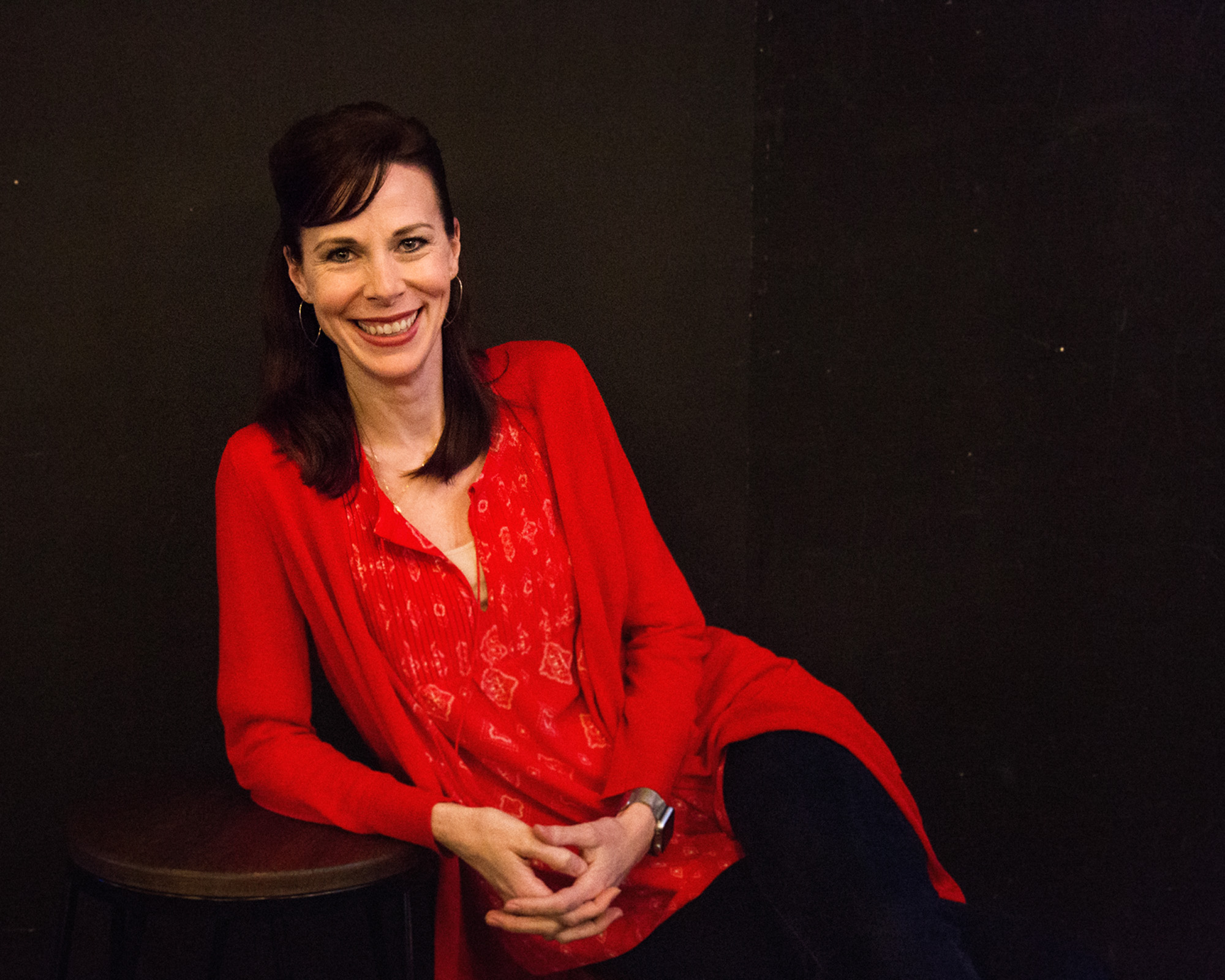
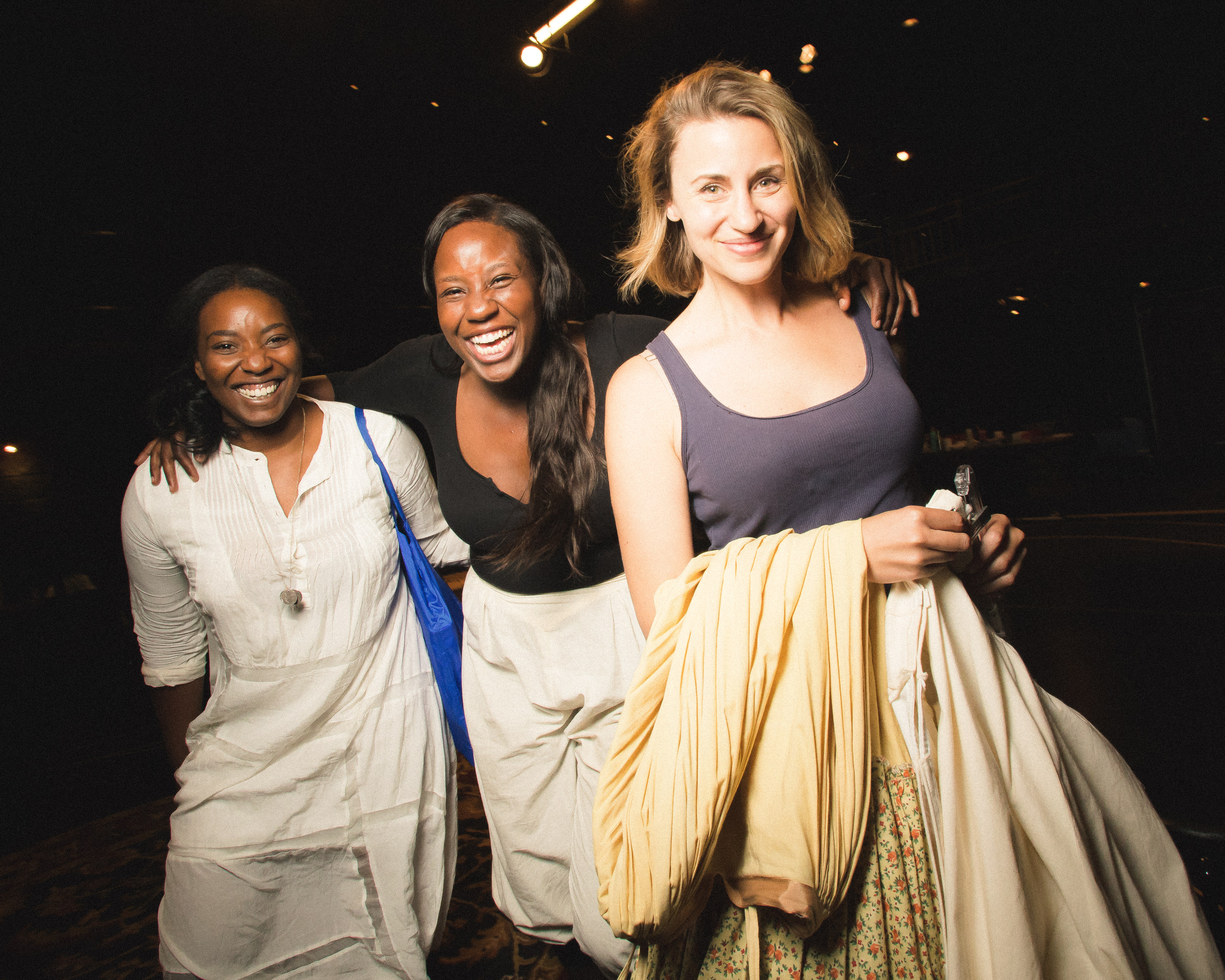
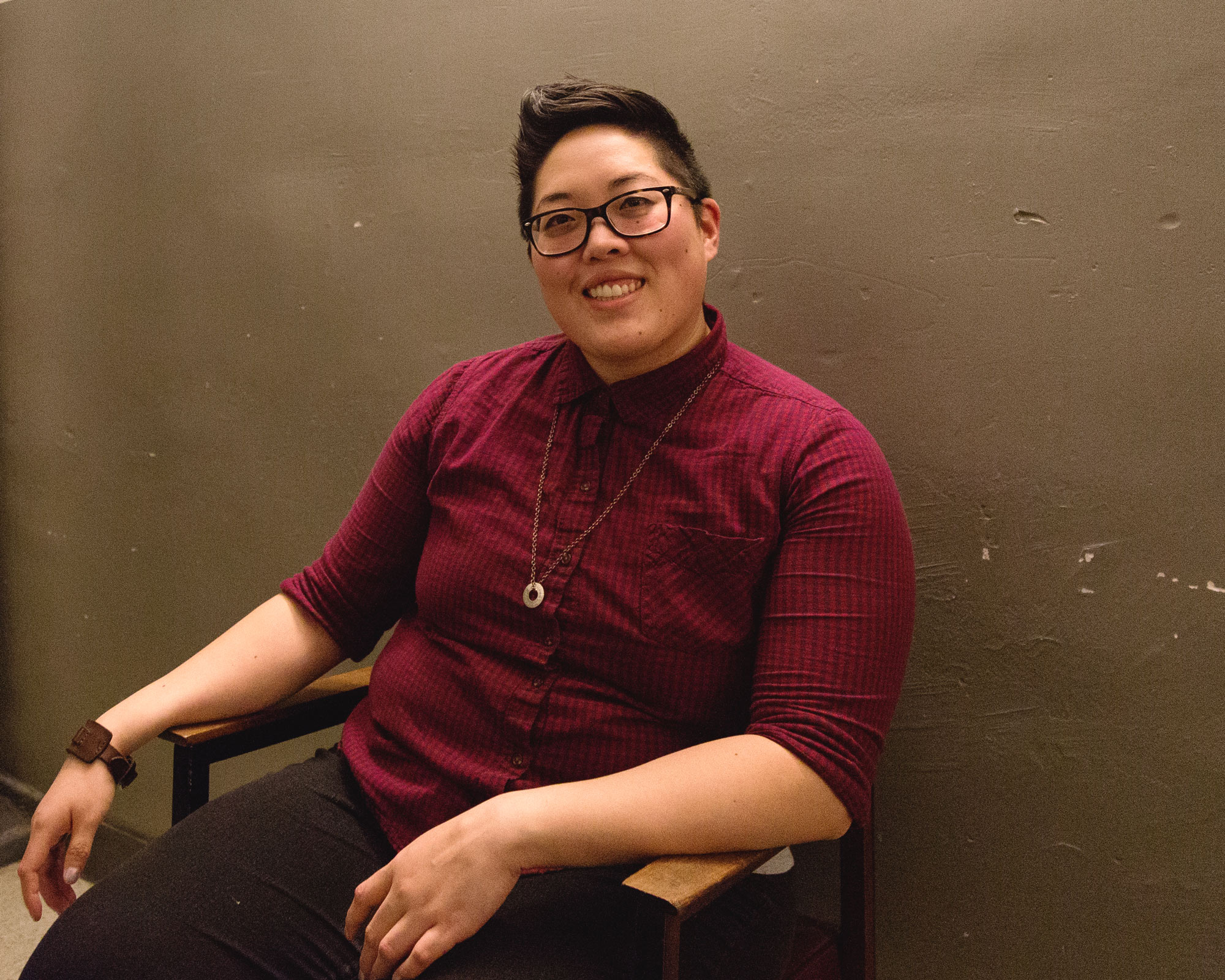
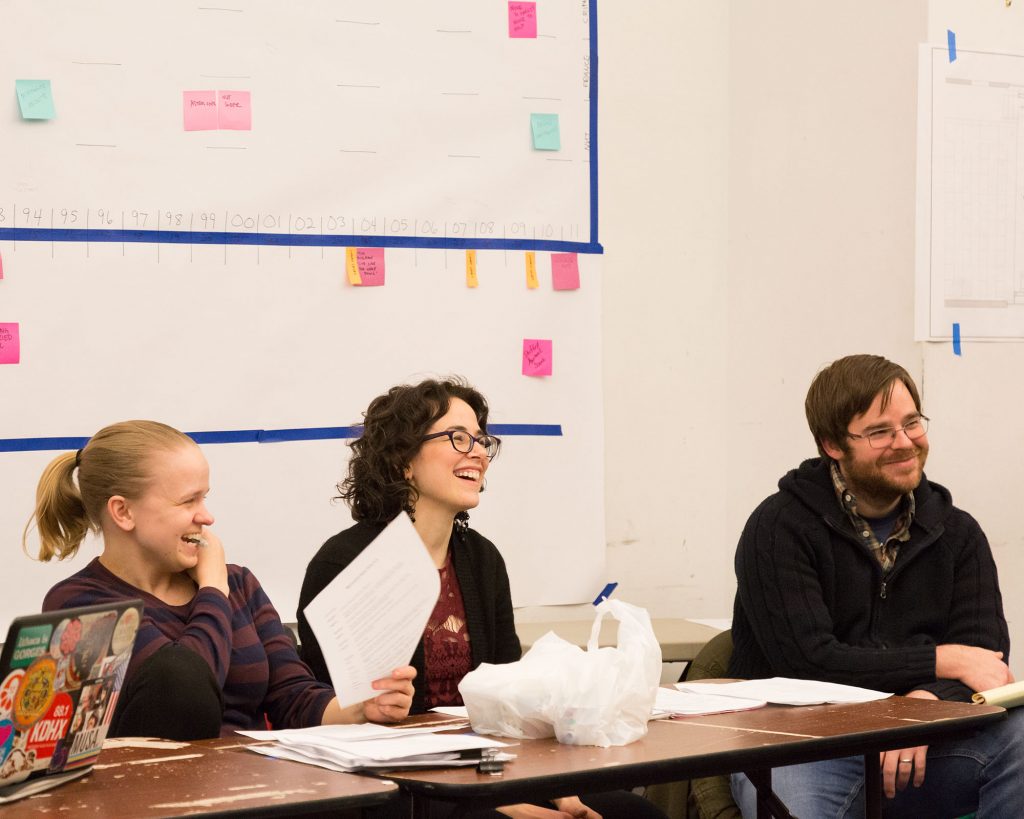
Kimberly Chatterjee, Kate Hamill, Amelia Pedlow, and Nance Williamson


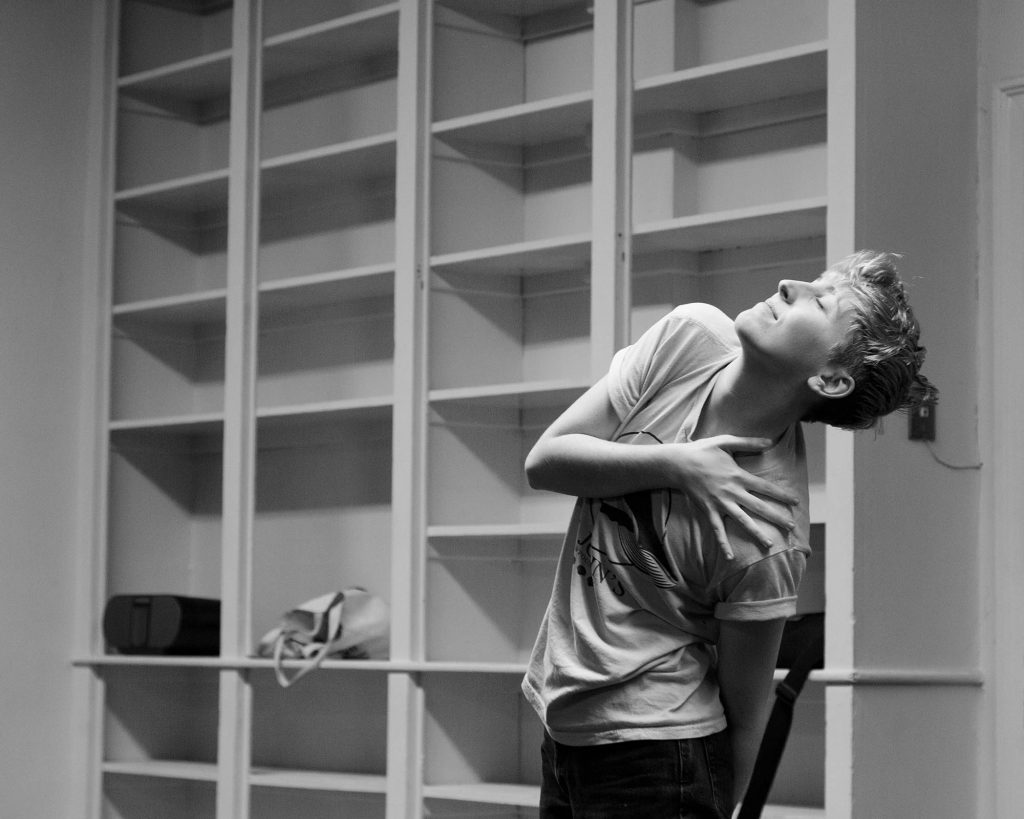
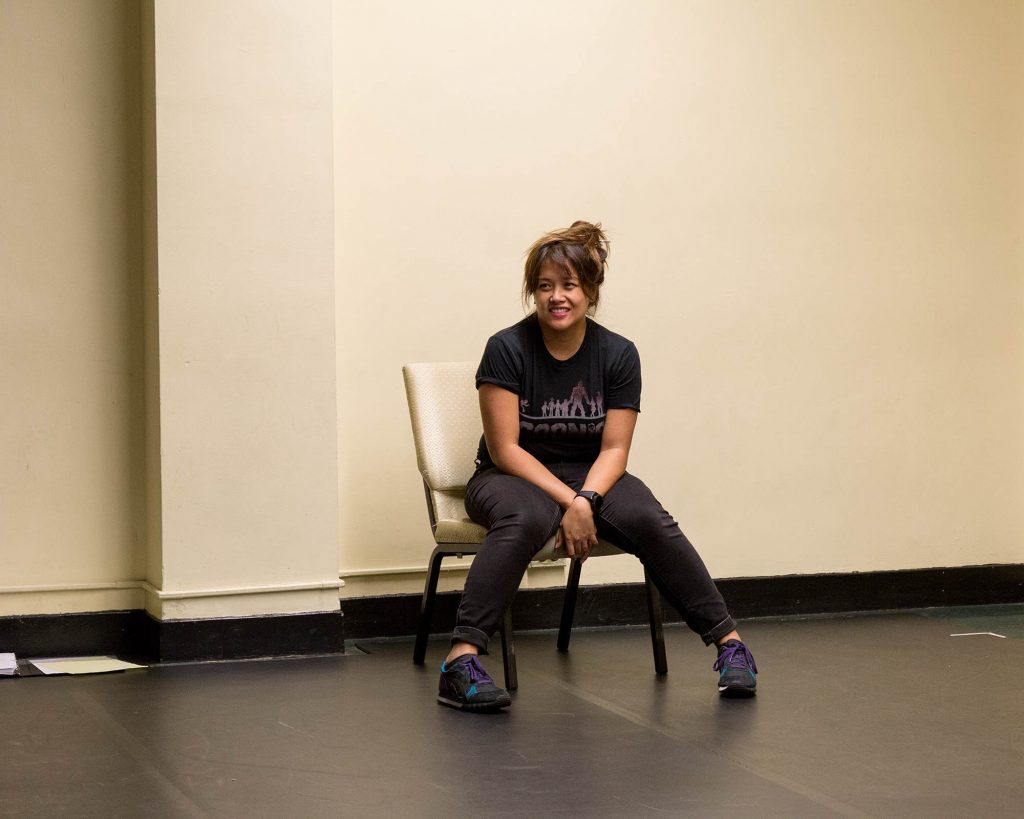
Something joyous is happening at the Cherry Lane Theatre. That’s the home of Kate Hamill’s uproariously funny, clever, and at times deeply moving adaptation of Jane Austen’s most famous and celebrated novel, Pride and Prejudice. The limited engagement, directed by Amanda Dehnert and led by an energetic cast with Hamill herself playing the iconic Lizzie Bennett, is being presented by Primary Stages in co-production with The Hudson Valley Shakespeare Festival through January 6. We caught up with Kate and the other women in the cast: Kimberly Chatterjee, Amelia Pedlow, and Nance Williamson—whose palpable energy, playfulness, and affection towards each other suggested we were spending an afternoon with the Bennetts themselves—to discuss the role of women in the arts and the ways this 200-year-old text still manages to enlighten and surprise us.


Margarita Javier: Tell us about the character or characters you play.
 

Kate Hamill: I play Lizzie Bennett, and I wrote the script as well. Lizzie is a bit of a cynic. At least for herself, she’s extremely anti-marriage minded. And she has to grapple with what happens when you meet someone who kind of turns around your beliefs about yourself. Nowadays she would be a feminist, but she was born before those terms. She’s a proto-feminist.
 

Amelia Pedlow: I play Jane Bennett, who’s the eldest Bennet sister. She’s very sweet, she means very well, she’s a big ‘ol romantic, but she’s also a big believer in following the rules and doing the right thing. In that time, part of that meant not being too forward with guys. Not that we understand that at all! [laughs] That’s her tragic flaw. I also play Anne de Bourgh, who’s the daughter of a very powerful, very wealthy lady of the time, and she is going to inherit her mother’s estate and marry the love of her life, Darcy. That’s what happens at the end of the play, spoiler! [laughs] She’s a perfect angel.
 

Kimberly Chatterjee: I play Lydia Bennett, who is the best of all the Bennett sisters. [laughs] She’s the youngest sister, and she loves her mother. She thinks her mother is the absolute perfect prototype of a woman. She loves her sisters. She thinks she’s smarter and better than them, but she idolizes them, which of course makes no sense. What I think is so interesting about her and the amazing way that Kate wrote her is that you think she isn’t paying attention or is just bopping through life, but she’s actually taking away all these nuggets of information of things that she’s learned about how to be in the world. She gets it all wrong, but she’s constantly observing and taking in the world around her. And then when she finally takes charge, it doesn’t go great. But she has some good reasons for it, which is amazing. And I also play Lady Catherine de Bourgh, who is Darcy’s aunt, the wealthiest woman in England; powerful, has no time for nonsense, but also loves to belittle and crush people for fun [laughs] just because she can. And her sweet, beautiful, perfect daughter Anne is going to marry Darcy. There’s nothing wrong with Anne. [laughs]
 

Amelia: Nothing is wrong!
 

Kimberly: Nothing is wrong! They’re been betrothed since probably before they were born, and it’s going to go great. She has not a care in the world when we meet her! [laughs]
 

Nance Williamson: I play Mrs. Bennett, who is the mother of all of these beautiful girls. My agenda is to get them married well. Because if we don’t, there are no sons in the family, there are just daughters, which means that our home will go to the next male heir, which is Mr. Collins. And if Mr. Bennett—my husband—dies, we’re out on the street. So I have made it my life’s work to prepare and prod and push and irritate my daughters into being marriage-minded. I’m the push behind them all. And I also play the servant, whom we affectionately call Lurch. [laughter]
 

Amelia: Uncredited.
 

Nance: A bubbling male, old, bitter…
 

Kate: …secret lover of Lady Catherine. [laughs]
 

Nance: Not true!
 

Kimberly: Not true at all!
 

Amelia: It’s on the record, guys. It’s going in the public record. [laughs]
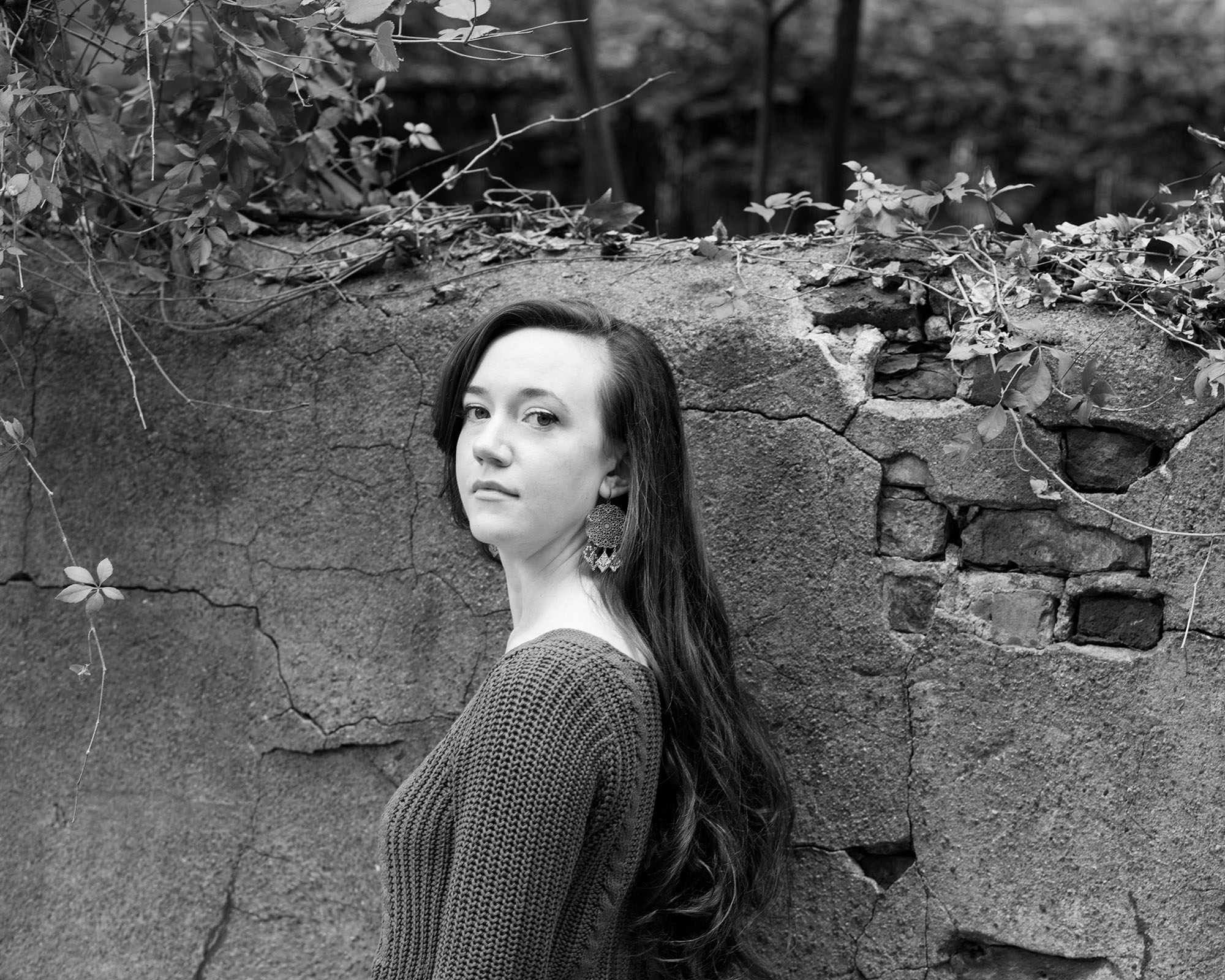
 

Kimberly Chatterjee, Kate Hamill, Amelia Pedlow, Nance Williamson
 

Margarita: You just finished a very successful run at the Hudson Valley Shakespeare Festival and you’re coming into this Primary Stages production with high expectations. They announced an extension even before the first preview happened. What has this experience been like so far, and what are your expectations now coming to play in front of New York audiences?
 

Kate: I think we’re just trying to let the play and the production teach us what it is, especially in a new space. The space is very different. During the first show, we were like Oh, we don’t have to scream! Hudson Valley is a 500-seat outdoor theater, at which Nance has done 18 seasons. So automatically that’s a big difference. Otherwise, I think this is what the preview process is for. We’re feeling it out. I think it even changes the jokes.
 

Nance: It does. And, you know, we went to people’s homes and did scenes for fundraisers, so besides performing in the tent, we were in different homes, yards—in different kinds of places. There’s a sort of playful improvisational chaos to doing it. It can be, when you’re not tired, a really fun process to see how we shift this here, how do we do this or that. And it’s a wonderful cast.
 

Kimberly: I was going to say we all, even when we’re at our most tired and sick and grumpy, we still love each other, which seems kind of impossible, but makes even the most stressful parts of this enjoyable. We have each other; we trust each other to be able to navigate the jokes and the timing. If something doesn’t go right, it’s never because someone is incompetent. I never walk away like Well. Everyone’s terrible! [laughs]
 

Kate: I also credit so much our director, Amanda Denhert, who creates a really fun, happy, safe room in which you feel really free to make stupid decisions. [laughs] And she sets that tone so much.
 

Margarita: Given how well known and beloved Pride and Prejudice is, and how often it’s been adapted, is there any pressure in trying to contribute something new and unique at the same time that you want to appease fans of the original?
 

Amelia: My sister is the one who gave me this book when I was however old and said, “Here is your bible.” And she’s very literary in general, but she knew I was going to love this and The Princess Bride—she introduced me to both. When she was coming to see the show, she was the person I was most excited to see it because I knew that anyone who loves this book will have a whole other level of love for this production, that people who don’t know the book at all—my boyfriend, for one – had an amazing time. Kate so beautifully takes characters and moments and recognizable scenes from the book and hones in on exactly what has made them so easy to fall in love with throughout the hundreds of years people have loved this book. Bingley being a dog might be one of the biggest ones. [laughs] My sister lost her mind.
 

Kate: He’s not literally a dog.
 

Kimberly: He’s dog like.
 

Amelia: Inspired by a Labrador. And that, in essence, is that character! It’s such a beautiful, slightly theatrical, irreverent thing, but ultimately a real distillation of the character in the Jane Austen novel. That type of work is throughout the piece and I know my sister was one of those people—and we had a lot of them over the summer—who began cackling from the moment something was introduced without having to get to know it over time. It really speaks to people on both of those levels, and I’m really excited for all of those people to see it.
 

Kate: The kind of theater I dislike the most, I think, is when I go in expecting something and it just meets those expectations, and I leave and nothing in me was challenged. I like stuff that’s more surprising. I think this is like that. We surprise ourselves! Sometimes we’re like What’s happening? But hopefully it’s a way to see a story that’s 200 years old and that people, including so many of us, love so much in a new, surprising way while still honoring it.
 

Margarita: What do you think Jane Austen would make of the current political climate in the UK and US?
 

Kate: There was an article about a year ago about—derp—“Alt right says Jane Austen would have liked them.” No! You know what? When you’re a racist, sexist hammer, everything looks like a racist, sexist nail. Her writing is so feminist, so subversive, and I think she would tear apart Donald Trump and all his UK counterparts and flip them the bird in every single way. Bite me.
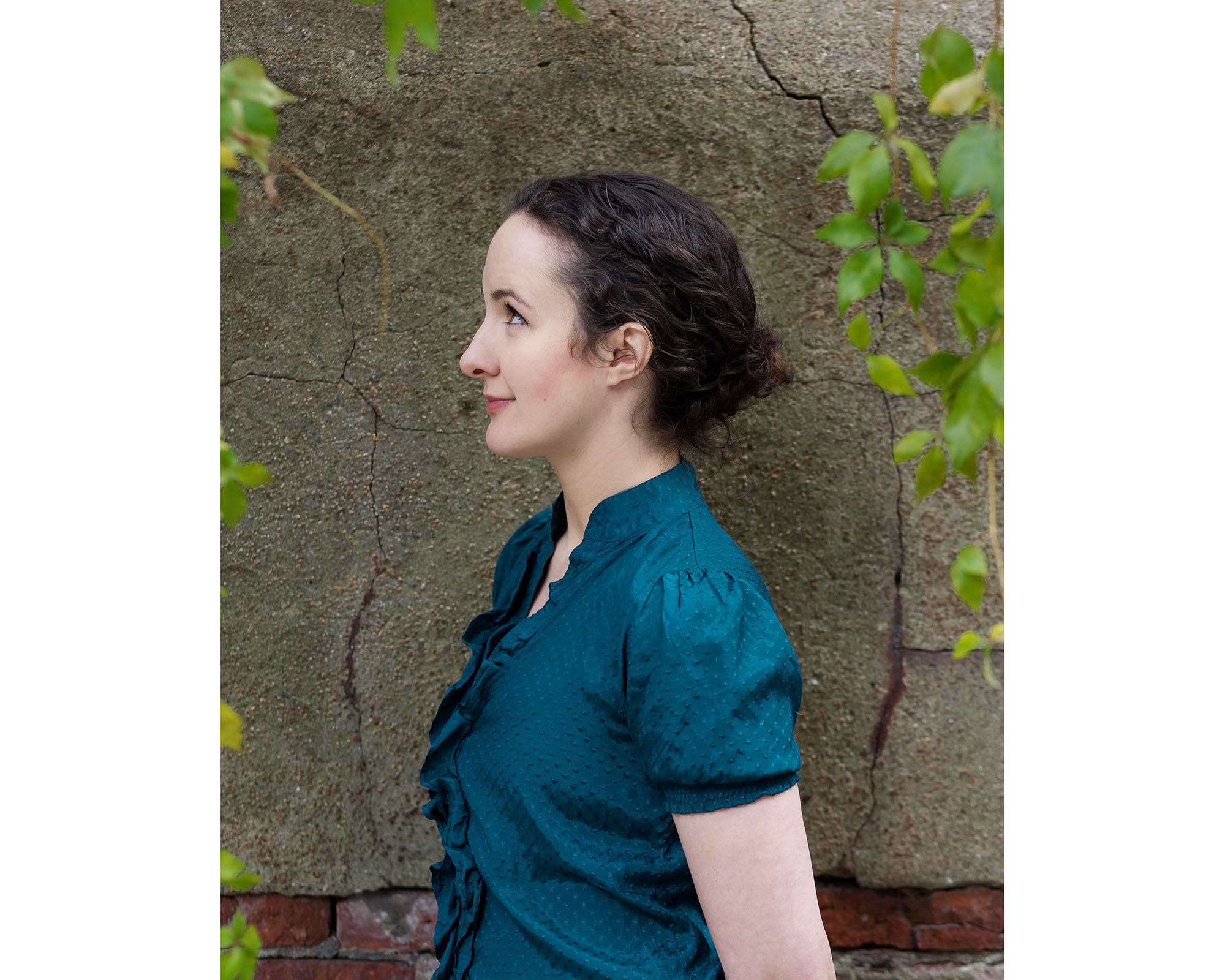
 

Kimberly Chatterjee, Kate Hamill, Amelia Pedlow, Nance Williamson
 

Margarita: There have been a lot of sexual harassment accusations coming forward against powerful men, in the arts and politics, and people, especially women, are feeling open to share their stories in ways we haven’t felt comfortable talking about it before. I think all of this brings relevancy to texts like this one, especially the way Austen talks about marriage. So I was wondering, what do you think is your character’s contribution to this discussion? What is her #metoo story?
 

Kimberly: Poor Lydia doesn’t know anything.
 

Kate: I got a letter from one of the other productions from someone who was quite nice but was saying, “It was so upsetting to me when Mr. Collins pursues Lizzie because it seemed like that was upsettingly sexual, upsettingly a sexual-harassment thing.” And I’m like “It is. She says no, and he won’t listen to her.” My experience being in it is the more terrified I am, the funnier the audience thinks it is. I think it’s a laugh of recognition. So for Lizzie, she sees so clearly how the power dynamics in a marriage situation are set up that she doesn’t even want to play that game. We were saying the other day that the subtext of this play is love can exist in patriarchal structures, but patriarchal structures make it harder. Lizzie eventually falls in love with a man and she’s like Gah! How do you reconcile that with feminism? So that’s Lizzie.
 

Nance: Mrs. Bennet, I mean, is in some ways so who she is, so in spite of being married, she views it is a necessary—I wouldn’t call it “evil”—but she’s very much in charge of that family, or so she thinks. Her husband has kind of distanced himself from the family, he loves Lizzie especially, and the rest of them are kind of silly, cackling creatures. She’s very much driven, she’s very much in charge, but it’s chaotic, and her agenda—I wouldn’t call it a “feminist” one at all—is a realistic one given the time. It’s not like Oh, you’re going to go to college and get a degree and take care of yourself. There’s a desperate need to get the girls married because they need to. So it’s a kind of survival mode, but it’s not necessarily a model marriage that the daughters would look at and go “I’m going to have a marriage just like my parents” because it’s a little dysfunctional.
 

Kate: Traumatizing!
 

Nance: And traumatizing. It is what it is, and it’s kind of loveable and sad, chaotic and crazy.
 

Amelia: There are so many things to say, because this play deals with all of these themes on a hundred different levels. One thing I will say that’s maybe inspiring, since the boys aren’t here: The men in power in this play, the men who have power, men who have wealth and money, who are meeting these girls behave in quite a respectful manner in many ways. They recognize their own power and they have genuine feelings, and so they err on the side of caution and hesitation and move very slowly. There’s a lesson there to be taken away. This was written by a woman, and these are the good guys, and that’s how the good guys should behave, especially when they have power and money, and know it. If they wanted to just take one of these girls, they really could. But they know it’s not what the women want, and I think that’s evidence of the author and the playwright. It’s really easy to fall in love with them when they behave that way. I’ll say that.
 

Kimberly: Lydia… We don’t get to see much of her post-marriage relationship. One can imagine that it is a very unhappy one. Because Wickham has absolutely no interest in any permanent relationship with anyone, even if there was a world—not to speak for Mark’s character, but from my perspective—if there was a world where he couldn’t love someone, permanence of any kind is not on his mind.
 

Kate: Yeah, he’s a narcissist!
 

Kimberly: And she’s young and naïve and incessant and outspoken and it’s going to be miserable. It’s going to be absolutely miserable. And she’ll have a level of protection because Darcy’s a good guy. She will never be on the street. But in that time, you can beat your wife, you can do whatever you want. I imagine she has a long, dark road ahead. But she will visit her family and come back to the women in her life as much as she can. Which is great to have that in contrast with Lady Catherine, who, when we meet her in the play, she’s in charge of everything; it’s her money, it’s her power, it’s her home, it’s her daughter. She gets to plan whatever she wants to do. Her values aren’t necessarily the most understandable. She doesn’t necessarily care what other people think, which is why things don’t work out. But it’s very freeing and fun to be like I don’t have to consider anyone else! You don’t get to see any other woman in the play do that. Lydia may act that way, but that’s not the actual reality. Catherine’s reality is “I can do whatever I want” until it comes down to the men.
 

Kimberly Chatterjee, Kate Hamill, Amelia Pedlow, Nance Williamson
 

Kate: I think it’s so interesting when people are like “Well, this is a comedy.” And a lot of it is very funny and very absurd, but I think it’s so funny when people want to censor out the darkness and the desperation. Do you think women’s lives don’t still have those things? Do you think they didn’t have them then? I think the love stories that work out in this play are moving because they get past that imperfection, or they embrace that imperfection, whereas it’s so funny when people are like “Well, I was just expecting a lot of polite conversation!” [laughs] “It’s not very theatrical!”
 

Amelia: And how could you even say that if you’ve ever read or seen anything by Jane Austen ever? Every single work, even the ones that don’t jump off the page in the most exciting way, it’s all about the struggle and the incredible things they have to overcome.
 

Kate: And how does that reflect people’s relationships? Even the happiest relationships have dark times and you mess up, and you fight, and, you know.
 

Nance: You do. I’ve been married for a long time, in a happy marriage, but you have to have the bottom notes, the bottom notes give it purpose. If it was just all that, why do it? You can’t live that way.
 

Margarita: I want to talk about the fact that some actors play multiple roles. I think it’s really cool that a lot of the female roles are played by men. It was the same in Sense and Sensibility and Vanity Fair. I’m curious, is this something that happens in the writing process, or something that comes about during rehearsals or casting? Is there some sort of thematic link by having the same actors play these multiple roles?
 

Kate: I like ensemble pieces. I like everyone in the ensemble to have basically equal roles. I think that that’s more fun for actors, and, if possible, in very contrasting roles. In this play, I wrote a lot of roles to be gender neutral, so Mrs. Bennett can be played by either a man or a woman, Mr. Bennett can be played by either a man or a woman, Mary can be played by either a man or a woman. Collins is most often played by men just because I want him to be disgusting. And the most perfect, beautiful woman in the play, Miss Bingley, is played by a man. I wanted it to be gender neutral just because sometimes I think the audience listens differently. For instance, all the men playing women in this particular production are the women who enforce patriarchal structures. They’re the ones who give them roles and say, This is perfect, this is imperfect, this is what you’re supposed to do, this is what you’re not supposed to do. But then having that choice of gender neutrality allows us to cast based on the energy of who comes into the room. Nance read Mrs. Bennett at the first reading and I was basically like Well! That’s cast! Phew! [laughs]. In Vanity Fair everyone except the two women were played by men because that is about women in a patriarchy, in a world full of men. So that was a choice. This one is more gender neutral. This is what we ended up with based on who came in the room.
 

Margarita: So in other productions it could be cast completely different?
 

Kate: Oh yeah! It’s listed as completely gender neutral. In general, I feel like the right actor can switch back and forth, so this is what we landed here. And it’s so fun having women play men, and men play women. You just listen differently. When the men are saying, “This is how women are supposed to act” the audience listens differently. Including Charlotte. I love Charlotte. I think Charlotte is the most sympathetic character, but she enforces those patriarchal rules, including on herself, and she pays the price, for sure.
 

Margarita: What has it been like working with the director, Amanda Denhert?
 

Nance: She’s great. I met Amanda when she was a graduate student. She was, I think, the assistant director or musical director of A Christmas Carol that I did in the mid-90s, at Trinity Rep. I vaguely remember her—I was a flying ghost—and I remember her with singing children. She was a graduate student, but I remember her because she would really rehearse the B-team. She was very bright and very smart. And over the years, she worked a lot over at Trinity Rep, and I had worked there a number of times. So you would hear about these amazing productions that were happening by this young woman, kind of in the tradition of Adrian Hall and Eugene Lee. Then I sort of lost track of her for a time. So to meet her again 20 years later has been really fun, because I grew up in that same tradition: a creation of what the play is. It’s not all decided before you come into the room; it’s very much a piece of alchemy that is discovered right then as opposed to an idea of what something should be and having to find your little nook in what’s already decided. It’s very freeing and very playful. She really sets a fun tone, as Kate was saying.
 

Kate: Yeah, highly theatrical, totally fearless. Working with her as a playwright as well as an actor, she really illuminates the text, really wants to be very specific about what the text is and that pushes me to be a better writer. Super collaborative. It makes it such a fun, happy, and loving room. She was described to me before we met as someone who creates “feminist fairy tales.” And I think that’s very true. They’re so beautiful, there’s so much heart, but they’re totally fearless as well. Oh my God. She has no fear.
 

Amelia: No, she actually doesn’t. You’ll meet some directors who’ll say, and she actually said on the first day, “I really want us to really mess up. I really want us to do it very wrong, to fully go down the road of a wrong choice for a week and a half and then we’ll swing back around.” A lot of directors say that. But she means it. And part of the reason she’s able to mean it, I think, is as much as she’s operating on instinct and she’s a brilliant musician, her instinct absolutely pairs up with her intellect in a way that she’s able to articulate why she wants your left hand not your right hand in that moment, or why this is the operative word and not that one, or why we’re cutting the cat, which actually happened in the middle of rehearsal. Some directors will say, We’re cutting the cat because we’re cutting the cat; the cat doesn’t make sense. Amanda will say, We’re cutting the cat because the cat is a creature and you’re a creature and if we’re focusing on this creature and how it moves in a new world in a new place, we’re not meeting your creature yet and you go Of course! That makes so much sense from an audience’s perspective! And she’s able to take that seat and tell you for storytelling purposes why she wants a ridiculous choice, or to take away a ridiculous choice. And that’s a really rare thing in my experience, to even take the time to do it. It gives the actors so much respect.
 

Kate: She really is a master director. And you can tell, because she’s a master of that craft. Sometimes she says something and I’m This should be in a book! She can defend the principle of what you’re doing. It’s never arbitrary. It’s based in the principles of her convictions.
 

Nance: And I would say that because of you, Kate, the relationship between the playwright and the director is so interesting. Kate will have the playwright part of her brain listen to a scene and go “How about if we change that?” and then the actor part of her brain says something else. And so the director is talking sometimes to the playwright part of Kate’s brain, sometimes to the actor part. And Kate will sometimes come out as one part of her in response, and the other part will come out and do this. It’s like an amazing relationship that the three of you have.
 

Kimberly Chatterjee, Kate Hamill, Amelia Pedlow, Nance Williamson
 

Kimberly: Sometimes she’d be like “Can I speak to the playwright now?”
 

Nance: It’s like Sybil, only everybody knows it’s going on. [laughs] I want to talk to Zuul now. Is Zuul in there? [laughs]
 

Margarita: It almost makes me angry that a piece like this one, based on a woman author’s book, written by a woman, directed by a woman, with strong female characters is so rare, especially in New York City, in this landscape. We’re so underrepresented in the arts. So I’m wondering, as women artists, what can be done? What is your role in improving representation for women?
 

Kate: To be completely honest, I think there’s no excuse. There’s no excuse, and it starts at the undergraduate level. When I was an undergrad, what I was told was: “There are more roles for men and there’s more work for men, and that’s how it is” as if it was handed down on stone tablets. And I liked my undergrad, but that’s how it was treated. And then in the world you’re often taught that there just isn’t as much work, and it’s de facto. What I think is really encouraging now is you see members of the public really putting pressure on: Why is this season all male? Why are you having all-male directors? And that’s why things are changing. I feel like that’s pretty key. There’s no excuse, actually.
 

Amelia: There isn’t.
 

Kimberly: This is the non-romantic version of this, but money speaks. Don’t go to see things that you think are hurting the art that you want to see in the world. And go see things that support it. I remember—and this is not theater—but when the Ghostbusters movie came out, I have so many female friends who don’t care for the genre and they were like Absolutely! I’m going to go spend money and support this to show box office numbers. Because people think it’s a risk. They think people aren’t interested in it, they think people won’t spend their money. But then time and time again you have things like the all-female Henry IV at St, Ann’s Warehouse—which was amazing—and it’s like Oh, that show is selling out every single night and it’s extending? Hmmm. Maybe we can do that.
 

Kate: Sixty-eight percent of the ticket buying audience is female. They’re already coming! Like “if you build it they will come”? They’re already coming! Why are you not playing to your home base? It’s so outrageous!
 

Kimberly: And I think it’s the idea that people think that female centric stories, if it’s an all-female anything, the female centric stories will be uninteresting or unrelatable. That’s what I think the undertone is. And it’s like Kate was saying: What did you think women’s lives were and are that would be so uninteresting or shallow, that people wouldn’t want to see that? Nobody ever says that. I grew up idolizing so many male centric stories and the inverse is absolutely true.
 

Kate: When Sense and Sensibility first came Off-Off-Broadway, a producer laughed in my face that it was happening, like “Haha!” and turned and walked away from me. And it ran for a year! That’s a story about women! That’s your ticket buying audience, and there’s no excuse anymore. It’s like, pick a side American theater—I’m sorry! Donald Trump is the fucking President. Pick which side you’re on. Really. Don’t be those guys. Don’t be the people who reinforce that the female is always the “other” because the female is half of your population!
 

Kimberly: And have conversations. There are so many conversations that people don’t want to have, about gender, about race, often the two going together, or how the two don’t go together, and it’s never going to be comfortable. And when we decide to avoid uncomfortable conversations, we get to where we are today in America, which will get better, but it’s awful right now.
 

Kate: I’m so interested to hear what Nance has to say, because Nance has been in the business for a long time.
 

Kimberly Chatterjee, Kate Hamill, Amelia Pedlow, Nance Williamson
 

Nance: I was going to say that Davis McCallum, who’s the new artistic director of the Hudson Shakespeare Valley Festival, has really done a good job. He hired Kate, and did Kate’s play. He did Lauren Gunderson’s play last year, and he hires women directors. He’s in a position now of power where he’s hiring women writers in a Shakespeare festival. A Shakespeare festival. And he’s putting women in men’s roles. He’s injecting women in a much more vivid upfront way than there have been in a lot of different places. I think to support theaters like that who do that is great. I think that there’s a lot of young artistic directors, young men artistic directors who are supporting that and doing that.
 

Kate: And female artistic directors.
 

Nance: And female artistic directors, obviously. We just did a three women version of The Scottish Play, and it was from a man’s point of view, but coming from a woman’s mouth. And how does that sound to you? How does that speak to you? Do you pretend that you’re a man? Do you pretend you’re a woman? Do you pretend that you’re androgynous? And so it opens up, I think, for the actor, for the audience, all sorts of different ways of looking at text that is broadening in a way, that’s kind of exciting and thrilling.
 

Kimberly: It was absolutely brilliant, that production. I understudied the production and saw it a bunch of times and I remember talking to a male director after. He said, “Don’t you think that’s a masculine story, that it’s such a man’s perspective?” And I laughed in his face because I assumed he was joking. It was a white male director who has directed in many places. I was just like “Hmm.” To me, it was such an incredible, beautiful production—and of course, no production is ever perfect—but it was definitive for me of Women can play men in men centric stories, unequivocally. And trying to articulate that to someone who so did not hear it was very Wow, we have to talk about it over and over and get people to see it over and over again before they listen.
 

Amelia: I’m with you. I’m just with you.
 

Nance: I think the bottom line is that you do the best work possible. Because I think the work is what makes people come. You have to make those choices, but it has to be done well.


Kimberly Chatterjee (Lydia/Lady Catherine) NEW YORK: The Tempest (Classical Theatre of Harlem); The Christians (Playwrights Horizons). REGIONAL: Pride & Prejudice, The General From America, Macbeth, Measure for Measure (Hudson Valley Shakespeare Festival); As You Like It (Folger Theatre). TELEVISION: “High Maintenance.” Proud graduate of NYU Tisch’s New Studio on Broadway. Kimberlychatterjee.com
 

Kate Hamill (Lizzy) is an actor / playwright. As playwright: Sense & Sensibility (in which she originated the role of Marianne), Winner, Off-Broadway Alliance Award 2016; Nominee, Drama League Award (Best Revival, 2016); 265+ performances Off-Broadway. Other plays include Vanity Fair (in which she originated the role of Becky Sharp; Nominee, Off-Broadway Alliance Award 2017), In the Mines (Sundance Lab semi-finalist), Em (Red Bull New Play finalist), Little Fellow (O’Neill semi-finalist). Additional acting credits include: The Seagull (Bedlam), All That Fall (Kaliyuga), Dreams… Marsupial Girl (PearlDamour). Her plays have been produced at the Guthrie Theatre, Pearl Theatre, Dallas Theater Center, Folger Theatre (Helen Hayes Award, best production: S&S) & others. Upcoming productions at Oregon Shakespeare Festival, A.R.T., Playmakers Rep, Seattle Rep, & more. Kate-hamill.com
 

Amelia Pedlow (Jane/Miss De Bourgh) OFF-BROADWAY: The Liar and The Heir Apparent (Classic Stage Company); ‘Tis Pity She’s a Whore (Red Bull Theatre Company); You Never Can Tell (The Pearl). REGIONAL: Pride and Prejudice and The General from America (Hudson Valley Shakespeare Festival); Red Velvet and The Metromaniacs (The Old Globe); The Metromaniacs, A Midsummer Night’s Dream, and Merchant of Venice (The Shakespeare Theatre DC); Ether Dome (La Jolla Playhouse, Hartford Stage, and The Huntington); The Glass Menagerie, Hamlet, and The Liar (Denver Center); Legacy of Light (Cleveland Playhouse); The Diary of Anne Frank and The Tempest (Virginia Stage Company). TV: “The Good Wife”; “Blue Bloods”; “Shades of Blue”; “The Blacklist”. EDUCATION: B.F.A. Juilliard.
 

Nance Williamson (Mrs. Bennet) is thrilled to be reprising Mrs. Bennett in Pride and Prejudice. During her 33-year career as an Equity actor Nance has performed on Broadway in Broken Glass, Henry IV, Cyrano and Romeo and Juliet as well as numerous Off-Broadway and regional productions most recently Amanda in The Glass Menagerie at Pioneer Stage and premier production of Book of Will at DCTC. Nance is happily married to actor Kurt Rhoads.

Posted on

In Process: The White Dress

The White Dress


I am a guest at the first rehearsal of The White Dress—a new play by Roger Mason, directed and choreographed by Adin Walker, which will be presented at The American Theatre of Actors from November 2nd through November 5th. The play follows Jonathan, a young person navigating their gender identity—with a vivid, dynamic ensemble accompanying and guiding him along. Everyone is on a journey; each character is navigating their own path to self-discovery.
 

It’s time to meet each other. The rest of the team, in the basement of the South Oxford Space, talks to Roger, who is in Los Angeles. He is on speaker, being passed from person to person on someone’s phone, which somehow makes him larger than life. He is infectiously enthusiastic. We all go around the room, introduce ourselves, share our pronouns, and share stories of our first encounters with our identities—as a room, we once threw up out of physical attraction, we were once called a racial slur immediately after learning about slavery, we once demanded the right to play the flute as a child.
 

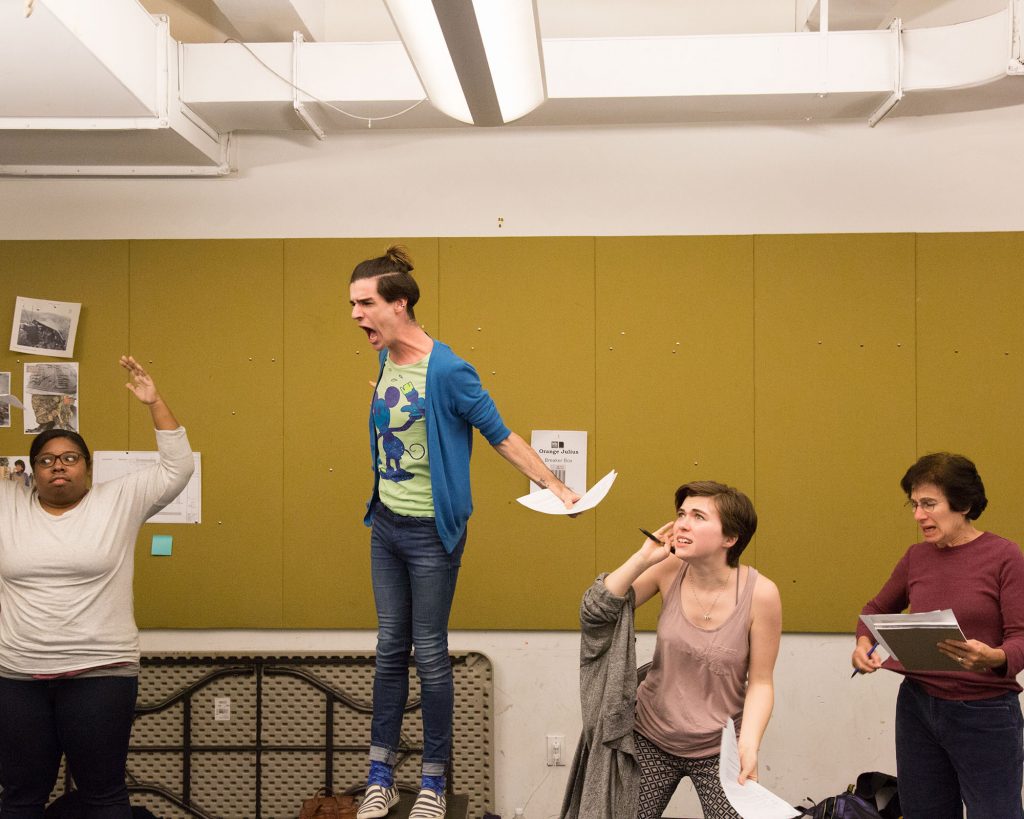
They start with a read-through around the table—a new draft, with a few surprises in it. But it’s clear that this is a process that will really begin in the bodies of the actors. This process will begin with movement, with establishing a gestural vocabulary that will inform the text. They read the play without its stage directions—I have no script to consider, so I focus on the language itself and I close my eyes a few times. Expressions of love and recklessness run throughout—lines like “Remember when you didn’t give a damn?” stick with me. On identity— “Did you put them on? Then they’re yours.” We hear Charles Inniss (the sound designer) play a theme for Jonathan. Serafina Bush (the costume designer) shows us an array of wild and fabulous reference images. The square space between the rectangular tables is full of possibility.
 

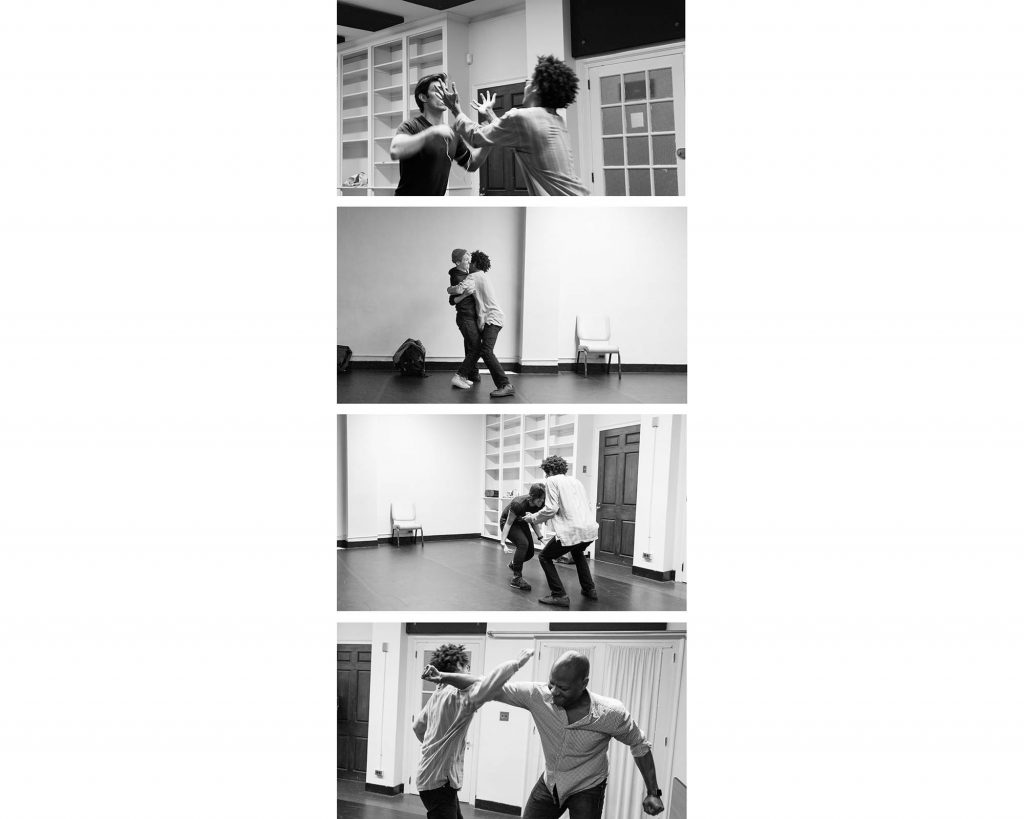
The next time I’m in the room, they’ve spent almost a week with the piece. I walk in and Mayfield Brooks (the movement dramaturg) and Michelle Vergara Moore (playing Hazel, Jonathan’s mother) are working on a movement piece together. Mayfield tells Michelle that they are making a “score, pattern, structure.” They are working with a silk jacket. Mayfield works like the conductor of an orchestra—if conductors of orchestras gave their entire bodies to their performance.
 

With their own movements as well as their words, they encourage Michelle to follow her actions through to their natural conclusions—“Do that whole thing again, but have a pathway.” The philosophy of movement in this piece, as Adin describes it, is to explore how each character is “carrying the identities and signifiers that are inscribed onto their bodies.” Michelle is learning the language of her character’s body—they talk about the dance she is doing as if it is an internal monologue: there is a moment of remembering, there is a moment of release.
 

The rest of rehearsal is devoted to first attempts. Izzy Castaldi and Stanley Mathabane track their teenage characters’ relationship through a few different moments: they experiment with a sleepover scene, a nosebleed moment, a kiss where lips don’t touch. Adin wonders if the entire show could be done without using a single chair. They decide to try the scene at hand without chairs. This is the time to try things, after all—and I look forward to witnessing the decisions they make.


***


The White Dress is playing at The John Cullum Theatre at the American Theatre of Actors on November 2 to November 5, 2017. Tickets can be purchased at thewhitedressplay.com/.

Posted on

A Conversation with Christa Scott-Reed

Christa Scott-Reed


Shadowlands tells the touching story of the relationship between C. S. Lewis and Helen Joy Davidman. The Fellowship of Performing Arts is producing the first New York revival of this acclaimed play, which began performances at the Acorn Theater on October 17. We spoke with Christa Scott-Reed, who is making her directorial debut, about what makes the play relevant to modern audiences, and about the relationship between faith and the arts.


Margarita Javier: Could you tell us a little bit about yourself?
 

Christa Scott-Reed: I’m originally from the Pacific Northwest, from a little town called Wenatchee, Washington. It’s actually surprisingly home to a few theater artists in New York. It’s interesting because for a small town kind of in the middle of nowhere, they have a surprising love for theater. And I think it’s because it’s not geographically close to any other cities, so they sort of had to create their own cultural life.
 

MJ: So there’s a lot of theater there?
 

CSR: Yes! I mean, it’s all community theater; it’s not professional. But there’s a real love of it. For an agricultural town and one that’s relatively conservative, it’s remarkable how much they really value theater. I grew up just being immersed in it from a young age. And occasionally we’d get to go over to Seattle—and Dan Sullivan was running Seattle Rep at the time—and saw stuff there, and so that’s where I began. I went to undergrad at Whitman College in Washington, went to grad school at the Denver Center, and then found my way here.
 

MJ: Did you start as a performer?
 

CSR: I was always a performer until this particular job.
 

MJ: This is your first time directing?
 

CSR: This is my first time directing, yes.
 

MJ: How did that come about?
 

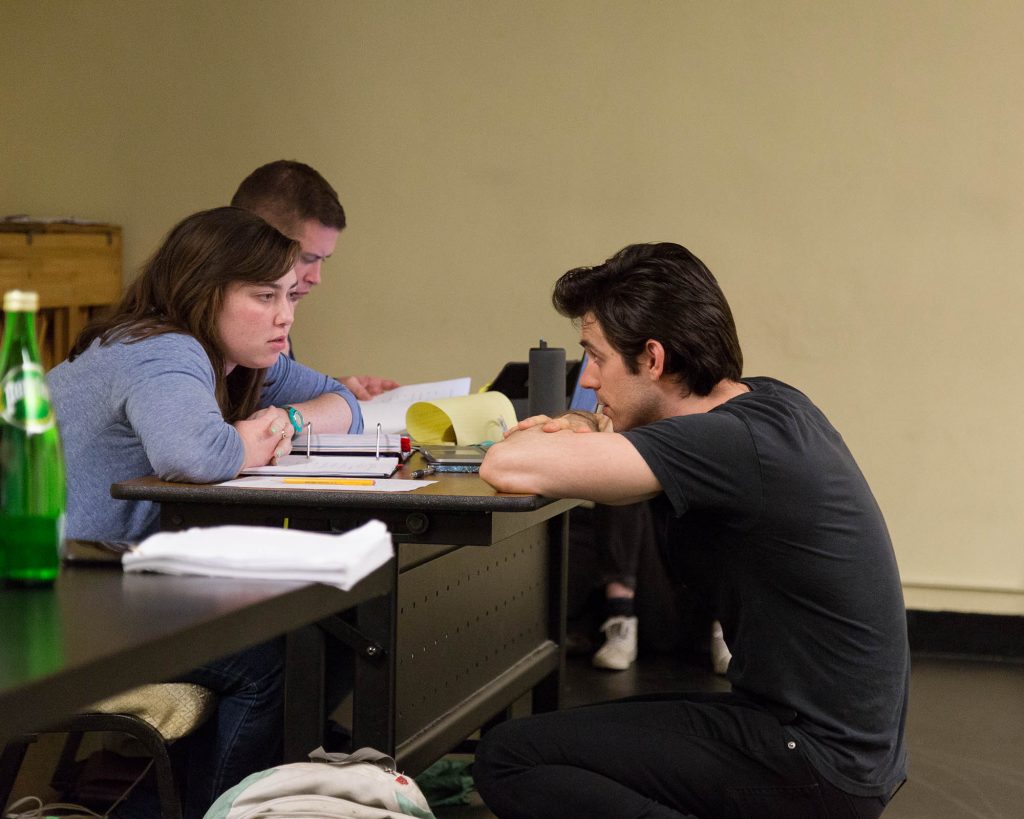
CSR: As a performer, I worked for Fellowship of the Performing Arts starting in 2013 on their production of The Great Divorce. And it started as a developmental production Off-Broadway, then we did a two-year national tour, and then we brought it back again to Off-Broadway. So it was a long stretch with them. And while I was working with them on Great Divorce, they started using me because, in my off-time as a performer, I also teach and coach other actors, so they started bringing me in, kind of as an artistic consultant, to maybe work with other actors in other productions, to direct readings, to help cast readings, to give artistic input in certain ways. And they started using me more and more for that. They sort of made it official when they realized that one thing they lacked in the company was a literary manager. And since I had been doing a lot with them in various ways, they said, “How about stepping in for this literary manager job?” I said, “I’m still a performer!” They said, “We get that; let’s call it a part time gig.” And in that role as literary manager, I directed a staged reading of Shadowlands for over a hundred donors and everybody seemed happy with that. Things started rolling and, because they had seen me handle the stage reading and because they had seen me in the room with actors, a couple of which are in the cast now, they said, “Ok you know what? We feel like we trust you. Let’s just have you do it. You’ve been a professional actor for over 20 years—you’ve been in the room. We think you can handle this.”
 

Christa Scott-Reed
 

MJ: Are you taking from directors you’ve worked with?
 

CSR: Absolutely. In fact, the other day my assistant director was noticing how I was doing my notes in the script a certain way, and he said, “Who’d you get that from?” And I said, “Rob Ruggiero” [laughs]. So, absolutely. And in fact, I’ve reached out in this process to several good friends of mine who I respect hugely as directors, and asked for their advice, their wisdom. They’ve put in good words for me. I’ve not been shy to try to humbly learn from those who know better than I do.
 

MJ: Correct me if I’m wrong, but this is the first New York City revival of Shadowlands.
 

CSR: It is.
 

MJ: So it’s a big undertaking as the first project to be directing, right?
 

CSR: It is. When you’re going to direct something for the first time, why not pick a show that’s set in the 1950s England, with 12 cast members, two of which are children, and 35 scene changes—why not? I mean, it’s an easy one. An easy one [laughs].
 

MJ: What can you tell us about the show itself, Shadowlands?
 

CSR: It’s a beautiful show. A lot of people know it because it was not only from Broadway and the West End, but because it was made into a movie with Anthony Hopkins and Debra Winger. People know it from that. They go “Oh right, Shadowlands!” But it’s time for it to come back to remind themselves of it. It’s a beautiful story. It’s known as a little bit of a three-hanky piece, but it’s not just that. Working on it, I’m reminded of how moving and how thought provoking it is. Those are all clichéd words, but really true in this case. And it’s also really nice -I was telling somebody else- it’s really nice to have a show that is a love story, but a love story between people who aren’t 22, who aren’t passionately falling for each other in that first-time way. There’s room for those stories, and those stories are being done, but I like the fact that these are mature people who have lived their lives, who have pain and suffering under their belts, who have past marriages and children and all those kinds of things. Telling that story as a love story is, I think, refreshing, especially for a theater audience who’s not largely 22 year olds. I know I’m not! And then you add to it the layers of what it has to say about the meaning of suffering: Why does God allow suffering in the world? What do we give up in order to gain something? When we gain so much joy and love, what do we give up in the form of pain and suffering? How does that test our faith, our doubt? All universal subjects that really resonate. Even though C. S. Lewis was, I think, a renowned Christian, there are things that resonate for anyone regardless of faith background. It’s about human experience.
 

MJ: And because this is based on a true story, has there been a process of doing research into the lives of C. S. Lewis and Joy Davidman? What has that been like?
 

CSR: Absolutely. And in fact, as somebody who probably in another life would have preferred to be a librarian—and I don’t joke when I say that—I love research. I took my dramaturgical element burden a little bit too far and spent months reading every biography I could get my hands on, and I ended up compiling it into this hefty stack of research about the characters, background about Oxford, everything I could get my hands on. And I presented it to the cast. I said, “There won’t be a test on this, but use this as a resource.” And I remember Danny, who plays C. S. Lewis, said, “Well, I do have a friend in England who had studied with or knew C. S. Lewis, and I was going to contact him. I don’t know that I need to now!” [laughs]. So I went a little crazy. It was also important for me to tell them that this isn’t a documentary. Danny doesn’t look like C. S. Lewis. These are different people—this is a play, it’s not reality. Of course it’s inspired by true events, and we want to maintain a sense of strong connection to those ideas. He may not look exactly like Lewis, but he is Lewis for this story. What are his needs, his wants, his loves?
 

Christa Scott-Reed
 

MJ: Why do you think this play is relevant to today’s audiences, specifically in New York? What do you think it’s telling us?
 

CSR: Touching on what I said before, honestly, look at what happened recently in Las Vegas. One of the first things the character of Lewis does as he walks out onstage is to hold up a newspaper and say, “This tragedy.” In this case, it was the Gillingham bus disaster in the 1950s. He says, “This just happened. How can God allow this to happen? What is the meaning of this kind of suffering?” Obviously, that’s true of any period in time, but I think this is something we’re struggling with constantly. How do we deal with pain? What is the purpose of it? I think it’s true no matter what decade you’re in. It’s always going to be relevant.
 

MJ: And you mentioned this is being produced by the Fellowship of Performing Arts, a not-for-profit company that is interested in delivering theater that has a Christian worldview. So first of all, how did you first become involved with them?
 

CSR: I auditioned like anybody else through their casting director for The Great Divorce. One thing I particularly respect about FPA is they have this mission to deliver theater from a Christian worldview that will engage a diverse audience, so they want to present a piece of art that is executed to its highest level possible. To that end, they want the best artists. They did not ask me when I auditioned what my faith background was or what my beliefs were. I’ve been at talkbacks with the artistic directors, and members of the audience ask, “Well, who in the cast, or designers, or crew—who is Christian?” And he just says, “I don’t know. You’ll have to ask them.” And I really appreciate that. What they require from an artist who works with them is somebody who is willing to do the best job they can, to make the best piece of art that they can, that speaks to that mission. But we have artists of all faith backgrounds or no faith backgrounds. Because so often—and I’m just speaking for myself now—when you hear the term “Christian theater”—and I happen to be a Christian—but even I wince a little bit. You think this is going to be some kind of eye rolling niche theater that’s just … ugh. And that’s really not their purpose. They really want to do a piece of art that’s intellectually challenging, emotionally engaging, something that audience members can come to and, regardless of faith background, be interested or fascinated by, come out of the theater laughing, thinking. They have managed to do that. When we did The Great Divorce, friends of mine came to see it when we were on tour in D.C.—and these are people who firmly have their own faith tradition which is not Christian, and they will never be interested in being Christian, nor should they—but they signed up for the newsletter because they loved the play so much. They all happen to be psychologists and they were all so engaged in the ideas. That’s the kind of thing that they’re interested in. Yes, of course FPA wants to provide theater for practicing Christians who are looking for art that speaks to them, that’s not speaking beneath them, but actually meets them at an intellectual level that’s satisfying. But at the same time, we want to bring other people in. The ideas of C. S. Lewis are interesting to people of all different types and sorts.
 

MJ: Going by what you said, I think we can agree that Christianity as a religion has been hijacked by the political right, definitely in this country, but also other parts of the world. Because of that, there tends to be a negative association with that religion for people of more liberal political leanings, especially in the theater world. What would you say to that end in terms of what this theater company is trying to achieve?
 

CSR: Certainly in our audience, there are conservative people, there are progressive people, there are people who span all parts of the political spectrum, as well as all parts of the faith spectrum. But I think we deliver stories that speak authentically to the human experience and that expand our imaginations rather than limit them. And I think a lot of progressives—and I count myself as progressive—get upset with a too-conservatively imagined Christianity; there’s this idea of limiting thought, of limiting experience of putting up barriers and saying, “This is acceptable and this is not.” And I don’t think that artists are in the business of doing that.
 

MJ: Right, and C. S. Lewis was a perfect example of that: he was very much an intellectual proponent of Christianity.
 

CSR: I know that for Max, our artistic director, his real desire is to do work that is intellectually respected. I think we can get people’s attention that way. You can walk in and be like “Let’s see what these Christians have for us” and then walk out going “That blew my mind a little bit.” We get a lot of reviews like that. Over the course of the last few years, a lot of the reviewers will start by saying, “I expected to be preached at. And that’s not what I got. I started thinking new thoughts.” We’re not in the business of alienating people; we’re not in the business of telling people what to think. We’re in the business of showing a piece of art that hopefully speaks to your body, soul, and mind.
 

Christa Scott-Reed
 

MJ: When you talk about a “Christian worldview,” what is that? What is a Christian worldview?
 

CSR: Well, certainly, it would be one that speaks to the values and the ideas behind a Christ centered life. So it would be love, compassion, what they talk about in Shadowlands. The whole concept of the title of Shadowlands is a Platonic idea—that the world we live in now is really just a shadow of the life to come, that true reality is something that lives beyond. It’s not special just to Christianity, but it’s certainly something that is an important part of Christianity: that there is another world, there is something supernatural that is beyond that. All of our shows have an element of the supernatural for that reason: that there’s something beyond, there’s something more. If we can find how we can best live in the present and be in the best relationship with other people and with God, that’s all part of becoming more real for the realness to come.
 

MJ: I’m fascinated by Joy Davidman.
 

CSR: I know, right? What an amazing character.
 

MJ: And we don’t know as much about her as we do about C. S. Lewis, so I was hoping you can talk about her, in terms of the play.
 

CSR: Yes, it’s interesting when you asked, “How does this play speak to New Yorkers?” because she’s perfect. She is such a New Yorker: from the Bronx, born into a Jewish but non-religious family, an incredible intellectual. She was absolutely C. S. Lewis’ intellectual equal. She was a genius, off the charts.
 

MJ: That’s what drew him to her initially, her intellect.
 

CSR: Oh absolutely, yeah. And she started as a passionate communist and a writer, and then discovered that communism as it was being practiced was just not for her, so she eventually moved away from that. She was always searching for something. At one point she was interested in Dianetics, before it became Scientology, but she eventually came to Christianity herself and, as a result of that, started writing to C. S. Lewis and him to her. As you said, then it was meeting of the minds—this purely intellectual relationship started via letter writing for a couple of years and then once they finally met, everything blew up from there.
 

MJ: What can you tell us about the cast?
 

CSR: Our cast is great. Daniel Gerroll plays C. S. Lewis. He’s a wonderful British and American actor that people will know from years of Broadway and Off-Broadway shows, films, and television. Robin Abramson plays Joy, and she’s a revelation. I’m really excited about showing Robin to New York audiences because she has been sort of the young leading lady of Pittsburgh, which is where she’s from. She only recently moved to New York, this is her New York stage debut. This feels like the way Joy kind of bursts into C. S. Lewis’ life, and, in a way, I feel like Robin is bursting into New York, and I can’t wait for people to see her. It’s just a wonderful group of actors. John C. Vennema, whom audiences have seen in a million wonderful things in New York, is exceptional and hilarious as C. S. Lewis’ brother Warnie. There are excellent actors across the board in this play.
 

MJ: Being a performer yourself, how does that inform your job as a director?
 

CSR: My assistant director, whom I had never worked with before, has worked with lots of directors but never with one who was also an actor, so he keeps saying, “It’s so interesting the things that you focus on that other directors don’t.” Whether it’s concern about how certain actors should carry certain things, or how difficult it will be for an actor to wear a costume, or how the dialogue is going—just little actor-centric things. He says most directors don’t think of that stuff. I think my strength going into the production was knowing how to communicate with actors, not only from teaching and coaching, but also just being in productions and having that relationship. The thing that I’ve had to learn on the job is staging in a way I never had before: blocking, seeing the entire arc of a show in a new way. I was always focused on my part as an actor. So it’s been a learn-on-the-job situation, but it’s been very satisfying.
 

MJ: Who would you say are your biggest influences both as a performer and as a director?
 

CSR: Where to begin? I will have to say Dan Sullivan’s productions on Seattle Rep stage. His productions are what made me love theater. There are so many beautiful directors working today. I saw a production recently that blew me away, Everybody by Branden Jacobs-Jenkins at Signature, directed by Lila Neugebauer. It’s a modern retelling of the medieval Everyman story, and it had this heightened, almost theological, philosophical thing, and it was not coming from a Christian worldview, but it spoke at those levels and it was so deeply affecting. Shadowlands is a little bit of a departure for FPA in the sense that it’s so traditional. They have tended to do very artistically “out there” stuff, whether it’s The Screwtape Letters or The Great Divorce. The show they have right now, Martin Luther on Trial, which is touring, tells the story of Martin Luther in the afterlife; he’s on trial and the devil is the prosecuting attorney. St. Peter is the judge and the witnesses are everyone from Hitler to Freud to Pope Francis to Martin Luther King Jr. They tend to do these highly theatrical pieces, so in a way, Shadowlands is a bit more of a traditional affair for them. But it still has magic in it.
 

Christa Scott-Reed
 

MJ: What do you feel is the relationship between faith and the arts, specifically theater?
 

CSR: It seems like such a natural connection. If you go back in history, theater first evolved from religious expression: the mask works of the Greeks, to the Medieval Churches, the Passion plays. How do you express magic? How do you express the unexpressed? Through art, right? And how does one even begin to articulate what is faith or what is ultimate joy as experienced through faith? Why do they sing in musicals? Because they have no other way of expressing emotions. I think at some point, you have to leave standard expressions and enter into an artistic realm. Even Christ spoke in stories, in parable. A lot of times, it’s difficult when we get too strict in our definitions of biblical text, because we as a society don’t have an understanding of how people thousands of years ago wrote and expressed themselves much more metaphorically. So it seems like the arts are a natural extension of that.
 

MJ: Moving forward, do you want to direct again?
 

CSR: I’m certainly open to it. It’s been a really fun, mind-blowing, and mind-expanding experience. I’ve learned so much more about theater. I thought I kinda knew it; I was like: “I got this! I know all about it!” And then you go into this meeting where they’re discussing set construction, and where and how it gets constructed, and they talk about the electrics, and the light rigging, and I realized I didn’t even begin to know. The amount of marketing material, the thousands of daily e-mails tweaking every little thing. I didn’t realize that when you pull open that wonderful Wizard of Oz curtain, behind there, it’s a mile long. I don’t want to sound too ignorant; I obviously had an idea, but there was more that I had no idea about. So it’s exciting. I’ve just seen behind the curtain. I want to get better at it. I want to learn even more. Let your readers know, though, I am not giving up acting. It is my passion. Please cast me! [laughs]
 

MJ: Is there a play that you would love to direct?
 

CSR: The minute I learned that I was directing this, I was like: “So that my mind doesn’t completely liquefy from being too overwhelmed, I’m just going to focus on this play and think about nothing but this play”. So obviously it hasn’t occurred to me. Other than the fact that as a literary manager I have other scripts for FPA that we’re talking about developing and—no pressure on FPA—but certainly every now and then it occurs to me about whether I’d like to try to convince them to let me do this again.
 

MJ: What about performing wise? Is there any role you’ve always wanted to play and haven’t yet?
 

CSR: It’s interesting how I’ve had to shift those over the course of my life. There would be parts that now I realize “I’ve aged right out of that one, haven’t I?” I did so much classical theater when I was a younger woman, and then I had children and that necessitated staying in New York, so I just started working with more new plays. So now that I’ve skipped forward into a different age range, when can I go back to playing all those classical roles that were always out of my reach? But still please cast me in modern plays and in film and TV [laughs].
 

MJ: Why should people come see this show and what do you hope people will get out of it?
 

CSR: I’ll say the obvious: it’s really good. It’s a really good play. Our sound designer, John Gromada, a wonderful Tony-nominated sound designer, said, “This is a really good play!” It sneaks up on you. You go in and think: I’m going to hear some smart ideas from the mouth of C. S. Lewis that you would expect to hear. And then all of a sudden, you’re crying and you’re not exactly sure why. It just sinks into your bones. There’s something about this play that is deeply affecting in a mature way. Not that you can’t be 22 and see this and enjoy it, but this is a play for someone like me, someone who’s had some life experience and who’s had to ask those tough life questions, deal with pain and loss and love and joy. I was just reading this amazing article about the midlife crisis for women—a subject that’s not much dealt with—and how suddenly there’s this perfect life storm of all these different life things bouncing up against each other. Coming to see a piece of art like this—where someone like me is sorting through those ideas too, but in a way that’s a thousand times more articulate than I could ever be—emotionally organizes those thoughts in a way that makes me go: “Yes. This is actually how prayer works in a way that’s not derivative or simple minded. That is really how we can think of suffering and love in a way that has real genuine, mature thought, but still grabs me by the gut at the same time.” We go see smart plays, witty plays, and we go see emotionally powerful plays that are messy. But to see those worlds meet? I think it’s rarer than we realize.


Broadway: The Pitman Painters.  National Tour: C.S. Lewis’ The Great Divorce. Off-Broadway: Church and State (New World Stages); The Great Divorce (world premiere, Fellowship for Performing Arts); The Talls (world premiere, Second Stage); The Freedom of the City (Irish Repertory Theatre); Celebration and The RoomThe Bald Soprano and the Lesson10×2010×25 (Atlantic Theatre Company); Beasley’s Christmas PartyPullman Car HiawathaMuseum (Keen Company); Deathbed (world premiere, McGinn-Cazale Theatre); Marion Bridge (Urban Stages); The Voysey Inheritance (Mint Theater Company).  Film & Television: 30 RockThe ImpossibilitiesEdenGossip Girl666 Park AvenueLaw & OrderLaw & Order: SVULove LifeNew AmsterdamAs the World Turns. Regional Theater: Mark St. Germain’s Relativity at TheatreWorks (with Richard Dreyfuss); On Golden Pond (with Keir Dullea, Bucks County Playhouse); Argonautika, Honour (with Kathleen Chalfant, Berkeley Repertory Theatre); Restoration ComedyThe Food Chain (The Old Globe); The Little Dog Laughed (Intiman Theatre);  As You Like ItCrimes of the Heart, the world premiere of Charles L. Mee’s Limonade Tous les Jours (Actors Theatre of Louisville).  Other Regional: Papermill Playhouse, Cincinnati Playhouse in the Park, Repertory Theatre of St. Louis, Pioneer Theatre, Barrington Stage, Syracuse Stage, Denver Center Theatre Company, Cleveland Playhouse, Olney Theatre Center, and many more.

Posted on

Line, Please!?

line please


Hi, I’m Liz and I’ll be offering you advice on navigating the tricky situations that can come from working in or being a fan of theater.
I’ve been doing it out on my blog, fyeahgreatplays.com, for a while now, so it seemed only natural to migrate here in a more official Advice Columnist capacity. I’ve freelanced as a stage manager around New York as well as regionally, I’m a member of Actor’s Equity and a total contract junkie, and I occasionally cohost a podcast on theater and performance (Maxamoo).
 

To submit a question, email lineplease@stageandcandor.wpcomstaging.com.


Dear Liz,
 

With all of the warranted criticism about the under-representation of female playwrights, besides producing more female-written plays, do you think the male playwrights should be telling different kinds of stories and focusing on other types of characters?


As I’ve gotten older, I’ve realized “write what you know” is sort of crap. It’s how you end up with 10,000 novels about old white professors with inner turmoil. There’s no benefit to living in a bubble. Our world and the many stories within it are worth exploring. 
 

My first preference would be to just produce more work by women, POC, and other marginalized groups and let them tell their own stories in their own words. They know best, and again, these stories are universal and worth hearing. I also know realistically this is a slow uphill climb (with little victories all the time!), and they shouldn’t bear the burden of being the only voice of their group. So I also believe in “holding the door” for people. As a white woman, I have privilege, so if I’m given an opportunity, it’s my responsibility to hold the door open and bring in others who may not have access to that opportunity. I want to champion people who might not get a voice otherwise. 
 

So the onus is on those male playwrights who are being produced to stop navel-gazing and look beyond their lives for stories. If they can tell these stories in a conscientious way, more power to them. And then they should hold the door open for the firsthand experiences, give them the voice and the opportunity. Nothing’s worse than, for example, a whole bunch of white men working on a show about Muslim-Americans.

Posted on

A Conversation with the Crystal Lucas Perry, Alexandra Henrikson, and Olivia Washington

Crystal Lucas Perry, Alexandra Henrikson, Olivia Washington


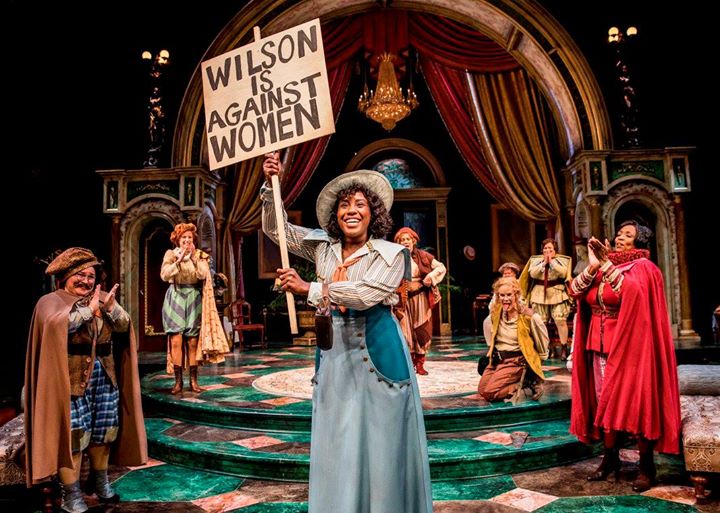
When you think of plays that empower women, The Taming of the Shrew doesn’t come to mind, but Chicago Shakespeare Theatre’s new production is trying to change that. With a cast of thirteen women and a suffragette twist, this Shrew is unlike any production you’ve ever seen before. I sat down with three of the show’s stars, Crystal Lucas Perry, Alexandra Henrikson, and Olivia Washington to talk about voting, feminism and Oregon Trail.


Kelly Wallace: So, you guys have started performances? You started last week, yeah? Let’s start with who you are and who you’re playing—just give me a short description of that character.
 

Crystal Lucas Perry: I’m playing Petruchio as well as Mrs. Van Dyne—Victoria Van Dyne. Mrs. Van Dyne is a suffragette during 1919, and one of the champions of the club. She prides herself on being out and physical with the movement and doing her best to do her part. Any chance she has to express her enthusiasm for the cause and the rights of women, she takes it. She encourages her other suffragettes and members to also take pride in the cause. And then Petruchio, obviously the tamer of the shrew, he’s a man going after what he wants. He will stop at nothing to obtain that.
 

Alex Henrikson: Hello, I’m eating a muffin. When I know I’m being recorded I suddenly get real weird and I apologize. I’ll stop trying to entertain. I play Kate and Mrs. Louise Harrison. What’s so fun is Mrs. Louise Harrison is a woman in 1919 and is an industrialist’s wife and is happy to be so and likes that her husband is in charge. I like to imagine him as a middle-aged Sean Connery…
 

Crystal: Wouldn’t we all like to imagine being married to a middle-aged Sean Connery?
 

Alex: Sean Connery’s where you start. No, but, she’s that woman who has learned to play the world with the set of tools that she has in 1919 to have power, which is her beauty, her being a great host, her gentle voice, and also her diva-level narcissism—which is another part of it that’s a little hard to reconcile sometimes. She doesn’t understand suffrage. She’s come here to act; she wants to be an actress. I think she’s a frustrated actress because she would’ve been a great actress in a different time. Then I get to play Kate, which is just the most fun. It feels like every time we get together is a political act, which feels great at this moment in time. In the beginning, I get to be a woman who goes from being a wildcat and not knowing how to use her words exactly but having all this passion, to a woman who figures out how to use her words by the end. Unfortunately, what she uses her words for is not what me, Alex Henrikson, would want her to stay. That’s what the play wrestles with on that journey.
 

Olivia Washington: I play Emily Ingersoll slash Ms. Ingersoll slash Bianca. Emily is a daughter of the Senator, Senator Sherman, and she’s very loving and supportive and keeps to herself. She has an awakening at the end, and meeting all these women … she’s not an initial supporter of suffrage, but she’s educated on it. She’s learned it more in a book way, not in the way of having seen what it is. So I think she wakes up to the idea of what it means to believe in something, and believe in something for the country and for herself as well. She’s able to have conversations with her mother that she wouldn’t have been able to have without that awakening. And then Bianca … she’s so much fun to play. And in a similar way, she is a loving daughter. But she kind of uses her power in a different way than Kate uses her power. She picks her times to speak and how she speaks to get what she wants, but then still goes behind her dad’s back and gets married. I like that kind of sassy, quiet, sneaky way about her.
 

Kelly: What does it feel like to do a show, which as you mentioned has this political side, right now? This is, undeniably, a very contentious moment in our country, no matter what side you’re on.
 

Crystal: Well, I think about the Women’s March that happened everywhere, I like to imagine Mrs. Van Dyne at the front lines of that march, making all the hilarious yet powerful signs. I can’t help but think of her as one of those women, and the Instagram photos she must have taken [laughter]. That was a day to gain a ton of followers. But, really, that’s the beauty of what I get to witness. I watch how these women choose to fight, seeing how the women of today choose to fight, or choose to push against the barriers we’re facing. It always seems to be the same. They use what they have to get what they want. They take the opportunities that they are able to seize and use that as a platform.
 

During the play, we have our own “votes,” um … what’s it called?
 

Alex: A democratic process? [laughter]
 

Crystal: We do the whole voice voting “ay”/”nay” thing, and that’s what’s so beautiful. This is a chance where we get to demonstrate and recognize our power. It might be something meaningless, but it means something to us. We can make change within our little house and that gives us the power to go and make change elsewhere. That’s something I like, the parallels between those two, of how we choose to fight and how we energize ourselves to make something better.
 

Alex: Yeah, what you just said made me think of how being in high school, there were lots of boys telling me like, during the Gore vote (okay, it was a little past high school, don’t worry about the time), that my vote didn’t mean anything, that it was the lesser of two evils.
 

Crystal: Where’d we hear that again?
 

Alex: Exactly. It comes up every single election, doesn’t even matter who the politicians are, there’s a mistrust of government. To me, I never saw it as a lesser of two evils. I always can see someone I admire, some quality, and only this year—and it’s taken me a long time to get here—but my vote does matter. What I think does matter. I went to the Women’s March and I saw a lot of little girls with a lot of women around them saying, No, this is important. There are more women getting involved in politics. When I was doing research for this show, I read Rebecca Traister’s book, All the Single Ladies. She tells this story of women in Wyoming, where there’s all this trash in the streets and the male politicians and the mayor couldn’t get it together, and the women were like, “Our streets are disgusting.” So they all ran for positions in the town, won, got all this shit done, and then went back to the house all like, see you later. There’s part of me that’s really excited. For me, this has been a huge awakening experience, and I think the same happens for my character, and getting to do The Taming of the Shrew for the third time (I’ve played Gremio and Bianca before) … what’s been nice about this time and this rehearsal process is when we would get to points where it just was never okay with me. You watch these versions and you’re like “…and he probably raped her,” or he’s calling her chattel. It’s dark. It’s so funny, but then it gets really, really dark. You see these two characters smash against each other and fall in love.
 

Kelly: Not the fun Beatrice and Benedick kind of thing.
 

Alex: They’re literally hitting each other.
 

Kelly: It isn’t that contentious, Shakespearean, comedic courtship…
 

Alex: It’s their way of falling in love, and I think they do fall in love, but for me as a modern woman in 2017, playing a woman in 1919, watching this play from the 1590s, I have all these out of body experiences. I’m seeing what’s not okay with me; I’m seeing where my line is. I think that now, as a woman who is 32 (and you can print that, I’m proud of it), I’m finding all these things that aren’t okay for me anymore. I can point to that and say it wasn’t okay when it happened.
 

Olivia: I agree with both of them. To put it so simply, it’s amazing how something so small can birth a bigger movement. I think that was a lovely reminder, not just in this political climate, but in the world. This story of these women, it shows your voice matters, even if people are telling you it does not matter. If you can just get involved, I think that’s what most people of our generation are saying right now. Most millennials are like, you know what, a takeaway from this whole election is that I need to pay more attention to what’s happening. We have to take back our rights, and our voice, because we can. I’m going to educate myself on things about our government that I let go by, because I let people speak for me, or because I assumed it would be okay. Growing up in that way, we have to take responsibility for our actions and our part in making a difference in the world today.
 

Crystal: And what affects one affects us all. Mrs. Van Dyne knows the passing of this, this 19th Amendment, and the right to vote, may not mean mountains are moved for her individually. A move for women is a move for her. A win for women is a win for her. Not until ’65 when the Voting Rights Act passes does she get that, so the barriers are still in the way for her character particularly. But the fact that they’ve been able to come together and be united in this is a complete reflection of what I see with women today. We have been able to set aside our differences and our viewpoints because at some level, we agree this vote is a right that belongs to us all. `
 

Olivia: For the good of the country.
 

Kelly: You’ve had a few performances—do you have any sense of how the audience has been reacting? It’s a show that everyone’s familiar with, but has a wildly different take on.
 

Olivia: I’ll speak up first since they’re onstage most of the time and we’re in the aisles watching it. It’s one of my favorite parts, watching the end of the first act. They get married, and you’re just listening to the audience respond. Everyone is so sucked in. They’re trying to figure out Petruchio like, is that a woman? I don’t know…
 

Alex: Crystal is an incredibly convincing gentleman…
 

Olivia: But really, you watch this man overpower this strong-willed woman and what is she gonna do? What are we gonna do? Can we do anything? The vocal responses coming from the audiences are chilling sometimes. So it doesn’t matter if it’s a man playing this part; it doesn’t matter if it’s a woman. If you’re good at your job, you get the message across. They do it so beautifully and you’re watching it and … it sucks. People realize it’s not that kind of comedy.
 

Alex: And that final “No,” Barbara [Gaines, Artistic Director] was like, “What do you feel in that moment?” And my answer was: “I don’t want to go with him.” So she told me to say that. And I did. And you hear the audience laugh, it’s like this almost impetuous child. Then Crystal takes that impetuous energy away and everyone is silent. I love this play, and I am a feminist, and this is the moment for me that shows why this play is so tricky.
 

Kelly: How is that for you, playing such an aggressive man? Does the gender swap change anything about your onstage interaction?
 

Alex: I feel like I’m actually stronger onstage with her than with any male counterpart because I feel like she can actually match me. Like, as an actress, I’m very tall. I’m 5’10” and I have a very large wingspan and a very big voice. Oftentimes, I felt like I had to diminish myself to make sure the guy looked strong, or at least that’s the traditional gender role. So many shows would say they couldn’t find someone to match me, which, I think, is often code for finding someone as tall as me. When I met Crystal, it was like wow, it’s on. I’m not pulling any punches, she didn’t pull any punches with me. We just kept raising up. I wish every actor could get to work with Crystal Lucas Perry and Olivia Washington at some point. Everyone says yes. No one is diminishing themselves. Now that I know how much power there is, I can see how I wasn’t raising up to that.
 

Crystal: Aside from the physical adjustments I’m trying to show that are more masculine, I honestly don’t turn off my female brain. I really think of him as a woman who thinks differently and who executes from a different place than my other counterparts. As a woman playing this role, it’s incredibly satisfying because I know every move I would make as a woman. I know every tic that would turn me off or on as a woman. So because I know those things, I get to decide if I would be turned off or on by that.
 

Kelly: You know to push those buttons.
 

Crystal: Oh, I get to push the buttons, and I recognize when buttons are being pushed of mine. It’s really lovely and working with Alex has been fun because she does not filter and she goes all in and so we’ve been able to take this scene … I mean, we could show you the wooing scene in a million different ways and keep you on your toes. That’s just been the joy. Previews are helping us figure out what story we want to tell with that. At the end of the day, it’s two people coming together and realizing they can’t just break through the other person, they can’t just go around them, they have to meet—there has to be a collision. It’s exciting. He’s a really strong woman, strong in a different way.
 

Crystal Lucas Perry, Alexandra Hendrikson

(Liz Lauren)


Kelly: Now, the framing of this show is the suffragette movement; you’re all playing these 20th-century suffragettes as well. You’re both people of color, as you brought up, the right to vote wasn’t a “win” at that moment, so what is that like for you as a human and as an actress? This victory, ostensibly, has happened, but not for everyone.
 

Crystal: A win for one of us is a win for all. And we talked a lot about that. We chose to acknowledge who we are in the space and celebrate that, because that’s one more beautiful thing about these women being able to come together because of their social level. They’re here, in this group, choosing to commune with this Shakespeare. Of course, all of these things happen on this day. I think that I’ll speak for Mrs. Van Dyne: she’s a woman who has a vision for the future, and she is able to see that we have to focus on right now, and right now, this is the next step. This is the opportunity. Similar to how Petruchio seizes an opportunity when it’s presented, she’s gonna seize this opportunity as it stands before her. There’s not many times we have to touch on it. It’s there. It’s a part of the play by us being onstage.
 

Kelly: It doesn’t need to be explicit.
 

Olivia: It’s underneath; the undertones are there. And we have different perspectives. You have Mrs. Van Dyne, who is such a clear cut fighter for the cause, and I think for my character, I was raised by a white Senator’s family, so I come from a place of privilege in that family and in that home. And yet, there’s this kind of … Oh, I have to start using my voice in a way outside the safety net of my home that was created for me. I am a woman of color in this world, and I want to effect change in this world, but not just from back here. So, how do I step forward? This is all undertone, of course.
 

Kelly: But that’s the kind of undertone and tension that keeps the show interesting, it draws you in even further.
 

Crystal: There’s a moment in the play where some of us rush out to join a rally and some of the women stay, and you hear some of their reasons. Some people feel they’re too old, some are too afraid, and you get a chance to see that it’s not just because they don’t want that, it’s because they have something to lose themselves. So getting to the core, stripping color, stripping social class, stripping all of those other things, it gets to the human need of wanting to be safe and wanting to make change and wanting to be a part of something great.
 

Olivia: It’s human. You see throughout history—no matter race, gender, whatever—to fight for a bigger cause, you let go of yourself, it’s for the bigger battle.
 

Crystal: And I don’t think these women are done. I feel like they’ve got a taste of change and the ability to make change.
 

Kelly: There’s an optimism in where it ends up. The “tide-turning” feeling is very present. And that one-hundred years ago … not even, really…
 

Olivia: It’s so crazy!
 

Kelly: How recently all of this was for millennials is mind-boggling. The Voting Rights Act, Roe vs. Wade, marriage equality … we feel like these are all a given. Of course, we should have those things. I think the good idea behind the Women’s March is maybe to remind younger generations how much there is to protect, and what we still have to lose.
 

Alex: I was born in the ‘80s, we had the internet, I was playing Oregon Trail on it…
 

Kelly: I’m not sure if the internet was a net positive or not yet.
 

Alex: I’m not sure either, we won’t take a side. But part of it was that I saw all this heroines in Disney movies. I wasn’t seeing Snow White anymore, I was seeing Belle. And she really liked reading. Then it turned into this competition of reading. Or She-Ra princess of power! I think the heroines and the storytelling I had growing up versus what my mother had … it affected what her expectations of me were. She told me if I got pregnant before 30 it would hurt more to give birth to the baby? Which is a lie, of course? She also told me I didn’t need to learn to cook, let’s look into writing more. I think she was doing this very active “you will not be that woman.” By ‘that woman,” she meant the idea of what she was brought up as, and what she was trying to steer me away from. By now we know every woman is every woman. I love cooking. I get turned on when I cook a meal for a man. It is hot! You know? I also get turned on when I cook a meal for all my friends, not turned on in that way. It’s just seeing all the different options that we as women have. When I look at Mrs. Van Dyne and I see her going outside and going into the fray again, I think she is black, she will get double hurt and that’s how brave she is. That’s one of the things I use for my character to move forward. She’s such a brave fucking woman, why am I being a coward over here? You can’t know something until you know it. Because I’m playing Kate, I have a very clear journey through the play of learning that there’s more. And once you know something, you can’t unknow it. I think that’s what’s so exciting about the storytelling in this. I think that our storytelling is powerful—what story we are telling, specifically.
 

Crystal: I definitely have to thank Barbara Gaines and Ron West, our writer and director, for allowing us the time to work through this process. We have a huge play to learn, we didn’t have that much time to do it. We also have two plays to learn, because of the frame of a play within a play. It’s still being developed every day. So to be able to alot for those times where we can have these conversations as we’re having now, and be very specific and clear about the weight of these situations and the way we want to play these things here—it’s a balancing act. Truly, knowing the mothers who have come before us and all of their accomplishments and their sacrifices and their triumphs … all of that is what lies beneath the foundation of this play.
 

Crystal Lucas Perry, Alexandra Hendrikson

(Liz Lauren)


Kelly: What do you hope the audience experiences with this show?
 

Crystal: Always, for me, I hope it starts conversation. I think there are so many things to talk about after you see this show. Whether it’s about how you had so much fun watching these women…
 

Alex: It is funny, it’s really funny!
 

Crystal: Thirteen women onstage at one time. We were just talking about how we’re pretty sure there isn’t another production with thirteen women onstage in America right now. That’s a beautiful thing. All of these characters would be men. So there’s a celebration of that! There’s a celebration over these women playing a part in the 19th Amendment! But also Alex’s character’s journey—not just as Kate, but as Mrs. Harrison—is that she goes through a change. One of her lines is “people change” and again, it’s also what Olivia says. The more we educate ourselves, the more information we have about what is happening and what we can do to be a part of that—how we’re hurting, and how we’re helping. You could say the same about the environment: ultimately, the more we know, the more we can contribute. I believe that everyone who comes to the theater wants to be a part of something.
 

Olivia: Also, I hope the audience sees how things aren’t so black and white. Growing up in our safe millennial bubble, we have to realize things can be confusing and muddy. It won’t always be all good or always bad. Coming away from this production, I’ve laughed, but there are other parts I’m not really okay with. Why is that? You have to realize the world is not so clear-cut, so where do you fit into that? How do you have a conversation about that? I think that’s what I come away looking at.
 

Crystal: You’ll meet this women and see little glimpses of who they are and their backgrounds— whether it be religious, or racial, or a stance—but no matter what, they’ve come together for this cause. No matter what they are, there is something bigger than them. For the audience to see that, to see it was happening during that time, and to have it mirror what’s happening now—to know it’s possible, it still exists, that things do matter. It’s an important reminder for people.
 

Alex: I like looking out into the ground. One night, I was doing the final monologue. I saw this woman elbow her husband at a certain point. I guess I want women to feel seen. I hope men can see their women feel seen and support women talking. It’s just an opportunity to say hi, we see you. There’s one moment where Barbara had given me the direction, to be Kate at the end and do the submission speech, but let Mrs. Harrison push against that. I almost felt like I saw ghosts last night. Because there are posters of suffragettes, but then I saw my mother, and my grandmother, and little me, and the little mess of people in the audience, and their mothers and grandmothers—and I’m wearing my grandmother’s ring in this, so it feels like these generations of women who have supported and loved each other. There’s something beautiful about women from 2017 playing women from 1919, playing men from the 1590s. You feel the ghosts. Theater is a tradition where you feel the ghosts anyway; you feel this communal, tribal vibe of coming together to tell a story at the end. There’s this moment of the campfire and our mothers and our grandmothers holding hands across millennia, and it’s beautiful.


Crystal Lucas-Perry makes her Chicago debut at Chicago Shakespeare Theater. Off-Broadway credits include Bull in a China Shop (Lincoln Center Theater); Little Children Dream of God (Roundabout Theatre); Bastard Jones (The Cell Theatre); The Convent of Pleasure(Cherry Lane Theatre); Storm Still: A King Lear Adaptation (Brooklyn Yard Theatre); Devil Music (Ensemble Studio Theatre); and The Wedding Play (The Tank Theatre). Regional credits include A Sign of the Times (Goodspeed Musicals); Far from Heaven, A Streetcar Named Desire, Finding Robert Hutchens, and When You’re Here (Williamstown Theatre Festival). Film credits include Mimesis 2, Frank and Azalee Austin, and Roulette. Ms. Lucas-Perry is also a solo artist and continues to compose, produce, and perform her original music at venues across the country. She received her BA from Western Michigan University’s College of Fine Arts and her MFA from New York University’s Tisch Graduate Acting Program.
 

Alexandra Henrikson makes her Chicago debut at Chicago Shakespeare Theater. Broadway credits include Larry David’s Fish in the Dark and The Snow Geese (Manhattan Theatre Club). Off-Broadway and her off-off Broadway credits include: We Play for the Gods (Women’s Project Theater); Bones in the Basket (The Araca Group); Hell House (St. Ann’s Warehouse); Commedia dell’Artichoke (Gene Frankel Theatre); The Maids (Impure Artists); and Much Ado About Nothing (Smith Street Stage). Her independent film works include: Towheads, Love Like Gold, and Here We Are in the Present … Again. Regional credits include: the world premiere of Steve Martin’s Meteor Shower (The Old Globe); Ironbound (Helen Hayes nomination, Round House Theatre); Fairytale Lives of Russian Girls (Suzi Bass Award – Best Ensemble, Alliance Theatre); and productions with California Shakespeare Theater and the Eugene O’Neill Theater Center. Ms. Henrikson received a BFA in theater from New York University and an MFA in acting from Yale University.
 

Olivia Washington makes her Chicago debut at Chicago Shakespeare Theater. She has appeared off Broadway as Laura in The Glass Menagerie (Masterworks Theater Company) and in Caucasian Chalk Circle (Stella Adler Studio of Acting). Her regional credits include Clybourne Park (Hangar Theatre). Film and television credits include Lee Daniel’s The Butler and Mr. Robot. Ms. Washington received her BFA in drama from the Tisch School of the Arts at NYU.

Posted on

A Conversation with Orion Stephanie Johnstone

Orion Johnstone


Upon entering Rattlestick Theatre for my scheduled conversation, an air of freeing and loving spirit came over me as I look up to see Orion Stephanie Johnstone ready to greet me. Once in awhile, you connect with someone so inspiring, time flies by, and you forget you’ve only just met this person for the first time an hour before. I sat down with Orion, co-director of Diana Oh’s {my lingerie play} 2017: Installation #9: THE CONCERT AND CALL TO ARMS!!!!!!!!!, The Final Installation for a wide-ranging and impassioned conversation about their influences, their identity, giving power to marginalized voices, and what it means to “queer the world.”


Michelle Tse: Let’s start with your journey with Diana [Oh], and specifically with {my lingerie play}.
 

Orion Stephanie Johnstone: Well, first off, I’d like to clarify: Diana has been doing {my lingerie play} installations since 2014, and what we are talking about here is the 9th installation in 2017: the concert and call to arms!!!!!!!!!, yes, with nine exclamations points.
 

Diana is a brilliant, powerful force in the world and we have circled each other and held each other in huge mutual respect for years, but had not worked together until this project. She came to me and said, “You are the one that I need to co-direct this.” At first I was humbled, and I hesitated, and I asked a lot more questions because I’m a highly collaborative theater artist, not primarily a capital “D” director. I have loads of facilitation experience and other things and I’m very comfortable in leadership positions, but this is a different hat than I’ve ever worn. Diana said, I don’t need this experienced director; I need a spiritual leader of the room. I need someone who I trust will hold a space where we all can transcend shame together. As a sexuality educator, I am passionate about not just inviting individuals to transcend shame, but in deepening all of our understanding of how our personal shame is connected to intersecting and overlapping systems of oppression.
 

After many conversations where I was always honored to be asked but wanted to ask more questions to make sure that this was a fit, I said an enthusiastic, “Hell yes.” And I’m so grateful that I did. We’ve been working together pretty intensely since early summer.
 

Orion Johnstone

(Pedro Aijon Torres)


MT: I have to say that when I was here, I felt like it was the first time in a long time other than a couple things here and there, that I actually had the thought of, “This is what an inclusive space is.” It’s happened a couple times before, but never in theater, honestly. Can you talk about the vision and the preview process?
 

OSJ: The two central questions of my life are: Who and how might we be together, more bravely in light of our collective liberation? And how might I be consistently expanding who I mean when we say “we”? I keep trying to run hard and fast away from theater-making because I have so often run up against the “who and how we are together” being so secondary to hitting certain other marks, or to commodifying the soulfulness of what’s being created.
 

The invitation that Diana posed to me, essentially, is how do we live by those central questions, to embody our commitment to the idea that how we make is as important as what we make. How do we create a robust culture of courage and compassion, and care, and lead with that and trust that in every aspect of the process. There are always going to be things that are beyond our zones of awareness, but I’m done with feeling immobilized by that. I’m always so grateful when something is brought to my attention like, Oh, I haven’t actually been accountable to this person or this community in this. I think it’s easy to feel guilty and overwhelmed and shut down, but my prayer and intention for myself and for all of the work that I make is “May I embrace that we’re all on a continual learning journey about this, and to hear that feedback. Hold that with love and how might we expand, how might we do better, even knowing that nothing is going to be perfect.” I fiercely love Diana in her commitment to that, too!


(Jeremy Daniels)/ ({my lingerie play} 2014: Installation #5: 30 PEOPLE; Emma Pratte)/ (Jeremy Daniels)


MT: Feeding off of that and what we were talking about in an earlier conversation, you have the community choir for queer and trans folks, the dating app for kinky people, your sex and relationships coaching practice, and—
 

OSJ: —The alternative divinity school.
 

MT: Exactly, so a lot of your work centers around giving power to marginalized voices and people, so when you do come across someone that is maybe a straight white folk who considers themselves liberal and progressive, but maybe keeps asking the wrong questions. They want to learn, but you just keep hitting that same roadblock. Do you keep going back to them like, “Hey, that’s not cool, you got to do x, y, and z,” and at what point do you say, “Okay, I need to just maybe walk away from this situation,” focus on marginalized folks, then beam up that space as opposed to the education of that larger “we” that you were talking about?
 

OSJ: Thank you so much for that question and the many, many layers in it.
 

MT: I could’ve been a little more concise, but that’s what keeps me up.
 

OSJ: I share this question so much! First off, I think that I couldn’t get up in the morning if I didn’t believe that every human is capable of transformation. And also, I’m very exhausted. I’m very very angry. I’ve been learning about how to not shy away from expressing my anger and instead to deepen in learning how I might express my anger with love in a way that hopefully doesn’t diminish anybody else’s humanity, and also doesn’t diminish the very real violence and erasure that people I’m in community with and/or myself are experiencing.
 

Capitalism would have us believe the lie that there’s scarcity in terms of who can be liberated. Like, If we’re having racial justice we can’t be focused on trans justice right now. Bullshit. If we’re focused on trans justice, then we can’t be talking about disability rights, and so on and so on. That’s absolutely bullshit.
 

MT: The linear versus intersectionality, basically, right?
 

OSJ: Yeah, and if I truly believe that our liberation is collective, that absolutely must include cis white straight people, too. And also, I keep learning more about how and where I channel my energy day to day. At least right now, my energy is most channeled toward amplifying and co-liberating with marginalized folks, or rather, people who carry power that is not necessarily the most dominantly celebrated kind of power. More and more these days, I get honest about my capacity for conversations that are primarily educational, and I honor that that labor does not always have to be mine to do. I try to see where I can show up to do labor for other folks who can’t, knowing that my liberation is intimately bound with theirs. And I believe that, as a white person, I have a responsibility to have tough conversations with other white people. I realize that my answer is all over the map here. The big answer to your question is, it’s really fucking hard as I know you know, and it’s a continual navigation day to day.
 

MT: For some reason it reminds me of Maya Angelou, who talked about why she doesn’t hate her rapist. That she feels that we all have that within us. That we all have Hitler and Gandhi, basically within us, right?
 

OSJ: Yeah, yeah.
 

MT: It’s just a matter of how your life journey has made you access different nodes of those feelings and those wires within your head. When it’s so violent everyday you can’t help but be like, “Oh.”
 

OSJ: Can I … I want to respond just a little bit more to that other question.
 

MT: Please do.
 

Jeremy Daniel

(Jeremy Daniels)


OSJ: I’m 34 now. Until I was 22, I was a fundamentalist Evangelical Christian. Though I was always acting from a place that I understood to be compassion and care, I perpetuated Christian Supremacy and its ties to patriarchy and homophobia and transphobia and white supremacy. I mean, I still inevitably perpetuate oppression in a way that none of us are separate from. But having had a worldview and paradigm that is so extremely different from what I have now, I now have so much compassion for people’s journeys. At the same time, it’s not easy to hold to that compassion when people I know and love are experiencing such violence on a daily basis and there’s so much to be heavy-hearted about.
 

MT: I now have to take every other day off from watching even Vice news, because the saturation and violence and abuse is so rampant.
 

OSJ: Can I ask how you’re holding that question these days?
 

MT: I’ve now had a few white friends tell me, “Please just send them my way because I’m frustrated just hearing about what you had to deal with.” But lot of these moments come up when you’re not expecting it or when you’re the only person at the table who can answer the question. It’s quite painful to constantly be teaching empathy and essentially telling folks, “Hey, I matter as much as you.” I often come up against the moment of do I just shut up and order a drink, or do I just get up and scream, “Are you seriously only able to relate it back to yourself only?” It’s especially painful when you’re halfway into a conversation and they’ve agreed that, for example, white feminism is a problem, and that they’ve been doing the reading they need to, so you have an expectation. Then later on, they’ll say or mention something that is so exclusionary that my heart will just sink to my feet. Somedays I have to just be okay with, Okay, this is as much as I can affect today, here and now.
 

OSJ: That’s so real. Thank you for sharing that. I think of the times when I’ve been called in around the privileges that I carry as a white person. There have been times when folks have been really patient with me and asked me questions and stuck with me even at the expense of their spirit energy, and I have grown from that. And then there have been times when folks have been really, really angry at me, and me having to sit with that discomfort has also invited some necessary growth and transformation.
 

MT: I think for me, though, I always know that if I show emotion, especially anger and frustration, that other person would shut down completely. I’m exhausted, I can’t deal sometimes, but I can’t be shutting down and angry and not dealing with it because if I tell them to go away, they might never engage with that particular issue again. And that becomes another weight, especially when it comes to racism. That in itself is frustrating. There’s no one else around me that can take this mic right now and … It’s like, “Well, crap, what do I do?”
 

OSJ: Yes, yes. I hear and honor that and I wish that I had a simple answer and response. I think the only thing that I know to be true is how—well, I guess I hope to be true is—I hope that even when you or I, or anyone feels very alone and like they’re the only person that could have this conversation, that actually, that isn’t the case. That we do all hold it together. Whenever any of us can have capacity, that’s a good thing, and none of us has to have capacity all the time.
 

MT: Right, exactly.
 

OSJ: And by us, I mean: folks who have experienced the marginalization, folks who have feared for their literal safety while walking down the street, though that’s not a clear cut binary of those who have and those who haven’t. I feel like this is tricky territory.
 

MT: Those invisible marginalizations.
 

OSJ: It’s just wild.
 

MT: I have friends on a spectrum of disability or differently abled from you can’t see it at all, to being in a motorized scooter. And it’s painfully obvious that this city doesn’t cater to that well what so ever.
 

OSJ: New York City sucks in terms of access.
 

MT: All anyone has to do is spend a couple hours with someone differently abled. It’s bananas.
 

Jeremy Daniel

(Jeremy Daniels)


OSJ: Can I give a shout out?
 

MT: Yes, please do.
 

OSJ: My friend Bri just started a podcast called Power Not Pity—conversations with people about access and disabilities. I think it’s fabulous.
 

MT: Amazing. I’ll have to check that out.
 

OSJ: I have a lot to learn.
 

MT: Yeah, I’m definitely learning too. I don’t see the point in living if we don’t keep learning and challenging ourselves. For inclusion and representation though, my thought is that for a lot of folks, they see progression in the linear format, and our intersectional brains have an easier time seeing the interconnectedness.
 

OSJ: I love the thing that Lilla Watson said, you probably know it already: “If you have come to help me, you’re wasting your time, but if you have come because your liberation is bound with mine, then let us work together.” Thinking in terms of collective liberation doesn’t slow us down or cost us anything, actually it means that we’re on the only possible track to cultural transformation, I believe.
 

MT: There’s that media norm though, the progressions. In my head, the only way I can try to relate, is to try to see it from that other perspective of there’s white feminism, then there’s current day feminism—that’s a little bit intersectional—and then there’s what you’re talking about, which is what I subscribe to, trans-inclusive feminism.
 

OSJ: Or even trans-centered feminism.
 

MT: Oh, that’s even better, yes. Thank you. So I wondered if you could speak about that and the dangers of not being trans-centered, and for it to be happening alongside intersectional conversations, about race, gender and sexuality, about economics … On and on.
 

OSJ: Thank you, and I could go on for days. This is where my major point of exhaustion lies. First and foremost, it’s no secret that our transfeminine sisters and siblings of color face, by far, the highest risk of violence and discrimination out of anybody. And yet, even in so many wonderful, progressive spaces that I move in, there is often not only a learning curve that needs to happen, but an unwillingness to honor the identities of trans folks.
 

It’s so fucking sad and enraging to me when women, or anybody, feels like including transfeminine people in their feminism is taking something away from them. Again, that goes back to the lie of scarcity that capitalism would have us believe. That by including all women, trans and cis, that inclusion doesn’t mean we’re brushing under the rug that different women have different experiences. Women of different backgrounds and identities of all kinds—race, class privilege, ability—have very, very different experiences. And people are dying! It’s so sad to me when folks feel like that’s taking something away to be inclusive there.
 

It also breaks my heart that so much that the world has so very very very far to go in terms of even welcoming and fighting for the basic rights of binary trans men and women. So that in terms of non-binary trans folk across the gender spectrum—as I think you know, I am non-binary—we just brush that conversation under the rug or we just can’t even go there yet.
 

MT: It’s the progression of others versus the self.
 

OSJ: I also don’t believe that that’s linear.
 

MT: It’s not.
 

OSJ: And I truly believe that everyone, trans and cis, binary and non-binary, is more liberated when we hold this more expansive understanding of gender and gender complexity.
Jeremy Daniel

(Jeremy Daniels)


MT: Bringing you back to the show, as related to that point: there’s a phrase you and Diana use that I love so much—
 

OSJ: —Queer The World.
 

MT: Queer The World.
 

OSJ: I love Diana’s specific phrasing in the show. She says something like: “What ‘Queer the World’ means, to me, is not that everyone should be gay. Queer The World is direct confrontation, an unapologetic disruption of the lies that capitalist patriarchal cis heteronormative society would tell us.” That’s from Diana. I was like, “Hell yes!!”
 

MT: Oh, I’m so happy. I was so happy when that moment in the show manifested.
 

OSJ: Queer, to me, contains both ultimate celebratory welcome and wonder, like welcoming all of who you are, and also it simultaneously contains this bold fuck you, this unapologetic disruption. The word “queer” originally meant something that was askew of what is straight or capital “N” normative, and so “queering” is necessarily, by definition, questioning the norm, inviting discomfort. It takes courage to be together in this discomfort, in these big questions which unapologetically disrupt these lies and the pressure of the dominant stories of normativity. And of course then, queer is so much more than just who you are attracted to, queer is who you are accountable to.
 
MT: I do want to get back to something that keeps coming up, capitalism. You mentioned earlier stepping away a little bit from theater arts.
 

OSJ: Stepping away a lot from theater arts.
 

MT: I come from an industry that I saw to be even more oppressive than the theater environment. I was like, “What?” When I first started, I was like, at least this is somewhat fixable. But again, finances play a big role. Do you think that folks aren’t able to work in the theater and become theater artists unless they had some sort of external financial support system? I would guess economics would be—
 

OSJ: —By work in the theater, just to clarify, we’re talking about contemporary North American commercial and non-profit theater.
 

MT: Yeah, exactly. Even off Broadway.
 

Orion Johnstone

(Emma Pratte)


OSJ: I was in a great discussion today with the alternative divinity school that I co-created, and we were naming how we want to celebrate and lift up unpaid labor, the emotional labor that folks are doing on the team. We want to lift that up. And also, we want to acknowledge: Who has the privilege to have space and time do that unpaid labor? Like it’s no secret that so many unpaid internships in the arts are filled by folks who carry the privilege to be able to take that financial risk because of their external support system, and that that then carries over into who moves up beyond intern roles in the art world.
 

What you’ve asked is big and hard and important, and I’m inspired by so many models of community art making and how much I believe that culture and art making is a basic human right. Anything we’re making in this society is going to be navigating the systems that are broken in different ways to greater or lesser degrees. That’s why I’ve been running from theater. Not because I don’t believe in its transformative power, because I really do. I don’t believe that art is a luxury, I believe that art is a human right.
 

Personally, I try to orient by these three questions inspired by this Quaker philosopher, Parker Palmer: “To what extent am I honoring my gifts and capacities and limitations? To what extent am I honoring the needs and hungers in the world, and to what extent am I honoring the intersections between those things?” When I most deeply answer to that question, the answer for me lately is very rarely art making. The answer to me is usually soulful organizing, facilitation, and long term movement building. I love the thing that Grace Lee Boggs said … What a hero she was. One of the many powerful things she said was that we must do more than struggle against existing institutions, we need a philosophical spiritual transformation toward being more human human beings. All of the organizing work I do is leading with that and asking the big questions about what is the widespread cultural healing that needs to go instep in order for widespread systems to change towards more justice that needs to happen. I’ve been running from theater because can’t stomach making art unless the culture of the process honors all of what I’ve articulated here, and I’ve been so lucky lately to be asked to make a few things that do honor all of that, like Primer For a Failed Superpower with the TEAM and this show with Diana.
 

Jeremy Daniel

(Jeremy Daniel)


MT: Which is another huge hurdle, because I often say to people that I didn’t realize how the other half lived until Obama came along and by the fifth or sixth year, I was noticing that my friends of color and I were walking a little taller, talking a little louder, dreaming a little bigger. I remember when Fresh Off the Boat premiered, and after it was over, I thought to myself, “Holy shit, this is how white people watch TV?” It was a different form of soul crushing for me on November 9th and 10th, I think, than a lot of folks. I often say I’m not mad at what happened, I’m mad at how folks were reacting to it because I couldn’t believe they had no idea where they exist. Then it becomes every single day like, “Oh, you didn’t hear this that I said for how many years?” Every time a white friend was disappointed, it was a reminder that nothing I said came through. That’s been every day, I feel like, since November, and I sink a little lower each time.
 

And so with what Grace said, knowing that we need the spirituality but also knowing that for someone like me to know my history, my people’s history, whatever it is, is so hard to find. There’s so much erasure. Especially in the Asian community, where we’re already so different and diverse, yet lumped together. So even when there is representation, it’s not proper representation.
 

OSJ: Yes.
 

MT: So when you’re doing work on how to be spiritually transforming, how do you spiritually identify or go beyond the existing infrastructure, how do you even then discover … Are you actively defining in the moment or how much of it are you trying go back in history and try to reference something and try to … My point is, you’re always going to be referencing something whether you know it or want to or not.
 

OSJ: I bow to that question. I’m thinking of it in terms of what we’re building upon and who are we accountable to from the past as we’re building. We talk about that at the alternative divinity school, what is the intersection between the ancient and the emergent, the old and the new? And I think so much about how there are so many layers to the violence that White Supremacy does to all of us. Including so much violence toward folks who are not white, and also robbing white folks of their humanity and connection to breath and body. I think of my Polish ancestors, and how many Slavic, earth-based traditions were covered over by Catholicism. A lot of my work is listening for what violence White Supremacy has done to all people, and how can we reclaim and support the spirit there. There’s obviously so much, but I think about queer and trans ancestry so much. Like Marsha P. Johnson, may she rest in power.
 

MT: Oh, yes. I love her and the power she brought forth.
 

OSJ: Marsha P — This hat says, “pay it no mind,” and that’s what the P in Marsha P. Johnson, it stands for “pay it no mind.” “Pay it no mind” is what she purportedly said to a judge when the judge asked her about her gender. She’s one of the people I’m proud to call chosen ancestor. She and Silvia Rivera were supporting and holding space for homeless trans youth, even while they were both homeless themselves! I think it is absolutely essential to think about what lineages we are personally coming from and building upon and also in movement sense. And I love geeking out about what we’re building on.
 

MT: I want to do a quick aside here and talk about Alt*Div, since it keeps coming up. Can you tell our readers about it?
 

OSJ: Oh yes, absolutely! Alt*Div is an alternative divinity school for soulful community builders, rooted in anti-oppression and collective liberation. We believe our world is in spiritual and moral crisis, that we are more alone and less connected to what matters, and to each other, than ever before. Because of that, we urgently need communities, and community leaders, which foster, as Grace Lee Boggs says “more human human beings,” in order to meet the urgent crises of our time and be a part of widespread cultural healing and systems shift toward a more just world. In practical terms, it’s a self-directed, de-centralized learning community for folks who are interested in those things. We’re now in our second year, and we’ve got participants from many places around the world. Thanks for asking!
 

Pedro Aijon Torres

L to Right (Back to Front): Rocky Vega, Orion Stephanie Johnstone, Diana Oh, Justin Johnson, Jhanae Bonnick, Matt Park, Ryan McCurdy, Mei Ann Teo, and Corey Ruzicano. (Pedro Aijon Torres)


MT: I am so glad I asked. That’s so inspiring. Now, why should people come see your show? I know, that’s another hour but, maybe a sentence answer.
 

OSJ: For spiritual nourishment! And to catch the contagious aphrodisiac of courage.
 

MT: I love that. I love that so much.
 

OSJ: Aphrodisiac of courage is the primary spell that Diana intends us to cast with this piece. Diana is fucking extraordinary and courageous, and her perspectives are incredibly important … I just want everyone to hear her voice and her story, and see her incredible work. And to leave drenched in glitter and soul sweat!
 

MT: Me too. Thank you.
 

OSJ: Thank you, Michelle.


{my lingerie play} 2017: Installation #9, THE CONCERT AND CALL TO ARMS!!!!!!!!!, The Final Installation is a play, a protest, a concert, and an installation all at once. Through this concert-play, Diana and her band explore mainstream culture’s relationship to the body and the deep and complex dynamics that exist regarding sex and gender politics. This culminates in a genre-bending soulful rock and R&B concert-play and final installation of {my lingerie play} 2017: 10 underground performance installations in lingerie staged in an effort to provide a saner, safer, more courageous world for women, trans, queer, and non-binary humans to live in.
 

Orion Stephanie Johnstone is a theatermaker/organizer/sexuality educator/community minister/composer with a fierce commitment to our collective liberation. Their original music has been at venues including Joe’s Pub, the Bushwick Starr, HERE, 3LD, and CSC. They were the assoc. MD of War Horse (1st nat’l tour), and they are music supervisor for the TEAM’s Primer for a Failed Superpower, alongside director Rachel Chavkin. They co-host the podcast Sex For Smart People, they are the chief director of content for KinkedIn: a new dating app for kinky people, they recently co-created a new alternative divinity school for soulful community builders, and they studied justice ministries at Auburn Seminary. www.orionjohnstone.com

Posted on

A Conversation with Duane Boutté, Michael Laurence and Thom Sesma

Duane Boutté, Michael Laurence, Thom Sesma


Thomas Jefferson, Charles Dickens, and Count Leo Tolstoy are trapped together in a room. That’s the basic premise for Scott Carter’s play, The Gospel According to Thomas Jefferson, Charles Dickens and Count Leo Tolstoy: Discord, which recently opened at the Cherry Lane Theater as part of Primary Stage’s season. I recently sat down for an engaging conversation with the three talented, charming, and intelligent actors who bring Jefferson, Dickens, and Tolstoy to life.


Margarita Javier: I love the title of the play: The Gospel According to Thomas Jefferson, Charles Dickens and Count Leo Tolstoy: Discord. What can you tell us about it?
 

Duane Boutté: Where to begin?
 

Thom Sesma: How much do you know about it, firstly?
 

Margarita: I know the playwright, Scott Carter, found out that these different people had written their versions of the gospels, so he wrote an imagined meeting between the three of them in the afterlife. And then they get into a philosophical discussion, all their ideals clashing.
 

Thom: Thanks for explaining it; now it’s all so much clearer to me! [laughs]
 

Margarita: But how would you describe it?
 

Michael Laurence: That’s a pretty good summary. They’re trapped in a limbo, sort of No Exit style.
 

Duane: And they’re all on a quest to find out why the three of them are together, and that ends up being very, I think, powerful, when they finally do figure it out.
 

Thom: They’re three very cerebral, self-sufficient individuals, and this meeting of the minds is between three very self-sufficient, powerful egos who can’t help but result in conflict, without effort.
 

Michael: And it’s a conflict that’s sort of ignited by the discovery—and I don’t think this is a spoiler because it happens pretty early on, the title kind of sums it up anyway—but it turns out that they all edited a version of the New Testament. And so that sends them hurdling into a clash of ideas around theology.
 

Thom: That’s the premise. But essentially, to reduce it to the most basic idea, it’s about three guys trapped in a room who aren’t getting along.
 

Duane: It’s about an afterlife, it’s about salvation, it’s about Christianity.
 

Thom: It’s about doubt, skepticism, and faith. Faith at work even when you don’t realize it.
 

Duane Boutté, Michael Laurence, Thom Sesma
 

Margarita: How much did you already know about the characters you’re playing—Jefferson, Tolstoy, or Dickens—before you embarked on this project?
 

Duane: I think we all knew a little about these people, as much as anyone else. I think we’re all pretty well-read as individuals. We know about Jefferson from history, we know about Tolstoy because we all saw a miniseries of War and Peace at some point in our life, we’ve all read Christmas Carol or seen Oliver! the Musical. But Scott Carter, the author, in addition to being incredibly read and well-informed and deep into the research for this play, is also the most generous playwright I think I’ve ever worked with in sharing his research. So about three months before we started working, we all started getting packages in the mail.
 

Michael: A tome every week. Giant biographies.
 

Duane: More reading than you could ever do in a lifetime.
 

Margarita: And did you actually read all of it?
 

Duane: We did our best. [laughs]
 

Margarita: Have you read the gospels that they each wrote?
 

All three: Yes.
 

Duane: That was the easy part.
 

Thom: Those are relatively short.
 

Michael: He sent me, I think, six biographies of Jefferson, and each one of them is a doorstopper, a 900-page tome.
 

Thom: I got two biographies of Tolstoy, a stack of essays, several videos, a documentary on Tolstoy’s life, a video adaptation of War and Peace, a new translation of War and Peace, a new translation of Anna Karenina, and a number of other translations of his fiction.
 

Duane: I got about the same. I got two biographies, I got his notes on Dickens’ American tour, I got three novels, short stories, and videos. We just sort of take it from where you are, and pull what to use as your research for that week.
 

Michael: I think he told me in a note after the third or fourth package arrived, he said, “I’m helping you to build the Jefferson pavilion in the Scott Carter wing of the Laurence library.” Just a giant shelf of books and videos. [laughs]
 

Margarita: Is accuracy important to this play in terms of being true to these people or are there liberties taken?
 

Duane: It’s important for a way in, and then the play is the play. Things are taken at face value of the play, but also knowing that people are coming into the experience with maybe some knowledge of perhaps one more than the other two. So there is a responsibility, but when it comes down to it, the play tells you what you need to know.
 

Duane Boutté, Michael Laurence, Thom Sesma
 

Margarita: How has it been working with the director, Kimberly Senior?
 

Thom: Kimberly’s terrific. It’s a great room to be in. First of all, to be with a couple of incredibly generous actors, guys who are fun to spend time with. Kimberly’s the same way. She makes the room a very safe place to do your work. I’ve heard it said that 75% of a director’s job is getting people on the same page and then getting out of the way. And she has done that since day one. She’s just tremendous.
 

Duane: She gives us a lot of room for exploration.
 

Thom: And she challenges us, too, to not take the easy way out.
 

Margarita: You’re currently in previews. How has the audience response been so far?
 

Duane: It’s been good. They’re laughing with us a lot, which is I think part of the hopes for the play: that people are drawn by the characters, and their humor, and then they’re more inclined to follow the more philosophical aspects of the play.
 

Margarita: I’m interested in talking about the casting. I know the casting notice specified that it was open to all ethnicities. Even though these were historically white men, the casting doesn’t necessarily correspond to that. Is this something that Scott has always intended? Was it just for this production? Is it something that makes any difference in the way it’s performed, or does it not matter?
 

Michael: I’m the “necessarily” in that sentence [laughs]. There have been a few other productions of this play, and I think this is the first production that is not three white actors playing three white dead men. And I think that was purposeful; I think that was in line with Kimberly’s vision of the play in New York, in a post-Hamilton theatrical landscape.
 

Duane: Kimberly has expressed that she’s grown tired of seeing and working on plays that don’t reflect the world that she lives in. And along with that, she’s wanted to find opportunities in things that she’s now working on. So this is not just this play, this is something that’s important to her going forward in her work. She wants to find ways for the plays to reflect the people she knows. So she came into this with the desire to have a cast of mixed races and really had to hold out for that. It didn’t turn out for her in the initial casting. She had to really be patient. And she was, and I’m grateful that she was.
 

Thom: You know what’s been really lovely? It’s that we’ve been performing now for a full week, right? A full week of performances. We have an African American playing Dickens, we have an Asian American playing Tolstoy, and a white guy playing Jefferson. I haven’t heard one single comment by anyone about the diverse landscape that’s onstage right now. Which is great, which means it doesn’t matter.
 

Margarita: It doesn’t. And I imagine it’s a more sophisticated audience going to this show. Because there have been comments about that kind of thing in other productions, even Hamilton had a bit of backlash.
 

Duane: I think in Hamilton, and also in this play, it adds relevance for me, because we all have these ideas of Thomas Jefferson now, who in our company is the one role played by a white actor. And he’s now running in relation to actors of a different background, which I feel from the inside, I carry who I am in everything I do. So I think it informs Dicken’s reaction to Jefferson, Dicken’s reaction to America. Dickens did visit America, twice, and had strong opinions about slavery and class. I think that for me as an African American male, it’s easy for me to adopt his perceptions, because I agree with them.
 

Michael: At least one of the themes of the play, one of the major themes, is race relations. I think, in a way, it brings another layer into the room and the experience for the audience watching this play, because the legacy of race relations, the legacy of slavery is threaded into the biography of Jefferson and Dickens, and in a more indirect way Tolstoy as well, because there’s a sort of analog there with Russian serfs and Tolstoy’s relationship to people “who are owned,” as Dickens says in the play. So I think that, whether it’s pointed to or not, there’s an added layer there of some kind.
 

Duane Boutté, Michael Laurence, Thom Sesma
 

Margarita: Why is it okay for a person of color to play a historically white person, but it’s not ok for a white actor to play a historical person of color?
 

Duane: If you look at the canon of American plays, and you’re going to give a ratio of how many roles there are in produced theater that call for white characters, compared to the roles and opportunities available for black characters, or Asian characters, who are more underrepresented, etc., and how many people in this country whose stories aren’t being told. So for that reason, it’s just not time. We’re not there yet. When will we be there? I can’t say. But it’s not time yet.
 

Thom: To put it another way, to use this as a point of departure: To see a white person playing, for instance, the King of Siam, indicates white ownership of that character. Of that role. In other words, it’s an extension of a kind of slavery, if you will, to put it very crudely. That somehow it’s still ok to be colonial. When in fact it’s not. Why is it correct in the other way? Because it’s the only way we can give the public greater exposure. It’s interesting also, the thing about Hamilton, I just have to point this out, in terms of people’s backlash towards Hamilton: Hamilton is about people of color telling the story of the white person. “Who lives, who dies, who tells your story.” That’s what that’s about, so that’s why the backlash of show is missing the point.
 

Margarita: I agree and I feel the same way because I’m Latina and historically a lot of famous Latino roles have been played by white actors and like you say it’s kind of ownership of your role, but it’s also misrepresentation because then it’s portrayed in a way that’s not accurate to our real experience and that furthers the divide and people’s misconceptions about our cultures.
 

Thom: It’s not just ownership of the role; that minimizes what I’m trying to say. It’s ownership of the race. Ownership of the culture. And that’s what perpetuates more than anything else. You know, there’s a huge controversy right now over the casting of a production of Evita. Which is interesting because ethnically, Eva Perón didn’t have any Latina blood in her. She was Basque and French, right? Or Italian. And yet they never even saw Latina women for the role simply on the basis of their talent; they were excluded because they were Latina.
 

Margarita: What do you think this play is telling us, why is it relevant to us now in this moment of time?
 

Michael: For some of the reasons we were just talking about, in terms of how America is haunted by its own past.
 

Duane: Kimberly came into our dressing room a few nights ago, and said that a friend of hers thanked her for this play because it’s about things that we don’t get to see and discuss in the theater. Religion. Christianity. God. Atheism. And for that reason I find it unique, important. It’s a thing that we avoid because it’s a very tender topic for a lot of people. And it’s potentially divisive.
 

Michael: I also think it’s enormously relevant in the sense that America, our country is in the throes of an existential crisis right now. An identity crisis, the culture wars of the ‘80s have reared their heads again. The political divide is deeper than it’s been since the 1960s. More savage, more violent. People are more deeply entrenched and tribal in their thinking and their politics. Not to talk about it only from the Jefferson side of things, but I feel that responsibility every night, of walking out onstage and playing one of the great Presidents in our country’s history who, for all of his flaws, which are unmasked appropriately in this play, bring those questions, even just in terms of separation of Church and state which, again, is something that is also tearing questions around that issue. And here we’re reminded that the origins, the founding of our nation, that there was an experiment there, a new experiment in the world, about separating those things and why that was and how that came about. That’s important to see.
 

Thom: The fact that Christianity has been hijacked by the radical right, has been turned into a truncheon that they can beat anyone with, is frightening. Because it’s not just the origins of our country, it’s the origins of Christianity itself, which is based on charity, which is rooted in thought and kindness and suffering. It goes back to what Duane was saying, what Kimberly told us about her friend. Generally, there are people in the theater who tend to be progressive; left-leaning people don’t want to talk about those things. Don’t want to talk about faith. Don’t want to talk about belief. They will talk about skepticism. And I think that most of those people, like these characters, are more spiritually oriented than they actually realize.
 

Duane: And it’s not a play just for Christians. It really isn’t, you know?
 

Michael: It’s relevant too to how essential it is to see three cerebral, great figures who shaped history, each of them in their prominent ways, discussing religion and politics and being nuanced and thoughtful in ways beyond 140 characters.
 

Thom: And revealing themselves not as icons, but as humans. Deeply flawed, fallible, passionate humans.
 

Duane Boutté, Michael Laurence, Thom Sesma
 

Margarita: What are your personal artistic influences? Anything that moves you or any particular work or artist that has really motivated you throughout your career?
 

Duane: Tough question.
 

Michael: For me there’s almost too many influences to name here, but I will say, something that is very moving to me personally is I have always been steeped in the lore of Off-Broadway. When I was a teenager, I was meeting Beckett and Albee. And the Cherry Lane, which is ground zero for a lot of those early Off-Broadway experiments of the ‘60s and ‘70s, for me, it’s such a joy to be performing there.
 

Thom: I’m so glad to hear you say that because I feel exactly the same way. I was telling someone else about that. You can have a career, for 35, almost 40 years, on Broadway and TV and film, but man, I feel like I’ve arrived. At this extraordinary, legendary place. To “trod these boards,” as they say, where Beckett had his American premiere.
 

Michael: You walk into the stage door and there’s a giant poster of Beckett looming on the wall. And Sam Shepherd and Irene Fornés. Albee.
 

Thom: We just let the ghosts take care of us. [laughs]
 

Margarita: Since you mentioned Beckett, Michael, I wanted to tell you I saw Krapp 39.
 

Michael: You did? Oh my God, wow!
 

Margarita: Yeah, I studied Beckett in grad school.
 

Michael: Did you really?
 

Margarita: Yeah! I saw your play and I loved it.
 

Michael: Oh thank you!
 

Margarita: Are you still writing?
 

Michael: My last play was called Hamlet in Bed, it was at Rattlesnake. And then last summer I took both pieces, Krapp 39 and Hamlet in Bed to the Edinburgh festival, so that was a dream come true. And I’m working on a new play now. Writing—I don’t want to say I love it more than acting, but…
 

Margarita: Does writing inform your acting? Or does your performing inform your writing?
 

Michael: I’m sure it does in many ways I’m not great at articulating. But I’m sure it does.
 

Margarita: And Duane, you’re a composer and a director. What’s it like for you, as a director, when you’re performing for someone else?
 

Duane: I have to turn it off. Absolutely turn it off. One of the things that I always tell myself is “your director is very smart,” no matter who I’m working with. The other person is sitting on the outside looking at things that I’m not. It’s not my job to look at. So listen to your director. Always say yes, and maybe eventually you’ll figure out why you’ve been asked to do what you’ve been asked to do. It’s nice to just focus on one character and that character’s track and journey, and let someone else be responsible for all the rest of it.
 

Duane Boutté, Michael Laurence, Thom Sesma
 

Margarita: What, if anything, is your dream role?
 

Duane: One of my favorite playwrights is August Wilson. I’ve only been in one of his plays.
 

Margarita: Which one?
 

Duane: Joe Turner’s Come and Gone. That was in Denver during graduate school. It was a company production, but I was a student. So I would love to do some of his plays. They, for me, are right up there with O’Neill and the other greats. And I’ve had a good time with Shakespeare; there are certainly a lot of those roles that I hope I don’t outage.
 

Margarita: Which one? Name one.
 

Duane: Hamlet. I’d love to play Hamlet.
 

Margarita: You can still play Hamlet!
 

Thom: You know, I’ve gotten to play a lot of my dream roles. I’ve been very blessed in that way. And I know it sounds like such a cliché, but my dream role is invariably the one I’m working on. It really is. Because it has invariably all the same chewiness—you still have to be truthful, you still have to be naked, eager to work what teaches you. Willing to follow where it leads.
 

Michael: I’ve been lucky to play many dream roles, and there are many more that I’m a little long in the tooth to play as well. I have always wanted to play Jerry in The Zoo Story. I actually auditioned for Albee for a production of that, and I didn’t get it because I think I was trying too hard. But we ended up having a nice long conversation about Beckett. More than anything these days, what I love doing is working on new plays. So my dream role maybe hasn’t been written yet. I can tell you there are so many playwrights that I would love to work with. A couple of years ago in one season I worked with both Branden Jacobs-Jenkins and Sam Hunter, who are two of the most brilliant playwrights I know. So I would eagerly jump into anything, any worlds that they create. Annie Baker, I would love to be in an Annie Baker play. We’re lucky to be living in an era of so many extraordinarily gifted American playwrights. And you know, if none of that works out, I’ll go and write a dream role for myself.
 

Margarita: Discord is currently running through October 22. Why should people come see this play?
 

Duane: Because it’s good. And it has heart.
 

Michael: And funny. It’s very funny.
 

Thom: Because there’s nothing better than a good night at the theater. What are the six most beautiful words in the English language? “We are going to the theater.”


Duane Boutté (Charles Dickens) played Harlem Renaissance artist “Bruce Nugent, young” in Rodney Evans’ film Brother to Brother, and “Bostonia” in Nigel Finch’s Stonewall (’96). Boutté appeared on Broadway in Parade and Carousel (Lincoln Center), and Off-Broadway in The Bubbly Black Girl Sheds Her Chameleon Skin and as “Louis Chauvin” in The Heliotrope Bouquet by Scott Joplin and Louis Chauvin (Playwrights Horizons).

Michael Laurence (Thomas Jefferson) previously appeared at Primary Stages in Opus and The Morini Strad. Also: Talk Radio (Broadway), Hamlet in Bed (playwright/performer,Rattlestick), Appropriate (Signature), The Few (Rattlestick), Genet’s Splendid’s (La Colline, Paris), Poison (Origin), Krapp 39 (playwright/performer, DramaDesk nomination), “John Proctor” in The Crucible (Hartford), Starbuck in The Rainmaker (Arena). TV: “Shades of Blue” (recurring), “Damages,” “The Good Wife,” “Elementary,” others.

Thom Sesma (Count Leo Tolstoy) has appeared in leading roles on and Off-Broadway, and at some of the nation’s leading regional theaters, including The Old Globe, Yale Rep, Cincinnati Playhouse, Arena Stage, McCarter, and Baltimore Centre Stage. Most recent credit: John Doyle’s acclaimed revival of Pacific Overtures (Classic Stage Company.) Television: “Madam Secretary,” “Jessica Jones,” “Gotham,” “The Good Wife,” “Person Of Interest,” “Over/Under,” “Single Ladies,” and more. Proud member AEA and SAG-AFTRA.

Posted on

A Conversation with Joe Breen

Joe Breen


On a breezy evening in Hell’s Kitchen, I met up with my tall, well-spoken and charming friend Joe Breen, a NYC based playwright whose latest play, All My Love, Kate, is being presented as part of this year’s ESPA Drills at Primary Stages. It tells the love story of two men whose relationship is challenged when one of them enlists to fight in World War II. I attended an early reading of the play last year, and found it to be deeply moving, surprisingly funny, politically relevant, and full of sharp, witty dialogues. I sat down with Joe over wine and hummus for a long and engaging conversation about his play, the things they don’t teach you about World War II, the LGBT community, authentic representation in the arts, and our mutual obsession for musical theater.


Margarita Javier: Tell us a little about yourself, your background, and where you come from.
 

Joe Breen: I grew up in Western Massachusetts, in the Berkshires. I was exposed to a lot of great theater out there. I moved to New York City in 2002 as an actor, singer, and dancer in the musical-theater world. Somewhere along the line, I started writing.
 

MJ: Why do you write?
 

JB: It was something that I never really put much thought into; it was something that I always just did. A lot of times, it would be something you could do at 3 o’clock in the morning, or in between acting jobs. It was something I did for fun, but I never thought much about doing anything with. And then, within the past few years, I really started taking it very seriously and looking at what I was doing. And here I am.
 

MJ: Why did you suddenly start taking it seriously?
 

JB: Once I made the decision to stop performing, I decided to go back to school. While I was in school, the academic part of my brain was being stimulated in a way that it never had before. I didn’t go right to college after high school. The artistic side of myself was not being fed at all. So I found myself writing to fulfill that, and the more I wrote, the more I actually started believing in it and wanting to do something with it.
 

MJ: What kind of stuff were you writing? Was it always theater or did you write anything else?
 

JB: I used to write a lot of short plays. I wrote some screenplays in my early 20s. I wrote a novel—an unpublished novel. And then a play that I had started over 10 years ago, which I had worked on on and off, I really started focusing on getting that finished and getting it where I wanted it to be. I felt the drive to create something. I started to realize that I got much more fulfillment out of writing something and creating something, and creating a world, than I did in actually performing. That was a big sort of “Aha!” moment to me.
 

MJ: You mentioned a play that you had been working on for 10 years. What was that?
 

JB: It’s called The Hands that Hold Us. It was a finalist for the Princess Grace Playwriting Fellowship last year. And then it was selected as part of Capital Repertory Theatre’s NEXT ACT! New Play Summit. There were four plays chosen to get staged readings, which took place last October.
 

MJ: It’s amazing that you just decided to do this seriously and already you’re a finalist for awards and getting staged readings.
 

JB: It was. And I have to give a lot of credit to a company called The Bechdel Project which produced the first table read. I sent the play to a friend of mine, Maria Maloney, who’s one of the founders of the company. And she said, “Let’s hear this out loud!”
 

MJ: Why theater specifically? What draws you to theater as an art form?
 

JB: As far as writing for theater, I think it’s because theater is where I’m the most comfortable.
 

MJ: Why?
 

JB: Because I know it. It’s something I’ve always done. As a kid, I was in productions of The Music Man and Mame—you know, community theater.
 

MJ: So you fell in love with it as a young kid.
 

JB: Yeah. And as I evolved and became a professional actor, writing theater seemed like the natural next step.
 

MJ: Who and what would you say are your artistic influences? Who are your favorite writers, favorite playwrights, and favorite pieces of theater?
 

JB: I’m not gonna lie; I’m a big musical-theater dork. So when I’m asked, “What are your favorite productions?” I sit there and name a bunch of classic musicals.
 

MJ: Like what?
 

JB: Man of La Mancha, A Little Night Music … I love Sunday in the Park with George. Most recently, Bandstand. I have to plug Bandstand, one of the greatest things I’ve seen in a long time. I also loved The Visit.
 

MJ: An underrated masterpiece!
 

JB: Yes. That’s where my heart is.
 

MJ: But you mostly write straight theater.
 

JB: Yes, I only write straight theater. When it comes to playwrights, I love Tennessee Williams. I love Eugene O’Neill. Sort of the big classic Americana plays.
 

MJ: I’m also a big theater lover, and I sometimes go see a piece of theater that makes me go, “Yes! This is why I want to work in theater!” Have you had moments like that? What’s the earliest experience you had where you were like, “This is what I want to do”?
 

JB: I grew up watching a lot of old musical films. Also, growing up in the Berkshires, we had Williamstown Theatre Festival, Berkshire Theatre Festival, and Barrington Stage Company. In the summer, there would be summer stock—The Mac-Haydn Theatre which is a small summer-stock theater that only does musicals. Because that was my big love, my uncle, who also loved musicals, had season subscriptions, and brought me all summer long to Mac-Haydn Theatre. When you see a production of The King and I on a tiny, round stage and Anna’s in a hoop skirt, there’s no room for anyone else. And in my head as a kid, not being able to separate or see the difference between that and Yul Brynner and Deborah Kerr in the film—there’s something magical about that.
 

Joe Breen
 

MJ: Tell us about Primary Stages and ESPA. How did you become involved with them?
 

JB: Kimberly Faith Hickman, one of the founding members of the Bechdel Project, was an assistant director at MTC for Of Good Stock, written by Melissa Ross. Kimberly had said that The Hands That Hold Us reminded her a lot of Ross’s style, so she connected us through email. Ross and I had a little back and forth over email; I was asking for advice because, like I said, I was very new to this. I’d had some short plays produced over the years, but never a full length play. I was very much out to sea. With the short plays, you can enter them to random festivals here and there. But when suddenly you have a large two-hour-plus play, it’s different. So Melissa, who actually teaches at ESPA, suggested I take a class there. She said they have a lot of amazing instructors, so I signed up for a first draft class with Bess Wohl who wrote Small Mouth Sounds, and that’s where I really started working on All My Love, Kate.
 

MJ: And All My Love, Kate is being featured as part of this year’s ESPA Drills. How did that come about?
 

JB: The ESPA Drills happen every year, and the rules are, in order to submit, it has to be a full-length finished play that has been developed in some way at Primary Stages. Over the span of a year, I had taken four classes there and had worked on All My Love, Kate. So I submitted it—it’s a blind submission process—and they got back to me and said I was a semi-finalist, then a finalist, and then I was one of the four plays chosen.
 

MJ: So yours is one of only four plays chosen. Do you know anything about the other playwrights in the series: Liz Appel, Jacqueline Bircher, and Daniel Loeser?
 

JB: Yes. Primary Stages ESPA sent us to a house in the Catskills on a retreat and I was very nervous because you know there’s always one person—especially when you get a group of artists together—there’s always going to be that one person that makes you want to bash your head against the wall. But there was not. Other than the four of us, there was Sarah Matteucci, the Associate Director of Education of ESPA, and playwright Crystal Skillman, who was our faculty advisor. The four of us connected so quickly. We’re very different people, very different writers, with very different processes, very different styles. The four plays are very different, but we’re all very supportive of each other. I know that sounds ridiculous, people say that all the time, but it really is true. We keep saying we were shocked at how well we jelled, being as different as we all are.
 

MJ: So, All My Love, Kate. What is it about? What was the inspiration? How did you come up with it?

JB: At the core, it is a love story. It takes place in the 1940s right before and during World War II. It’s about two men—they live together, they have a life together, they’re in a committed relationship. Then the war happens and one of them joins the Air Corps in a station in the Philippines. That’s the basic plot. It’s about two men who want to be together, but can’t. But on a larger scale, what I hope that I’m doing is examining the idea of what it means to be an American, what it means to be a patriot, and whether or not you can be those things if you don’t fit into the definition that has been set up by the government, by the country, by society.
 

MJ: Right, how do people who don’t conform to heteronormative standards fit into the narrative of American history?
 

JB: In the ‘40s it was a different mindset when talking about war. Nowadays, many of us look at war in a very cynical light. In the ‘40s, when America went to war, if you were a man, you joined up. You didn’t question it. You just did. And to be an American hero—a male American hero—you went to war, you fought for your country, you put your life on the line. And as for women—gender roles blurred a little bit in the ‘40s for women. Because suddenly they were allowed to go to the workforce to replace the men who were fighting. Various branches of the military had all-female divisions. The women, they had secretarial jobs, they worked the radios, they did things that were not combative, but the women were fighting for the country all the same. It all leads to the inspiration of my play—and it’s the women who were at home, who didn’t join the ranks, who didn’t necessarily go to the factories—they had their own part to play, too. To be an American hero as a woman meant to sacrifice your husband, your brother, your son. And if they died, then you suddenly became part of a group that was called the Gold Star Wives. And they were held up almost with reverence, almost like the Virgin Mary, because of all they had sacrificed. There’s actually a song in Bandstand (to bring it back), “Who I Was,” that Laura Osnes sings about what her life was like before she became a Gold Star widow. And so that whole idea of these women in a way being glorified for sacrificing the men in their lives, I started to wonder how many Gold Star men and women there were who went unacknowledged, because at that time men and women who were gay in the military service could not admit to having those loves at home, could not tell you, they couldn’t even admit who was waiting for them at home.
 

MJ: Why was that important for you to explore?
 

JB: In many ways, I think we as an LGBT community take for granted—I mean, this is such an old, gay man way of like, “Oh if the kids only knew!”—but we take for granted, especially in this city, the freedoms and the rights that we have. Don’t Ask Don’t Tell has been overturned; that’s amazing. But now we’re in the process of our President saying that Trans soldiers are not allowed to fight, cannot be a part of the military, cannot voluntarily fight and die for their country. I started writing this play before that happened, but it’s taken on a very interesting timeliness, which surprised me, because my writing tends to be a throwback when it comes to “queer theater”—and I hate that term.
 

MJ: Why do you hate that term?
 

JB: I find it reductive. Because as soon as a play—not even a play, but a film, a novel, anything—if the voice that is highlighted is a gay character, a black character, an Asian character, or a Latino character, it suddenly becomes “a gay play,” “a black play,” etc. And there’s this weight and this extra expectation that is placed on them. And I think as gay writers, as far as theater goes, what we write has tended to be very timely. It talks about a specific experience in a point in time. You look at Tennessee Williams, he was writing gay men. They were self-hating closeted Southern gay men. But at the time, that was a very true experience for the average gay man. Now we look at Tennessee Williams’ plays as period pieces. We then moved on to Angels in America and Torch Song Trilogy, or Torch Song as it’s called now, which I cannot wait for. And those plays were very specific to the gay experience of those times. Very of the time—what the gay community was dealing with in that moment. Although, if you look at Torch Song, a character in that wants to get married and have children, which was very forward-thinking. We weren’t, I don’t think, actively fighting for marriage equality when that play was written.
 

MJ: I think the LGBT community was, but it wasn’t at the forefront of the narrative.
 

JB: Right, there were other battles to fight. But now when those plays are done, they’re looked at as period pieces. Now we have plays like Dada Woof Papa Hot, by Peter Parnell, which explored the idea of Ok, we can get married and have kids and a house; we can be out and proud. But then what? What happens to the community that we built and the community that kept us safe for so many years? What does it evolve us into?
 

MJ: Funny you mention that, because I was going to ask you about the changing landscape of theater that deals with LGBT issues. There was a piece in the New York Times when Dada Woof Papa Hot came out about the changing landscape of LGBT theater.
 

JB: I remember that!
 

MJ: It was about that play as well as Steve by Mark Gerrard, at Signature, and it was about how now that we have marriage equality, what are these new-wave LGBT plays talking about? They interviewed Craig Lucas, and he actually said that he wouldn’t bet on “a whole bunch of plays celebrating our achievements only because we don’t know how long those achievements are going to last.” This was in 2015. Now, after the 2016 election, we’re realizing that Lucas was right; all of these things that we were celebrating may not be as secure as we thought they were. Suddenly, we realize we’re not past these issues yet. I was thinking about how supposedly we’re past talking about the AIDS crisis in theater, and just recently Michael Friedman died of AIDS complications. So these things that we had supposedly moved past from, we haven’t. You mentioned revivals of Torch Song and Angels in America, which is coming to Broadway next year, and suddenly we’re realizing, yes they’re period pieces, but they’re still incredibly relevant.
 

JB: Much to our surprise.
 

MJ: So I wonder: As a gay writer, are you consciously writing as part of this history and do you have anything to contribute to the new wave of LGBT plays?
 

JB: It’s interesting because one of the questions I always hate as a writer is when someone asks “Why are you writing this? What do you want the audience to take away from this? What are you saying?”
 

Joe Breen
 

MJ: By the way, why are you writing this? What do you want the audience to take away from this? What are you saying?
 

JB: [laughs] Well that’s a three-part question. When I started writing this play, I just started writing a story that happens to take place in the 1940s, a very interesting point in history. And the play just happens to be about two men. Well no, I guess I can’t say that it “just happens” to be that way, because I made the decision to write it about two men because of the whole question of how many Gold Star widows were men. See, I am in awe of writers who can look at something, one of the great topics and say, “I’m going to write a play about that. I’m going to write of today and now,” and have something to say about that. Because if I tried to do that, I’d be afraid it would come across as too heavy-handed.
 

MJ: I know what you mean, but I’ve spoken to a lot of writers and I feel like most come at it from a very personal standpoint; I don’t think it’s always wanting to make a political statement. I think for most writers, it’s a very personal experience and then you can extrapolate any kind of political message from that.
 

JB: I guess that’s what I was trying to get to. When someone says, “What do you want people to take away from this?” I never know; I don’t know what I want people to take away from this. My last play, The Hands That Hold Us, is about Alice, a 25-year-old woman who, during her third bout of cancer, chooses to forego treatment, much to the chagrin of her family. Now, while writing and working on that, a lot of people asked me, “Are you saying that people should have the right to kill themselves? Don’t they have a responsibility to their family to fight?” And I never knew what to say to that. Because when it comes to the character of Alice, I still don’t know if I agree that what she did is right. I don’t know if I would do that. So I guess what I’m saying is it’s up to the audiences, to people like you, to go see the play and walk away and draw your own meaning and conclusions. Because one person could go to this play and say “Oh, he’s showing us why gays should be open in the military” but then someone else could say “My God, he’s showing us why gays shouldn’t be open in the military.” It’s subjective; all art is such a subjective thing.
 

MJ: Your play is fiction, but it does take place during World War II. During the process of writing, did you do any research? Was historical accuracy important? Did you come across any real life stories that may have inspired your characters?
 

JB: When I first started going down this road, I knew that gay people were out there in the world during this period; although, what’s interesting is that even during readings, I’ve had people in the room who are gay and have asked me, “Well, were people living together as actual couples then?” Well, it didn’t just suddenly happen after 1981! But there aren’t a lot of examples of that. It wasn’t in the media; it’s not in films. But a very important book that I came across is called Coming Out Under Fire: The History of Gay Men and Women in World War II by Allan Bérubé. And it’s focused on men and women who joined the US military. There’s also a documentary which is wonderful. The documentary came out as a response to Don’t Ask Don’t Tell being put into effect. And they talk firsthand to the gays and lesbians who were there. And amazingly, a lot of them in the documentary wouldn’t go on camera, even though they were lending their voices. They were shown in shadows. Even then, it would’ve been the ‘90s, these are World War II vets that lived—if not openly—lived as gay and lesbian women with partners. And they still had that fear of letting that be known. I also did a lot of reading into various battles, trying to get a general sense of the things we didn’t learn in history class. I was doing reading on the fall of Bataan and the Bataan Death March. I was very intrigued by this group of soldiers because within seven hours of Pearl Harbor being hit, the Philippines was hit. We weren’t at war yet, officially. The military people in the Philippines, both American and Filipino, hadn’t even heard about Pearl Harbor yet. So within seven hours, the Japanese Imperial army bombed Manila, which became the Battle of Bataan. Ultimately, Japan won the battle and in what was a truly horrific war crime, this group of soldiers was marched over I think six days, 60-plus miles, no water, no food, and something like 70,000 American and Filipino POWs. What fascinated me about this group of people that was involved in the Bataan Death March, is that they were among the first soldiers to be captured during World War II and one of the last to be released. They were shuttled from a few different countries, shuttled from different camps; so much so, that the military and the government lost track of them. Many of their families were told that they were presumed dead. And then suddenly, World War II ends and all these soldiers are coming back saying, “I’m not dead.” So I was very fascinated by that. Which actually leads me to one of the biggest struggles I’ve had in writing this play. It’s a Japanese character named Toshio, who is a soldier in the Imperial Japanese Army. And the reason I’ve struggled so much with him is because, from the very beginning, I have been hyper-aware of being a white man writing a person of color, who, historically in this moment of time, was considered and will be considered the “villain.”
 

MJ: Right because at the time Japan was the enemy of the United States.
 

JB: Right. And the worst thing you can say to a liberal white person is that they’re racist, you know? We’re terrified of that! [laughs] So, I have this Japanese character, who, in my efforts to want to make him three-dimensional, I was afraid to commit to the parts of him that would be perceived by audiences as being offensive. I had a reading this spring and, historically in the ‘40s, Americans called Japanese people “Japs.” It wasn’t even in their minds that it was a derogatory term, if they wanted to be derogatory they would use something else. This was just what they were. So I have a character in the play that represents very much the heteronormative, white-America good ol’ boy. And that is how he refers to Japanese people. After the reading, during the feedback session, another playwright in the room, a white liberal man, said he was very offended by the use of the word “Jap.” And he thought it was too much, and it really took him out of it. And so, of course, my white liberal Spidey senses started tingling, thinking, “Oh God, what have I done?” But in the room were two Asian actors—one Filipino, one Cambodian. And both of them stood up and said, “Oh no, that’s not offensive at all; it’s very valid. It rings true to me.”
 

MJ: Because it’s being said by a racist character.
 

JB: Exactly. So that was interesting. Flash forward a year later, just recently, I’m still struggling with this character. And one night before a reading, I made a very bold choice, and had him do something that I was very uncomfortable with. The next day, when that part came up in the play, there was an audible gasp. And during the feedback session, those white liberals of us in the room were like, “Oh that was so shocking! We’re afraid of what that’s going to make Toshio look like.” But the Japanese actor in the room said, “No, he’s a trained soldier. That is exactly what he would have done in that scenario.” So it’s a very hard thing to write an “other” to myself, because we handle those characters with kid gloves, and risk making them, for lack of a better term, an “Uncle Tom” character.
 

MJ: It’s interesting because I think a problem not just in theater, but in any kind of artistic representation—when it specifically comes to white people writing people of color, especially white liberals writing people of color—there’s a tendency to idealize.
 

JB: So that we can say, “See? They weren’t all bad!”
 

MJ: Right. And in this overt effort to not be offensive, it creates a stereotype in itself. It’s interesting that you’re so hyper-aware of that.
 

JB: I’m very fortunate that I have very outspoken people of color in my life that will call me out on things like that. And they make me aware of my white guilt. [laughs]
 

MJ: So when writing for Toshio, have you done any research? How do you approach being authentic to a Japanese character, apart from your liberal guilt?
 

JB: Something I feel very strongly about, and it’s something that’s unfortunately not feasible for the reading, is I want all of Toshio’s dialogue to be in Japanese. I don’t speak Japanese, I’m writing all of his dialogue in English with the intention of it being translated. For the purposes of a staged reading, there’s not going to be projections of his lines.
 

MJ: But your intent is for the character to only speak Japanese.
 

JB: Right.
 

MJ: Do you want it translated for the audience?
 

JB: I’ve gone back and forth. Initially, I wanted the English speaking audience to be as clueless to what he’s saying as the American characters in the play. But I think feasibly down the road, when it came to a full production, I would want to do the tried and true projections of the translations. But for the purposes of this reading, Toshio will be reading his lines in English, just so everyone in the theater can understand what is happening. But that is something I feel very strongly about. I want him to speak Japanese. I’ve also done research into the treatment of homosexuality both in Japan and in the Japanese military. Which surprisingly, within the world of the military, was much more accepting because in the American military, if you were outed as gay, or you outed yourself, it was an automatic dismissal—dishonorable discharge. There were no rules about that in the Japanese military at the time because it almost wasn’t acknowledged that it was a thing. But openly, the male soldiers were having sex with each other, but it was almost seen as a necessary evil. But it wasn’t thought about as anything more than that. It’s hard to find testimonies and documentation of gay Japanese people from the ‘40s because it wasn’t acknowledged. But, of course, there were! So I’ve tried to piece together as many things as I could find, and then of course, at a certain point, you have to let that go and write for the story you’re creating.
 

MJ: One of my earliest memories as a theatergoer was going to see A Chorus Line as a little girl with my parents and sister. I’m from Puerto Rico, and we were on a trip to New York. This was in the ‘80s, I’m aging myself, but I was young. And, like yourself, I’ve been an avid theatergoer all my life. And I have this vivid memory of seeing this Puerto Rican woman character in this play on Broadway.
 

JB: Diana Morales!
 

MJ: Diana Morales! And she was talking about being from San Juan, and I had this immense feeling of recognition and just wanting to root for her that was very foreign to me. I wasn’t used to seeing myself represented in that way. Anyone who is in some way outside the norm, it’s very rare to see ourselves represented in the media. Especially represented accurately. And this was very authentic and true to my real experience.
 

JB: Because that came from the testimony of a real Puerto Rican.
 

Joe Breen
 

MJ: Right, Priscilla Lopez. It was actually her real story and it was vivid. And I had never seen that on a Broadway stage. I’m wondering if you’ve ever had that experience. Of seeing yourself as a gay man recognized?
 

JB: Growing up in the ‘90s, I was still trying to figure out what it was that made me different. I came out to my parents on my 16th birthday, but prior to that, I didn’t know what it was that was different about me. But the first one that I can remember—and what’s interesting is I couldn’t even identify it at the time—where I was like, “Oh! That’s me!” was Rickie in My So-Called Life. I was just like, Wow, he’s hanging out with Claire Danes and combing her hair; hanging out in the girls’ bathroom—all the things that I wanted to do.
 

MJ: And the character doesn’t even acknowledge he’s gay until one of the very last episodes.
 

JB: Right. I didn’t have the self-awareness to realize, “That is it. That is who I am.” But I remember being fascinated by him. To parallel your musical theater story, one of the first gay characters I remember in a musical is Molina from Kiss of the Spider Woman. I remember being in my room singing along with Chita Rivera and Brent Carver, but again, not understanding that what I was seeing in Molina was myself. And that my reverence for Chita Rivera was the same as his reverence for Aurora. I didn’t have that. But I was still doing it.
 

MJ: You still felt that connection, even if you couldn’t identify it.
 

JB: I imagine for you it’s a very visual thing; you’re like, “Oh! There I am.”
 

MJ: Yes, it’s very visual.
 

JB: For me it was an emotional connection without understanding what that was.
 

MJ: There are some writers and artists in the LGBT community who talk about the dangers of what they call “queer assimilation” as a way of finding acceptance in a heteronormative society. Even the idea of marriage as a way of normalizing these relationships, letting straight people know, “We’re just like you” in order to gain acceptance. But some artists believe it’s at the cost of losing this culture that was always in the fringes, this otherness that they’re very proud of. That’s a complicated issue and has many sides, but I was just wondering how do you personally feel about that?
 

JB: I am a gay man who has always wanted to get married. I’ve had other gay men look at me and say, “That’s just because you grew up wanting to be straight, wanting to be Meg Ryan in When Harry Met Sally.” Is that valid? Perhaps. But for whatever reason, I’m someone who very much believes in the institution of marriage, not in a religious or even political or financial way, but to me there’s something very powerful about being able to say, “You are the one for me; I am committing to you.” At the expense of not being able to go to a bar and hook up with anyone I see. To me, there’s something very special about that. Now, that’s not to say that I think that marriages last forever and that there’s one person for everyone. I’m not saying that. But for me personally, I’m someone who finds that to be a very special thing. There’s a play Off-Broadway right now, Afterglow, I have not seen it but my understanding is that it’s about a committed, married, same-sex couple who’s exploring the idea of polygamy, or at least an open marriage. ‘Cause it’s saying, We have this connection, but do we have to play by “heteronormative rules”? So when it comes to the question of gay marriage as falling into queer assimilation, I would say it doesn’t have to be, because you can make up your own rules. And it’s not just for gay people, straight people, too. No one’s saying what the rules of your marriage have to be. I feel like if there is a couple who has committed to having a life together and raising a family together but they choose to have an open marriage, it’s certainly not my place and I should never tell them they’re doing it wrong. But on that same token, if I choose to have a monogamous relationship, I think it’s dangerous for someone to turn around and say I’m doing it wrong because I’m trying to assimilate.
 

MJ: Of course, I mean there have been monogamous same sex relationships throughout history.
 

JB: Right, and I get how people are equating —I also don’t like the term “gay marriage.” Marriage equality— equating marriage equality to assimilation, I get it. But fighting against that is, I think, dangerous because to be gay does not necessarily mean to be a polyamorous person. A lot of people rope that into part of our culture, but I don’t see that as a cultural choice, I think that’s just a sexual choice.
 

MJ: Authentic representation in the arts has become a hot-button issue lately. Mostly when it comes up, we’re talking about people of color, but it’s been used to included the Trans community—Trans characters should be played by Trans actors—and we’re starting to see greater representation of disabled actors playing disabled roles that had traditionally been portrayed by able-bodied actors.
 

JB: Like the autistic actor who’s doing The Curious Incident of the Dog in the Night-Time.
 

MJ: Right, or the Deaf West Theatre production of Spring Awakening, or The Cost of Living, for which the playwright Martyna Majok has specified that the disabled characters must be played by disabled actors. There’s a push for more authentic representation in the sense not just of how it’s written, but how it’s portrayed. It’s partly for authenticity, but also partly to give participation to performers who are in some way marginalized. But this discussion doesn’t usually extend to the gay, lesbian, and bisexual communities. We have a lot of prominent gay roles being portrayed by straight actors; straight playwrights write gay themes. I don’t know if there’s a right or wrong answer to that, but I was just wondering if you personally have an opinion on it.
 

JB: My view on that has evolved. But it’s a double edged sword because there remain a lot of actors who are in the closet. There are actors who will not come out for fear of losing their career. There are actors who have come out and lost their career. On the other hand, there are actors who have come out and have an amazing career: Michael Urie, for example. In one respect, if I say that gay characters should be played by gay actors, that lends credence to people saying, “Gay actors can’t play straight characters.” But with all of that said, for the past year, I’ve had a lot of readings of this play. And I had an actor, who throughout the entire process was reading the role of Danny, the character who stays in the States while his partner is overseas. And he’s a fantastic actor, but he’s straight. Now that’s something that in the earlier readings never occurred to me, until we did a reading and I wanted to mix up the voices. And I had a bunch of actors who had never read any of the roles, and I had a gay actor play that role. And suddenly something clicked in me. And it’s not that what he was doing was better than what the initial actor was doing. But it was still something that I thought, “Oh! This is right.” So moving forward, do I want to pull an Edward Albee and say, “No! Only gay actors can play my characters!”? No, I’m not going to say that. If Colin Firth wants to play one of my gay characters, please, by all means! [laughs] But I will say there is something when I’m sitting in that room—and not to take away from that straight actor who had been reading Danny so beautifully for a year—but there is something emotional for me to be watching a gay man read my words. Truth is a hard thing to get at.
 

Joe Breen
 

MJ: Going back to the discussion we had about the character of Toshio, in terms of authentic representation, how was that approached in the casting?
 

JB: Toshio was the last one to be cast in the reading, because Sara Matteucci felt very strongly that he not just be an Asian actor. She wanted a Japanese actor. During the table reads, I’ve had a Cambodian actor, at one point Sara read it herself, but for the reading itself she wanted a Japanese actor. And I get it. And I’ll be honest, I didn’t think about that until she brought it up, and then as soon as she said it I thought, “Oh, absolutely.”
 

MJ: When is the reading?
 

JB: Tuesday October 3rd at 6:30 PM at the Cherry Lane Theater. It’s free!
 

MJ: What are your future hopes for this play?
 

JB: Broadway!
 

MJ: No, honestly. I don’t think Broadway is the end goal for everybody.
 

JB: For me, Broadway will always be the end goal. [laughs] I just want it to have a life, whatever that means, because I’ve fallen in love with all of these characters. I have had fights with these characters and hated them all at different points like a crazy person, but ultimately I love these characters and I love the story that I’m telling. I want people to meet my characters.
 

MJ: Are you working on something new?
 

JB: [laughs] “That is not like you George!” Well played. Now that you ask me, I have a very rough draft of a first act of another play that is about a female painter during the expressionist movement and a woman’s place in the art world.
 

MJ: Assuming you make it, Joe Breen plays being performed all over the country and studied in classrooms—what do you think they would say is the unifying thread of your work? What will your work be remembered for?
 

JB: Oy. [laughs] Aside from there being a gay character in all of them, I think the common thread in my plays is—this sounds so corny—but relationships between people, whether it be romantic, siblings, or friendship. They’re all about love. Oh god, that’s awful! I sound like the end of Love Actually. “Love is all around.” But yes, truthfully, all my plays are about love. The primary passion in your life, whatever it is that makes you tick, be it romantic, or artistic, or familial.
 

MJ: And what is the primary passion in your life?
 

JB: My ultimate goal is to be able to relax. To be able to breathe. [laughs]


Joe Breen is a New York-based playwright, whose work has been seen at The Bechdel Project, Theatre in Asylum, The Boston Center For The Arts, and as part of the Primary Stages ESPA Detention Series. His play, The Hands That Hold Us, was a 2016 finalist for The Princess Grace Awards Playwriting Fellowship through New Dramatists, and winner of the 2016 NEXT ACT! New Play Summit at Capital Repertory Theatre in Albany, NY. He is a member of the Dramatists Guild of America, and resides in Manhattan with his boyfriend and two geriatric Brussels Griffons.

Posted on

A Conversation with Michelle Lauto

Michelle Lauto


Since moving to Chicago, to say Michelle Lauto has been busy is an understatement. She’s played the iconic Liza Minnelli (The Boy from Oz), the big-city-dreaming Vanessa from In the Heights, and she just finished up a run in a second Lin-Manuel Miranda-related starring role, in Spamilton. Before she jumps into her latest triumph, NYU student-flower-child Sheila in The Mercury Theatre’s Hair, she sat down with us to talk theater, identity, and using Coinstar to get Rent tickets.


Kelly Wallace: How did you come to be in Spamilton?
 

Michelle Lauto: It was kind of crazy. I had just signed with the agency I’m with now, Stewart Talent, that morning. They told me they wanted to represent me…that night I got an email saying they had an audition for me tomorrow. I left almost in tears and called my dad, like, I need a job; I can’t keep doing this. I was really hoping for a break. I got a callback and they had me come dance, they had me sing and do more material and a few days later I got a call from my agent and he told me I was going to be in Spamilton. They offered me an Equity contract, because I’d been EMC, which meant that I could turn and get my card. It was the fastest thing in the world. It went from me crying under the train tracks saying, Something has got to give; I can’t do this to, My whole life is changing!
 

I’m doing insane quick changes, going from full Hamilton to 55-year-old Liza Minnelli in 25 seconds. I’m having so much fun. It’s opened a lot of other doors and introduced me to a lot of cool people. It’s insane. I’m having a great time.
 

KW: Did you go to school for musical theater?
 

ML: I am a college dropout!
 

Michelle Lauto
 

KW: What made you decide to come out here and leave college?
 

ML: I think anyone’s path is the right path for them. Studying musical theater in a BFA program was not my path. I didn’t feel like I belonged in a program like that. My friends who went to Pace loved it and that’s awesome for them, but I had this urge to be auditioning. So I did. I was also, at that time, getting a bunch of callbacks for things. So, I felt like, “You have Dramatics 101 and this text, or you have a callback for the national tour of Rock of Ages,” so I would go to the callback. After awhile, it started to feel counterintuitive to spend $45,000 a year to do what I was already doing. Again, I’m not dismissing the value of education in theater; it’s just not for everyone.
 

I thought I was just going to work in the city, live in the city, and audition. But, as you know, living in New York City costs a lot of money. So, when you’re 18-19 years old and bartending until 3 o’clock in the morning, you don’t want to wake up at 6AM to get your name on a list and maybe get seen at 5:30pm. Maybe they’ll let you sing eight bars. It started to feel really taxing. I was craving something else: I always wanted to do comedy; I always loved writing. Living somewhere else started to feel really appealing to me, having grown up in New Jersey and then living in New York…that was all I knew. The only city I knew was New York. To me, there was no other city. You just call it, “the City.” You say, “I’m going to the City” and everyone knows what you mean.
 

KW: Which I said for months after moving to Chicago, and people would be so confused.
 

ML: They’re like, “Which city are you referring to? Be specific.” So the plan was to go to Chicago for a year, study and go through the initial program at Second City, and then I was going to leave. I met amazing friends. I also started to vibe with Chicago, I really liked it here, but I still had my plan to move back to New York. I auditioned for conservatory at Second City and got in. I told myself that if I got in, it was a sign that I should stay for a while more. I sort of walked away from musical theater for a while. I had to go back and start auditioning for things. I went to an audition here for a non-equity production of Murder Ballad and it was the very first thing I auditioned for and I got offered the swing track, to cover both women in the show. From there, it was steps and making connections and auditioning and working my tush off.
 

KW: What do you feel like is the biggest difference between New York and Chicago?
 

ML: I love my home and I love New York. My dream has not changed since I was five years old. I want to be on Broadway one day. As far as the acting scene goes, Chicago is a city of workers. It’s about the work, not about the ego. I think if you’re not in it to do the work, you won’t last long. That spreads really fast. If you start to garnish a reputation as someone who doesn’t do it for the work or doesn’t do it for the right reasons, that spreads like wildfire.
 

KW: This city seems to talk more about things. I think that Chicago is having more conversations about the content and direction of theater than New York does.
 

ML: Absolutely. I was a part of In the Heights at Porchlight, and there was a ton of controversy around it. I don’t regret it at all. I’m very grateful for the conversation it ignited within the theater community. But it’s very interesting to watch the buzz and attention it got, and the huge controversy it caused, and then I see the national tour of something like Aladdin and, great, but is there a single Middle Eastern person in the Broadway production or on the tour? Probably not. Or, if there are, they’re very underrepresented. There’s a tendency to say, “There’s diversity!” in a way that makes people of color interchangeable. Latinos are very different from Middle Eastern people and black people are very different from Latinos. That’s not interchangeable.
 

Michelle Lauto
 

KW: How do you think we can go from tossing blame around to actually, constructively working on developing more inclusive talent?
 

ML: My boyfriend, Nick, and I were talking about this the other day in a broader sense of the political landscape. We’re in – I don’t love this term, but I see it so much – “woke culture.” It’s like, “How woke are you?” Competitive wokeness. While I love that as someone who has been a social justice warrior since I was 10…when we play the blame game too much, it poses risk to alienate people from your cause or your movement. There’s a way of saying, “Hey, that’s not acceptable, we have to do better than that” without coming out with a pitchfork.
 

Unfortunately, what wound up happening was that our cast was comprised of 15 or 16 people of color who were black or Latino, and we all felt really alienated from our community. Our show was a sold-out run for four-and-a-half months. That doesn’t happen in Chicago and it certainly doesn’t happen for shows full of brown people.
 

KW: The audience and the ticket sales say something, in terms of the wider reaction.
 

ML: Absolutely. And I got to have conversations with students who came in from primarily Latino neighborhoods to see our show, we had talkbacks with them…I don’t regret a minute of that process. It was taxing, and that’s part of what comes with it. I say that from a place of privilege. If that’s the most taxing thing in my life, then I’m a very fortunate person. I love the accountability of Chicago theater, I think we need to hold each other accountable. What upset me the most was when I see casting announcements day after day for non-race-specific shows, for revues even, with all white people. No one is saying anything about that. Misrepresentation onstage is a problem and shouldn’t be accepted or dismissed, but why is it only exclusive to our stories? Why can’t representation mean this cool new piece that doesn’t have anything to base itself on, casting wise? Can’t we agree that it would be cool to have those opportunities too?
 

KW: As an actor, what do you think your responsibility is to be engaged politically or as an activist, both in the industry and in the broader world? A lot of people would say, “Oh, well, you’re an entertainer, stick to entertaining. We don’t need your political opinion.”
 

ML: Ugh! When people tell actors to stick to acting, I want to tell them that art has never just been about entertainment, ever. Plays and musicals and films and books have all come from a place of people writing what they know or making social commentary. You can’t separate the two almost ever, in my opinion. How can you possibly embody the essence of someone else if you’re not putting yourself in other people’s shoes? That means doing your research about all different cultures. It means advocating. Don’t just slide into someone’s skin and use it. What can you do to advocate on the part of communities you’re representing? I think it’s really important to put your money where your mouth is.
 

KW: When did you become interested in musical theater?
 

ML: I think I was interested in musical theater before I really knew what it was. My mom likes to say I was singing before I could speak. I always loved singing and performing. The moment that I felt like, This is going down, this is what I have to do for the rest of my life — and it’s so corny and so clichéd – but I was a freshman in high school and my choir’s class trip was to see Wicked and I was just in tears the whole time. My best friend from high school was sitting next to me and clutching my arm. Elphaba and Glinda came out to take their bows and did a kind of princess wave and I was up in the mezzanine, but I was waving back to them. I thought they were doing this for me. And then I saw Rent. It was really special. I grew up listening to pop and rock, so I didn’t have a traditional musical theater voice at that age. I thought I should just belt everything, which at 14 is just screaming. But Rent was the first rock musical I ever saw, so it changed my world. The women were unconventionally pretty, they sounded unconventional, and that really spoke to me. It made me feel like I could be on Broadway.
 

The first professional Broadway show I auditioned for was Spiderman, for Mary Jane. And this was at least four years before it even wound up opening. It’s hilarious to think that at 16 I thought I could sing “Come to Your Senses” and surely if I just scream through this Jonathan Larson song, I’ll be in the Spiderman musical. But actually from that I wound up getting a callback for Next to Normal on Broadway, for Natalie. I remember being really excited. That was kind of the start of everything. Ultimately, it’s my favorite thing. I have a love/hate relationship with it sometimes, but I think that’s any person/actor’s relationship with it.
 

Michelle Lauto
 

KW: You’ve talked about this before — you’re Puerto Rican; you feel you white-pass sometimes.
 

ML: Definitely. I’m mixed, my dad is Italian and stuff, and I have fair skin. So I’m afforded privileges. That’s just obvious. I think I’ve found a good balance in the last year or so.
 

KW: Was that confusing for you? To figure out where you fit on the spectrum?
 

ML: Definitely, big time. Even auditioning for In the Heights, there was a part of me that was tentative to audition because of the way I look. But I’ve gotta say, somebody who kept coming back into my mind was Krysta Rodriguez. When I saw her in In the Heights, I saw her go on as Vanessa, and it made me think I could play that part. Mandy Gonzalez is half-Jewish. Those experiences really changed me, in terms of how I saw myself. I needed to just be Michelle. I’m very lucky in that I got to play an iconic Italian woman, Liza Minelli.That’s something I’m very grateful for. It’s also been exciting to embrace different sides of myself. Ethnicity, even voice type. I’ve stopped saying, I’m not this enough, I’m not an ingenue enough, I’m not Latino enough, I’m not white enough. I think one of the reasons I’ve always felt like I don’t belong in certain situations is that I can’t tell you how many times in the audition room people ask what I am or say I’m ambiguous looking. I’m a human being. Yes, I know what you’re saying, but it makes me feel kind of weird about myself. It makes me think about what people perceive me as and I wonder what people see me as and what I’m allowed to own. Even when I signed with my agency, my one friend was like, “Make sure they don’t just send you in for Latino roles, show them that you want everything”.
 

KW: You’ve been working here for awhile, but I imagine you’d consider In the Heights to be one of the bigger shows you’ve done in terms of publicity and visibility.
 

ML: Definitely. It was my first time leading an Equity show. I’ve been in some great shows in Chicago, but I loved doing In the Heights more than anything in this whole world. I’m spoiled in a way, and I don’t take it for granted that I had this opportunity, but it’s a whole other thing to literally not be able to get a ticket to an Equity storefront theater in Chicago. It was wild. In any show, you wonder how the house is going to be. That’s the nature of the game.
 

KW: Right, and it doesn’t inherently say anything about the quality of the show or you personally or anything like that.
 

ML: And hey, I’ll give 20 people the same show as I would give 500 people. You paid money to be here; we entered into a contract when you walked into this building. You’re here to be entertained and I’m here to entertain you and move you. But to just walk out every night and it was a sold out crowd that was losing their shit every night for us…wow.
 

You go from, “Please come see my show in Wicker Park, this is a beautiful piece of art,” and unfortunately, a beautiful piece of art doesn’t always sell tickets. I wish it did. I really wish it did. But to go from that to this school bus of 16-year-old girls whose class trip was to see our show, messaging me on Instagram…it’s a pinch me moment.
 

KW: Is that something you care a lot about? Being a role model for young people who come see your shows, engaging with young people?
 

ML: Yes! I love teaching too. In New York I worked at The Broadway Workshop which offers professional theatrical experiences to young kids. I was a teacher last summer for Emerald City. I’ll be teaching at Porchlight this summer. I think that’s something that I still hang onto – I was a nanny for so long. I love kids. And I love watching kids get so excited over musicals, because I was the 14 year old seeing Wicked and waving to Elphaba and Glinda.
 

KW: Who are some of the people you looked up to who inspired you to get into this business?
 

ML: I think, like any young girl, I saw Idina Menzel for the first time and was like, “Woah.” I remember taking the kids I watched to see Frozen and being so emotional to hear her voice as a Disney princess. It felt like everything came full circle. Alice Ripley. I’m thinking about people who mesmerized me. Watching Alice Ripley…that’s how you act. There were also shows that expanded my mind. The Drowsy Chaperone really got me. I think it was the Man in Chair’s monologue at the end. I just remember thinking, Oh, there’s a piece of my soul. Karen Olivo is another one. When I’m feeling down, I watch her Tonys’ speech. For one, I love that she was not a dancer and won a Tony playing Anita in West Side Story. She became a dancer for that show, but the point being that she worked her ass off and made the impossible possible.
 

KW: Well, she didn’t say, “I’m not going to audition for this; I’m not a dancer.”
 

ML: Exactly. That’s something I need to learn how to do. Just also the career Karen has had is so inspiring to me, and taking space when you need space. I know how that works.
 

Michelle Lauto
 

KW: It’s a tough business. Especially right now. Where do you want to see theater go in the next five or ten years? Taking into account, even, the political environment we’re in, the way the world is changing, where do you feel like we need to go to continue to be relevant?
 

ML: That’s been my comforting thought since November, that maybe, just maybe, some really incredible art will be made. It will happen. I don’t know if it makes the medicine go down that much better, because we don’t have that art right now. Let’s not limit ourselves to who can be the protagonist in a story. That’s where I think we still have a lot of room to grow even with more “diverse” shows and stuff. We lack in certain ways within that. Porchlight is doing Marry Me a Little and we get to see Bethany Thomas in that, who’s amazing. She’s unbelievable. We get to see a tall black woman leading a Sondheim show. And guess what? No one blinks an eye at that. Because whatever construct people have made in their head about who can play certain parts…it’s just a construct. It’s made up.
 

I think we can do more. I think we have a construct of what a leading man looks like. It doesn’t have to be like that. I want to see all different bodies and voices being represented. More than anything, writing. I was just saying this at lunch, they announced the Carousel revival, and that’s cool. I personally don’t think Carousel should be done in 2017. I don’t think it has any place being done in 2017. It has beautiful music. I love some of the actors who were announced. Do I think it’s problematic that they’re putting a white woman onstage and having her beaten by a black man? Yes. I think it’s problematic as hell. I don’t feel good about it. It makes me feel icky.
 

KW: It’s one thing to say we want diversity, we want “color blind” casting, but we need to look at which roles we’re casting and why.
 

ML: It matters what stories we’re giving people. “Oh, we’re doing a diverse production of this…” Okay, is it still a traditionally white story that in no way relates to the community? The beauty of In the Heights is a story about a group of people we don’t hear stories about. Hamilton, despite it being about the American Revolution, they related to a place that’s about what it means to scrappy and an immigrant. To me, that means we need to be behind the table writing. We need to be casting. We need to be in every aspect of this, behind the scenes. I think we have to continue on a quest to make inclusivity a priority. That means people with different body types, people of different races, people with different abilities, people with different gender identities. The list goes on and on. I think we’re getting there. I feel it, I feel us and the community as a whole wanting more. That’s what I want to see.


Michelle Lauto is a Chicago based actor, singer, writer, and improviser. Michelle grew up in the Jersey suburbs of New York. She began acting in and around the city at the age of 16. At 21 she moved to Chicago to study her other love: comedy. Michelle is a 2014 graduate of The Second City Training Center’s Conservatory program. She loves crafting, watching true crime shows, and talking about pizza.

Posted on

A Conversation with Morgan Green & Johnson Henshaw

Morgan Green Johnson Henshaw


To hear some people tell it, New York is the only incubator for the most exciting young artists. But as the Sharon Playhouse proves, creating work outside of the Broadway and Off-Broadway sphere isn’t just a way to pay the rent — it’s a way to make the art you really want to make.
 

We took a break from the city and met with Johnson Henshaw, Artistic Director of Sharon Playhouse, and director-in-residence Morgan Green after their first run-through of The Music Man — their third collaboration this summer — to talk about the inventive restructuring of the Playhouse’s season, the importance of trust, the goal to foster emerging theater artists, and their thoughts on the future of this art form.


Michelle Tse: How was the first run-through?
 

Morgan Green: It was good. I have a headache [laughs] but it was really good.
 

Michelle: Should we get you some water?
 

Morgan: I’m good. I just had some; I’ll be okay. [laughs] No, but it was very exciting to see everything together. Johnson was there, and we had the smallest little audience so I feel like there was a lot of pressure in a good way, so that the actors were really focusing.
 

Michelle: That’s good. That’s exciting! So I wanted to start with asking about why you, Johnson, chose to do a director-driven season, particularly with an emerging female director.
 

Johnson Henshaw: I’m a director myself, and in my 20’s all of my playwright friends had so many opportunities for fellowships and mentorships and all sorts of ways that theaters in New York were trying to connect with them — they were trying to foster and incubate them. There’s not a lot of that for directors. Then I did this fellowship with the Old Vic in London. I went over to London, and visited many of the major theaters there — the National Theatre, the Donmar. Those theaters have these incredible incubators where they take young directors who have just gotten out of drama school or university and they start giving them space and time and money — they’re fully salaried! — and they start prepping them so that they are ready to do mainstage productions at the National Theatre when they’re like 26 years old. So then those directors are being seen by commercial producers and other artistic directors. Their work is getting seen much earlier and their careers are so much more dynamic and fruitful because of it.
 

Directors in New York have to tie themselves to playwrights. They have to really fight for those relationships. [Morgan and I] talked about this a little bit. The playwrights you get, that’s how your boat floats or sinks. It’s so often that the director’s work takes a back seat. When I had this opportunity, I was like, This should be a place that’s a theater for directors. Where they get to come up and do work that they’re excited about, as opposed to an artistic director being excited about [a certain] play, and finds a director to do that work.
 

I wasn’t sure originally that it was going to be all one director for the whole season but I had reached out to people at Playwrights Horizons, the Public Theater, Manhattan Theatre Club, and New Georges, and I said, Who are young directors you’re interested in? There was a bunch of names on each of those lists, and some people were on two lists, but maybe not all of them, and there was only one name that was on every single list, and that was Morgan’s. I actually didn’t know her work. I didn’t know her. [laughs] This was all happening around late December, and Minor Character the show that Morgan did with [her theater company], New Saloon, had been asked to be in the Under the Radar Festival as part of the Incoming lineup.The show was sold out, but I got a friend of mine to write Morgan to say, Hey, this is my friend Johnson, he just got this job, he wants to come see your show, can you get him in? And she said yes, of course.
 

I thought I would go see Minor Character, and if I liked it, I’d be like, Why don’t you direct a show this summer? What show do you want to do? And I was so blown away by it, it was so incredible, and one of the best things I’ve seen in the theater ever, I couldn’t believe it. And the ways in which it was great felt like the work of a really great director. It was so smart and so stylish and moving. So I met with Morgan, we had breakfast, and I sort of was like, Will you come and direct all the plays? Because first of all, I wanted to bring Minor Character here, but I didn’t want that to be the only show that Morgan directed this summer. Selfishly, the best part about this job, is I get to program work that I want to see. It’s the best part of being artistic director.
 

Because this audience is an older audience, the work that has typically been done here at the Playhouse is very traditional and I was trying to figure out what were the programming choices that would be great for a director to tackle but for this audience would feel welcoming. So my guidelines were a classic American musical, a classic American play, and a new work, and that was Minor Character.
 

Morgan Green Johnson Henshaw
 

Michelle: So Minor Character kicked off the season for obvious reasons that Johnson just touched on, and tonight we’re seeing Far Away. Why Far Away?
 

Morgan: Like Johnson was saying, there are all these opportunities to direct new plays and to ‘pitch’ yourself to playwrights as a director. I have been doing that, and I have relationships with playwrights that I like, but it’s really rare for an opportunity like this to come, for someone to ask me, the director, What do you want to do? So for the play, Johnson originally proposed it be a great American play, so I was thinking about Arthur Miller and Tennessee Williams, but I really wanted to fill that slot with a work by a female playwright. I love Caryl Churchill, and I’ve always loved her, and I feel like she’s not done enough in New York or America in general — she’s not as well known here, she’s in England. And she’s one of the greatest living playwrights. So it felt like a really special opportunity to do a Churchill play, whereas that would not happen in the city, and nobody would let me do it, unless I self-produced it. So I jumped at the opportunity, and Far Away is a play that I’ve wanted to direct since the first time I read it. I had visualized it when I was reading it, which is a good sign. I didn’t direct it when I first encountered it because I didn’t understand the ending. As I came back to it for this as an option for the middle slot, I still didn’t really understand the ending, but I was kind of excited by that challenge. I was also excited by its relevance, how it feels like the whole world is going to war, struggling with the responsibilities as an artist, and the distance between art and politics. Caryl’s is being self-aware and critical about artists, and I was excited to engage with that.
 

I was also really excited by the contrast between Minor Character which is Chekhov — but it’s also extra Chekhov, because we do 6 different translations on top of each other — with The Music Man, a musical with 27 people and huge, with this really spare, really poetic dynamite little play in the middle that is 45 minutes long, but has three distinct time periods and worlds within it, with this crazy hat parade spectacle. I got to have that theatrical event happening that is physical and design-based, which feels like an essential part of theater to me. I’m not that excited about plays that are just people talking to each other. It basically has all the things I like about theater in 45 minutes. [laughs]
 

Michelle: Well, that’s perfect then! You just mentioned being able to very quickly visualize Far Away. Is that how your process comes about most times? How do you negotiate between visual and literary cues?
 

Morgan: Yeah, I was thinking that [about Far Away because it can be seen] in terms of something that’s unusual. But to me it’s still not actually that radical because everything I’m doing this summer is text-based.
 

A lot of my work is text-based. The text is almost always the first thing versus a visual or an idea. So for me it does start with the text, and sitting alone and visualizing the text, and it feels right if I can get a picture [in my head]. It’s very instinctual, and it’s also about choosing the right material for the setting. I have maybe a bucket list of plays or projects that I want to do, but it doesn’t feel real till I’ve seen the space, see what would work in the space, what would be good for the audience at this time; it’s like this perfect storm of things that have to click into place.
 

Michelle: So how did the choice of The Music Man come about?
 

Johnson: I had two musicals in mind that I didn’t say anything about, but Morgan immediately said, I really want to doThe Music Man, and that was the show I wanted her to do. The story of a con man who comes to middle America is … so real.
 

Michelle: Absolutely. We just saw Death of a Salesman last night.
 

Johnson: Oh! Theater Mitu’s? What did you think?
 

Michelle: We loved it. We sat in the front row, so it was incredibly immersive. We very much interpreted it as empathizing with a Trump voting family. I also hadn’t seen that play in so long that I forgot about how agitated I get sitting through Willy’s monologues. It was very much like… dude, get a grip. We ran into a large group of friends and many of them didn’t make that connection, though.
 

Morgan: Oh, wow.
 

Johnson: That’s wild.
 

Michelle: They were either thinking about their own fathers, or family or friends, or whatever it was. Anyway, it just seems like it’s something that’s popping up everywhere, and folks are making connections whether the directors meant for it or not.
 

Johnson: Well, [Willy] is so emblematic of the worst parts of our culture. So as we look at these stories of patriarchy, and whiteness, and oppression, he’s in all of those.
 

Morgan: One of the things I was trying to deal with after Trump was elected — there was all this criticism about him, obviously, leading up to the election, every horrible thing he did, every lie, and everything that was revealed that was like, Is this the thing that’ll take him down? No, that’s not it. There was nothing that happened that was so bad that would prevent him from succeeding, so I was thinking about the public that elected him, and that there was more of those people in New York, around me, than I realized. So I was really connecting to The Music Man in that it’s a story about townspeople in middle America who accept a fantasy and enjoy it, because it sounds good and it feels good. They just buy into it, even when they find out that it’s a fantasy and they’ve been lied to and cheated. They kind of forgive this white guy. So I was interested in looking at myself and people who enjoy the feeling of believing in a fantasy. That’s so much a part of the American dream and the American psyche, and advertising, and Twitter — I mean, we’re just fed pieces of information and we consume them, digest them, and take them for truth. We don’t stop to think or criticize. And if we do, and something is revealed to be a lie, we’re still okay with it, because it felt better. It feels better, and is more satisfying to just buy the fantasy. And I experience that too in myself, so it was not so much getting to Trump voters specifically, but at American people who buy the fantasy.
 

Michelle: I definitely looked up the exit polls for this town when I was preparing for this interview. [laughs]
 

Morgan: You did?
 

Michelle: It went…
 

Johnson: For Hillary.
 

Morgan Green Johnson Henshaw
 

Michelle: Yeah, well, 800-something to 500-something. So it’s interesting to me. I also looked up the demographics, which says it’s about 98% white. This summer season you’ve put on and are putting on work that is perhaps challenging to the audience, but I wonder, at a place like the Sharon Playhouse, is there any fear of touching on subjects like racial disparity, gender disparity, or any marginalized issue, without basically pissing off most of your subscriber base?
 

Johnson: This pocket of Connecticut, Litchfield County, is in many ways a weekend community. So many of the people up here are city people, who come up here on the weekends. So it’s a sophisticated bunch.
 

Morgan: In Minor Character, men play women, and women play men, and actors of all races play the different characters. It’s really fluid, and one person who came to a dress rehearsal that the only good part of the show was when the women were kissing each other. So I feel like there is also that contingency of an audience here. There’s also people who totally loved it and embraced it. I think New Saloon, my company that I made Minor Character with, I don’t think we’re trying to make a bold statement about racial politics in our piece, but we are making a statement about identity and its fluidity and how we all hold many identities inside of us. I think that the intentionally diverse casting is trying to crack open some stereotypes. The diversity in the casting of that piece is essential to the project. We couldn’t do Minor Character with an all white cast. That felt important to get to do here.
 

Michelle: In that sense, what do you think of color conscious casting, which is what I’d call what you just described in Minor Character’s concept, versus a director and casting director trying to check off boxes in trying to satisfy diversity in a way?
 

Morgan: I try not to do those kinds of plays, or if I do, I play against it. In The Music Man, the Paroo family is written as an Irish family, which had more social stigma when it was first originally written, but no longer does. So I’ve cast the Paroo family as an African American family. The storyline is about how Marian is treated in this town in Iowa, so I think it heightened the urgency, especially because of the whole plotline about her younger brother and his safety and success in the world. So there’s a young Black boy running around in a town that is stirred up by this white guy and it becomes sort of an angry mob. That’s really scary right now.
 

Johnson: In the run-through today, I was so struck by the line about Winthrop’s father being killed, about being dead, which is usually, like, whatever. But when you have this young Black boy, upset, and his mother trying to explain things to him, it just made me think of Philando Castile, and so many others…. All the black bodies that are being killed every day, and those children that are left behind…
 

Michelle: Absolutely. I’m very interested in coming back and seeing it done in this way. I want to now zoom out a little and go back to a great point that was brought up, about the disparity between fellowships and mentorship for playwrights versus directors. I would argue there are even less for designers. Though all this seems very doable to me.
 

Johnson: Yeah.
 

Michelle: So, how has the experience been, what are the lessons learned, and what can others take away from this type of programming? How would you encourage other artistic directors or administrative folks to be inclusive in their guidance of emerging theater artists?
 

Johnson: It’s a leap of faith. You have to trust the artist. I’ve only seen Morgan do one show.
 

Morgan: He was very trusting. I couldn’t believe it.
 

Johnson: Well, I don’t think great work happens without great risk. There are so many theaters in this country. There are so many theaters in New York that are picking the trusted directors, the old steady hand, with the way that it has been done before. It feels to me, if I’m going to be a young artistic director, I should do something different. I should make a different choice. I should think about who’s going to make the next great theater, and give a platform. I’m really proud of Morgan’s work, and now she’s had three big productions in a row. I won’t speak for whatever she’s learned, but there have been insane learning moments. No artistic director can ever tell her she’s not ready to do a musical. No artistic director can tell her she doesn’t know how to do a stylized Caryl Churchill play, you know, and that’s so exciting to me. To give her that experience…
 

Morgan: Yeah, it’s a ton of experience right in a row. It forces this kind of feverish creativity.
 

Michelle: It must be all overwhelming.
 

Morgan: Very overwhelming. But it’s pushed me to be really collaborative with the designers and the actors and trust them in the way that Johnson’s trusting me. I think [Johnson] told me I brought about 80 people here, all in all.
 

Johnson: 70 people contracted.
 

Morgan: Right. So I brought my entire New York network with me. So it’s not like I actually did this by myself, you know? There’s a lot of other people involved. The pressure I find useful, but that’s just the kind of person I am. I like the pressure, but it is and was overwhelming.
 

Michelle: Right. Because other than the Lincoln Center Theater Lab—
 

Morgan: Right, which is not practicing, it’s a lab.
 

Michelle: Exactly. Other than that, I don’t think I’ve heard much else for directing.
 

Morgan: There are a lot of residencies and apprenticeships that are centered around assistant directing, and I’ve done a lot of those, and it’s a good way to learn, and met a lot of people I learned a lot from. In terms of getting our hands dirty, and making work, there’s not a lot of opportunity for that. There is in London, for example, so it feels like there’s a real dirth for directors in that.
 

Michelle: In Europe, to my knowledge, it’s mostly government subsidies that allow that to happen though, right? We are on a different system.
 

Morgan: Yes, it’s a completely different structure.
 

Johnson: Yes, but it used to exist in New York. New York Theatre Workshop, throughout the ‘80s, that’s where Michael Greif started, in the New Directors Project, where they would throw up these plays that were hugely foundational for a lot of the directors who are now directors on Broadway. The Public Theater, you look at what Joseph Papp was doing, he was finding young directors and just giving them rooms and giving them actors and paying those people, and saying, What happens in this room?
 

Michelle: That doesn’t quite happen anymore.
 

Johnson: It doesn’t quite happen anymore like that. I wish that all those Shakespeare plays in the park weren’t directed by Daniel Sullivan. I wish they were directed by young directors. We just keep seeing the same plays directed by the same people. It’s so boring.
 

Morgan Green Johnson Henshaw
 

Michelle: I agree. And so both of you are relatively young for being in the positions that you are in. What would you say is the steepest part of the learning curve so far?
 

Johnson: This summer has been a lot just in terms of getting 70 people up here to Sharon, Connecticut, and getting them all to the theater, making sure they’re housed. The logistics of producing here are tough. But in terms of the experience of being an artistic director…As a director, I’m always so nervous about sharing my own work, you know? And I have this sense of modesty, or I’m embarrassed to tell someone that I think what I’ve done is good. The great thing about being artistic director is that I get to scream from the rooftops about how special [Morgan] is, and that feels awesome.
 

Morgan: It also feels awesome to me. [laughs]
 

Johnson: But with the learning curve, I don’t know. Morgan and I haven’t agreed on every choice this summer. There have been some moments of disagreement. I think figuring out how to negotiate those disagreements has been a learning event.
 

Morgan: Right. And for me, it’d be how to take notes from an artistic director. I haven’t had that experience before, figuring out what things I can really negotiate on and what I need to fight for. Another thing that I think I’ve been getting better at out of necessity is articulating my ideas and my vision so that it is clear to people that are not inside my head, or don’t have the same relationship to theater as I do. To be clear about what I want to do, I have to change the way in which I’m describing it, based on who I’m talking to. I feel like being forced to do that so many times, with so many different kind of people this summer, I’ve gotten a lot better at it.
 

Michelle: Communication bootcamp!
 

Morgan: Seriously, yeah. I can’t assume somebody knows what something looks like in my head. I have to break it down.
 

Michelle: So as a theater and as directors, what do you hope the future of theater would look like? What do you want to see more of, or less of?
 

Morgan: I want to see more work that is breaking out of traditional theater conventions. I feel like I see a lot of theater that I’m sort of expecting. I feel excited to see work that is breaking the mold, so that in order for that to happen, people need to be given opportunities that aren’t necessarily given to them. So what Johnson’s doing here feels like that, but also for women, for queer artists, and people of color, having more opportunities to make their work — with support, because it’s so hard to do it on your own.
 

Johnson: I just want to see less of the straight white male gaze. I feel like so many of my theatrical experiences come through the viewpoint of a straight man, and we’ve seen that. I want to see so many more people’s work than I’ve gotten to see.
 

The funny thing is, in these Far Away talkbacks [which happens after every performance], there are people who love it, and people who are angry that the play makes them think. They’re angry because they’ve been challenged and not simply entertained It has emboldened me hearing that to only want to present work that challenges people, that challenges their perception of what should happen in a theatrical space. I want to make work and present work that people are still talking about later, that they’re still responding to. I’ve learned that so many people go to the theater and really want it to happen in there, and end in there, and to never engage with it again. I hope that nothing we do this summer ends in that space. I sort of hope that of all work.
 

The Wassaic Project, [an artist-in-residency program 20 minutes away in Upstate New York,] some of their residents came over, saw Minor Character, and loved it. They went back and told the rest of them, You have to come see this. They’re visual art people who don’t think that summer theater is going to be cool. They all came and lost their minds. I’ve now had so many conversations with people who have stopped working in theater because the rules of it, and the system of it, is so oppressive about the type of work that had to be made. So many of them have seen Minor Character and have been so inspired and thought, Oh right, theater can feel like this. It can feel dangerous and totally new while exploring something really old. I hope to keep being a part of work like that.
 

Michelle: Absolutely. Morgan, you mentioned quickly opportunity for women. I wonder if you can expand on your thoughts on opportunities for women and directors, perhaps particularly for musicals. I’ve been thinking a lot about not just what we touched on earlier about the lack of a support system, but even in terms of someone like me going to ‘diversity’ panels, and feeling like I’ve been going to the same one for five years in a row. It’s so circular. I wonder what a young 20-something just out of school can do beyond somewhat following the system that already exists.
 

Morgan: I can talk about my own experience with it, which is that I just made work. It was small, and dinky, and scrappy and self-produced, and I’d invite everybody I could to come see it. Most of them didn’t come until the third or fourth thing that I invited them to. I just kept going. A lot of the things I knew they wouldn’t come, but I’d invite them anyways, just so that by the sixth time – I guess I was pretty annoying… But it’s a dangerous line to walk because you can’t force yourself to receive recognition or gain support. It’s a delicate balance I think. But that’s what I’ve started to tell younger artists who ask me about it. Make work, and invite people to see it, as opposed to sitting and waiting. Instead of asking for opportunities, make them. I guess that’s pretty generic sounding.
 

Michelle: Yes, and it’s also hard to make it or make work as young theater artists if you don’t have some sort of financial support. So once again it becomes a very circular movement, where everyone who is able to make it in this industry is at least middle, upper-middle class.
 

Johnson: Totally.
 

Michelle: Yet theater is suppose to be a form of art empathy, and yet the spectrum of voices needed is impossible to achieve with this current model. It’s frustrating.
 

Morgan: That is really frustrating, and I think that without financial support, what I have noticed is that it just takes a lot longer. If you have that cushion, you can just do your work all the time and nothing else. If you’re working to support yourself, it’s a much slower slog. It takes a long time to get anywhere.
 

Johnson: That’s the worst. That sucks. It sucks that the big institutional theaters aren’t doing more.
 

Morgan: This is the first year that I am freelance directing and not doing five other jobs. So I tutored, did admin work, waited tables, did all the things. I actually have no idea if I’ll be able to sustain this. It’s very up in the air, so we’ll see.
 

Morgan Green Johnson Henshaw
 

Michelle: I think and hope that you will. Lastly, any other advice, and what’s next for both of you, after The Music Man?
 

Morgan: What I said before, I think: Make work. Sometimes you do have to be silent for a really long time and listen and learn. I was so frustrated by doing that for so long, but now I’m feeling grateful for putting in that time. Also, going to see stuff and learning from other people.
 

What’s next for me, is I’m directing a play by Milo Cramer, who is in New Saloon, called Cute Activist, at the Bushwick Starr in January. We just did a reading here this summer actually, very casually. Johnson read in it [laughs] and it was amazing.
 

Johnson: I would agree, make work, find artists you love and write to them and tell them you love their work and ask how you can help them make their work.
 

Morgan: That’s so good.
 

Johnson: Because the most important way to get people to come see your work is to be a part of a community. I think singlehandedly that is the key to success. It’s such a small world, and people want to help their friends.
 

Morgan: That’s true.
 

Johnson: And be nice to people. Don’t be a jerk.
 

I don’t know what happens next! This has sort of been a big, grand experiment. I think at the end of the summer we will take stock, and see what’s right for the playhouse moving forward. And I’m going to try to make some work. Morgan has very much inspired me to.
 

Michelle: Amazing. That’s the best type of collaboration.
 

Johnson: And I made a friend!
 

Morgan: Yes you did!
 

[Everybody laughs]
 

Johnson: It’s the best part of it all.
 

Michelle: Wonderful. Thank you so much for sitting down with me!
 

Morgan and Johnson: Thank you so much!


Morgan Green is a theater director and co-founder of New Saloon. She is thrilled to have the opportunity to direct three shows at the Sharon Playhouse this summer. Recent credits include Minor Character: Six Translations of Uncle Vanya at the Same Time (The Public Theater), I’m Miserable But Chance Scares Me by Milo Cramer (The Brick), Parabola by Sarah DeLappe (JACK), and William Shakspeare’s Mom by Milo Cramer (Ars Nova). Morgan is a New Georges Affiliated Artist, part of the 2012 Williamstown Theater Festival Directing Core, the 2013 Lincoln Center Director’s Lab, and a 2014-2015 Bob Moss Directing Resident at Playwrights Hoirzons. She was the Associate Director for Pam Mackinnon on Amelie, A New Musical on Broadway. Upcoming works include Cute Activist by Milo Cramer (The Bushwick Starr) and the West Coast Premier of The Wolves by Sarah DeLappe (Marin Theatre Company).
 

Johnson Henshaw is a film and theater maker. He has developed theatrical work with New Georges, New York Theater Workshop, PS122, Dixon Place, the Public, and the Goodman Theater in Chicago. While at the Public Theater he assisted the writers Tony Kushner, Branden Jacobs-Jenkins play An Octoroon whose production would be cited by the MacArthur Foundation when they awarded Mr. Jacobs-Jenkins one of their ‘Genius Grants’. For nearly 3 years Mr. Henshaw produced a monthly performance review in Brooklyn called Pillow Talk which featured performers such as Erin Markey, John Early, Kate Berlant, and Sasheer Zamata. Because of Pillow Talk, Johnson was approached by the Meredith Corporation to create and produce a comedy web-series for their new coporate channel DIGS as part of the Youtube 100 Channel Initiative. Johnson and co-creator Kim Rosen created Craft & Burn which the New York Times called, “raucous, and darkly funny.” In 2013 Johnson was selected by the Film Society of Lincoln Center to take part in their first Artist Academy, a laboratory for emerging filmmakers. He is a co-founder of Nobody Cares Productions with Kim Rosen. Their first television pilot “Entrepeneur” was bought last year and ultimately lost on the shelves of development. Johnson splits his time between Sharon and Greenwich Village with his partner Michael and their poodle, Henry.

Posted on

A Conversation with Zurin Villanueva & Darnell Abraham

Zurin Villanueva Darnell Abraham


Theater has a sneaky way of recycling itself. It’s relevant. Then time passes. And then it’s just like new again.
Ragtime at Barrington Stage arrives at a time where the issues from the musical set in 1900s America are eerily timely. Racism, xenophobia, immigration rights… it feels like the characters could have lived as easily in today’s America as they do in Roosevelt’s. We chatted with the production’s Zurin Villanueva and Darnell Abraham to talk about the source material, the process of breathing new life into the much-beloved show, and where we go from here as artists and Americans.


Michelle Tse: How would you say you identify most and least with Sarah and Coalhouse, respectively?
 

Zurin Villanueva: Sarah is a simple but very decisive woman. When there is a problem she immediately goes into solution mode. I definitely relate to that impulse. Also, the heartbreaks in my life have helped me tap into the grief Sarah is feeling in “Your Daddy’s Son” and “New Music.” It was not hard to know what it felt like to be left by the love of her life.
 

Darnell Abraham: I grew up in a rough part of town and had to learn how to survive in two different worlds: the ‘hood,’ with its unique challenges, while going to schools in predominately white neighborhoods with their own unique challenges as well. So I had to learn how to exist in two different worlds without compromising who I really am, all the while believing that if I work hard enough, I’ll be recognized and awarded for my hard work and championing the fact that Black men are as equally intellectual, talented – and contribute as positively – to society. We see the exact same thing in Coalhouse. He learned how to exist in two different worlds and did his best to rise above a system that was designed to work against him. He rose above it until a couple traumatic experiences turn him.
 

Michelle: Wonderful. What do you think of the ending of the show and what do you think will become of the baby?
 

Zurin: The ending of the show is something we spoke about in length during the staging of this production. It’s hard because once the show has ended we have delved head first into the harsh reality of racial prejudice, immigration, big business, and even a woman’s role in society and then we kind of end the story with not much idea of what the solution to all those things are. I love the fact that Joe Calarco decided to have the last image of the children. Saying that they are our only solution, which I wholeheartedly believe is true. Coalhouse Junior would have probably lived a good life, very different from other boys his color – and that would be a good thing in some respects, but hard for him when feeling different than his peers. When this happens in real life, this makes the child feel like he can’t be himself but only a representation of what his white peers expect him to be. He’d be like many Black children who have been brought up in privilege, surrounded by people that may not look like them. Hopefully, it leads them to a greater understanding of both worlds and our society as a whole.
 

Zurin Villanueva Darnell Abraham
 

Darnell: Zurin answered this question perfectly. I agree.
 

Michelle: Leading off that, Ragtime revolves around not just the identity of the characters, but also about the changing identity of America as a country. Does our current sociopolitical situation make that story more poignant and important to tell right now?
 

Zurin: Of course it does. I think it’s obvious in the midst of Black Lives Matter movement, immigration laws changing against new refugees, and even abortion coming back into the forefront how sensitive we all are now as a country. The sad truth is, not much has changed, especially when speaking of how African Americans are treated in this country by law enforcement. It’s very scary and we are all aware of it. I do believe as long as we stay vigilant and keep pushing for policy change, fighting for what’s fair and right, we will succeed. As a country, we have become complacent in exercising our rights as citizens to make sure our rights stay intact. And seeing the play now reminds us of that fact and hopefully inspires us to action.
 

Darnell: I think Ragtime has always been poignant but I must say it is even more so now than before in modern history. When it comes to our sociopolitical landscape and the overall changing identity of America, I have learned that people will see what they want to see and hear what they want to hear, but when you put a mirror in front them, they can’t deny what’s in front of them. That’s what Ragtime is and what it does — it’s a mirror that forces us to reckon with our inner demons and brokenness. There has never been a more crucial time for this in our country.
 

Michelle: So how has it been performing this piece in a place like Pittsfield, where the demographic is 85-95% white?
 

Darnell: As an actor, I am focused on sharing my truth regardless of the demographic of the audience. However, I hope that by doing so, it will enlighten the audience.
 

Zurin: Unfortunately, it’s not much different than all of the other regional theaters I’ve performed at with the exception of Crossroads Theatre in New Jersey. All the other great regional theaters I’ve performed at have been 90% white as well. I’m glad there have been some school groups that have come that have children of all ethnicities, that is always the most important thing to me. As long as young people see actors that look like them doing this, they know that more is possible than what they may have been taught. That is something I would definitely like to see more of.
 

Zurin Villanueva Darnell Abraham
 

Michelle: What does Ragtime say about the role of Blackness in America and how does that connect to the present real world? Do you think it is interpreted differently now vs. its conception in 1996?
 

Darnell: I believe ‘Blackness’ is the result of ‘Whiteness.’ It’s merely cause and effect. I believe in context of the show, Blackness in America is an acknowledgement of racial disparity. Ragtime makes this clear by reminding us of what American society looked like at the turn of the 20th century. Sadly, not much has changed since. There is a natural evolution to everything but I think the principal themes found in the show are timeless and timely. How we interpret them today will vary depending on individual experiences.
 

Zurin: Well, I would like to say that random citizens can no longer stop a vehicle or harm another person without getting arrested the way it happened in 1906 when things like lynching were common. However, [as Darnell pointed out], the only difference now is at least now they are arrested and tried before they are often acquitted such as Trayvon Martin’s killer who was not a cop. We have to think about what that says about our society, what that says about what we believe. If a Black child can be killed beyond a shadow of a doubt and the killer is not punished, what does that say to our youth about what’s important? I think while doing this play we all realize how little has changed. Then we are forced to ask ourselves how is that possible? It shouldn’t be and we have to face that reality.
 

Michelle: So would you both agree with Coalhouse regarding the conclusion that words can best actions, in terms of spurring radical change?
 

Darnell: I think Coalhouse finds middle ground. He exhorts his followers to resist violence but to continue the fight for justice with word and action. I like to think of it as embracing the fundamental ideas of Booker T. Washington and W.E.B. Dubois.
 

Zurin: No, I do not think only words can spur change. I don’t agree that violence does it either. I do believe that having conversations across color lines do help. We have to talk to each other, that is the only way we can start to heal ourselves. In terms of results, I think the only action that really gets a response in this capitalist society is money. The only thing that can truly stop the policy that is against our best interest is attacking the businesses that uphold those policies.
 

Michelle: I am also curious about both your thoughts on the role of race in the industry, and specifically the idea of playing roles written by folks outside of the culture.
 

Zurin: Race in this industry is just starting to shift. It shifts in that roles that would previously be given to white actors are now up for grabs by other races. The roles in Great Comet on Broadway right now is a great example. I’m sure this is a result of Hamilton. Hamilton’s success using a cast of color entirely to play real-known people that were most certainly white and having that show be a huge success proves that color will not stop folks from buying tickets. That has been the myth used for centuries. That somehow more roles of color in Broadway shows, TV, and movies would hurt ticket sales. That has always been a myth and now we know for sure. With regards to people of other cultures writing stories of other people, I think we will always have a bit of that and as long as their research is done that is fine. I think it’s a matter of range. I only take issue if the ONLY stories being produced about my people are written by other races. That means the variety of storytelling is off and that should never be. In a perfect world, of course.
 

Darnell: I agree with Zurin on this. The tide is changing and I hope that our industry leaders will continue to embrace art that is reflective of our diverse society. I applaud writers like Terrence McNally that seemingly take careful approach in developing characters of color such as Coalhouse. In addition, to see more inclusive casting in the industry coupled with more roles written for artists of color is encouraging. Audiences are also beginning to hold our leaders accountable because they want entertainment — whether on the screen or the stage — that reflects our real world.
 

Zurin Villanueva Darnell Abraham
 

Michelle: A slight change in topic — Darnell, you list a handful of charitable organizations you’ve worked with on your website, from sending Liberian kids caught up in the war to school, to empowering the poor in Harlem, to providing safe drinking water, and ending sex trafficking of young girls. How do you choose which organization to work with? What would you like to say to folks who are new to activism, most likely since and because of the current climate?
 

Darnell: My wife and I aim to support local and global communities however we can. We look for organizations whose mission align with topics that we are passionate about: education, feeding the poor, human rights, women rights, and the right to live a healthy and fulfilling life. We’ve come in contact with some of these organizations by way of own network and research. My advice for anyone new to activism, especially in the midst of our current sociopolitical climate is this: It’s a big beautiful world and we all must do our part to make sure that it is protected for generations to come. Humble yourself. Challenge yourself by interacting with people who don’t share your faith, political views, or social ideologies. We can all learn something from someone whether it be good or bad. Protect the widows and the orphans and love your neighbor, but you must learn how to truly love yourself first before you can extend love healthily.
 

Michelle: Finally, any advice for aspiring theater artists? What has been the steepest part of the learning curve for you?
 

Zurin: I would say what has helped me the most was my awareness of my skill. Knowing where I was in development, checking every three months on what I was missing, what I needed to improve upon, and what teacher or lesson could help me fix it. The key is to stay aware and know that no matter where you went to school, your training is never over. You are constantly changing as a person. That means your skill will change and you must keep abreast. You can also learn on the job. A job can get you to the next level but only if you know how to get through the audition. The audition is in many ways the most difficult thing in this business. You have to learn how to love the audition any way you can. If you are freaked out by dance auditions, go until you don’t care. Know how long you need to practice before you start over analyzing or how short if you’re under prepared. Love the audition at all costs.
 

Darnell: Keep going! Surround yourself with people that will be honest and supportive. Be hungry to grow and learn. Stay humble but be persistent. Don’t let anyone dictate your truth. No one.
 

Michelle: Thank you both for such a lovely conversation!


Zurin Villanueva. Broadway: Shuffle Along, or the Making of the Musical Sensation of 1921 and All That Followed. National Tour: The Book of Mormon. New York: Witness Uganda (lab). Regional: Ruined (Everyman Theatre), Ain’t Misbehavin’ (Crossroads Theatre), Josephine Tonight! (MetroStage), and Crowns (Arena Stage).
 

Darnell Abraham has been seen on many stages around the world and continues to prove himself a versatile artist by slipping into character for traditional or contemporary musical theater. In the studio and concert stage, he has collaborated with some of Broadway’s top performers as well as Grammy and Emmy award-winning artists. Darnell received critical acclaim for his recent performance as Jake in Media Theatre’s Broadway Series production of Side Show. Darnell has been featured as a principal performer in Disney’s Festival of The Lion King and can be heard on the video game soundtrack Tekken 7 by Bandai Namco Entertainment. He has also been an invited guest solo artist for several high profile events around the United States as well as a global think tank in Cape Town, South Africa where he performed for world leaders representing over 44 countries. Darnell is a proud member of the Actor’s Equity Association and resides in Manhattan. He will continue in the role of Coalhouse at Ogunquit Playhouse in their production of Ragtime from Aug. 2-26. Learn more here.

Posted on

A Conversation with Rubén Polendo

Rubén Polendo


Last week, I had the opportunity to speak to Rubén Polendo, the Founding Artistic Director of Theater Mitu to talk about reinventing the classic American play by Arthur Miller, Death of a Salesman, and making theater in a time of change. A look inside his company’s process is a look inside one of the most innovative and creative minds in today’s American theater.


Darrel Alejandro Holnes: Why Death of a Salesman? Why now?
 

Rubén Polendo: I’ll tell you a bit about the arrival of the project, and then connect it to the now. When we first started exploring the piece, it came into the company’s conversation in a really particular way. We had been, as we often are on a yearly basis, in a conversation about what the next works we’ll be doing are. And I realized that as a company, we had fallen into a bit of a rut of saying, oh we don’t like that, oh we don’t do that. So there was an instinct in me to really unpack that. So I told the company — these are members who have been with the company for eight, six, or seven years, so there’s a fluency flowing through the dialogue — to make a list of all the things that we hated, that Theater Mitu “doesn’t do.” From making the list — and Arthur Miller ended up on that list — and it was oh, Arthur Miller. Who cares! It’s boring! It’s old-timey! All these things. After making that list, I told the company that I believe that this must be our next three years of work. If we’re asking audiences to open their hearts, their minds, their conversations, then there’s a kind of arrogance in the artist in then saying we only do that which is comfortable to us. I challenged the company away from saying Theater Mitu doesn’t do, be it Arthur Miller, Shakespeare, or musicals, into how does Theater Mitu wrestle with, or do, or engage with. It was such a wonderful space. So that was step one.
 

That summer, we had one of our training intensives, when we were in Thailand. I had packed my Arthur Miller plays and was reading them. I was gravitating towards The Crucible, just because the thematics I had some interest in and so forth, but I had several of his other plays with me. It happened to be that that moment landed during a company retreat, and in the timeline of the founding and original members, that while we were in Thailand, we started a whole other conversation, which was about really reaching that adult moment in your life as an artist and really coming to terms with who you are as an artist. The way that for me, in my early 20’s, so much was driven by what I was going to be and do, like it was a really conscious shaping of the future. Something really happened on the outset of reaching my late 30’s, which is that kind of realization of so this is who we are, and this is what the company has become, and it was really a celebration and admission to what it is. In some cases, it has become a letting go of what didn’t happen, or what did take shape, and so forth. And so in taking part in this part joyful, part sad conversation, and realize how much external pressure there was for us to be what we thought we were going to be, and do what we thought we were going to do, and so it became a very personal dialogue about aspirations that one has when young, and the realizations of where those land when you are truly an adult. I remember that night I went back to the place where we were staying at in Thailand, picked up Death of a Salesman, and then all of a sudden saw this incredible spectrum around that exact conversation, of Biff, saying, I am who I am, I am proud of it, let go of everything else, right up to Willy saying no, no, no, I am what I was supposed to be, I’m going to keep fighting for it. So there was a kind of entrapment to that, and within it are contradictions and nuances and so forth. I became incredibly moved by the piece. When I was rereading it, the four central characters became very clear to me quite instinctively, and their aloneness became very clear to me. And everybody else in the world of that Miller play felt so pre-recorded somehow, in the way that when you’re in some kind of crisis and you come to somebody and expect them to listen, that person always says, It’s going to be okay! Cheer up! – these kind of pre-recorded clichés. So that propelled a further instinct that all of the other characters would actually be pre-recorded, and the void of the humanity turns into these objects. That’s what started the process.
 

As we developed the piece and continued into the present time, it continues to reveal itself. One of the big revelations was, of course, being in this political moment — we’re in such a, I mean, the most benevolent framing would be to call it a moment of transition — there’s a way in which one of the biggest threads is this constant attempt to rewrite what is to be American. To actually see how literal it is to write people out of what is means to be American. To look back at Miller’s piece and realize he was dealing with the same things, which was revealing with this creature, Willy Loman, whose entire identity is tethered to his function, yet his function is being written out, by nature of industrialization, by nature of his age, and the nature of all of this change that is happening into the 50’s. The world is moving forward to this idea that it’s progress, it’s a new way of thinking, and people are being written out; Willy Loman is being written out. So to me that takes on a kind of Greek Tragedy quality to it, which really sets everything sail to where it is headed. I feel like it becomes a cautionary tale and a reminder of the moment and echoes the words of the play, which is that if we don’t pay attention, this is where it ends, just so everybody knows. The piece reveals itself so vibrantly. Manifesting it now really became important to us as a company.
 

Rubén Polendo
 

DAH: Can you talk about the theatrical approach to Death of a Salesman, and how you’re using the theatrical elements to answer the question of “What happens when you’re written out of the American Dream”?
 

RP: This goes back to that initial instinct. We as a company not only make work together, but we train together as well. One of the big goals is really to lean in and trust the artistic instinct, and to know that following that instinct will actually reveal the reason for that instinct. Often in making theatrical work, the artists have an instinct, and immediately that instinct is interrogated. So as an artist, you see the color blue, and someone says why is that? Why is that in the script? And you think, I don’t know! That was an instinct! We as a company actually feel that the rationale for all of our instincts we usually don’t see or truly understand until the work is complete because you’re being impacted by the text and your own ideas in the moment.
 

The instinct for me as a director became to manifest these four central characters and to really place them in a complete austere aloneness. That already had a kind of aesthetic implication which sort of implied an incredibly bare space, dry and absent of humanity. Once we did the pre-recorded voices, once that started, my instinct was to follow that and make [the supporting characters] these objects. There was also obviously a gravitation towards the time period so they became these objects of the time and they really became about manifesting the metaphorical language one uses for people. So if someone says, “that young man is so bright,” it literally manifests as a bright light that no one can even look at because it’s so bright. It was about taking the poetics of everyday language and manifesting them on stage. There’s something about that clarity that is so fantastic and exciting.
 

The equation that is then created is this world that has somehow stopped paying attention to the changes happening, but in fact, is just very blindly becoming another object or cog or piece in the machinery. We use this emotional focus on the family that is actually trying to stay human and ask questions and explore. The result is this very asphyxiating experience with, say Willy, as he’s sitting surrounded by these other characters that have now become objects, and truly saying, help me, please help me. And the objects are completely inhuman, and out of the recording comes, It’ll get better tomorrow! Willy, what’s going on next Thursday? And they keep ignoring him. It’s really frustrating to watch, because the objects just go about themselves, and it really becomes this cautionary tale of what happens when you ignore.
 

DAH: Thank you for sharing that; I just learned a lot. It makes me really curious about your work with your design team, and how they’ve all come together to create this very unique Theater Mitu aesthetic.
 

RP: One of the things that’s really important to us is to really promote a unified process, which is to move away from creating a kind of space that separates between director, designer, and actor. This makes for a longer process for us in terms of how it long it takes to develop work, but we do this because designer and actor and myself and all the other collaborators go from day one together. We actually don’t have pre-production meetings, we don’t have design meetings, we’re always all together. So what starts happening is that the aesthetic is really shaped in a unified way and links directly to the style. There’s never an aesthetic or design choice that is made and then revealed to one of the actors. It’s really about artists sitting together, having equal voice around this text, and really have it come from a central space; it becomes quite democratic. My job becomes much more curatorial, actually curating those ideas into unison.
 

I think of it as these three moments: First, it’s a really unified collaborative moment around the tables, the other is the moment is which everyone begins to bring out their skillsets, then the last – which is probably the most divided moment – is when we really separate to designer and actor on stage. In many ways that’s the least interesting moment as a director, but obviously is the one that gets us to the result.
 

Rubén Polendo
 

DAH: Can you talk a bit about how music works in this piece? I know you have the fortune of working with Ellen Reid and Ada Westfall.
 

RP: Yeah. So Ellen and Ada are incredible. They were very much in that first moment of sitting around tables. We were still trying to understand the piece and the instincts of it. For me, music played a really key role because it manifests a kind of emotional landscape to the piece. The entire piece is scored beginning to end. It’s a score that’s looking at a lot of source material that at first glance have nothing to do with Arthur Miller, so we did tons of research into funerary chants and songs from different parts of the world. Then of course we did a ton of research into 1930’s and 1940’s jazz, particularly into the 50’s and really begin to transliterate and play in that. Ada and Ellen are and have been in every moment of the piece. Every rehearsal they are there, creating along with the actors. So the score interestingly is really attached to the piece. I don’t know that I’ve even heard many of the scenes without music; I don’t know what that would sound like. What happens is that the rhythm, the emotional space, and the pitching of the actor’s language are really linked to the music. The music is music, but the music is soundscape, in a lot of ways.
 

The other pieces are from Willy’s long monologues. There are about four per act. Well, they’re more soliloquies, not monologues. And I hate them. I think they’re so incredibly boring. [Laughs] I always like it when the company kind of gives in to them. At the beginning we decided that we would not touch the text. So we sat there with this instinct of working around it, and then we started playing with song. With orchestrating and pitching and adding chromality to those moments, they kind of become these song-speak moments. And then I loved them. And then we all loved them.
 

When the character goes into these song-speak moments, it’s like madness. It creates these beautiful moments of madness that’s quite stunning. So the music is not only a score, but is integral to each Willy Loman scene. I can’t imagine it any other way. A couple years ago, I saw another production of Death of a Salesman and it was so confusing to me! [Laughs] He doesn’t sing? What does this mean?! [Laughs] I say that because the instinct I have for it was actually such a clumsy one, where it was not born out of this rigorous dramaturgical map. It was born out of an artist saying, When I hear this monologue, I, the director, disconnect. It’s uninteresting to me. So the music heightens it in many ways. Ultimately there’s a full score, and [Willy] is the only one who sings in this way, because of his state of mind.
 

DAH: The theme of the Lincoln Center Director’s Lab this year, which I am a part of, is “Theater in a Time of Change.” What your play is asking is very timely: What happens when you are written out of the American Dream? Can you expand on what it means to make theater in a time of change, responding to the current political climate? I’m thinking also about increasing diverse representation in theater.
 

RP: Absolutely. The theme behind the lab this year I think is terrific for obvious reasons. As a whole, I actually think oftentimes where there is dialogue or conversations around change, it either vilifies it, or somehow triumphs it too much. I think one of the big things that’s missed is that there is a great amount of responsibility in change in that change is often deeper than the aesthetics of change, but the big change is actually a change in the belief system. I feel that artists are essential in assuring that the process is a healthy and productive one for the great societal space. I feel very deeply that the kind of language we use in our company around the subject of mythology — and I don’t mean mythology as in ancient or western idea of myths, but more of the anthropological definition of mythology, which are the set of stories one tells to make sense of the world around them — I think that as artists, we create the mythology. In creating that mythology, we have this incredible opportunity to celebrate the belief that we have at the moment. So I feel the space of change, and the conversations around change — capital C Change in terms of belief systems — really can be impacted by artists. That’s what makes our work political and spiritual and social.
 

This piece is certainly key in that. But more than that in many ways, Theater Mitu in many ways is constantly looking at this notion of change and how we make art, and how that changes. How do we innovate, collaborate, have ideas of inclusion — how do we truly truly do that, knowing we can lead the conversation in terms of how beliefs develop and change. So that to me I feel is the work at the roots as artists. To me, that becomes an important part of our responsibility, regardless of the piece. I take it on very directly as a company who is interested in that. Forgive me for being a bit esoteric, but when we hear the word “change,” it’s very easy to get caught up in the cosmetics in terms of a change, but I believe it’s key to look at change in terms of belief systems and values. What in that is changing, when is it changing, and do we want it to? If we don’t, we get a chance to speak to it. But that also means we have to look at how we make work, and how we organize, and who we give voice to.
 

Rubén Polendo
 

DAH: That’s incredible. What is next for Theater Mitu? What is next for Rubén Polendo?
 

RP: [Laughs] For Theater Mitu, after we premier Death of a Salesman [at BAM], we begin it’s tour by going to Chile, and that will begin its trajectory in the next year. We’re developing a new piece called Remnant. And Remnant is a piece that’s made up of interviews with soldiers that have gone to combat all over the world — Middle East, Southeast Asia, the United States, Latin America — and interjecting that with sacred text concerning the subject of death. It’s quite an ambitious project. It’s at its very early phase. And then we have another project which will be premiering next year, which is a huge investigation into Hamlet. So it’s not a version of Hamlet, but more a dissecting of Hamlet. Those are our two development projects, but for now Salesman is our focus.
 

For me, I was appointed in September as chair of Tisch Drama, so I will continue doing that and building and shaping and continue to serve the department of drama at Tisch, and really bring a lot of the conversation you and I are having here more into the blood of the department. In many ways it’s already there, but it’s about activating and using innovative ideas of change. So that takes up my time just a little bit.
 

DAH: That’s wonderful. And congratulations on that position. I remember when it was announced.
 

RP: Thanks! It’s been really fun. Everyone keeps asking me, but I’m having a really good time, because I’m approaching it as a director and I love coming together with people and making things. Students have been really key in that. Colleagues have been really key in that. It’s a really great moment to do exactly what you were talking about which is what is the role of the artist in the time of change? It’s key to look at everything in terms of diversity and innovation and sustainability of the artists, so it’s been really cool.
 

Rubén Polendo
 

DAH: Do you have any advice for an artist making theater in a time of change? I’m specifically thinking about a theater director entering this current landscape. How do we make innovative theater today that challenges our audiences but also sells tickets?
 

RP: Again, the root of that kind of goes back to the previous questions. For me, it goes a little bit back to the making of the work. I think that the mindset becomes very important. Something we really believe in in the company and something I’m really trying to espouse at Tisch, is to move away from thinking of theater as an industry, and to begin to look at theater as a field. In a very small part of that field, is the industry, and the rest is this incredibly artistic field. So the job of the artist is to actually navigate that field versus to look at it as an industry space. What that means in the year 2017 is that the artist has agency. We can navigate, propel, make, communicate, on digital spaces, on a range of ideations and create new collaborative models. There’s some of us that are stuck in this 1920’s model that the phone is going to ring, and someone is going to go, I’m going to make you a star! I honestly believe that that is so debilitating to the artist, and absolutely goes against sustainability. I say this because I feel like that 1920’s model is so placed in me in grad school, that even though I kind of knew better, I still was kind of waiting for it. And that waiting is deadly. Waiting won’t create innovation, and in fact will limit you in the shaping of the artist to try to fit into an industry. So it should be the field that changes the industry. I feel like an artist should be doing, say, a large scale project within the industry, and then a global collaboration, and then should be publishing something, and then should be writing a column, and then should be teaching, and then should be doing an experimental piece in Mongolia, and then come back to New York and do something. So this navigation, all of a sudden, impacts the artist, maintains their sustainability, and frees them from this waiting model, which to me is so crazy. And I think we’re inspiring as artists, but also insecure as artists, in that when that phone rings… I mean, you literally feel like Willy Loman, right? They’re not calling him anymore! We make this crazy equation! I always tell my students that things happen in the artistic life, we really have to move away from making things a metaphor, so it doesn’t really mean anything. I say that because, for example, all the folks who are now graduating from Tisch drama, some of them applied to graduate school and didn’t get in. So their first response is, that must mean that I am fill in the blank. So I feel like, stop making your life a metaphor! It doesn’t mean anything! You didn’t get into grad school. So the next question should be, what’s next? You have agency. You’re not in a place where if you don’t get into grad school, forget it. We love making our lives a metaphor, whether it’s grad school, or any opportunity, or an audition. We keep beating ourselves up in that way. I’ve seen too many students who became colleagues who got lost in that. I see them 10, 15 years later, and they’ve left the field, because they believed it was only an industry and they couldn’t find a way to fit into that. It’s a little idealistic, but it’s also the idea behind Theater Mitu.
 

DAH: Wow, that’s incredible and so generous. Thank you for a wonderful conversation. Is there anything else you want to add that you didn’t get a chance to?
 

RP: No, your questions have been great. Thank you so much. It’s really a joy to chat with you.


Rubén Polendo is the founding artistic director of the permanent group of collaborators, Theater Mitu. He and his company work towards expanding the definition of theater through rigorous experimentation with its form. Polendo and his company research and investigate global performance as a source for their training, work, and methodologies. This is all driven by what he calls, “Whole Theater,” a theatrical experience that is rigorously visual, aural, emotional, intellectual and spiritual all in the same moment. His practice investigates trans-global performance; interdisciplinary collaborative models; the performativity of non-violence; the geopolitics of objects; contemporary mythology; artist training and education; investigations of the ritual and the sacred. In addition to his scholarly work, Polendo produces theatrical productions that bring these ideas to life. He has directed, curated and/or written a great many of Theater Mitu’s work, which has premiered in theaters Internationally and in the United States. Internationally, these include: The Cairo Opera House (Cairo, Egypt), Teatro DUOC (Santiago, Chile), Od Nowa (Torun, Poland), Mansion (Beirut, Lebanon), Centro Cultural Paso Del Norte (Mexico), Black Box (Ulaanbaatar, Mongolia), Visthar (Bangalore, India), Patravadi Arts Center (Bangkok, Thailand), Manarat al Saadiyat (UAE) and The NYUAD Arts Center (UAE). In the United States, these include: Mass MoCA (North Adams, MA), Contemporary Arts Center (New Orleans, LA), Los Angeles Theater Center (Los Angeles, CA), Ignite Arts/CaraMia (Dallas, TX), and Z Space (San Francisco, CA). Additionally in the United States, Polendo’s work as been seen at Baruch Performing Arts Center, New York Theater Workshop, CSV, The Public, INTAR, Blue Light, Lincoln Center, A.C.T., McCarter, The Perseverance, NAATCO, Mark Taper, Alliance, ETC and South Coast Rep. His Awards and recognitions include the prestigious MAP Fund Grant, the CEC Arts Link Grant, Mid Atlantic Arts Foundation, NY Cultural Development Fund, National Endowment for the Arts, NEFA’s National Theater Project award, the Rolex Protégé Arts Initiative, Company Residencies at NYUAD Arts Center and at New York Theater Workshop, New York State council for the Arts Grant, The Rosenberg Foundation Grant, Alpert Award, Greenwald Foundation Grant and The Mental Insight Foundation Grant, The Watermill Center Resident Artist, and a Sundance Theater Lab resident artist. Polendo has an MFA in directing from the UCLA School of Theater, an M.A. in non-Western theater from Lancaster University in the U.K., and a B.S. in Biochemistry from Trinity University in Texas. Currently he is Chair of Undergraduate Drama at New York University’s Tisch School of the Arts. Based in New York City, he continues to create, develop and present work in the US and Internationally.

Posted on

A Conversation with Ariel Stess, Alex Borinsky, and Heidi Schreck

Ariel Stess, Alex Borinsky, Heidi Schrek


It was a pleasure to sit down with Ariel Stess, Alex Borinsky, and Heidi Schreck, the playwrights of Clubbed Thumb’s Summerworks Series, to talk about plays, passion, and politics. In our current climate, I find myself most hopeful in conversations like these, with artists actively engaged in reflection, questioning and the desire to learn.


Corey Ruzicano: I’d love to begin by hearing about each of your pieces and talking about entry-points — what excites you about a story; what’s your way in?
 

Ariel Stess: I often start with an image as I’m starting, or a memory.
 

Heidi Schreck: Mine is different each time. This particular piece I’ve been working on for over a decade on and off, which is funny because it’s so unfinished, still. I grew up doing these Constitution Contests to store up scholarship money which is how I paid for college. I wanted to do a piece kind of inspired by this writer, W. David Hancock, called Race of the Ark Tattoo, which was a rummage sale and the audience could pick an item and the actor would tell a story about the objects and the stories would weave together and even though the story was different every night it formed the same sort of whole every night. For some reason when I saw that, I had this idea — which I’m not doing — to take out the amendments of the Constitution and talk about them and tell a personal story about each one. It’s actually evolved into something very different exploring the history of the women on my mom’s side.
 

Alex Borinsky: It’s different for me too, for each piece, but it tends to be a little swatch of texture or language. Or just a sense of the machine of the play or how it moves. For this one, I was really responding to the Clubbed Thumb biennial commission prompt so I was reading a lot of [María Irene] Fornés’ plays and her voice is very clear and she’s very suspicious of style, I think. There are all these people that speak very directly but in a very human way, so that texture was part of it. And then I wanted to use a shape where things kept getting split off from each other.
 

Corey: Those sound great — Ariel, I don’t know if you wanted to talk a little bit about your piece and maybe the memory or the image that sparked it?
 

Ariel: For this piece, I was reading a lot about the criminal justice system, reading a lot about who was getting stopped and frisked, so that’s the first image that I came to, the idea of white people being stopped and frisked and wondering what that would be like. We don’t see that, so I wanted to put that on stage and that’s where the play came from. I was trying to explore different systems that are not broken but engineered to oppress people,: incarceration, school, and criminal justice.
 

Ariel Stess, Alex Borinsky, Heidi Schrek
 

Corey: Absolutely, and I’m definitely interested in hearing about what everyone’s relationship is to creating in this political climate. Maybe it doesn’t feel different at all than it did a year ago, and I’d like to hear about that too.
 

Heidi: It’s funny because I’ve been working on this constitution piece for over a decade and someone said, I think you have to do it now, even though it’s not finished. And I agreed. Although I do think it’s interesting — I was working on a TV show when the election happened where suddenly the content changed dramatically and then I started working on this…it’s tricky for me to figure out how to tune your work in response to what’s going on because I’ve found for me that it’s easy to fall into a very crude, very heavy handed response and for the work to become polemical. I think the problems of responding to it as an artist are the same as responding to it as a person, which is, What is my duty now, what is my obligation? And also recognizing our complicity. That for many of us, being passive has contributed to this. The recognition that this is a symptom of things that have been here all along and complicity and being really passive about them before is maybe what’s led to this. I guess I’m finding all the confusion I have as a person confronting it is translating to my work.
 

Alex: Confusion sounds right. I feel like it’s just brought into focus some things that have been in the background for awhile. There’s a project that I’ve been obsessed with since I was a part of it and that was part of the inspiration for this play. A few years ago I met someone who said he was going to Vermont for a month to work on a musical in a field and asked if I wanted to come. I did and there were about 50 of us living in a field in tents, pooping in buckets, and rehearsing under a circus tent for a month. There are so many things I could say about this, but it was 50 people living in a field, many of whom were politically oriented or engaged and were taking a break from that work. We’re all cooking and living and working together on this project; we only have three copies of the score so we have to share those – you’d write down your lines, and there was an actor who had been an opera singer who would lead us in vocal warm-ups and teach us how to sing the parts. There was some conflict, some romances…it was a whole little society in and of itself. One person built a revolving stage on roller blade wheels and we took it on tour. I remember that before the show in Philly — we would do these shows and it would be swelteringly hot with like three-hundred people gathering to watch this very, very large show— the assistant director said, we’re performing this play– but we’re also performing ourselves, the relationships and the process of it. I just keep thinking about that, how with any play, the process is woven deeply into what the piece becomes. So that experience is part of what inspired this play for Clubbed Thumb, but especially since the election I’ve been thinking about process and theater-making — how important it is to be thoughtful about process. I don’t want to be too grand and say it’s a political act… but just awareness and attending to how we exist with one another. What we’re making is not just a product, it’s a set of relationships.
 

Ariel: I would agree. What I’ve been thinking about mostly is: how does the model for creating relate to the product you make? It felt like previously it was okay not to think too much about power structures or dynamics or resource distribution and then have a product that is political or stirs up a political question, but now I’m reflecting more on the steps and all of the collaborations that go into making something and making something political and how to be sensitive to that. The steps and the way we make things are the thing we make, but for some reason, ever since the election, I’ve been even more focused on that.
 

Heidi: That’s true for me too. I worked on a show called I Love Dick and we began to examine the way that structure works. We had many writers of color on staff, for example, but they’d hired upper-level writers who were all white. We took an anti-racism workshop and an anti-oppression workshop to see how the way we were making the show was still enacting an oppressive power structure.
 

Michelle Tse: Heidi, I know you a little bit, so I just have to ask: I know you were a journalist in Russia. I would love to hear about that.
 

Heidi: You want to know my take on the situation?
 

Michelle: It’s fascinating that you were there. For me, being an immigrant, yes, this is all overwhelming, but not shocking. So I wonder if for you, as an American who lived there, not necessarily covering politics but working as a journalist —
 

Heidi: I don’t have any secret information.
 

Michelle: I wonder what your reaction was when things started happening here — did you have any perspective on what you thought might happen?
 

Heidi: Maybe it feels less surprising to me than to some people. Because I was in Russia when the groundwork was being laid for Putin, I saw how easily it can happen. And I never assumed it couldn’t happen here.
 

Ariel Stess, Alex Borinsky, Heidi Schrek
 

Corey: I’ve also been asking most of the people I speak with what change you’re looking to see in the field — you can be as specific and granular or as expansive as you want with that, but I’m interested in how people articulate that vision. If you were going to make a change in the field or within your reach, what might that look like?
 

Heidi: For me, one granular thing that is connected to an expansive idea, is understanding that I am not some kind of “neutral” voice because I am white. And if I don’t examine how whiteness affects my process, my working relationships, the way I think about story, I’m likely perpetuating oppression. I’ve been the only woman in a writers room before, so I’ve seen how well-intentioned men have blind spots when it comes to their own complicity in misogyny. I have to confront that in terms of racism.
 

Alex: One thing I’ve been thinking about is that it’s very easy to start thinking — and I’m talking about playwriting specifically but you could say this about art-making in general — about what makes it possible to do your work is in relationship to institutions. The ways that they do and do not provide resources to support your work. I think in a weird way that becomes sort of a focus for what makes it possible to live in New York and make art – what this or that institution supports. But I feel like for most people, what makes it possible to live in New York or any place is stuff like, is housing affordable, is food affordable, do you have access to healthcare and education and childcare. It’s very easy for artists to start thinking of ourselves as living in a different city than everyone else, in that artists are fighting for resources in the context of arts institutions—as opposed to fighting for affordable housing or childcare, which are other ways of making art-making possible. How do we avoid getting siloed within the arts-ecosystems that make our artist-lives possible, instead of living in the same city as the rest of the people who live here, and see that we need to fight for the same things as everyone else to make this place livable, and to make art-making possible?
 

Ariel: Yeah, the only thing I can think of right now is, and it’s really small, but I’ve been thinking about lack of information and how withholding information can be a form of power. I’m thinking about ways that the process of making and supporting art can be more transparent — all of the people in the making of art being in on the goals, like appealing to a certain audience, or being aware of the things you have to do, as part of an institution, to appeal to that certain audience. I’d like to see more basic information-sharing, I’ve just been feeling recently that there’s a lot of information withheld depending on your role in the process of making a play and it’s just expected that some people get this kind of information and [other] people get that kind of information and that feels like a sort of oppression as well. That’s the way we know how to work in a collaborative art like theater, and I’m not sure what that shift would look like because we keep information from each other to protect egos and protect the creative process.
 

Corey: Because it’s so complicatedly personal. I wonder, in that vein, what ingredients make a successful collaborator? What makes you excited to work with someone?
 

Heidi: It really varies. I think for me, it’s a sense of openness and a willingness to be okay with not knowing or deciding too quickly. I’ve been working with Oliver Butler on this piece and what has been very exciting for me that we’re both willing to sit in the place of we don’t know yet, we don’t have to decide yet. That’s very exciting for me and allows me to push the kind of work that I normally feel able to do because I’m just getting a little more comfortable in the mystery of it all.
 

Ariel: Probably a willingness to make decisions and then switch them, to be able to say, I was wrong. I’m working with Kip Fagan and being able to go back and change things has been really important for us and being able to talk about a lot of things that may be uncomfortable or even if you’re talking about it badly, you talk and then find out how to do it better through talking.
 

Alex: The only thing to add to that is trust. I’m working with [director]Jeremy [Bloom]. I trust him, and that’s so important.
 

Corey: We are talking a little bit about language, but I’d love to hear about the development of each of your voices as a writer and what influences have stuck with you throughout that developmental process. Was there a new language you had to learn to be able to write this piece?
 

Ariel: I think when I was working on this piece, I was thinking about words that seem neutral but have a violence to them or have an oppression within them, so I guess that’s what I’ve been working on. I wrote the play knowing I would highlight certain words or phrases that sound neutral but aren’t, but then when we were working on the piece, there was text that I wrote and when I wrote it I thought it was neutral, which turned out to have a violence to it or cruelty as well. I was italicizing words and phrases in the script that I deemed questionable initially — words we use all the time — and then as we went through the script with the actors I found more and more words that I had written but hadn’t realized their violence, so it’s been a process of examining language and how it’s oppressive and violent and at times unexpectedly discovering that oppression and violence in words I’m still using. Once you start to scrutinize language, you see a lot of cruelty in commonplace expressions.
 

Heidi: I’m dealing with the language of the Constitution and it’s very strange. I’ve been meeting with a lot of constitutional scholars about it and one of the most fascinating things has been how different words’ meanings can be in legal language [versus] in human language. The word ‘person’, for example, as a legal term means something very different than what we think it does — the idea of corporate personhood is problematic in so many ways, but it actually doesn’t mean ‘person’ in the way that we think of it. It’s fascinating and I’d like to explain more but I’m not sure that I have fully grasped it myself. And that’s been so interesting to see how the language of this document that’s shaped so many things about our lives has its own very confusing rules and is its own foreign language in a sense. I find it quite overwhelming.
 

Alex: For me, it feels like Fornés and her suspicion of style, so it’s been a lot of trying not to do too much. It’s also just trying to give myself permission to be a little stupid. Which is not necessarily Fornes, but. I’ve been trying to give all of my stupid, cheesy impulses some space.
 

Heidi: I started writing because of Fornés. I found her in high school and that was the first time I thought I might want to be a playwright; she’s been very influential for me.
 

Alex: Which did you read?
 

Heidi: I read Springtime and then Fefu.
 

Ariel: I know, I remember thinking, You can do that with a play?
 

Heidi: I got to be in Springtime when I was 20. I still feel this, for most of my 20s, a lot of my early plays are just complete rip-offs, but I had to write those plays.
 

Ariel Stess, Alex Borinsky, Heidi Schrek
 

Corey: I keep thinking about what you said about thinking about yourself as a white writer more than you ever have and I wanted to see if that resonates with anyone else or what that shift in consciousness has looked like for you either in action or impression.
 

Heidi: I honestly don’t know yet. I feel much more aware that I can’t position myself as some neutral default person and I don’t yet know exactly what that will mean but it seems like something I understood intellectually, that I understand viscerally now. I think it’s a good thing.
 

Alex: Yeah. It needs examining.
 

Heidi: I will say it has come up in my piece a little bit because I’m telling stories that I learned at 15 that now many, many years later, I have to reframe. Here’s a very simple example: I grew up learning that where I come from, Washington state, the male to female ratio when my grandmother came over from Germany, who was a mail order bride, was nine to one – nine men to every woman – and that’s why they were shipping all these women in. But, of course, now I know that that’s a totally false statistic. It leaves out the Native American women — the women of the Salish Tribes. As I go back and reframe the stories I was taught and see how inaccurate it was, I feel like it just sort of speaks to how seldom we’re looking at the whole story.
 

Ariel: I agree. I think understanding yourself as a white person and a white woman, understanding myself as those things and how that should affect your work and your writing…I think there’s a lot more work to be done. We’re all moving in certain circles and I want them all to expand and I’m not sure how. That’s what I’m working on, trying to expand those bubbles of social groups because that’s where you’re stalled if you’re only in touch with one type of person.
 

Corey: Absolutely. To close I would just like to hear something you’re excited about — whether that’s in this piece or something you’re working on next or what you’re going to have for lunch.
 

Ariel: Well, my play is running right now, so I’m excited to see it tonight. The actors are incredible and the designers are amazing and the direction…I’m excited to watch them again.
 

Heidi: I’m going to see Indecent and I haven’t seen it yet and I cannot wait.
 

Alex: I’m excited to spend some time outside this summer.
 

Corey: Where outside?
 

Alex: I think the beach a little. Maybe in Vermont.
 

Corey: Back to the field!
 

Alex: Back to the field.


Posted on

Reconciling My Filipino-American Identity

Shea Renne


I was born in Quezon City in the Philippines on September 30, 1991. Soon after, I was put up for adoption. My 18 year-old birth mother didn’t have the resources to take care of a baby at her young age. For reasons unknown to me, my birth father was out of the picture. But I was loved. I have to believe it. I believe with my whole heart that I was given up for adoption because she, my birth mother, wanted me to have a better life than she knew she could provide.
 

Seven months later, I was flown from the Philippines to Ann Arbor, Michigan. To this day, my adoptive parents are MY PARENTS. There were times growing up when I was confused, sure, but no doubt about it, I belonged with them. My family is my family. My mom is my best friend. We are soul mates. Anyone who knows us can attest to that. That being said, I was certainly curious. I have a strange obsession with meeting my friend’s parents because I’m fascinated at how similar they are, not just in personalities, but also in physical features. You look so much like your mom! You’re twins! You’re definitely a combination of your mom and dad.
 

Growing up in a predominately Caucasian town in Michigan gave me a very small window to the world. My parents did their best to introduce me to my Filipino culture, but I avoided it. In school, I became known as “the whitest Asian you’ll ever meet.” I thrived on it. I laughed about it. But now, being in the Filipino musical, Here Lies Love, I’m immersed in my culture, and I’m slowly but surely embracing it. I feel like I’m in a whole new world, and I’m embarrassed at how I pushed it away for so long, until now.
 

Here Lies Love is one of my most proud theater opportunities to date. Being in a predominantly Filipino-American show is unlike any other show I’ve ever been in. I learn new things every day from my cast, whether it be phrases in Tagalog, or new Filipino foods. (During my Broadway debut in Allegiance, I had my first lumpia and nearly fainted — It was so good, I had 10). In the dressing room, I hear stories of Filipino families and their distinct habits, and how my friends were raised. Of course, Allegiance consisted of mostly Asian Americans, but somehow, being a Filipina in a show that tells a piece of Philippine history changes my perspective of my culture. We are family here. I can’t begin to explain the connection I feel with these cast members. Maybe it’s because they’re just really great people, but something about being among other Filipinos makes me feel at home.
 

A few days ago, my castmate and friend, Janelle Velasquez, was talking about how she bought a DNA test called 23andMe. You spit in a tube, receive your ancestry composition, and have an option to connect with people who share DNA with you. My heart and my brain told me: I needed to do this too.
 

I have been considering doing a DNA test for years, but something always held me back. Was I ready? How would I react? How would my parents handle it? I kept putting it off. In my early teens, I told my parents that I wanted to find my birth parents when I was 18 and could legally investigate. I finally turned 18 years old, but I told myself I couldn’t follow through with my plans because I was too busy with college, etc. The truth was, I wasn’t ready emotionally.
 

Now I’m 25 years old. A few days ago, I bought myself a DNA test and told my mom. We cried together on the phone. I told her she is my mom and my only real mom, but that I needed to do this for myself. I told her my curiosity was starting to break me down. Although she was of course emotional, she trusts me and is as supportive as can be.
 

I want to thank Here Lies Love for giving me the courage to take the steps to know myself better. The DNA test may not prove much, but this experience has shown me that there is so much more to who I am than I thought. Here Lies Love has opened up my heart and my mind. I don’t know if I would have ever gained this newfound perspective if it weren’t for this show. I will forever be grateful.
 

The universe works in mysterious ways. I truly believe everything happens for a reason. I was given up for adoption so that I could be with my family in the United States. And in being in the United States, I have found my passion and love for the theater. My parents have given me every resource possible for me to chase my dreams of being onstage. I am so lucky to represent Asian Americans and Pacific Islanders in this business. Before I graduated from the University of Michigan, I was one of those actors who shied away from roles because of excuses such as, “I’m not white,” and “They won’t cast an Asian for that role.” A dear director and friend, Jen Waldman, was the person who helped me to believe that I can be whatever damn role I want to be if I work hard for it, and that I shouldn’t let my being Filipina take me away from that. I’m so proud to be a part of the AAPI community and I hope that this inspires young actors to chase their dreams, regardless of their color or nationality.


 Shea RenneShea Renne is an actress based in New York City. She is currently in Here Lies Love at the Seattle Repertory Theatre. Other credits include: Broadway: Allegiance (Betsy Tanaka). Regional: Spring Awakening (Ilse, The Hangar Theatre), Seussical The Musical (Bird Girl, The St. Louis Muny), West Side Story (Rosalia, Music Theatre Wichita), South Pacific (Liat, MTW) Footloose (Urleen, Fulton Theatre). She is a proud member of the Actors’ Equity Association and graduate of the University of Michigan.

Posted on

A Conversation with Mimi Lien

Mimi Lien


It’s hard to believe that Mimi Lien only just made her Broadway debut this past season with Natasha, Pierre & the Great Comet of 1812. Although Mimi cultivated her craft over the years in various off-Broadway and regional productions and at her performance venue, JACK, this MacArthur Fellow seems to be just getting started. I had the honor of sitting down with Mimi within the environment she created at the Imperial Theater, to discuss her most ambitiously-scaled project to date, her journey from architecture to scenic design, and her experience with being Chinese-American.


Michelle Tse: I must say first that as a designer who recently left architecture, I shed a tear when I walked through those double doors onto the set and into this house. Thank you for the inspiration. And do call me out if the questions get too nerdy.
 

Mimi Lien: [laughs] Thank you! And that’s quite alright — I, too, am nerdy!
 

MT: Perfect. For our readers who may not be completely familiar, what for you is the big concept idea of this design?
 

ML: The main thing about the design for me was that it functions as a delivery system: to deliver the actors to the audience. I say this — and I do feel this way, but others may disagree — that it’s not the usual spectacle, but it’s about creating the environment, creating the container, and orchestrating the way that people share space together within that.
 

MT: What is it like staying with a show through so many iterations and getting to scale up each time? Did the difference in the container of the show force you to make design choices that you wouldn’t have done and maybe then ended up getting incorporated?
 

ML: It has been heartbreak and ecstasy, because of the effort to maintain the essential DNA of the show and of the design. I feel really fortunate, and we as a team have been fortunate — and I don’t know that we would’ve known this from the outset — because we’ve had to design it in so many different places and tried to adapt that basic concept to a lot of different physical scenarios, we’ve gotten to prove to ourselves that somehow we got it right the first time.
 

The reason there’s red curtains everywhere is to create one envelope that everyone is in. It’s not just the stage is over there, and the audience goes over here. It’s enveloping the audience too. All of these same elements have been here since the beginning: the curtains, the paintings… so on the one hand, it’s a design that very much responses to each environment, but the thing that we’re trying to deploy is remarkably consistent.
 

I think there were moments of anxiety about when we first went from a black box to a proscenium. When we went from the tent to A.R.T. was probably the biggest moment of fear for me. We were very worried that we’d lose something that was essential to the show. I was pleasantly proven wrong.
 

MT: Was the proscenium covered in red curtain, like it is here?
 

ML: At A.R.T. we were actually able to remove the proscenium. That was a theater that was built in the ‘60s, so it was sort of modular, and they didn’t have the ornate frame like we do here, where we’ve covered the proscenium on all sides. At A.R.T. there wasn’t a real proscenium, per say, and there were these portals that we kind of were able to just remove.
 

Mimi Lien
 

MT: Well that’s nice! So now, making your Broadway debut… I mean, you got to revamp a Broadway theater! What’s that like? Was it another point of anxiety, or after all those iterations, it was more, “Nah, I got this!”
 

ML: [laughs] Well definitely I think the most anxiety came when we went to A.R.T.. Because that was completely redesigning it to fit a completely different space. The audience-actor relationship was going to be very different, dictated by the space. Once we did that, I knew it was going to work here. The one big difference here is there’s a mezzanine, a second level. We didn’t have that at A.R.T. — everyone was in the same room, everyone can see the same thing all the time. Here, there are things that happen down [in the orchestra] that people can’t see up [in the mezzanine], and vice versa. But I knew that it was doable.
 

I feel very fortunate to have the backing of producers who recognized the importance of the environment to the show, and supported that. It’s something that I think many producers would say no to. It’s too expensive. It’s too involved. For example, putting up the red curtains: it’s just a simple gesture that fulfills the concept of putting everyone in the same space, but there’s nothing to hang it on! There’s no drawings that existed of this space. Everything had to be measured. Now there’s a whole system of pipe structure behind the curtains that were really hard to put up.
 

MT: Did you work with a registered architect, then? Or was it all on the structural engineer?
 

ML: The shop that built it has a number of engineers on staff, so I worked with them. But also we got a permit of assembly, because we have to comply with building code, and be approved because the audience is occupying the same space as the actors. The entire set has to be code-worthy, so we did work with an architect because we needed all drawings stamped and submitted to the Department of Buildings. There was also a code consultant and expeditor. So, leaving architecture… [chuckles] I somehow found my way back through this show.
 

MT: Great, that’s exactly what I was about to get to! You’ve spoken before about buildings as “a series of theatrical events.” So how important was it, aesthetically and phenomenally, to design the choreography from 45th street, to the lobby bunker, to the interstitial threshold, then finally into the house, knowing it might not be registering in a theater patron’s mind what is happening?
 

ML: The path that the audience takes has been really important to me design-wise, and also dramaturgically to the show. We really wanted to draw the distinction between the outside and the inside. I mean, “There’s a war going on. Out there somewhere.” So although some people might not recognize what they’re going through when they’re coming into the show, I do think that by the time intermission comes around, they can wander back out and go, Ohh, right! I saw Andre going to war and walked out here into the hallway in which I entered, and that was a military bunker! So for me that was very important for the audience to walk through that “war outside”, before arriving “inside.” Certainly from a design and spatial standpoint, creating and extending this portion of the journey in order to make that moment of entry really be high contrast is something we’ve done since Ars Nova. We didn’t have any money to construct anything, but we took the audience through the basement, to the dressing rooms, where we turned off all the lights, and we had a boombox and sodium vapor on the floor, which was effective. The point is to disorient the audience spatially and by doing that, it triggers this questioning of where you are. I feel like when you walk into a normal theater lobby, it’s I know where I am, I’ll pick up my ticket and go to my seat. There’s no being thrusted into an unknown circumstance, and so by doing it physically, you’re essentially switching on the senses of the audience member, and I think that’s a great way to prime someone for this experience of watching the show.
 

MT: Then on top of that, having to negotiate between the audience’s path to their stage seating versus the rest of the house… what did that resolution look like?
 

ML: Originally I would’ve loved to have created that bunker hallway for all of [the audience], and there was talk of making the back [of the house] an aisle that I was going to encase like a tunnel, out of corrugated metal, so that you’d still walk through a hallway into these doors that would open into the aisles for the seats. But it was maybe the only thing they said no to. [laughs] We were even going to do the mezzanine lobby as a bunker. So there was a point where we just ran out of time, you know?
 

MT: Ah, yes. But this is nice, too.
 

ML: Yes, this is nice, too!
 

Mimi Lien
 

MT: I know the general idea is this is a supper club, cabaret room. Was there a particular way in which you decided what type of chairs went where in terms of the location of the stage seats? Did that change at all throughout the production?
 

ML: No, that was from the beginning, setting out to design a supper club at Ars Nova. When I thought of what kinds of chairs people sat on in supper clubs, it was, Well, there’s the banquets in the booths, there’s bar stools at the bars, and sometimes there are loose tables and chairs. It was just a matter of variegated… Akin to a family of seating.
 

MT: And I also imagine for this show, you maybe collaborated with the other designers more than any other production. Was there one designer you worked with more closely than another? We sat down with Paloma [Young, costume designer] recently, who said your set informed her designs a lot.
 

ML: Really?!
 

MT: Yes! And I noticed when I was at the show that when the actors are spinning around on the constructed aisles that the circumference of their dresses were literally the exact width of your aisles.
 

[Everybody laughs]
 

ML: I know! I don’t know whether it’s possible that Paloma went and calculated that, but I noticed that, too! Everytime I watch the hem of their skirts I worry that it was going to knock over something. [laughs] I mean, if Paloma has calculated that, she hasn’t told me, but I worship her. I feel like for me, a lot of the bunker is actually in response to the punk flavor of some of the ensemble costumes. We certainly talked about it in the beginning, about this being an anachronistic vision of Russia. We’re not being period specific. This is not what 19th-century Russia looks like, you know? This is maybe if you went to a nightclub in Moscow in the late ‘90s and their theme was Imperial Russia. Maybe that’s it. So that has a lot to do with the techno music that Dave [Malloy, creator and composer] composed. So it’s kind of a mashup of things.
 

For me also, growing up in the ‘80s, Russia was this very bifurcated thing. There’s the Cold War era Russia, and then there’s this imperial, lush, czarist era, and those are the two different versions of Russia that immediately come to mind.
 

MT: Right. So in terms of the collaboration —
 

ML: Right. So I think Paloma and I kind of collaborated in that way, where we sort of provided little inspiration launchpads for each other. Bradley King, the lighting designer and I had a more literal collaboration with the chandeliers. They are an object that both departments are completely responsible for. I literally had to draw the drawing of the chandelier, decide how many light bulbs looked good, send it to him, then he would tell me whether there was enough power to circuit that many lightbulbs. So there was this back and forth in that way, with the layout of the lightbulbs and how they’re hung. It was a complete hand in glove kind of [collaboration].
 

Mimi Lien
 

MT: And the sound? Cause I noticed the vents on the stairs as well — those are speakers, correct?
 

ML: Yep! Those are speakers! Because of the way the show works with it’s 360 degree experience, we needed the sound to come from everywhere. Because the performers go everywhere, the sound needs to follow. When they’re singing, it needs to sound like the sound itself is coming from that particular spot in the theater.
 

There are also surround speakers — some of the paintings are printed on a scrim, so that sound can penetrate. Again, I drew my painting elevation, and then I sent it to him, and he’d put a layer of speakers on. Sometimes it wouldn’t land behind a painting, so I’d have to ask if I can move it, and if it’d be okay.
 

MT: Phenomenal. So let’s move on a bit to your personal journey. I’m incredibly interested in knowing how supportive your parents were about you going into the arts. I know you started in architecture.
 

ML: They’ve definitely been supportive. They never said no. I actually knew I wanted to be an architect since I was 8 or 9. I had a brief foray into science and biology, which coincided with when I was applying for college, after my 10th grade biology class. I was like, I’m going to be a genetic engineer! So I actually applied to college as a biology major, which I think they were happy about. But after my first semester of college, I was like, this is not for me. So I immediately went back to architecture.
 

I think during my time in college, it was a gradual becoming or recognizing that I wanted to be an artist. So I don’t feel like there was a moment where I felt like I was making a big decision. I was taking more and more art classes as I was going through college, just through my mindset — or maybe I wasn’t even aware of it. My memory is that it was kind of this gradual journey. But I guess there was a moment when I graduated from college where I thought I was going to grad school for architecture. But then I was like, you know what? That’s a long road. You know — three years of grad school and then working [to fulfill NCARB requirements]. I had just taken my first painting class my senior year of college, and I’d been having this artistic awakening, I guess, so I said, I’m going to take a year and do something for myself before I go to grad school. So that fateful year I was in Italy and it was while I was there that this teacher suggested, Have you ever thought about set design? I guess that out of everything was the moment of Oh, maybe I’m going to do this instead. Then I actually applied to a graduate program in set design in London. Then I ended up not going to London because I thought I needed to figure out what this thing is and to work for a little bit first, so then I ended up moving to New York and started trying to look for a job doing set design. But they were very supportive.
 

MT: That’s amazing. Are they first generation?
 

ML: Yeah. They came to the US in the mid ‘60s for graduate school, so they were in their early 20s. My mom studied computer science and my dad studied linguistics. I always say that I feel like my mom has this soul of an artist. There are some people in my dad’s family, like a couple of my cousins [are artistic]. One of them is a musician, a pianist, and another one is an architect actually, and another is a fashion designer.
 

MT: Oh wow. Amazing.
 

ML: Yeah! So his side of the family… though no one was an artist out right, I feel like there’s an appreciation. My uncle, my dad’s brother, became a graphic designer. So I feel like there’s some, but there’s definitely a cultural bias where it was a luxury, you know?
 

MT: Absolutely.
 

ML: Like it was indulgent. But they never really brought that up or made a case about that…. Yeah, it is amazing. I don’t think I appreciated it at the time. I guess also in my undergrad architecture class of 20, 10 were female, 10 were male—
 

MT: What!
 

ML: Yeah I know. So of the males, one of them was Asian, and of the females, nine were Asian and one was white. [laughs] It was very weird.
 

MT: Okay we need to do some sort of analysis about that.
 

ML: [laughs] So a lot of those classmates, I feel like our parents probably had similar journeys, and so somehow architecture was okay, because it was still a well respected profession. So maybe that’s the way I inadvertently ended up easing [my parents] into it. [laughs]
 

Mimi Lien
 

MT: So do you think your varied background aided in your varied lenses of work now? Specifically with your installation work —
 

ML: Yeah, most designers — at least the ones I know — do work in ballets and operas and dance pieces [like me]. But yes, installations. I have always felt that because I didn’t have an undergraduate theater education, I’ve always somehow found it to be helpful. On the one hand there’s a lot of things that I don’t know, and I was never really taught the cannon, but I think that it maybe has been helpful in some way because I don’t think that there’s only one way you’re suppose to do things. By the same token, coming from that background, I still feel very inspired by architecture and the dialogue within that community. So I kind of try to keep up with that. I feel like it feeds me as an artist in general, to not just be having a dialogue in one community. I do feel the more you can be exposed to different things and different kinds of people, it’s just going to lead to a more complex and diverse understanding and way of working. So the short answer is yes.
 

MT: Jumping a little bit here, but I’m curious about your process for designing Frances Ya-Chu Cowhig’s The World of Extreme Happiness. How did you research that? I’m originally from Hong Kong so I assume I know that area a tiny bit more than a Chinese-American would, and your design was so authentic and familiar to me, from what I’ve experienced myself when I go north of the border.
 

ML: Oh good, I’m glad to hear that. I think a lot of it started with the playwright. I do feel like when I read that play for the first time, I did feel a sense of shock. Because the language that was used was so Oh! I don’t normally see Chinese people being portrayed this way, swear, saying “fuck”…
 

MT: And people gasping at the just born baby girl being thrown into the trash in the opening scene—
 

ML: But that wasn’t as shocking to me.
 

MT: Right. We know.
 

ML: I feel like the stereotype of Chinese people and the way they feel about girls, I knew about. So, I do speak Chinese, but I don’t actually read Chinese. I did at one point when I was younger, but then I just lost it. But I do speak to my relatives [in Chinese] and I do have a basic vocabulary. My accent is pretty good so I pass pretty well, but I don’t know any swear words in Chinese! My chinese is limited to how I communicate with my grandparents, so maybe it was shocking to me to hear these Chinese people swearing, and then it was transposed to English, my primary language, but then the whole thing is this culture that I feel like I know very well, but I also haven’t spent any time there because I was born here, so…
 

MT: …have you been since?
 

ML: I have. I have visited China twice. I’ve been to Hong Kong three times. But all those were brief visits. And I definitely absorbed that and I think a lot of that I drew upon for that design. It was just a feeling. When I look at a photo [for reference], I knew what felt right. I recognized as being true.
 

Mimi Lien
 

MT: Epigenetics, maybe. Finally, a question we love to ask everyone: any advice for up and coming artist in your field?
 

ML: I’ve definitely felt that a certain amount of tenacity is necessary. On the one hand theater is a place where you can do anything. The stage is your laboratory and it doesn’t have to be like life — which is why I initially made the shift from architecture. I don’t have to adhere to building code — of course now I do, but — or gravity, or permanence. On the other hand, theater can oddly be low-tech when compared to architecture. I can’t even tell you how many times people have told me I can’t span unsupported a distance of 20 feet.
 

MT: But yes you can! Just a way more expensive I-beam.
 

ML: Exactly. They say it as if it is impossible. Look at the Barclays Center! There’s a giant cantilever! So I think it’s just the economics and time. In theater, often those aspects are taken as unchangeable things. Literally people have said, You can’t do that. And then I have had to be like Well actually, yes you can. There are other ways to do that. So I do feel like I’m always having that conversation. But then when people get excited about something it’s really helpful, because then everyone wants to make it happen and you put your heads together and figure it out.
 

So I feel like that tenacity to be able to want to try new things and get these new ideas accomplished is one thing. And it is exhausting a little bit the lifestyle and the schedule — 10 projects a year — compared to architecture, it’s like one building might take two years—
 

MT: Seven.
 

ML: Or seven! The turnover is so fast; it’s a lot of adrenaline. So sticking with it is the advice I have.
 

MT: Wonderful. Thank you so much for sitting down with me.


Mimi Lien is a designer of sets/environments for theater, dance, and opera.  Arriving at set design from a background in architecture, her work often focuses on the interaction between audience/environment and object/performer.  She hails from New Haven, CT and is based in Brooklyn, NY.
 

She was recently named a 2015 MacArthur Fellow, and is the first set designer ever to achieve this distinction.  Selected work includes Natasha, Pierre, & The Great Comet of 1812 (Broadway, Lortel Award, 2013 Hewes Design Award), John (Signature Theatre, 2016 Hewes Design Award), Appropriate (Mark Taper Forum, LA Drama Critics Circle Award), Preludes, The Oldest Boy (Lincoln Center), An Octoroon (Soho Rep/TFANA, Drama Desk and Lortel nominations), Black Mountain Songs (BAM Next Wave). Her stage designs have been exhibited in the Prague Quadrennial in 2011 and 2015, and her sculptures were featured in the exhibition, LANDSCAPES OF QUARANTINE, at the Storefront for Art and Architecture.
 

Her designs for theater, dance, and opera have been seen around the U.S. at such venues as Lincoln Center Theater, Signature Theatre, Playwright’s Horizons, the Public Theater, Berkeley Repertory Theatre, The Joyce Theater, Goodman Theatre, Soho Rep, and internationally at Perm Opera and Ballet Theatre (Russia), Intradans (Netherlands), National Theatre (Taiwan), among many others.  Mimi Lien received a B.A. in Architecture from Yale University (1997) and an M.F.A. in Stage Design from New York University (2003).
 

She is a company member of Pig Iron Theatre Company and co-founder of the performance space JACK.

Posted on

A Conversation with Martyna Majok

Martyna Majok


Every time the name Martyna Majok comes up in a conversation, it is always followed by the same knee-jerk reaction: a look of awe, a hand on the heart, a great big beaming smile. In ink and in action, Martyna is an exceptional human. She speaks and writes with fierce compassion; she listens without agenda; she crafts stories with unflinching integrity and wholehearted grace. I am reminded joyfully and often how lucky I am to be one of Martyna’s many admirers and wish everyone that luck in the theater, at the bar, and beyond.


Corey Ruzicano: Just as a jumping off point, let’s talk a little bit about what you’re working on, what you’re excited about coming up.
 

Martyna Majok: I’m working on a play about two generations of immigrant women from various places whose lives at some point intersect in the same apartment in Queens. It’s set in the year 2001 and 2017.
 

CR: Scary.
 

MM: Yeah. The second act is just one long scene with all the women in December 2001. I was living right over the water in North Jersey when 9/11 happened – we watched the towers fall from our school windows – and the sense of national mourning and worry in certain communities feels eerily similar. Playwrights are now having to specify whether their plays are pre- or post-Trump. Similarly with 9/11. I began writing queens in April 2016. I chose to write about the present in relation to 2001 and where we’ve arrived at since through the lens of various female immigrant experiences. And then November happened. I didn’t really need to change much about the play, besides just stating the dates. A lot of it’s set in a basement apartment where these women had lived while they were in transition. I have two of the three acts written. It feels epic and exciting and daunting. It’s a challenge. The past two plays were 90 minutes and had four people in them. This one has seven women and is probably gonna run three hours.
 

CR: It’s so exciting.
 

MM: And scary.
 

CR: It’s big! And the other thing is Cost of Living, which you already know I love.
 

MM: Yeah. We did it at Williamstown and now we’re doing it at Manhattan Theatre Club.
 

Martyna Majok
 

CR: I can’t wait. It’s funny, I was going to say – a lot of the shock right now in this new political climate is a reaction to a lot of things that aren’t really that new, and yet it does feel like a really different world than the last time you and I were sitting down to have a conversation. I have the words “pre- and post- Trump” written in my notes even, and I’m sure there are different answers now. I wonder how you’re making active decisions in your work to address the climate right now.
 

MM: Yeah. He’s definitely in queens. Not as a character and his name is never spoken – because we don’t need to see or hear any more of him – but he’s there. Unless I can get Alec Baldwin. If I can get Alec Baldwin, maybe I’ll toss in a monologue.
 

CR: Might be worth it to break the all-women rule you’ve set, if Alec wants to play.
 

MM: Totally. I wonder if it would have been different if I had started writing it now – if today had been my starting point. But nothing about the events of the play has really changed. It was always set in the present. I just made the months and year specific. I recently saw a play that a playwright had written in 2014 or 2015 but who then decided to move it to present day, post-election. And sometimes that works and sometimes it doesn’t. In certain plays, the political can feel like it’s added on. It’s gonna feel like an afterthought if it wasn’t something you were concerned with before you first started writing. That concern is often woven into the DNA of a play whether you say it’s post-election or not. It’s tricky. I’m writing queens as we go. We see June in the play, so we’ll see if what I fear happens.
 

CR: The Prophet Martyna.
 

MM: Scary. Actually speaking of prophets, I was re-reading “Homebody/Kabul” by Tony Kushner, who was writing this giant play about Afghanistan, and it started rehearsals in September of 2001.
 

CR: He does seem to be able to uncover us before we uncover ourselves.
 

MM: Exactly. Genius. There’s a foreword or an afterword where he said that after 9/11 happened, the Times pretty immediately asked him to write something in response. He writes about how he didn’t feel quite comfortable doing that. And he talked about the Jewish period of mourning, the ritual, I’m not sure what it’s called—
 

CR: Shiva.
 

MM: Yes, and it’s a week, right? You mourn the person for a week.
 

CR: And there are sort of rules you have to follow.
 

MM: Exactly. He said it was too early to write something. That there was a process of mourning he had to go through – that the country had to go through – in order to process that day and so he decided not to write anything. There’s something similar about plays about this present moment. It would be good to sit with this for a little bit. I would like to sit with this too. I was bursting into tears at random moments for the first three or four days after the election. I would walk out of my apartment and crumble. I think that in making art about this moment, there are parallels to be made with the past. We could start with yesterday in trying to understand today. Of course some things are unprecedented. But I think a lot of the answers are in history – in the psychology surrounding power. I’m primarily focused on the lives of these women in queens. And the laws governing immigration are a factor in their lives. And many of these laws have been in place a while. The destruction some of these rules – and their recent, higher stringency – have waged on the lives of certain people is now coming into sharper focus. People are talking about it.
 

CR: I’m sure, and I wonder, if we shift back a little, if you could talk a little bit about your journey – how you got to where you are now and if the practice of telling your story has informed how you tell the stories of others.
 

MM: You mean like when I’m talking to other people?
 

CR: Yeah, just in how you’ve developed your biography, even solely for yourself.
 

MM: Whenever I have tried to write a version myself, it always comes out terrible. I hold back too much in my writing. So instead I write about things that I have gone through, or that I am going through, for characters that are different from me but who have a certain experience in common with me. Externally we may seem different, but internally we’re incredibly similar. They’re often composites of people I know too – so the characters themselves don’t feel like total strangers. You have to write what you know, but if you know too much there’s no reason to go through the writing. I need that distance to be able to get close to the truth. You have to write what you know to understand what you don’t about the world. I can only understand myself or talk about myself when I’m wearing a mask. I’m not even sure I answered your question.
 

Martyna Majok
 

CR: No that was even better than the question that I asked. I’m always interested, and this is maybe a hot button issue right now, but I’m always interested in this ownership of story and how you navigate the politics of that?
 

MM: Yeah, it’s tricky. No one’s saying you can’t write a certain story. A writer can write what a writer wants. That’s the beauty of what we’re afforded here. But I think that there’s a responsibility for knowing what the stereotypes and tropes are of the people that you’re writing about because you are always in cultural conversations with those things. People are human – flaws aplenty. But in the limited space of a 90 or so minute story, you need to make sure you are not reinforcing something damaging or dishonest about any one identity or experience. That’s also just a recipe for making a good character: no one is entirely noble or villainous. Everyone is complicated. But I get the authenticity question. With queens, I feel comfortable to write about Eastern European women. I was born in Poland. I am an Eastern European female immigrant. And I witnessed enough varieties on that experience growing up – being an immigrant in America – through people in my life who come from a mix of countries to feel like I can connect. There’s not one version of an immigrant story. Other writer’s versions of the experience will be different from my own, my family’s, and those families I’ve known.
 

I will say this though: people coming in to see a play that is representing something about them and their culture are gonna smell a rat instantly if it isn’t truthful. That’s how I feel about certain plays about the low-income experience. I’m particularly sensitive to those stories because there’s a psychology to that experience. There’s a way of moving through the world, and what kind of humor you have, and the specificity of certain circumstances and experiences you have gone through. They become shorthand for those who have experienced them. So yes, you can write whatever you want. You can tell whatever story you want to tell. but the folks who have gone through it will know.
 

CR: Yeah, absolutely, that representation of shorthand is such a tricky thing. In your writing and in your speaking, you employ language in such a beautiful way and I was wondering if you would tell me a little bit about the development of your voice. You started writing in high school?
 

MM: Pretty late. I didn’t see a play until I was eighteen. My first encounter with playwriting though…I used to work for this adult literacy program that would help immigrant parents and their preschool aged children learn English together. I would write these skits of what they might need to say if they, say, needed to go to the bank or grocery shopping, things like that. They weren’t really plays. They were little scenes. Circumstances. The point was to give the students “ready language” – like muscle memory. Practical English. Then my skits started to get a little too elaborate. There was a murder heist in one. An affair at the grocery store. But I didn’t know that that was playwriting. For a long time I thought a play was a movie you couldn’t afford to make. And about language: I grew up in an immigrant neighborhood where a lot of adults were learning English at the same time as they were teaching their own children to walk and talk. Or the parents would come over with their kids and their kids would learn English at school and the parents were learning from them or from doing whatever job they were doing. I became sensitive to language. It communicates so much about a person – the rhythm of how they speak, their sentence structures, whether they interrupt themselves. I get really nervous whenever I do interviews where I’m recorded because it’s this really vulnerable thing. It reveals so much and I can’t edit. In my own playwriting, more so than writing a character biography, listening to someone talk tells me so much about them.
 

CR: Absolutely, and as someone who has known people from these many places and who has gotten to travel to different parts of this country and a little bit outside, I wonder how that perspective has affected your work. Have their been lessons from your travels that have influenced your writing or are there lessons that you think New York could learn from other parts of the world about how to make or take in work?
 

MM: I’ve been to two places that I’ve seen theater outside of this country – I think just two? I’ve been to Poland and to Russia. I went to Russia with a program in grad school that was similar to one of the Lark programs where they translate your play into Russian and they stage it. I speak Polish; I don’t speak Russian, but I know enough cognates to have an idea of what’s going on. It’s funny – they flew me out to Moscow, translated my play and then when I got there they were like, What are you doing here? Get out! Playwrights, we don’t want you here! The director that was trying to get me out of the room said he didn’t speak English very well so I’d have to go but it turned out the two main actresses were from Poland. They said they’d translate for me but the director was not having it. For that particular experience though, I was totally fine to be out of the room. I mean, Isherwood wasn’t about to show up to Moscow to like, make or break this production. I was happy to go out and grab a drink and walk around Moscow and, you know, See you at opening!
 

CR: Wow, so it’s a really director-centric culture there?
 

MM: Oh yeah, it seems like they’re the auteurs there. I was on a panel with some Russian playwrights who became really emotional talking about how they felt like their words were disrespected. In their experiences, the directors would cut or insert or do whatever they want with their text. It seems if you want to have the more authorial voice in Russia, you become a director. But that was just my one experience. It seems similar in Poland. In this Russian production of my play, I was more watching someone’s response to my work versus my work. It was interesting to me as an experiment. And in Poland, from what I understand, it’s similarly director-driven, where often groups work for a long time devising a piece of theater that’s written together. Or they work from a text that they choose from freely. And it’s very politically engaged. I went out this past December for the Festiwal Boska Komedia in Kraków – my first time seeing Polish theater in Poland – and these shows were not shy about attacking the direction of the current government. I’d love to be able to work on a text for a really long time. Or to devise with a group – like Joint Stock, where people meet around an idea, talk and explore, and then the writer goes off with those thoughts and creates something for an ensemble. I’ve only gotten to do that once and I loved it.
 

CR: When you get stuck, do you have a trick or a system for how to keep going?
 

MM: Good question. Someone puts a gun to my head, essentially. My agent or an artistic director will be like, Where are the pages? and then I’ll have a nervous breakdown and write them. There’s certain plays that I’ve written in a week, but most take a much longer time. I get stuck whenever I feel like I’m not heading in an honest direction. I stop being able to write. And then I have to take a break. I think when you get stuck, it’s because you forget when you were in a position like the one the character’s in, that you’ve separated yourself from who you’re writing and the situation you’re writing about. It means there’s something hiding from you in that moment. You haven’t been allowing yourself to see the true depths of this thing you’re dealing with. Because it can be difficult. For me, I have to go back to the times when that thing happened, or something like that thing. It’s not necessarily the same situation you’re writing about, but recalling that last time you felt grief or betrayal helps to find your way back into the life of your character and what they might feel they have to do next. And also, drinking. Drinking helps when I’m stuck.
 

Martyna Majok
 

CR: I was gonna say, wine’s gotta be an answer here. So I keep saying this but I’ll say it again, I love queens, and I wonder what the process has been like working with all women—
 

MM: Highly recommend.
 

CR: Amazing. Tell me more, are there stark differences or—
 

MM: It’s been great. There’s always a moment, each time I’ve developed it with actors, where someone realizes somewhere midway through the process that we’re all women in the room. And then—this is what happened to me when I first noticed—then the conversation moves very quickly to shorthand. We talk about certain things without having to give context or much explanation. We feel united in an experience, which lets us celebrate and listen to our differences within that experience. There was one process where I realized everyone in the room was either an immigrant or first generation. Which was very exciting. I realized that I could talk about certain things that I might have to give context for in other rehearsal rooms. You don’t have to explain—
 

CR: There’s a fluency.
 

MM: Exactly, there’s a fluency. We make this work because we’re trying to unearth the things that are hard to express or articulate. And part of that is being in a supportive place to be able to talk about all these things. As a playwright, I’m hoping to make something that feels universal while being very specific. And being in rooms with this play with all women–with all of our differences, we share so many common experiences. We can get right to the difficult thing.
 

CR: Totally, less codes to switch through.
 

MM: Yeah. I’m realizing right now I’ve mostly worked with female directors. It wasn’t a conscious choice.
 

CR: Yeah, what are some of the things you’ve learned from your collaborators? Could you talk about some of the lessons you’ve learned about how to work successfully with collaborators?
 

MM: I think it’s how to have a conversation in pursuit of clarity and truth. The process of making theater – once you’re in rehearsal – can feel fast. Sometimes you get lost or you feel you have to make decisions quickly. And as long as you trust the person you’re working with, and you want them to succeed and they want you to succeed, you respect one another. All the directors I’ve really connected with, we’ve both been able to say, I don’t understand that, let’s investigate that, let’s talk and drink.
 

CR: Always drink. This one’s a big question: I wonder if you have thoughts about what essential changes you think need to be made in the field right now.
 

MM: Oh man. You know, I see the changes happening slowly, in terms of diversity of stories. I’ll be curious to see what [The Dramatists Guild and The Lilly Awards’s] The Count is this year. But I guess here’s something…and how to say this without insulting people…I feel like I’ve been seeing a lot of plays lately that are actively about nothing. Like that’s the point. The ennui of comfort and being dissatisfied with that.
 

CR: With comfort?
 

MM: Yeah, and lots of what is the meaning of life plays that just sort of…
 

CR: Can’t help but betray privilege?
 

MM: Maybe it’s just not for me. Because there is a way to raise the what does it all mean question that can be outside of privilege or outside of comfort or is more inclusive of other experiences that are not just that, that isn’t just everyone else has this thing, why don’t I have this thing. I get that people are often writing from their experience and you can’t fault them for that. But anytime you get to stage a play, you are given a platform to address a lot of people and there is an immense privilege in that. I think we have to be more responsible about what we make that conversation about. Just to recognize that not everyone has the opportunity to hear their story, let alone their words on that kind of platform. I think playwrights should use it well. With great power comes great responsibility.
 

CR: Yep, we’ve all gotta learn from Spider Man.
 

MM: Who doesn’t?! I feel like there’s sometimes this classism – this idea that because one character is a lawyer or a king or “established,” that they’re stronger, more valid characters than characters from lower classes. You have to treat your characters with integrity no matter their background.
 

CR: Well, also it would be pretty historically inaccurate to say that all of leaders are “strong characters” just because they’ve been given a place in history.
 

MM: Exactly.
 

Martyna Majok
 

CR: The last question I want to ask you is if there’s a question in your life or in your work right now that you’re grappling with?
 

MM: Yeah, I’m actively dealing with what’s the right balance of shorthand and explanation of experience. I understand that, at least at the moment, your typical audience is going to be comprised mostly of theater people and people with disposable income. So I think about an audience’s relationship to an experience onstage they may not have had in life. How much of that do I have to explain versus how much of it can I just show?
 

CR: Yes, I’ve been thinking about that exact thing a lot lately, what the responsibility of the playwright and director, the text and the choices made with it to the audience when the majority of them will not have gone through what they’re watching onstage. Where is the line of when you’re doing that story a disservice by over-explaining or by under-explaining? How do you include everyone and not assume a baseline understanding without pandering—
 

MM: It’s hard to know what an audience is getting sometimes.
 

CR: Exactly, how do you meet people where they’re at when it’s a stretch for them to go where you’re trying to take them?
 

MM: Yeah, I’m wondering with queens how much of the immigration process I need to explain. What does overstaying a visa actually mean, what rights are kept from you, things like that. I’m trying to balance that, how much is too much.
 

CR: Totally – what moments will benefit from a really clear, practical or intellectual understanding and what moments just don’t need it?
 

MM: Exactly. Which is why it’s like, four hours long right now. I’m shooting for three.
 

CR: A tight three hours.
 

MM: Yeah, man!
 

CR: It’s an epic.
 

MM: I keep thinking like, I could have just had three plays! I should have stretched this out and had three productions!
 

CR: I know but that’s part of what’s so cool about it, defying that pressure for the 90 minute four-hander!
 

MM: It was never the plan! But every time I turned a corner, there was just more there, more story. So I just figured I have to do this.


Martyna Majok was born in Bytom, Poland, and aged in Jersey and Chicago. Her plays have been performed and developed at The O’Neill Theater Center, Steppenwolf Theatre Company, Williamstown Theatre Festival, Manhattan Theatre Club, Actors Theatre of Louisville, Rattlestick Playwrights Theater/Women’s Project Theatre, Ensemble Studio Theatre, Round House Theatre, LAByrinth Theatre Company, The John F. Kennedy Center, Dorset Theatre Festival, Marin Theatre Company, and New York Stage & Film, among others. Awards include The Dramatists Guild’s Lanford Wilson Award, The Lilly Awards’ Stacey Mindich Prize, Helen Merrill Emerging Playwright Award, Charles MacArthur Award for Outstanding Original New Play or Musical (Helen Hayes Awards), The Ashland New Plays Festival Women’s Invitational Prize, The Kennedy Center’s Jean Kennedy Smith Award, Marin Theatre’s David Calicchio Emerging American Playwright Prize, New York Theatre Workshop’s 2050 Fellowship, Aurora Theatre’s Global Age Project Prize, National New Play Network’s Smith Prize for Political Playwriting, Jane Chambers Student Feminist Playwriting Prize, and The Merage Foundation Fellowship for the American Dream. Commissions from Lincoln Center, The Bush Theatre in London, The Geffen Playhouse, La Jolla Playhouse, South Coast Rep, Manhattan Theatre Club, Marin Theatre Company, and The Foundry Theatre. Publications by Dramatists Play Service, Samuel French, TCG, and Smith & Kraus. Residencies at SPACE on Ryder Farm, Fuller Road, Marble House Project, and Ragdale. BA: University of Chicago; MFA: Yale School of Drama, The Juilliard School. She has taught playwriting at Williams College, Wesleyan University, SUNY Purchase, Primary Stages ESPA, NJRep, and as an assistant to Paula Vogel at Yale. Alumna of EST’s Youngblood and Women’s Project Lab. Martyna is a Core Writer at Playwrights Center and a member of The Dramatists Guild, The Writers Guild of America East, and New York Theatre Workshop’s Usual Suspects. Martyna was a 2012-2013 NNPN playwright-in-residence and the 2015-2016 PoNY Fellow at the Lark Play Development Center.

Posted on

A Conversation with Paloma Young

Paloma Young


In this first few moments of speaking with Paloma Young it is clear she is as eloquent and intentional as her work is eye-catching and boundary-defying. Our conversation reminded me of a deep and often left unsaid truth in the theater, about how immediately and sometimes ubiquitously designers hold the keys to our understanding of a story. The world she has created through the costumes of Natasha, Pierre & the Great Comet of 1812 is staggering in all its brightness and her talent as a storyteller is every bit as brilliant.


Corey Ruzicano: What was so fun about watching Great Comet was getting to see all of these different source materials and mediums put together. I wonder if you could talk about what you’ve learned from the dialogue of all those different things, and what you’ve learned from the dialogue of working with your collaborators.
 

Paloma Young: What’s really unique about Great Comet is that I’ve gotten to work on it over a long period of time. Especially when we transferred to Broadway and we really expanded both the size of the ensemble but also what they were doing and how they were helping to tell this sort of crazy mash-up that Dave [Malloy] had created – I was able to take the things I had used before but really layer on a lot more texture and incorporate things about the performers’ personalities. Something that Sam [Pinkleton] the choreographer does, is he really embraces the individual weirdness in the way that we’re creating a world of individuals, so even though our ensemble’s not exactly human – sometimes they fill a space like they’re a band of gypsies or they’re people at the opera, but they’re also sort of a Greek Chorus that tells the characters what they’re going through. I look for ways that they could live in a half-human, half-magical world, and then also really capture the spirit of the really eclectic music of the score. What I do is I a lot of thrifting and in addition we have a lot of folk pieces, but not just Russian folk and Ukrainian folk or things that are one step removed from Russian peasant wear, but also maybe a second step removed. We sort of spread the world all the way out, I would say, we hit Europe, we hit South Asia…if something were sort of Mexican I would nix it, anything that really felt like it was the other side of the world. But it really is a way that I think the spirit of the show itself is telling the story about 19th-century Russia. Tolstoy wasn’t even telling the story contemporaneously, he was telling it many decades after the war and so it’s definitely a 21st-century telling and so it’s like, how do our audiences think about Russian peasants? How do they think about opulent people at an opera or at a ball? And the way that those ideas get translated, if you think of the opera for instance, as this kind of Lower East Side “we’re gonna go to this crazy Russian opera party,” and so conceptually you take that artistic idea and throw together these couple of disparate elements that feel like A) a little fancy, B) maybe a little Russian, color-wise, you know, a lot of embroidery and maybe some kind of jewels – but the spirit of it is really is youth and fun and free and a little bit trashy.
 

CR: What more could you want.
 

PY: Exactly, so there’s all of that, and a lot of that’s collaged – the ensemble, I’m not building from scratch as I would for a character like Natasha, where I do the drawing, I research for certain things that I want the draper to look at when they make the dress, and then pick the fabric. It’s a couture garment; it’s handmade from scratch. That’s one form of storytelling. And I’m definitely influenced by the performer and that particular actor’s look, but when you move into the ensemble, I’ve got a closet of things that I’ve gotten and then I just spend some time in a room with them, we have a fitting, we try things on, and sometimes we won’t use anything from a first fitting but I get this great sense of who they are as a character. I mean the personality of the character, how they move – I ask them to move around the room in the clothes – and then we do further shopping and treasure hunting and really get to put together larger themes: what are the shapes that this person wears on their body? What pants do they wear – do they wear skinny pants that are really stretchy, are we accentuating their legs? Are we accentuating their arms? Do we want a really columnular shape to accentuate what Leah Loukas, the hair designer, is doing with their hair? And we also throw in a lot of easter eggs. With Great Comet, you’re so close to the actors, and most of the time you want to be focused on the core part of the story and the key players, but we also want the audience to feel like they’re living in this world, and a lot of this world is about Natasha and Pierre, in different ways, being overwhelmed by the saturation of stimuli that Moscow throws at them and so I just packed in a lot of stimuli, so if the audience, for one second are like, Natasha’s run off to get her hair piece put on for the ball, they look over and there’s all sorts of crazy textures and colors, and so hopefully they feel a little bit part of the world in that way.
 

Paloma Young
 

CR: Absolutely, and I think that speaks a little bit to that idea that you and Mimi had said in a previous interview, about creating an environment rather than a representation of something. I wonder if you could talk a little bit about what that means to you. Is there an image that you started with for this piece or if there’s something that’s stuck with you that this piece has taught you that you’ll carry with you into the next project?
 

PY: In a lot of ways, I was really inspired by Mimi’s set. When I came onto the project, she had already been working for several months; she had been involved with the workshop before we did it at Ars Nova, so I was lucky in that I got a sense of what the atmosphere was going to be before I really had to have any sort of visual thoughts about what the people would be wearing in the space. I usually start from pure research – place, dresses from 1812, portraits, things in museums, paintings of the time for color pallette – and then I expand from there, this information plus the tenor of the way the story’s being told, that much more energetic, youthful speed to things, and I just start bringing my own personal experience. You have research, plus the story and the score coming together and it’s going to be in this beautiful red velvet box and you have these archetypal characters like the Innocent Girl and her Best Friend who is also her cousin, which in a way really matches up with that space because a lot of women in 1812 were wearing that white empire waisted dresses. She’s going to be like an albino moth, and everyone is going to come at her, you can’t take your eyes off her, she’s so full of light, so to set her in a white dress in the center of this overwhelming opulent gold and red space, so in that sense it was really the environment plus that information and then as we expanded it was the playfulness of the score and that I know that the colors of the Russian military are green but I don’t like that green. Not so much that I don’t like it, there’s a place for it, but the green of the Imperial Army is what we now would think of as Christmas green, Nutcracker green, with red accents. If I use that green – because of where we are culturally, where our audience is culturally – it’s going to look like Christmas. There was a much sexier and sinister story to tell, so I took that green and pushed it into a more acidic, beetle-y place, so even though the war is going on outside of our space, the way that the war and the violence and the potential danger creeps into the space is through color.
 

CR: Oh that’s so interesting, it’s such an act of translation of what the research says and knowing what will read with an audience today–
 

PY: Yes, and I jumped around a lot but that’s a really good example of creating an environment and not just trying to recreate research because you have to think about who your audience is and the context of where their brains are in 2016, 2017. It’s changed even over time, I started working on the show in 2012 and so there were certain things that if they still wanted to have sort of an edgy feel, the sense of what was edgy in 2012 is different than what’s edgy in 2017, so every time we have a new costume track put in the show, it changes a little bit. It’ll be interesting to watch the show evolve over time.
 

Paloma Young
 

CR: Totally, and I keep thinking about something else you said in another previous interview, the idea that seeing a character through the lens of when they actually lived gives us the permission to forgive them and that was such a good articulation for me of how much power you have as a designer. We’re such an image-based culture, how do you harness that power and focus it toward storytelling?
 

PY: The biggest thing I do is listen to my collaborators. I’m one brain and I come to the table with my own cultural biases and my own visual biases and I like to think that I am very self critical that I am always on the lookout for how people are interacting around me and how people dress, and that I am doing my best to understand as much of the cultural context as possible at all times, but really knowing that the more input I can have, the better. And learning to be open to that and not defensive is how I sort of hopefully get to the best place of storytelling. There will always be two people in the audience that read the same dress two radically different ways because we’re all different human beings, but my goal is to get at least most of the people engaged in the story and engaged in a way that is not distancing. Even if they’re reading it differently, they’re reading it with interest and so they might take away a different story, but they’re still engaging. One of the things I try to get away from is the idea of, let’s make a costume that’s simple and beautiful and pleasing to everybody, or is absolutely an archetype or a play off of archetypes. I like to have a variation in there because even though it’s a costume, it should still feel like clothing that the character is wearing, unless it’s a big Busby Berkeley number and there are sunflower headdresses, there’s not really a human behind that, that’s just fun and magic and color.
 

CR: Well, that sounds good too. When you get stuck, how do you keep going? Where do you go for inspiration? It sounds like talk to you collaborators a lot, but is there also a creative process that you’re able to stick to?
 

PY: I like to go to museums, because I’m very bad about going on a regular basis, which, living in New York, makes me feel like the worst person in the world, but when I am feeling stuck I’ve surrounded myself with the story, the music, the research, the collaborators, I’ve brought them into my headspace, so it doesn’t really help to keep pinging things off of them, so I need to go to a place that’s visually a completely different space, that did not ask to be in conversation with the work that I’m in. I just come in, not necessarily looking for inspiration but just to give myself some distance, and then a lot of times I will find something either in the museum or someone sitting reading a book at that museum…there’s just something about stepping out of that headspace and not answering emails or thinking about budget, being able to step out and jump into a completely different visual world whether it’s sculpture or an atmospheric piece or an installation or just painting…I think that that’s very helpful.
 

Paloma Young
 

CR: And I think particularly with this piece, but probably in all pieces, the audience is sort of the last scene partner, but in this one particularly you all have to capitalize on the audience – how do you prepare for that and how do you create the space between the performers and the spectators?
 

PY: In Great Comet, the audience is part of the show. In live theater, every audience is part of the show – they’re laughing, they’re crying, they’re bored – they’re filling the space with an energy, with sound, they make the space warmer, they can make the space noisier…they’re always part of a performance, but in this case they are always seen. There’s something in our brains visually where we’ve gotten so used to viewing movies and theater in a proscenium that we can actually make most of the audience disappear when we’re in that format, even when we first sat down we could see the people in front of us, we had peripheral vision, we’re conditioned to do that. In Great Comet, every time we are looking at a character we are also looking at a new section of the audience because as that character moves through the space we are also seeing new people in the audience, so you cannot ignore them as part of the visual space. For the most part, you don’t want people to focus on the audience but you do want them feel like they’re part of the party; we don’t want to completely isolate them because that’s part of the energy of the space and this particular story and that this is happening in the context of this fancy club. It should feel intimate and I think it enhances our experience as an audience when the audience interacts with the performers and the performers with the audience. That can sometimes feel a little bit jarring but if you see someone across the way having a similar experience, it normalizes it. So one of the things that I wanted to do was to make the ensemble both pop from the audience and the crowd so if you’re looking at them all you can distinguish them but not distance them so much that there wasn’t a link between the two, which was one of the big reasons for using real clothes. Our eyes, as an audience, are very savvy about things that feel false in any way, especially about clothes because we wear them. It’s always my biggest challenge as a designer–everyone has opinions about clothes because we all put them on in the morning. With grandiose architecture or lighting design or sound design, there’s this little bit of magic to it, where I’m dealing with something that’s much more intimate and visceral – not just to the actor that has to wear it – but to the people that are watching them wear it and thinking about how it feels to the actor on their body and how it makes them feel and how they would feel wearing it… I just saw La La Land and there were actually a lot of things I really liked about the design of the movie but a lot of Emma Stone’s dresses, you could tell that they had been made for her and that they’d been made out of silk which was the right kind of fabric for the movement that they wanted but the wrong kind of fabric for the character. You know, where did she buy that dress? I have a lot of context and experience articulating why that felt false to me but I’ve met a lot of people who said, it just felt weird. We don’t always know why, the audience doesn’t always know why, but they can tell when something is just a costume and what we wanted to do with Great Comet was really break down that. Is this a costume? Is this not a costume? And some people hate the costumes and think they look like they cost us five dollars, but that’s what’s so wonderful about it, to have all these different perceptions. But it’s very intentional for them to feel like a bridge between us and our sort of couture costumes in the center of the story where everything is made from scratch and feels period even though we tweaked all sorts of elements about it, but they are built from scratch just like a dress in 1812 would have been – it would not have been made in a factory, it would have been made by hand, pattern out on a table. So in that sense it’s just as true as the crazy punk rock gypsy girl that’s in H&M mixed with something from Beacon’s Closet, something that I got from some antique sale in Romania, they’re all just thrown together and they feel like, not like a person you would necessarily see every day, but a character that exists in our world.
 

CR: Definitely, and it feels related to that theme of ”There’s a war going on. Out there somewhere,” and we pass through the bunker and we get to get lost in the red drape of the art, but there is a war going on in our world today. What stories are you looking to see in the world? What are you hoping to say with your work?
 

PY: I think the most important thing I can do as a designer is to not attempt to tell all the story or all the feeling with the costumes because I’m there to support a much larger, collaborative creation. I feel that way about Great Comet and I can certainly put my own personal commentary that comes from an emotional place in a way, of what I feel it’s like to be a modern teenage girl and the heartbreaking impact of bullying…but I’m making those design choices based on what makes me the saddest. I was like, this makes me sad, and I want the audience to feel as sad as I do and I want them to feel it as not a distant emotion but that the characters that they’ve been watching and following actually remind them of things that they feel sad or happy about in a much more contemporary way. There’s a lot of steps. I picked this cotton and I picked this shape because it makes me think of sexting scandals. None of that – there’s no direct line. It’s that part of your brain where it starts this plus this, and then it just sort of jumps over and expands in a way that you can share your emotions with somebody without using words or something that is fully articulated. It’s important to bring my emotion to the table when there are things that resonate with me in the story. I definitely connect with the sense of anarchy and that sort of morphed into this form of resistance, there’s a lot of punk-rock imagery and there are some pussy riot references that are hidden in there. I really wanted someone to dance in a full balaclava but she just couldn’t breathe.
 

CR: Wow, weak.
 

PY: I know! She’s got it rolled up into a beanie, so I know and she knows. We know together. So yeah, staying out of the way but also being emotionally present in my design is the best I can hope for in terms of resisting or being politically or emotionally woke in my sense of art.
 

Paloma Young
 

CR: My final question is if you have any questions that you’re grappling with right now in your life or work right now?
 

PY: I feel like your last question kind of bleeds into that. For me, it’s not been the greatest year civically, politically, culturally. And I struggle sometimes with, how is my work relevant? If my work isn’t actively a form of resistance or a form of progress… The most progressive, the craziest thing I could do right now would be to move to Detroit and vote or maybe run for school board, but not do theater, not do design. That’s the gnawing emotion but it’s also that this is the way that I have a voice. I think if you give up and you don’t make art of all kinds, you let the terrorists win. Then you really have contributed to creating a world that is without joy, without nuance, without refuge for different ways of thinking. With Great Comet what has been so special is the way that the choreography works and the way that the directing works, the energy and the emotions that are written into the book as it were, it’s all very gender-fluid. Even though we have this very heteronormative love triangle in the center of our story, when you’re watching it, there’s a lot more nuance in the way that these characters relate to each other and the way that Anatole has a lot of feminine characteristics, in the way that Bowie is rock and roll and the way that Adam Ant is sexy but also not hyper-masculine and that that’s an acceptable form of sexiness. And when you get into the ensemble that just explodes, even when I was doing the racks for the show, my intern had come in and made a great closet of here’s the men’s shirts, here’s the women’s shirts, here’s the men’s pants, here’s the women’s pants, and I just said, there’s no binary. All the pants together by waist size, all the shirts together. There’s a lot of women wearing men’s clothes, a lot of men in women’s clothes. One of our male swings has a sarong-loincloth that he wears – there are male-male couples in the ball, female-female…as a world, it’s very progressive and representative of the world I live in now and the world that I want a larger demographic to accept as normal. I get to be part of that and I get to be a part of making that seem enticing but also normal. It’s not just, oh look at those crazy S&M people over there, there’s something beautiful and sweet and real about them when they’re crying together at the end of the show. If a Josh Groban fan from Iowa comes out to see this show a lot of that is gonna be like, whoa New York is crazy, but through the design if I can be a part of something that expands their world even just a couple of inches, then I do feel like I have a little bit of purpose.


Paloma H. Young. NY: Brooklyn Babylon (BAM Next Wave), Peter and the Starcatcher (NYTW, Drama Desk nom.), Wildflower (Second Stage). Regional: You, Nero (Berkeley Rep); Current Nobody, Hoover Comes Alive! (La Jolla Playhouse); Titus Andronicus (California Shakespeare Theatre); A Midsummer Night’s Dream (Old Globe); Pride and Prejudice, Charlotte’s Web (South Coast Rep); 1001 (Mixed Blood); Dos Pueblos (Miracle Theatre). Graduate of UCSD.

Posted on

NYFA Hall of Fame 2017

Lynn Nottage, NYFA


I saw Sweat at the Public Theater the day after the presidential election, and I have never had a more politically timely experience of theater in my many years in New York theater. Months later, I took my NYU students to see the show on Broadway and then had the fortune of introducing them to Lynn Nottage at a preview of Venus at Signature theatre; she was her usual kind and generous self, a little shy and a little quiet too. It’s a wonder how playwrights with such important voices on stage are at times the quietest in person. Then again, when you’re in dialogue with the forces that shape the economic, social, and racial realities of this country’s working class, as she is in Sweat, perhaps you commit the best of your mind to that conversation. What I hope my students take away from Sweat is that we must enter the conversation and confront these forces. Some may call this “resistance” and in a society that may have been rather apathetic, perhaps any kind of civic engagement is a “revolution.” I’m not sure that I am one of those people, but I was impressed by how Sweat speaks to our times and am happy to share this Stage & Candor exclusive with our readers, Lynn Nottages’s remarks from her induction into the NYFA Hall of Fame Benefit Lifetime Achievement Award acceptance speech. Check it out below.


“Twenty two years ago, before my very first writing commission, before my very first production of a play in New York, before I had an inkling that I was going to forge a life in theater in New York, I received a NYFA grant. It was the first grant I ever received. And it was really the first substantial thing and the first time that anyone said that ‘you can be a writer.’ And it pumped up my ego just enough to contemplate a life in theater so I thank you for that. It was unexpected and it resuscitated all of my creative impulses. It was 1994, I’d just gotten married and spent a lot of money on that wedding, and recently left a full time job and was trying to figure out how to forge a life in an industry that really didn’t seem to want me at all. And I was temping at a pharmaceutical company…has anyone ever temped at a pharmaceutical company? [laughter from crowd] So you know how that was…where people literally treated me like fly paper. And the only consolation was that at night, I got to go into the supply closet and get reams of paper and supplies that I would horde and stack in my apartment. [more crowd laughter] But, I was writing plays and I was using that paper and commiserating with friends and feeling that I’d made this awful mistake that I’d left my full time job. And then, I got a letter in the mail–you guys remember when you used to get letters in the mail–and they arrive in those sort of off-white envelopes and usually those off-white envelopes meant that you’d won a prize or most often for us writers it was rejection letters. And, um, this time it was from NYFA, which formalized literally the beginning of my writing career in New York. Periodically artists and ideas come under siege, and I’m so grateful that there’s an organization that recognizes the totality of who we are as artists and doesn’t restrict our craft. And doesn’t sort of demand that we sort of conform to anything…they just give us grants and let us write what we want to write. I think that that’s a really beautiful thing, and a very rare thing. And as writers we so often face criticism, and we face rejection, and we face exclusion, and we face a multitude of these very visible barriers but more often very invisible barriers. And so we need those bursts of encouragement and support to get us through our days. And that letter I have to say is just that burst of encouragement that really gave me life at a moment when I needed life, and pushed me forward at a time when I really needed to be pushed forward. And I have to say that that’s true and it’s not hyperbole. And I thank you for also having the very easiest grant to write [cheers and applause from audience]. It’s such an artist-friendly application and we fill out those applications that make us jump through hoops and it’s such a blessing to have an application where you can write a paragraph, send in your resume, send in a sample of writing, and then god forbid you get a grant six months later. And so, a NYFA grant is wonderful because it asks the artists not to change their impulses and shift who they are, but merely to continue do what you do. But mostly I have to thank my husband, who in 1994 was the person who said ‘you should apply for this grant’ and is the person who continues to push me. So thank you.”

Posted on

A Conversation with Mfoniso Udofia & Ed Sylvanus Iskandar

Mfoniso Udofia & Ed Sylvanus Iskandar


Mfoniso Udofia and Ed Sylvanus Iskandar are the latest dynamite duo to take over New York Theater Workshop, and this time with two plays, Sojourners and Her Portmanteau, two plays in a nine-play cycle Udofia is writing. We sat down with these dynamic, emerging, and important voices in contemporary American theater to talk about time, family, immigration, and history – all essential themes to the play and their overall work.


Darrel Alejandro Holnes: Thank you for sitting down with me.
 

Ed Sylvanus Iskandar: Oh, thank you!
 

DAH: And thank you for having me sit in on your rehearsal today. That was a really great opportunity and privilege. A lot of my first questions are in response to what I saw here in this brief scene that was rehearsed for the last hour. And my first questions is – both of you feel free to jump in – family is essential to the play, so what role does your family play in your process: inspiration, support, obstacle, all of the above?
 

[Ed and Mfoniso laugh]
 

ESI: I think because I left home when I was seven to go to boarding school I have been on a fairly consistent life-long journey in terms of defining and redefining for myself what “family” actually means. And family is…not special for me anymore. I still say I go home to Indonesia because my parents are still there, the home I grew up in is still standing, but I think when I say “family” now it feels like it’s about a community of people that I have been lucky enough to be accepted by. And that includes my biological family, but that seems to define for me not only a space emotionally in my life, but also the way I like to work and the kind of work I like to do with an audience watching. Which is really, I think, more than anything driven by the ability to further social connections – real ones. It’s how I conduct my rehearsal process. It’s how I like to let my companies and my car spawn – I’m constantly cooking. I can’t help it. It’s my nervous tick. It’s not a nervous tick. It’s a thing I like to do in order to keep myself grounded. This is actually kind of amazing here because I love working at New York Theater Workshop. There’s a little kitchen that just feels like a home. I really can settle into the rehearsal process in the way that you normally can’t in self-rented or borrowed rehearsal space. What the general managers do, which is really so amazing, is they literally give you the third floor. And you can figure out a way to make it work. And I do think with a play like that and a process like this – two plays together – that my job is to make family out of the people that are most regularly in the room, and to incorporate the designers who will now start to come in and join us in tech. And you know, I’ve come to the realization that once the play opens my job is actually over. And my real job is about making sure that whatever we’ve built together has a foundation to continue.
 

DAH: Like a family?
 

ESI: Yes.
 

Mfoniso Udofia & Ed Sylvanus Iskandar
 

DAH: Beautiful! And you, Mfoniso?
 

Mfoniso Udofia: I write about immigrants, also I’m the child of immigrants. My family’s been instrumental, at least for me, for the creation of these plays. In that my mother has become my biggest champion. When you talk about the child of immigrants and what trajectory is, there’s so many hopes and dreams. My mother looked at me and she was like, You are going to be a lawyer! Propah! You go do that. And so it was a huge thing when all of a sudden I was like, Mommy I’m an artist, and she’s like, No you’re not. At all. And so to turn around because family for me – it’s not as if I have much spread, you know, it’s quite localized. What my mom thinks, what my father thinks, what my brother, my sister – they’re my people here. So there are not many other people. So when my mother turned around and said, “Aye, daughter you’re an artist” it’s like breathing. And so it makes creating these plays…I mean creation in general is plot. So to have that family support, especially when I was wondering for the longest time if I would get it, is incredible for me. And then yes to what Ed said, you’re also building family. But I’m so lucky to have biological family to go, Oh yes, this is a good thing. as I’m building family and being in relation to some incredible artists, some geniuses in their own right. You know? I also have the core support that I find I need in order to write plays about families.
 

DAH: Sure, sure. And that’s a beautiful thing. Also beautiful, yet just as complicated, is how, in the scene that I observed, love seems to be defined as “mountains of desire, bitter river of burden.” Can you explain what this line means and how that works through the play?
 

MU: “Mountains of desire and a bitter, bitter river.”
 

DAH: Yes, that’s quite a line. Care to elaborate?
 

MU: I’m not sure, and this is where I get … Am I gonna say this? Yea. Sometimes I think American Western love is illogical [laughs]. It’s extraordinarily romantic, and this kind of straight thing. Maybe I’ve watched too many romantic comedies. I probably did and then I went, Ooo this is what love is. And then I was in the middle of it going, This is not love! I don’t know what that thing was. I think love is complicated – is an action, actually. It’s not this thing that just falls on you. And if it does, it doesn’t stay a thing that just falls on you. So, there is, there can be love and burden. I don’t know that it is necessarily a terrible thing. It doesn’t have to be. It doesn’t also have to be a thing that you…You know, you can look at that kind of love, you can go, I choose this. I want it. I walk into it. Or you can look at that and you can be like, I don’t. I can’t do that for now. Because the love I have of myself or my own desire won’t let me carry the burden of the love that I might have for you – it’s complicated. That line of love is complicated and purposefully convoluted. And love and desire, duty and birth date, they went through all my plays and they live side-by-side, because I don’t know if I…I think as an artist myself I’m trying to figure out exactly what the natures of love are. And at any given point, even in my relationship with Ed and relationship with the actors and my relationship with any production company, love is always changing. You know what I mean? So I’m not into the purest feeling of it. And so depending on where you are I think you will hear that line differently.
 

DAH: Interesting. And Ed, in your vision, of this play and of both plays, how do you see the characters negotiating desire and burden. How do you see those themes working throughout the play?
 

ESI: They’re not separate. It’s two flipped sides of the same coin, which is also how I think of both plays. I don’t think of them as two separate plays at all because I think the expression of love causes burden. And I think if love is going to be worth anything, it’s going to require that amount of work. I think that…Yes, I think I can say the experience of working on both plays and getting to know Mfoniso as a collaborator, it’s an amazing thing because I find myself challenging my own definition of what love means from the assumption of what I think I’ve given, and continue to find more that I’ve assumed – that I then need to ingest and choose to give more of, in order to actually continue deepening and building. And I can say that that’s probably the most full love I have given an experience. Because the journey of it has been so full and it’s been so expansive.
 

DAH: I love that word that you used, “journey.” Can you tell us a little about the journey of all nine plays?
 

MU: [laughing] How much time do we have?
 

Mfoniso Udofia & Ed Sylvanus Iskandar
 

DAH: Can you discuss how what people will see in these two plays are paintings that are part of a larger picture?
 

MU: So when I started writing, the first play I ever wrote was The Grove – it’s the youngest play and I was writing about the eldest daughter, some immigrants…And she was in the middle of figuring out what identity and duty and love, you know, where those things shred up against each other. Then I realized that in order to understand Mac you have to actually understand from whence she came. And so then from there came, what is now known as Sojourners, which was first called Towards because I knew I going towards something, but I didn’t know what,so that was the title of it. The Grove, then Towards, and then to understand the parents I had to understand the revolution in country and that’s where you get something like runboyrun – which goes back and forth between the Nigerian homeland and now the American resettlement place that they are in. Then from there came my number of nine, which will be five interior plays that follow Abasiama and Disciple Uffat, and the last four are gonna be love plays which follow their children as first generation youth in America or discovering what blackness is without a certain kind of historicity attached to it. Technically these could go on forever, they’re not. I’m gonna end it at nine. A promise that I’ve given to myself that it has to end at nine, but as I’m writing I’m discovering how concerned I am with lineage and I do think that that is something of a very immigrant mentality too. Like now that I’m here, what does “forward” actually mean on soil that is not my historical soil. So I don’t know if that explains the question, but that is at least the scope of the project.
 

DAH: Yeah. And I think that’s definitely what people need. I’m also an immigrant. So I absolutely understand what you’re saying about lineage. And in thinking about that I recall how the character played by Chinasa has a line about the baby’s name and time. Time must certainly play an important role in this play and in any sort of nine-part series, as you just explained,, that follows this family over generations. Why write about time? And let’s broaden that and also say, why write about lineage? Why bring that to the contemporary American stage?
 

MU: It was particularly important for me to write about West African, Nigerian, Ibibio, migration here and what lineage is. In my culture you actually count where you’re from, you hold it. You come from compound culture. You know your grandparents, you know the history of your great-grandparents, and your great-great – which is very, very, very different somehow, than what I find happening here, and I think we might be in the middle of a change. It’s like more 32-year-olds are staying at home with mom, you know. There’s a shift starting to happen. However, we don’t build community and lineage that way here. I see my people from home being able to count their history. Lineage is important for me, because when you come from that culture and you come into this culture, what do you retain and how? It’s as simple as, in one of the plays, Abasiama and Upem, you know, they’re fighting to figure out how to make fufu here. And they’re going to get products that are not yam in order to do it. So it’s fighting to figure out: How do I make lineage here now that it’s different than the way it was back home and I’m not going back home?
 

DAH: Are those some of the struggles you’ve faced?
 

MU: It’s some of the struggles that I’ve watched my people face. And yes, I can implicate myself here and I am interested in this because I have heard the stories of grandmothers and great-grands and my great-great who is this Big Man. And I wanna be able to pass some of that to my children as well, so I want to answer the question, what is that new tradition that I need to make here, in a different space, for me to carry on that culture?
 

Mfoniso Udofia & Ed Sylvanus Iskandar
 

DAH: And is that something that resonates with you Ed, as to why you were drawn to these projects? Is it also something that you can relate to personally?
 

ESI: What specifically?
 

DAH: This idea of time, lineage, and how it’s negotiated between the characters – what we carry maybe, from one generation to the next.
 

ESI: Yes and no. Because my relationship to time and lineage is very different for all the reasons we chose to work together. I am an incredibly linear person and everything about how I negotiate achievement, finishing, and construction is linear and very logical. And one of the very first things Mfoniso said – I’m paraphrasing – to me in one of our earlier conversations, before we committed to this play together, is the notion that for her time is a spiral and time is relative and your experience of time is completely insular and about how it is you understanding how to listen to yourself and how to contextualize yourself within the definitions of time of those around you. And I can relate to that very deeply. Although it still is interesting because it’s not necessarily natural in my thinking process. But I came to the scene in New York and created many long-form pieces, which is something I’m very interested in. The average run time with a show I’ve done in New York is typically six-plus hours. And I learned over the process of making those plays that an audience’s experience of six hours does not mean the same thing as an actual experience of six hours depending, of course, on your choice of activity within those. To be even more simplistic in that particular analogy, I have sat and watched plays that are sixty minutes that felt much longer and ones that are six hours that can speed by. So that is, I think, where we connect. And it’s also where we differ because my natural instincts normally take me to a place where I want to move forward when Mfoniso is still in a place of thought. And I think that is both our strength and our challenge. And we’re guilty of it in this relationship together.
 

DAH: Considering what we’ve just discussed, what do you hope the audience walks away with after seeing these plays? And I’m sure the list of things is endless, but specifically thinking about time, lineage, maybe time as a spiral, as linear – what are you hoping they walk away with at the end of the day?
 

MU: Multitiered. These plays aren’t just about time and lineage. The subject is something a bit more political. I hope that the audience walks away with a more nuanced imagination regarding the lives immigrant bodies lead on American soil. I also hope that people walk away a little shaken by how quick they are to potentially judge and assess someone’s motivation when they are within that struggle. Like the pairing of Sojourners and Her Portmanteau. Some of the weeping I’ve seen people do about what Abasiama does at the end of that play without understanding what Abasiama is going through to then maybe come back in Her Portmanteau and get even more information. Perhaps we can nuance-out what bodies of color do in moments of struggle. I hope that people will actually get up and go out and read some books. Because people don’t read books.
 

DAH: A couple titles?
 

Mfoniso Udofia & Ed Sylvanus Iskandar
 

MU: Ben Okri’s The Famished Road, Chinua Achebe’s There Was A Country and Things Fall Apart, Helen Oyeyemi’s Icarus Girl and the way in which she’s constructing fairy tale stories from other mythologies, which is part of what’s happening here as well. And then even just researching: exactly where is Nigeria? Where are the Ibibio people? Do I know these people? And why haven’t I even thought to think and ask about who and what and where they were? So, those are some of my hopes.
 

[Everyone laughs]
 

DAH: So, Chinese-Indonesian director with American training, Nigerian-American playwright, is the global perspective an American perspective? This should be a prompt for you to discuss trends in contemporary American theater, perspectives in a contemporary American theater, and what it means to have creators – playwright and director – with these different backgrounds in that space.
 

MU: Do you want to go first before I go? This is a complicated one.
 

ESI: I could try. I might be better able to answer this question by posing a response to the previous one. I’ve been thinking, a lot in the past two weeks especially, about the gift of being able to work on Sojourners a second time. It’s something that I have not had a great deal of experience in doing – having an opportunity to revisit and build upon and advance from and learn through. And what’s most interesting to me is in this second attempt at turning the story of Sojourners, is I find myself continuously letting go everything I imposed upon the play. And I find myself reaffirming the nuance in the text and the nuance in the stage direction.
 

That I was not able to fully comprehend the last time. Which also reveals a level of re-commitment and reveals an actual trust in what’s on the page that I feel I did not have the first time. Because my response to the play initially was, Surely this is a Nigerian A Doll’s House [by Henrik Ibsen], because my cultural framing is Western. And I feel the conversation I had with the play initially, even though I fully believed that I had advanced beyond the conversation that I actually did have was about trying to figure out how it fit within a Western construction. I honored it’s variation, I honored it’s uniqueness, but I do think my basic map in my head, or through my gut, was in comparison to linearity and a Western dramaturgy I have become used to, not just because of training, but because of the way a play looks on the page.
 

And what I feel the gain of this experience has been for me is, a further understanding of A) the basic truth that when we need to write something that it’s all intentional – which is something I fully love so much. And there I think she is similar to Ibsen. You ignore a stage direction and a word or a punctuation mark at your peril. And B) I also then fully understand that the play can only fully do its work and and fully realize its impact if it’s staged from the perspective of that trust.
 

It’s not that I didn’t believe I trusted the play last time. I would never sign on to a play that I don’t trust, or a voice that I don’t trust or a person I don’t trust. But it’s a higher level of trust that I’ve developed in the interim. And it is linked to what I now understand I can be more intentional about on the stage. And I find everything is stripped down in a gorgeous way. There’s just less of everything. There’s less space. I think I’m trying to make, in between scenes, to try and foreground story that is always useful, but may not be necessary because I was afraid that the story that’s in the text, wasn’t enough. And I find myself doing less in the scenes themselves – in a fairly radical way.
 

The scene that you experienced watching in rehearsal, previously does not look a thing like that. It has changed from a scene about a woman moving within her home and negotiating how it is to leave the door, to a scene in which this woman has no inkling to the choice that would take her to the door at all. And so has become a scene in which it’s two people on a couch. And that is also I think the right way to frame what I now believe fundamentally is my job, which is to construct every scene in such a way that the audience can listen.
 

The text is so rich it is outrageous how much work I have to do before rehearsing to actually get fully on top of it. And I suddenly realize that is also the level of attention I’m asking for from an audience. So if I’m not allowing them to tune into the auditory context of the physical picture, I’ve not done my job. I’ve created, successfully, distractions rather than amplifications, which was my original intention. So I do believe my intentions have always been sincere, but I do know how much I have learned.
 

Mfoniso Udofia & Ed Sylvanus Iskandar
 

DAH: Mfoniso, sometimes people say that the United States is a nation of immigrants. This play, and also our conversation so far has also discussed the idea of immigration and what that means and what those stories are. So my question to you now is, is the immigrant story inherently an American story? And is the American story essentially an immigrant story? Are Sojourners and Her Portmanteau inherently American stories?
 

MU: Am I gonna say some of these stigmas out loud? Yes. America has some work to do. And I do think yes, America is a country chocked full of immigrants that after maybe the third or fourth generation develop the worst case of amnesia and forget. And then we’re somehow cycling from an immigrant nation to a violently xenophobic one within the same – it’s a vicious spiral that is almost nonsensical. What kind of peculiar American amnesia is this? And so it’s like we have to constantly teach ourselves to remember, which is part of the plays, what it is to remember to not forget. Because we are a country of immigrants and that makes us special.
 

Ed’s sight is different than my sight; it’s different than your sight; and the way I look at the story is different than the way Ed will, or the way somebody else will. And as a nation of immigrants, we also have to be a nation of plural ideology. And that’s what I feel like America doesn’t do very well. There’s something else that happens as amnesia trips us up and then we become set in this weird non-porose American way. And so we should be. We are a nation of immigrants.
 

And it becomes a real issue for me when I don’t understand why I’m not seeing more plural stories on the American stage. Why me and Ed together – myself creating this play, and Ed setting it up from page to stage is just this radical, amazing thing. When actually that’s the thing. And why haven’t we been taught earlier how we shred up against each other? That our gazes are different? Why is this learning happening in what feels like a very singular narrow way? Why isn’t this the American theater normative, if we are a nation of immigrants and if theater is a representational art form – which we claim theater to be – because what Ed is talking about is true and is particularly salient in our case. There are two different gazes; we have read two different cannons; we have two different histories, none of them – I don’t know that we should be ascribing value to one over the other, but my sight is critically different than Ed’s sight. So the way in which we work together, that is the American theater. But by God, we’re taking photos of it and putting it in an exhibit and going, Look at this beautiful wonderful thing, when it should be the thing!
 

DAH: When it should be the norm.
 

MU: Right.
 

DAH: Right. Last question. I teach dramatic writing at NYU and I always end interviews by asking theater-makers what advice they have for young theater-makers: so student directors, student playwrights, you know. And not just students formally enrolled in the university, but anyone who’s just starting out and in this field and in this industry. Any tips? What do you wish someone had told you ten years ago?
 

ESI: I would say don’t do it unless you must because the theater is far too important a space to be met by anything less than a total commitment of your life. To squander even a single person’s gamble that night, on purchasing a ticket, only to be met by incompetence is the only real crime I can imagine an artist can commit.
 

MU: I second that. I tell some of my students to rigorously pursue their inherent, innate, illogical – the way I write plays, the way I construct plays, makes some people discomforted, some people…There’s a range of emotions when people first meet my play. But I had to. It’s been seven years now. The rigor that’s involved in the playwriting, and then the trying it out and teaching people and then knowing that it works, and then the rigor it’s advocating against a new – I shouldn’t say “new” because then it makes me like, like I was birthed now and there are other people who write like me. The rigor of the education and the teaching into and then the standing behind your work when people might not be able to see through it is a real skillset. And I say “rigor” because there are some students who are like, I did this new thing. It’s great. But they haven’t practiced it and gone through the steps to go, No, does it really work? How do I stand by it? I’m not saying just pursue your illogical passions – it’s like, do so rigorously. And perhaps it’s not illogical, pursue whatever is inherent in you. And I think the keyword is “rigor.” I don’t know that I’d be anywhere without it and I don’t know many artists who are. With the artists that I love, I think about their longevity, the span of their careers. There is rigor attached to it.
 

DAH: Excellent. So previews begin April 22nd and the play opens May 7th. I will be there. Thank you so much!
 

MU & ESI: Thank you!


Mfoniso Udofia, a first generation Nigerian-American storyteller and educator, attended Wellesley College and obtained her MFA from ACT. She co-pioneered the youth initiative, The Nia Project, providing artistic outlets for youth residing in Bayview/Huntspoint. Mfoniso’s Ufot Family Cycle plays, Sojourners and Her Portmanteau, will be produced this coming Spring 2017 as part of New York Theatre Workshop’s season. She is also Playwrights Realm’s 2015-16 Page One Playwright and in Winter 2016 they produced the World Premiere of Sojourners. In Spring 2016, The Magic Theater in San Francisco produced the West Coast Premiere of Sojourners and the World Premiere of the third installation in the Ufot Family Cycle, runboyrun. Mfoniso is currently working on Oregon Shakespeare Festival’s Play On! commission translating Shakespeare’s, Othello. She’s also the Artistic Director of the NOW AFRICA: Playwrights Festival and a proud member of New Dramatists class of 2023. Mfoniso’s plays have been developed, presented and/or produced by Playwrights Realm, The Magic Theatre, Dr. Barbara Ann Teer’s National Black Theatre, Hedgebrook, Sundance Theatre Lab, Space on Ryder Farm, NNPN and New Play Showcase, Makehouse, Soul Productions, terraNOVA, I73, The New Black Fest, Rising Circle’s INKTank, At Hand Theatre Company, The Standard Collective, American Slavery Project, Liberation Theatre Company and more. Mfoniso was a finalist for the 2015 PoNY Prize, the Eugene O’Neill NPC, Bay Area Playwrights Festival, Many Voices Fellowship, Page73 Development Programs, Jerome Fellowship, NYTW’s 2050 Fellowship and Lark Playwrights’ Week.
 

Ed Sylvanus Iskandar has directed over 150 productions globally. NEW YORK: The Mysteries, Restoration Comedy, and These Seven Sicknesses (all NYT Critics’ Picks, The Flea Theater); The Red Umbrella (Drama League); The Golden Dragon (The Play Company at the New Ohio Theatre). REGIONAL: Head Over Heels (Oregon Shakespeare Festival), Don Juan, Translations, and The Collection (Stanford Repertory Theatre); Homemade Fusion (Pittsburgh CLO); Don Carlos, Brand and Miss Julie (CMU); The Dumb Waiter, No Exit, Death and the Maiden and Sexual Perversity in Chicago (Edinburgh Fringe Festival). INTERNATIONAL: Venus in Fur (Singapore); Memphis (Japan) OTHER: As Founding Artistic Director of invite-only NYC collective Exit, Pursued By a Bear (EPBB), Ed has served over 12,000 free home-cooked meals and shared 150 priceless nights of theater over the course of staging 8 Labs and 40 Salons, including NY or world premieres of The Further Adventures of Hedda Gabler, Arok of Java, and the musical Dani Girl, alongside new versions of Don Carlos, The Master Builder, and King Lear. Restoration Comedy and These Seven Sicknesses both began their NYC lives as EPBB Labs, later transferring to critical acclaim as productions at The Flea. EPBB fulfills a vision of theater that deepens the audience’s ability to engage by creating empathy for the human effort behind the art. Ed’s body of work with EPBB was honored with the 2013 National Theatre Conference Emerging Professional Award, conferred by Bill Rauch (Artistic Director of the Oregon Shakespeare Festival).

Posted on

A Conversation with Lauren Yee


When you see King of the Yees, the latest work by playwright Lauren Yee, you’ll either feel like Larry Yee is your father, or you’ll wish he was. Now having its world premiere at The Goodman Theatre in Chicago, the play is a two-hour journey through Lauren’s changing relationship with her dad, imbued with sharp emotional insight and unrelenting joy. It’s hard not to be swept up in the exuberant warmth as we follow Lauren Yee (the character) through San Francisco’s Chinatown, searching for a deeper relationship with her father…and good, cheap liquor.
 

We sat down after the show’s third preview to talk about representation, the future of Chinatown, and being a character in your own play.


Kelly Wallace: This is the first full production of King of the Yees. What’s it like to see that after it being in development for years?
 

Lauren Yee: I feel like it’s been such a joy and privilege to have seen this piece through from the very beginning with The Goodman Theatre and do it all the way up until the world premiere. How often does that happen? We started it when it was just an idea and then they commissioned it…we had a reading, then a workshop. I would say this play has been through the process rather quickly, but at the same time, I think it’s been like three and a half years since I started thinking about it. It’s a reminder of how theater is sometimes not nimble. I feel like theater having the ability to respond to the world it lives in is a great characteristic for theaters to have.
 

KW: When you first started brainstorming this, what was your process like taking this from an idea to a script?
 

LY: I knew I always wanted to write a play about my father. I always thought he deserved to have his own piece. And then when I started writing it, I didn’t really know what the “why now” of it was or what shape it was going to take. Then, coincidentally, some of the real life events that happened in the play happened, just as I was starting to sit down and say, “why now.” My father has been dedicated to this community and these political causes for years and years, what is the “why now”? It’s almost like you sit down to write the play and then the universe rolls out the answer in like a wonderful way.
 

KW: When did you show the script to your father?
 

LY: Late in the process. I think my father first saw it when we did the New Stages workshop production, which is fairly late in the play’s evolution. It had been around for awhile, and I think at first I told him it was a play about Yees. I said it was about the Yee Family Association. And when he heard that, he was like I know how I will help you and put me in touch with all the different Yee branches across the country. I got to meet these very similar men at very similar organizations around the country who were very much like my father but not quite. Like, I got to see the bizarro versions of him. Doing the play was actually my strange way of getting to know my father, in a very roundabout sort of sense. I didn’t say to him, I want to write a play about you and know you better. But I said, I want to write a play about other people named Yee. There was a point at which I told him and that I was writing this play and it’s about him. And I remember his reaction to it. We’re a very non-confrontational family, and I think we were driving in the car, and I was like, Oh, this play is about you, and he said, Oh…okay, and kept on driving. I think, luckily, it’s a portrayal that’s filled with a lot of affection.
 

KW: You can definitely tell it comes from a place of extreme warmth.
 

LY: Yeah, so I felt more comfortable about that. Also, Act II is all of my father’s favorite things in one play. That also feels like a gift I’m giving to him, and hopefully to other people.
 

KW: There’s a frustrating tendency for people to say this is a Chinese show, this is a Black show, this is a gay show…whereas we’re supposed to accept the universality of every play about straight white characters unquestioningly.
 

LY: This play is very definitely set in a very specific world with a very specific aesthetic and in that kind of very specific story…it’s still all of us. This play is a play for anyone who has been through that relationship with their parents where they’re coming of age, have a great relationship with their family, but at the same time, there’s this awkward transition from your parent parenting you to you going out into the world on your own and saying this is who I am, let’s meet each other as adults. I feel like that’s something everyone goes through. What’s also interesting is that this play very clearly refracts Lauren’s, and my, experiences growing up as an American in San Francisco with many different references. The play touches on everything from Sesame Street to Greek mythology to “Thriller” to kung fu movies…it’s kind of a hodgepodge of all the interests I had growing up as a child.
 

KW: Was it hard to write yourself as a character?
 

LY: I think it was kind of fun. The interesting thing is that when I first started I thought that in order to write the play, I needed to make it very dramatic. My first draft was making the relationship between father and daughter much more tense and dysfunctional and I thought I was writing my own August: Osage County where they hate each other and they don’t know one another. I think that the story I’m capable of telling is the story of a father and a daughter who love each other a lot, who have a great relationship, but have never been able to connect in the way that Lauren wants to. I feel like that is so much more reflective of a lot more people.
 

KW: Is it harder to cut and edit things from this as opposed to some of your other work?
 

LY: Yeah, I think so. I think the play always continues to delight me, just because it’s a lot of things that I love and have a very strong relationship to, obviously. But at the same time, it’s been a lot easier for me to separate myself from the story than a lot of people would expect. When actors embody these roles, they worry I’m going to be offended or that they’re doing it wrong, and I feel like we’ve assembled such a lovely, open-hearted group of actors, that I never worried about that. I always believe that they understand what the play is.
 

KW: What was it like to try and cast someone to play your father?
 

LY: We got lucky very early on. One of the first workshops I did of this piece was with Francis Jue, whose background is very similar to mine. His parents were born and raised in San Francisco, they lived in Chinatown, he grew up outside of Chinatown, he’s a Chinese-American kid from San Francisco. In addition to being a really transcendent performer, he also just inherently gets the world that the play is set in because that’s what he experienced growing up. I don’t think that’s necessary to do the part, but I think it gives it this wonderful texture.
 

KW: Have you been to Chinatown here, since you got to Chicago?
 

LY: I have! I went to visit the Chicago Yee Association. It was great, it was the same struggles my father goes through. It’s like…no one wants to join, I didn’t want to join, but they guilted me into it. But once you have the right connection, there’s this incredible generosity that happens. They take you out, you’re like family. I think that’s kind of the two sides of this. Chinatowns are like any other ethnic or specific closed community. To an outsider, it can seem kind of unwelcoming, but as soon as you have the right way in, the world opens up. I find those organizations throughout the United States to be super interesting.
 

KW: Do you still struggle with balancing holding on to the traditional parts of your community while not standing in the way of forward motion?
 

LY: Yeah, I think it’s something I struggle with all the time. Every single human being related to me lives in San Francisco. My brothers, my cousins, my parents, all their siblings. We’ve been in San Francisco for like a hundred or a hundred and fifty years. So, for me, there always is that struggle of living outside of that community and not giving my children the same experience that I grew up with. You couldn’t go into a restaurant without somebody knowing someone else. My father walks through San Francisco and people recognize him on the street. I can’t give them that.
 

KW: Was the play always a “show-within-a-show”?
 

LY: Yeah.
 

KW: What made you decide that was the right way to structure the story?
 

LY: I think the play, thematically, always seemed to be about representation and how to tell a story and how to represent something specific and idiosyncratic and complicated onstage in a nuanced way. It felt like in order to tell the story of Chinatown, viewing it through the lens of wondering how do we tell this story seemed very important.
 

KW: There’s a joke in the show where your dad answers the question about who the show is for with “the Jews”! Who do you think the show is for?
 

LY: I think there’s always joy in seeing audience members who are Asian-American or from San Francisco or have a very specific firsthand knowledge of what’s going on in the play. There’s a joy in that they’ll just get some of it in a way that other audience members don’t. But I am really interested in sharing this story with all different kinds of people. It’s a play for anyone who dearly loves their parent and finds them so totally frustrating. If someone could see the show and think, that’s my father, or at the end of the play, if they leave and want to call their parents and start asking these questions…that would make me happy.
 

KW: The line where the father says “if you don’t vote, you never know what could happen”…was that always in the show? I would imagine it gets a very different reaction now.
 

LY: It didn’t mean anything before!
 

KW: The whole audience had this sort of mournful laugh.
 

LY: Before you didn’t get a reaction to it at all. It was like, oh yeah, of course. But I think that particular joke plays differently. It’s always been a part of who my father is and what he believes in. Whoever we are, we need to represent and exist in the world. If you don’t demand that, you don’t get to exist.
 

KW: Where did you, real Lauren Yee, land on the question of whether or not Chinatown is still something that needs to exist?
 

LY: It’s complicated. I think Chinatown, over the next ten, twenty, thirty years will always be shifting. I’m not one of those people who thinks we have to hang onto something because it has existed before. Theaters die, organizations die, because nobody needs them anymore. But I feel like what we can do, in positive ways, is figure out how to open up those communities and get people whose interests might intersect with it in there. For example, it’s very hard to join the Yee Fong Toy Family Association. I wish that process were more open, it’s just very hard. I feel like the more that we share these stories and the more we’re talking, the more information gets passed down. As far as Chinatowns in particular, you do have more mainland Chinese folks coming in and being part of Chinatown. And then you have new, specific enclaves. Here in Chicago, a lot of the suburbs have a lot of Chinese immigrants moving in. I think Asian-American identity in the United States will continue to evolve and I think it’s just a reality that you have to adjust with it. In ten or twenty years, there’s going to be an even larger mixed-race population. I think it would make me sad if that wasn’t considered a part of what Chinatown and what Chinese identity is.
 

KW: What do you really want to see from plays and playwrights in the future?
 

LY: I want to see plays do what only plays can do. There’s so much good TV and film going on right now, amazing stuff, and I think we could do what they do, but we’re not going to do it as well. That’s not what theater does best. Theater is best when it celebrates the act of live performance and sharing it with this live audience who is assembled here tonight and sharing the space with you. The more we can invest in events or experiences that can only happen in person, the better.


Lauren Yee returns to Goodman Theatre, where her play King of the Yees appeared in the 2015 New Stages Festival. Her plays include Ching Chong Chinaman (Pan Asian Repertory Theatre, Mu Performing Arts, SIS Productions and Impact Theatre), The Hatmaker’s Wife (Playwrights Realm, The Hub, Moxie and AlterTheater), Hookman (Encore Theatre and Company One), in a word (rolling world premiere at San Francisco Playhouse, Cleveland Public Theatre and Strawdog Theatre Company), Samsara (Victory Gardens Theater, Chance Theatre, Eugene O’Neill Theatre Center’s National Playwright Conference and Bay Area Playwrights Festival) and The Tiger Among Us (MAP Fund and Mu Performing Arts). She was born and raised in San Francisco and currently lives in New York.

Posted on

A Conversation with Ethan Lipton

Ethan Lipton


Watching The Outer Space is a little like looking in a telescope and a microscope at the same time, where the mundane is epic and the expansive is accessible. Mad scientist musician-playwright Ethan Lipton and his collaborators have mixed together science fiction, cabaret, twang, heart, humor, and humanity and created a piece that falls into a category all its own, reminding us that the small things in life are often what take up the most space.


Corey Ruzicano: I love the language that you use, I was really drawn to the way you’re telling a story about something so big and fantastic and so small and human at the same time – what has the development of your voice been like? What influences have been part of that journey?
 

Ethan Lipton: I like metaphor and I think one of the reasons why I’m drawn to it a lot of the time is because a lot of what I like to talk about is often quite small, so when you find the right metaphor for an experience, and for me it’s often about how something feels, then it gives you an opportunity to say those things that are the every day and explore them with a sense of awe and wonder. It also helps put everybody in the room on the same footing. When it’s nobody’s actual life, it’s everybody’s life. It opens up an imaginative space that I like. As an audience member, work that I respond to is the work that makes me lean in a little bit and do a little bit of work myself. For me, I guess that’s my expression of that same sort of thing where I’m trying to create a specific image or tell a specific story but one that will call attention to the negative space around it so that they imagine their own world and life. That’s the the best experience for me, when people are deeply engaged with their own life during one of our things.
 

CR: Absolutely, I read one of your other interviews with American Theater and you were talking about this idea of not wanting to let real-life truth get in the way of what feels truest in the telling of the story – how do you create a metric system for that; how you shape or gauge what’s going to be most truthful?
 

EL: I don’t know exactly what that is; I think it’s just a lot of trial and error. Some descriptions of things make it seem smaller – some truth, some details distract and other details or truths invite in or open up, and that’s just a kind of trial and error. Sometimes there’s a way to perform something that leans against what you’ve written a little and that can open it up, sometimes you have to really sell the thing that’s been written directly, and sometimes you have to rewrite. I’m not ever that interested in telling people things about myself or my own life – I do use my own life as material a lot because it comes from a sort of imaginative space mostly but it’s that thing of really wanting people to see a story about themselves, and so there’s some invisible line or where that detail can be positioned where people can get in, and you can kind of feel that. I also feel like theater is a public experience – obviously we’re at the Public Theater which was made to serve the public, but when there’s a sense of service in the words, particularly in a show where there aren’t multiple people talking, it’s really just one person. So if there’s some awareness of the audience’s experience – which is not the same as pandering or giving them what they want, but making sure that you’re communicating to people in a way that they are able to receive it – that’s a sort of compass, I guess.
 

Ethan Lipton
 

CR: Yes, definitely. This is a story about a couple weathering a transition together and I wonder if you could talk a little bit about change – what endures in the story or in art in general and how have you learned to navigate change over the course of your career?
 

EL: Certainly for me, I started off as a playwright and I had a couple of plays produced and was writing plays really from my early 20s, but when I moved to New York I didn’t really know how to access that community. Theater is always local in some way and New York is no different even though it’s the biggest scene of them all. That was really when I started performing, singing songs, which I always just done for my own pleasure and the occasional mildly-stoned friend, but singing publicly for me was initially just for me to have a little bit of a creative outlet while I was trying to be a playwright and find opportunities. Then music became a kind of saving grace for me in some ways, it really was a relief from playwriting, the gestation period of songs is so much shorter, and I started playing with a band and for a long time I kept those things separate – the playwriting and the music – and then at some point it seemed like a danger idea, because I liked them separate, but also a good challenge to combine them. But there wasn’t really…whatever this form is, isn’t really a well-branded form. It’s not like everybody understands exactly what it is, and as a playwright I already come up against this thing all the time where I’m trying to explain my work in ways that people can understand and it’s hard to understand so this was a new thing that people wouldn’t necessarily understand…but it turned out to be a great experience and something that has ended up giving a lot back and in some ways has been––there was a time when having two separate artistic pursuits might be confusing for people or might make people think, Oh is he serious about anything? But now, I feel like the whole world does so many different things. When I started, that was not such an obviously good idea and now it feels like it’s been a very good idea. It’s been fine for the separate careers but it’s also helped create this other world of opportunity, and creatively I feel like songwriting has been good for my playwriting and playwriting is clearly a part of my songwriting. So that has changed, my outlook, however I self identify as a creative person has changed. I also had some fantasy of being some kind of weird hybridy-artist without really knowing what that was, but then it took a long time to actually do that.
 

CR: Yeah, in the program Oskar Eustis says you’ve created your own genre, and I’m sure that’s the kind of observation you can only make looking back, rather than while you’re in the process, but I wonder if you have advice for young people who have similar separated or disconnected creative interests.
 

EL: I have to say, for me it was the only way I could have done it. I really recommend it, again I think it was good for the work itself – it loosened things up, it was more rewarding. I think there is probably a certain period where getting the work recognized is important and you’re building a career there’s a fear that doing many things will confuse people, but I wouldn’t give a shit. I just wouldn’t worry. People in the fine arts do it all the time where you’re working in different mediums. It just seems like you have to be doing work that’s giving you something back, so if that can be just one thing, that’s great, but if you’re a person that has wider interests, you should pursue them. And if you’re a younger person, then you already know that you’re going to have to do a million things in the course of your lifetime because there’s no such thing as single career track anymore. I think it’s awesome and people should double-down.
 

Ethan Lipton
 

CR: I’ll make sure my dad reads this interview.
 

EL: Oh, sure, is he like, what are you doing as a journalist and a director?
 

CR: Well he went to college and then went to med school and now he’s a psychiatrist. He picked his path and then he had the answer, so it’s hard for him to understand that it doesn’t really exist in the same way.
 

EL: Right, well and to some degree in the arts I think it’s kind of always been this way. There’s always been a lot of overlap – Shakespeare was also an actor and Patti Smith was doing theater in the 70s.
 

CR: And you have to know about life to make something about life.
 

EL: Exactly, you have to have broader experiences. And even if you’re only doing one thing, career paths are never linear, especially in our field. So there’s no way to create cause and effect; you can make gestures and best practices and try to push things ahead, but you’re never totally in charge of what’s happening, so you have to do other things.
 

CR: Of course. I don’t know how the program was put together, but in it is that famous Milan Kundera quote that “happiness is the longing for repetition,” and I thought that this piece really spoke to that ache for familiarity we all sort of orbit around and I wonder if you could talk a little bit about that and it’s affect on making work.
 

EL: Yeah, I feel like your well-being in the world is always one of those fluid elements you’re trying to manage. There’s your job, there’s where you live, there’s your relationships – I feel like the piece kind of looks at all your different relationships, like your relationship with your job, with your self, with your career and all these other things. And that relationship with yourself and whether or not you’re feeling fundamentally aligned with yourself or misaligned, that affects all of those other relationships and so for me, as someone who fundamentally – and I don’t know if anybody really likes change, I guess we all like the change that we’re in charge of…but No Place to Go, the previous play, dealt with this in a different way too.I’m not always the most elegant person at going through change and I think that that need to be kind of right with yourself is something that…if you’re okay with yourself, all that other stuff seems a lot easier. If you aren’t, it all seems harder. I like repetition. Even though I don’t live close to the city any more, I don’t come here very often outside of doing this show, but I always have these fantasies about New York, how I could eat so many different things and I basically go to the same two or three places every time I come back because what I really want is this feeling, and repetition lets you access that in a certain way.
 

Ethan Lipton
 

CR: Yeah, and I’d love to hear about how you’ve come to find and create relationships with your collaborators and what you’ve learned from them.
 

EL: That also would have been so hard to predict when I was starting out. The guys in my band I’ve played with for twelve years. When I started, I had a rotating group of people I worked with and I’d play these two- or three-song sets in downtown variety shows and I remember my guiding principle with the musicians I worked with was that I didn’t want drama and I didn’t want to lose a lot of money. I was fine breaking even or losing a little bit of money, but I was not going to gamble my entire whatever part-time job I had at the time on some music thing. And so there was a kind of lightness that I approached that with and the guys I’ve ended up working with for so long had a similar something there, in addition to us having a shared sensibility, we’re all kind of silly but willing to take it seriously. I think they all got the joy, like a lot of my songs even outside of the show have a veneer of sincerity. I mean they are sincere, but they’re also silly or absurd or undercut that in ways, and they all knew how to own that. I think we just enjoy playing together. We never have had the pressure or opportunity to make it like a full-time career and in some ways that has been easier because it has meant that when we do get an opportunity, we’re into it; everybody’s excited and has been able to make time for it over the years which is fairly amazing cause they all have other lives too. And then on the theater side, Leigh [Silverman] saw the band play years and years ago and I met her afterward and she was super sweet and kind and funny, and I knew she was a director and I had just gotten into the emerging writers group at the Public, that was the first year of that, and I was like, I would love to work with you some day, can I send you something? And she said, totally, and I couldn’t believe, I still can’t believe I get to work with her. She is such a great collaborator in all of the ways that a good director is: she’s smart, she’s thoughtful, she’s really hardworking, she’s organized, she’s a fierce advocate, will fight for things that are important, is a good ally, has her own take on the thing, but doesn’t ever make it about that so you really feel like you’re talking to someone who has your best interest. And then beyond that, I do end up working with the same actors as a playwright, ‘cause I like that familiarity and also because there’s a certain approach to the tone that people need to be able to access, so if I find people who can do that, then I tend to go with those people. My fantasy for my band and my theater career is to be able to continue to work with the same people, not exclusively – it is always great to have new people come around a be a part of that mix – but to just have a creative family that you can go back to over and over again. And that includes designers; this is the third time that David Zinn has done something of mine which is crazy that he makes time for us, and Ben Stanton and even our production crew is fantastic – Shelley and Caroline and Hillary, they’re all great, and Dean, who’s our dresser who puts up with us, they’re all great.
 

CR: Yes, that definitely sounds like the dream. Certainly there are always a lot of reasons to move away from the arts – how do you keep sticking with it?
 

EL: At some point, when I was younger, there was a question about discipline, like how do you keep working at it, how do you actually keep putting in the work, and then how do you hang out long enough for stuff to happen – because that’s definitely part of it, just hanging on long enough for opportunities to arise. I was fairly disciplined, but I think I was compelled and I think pretty early on it has to be a compulsion in some way, where it doesn’t really feel like an option not to do it, where you don’t feel good or okay if you’re not in some way making stuff, and if that’s the case, if you’re compelled, you’ll find a way to make it. If you’re not getting the career opportunities, you’ll pivot and make different stuff, or you’ll find different ways to get your voice heard. Because I think if it is a choice, like for me, going to the gym is always a choice, and so I usually choose not to do it. For some people, it’s a compulsion, they have to do it, and I think if anything stays a choice for too long, then eventually I think you’ll choose not to and that’s totally okay. There have definitely been moments in my career where I was at a crossroads, where I was like, do I want to keep doing this enough, or do I have to do it, because maybe having to do it is too hurtful or too frustrating, but somehow you push through those moments and keep going. I do sometimes joke that in my next life I would like to something that didn’t require so much of one’s self, but that’ll have to be the next life because I’m enjoying this life.
 

Ethan Lipton
 

CR: I’m happy to hear that. Later on in the story, there’s sort of a decision to become politically active in the community of the characters, and there’s an introduction of a reference to the Dark Lord, and I just wanted to talk a little bit about that and about making art in our current political climate.
 

EL: Yeah, well most of the piece had been written before the election and that event of a new administration seemed to change just everything in the world, and I thought about different ways to integrate that in the periphery of the piece and what I realized, why it was worthwhile to try to put it in for me, was that the character, the main character that’s being discussed, before then is really a prisoner of his own self-interest, he can’t get out of his own head, his own way. He is situationally or otherwise, despairing and it seemed like by the end of the piece he is less stuck and he’s more aware of the world, so it seemed to fit in that he could be impacted by that event. I feel like if that event had happened earlier in the piece, it wouldn’t have taken, because he’s not really able to be impacted by anything. One of the nice things about doing the show, I feel like everyone I know in a small, understandable, self-centered way, has had this question of: what are we doing right now, how is any of this art relevant and what should we be doing and how does the work I’ve already been doing, look in this light, all these questions. It’s been great to do this show and to experience people needing to feel things, particularly things that are not directly related to the chaos of the world. That is something that art is supposed to do – to make us feel empathy and go on journeys and expand us, and I know that there is going to be a lot of pointed, political, angry, really useful art in the months and years to come and that will be really important, but my experience of doing the show is a reminder that we also need to keep looking at our humanity and accessing that and that’s important. If you’re making stuff that doesn’t feel directly political, that’s going to feel like a risk every time and you won’t ever know until you get it in front of an audience whether it’s something people can use. But that’s sort of always true, you never really know. Theater has such a long gestation period that there’s always that kind of panic when you’re doing something that gets planned 18-24 months ahead that you’ve maybe been working on for five years, the moment always informs it. I feel like if you are true to the project, then you just don’t know when what you’re doing will be something people will really need at that moment. The next project I have is something very outward looking, it’s about the privatization of public education and I’m excited about that because it feels timely in a different way, and this piece was much more inner looking, so it’ll be nice to have that change; but doing this thing has reminded me, or at least made me aware in a certain way, that people still need to feel things, they still need to access their humanity.
 

CR: Yes, absolutely. My final question is about your questions – if you have any that you’re grappling with in your life or in your art these days?
 

EL: Yes. Lots of them. I mean I think that question of how to move forward, where to direct one’s energy. I think there’s always a lot of concern about… you have to have a lot of projects in the hopper once you get a seat at the table. I feel like I have a seat at the table in a way that is satisfying and I feel proud of, but you really have to keep going, so I never know how that’s going to unfold. Whatever sense there is of getting to a place in your career where you feel like you know how it’s going to go from here on end, I just don’t think that ever happens or it hasn’t happened yet, so I am full of questions. I guess that is as it’s always been.


Ethan Lipton’s plays include Tumacho; Red-Handed Otter; Luther; Goodbye April, Hello May; and Meat. His musical No Place to Go (Obie Award) was a New York Voices commission and produced by The Public in Joe’s Pub and has toured widely in the U.S. and Europe. Lipton is an alum of The Public’s Emerging Writers Group, a Clubbed Thumb associate artist, and a Playwrights Realm Page One fellow. Ethan Lipton & his Orchestra (featuring Vito Dieterle, Eben Levy and Ian Riggs) has been a band since 2005 and has released four studio albums.

Posted on

Line, Please!?

line please


Hi, I’m Liz and I’ll be offering you advice on navigating the tricky situations that can come from working in or being a fan of theater.
I’ve been doing it out on my blog, fyeahgreatplays.com, for a while now, so it seemed only natural to migrate here in a more official Advice Columnist capacity. I’ve freelanced as a stage manager around New York as well as regionally, I’m a member of Actor’s Equity and a total contract junkie, and I occasionally cohost a podcast on theater and performance (Maxamoo).
 

To submit a question, email lineplease@stageandcandor.wpcomstaging.com.


Dear Liz,
 

This is sort of a weird question but what you do eat during tech? I get so tired after long days and I either get so busy i don’t eat anything or I eat a bunch of junk food because it’s there.


This is a good question! I used to operate the way many young technicians do, which is with a bit of a martyr complex: come in early, stay late, don’t take breaks, eat junk. Then I learned that will burn you out SO FAST. Self-care is important, especially in long rehearsal days, and there’s no shame in making sure you’re functioning in top form!
 

I’ve gotten very good at meal-planning in the last few years. It’s a habit you have to force yourself into, because it takes prep time, but it has immense benefits. The basic requirements for tech food for me are that it has to taste good at room temperature (I never know if I will have access to a fridge, or will get more than few bites in before it has to sit), is filling, not too fussy or loud, and is something I actually want to eat, or else I’ll just head out and buy a pack of gummi bears instead.
 

(Actually, gummi bears are one of my favorite tech snacks. Not the most nutritionally sound, so sue me.)
 

Some suggestions:

  • Mixed nuts — especially all the different flavors of almonds (wasabi soy is my favorite)
  • Clementines — they pack well, plus they smell good
  • Pita sandwiches — I don’t like soggy bread, and pitas are sturdier and more travel-friendly
  • Grain or bean salads — lettuce wilts. My personal favorite is Texas Caviar, which is recommended as a dip but is hearty enough to eat on its own (and delicious). I also make this tabouleh salad with chickpeas. You can make these in bulk on your day off and eat it throughout the week. They also taste better the longer they sit.
  • Gummi bears — or your candy of choice. Look, sometimes you are going to be really cranky and you don’t want the healthy food. Having a treat you like can make it better.
  • Posted on

    A Conversation with Kimberly Senior

    Kimberly Senior

    In Emily St. John Mandel’s 2014 novel, Station Eleven, she imagines a world where a theatrical troupe called The Travelling Symphony travels the country, performing Shakespeare after a plague turned the United States into an abandoned dystopia. Should we ever find ourselves in that reality, Kimberly Senior is ready to roll her sleeves up and get on the road. With a firm belief in the enduring power of art and the absolute necessity of stories, she creates art that stimulates and inspires. Her latest project, directing Theresa Rebeck’s The Scene at Writers Theatre, opened on March 2nd. Much like some of her previous work, it asks the audience to grapple with a lot of tough questions about conscience, moral relativism, and the complexities of human relationships.
     

    We sat down the night before opening to talk about the show, her commitment to parity, and what role art and artists will play in the current political climate.
     

    Kelly Wallace: So let’s start with this show, The Scene. How are rehearsals and previews going?
     

    Kimberly Senior: Good, it’s been such a great experience from top to bottom. The play, which was written ten years ago, is even more resonant today. It really deals with the idea of what happens if we live in a world without consequences – where meaninglessness is key, not giving a shit about anybody means you’re awesome, and selfishness is the top value. It’s harrowing. Then last week the playwright, Theresa Rebeck, came to town.We’ve known each other for a while. It’s our first time being in a room together. She has this amazing light and pushed us to work even more towards the things we were already doing. We’ve had five previews, so we’ve had five different audiences now. I was sitting behind these two women and at intermission one turns to the other and goes, “Oh my god, I love it!” And the other one goes, “Oh my god, I hate it.” And then they started talking away about that and I was like, Yes, yes, yes! Everyone identifies with a different character. It just feels really resonant. I wish I could stay in previews forever because I love working during the day, seeing the play manifest at night, changing things, being a fly on the wall.
     

    KW: Most of the creative team for this show is female…
     

    KS: It’s at least 60% women working on this show. And it’s a huge value of this theater. Not just gender parity, but racial parity. I want to start using the word parity more, because I believe it’s more about equality than about diversifying. It’s about how are we addressing these things and reflecting the world that we live in. Our world now looks like that optimistic Benetton commercial from the 80s. So, how are we putting that on our stages in our theaters? This theater is incredibly supportive of that mission and has also really made it their own mission. I think we all feel enriched by that.
     

    KW: You’re the resident director here; you’ve directed here quite a bit. What do you like about Writers Theatre?
     

    KS: My values and ethics are represented throughout the organization, and I love the audience here. They are brilliant. The people are passionate, and intelligent, and hungry to have intellectual conversations. They’re supportive of the work and the artists. Very few theaters give the opportunity for the artists to interact so much with the audience and I feel – maybe because it’s a small community – I get to know them. I recognize people here. I love the depth of experience that you get. I also feel like Writers is one of the places where their mission is the artist and the word, and that is true. I do some of my best work here.
     

    KW: Talking about the Benetton commercial sort of world, I was thinking about that because your show has a cast that is…I believe there’s one white man in the cast?
     

    Kimberly Senior
     

    KS: There’s no majority; we have four different races onstage.
     

    KW: It doesn’t seem like any of the characters within the text are race-specific. My question is…one of the things that is frustrating is that the default in casting seems to be “cisgender, white” unless it’s specified otherwise. What do you think about how we can get out of that narrative? Whether it be race, gender identity, disability, etc.
     

    KS: It’s interesting. I think it starts with our playwrights when they’re doing those casting breakdowns in the front of the script – make it so there isn’t a default. It can say “Kimberly, white female.” Starting to specify “white” could be one interesting way. I think that’s part of it, to make sure those things aren’t just givens. And when is it a necessity that a character be a certain race, gender, etc.? Of course, there are times that’s essential to the telling of the story. And then there are times where it really doesn’t matter. I remember a lot of the conversation five/six years ago was about how great it was that we had all these “gay” plays, which are plays about being gay. But, as it turns out, gay people also have parents and go to work and eat food…why is every single play with gay characters talking about the experience of being gay or about coming out?
     

    KW: Yes, exactly! Literature is the same way. The story is always inherently about sexuality or coming out of the closet.
     

    KS: As opposed to a story with someone who just happens to be gay, right. I think within the LGBT world things are starting to get better, and now we’re moving into this landscape of queer, gender non-conforming, and trans…how do we tell those stories? I think that we’re attempting to keep pace with how those stories are being told in the public eye as well. Though, obviously, it’s been in the private world since the beginning of time.
     

    KW: I think of something like Moonlight. It’s not about being gay. It’s not a coming out story. It’s not about sexuality. It’s just about a life, where he happens to be gay.
     

    KS: It was amazing. And we’re also talking about identity and how do we all walk around and claim our identity? I don’t want to be removed from being called female. I lead from that place, I am that place. But it isn’t all I am. I have days where I’m like, “Am I the worst because I’m this cisgendered straight woman? Does that make me terrible?” And the answer is, I’m not the enemy. But for the former majority, the former default, they need to name their identity as well. I don’t have to always say who I am, but I should. I think that’s helpful. Playwrights writing stories about what it means to be in the world as a person is helpful. I don’t wake up every day and think, “Wow, what is it like to be a half-Arab/Jewish woman, mother, freelance theater director living in the world?” We don’t wake up with those questions, so our stories shouldn’t always have to be about them.
     

    KW: Right, well, that’s what you are. It’s your lived experience, you don’t necessarily spend every day thinking about it. One thing that I think we struggle with is including all of it, the intersectionality, and how all of it fits together…
     

    KS: I love that idea of lived experience. We have to acknowledge that this is the only skin I’ve ever been in. To be able to be candid about saying, I don’t know what your experience is. You’re a whole different person taking up a whole different space in the world than I am. So I need to open myself up to hear from you, to not make assumptions about you. We need to be open and ready to listen to somebody else’s lived experience and be ready to claim terrific, wonderful ownership of our own lived experience. I hope that’s where we’re going; it’s become an imperative now because some people are being denied their voice.
     

    Kimberly Senior
     

    KW: Do you feel like being an artist is different now, in this political climate? Do you feel a different responsibility?
     

    KS: Yes. When you go back through history, one of the first targeted groups in totalitarian regimes are the artists. I guess we’re a threat. I think with being something that could be dangerous, with being something that could be weaponized, understanding that it’s a privilege – it’s a responsibility. I guess we are now speaking on behalf of everyone. I think it’s important to think about the stories we’re telling. A friend of mine, who is a fantastic writer, has written a beautiful play that’s about two different couples and the decision to have a baby. Which is a totally real experience that a lot of people go through. It’s so well-written, it’s funny, it’s heartbreaking. It draws from experience I’ve had in my life. I’m very connected to it and it means something to me, so I said to him, “There’s just only twelve months in the year. And I can only do so many projects. So I can’t work on this right now, because there are some other stories that I think I have to push to the front of my queue that are speaking more to this specific moment. Your play is every moment.”
     

    I’m also very interested right now in a generational conversation that I’m finding myself feeling challenged to have. I’m gonna be 44 soon and I’m just acknowledging that I’m not part of the same generation that 20 year olds are in. I grew up in a different way. I have different vocabulary. I have different levels of understanding. I think talking about “non-binary,” “gender nonconforming” – that’s language I want to understand.
     

    KW: I think a lot of people feel that way. That they want to be an ally, they want to be there to help…
     

    KS: But they don’t know how. To be an ally, you have to have vocabulary to be able to engage. And I’m terrified of saying the wrong thing. That’s just an example of a way that I feel like I need to catch up. So I’m interested in stories that are accessing the generational divide of mutually well-intentioned people and where those conversations go wrong. I think it’s really interesting, explosive theater. And then what happens to us going forward. I think it could open up a vein to help people to start talking. A mother could say to her daughter, I don’t get it. It’s not because I’m a jerk, or your enemy. Help me.
     

    KW: When you think about what we were saying about artists being targeted, funding for arts programs potentially going away…how would you explain to someone why they should invest in the arts?
     

    KS: Well, it’s the opposite end of the threat thing. If we’re a threat, we must have a power to have a voice. In a culture where the media isn’t invited into the White House…we have to rely on our artists to get the story out. Theater began as a news source. Artists would travel from town to town and put on shows about what was happening in these different towns. That’s important – that we are a way to keep different perspectives alive. We’re a way to create representation. And we have to do better. I know a lot of artists who grew up in red states. And after the election, I knew a lot of artists who would say, I grew up in Alabama. I have to go back there and make theater with those people. They have things to say, they have voices. How do we support greater representation on our stages, how do we support all these voices in our country? The arts are a great way to do that. You’re angry? Let’s send some theater to your town and help your story be told. That’s what I would say. It is an amazing opportunity to create community and create dialogue. In theater, there’s a shared experience of going to the theater together. When communities are dying, when we’re all on our devices, it’s one of the few places left where you can come together in a non-partisan way and be with people who are different than you. When you go to a church, there’s a shared system of belief, a religious organization. When you come to the theater, you don’t know who you’re gonna be sitting next to.
     

    KW: The power of art or culture is empathy — seeing other human beings, even if they’re fictional characters, for some reason, does something for people.
     

    KS: Because it’s just a step away enough. If you’re talking, it becomes personal. I think sometimes people feel a little attacked when they don’t understand something. The great news is if you take away our funding, we don’t need much. We have all these historical stories about theater companies and plays that existed in the ghettos during the Holocaust and we have wonderful stories that grow out of marginalized communities. What more evidence do we need that theater has to exist? When people are in their last, most desperate moments and everything is taken away from them, the power of stories is the thing that has survived again and again and again. All of our religious texts are stories of survival. There’s not one religious text that isn’t about a marginalized people. They’re all coming from this place of forces working against them. What do you do? You create stories, you write them down, you pass them on. You can take away our funding but you can’t take that away. You can’t kill us.
     

    KW: Thinking about your work on Disgraced…I think the quote was that it was a “powder keg of identity politics.” Now we hear that phrase a lot in the mainstream political world…
     

    KS: The experience of working on that play over five years has been really interesting. The world caught up to the play. Ayad [Akhtar, the playwright] and I talked about this the last time we worked on it together. Lines resonate in a different way. A lot of Amir’s hostility in his rants are things that when he said in 2011-2012, people hadn’t heard that language before around Islam. Now…Trump is saying that stuff, so the audience would laugh at it now, whereas in 2012 they were horrified by it. But now they recognize and know what it is. It’s kind of amazing.
     

    Kimberly Senior
     

    KW: If you had to describe Chicago theater to a New Yorker, what would you say?
     

    KS: There are short and long answers to that. A lot of it is about economics. Everything is so expensive in New York, as you know, so that means that to be able to live as an artist there is more complicated. To be able to produce is more complicated. Here, there’s just a lot more space, a lot more time, and in a way there’s more money because the cost of living is so much less. So there’s a lot of freedom. There’s a lot of risk-taking that happens because it can. I love the New York community in very different way. There’s a great standard of excellence, there’s an ambition and a drive and a pace…my metabolism makes sense there. It’s also easier to have a community here in Chicago. Everybody drives and hangs out at each other’s houses because people have houses you can hang out in.It just changes the conversation. My friends who I make plays with, we’ve grown up together here in a way. There’s a great sense of community here. There’s no anonymity here. And there definitely is anonymity in New York. There’s pros and cons.
     

    In some places it feels like non-equity equals non-professional. Like, union status equals a certain level of professionalism. Which isn’t wrong, but here in Chicago there is a huge, thriving non-equity community. Which goes back to economics. You can work for free and have your daytime job and still make theater. I was able to cut my teeth on dozens of productions. I think I’ve directed something like 140 productions professionally. I couldn’t have done that living in New York. I was able to do that here because there are a breadth of companies that are producing on a low budget.
     

    KW: There’s just so much here in terms of smaller theater companies…
     

    KS: I can make a play above a Mexican restaurant and increase my skill set and put in my Malcolm Gladwell “10,000 hours” and experiment. The crossover between highly experienced artists working alongside novices happens a lot in this community and there’s a lot of mentorship, both accidental and intentional. I think that’s really special. It’s a result of the fact that there are so many artists making so much work at so many different levels. Then there’s the other thing, which is…in L.A., there’s always the chance that you might get film or TV. In New York, there’s always that chance the show is going to go to Broadway. Here…I mean, those chances exist, but not in the same way.
     

    KW: As a director, you did not go the “traditional” path with getting an MFA…
     

    KS: I didn’t get a grad degree, I didn’t assist anybody.
     

    KW: I know it’s hard to say if it was better or not…
     

    KS: I don’t know any other way. Everybody has a different path. My path isn’t at all what I thought it was going to be. I thought I was going to assist a bunch of people and do fellowships and go to grad school. I was planning on all those things; I think those things are great. I ended up being in this town and one thing lead to another and suddenly I was like, Well, I can’t go to grad school next year because I already have four shows that I’m doing. I also worked in the administrative offices at Steppenwolf Theatre for a very long time. I think what was cool for me was my day job was at Steppenwolf, so I got to work at this big, high-functioning professional institution. I learned, just by being around, about writing grants and marketing and being around those conversations while I was making my own art with spit and duct tape at night. Getting to have that balance was a tremendous kind of grad school for me. And as it turns out, I’m a really big nerd who reads all the time anyway. I start director’s groups and we all get together and exchange books…it’s like I’m still in grad school! It’s a very long degree.
     

    I think one of the challenging things for people in the arts is that we always have to be beginning. It doesn’t matter how many plays I’ve directed because the next time I walk into a room for the first rehearsal, it will be the first rehearsal of that play with those actors at that theater…you have to start over every time. It has to be okay for you to feel terrified constantly.
     

    KW: As you said, you teach too, what’s that like?
     

    KS: All I want is to be in the classroom. It’s the best. Part of it is, like we were talking about earlier with the generational conversation, I have to be around people who have new ideas. It’s the future of the American theater that I’m teaching, I want to hear from them. What stories do they want to tell? What are they excited about? What are their conversations? I remember trying to teach my kids how to tie their shoes. It was so hard for me to explain how to do it because you do it without thinking. A lot of the things we do in our work, whatever your job is, you do without thinking. Teaching makes you rewind and pull apart your process and your thinking. I think that is really important. I’m constantly reinventing the way that I approach work and I think it’s because I’m constantly getting new feedback and a lot of that is from students There’s a kind of think-tank approach. I mean, I’m not teaching math. There’s not a finite answer.
     

    KW: It’s not definite in the way math is.
     

    KS: Right, that’s why I’m like, You can’t do anything wrong in this class except be a jerk, not show up, not get your work done, or be unkind to people. But you can’t be wrong.
     

    KW: You have this mentor role as an educator, and you’re a parent…what do you feel is important to be teaching kids and students right now?
     

    KS: We’ve touched on a lot of the things, but I think it’s guided by a passionate curiosity about others and the world around you. A very big thing is about agency and ownership and breaking down a lot of our coded behavior that we have. Something I’m personally working on is speaking in declarative sentences. Removing the word “just” and “sorry” and “kind of”…
     

    KW: “Just” is such a big one.
     

    KS: And the word does nothing. Removing “I guess,” “sort of” – removing that language from my speech, from my emails. “Would it be possible if…?” “Does that make sense…?”
     

    KW: “If that’s okay with you…”
     

    Kimberly Senior
     

    KS: There’s a sense of ownership that I’m trying to teach. You have a point of view and it’s yours and it comes from your lived experience and from your perspective and it is of equal value as the person next to you. I’m trying to do that for myself and help others do that. I think there’s something about finding our own power, coupled with passionate curiosity. I’m really trying to remove anger or victim mentality. Not, “you can’t,” but “I can.” I’m trying to change that language.
     

    KW: Where do you feel like theater is going? Where do you want it to go in the next five to ten years? Where do you want to see us?
     

    KS: I would like theater to keep pace with the world around us. It’s exciting and terrifying that we don’t know what’s to come. I would hope that our theater is brave enough to ask the hard questions and stand up for itself and the stories that need to be told. Theater should be a safe space to explore. The things we shouldn’t say and do in real life, we should do in the theater, so then we can talk about them. I don’t think all of our theater should be nice and rosy and all of us holding hands and hugging and kissing. That’s not what the world looks like. And I know it’s hard for somebody to have to play Hitler or a serial killer, but those things exist and I think if we put them onstage and we’re not afraid of showing those things and we talk about them, we can go and heal outside in the world. We can heal ourselves. I believe every act of theater is a political act by being a publicly witnessed event. How do we stay with our politics, how do we keep pace with the important stories being told? Have plays about what it means to be seen in the world. How are we activating the issues around us through tremendous humanity and empathy and passionate curiosity?
     

    Posted on

    Line, Please!?

    line please


    Hi, I’m Liz and I’ll be offering you advice on navigating the tricky situations that can come from working in or being a fan of theater.
    I’ve been doing it out on my blog, fyeahgreatplays.com, for a while now, so it seemed only natural to migrate here in a more official Advice Columnist capacity. I’ve freelanced as a stage manager around New York as well as regionally, I’m a member of Actor’s Equity and a total contract junkie, and I occasionally cohost a podcast on theater and performance (Maxamoo).
     

    To submit a question, email lineplease@stageandcandor.wpcomstaging.com.


    Dear Liz,
     

    How did the Jewish community get so involved in New York theater? Is there a historical basis or do Jews simply love live theater more than a lot of other groups?


    I had my theories, but as a goy, I wanted the opinion of some actual Jews. To the experts!
     

    David Levy, who holds a master’s in Jewish Studies from Hebrew College, confirmed my theory that historically, Jews (and many other immigrant populations) have been excluded from many professions, and began to pick up the undesirable jobs, like money collectors, miners, and actors. Together, they created a tight-knit community of playwrights, actors, and directors, There’s also the Yiddish theater tradition.
     

    Stage & Candor‘s own Esther Cohen reminds me that “Yiddish was a dying language because Jews were assimilating in America, but Yiddish theater still provided a cultural connection for Jews.” It was a rallying cultural event for American Jews, especially Jews emigrating to New York City as the vaudeville and Broadway scenes grew, and may have led to more crossover and involvement in the theater scene later on. There is a whole documentary specifically about Jews and Broadway Musicals that aired on PBS and is still available to watch for free on their website here.
     

    If you want to learn more, Levy recommends the book “Making Americans: Jews and Musical Theatre” by Andrea Most. It’s a more academic take that looks for Jewish themes in works like Oklahoma!, Annie Get Your Gun and more.
     

    Posted on 1 Comment

    A Conversation with Ellie Heyman

    Ellie Heyman


    Meeting Ellie Heyman amongst the hymnals and lighting instruments of a church balcony felt both appropriate and thrilling. In telling this story of a long-ago Siberia, she has employed an indie rock Russian folk band, the power of a charismatic leader, and the truth she believes can only be found in the body. She explores our connection to the sacred and profane and reminds me that the best way to great art is through collaboration and curiosity.


    Corey Ruzicano: Let’s start by talking a little bit about this project, Beardo, and what the Russian historical tradition and Rasputin as a historical icon has to teach us about today?
     

    Ellie Heyman: Jason started researching Rasputin, both Jason [Craig, book and lyrics] and Dave [Malloy, music] read the same book about him and one of the things they found is that there’s no definitive history that says, “This is the story of Rasputin”; there’s actually conflicting narrative after conflicting narrative after conflicting narrative. I think Jason was very taken by the power of this charismatic personality to go from a poor peasant dude in Siberia to gaining tremendous power within the palace. Ultimately his dealings were largely influential to the fall of the Russian empire. So it’s like, how did this guy take power? What was that? This story that we’re telling isn’t about Rasputin, it’s definitely Beardo.
     

    CR: So tell me who that is.
     

    EH: There’s a song lyric: “He’s a weirdo with a beardo, misbehavin’ and unshaven.”
     

    CR: There you go, that says it all.
     

    EH: Exactly. All you need to know. There’s a mysteriousness to it all. In our world, Beardo starts as this man who has put his hand in a hole and he’s been there for an indefinite amount of time and a man finds him, a man who lives in a shack, hence his name is Shackman, and Shackman says, “Hey, dude, your hand’s in a hole, why don’t you take it out?” And, through some coaxing, he gets his hand out of that hole, and while his hand was in it, something has come into his brain and maybe it is God, maybe it is just hallucinations, maybe he has just honed his talents as a sociopathic storyteller who can read people in this sort of otherworldly way, but he suddenly has this thing that is leading him on and what that thing is, is deeply ambiguous on purpose. This is not a piece about religion, but this is a piece about someone who is able to charm and take power and maybe we love him for that and maybe we hate him for it, which is sort of interesting in today’s world, and is maybe a little different than the world was nine months ago. The piece was done in California a couple years ago, and we developed it further, and a bunch of stuff has gotten rewritten, so in the last many months where we’ve been really trying to figure out how it wants to grow and what this is, the world did feel different than it does now. I really appreciate that it’s not a direct one to one of our current political climate, but yet everything around the power of the charismatic leader and those that love him and those that hate him—the way that it polarizes people and how we all want someone to be a savior and the way in which that can destroy us—all of that is there within it. It is an interesting moment for this piece to be happening.
     

    CR: Totally, and more and more it feels more clear that everything is story. Even in the last week: everything is a story.
     

    EH: And everything is just your story.
     

    CR: Your version of it, right. And how interesting it is that the spark of this piece is this man whose story isn’t really clear.
     

    EH: Absolutely, who has so many conflicting versions out there. I’m listening to this book on tape that’s this sort of new and epic biography of Rasputin, and it’s 33 hours long. I think I’m into hour 20 of it right now, so I feel pretty good about myself. Basically it tells you something and then tells you that these other people believe something different and then it tells you something else—it conflicts with itself, so far for 20 hours.
     

    CR: It’s funny, in some ways I guess, that isn’t that different than any other historical figure, we just tend to assume a pretty linear narrative about a lot of things.
     

    EH: Absolutely.
     

    Ellie Heyman
     

    CR: So how does indie rock music play a part in uncovering or informing this narrative?
     

    EH: Jason and Dave are just really incredible together. Jason has written this language that is so evocative to me, it really feels like poetry. It has tinges of Beckett in it, it has tinges of Sam Shepard in it, it’s also just 100 percent pure Jason—the words are weird in the best possible way. And then Dave has such a deep knowledge of so many types of musical traditions that he pulls from whatever he needs in order to express the story. There’s definitely traditionally and classically Russian music, classical music, Russian folk music, folk music that Dave likes, electro-pop…it really is this huge hodgepodge of styles. There’s a song on the uke that feels a little Hawaiian to me. Dave is really pulling on whatever influence he needs to help tell the story that he wants or evoke the feeling that he wants. It’s interesting because Jason is so provocative with the language and Dave is so freely expressive with the music that it’s amazing that, when the two come together, the piece feels as whole and complete as it does, because there’s so much variation within it. It doesn’t really operate on a purely analytical logic, there’s more of an intuitive logic to the piece that, by the end, really drops in. All of these various disparate things come together to make a whole.
     

    CR: That’s interesting because I think that in and of itself is an interesting tool to get at how to bridge the gap between the different historical perspectives.
     

    EH: Definitely, and Jason always says, “This is our way of looking at it.” We’re definitely not saying it’s Rasputin—anyone who comes to this looking for a historical fiction piece will be sad.
     

    CR: Or maybe they’ll be enlightened! I like what you said about intuitive logic, I wonder if you could talk a little bit more about the use of fiction or storytelling in today’s world, using intuitive logic rather than a more linear, fact-based narrative.
     

    EH: Sure, I think of something that Jason does that I also really lean into as a director: There’s a lot of space in between things in certain ways; we can show you something and it can be good, but if we can get you to imagine it, what you imagine will always be better and will always be more personal to you. So how can we evoke your imagination to be part of this whole experience? We can show you a scene of these two people in this moment and everyone has that narrative structure in their brain, we don’t actually have to show you the very next scene, we can show you a scene you didn’t expect, way more fast-forwarded, and in that moment you’re both with this scene and cataloging everything you think got you to that point. It’s this very charged experience because you’re partnering in your imagination and piecing together and you’re imbuing it with all the things we might have left out but that you have to bring in, in order for it to click for you.
     

    Ellie Heyman
     

    CR: Yes, from looking at your portfolio, it seems like imagination is an intrinsic tentpole in your body of work, and I wonder if you could talk a little bit about that, about fostering imagination and what values you think it has in your work and life?
     

    EH: Yeah, as a kid I spent a lot of time alone. I think that imagination was how I figured out how to orient myself in the word. When I wasn’t safe or didn’t feel okay, it was a place for me to go, and I think that imagination has always sort of been my best friend and sanctuary. I think that when people watch something in a passive way, you only kind of care about it but when you’re partnering with it, when you use your imagination to enter into the story and participate with us, it’s not just our story but it’s also your story—there’s a much deeper bond between the audience and the story. I’m thinking so much about the role of art in our crazy world right now, and yes, it’s always been important, but the feeling of immediacy is stronger now than ever before in my life. People need to remember their own humanity and they need to be finding it in each other, and I think our brains can lie to us, they can justify anything inside of our minds, where our bodies are not very good at lying to us. When something feels wrong, it feels wrong. We might store it up for a long time, but it’s never gonna take something that feels wrong and make it feel right. By creating theater that is deeply grounded in our humanity and is deeply visceral, we’re going to get audiences to feel their own bodies and to start breathing, and once you start feeling and once you start breathing, there’s a whole chain of events that can start to happen about extending to others and feeling like you’re a part of the community that you’re in, and maybe starting to think about your choices a little bit differently. I’m always as interested in what Jason puts in as I am in what he leaves out. There’s something about both making the audience engage and participate imaginatively and to be feeling it in their bodies. The reason that we have this scaffolding here is because I kept saying to our amazing set designer Carolyn Mraz, I just need them to be able to climb on things. I need people’s bodies to be able to feel at risk because I think that, that will awaken the audience’s bodies in a new way. To me those things—imaginative, visceral and often athletic engagement—are the tools that allow it to be emotional in a way that matters.
     

    CR: And I’m sure doing it in a space like this lends itself to that.
     

    EH: Yeah, the piece is so much about what is the sacred and what is the profane and what happens when they get confused. I feel like our culture has lost any kind of sense of what the sacred is, I feel like we could walk outside to go get a coffee and there could literally be two people having sex in the middle of the street and I don’t even think I’d remember it by 7 p.m. We’ve totally lost what’s proper, what it is to cross thresholds, especially around sex, so there was something about putting it in a church. When we started looking at different churches, I felt my whole body think, “Oh, I need to behave. Am I talking too loudly? Am I wearing enough clothing?” You remember your morals, or the morals you were raised with, and I think raising those inhibitions is really useful in exploring this story because then we have somewhere to go.
     

    CR: I would love to hear more too about what you’ve learned from your collaborators?
     

    EH: We have the best team. I love them. Caroline Mraz is our set designer and Mary Ellen Stebbins is our lighting designer. Mary Ellen is the lighting designer that I work with on everything I possibly can. We went to grad school at Boston University together. I don’t even think we talk during tech, occasionally I’ll just look at her and she’ll say, “I know.” Even when the three of us looked at the space together, Mary Ellen is very kinesthetic based, as am I, so the two of us didn’t have to have any larger conversation because we both already knew that for us, it’s about the bodies and the angles and is as much about what you don’t see as what you do see. With Carolyn, there’s already a bunch of choices that are made for us because we’ve chosen this space, and so the question was, how do we actually wake this space up? It’s really important to me to think about lights and sets as a whole, because if this is the space, scenically it’s as central to decide what we do see as it is to decide what we don’t see. There’s Katja Andreiev, who’s our costume designer who is Russian, she speaks Russian, and she’s been our expert. We’ve been thinking about what it means to do this place that should feel like the beginning of the play is in Siberia and in Brooklyn at the same time. It shouldn’t feel like these characters are people who are so different and so foreign from us, they are in this story, but they are also of us, and so she has found this really interesting way of exploring the costumes to bring out the characters and to tell the story of these people in Russia while bringing it more into contemporary dress where she’s treading lines with the kind of ambiguity that we really want. Our band is dressed like contemporary Russian hooligans, it’s a Russian folk band accompanied by only strings and our lead, Damon Daunno, plays the guitar so, so well and adds to all that. Dan Moses Schreier is our sound designer and he comes from the Broadway world and that’s fantastic because the acoustics in a church are such a challenge that we have very fancy guns dealing with our sound department. We have to get everyone to speak a little bit more quietly because it’s so echo-y. My favorite thing Dan says to me is “the space gets over excited.” I love that. The way in which the acoustics work, the actors can speak quite quietly and there’s subtlety in their voice that is fuller, where if they speak loudly it just echoes and goes everywhere. We have an eclectic crew of designers and the cast just breaks my heart. They’re so good and so brave and they’re eight of the weirdest, most different people I’ve ever met and they are greater than the sum of their parts when they’re together, but they all have wildly different energies and backgrounds and training, and when they come together at first it’s like, what am I looking at? I would describe them as very effervescent.
     

    Ellie Heyman
     

    CR: That sounds great, in steering that kind of ship, what tools have you employed to keep all those different pieces together?
     

    EH: I feel like most of what I do is go around screaming, “Good job, keep going, more, go further!” Because the more I can encourage them to turn up the volume on their impulses, the wildness that ensues is where I think the gold is.
     

    CR: And I’m sure there’s so much to be learned from all those different backgrounds coming together. We’ve already talked about this, but why this story now?
     

    EH: I think the power of the charismatic personality is really big right now. I think that one of the things that Rasputin/Beardo do is to help free people from themselves. At the beginning of the play he sort of sets people off to be less afraid of what they’re most afraid of, and often that thing is God. So what if God isn’t the voice that’s damning you and telling you that you’re bad, but that pleasure could also live in God, and connection could live in God, and that ecstasy could be sacred? The relationship of sensuality and sacredness is really interesting and an unexpected turn in a story about this wild, rowdy, chaotic, dirty guy who accidentally takes all this power. I also think there’s something about what drives to people to follow.
     

    CR: I do think what you said about the desire we have for someone to be a savior is so interesting and I find it to be so true. Even just within interpersonal relationships, the need for someone to know the answers feels, probably always relevant, but particularly relevant right now. Looking at all of your beautiful photos online, it feels like you consistently employ a really evocative visual language onstage and I wonder if you could talk about how you develop that language and how you specifically apply it to this story?
     

    EH: I think that aesthetic beauty is really important to me. If I go see a play and it’s ugly and the people are mean, I just don’t care. I think that we, as makers, have to earn your attention and your buy in. I also am just so struck by the human body and the beauty of bodies and bodies in relationships I find really emotionally compelling. So I’m always looking for where is the beauty in the piece, where is the mystery in the piece, and how can the bodies be activated in the piece? I think that, that’s very reflective in a lot of the choices that Carolyn and I found together in the set, because it was how do we find things that we feel can activate the actor’s bodies but doesn’t feel like we’re building a set inside of a church. And then we found really physically game actors, casting is a huge part of it to me—there are amazing actors who are really intellectual and always have to absolutely understand something before they do and I don’t work very well with them. I need people who will go and who will play and who will find hanging really compelling, not just because it’s athletic but because when you climb and hang, it makes you feel a certain way, and what is the relationship between emotion, sensation, and physical action?
     

    CR: It feels related to what you were saying about how our bodies can’t lie to us as well as our minds can.
     

    EH: Exactly. If we’re going for truth, we’re actually not going for alternative truth, we’re going for truth, and I think the only place that lives is in our bodies. I think that if you’re lying to yourself, you know or you will eventually get sick.
     

    CR: And it also feels like the other side of the coin there is that I can’t help but think as beautiful and truthful as bodies are there’s also the great fear of the body.
     

    EH: Exactly. And this is all about what is it to free the fear of your body. But then everyone dies. So it’s complicated.
     

    CR: Well, sure, the body is the beginning and end of all things.
     

    EH: I have a good friend who said, “Uh oh, yeah, because your body is where your feelings are.” So of course it’s dangerous.
     

    CR: And ultimately you get planted and then you’re part of the body of the Earth, so it’s all about the body. The fear and the beauty both live there.
     

    EH: And seeing bodies in action in a church somehow wakes up that image that feels really important to see. We’re desensitized to seeing people on a trapeze now, but you see someone in a sacred space using their body in a way you don’t expect them to, you start paying attention and seeing it anew.
     

    Ellie Heyman
     

    CR: Is there any central question you’ve been grappling with either with the content of the piece or in the context of your work these days?
     

    EH: I think we’ve talked about a lot of them already, but something I think about a lot is who sees theater? It’s important to me to make theater for a popular audience, I’m not interested in just making theater for theater people, I want to make theater for everyone, so I want to make theater for people who do see a lot of people, for whom that is their church, and I want to make theater for people who saw a terrible production of Guys and Dolls and realized that they should never go back. And you know what, they shouldn’t ever go back there, but they should come see something else. That’s something I love about working in nontraditional spaces, there are the theater people who get that, oh here’s a thing in a nontraditional space, but for the people who don’t, it’s more of an event. It has the opportunity to be in between worlds, to be cool and inviting and not as exclusive feeling. My real question is how am I reaching the people beyond my theater community. I think theater is really amazing because it gives us a place to feel scary things together and a social processing, which is another reason why it’s interesting doing it in a church, but for people who would love that but don’t know that this is for them, my hope is that by seeing it in a nontraditional space, people feel invited and welcome to come.


    Ellie Heyman is a New York City-based theatre director. She often collaborates with musicians and her work is best known for its athletic physicality and visually imaginative aesthetic. Ellie directed The Traveling Imaginary, a theatrical rock show, which was rated in the “top five shows of the year” by NPR and a Time Out  “Critic’s Pick” on two continents. Ellie is the Co-Artistic Director of The Orbiting Human Circus with Julian Koster and co-directs/develops the podcast The Orbiting Human Circus (of the Air). Ellie directs the ongoing projects of Erin Markey, Becca Blackwell, Heather Litteer and Banana, Bag & Bodice. Her work been developed by The Public Theater/Joe’s Pub and New York Theater Workshop and presented by The Kennedy Center, Abrons Art Center, The Bushwick Starr, La Mama, New World Stages (Incite Festival), Brown University, Duke University, The Drama League, Boston Center for American Performance, En Garde Arts and indie rock clubs across America. Currently Ellie is developing Elevation 506 in Bulgaria with Yasen Vasilev and Home in Istanbul with Turkish playwright Sami Berat Marcali. Upcoming projects include: Mr. Pictures by Dane Terry (PS122) and the NYC premiere of Beardo by Dave Malloy and Jason Craig (Pipeline Theater). She is a graduate of Northwestern and Boston Universities (MFA), a Drama League Directing Fellow, and current WP Theater Lab Member.

    Posted on

    A Conversation with Annie Dow & Eddie Martínez

    Annie Dow Eddie Martínez


    Within just a few years, Tanya Saracho has emerged as one of the most vibrant, creative, original, and, in many ways, important contemporary playwrights. Seeing her fantastic new play Fade, which is currently at the Cherry Lane as part of Primary Stages season, you understand why. In it, Lucía, an aspiring writer, crosses paths with Abel, a janitor in the building she now works in. The two bond over their shared Mexican background. Stereotypes and preconceptions are shattered as the two converse, and issues of class, culture, identity, and more are explored in depths rarely, if ever, seen onstage. We sat down with the two talented and engaging stars of Fade, Annie Dow and Eddie Martínez, to discuss their process and the play’s meaning and importance in this current political climate.


    Margarita Javier: I really loved the play a lot, but first I wanted to know if you guys could talk a little about your background, where you’re from, how you got here.
     

    Annie Dow: I’m from Monterrey, México, and I came here for college. I came here when I was 18. I grew up in Monterrey, doing my thing, doing theater stuff in my high school. So I caught the acting bug, I applied to NYU, got in.
     

    MJ: Why did you want to go to NYU?
     

    AD: Before acting was really in my head, I had this idea that I really wanted to go to a liberal arts college, one that had the trees and brownstones. I had this visual of what I really wanted. And then of course I applied to NYU that has basically no trees or brownstones, it’s just the park and that’s it (laughs). And I knew it’s a great theater program. I came to New York City for the first time when I was 15, and it was all Broadway and big eyes and “Oh my god, this is it! This is where I wanna be!” You know? So a few years later I was here.
     

    MJ: How did you like it when you first moved here?
     

    AD: You know, it’s weird because there was a lot of culture clash. I mean, I grew up speaking English at school and watching American TV, but there were a lot of little things that I didn’t know. Like saying, “Hi,” to people? Do you hug them? Do you kiss them? Do you handshake?
     

    MJ: I had that too, because back in Puerto Rico we greet each other with a kiss on the cheek. But here they don’t do that.
     

    AD: Right! And in groups of friends, or people you haven’t seen in a long time, it’s a big hug. Okay, great, but what do you do in the professional world, and what do you do on a date? It’s bizarre. ’Cause a handshake feels extremely cold, sometimes a little too cold for work, but then on a date kissing someone you just met on the cheek is weird. So that kind of stuff was a little disorienting at first. I was lucky enough that my program was very interested in the individual person’s perspective, so there was a lot of “Oh this is how you do it? Okay we’ll do that. And that’s how you do this other thing? Okay we’ll bring that in.” So it wasn’t like I had to shut down who I was or where I came from. I got to bring it to the table.
     

    Annie Dow Eddie Martínez
     

    Eddie Martínez: I was born and raised in Chicago, Illinois. My parents are both from El Salvador. They met in the early ’70s in Chicago. I started doing theater late, when I was 16 or 17, around junior year of high school. My guidance counselor was asking me “What do you want to do with yourself?” And I sort of always was into film, so I thought I wanted to be a filmmaker. I started talking about that and she told me about a summer program at Columbia College Chicago, which is like a liberal arts school in Chicago, and through that I did an acting class, ’cause it was a backup to some of the film classes which ended up being full. I did the acting class and caught the bug right there. Ended up going to Columbia for theater, and then I got involved in the sketch comedy improv scene at Second City in Chicago. I was part of the first all-minority sketch group. We called ourselves BrownCo, ’cause all the touring companies are GreenCo, RedCo, BlueCo, so we were like, “BrownCo!” (laughs). It was just a joke at first, but it stuck. And then I got involved with doing shows with Teatro Vista, which is, I think, the only Latino equity theater company in the Midwest. I worked with Steppenwolf out there, the Goodman, Lookingglass. So yeah, most of my work has been out in Chicago.
     

    MJ: And what brought you to New York?
     

    EM: This show. I’m still in Chicago. I’m here just for the three and a half months or whatever it’s been or it’s gonna be. I got involved with the show like three years ago. It was just a reading at the Goodman Theatre in downtown Chicago. I’ve known Tanya for 10 to 11 years. You know, she started out as a playwright in Chicago, she was an actress in Chicago, so we know a lot of the same people, and we worked at a lot of the same places. You know, we were the Latino theater community in Chicago. So through that she just reached out to me and was like, “You know, I think you’d be good for this part, do you want to do a reading for it?” And the show was only like 55 pages at the time. So we did a reading of it at the Goodman and then a year passed and that was it, I did the reading and that was that. And then the people at Denver Center wanted to maybe commission it and all that, so then we did the New Play Summit at the Denver Center, and I went to Denver for two weeks to do that. Through that they decided to produce the show and then I did it this time last year in Denver for the world premiere.
     

    MJ: And Annie, how did you get involved with this show?
     

    AD: Oh man, it was just a goodness of heart, a good friend. Cristina Nieves and I had worked on one of Tanya’s other plays in New Jersey and I didn’t get a chance to meet Tanya at all during that process. We weren’t too familiar with each other. And when Primary Stages picked up the show, Cristina told Tanya, “You have to meet her.” So you know, casting reached out and I actually ended up doing a reading before Eddie jumped on.
     

    EM: Yeah, ’cause after Denver it was sort of up in the air. I wasn’t promised anything.
     

    AD: I think Primary Stages did an original reading in October or something to see where the play was and what made it work and what didn’t etc. So I came in for that, and then we did that other reading in December? November?
     

    EM: Early December.
     

    AD: Yeah, and then it was like, “Okay now you’re doing the show.” Okay! So it was really just the power of community. I’m eternally thankful to her [Cristina] because I never would’ve been on anybody’s radar if it wasn’t for that.
     

    MJ: I’m wondering about your process in approaching your characters, especially since I notice there are some similarities in yours and your characters’ backgrounds. So specifically for this play, but also when you have to play a Latino character in other projects, how do you approach that? Is making sure the accent is correct something that you focus on? What are your processes as actors?
     

    EM: There are some parallels between me and Abel, but then there’s these huge differences that I can’t even relate to. But we’re both from blue-collar working-class communities, which is what I grew up in. I went to Catholic school for 13 years but it was still very much representative of Chicago; Latinos, Black, Asians, everybody. So I grew up with the American experience. Hip-hop culture was also something that influenced me a lot growing up, because there weren’t a lot of salvadoreños in Chicago, so they thought I was Mexican or Puerto Rican or Middle Eastern, you know. I heard everything. But approaching Abel, I think the first thing I did was just learn about El Sereno, Boyle Heights, the people out there and what they’re like. And the little differences because, yeah, it’s similar communities, but LA and Chicago are two different things. As far as accents or anything like that, I didn’t really focus on that too much. I thought about doing this sort of, you know, more like Chicano rounding everything out, that sort of thing, but I felt like I’ve met a lot of people out there that don’t speak that way, and I sort of wanted to represent that. You gotta find the right places where it comes out and where it’s just like, “I’m at work, and it’s standard American English.”
     

    AD: For Lucía, it’s hard because biographically the main stats are all very similar, I think. I mean, I look the way I look, I have the name that I have. It has put me in a position of being able to “pass” for white a lot of the time, so it creates an interesting dynamic where I was never really tokenized. It would be one or the other. Like extremely, “Oh, you are Mexican, you are a foreigner. Tell us about your culture, let’s go have Cinco de Mayo.” It was kind of like that level of interest and specificity, which is to say not much. And then on the other hand it would be me finding myself in rooms of people having very candid conversations about race or class or whatever and forgetting who I was and where I came from. So having to kind of be in the position that Lucía is in, of, like, “Oh man, do I say something? Do I call these people out? Do I pick my battles? Where is the line? What responsibilities do I have to represent who we are and where we come from? Do I even have the authority to do that?” Those kinds of questions have been in my head for a while, and so when this play comes along, I’m like, “Oh, this is exactly it.” So preparing for this was a lot of grappling with those questions, asking friends, asking people who immigrated the way I did, which is basically through education and work. Do you speak in Spanish to your servers? Do you wait? And it raises a lot of questions, especially coming from a place where I was the majority. They’re hard to contend with and interesting and fascinating questions. For me it was mostly engaging with those questions in my own life and with my friends and life. So in terms of the externals it’s not like I had to do a lot of body work or had to put on a voice. I think the closest was to do a Mexico City accent which is not my…
     

    EM: Differentiating that, because you wanted to get it authentic. I remember you talking about getting it right for the mexicanos who do come see this.
     

    AD: Right. Because I can pull off a pretty good Mexican Monterrey fresa [upper class] accent, but I think that comes across as a little provincial to someone from Mexico City. And Tanya wanted something a little more Mexico City, so I had to do some research, watch some YouTube videos, talk to some people I know. So for me it was a lot more internal work. Then of course getting into what position do I have to put myself in, in relation to the world around me, and am I going to do the things Lucía does? I think in Lucía’s mind it’s a lot of, “It’s either me or him, and I have to choose me.”
     

    Annie Dow Eddie Martínez
     

    MJ: One of the things that resonated with me about this play is how it deals with authentic representation, of Latinos and, in this case specifically, Mexicans. The play does poke fun of it when they talk about the executives having created a “generic Latino” character, so I wanted to get your thoughts about authentic representation in general, what has your experience been, and how this play deals with that.
     

    EM: Yeah. I think that there’s still a lot of work to do. I’m trying to think of what Latino shows are really out there right now.
     

    AD: There’s that new Netflix one.
     

    MJ: It’s really good, One Day at a Time. With Rita Moreno.
     

    EM: Oh, yeah yeah! I haven’t gotten a chance to see it.
     

    MJ: It’s about Cubans, and it’s really good.
     

    EM: People are saying it’s a good representation.
     

    MJ: It is, and they have Latino executives and writers.
     

    EM: Yeah, I think that’s what it is, more than anything. Nothing’s going to change until Latinos are behind the scenes. Producing, show running. It’s why it’s exciting, this sort of position that Tanya’s in right now. She may be one of the pioneers of this, you know what I mean? ’Cause it’s 2017, but yet we’re still scratching the surface. I think there’s still a lot of the archetypes that have been out there, like when I audition for stuff it’s still very much the thug, the criminal, or the janitor. Why I said yes to this, why I was okay playing a janitor in this, is because it’s more than that, you know what I mean? But there’s definitely those parts out there. The “wise janitor,” you know? But I’ve also done stuff that had nothing to do with my race. I did a movie called The Dilemma, and I played an IT guy. And actually the part was originally written for, I think, an Indian guy. And I went in there and I didn’t try to do an accent or anything like that. ’Cause that’s a whole other thing that I’m having issues with now. Somebody asks me to audition for an Indian or Middle Eastern, and I’m not. So I’m kinda turning those things down now. With this particular part, I just went in and did my own thing and they ended up changing the character and made him Latino, and that worked. But that’s not always the case. And it was comedy. I think comedy, I think they say something in the play about where in comedy it’s okay and for other genres it’s not. So I think in the comedy world there seems to be a lot more diversity. I hate that word sometimes, but yeah. I’ve had voiceovers where I’m the voice of a taco, things like that. Which I’ve done. But, you know.
     

    AD: Oh, yeah. Or like, “Selling that cerveza!”
     

    EM: Yeah, that sort of thing. So there’s still a lot of work to do, but we’re still in a place where we need to make money. But I’m a lot more conscious of what I do, especially after doing this show. I think before maybe I would’ve been a little bit more open to doing things that, even though I didn’t agree with, I was like, “Well, I need the money!” But now with this show it’s like, no. You have to put your foot down at a certain point or it’s going to continue. I mean they’ll replace me, you know? It is what it is. But there’s still a lot of work to do.
     

    AD: I think for me it’s almost kind of coming at it from the opposite experience. I’ve had casting directors tell me, almost in confidence, “Oh you’re so lucky you get to play white.” And because I came from a place where I was the majority, suddenly realizing, “Oh, there’s something wrong with who I am? Being white, playing white is better than Latina? What does that mean?” And then also on the other hand people being like, “Oh you’re not Latina enough to play a Latina.” And it’s like, “But I am Latina! Do you need my passport? It’s here!” So I’ve had a lot more fluidity in terms of the ethnicity that I play or the nationality that I play. I do think that Eddie has a point when he says that things change a lot when the artist gets to bring their own lives into it. So I’m looking into, like, Orange is the New Black, where you get to actually bring in your own experience. And the Latinas aren’t “Latinas,” they’re Dominican and some of them are Mexican, and that creates a thing. And the Asian girl, Soso [played by Kimiko Glenn], who’s very privileged, is different from the rest of the Asian people in prison. And I think that does something. If we can’t create our own material, then at least let us bring something of our background, of ourselves, because if you don’t have the experience to draw out a full-fledged character, which is okay, then at least let the actor bring something to the table, or hire writers that are doing that. Shows like How to Get Away With Murder having Karla Souza there, or watching Sara Ramirez when I was a little younger in Grey’s Anatomy was transformative for me, because I was like, “She’s me! She’s not this idea of what I’m supposed to be.” And learning to challenge people a little more on that when doing a commercial or when doing whatever it’s like, “Oh, do you mind if I try this? Or is this okay, can I try it?” And most of the time people are open. Or maybe I’ve been lucky enough that I’ve auditioned for the right projects. But we still have a long way to go, and I don’t know, there’s just something more colorful about differences.
     

    EM: Again, a lot of shows, a lot of productions, I think, are trying to be better about stuff like that. I know a playwright here that I was hanging out with a week ago, and he’s a consultant on the show Power, and what they have him there for is basically to make sure that when Dominicans speak Spanish, they sound like Dominicans, and that the Mexicans sound like Mexicans. Because in so many shows in the past, somebody’s Mexican but they obviously sound Dominican, and we all know that, we catch that. Or somebody’s supposed to be Puerto Rican and they obviously sound Mexican. So they have him there and it’s a position now, and that is a good step.
     

    AD: It’s like that show Narcos, I think, where it’s like the colors of the Latino rainbow, but they’re all supposed to be Colombian. And it’s like, “Great, this is showcasing Latino diversity this is awesome,” but…
     

    EM: Some of them nail it. But some of them are obviously not Colombian.
     

    AD: I’ve just always assumed that the drug trade is multicultural and that’s what we’re going to do.
     

    EM: We’re ALL drug dealers! (Laughs.)
     

    MJ: I think that speaks to the fact that there’s still a pervasive idea that audiences are mostly white. You know? Because they don’t notice those things. But there are audience members for whom it does matter. Like you wouldn’t have a British character speaking in an obvious American accent, they would never do that, but they still do it with Latinos or with Asians as well. And I think it’s important to keep in mind that not only do we want more diversity on screen, but for everyone to realize that the audience is diverse as well. Cater to all of us.
     

    EM: It matters.
     

    AD: And I think at the same time it’s important to talk about creating that diverse audience. So especially theaters in the city they’ll put on this great Latino play or this great Middle Eastern play, and then where are the audiences? A lot of the time there is no culture of going to the theater because the theater has not provided anything that is interesting to us, and has been to a certain degree unwelcoming. I mean, for some people it has been dangerous to go out and participate in community events like theatergoing. So being able to reach out to these communities and continue engaging them is, I think, very important. Because, I’m sure Eddie has felt this way, but the show is a completely different show depending on who’s in the audience. It’s incredible.
     

    EM: Where we get the laughs changes based on who the audience is.
     

    AD: Yeah, if the audiences are mostly white, English speakers, then it’s a serious drama. And if it’s Latinos, or even younger people, it’s an uproarious comedy. It’s so strange.
     

    MJ: Yeah, I noticed that when my friend and I saw it, we were reacting differently than a lot of the people around us. And we were like, “Oh, that’s because our experience and understanding is different.”
     

    AD: Right, and I can imagine it’s uncomfortable to not be in on the joke for once. You know? But I think that discomfort is — I mean, I’ve been feeling it my whole life.
     

    EM: I think that’s the best thing about the show: whether you enjoy it or not, or whether you agree with these characters and the choices they make, it creates a conversation. I think that’s the best thing about it. We’re talking about things that make people uncomfortable. And we want people to go home and talk about these things. I wish we had talk backs after every show, just to really be able to hash things out. So people are walking away with a clear message of what the show is trying to say, ’cause it can be interpreted, I think, a lot of different ways.
     

    AD: Yeah, I mean it depends on especially what Lucía does or doesn’t do in order to get ahead. I’m sure there are many different perspectives on that, and whether that is okay or whether it’s not okay.
     

    EM: Like the guy I told you about who’s a DJ, and he brought a date and she was a mexicana — dark skinned from Chicago, who grew up in a rough neighborhood, her dad was in jail for 10 years, and she ran far away from that lifestyle. She moved out here, created this whole new life, and then she saw the show and she loved it and she was crying. And I was like, “But what did you take away from it?” And she was like, “That you have to sell out!” And I was like, “Noooooo!” And this is somebody that doesn’t go to the theater, you know what I mean? She’s from a different world. And I was like, “Nooooo! That is not! No!” But it made me worried. I think people that go to the theater, they get it. But somebody who doesn’t, I’m afraid — is that what they take away? I wouldn’t want that.
     

    MJ: I do appreciate the complexity in this play though, that it doesn’t have a moral absolute. Especially when it comes to Lucía’s actions, I think it can be interpreted in different ways. Do you hate her or do you understand where she’s coming from? That’s something to be discussed. The play doesn’t lay it out, and I like that, because I’m tired of seeing things where the moral is very obvious, especially in the context of a Latino play, to have that complexity in it, I was blown away by it. I think that’s a good thing.
     

    EM: And I can’t think of another play that really talks about the classism thing.
     

    AD: The only other play I can think of is one of Tanya’s plays. She seems to be the only one who’s really talking about it. And it’s an issue that, at least in México, is not talked about to the degree that it should be. So it’s funny that now I’m here and now we’re talking about it.
     

    EM: In México they’re just now acknowledging their African roots, within some of the people. And that’s huge.
     

    AD: And it’s not like it was, and maybe I’m wrong about this, it was never a taboo, or a conscious shunning of all that, it was just kind of like a whitewash. Like it doesn’t exist, it doesn’t matter, it’s irrelevant, why should we care?
     

    EM: Who did that benefit?
     

    AD: Right. And it’s almost infuriating that it’s so passive. It’s not coming out of hatred — it seems to be coming out of ambivalence, which is worse to me. Like I just don’t care either way.
     

    EM: Yeah, that is worse, absolutely.
     

    MJ: Yeah, and I had never seen it addressed before in an English-language play, and to have that addressed to a presumably English-speaking audience is great, because Latinos are usually lumped in as just “Latinos,” and we have so much conflict with each other, not just cultures but also class. And it’s good to show that to people who may not understand. That might help create a better understanding, especially for the immigrants living here, that there are these issues that we’re grappling with. Within our communities there is so much conflict, and it was great seeing that represented onstage.
     

    EM: Yeah, or like Afro-Latinos who come here to the US and have to assimilate into the black culture, ’cause, “Oh, that’s who I am, that’s who I have to be.” And black culture isn’t acknowledging that. So there’s that, too.
     

    MJ: Right, where do I belong in this conversation?
     

    EM: Exactly.
     

    Annie Dow Eddie Martínez
     

    MJ: Not that I want to get too political, but given the current political climate, especially all the talk about immigration and all the negative attention immigration issues are receiving: Do you feel any responsibility as artists, as actors, to address this in some way? To elevate the conversation? And how do you do so?
     

    EM: Yes. How is what I’m still trying to figure out.
     

    MJ: I think even what you were saying before about turning down certain roles is a choice to address that.
     

    EM: Yeah. The last thing I turned down was something where I’d be playing a bay worker, the guys who line up at, like, The Home Depot waiting for work. There’s nothing wrong with that. Like, I want to put dignity into any role, I would play those parts, as long as there’s dignity. If you show how they really are, they’re hardworking, doing it for a reason. But in this movie it was more like the white-savior thing, and I see too much of that. So that was one thing that I turned down. So yeah in that way, I think, I can be active. But it’s also going to the protests, things like that, which we’ve been missing out on ’cause we’ve been in rehearsals. I think in time we’ll know where we can do things.
     

    AD: I think for me the most important thing that I’ve sort of learned over the last couple of years is: What’s the conversation that we’re having? Who’s in charge of framing that? Because if you start engaging in a conversation in the terms that the other person is using, you’re already losing. You really have to reframe the whole thing. And so I think the conversation that this country has been having over immigration, over nationality, over national origin, over race, puts anybody who’s arguing for inclusivity or for a bit more of a cosmopolitan, a political, or an expansive approach at a disadvantage, until we figure out a way to reframe the conversation. A show like Hamilton is, I think, doing an incredible job, and even with that — I love me some Lin-Manuel Miranda — but couldn’t we have a female Hamilton?
     

    MJ: He said we could, actually. He went on record and said he’d support women playing the Founding Fathers.
     

    AD: Oh good! That’s something that I’m excited about, just being able to reframe it so we don’t have this idea of the past or even the present that is shaped by somebody else who might not have the best interests of everybody at heart. I think that’s the most important thing for me. So I think yeah, artists and journalists, anybody who’s in charge of painting a picture of something you can’t see because you’re not there, I think there’s a huge responsibility there and I think, in a way, both those communities are at fault for what’s happening. Because we’ve abdicated that responsibility.
     

    EM: In brown and black communities too, we want people to take part in our struggle, our plight of immigration, etc., but our communities as well have to address the homophobia, the sexism, because those are huge problems among the straight males in the black and brown communities. Still very sexist, misogynist, homophobic.
     

    AD: Looking at it in a real, in a very unfiltered way, makes a big difference. I think a lot of people who maybe have formed certain ideas of Muslim immigrants or Latino immigrants or whatever, those impressions are not because they have been in touch with somebody who has affected their lives in a negative way. Those impressions are there because somebody told them that’s the way it is. So how do you change that conversation? How do you start telling at least the truth?
     

    EM: When people interact with each other, it’s amazing how a lot of that goes away. You know what I mean? Like a lot of the people who are racist, they’ve been in all white communities in, like, the South. And they don’t really interact with anyone else. And even if they do, they’ll say, “Oh but they’re different!” Why are they different? Because you know them! ’Cause you interact with them. ’Cause they’re not this stereotype that you see on TV or the media or whatever. It’s just about interaction.
     

    MJ: Yeah, and I think also greater exposure in the media is important to that effect. Because if you live in a community where there aren’t any Latinos or black people etc., and all you see is what’s on the news or what’s in movies, that’s the idea you’re going to have. And if we start to reshape the ways we’re portrayed that might have a positive effect. It might already be happening.
     

    AD: Right, and it should be a diversity of experience. There are also women like Lucía, who have an ability to blend in and coast through and maybe trample on others to get what she wants. So there’s that too. The Latino experience is extremely diverse, but we’re losing the conversation because it’s been framed as this one or the other thing.
     

    EM: And it’s not.
     

    AD: Right.
     

    EM: Another thing we do is we stereotype poor white people, rural America, and I think we need to be better about that. Connecting with those people. ’Cause if we all get together? Forget about it. That’s what they don’t want in this country. They want to keep it separate. And they use race and religion and all these things because it’s important to a lot of these people. But really? If the poor and the black and brown and LGBTQ and the women and the poor white people that have been forgotten in this country got together? I got chills.
     

    MJ: is there a line in the play that resonates with you?
     

    EM: So many good ones! “The language of assholiness is universal.”
     

    AD: I don’t know. Oh, man. I’ve suddenly forgotten all my lines. I think Lucía has a moment where she grapples with maybe not knowing what her artistic contribution should be, so she tells Abel, “I don’t know if I have anything left to say.” That resonates with me because in it is wrapped up not only whether she’s maybe going through some writer’s block or if she considers herself a hack or not, but also who she’s supposed to be and what she’s supposed to say to whom. I think it’s a big question for her, and sometimes it is for me too.
     

    MJ: Who are your biggest influences as actors?
     

    EM: An actor that I’ve always looked up to is Benicio del Toro. ¡Puertorriqueño! Yeah, man, that guy to me is it, because he can play anybody. It has a lot to do with the way he looks, but it’s also how seriously he takes what he does. I aspire to that.
     

    AD: I really like old-timey movies. So I think Greta Garbo, everything she ever did, was insane. She basically invented acting on camera. And then Bette Davis. The first time I saw Jezebel, I was like, “Oh my god!” So yeah. Nobody alive matters! (Laughs.)
     

    MJ: What is your dream role, if you have one? Regardless of ethnicity or gender or any other constrictions?
     

    EM: I like Aaron the Moor in Titus. I don’t think I’d ever play it. Maybe!
     

    MJ: Oh, that’s a good one! Have you done any Shakespeare?
     

    EM: I did As You Like it, [at the Denver Center]. I played Corin, the shepherd.
     

    AD: I think probably Juliet. I just don’t think Juliet is some star-struck swoony ingénue. She’s a rebel! She runs away and gets married to someone she just met! And she fights with the guy all the time!
     

    EM: That’s a Latino relationship right there!
     

    AD: (Laughs.) Yeah! And you don’t see that. So I’d love to do that. Also if somebody reads this and wants to let me audition for the role of Hamilton, I will take that!
     

    MJ: So I did a little research and I saw that you, Annie, co-wrote a short film and you, Eddie, I saw you were working on a script. Do you have aspirations as writers as well as performers, and how’s that going?
     

    AD: I definitely write. I go back and forth between deciding whether what I write is meant for my own personal enjoyment or whether it is something that I should make, and I think at this point, given where we are, I think it’s something I should make. So originally I was supposed to produce a web series, but then I booked this role, so I’m pushing it to spring. So I’m excited about that.
     

    EM: You’re doing it!
     

    AD: Yeah, yeah, yeah, definitely! This has been a pet project for a few years now so I’m excited to get it off the ground.
     

    MJ: What’s it about?
     

    AD: I think, I’m not 100 percent sure on the title, but I think it’s called Kink, and it’s about a young woman who decides that she wants to be an escort to provide kinky services and what that entails. So she, you know, lets people lick her toes or that sort of thing. Yeah. And what that journey is. She’s also somebody who maybe isn’t that comfortable with her own sexuality, so learning to deal with that.
     

    EM: I have two or three ideas for scripts that I’ve been thinking about for two years, but I wrote one short film. It is done. I just haven’t shown it to anyone. I have Tanya and another friend that I keep on saying, “I’m going to send it to you guys! I’m going to send it to you guys!” It’s inspired by the neighborhood I grew up in and Catholic school and basketball, which was very important, the community got into it more than they probably should have. These were eighth graders playing, and I’m pretty sure they were gambling on the side, and people fixing games. Like this is an eighth grade game, but they were the priests, the altar men, the cops. Yeah so it’s about that but exaggerated a little. Elements of comedy. The main character’s just this kid who wants a pair of Reebok pumps, and he’s got these whole Payless-type shoes he’s had for five years, they’re two sizes too small, but he still brushes them with a toothbrush to clean, and it’s sort of what he decides to do to get the Reeboks and all these situations he ends up in.
     

    Annie Dow Eddie Martínez
     

    AD: Don’t you and I have a thing we’re going to work on now?
     

    EM: Oh, yeah, what was that idea?
     

    AD: We came up with something in the middle of rehearsal.
     

    EM: And we were like, “We need to work on this.”
     

    AD: What was it? It was like — oh what do you call those competitions?
     

    EM: Oh, yeah, it was about in South Texas, at a grade school, a competition for El Grito, but how it’s all boys who compete in these competitions and there’s this little girl who wants to compete, but everyone’s like, “No, no, no, you don’t do that.”
     

    AD: I think it’d be a short film. Just about that.
     

    EM: I don’t even know, somebody was talking about it and we started riffing and then we were like, “We need to write it.” I know nothing about South Texas (laughs).
     

    AD: That’s okay, I’ve been there (laughs).
     

    MJ: You should definitely work together again because you have great chemistry onstage.
     

    EM: Aw, thank you.
     

    MJ: Finally, why should people come see this play?
     

    EM: I think for the reason that we said earlier, about the conversation that can be had after seeing the show. Seeing something that you probably haven’t seen before about Latinos onstage, which is the classism. And it’s funny, it’s a good time! And it’s by one of the most important playwrights that we have right now, Tanya.
     

    AD: Yeah. The same.


    Annie Dow was born and raised in Monterrey, México. Regional credits include Much Ado About Nothing (Hero) with the Shakespeare Theatre Company in DC alongside Kathryn Meisle, Derek Smith, and Tony Plana; as well as the world premiere of Tanya Saracho’s Song For the Disappeared (Mila) with the Passage Theatre Company in New Jersey. In New York, she has participated in the development of new plays and musicals at CAP 21, Baryshnikov Arts Center, The New Victory Theater, Playwrights Realm, and The Lark. She has recently appeared onscreen in LMN’s I Love You…But I Lied, as well as Netflix’s “The OA” and “The Late Show with David Letterman.”  Annie is also a veteran commercial actor and voiceover artist, appearing in multiple national and regional ads in both English and Spanish. She earned her BFA in Drama and Psychology at NYU’s Tisch School of the Arts and is a proud member of AEA and SAG-AFTRA.
     

    Eddie Martínez Chicago Theatre credits include: Parachute Men as Andrew (Teatro Vista), Big Lake Big City asStewart (Looking Glass Theatre), Our Lady of 121st Street asPinky (Steppenwolf Theatre Company). Denver Theatre credits: FADE as Abel (Denver Center Theater Company), As You Like It as Corin (Denver Center Theatre Company). Film & TV credits include “The Dilemma”, “The Break Up”, “Boss”, “Chicago Fire”, “Sense8’, and “Sirens”.

    Posted on

    A Conversation with Sarah Stiles

    Sarah Stiles


    Sarah Stiles does a lot of things. She sings, she dances, she acts, she crochets cozy hats and scarves in her spare time. And she’s picked up quite a few fans (and a Tony nomination) playing funny and fierce women on and off-Broadway. With a long list of projects lined up, she’s about to take over your TV screen too. Outside of her work, Sarah is a true believer in the radical and revolutionary power of love, empathy, and small acts of kindness, in a world where those beliefs couldn’t be more essential. I sat down with her to talk about life and art, and, most importantly, how we can start to move past fear and get to the hard work of building a world where everyone can be safe and smiling and free.


    Kelly Wallace: Tell me a little about how you grew up, and why you were drawn to acting?
     

    Sarah Stiles: I grew up in New Hampshire and I started doing theater in about 4th or 5th grade. Whenever we had school projects, I always found some way of making it a play. So my teacher pulled my mom aside at one point and told her to think about getting me involved in theater. I joined a theater camp and I fell deeply in love. I started doing community theater, semi-professional sort of non-equity stuff. It was definitely like a job though. Some of it was at Seacoast Repertory Theatre. I started doing that every summer starting when I was 11, until I left for New York, right out of school. I left school my senior year of high school, and I did get a diploma, but through a different school in the mail? I was fourth in my class but I dropped out my senior year and started working at that community theater in their office. And then I came straight to New York. So I didn’t go to college, I went to AMDA for a year and a half and then just started working. I’ve done a lot else to survive.
     

    KW: And growing up in New Hampshire…it’s not really a diverse state.
     

    SS: Not at all.
     

    KW: Did you feel like you were exposed to art that was outside of your worldview?
     

    SS: Yes, mostly because of my mom. She comes from a family of artists, fine artists, so we were going to the museums. We were going to Boston a lot. I was in a lot of road shows. Once I figured out I loved musicals, she started taking me. We watched great movies, we were well-read. We were brought up macrobiotic and we always had different food nights to try to experience different cultures as much as we could. There were a lot of influences. It was still a small town though.
     

    KW: So when you came here, did you have total culture shock?
     

    SS: For sure! I moved to the Upper West Side, somewhere around the 70s, and went to school. I don’t think I really left that area for the first six months. The subway terrified me – everything was crazy. I grew up in the woods where you had to drive to get to the nearest friend’s house. We were on a dirt road. Then to move here was…intense. But singing and dancing and acting…that was all the same. That was my grounding force.
     

    KW: After you came here and started professionally acting…you’re in this position of constantly being judged. That’s kind of your career, in a way. It’s part of your job description. How do you stay sure of yourself when you’re in that position so often?
     

    SS: I don’t…I think I struggle constantly with confidence. There’s just nothing in the world that I want to do more than this. When your drive is that strong and your love and passion for something is that strong, you’ll put up with a lot. You keep getting beaten down but you stick it out.
     

    KW: They always say if you can do something else, do something else.
     

    SS: Yeah. Isn’t that everything? The thing about being human is you have to figure out what you love and go for that. If you’re doing anything else besides that, whatever it may be, you’re not really happy.
     

    KW: Theater is obviously your main focus, but you do other things too. You have your fashion line on the side, for example. Does having those other outlets inform your art across disciplines?
     

    SS: Just being a well-rounded person makes you a better artist. I don’t necessarily consider myself a theater girl, I would say I’m an actor, whatever medium. I’m doing a lot more TV and that’s been really fun, and so different. Whatever I’m doing, I like to be creative. I love making things – tactile things like handiwork and crafts. I love cooking. I love creating things. It’s never a solo thing for me either; I really like working with people. That’s why being an actor is the greatest. There’s so many people involved in making this one piece. I love discovery. I want a million lives because there are so many things I want to do in the world. Being a student of life and acting and performing has been such an amazing way of being a student.
     

    Sarah Stiles
     

    KW: You did Into the Woods in Central Park, playing Little Red. I was thinking about this when we set up the interview…when they did the movie, the scene between Red and the Wolf was so different. The way it was played in the park was much less G-Rated. What was your take on that scene when you played the role? Most people interpret it as a sort of sexual awakening…
     

    SS: It is 100% that for me.
     

    KW: Then in the movie, it was overtly not that at all.
     

    SS: They couldn’t, really, when they decided to go with an actual child. I deeply loved that particular production. I think that will go down as one of my favorite experiences. I just love the show; I loved that take on her. It was something that we really discovered in the rehearsal process. They weren’t sold on what Red would look like. The drawing of her was very different than what my costume ended up being. We really came up with that based on what I was coming into the room wearing and my approach to her. The director would give certain suggestions on how to move and what her vibe was and how she’d stuff all this food in her mouth…and I just saw her as this scrappy, tough, tomboy. It wasn’t the easiest collaboration in rehearsals, but it wound up being so lovely by the time we opened.
     

    KW: Little Red goes through one of the largest growth arcs in the entire story. She starts out so young and so naive, and at the end, she’s left with pretty much no one. She’s gone through this sexual awakening, she’s gone through this horrifying, traumatic experience…
     

    SS: James Lapine came and talked to all of us about it before we opened. And he told me that everyone in the show, when they go into the woods, they’re going in with a lot of fear. Except Little Red, who goes in with absolutely no fear. By the end, she learns fear. She learns that there are bad things, that there are consequences, and that life can be a little scary. I always thought that was interesting. I thought about that a lot when I started the show every night. She’s just fearless. Then it’s just a matter of letting things affect you. The way it ended, the way he directed it, with the four of us [Jack, the Baker, Cinderella, and Little Red] coming out of the woods…it’s like the apocalypse. He said basically, I want to feel like you walk through, the fog clears, and you’re looking at war. Everything around you has been destroyed. It’s a battleground, and there’s no one left. That’s what it should feel like. I remember walking through it, and we were by ourselves at that point, and it was so easy to imagine it that way. Being out in the park, it was so great. It was musical war. I felt like we started every show tucked underneath the mulch in back and everyone is on the floor all curled up and as soon as the music starts, we’d just go.
     

    KW: Did you meet the Central Park raccoon?
     

    SS: The raccoon was obsessed with me. I had to hide during Amy’s song, “Moments in the Woods.” I had the baby and all the luggage. I was just sort of in the mulch on the ground behind her, behind a tree. The raccoon would constantly come at me in that moment. I had my little fake dagger and I would be like, back off.
     

    KW: Little Red could take a raccoon.
     

    SS: Yup, and then eat it, and make a coat. She’s not afraid.
     

    KW: You end up playing a lot of children in your career. What’s different for you when you play someone who’s 10, versus playing an adult?
     

    SS: The thing about playing kids is you have to remember this is the first time they’re ever experiencing what is happening. It’s the first time I’m hearing someone say something, the first time being presented with new situations, so everything is constantly fresh. Thinking in those terms really helps me. There’s no baggage attached. Every situation has this undertone of not knowing, not being sure what’s gonna happen, and then going from there. It’s the moment to moment that gets hard, because they’re so all about what’s right in front of them. It’s actually very liberating to play children, honestly. I’ve always really loved it. There’s a freeness about it and a bravery and excitement. Does that make sense?
     

    KW: Yeah, absolutely.
     

    SS: It’s like you’re on your toes and there’s a bubble above your head. That’s the best way I can describe it. Even in Hand to God, Jessica is like that. Even though she’s very grounded and earthy, she’s closer to being a teenager, and she’s very wise.

    KW: She is his grounding force throughout the entire show.
     

    SS: She is. She’s kind of like the audience, in a way. She’s very steady. But still, this is the first time any of this stuff has happened to her; she doesn’t have a lot of experience.
     

    KW: To be fair, not many people have puppet sex experience.
     

    SS: No, certainly not. I don’t know how much sex she’s had…you know, that’s interesting. I’m not sure if she’s a virgin or not. I wonder if she’s had sex. She’s definitely had puppet sex…but she knew a lot of moves. She knew what she was doing. She’s either watched a lot of porn or read a lot of books or…
     

    KW: You also did the 25th Annual Putnam County Spelling Bee and understudied three characters – Marcy, Logainne and Olive. What did it feel like to do Marcy? Did you ever go on?
     

    SS: No. That was my first Broadway gig and I was with the company for just a few weeks. I hadn’t had put ins, I hadn’t even rehearsed Marcy yet. It was a Sunday night when both Celia [Keenan-Bolger] and Sarah [Saltzberg] were out and I ended up going on for Sarah at the matinee and Celia at night. That was my big debut. It was insane. After that, I started rehearsing Marcy, which was super hard. Kate Wetherhead had been doing it and they said she played it like a smart, preppy, Southern girl. Like a Type-A kind of cheerleader. I’m so glad I never went on though.
     

    KW: That character just seems so overtly Asian-American, so many of the jokes rely on playing off that stereotype. Did you ever feel a little uncomfortable with that?
     

    SS: Oh yeah. I mean, I did not want to go on for that role. I just knew I wasn’t going to do it right. I had no idea what take I would do. Now, I’d approach it differently and try to find another way into the role, but that was one of my first big jobs. I couldn’t quite figure it out. But Kate went on and she’s great, so I guess she figured it out. When I was, on our Mitch Mahoney cover was white. It was Andrew Kober, actually. He played it kind of like Vanilla Ice.
     

    KW: That was one of the first shows I saw where someone had gay parents. It was very cool to see that just as a thing that you can have. Was that your first experience playing a non-nuclear family?
     

    SS: I think it was. Except Little Orphan Annie, I guess. She doesn’t really have a family.
     

    KW: She doesn’t really have anyone.
     

    SS: I mean…she’s an orphan.
     

    KW: Vanities was another show that was fascinating that is just about female friendship that don’t involve a man or a love triangle. It’s about those women, their relationships – that’s the story. A lot of the time a girl always has some kind of man she’s tangled up with onstage.
     

    SS: That’s so true. I did do Steel Magnolias, which is all ladies.
     

    KW: What was it like to build those very close relationships in the rehearsal process for Vanities?
     

    SS: I did two major productions with different girls. It was always awesome. That show really lends to that. It’s three very different personalities and you’re doing super fun things and you’re out of town and you’re bonding. We all loved each other.
     

    KW: And your character, Joanne, is really a departure from you, Sarah Stiles.
     

    SS: Oh totally. She’s a disaster. I mean, I’m a disaster too, but in a different way. She’s very closed-minded. But the thing is, she’s got a huge heart, she’s just been brought up in such a way that she can’t even comprehend other ways of doing things. She’s trying so hard to be loved and be perfect and be accepted. That’s the path she thinks she has to go down in order to achieve that. I have a lot of love for Joanne, even though she says some really terrible things.
     

    KW: You move here, no high school diploma, no college…in a business of where women get take advantage of quite a bit..did you ever feel vulnerable or worried about that?
     

    SS: Not necessarily, but my path was more…I did more damage to myself than other people did to me, honestly. It took me a very long time to figure out who I was and connect with myself and be really proud of myself. As soon as I believed that I was deserving and interesting and capable, then things got a lot easier. That was the hardest part for me. I don’t think it was other people.
     

    Sarah Stiles
     

    KW: In the time I’ve known you, you’ve always been such an outwardly loving and positive person. Someone recently told me that love isn’t just an emotion, it’s a conscious choice we make every day about how we interact with the world.
     

    SS: I love that, that’s such a beautiful sentiment. I think I am positive person. I have darkness in me, you have to, you have to have both. I swing really far one way, but also in the other direction. I want people around me to feel good and to feel happy and feel loved, so I try to approach every situation that way. I do want that, I’ve always been that way. You have to make that choice. Authenticity is also really important to me though. I don’t want to bullshit anyone or be fake, but I think I’m able to look at someone and see something that is…like a jewel inside of them. That’s the part that I’m going to extract and focus on. That’s what I try to do. It’s not always as great for boyfriends along the way…that one part is so good, but the rest is so bad. That one thing is so shiny! That’s what life is about. That’s why I love theater so much, there’s that immediate thing that happens when you’re onstage and the audience is there and you’re connecting and you can just feel the energy coming back to you. That’s delicious to me. TV is not the same thing. Even though I really love some of the TV that I’ve done.
     

    KW: It’s not that live, immediate response.
     

    SS: It’s very different, there’s also a really wonderful intimacy on camera. When you’re in the scene with them, it feels so real and so close…
     

    KW: Well, you’re not playing to the back of the house.
     

    SS: Exactly. So there’s something incredible about that too, it feels unbelievably raw. I like both.
     

    KW: Given your upbringing, when do you feel like you started to be aware of diversity and started being around more people who didn’t really look like you?
     

    SS: I must’ve been older. There’s like no other race but white in New Hampshire. Like, super white. In my high school, I don’t think there were any people of color. Definitely not in my class. It wasn’t until I came to New York, really. But it wasn’t a shock of like…”Oh, there’s black people here!” It’s funny, I remember having the Guys and Dolls album as a kid and it was an all-black cast and I didn’t know the show, I didn’t know anything, but I grew up thinking it was just an all-black show. I had no idea. I just assumed that’s what it was.
     

    KW: Do you think now, with a lot of these conversations we’re having about different kinds of privilege that people have or different ways that you present visually…does that make you think about the advantages and disadvantages you’ve had?
     

    SS: I will say this, I will speak to just beauty in general, and the idea of…it’s very hard to be a woman, especially an older woman, in this business, where everything is filtered and social media is there…there’s such an emphasis on physical beauty. That’s hard, and once you go down that rabbit hole, it gets even harder.
     

    KW: That’s part of your career, in a lot of ways…
     

    SS: It is. I’ll be totally honest and I have no problem saying this…I’m 37, I play kids. On TV, I don’t look like I’m in my early 20s, but I’m also still not totally in my mid-30s, I’m in this in-between place and I absolutely started to get botox a couple years ago. I had to, I’ve got these teeny forehead and I’m crazy expressive, so I had a lot of creases. My manager and I talked about it, it was a very conscious decision. I went and got it done, I don’t know why I didn’t do it sooner. I come from this very hippie, natural background, but I also don’t think it’s a problem to do things like that. As long as you’re not doing it for other people and you’re doing it for yourself and you have self-love.
     

    KW: You felt like it was really your decision and it was for you.
     

    SS: Yes. I didn’t get it done until I knew totally who I was, and loved who I was. It has made a difference in my TV career, for sure. It’s hard. Where does it stop? I love actresses like Kate Winslet who is very open about being your own person and not doing things to yourself. In this day and age, most people do though. It’s a weird balance. As long as you really keep that core human inside you safe, happy, and feeling good…the outward stuff is easier.
     

    KW: Right.
     

    SS: It is hard though. I just started wearing my hair curly again, I’d been straightening it for years, because I thought it made me more beautiful. I went back to my natural hair when I started dating this guy who I really frickin’ love. I came out of the shower once and hadn’t dried it and he was shocked, he asked what was going on with my hair. I told him that’s just how it is and he told me it was the most beautiful thing he’d ever seen. So I tried wearing it that way again and I booked a huge job a week later with this crazy, curly hair that’s actually me. I’m really embracing it. Beauty and appearance…that’s the thing I think about more than anything else in terms of me feeling insecure. Do I think I lose jobs sometimes because I’m not pretty enough? Yeah. I still think it sometimes. It’s just a constant process.
     

    KW: Who are some of your inspirations and heroes when you were growing up? Or even now?
     

    SS: It’s weird maybe, but my sister is who I thought of. It’s such a small thing, but she’s an incredible woman. She’s five years younger than me,she has two babies, and she just got divorced from her husband, who is transitioning to be a woman. It was a very intense, crazy experience. The road to that and also the acceptance of it. Living with it, trying to be okay with it. She realized it just wasn’t what they wanted and what their life was. But watching her go through it with such positivity and strength has been deeply inspiring to me. On a grander scale…I’ve never necessarily been obsessed with some diva or celebrity, but it’s really my circle of friends and the people I meet along the way who inspire me. My best friend, Jess Chase, who is at MCC – I love how she lives her life. Watching her and how she’s grown in her career…I see all sides of her and it inspires me. Is that a bad answer?
     

    KW: There’s no bad answer to that question!
     

    SS: That’s really how is. It’s the people who taught me along the way.
     

    KW: What role have you played that’s the closest to you? Real life Sarah Stiles.
     

    SS: Oh gosh. I think every role has a piece of me in it. I think the raw core of me, the essence, is Little Red. If I had no boundaries and was just really able to do anything that I wanted, I think that would be her. I’m feisty like that. I’m also just curious and brave. She’s so brave, she throws herself into things. Logainne was for sure the worst pieces of me. Because of that, it was one of the hardest roles I had to play. When I say worst pieces, I mean the parts of me that I find the hardest to deal with. It’s her anxiety, her need to be loved and to be perfect, her competitiveness and her drive…there’s a lot of me in that. Those are parts that I’m not as comfortable letting out into the world. So playing her on the road like that almost broke me, for real. Jessica was a big turning point for me. I told the director and the writer this, but I said that I felt like I grew up so much through Jessica. She really taught me a lot. I’ve come to a place where I’m much more Jessica in my real life than I ever was before. The calm, the balance, the ability to see a situation and find a solution. And not needing to be validated, totally feeling validated on my own and by myself. I learned that from her and being in her shoes for a year. I cried so hard at closing. I was so worried that I was going to lose that part of myself. Every night, I got to remind myself to be that way. And so I was really nervous that I was going to leave her and fall off the rails. But I didn’t! She’s still in me!
     

    Sarah Stiles
     

    KW: Tell me about the projects you have coming up and where people can look for you, I know you have a lot of exciting things in the works.
     

    SS: Dude, yes! I can’t believe how much has happened. I’m going to be in I’m Dying Up Here on Showtime, which is debuting June 4th. I’m in one of those episodes, I’m in the trailer…without my clothes on. And then I just started shooting the third episode of Get Shorty with Epix. They picked up all 10 episodes…I play Gladys, who is Rick’s [Ray Romano] secretary. I’m doing the whole series and we’re in the middle of it in Albuquerque right now.. It’s been really fun so far. And then there’s the animated series, Sunny Day, for Nickelodeon. I play the mean girl, Lacy, in that and it’s coming out this summer.
     

    KW: Talk about the night of the election, after the election, how did that go for you?
     

    SS: This is so awful, but I went to sleep at like…9? It didn’t even occur to me that this would happen. I remember going to bed early. I don’t remember why, but I was asleep by 9. My phone started blowing up later and I started getting all these text messages from a girlfriend saying she couldn’t believe what was happening and didn’t know what was going on. I didn’t know what she was talking about. I remember looking at it and thinking there’s no way, and then I woke up at something like 4 or 5AM and seeing a text from the same friend freaking out and I looked online and all of the headlines and I just…I thought it was a joke. I remember calling my mom at like 4:30AM and we both just cried. My sister called me first thing in the morning just sobbing. All of these powerful, amazing women in my life, men too, but especially the women in my life…people were just heartbroken by it. I got on a bus immediately that afternoon to go see my sister in New Hampshire so I could be with her because it was just so crazy. I watched Hillary’s speech on the bus and just sobbed.
     

    KW: That speech was so much more dignified than I would ever have been able to be in that moment.
     

    SS: It’s been one of the strangest things ever. It’s like a horrible movie.
     

    KW: I’ve heard a few people say this but I agree…if you pitched this as a movie, they’d tell you it was unrealistic.
     

    SS: I totally agree. It’s so strange and it’s caused such an upheaval. I have moments of a lot of fear about it, but at the end of the day that doesn’t do anyone any good. I was preaching to all my friends about it, about how we have to…it’s not about thinking positive. We are in charge of ourselves, our happiness, and the space immediately around us. We need to keep paying that forward and pushing out and stay committed to our happiness and faith. It sounds like a Pollyanna thing, but it does help. It gives comfort and peace of mind and small acts of kinds will lead to bigger acts of kindness. That’s so important right now. The fear and the hate is very loud and splashy and it’s intimidating.
     

    KW: The opposition is very in your face right now.
     

    SS: Absolutely. But kindness and truth and love always…ugh, I want to say trumps it but that phrase is sort of ruined now. But it does. It will prevail. I have complete faith in that. We have to keep loving and being authentic and believing that there is a reason for all of this. I don’t know what it is but…
     

    KW: I hope you’re right. I keep thinking of something Cory Booker said this week, “The arc of the moral universe does not just naturally curve towards justice, we must bend it.”
     

    SS: That’s a great way to put it. I read this amazing quote about the morning that it happened:
     

    “There’s a concept in behavioral therapy known as an “extinction burst”—basically, when you’re trying to remove a behavior (let’s say in this case, xenophobia, misogyny/etc) often you will actually see an increase in that behavior before it dies. The old world order is SCREAMING right now. What I’m seeing tonight are the death throes of a system that cannot last. Whatever the outcome, remember that what happens at the federal level is not the end of the story. We can take charge in our communities and we can continue to move in the right direction. Let ‘em scream, the rest of us have work to do.” – Amanda Jennison-Sousa
     

    It really gave me some peace to read that in the weeks leading after the election.
     

    KW: Do you feel like as an artist and someone in this community, that there’s a role and a responsibility that we have now as people who are leaders or have an influence that not everyone else has?
     

    SS: I think we all have a responsibility as humans. In one way, it’s all the same. But as a performer, you’re reaching more people. We have these built-in platforms where we get to speak to large groups of other humans. We do have a responsibility in the sense that we have a much bigger audience.
     

    KW: What would you say to the people who follow you and who you can reach who are probably pretty scared or angry or freaked out right now?
     

    SS: I say choose love, honestly. I think it’s really easy to get wrapped up in scary quotes and horrible Twitter things that he sends out…it’s very easy to get caught up in all of that. It’s so important to keep yourself healthy and happy and full of faith. It’s the only thing we have control over, to care for other people and be kind. And faith…just have faith that we’re not going to fall. The universe doesn’t want us to fail and get trampled. Now we know how important our own voices are and that we really need to find the things we believe in and fight for them. A lot of us just never realized this could happen, it didn’t occur to us to do more. I don’t think anyone can make that mistake again.


    Sarah Stiles has been seen onstage as Annelle in Judith Ivey’s Steel Magnolias at the Alliance Theatre, Jessica in Hand to God (Tony and Lucille Lortel nominations), Little Red Riding Hood in Shakespeare in the Park’s Into the Woods. On Broadway: Muriel in On a Clear Day You Can See Forever (Muriel) Avenue Q (Kate/Lucy), The 25th Annual Putnam County Spelling Bee. Off-Broadway/original cast recordings: Joanne in Vanities (Second Stage), Nazirah in The Road to Qatar (York Theatre). She also toured in the first national companies of Spelling Bee and Tommy Tune’s Dr. Doolittle. Sarah will be featured in Showtime’s upcoming I’m Dying Up Here, Epix’s Get Shorty, and Nickelodeon’s Sunny Day.

    Posted on

    Line, Please!?

    line please


    Hi, I’m Liz and I’ll be offering you advice on navigating the tricky situations that can come from working in or being a fan of theater.
    I’ve been doing it out on my blog, fyeahgreatplays.com, for a while now, so it seemed only natural to migrate here in a more official Advice Columnist capacity. I’ve freelanced as a stage manager around New York as well as regionally, I’m a member of Actor’s Equity and a total contract junkie, and I occasionally cohost a podcast on theater and performance (Maxamoo).
     

    To submit a question, email lineplease@stageandcandor.wpcomstaging.com.


    Dear Liz,
     

    I think women have really been triumphing off Broadway, but on Broadway they are rarely given the chance to debut or transfer there. Why is that? Particularly in cases where the play/playwright has been a proven success. It’s also interesting that of all recent female-written plays sweat is the one that transfers to Broadway which conveys a “blue collar American” voice (female characters included, but still reads more masculine). Are Broadway investors afraid of “feminine” voices?


    I think Broadway investors are afraid of risk. Producing is risky, so the more secure the bet seems, the better. The safest bet seems to be someone who has been a success on Broadway before. And who are the people who have been successful on Broadway before? By and large, white male playwrights. It’s a vicious cycle, and runs alongside the “pipeline” discussion started a few years ago: there aren’t enough plays by women being produced, so they won’t produce plays by women. Like it or not, our theatrical canon has so many dead white guys it’s hard to keep them away. It’s why we get a revival of The Glass Menagerie or Gypsy every six months; it’s a dependable classic, a star vehicle that’s pretty much always successful.
     

    But there are still success stories that never seem to cross over. Annie Baker won the Pulitzer for The Flick, but even I’d agree that show would be a risky move to Broadway. Lynn Nottage’s Ruined also won the Pulitzer, and despite nine extensions and multiple regional productions, it never transferred either. But producing off-Broadway is significantly cheaper, and it can make financial success to keep selling out a smaller venue with lower run costs than to transfer to a larger and more expensive house. I’d also argue that Broadway shows are big and splashy, and neither of those are words I’d use to describe Ruined or The Flick. I think it’s possible that what investors consider “feminine” voices is really just intimate storytelling, which could get swallowed up in the extra-largness that is Broadway. I think Nottage has more than paid her dues, and Sweat is the right play at the right time (and I’m sure the average-American feel of it hypothetically appeals to the tourist crowd Broadway caters to). I’m not sure how successful it will be, but she sure does deserve it.

    Posted on

    Giving Voice to the Body: The Cast of ReconFIGUREd

    ReconFIGUREd


    Honest Accomplice Theatre tells stories that are rarely brought to light: those that are silenced, pushed aside, or deemed too “fringe” for mainstream theater. Working with an ensemble of artists, the company works to bring these topics into the light; to create dialogue about the things we don’t see onstage when it comes to the lives of female-identified and trans people.
     

    ReconFIGUREd, the company’s latest piece, is a heart-warming devised work about the experience of living in our bodies, and how it feels to inhabit the female and trans identity. We spoke with members of the cast about their process, their characters, and why theater matters.


    ReconFIGUREd
     

    Helen Schultz: How did you get involved with HAT/ReconFIGUREd?
     

    Seth Day (He/Him/His): It’s actually a funny story! Although I had some theater experience growing up, I’m not an actor by trade. I wasn’t actively searching for acting gigs, but I’m a member of this Facebook group that is a forum to share queer-friendly employment opportunities, and I saw the casting call for ReconFIGUREd and thought, “Why not!?” To be honest, I almost chickened out of the audition, but the project seemed so important to me. The subject matter of the show is what really piqued my interest. It was the first time I had seen a casting call that was genuinely interested in the trans experience.
     

    HS: Tell me about your character and creative/design role.
     

    SD: I’m one of the two actors playing Luke, a trans guy in the first year of his transition, who struggles with feeling the need to perform toxic masculinity in order to be seen as male. He also has some family drama going on and has to balance that with dealing with his masculinity issues. It’s very exciting for me as a transperson to get to play a trans character, and to put a story on stage that feels more authentic than other trans representations in the media.
     

    I’m also the prop designer, which was a first for me and a fun challenge! I really tried to give attention to detail to each and every prop in a way that each prop adds something to the story.
     

    HS: Why do you think theater is such a powerful medium for telling this kind of story and to help change people’s minds and erase some of the stigmas associated with current identity/body politics?
     

    SD: Generally when people see theater it’s for enjoyment, so I think when we go see a show, we let our guard down. If I were to walk up to someone and try to engage in a conversation about the body or gender or any sensitive topic, I think they’d probably be a little guarded. But when we let our guard down and are open, theater can really change us.
     

    HS: Tell me about one of the scenes in the play.
     

    SD: There is a power ballad sung from the last remaining estrogen in a menopausal body. What more do you need?
     

    HS: Tell me about a moment in the development process that surprised or stuck out to you.
     

    SD: At the beginning of each devising session, we would go around and introduce our name and pronouns (as these are things that can change!). And one session, one of the ensemble members asked us to use a pronoun I had never even heard of before, which was a really humbling moment for me. Sometimes I think just because I’m trans, I know all there is to know about gender, but that was a great reminder that we all have room to grow and learn!
     

    HS: What is one thing you hope people take away from this piece?
     

    SD: I suppose I don’t really care what people take away from the show as long as they’re still thinking after it’s over. My hope is that the show starts a conversation!
     

    HS: What makes this show unique?
     

    SD: I think one of the most unique aspects of this show is its honesty. That and the fact that about a third of the cast is trans! Which is just amazing.


    ReconFIGUREd
     

    Helen Schultz: How did you get involved with ReconFIGUREd?
     

    Jo’Lisa Jones (She/Her/Hers): I saw a posting to audition for the devising portion, not realizing that a friend of mine had actually worked for HAT previously and gave them glowing reviews, so I knew I should go for it! The reason I first wanted to get involved was because I feel like seldom do women and trans folk have an opportunity to truly discuss and express what our bodies go through. I also wanted to share and relate my experiences with other people so that others feel comfortable to speak up and so that I could find some camaraderie.
     

    HS: Tell me about your character.
     

    JJ: My character’s name is Fiona, and she works in a women’s health clinic that also performs abortions. Despite having fertility issues, she gets pregnant, only to suffer a miscarriage. This character is loosely related to a short movement piece that I created about having an invisible illness, as I have PCOS [Polycystic Ovary Syndrome] and can potentially have fertility issues, so this character is very near and dear to my heart.
     

    HS: Why do you think theater is such a powerful medium for telling this kind of story? How does it help change people’s minds and erase some of the stigmas associated with current identity/body politics?
     

    JJ: I think it’s a fun way to be educated. You are moved by the characters and gain new perspectives on what others may be going through. People want to have fun, and I think ReconFIGUREd is a really fun show that has a beautifully crafted undercurrent of truth telling and insight – and other times we just let it all hang out because that’s appropriate too!
     

    HS: Tell me about a moment in the development process that surprised or stuck out to you.
     

    JJ: I think the strongest moment in the development process that stuck out was the day we were embodying mental illness and addictions. It was truly enlightening to me. I have been very fortunate to not suffer from either and, although I may logically understand both, I don’t always physically or emotionally understand what’s happening. It finally clicked that day because, rather than having a verbal scene, I got to see how it wears on the body, and that really struck a cord with me.


    ReconFIGUREd
     

    Helen Schultz: How did you get involved with HAT/ReconFIGUREd?
     

    Jordan Ho (Xe/Xem/Xyr or She/Her/Hers): I started working with HAT in 2015 for the Tank run of The Birds and the Bees: Unabridged and I have been with them ever since. I stayed because this company is like home to me.
     

    HS: Tell me about your character.
     

    JH: I devised the role of Melanie in the show with castmate Holly Samson. There are many facets to Melanie: having a trans brother and a mother who works in an abortion clinic, on top of figuring out her race, ethnic identity, and coping with mental illness. It’s been a joy getting to create Melanie, and I hope anyone else who is suffering can find comfort in her arc.
     

    HS: Why do you think theater is such a powerful medium for telling this kind of story? How does it help change people’s minds and erase some of the stigmas associated with current identity/body politics?
     

    JH: When talking about the body academically, it’s easy to desensitize ourselves from actually addressing the issues. Not to say that literature and news articles are telling lies, but written word automatically makes these concepts abstract and not attached to our physical forms. And even if these concepts do manifest inside our bones, the natural next step is to act, which is why we do theater. I think there will be something powerful about seeing actual bodies tell the stories about how we carry and take care of our vessels.
     

    HS: Tell me about one of the scenes in the play.
     

    JH: There happens to be a musical number called “Gemme Femmes” that is horrifyingly entertaining. I grew up watching shows like Sailor Moon, The Winx Club, and Mew Mew Power, so I have a strong affinity to girl-power television. That being said, it is so, so interesting looking back and seeing just the opening intros and seeing these shallow molds of femininity veiled under the guise of being a cute television show for kids.
     

    HS: Tell me about a moment in the development process that surprised or stuck out to you.
     

    JH: Honestly, I was most surprised when we learned our character tracks and who was paired with whom. I’m a trans gender fluid actrex, so I just assumed that I would be assigned a trans character. But when I heard that I would be working with Holly to devise the role of a cisgender woman, I was really struck for a moment. And then I had a creative epiphany: because if Hollywood is so dead set on allowing cis people to play trans characters, then why can’t a trans person play a cis character? I will never forget this moment because it gave me such clarity that trans artists are capable of anything. Creating this role has helped me reclaim my femininity, and I’m so glad that Maggie, Rachel, and Holly have trusted me in this creation process.


    ReconFIGUREd
     

    Helen Schultz: How did you get involved with HAT/ReconFIGUREd?
     

    Simona Berman (She/Her/Hers): I came on board this year for ReconFIGUREd and am outrageously happy to now be in the company.
     

    HS: Why do you think theater is such a powerful medium for telling this kind of story? How does it help change people’s minds and erase some of the stigmas associated with current identity/body politics?
     

    ​”​And i said to my body. softly. ‘I want to be your friend.’ it took a long breath. and replied ‘i have been waiting my whole life for this.'”​

    When I first read this quote by Nayyirah Waheed, I literally took a deep breath as I was reading, unconsciously wrapped my arms around my body, and started to cry. Or at least dry heave a bit, because I stopped myself from crying long ago when I was bullied growing up and didn’t want to give the bullies anymore fodder for their fire. Much of that bullying was a catalyst in my long continuous battle with my body. Along with a few eating disorders, I also struggle with body dysmorphia: where I look in the mirror and see my arm and where the large muscle from doing gymnastics meets my large breast it triggers my brain to see my body as one big armbreast – much bigger than it actually is.
     

    That quote by Nayyirah took me out of my head and separated me from my body and gave my body its own persona, arousing empathy in me for my body. As a self-hating Empath, it is easier for me to be moved to action by others, not so much for myself. I suddenly saw my body as a scared little girl, who opened her arms wide and said, “Please love me, I beg of you!” The quote made me want to take care of that little girl that is my body. This was easier for me to process as opposed to trying to just love me for me.
     

    That’s what theater does for certain issues, such as the ones we tackle in ReconFIGUREd. Theater takes an issue and initiates awareness for someone to be able to see outside of themselves. For an audience, if they connect deeply to the story as if it was theirs personally, theater allows for aesthetic distance where the story becomes a safe friend that might help someone feel less alone or less awkward. It also opens up whole new worlds for people who can’t relate at all to the story personally, but being able to see, hear, feel the story played out can now evoke empathy for the characters. Or at least a better understanding, as opposed to just hearing about it or reading about it in a random story.


    ReconFIGUREd
     

    Helen Schultz: How did you get involved with HAT/ReconFIGUREd?
     

    Holly Sansom (She/Her/Hers): I started working with Maggie and Rachel before the Honest Accomplice Theatre company was created, back in 2012. I was an original ensemble member and deviser for the show The Birds and the Bees: Unabridged. When HAT was formed in 2014, I came on as the General Manager as well.
     

    HS: Tell me about your character.
     

    Holly: I share the role of Melanie with Mx. Jordan Ho. Melanie is a cis woman thinking about her identity as a biracial person in America. She is also dealing with mental illness and how these aspects of her body affect her relationship with the world and the people in her life.


    ReconFIGUREd
     

    Helen Schultz: How and when did you get involved with HAT/ReconFIGUREd?
     

    Jesse Geguzis (Squee/Squer/Squem): I had auditioned for the previous project and then I was asked to be a part of this project about a year ago.
     

    HS: Tell me about your character.
     

    JG: Luke is a young trans guy in college and struggling to be comfortable in his new body with old friends and family of origin.
     

    HS: Why do you think theater is such a powerful medium for telling this kind of story? How does it help change people’s minds and erase some of the stigmas associated with current identity/body politics?
     

    JG: I think theater can change the world. Everyone involved in this project is throwing their energy at creating change. I think visual mediums are the strongest vehicle to get into folks’ heads and leave them starting to change their thinking. It plants a seed. This company is gardening a new world by telling new non-heteronormative narratives.
     

    HS: Tell me about one of the scenes in the play.
     

    JG: My favorite scene is with my character, Luke, and his sister Melanie, fighting and trying to find common ground around identity struggles. The whole scene takes place with both characters wearing the same giant shirt, as a punishment for fighting by their mother.
     

    HS: What is one thing you hope people take away from this piece?
     

    JG: I hope people leave thinking about how to open up their minds more and more every day.
     

    HS: What makes this show unique?
     

    JG: It’s a company of only female and trans-identified folks.


    reconFIGUREd
     

    Helen Schultz: How and when did you get involved with HAT/ ReconFIGUREd?
     

    Kat Swanson (She/Her/Hers): I was lucky enough to be involved with HAT early through some of the first Birds and the Bees workshops, which I heard about through Rachel while working with her on another project. I remember being so struck by the questions being asked and by the process. I tried to be involved in whatever way I could from there. I helped out a bit with general support on one of the Birds and the Bees productions, and finally had the chance to be involved from the beginning of this project.
     
     
    HS: Tell me about your character.
     

    KS: My character is a struggling single mother named Donna. She has an eight-year-old daughter named Ari – short for Ariel – who she’s supporting on her own (the father has been out of the picture for some time now), which creates a lot of financial hardships. She also grapples with lack of self-love, binge eating disorder (BED), and back pain, partially caused by having larger breasts. Donna suffers from the classic single-parent time versus money dilemma: how can she be a good mother to Ari when all she has time to focus on is the next step, the next place to be, the next bill to pay? She’s in survival mode and is realizing the negative impact on her growing daughter.
     

    HS: Why do you think theater is such a powerful medium for telling this kind of story and to help change people’s minds and erase some of the stigmas associated with current identity/body politics?
     

    KS: I really think that seeing is believing and feeling is understanding. People who aren’t trans or women or disabled and so on don’t really know what gaps exist in their understanding. When you don’t live it, you just don’t know. You can read an article or catch on to all the political and social media buzzwords and think you know something, but you just don’t. People are often afraid to admit, even to themselves, that they don’t understand.
     

    Theater is such a unique art form in how it is able to combine all the other art forms to create a true, visceral experience. It is able to make the audience see and feel and have at least the opportunity to start to know. By attending and really opening yourself up to a play that portrays an experience that is not your own, you get a chance to empathize with other people. That empathy, especially when it occurs on a large scale, is – I think – what really has the power to make a difference in people and society as a whole.
     
     
    HS: Tell me about one of the scenes in the play.
     

    KS: Ooph – tough question! There are so many excellent ones. My favorite scene is one that portrays caretaking for a character whose mobility has been severely impacted by her battle with cancer. It’s really loaded – the daughter is getting ready herself and is helping her mother get ready for the day at the same time. The scene is great because the dialogue is very normal but also tells so much in so little. I think it’s something a lot of families can relate to, [regardless of the] situation they’re in. It hit a chord with me because my mom has been wheelchair-bound her entire life, but growing up, I realized that no one really understood what that meant for her day-to-day life. They had this general, blind pity and were usually kind – all good things – but they had no idea what it took for her just to get out of bed, to use the bathroom, things that able-bodied folk, myself included, often take for granted. I cried when I saw it because it just hit home so hard. I hope it makes able-bodied folks happy to be in their bodies to some degree, and also helps people who are in a similar position as this character for whatever reason feel more understood and represented onstage.
     

    HS: Tell me about a moment in the development process that surprised you or stuck out to you.
     

    KS: I didn’t realize how tough the development process could be. For a while, I thought I was the only one who was in rehearsal feeling as though I didn’t belong there, like I didn’t have anything to contribute. To Maggie and Rachel’s credit, things kept moving forward because they heard these concerns from several folks in the room and implemented things like a “question box”. [The idea of the box is] to try and help the cast understand each other better, and also understand what they each brought to the room – all while taking the “educator” responsibility on themselves. [Because of that], folks who are often put into that position involuntarily in their day-to-day lives didn’t have to take that role on here. It became such a safe space to discuss really challenging issues with lots of differing viewpoints. While it was tough, the end result and the value of realizing that kind of space is possible was immeasurable to me.
     

    As for a specific moment… picking one, I guess I was really surprised to realize that a lot of people don’t view their periods as a negative thing. For some it’s culturally celebrated, for others it’s empowering and magical – it opened my mind because for me, my period had just always been a monthly “Congrats, you’re not pregnant!” notification and a frustrating, painful, messy pain-in-the-ass. It’s hard to explain, but it was a really memorable rehearsal.
     

    HS: What is one thing you hope people take away from this piece?
     

    KS: I hope people take away a new appreciation for the complexity of a person’s agency over their body, as well as the wide variety of experiences that are different from their own. I hope they see and appreciate something new, and I hope they ask questions and start talking about things they’ve been silent about before.
     

    HS: What makes this show unique?
     

    KS: It’s people and it’s honesty.


    ***


    ReconFIGUREd is playing at The Tank on January 6 to January 15, 2017. Tickets can be purchased at http://thetanknyc.org. For $10 tickets, use code HATBODY.

    Posted on

    A Conversation with Mark Russell

    Mark Russell


    In the dying fire of 2016 we met in the heart of the Public Theater to speak with Mark Russell, the Festival Director of the Under the Radar Festival. UTR itself is a conversation, within each piece and across artists and disciplines, and Mark Russell has been orchestrating this dialogue for over a decade. He reminds us that a festival is a celebration. Always and especially in our current climate, art gives us the opportunity to tell the truth in ways we don’t expect and that is certainly something worth celebrating.
     

    As I look into the darkened unknown of 2017, it is in conversations like these, about and in the art and truth that I find hope.


    Corey Ruzicano: I would love to start by talking about what it means to be a curator. From PS. 122 and Portland and now the Public, what are some of the things you’ve learned and what values have become important to you, as a curator?
     

    Mark Russell: Well, curator is an interesting word. I’ve never really embraced the word “curator”; I usually call myself a programmer, because I feel I’m just a lens on what’s going on and I’m trying to reflect that. And in theater, where this stuff moves around a lot, if I wanted to do my Blue Period or my All Hamlet Festival, it would take so much money to make it happen. So I have to be really open and available to what’s going on. The real agenda of the Under the Radar Festival is to give a snapshot of what we think is going on in performance and new theater around the world.
     

    CR: What role does this medium play during any current event, but particularly this current political climate? What can you speak to with a festival that you couldn’t speak to in the same way with a house that has more established yearlong programming? What tools does the festival give you to react?
     

    MR: Well, you know festivals are celebrations, they are a time when you can break the rules. Either it’s celebrating bringing in the crops or Lent or having a whole bunch of bands together, and this one is all about the theater community. It’s a time when we throw away the rules, go binge on theater, bring together that community around it, and join it. It’s also open for people around the city to join in the celebration. Within celebrations, especially theater celebrations, there is room for sadness and anger and loss and poignancy, but coming together is the force of the festival. There’s a lot of need. I feel a need to come together with these people.
     

    CR: Absolutely, I think there’s been so much interesting talk about how the language of our country has become a utilitarian one, that we’ve made a shift away from the communal and spiritual-based vocabularies of the past, and I come to theater the way I think a lot of people go to church. I’m interested in how you’ve come to define that idea of community for yourself and how you’ve built the community for this event?
     

    MR: The community sort of built itself and I’ve been adding on, of course, drawing in the artists and what they bring to it. Sometimes the festival can sort of shift in communities, in what it’s addressing and who comes. It’s interesting because I didn’t know what to expect this year. I thought, either it’s going to be really happy and joyous or we could be despondent, we could be bored—we just didn’t know. And then when this election happened, when certain things happen, I looked around at the work that we had invited and thought, yes, it’s going to fit. In fact, in this room are going to be 600 Highwaymen, where the audience makes the show themselves, and in that sense it’s all about community and how far you can push it and stretch it—what our agency is in community. I’m very happy about what this festival will say in January in all its different parts. The Bengsens are more about the joy.
     

    CR: Yeah, Hundred Days is such a celebration of life.
     

    MR: And I need that as well.
     

    Mark Russell
     

    CR: What’s it like to have all these different voices and vocabularies speaking together in one conversation and how do you go about orchestrating a conversation like that?
     

    MR: If I knew the conversation, I would be bored, so I’m just waiting to see what this festival is going to say along with everybody else. I have a few more clues than most people, but actually, when you start to go through these festivals, there’s a different thread and you go, oh everyone’s about missing dad. All these different themes and threads come out. And actually we’re gonna do this: Jeanie O’Hare, the new dramaturg, is going to do a special event called “The Sweep” and it’s going to be in this room. She’s going to be embedded throughout the festival and then talk about the different themes that she sees and allow everyone to join in on the last Saturday of the festival to talk about what they saw.
     

    CR: What else are you excited about this year?
     

    MR: Oh gosh. This year we have more things being made for the festival than ever before.
     

    CR: Oh really, what is that process like?
     

    MR: It’s like commissioning 600 Highwaymen, which is our centerpiece, but also things like Club Diamond, which began as a workshop last year and is now a full blown, beautiful piece that we’ve helped shepherd to get there. I have an associate that I work with, Andrew Kircher, who sort of acts as a producing dramaturg for all these pieces. So we get into some of the technical challenges but also the dramaturgical, the textual, the larger challenges within each piece, and I’m very excited that all of them are coming together. Keith Wallace is taking a piece that is a promenade piece for basketball courts that he was doing in San Diego, and we’re taking it and making it into an actual sit down piece and trying to make that crossover, and of course it will really be a different piece when it gets here. I’m really excited about it. It means that this piece, which is one of the strongest Black Lives Matter pieces I’ve seen, is going to reach more people, and I think that’s even more important than the interactive version.
     

    CR: So what is that submission process like? How do you go about choosing which voices you give a platform to?
     

    MR: Now I’d have to shoot you. I’m not an intellectual curator, I’m more “go from the gut” and “I feel like…” I see something and think, “This is a voice that my community of Under the Radar needs, those that have been there and those that I want to reach out to and bring into the room, those people need this part of the conversation.” I spend all year looking for it, I travel places, people send me videotapes, I have a lot of spies around the world that call me up and say, “This is the piece you want.” I’ve been doing it a while and there’s a flow to it. I’m also thinking of pieces for ‘18 and ‘19. I think of it as a privileged position, of course. It’s a joy. I work with a lot of people to make this happen; it isn’t me coming down from the mountain. I’m working with people like Andrew or my producers Ellen Dennis and Lily Lamb-Atkinson. It’s a conversation, and at the end I end up taking responsibility for it, so someone can hate me. We try and create a shape, you need a little bit of joy like the Hundred Days, and you also need a little bit of beauty like Manuel Cinema’s Lula Del Ray, or Club Diamond, and then you need to look into pieces that are taking the form and stretching it like Gardens Speak, which is about Syrian martyrs and is the most powerful piece I saw this year. It doesn’t have any actors in it, it’s more of an installation piece and I’m really excited about it. We have interactive pieces like 600 Highwaymen which is all about community and the piece that we’re doing out in the Brooklyn Museum in the Egyptian wing by Rimini Protokoll called Top Secret International (State I), and by the end of that you’ll think of everyone as spies. It’s about the spying community, and you actually do a little spying yourself in and amongst this beautiful exhibit of Egyptian antiquities.
     

    Mark Russell
     

    CR: It’s so interesting to get to see the vernacular of a piece like that in relation to different mediums. I always feel the most fulfilled when I can see the shoulders that people are standing on, not just theatrically but visually or aurally, etc.
     

    MR: Under the Radar is dealing with a lot of cross disciplinary things, which is really where a lot of the inspiration goes or a lot of the rules get broken. And that transgression opens up a certain truth, and that’s what I’m interested in.
     

    CR: I love that idea of truth, especially in this era where truth feels like a really rare commodity, or maybe that it’s over produced and so people are inundated and oversaturated with it.
     

    MR: We’re in the KMart of Truth.
     

    CR: Exactly, Ira Glass, before the election, said, “it’s easier than ever to check if a fact is true and facts matter less than ever.” I’m interested in how theater can speak to the art of telling truths in interesting and unexpected ways. I wonder if you could talk about how the festival gets at that.
     

    MR: Again it’s something that we try to feel. Sometimes things can be all about facts. Rimini Protokoll has tapes in it from Edward Snowden. Or it can be completely fantastical, an artificial world, but get at a core, human truth, a more spiritual truth that we know and can share. That’s what we’re going for. When I’m in a room and I feel that or I feel an artist going toward that, that’s where we want to go and those are the people we try to include in this thing. Marga Gomez is doing a solo performance piece, but it’s so much about gentrification and loss and all the things that are going on in San Francisco, in her hometown, but also about her missing her dad who was this crazy Latin music star.
     

    CR: I’m interested still in how, as a programmer, when you talk about this community, a lot of which has built itself, how do you go about knowing them? Even practically, how do you get to know them and how do you speak with and about them?
     

    MR: Once the festival starts I spend most of my time in the lobby. I feel like I’m meeting that community while trying to expand on who else we need to include. It’s interesting to see who selects and makes the effort to come and who does not. We have a lot of opportunities to exchange and speak after shows, we meet in our reading room and talk. In some ways festivals are transient communities. You’ll go and say, I saw you at that show, what did you think? The whole idea is to see more than one show and join this thing, this celebration, and then it all goes away. Hopefully they come back next year, or maybe find themselves at a mainstage Public Theater show, but the main experience is the festival. A lot of these names are not known at all but they’re all really interesting artists and they have a lot to say, and the audience is taking a risk with them. The way I book these things is by imagining how I see or want to see New York City. I want it to reflect everything. I want it to be queer, I want it to be multicultural, to have passion, to have energy. That’s how I put this together. And sometimes I look at it, I looked at it in July, and we realized something was missing. By the end of August we found something, took the whole festival, turned it upside down and put this other thing in it. It really stretched us, but that’s how we make this soup.
     

    Mark Russell
     

    CR: I just want to ask you why you love theater? Why have you stuck with this?
     

    MR: I started as a theater director and now I’m directing a theater. I’m just honored that I get paid to do this. I’ve always been about bringing people together, at one point I think I could have gone into the church if I’d believed in that Jesus story. I think that could have been a lot easier and with a better health plan. In some ways it’s a lot of that, I’m tending to a flock.
     

    CR: You have a congregation.
     

    MR: And these vessels, these places where people meet, there’s such history. It’s an honor to be building on top of that and answering to that.
     

    CR: And continuing its relevance.
     

    MR: Exactly.
     

    CR: And since you’ve gotten to travel and see art all over the world, what do you hope New York City can learn from the art of other countries?
     

    MR: Well, one particular one that’s very relevant here–and let’s hope it doesn’t get this bad–but the Belarus Free Theatre is a truly underground theater. We talk about underground theater, but they are truly underground. If they do anything and the authorities find out, they arrest the audience and the actors. I went to Minsk and I saw this piece, Time of Women, and I’ve tried to recreate as much as I can, except the police part, the experience of going to see one of their pieces. It’s kind of like seeing a Birdman movie, you’re so close to these great actresses and the story is so powerful. This one is about women journalists that were arrested and questioned and toyed with and eventually got out, but when the regime began to down the hammer, they were there and this is their real experience. I could have done this in a room where I could get 200 people, but instead I’m doing it in a room where I can get 49. Makes it tough. We’re doing lots of shows of it. God forbid we have to actually go underground considering certain people’s lack of allowing diverse voices or hearing answers they don’t like. It’s a cautionary tale. These things happen. When I came in on Nov. 9, I was walking in here and I ran into Gale Papp, Joe Papp’s widow, and said, “Gosh this just reminds me of the night when Reagan got in.” And she said, “It reminds me of Mccarthy.” That put it in a whole new perspective.
     

    Mark Russell
     

    CR: It will be interesting to see artists either continue to play like they did in the Mccarthy Era or have to invent a new way to exist as we move forward.
     

    MR: It brings up, where are you going to stand? What are your limits?
     

    CR: The lines are getting drawn.
     

    MR: The lines are getting drawn. With whom do you collaborate, how do you collaborate and to what level? These questions I hoped I’d never have to answer. It’s been luxurious, we haven’t been put on the line, but that could be happening in our world and I hope something like this begins to get people thinking about those things because those questions are coming.
     

    CR: What are those questions you’re having to grapple with as you build this festival and exist within this particular community?
     

    MR: I’m always trying to keep this community a bit on edge and challenged, so it goes both ways. I don’t want us to feel comfortable downtown. I don’t want it to feel like, we’re all friends and we all laugh at each other’s jokes … I’m not interested in that work, I’m always looking for the group that’s trying to crack out of that and at the same time doing really professional and important work. I think those questions haven’t been asked yet, and who knows how they’ll show up as questions and how we will be asked to put ourselves on the line. We’ve been watching this, Mitt Romney shows up for the circus, how does he sleep with himself at night after this experience of being stumped by Trump? Are we going to be considered irrelevant to this world? Rudy Guiliani came down on a bunch of work during his administration, not as much performance as visual artwork that he thought was disgusting and should be shuttered, and it took the artist community coming together and saying no. There will be an economic effect, they can take away the money. I’m thinking about the people in the middle of the country, across the country, those are the real trenches. It’s unlikely that we’ll feel it in the same way. We might get threatened, but it’s going to be hard for them to affect us financially. But in Iowa it’s different. You could be driving home and someone could egg your house, and just as you watch the few protesters in the Trump rallies that were pushed and shoved and abused as they were going—it’s trying to keep a perspective on all that.
     

    CR: Exactly, I keep thinking about the short game and the long game and how you balance those two things when it feels like a state of emergency, like there’s only time for the short game, but that’s not necessarily going to best serve us. I’m trying to look for balance in how to approach both of those things, and I’m sure for someone who is programming for this moment right now as well as in the future, there are a lot of ingredients that have to get balanced. How do you define success for this festival?
     

    MR: Well I have to say one of the most successful moments we’ve ever had was getting Belarus Free Theatre out of the country right after they’d been arrested and they had to go through safe houses and safe cars and not ride the train, etc. and we reworked their visas to actually get them here. So it was the first time that we were more on the front page than the Arts & Leisure page. That was one of the most striking moments in our history. I love it when shows really resonate. HuffPost just put one of our shows that we did so, so far last year, Germinall, as one of their favorite shows. I love that. These things really do land and stay with people.
     

    Mark Russell
     

    CR: In a world where we’re constantly inundated with headlines that aren’t physical, that you can’t touch, so often the only thing that does stick is story. So how do you find the stories and get them to the people that need them? Do you have any advice for this up and coming generation, in this field, in this time?
     

    MR: I have really high hopes for this generation. The people that I’ve met and that work with me are so much more savvy and know better how to take care of themselves in the long run that I have really high hopes that they will be a great resistance. There is a spine. I’m excited to see how they’re going to deal with this because there will be some marching in the streets, but it’s going to take totally new tactics that we don’t even know about to get actual things done and to keep everyone together and safe. I have great hopes and I listen and that’s what I’m trying to put forward.


    Mark Russell created the Under the Radar Festival in 2005. The Festival moved to The Public in 2006 and became an integral part of its season. From 1983-2004, Russell was the Executive Artistic Director of Performance Space 122 (P.S. 122).