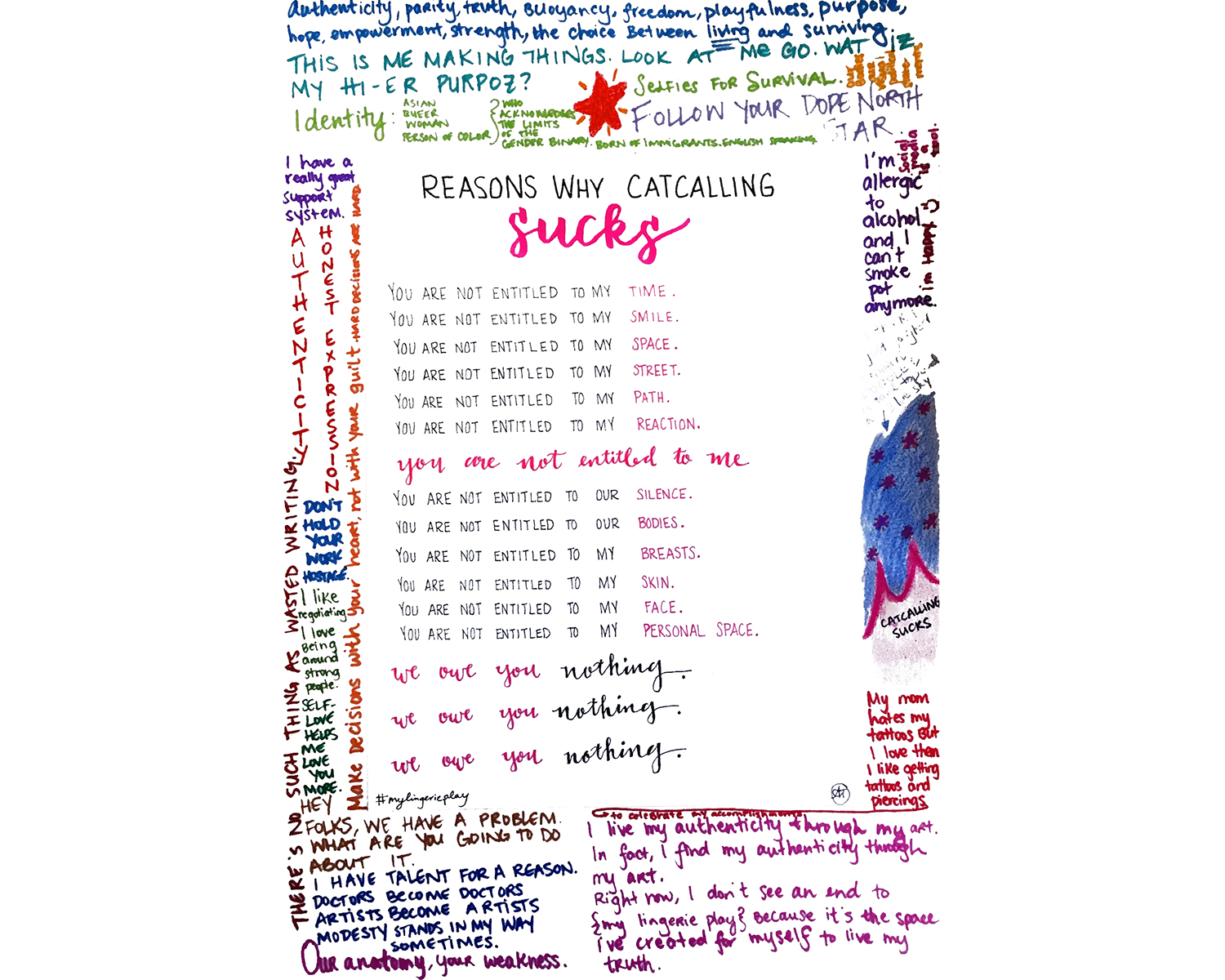
Upon entering Rattlestick Theatre for my scheduled conversation, an air of freeing and loving spirit came over me as I look up to see Orion Stephanie Johnstone ready to greet me. Once in awhile, you connect with someone so inspiring, time flies by, and you forget you’ve only just met this person for the first time an hour before. I sat down with Orion, co-director of Diana Oh’s {my lingerie play} 2017: Installation #9: THE CONCERT AND CALL TO ARMS!!!!!!!!!, The Final Installation for a wide-ranging and impassioned conversation about their influences, their identity, giving power to marginalized voices, and what it means to “queer the world.”
Michelle Tse: Let’s start with your journey with Diana [Oh], and specifically with {my lingerie play}.
Orion Stephanie Johnstone: Well, first off, I’d like to clarify: Diana has been doing {my lingerie play} installations since 2014, and what we are talking about here is the 9th installation in 2017: the concert and call to arms!!!!!!!!!, yes, with nine exclamations points.
Diana is a brilliant, powerful force in the world and we have circled each other and held each other in huge mutual respect for years, but had not worked together until this project. She came to me and said, “You are the one that I need to co-direct this.” At first I was humbled, and I hesitated, and I asked a lot more questions because I’m a highly collaborative theater artist, not primarily a capital “D” director. I have loads of facilitation experience and other things and I’m very comfortable in leadership positions, but this is a different hat than I’ve ever worn. Diana said, I don’t need this experienced director; I need a spiritual leader of the room. I need someone who I trust will hold a space where we all can transcend shame together. As a sexuality educator, I am passionate about not just inviting individuals to transcend shame, but in deepening all of our understanding of how our personal shame is connected to intersecting and overlapping systems of oppression.
After many conversations where I was always honored to be asked but wanted to ask more questions to make sure that this was a fit, I said an enthusiastic, “Hell yes.” And I’m so grateful that I did. We’ve been working together pretty intensely since early summer.

MT: I have to say that when I was here, I felt like it was the first time in a long time other than a couple things here and there, that I actually had the thought of, “This is what an inclusive space is.” It’s happened a couple times before, but never in theater, honestly. Can you talk about the vision and the preview process?
OSJ: The two central questions of my life are: Who and how might we be together, more bravely in light of our collective liberation? And how might I be consistently expanding who I mean when we say “we”? I keep trying to run hard and fast away from theater-making because I have so often run up against the “who and how we are together” being so secondary to hitting certain other marks, or to commodifying the soulfulness of what’s being created.
The invitation that Diana posed to me, essentially, is how do we live by those central questions, to embody our commitment to the idea that how we make is as important as what we make. How do we create a robust culture of courage and compassion, and care, and lead with that and trust that in every aspect of the process. There are always going to be things that are beyond our zones of awareness, but I’m done with feeling immobilized by that. I’m always so grateful when something is brought to my attention like, Oh, I haven’t actually been accountable to this person or this community in this. I think it’s easy to feel guilty and overwhelmed and shut down, but my prayer and intention for myself and for all of the work that I make is “May I embrace that we’re all on a continual learning journey about this, and to hear that feedback. Hold that with love and how might we expand, how might we do better, even knowing that nothing is going to be perfect.” I fiercely love Diana in her commitment to that, too!


MT: Feeding off of that and what we were talking about in an earlier conversation, you have the community choir for queer and trans folks, the dating app for kinky people, your sex and relationships coaching practice, and—
OSJ: —The alternative divinity school.
MT: Exactly, so a lot of your work centers around giving power to marginalized voices and people, so when you do come across someone that is maybe a straight white folk who considers themselves liberal and progressive, but maybe keeps asking the wrong questions. They want to learn, but you just keep hitting that same roadblock. Do you keep going back to them like, “Hey, that’s not cool, you got to do x, y, and z,” and at what point do you say, “Okay, I need to just maybe walk away from this situation,” focus on marginalized folks, then beam up that space as opposed to the education of that larger “we” that you were talking about?
OSJ: Thank you so much for that question and the many, many layers in it.
MT: I could’ve been a little more concise, but that’s what keeps me up.
OSJ: I share this question so much! First off, I think that I couldn’t get up in the morning if I didn’t believe that every human is capable of transformation. And also, I’m very exhausted. I’m very very angry. I’ve been learning about how to not shy away from expressing my anger and instead to deepen in learning how I might express my anger with love in a way that hopefully doesn’t diminish anybody else’s humanity, and also doesn’t diminish the very real violence and erasure that people I’m in community with and/or myself are experiencing.
Capitalism would have us believe the lie that there’s scarcity in terms of who can be liberated. Like, If we’re having racial justice we can’t be focused on trans justice right now. Bullshit. If we’re focused on trans justice, then we can’t be talking about disability rights, and so on and so on. That’s absolutely bullshit.
MT: The linear versus intersectionality, basically, right?
OSJ: Yeah, and if I truly believe that our liberation is collective, that absolutely must include cis white straight people, too. And also, I keep learning more about how and where I channel my energy day to day. At least right now, my energy is most channeled toward amplifying and co-liberating with marginalized folks, or rather, people who carry power that is not necessarily the most dominantly celebrated kind of power. More and more these days, I get honest about my capacity for conversations that are primarily educational, and I honor that that labor does not always have to be mine to do. I try to see where I can show up to do labor for other folks who can’t, knowing that my liberation is intimately bound with theirs. And I believe that, as a white person, I have a responsibility to have tough conversations with other white people. I realize that my answer is all over the map here. The big answer to your question is, it’s really fucking hard as I know you know, and it’s a continual navigation day to day.
MT: For some reason it reminds me of Maya Angelou, who talked about why she doesn’t hate her rapist. That she feels that we all have that within us. That we all have Hitler and Gandhi, basically within us, right?
OSJ: Yeah, yeah.
MT: It’s just a matter of how your life journey has made you access different nodes of those feelings and those wires within your head. When it’s so violent everyday you can’t help but be like, “Oh.”
OSJ: Can I … I want to respond just a little bit more to that other question.
MT: Please do.

OSJ: I’m 34 now. Until I was 22, I was a fundamentalist Evangelical Christian. Though I was always acting from a place that I understood to be compassion and care, I perpetuated Christian Supremacy and its ties to patriarchy and homophobia and transphobia and white supremacy. I mean, I still inevitably perpetuate oppression in a way that none of us are separate from. But having had a worldview and paradigm that is so extremely different from what I have now, I now have so much compassion for people’s journeys. At the same time, it’s not easy to hold to that compassion when people I know and love are experiencing such violence on a daily basis and there’s so much to be heavy-hearted about.
MT: I now have to take every other day off from watching even Vice news, because the saturation and violence and abuse is so rampant.
OSJ: Can I ask how you’re holding that question these days?
MT: I’ve now had a few white friends tell me, “Please just send them my way because I’m frustrated just hearing about what you had to deal with.” But lot of these moments come up when you’re not expecting it or when you’re the only person at the table who can answer the question. It’s quite painful to constantly be teaching empathy and essentially telling folks, “Hey, I matter as much as you.” I often come up against the moment of do I just shut up and order a drink, or do I just get up and scream, “Are you seriously only able to relate it back to yourself only?” It’s especially painful when you’re halfway into a conversation and they’ve agreed that, for example, white feminism is a problem, and that they’ve been doing the reading they need to, so you have an expectation. Then later on, they’ll say or mention something that is so exclusionary that my heart will just sink to my feet. Somedays I have to just be okay with, Okay, this is as much as I can affect today, here and now.
OSJ: That’s so real. Thank you for sharing that. I think of the times when I’ve been called in around the privileges that I carry as a white person. There have been times when folks have been really patient with me and asked me questions and stuck with me even at the expense of their spirit energy, and I have grown from that. And then there have been times when folks have been really, really angry at me, and me having to sit with that discomfort has also invited some necessary growth and transformation.
MT: I think for me, though, I always know that if I show emotion, especially anger and frustration, that other person would shut down completely. I’m exhausted, I can’t deal sometimes, but I can’t be shutting down and angry and not dealing with it because if I tell them to go away, they might never engage with that particular issue again. And that becomes another weight, especially when it comes to racism. That in itself is frustrating. There’s no one else around me that can take this mic right now and … It’s like, “Well, crap, what do I do?”
OSJ: Yes, yes. I hear and honor that and I wish that I had a simple answer and response. I think the only thing that I know to be true is how—well, I guess I hope to be true is—I hope that even when you or I, or anyone feels very alone and like they’re the only person that could have this conversation, that actually, that isn’t the case. That we do all hold it together. Whenever any of us can have capacity, that’s a good thing, and none of us has to have capacity all the time.
MT: Right, exactly.
OSJ: And by us, I mean: folks who have experienced the marginalization, folks who have feared for their literal safety while walking down the street, though that’s not a clear cut binary of those who have and those who haven’t. I feel like this is tricky territory.
MT: Those invisible marginalizations.
OSJ: It’s just wild.
MT: I have friends on a spectrum of disability or differently abled from you can’t see it at all, to being in a motorized scooter. And it’s painfully obvious that this city doesn’t cater to that well what so ever.
OSJ: New York City sucks in terms of access.
MT: All anyone has to do is spend a couple hours with someone differently abled. It’s bananas.

OSJ: Can I give a shout out?
MT: Yes, please do.
OSJ: My friend Bri just started a podcast called Power Not Pity—conversations with people about access and disabilities. I think it’s fabulous.
MT: Amazing. I’ll have to check that out.
OSJ: I have a lot to learn.
MT: Yeah, I’m definitely learning too. I don’t see the point in living if we don’t keep learning and challenging ourselves. For inclusion and representation though, my thought is that for a lot of folks, they see progression in the linear format, and our intersectional brains have an easier time seeing the interconnectedness.
OSJ: I love the thing that Lilla Watson said, you probably know it already: “If you have come to help me, you’re wasting your time, but if you have come because your liberation is bound with mine, then let us work together.” Thinking in terms of collective liberation doesn’t slow us down or cost us anything, actually it means that we’re on the only possible track to cultural transformation, I believe.
MT: There’s that media norm though, the progressions. In my head, the only way I can try to relate, is to try to see it from that other perspective of there’s white feminism, then there’s current day feminism—that’s a little bit intersectional—and then there’s what you’re talking about, which is what I subscribe to, trans-inclusive feminism.
OSJ: Or even trans-centered feminism.
MT: Oh, that’s even better, yes. Thank you. So I wondered if you could speak about that and the dangers of not being trans-centered, and for it to be happening alongside intersectional conversations, about race, gender and sexuality, about economics … On and on.
OSJ: Thank you, and I could go on for days. This is where my major point of exhaustion lies. First and foremost, it’s no secret that our transfeminine sisters and siblings of color face, by far, the highest risk of violence and discrimination out of anybody. And yet, even in so many wonderful, progressive spaces that I move in, there is often not only a learning curve that needs to happen, but an unwillingness to honor the identities of trans folks.
It’s so fucking sad and enraging to me when women, or anybody, feels like including transfeminine people in their feminism is taking something away from them. Again, that goes back to the lie of scarcity that capitalism would have us believe. That by including all women, trans and cis, that inclusion doesn’t mean we’re brushing under the rug that different women have different experiences. Women of different backgrounds and identities of all kinds—race, class privilege, ability—have very, very different experiences. And people are dying! It’s so sad to me when folks feel like that’s taking something away to be inclusive there.
It also breaks my heart that so much that the world has so very very very far to go in terms of even welcoming and fighting for the basic rights of binary trans men and women. So that in terms of non-binary trans folk across the gender spectrum—as I think you know, I am non-binary—we just brush that conversation under the rug or we just can’t even go there yet.
MT: It’s the progression of others versus the self.
OSJ: I also don’t believe that that’s linear.
MT: It’s not.
OSJ: And I truly believe that everyone, trans and cis, binary and non-binary, is more liberated when we hold this more expansive understanding of gender and gender complexity.

MT: Bringing you back to the show, as related to that point: there’s a phrase you and Diana use that I love so much—
OSJ: —Queer The World.
MT: Queer The World.
OSJ: I love Diana’s specific phrasing in the show. She says something like: “What ‘Queer the World’ means, to me, is not that everyone should be gay. Queer The World is direct confrontation, an unapologetic disruption of the lies that capitalist patriarchal cis heteronormative society would tell us.” That’s from Diana. I was like, “Hell yes!!”
MT: Oh, I’m so happy. I was so happy when that moment in the show manifested.
OSJ: Queer, to me, contains both ultimate celebratory welcome and wonder, like welcoming all of who you are, and also it simultaneously contains this bold fuck you, this unapologetic disruption. The word “queer” originally meant something that was askew of what is straight or capital “N” normative, and so “queering” is necessarily, by definition, questioning the norm, inviting discomfort. It takes courage to be together in this discomfort, in these big questions which unapologetically disrupt these lies and the pressure of the dominant stories of normativity. And of course then, queer is so much more than just who you are attracted to, queer is who you are accountable to.
MT: I do want to get back to something that keeps coming up, capitalism. You mentioned earlier stepping away a little bit from theater arts.
OSJ: Stepping away a lot from theater arts.
MT: I come from an industry that I saw to be even more oppressive than the theater environment. I was like, “What?” When I first started, I was like, at least this is somewhat fixable. But again, finances play a big role. Do you think that folks aren’t able to work in the theater and become theater artists unless they had some sort of external financial support system? I would guess economics would be—
OSJ: —By work in the theater, just to clarify, we’re talking about contemporary North American commercial and non-profit theater.
MT: Yeah, exactly. Even off Broadway.

OSJ: I was in a great discussion today with the alternative divinity school that I co-created, and we were naming how we want to celebrate and lift up unpaid labor, the emotional labor that folks are doing on the team. We want to lift that up. And also, we want to acknowledge: Who has the privilege to have space and time do that unpaid labor? Like it’s no secret that so many unpaid internships in the arts are filled by folks who carry the privilege to be able to take that financial risk because of their external support system, and that that then carries over into who moves up beyond intern roles in the art world.
What you’ve asked is big and hard and important, and I’m inspired by so many models of community art making and how much I believe that culture and art making is a basic human right. Anything we’re making in this society is going to be navigating the systems that are broken in different ways to greater or lesser degrees. That’s why I’ve been running from theater. Not because I don’t believe in its transformative power, because I really do. I don’t believe that art is a luxury, I believe that art is a human right.
Personally, I try to orient by these three questions inspired by this Quaker philosopher, Parker Palmer: “To what extent am I honoring my gifts and capacities and limitations? To what extent am I honoring the needs and hungers in the world, and to what extent am I honoring the intersections between those things?” When I most deeply answer to that question, the answer for me lately is very rarely art making. The answer to me is usually soulful organizing, facilitation, and long term movement building. I love the thing that Grace Lee Boggs said … What a hero she was. One of the many powerful things she said was that we must do more than struggle against existing institutions, we need a philosophical spiritual transformation toward being more human human beings. All of the organizing work I do is leading with that and asking the big questions about what is the widespread cultural healing that needs to go instep in order for widespread systems to change towards more justice that needs to happen. I’ve been running from theater because can’t stomach making art unless the culture of the process honors all of what I’ve articulated here, and I’ve been so lucky lately to be asked to make a few things that do honor all of that, like Primer For a Failed Superpower with the TEAM and this show with Diana.
MT: Which is another huge hurdle, because I often say to people that I didn’t realize how the other half lived until Obama came along and by the fifth or sixth year, I was noticing that my friends of color and I were walking a little taller, talking a little louder, dreaming a little bigger. I remember when Fresh Off the Boat premiered, and after it was over, I thought to myself, “Holy shit, this is how white people watch TV?” It was a different form of soul crushing for me on November 9th and 10th, I think, than a lot of folks. I often say I’m not mad at what happened, I’m mad at how folks were reacting to it because I couldn’t believe they had no idea where they exist. Then it becomes every single day like, “Oh, you didn’t hear this that I said for how many years?” Every time a white friend was disappointed, it was a reminder that nothing I said came through. That’s been every day, I feel like, since November, and I sink a little lower each time.
And so with what Grace said, knowing that we need the spirituality but also knowing that for someone like me to know my history, my people’s history, whatever it is, is so hard to find. There’s so much erasure. Especially in the Asian community, where we’re already so different and diverse, yet lumped together. So even when there is representation, it’s not proper representation.
OSJ: Yes.
MT: So when you’re doing work on how to be spiritually transforming, how do you spiritually identify or go beyond the existing infrastructure, how do you even then discover … Are you actively defining in the moment or how much of it are you trying go back in history and try to reference something and try to … My point is, you’re always going to be referencing something whether you know it or want to or not.
OSJ: I bow to that question. I’m thinking of it in terms of what we’re building upon and who are we accountable to from the past as we’re building. We talk about that at the alternative divinity school, what is the intersection between the ancient and the emergent, the old and the new? And I think so much about how there are so many layers to the violence that White Supremacy does to all of us. Including so much violence toward folks who are not white, and also robbing white folks of their humanity and connection to breath and body. I think of my Polish ancestors, and how many Slavic, earth-based traditions were covered over by Catholicism. A lot of my work is listening for what violence White Supremacy has done to all people, and how can we reclaim and support the spirit there. There’s obviously so much, but I think about queer and trans ancestry so much. Like Marsha P. Johnson, may she rest in power.
MT: Oh, yes. I love her and the power she brought forth.
OSJ: Marsha P — This hat says, “pay it no mind,” and that’s what the P in Marsha P. Johnson, it stands for “pay it no mind.” “Pay it no mind” is what she purportedly said to a judge when the judge asked her about her gender. She’s one of the people I’m proud to call chosen ancestor. She and Silvia Rivera were supporting and holding space for homeless trans youth, even while they were both homeless themselves! I think it is absolutely essential to think about what lineages we are personally coming from and building upon and also in movement sense. And I love geeking out about what we’re building on.
MT: I want to do a quick aside here and talk about Alt*Div, since it keeps coming up. Can you tell our readers about it?
OSJ: Oh yes, absolutely! Alt*Div is an alternative divinity school for soulful community builders, rooted in anti-oppression and collective liberation. We believe our world is in spiritual and moral crisis, that we are more alone and less connected to what matters, and to each other, than ever before. Because of that, we urgently need communities, and community leaders, which foster, as Grace Lee Boggs says “more human human beings,” in order to meet the urgent crises of our time and be a part of widespread cultural healing and systems shift toward a more just world. In practical terms, it’s a self-directed, de-centralized learning community for folks who are interested in those things. We’re now in our second year, and we’ve got participants from many places around the world. Thanks for asking!

MT: I am so glad I asked. That’s so inspiring. Now, why should people come see your show? I know, that’s another hour but, maybe a sentence answer.
OSJ: For spiritual nourishment! And to catch the contagious aphrodisiac of courage.
MT: I love that. I love that so much.
OSJ: Aphrodisiac of courage is the primary spell that Diana intends us to cast with this piece. Diana is fucking extraordinary and courageous, and her perspectives are incredibly important … I just want everyone to hear her voice and her story, and see her incredible work. And to leave drenched in glitter and soul sweat!
MT: Me too. Thank you.
OSJ: Thank you, Michelle.
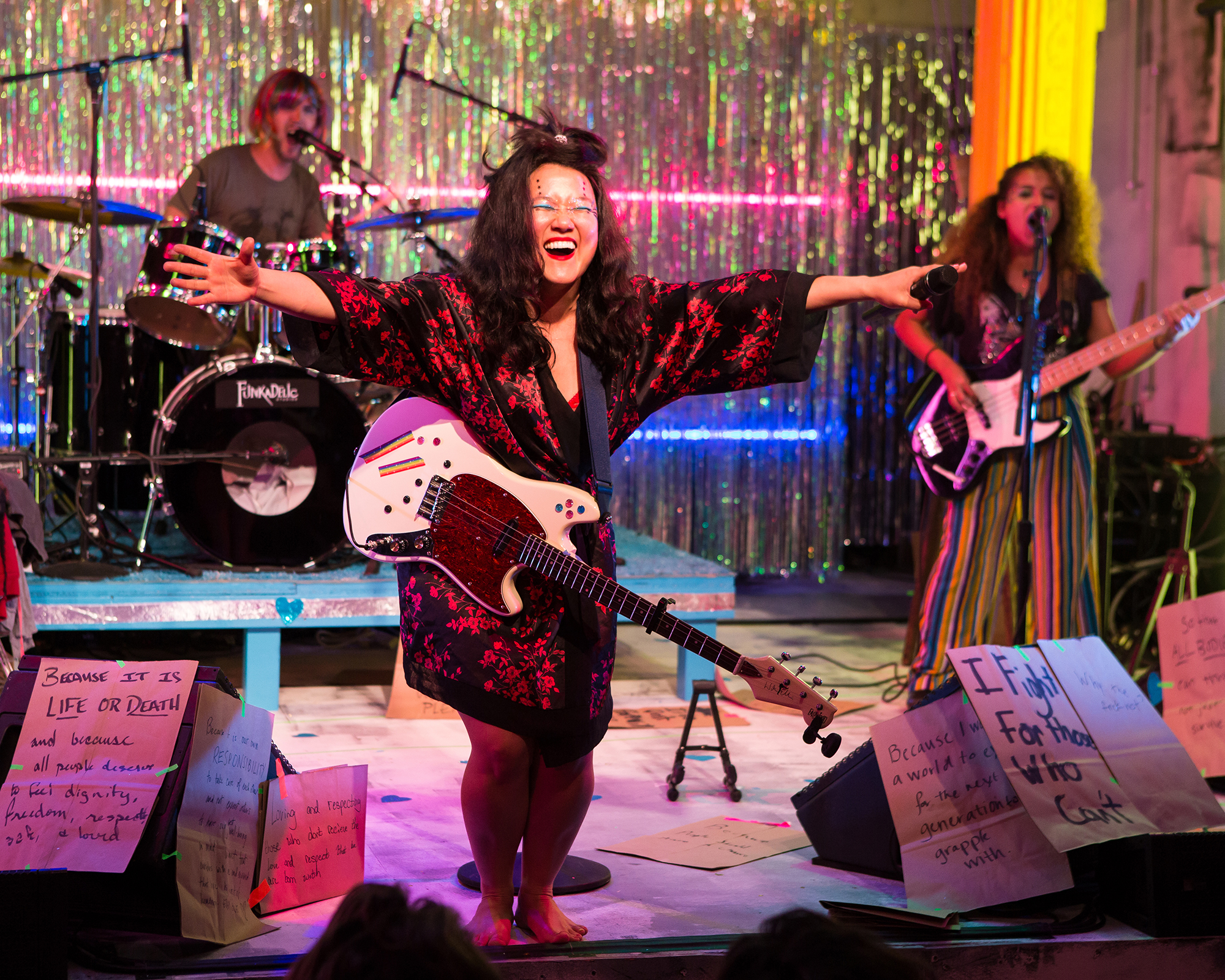
{my lingerie play} 2017: Installation #9, THE CONCERT AND CALL TO ARMS!!!!!!!!!, The Final Installation is a play, a protest, a concert, and an installation all at once. Through this concert-play, Diana and her band explore mainstream culture’s relationship to the body and the deep and complex dynamics that exist regarding sex and gender politics. This culminates in a genre-bending soulful rock and R&B concert-play and final installation of {my lingerie play} 2017: 10 underground performance installations in lingerie staged in an effort to provide a saner, safer, more courageous world for women, trans, queer, and non-binary humans to live in.
Orion Stephanie Johnstone is a theatermaker/organizer/sexuality educator/community minister/composer with a fierce commitment to our collective liberation. Their original music has been at venues including Joe’s Pub, the Bushwick Starr, HERE, 3LD, and CSC. They were the assoc. MD of War Horse (1st nat’l tour), and they are music supervisor for the TEAM’s Primer for a Failed Superpower, alongside director Rachel Chavkin. They co-host the podcast Sex For Smart People, they are the chief director of content for KinkedIn: a new dating app for kinky people, they recently co-created a new alternative divinity school for soulful community builders, and they studied justice ministries at Auburn Seminary. www.orionjohnstone.com