Posted on

A Conversation with Morgan Green & Johnson Henshaw

Morgan Green Johnson Henshaw


To hear some people tell it, New York is the only incubator for the most exciting young artists. But as the Sharon Playhouse proves, creating work outside of the Broadway and Off-Broadway sphere isn’t just a way to pay the rent — it’s a way to make the art you really want to make.
 

We took a break from the city and met with Johnson Henshaw, Artistic Director of Sharon Playhouse, and director-in-residence Morgan Green after their first run-through of The Music Man — their third collaboration this summer — to talk about the inventive restructuring of the Playhouse’s season, the importance of trust, the goal to foster emerging theater artists, and their thoughts on the future of this art form.


Michelle Tse: How was the first run-through?
 

Morgan Green: It was good. I have a headache [laughs] but it was really good.
 

Michelle: Should we get you some water?
 

Morgan: I’m good. I just had some; I’ll be okay. [laughs] No, but it was very exciting to see everything together. Johnson was there, and we had the smallest little audience so I feel like there was a lot of pressure in a good way, so that the actors were really focusing.
 

Michelle: That’s good. That’s exciting! So I wanted to start with asking about why you, Johnson, chose to do a director-driven season, particularly with an emerging female director.
 

Johnson Henshaw: I’m a director myself, and in my 20’s all of my playwright friends had so many opportunities for fellowships and mentorships and all sorts of ways that theaters in New York were trying to connect with them — they were trying to foster and incubate them. There’s not a lot of that for directors. Then I did this fellowship with the Old Vic in London. I went over to London, and visited many of the major theaters there — the National Theatre, the Donmar. Those theaters have these incredible incubators where they take young directors who have just gotten out of drama school or university and they start giving them space and time and money — they’re fully salaried! — and they start prepping them so that they are ready to do mainstage productions at the National Theatre when they’re like 26 years old. So then those directors are being seen by commercial producers and other artistic directors. Their work is getting seen much earlier and their careers are so much more dynamic and fruitful because of it.
 

Directors in New York have to tie themselves to playwrights. They have to really fight for those relationships. [Morgan and I] talked about this a little bit. The playwrights you get, that’s how your boat floats or sinks. It’s so often that the director’s work takes a back seat. When I had this opportunity, I was like, This should be a place that’s a theater for directors. Where they get to come up and do work that they’re excited about, as opposed to an artistic director being excited about [a certain] play, and finds a director to do that work.
 

I wasn’t sure originally that it was going to be all one director for the whole season but I had reached out to people at Playwrights Horizons, the Public Theater, Manhattan Theatre Club, and New Georges, and I said, Who are young directors you’re interested in? There was a bunch of names on each of those lists, and some people were on two lists, but maybe not all of them, and there was only one name that was on every single list, and that was Morgan’s. I actually didn’t know her work. I didn’t know her. [laughs] This was all happening around late December, and Minor Character the show that Morgan did with [her theater company], New Saloon, had been asked to be in the Under the Radar Festival as part of the Incoming lineup.The show was sold out, but I got a friend of mine to write Morgan to say, Hey, this is my friend Johnson, he just got this job, he wants to come see your show, can you get him in? And she said yes, of course.
 

I thought I would go see Minor Character, and if I liked it, I’d be like, Why don’t you direct a show this summer? What show do you want to do? And I was so blown away by it, it was so incredible, and one of the best things I’ve seen in the theater ever, I couldn’t believe it. And the ways in which it was great felt like the work of a really great director. It was so smart and so stylish and moving. So I met with Morgan, we had breakfast, and I sort of was like, Will you come and direct all the plays? Because first of all, I wanted to bring Minor Character here, but I didn’t want that to be the only show that Morgan directed this summer. Selfishly, the best part about this job, is I get to program work that I want to see. It’s the best part of being artistic director.
 

Because this audience is an older audience, the work that has typically been done here at the Playhouse is very traditional and I was trying to figure out what were the programming choices that would be great for a director to tackle but for this audience would feel welcoming. So my guidelines were a classic American musical, a classic American play, and a new work, and that was Minor Character.
 

Morgan Green Johnson Henshaw
 

Michelle: So Minor Character kicked off the season for obvious reasons that Johnson just touched on, and tonight we’re seeing Far Away. Why Far Away?
 

Morgan: Like Johnson was saying, there are all these opportunities to direct new plays and to ‘pitch’ yourself to playwrights as a director. I have been doing that, and I have relationships with playwrights that I like, but it’s really rare for an opportunity like this to come, for someone to ask me, the director, What do you want to do? So for the play, Johnson originally proposed it be a great American play, so I was thinking about Arthur Miller and Tennessee Williams, but I really wanted to fill that slot with a work by a female playwright. I love Caryl Churchill, and I’ve always loved her, and I feel like she’s not done enough in New York or America in general — she’s not as well known here, she’s in England. And she’s one of the greatest living playwrights. So it felt like a really special opportunity to do a Churchill play, whereas that would not happen in the city, and nobody would let me do it, unless I self-produced it. So I jumped at the opportunity, and Far Away is a play that I’ve wanted to direct since the first time I read it. I had visualized it when I was reading it, which is a good sign. I didn’t direct it when I first encountered it because I didn’t understand the ending. As I came back to it for this as an option for the middle slot, I still didn’t really understand the ending, but I was kind of excited by that challenge. I was also excited by its relevance, how it feels like the whole world is going to war, struggling with the responsibilities as an artist, and the distance between art and politics. Caryl’s is being self-aware and critical about artists, and I was excited to engage with that.
 

I was also really excited by the contrast between Minor Character which is Chekhov — but it’s also extra Chekhov, because we do 6 different translations on top of each other — with The Music Man, a musical with 27 people and huge, with this really spare, really poetic dynamite little play in the middle that is 45 minutes long, but has three distinct time periods and worlds within it, with this crazy hat parade spectacle. I got to have that theatrical event happening that is physical and design-based, which feels like an essential part of theater to me. I’m not that excited about plays that are just people talking to each other. It basically has all the things I like about theater in 45 minutes. [laughs]
 

Michelle: Well, that’s perfect then! You just mentioned being able to very quickly visualize Far Away. Is that how your process comes about most times? How do you negotiate between visual and literary cues?
 

Morgan: Yeah, I was thinking that [about Far Away because it can be seen] in terms of something that’s unusual. But to me it’s still not actually that radical because everything I’m doing this summer is text-based.
 

A lot of my work is text-based. The text is almost always the first thing versus a visual or an idea. So for me it does start with the text, and sitting alone and visualizing the text, and it feels right if I can get a picture [in my head]. It’s very instinctual, and it’s also about choosing the right material for the setting. I have maybe a bucket list of plays or projects that I want to do, but it doesn’t feel real till I’ve seen the space, see what would work in the space, what would be good for the audience at this time; it’s like this perfect storm of things that have to click into place.
 

Michelle: So how did the choice of The Music Man come about?
 

Johnson: I had two musicals in mind that I didn’t say anything about, but Morgan immediately said, I really want to doThe Music Man, and that was the show I wanted her to do. The story of a con man who comes to middle America is … so real.
 

Michelle: Absolutely. We just saw Death of a Salesman last night.
 

Johnson: Oh! Theater Mitu’s? What did you think?
 

Michelle: We loved it. We sat in the front row, so it was incredibly immersive. We very much interpreted it as empathizing with a Trump voting family. I also hadn’t seen that play in so long that I forgot about how agitated I get sitting through Willy’s monologues. It was very much like… dude, get a grip. We ran into a large group of friends and many of them didn’t make that connection, though.
 

Morgan: Oh, wow.
 

Johnson: That’s wild.
 

Michelle: They were either thinking about their own fathers, or family or friends, or whatever it was. Anyway, it just seems like it’s something that’s popping up everywhere, and folks are making connections whether the directors meant for it or not.
 

Johnson: Well, [Willy] is so emblematic of the worst parts of our culture. So as we look at these stories of patriarchy, and whiteness, and oppression, he’s in all of those.
 

Morgan: One of the things I was trying to deal with after Trump was elected — there was all this criticism about him, obviously, leading up to the election, every horrible thing he did, every lie, and everything that was revealed that was like, Is this the thing that’ll take him down? No, that’s not it. There was nothing that happened that was so bad that would prevent him from succeeding, so I was thinking about the public that elected him, and that there was more of those people in New York, around me, than I realized. So I was really connecting to The Music Man in that it’s a story about townspeople in middle America who accept a fantasy and enjoy it, because it sounds good and it feels good. They just buy into it, even when they find out that it’s a fantasy and they’ve been lied to and cheated. They kind of forgive this white guy. So I was interested in looking at myself and people who enjoy the feeling of believing in a fantasy. That’s so much a part of the American dream and the American psyche, and advertising, and Twitter — I mean, we’re just fed pieces of information and we consume them, digest them, and take them for truth. We don’t stop to think or criticize. And if we do, and something is revealed to be a lie, we’re still okay with it, because it felt better. It feels better, and is more satisfying to just buy the fantasy. And I experience that too in myself, so it was not so much getting to Trump voters specifically, but at American people who buy the fantasy.
 

Michelle: I definitely looked up the exit polls for this town when I was preparing for this interview. [laughs]
 

Morgan: You did?
 

Michelle: It went…
 

Johnson: For Hillary.
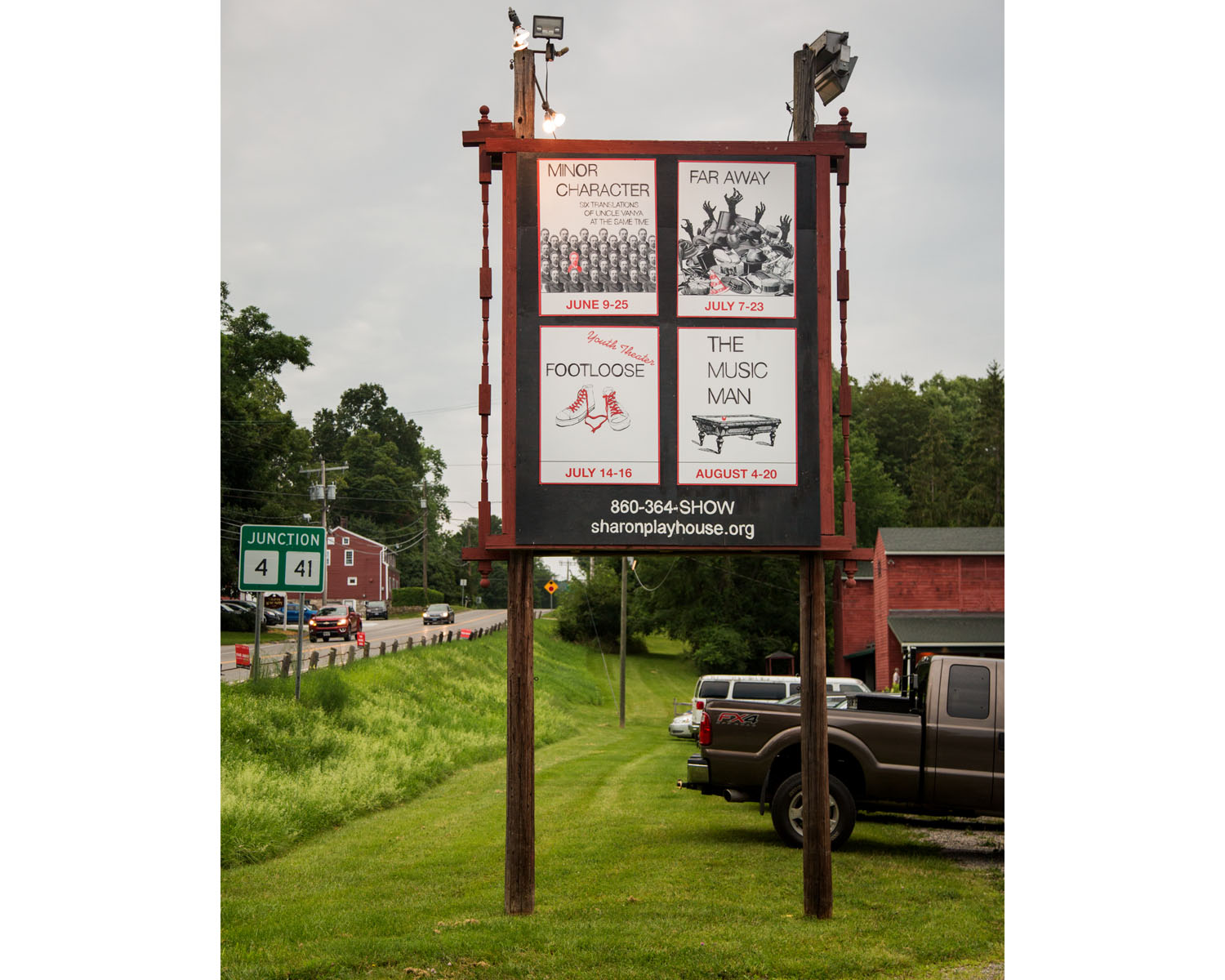
 

Morgan Green Johnson Henshaw
 

Michelle: Yeah, well, 800-something to 500-something. So it’s interesting to me. I also looked up the demographics, which says it’s about 98% white. This summer season you’ve put on and are putting on work that is perhaps challenging to the audience, but I wonder, at a place like the Sharon Playhouse, is there any fear of touching on subjects like racial disparity, gender disparity, or any marginalized issue, without basically pissing off most of your subscriber base?
 

Johnson: This pocket of Connecticut, Litchfield County, is in many ways a weekend community. So many of the people up here are city people, who come up here on the weekends. So it’s a sophisticated bunch.
 

Morgan: In Minor Character, men play women, and women play men, and actors of all races play the different characters. It’s really fluid, and one person who came to a dress rehearsal that the only good part of the show was when the women were kissing each other. So I feel like there is also that contingency of an audience here. There’s also people who totally loved it and embraced it. I think New Saloon, my company that I made Minor Character with, I don’t think we’re trying to make a bold statement about racial politics in our piece, but we are making a statement about identity and its fluidity and how we all hold many identities inside of us. I think that the intentionally diverse casting is trying to crack open some stereotypes. The diversity in the casting of that piece is essential to the project. We couldn’t do Minor Character with an all white cast. That felt important to get to do here.
 

Michelle: In that sense, what do you think of color conscious casting, which is what I’d call what you just described in Minor Character’s concept, versus a director and casting director trying to check off boxes in trying to satisfy diversity in a way?
 

Morgan: I try not to do those kinds of plays, or if I do, I play against it. In The Music Man, the Paroo family is written as an Irish family, which had more social stigma when it was first originally written, but no longer does. So I’ve cast the Paroo family as an African American family. The storyline is about how Marian is treated in this town in Iowa, so I think it heightened the urgency, especially because of the whole plotline about her younger brother and his safety and success in the world. So there’s a young Black boy running around in a town that is stirred up by this white guy and it becomes sort of an angry mob. That’s really scary right now.
 

Johnson: In the run-through today, I was so struck by the line about Winthrop’s father being killed, about being dead, which is usually, like, whatever. But when you have this young Black boy, upset, and his mother trying to explain things to him, it just made me think of Philando Castile, and so many others…. All the black bodies that are being killed every day, and those children that are left behind…
 

Michelle: Absolutely. I’m very interested in coming back and seeing it done in this way. I want to now zoom out a little and go back to a great point that was brought up, about the disparity between fellowships and mentorship for playwrights versus directors. I would argue there are even less for designers. Though all this seems very doable to me.
 

Johnson: Yeah.
 

Michelle: So, how has the experience been, what are the lessons learned, and what can others take away from this type of programming? How would you encourage other artistic directors or administrative folks to be inclusive in their guidance of emerging theater artists?
 

Johnson: It’s a leap of faith. You have to trust the artist. I’ve only seen Morgan do one show.
 

Morgan: He was very trusting. I couldn’t believe it.
 

Johnson: Well, I don’t think great work happens without great risk. There are so many theaters in this country. There are so many theaters in New York that are picking the trusted directors, the old steady hand, with the way that it has been done before. It feels to me, if I’m going to be a young artistic director, I should do something different. I should make a different choice. I should think about who’s going to make the next great theater, and give a platform. I’m really proud of Morgan’s work, and now she’s had three big productions in a row. I won’t speak for whatever she’s learned, but there have been insane learning moments. No artistic director can ever tell her she’s not ready to do a musical. No artistic director can tell her she doesn’t know how to do a stylized Caryl Churchill play, you know, and that’s so exciting to me. To give her that experience…
 

Morgan: Yeah, it’s a ton of experience right in a row. It forces this kind of feverish creativity.
 

Michelle: It must be all overwhelming.
 

Morgan: Very overwhelming. But it’s pushed me to be really collaborative with the designers and the actors and trust them in the way that Johnson’s trusting me. I think [Johnson] told me I brought about 80 people here, all in all.
 

Johnson: 70 people contracted.
 

Morgan: Right. So I brought my entire New York network with me. So it’s not like I actually did this by myself, you know? There’s a lot of other people involved. The pressure I find useful, but that’s just the kind of person I am. I like the pressure, but it is and was overwhelming.
 

Michelle: Right. Because other than the Lincoln Center Theater Lab—
 

Morgan: Right, which is not practicing, it’s a lab.
 

Michelle: Exactly. Other than that, I don’t think I’ve heard much else for directing.
 

Morgan: There are a lot of residencies and apprenticeships that are centered around assistant directing, and I’ve done a lot of those, and it’s a good way to learn, and met a lot of people I learned a lot from. In terms of getting our hands dirty, and making work, there’s not a lot of opportunity for that. There is in London, for example, so it feels like there’s a real dirth for directors in that.
 

Michelle: In Europe, to my knowledge, it’s mostly government subsidies that allow that to happen though, right? We are on a different system.
 

Morgan: Yes, it’s a completely different structure.
 

Johnson: Yes, but it used to exist in New York. New York Theatre Workshop, throughout the ‘80s, that’s where Michael Greif started, in the New Directors Project, where they would throw up these plays that were hugely foundational for a lot of the directors who are now directors on Broadway. The Public Theater, you look at what Joseph Papp was doing, he was finding young directors and just giving them rooms and giving them actors and paying those people, and saying, What happens in this room?
 

Michelle: That doesn’t quite happen anymore.
 

Johnson: It doesn’t quite happen anymore like that. I wish that all those Shakespeare plays in the park weren’t directed by Daniel Sullivan. I wish they were directed by young directors. We just keep seeing the same plays directed by the same people. It’s so boring.
 

Morgan Green Johnson Henshaw
 

Michelle: I agree. And so both of you are relatively young for being in the positions that you are in. What would you say is the steepest part of the learning curve so far?
 

Johnson: This summer has been a lot just in terms of getting 70 people up here to Sharon, Connecticut, and getting them all to the theater, making sure they’re housed. The logistics of producing here are tough. But in terms of the experience of being an artistic director…As a director, I’m always so nervous about sharing my own work, you know? And I have this sense of modesty, or I’m embarrassed to tell someone that I think what I’ve done is good. The great thing about being artistic director is that I get to scream from the rooftops about how special [Morgan] is, and that feels awesome.
 

Morgan: It also feels awesome to me. [laughs]
 

Johnson: But with the learning curve, I don’t know. Morgan and I haven’t agreed on every choice this summer. There have been some moments of disagreement. I think figuring out how to negotiate those disagreements has been a learning event.
 

Morgan: Right. And for me, it’d be how to take notes from an artistic director. I haven’t had that experience before, figuring out what things I can really negotiate on and what I need to fight for. Another thing that I think I’ve been getting better at out of necessity is articulating my ideas and my vision so that it is clear to people that are not inside my head, or don’t have the same relationship to theater as I do. To be clear about what I want to do, I have to change the way in which I’m describing it, based on who I’m talking to. I feel like being forced to do that so many times, with so many different kind of people this summer, I’ve gotten a lot better at it.
 

Michelle: Communication bootcamp!
 

Morgan: Seriously, yeah. I can’t assume somebody knows what something looks like in my head. I have to break it down.
 

Michelle: So as a theater and as directors, what do you hope the future of theater would look like? What do you want to see more of, or less of?
 

Morgan: I want to see more work that is breaking out of traditional theater conventions. I feel like I see a lot of theater that I’m sort of expecting. I feel excited to see work that is breaking the mold, so that in order for that to happen, people need to be given opportunities that aren’t necessarily given to them. So what Johnson’s doing here feels like that, but also for women, for queer artists, and people of color, having more opportunities to make their work — with support, because it’s so hard to do it on your own.
 

Johnson: I just want to see less of the straight white male gaze. I feel like so many of my theatrical experiences come through the viewpoint of a straight man, and we’ve seen that. I want to see so many more people’s work than I’ve gotten to see.
 

The funny thing is, in these Far Away talkbacks [which happens after every performance], there are people who love it, and people who are angry that the play makes them think. They’re angry because they’ve been challenged and not simply entertained It has emboldened me hearing that to only want to present work that challenges people, that challenges their perception of what should happen in a theatrical space. I want to make work and present work that people are still talking about later, that they’re still responding to. I’ve learned that so many people go to the theater and really want it to happen in there, and end in there, and to never engage with it again. I hope that nothing we do this summer ends in that space. I sort of hope that of all work.
 

The Wassaic Project, [an artist-in-residency program 20 minutes away in Upstate New York,] some of their residents came over, saw Minor Character, and loved it. They went back and told the rest of them, You have to come see this. They’re visual art people who don’t think that summer theater is going to be cool. They all came and lost their minds. I’ve now had so many conversations with people who have stopped working in theater because the rules of it, and the system of it, is so oppressive about the type of work that had to be made. So many of them have seen Minor Character and have been so inspired and thought, Oh right, theater can feel like this. It can feel dangerous and totally new while exploring something really old. I hope to keep being a part of work like that.
 

Michelle: Absolutely. Morgan, you mentioned quickly opportunity for women. I wonder if you can expand on your thoughts on opportunities for women and directors, perhaps particularly for musicals. I’ve been thinking a lot about not just what we touched on earlier about the lack of a support system, but even in terms of someone like me going to ‘diversity’ panels, and feeling like I’ve been going to the same one for five years in a row. It’s so circular. I wonder what a young 20-something just out of school can do beyond somewhat following the system that already exists.
 

Morgan: I can talk about my own experience with it, which is that I just made work. It was small, and dinky, and scrappy and self-produced, and I’d invite everybody I could to come see it. Most of them didn’t come until the third or fourth thing that I invited them to. I just kept going. A lot of the things I knew they wouldn’t come, but I’d invite them anyways, just so that by the sixth time – I guess I was pretty annoying… But it’s a dangerous line to walk because you can’t force yourself to receive recognition or gain support. It’s a delicate balance I think. But that’s what I’ve started to tell younger artists who ask me about it. Make work, and invite people to see it, as opposed to sitting and waiting. Instead of asking for opportunities, make them. I guess that’s pretty generic sounding.
 

Michelle: Yes, and it’s also hard to make it or make work as young theater artists if you don’t have some sort of financial support. So once again it becomes a very circular movement, where everyone who is able to make it in this industry is at least middle, upper-middle class.
 

Johnson: Totally.
 

Michelle: Yet theater is suppose to be a form of art empathy, and yet the spectrum of voices needed is impossible to achieve with this current model. It’s frustrating.
 

Morgan: That is really frustrating, and I think that without financial support, what I have noticed is that it just takes a lot longer. If you have that cushion, you can just do your work all the time and nothing else. If you’re working to support yourself, it’s a much slower slog. It takes a long time to get anywhere.
 

Johnson: That’s the worst. That sucks. It sucks that the big institutional theaters aren’t doing more.
 

Morgan: This is the first year that I am freelance directing and not doing five other jobs. So I tutored, did admin work, waited tables, did all the things. I actually have no idea if I’ll be able to sustain this. It’s very up in the air, so we’ll see.
 

Morgan Green Johnson Henshaw
 

Michelle: I think and hope that you will. Lastly, any other advice, and what’s next for both of you, after The Music Man?
 

Morgan: What I said before, I think: Make work. Sometimes you do have to be silent for a really long time and listen and learn. I was so frustrated by doing that for so long, but now I’m feeling grateful for putting in that time. Also, going to see stuff and learning from other people.
 

What’s next for me, is I’m directing a play by Milo Cramer, who is in New Saloon, called Cute Activist, at the Bushwick Starr in January. We just did a reading here this summer actually, very casually. Johnson read in it [laughs] and it was amazing.
 

Johnson: I would agree, make work, find artists you love and write to them and tell them you love their work and ask how you can help them make their work.
 

Morgan: That’s so good.
 

Johnson: Because the most important way to get people to come see your work is to be a part of a community. I think singlehandedly that is the key to success. It’s such a small world, and people want to help their friends.
 

Morgan: That’s true.
 

Johnson: And be nice to people. Don’t be a jerk.
 

I don’t know what happens next! This has sort of been a big, grand experiment. I think at the end of the summer we will take stock, and see what’s right for the playhouse moving forward. And I’m going to try to make some work. Morgan has very much inspired me to.
 

Michelle: Amazing. That’s the best type of collaboration.
 

Johnson: And I made a friend!
 

Morgan: Yes you did!
 

[Everybody laughs]
 

Johnson: It’s the best part of it all.
 

Michelle: Wonderful. Thank you so much for sitting down with me!
 

Morgan and Johnson: Thank you so much!


Morgan Green is a theater director and co-founder of New Saloon. She is thrilled to have the opportunity to direct three shows at the Sharon Playhouse this summer. Recent credits include Minor Character: Six Translations of Uncle Vanya at the Same Time (The Public Theater), I’m Miserable But Chance Scares Me by Milo Cramer (The Brick), Parabola by Sarah DeLappe (JACK), and William Shakspeare’s Mom by Milo Cramer (Ars Nova). Morgan is a New Georges Affiliated Artist, part of the 2012 Williamstown Theater Festival Directing Core, the 2013 Lincoln Center Director’s Lab, and a 2014-2015 Bob Moss Directing Resident at Playwrights Hoirzons. She was the Associate Director for Pam Mackinnon on Amelie, A New Musical on Broadway. Upcoming works include Cute Activist by Milo Cramer (The Bushwick Starr) and the West Coast Premier of The Wolves by Sarah DeLappe (Marin Theatre Company).
 

Johnson Henshaw is a film and theater maker. He has developed theatrical work with New Georges, New York Theater Workshop, PS122, Dixon Place, the Public, and the Goodman Theater in Chicago. While at the Public Theater he assisted the writers Tony Kushner, Branden Jacobs-Jenkins play An Octoroon whose production would be cited by the MacArthur Foundation when they awarded Mr. Jacobs-Jenkins one of their ‘Genius Grants’. For nearly 3 years Mr. Henshaw produced a monthly performance review in Brooklyn called Pillow Talk which featured performers such as Erin Markey, John Early, Kate Berlant, and Sasheer Zamata. Because of Pillow Talk, Johnson was approached by the Meredith Corporation to create and produce a comedy web-series for their new coporate channel DIGS as part of the Youtube 100 Channel Initiative. Johnson and co-creator Kim Rosen created Craft & Burn which the New York Times called, “raucous, and darkly funny.” In 2013 Johnson was selected by the Film Society of Lincoln Center to take part in their first Artist Academy, a laboratory for emerging filmmakers. He is a co-founder of Nobody Cares Productions with Kim Rosen. Their first television pilot “Entrepeneur” was bought last year and ultimately lost on the shelves of development. Johnson splits his time between Sharon and Greenwich Village with his partner Michael and their poodle, Henry.

Posted on

A Conversation with Zurin Villanueva & Darnell Abraham

Zurin Villanueva Darnell Abraham


Theater has a sneaky way of recycling itself. It’s relevant. Then time passes. And then it’s just like new again.
Ragtime at Barrington Stage arrives at a time where the issues from the musical set in 1900s America are eerily timely. Racism, xenophobia, immigration rights… it feels like the characters could have lived as easily in today’s America as they do in Roosevelt’s. We chatted with the production’s Zurin Villanueva and Darnell Abraham to talk about the source material, the process of breathing new life into the much-beloved show, and where we go from here as artists and Americans.


Michelle Tse: How would you say you identify most and least with Sarah and Coalhouse, respectively?
 

Zurin Villanueva: Sarah is a simple but very decisive woman. When there is a problem she immediately goes into solution mode. I definitely relate to that impulse. Also, the heartbreaks in my life have helped me tap into the grief Sarah is feeling in “Your Daddy’s Son” and “New Music.” It was not hard to know what it felt like to be left by the love of her life.
 

Darnell Abraham: I grew up in a rough part of town and had to learn how to survive in two different worlds: the ‘hood,’ with its unique challenges, while going to schools in predominately white neighborhoods with their own unique challenges as well. So I had to learn how to exist in two different worlds without compromising who I really am, all the while believing that if I work hard enough, I’ll be recognized and awarded for my hard work and championing the fact that Black men are as equally intellectual, talented – and contribute as positively – to society. We see the exact same thing in Coalhouse. He learned how to exist in two different worlds and did his best to rise above a system that was designed to work against him. He rose above it until a couple traumatic experiences turn him.
 

Michelle: Wonderful. What do you think of the ending of the show and what do you think will become of the baby?
 

Zurin: The ending of the show is something we spoke about in length during the staging of this production. It’s hard because once the show has ended we have delved head first into the harsh reality of racial prejudice, immigration, big business, and even a woman’s role in society and then we kind of end the story with not much idea of what the solution to all those things are. I love the fact that Joe Calarco decided to have the last image of the children. Saying that they are our only solution, which I wholeheartedly believe is true. Coalhouse Junior would have probably lived a good life, very different from other boys his color – and that would be a good thing in some respects, but hard for him when feeling different than his peers. When this happens in real life, this makes the child feel like he can’t be himself but only a representation of what his white peers expect him to be. He’d be like many Black children who have been brought up in privilege, surrounded by people that may not look like them. Hopefully, it leads them to a greater understanding of both worlds and our society as a whole.
 

Zurin Villanueva Darnell Abraham
 

Darnell: Zurin answered this question perfectly. I agree.
 

Michelle: Leading off that, Ragtime revolves around not just the identity of the characters, but also about the changing identity of America as a country. Does our current sociopolitical situation make that story more poignant and important to tell right now?
 

Zurin: Of course it does. I think it’s obvious in the midst of Black Lives Matter movement, immigration laws changing against new refugees, and even abortion coming back into the forefront how sensitive we all are now as a country. The sad truth is, not much has changed, especially when speaking of how African Americans are treated in this country by law enforcement. It’s very scary and we are all aware of it. I do believe as long as we stay vigilant and keep pushing for policy change, fighting for what’s fair and right, we will succeed. As a country, we have become complacent in exercising our rights as citizens to make sure our rights stay intact. And seeing the play now reminds us of that fact and hopefully inspires us to action.
 

Darnell: I think Ragtime has always been poignant but I must say it is even more so now than before in modern history. When it comes to our sociopolitical landscape and the overall changing identity of America, I have learned that people will see what they want to see and hear what they want to hear, but when you put a mirror in front them, they can’t deny what’s in front of them. That’s what Ragtime is and what it does — it’s a mirror that forces us to reckon with our inner demons and brokenness. There has never been a more crucial time for this in our country.
 

Michelle: So how has it been performing this piece in a place like Pittsfield, where the demographic is 85-95% white?
 

Darnell: As an actor, I am focused on sharing my truth regardless of the demographic of the audience. However, I hope that by doing so, it will enlighten the audience.
 

Zurin: Unfortunately, it’s not much different than all of the other regional theaters I’ve performed at with the exception of Crossroads Theatre in New Jersey. All the other great regional theaters I’ve performed at have been 90% white as well. I’m glad there have been some school groups that have come that have children of all ethnicities, that is always the most important thing to me. As long as young people see actors that look like them doing this, they know that more is possible than what they may have been taught. That is something I would definitely like to see more of.
 

Zurin Villanueva Darnell Abraham
 

Michelle: What does Ragtime say about the role of Blackness in America and how does that connect to the present real world? Do you think it is interpreted differently now vs. its conception in 1996?
 

Darnell: I believe ‘Blackness’ is the result of ‘Whiteness.’ It’s merely cause and effect. I believe in context of the show, Blackness in America is an acknowledgement of racial disparity. Ragtime makes this clear by reminding us of what American society looked like at the turn of the 20th century. Sadly, not much has changed since. There is a natural evolution to everything but I think the principal themes found in the show are timeless and timely. How we interpret them today will vary depending on individual experiences.
 

Zurin: Well, I would like to say that random citizens can no longer stop a vehicle or harm another person without getting arrested the way it happened in 1906 when things like lynching were common. However, [as Darnell pointed out], the only difference now is at least now they are arrested and tried before they are often acquitted such as Trayvon Martin’s killer who was not a cop. We have to think about what that says about our society, what that says about what we believe. If a Black child can be killed beyond a shadow of a doubt and the killer is not punished, what does that say to our youth about what’s important? I think while doing this play we all realize how little has changed. Then we are forced to ask ourselves how is that possible? It shouldn’t be and we have to face that reality.
 

Michelle: So would you both agree with Coalhouse regarding the conclusion that words can best actions, in terms of spurring radical change?
 

Darnell: I think Coalhouse finds middle ground. He exhorts his followers to resist violence but to continue the fight for justice with word and action. I like to think of it as embracing the fundamental ideas of Booker T. Washington and W.E.B. Dubois.
 

Zurin: No, I do not think only words can spur change. I don’t agree that violence does it either. I do believe that having conversations across color lines do help. We have to talk to each other, that is the only way we can start to heal ourselves. In terms of results, I think the only action that really gets a response in this capitalist society is money. The only thing that can truly stop the policy that is against our best interest is attacking the businesses that uphold those policies.
 

Michelle: I am also curious about both your thoughts on the role of race in the industry, and specifically the idea of playing roles written by folks outside of the culture.
 

Zurin: Race in this industry is just starting to shift. It shifts in that roles that would previously be given to white actors are now up for grabs by other races. The roles in Great Comet on Broadway right now is a great example. I’m sure this is a result of Hamilton. Hamilton’s success using a cast of color entirely to play real-known people that were most certainly white and having that show be a huge success proves that color will not stop folks from buying tickets. That has been the myth used for centuries. That somehow more roles of color in Broadway shows, TV, and movies would hurt ticket sales. That has always been a myth and now we know for sure. With regards to people of other cultures writing stories of other people, I think we will always have a bit of that and as long as their research is done that is fine. I think it’s a matter of range. I only take issue if the ONLY stories being produced about my people are written by other races. That means the variety of storytelling is off and that should never be. In a perfect world, of course.
 

Darnell: I agree with Zurin on this. The tide is changing and I hope that our industry leaders will continue to embrace art that is reflective of our diverse society. I applaud writers like Terrence McNally that seemingly take careful approach in developing characters of color such as Coalhouse. In addition, to see more inclusive casting in the industry coupled with more roles written for artists of color is encouraging. Audiences are also beginning to hold our leaders accountable because they want entertainment — whether on the screen or the stage — that reflects our real world.
 

Zurin Villanueva Darnell Abraham
 

Michelle: A slight change in topic — Darnell, you list a handful of charitable organizations you’ve worked with on your website, from sending Liberian kids caught up in the war to school, to empowering the poor in Harlem, to providing safe drinking water, and ending sex trafficking of young girls. How do you choose which organization to work with? What would you like to say to folks who are new to activism, most likely since and because of the current climate?
 

Darnell: My wife and I aim to support local and global communities however we can. We look for organizations whose mission align with topics that we are passionate about: education, feeding the poor, human rights, women rights, and the right to live a healthy and fulfilling life. We’ve come in contact with some of these organizations by way of own network and research. My advice for anyone new to activism, especially in the midst of our current sociopolitical climate is this: It’s a big beautiful world and we all must do our part to make sure that it is protected for generations to come. Humble yourself. Challenge yourself by interacting with people who don’t share your faith, political views, or social ideologies. We can all learn something from someone whether it be good or bad. Protect the widows and the orphans and love your neighbor, but you must learn how to truly love yourself first before you can extend love healthily.
 

Michelle: Finally, any advice for aspiring theater artists? What has been the steepest part of the learning curve for you?
 

Zurin: I would say what has helped me the most was my awareness of my skill. Knowing where I was in development, checking every three months on what I was missing, what I needed to improve upon, and what teacher or lesson could help me fix it. The key is to stay aware and know that no matter where you went to school, your training is never over. You are constantly changing as a person. That means your skill will change and you must keep abreast. You can also learn on the job. A job can get you to the next level but only if you know how to get through the audition. The audition is in many ways the most difficult thing in this business. You have to learn how to love the audition any way you can. If you are freaked out by dance auditions, go until you don’t care. Know how long you need to practice before you start over analyzing or how short if you’re under prepared. Love the audition at all costs.
 

Darnell: Keep going! Surround yourself with people that will be honest and supportive. Be hungry to grow and learn. Stay humble but be persistent. Don’t let anyone dictate your truth. No one.
 

Michelle: Thank you both for such a lovely conversation!


Zurin Villanueva. Broadway: Shuffle Along, or the Making of the Musical Sensation of 1921 and All That Followed. National Tour: The Book of Mormon. New York: Witness Uganda (lab). Regional: Ruined (Everyman Theatre), Ain’t Misbehavin’ (Crossroads Theatre), Josephine Tonight! (MetroStage), and Crowns (Arena Stage).
 

Darnell Abraham has been seen on many stages around the world and continues to prove himself a versatile artist by slipping into character for traditional or contemporary musical theater. In the studio and concert stage, he has collaborated with some of Broadway’s top performers as well as Grammy and Emmy award-winning artists. Darnell received critical acclaim for his recent performance as Jake in Media Theatre’s Broadway Series production of Side Show. Darnell has been featured as a principal performer in Disney’s Festival of The Lion King and can be heard on the video game soundtrack Tekken 7 by Bandai Namco Entertainment. He has also been an invited guest solo artist for several high profile events around the United States as well as a global think tank in Cape Town, South Africa where he performed for world leaders representing over 44 countries. Darnell is a proud member of the Actor’s Equity Association and resides in Manhattan. He will continue in the role of Coalhouse at Ogunquit Playhouse in their production of Ragtime from Aug. 2-26. Learn more here.

Posted on

A Conversation with Mimi Lien

Mimi Lien


It’s hard to believe that Mimi Lien only just made her Broadway debut this past season with Natasha, Pierre & the Great Comet of 1812. Although Mimi cultivated her craft over the years in various off-Broadway and regional productions and at her performance venue, JACK, this MacArthur Fellow seems to be just getting started. I had the honor of sitting down with Mimi within the environment she created at the Imperial Theater, to discuss her most ambitiously-scaled project to date, her journey from architecture to scenic design, and her experience with being Chinese-American.


Michelle Tse: I must say first that as a designer who recently left architecture, I shed a tear when I walked through those double doors onto the set and into this house. Thank you for the inspiration. And do call me out if the questions get too nerdy.
 

Mimi Lien: [laughs] Thank you! And that’s quite alright — I, too, am nerdy!
 

MT: Perfect. For our readers who may not be completely familiar, what for you is the big concept idea of this design?
 

ML: The main thing about the design for me was that it functions as a delivery system: to deliver the actors to the audience. I say this — and I do feel this way, but others may disagree — that it’s not the usual spectacle, but it’s about creating the environment, creating the container, and orchestrating the way that people share space together within that.
 

MT: What is it like staying with a show through so many iterations and getting to scale up each time? Did the difference in the container of the show force you to make design choices that you wouldn’t have done and maybe then ended up getting incorporated?
 

ML: It has been heartbreak and ecstasy, because of the effort to maintain the essential DNA of the show and of the design. I feel really fortunate, and we as a team have been fortunate — and I don’t know that we would’ve known this from the outset — because we’ve had to design it in so many different places and tried to adapt that basic concept to a lot of different physical scenarios, we’ve gotten to prove to ourselves that somehow we got it right the first time.
 

The reason there’s red curtains everywhere is to create one envelope that everyone is in. It’s not just the stage is over there, and the audience goes over here. It’s enveloping the audience too. All of these same elements have been here since the beginning: the curtains, the paintings… so on the one hand, it’s a design that very much responses to each environment, but the thing that we’re trying to deploy is remarkably consistent.
 

I think there were moments of anxiety about when we first went from a black box to a proscenium. When we went from the tent to A.R.T. was probably the biggest moment of fear for me. We were very worried that we’d lose something that was essential to the show. I was pleasantly proven wrong.
 

MT: Was the proscenium covered in red curtain, like it is here?
 

ML: At A.R.T. we were actually able to remove the proscenium. That was a theater that was built in the ‘60s, so it was sort of modular, and they didn’t have the ornate frame like we do here, where we’ve covered the proscenium on all sides. At A.R.T. there wasn’t a real proscenium, per say, and there were these portals that we kind of were able to just remove.
 

Mimi Lien
 

MT: Well that’s nice! So now, making your Broadway debut… I mean, you got to revamp a Broadway theater! What’s that like? Was it another point of anxiety, or after all those iterations, it was more, “Nah, I got this!”
 

ML: [laughs] Well definitely I think the most anxiety came when we went to A.R.T.. Because that was completely redesigning it to fit a completely different space. The audience-actor relationship was going to be very different, dictated by the space. Once we did that, I knew it was going to work here. The one big difference here is there’s a mezzanine, a second level. We didn’t have that at A.R.T. — everyone was in the same room, everyone can see the same thing all the time. Here, there are things that happen down [in the orchestra] that people can’t see up [in the mezzanine], and vice versa. But I knew that it was doable.
 

I feel very fortunate to have the backing of producers who recognized the importance of the environment to the show, and supported that. It’s something that I think many producers would say no to. It’s too expensive. It’s too involved. For example, putting up the red curtains: it’s just a simple gesture that fulfills the concept of putting everyone in the same space, but there’s nothing to hang it on! There’s no drawings that existed of this space. Everything had to be measured. Now there’s a whole system of pipe structure behind the curtains that were really hard to put up.
 

MT: Did you work with a registered architect, then? Or was it all on the structural engineer?
 

ML: The shop that built it has a number of engineers on staff, so I worked with them. But also we got a permit of assembly, because we have to comply with building code, and be approved because the audience is occupying the same space as the actors. The entire set has to be code-worthy, so we did work with an architect because we needed all drawings stamped and submitted to the Department of Buildings. There was also a code consultant and expeditor. So, leaving architecture… [chuckles] I somehow found my way back through this show.
 

MT: Great, that’s exactly what I was about to get to! You’ve spoken before about buildings as “a series of theatrical events.” So how important was it, aesthetically and phenomenally, to design the choreography from 45th street, to the lobby bunker, to the interstitial threshold, then finally into the house, knowing it might not be registering in a theater patron’s mind what is happening?
 

ML: The path that the audience takes has been really important to me design-wise, and also dramaturgically to the show. We really wanted to draw the distinction between the outside and the inside. I mean, “There’s a war going on. Out there somewhere.” So although some people might not recognize what they’re going through when they’re coming into the show, I do think that by the time intermission comes around, they can wander back out and go, Ohh, right! I saw Andre going to war and walked out here into the hallway in which I entered, and that was a military bunker! So for me that was very important for the audience to walk through that “war outside”, before arriving “inside.” Certainly from a design and spatial standpoint, creating and extending this portion of the journey in order to make that moment of entry really be high contrast is something we’ve done since Ars Nova. We didn’t have any money to construct anything, but we took the audience through the basement, to the dressing rooms, where we turned off all the lights, and we had a boombox and sodium vapor on the floor, which was effective. The point is to disorient the audience spatially and by doing that, it triggers this questioning of where you are. I feel like when you walk into a normal theater lobby, it’s I know where I am, I’ll pick up my ticket and go to my seat. There’s no being thrusted into an unknown circumstance, and so by doing it physically, you’re essentially switching on the senses of the audience member, and I think that’s a great way to prime someone for this experience of watching the show.
 

MT: Then on top of that, having to negotiate between the audience’s path to their stage seating versus the rest of the house… what did that resolution look like?
 

ML: Originally I would’ve loved to have created that bunker hallway for all of [the audience], and there was talk of making the back [of the house] an aisle that I was going to encase like a tunnel, out of corrugated metal, so that you’d still walk through a hallway into these doors that would open into the aisles for the seats. But it was maybe the only thing they said no to. [laughs] We were even going to do the mezzanine lobby as a bunker. So there was a point where we just ran out of time, you know?
 

MT: Ah, yes. But this is nice, too.
 

ML: Yes, this is nice, too!
 

Mimi Lien
 

MT: I know the general idea is this is a supper club, cabaret room. Was there a particular way in which you decided what type of chairs went where in terms of the location of the stage seats? Did that change at all throughout the production?
 

ML: No, that was from the beginning, setting out to design a supper club at Ars Nova. When I thought of what kinds of chairs people sat on in supper clubs, it was, Well, there’s the banquets in the booths, there’s bar stools at the bars, and sometimes there are loose tables and chairs. It was just a matter of variegated… Akin to a family of seating.
 

MT: And I also imagine for this show, you maybe collaborated with the other designers more than any other production. Was there one designer you worked with more closely than another? We sat down with Paloma [Young, costume designer] recently, who said your set informed her designs a lot.
 

ML: Really?!
 

MT: Yes! And I noticed when I was at the show that when the actors are spinning around on the constructed aisles that the circumference of their dresses were literally the exact width of your aisles.
 

[Everybody laughs]
 

ML: I know! I don’t know whether it’s possible that Paloma went and calculated that, but I noticed that, too! Everytime I watch the hem of their skirts I worry that it was going to knock over something. [laughs] I mean, if Paloma has calculated that, she hasn’t told me, but I worship her. I feel like for me, a lot of the bunker is actually in response to the punk flavor of some of the ensemble costumes. We certainly talked about it in the beginning, about this being an anachronistic vision of Russia. We’re not being period specific. This is not what 19th-century Russia looks like, you know? This is maybe if you went to a nightclub in Moscow in the late ‘90s and their theme was Imperial Russia. Maybe that’s it. So that has a lot to do with the techno music that Dave [Malloy, creator and composer] composed. So it’s kind of a mashup of things.
 

For me also, growing up in the ‘80s, Russia was this very bifurcated thing. There’s the Cold War era Russia, and then there’s this imperial, lush, czarist era, and those are the two different versions of Russia that immediately come to mind.
 

MT: Right. So in terms of the collaboration —
 

ML: Right. So I think Paloma and I kind of collaborated in that way, where we sort of provided little inspiration launchpads for each other. Bradley King, the lighting designer and I had a more literal collaboration with the chandeliers. They are an object that both departments are completely responsible for. I literally had to draw the drawing of the chandelier, decide how many light bulbs looked good, send it to him, then he would tell me whether there was enough power to circuit that many lightbulbs. So there was this back and forth in that way, with the layout of the lightbulbs and how they’re hung. It was a complete hand in glove kind of [collaboration].
 

Mimi Lien
 

MT: And the sound? Cause I noticed the vents on the stairs as well — those are speakers, correct?
 

ML: Yep! Those are speakers! Because of the way the show works with it’s 360 degree experience, we needed the sound to come from everywhere. Because the performers go everywhere, the sound needs to follow. When they’re singing, it needs to sound like the sound itself is coming from that particular spot in the theater.
 

There are also surround speakers — some of the paintings are printed on a scrim, so that sound can penetrate. Again, I drew my painting elevation, and then I sent it to him, and he’d put a layer of speakers on. Sometimes it wouldn’t land behind a painting, so I’d have to ask if I can move it, and if it’d be okay.
 

MT: Phenomenal. So let’s move on a bit to your personal journey. I’m incredibly interested in knowing how supportive your parents were about you going into the arts. I know you started in architecture.
 

ML: They’ve definitely been supportive. They never said no. I actually knew I wanted to be an architect since I was 8 or 9. I had a brief foray into science and biology, which coincided with when I was applying for college, after my 10th grade biology class. I was like, I’m going to be a genetic engineer! So I actually applied to college as a biology major, which I think they were happy about. But after my first semester of college, I was like, this is not for me. So I immediately went back to architecture.
 

I think during my time in college, it was a gradual becoming or recognizing that I wanted to be an artist. So I don’t feel like there was a moment where I felt like I was making a big decision. I was taking more and more art classes as I was going through college, just through my mindset — or maybe I wasn’t even aware of it. My memory is that it was kind of this gradual journey. But I guess there was a moment when I graduated from college where I thought I was going to grad school for architecture. But then I was like, you know what? That’s a long road. You know — three years of grad school and then working [to fulfill NCARB requirements]. I had just taken my first painting class my senior year of college, and I’d been having this artistic awakening, I guess, so I said, I’m going to take a year and do something for myself before I go to grad school. So that fateful year I was in Italy and it was while I was there that this teacher suggested, Have you ever thought about set design? I guess that out of everything was the moment of Oh, maybe I’m going to do this instead. Then I actually applied to a graduate program in set design in London. Then I ended up not going to London because I thought I needed to figure out what this thing is and to work for a little bit first, so then I ended up moving to New York and started trying to look for a job doing set design. But they were very supportive.
 

MT: That’s amazing. Are they first generation?
 

ML: Yeah. They came to the US in the mid ‘60s for graduate school, so they were in their early 20s. My mom studied computer science and my dad studied linguistics. I always say that I feel like my mom has this soul of an artist. There are some people in my dad’s family, like a couple of my cousins [are artistic]. One of them is a musician, a pianist, and another one is an architect actually, and another is a fashion designer.
 

MT: Oh wow. Amazing.
 

ML: Yeah! So his side of the family… though no one was an artist out right, I feel like there’s an appreciation. My uncle, my dad’s brother, became a graphic designer. So I feel like there’s some, but there’s definitely a cultural bias where it was a luxury, you know?
 

MT: Absolutely.
 

ML: Like it was indulgent. But they never really brought that up or made a case about that…. Yeah, it is amazing. I don’t think I appreciated it at the time. I guess also in my undergrad architecture class of 20, 10 were female, 10 were male—
 

MT: What!
 

ML: Yeah I know. So of the males, one of them was Asian, and of the females, nine were Asian and one was white. [laughs] It was very weird.
 

MT: Okay we need to do some sort of analysis about that.
 

ML: [laughs] So a lot of those classmates, I feel like our parents probably had similar journeys, and so somehow architecture was okay, because it was still a well respected profession. So maybe that’s the way I inadvertently ended up easing [my parents] into it. [laughs]
 

Mimi Lien
 

MT: So do you think your varied background aided in your varied lenses of work now? Specifically with your installation work —
 

ML: Yeah, most designers — at least the ones I know — do work in ballets and operas and dance pieces [like me]. But yes, installations. I have always felt that because I didn’t have an undergraduate theater education, I’ve always somehow found it to be helpful. On the one hand there’s a lot of things that I don’t know, and I was never really taught the cannon, but I think that it maybe has been helpful in some way because I don’t think that there’s only one way you’re suppose to do things. By the same token, coming from that background, I still feel very inspired by architecture and the dialogue within that community. So I kind of try to keep up with that. I feel like it feeds me as an artist in general, to not just be having a dialogue in one community. I do feel the more you can be exposed to different things and different kinds of people, it’s just going to lead to a more complex and diverse understanding and way of working. So the short answer is yes.
 

MT: Jumping a little bit here, but I’m curious about your process for designing Frances Ya-Chu Cowhig’s The World of Extreme Happiness. How did you research that? I’m originally from Hong Kong so I assume I know that area a tiny bit more than a Chinese-American would, and your design was so authentic and familiar to me, from what I’ve experienced myself when I go north of the border.
 

ML: Oh good, I’m glad to hear that. I think a lot of it started with the playwright. I do feel like when I read that play for the first time, I did feel a sense of shock. Because the language that was used was so Oh! I don’t normally see Chinese people being portrayed this way, swear, saying “fuck”…
 

MT: And people gasping at the just born baby girl being thrown into the trash in the opening scene—
 

ML: But that wasn’t as shocking to me.
 

MT: Right. We know.
 

ML: I feel like the stereotype of Chinese people and the way they feel about girls, I knew about. So, I do speak Chinese, but I don’t actually read Chinese. I did at one point when I was younger, but then I just lost it. But I do speak to my relatives [in Chinese] and I do have a basic vocabulary. My accent is pretty good so I pass pretty well, but I don’t know any swear words in Chinese! My chinese is limited to how I communicate with my grandparents, so maybe it was shocking to me to hear these Chinese people swearing, and then it was transposed to English, my primary language, but then the whole thing is this culture that I feel like I know very well, but I also haven’t spent any time there because I was born here, so…
 

MT: …have you been since?
 

ML: I have. I have visited China twice. I’ve been to Hong Kong three times. But all those were brief visits. And I definitely absorbed that and I think a lot of that I drew upon for that design. It was just a feeling. When I look at a photo [for reference], I knew what felt right. I recognized as being true.
 

Mimi Lien
 

MT: Epigenetics, maybe. Finally, a question we love to ask everyone: any advice for up and coming artist in your field?
 

ML: I’ve definitely felt that a certain amount of tenacity is necessary. On the one hand theater is a place where you can do anything. The stage is your laboratory and it doesn’t have to be like life — which is why I initially made the shift from architecture. I don’t have to adhere to building code — of course now I do, but — or gravity, or permanence. On the other hand, theater can oddly be low-tech when compared to architecture. I can’t even tell you how many times people have told me I can’t span unsupported a distance of 20 feet.
 

MT: But yes you can! Just a way more expensive I-beam.
 

ML: Exactly. They say it as if it is impossible. Look at the Barclays Center! There’s a giant cantilever! So I think it’s just the economics and time. In theater, often those aspects are taken as unchangeable things. Literally people have said, You can’t do that. And then I have had to be like Well actually, yes you can. There are other ways to do that. So I do feel like I’m always having that conversation. But then when people get excited about something it’s really helpful, because then everyone wants to make it happen and you put your heads together and figure it out.
 

So I feel like that tenacity to be able to want to try new things and get these new ideas accomplished is one thing. And it is exhausting a little bit the lifestyle and the schedule — 10 projects a year — compared to architecture, it’s like one building might take two years—
 

MT: Seven.
 

ML: Or seven! The turnover is so fast; it’s a lot of adrenaline. So sticking with it is the advice I have.
 

MT: Wonderful. Thank you so much for sitting down with me.


Mimi Lien is a designer of sets/environments for theater, dance, and opera.  Arriving at set design from a background in architecture, her work often focuses on the interaction between audience/environment and object/performer.  She hails from New Haven, CT and is based in Brooklyn, NY.
 

She was recently named a 2015 MacArthur Fellow, and is the first set designer ever to achieve this distinction.  Selected work includes Natasha, Pierre, & The Great Comet of 1812 (Broadway, Lortel Award, 2013 Hewes Design Award), John (Signature Theatre, 2016 Hewes Design Award), Appropriate (Mark Taper Forum, LA Drama Critics Circle Award), Preludes, The Oldest Boy (Lincoln Center), An Octoroon (Soho Rep/TFANA, Drama Desk and Lortel nominations), Black Mountain Songs (BAM Next Wave). Her stage designs have been exhibited in the Prague Quadrennial in 2011 and 2015, and her sculptures were featured in the exhibition, LANDSCAPES OF QUARANTINE, at the Storefront for Art and Architecture.
 

Her designs for theater, dance, and opera have been seen around the U.S. at such venues as Lincoln Center Theater, Signature Theatre, Playwright’s Horizons, the Public Theater, Berkeley Repertory Theatre, The Joyce Theater, Goodman Theatre, Soho Rep, and internationally at Perm Opera and Ballet Theatre (Russia), Intradans (Netherlands), National Theatre (Taiwan), among many others.  Mimi Lien received a B.A. in Architecture from Yale University (1997) and an M.F.A. in Stage Design from New York University (2003).
 

She is a company member of Pig Iron Theatre Company and co-founder of the performance space JACK.

Posted on

A Conversation with Paloma Young

Paloma Young


In this first few moments of speaking with Paloma Young it is clear she is as eloquent and intentional as her work is eye-catching and boundary-defying. Our conversation reminded me of a deep and often left unsaid truth in the theater, about how immediately and sometimes ubiquitously designers hold the keys to our understanding of a story. The world she has created through the costumes of Natasha, Pierre & the Great Comet of 1812 is staggering in all its brightness and her talent as a storyteller is every bit as brilliant.


Corey Ruzicano: What was so fun about watching Great Comet was getting to see all of these different source materials and mediums put together. I wonder if you could talk about what you’ve learned from the dialogue of all those different things, and what you’ve learned from the dialogue of working with your collaborators.
 

Paloma Young: What’s really unique about Great Comet is that I’ve gotten to work on it over a long period of time. Especially when we transferred to Broadway and we really expanded both the size of the ensemble but also what they were doing and how they were helping to tell this sort of crazy mash-up that Dave [Malloy] had created – I was able to take the things I had used before but really layer on a lot more texture and incorporate things about the performers’ personalities. Something that Sam [Pinkleton] the choreographer does, is he really embraces the individual weirdness in the way that we’re creating a world of individuals, so even though our ensemble’s not exactly human – sometimes they fill a space like they’re a band of gypsies or they’re people at the opera, but they’re also sort of a Greek Chorus that tells the characters what they’re going through. I look for ways that they could live in a half-human, half-magical world, and then also really capture the spirit of the really eclectic music of the score. What I do is I a lot of thrifting and in addition we have a lot of folk pieces, but not just Russian folk and Ukrainian folk or things that are one step removed from Russian peasant wear, but also maybe a second step removed. We sort of spread the world all the way out, I would say, we hit Europe, we hit South Asia…if something were sort of Mexican I would nix it, anything that really felt like it was the other side of the world. But it really is a way that I think the spirit of the show itself is telling the story about 19th-century Russia. Tolstoy wasn’t even telling the story contemporaneously, he was telling it many decades after the war and so it’s definitely a 21st-century telling and so it’s like, how do our audiences think about Russian peasants? How do they think about opulent people at an opera or at a ball? And the way that those ideas get translated, if you think of the opera for instance, as this kind of Lower East Side “we’re gonna go to this crazy Russian opera party,” and so conceptually you take that artistic idea and throw together these couple of disparate elements that feel like A) a little fancy, B) maybe a little Russian, color-wise, you know, a lot of embroidery and maybe some kind of jewels – but the spirit of it is really is youth and fun and free and a little bit trashy.
 

CR: What more could you want.
 

PY: Exactly, so there’s all of that, and a lot of that’s collaged – the ensemble, I’m not building from scratch as I would for a character like Natasha, where I do the drawing, I research for certain things that I want the draper to look at when they make the dress, and then pick the fabric. It’s a couture garment; it’s handmade from scratch. That’s one form of storytelling. And I’m definitely influenced by the performer and that particular actor’s look, but when you move into the ensemble, I’ve got a closet of things that I’ve gotten and then I just spend some time in a room with them, we have a fitting, we try things on, and sometimes we won’t use anything from a first fitting but I get this great sense of who they are as a character. I mean the personality of the character, how they move – I ask them to move around the room in the clothes – and then we do further shopping and treasure hunting and really get to put together larger themes: what are the shapes that this person wears on their body? What pants do they wear – do they wear skinny pants that are really stretchy, are we accentuating their legs? Are we accentuating their arms? Do we want a really columnular shape to accentuate what Leah Loukas, the hair designer, is doing with their hair? And we also throw in a lot of easter eggs. With Great Comet, you’re so close to the actors, and most of the time you want to be focused on the core part of the story and the key players, but we also want the audience to feel like they’re living in this world, and a lot of this world is about Natasha and Pierre, in different ways, being overwhelmed by the saturation of stimuli that Moscow throws at them and so I just packed in a lot of stimuli, so if the audience, for one second are like, Natasha’s run off to get her hair piece put on for the ball, they look over and there’s all sorts of crazy textures and colors, and so hopefully they feel a little bit part of the world in that way.
 

Paloma Young
 

CR: Absolutely, and I think that speaks a little bit to that idea that you and Mimi had said in a previous interview, about creating an environment rather than a representation of something. I wonder if you could talk a little bit about what that means to you. Is there an image that you started with for this piece or if there’s something that’s stuck with you that this piece has taught you that you’ll carry with you into the next project?
 

PY: In a lot of ways, I was really inspired by Mimi’s set. When I came onto the project, she had already been working for several months; she had been involved with the workshop before we did it at Ars Nova, so I was lucky in that I got a sense of what the atmosphere was going to be before I really had to have any sort of visual thoughts about what the people would be wearing in the space. I usually start from pure research – place, dresses from 1812, portraits, things in museums, paintings of the time for color pallette – and then I expand from there, this information plus the tenor of the way the story’s being told, that much more energetic, youthful speed to things, and I just start bringing my own personal experience. You have research, plus the story and the score coming together and it’s going to be in this beautiful red velvet box and you have these archetypal characters like the Innocent Girl and her Best Friend who is also her cousin, which in a way really matches up with that space because a lot of women in 1812 were wearing that white empire waisted dresses. She’s going to be like an albino moth, and everyone is going to come at her, you can’t take your eyes off her, she’s so full of light, so to set her in a white dress in the center of this overwhelming opulent gold and red space, so in that sense it was really the environment plus that information and then as we expanded it was the playfulness of the score and that I know that the colors of the Russian military are green but I don’t like that green. Not so much that I don’t like it, there’s a place for it, but the green of the Imperial Army is what we now would think of as Christmas green, Nutcracker green, with red accents. If I use that green – because of where we are culturally, where our audience is culturally – it’s going to look like Christmas. There was a much sexier and sinister story to tell, so I took that green and pushed it into a more acidic, beetle-y place, so even though the war is going on outside of our space, the way that the war and the violence and the potential danger creeps into the space is through color.
 

CR: Oh that’s so interesting, it’s such an act of translation of what the research says and knowing what will read with an audience today–
 

PY: Yes, and I jumped around a lot but that’s a really good example of creating an environment and not just trying to recreate research because you have to think about who your audience is and the context of where their brains are in 2016, 2017. It’s changed even over time, I started working on the show in 2012 and so there were certain things that if they still wanted to have sort of an edgy feel, the sense of what was edgy in 2012 is different than what’s edgy in 2017, so every time we have a new costume track put in the show, it changes a little bit. It’ll be interesting to watch the show evolve over time.
 

Paloma Young
 

CR: Totally, and I keep thinking about something else you said in another previous interview, the idea that seeing a character through the lens of when they actually lived gives us the permission to forgive them and that was such a good articulation for me of how much power you have as a designer. We’re such an image-based culture, how do you harness that power and focus it toward storytelling?
 

PY: The biggest thing I do is listen to my collaborators. I’m one brain and I come to the table with my own cultural biases and my own visual biases and I like to think that I am very self critical that I am always on the lookout for how people are interacting around me and how people dress, and that I am doing my best to understand as much of the cultural context as possible at all times, but really knowing that the more input I can have, the better. And learning to be open to that and not defensive is how I sort of hopefully get to the best place of storytelling. There will always be two people in the audience that read the same dress two radically different ways because we’re all different human beings, but my goal is to get at least most of the people engaged in the story and engaged in a way that is not distancing. Even if they’re reading it differently, they’re reading it with interest and so they might take away a different story, but they’re still engaging. One of the things I try to get away from is the idea of, let’s make a costume that’s simple and beautiful and pleasing to everybody, or is absolutely an archetype or a play off of archetypes. I like to have a variation in there because even though it’s a costume, it should still feel like clothing that the character is wearing, unless it’s a big Busby Berkeley number and there are sunflower headdresses, there’s not really a human behind that, that’s just fun and magic and color.
 

CR: Well, that sounds good too. When you get stuck, how do you keep going? Where do you go for inspiration? It sounds like talk to you collaborators a lot, but is there also a creative process that you’re able to stick to?
 

PY: I like to go to museums, because I’m very bad about going on a regular basis, which, living in New York, makes me feel like the worst person in the world, but when I am feeling stuck I’ve surrounded myself with the story, the music, the research, the collaborators, I’ve brought them into my headspace, so it doesn’t really help to keep pinging things off of them, so I need to go to a place that’s visually a completely different space, that did not ask to be in conversation with the work that I’m in. I just come in, not necessarily looking for inspiration but just to give myself some distance, and then a lot of times I will find something either in the museum or someone sitting reading a book at that museum…there’s just something about stepping out of that headspace and not answering emails or thinking about budget, being able to step out and jump into a completely different visual world whether it’s sculpture or an atmospheric piece or an installation or just painting…I think that that’s very helpful.
 

Paloma Young
 

CR: And I think particularly with this piece, but probably in all pieces, the audience is sort of the last scene partner, but in this one particularly you all have to capitalize on the audience – how do you prepare for that and how do you create the space between the performers and the spectators?
 

PY: In Great Comet, the audience is part of the show. In live theater, every audience is part of the show – they’re laughing, they’re crying, they’re bored – they’re filling the space with an energy, with sound, they make the space warmer, they can make the space noisier…they’re always part of a performance, but in this case they are always seen. There’s something in our brains visually where we’ve gotten so used to viewing movies and theater in a proscenium that we can actually make most of the audience disappear when we’re in that format, even when we first sat down we could see the people in front of us, we had peripheral vision, we’re conditioned to do that. In Great Comet, every time we are looking at a character we are also looking at a new section of the audience because as that character moves through the space we are also seeing new people in the audience, so you cannot ignore them as part of the visual space. For the most part, you don’t want people to focus on the audience but you do want them feel like they’re part of the party; we don’t want to completely isolate them because that’s part of the energy of the space and this particular story and that this is happening in the context of this fancy club. It should feel intimate and I think it enhances our experience as an audience when the audience interacts with the performers and the performers with the audience. That can sometimes feel a little bit jarring but if you see someone across the way having a similar experience, it normalizes it. So one of the things that I wanted to do was to make the ensemble both pop from the audience and the crowd so if you’re looking at them all you can distinguish them but not distance them so much that there wasn’t a link between the two, which was one of the big reasons for using real clothes. Our eyes, as an audience, are very savvy about things that feel false in any way, especially about clothes because we wear them. It’s always my biggest challenge as a designer–everyone has opinions about clothes because we all put them on in the morning. With grandiose architecture or lighting design or sound design, there’s this little bit of magic to it, where I’m dealing with something that’s much more intimate and visceral – not just to the actor that has to wear it – but to the people that are watching them wear it and thinking about how it feels to the actor on their body and how it makes them feel and how they would feel wearing it… I just saw La La Land and there were actually a lot of things I really liked about the design of the movie but a lot of Emma Stone’s dresses, you could tell that they had been made for her and that they’d been made out of silk which was the right kind of fabric for the movement that they wanted but the wrong kind of fabric for the character. You know, where did she buy that dress? I have a lot of context and experience articulating why that felt false to me but I’ve met a lot of people who said, it just felt weird. We don’t always know why, the audience doesn’t always know why, but they can tell when something is just a costume and what we wanted to do with Great Comet was really break down that. Is this a costume? Is this not a costume? And some people hate the costumes and think they look like they cost us five dollars, but that’s what’s so wonderful about it, to have all these different perceptions. But it’s very intentional for them to feel like a bridge between us and our sort of couture costumes in the center of the story where everything is made from scratch and feels period even though we tweaked all sorts of elements about it, but they are built from scratch just like a dress in 1812 would have been – it would not have been made in a factory, it would have been made by hand, pattern out on a table. So in that sense it’s just as true as the crazy punk rock gypsy girl that’s in H&M mixed with something from Beacon’s Closet, something that I got from some antique sale in Romania, they’re all just thrown together and they feel like, not like a person you would necessarily see every day, but a character that exists in our world.
 

CR: Definitely, and it feels related to that theme of ”There’s a war going on. Out there somewhere,” and we pass through the bunker and we get to get lost in the red drape of the art, but there is a war going on in our world today. What stories are you looking to see in the world? What are you hoping to say with your work?
 

PY: I think the most important thing I can do as a designer is to not attempt to tell all the story or all the feeling with the costumes because I’m there to support a much larger, collaborative creation. I feel that way about Great Comet and I can certainly put my own personal commentary that comes from an emotional place in a way, of what I feel it’s like to be a modern teenage girl and the heartbreaking impact of bullying…but I’m making those design choices based on what makes me the saddest. I was like, this makes me sad, and I want the audience to feel as sad as I do and I want them to feel it as not a distant emotion but that the characters that they’ve been watching and following actually remind them of things that they feel sad or happy about in a much more contemporary way. There’s a lot of steps. I picked this cotton and I picked this shape because it makes me think of sexting scandals. None of that – there’s no direct line. It’s that part of your brain where it starts this plus this, and then it just sort of jumps over and expands in a way that you can share your emotions with somebody without using words or something that is fully articulated. It’s important to bring my emotion to the table when there are things that resonate with me in the story. I definitely connect with the sense of anarchy and that sort of morphed into this form of resistance, there’s a lot of punk-rock imagery and there are some pussy riot references that are hidden in there. I really wanted someone to dance in a full balaclava but she just couldn’t breathe.
 

CR: Wow, weak.
 

PY: I know! She’s got it rolled up into a beanie, so I know and she knows. We know together. So yeah, staying out of the way but also being emotionally present in my design is the best I can hope for in terms of resisting or being politically or emotionally woke in my sense of art.
 

Paloma Young
 

CR: My final question is if you have any questions that you’re grappling with right now in your life or work right now?
 

PY: I feel like your last question kind of bleeds into that. For me, it’s not been the greatest year civically, politically, culturally. And I struggle sometimes with, how is my work relevant? If my work isn’t actively a form of resistance or a form of progress… The most progressive, the craziest thing I could do right now would be to move to Detroit and vote or maybe run for school board, but not do theater, not do design. That’s the gnawing emotion but it’s also that this is the way that I have a voice. I think if you give up and you don’t make art of all kinds, you let the terrorists win. Then you really have contributed to creating a world that is without joy, without nuance, without refuge for different ways of thinking. With Great Comet what has been so special is the way that the choreography works and the way that the directing works, the energy and the emotions that are written into the book as it were, it’s all very gender-fluid. Even though we have this very heteronormative love triangle in the center of our story, when you’re watching it, there’s a lot more nuance in the way that these characters relate to each other and the way that Anatole has a lot of feminine characteristics, in the way that Bowie is rock and roll and the way that Adam Ant is sexy but also not hyper-masculine and that that’s an acceptable form of sexiness. And when you get into the ensemble that just explodes, even when I was doing the racks for the show, my intern had come in and made a great closet of here’s the men’s shirts, here’s the women’s shirts, here’s the men’s pants, here’s the women’s pants, and I just said, there’s no binary. All the pants together by waist size, all the shirts together. There’s a lot of women wearing men’s clothes, a lot of men in women’s clothes. One of our male swings has a sarong-loincloth that he wears – there are male-male couples in the ball, female-female…as a world, it’s very progressive and representative of the world I live in now and the world that I want a larger demographic to accept as normal. I get to be part of that and I get to be a part of making that seem enticing but also normal. It’s not just, oh look at those crazy S&M people over there, there’s something beautiful and sweet and real about them when they’re crying together at the end of the show. If a Josh Groban fan from Iowa comes out to see this show a lot of that is gonna be like, whoa New York is crazy, but through the design if I can be a part of something that expands their world even just a couple of inches, then I do feel like I have a little bit of purpose.


Paloma H. Young. NY: Brooklyn Babylon (BAM Next Wave), Peter and the Starcatcher (NYTW, Drama Desk nom.), Wildflower (Second Stage). Regional: You, Nero (Berkeley Rep); Current Nobody, Hoover Comes Alive! (La Jolla Playhouse); Titus Andronicus (California Shakespeare Theatre); A Midsummer Night’s Dream (Old Globe); Pride and Prejudice, Charlotte’s Web (South Coast Rep); 1001 (Mixed Blood); Dos Pueblos (Miracle Theatre). Graduate of UCSD.

Posted on

A Conversation with Ethan Lipton

Ethan Lipton


Watching The Outer Space is a little like looking in a telescope and a microscope at the same time, where the mundane is epic and the expansive is accessible. Mad scientist musician-playwright Ethan Lipton and his collaborators have mixed together science fiction, cabaret, twang, heart, humor, and humanity and created a piece that falls into a category all its own, reminding us that the small things in life are often what take up the most space.


Corey Ruzicano: I love the language that you use, I was really drawn to the way you’re telling a story about something so big and fantastic and so small and human at the same time – what has the development of your voice been like? What influences have been part of that journey?
 

Ethan Lipton: I like metaphor and I think one of the reasons why I’m drawn to it a lot of the time is because a lot of what I like to talk about is often quite small, so when you find the right metaphor for an experience, and for me it’s often about how something feels, then it gives you an opportunity to say those things that are the every day and explore them with a sense of awe and wonder. It also helps put everybody in the room on the same footing. When it’s nobody’s actual life, it’s everybody’s life. It opens up an imaginative space that I like. As an audience member, work that I respond to is the work that makes me lean in a little bit and do a little bit of work myself. For me, I guess that’s my expression of that same sort of thing where I’m trying to create a specific image or tell a specific story but one that will call attention to the negative space around it so that they imagine their own world and life. That’s the the best experience for me, when people are deeply engaged with their own life during one of our things.
 

CR: Absolutely, I read one of your other interviews with American Theater and you were talking about this idea of not wanting to let real-life truth get in the way of what feels truest in the telling of the story – how do you create a metric system for that; how you shape or gauge what’s going to be most truthful?
 

EL: I don’t know exactly what that is; I think it’s just a lot of trial and error. Some descriptions of things make it seem smaller – some truth, some details distract and other details or truths invite in or open up, and that’s just a kind of trial and error. Sometimes there’s a way to perform something that leans against what you’ve written a little and that can open it up, sometimes you have to really sell the thing that’s been written directly, and sometimes you have to rewrite. I’m not ever that interested in telling people things about myself or my own life – I do use my own life as material a lot because it comes from a sort of imaginative space mostly but it’s that thing of really wanting people to see a story about themselves, and so there’s some invisible line or where that detail can be positioned where people can get in, and you can kind of feel that. I also feel like theater is a public experience – obviously we’re at the Public Theater which was made to serve the public, but when there’s a sense of service in the words, particularly in a show where there aren’t multiple people talking, it’s really just one person. So if there’s some awareness of the audience’s experience – which is not the same as pandering or giving them what they want, but making sure that you’re communicating to people in a way that they are able to receive it – that’s a sort of compass, I guess.
 

Ethan Lipton
 

CR: Yes, definitely. This is a story about a couple weathering a transition together and I wonder if you could talk a little bit about change – what endures in the story or in art in general and how have you learned to navigate change over the course of your career?
 

EL: Certainly for me, I started off as a playwright and I had a couple of plays produced and was writing plays really from my early 20s, but when I moved to New York I didn’t really know how to access that community. Theater is always local in some way and New York is no different even though it’s the biggest scene of them all. That was really when I started performing, singing songs, which I always just done for my own pleasure and the occasional mildly-stoned friend, but singing publicly for me was initially just for me to have a little bit of a creative outlet while I was trying to be a playwright and find opportunities. Then music became a kind of saving grace for me in some ways, it really was a relief from playwriting, the gestation period of songs is so much shorter, and I started playing with a band and for a long time I kept those things separate – the playwriting and the music – and then at some point it seemed like a danger idea, because I liked them separate, but also a good challenge to combine them. But there wasn’t really…whatever this form is, isn’t really a well-branded form. It’s not like everybody understands exactly what it is, and as a playwright I already come up against this thing all the time where I’m trying to explain my work in ways that people can understand and it’s hard to understand so this was a new thing that people wouldn’t necessarily understand…but it turned out to be a great experience and something that has ended up giving a lot back and in some ways has been––there was a time when having two separate artistic pursuits might be confusing for people or might make people think, Oh is he serious about anything? But now, I feel like the whole world does so many different things. When I started, that was not such an obviously good idea and now it feels like it’s been a very good idea. It’s been fine for the separate careers but it’s also helped create this other world of opportunity, and creatively I feel like songwriting has been good for my playwriting and playwriting is clearly a part of my songwriting. So that has changed, my outlook, however I self identify as a creative person has changed. I also had some fantasy of being some kind of weird hybridy-artist without really knowing what that was, but then it took a long time to actually do that.
 

CR: Yeah, in the program Oskar Eustis says you’ve created your own genre, and I’m sure that’s the kind of observation you can only make looking back, rather than while you’re in the process, but I wonder if you have advice for young people who have similar separated or disconnected creative interests.
 

EL: I have to say, for me it was the only way I could have done it. I really recommend it, again I think it was good for the work itself – it loosened things up, it was more rewarding. I think there is probably a certain period where getting the work recognized is important and you’re building a career there’s a fear that doing many things will confuse people, but I wouldn’t give a shit. I just wouldn’t worry. People in the fine arts do it all the time where you’re working in different mediums. It just seems like you have to be doing work that’s giving you something back, so if that can be just one thing, that’s great, but if you’re a person that has wider interests, you should pursue them. And if you’re a younger person, then you already know that you’re going to have to do a million things in the course of your lifetime because there’s no such thing as single career track anymore. I think it’s awesome and people should double-down.
 

Ethan Lipton
 

CR: I’ll make sure my dad reads this interview.
 

EL: Oh, sure, is he like, what are you doing as a journalist and a director?
 

CR: Well he went to college and then went to med school and now he’s a psychiatrist. He picked his path and then he had the answer, so it’s hard for him to understand that it doesn’t really exist in the same way.
 

EL: Right, well and to some degree in the arts I think it’s kind of always been this way. There’s always been a lot of overlap – Shakespeare was also an actor and Patti Smith was doing theater in the 70s.
 

CR: And you have to know about life to make something about life.
 

EL: Exactly, you have to have broader experiences. And even if you’re only doing one thing, career paths are never linear, especially in our field. So there’s no way to create cause and effect; you can make gestures and best practices and try to push things ahead, but you’re never totally in charge of what’s happening, so you have to do other things.
 

CR: Of course. I don’t know how the program was put together, but in it is that famous Milan Kundera quote that “happiness is the longing for repetition,” and I thought that this piece really spoke to that ache for familiarity we all sort of orbit around and I wonder if you could talk a little bit about that and it’s affect on making work.
 

EL: Yeah, I feel like your well-being in the world is always one of those fluid elements you’re trying to manage. There’s your job, there’s where you live, there’s your relationships – I feel like the piece kind of looks at all your different relationships, like your relationship with your job, with your self, with your career and all these other things. And that relationship with yourself and whether or not you’re feeling fundamentally aligned with yourself or misaligned, that affects all of those other relationships and so for me, as someone who fundamentally – and I don’t know if anybody really likes change, I guess we all like the change that we’re in charge of…but No Place to Go, the previous play, dealt with this in a different way too.I’m not always the most elegant person at going through change and I think that that need to be kind of right with yourself is something that…if you’re okay with yourself, all that other stuff seems a lot easier. If you aren’t, it all seems harder. I like repetition. Even though I don’t live close to the city any more, I don’t come here very often outside of doing this show, but I always have these fantasies about New York, how I could eat so many different things and I basically go to the same two or three places every time I come back because what I really want is this feeling, and repetition lets you access that in a certain way.
 

Ethan Lipton
 

CR: Yeah, and I’d love to hear about how you’ve come to find and create relationships with your collaborators and what you’ve learned from them.
 

EL: That also would have been so hard to predict when I was starting out. The guys in my band I’ve played with for twelve years. When I started, I had a rotating group of people I worked with and I’d play these two- or three-song sets in downtown variety shows and I remember my guiding principle with the musicians I worked with was that I didn’t want drama and I didn’t want to lose a lot of money. I was fine breaking even or losing a little bit of money, but I was not going to gamble my entire whatever part-time job I had at the time on some music thing. And so there was a kind of lightness that I approached that with and the guys I’ve ended up working with for so long had a similar something there, in addition to us having a shared sensibility, we’re all kind of silly but willing to take it seriously. I think they all got the joy, like a lot of my songs even outside of the show have a veneer of sincerity. I mean they are sincere, but they’re also silly or absurd or undercut that in ways, and they all knew how to own that. I think we just enjoy playing together. We never have had the pressure or opportunity to make it like a full-time career and in some ways that has been easier because it has meant that when we do get an opportunity, we’re into it; everybody’s excited and has been able to make time for it over the years which is fairly amazing cause they all have other lives too. And then on the theater side, Leigh [Silverman] saw the band play years and years ago and I met her afterward and she was super sweet and kind and funny, and I knew she was a director and I had just gotten into the emerging writers group at the Public, that was the first year of that, and I was like, I would love to work with you some day, can I send you something? And she said, totally, and I couldn’t believe, I still can’t believe I get to work with her. She is such a great collaborator in all of the ways that a good director is: she’s smart, she’s thoughtful, she’s really hardworking, she’s organized, she’s a fierce advocate, will fight for things that are important, is a good ally, has her own take on the thing, but doesn’t ever make it about that so you really feel like you’re talking to someone who has your best interest. And then beyond that, I do end up working with the same actors as a playwright, ‘cause I like that familiarity and also because there’s a certain approach to the tone that people need to be able to access, so if I find people who can do that, then I tend to go with those people. My fantasy for my band and my theater career is to be able to continue to work with the same people, not exclusively – it is always great to have new people come around a be a part of that mix – but to just have a creative family that you can go back to over and over again. And that includes designers; this is the third time that David Zinn has done something of mine which is crazy that he makes time for us, and Ben Stanton and even our production crew is fantastic – Shelley and Caroline and Hillary, they’re all great, and Dean, who’s our dresser who puts up with us, they’re all great.
 

CR: Yes, that definitely sounds like the dream. Certainly there are always a lot of reasons to move away from the arts – how do you keep sticking with it?
 

EL: At some point, when I was younger, there was a question about discipline, like how do you keep working at it, how do you actually keep putting in the work, and then how do you hang out long enough for stuff to happen – because that’s definitely part of it, just hanging on long enough for opportunities to arise. I was fairly disciplined, but I think I was compelled and I think pretty early on it has to be a compulsion in some way, where it doesn’t really feel like an option not to do it, where you don’t feel good or okay if you’re not in some way making stuff, and if that’s the case, if you’re compelled, you’ll find a way to make it. If you’re not getting the career opportunities, you’ll pivot and make different stuff, or you’ll find different ways to get your voice heard. Because I think if it is a choice, like for me, going to the gym is always a choice, and so I usually choose not to do it. For some people, it’s a compulsion, they have to do it, and I think if anything stays a choice for too long, then eventually I think you’ll choose not to and that’s totally okay. There have definitely been moments in my career where I was at a crossroads, where I was like, do I want to keep doing this enough, or do I have to do it, because maybe having to do it is too hurtful or too frustrating, but somehow you push through those moments and keep going. I do sometimes joke that in my next life I would like to something that didn’t require so much of one’s self, but that’ll have to be the next life because I’m enjoying this life.
 

Ethan Lipton
 

CR: I’m happy to hear that. Later on in the story, there’s sort of a decision to become politically active in the community of the characters, and there’s an introduction of a reference to the Dark Lord, and I just wanted to talk a little bit about that and about making art in our current political climate.
 

EL: Yeah, well most of the piece had been written before the election and that event of a new administration seemed to change just everything in the world, and I thought about different ways to integrate that in the periphery of the piece and what I realized, why it was worthwhile to try to put it in for me, was that the character, the main character that’s being discussed, before then is really a prisoner of his own self-interest, he can’t get out of his own head, his own way. He is situationally or otherwise, despairing and it seemed like by the end of the piece he is less stuck and he’s more aware of the world, so it seemed to fit in that he could be impacted by that event. I feel like if that event had happened earlier in the piece, it wouldn’t have taken, because he’s not really able to be impacted by anything. One of the nice things about doing the show, I feel like everyone I know in a small, understandable, self-centered way, has had this question of: what are we doing right now, how is any of this art relevant and what should we be doing and how does the work I’ve already been doing, look in this light, all these questions. It’s been great to do this show and to experience people needing to feel things, particularly things that are not directly related to the chaos of the world. That is something that art is supposed to do – to make us feel empathy and go on journeys and expand us, and I know that there is going to be a lot of pointed, political, angry, really useful art in the months and years to come and that will be really important, but my experience of doing the show is a reminder that we also need to keep looking at our humanity and accessing that and that’s important. If you’re making stuff that doesn’t feel directly political, that’s going to feel like a risk every time and you won’t ever know until you get it in front of an audience whether it’s something people can use. But that’s sort of always true, you never really know. Theater has such a long gestation period that there’s always that kind of panic when you’re doing something that gets planned 18-24 months ahead that you’ve maybe been working on for five years, the moment always informs it. I feel like if you are true to the project, then you just don’t know when what you’re doing will be something people will really need at that moment. The next project I have is something very outward looking, it’s about the privatization of public education and I’m excited about that because it feels timely in a different way, and this piece was much more inner looking, so it’ll be nice to have that change; but doing this thing has reminded me, or at least made me aware in a certain way, that people still need to feel things, they still need to access their humanity.
 

CR: Yes, absolutely. My final question is about your questions – if you have any that you’re grappling with in your life or in your art these days?
 

EL: Yes. Lots of them. I mean I think that question of how to move forward, where to direct one’s energy. I think there’s always a lot of concern about… you have to have a lot of projects in the hopper once you get a seat at the table. I feel like I have a seat at the table in a way that is satisfying and I feel proud of, but you really have to keep going, so I never know how that’s going to unfold. Whatever sense there is of getting to a place in your career where you feel like you know how it’s going to go from here on end, I just don’t think that ever happens or it hasn’t happened yet, so I am full of questions. I guess that is as it’s always been.


Ethan Lipton’s plays include Tumacho; Red-Handed Otter; Luther; Goodbye April, Hello May; and Meat. His musical No Place to Go (Obie Award) was a New York Voices commission and produced by The Public in Joe’s Pub and has toured widely in the U.S. and Europe. Lipton is an alum of The Public’s Emerging Writers Group, a Clubbed Thumb associate artist, and a Playwrights Realm Page One fellow. Ethan Lipton & his Orchestra (featuring Vito Dieterle, Eben Levy and Ian Riggs) has been a band since 2005 and has released four studio albums.

Posted on 1 Comment

A Conversation with Ellie Heyman

Ellie Heyman


Meeting Ellie Heyman amongst the hymnals and lighting instruments of a church balcony felt both appropriate and thrilling. In telling this story of a long-ago Siberia, she has employed an indie rock Russian folk band, the power of a charismatic leader, and the truth she believes can only be found in the body. She explores our connection to the sacred and profane and reminds me that the best way to great art is through collaboration and curiosity.


Corey Ruzicano: Let’s start by talking a little bit about this project, Beardo, and what the Russian historical tradition and Rasputin as a historical icon has to teach us about today?
 

Ellie Heyman: Jason started researching Rasputin, both Jason [Craig, book and lyrics] and Dave [Malloy, music] read the same book about him and one of the things they found is that there’s no definitive history that says, “This is the story of Rasputin”; there’s actually conflicting narrative after conflicting narrative after conflicting narrative. I think Jason was very taken by the power of this charismatic personality to go from a poor peasant dude in Siberia to gaining tremendous power within the palace. Ultimately his dealings were largely influential to the fall of the Russian empire. So it’s like, how did this guy take power? What was that? This story that we’re telling isn’t about Rasputin, it’s definitely Beardo.
 

CR: So tell me who that is.
 

EH: There’s a song lyric: “He’s a weirdo with a beardo, misbehavin’ and unshaven.”
 

CR: There you go, that says it all.
 

EH: Exactly. All you need to know. There’s a mysteriousness to it all. In our world, Beardo starts as this man who has put his hand in a hole and he’s been there for an indefinite amount of time and a man finds him, a man who lives in a shack, hence his name is Shackman, and Shackman says, “Hey, dude, your hand’s in a hole, why don’t you take it out?” And, through some coaxing, he gets his hand out of that hole, and while his hand was in it, something has come into his brain and maybe it is God, maybe it is just hallucinations, maybe he has just honed his talents as a sociopathic storyteller who can read people in this sort of otherworldly way, but he suddenly has this thing that is leading him on and what that thing is, is deeply ambiguous on purpose. This is not a piece about religion, but this is a piece about someone who is able to charm and take power and maybe we love him for that and maybe we hate him for it, which is sort of interesting in today’s world, and is maybe a little different than the world was nine months ago. The piece was done in California a couple years ago, and we developed it further, and a bunch of stuff has gotten rewritten, so in the last many months where we’ve been really trying to figure out how it wants to grow and what this is, the world did feel different than it does now. I really appreciate that it’s not a direct one to one of our current political climate, but yet everything around the power of the charismatic leader and those that love him and those that hate him—the way that it polarizes people and how we all want someone to be a savior and the way in which that can destroy us—all of that is there within it. It is an interesting moment for this piece to be happening.
 

CR: Totally, and more and more it feels more clear that everything is story. Even in the last week: everything is a story.
 

EH: And everything is just your story.
 

CR: Your version of it, right. And how interesting it is that the spark of this piece is this man whose story isn’t really clear.
 

EH: Absolutely, who has so many conflicting versions out there. I’m listening to this book on tape that’s this sort of new and epic biography of Rasputin, and it’s 33 hours long. I think I’m into hour 20 of it right now, so I feel pretty good about myself. Basically it tells you something and then tells you that these other people believe something different and then it tells you something else—it conflicts with itself, so far for 20 hours.
 

CR: It’s funny, in some ways I guess, that isn’t that different than any other historical figure, we just tend to assume a pretty linear narrative about a lot of things.
 

EH: Absolutely.
 

Ellie Heyman
 

CR: So how does indie rock music play a part in uncovering or informing this narrative?
 

EH: Jason and Dave are just really incredible together. Jason has written this language that is so evocative to me, it really feels like poetry. It has tinges of Beckett in it, it has tinges of Sam Shepard in it, it’s also just 100 percent pure Jason—the words are weird in the best possible way. And then Dave has such a deep knowledge of so many types of musical traditions that he pulls from whatever he needs in order to express the story. There’s definitely traditionally and classically Russian music, classical music, Russian folk music, folk music that Dave likes, electro-pop…it really is this huge hodgepodge of styles. There’s a song on the uke that feels a little Hawaiian to me. Dave is really pulling on whatever influence he needs to help tell the story that he wants or evoke the feeling that he wants. It’s interesting because Jason is so provocative with the language and Dave is so freely expressive with the music that it’s amazing that, when the two come together, the piece feels as whole and complete as it does, because there’s so much variation within it. It doesn’t really operate on a purely analytical logic, there’s more of an intuitive logic to the piece that, by the end, really drops in. All of these various disparate things come together to make a whole.
 

CR: That’s interesting because I think that in and of itself is an interesting tool to get at how to bridge the gap between the different historical perspectives.
 

EH: Definitely, and Jason always says, “This is our way of looking at it.” We’re definitely not saying it’s Rasputin—anyone who comes to this looking for a historical fiction piece will be sad.
 

CR: Or maybe they’ll be enlightened! I like what you said about intuitive logic, I wonder if you could talk a little bit more about the use of fiction or storytelling in today’s world, using intuitive logic rather than a more linear, fact-based narrative.
 

EH: Sure, I think of something that Jason does that I also really lean into as a director: There’s a lot of space in between things in certain ways; we can show you something and it can be good, but if we can get you to imagine it, what you imagine will always be better and will always be more personal to you. So how can we evoke your imagination to be part of this whole experience? We can show you a scene of these two people in this moment and everyone has that narrative structure in their brain, we don’t actually have to show you the very next scene, we can show you a scene you didn’t expect, way more fast-forwarded, and in that moment you’re both with this scene and cataloging everything you think got you to that point. It’s this very charged experience because you’re partnering in your imagination and piecing together and you’re imbuing it with all the things we might have left out but that you have to bring in, in order for it to click for you.
 

Ellie Heyman
 

CR: Yes, from looking at your portfolio, it seems like imagination is an intrinsic tentpole in your body of work, and I wonder if you could talk a little bit about that, about fostering imagination and what values you think it has in your work and life?
 

EH: Yeah, as a kid I spent a lot of time alone. I think that imagination was how I figured out how to orient myself in the word. When I wasn’t safe or didn’t feel okay, it was a place for me to go, and I think that imagination has always sort of been my best friend and sanctuary. I think that when people watch something in a passive way, you only kind of care about it but when you’re partnering with it, when you use your imagination to enter into the story and participate with us, it’s not just our story but it’s also your story—there’s a much deeper bond between the audience and the story. I’m thinking so much about the role of art in our crazy world right now, and yes, it’s always been important, but the feeling of immediacy is stronger now than ever before in my life. People need to remember their own humanity and they need to be finding it in each other, and I think our brains can lie to us, they can justify anything inside of our minds, where our bodies are not very good at lying to us. When something feels wrong, it feels wrong. We might store it up for a long time, but it’s never gonna take something that feels wrong and make it feel right. By creating theater that is deeply grounded in our humanity and is deeply visceral, we’re going to get audiences to feel their own bodies and to start breathing, and once you start feeling and once you start breathing, there’s a whole chain of events that can start to happen about extending to others and feeling like you’re a part of the community that you’re in, and maybe starting to think about your choices a little bit differently. I’m always as interested in what Jason puts in as I am in what he leaves out. There’s something about both making the audience engage and participate imaginatively and to be feeling it in their bodies. The reason that we have this scaffolding here is because I kept saying to our amazing set designer Carolyn Mraz, I just need them to be able to climb on things. I need people’s bodies to be able to feel at risk because I think that, that will awaken the audience’s bodies in a new way. To me those things—imaginative, visceral and often athletic engagement—are the tools that allow it to be emotional in a way that matters.
 

CR: And I’m sure doing it in a space like this lends itself to that.
 

EH: Yeah, the piece is so much about what is the sacred and what is the profane and what happens when they get confused. I feel like our culture has lost any kind of sense of what the sacred is, I feel like we could walk outside to go get a coffee and there could literally be two people having sex in the middle of the street and I don’t even think I’d remember it by 7 p.m. We’ve totally lost what’s proper, what it is to cross thresholds, especially around sex, so there was something about putting it in a church. When we started looking at different churches, I felt my whole body think, “Oh, I need to behave. Am I talking too loudly? Am I wearing enough clothing?” You remember your morals, or the morals you were raised with, and I think raising those inhibitions is really useful in exploring this story because then we have somewhere to go.
 

CR: I would love to hear more too about what you’ve learned from your collaborators?
 

EH: We have the best team. I love them. Caroline Mraz is our set designer and Mary Ellen Stebbins is our lighting designer. Mary Ellen is the lighting designer that I work with on everything I possibly can. We went to grad school at Boston University together. I don’t even think we talk during tech, occasionally I’ll just look at her and she’ll say, “I know.” Even when the three of us looked at the space together, Mary Ellen is very kinesthetic based, as am I, so the two of us didn’t have to have any larger conversation because we both already knew that for us, it’s about the bodies and the angles and is as much about what you don’t see as what you do see. With Carolyn, there’s already a bunch of choices that are made for us because we’ve chosen this space, and so the question was, how do we actually wake this space up? It’s really important to me to think about lights and sets as a whole, because if this is the space, scenically it’s as central to decide what we do see as it is to decide what we don’t see. There’s Katja Andreiev, who’s our costume designer who is Russian, she speaks Russian, and she’s been our expert. We’ve been thinking about what it means to do this place that should feel like the beginning of the play is in Siberia and in Brooklyn at the same time. It shouldn’t feel like these characters are people who are so different and so foreign from us, they are in this story, but they are also of us, and so she has found this really interesting way of exploring the costumes to bring out the characters and to tell the story of these people in Russia while bringing it more into contemporary dress where she’s treading lines with the kind of ambiguity that we really want. Our band is dressed like contemporary Russian hooligans, it’s a Russian folk band accompanied by only strings and our lead, Damon Daunno, plays the guitar so, so well and adds to all that. Dan Moses Schreier is our sound designer and he comes from the Broadway world and that’s fantastic because the acoustics in a church are such a challenge that we have very fancy guns dealing with our sound department. We have to get everyone to speak a little bit more quietly because it’s so echo-y. My favorite thing Dan says to me is “the space gets over excited.” I love that. The way in which the acoustics work, the actors can speak quite quietly and there’s subtlety in their voice that is fuller, where if they speak loudly it just echoes and goes everywhere. We have an eclectic crew of designers and the cast just breaks my heart. They’re so good and so brave and they’re eight of the weirdest, most different people I’ve ever met and they are greater than the sum of their parts when they’re together, but they all have wildly different energies and backgrounds and training, and when they come together at first it’s like, what am I looking at? I would describe them as very effervescent.
 

Ellie Heyman
 

CR: That sounds great, in steering that kind of ship, what tools have you employed to keep all those different pieces together?
 

EH: I feel like most of what I do is go around screaming, “Good job, keep going, more, go further!” Because the more I can encourage them to turn up the volume on their impulses, the wildness that ensues is where I think the gold is.
 

CR: And I’m sure there’s so much to be learned from all those different backgrounds coming together. We’ve already talked about this, but why this story now?
 

EH: I think the power of the charismatic personality is really big right now. I think that one of the things that Rasputin/Beardo do is to help free people from themselves. At the beginning of the play he sort of sets people off to be less afraid of what they’re most afraid of, and often that thing is God. So what if God isn’t the voice that’s damning you and telling you that you’re bad, but that pleasure could also live in God, and connection could live in God, and that ecstasy could be sacred? The relationship of sensuality and sacredness is really interesting and an unexpected turn in a story about this wild, rowdy, chaotic, dirty guy who accidentally takes all this power. I also think there’s something about what drives to people to follow.
 

CR: I do think what you said about the desire we have for someone to be a savior is so interesting and I find it to be so true. Even just within interpersonal relationships, the need for someone to know the answers feels, probably always relevant, but particularly relevant right now. Looking at all of your beautiful photos online, it feels like you consistently employ a really evocative visual language onstage and I wonder if you could talk about how you develop that language and how you specifically apply it to this story?
 

EH: I think that aesthetic beauty is really important to me. If I go see a play and it’s ugly and the people are mean, I just don’t care. I think that we, as makers, have to earn your attention and your buy in. I also am just so struck by the human body and the beauty of bodies and bodies in relationships I find really emotionally compelling. So I’m always looking for where is the beauty in the piece, where is the mystery in the piece, and how can the bodies be activated in the piece? I think that, that’s very reflective in a lot of the choices that Carolyn and I found together in the set, because it was how do we find things that we feel can activate the actor’s bodies but doesn’t feel like we’re building a set inside of a church. And then we found really physically game actors, casting is a huge part of it to me—there are amazing actors who are really intellectual and always have to absolutely understand something before they do and I don’t work very well with them. I need people who will go and who will play and who will find hanging really compelling, not just because it’s athletic but because when you climb and hang, it makes you feel a certain way, and what is the relationship between emotion, sensation, and physical action?
 

CR: It feels related to what you were saying about how our bodies can’t lie to us as well as our minds can.
 

EH: Exactly. If we’re going for truth, we’re actually not going for alternative truth, we’re going for truth, and I think the only place that lives is in our bodies. I think that if you’re lying to yourself, you know or you will eventually get sick.
 

CR: And it also feels like the other side of the coin there is that I can’t help but think as beautiful and truthful as bodies are there’s also the great fear of the body.
 

EH: Exactly. And this is all about what is it to free the fear of your body. But then everyone dies. So it’s complicated.
 

CR: Well, sure, the body is the beginning and end of all things.
 

EH: I have a good friend who said, “Uh oh, yeah, because your body is where your feelings are.” So of course it’s dangerous.
 

CR: And ultimately you get planted and then you’re part of the body of the Earth, so it’s all about the body. The fear and the beauty both live there.
 

EH: And seeing bodies in action in a church somehow wakes up that image that feels really important to see. We’re desensitized to seeing people on a trapeze now, but you see someone in a sacred space using their body in a way you don’t expect them to, you start paying attention and seeing it anew.
 

Ellie Heyman
 

CR: Is there any central question you’ve been grappling with either with the content of the piece or in the context of your work these days?
 

EH: I think we’ve talked about a lot of them already, but something I think about a lot is who sees theater? It’s important to me to make theater for a popular audience, I’m not interested in just making theater for theater people, I want to make theater for everyone, so I want to make theater for people who do see a lot of people, for whom that is their church, and I want to make theater for people who saw a terrible production of Guys and Dolls and realized that they should never go back. And you know what, they shouldn’t ever go back there, but they should come see something else. That’s something I love about working in nontraditional spaces, there are the theater people who get that, oh here’s a thing in a nontraditional space, but for the people who don’t, it’s more of an event. It has the opportunity to be in between worlds, to be cool and inviting and not as exclusive feeling. My real question is how am I reaching the people beyond my theater community. I think theater is really amazing because it gives us a place to feel scary things together and a social processing, which is another reason why it’s interesting doing it in a church, but for people who would love that but don’t know that this is for them, my hope is that by seeing it in a nontraditional space, people feel invited and welcome to come.


Ellie Heyman is a New York City-based theatre director. She often collaborates with musicians and her work is best known for its athletic physicality and visually imaginative aesthetic. Ellie directed The Traveling Imaginary, a theatrical rock show, which was rated in the “top five shows of the year” by NPR and a Time Out  “Critic’s Pick” on two continents. Ellie is the Co-Artistic Director of The Orbiting Human Circus with Julian Koster and co-directs/develops the podcast The Orbiting Human Circus (of the Air). Ellie directs the ongoing projects of Erin Markey, Becca Blackwell, Heather Litteer and Banana, Bag & Bodice. Her work been developed by The Public Theater/Joe’s Pub and New York Theater Workshop and presented by The Kennedy Center, Abrons Art Center, The Bushwick Starr, La Mama, New World Stages (Incite Festival), Brown University, Duke University, The Drama League, Boston Center for American Performance, En Garde Arts and indie rock clubs across America. Currently Ellie is developing Elevation 506 in Bulgaria with Yasen Vasilev and Home in Istanbul with Turkish playwright Sami Berat Marcali. Upcoming projects include: Mr. Pictures by Dane Terry (PS122) and the NYC premiere of Beardo by Dave Malloy and Jason Craig (Pipeline Theater). She is a graduate of Northwestern and Boston Universities (MFA), a Drama League Directing Fellow, and current WP Theater Lab Member.

Posted on

Writing While Asian

Timothy Huang


“Dear Mr. Huang,” the email usually reads. “I was recently at your show at [insert venue here] and really enjoyed your work. I was wondering if we could have a meeting. I’m a [lyricist/librettist] in need of a composer and I’m working on a show that I think is right up your alley…” My eyes roll. This email/facebook message/tweet always seems to find its way to me – no matter where I run, no matter what disguise I’m wearing, or what wooden barrel I’m hiding in. And it is always awkward.
 

With the exception of one single time (hey, Marlo), what happens next is always the same: I take the meeting, the person has little if any idea what is actually “up my alley,” and instead is actually just a Caucasian person who wants to write about China but feels the need for some kind of political cover. And it breaks my heart. For so many reasons, none of which are what you probably think.
 

I’ve written about this before, but in order to really appreciate the cognitive dissonance, let’s talk about a few givens:
 

1. We live in a time where plays and musicals that aren’t about race can and should be cast color-consciously – aware and reflective of the diversity of contemporary audiences. This is a step forward.
2. We also live in a time where the playing field is still uneven. Characters within produced shows still largely reflect a heteronormative, Caucasian, male perspective. (This isn’t a bad thing, per se; it points to a deeper institutional exclusivity that’s a different discussion altogether – see below about the tail-eating snake.)
3. Because of this, when shows are written specifically for characters of color (or for that matter, of any diversity), we should always make our best efforts to cast them “traditionally” diversely.
 

So why is it, you ask, that if we adhere to this type of awareness in the casting of the show we should be blind in the creating of it? Isn’t the telling of a story as much about the author as the subject? I for one have seen countless shows about Asians written by non-Asians that were at best ill-considered, at worst offensive. Why shouldn’t all shows about Chinese things be written by someone who was culturally Chinese?
 

The short answer is, “Because if I want to write about #BlackLivesMatter, I shouldn’t have to be Black to write about it.” Nobody has the corner market on telling stories about other people or cultures. Period. What we do have (and this is part of the longer answer, so pay attention), is a responsibility to represent those other people and cultures as if they were our own – with the highest of standards and greatest integrity, with twice as much research and twice as much oversight.
 

During the writing of my full length Peter and the Wall, (which involves an American man who must travel to Japan to locate and identify the body of his deceased husband) it wasn’t just researching Gay culture in Japan, or government procedure for transporting a dead American citizen, though it was that as well. It was enlisting the help of three different Japanese and Japanese-American translators to get confirmation of pronunciation, and then scansion (some words “sing” differently than they “speak.” And sometimes my very American ideas “did not exist in Japanese thought.”) Then, when we got into workshop, it was things like “‘a concierge would never be this impolite’ vs. ‘But I need her to be the bad guy in this scene so he can be the good guy. How do I achieve that?’” It was, in short, a monumental pain in the ass. And it cost me many beers and favors. But each time, it was me with an idea and context, and frequently a finished execution being asked to modify. It was never “You do it. Whatever you do is okay because your last name is Matsui.” And it certainly wasn’t “I’ll just hire a Japanese director.” (Though if you’re out there and interested, give me a call.)
 

And here’s where the heartbreak comes. More often than not the shows I’ve been asked to co-write were born from a desire to exoticize, or otherwise re-appropriate Chinese culture and not, say, add a meaningful or deeper understanding therein. At the ground floor, if there isn’t a dramatic need for you to set a show “in an exotic locale” you’re fetishizing. If writing as an outsider is research and oversight, then hiring an insider is circumventing the former with the latter. These were never my stories to tell, yet embedded within the offers to co-write them was a tacit expectation that not only would I do the homework, but I would in part be the homework.
 

Now, let’s not talk about how the color of my skin doesn’t qualify me to write for the Erhu or Pipa any more than it qualifies me to write you a doctor’s note. My ethnicity is not a permission slip. The writers I have encountered were either unaware of their own responsibility, or just lazy. No middle ground. Either way, the eyes roll, the heart breaks.
 

But the good news is this isn’t where the story ends; it’s where it begins. Firstly, these invitations always come from decent if misguided intentions and any time there’s curiosity, there’s also room for recognition. I have a list of questions I always ask writers in this situation about why this story, why you, why me. Even if I know I want to decline the invitation, I take the opportunity to share the questions. Curiosity begets recognition begets responsibility. Secondly, that same curiosity manifests in general audiences as a desire to see what my former grad school professor and good friend Robert Lee, calls the “Third Generation [Asian-American] Show” to enter the conversation. These are shows where the ethnicity or self-identity of a character, while deliberate, takes a back seat to larger thematic ideas within the narrative: A Chinese-American protagonist, for example, whose journey is not about struggling to understand her first generation parents, but instead, must come to terms with her best friend who is in love with her. In this story, she is allowed to be Chinese American because such things exist.
 

And such things do. Just off the top of my head I can count fifteen plays and musicals that follow the Third Generation Rule (twelve if I’m not including my own work). These types of shows have existed for years. And while they have been produced on smaller scales, off-radar, their emergence into the mainstream is helping to dismantle snake that eats its own tail mentality: no one will produce stories like this because they don’t resonate with audiences, because no one will produce stories like this…. lather, rinse, repeat. Imagine then, what a difficult and monochromatic world it would be if the advent of these kinds of stories were coupled with the expectation that they be written only by people who had first-hand knowledge of that experience. The skin may be different, but it’s still the same snake eating the same tail.
 

Like the lyric says: Art isn’t easy. But it isn’t meant to be, and we won’t always get it right. My list of questions changes frequently because nuance is hard. But as excruciating as these conversations can be, they are always necessary for quality work. They may not yield bars of music, or fancy lyrics, but they are the telltale signs of marginalized stories coming into the mainstream. And that is not a bad thing at all. Curiosity begets recognition, begets responsibility.


 Timothy HuangTimothy Huang is a New York based writer of new musical theater. His full length musical Costs of Living was the recipient of the 2015 New American Musical Award, and the 2015 Richard Rodgers Award. Other works include Peter and the Wall (2013 Rhinebeck Retreat), And the Earth Moved, (CAP21) Death and Lucky (MacDowell Fellowship), the song cycle LINES (NYMF), A Relative Relationship (Winner, Best Musical, 2013 SoundBites Festival) and Missing Karma (2016 Samuel French OOB Short Play Festival). He is the creator of the one person musical The View From Here (cast album available wherever digital music is sold) and was a 2012 Dramatists Guild Fellow. He is also the recipient of the 2013 Jerry Harrington Award, a Fred Ebb Award Finalist and a two time Jonathan Larson Grant finalist. His song Everything I Do, You Do (with co-lyricist Sara Wordsworth) was recorded by Sutton Foster for the charity album Over the Moon: The Broadway Lullaby Project. To see a website made before the advent of smart phones, please visit www.TimothyHuang.net

Posted on

A Conversation with Lauren Molina & Bri Sudia

Lauren Molina Bri Sudia


“What year is this?” Bri Sudia, in-character as Ruth, asks in a promotional video for Wonderful Town. In the video, Lauren Molina and Bri Sudia run all around Chicago, trying to figure out if it’s quite as wonderful of a town as New York City. And even though their characters are confused after arriving straight out of 1935, you could be forgiven for asking the same question in earnest with one look around today’s world. So you can see why The Goodman would think we all need a little more Leonard Bernstein in our lives right now. The production, helmed by MacArthur-certified genius Mary Zimmerman, opens this week and from what audiences are saying, the break spent with smartphones and cable news turned off is giving them a rare respite from a rapidly changing world, a chance to live in an exuberant, silly, joyful Wonderful Town, even if it’s just for two and a half hours.


Kelly Wallace: Let’s start with how you came to be involved with the show.
 

Lauren Molina:  I got an audition through my agent and fortunately I had a wonderful experience doing Candide here at The Goodman years ago with Doug Peck, the music director. They brought me in for an audition and after some callbacks, I ended up with the part!
 

Bri Sudia: I’m based here in Chicago so I knew the show was auditioning and was sort of trying to figure out how to get seen for it, since I don’t have an agent, who usually makes that process a little smoother. But actually our musical director, Doug Peck, who is fabulous and just a great music director and also a really good human being…he threw my name out. He said, “It sounds like you’re looking for Bri Sudia.” And then they had me send a tape, because they were in New York City, probably because of Lauren, and then I came in when they were back in Chicago and it all just fell into place from there.
 

KW: Did you know each other before working on this show?
 

BS: No! We actually met for the first time on a phone interview, just like this one.
 

LM: Which is actually hilarious because we were on the phone for this interview for what seemed like 40 minutes and when we got off, a couple days later the interviewer sent us an email saying that interview was never recorded, so we have to do it all over again.
 

KW: Well, I promise you this is recording and we won’t do it over again. So you didn’t know each other, you come into the rehearsal room and you’re playing sisters. How did you create that bond with each other in a believable way?
 

LM: I have to say, Bri makes it super easy to be her sister. I really feel a kindred spirit towards her and I feel like we are sisters in comedy as well as we have a sense of…I don’t know. I just feel like we both get it.
 

BS: Yeah, we had to do a couple of different press events before we even started rehearsals. For example, we had to take the poster photograph.
 

LM: They flew me out to Chicago a week early, just to do that kind of thing.
 

BS: So she came out for the photo shoot and I don’t know if you’ve ever been to a professional photo studio but it’s very…models have it hard; I get it now. It’s not easy but we had such a fun time and we had the whole day to get to know each other outside of the confines of a rehearsal hall and any pressure to chat. We had the choice to get to know each other and then we did another day doing the promo video, which you can see on the website, of us just going around Chicago and talking to people about what makes Chicago great. We had a really good time and just enjoy each other. The other thing that’s wonderful is that there’s nothing better than being onstage with someone who you really think is funny and who you really think is a great singer. We learned to love matching our voices together. We’re different singers but when we sing together, we wanted it to sound like people who grew up together and they do sound alike. We found a way of blending our voices into the duets we sing together and that’s just been a bonding experience on its own.
 

Lauren Molina Bri Sudia
 

KW: So you were asking people what’s so great about being here in Chicago…what do you love about being out here? Lauren, you’re based in New York and Bri, you’re based here, so I’m sure you have different experiences.
 

LM: I love Chicago theater because everyone is so genuinely nice. I feel this warmth here that is so special, that I feel no cattiness or competitive divaness here. I feel like it’s a community that builds each other up, in my experience. Bri, you live it more, but just whenever I’m here I feel that. And whenever I’m in Chicago, I’m doing a dream job, so that doesn’t hurt. Even just the city in general, people are very friendly and in the summertime, I think people are extra happy.
 

BS: That’s so true.
 

LM: I just find a general sunniness here. Also, people are very smart here. At least working with The Goodman, the people in our cast, the creative team – the wheels are always spinning. Mary Zimmerman is actually a certified genius: she’s a MacArthur Genius Award winner! So in general, I love Chicago.
 

BS: I came here because, well, I went to grad school out here, but I’m from the East Coast, and I applied to a lot of graduate programs on the East Coast and for graduate school they do these sort of interview/callback weekends where you go and you meet the other potential students and see the facilities. All the schools I saw on the East Coast…everyone at the callback was really beautiful. I remember being there and taking my shoes off and wanting to do my monologue barefoot. When I auditioned for a school in the Midwest, before I even had a chance, the school I ended up going to, he said why don’t you take your shoes off and let’s talk? There was something about that – I’ve always hated shoes my whole life, so I love working barefoot – it felt like a sign to me that the type of work being done here is just dressed down and it’s about people. It’s not about how you look as much. I feel like I can walk into a room in an audition in Chicago and they will really consider you if you’re outside the box. I’m 5’10” and I’m not super-petite and I don’t really fit into a type. I’ve made my own type.
 

LM: Yes, girl! I feel the same way.
 

KW: I definitely get that vibe. Lauren, I had seen you in Sweeney Todd, so I knew that aspect of your voice, and then I saw you sing “King of Anything” by Sara Bareilles and it was just a totally different thing. It’s so important for women who aren’t that cookie-cutter stereotype musical theater girl. I’ve seen both of your work enough to know that neither of you “fit” in a box, in a great way.
 

BS: And that’s what’s awesome about Chicago; Chicago says yes. Chicago says show me your idea. Show me your idea of this character. Show me who you are. And when we all say yes together, it makes it really exciting and different. It’s so filled with people breaking expectations and filled with people breaking barriers and getting out of that box. We’re also fiercely protective of our own and that’s something I just really admire. If they identify a problem, they go after it and they attempt to solve it. We don’t just bring it up and say this is a problem, someone fix it. The community is really driven, as we’ve seen lately, to make change and make things better for everybody. I just couldn’t be more proud of our community.
 

wt_03_lizlauren
 

KW: You’re right, we’ve seen a lot of that especially in the past few months, for better or worse. There’s been this series of conversations about appropriate casting and diversity in shows. In New York, I didn’t necessarily hear those conversations happening in as big of a way, the way that you hear it here.
 

LM: From the New York perspective, I feel like small, experimental theater does exist, but it’s so priced out in New York. Everything has become so commercial; things that are happening Off-Broadway are basically guaranteed to not make money, so people don’t want to do that anymore and people aren’t taking the same kind of risks in New York that they can in Chicago, I think just simply based on funding.
 

KW: You don’t necessarily have access to the top of the food chain in New York, so to speak. New York is such a machine.
 

LM: It’s so money-driven. I really see that, as an outsider, coming into this community. I feel everything that Bri is talking about. People are very aware and conscious.
 

BS: Also, casting people here are way more accessible. They’re more accessible to young actors and old actors alike and you develop relationships with them. I first met Bob Mason at Chicago Shakespeare Theatre six or seven years ago and he has seen me and he sees a lot. He comes out to Utah Shakespeare Festival most years, so he’s had the chance to see me out there. We had a relationship where it wasn’t a matter of if you were good; it was about if you were right. You can ask questions. You can get feedback. I feel like the one-on-one relationship is really special and helps young actors get better and do better and work more. That upward mobility and support is really exciting.
 

wt_02_lizlauren
 

KW: Lauren, you’re very active on social media. You’re very openly political; you talk a lot about your personal views. Do you feel like marrying your performance with that activism is something that’s important to your art?
 

LM: I mean, I believe in speaking up for equality and justice. I don’t think you often get an opportunity in a commercial way to be in a show that’s going to address some of the greater issues we have. For me, I haven’t gotten to do any political pieces or anything, but I do think that what I can do is use any…I’m like an F or G-List “celebrity,” maybe like H or I or J. But any people that respect me as a person, I can use that platform to bring up things that I believe in or sing about them with The Skivvies and talk about them. It’s very important. I wish I could do it more through big plays or musicals, but often it has to be on a smaller scale. I like to be a part of benefits and concerts that raise awareness too, that raise money for all different types of organizations.
 

KW: Bri, you worked on Shining Lives at Northlight, which is such a women’s story and definitely the heart of it was the bond between those women. It addresses the very real issues that existed at the time – these are real events. What was it like to build that character and engage with that kind of history?
 

BS: That show is incredibly special to me mostly because it was the first time I’d ever worked on a new musical and originated a character and I was with it for about a year before we actually went into rehearsal. Multiple people did multiple workshops of it. During one of those workshops, when we were up at Northwestern rehearsing, Molly Glynn and Bernie Yvon passed away. We got word of their passing during the workshop. We were all together. We had really just met and we were working on this show about what it is to be friends and lose friends and grieve friends and how to move on, figuring out if it’s even possible to move on, and what that looks like. I didn’t know them personally, but the moment that happened between all of us in the room that day was…it was an unspeakable level of grief. Once you show that deep of an emotion to a stranger, you’re linked to them. Because we don’t often really, really ugly cry in front of people we just met, let alone our professional comrades. It’s a rare thing to really let it fly. I think that day, and in the following days, all of our barriers were down and we were walking with that in our hearts. After that workshop, making the show really always kept the preciousness of life and the time we have together in the forefront of the piece. I think that was a big factor in why we actually felt such a strong bond, the women in that show particularly. We genuinely love each other. It’s the only cast I’ve ever been a part of that regularly tries to see each other. The four of us regularly try to hang out and have a glass of wine and catch up because we shared so much of our lives together.
 

KW: I think a lot of people are drawn to theater, as you were describing, because it can be very healing and help people through their struggles in real way. Shining Lives took that on in a very serious way, but at the same time, you’re both working now on Wonderful Town and that kind of show brings a different kind of healing, almost a form of escapism, at a time that we’re in right now.
 

LM: Absolutely. I want to touch on this topic as Bri is talking about the sadness. I feel as a performer, part of the way I can give back is by making people laugh and bringing people joy through theater and music. And in a different way, on a side note, I have a band called The Skivvies and we perform in our underwear and do comedic mash-ups and on October 17th, Bri is going to be doing a number with us! But I do feel like there’s something to feeling confident and empowering in being that exposed…literally in my underwear but also just being real and natural and bring people joy by connecting with them. And I think with Wonderful Town, you escape. The comedy and the deliciousness of the characters…I think we definitely need that in today’s world.
 

wt_03_lizlauren
 

KW: And to touch on another issue that I think is important in theater now…Bri, I noticed you have a degree in interpreting sign language. What made you decide to pursue that? Have you had experience using that in your work?
 

BS: Yeah, I was actually involved in community theater as a kid, but I went to college for interpreting and worked as an interpreter for several years in New Jersey and Philadelphia. I started regularly interpreting for theatrical performances. I trained at the Theatre Development Fund, the Juilliard School theater interpreting program, which is a summer intensive where they train you specifically in interpreting theatrical performances. That was what I did. There came a point where I became deeply conflicted because I wanted to be onstage and it was hard for me to continue that on the sidelines, so I stopped and went back to graduate school for acting. But I love working and performing in ASL, it’s one of my favorite things. I’m so happy to see a resurgence of shows like Big River as a Deaf West Production and Spring Awakening which had such success.
 

LM: The deaf production of Hunchback of Notre Dame.
 

BS: Yeah! John McGinty, he and I worked together on Tribes at Steppenwolf. I’m always excited to incorporate ASL into my acting. The time commitment of interpreting would be impossible right now, but I would definitely go back to interpreting. My hands feel a little rusty.
 

KW: Lauren, you briefly touched on your group, The Skivvies. do you want to tell us a little more about that and how it came about?
 

LM: Absolutely. It was kind of a fluke how it got started. My best friend, Nick Cearly, we met in 2003 doing a children’s theater tour together and then became best friends. So we made music together, with our clothes on. But it wasn’t until four years ago, when we were hanging out one day, where we were putting a cover on YouTube and we wanted to strip it down in the quirky way that we usually do. We made this arrangement of Rihanna’s “We Found Love” and set up the video camera. I was trying to figure out what to wear to film the piece and I was walking around in my bra and Nick said, you should just wear that. I said, well, we are stripping it down. What if we did a whole strip-down music series? And then my boyfriend said you should call yourselves The Skivvies and we did a whole series. The videos started to go viral, and fans started asking when we’d do a live show, so we did. Everything blew up since then. We’ve had amazing Broadway friends guest perform with us and it’s so collaborative. It’s all about the music and coming up with fun new arrangements constantly. I love the freedom of being creative with my best friend and starting a small business has felt. This industry can be so miserable sometimes and so full of rejection…being able to start something and keep it up in a way that is so fulfilling and bring it around the country has been incredible. Right now, we’re just trying to balance theater and The Skivvies and try to plan concerts when one of us is out of town doing a gig, we try to do concerts in that city. We jump around all over and what’s next…who knows.
 

KW: And Bri, you’re doing Sweeney Todd at the Paramount next season, is that right?
 

BS: Yes, that’s correct!
 

LM: You are!?
 

KW: Do you have any tips for her?
 

LM: Wait, I didn’t know this! Who are you playing?
 

BS: I’m in the ensemble, I think I’m going to sing in the quintet.
 

LM: Oh super. We did it just slightly differently…
 

BS: Just a little bit! And before that I’m doing Miss Bennett at Northlight.
 

LM: You’ve got things all planned out. I don’t have any theater planned yet after Wonderful Town but I have a bunch of concerts. In January, I’m doing a show called Eating Raoul and we’re just doing a few performances of a reading version of that musical at 54 Below. We have a holiday show, we’re taking it to San Francisco and Cincinnati, Nantucket. All over the place. It’s going to be crazy. It’s so fun; I love traveling so much.
 

BS: She does really good train station dances.
 

LM: Ohhh yeah. When I’m miserable and waiting for delayed flights or trains, I like to dance when there’s no one else in there at 1AM and send my videos to Bri.
 

KW: See, and just based on this conversation, I would buy that you were sisters.
 

LM: Absolutely, we are.
 

wt_04_lizlaurenrehearsal
 

KW: What is it that attracts you to this piece? What do you love about it? Is there a moment or a theme that made you want to do this?
 

LM: I think it’s the joy. The music and the characters are so classic – classic musical theater comedy.
 

BS: Exactly, it’s what I grew up on. It feels like…it feels familiar. We were talking a lot in rehearsal about the running time of the show because you know, musicals used to be allowed to be these big, epic experiences that were hours and hours long and our tolerance as American audiences has gone down a bit. Movies are shorter.
 

KW: Well, you would know specifically, just based on doing Tug of War at Chicago Shakes. I saw that, at first I have to admit I balked at the idea of 6 hours. And I swear, I went and at the end of it, I was like, wow I could sit here for three more hours. I’ve been to 75 minute shows that felt longer. So I feel like, when you have something that’s engaging, it should be allowed to be as long as it needs to be.
 

BS: Absolutely, that’s something that’s really exciting to throw the kitchen sink at an audience. We joke about it in rehearsal, but I don’t think there’s anything in rehearsal that the show doesn’t tap. We have singing policeman…
 

LM: Irish step-dancing policeman.
 

BS: Swing dancing, secretaries on wheels…we have pretty much everything that you can want out of a musical comedy, and we’re just hoping to bring our audiences a few hours of a great time and leave them smiling.


Lauren Molina returns to Goodman Theatre, where she previously appeared in Mary Zimmerman’s Candide (also at Huntington Theatre Company and Shakespeare Theatre, Helen Hayes Award). She appeared on Broadway as Regina in Rock of Ages and Johanna in Sweeney Todd (IRNE Award). Off-Broadway, Ms. Molina played Her in Marry Me A Little (Keen Company, Drama League Award nomination), originated Megan in Nobody Loves You (Second Stage Theatre and also at The Old Globe, San Diego Critics Circle Award nomination) and Regina in Rock of Ages. She most recently performed as Audrey in Little Shop of Horrors at the Cleveland Playhouse and the Countess in A Little Night Music at Huntington Theatre Company. Other regional credits include Murder Ballad (TUTS Houston), The Rocky Horror Show (Bucks County Playhouse) and Ten Cents a Dance (Williamstown Theatre Festival). Television credits include The Good Wife, and she has filmed pilots for A&E, WE and FOX. She is half of the comedy-pop duo The Skivvies and can be found performing in New York City and on tour across the country. LaurenMolina.com. TheSkivviesNYC.com.
 

Bri Sudia makes her Goodman Theatre debut. Chicago credits include Shining Lives, A Musical (Northlight Theatre); Far From Heaven (Porchlight Music Theatre); Road Show, Pericles and Shakespeare’s Greatest Hits (Chicago Shakespeare Theatre) and understudying in Tribes (Steppenwolf Theatre Company). Regional credits include three seasons at the Utah Shakespeare Festival, the Texas and Arkansas Shakespeare Festivals and the Milwaukee Repertory Theatre. Ms. Sudia received her MFA in acting from The University of Illinois and holds a degree in sign language interpreting for the deaf.

Posted on

Acting While Asian

Ann Harada


Being an actor is not particularly fun except when you’re working, but it is very difficult to be taken seriously when you complain about being an actor because it is so obviously a conscious choice to be one. Absolutely no one is encouraged to be an actor, so, if you are one, you have done so against conventional wisdom and deserve whatever hardships come with the profession. Now multiply that premise by about a thousand if you are an actor of color.
 

On top of the dearth of roles for Asian actors, I was a young Asian character actress, so I was practically unusable. And by “character actress,” I mean “not conventionally attractive,” so I would never be cast in shows like Miss Saigon or The King and I because I didn’t fit the mold of what Asian women were supposed to look like: slim, beautiful, and graceful. I remember auditioning to replace Mia Korf in the 1988 off-Broadway production of Godspell and absolutely nailing the callback, only to be told I wasn’t cast because I wouldn’t fit her costume. Hilariously, I recently met one of the producers of that show, who insisted I had been cast in Godspell. I replied that I had not. “Well, if it wasn’t you, who was it?” “You hired Elizabeth Kubota,” I answered, almost instantly. I have not thought about this incident in years and was amazed how quickly it all came back to my mind. Maybe I haven’t dealt with rejection very well after all. I also didn’t fit the costume when I auditioned to replace Cathy Foy as Chah Li in Song of Singapore. Of course, that character demanded an element of glamour, not something I usually project. I did get to play Bloody Mary a couple of times!
 

I was born and raised in Hawaii, and when I was growing up, it didn’t occur to me that being Asian might be a liability when it came to casting. All the plays I ever saw in high school or in the community theaters cast the best actor available for the role regardless of race. At that time, I never thought I’d ever be trying to act professionally. And I probably would never have had the guts to try if it weren’t for the encouragement of a Broadway veteran, Roger Minami, who performed the iconic “Arthur in the Afternoon” number with Liza Minnelli in The Act. For some reason Roger attended a performance of A Funny Thing Happened on the Way to the Forum at my local community theater when I was playing Philia, and told me that I had talent and could do it professionally. He was an Asian in musical theater and so was I! And he had worked with the best! Not that I want to put all the blame for my career at his doorstep, but it was reassuring. When I meet young Asian theater fans at a stage door, they have the same look in their eyes as I did….”you did it, maybe I can too.”
 

I have been terrifically lucky to have been offered many jobs that fall under the concept of non-traditional casting. I can’t stress enough that non-traditional casting only goes one way. It’s only supposed to enable minority actors to play traditionally white roles, not vice versa. White actors have always had more opportunities than the rest of us. They don’t need to play roles designated for people of color. I played one of the stepsisters in Cinderella on Broadway; I played the mom who vomits in God of Carnage at George Street Playhouse; I was Zerbinette in Scapin at Portland Stage; I played Ms. Darbus the drama teacher in High School Musical, Maggie Jones in 42nd Street, and Rosie in Mamma Mia – all at the MUNY. I like to think that the directors and producers of these shows managed to see my soul as well as my face when they cast me. Not that I’m ashamed of my face, but it’s nice to know I’m not just being cast on the basis of it. However, some of the most precious memories of my career occurred when I was cast traditionally as Pitti-Sing in Mikado, Inc. at Papermill Playhouse, Comrade Chin in M. Butterfly on Broadway, and Christmas Eve in Avenue Q. At least in the first two shows, it was a comfort to experience a cast full of other Asian actors, a built-in family of peers and confidantes. To finally belong, with all of the baggage that word entails.
 

I know things are getting better for actors of Asian descent. I know efforts are being made to increase diversity in casting and that awareness is being raised in regards to yellowface and race-specific casting. I know this because I hear white actors complaining that they are losing roles “because of diversity.” I also know this because black actors have made it a point to come up to me and say, “Wow, I thought we had it bad, but you guys REALLY don’t have many opportunities.” There are so many horrible inequalities in this world, casting almost seems irrelevant. But I do believe the more faces of color on our stages and screens there are, the more people will understand the importance and relevance of inclusivity in both art and in daily life. And they will be better able to identify with us, get involved in our stories, and empathize with our feelings because we are a part of their world. 


 Ann HaradaANN HARADA is best known for playing Christmas Eve in the Broadway and West End productions of AVENUE Q and stepsister Charlotte in RODGERS + HAMMERSTEIN’S CINDERELLA. Other Bway: Madame Thenardier in LES MISERABLES (revival), 9 TO 5, SEUSSICAL, and M. BUTTERFLY. She performed her solo concert in Lincoln Center’s American Songbook series in 2014. Film: SISTERS, TROUBLE, YOUTH IN OREGON, ADMISSION, HOPE SPRINGS, FEEL, HAPPINESS. TV includes: SMASH (recurring as Linda, the Stage Manager), LIPSTICK JUNGLE, 30 ROCK, DOUBT, THE GOOD WIFE, HOUSE OF CARDS, MASTER OF NONE, THE JIM GAFFIGAN SHOW (recurring as Stevie, Jim’s clueless agent).

Posted on

A Conversation with Scott Gilmour & Claire McKenzie


The story of Forest Boy seems like it was meant to be put onstage: out of nowhere, a boy emerges from the woods, and tells the story of how he hid out in the forest and is all alone in the world. Or is he?
 

Scott Gilmour and Claire McKenzie, a composing team from Scotland, brings Forest Boy to the New York Musical Festival this summer. We sat down to talk about making a living as an artist, social media, and the freedom to construct one’s own identity.


Helen Schultz: How did you first encounter the story of Forest Boy?
 

Scott Gilmour: In 2013, Claire and I were commissioned to write a piece for the Royal Conservatoire of Scotland. We were brought in for a very last-minute notice – they said, “We have a development week thing and if you have any ideas, you can come in and work with this cast,” but we didn’t have any ideas. That story was trending at the time on Twitter and Facebook, and we kind of got a bit hooked.
 

Claire McKenzie: I found it on Facebook one night and I read it, and it’s a fascinating true story and I just wanted to keep on reading about what happened. It was still unraveling at the time, so back then there wasn’t an end to the story – where it ended was that he was found working in Burger King. I thought there’s something very poetic about that. He came out of the forest and this land and character he had created, but in reality he was working at a Burger King. I found that there was something theatrical in that for me.
 

SG: We took the story and a song into this development week as a starting point, and the conservatoire that we were working with liked it. They gave us some commission money to go to the Edinburgh Fringe Festival. The story was still unraveling, [so] the version at Fringe didn’t have an ending. This version does have an ending, don’t worry.
 

HS: And you both went to the Royal Conservatoire in Scotland. How did you guys meet and start working together?
 

CM: I studied composition in the music school – they have a music school and a drama school. For the first four years, our paths didn’t cross because I was in the music school. Scott studied musical theater performance. I moved to the drama school for a year and did musical direction. We met and became friends through that course and through meeting in drama school. We decided that we liked the same things, and we went to see lots of theater and just became friends. One day we decided we might try to write together, and, actually [Scott] signed me up for something–
 

SG: –yeah… I kind of forced Claire to do it. We had put together another project, and it was a new works thing. I was working as an actor in it, and you were a musical director. The vibe of the room was very cool, and I thought maybe we should try to do this, the two of us. At the end of my degree, there was this sort of collaboration thing between the Conservatoire and this theater in Glasgow that was an underground, new works venue. They had this collaborative project where if you had any ideas you wanted to develop, you could do that. I didn’t ask Claire, and I [just] signed her up to work with me. We went for the pitch, and our first piece was a piece called Freak Show. It was based around a Coney Island freakshow, so it was a song-cycle type thing. It was sort of immersive, so the audience moved around it and if you’d stop by a performer, they’d have a song and interact with you. That was the first idea we had. From then on, that show went on to have another life and we were like, “Oh! Well maybe we should do this again sometime!” That was four years ago, and now we’re here!
 

Scott Gilmour & Claire McKenzie
 

HS: Forest Boy is of course based on a true story and real people that are still alive. How did you go about culling all these facts and figures, and putting them into something that’s also narrative?
 

SG: For me, I find it a challenge in that when you’re able to come up with your own world and your own story, there’s a lot more artistic license to do what you want with it. When you take a true subject, there’s a respect there. You can’t lie too much if it’s a true thing. The biggest challenge was trying – with the theatricality – to fit in these facts.
 

CM: True, and I’d say structure. Because we’ve done three or four different versions of the show over the years, I think the main thing that we’ve been playing with is what the best order and structure to tell the audience this story, because it’s quite complicated. Do you tell them all of the forest story, then all of the real story of what really happened, or do you tell them at the same time, or do you try and tell them as it was unveiled in the press? That’s this version. You can tell it lots of different ways. It’s just very complicated story to tell – it’s not a linear structure.
 

SG: It’s also that dangerous thing that when you get a real story, you’ve got to try and find the version of it that’s actually true because it was a story that came through the press and social media, and they have a tendency to exaggerate. In order to get the facts, you need to troll through the different articles. For me, when it came to getting the actual facts and figures about when he was there, when he was kept there, and how long he stayed in Berlin and all that, I actually turned to the German papers. Everyone else was a knock-off version of the German newspapers at the time. There were a lot of news sources in the UK, but there was a sort of a diluted version of the truth, so you have to do the detective work to get the real story.
 

CM: He hasn’t done many interviews. There’s not much we found of what he made of the whole thing. He’s decided not to really talk about it.
 

SG: I think that was a way in, of making it a drama, because he’s the only one that has not spoken out. So you’ve got all these people saying that he’s like this, or like that, and actually there’s this kid in the middle of it all who still hasn’t done any press – he did one interview in a little tiny paper in Holland, and that’s it. Immediately you go, well maybe we can make a character out of him.
 

HS: So much of this show is about media frenzy.
 

CM: That’s a big part of the show.
 

HS: And I feel like that’s a big part of our world right now, too.
 

CM: They made “Forest Boy.” They made the story what it is. In reality, a boy turned up and tried to be taken in by social workers, but we – the media and social media and the press – made it into the story of Forest Boy, a big mystery that lasted about a year. Without them, it would have never become a story.
 

SG: It’s enticing and I think it was one of the reasons that we felt maybe now is the time to tell the story in that way because even five years ago, ten years ago certainly, it wouldn’t have happened. He wouldn’t have become this huge, massive “who’s Forest Boy?” and #ForestBoy would have never become a thing. It would have stayed local, it would have stayed a national thing in Germany and it wouldn’t have permeated across into all our cultures. Forest Boy is one story, but – like you said – social media is doing that all over the place. It’s exaggerating everything. As a person, I get most of my news through Twitter way quicker than I get it through a newspaper – it’s immediate. That said, you take what’s said there as truth… It’s a different time now, I guess.
 

Scott Gilmour & Claire McKenzie
 

HS: Has it made you consider these things differently in your own lives, and how it forms your opinions?
 

CM: Scott doesn’t have Facebook, do you?
 

SG: I’m really bad at it; I’m really awful. I’ve been told to get Twitter because of work. But I’m getting better at it. I’ve started doing hashtags and everything, but I never got Facebook. It is a really fascinating thing: how quickly you can become reliant on it being there, and how quickly you can rely on it not just for communication, but for information. We take what it says as granted right away.
 

CM: Also, we know something that’s happened, instantly, anywhere in the world. In the past, it would take time to feed through.
 

SG: Exactly! Like the thing in Turkey, the madness that happened there. The Prime Minister, he’s out of the country, and they cut off the internet in Turkey, but he’s got Twitter and can see everything happening, like the coup. It’s a really different kind of time.
 

HS: And now celebrities like Forest Boy have morphed into politicians like Donald Trump.
 

SG: Because he’s become a character in himself.
 

CM: In Scotland, we have an opinion of him through the media. That’s all we have.
 

SG: Taking it back to the story, what always took me about that story was that it he has been turned into a character, like Donald Trump – he’s become The Forest Boy. But who actually is that, underneath all that stuff? Why did he do that thing, and how does he feel about it? It began to become a window into why we wanted to make a piece about it.
 

HS: Forest Boy also constructs his own identity, that’s so disparate from his reality. Could you talk about identity in this piece, and what role it plays?
 

SG: I think one of the most exciting parts of this story, for me, is that it immediately divides people. On one side, you have people saying this guy is a hero! He managed to convince the whole world that he was this kid from the forest, he escaped his life, and he said I’m not going to accept that this is the life I’ve been given, I’m going to do something different about it. And I feel that. I think he’s brilliant. And that fact that his imagination could do that to the world. But then you get all these other people, who are like he’s like a little dick. How could you do that?! He lied, and cheated, and played everyone along in that way and I think it’s one of the interesting parts of the story: what is it about his identity and our own? Do you just accept what’s been laid out in front of you, or do you have a say in it?
 

CM: Can you change it? He did. He tried to.
 

SG: I think as a piece, it’s a massive part of it. One of the hooks about the story is that you kind of want it to be true. You want to believe that he actually did live in the forest. You think, wouldn’t that be great? Because in the back of your head, it’s the thing you ask yourself: could I do that? Could I drop everything and go live in this other place and become someone else? I think it questions an awful lot about how we feel about our own identity, and I certainly did when I first read it.


HS: Switching gears a bit: can we talk about the difference in making art in the US, Scotland, and the UK?
 

CM: There are some similarities – we have experience in Fringe; and this right now is a festival. There are some similarities in the kind of speed you need to make it, the speed you need to put it up in the theater; there’s no comfort time, everyone’s running at pace to make the show, which I think creates an energy. I think that’s something that, for shows that a take a long time, sometimes you can lose that momentum. So that’s a really positive thing. In terms of differences, in Scotland, musicals aren’t a big culture, and in the UK it’s not as big as it is here in the US. Scotland hasn’t made that many [musicals] so you’re trying to build an audience for musicals over there, while here the musical is the major genre of theater. It’s wonderful being in this environment where it’s such a big thing and you have a massive audience waiting to see the work.
 

SG: I think it’s a slightly different feeling about how you make stuff over here as well. It’s different in that – particularly in New York City, which is like this incredible place that all this wonderful work come from – even at this stage, you’re surrounded by a bunch of people asking you, “What’s the next thing? Where’s it going to go next?” I think that’s great, because to think in that way is really positive. In Scotland, because a lot of arts is subsidized by the government, if you want to do anything, you have to send an application into an arts council, and if they consider it and they like it, you get some money to do the thing. Whereas here, if you want to do the thing, do the thing. You’re on your own and you’ve got to make it. That energy is really present here, but sometimes you can see it clouding everyone’s vision on actually making a bit of art because everyone is so worried about the next thing, and how can we make it bigger.
 

CM: It’s very much a business here, isn’t it?
 

SG: That’s it! That’s missing from where we are.
 

CM: Well, we’re on a festival level, but on a Broadway level, there has to be a return. There has to be a viable business, which is understandable. Whereas in Scotland, you would get money to put on a show and if you made money, that would be great.
 

SG: It’s less for profit. It’s never “let’s sell this thing out.” It’s “let’s make another piece for people in Dundee because they don’t get theater that much and let’s make it for them” and that’s a slightly different tone. Actually, being over here, I think the best version is set somewhere between the two. I think it’s something that I think is a business, but also keeps the heart of it at the front.
 

CM: It’s probably why we’re grateful to be here, though, because we’re learning from both ways of doing it. We’ll hopefully find that middle ground of how to make work, but also make money while doing it. That would be nice.
 

HS: How does government funding affect the tenor of your work, and what it’s like to live as an artist in Scotland?
 

SG: You can live as an artist in Scotland. You can afford to. You can afford to do a couple of jobs throughout the year and that is enough to make a living and you can have your own place just by doing your job. Over here everyone has so many jobs and everyone does everything – it’s amazing! Everyone’s sort of like I do this at night, then that and that pace is really incredible.
 

CM: I have to move around Scotland to whichever theater wants some music for the next show, but I’ve only ever worked as a composer. I imagine I couldn’t have that here. I would have to do something else on the side. I imagine I would have to do something else and write in my spare time here with the hope that it would get on.
 

SG: We’ve been been quite lucky in that way. It’s that thing of allowing you some time to develop your craft. We’ve done five other shows since doing Forest Boy, and now we come back to doing Forest Boy and it’s like, “oh, we’re better at this now than when we started.” I think being away from it, working in a more regional environment, [in our case] Scottish theater, allows you that time to make mistakes; you’re allowed to get it wrong, and it doesn’t destroy your entire career if you get it wrong in an environment like that. It feels like – coming to a place like New York – it’s a wonderful place to bring stuff to when it’s ready to come here. If it’s really ready, it’s the perfect place for it to flourish. But if you mistime that, you kind of get eaten up, it feels like, and you can never come back here.
 

Scott Gilmour & Claire McKenzie
 

HS: Claire, I wanted to ask you, in the US, female composers are not the most common, and it’s just starting to get talked about. Is it the same in Scotland?
 

CM: It’s still a male-dominated industry. I’m a musical director as well, and that’s very male-dominated. The thing is, I’ve kind of gotten used to it because I remember even when I was back in school, I was the only one in my music class. I was the only girl in the composition department when I started at the Conservatoire. That’s gotten better though – they’ve started bringing in more girls. But I remember at the start I was the only girl in my year. I’ve just kind of been used to that environment. I stopped noticing it. I think if you do a good job and you keep doing good work, it shouldn’t matter, and I hope it would count over here as well. I remember I was warned when I thought I wanted to go into theater by quite a lauded musical director in London. He said, “It’s really hard for a woman.” At that stage, I think it really was. I hope it’s changing. I think it is in the UK, and I would hope it is here, too. It’s good that we are talking about it as an issue!
 

HS: I think Fun Home was our wake-up call.
 

CM: Yes. You know, you’re right. I can’t name anyone… even in London, can you name anyone? In the big shows?
 

SG: No, actually.
 

CM: It’s an interesting one. It’s funny – when you’re living it, you don’t realize it so much. Maybe we should change all that.
 

HS: The stories we tell about ourselves and others are at the center of this piece. When you choose to write stories about yourself and others, how do you decide on what stories you choose to tell? How do you take on that responsibility?
 

SG: The way we always work is the story has to come from both of us. Usually the idea has got to be a thing that we share and we both connect to because if it’s not that, it’s never going to work. From that point, we find a way in, make a story, make what it will be as a structure, and write the thing. And then I give it to Claire, and she makes it sound good. That way of working always puts the story at the heart.
 

CM: For us, it’s always picking the lyrics first. In terms of picking a story, we probably go with something that would allow music to have a voice, because I think there’s nothing worse than a very domestic story where you’re trying to chuck music in there.. Certainly with Forest Boy, there was such an environment and imagination, and so many themes that allowed me to be a bit freer in the writing.
 

SG: I think it has to be a story around an idea that has a way in for music and song for it to make sense, otherwise it’s a waste of the form and it just allows for a lot of storytelling that way. Even if it’s not on a domestic level, if it’s pitched right… Fun Home is totally brilliant that way. It’s allowing the music to do some storytelling for you. I think that’s where musical theater can suffer a little from “I’ve got this great idea, let’s make a musical from it!” Yes, but that idea has to be musical as an idea.
 

CM: In terms of our ideas, some of our ideas are completely original, whereas I think with Forest Boy and a couple of our other shows, it’s like more of an adaptation, but here’s what we can make our own. It’s always how original can we be with this?
 

HS: Does Forest Boy know about this musical?
 

SG: No, but we’ve tried to find him. We went to Berlin to try to find some information about him, and we went to the various places where he appeared. We found the people he appeared to and it was crazy! We met them, and they remembered him. When he arrived in Berlin, he turned up and said to them, “I’m all alone in the world; I don’t know who I am”. They totally remembered him. It was odd because we only knew about him through social media, and suddenly we’re at this place and it’s like my god, it really was real – this was a thing! 
He doesn’t know about it because he’s missing again. After they found out about him and that it was a hoax, he went on trial, disappeared, and they found him nine months later, as we said earlier, at a Burger King. After that he had to do the community service and then he just vanished. He was meant to be sent back home to the Netherlands but he never did. So that’s why he doesn’t know, I guess.
 

CM: We would love to meet him. We have a million questions for him.
 

SG: The biggest question that we’ve always spoke about is did he plan it? Or did it just come out? That was a choice in the writing and I had to decide that. But I’ve always been so intrigued: did he actually plan it, or did he just appear in front of them and it just came out at that moment? It just changes the whole color of the lie, and the story.
 

CM: Maybe if the story has another life and we can get to him some way, that would be a goal.
 

HS: Is it weird to talk about this person and think about what they would do and know that they are out there somewhere?
 

SG: In my head, if he is the character I think he is, I’d imagine he’d be quite cool in that he is a total fantasist, and I think that the idea that your story is so good that people would spend years writing a musical… I think that’s the fuel for more fantasy. It’s kind of weird, that he’s out there somewhere. All of them are! All the people in that story are really real. That’s the weird bit: the fact that these people are normal, everyday people and just were just thrown into this crazy limelight and then they go back to being normal again.
 

Scott Gilmour & Claire McKenzie
 

HS: And there’s this sort of empathy in writing about these people who are all pretty “grey area” – can you talk about theater and empathy and how you access that?
 

SG: For me, it’s where’s the heart? What’s the idea? It has to fit the theater and it has to fit the imagination. It also has to answer the question, “why should we care about it?” Going to the theater is kind of a pain in the ass, actually – it’s expensive and not always good and if you can answer why I should care about this thing, it actually helps with all of that. I think talking about empathy, it only becomes relevant when the story that you’re telling can in someway be taken back to the present, watching it and going “Oh that’s me, and my own life”. With this story, it’s the subject of identity, and do we have to just accept who we are, or can we make a change in that too?
 

CM: And we’ve played with different endings as well – we won’t give it away, but in terms of giving the audience the “oh! I could make my life what I want it to be!” and “I have some control,” it’s that sort of… you can make your life exactly what you want with some confidence and courage.
 

SG: And I think it’s the magic of theater. It’s that actual live conversation between the people onstage and the audience out there, and if we can strike some kind of note that the audience can take away, the note is what theater has over all these other forms. You can’t really get that note as strongly from a film or a book. They speak to us in different ways because they speak to us in the way of life. Think about this and it is magic in that way and I think that what you said in terms of empathy, that’s how you get into it.
 

HS: And I love that idea of courage too, and I was wondering where you get the courage to go out there and make something like this, and put it in the world as artists.
 

CM: Because… the two of us.
 

SG: Definitely.
 

CM: I was composing a little bit before we started writing together, and I was doing fine, but I think, like, having the courage to come up to New York is a lot easier when you’re a team doing it. And facing it all the difficulties, I don’t think I would be here without you.
 

SG: I think that is the thing though. We’ve been a partnership for four, five years now, and you give each other confidence in that way.
 

CM: And you push each other!
 

SG: Exactly. Absolutely.
 

CM: If I was on my own, writing a musical, the writing would not be half as good. It’s only because we’re trying to make each other write the best we’ve ever written. And I’m trying to not only write for myself and the audience, but I’m also trying to write the best thing for you as well. So I do think that we’ll get the best part of each other out of that.
 

SG: I do think that it’s being alone, I think it’s something difficult as an artist out on your own, it is hard – it’s hard to keep momentum, to keep courage, but when you do have that other person –
 

CM: – even in those hard times, those stressful moments –
 

SG: – it’s okay, because it’s just a stressful moment. In short, it’s because there’s two of us.
 

HS: What advice would you give to someone who’s where you guys were when you first met?
 

CM: Don’t try to be anything you’re not when you’re a writer. Write from the heart. Only write something you connect with and want to tell. Don’t think “I know what a musical is,” because we don’t follow a form. Try and find your own voice, try to be original, but mostly don’t be afraid of making mistakes while you’re learning. And I think we’re absolutely learning.
 

SG: Totally. Get it wrong. Allow yourself to be inspired by other artists – by other writers, by other stories. But don’t try to emulate them. Just find yourself. Be inspired, but don’t emulate.


Scott trained at the Royal Conservatoire of Scotland and now works as an actor, writer and director within the UK and internationally. Alongside composer Claire McKenzie, he runs multi award-winning musical theatre company, Noisemaker. Together Scott and Claire are dedicated to creating and developing original and innovative musical theatre. Previous work includes The National Theatre of Scotland, The BBC, Chichester Festival Theatre, The Royal Lyceum, Clerkenwell Films, Dundee Rep and Starz.
 

Claire trained in composition at the Royal Conservatoire of Scotland and now writes music for theatre throughout the UK. Claire has worked for theatre companies such as National Theatre of Scotland, The Royal Lyceum Edinburgh, Dundee Rep, Citizens’ Theatre and was recently nominated for a BAFTA New Talent Award for Original Music. Alongside writer Scott Gilmour, Claire runs multi award-winning company, Noisemaker, who create and develop original music theatre in the UK and internationally.

Posted on

A Conversation with (some of) the cast of Hadestown

Hadestown


There’s something in the water at New York Theatre Workshop the famed East Village theater is known for producing hits: RENT, Once, and – most recently – David Bowie’s final project, Lazarus.
 

But Hadestown, a new musical based on Anaïs Mitchell’s concept album, has a certain magic all its own. The show, based on the Greek myth of Orpheus and Eurydice, combines bluegrass music with the inventive staging by Rachel Chavkin (Preludes; Natasha, Pierre, and the Great Comet of 1812; The TEAM). The result is an intoxicating glance into the underworld and a tale about the perils of love in an unforgiving world.
 

We sat down with some of the cast of Hadestown to talk about the development of the show, what Hadestown has to say about Trump-era America, and why theater – now more than ever – is the ultimate textbook on empathy.


Esther Cohen: How did each of you come to be involved with the show? I know it’s had many iterations.
 

Damon Daunno: In 2012, I received an email that they were doing a reading of this piece called Hadestown based on a concept album by Anaïs Mitchell, and this gang from Vermont was coming down to New York to try it out in the big city. I happily agreed to audition and was immediately blown away by Anaïs and her cronies and all the beauty that followed.
 

Lulu Fall: Rachel Chavkin, whom I know from doing Natasha, Pierre, and the Great Comet of 1812, reached out to my agents and asked if I could personally audition for the show. I’m really happy that I accepted the audition and that I … did a good job!
 

Shaina Taub: I grew up in Vermont, where Anaïs is from. I’d been a big fan of hers for a long time because she’s musical royalty in Vermont and beyond. So I’d been a fan of the record and then I was working with Rachel on Natasha, Pierre, and the Great Comet of 1812. And one day in a rehearsal she turned to me and said, “Do you know Anaïs Mitchell?” And I kind of just put it together in my head; I was like, “You’re developing Hadestown, YES! That’s perfect! That’s perfect!” I was so happy that they had found each other. And then I got to audition for the 2014 Dartmouth workshop and went to Dartmouth for 2 weeks to work on it and have luckily been a part of it ever since.
 

Amber Gray: Rachel Chavkin is sort of my partner in crime. Thank god – she keeps me employed. This is may be my sixth show with her, all of which have had many iterations. When we were doing Great Comet, she asked me to audition for Persephone and I GOT IT, yeah! [laughs] I also did the workshop in 2014.
 

Jessie Shelton: I did a reading with the Foundry Theatre upstairs at New York Theatre Workshop. The casting director saw me there and asked me to come in to audition. There was a long time where I heard nothing, but I went back for an open call cause I really wanted to work on this piece. They eventually called me back to be one of the Fates and that’s how I met everyone and joined the magic!
 

Nabiyah Be: I met Rachel when I was in college and ever since then I’ve been involved in many of her projects. She asked me to be involved in this, so I did the last workshop in the fall and have been involved since then.
 

Chris Sullivan: I also joined in the workshop right before this production. That’s about it for me.
 

061916_Hadestown Cast_S&C_04
 

Alicia Carroll: Even though this show has been in development for a long time, much of the music is very similar to the original concept album. In what ways have you all seen the show change over the years?
 

Damon: The core remains the same for sure. The greatest hits are the greatest hits. But what’s on the cutting the room floor is of course always vast. What have you guys noticed?
 

Jessie: I’m new to the show, but it’s really cool to hear how it started, the audience it had, the people who made it, and how it was made. Anaïs says on her website that the first album and production couldn’t have happened anywhere but Vermont. So to bring it to this city, obviously things had to change. I think that the story has shifted to be more accessible to a wider audience.
 

Esther: For those of you who have been with the show for a longer time, do you feel that you’ve had a big role in the development of it? What influence did the developmental climate have on the rehearsal room and how much influence do you think you had as actors?
 

Damon: Whenever I came back into the room for a new iteration it felt very collaborative. For example, I play tenor guitar. Rachel and Anaïs and I had a been in conversation for a long time about “What is going to be Orpheus’ golden gun?” And they were very open to my preferences and skill set and thoughts. The same went for the singing and musical phrasing. They gave me some license but then wrangled accordingly. That was really lovely.
 

Amber: I work on a lot of new plays and can sometimes be slow to say, “Oh, this isn’t working.” That’s never what I’m trying to do in a two week workshop. I’m just trying to do the thing that the writer has written for that one phase. When we did the workshop at Dartmouth a few years ago, that was the first time it had ever been on its feet in any form. Anaïs had originally written Hades for a tenor. And just by having it on its feet, you figure out, this works or this doesn’t work. And we realized that some cliches and archetypes were right on – like, Hades should definitely be that low bass. So that’s what actors can help figure out. The biggest thing that I’ve seen change over the past two years is that more has been added and spelled out for the audience. I think that’s a bit out of fear that people don’t know the myth.
 

Nabiyah: During the workshop in October, there were two polar opposite ideas of what Eurydice was in both Anaïs and Rachel’s heads. Either she was the wide-eyed, child-like soul not too experienced with pragmatic things in life, or she was hardened. And I feel like I was very much dwelling and swimming in the wide-eyed Eurydice in the workshop, and that was working for me. But then for this production I really had to dig into the other side of it.
 

061916_Hadestown Cast_S&C_05
 

Alicia: Do you see yourself as more of an Orpheus, or more of an Eurydice?
 

Jessie: It’s all in all of us. It all exists and sometimes Orpheus wins, sometimes Eurydice wins. Sometimes even Hades wins. What I love so much about Orpheus is that he can make something from nothing. I often feel that way as an artist. Maybe I don’t have a lot of skills in terms of making money [laughs], but I can make a lot of things just with my body. Then again, I also need to make sure that someone can give me money to put food on the table. So that’s a bit of Eurydice.
 

Lulu: If we all dig deep and think about it, there is a little bit of Orpheus in even the most practical people, and a little bit of Eurydice in the dreamers.
 

Esther: I love the line, “Orpheus has a way of seeing the world in the way that it could be.” Everyone needs a little bit of that hope.
 

Chris: There are so many moments like that in the life of an artist. You can’t see how anything you’re doing is going to do you any good, but you put all of your faith in your creativity and hope for the best. I mean, that is literally why we’re all sitting here. Because at one point we did it for the first time. And sometimes it works out, and sometimes it doesn’t, but we keep doing it.
 

Amber: When I was a kid, I actually thought art could change the world. And now that I’m 35, I don’t really believe that any more. However, I stay for the community. Having a community of artists is a radical thing and can change things. When I was a kid, I was very much an Orpheus and that’s why I went into theater in the first place. But I’ve gotten a little less Orpheus and a little more Eurydice.
 

Esther: Because you have to.
 

Damon: As you get older, you get smacked around enough that you do lose a little bit of the glow. You have to fight to get that back and remember why we do this and what’s so pure and potent about it. But it’s fair enough to move more towards Eurydice as you grow.
 

Jessie: That’s what brings you back to theater, though. Going through different periods, feeling jaded, having frustration and difficulty. But what I love about theater and the people in it is their child-like desire to always learn and be open to new people and opinions. When you work on a character that is so far from yourself, you have to meet them halfway and get inside their mind. That experience changes you, and you can let it go if you want, but the better artists carry it with them. I find that a lot of artists, even those in their 60s, 70s, 80s, still have a vital curiosity and willingness.
 

061916_Hadestown Cast_S&C_01
 

Alicia: Let’s talk about the politics of the show. The first thing out of everybody’s mouth at the talkback was, “Is this an allegory for our election?” The relevance of the message, especially because so much of it was written ten years ago, is astounding.
 

Esther: “Why We Build The Wall” was written in 2006. That’s amazing.
 

Amber: But those archetypes have always been around and they always will be. That’s why myths are so great for teaching lessons.
 

Chris: Exactly. It’s so thoroughly entertaining to see people surprised and offended by Donald Trump saying those things. Politicians have been saying this forever.
 

Nabiyah: It’s so funny to me because I was born and raised in Brazil, a place where corruption is a part of life. We have had Donald Trumps in our elections many, many, many times. It’s funny to see Americans react to someone who is gaining status through corruption and bigotry. It affirms the existence of this ongoing archetype that lives in any political system.
 

Esther: The concept of an “Us” and a “Them.”
 

Nabiyah: Yes.
 

Esther: So if Hadestown is America, what is our “Wall”? And who is the enemy?
 

Chris: The wall is money and the fact that we have all been conditioned to seek money above all else. The choice becomes, do you pursue financial security or do you pursue spiritual happiness? And can they coexist? I believe heaven in right in the middle, but that happens so rarely.
 

Jessie: The idea of a class system is also key to the concept of the wall.
 

Shaina: And fear. That’s the common denominator of humanity, that we’re all always scared. But it’s about how you channel that fear, and how leaders choose to manipulate that fear in order to unite people, either uniting them against an enemy or uniting them for good. Leaders throughout history, just like Trump, have gathered people based on fear. They say, “This is the enemy, and if this enemy is gone, your fear will go away. So we must build a wall against that enemy.”
 

061916_Hadestown Cast_S&C_02
 

Esther: At the end of the show, everyone says, “We’re going to tell this story again and again and again in hopes that it turns out differently.” Can you guys talk a little bit about retelling stories and, partially why this story now, and also what the point of retelling stories is in general. Is it because we hope they’re gonna turn out differently?
 

Chris: The point of telling a story again and again is because every time you tell it you’re at a different point in your life. And the people watching it are at a different point in their lives. And you learn something different from it every time you tell it. Every time we perform this on an acting level I learn something. So that repetition and that reintroducing it into the ether is – it might be the same story but it’s never told the same way twice.
 

Esther: Which is the magic of theater.
 

Jessie: Yes. Live theater is such an amazing space and I’m just at the very tip of the iceberg of discovering how amazing it is. People come back to see the show many many times and they learn something completely new. The four of us [The Fates and Hermes] watch the entire show every night – for one thing, we have to stay activated, so obviously I’m watching everyone and trying to figure things out afresh. But it’s not hard to do because if you just think thinking about – like I was hit by a bunch of new stuff today that I just never –that didn’t get me before. And that’s because every day, we go through a different day before we get to the theater. We have different conversations with each other, with other people, we have different experiences walking down the street in New York City. And that all comes into this story. And because it is so specific and yet so universal it’s – there’s constant turnover.
 

Damon: There’s a new audience every day.
 

Chris: The themes are why this story has lasted for thousands and thousands of years. There’s something primal. No matter how hard we try to evolve, we will never evolve out of this story.
 

Esther: And as you said, every person has a little bit of every character in them. And that’s why myths survive because every human being can identify with them.
 

Jessie: And I was taught growing up that we learn history so it won’t repeat itself. I don’t believe that is true because I’ve seen it repeat itself so many times, and it’s horrible – or great! And I think that’s another reason why retelling stories in different places, different times, even this show as written now with different people versus us a year from now is going to be completely different. And I think that’s because, yeah, to check back in, now that you’ve been in that headspace, now that this election is coming, whatever it is, you will see everything differently. And you can watch film over and over again and have a similar experience, but something about everyone coming to the table fresh every time is – that’s chemistry.
 

Esther: And people come to the theater to experience something, not to just see – if they already know what the ending is, they come to experience the story overall.
 

Nabiyah: I also think there’s something unique about retelling myths and tales, which is the aspect of dissecting archetypes. Because you can dissect an archetype as it is outside of yourself and in the external world, but you can also use it to dissect aspects of your psyche and learn so much about yourself, and therefore learn about other people and be more compassionate and be a little more understanding. So I think there’s something special about the classics.
 

Shaina: Specifically musicals, musicals that join sort of the canon of musicals that become a part of our international vocabulary and are done over and over again – and I believe Hadestown will join that canon – is that unlike films that get passed down over generations or paintings or other art forms, theater is constantly re-taken on. Like everyone does Fiddler in high school, there are these stories that generations of people grow up actually getting to embody and immerse in and it’s just this amazing shared dialogue of the generations that is unlike any other art form. Especially the musicals, what musicals do for community. That we gather to tell stories, the great ones again and again and again. Something that is simultaneously timeless and interacts differently in the ‘50s and the ‘70s and the ‘90s…2016, 2050…and will hold that mirror up to us again and again in different ways.
 

Damon: And that is the way in which art can change the world. I mean, this medium is epic; it is storytelling. Before the modern world, people gathered. And so, this kind of piece, that asks you to think about whose side you’re on, or where do you stand, what do you stand for. Do you want to fight for that, do you want to stand for that, do you wanna find that within yourself in this otherwise cold world? This hard world? It’s beautiful and magic, but it is hard, so it’s natural to wither sometimes. So to have children and young folks step into these themes and to have audiences, like waves, come in every day to take this really beautiful question into themselves. And hopefully they say, no, I am a light, I do want to stand for goodness, and can carry that into the world and can be that for their mini worlds, y’know? That’s how you do it. That’s how you change the world. You start on an individual level and ask people to find their humanity and then you find that humanity is a bit richer for it.
 

Esther: And one thing Stage & Candor is trying to do – it’s amazing going to this show and seeing such a diverse cast onstage, that’s incredible, and to see women in creative roles, directing and creating new musicals. But we also want to look around in the audience and see that reflected in the audience.
 

061916_Hadestown Cast_S&C_03
 

Jessie: There are theaters that have initiatives like “99 cent Sunday” and it’s like, even if you can’t, even if you’re a person who will camp out for something like that, those are often the most fun shows. Because those people really want to be there. Sometimes there are audiences – and I try not to be at war with them, but rather just send more and more energy out to get more back in hopefully – but people who just buy a ticket to be seen at a place. I hope that we will change something in their minds over the course of the show. But oftentimes, it’s like, yeah, you’re here and it’s a status symbol to have spent the money on this ticket, versus someone who is like, “I desperately want to see this!” And afterwards, those people say, “Thank you” after the performance and it’s genuine and real and I miss that a lot of the time. But of course, we have to get paid too so you find yourself at the higher-priced ticket venues.
 

Lulu: You can learn a ton from kids. My nephew, he wants to be an architect, and every time I visit he has me read the same book over and over again. And I always say, “Sure!” And every single time I read it, same words, same pictures, same everything, he tells me that he learned something different. And that fuels your imagination, that fuels your hunger, that just opens you up to endless possibilities. And going back to why storytelling is important, why doing what we do is important – it’s just to get a different perspective, to chip away at our walls and open up a little bit. And learn something new. And I think that’s so important, to open up to things. We did a student matinee a couple weeks ago, which was great and terrible and funny and weird. And they were with us in the end, they all gasped, they all went crazy. And I hope that they go see different performances; I hope that my nephew, hanging with me, hopefully will be able to check out more performances and be able to open up his world a little bit more – fuel his imagination. I believe in the power of moving the spirit and opening up your horizons and opening up that third eye.
 

Amber: It’s a human right to have a creative outlet. You have to have it.
 

Damon: And hopefully they’ll grow up to be police officers who don’t shoot people, y’know what I mean? There’s a sad element, there’s such a crazy element of this waking life, everyone on their own spiritual trajectory, but if you can just tip the scales a bit …
 

Jessie: I have to do a shout-out – because I’ve had people tell me to my face that they don’t see the need for the arts. And it’s just for all the stuff we’ve said here today – so vital. Because it’s not just about learning to sing and dance. That’s not what the arts mean; that’s not what an arts education means. It’s about looking at things differently.
 

Esther: It’s about learning compassion.
 

061916_Hadestown Cast_S&C_06
 

Chris: The only thing I wanted to say about theater, regardless of the show that is being performed, the mere act of theater is an act of revolution. We don’t have campfires any more, we don’t have anywhere to gather, so the theater is a place to gather and to witness something human and to witness something communally. It doesn’t matter what the show is because the act of doing it as a group affects the group in the same way every time. Now, the better the show, the better the effect on the group. But there’s a reason why – especially musicals, Shaina was commenting on musicals – there’s a reason the word “harmony” has become the most beautiful word in the world. Because if you watch enough people sing together in harmony, you will cry.
 

Shaina: I’m stealing this phrase from the Public Works program at The Public, but it’s, “When people are singing together, it’s a radical proposal of what humanity could be.” And are all the different factions and boroughs of New York and the world in harmony? No, of course not. But if they’re all singing onstage together, it’s saying, “It’s possible.” So take that out onto the street.
 

Chris: The most basic song ever written – lyrically, melodically – is “We Shall Overcome.” I mean, it’s a crappy song. But if you sing it with 10,000 people, it’s the greatest song in the world.
 

Nabiyah: I like to think that art itself, what is being created, is so much farther ahead than whoever is creating it, than us who are trying to figure it out. And whatever it is that we’re doing and expelling out with our bodies and voices and consciousness is much farther ahead. It’s like in music – music is so much more intertwined than the labels [think] – they’re trying to fit in all of these types of music. It’s already there, and we’re here trying to hold it back and categorize it.
 

Shaina: And it’s unkillable. There’s this quote that “theater artists don’t leave artifacts for the museums.” We put something out there and it happens and you can’t kill it or change it.


With Hadestown, celebrated singer-songwriter Anaïs Mitchell and inventive two-time Obie award-winning director Rachel Chavkin transform Mitchell’s “phenomenal concept album” (Rolling Stone) into a bold new work for the stage. This folk opera follows Orpheus’ mythical quest to overcome Hades and regain the favor of his one true love, Eurydice. Together we travel from wide open plains where love and music are not enough nourishment to survive the winter, down to Hadestown, an industrialized world of mindless labor and full stomachs. Inspired by traditions of classic American folk music and vintage New Orleans jazz, Mitchell’s beguiling melodies and poetic imagination pit nature against industry, faith against doubt, and love against death.

Posted on

A Conversation with Jaime Lozano & Lauren Epsenhart

Jaime Lozano & Lauren Epsenhart


Lauren Epsenhart and Jaime Lozano are hard at work. It’s almost opening night and there are decisions to make: what costume to choose; which lighting gel looks just right; where to seat their friends and family for the best view. But this dynamic team isn’t sweating any of it: having worked together since their time in graduate school at NYU, the two share a closeness and common vocabulary that is clear from the moment you meet them. Though these two artists were raised worlds apart, they’ve since learned to harmonize beautifully.
 

Their show Children of Salt, which has been in development for nearly ten years, is headed for its world premiere at NYMF. We sat down with them to discuss the state of diversity and empathy in the American theater, the wide-reaching Latinx influences in the show, and their longtime collaboration.


Esther Cohen: The two of you met at NYU’s Graduate Musical Theatre Writing Program.
 

Lauren Epsenhart: Yes, about nine years ago.
 

EC: How did you decide to work together and collaborate; when did it start clicking?
 

Jaime Lozano: They actually put us together.
 

LE: NYU has a process: It’s a two year program, and so the first year, you collaborate – so all the words people collaborate with all the composers, so you get to kind of feel each other out. At the end of that first year, you compile a list of people that you’re interested in working with. They do their best to match you with your top picks and people on your list, so they paired us!
 

JL: Yup! It was so random, but so right.
 

EC: So it was an immediate click for you guys?
 

LE: Yeah, pretty much.
 

JL: We wrote a couple of songs together during the first year, and I think we have a great collaboration and that’s why we were in each other’s lists in some way. I don’t know where I was on the list –
 

LE: I’ll never tell.
 

EC: Obviously it was up there!
 

JL: [laughs] So all the second year, we worked on this project. During the summer, we were trying to figure out about what we should write –
 

LE: Yeah, school isn’t really over in the summer in that program because that’s the time you’re paired up, at the end of the year, and then you’re exploring material. What we had to do was, we had to present an original option, then an adapted option at the beginning of the year to the faculty. So we started an original piece, which we actually are continuing to work on, and then we – we didn’t explore Children of Salt first, I thought about that today. We wanted to write Like Water for Chocolate, and the rights weren’t available, which I suppose worked in our favor.
 

JL: I’m sure someone is working on it right now and bringing it to Broadway.
 

EC: Well, darn it.
 

LE: Darn it, what do we do!?
 

Jaime Lozano & Lauren Epsenhart
 

EC: So let’s talk about why you did decide to adapt Los Niños De Sal.
 

LE: Jaime had seen the stage production in Mexico.
 

JL: Yeah, I did. I saw the stage production in Monterrey, Mexico, in 2001, I think. So eight years before we actually talked about adapting this piece. I told Lauren that I’ve seen this piece in Mexico that I liked, that is very poetic, that it could be good material to adapt into a musical. I sent her the script –
 

LE: It’s funny, you had actually printed the script.
 

JL: Right.
 

LE: So I remember reading through it – I don’t think I ever shared this with you, Jaime – I finished reading it, and I’m scared out of my mind, even trying to think about tackling it, because the stage show is so existential in a way, and it is very poetic, so I had to ground that into a solid musical piece –
 

EC: – without it losing that touch?
 

LE: Right. So I was quite intimidated by it.
 

JL: It was a big challenge. Now we keep the story –
 

LE: – and the theme –
 

JL: Right, but no: it’s a very different show. We made it our own, and we added a lot of different scenes that weren’t in the original play. We even changed a character. I think we brought a lot of ourselves into the piece in so many ways. It’s changed a lot from during that time at NYU to now eight years later.
 

LE: Yeah, a lot has happened and a lot has changed in that time.
 

JL: When Lauren said go for it, we contacted the writer and we asked him for the rights, and from there we have been working during the last eight years.
 

LE: We’re not always in the same state. He went back to Mexico for a period of time then came back to New York, then I left New York, so we’ve been doing a lot of it through email, and messaging.
 

EC: I can’t imagine how hard that must be.
 

JL: I think we dealt with a lot of it during those two years [at NYU], and knew each other very well, good and bad. We collaborated a lot. So we learned a lot from each other and helped us to keep working.
 

LE: You learn your vocabulary. And there were periods of time where nothing was happening.
 

JL: Yeah, like even for a year.
 

LE: Yeah, a year would go by, and we wouldn’t work on it, because he was in other projects and I was working, so it just all depends on where life is taking you in that moment. But that’s probably why the time doubled for us to get this on its feet – because we were together.
 

JL: But that helped the show as well.
 

LE: Definitely. I think something really clicked this past year, at least for me, in editing it, cause I finally got to that point where… it’s a Mexican piece, and I’m a Jewish white girl.
 

JL: Really?! I thought you were Mexican!
 

LE: [Laughs] But really, there’s so much richness in Mexican culture that I’ve not been privy to in the past because I didn’t grow up around it. I finally got to the point where in making those edits and in working on the book and lyrics, realized I do have to make it my own in some way.
 

JL: But at the same time, I always say that when something is very specific, that’s what makes it universal, you know? So the fact that it’s set in Mexico and they’re suppose to be a Mexican story is actually what makes it universal because of that specificity.
 

Jaime Lozano & Lauren Epsenhart
 

EC: Theater operates on the idea of empathy. When you see or listen to a piece of music or theater, you can relate to people that are different from you. But on the other hand, Jaime, you may have a better idea of adapting a Mexican piece of art because of your background. Lauren, theater is about playing pretend, but you also have to respect and relate as a Jewish white woman, while not knowing everything about that experience. So can you talk a little bit about how you both approached it?
 

LE: Well thankfully, Jaime is in my skin now. He’s kept me in check. There are a lot of things that have come up in writing the piece that I didn’t necessarily understand. For example, there’s something that happened recently. You weren’t there for it, Jaime, but we were talking about costume design. They showed me the costumes for one of our characters, Ángel, and I thought oh wow, it’s a little over the top there. Then I was speaking with our director, José Zayas, and our lead actor Mauricio Martinez, who said, “No, that’s common!” I didn’t know that. There are things that I just don’t know. Other people in the cast that are Latino or Mexican are able to say hold up, white girl, that’s not what it is.
 

JL: We’re very glad that we have a good mix of people in this production. We have a guy from Venezuela, another from Spain, an American with Mexican parents, Puerto Rican, a girl from LA, two Mexicans. Our choreographer is from Hamilton, Stephanie Klemons. We have people from all different cultures, and that helped the show a lot.
 

LE: Definitely. And they’re very proactive in suggesting ideas, and it helps, and makes it a bit more authentic.
 

EC: It’s funny that you say that you’re the only white person in the room, because in most rehearsal rooms, in the United States and across the world, it is very rare for it not just be white people. So it’s actually a very unique experience.
 

LE: You’re right. My past experiences have been like that.
 

EC: Theater is usually overwhelmingly white, and overwhelmingly male, especially on the creative side. In theater right now, diversity is growing, but a big issue is that non-black people of color are still extremely underrepresented. Hamilton is definitely helping, but how would you like to see that change, or how do you think that is changing?
 

JL: We’re lucky to be living in this era of the musical theater. There’s a lot of diversity on Broadway right now. We have Hamilton, we have On Your Feet!. Right now, two very close friends of mine are the stars of Chicago, and they’re Mexican. So I think it’s the right moment for this show to happen at NYMF. New York City is this big diverse city, people from all around, but for some reason, musical theater was about Jewish people, and gay people.
 

LE: Well, hey now.
 

EC: My boss always says that American Theater, for a very long time, was just the white upper middle class Jewish experience in the living room, and that’s all that it was. And then people started realizing oh wait! America is not all white Jewish people!
 

JL: What’s great is that, me as a Latino, I can identify myself with a lot of shows that have no Latinos. And white people should be able to see themselves in shows not about white people. That’s the great thing about theater and art. You can reflect yourself and whatever kind of show.
 

LE: Right, and that’s the point. And I suppose my experience is a bit colored, but this is my only true musical experience. In terms of being a part of something like this, I don’t have any other experience. It feels different for me – not in a bad way, but this is all I’m used to. How I’m perceiving things right now is different because all I see is Latin things on Broadway, because my head is so in it right now. I know it’s not a lot, but to your point, there’s a lot going on right now.
 

EC: This year is definitely a jumping off point for the Broadway community. This year was the first time in a long time it was possible for all black people to sweep the musical acting categories.
 

LE: I’m going to play devil’s advocate for a moment. I agree with you, but did you follow what happened at the Oscars this year, with all the people boycotting? I wonder if the Tonys had something to do with that, not to say that all the people who won didn’t deserve it. When I watched them, I had that moment of, good or bad, but this person is extremely talented but why are they really winning?
 

EC: Three of them were from one show. So part of it was obviously that Hamilton was going to sweep. I think without Hamilton, having four actors from four different shows that are people of color winning those trophies would’ve been much less likely.
 

JL: We’re not there yet.
 

LE: Absolutely not.
 

Jaime Lozano & Lauren Epsenhart
 

EC: Jaime, you work with – I’m going to butcher the name of this, I’m so sorry – R.Evolucion Latina. Did I just totally ruin that?
 

JL: No! No you didn’t. And before [NYU], I didn’t speak English.
 

EC: Wow.
 

LE: That was the first thing that came out of your mouth when you got here. I remember that. You introduced yourself and said “I don’t speak English” and then you sat down. I still remember that. That’s brave. That’s strong.
 

EC: I have so much respect for anyone who has to learn English in the twenties and thirties.
 

JL: At the end of everyday, I get a headache, because I was trying to understand what they were saying in class, and I didn’t get it. After class, I’d have to talk with friends.
 

LE: Really? During the first year?
 

JL: Yeah, and every week or two, the faculty would go over all the information with me.
 

EC: That’s really amazing.
 

LE: You never gave that away. You were always confident.
 

JL: I tried to fake it.
 

EC: You faked it till you made it!
 

JL: Yeah!
 

EC: Back to R.Evolucion Latina, can you talk about why arts activism is so important to you?
 

JL: R.Evolucion Latina is a non-profit organization, founded and led by Luis Salgado, who was the In the Heights Latin choreographer, and now he’s in On Your Feet! We they do, what they say, is that they do “art with a purpose”, to touch people, to move people. Luis Salgado is bringing musical theater to every suburb, for example they do this summer camp with hundreds of kids. During the fall, they do a free workshop with New York City actors and dancers. They bring kids to the theater. They’re just trying to bring arts to the Latino community. I work with them as a teacher. I went to different schools to teach musical theater or theater or music –
 

LE: A teaching artist.
 

JL: Right. A teaching artist. I worked on a couple of projects. We did something with a lot of Broadway artists – Corbin Bleu, Janet Dacal, so on, all the In the Height people – recorded an album and I was the music arranger on that. It’s called “Dare to Go Beyond”. Things like that. What is it called, a catchphrase? “Dare to Go Beyond” is actually their –
 

LE: Oh, motto.
 

JL: Motto. “Dare to Go Beyond” is their motto. It invites people to know that they can do anything they want to do. Just be brave, and go for it. Some of their projects are very private, some are very big, like this album.
 

Jaime Lozano & Lauren Epsenhart
 

EC: That’s really cool.
 

JL: I’m really glad I crossed paths with them. It started out when I was very alone in New York City. So this took me into a Latino community in New York City. Because of that, I met a lot of people that now have collaborated with us in the show. That’s what’s really great about New York City and musical theater in New York City – we’re really a community.
 

EC: Everyone knows everyone.
 

JL: Exactly. And especially in the Latino community. So it’s been really helpful as a Mexican to have this community.
 

LE: Hm, I just learned a few things.
 

JL: Another thing I want to bring up is that we have a lot of women on our team. Of course Lauren, our choreographer, our music director–
 

LE: Your wife.
 

JL: Right of course. Anyway, we have three very important women in our creative team.
 

LE: It’s interesting because – you’d mentioned earlier, being a women – it’s interesting being a woman in this particular instance amongst all of that, and not being Latino. I’m not saying this to be like… and I’m not saying it’s bad, I mean Jaime, I don’t think you’d even think twice about it, but there are times when I’m not completely comfortable and at times I feel like wow I really don’t fit in here. I definitely have those moments.
 

JL: Is it because one person speaks Spanish and then all of a sudden everyone’s speaking Spanish?
 

LE: No, no, you guys are very good about that with me. No. It’s not that. It’s just sometimes I don’t – I’m not a part of your culture necessarily.
 

EC: You’re not sure where you fit.
 

LE: I think that’s very true, in a certain way.
 

JL: I mean that’s how I felt at NYU.
 

LE: But you’ve moved on in a way that I haven’t.
 

EC: But I think it’s an important experience, I think – especially – as white people, to be in spaces where you think you don’t fit. Because you fit in most spaces.
 

LE: I’ve felt that way my entire life. That depends on perspective and experience also, though. Not every white person has the same experience. But it’s there.


Born in Monterrey, Mexico. Jamie Lozano is an accomplished musician, vocal coach, composer, arranger, orchestrator, musical producer and musical director. Jaime’s musical theatre works include Tlatelolco (composer, lyricist, librettist), Myths (composer), The Yehuatl (composer, lyricist), Lightning Strikes Twice (composer) Off-Broadway, The Yellow Brick Road (composer, lyricist) Off-Broadway and National Tour, Carmen La Cubana (additional orchestrations) Théâtre du Châtelet in Paris, France, Children of Salt (composer) New York Musical Festival 2016. Albums: Tlatelolco (producer, composer, lyricist), Carols for a Cure 2010 (arranger, orchestrator), R.Evolución Latina’s Dare to Go Beyond (arranger, orchestrator, music director), Florencia Cuenca’s Aquí – Los Nuevos Standards (producer, arranger, music director), Doreen Montalvo’s Alma Americana, Corazón Latino (producer, arranger, music director). As a director: The Last Five Years, Into the Woods, Jesus Christ Superstar, The Fantasticks, Jekyll & Hyde, Songs for a New World, Joseph and the Amazing Dreamcoat Technicolor, some of them Spanish World Premiere or Mexican Premiere; as well as his very own works Tlatelolco and Myths. He is a teacher and activist for the New York City based not-for-profit organization R.Evolución Latina. BFA: Music & Composition, Universidad Autónoma de Nuevo León; MFA: NYU/Tisch, Graduate Musical Theatre Writing Program. Proud member of the Dramatists Guild of America and BMI. “A mi hermosa familia, Florencia (Mi Henrucha hermosa), mi inspiración. Alonzo, bienvenido a este mundo, y mi princesa Ely Aimé. Los amo todo, siempre”.
 

Lauren graduated from the SUNY Plattsburgh, where she received a BFA in Writing. Lauren earned a MFA in Musical Theatre Writing from NYU. Lauren began a M.S.e.D. at CUNY Hunter and finished her studies at Indian River State College. Recent projects include Children of Salt and Pushing Daisy. Past productions have been featured at Lincoln Center, Julliard, NYU, The Secret Theatre, Goodspeed Opera House, Triad Theatre, Queens Botanical and The Theatre for the New City.

Posted on

Chimerica: Theater’s Role in Preserving History

Chimerica


Chimerica


Do you recognize the Tank Man photo? If you don’t, you’re not alone. Chinese history isn’t something that American schooling teaches about. Even some of the cast of Lucy Kirkwood’s Chimerica (playing now through July 31st at Timeline Theatre Company) didn’t have much familiarity with the now-iconic photograph taken during the Tiananmen Square protests in 1989. What happened after the photo was taken is anybody’s guess, there isn’t any definitive information on what happened to “the Tank Man.” That’s where Lucy Kirkwood comes in, demonstrating a masterful command of crafting an alternate history, and brings us Chimerica. The play is set 20 years after the protest, focusing on a photojournalist who is trying to uncover the identity of the man in the photograph, and the deeply felt relationship with his friend Zhang, who is still living in China. I spoke to several members of the cast and Artistic Director of Timeline Theatre, PJ Powers, about the show and their connection to it.
 

With performers that represent such a wide range of ages, their experiences with the photo and the protests themselves were varied. Wai Yim, who plays several roles including that of a Chinese soldier, recalls, “I remember that I saw [the Tank Man photograph] when I was in Hong Kong; I’m originally from Hong Kong and I saw it right after the massacre. I was so young then, I mostly remember snapshots of famous photos. I remember the burning rubbish, I remember people running, and I remember the Tank Man.” Yim moved to America in 1996, when Hong Kong was returning back to China from England, because his family did not want to risk life in a communist country. Christine Bunuan remembers seeing the photo when she was younger too but the show gave her the opportunity to engage with it more fully. She said, “It had the most impact on me when I auditioned for this play. Even more so when we started rehearsals and we got all the video – I’d never seen the video, it knocked the wind out of me. It punched me in the stomach to actually see the images of those who were killed when all they were trying to do was fight for what they believed in.” Cheryl Hamada knew the Tank Man photo well, it was ingrained in her growing up, but she wasn’t as familiar with the poster that her character, Ming Xiaoli, posed for in the play. “One of my characters is a dying woman,” she said, “and she talks about being in a Chinese propaganda poster. They brought some of the posters in…it was an interesting part of the history that I didn’t know about.”
 

In the rehearsal process, it was important to Timeline and director Nick Bowling to give the cast all the information they needed to understand the world of the show and begin to define their characters. The show mentions the fact that many people – especially those of the newer generation – may not even have seen the photo before, might not know anything about Tiananmen Square. Lucy Kirkwood’s script connects the larger political movement to an incredibly personal story in a way that will bring it to life for the unfamiliar and give new context and meaning to a familiar event to those who remember it well, like Yim: “Even though it’s about China and America, there’s the personal relationship, how one person struggled to achieve something at all costs. What is right and wrong, who’s a hero and who is not…the show is about humanity, still, no matter what.” Dan Lin, who plays the younger Zhang Lin among other characters, said the conversation began on the very first day of rehearsal, “Nick held up the photo and asked us to go around and say what the picture meant to us. People said things like justice, protest…I said, ‘wrong place, right time.’”
 

The historical significance of the show is conspicuous, but the significance of the production offstage isn’t lost on the company either. Artistic Director PJ Powers found the epic nature of the play, the global perspective, and the diversity of it incredibly appealing; he fought for two years to obtain the rights to do the show at Timeline. “I just want to shout from the rooftops that plays like this deserve championing. We read the play and we were like, …’This scares the fuck out of us. Let’s do it.’” Lin said that the opportunity to play parts that weren’t one-dimensional was one of the things he loved most about the show. “As a working minority actor,” he says, “I hope things like this come around more often. Juicy roles, well-rounded people with baggage and lives and perspectives – people you can identify with. I don’t feel any of my characters are caricatures in any way. That’s something I treasure.” Still, there is a lot of progress yet to be made in the theater industry, he admits, “I’d love to be able to play a Chinese-American one day. It’d be good to be me, to represent myself and people like me onstage. That would be really exciting.”
 

Chimerica is playing at the Timeline Theatre Company now through July 31st. Tickets can be purchased at timelinetheatre.com.

Posted on

Firebrand Theatre Company


As soon as the press release came out announcing the launch of Firebrand Theatre Company, the first equity, feminist musical theater company, we knew we had to sit down with its founders, Harmony France and Danni Smith. So, we spent an afternoon tucked into the corner of Hoosier Mama Pie Company in Evanston to talk about feminism and musical theater. A few days later, I attended the opening night of Hazel at Drury Lane in Oakbrook, and I mentioned that I’d met with them to a friend. She asked, “Was it at Hoosier Mama?” Our feminist pie summit had been overheard, and she was just as excited as I was. As it turns out, Firebrand’s launch was unintentionally well-timed, at a moment when the Chicago theater community is beginning to have some real conversations about the importance of representation and diversity. Firebrand and its founders are about to start a whole lot more.


Kelly Wallace: The timing of all this is perfect. It seems like you’ve jumped into a moment where this conversation is happening in a lot of different places.
 

Harmony France: It’s very odd. Because we didn’t plan it. There’s a couple of weird things that happened, and it’s why we think we’re on the right path. My post about body image and inclusive casting that went viral; we’d already been planning the company when that happened. Then we had to push our press launch day by a day because Steppenwolf was announcing, so we pushed it a day, not knowing that day was International Women’s Day. Not intentional.
 

Danni Smith: It’s all very serendipitous.
 

HF: Well, it is intentional in the sense that this is the conversation we wanted to have. What isn’t intentional is the “jumping on a bandwagon” – this is already the direction we’d been heading in for for a long time, actually knowing we’re starting a theater company for the last six months. But everything is happening very fast and it’s confusing a lot of old, white men. Our community is demanding change at a very rapid pace and I think a lot of people are really taken aback by it. I think it’s the quote, “Once we know better, we do better”. That’s what everyone needs to do. Take away the blame, take away the shame.
 

DS: And the defensiveness.
 

HF: And the offensiveness. All of it. And just…”oh, okay, now I know better, so now I’ll do better.”
 

KW: Why Firebrand? What inspired the name?
 

HF: We were stream of consciousness trying to think of something. We thought of Greek goddesses; I wanted something very ancient. This has been around for a long time. We thought Athena, but that’s a little on the nose. Then I thought of Cassandra of Troy, who was the prophetess who no one believed, and one of my favorite books from when I was younger was Marion Zimmer Bradley’s The Firebrand, where Cassandra is the firebrand. We liked it, and then looked up the meaning and it was like, “to incite change or cause radical action”.
 

DS: We were like…yup! There it is. That’s perfect.
 

KW: You just launched. Firebrand is here. How are you guys doing? What’s the response been like so far?
 

HF: It’s been overwhelmingly positive. Yeah. We’ve got support…nationally, not just in Chicago. Just people reaching out. LA, New York…
 

KW: This doesn’t exist anywhere else.
 

HF: It doesn’t exist anywhere. We’re the first one!
 

DS: The more we work on it and realize that, because we are so laser-focused with our mission, I think some people would get scared and say that’s very limiting. And for us, we acknowledge that we’ve not made it easy on ourselves. But that’s the excitement; it’s going to keep us really focused on what kind of work we’re producing.
 

KW: What kind of work do you want to produce?
 

HF: We definitely want to do full-blown musicals. It’s less about the type of musical and more about representation of women onstage, passing the Bechdel test, passing what we’ve started as the “Firebrand Test.”
 

The Firebrand Test:
— In this work, there are at least as many women as men in the cast,
— It lends itself to inclusive, diverse casting,
— It empowers women.


HF: We’ve both been a part of theater companies before. There’s something different with this one. People are donating their time to us in ways that I’ve never seen before. We don’t even have to ask. People are just approaching us. So I think we’ve really captured something.
 

DS: We’d make a list of like, ten people we could potentially ask to do something assuming that the first eight are going to say no. And then we’ll be…
 

HF: We’re actually – we’re not in trouble, but our next benefit, it’s our “Sung By Her” series, so basically we pick an artist and find some kickass women to do a tribute to that artist. So, the first one we’re doing is Pink. So we’ve reached out to more than what we would normally put in the show, thinking not everyone would do it, and then every person has said yes. So…
 

DS: You’ll get to hear more of Pink!
 

KW:You’re calling yourselves the first equity, feminist musical theater company. Why is it important to be Equity; what’s the importance in differentiating that it’s a union theater company?
 

HF: There are a couple things. One is because the shows we can produce are going to be so limited, by us, by our standards. If we need an Equity actor to play like, a random older character, we don’t want that to be a barrier too. We want to be able to have access to all actors. Plus, we don’t want to be unable to use someone because they’re union. The goal, eventually, is to pay everyone a living wage. That’s important to us too.
 

DS: We want to be a part of that, and I mean commercial in the sense of like, people that come to the theater and subscribe and are theater-goers, we want them to see this as a valid part of the conversation in musical theater. There’s something about people who don’t know the inner workings of Equity and non-equity and all that, there’s something about having that stamp to appeal to a more commercial base. It’s just – ultimately, it’s access.
 

HF: We want to be on the same level as any theater in the city. We want to be competitive with any theater in the city. We don’t really see ourselves as a storefront. I mean, we definitely still want it to be Chicago and have that feel and be in glorious intimate spaces, but also to have the professionalism, and the quality. That’s the goal.
 

Stage-&-Candor_Firebrand2

KW: You both come from an acting background. Have you ever turned a role down because you were either offended by or couldn’t stomach the content?
 

DS: It’s an interesting conversation because…I certainly feel like it’s in the light now because of social media and the access we have to raising our voices. I am appreciative of being asked to think before I accept. It would’ve never occurred to me that I couldn’t accept that role or that I shouldn’t go in for that. So I don’t know that there’s anything I’ve turned down at this point, but I certainly have an awareness now.
 

HF: Yeah, I want to say that I’ve walked out of unprofessional situations. I think it’s kind of another reason why we started this company; it’s years and years and years of frustrated conversations on my couch. How we were being treated or having to dance around a male director’s ego or a leading actor’s ego.
 

DS: Or being tired of seeing each other every Saturday morning at whatever callback it was for the same one part that was available to us in that show.
 

HF: To the point that for years we were almost convinced we were the same actor. Which we are not, at all. But we were constantly up for the same roles. And it’s because there is not a variety. We are so different but we are enough alike that we fit into this one type, and it’s just because when you’re a man, in musical theater, you can play anything. When you’re a woman, you’re the virgin, the whore, the mother, or the hag. Those are the options.
 

KW: Now we’re seeing things like Lauren Villegas’ “Am I Right?” and my wonder becomes, at what point is it an actor’s responsibility to say no? It is hard to make a living as an actor; at what point do you have to say no to a job?
 

DS: I think there are instances in which it is very clear. It is, for lack of a better term, black and white. What I appreciate about Lauren’s website is that it’s a series of questions. And ultimately she says, at the end of that, if after asking yourself all of these things you feel like you can move forward, then do that. But just make sure you’ve asked the questions. I think that is a responsibility of actors to do that.
 

KW: Why Chicago? What brought you here? Why are you still here?
 

DS: I’m from Indiana. And I did a New York showcase and I visited L.A., and those were always like, the three options that we were given. You can go to New York, L.A., or Chicago. And I had a professor who was actually with Red Orchid Theatre, but she teaches in Muncie, where I went to school. And she told us, she encouraged everybody to go to Chicago right out of school. Because she said, Chicago is like street grad school, which I always loved. She was like, if you go to Chicago and you show up at auditions, you will work. You know? It may not always be at the Goodman or wherever, but you’re going to work. And if you go to work and you are respectful and you show up on time and you do your job and you’re professional, you’ll probably get the opportunity to work again. I think for me, I just see her people working. They are here to work on their craft. So much risk is taken here, particularly in the storefronts. There’s a glorious, rich storefront scene here. I love that any day of the week you can find something to see and celebrate. Monday’s not necessarily a dark day for everybody here.
 

HF: The quality of work, the risk. I actually grew up in New York. Basically, after being in the Navy for six years, I got out, and the whole time I knew I wanted to get out and be an actor. I auditioned for two schools, Julliard and Columbia College. There was just something about Chicago; there was something about Columbia. You can take a math class, but it’s art-based. Columbia is the craziest liberal arts school ever, and it really appealed to my brain, that had been in this very regimented thing for six years. And the thing about Chicago that has really come home to me after doing a Broadway national tour is what Danni said. It is about the art here. There are actually people here, we all have to make a living. We all have to pay the rent. But we want to be artists first. The show I did was so commercial, and I got to travel the world with it. It was an incredible experience, but all I wanted to do was come home and make art. That’s all I wanted to do. When you’re an actor, particularly musical theater, the ultimate goal for most everyone is Broadway. And I think doing that tour, I was like…oh, maybe that’s not my ultimate goal. Maybe my ultimate goal is that I want to help fix some of these inequities. I truly believe the longer we go on this path that this is my calling. This. Not to star on Broadway. But I want to make a difference. The kind of theater that makes me feel good. I’ve never been a hoofer. I’m not a dancer. I don’t dance in ensembles. Dessa Rose, which I did with Bailiwick in Chicago a few years back, was about slavery, or I did a play at Profiles Theatre, which was about 9/11. When it’s about something, an activist part of me gets lit up. I need that aspect in my art. I need to feel like I’m making the world better, and not just because they’re distracted for an hour. I want them to actually leave the theater thinking about something. There’s just no better place for that then Chicago. I’ve been all over the world and I just wanted to come home.
 

DS: I would say the word that I feel like always comes up among Chicago artists is “community.” I always hear people saying the theater community.
 

HF: We actually care about each other. We care about each other’s careers. Like, in a different world, we could have not been friends because we were constantly in competition with each other. Chicago lends itself to wanting everyone to win. If she wins, I win. There’s just that feeling of camaraderie that I haven’t felt anywhere else…if I am losing a role, I want Danni to be really, really good! It’s just what Amy Poehler says.
 

DS: Bitches get stuff done?
 

HF: Well, bitches get stuff done, yes. But “good for her, not for me”. In that…that wasn’t for me. And every time I have lost something that I wanted so desperately, as far as a role or something, something else has happened that has enriched me more than that initial experience ever could.
 

KW: You said you worked on Dessa Rose and had a lot of conversations about race. When you come into starting Firebrand, you are in a position of power. Your Firebrand Test for submissions specifically lists diverse casting as a priority for you. What does “diverse” casting mean to you? What do you hope this is going to accomplish?
 

HF: Quite honestly, we want to have as many different types of people and women as possible. It just enriches the conversation. I’ve been casting for awhile. When I was with Bailiwick Chicago, we always used inclusive casting. The first show I helped cast at Bailiwick was Aida, and we cast it with an almost all-black cast. And that’s not how Aida is normally done. And Lili-Anne Brown [the director] was like, well, they’re in Africa. And I hadn’t ever thought of that. And I was like…well, yeah! They’re in Africa. It makes so much sense if you really think about it. I don’t see it as, “oh, we have to make sure we have this many of this type of person,” I see it as a privilege to represent as many points of view as we possibly can. It’s so important to us. We are just looking for an open, inclusive community, and that’s how we’re going to pick our shows. We’re going to pick shows that lend themselves to diversity.
 

DS: It’s all about action. It’s like…just do it. Just DO it. We’re committed to going beyond that paragraph blurb, just speaking of our casting right now, you know the blurb. Where it says, “all ethnicities are encouraged to attend”, it’s like…we’re gonna go beyond that. That’s a token stamp. We’re putting it into action. I don’t know how else more to say it. We’re just gonna do the damn thing. It’s also important to us because we’re very aware that we are two white women starting a feminist musical theater company that is committed to inclusive, diverse casting. We didn’t want to be “whitesplaining”.
 

HF: It’s a very complicated and nuanced conversation and feminism has a history of not being the most inclusive for other races. We’re very aware of that too.
 

KW: What made you hit that point of “enough is enough”?
 

DS: It truly has been a conversation we’ve been having for years, that other women have been having too. For me, the turning point was for the past six months I’ve been going through this process…I was close to having the amount of points to take my Equity card but somewhere in my mind, it was still in the distant future. Then I was offered a contract at The Paramount for A Christmas Story and they were like, we need to offer you an Equity contract because of the amount of non-equity we have to use. All of a sudden, it was like, we’re gonna do this. And it made me sit back and reflect on the past ten years of my life in this city as a non-equity actor and the incredible experiences that I’ve been able to have. It’s not that that isn’t available in Equity but the opportunities and the kind of work that’s produced at houses that have to maintain a subscription base and a lot of money…some of those glorious shows for actors where you get to dig in and work on something…they’re usually non-equity storefronts. That’s where those risks are taken. I was having this pain in my heart of…I feel like it’s time to go Equity and give that a try and give myself a chance to be paid a living wage to do what I do. But where can I find my heart again too? And it was in helping others. It was in taking action and this theater company happened because we were like, we need to act. We need to do something about it.
 

HF: It came from conversations not just about theater. It came from conversations about the war on women, about inequities in the political situation right now. And both of us have come to points in our careers where we’ve been like…this is such a vain thing, what are we doing? Shouldn’t we be helping the world? How can we do that? And what we came to is…well, this is what we do, this is how we help the world. We’re not politicians or heart surgeons or any of these things. I make art. But what if we make art with a socially-conscious mission? Then we can change the world, in our way.
 

KW: One of the things that you said is important is feeling like you’re creating a safe space. How do you do that and create an environment where people can express themselves without worrying about being judged for it?
 

DS: I think it’s all about communication. I had an incredibly positive experience with a show called The Wild Party (LaChiusa) and the very first get-together that we had, our director Brenda sat there with us and said, “I care about all of you as people first. You are a person to me before you’re an actor. And so I want to acknowledge that if there’s ever a point in this rehearsal process where you don’t feel safe or you feel like I can’t quite go there today, because today is not a good day, just know we can have that conversation.” And so just for her to have that conversation with us and establish that right away, it empowered everybody to jump off the cliff together. Everybody dove in and I swear it was because of that initial meeting of, let’s take a few minutes and acknowledge that we’re all human beings.
 

HF: I think for actors to feel comfortable and not “diva out”, ’cause I’ve done it and I’ve felt a certain way…is they need to feel respected and safe. Those are the two things. And there are so many situations where actors are just treated like scenery, y’know, where as Danni said…they’re not treated as people, as humans, as employees, as people with rights. So I had a similar experience with Dessa Rose where it’s about slavery, so that first day, we talked about race. We talked about it for like five hours. It was instructive and made us all feel safe with each other, that our opinions weren’t taboo, and we could speak honestly about things. I think you can have, even if it’s just a half-hour “come to Jesus” with the cast, it’s important to feel like you’re respected, to not feel scared. I always – as an actor, I was terrified I am going to be fired every day until we open the show. Every day, when I was in nun bootcamp for the Sister Act tour, I thought I was getting fired every day. And part of that insecurity is just…actors are insecure beings, in general, but part of that insecurity is being treated like, “Oh, you’re so lucky to be here. There’s so many people who would like to have your spot.” And that’s probably true, but that doesn’t mean we don’t have worth. Even if there are ten people that could fill my spot, I still have worth, you still chose me. So treat me with the respect that I deserve as a professional.
 

DS: There are a lot of little things that add up too, like something as simple as…if you don’t think you’re going to realistically use that actor until an hour into the rehearsal…don’t call them until an hour into the rehearsal. If you’re not paying that actor a living wage to be there, try to at least respect their time. Use them as much as you can. If we need to have a conversation that’s about the company or something logistically that’s not working, rather than having that in front of the actors, say “take a five” and have a pow-wow. Little things that you’d be surprised not every company feels that way.
 

HF: I mean, I have a military background. So rule number one is that you praise in public and you admonish in private. Like, that’s rule number one. And I can’t tell you how many theater companies I’ve been to where they’ll pick on someone or call someone out in front of the whole cast. That kind of stuff isn’t needed. And specifically because we’re actors, I think it gives us a great insight into how actors want to be treated. We just want to take care of our employees, and not just our actors, all of our employees. We just want to make them feel as safe and respected as possible. It makes for better work. When people feel good, they give you their best.
 

KW: Who are some of your influences? Who do you look at and see inspiration in?
 

DS: I feel like I see it more in my people here, in our community; I see it in my friend, Harmony. I look at Jeanine Tesori or a Michael John LaChiusa, who writes gorgeously for women.
 

HF: Lin-Manuel Miranda.
 

KW: And even something like Hamilton sounds like a huge risk on paper. Who do you have in your head with a stronger image of whiteness than the founding fathers?
 

DS: We’ve all seen the paintings, the portraits.
 

HF: The marble busts.
 

KW: And then you say, okay, let’s cast a multicultural rap musical about them. The idea just sounds outlandish to people, and then you see it. The opening number wasn’t even over and you’re not even thinking about the fact that these people aren’t the same race as the people they’re portraying.
 

HF: It’s a suspension of disbelief. It’s part of theater.
 

KW: I mean, you can buy a singing crab in The Little Mermaid but you can’t buy that Thomas Jefferson is played by a black man?
 

DS: That’s such a good point.
 

HF: It’s a wonderful point. And the thing is that I keep stressing this to people that we’re pitching things to…as a businesswoman, it doesn’t make sense to not be inclusive. It doesn’t make sense. This is an audience that has probably stopped paying attention to you because you are not representing them onstage. As we spoke about in the 2014/2015 season, 68% of the audience on Broadway were women. It makes good business sense to tailor to women. So it’s just a little backwards to me. I think in every way. All it’s gonna do when we make theater more inclusive, is include more people. More people are going to see themselves onstage. It’s the future of theater.
 

DS: If we want theater to be for everybody, it needs to be by everybody.
 

KW: Now, on Facebook, you wrote a post that went viral about commenting on women’s appearances. In theater, and especially in casting, how do you not comment on women’s appearances? That’s a world where the shorthand can be…
 

HF: It can be gross. On the other end too, I cast a show once where we were auditioning guys and they were being objectified. It’s tricky because you almost need to go back to the text. Every time. Does the text specifically say that we need a 5’8″ blonde with a 36/28/36? Maybe it does.
 

DS: Does it say specifically caucasian? Does it specifically black?
 

HF: Does it say specifically one gender, even? So that’s kind of how we’re gonna increase our canon. We’re going to really look at texts and looking at what can we get away with, quite honestly. It’s almost a challenge to ourselves of…how diversified can we get?
 

DS: How can we break the preconceived norm of what that show is “supposed” to be? And just go back and commit to breaking down that barrier and seeing it with fresh eyes.
 

HF: We have to be so creative with musical theater because it’s just not there. Even the shows that are…it’s so funny that I say that Broadway is revolutionary right now because that’s so not normally the case but it is. With Hamilton and Fun Home and even Waitress, there’s some really inclusive stuff.
 

DS: Eclipsed!
 

HF: But we’re not going to get those titles for a very, very long time. So in the meantime, we have to think outside the box of how we can bring change and how we can make this better within what we have to work with.
 

DS: While we continue to foster new work…
 

HF: While we foster new work. We don’t want to be behind! Why should we be behind New York? We’re Chicago. Are you kidding me? This is the hub! This is where you go for exciting, brave theater.
 

KW: And even when you put on this great work, you’re still in the position of having so many men in power who get to comment on what you’re doing…Waitress had that article in the New York Post that Michael Riedel wrote about Diane Paulus and her “merry band of feminists”…
 

HF: Oh yeah! The piece I’m writing is a response to that.
 

DS: It was infuriating on multiple levels too. Like, why can’t women have that conversation? Why can’t we dive deeper into this stuff with musical theater? Why is it only in plays that we can address tough topics?
 

KW: And women buy most of the tickets…
 

HF: 68% of them! The article is ridiculous anyway. He used The Color Purple as an example of what we should be striving for, rather than the domestic abuse in Waitress. Have you seen either show? The Color Purple is definitely about domestic abuse. Like, quite definitely. I didn’t even understand what that article was about. It infuriated me. It was so confusing. That last line about, “leave domestic violence to Tennessee Williams and David Mamet”…I mean, my blood was boiling.
 

DS: I just want to ask him…why?
 

HF: Why can’t a woman tell her point of view in a situation like that? Why is that not as important? Just…all the questions.
 

KW: And can’t a show be both things? Can’t it be a hopeful show and be about domestic violence?
 

HF: It is! You saw it, I saw it. I think it’s very uplifting at the end.
 

DS: And aren’t most shows about reflecting on human nature? At the core of them, it’s about reflecting on how we get through everything we get through in this world, what brings out the best in us, what brings out the worst in us. So it’s an examination of that and I don’t think that you can only have one or the other. Life isn’t that way.
 

HF: I also don’t think musical theater should be exempt from that conversation. Why can’t musical theater be effective, life-changing theater? It is!
 

KW: To reference Tennessee Williams and David Mamet completely erases musical theater from the conversation.
 

HF: Yes! It deletes the art form, entirely. Like musical theater isn’t worth that kind of heavy material. Some of my most profound experiences have been in musical theater. There is something about music that can touch emotions in us that nothing else can.
 

KW: And this isn’t to pile on to Michael Riedel. He’s hardly the only culprit.
 

HF: It’s just society.
 

DS: I think that’s another goal of our company too. In this world, I think it’s harder for women, that we’re pitted against each other. It’s easier to tear each other down, it’s easier to leave a snarky comment and not be held accountable. Something you would probably never say in person to somebody’s face. In this world of crazy, we can create a place where we lift each other up and we create opportunities for each other. There are always going to be people out there trying to tear it down. So, it’s incredibly important to us to try and make something good.
 

KW: One of the things that’s important to us is the idea that there’s not one way to be a feminist.
 

HF: We talked about that, we didn’t know if wanted to use the word feminist or not because it’s so loaded. It has all of this baggage attached to it. And finally we were like, what else is there, we don’t have another word for this yet. Hopefully one day we don’t need this word, but when we talk about feminism, all we’re talking about is equality. That’s it. At our launch party, we did a gender bender concert, and so many conversations were started from that. We picked a show that’s typical all-male with one female character and we turned it. It was all women and one male character. People came up to me and were like, I didn’t even notice that it was weird that this is all guys until you flipped it, ’cause it looked strange. People aren’t used to seeing it.
 

DS: Or hearing the words in a new way, of something they were maybe very familiar with and there’s the potential to unlock that by simply casting a woman.
 

HF: It was just very interesting, all of it. And on the other end of it, we cast a man to play a role that is very vulnerable and has moments of weakness, and when do you see a man do that in musical theater? So, it was really interesting. How did the story change, how did it stay the same? But people didn’t come up to us just to say, “Oh, that was awesome!” They wanted to talk to us about that stuff. I think that’s our ultimate goal. To get this conversation going.
 

DS: A lot of people play devil’s advocate with us about feminism and running a feminist theater company and we just want to say, stop playing devil’s advocate and just play advocate.
 

Stage-&-Candor_Firebrand1

KW: There’s this idea that a show about women, by women, is a “women’s musical” as opposed to a show about men by men is universal, it’s for everyone.
 

HF: There’s also this expectation that if it’s a woman’s story, it’s everyone wearing pink or eating cupcakes or something. It’s this certain thing; it’s a chick flick.
 

DS: “I had to go see some rom-com with my wife; it’s my duty.”
 

HF: Exactly. And it’s not necessarily the case, you know? And so…we just wanna be human. We just want to be equal. It’s just exhausting. Every day, reading some nonsense like the New York Post article or what’s happening in the political campaigns…
 

KW: I don’t know any woman who didn’t watch even the Democratic debate and say…wow, I’ve been that person who’s had a finger pointed in their face, maybe that’s not how you engage with someone. No matter who you’re supporting, you see the double standard.
 

DS: They even did it on Scandal a little bit.
 

HF: I haven’t seen the last couple!
 

DS: Well, Mellie’s running and they’re practicing debates and it’s all of that.
 

HF: I love that. Obviously as a theater company, we can’t endorse anyone or anything like that. But what I will say is that all of that trickles down. If we’re gonna treat a woman as accomplished and respected as Hillary Clinton this way…then you’ll treat any woman this way. We all have these silent rules. We see it played out on a national stage in this situation, and we’re not under scrutiny, but even now, when we have to do business dealings with a man, I find myself having to correct my corrective behavior, if that makes sense. You think, “I could charm my way out of that if I want to”. You think of all those things. We’ve figured out how to get what we want, as women, without actually saying what we want.
 

DS: You have to tell yourself that it’s okay just to ask the damn question.
 

KW: Things like the word “just”, that you don’t even think about. You diminish the things you’re asking.
 

HF: Or, “does that make sense?” I do that a lot.
 

KW: “We don’t have to do this, but…”
 

HF: It’s all those ways that we’ve learned to try to get what we want, without just saying what we want.
 

DS: And it’s not just with men, it’s with other women too.
 

KW: Even women are raised in the same society that men are raised in. We grow up being told to compete with other women. That’s hard, even for women, to escape.
 

DS: We both acknowledge the whole “seeing is believing” aspect of things. When we’ve talked about Star Wars, seeing a woman and a black man as our leading characters, in Star Wars
 

HF: But then you can’t find her doll!
 

DS: I remember reading some blog post, it was a Dad talking about his daughter, saying here’s why Rey is not a great example for my daughter. It was the whole anti-argument of…well, my daughter doesn’t need Rey to tell her she can be anything she wants to be. It’s like, actually sir, we do need to see that. For some of us, we need to see it to see that it’s even possible.
 

HF: When I was a little girl, when I would play Star Wars, I was a jedi. I mean, duh. Obviously. So, I’ve always known I’m called to be a jedi. But when you’re kids, there aren’t those rules, you learn them.
 

KW: People reacted the same way when J.J. Abrams talked about putting gay characters in Star Wars. And the reaction was that they were just trying to check the boxes…not really.
 

HF: No! And I think we need to stop that way of thinking. That like, oh, we need the tokens. I don’t think of it that way. I think of it like…it’s really important that we represent everyone.
 

KW: How is it more outlandish to be gay than to be an alien?
 

DS: It’s the singing crab and the founding father!
 

HF: It’s so absurd to me. It’s 2016. I look around at some of the stuff that’s going on, and it’s what feeds, and support feeds us to stay motivated because this is hard but I think the other thing that feeds me is looking around and being like, “No. This is 2016. Absolutely not.” It’s all crazy. We say every day that we have a lot of work to do. We’ll be talking about some of this and just stop and be like…we have a lot of work to do.
 

DS: We can do this, though.
 

HF: As cliché as it sounds, we’re just trying to make a difference.
 

DS: Be the change.
 

HF: I’m tired of bitching about it on my couch. I want to fix it…we’re trying to do things that…I mean, take all the activism away. We’re also artists that want to make really good art.
 

DS: We want to make really, really good theater.
 

KW: You have to balance the entertainment without losing the socially-conscious aspect of it. People want to go to a show and not feel like they’re being lectured.
 

HF: It’s a delicate balance, we talk about it all the time, how to get both things across? I don’t care if you came in the door because you believe in the cause or if you came in the door because you heard that show was awesome. I want both groups of those people to come in the door and see the theater. And maybe the people who heard the show was awesome are gonna leave with a little bit of that conversation started about activism and feminism. And maybe the people who came for the activism are going to see this great show.

Posted on

Approaching Race in The Adding Machine


Our production was probably miscast from the start. The Adding Machine, as it exists in our musical form, is a surrealistic expression of Mr. Zero’s journey that, loosely, takes place in the 1920s. The production was cast with an eye towards inclusivity and color-blindness with two Black men, one Black woman, and a Latino man participating in a show that lives in the mind of a racist White man. Along with three White women and another White man, we become the boss who fires him, the friends who ignore him, and the machinations of his destruction. We are a Benetton ad set in a polarized time.
 

That show, as I have described above, is possible. It could be compelling and beautiful while examining the role of race in America’s past and present. The problem is that The Adding Machine, as written, was, seemingly, not thought of with these issues in mind. It’s inhabitants hurl epithets around the stage in a stylized musical sequence that is an apparent send-up of American White nationalism in an age of discrimination. But, when you add minority bodies to that mix, the message becomes muddled.
 

None of this is an indictment of the actors on our stage. I could not have asked for a more talented, enthusiastic, and collaborative group to have the honor of taking the stage with every night. Everyone on that stage deserves their spot and more and has poured themselves into this production. The issue is how do we address this racism in an era of inclusivity?
 

Before I even auditioned, I asked the director about the racism in the show and how it would be approached. He responded with an enthusiastic desire to tackle race as presented in the script. I accepted his explanations with measured skepticism – I am, truthfully, jaded by years of experiencing people talking inclusivity, while not doing the real work of examining race.
 

Come a few weeks before rehearsals start, I am surprised by two emails. The first one is addressed to the cast, welcoming us; I’m immediately struck by the diversity. The second is a personal e-mail from our director asking to have a meeting on race in the piece: Wait, is he actually following through?
 

We meet, and one of the first things he does is apologize for asking me to be the voice on minorities and race. Maybe he does get it . I respond that, being so outspoken on race issues, I’ve come to expect and embrace it: anything I can do to help promote better understanding of marginalized voices. He then asks the exact same question that popped into my head upon reception of the cast list: How do we approach this racist world with a multi-racial cast? It’s not inherent in the script so, what do we do? We speak for three hours, weaving in and out of the topic of race in the show, the current state of the world, and politics at large. I leave encouraged.
 

First rehearsal – The director gives a speech about how the overt racism in the piece, while being a function of the time period, is a reminder of Mr. Zero’s dysfunction in the world and another manifestation of his ugliness. We’re told we will lean-into the racism while honoring our relationships to race as the actors playing the parts, the characters within the story, and as an audience viewing the racism.
 

Four weeks into rehearsal – We are tackling the most difficult sequence, racially: A list of slurs spoke-sung by the ensemble while in lock-step. I’m sitting on the side of the room, uninvolved in the sequence. The director walks over and asks what I think, given our earlier conversations and his stated intentions. I give feedback, we discuss, and he immediately starts working to address the more problematic aspects of the scene’s possible impact.
 

Tech – We’ve had a few audiences, and are working on that same sequence in a post-show rehearsal. If you’ve never been in a technical rehearsal, time is incredibly limited. You triage which issues are the most glaring. The director stops running the sequence to hold a 30 minute discussion about everyone involved in the scene’s opinion on what they’re being asked to do personally, creatively, and technically. In doing so, he, whether conscious of the impact or not, acknowledged that conversations about race are just as important as every other aspect of a show.
 

We’ve opened now. There are no more rehearsals. Reviews have poured in and they have been glowing. The show is a critical success. But, where did we land racially? Honestly, I don’t know. I’ve had friends of color ask me about it. I don’t think it’s perfect. I’m not even sure that it’s good. I don’t know that there was a way to achieve the sweet spot we desired given the racial make up of the cast.
 

What I do know is that I can, confidently, respond that it was addressed. I can say that it was a true collaboration and that the multitude of our experiences and perspectives were valued throughout the process. While I have to limit details about the depth of our conversations here for brevity, I can tell those who ask that, while we may not have gotten to the perfect choice, the conversations were valuable, respectful, and consistently held – This is not something I can say, with conviction, about many processes I have been a part of.
 

I’m not sure there is a “right” perspective on race on stage. What I am sure of is that, in a medium where our bodies are our instruments, candid, honest, and open conversation about what is being perceived is a huge step towards true diversity and inclusion. Start by asking questions and truly listening to the answers as equals. Theater is a community; we succeed, most, when we remember that.  


 Stage-&-Candor_Bear-Bellinger_BioBear Bellinger is an actor, writer, singer, bartender, activist, and all-around trouble maker based in Chicago.
 

He has been seen on stage with The Hypocrites, Court Theatre, Paramount Theatre, The Inconvenience, and Chicago Children’s Theatre among many others. And, his words have graced such prestigious spaces as Vox First Person, The RedEye, and his Facebook page. If you would like to follow more of what he has to say, you can follow him on Facebook under his name or on twitter: @lifeofablacktor.

Posted on

A Conversation with Jaime Jarrett


Jaime Jarrett is a composer, playwright, and student at the University of the Arts in Philadelphia. Their musical Normativity is being produced as part of The Next Link Project at The New York Musical Theatre Festival this July. We sat down at The Last Drop Coffee House in Philadelphia to discuss Normativity, being a queer person in theater, the limits of representation, and of course, Fun Home.


Esther Cohen: What’s your elevator pitch? How would you describe yourself as a person and an artist?
 

Jaime Jarrett: I got started in theater really young, maybe 6 years old. My parents sent me to workshops and classes, so I was a performer in the beginning.
 

EC: Everyone starts out in community theater musicals.
 

JJ: Yes! I think the first thing I did was Disney. And I always loved writing songs – I was writing these little songs when I was really young – but I started actually writing songs on guitar and piano when I was in middle school. I put my songs on Youtube for a while, but those are all gone now, of course. When I got to college I deleted them, because some of my friends were finding them, and those were not the type of thing I wanted circulating. They were really embarrassing. I realized that I really loved writing music my senior year of high school. I wrote this song that was a parody about being a hipster. Everyone always called me a hipster in high school, even though, if they had used their brains, they would have realized I was actually just gay. Like, wow, I wore a lot of flannels, I wonder why that was! So I wrote this parody song for a class and I kept getting asked to perform it again and again at school functions. And I started thinking, “Wow, people like this. I’m doing something cool that people like.” And then I wrote a film underscore for another class, and I won an award for that piece. That was when I started connecting the dots and going, “Oh, I’m good at this.”
 

EC: Discovering that you’re good at something is the best feeling.
 

JJ: It’s really wild. My freshman year of college, I wrote this song, and I remember showing it to the girl I was dating at the time and my sister, and I remember them saying “How did you do that?!” That was one of the first songs I wrote for Normativity.
 

EC: How did Normativity come about? It seems like it’s had a long development period before even getting to NYMF.
 

JJ: It started as this 60-minute show called Don’t Bury Your Gays.
 

EC: Oh god, what a title.
 

JJ: I know! And I got this mishmash group together of my friends and people who were friends of friends and we just did a show. And a lot of people came to see it. I was totally blown away by that. The summer after my freshman year of college, I made myself stay at school in Philadelphia so that I would write everyday. I would go to the practice rooms at 11 am everyday and I would stay for 6 or 7 hours. I’d bring my lunch and I’d just stay and write music all day. I wrote so much stuff that didn’t even end up in the show, but the whole point was that I was working really hard. I’m so grateful that I had that summer to kick myself into gear and say “I’m going to finish this show. I’m just going to do it until its done.” I was grateful for the consistency that writing gave my life. The schedule of waking up, eating breakfast, exercising, and then sitting with a piano for 7 hours. I loved that. That felt amazing. Especially because I don’t think I’ll ever have the chance to really do something like that again. Life gets in the way, y’know?
 

EC: And now you’re going to NYMF! How did the show get there?
 

JJ: I applied on a whim, knowing that there was a really high chance I wouldn’t get in. They told me I’d hear back sometime in December about whether or not I was being considered. And on December 1st, I got an email telling me I was being considered as a finalist. And that was “¦ I mean, I was screaming and jumping around because I had never been recognized that way before.
 

EC:: And NYMF is such an incredible festival!
 

JJ: I mean, it’s blowing my mind. I’m really grateful. And since then, everything has just been falling into place. Like, Mia [Walker], our director, was just casually talking to Rachel [Sussman], the Director of Programming, about what she wanted to work on next, and she told Rachel that she wanted to work on a lesbian love story. So from the first time I spoke with Rachel, she was able to say “We already have a director who’s interested.” And Mia is great. I think that our morality and our issues with the world lie in the same place, so I think we’re really going to click.
 

EC: Normativity is a story very much plucked from your own experiences. What’s your view on queer representation in media? What void are you trying to fill with Normativity?
 

JJ: Even with a really supportive family and friend group, I struggled with coming out to people. And as I continued to come out – because it really is an ongoing process – I was trying to pick apart why I wasn’t feeling comfortable with my identity yet. So I started looking at the theater and the media I was taking in, looking at the portrait of lesbians that was being painted there, and I thought, “this is where I think something is going wrong.”
That portrait was abysmal and made me feel like I did not have a life ahead of me in any way. I just remember thinking, and this is kind of dark, but I remember thinking pretty confidently that I was going to die before I was 30. I wasn’t suicidal, I just felt that I wasn’t going to have a long life.
 

EC: You were asking “What’s next?” and there didn’t seem to be a clear answer.
 

JJ: Exactly. I didn’t see any queer stories. I remember going into Barnes & Nobles and saying “I want a book with a lesbian protagonist. Can you help me find that?” And they searched, and searched, and searched, and found nothing. In an entire bookstore! There were floors and floors of books, and they couldn’t find one. Eventually, they directed me to the queer section. Which is the same at every Barnes & Noble I’ve ever been to. It’s two shelves, one labeled gay, one labeled lesbian. And it’s all erotica. And I was standing there wondering “Is this me? Is this what I get as a person?” I did find a handful of books with protagonists who were questioning their sexuality, but it was always a really taboo thing. There’s actually a line in the Normativity script that is pulled directly from the back of a book like that, in which a girl’s life gets turned upside down when she falls in love with a girl because she didn’t even know that could happen and now everything is so wrong! Why does realizing you’re gay always have to be associated with “and now my life is going to shit”?
 

EC: Why can’t it be “I realized I’m gay. And then, life continues.”
 

JJ: Yes! Life continues! We never see lesbian stories that continue on past the point of realizing you’re gay. It’s always about the tragedy of coming out. I just wanted to read a book about a girl whose problems didn’t revolve around her being queer. And that was so hard to find. So Normativity is about literally rewriting the queer narrative and pushing it in that direction.
 

EC: How do you think Fun Home deals with telling a fully-realized story about a gay woman without being all about the fact that she’s gay?
 

JJ: If someone asked me what Fun Home was about, in one word, I would say family. It’s about the connections that a child and parent can have, and it’s about uncovering your family’s past and rewriting the past. And I think it just so happens that one of the connections that Alison and Bruce shared was that they were both queer. But I wouldn’t say Fun Home is about being gay. What makes that novel and that show so great is that it’s not just about one thing – there’s so much to connect to. It’s written for anyone who doesn’t see themselves, who doesn’t know how to identify themselves in the world. That “Ring of Keys” song isn’t just about seeing someone like you who is gay – it’s about seeing someone who is like you, period.
 

EC: It’s about the thought of “I can live past 30 being who I am.”
 

JJ: Exactly. And my “Ring of Keys” moment came really late, in that it came when I saw Fun Home. I saw the show and I thought, “Oh, this is me. This is the kind of person I am.” I’m so grateful for that, and I do feel very connected to Alison Bechdel as an artist because of that.
 

EC: The ability to identify oneself in art and the media is obviously important to your work. How far do you think representation and truthfulness need to go in creating narratives? In other words, do writers and actors simply have to look the part, or do they have to have lived it too?
 

JJ: That’s a complicated question. So I’m gonna give you a complicated answer.
 

EC: Great!
 

JJ: I have this discussion every time I newly cast Normativity. We want a cast full of people who are queer. But what’s the deal if we see someone who is really right for the role and they happen to be straight? It’s a tricky question. And so far, we’ve only had straight women play the two lesbian characters. We’ve never had queer women in those roles. So even in my own work, I don’t have a clear answer.
As far as gender and race goes, I’m very strong and unwavering on the point that, if a character is trans or if a character is black, it must be a trans actor or a black actor playing that role.
 

EC: And why is that? Is it about bringing truth to the role? Or is it about artistic opportunity?
 

JJ: My friend explained this in a great way the other day. He is a cis man and he once played a serial killer. And he was saying, well, theoretically, in some world, he could become a serial killer. That’s something that could happen, it’s an experience he can tap into that is in the realm of possibility. However, no matter the experiences he goes through, he identifies as male and is never gonna be a trans man. And, no matter the experiences he goes through, he is white and is never going to become black. Identities are developed over time, but there are certain aspects of your identity that do not change. Your race doesn’t change, and while gender is fluid, I think we can all agree that there are cis people who will always identify as cis. There isn’t anything that can change that fact about you.
So it’s about truth of experience and it’s also about opportunity. Because if my cis male friend is cast in a trans role, there is a trans actor out there being actively denied an opportunity.
 

EC: Does your take on this issue change when it comes to writing experiences? Because a big part of playwriting is accurately writing a whole host of characters who might be completely different from you.
 

JJ: As someone who is queer, I can certainly speak to the sexuality aspect of that. I do think straight people should be writing queer stories as well. If straight people only write straight stories and queer people only write queer stories, then we’re not going to – well, first of all, we’re going to have fewer queer stories, because there’s less queer representation amongst playwrights.
 

EC: Right, and if white people only write plays about white people – which they kind of already do – there will be very few stories about anyone who is not white.
 

JJ: Yes. And as a white playwright, I can’t fully speak to the race aspect. Because maybe I’d like to say that I can totally write a truthful story from a black perspective, but could I? What I could do is listen. A lot. I once had a man ask me, “How do I write about women?” And I told him, to get a truthful perspective, you just have to listen. You have to talk to actual, real, live women and actually listen to their stories. If you don’t know someone’s life and lifestyle, and you want to write about that, then you have to actively learn and not stereotype and not fetishize.
 

EC: Talk to me about your experience being a woman and being queer in theater.
 

JJ: So, while I can certainly speak to experiences in the theater as a woman – because for most of my life I’ve been treated as one – I think it’s important to clarify that I currently identify as genderqueer.
 

EC: Great point.
 

JJ: When I was younger and auditioning for female roles, there was this weird competitiveness. I was realizing that all my friends who were male got cast all the time because there was a scarcity, and because there were so many girls, I just wouldn’t get callbacks for things. I just remember thinking that that didn’t make sense, because these boys who I was working just as hard as or harder than were getting roles, and I wasn’t getting any turnaround.
 

EC: When I was maybe 14 I have a distinct memory of a director telling me I didn’t “look like a leading lady.” When you’re not traditionally pretty as a female actress your options shrink intensely.
 

JJ: I remember all my dance teachers talking about my weight when I was younger. I would always hear that if I lost a couple pounds that I would be more marketable. And I’ve always felt uncomfortable with my body, but I could never figure out why. In the past couple years, I’ve come to identify somewhere in between the binary genders. I’m somewhere along that spectrum. So being told that my body wasn’t right, that it wasn’t female or feminine enough, when I was only 12 years old, was difficult. And men or boys just don’t get as much flack for their bodies not being perfect or not looking right.
 

EC: How did your experience change as you moved from acting to playwriting?
 

JJ: When I made the switch over to being a playwriting major, I started to dress how I wanted to dress. I realized that I didn’t have to be female anymore. I switched my major and I cut off all my hair. I was changing my major to Joan! I used that joke a lot when I was changing majors. I don’t really wear dresses anymore, I don’t really wear makeup – except for my eyebrows –
 

EC: On fleek eyebrows are important no matter who you are.
 

JJ: Yes, of course. So moving away from acting meant I got to stop thinking about how to make myself desirable for men to look at. Because even though I was never actually trying to attract men sexually, it still mattered what they thought.
 

EC: Because men rule the industry.
 

JJ: Exactly. And that’s part of why I love working with women and with non-binary folks. I feel very safe in that environment. And even if I’m working with men who identify as queer, there’s a shared perspective there that I like.
 

EC: One last fun question. Who or what inspires your work? Who are some of your dream collaborators?
 

JJ: When I was really young, one of my first memories is of my Mom playing a song from Falsettos on the piano and my Dad singing along. It’s such a beautiful song – “What More Can I Say” – about falling deeply in love with someone. And of course I ended up becoming so obsessed with queer politics, so William Finn has always had a big influence on my work. I also have such a love for the basics. I love Sondheim. And – this sounds so nerdy – sometimes I’ll just sit and listen to A Little Night Music because I think it’s just such a beautiful score and there’s a lot to learn from it. Also, although I know I’m so different from Lin-Manuel Miranda, I’m obsessed with his work. And if I could work with him one day, I would die. He’s just so smart. I just admire his sheer creativity. And I think he’s very socially-aware, which makes me happy.


Jaime Jarett is a Philadelphia-based playwright, composer, and lyricist who is currently studying Directing, Playwriting, and Production at the University of the Arts. Writing credits include Normativity, Aubade, The Cabin Play, and Brief Connection(s). They were the associate music director of Sometimes in Prague and will music direct and orchestrate the upcoming Hear Me War. Dramaturgy credits include She Keeps Me Warm and Michael Friedman’s American Pop. They are the recipient of the NVOT Outstanding Original Score Award for their work on the film From Me To You. Projects currently in development include Hearts, Brains, and Other Organs: A Song Collection in Progress and Fair Woman. They are particularly enthusiastic about bringing queer stories to the stage.