Posted on

A Conversation with Christa Scott-Reed

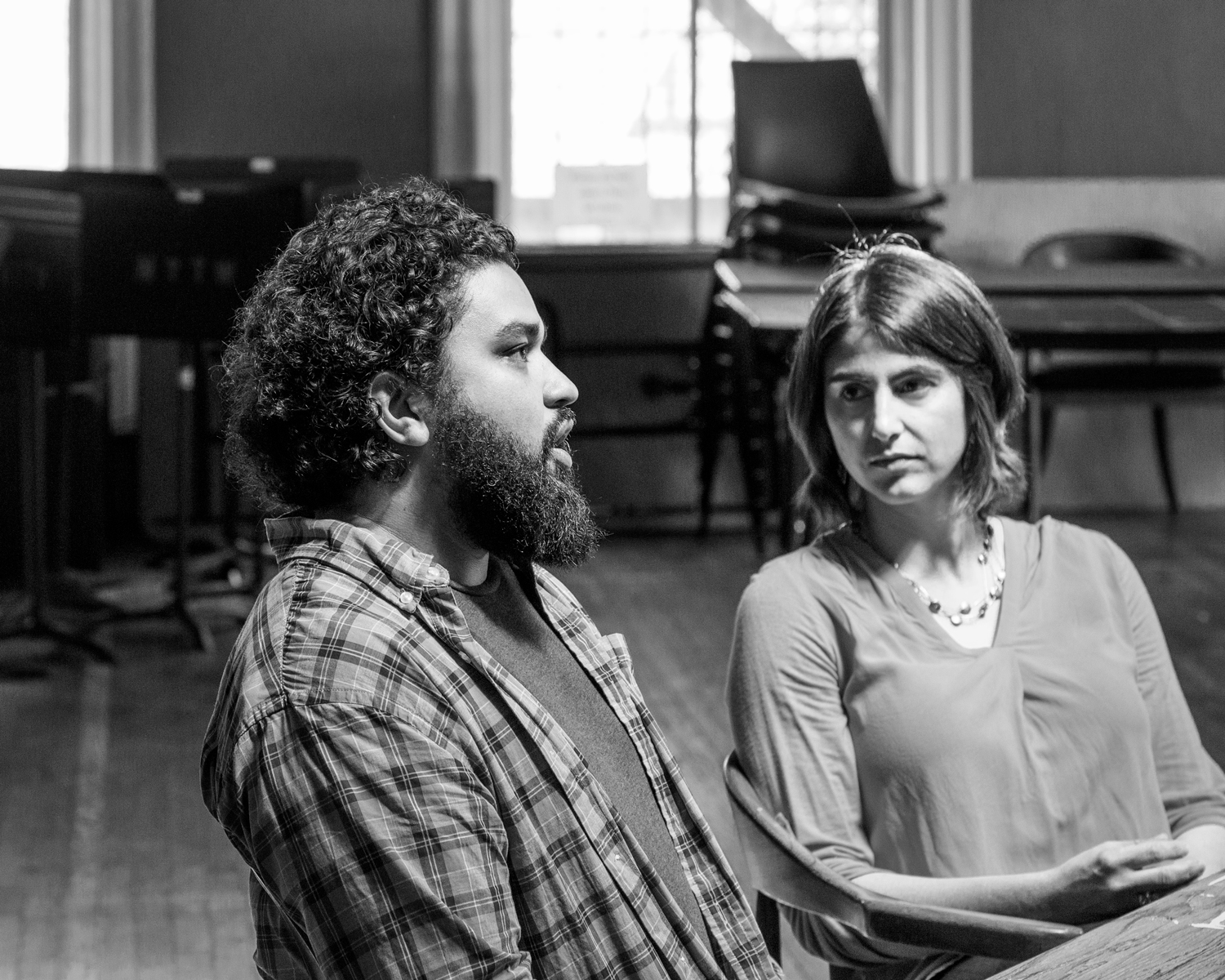
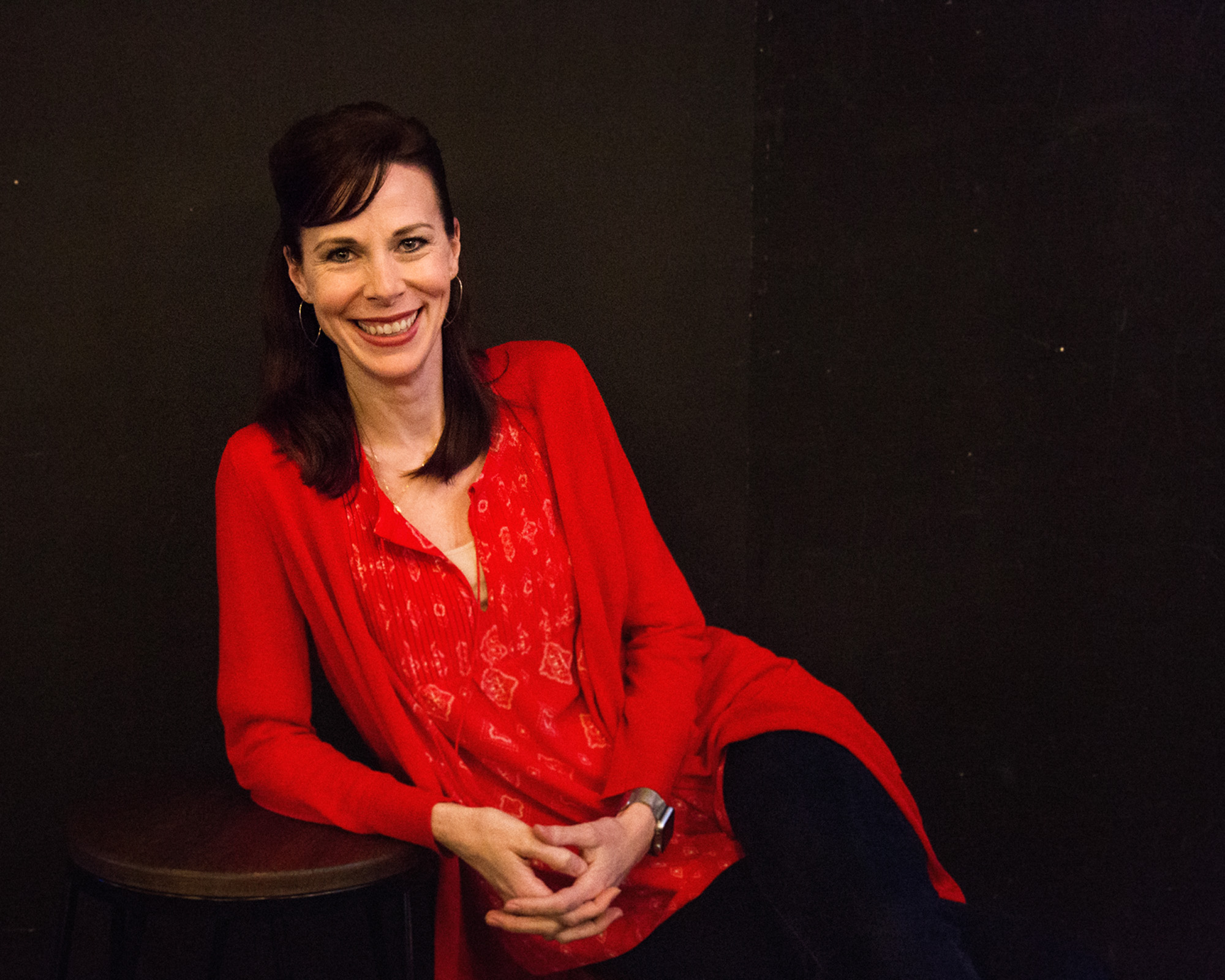
Christa Scott-Reed


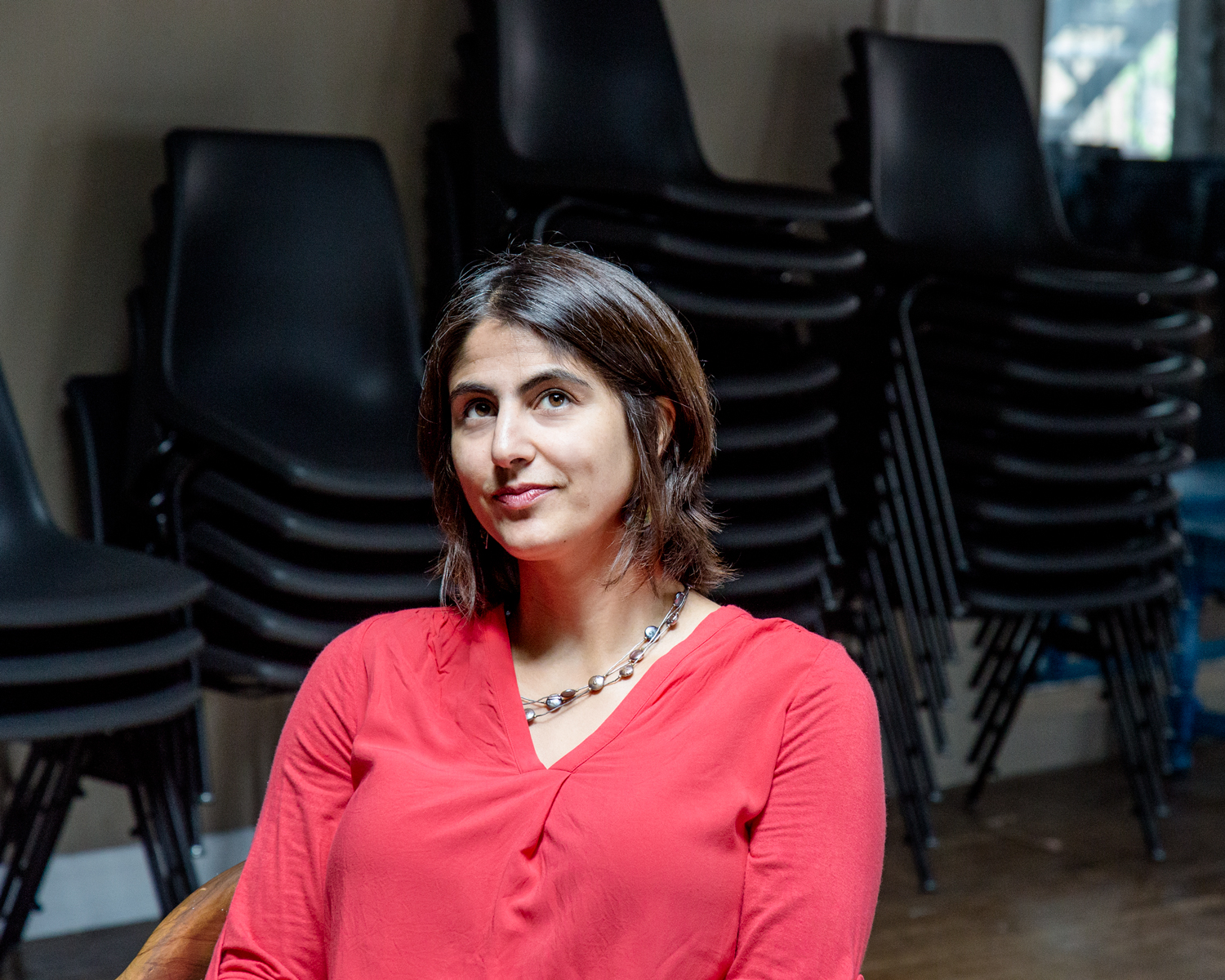
Shadowlands tells the touching story of the relationship between C. S. Lewis and Helen Joy Davidman. The Fellowship of Performing Arts is producing the first New York revival of this acclaimed play, which began performances at the Acorn Theater on October 17. We spoke with Christa Scott-Reed, who is making her directorial debut, about what makes the play relevant to modern audiences, and about the relationship between faith and the arts.


Margarita Javier: Could you tell us a little bit about yourself?
 

Christa Scott-Reed: I’m originally from the Pacific Northwest, from a little town called Wenatchee, Washington. It’s actually surprisingly home to a few theater artists in New York. It’s interesting because for a small town kind of in the middle of nowhere, they have a surprising love for theater. And I think it’s because it’s not geographically close to any other cities, so they sort of had to create their own cultural life.
 

MJ: So there’s a lot of theater there?
 

CSR: Yes! I mean, it’s all community theater; it’s not professional. But there’s a real love of it. For an agricultural town and one that’s relatively conservative, it’s remarkable how much they really value theater. I grew up just being immersed in it from a young age. And occasionally we’d get to go over to Seattle—and Dan Sullivan was running Seattle Rep at the time—and saw stuff there, and so that’s where I began. I went to undergrad at Whitman College in Washington, went to grad school at the Denver Center, and then found my way here.
 

MJ: Did you start as a performer?
 

CSR: I was always a performer until this particular job.
 

MJ: This is your first time directing?
 

CSR: This is my first time directing, yes.
 

MJ: How did that come about?
 

CSR: As a performer, I worked for Fellowship of the Performing Arts starting in 2013 on their production of The Great Divorce. And it started as a developmental production Off-Broadway, then we did a two-year national tour, and then we brought it back again to Off-Broadway. So it was a long stretch with them. And while I was working with them on Great Divorce, they started using me because, in my off-time as a performer, I also teach and coach other actors, so they started bringing me in, kind of as an artistic consultant, to maybe work with other actors in other productions, to direct readings, to help cast readings, to give artistic input in certain ways. And they started using me more and more for that. They sort of made it official when they realized that one thing they lacked in the company was a literary manager. And since I had been doing a lot with them in various ways, they said, “How about stepping in for this literary manager job?” I said, “I’m still a performer!” They said, “We get that; let’s call it a part time gig.” And in that role as literary manager, I directed a staged reading of Shadowlands for over a hundred donors and everybody seemed happy with that. Things started rolling and, because they had seen me handle the stage reading and because they had seen me in the room with actors, a couple of which are in the cast now, they said, “Ok you know what? We feel like we trust you. Let’s just have you do it. You’ve been a professional actor for over 20 years—you’ve been in the room. We think you can handle this.”
 

Christa Scott-Reed
 

MJ: Are you taking from directors you’ve worked with?
 

CSR: Absolutely. In fact, the other day my assistant director was noticing how I was doing my notes in the script a certain way, and he said, “Who’d you get that from?” And I said, “Rob Ruggiero” [laughs]. So, absolutely. And in fact, I’ve reached out in this process to several good friends of mine who I respect hugely as directors, and asked for their advice, their wisdom. They’ve put in good words for me. I’ve not been shy to try to humbly learn from those who know better than I do.
 

MJ: Correct me if I’m wrong, but this is the first New York City revival of Shadowlands.
 

CSR: It is.
 

MJ: So it’s a big undertaking as the first project to be directing, right?
 

CSR: It is. When you’re going to direct something for the first time, why not pick a show that’s set in the 1950s England, with 12 cast members, two of which are children, and 35 scene changes—why not? I mean, it’s an easy one. An easy one [laughs].
 

MJ: What can you tell us about the show itself, Shadowlands?
 

CSR: It’s a beautiful show. A lot of people know it because it was not only from Broadway and the West End, but because it was made into a movie with Anthony Hopkins and Debra Winger. People know it from that. They go “Oh right, Shadowlands!” But it’s time for it to come back to remind themselves of it. It’s a beautiful story. It’s known as a little bit of a three-hanky piece, but it’s not just that. Working on it, I’m reminded of how moving and how thought provoking it is. Those are all clichéd words, but really true in this case. And it’s also really nice -I was telling somebody else- it’s really nice to have a show that is a love story, but a love story between people who aren’t 22, who aren’t passionately falling for each other in that first-time way. There’s room for those stories, and those stories are being done, but I like the fact that these are mature people who have lived their lives, who have pain and suffering under their belts, who have past marriages and children and all those kinds of things. Telling that story as a love story is, I think, refreshing, especially for a theater audience who’s not largely 22 year olds. I know I’m not! And then you add to it the layers of what it has to say about the meaning of suffering: Why does God allow suffering in the world? What do we give up in order to gain something? When we gain so much joy and love, what do we give up in the form of pain and suffering? How does that test our faith, our doubt? All universal subjects that really resonate. Even though C. S. Lewis was, I think, a renowned Christian, there are things that resonate for anyone regardless of faith background. It’s about human experience.
 

MJ: And because this is based on a true story, has there been a process of doing research into the lives of C. S. Lewis and Joy Davidman? What has that been like?
 

CSR: Absolutely. And in fact, as somebody who probably in another life would have preferred to be a librarian—and I don’t joke when I say that—I love research. I took my dramaturgical element burden a little bit too far and spent months reading every biography I could get my hands on, and I ended up compiling it into this hefty stack of research about the characters, background about Oxford, everything I could get my hands on. And I presented it to the cast. I said, “There won’t be a test on this, but use this as a resource.” And I remember Danny, who plays C. S. Lewis, said, “Well, I do have a friend in England who had studied with or knew C. S. Lewis, and I was going to contact him. I don’t know that I need to now!” [laughs]. So I went a little crazy. It was also important for me to tell them that this isn’t a documentary. Danny doesn’t look like C. S. Lewis. These are different people—this is a play, it’s not reality. Of course it’s inspired by true events, and we want to maintain a sense of strong connection to those ideas. He may not look exactly like Lewis, but he is Lewis for this story. What are his needs, his wants, his loves?
 

Christa Scott-Reed
 

MJ: Why do you think this play is relevant to today’s audiences, specifically in New York? What do you think it’s telling us?
 

CSR: Touching on what I said before, honestly, look at what happened recently in Las Vegas. One of the first things the character of Lewis does as he walks out onstage is to hold up a newspaper and say, “This tragedy.” In this case, it was the Gillingham bus disaster in the 1950s. He says, “This just happened. How can God allow this to happen? What is the meaning of this kind of suffering?” Obviously, that’s true of any period in time, but I think this is something we’re struggling with constantly. How do we deal with pain? What is the purpose of it? I think it’s true no matter what decade you’re in. It’s always going to be relevant.
 

MJ: And you mentioned this is being produced by the Fellowship of Performing Arts, a not-for-profit company that is interested in delivering theater that has a Christian worldview. So first of all, how did you first become involved with them?
 

CSR: I auditioned like anybody else through their casting director for The Great Divorce. One thing I particularly respect about FPA is they have this mission to deliver theater from a Christian worldview that will engage a diverse audience, so they want to present a piece of art that is executed to its highest level possible. To that end, they want the best artists. They did not ask me when I auditioned what my faith background was or what my beliefs were. I’ve been at talkbacks with the artistic directors, and members of the audience ask, “Well, who in the cast, or designers, or crew—who is Christian?” And he just says, “I don’t know. You’ll have to ask them.” And I really appreciate that. What they require from an artist who works with them is somebody who is willing to do the best job they can, to make the best piece of art that they can, that speaks to that mission. But we have artists of all faith backgrounds or no faith backgrounds. Because so often—and I’m just speaking for myself now—when you hear the term “Christian theater”—and I happen to be a Christian—but even I wince a little bit. You think this is going to be some kind of eye rolling niche theater that’s just … ugh. And that’s really not their purpose. They really want to do a piece of art that’s intellectually challenging, emotionally engaging, something that audience members can come to and, regardless of faith background, be interested or fascinated by, come out of the theater laughing, thinking. They have managed to do that. When we did The Great Divorce, friends of mine came to see it when we were on tour in D.C.—and these are people who firmly have their own faith tradition which is not Christian, and they will never be interested in being Christian, nor should they—but they signed up for the newsletter because they loved the play so much. They all happen to be psychologists and they were all so engaged in the ideas. That’s the kind of thing that they’re interested in. Yes, of course FPA wants to provide theater for practicing Christians who are looking for art that speaks to them, that’s not speaking beneath them, but actually meets them at an intellectual level that’s satisfying. But at the same time, we want to bring other people in. The ideas of C. S. Lewis are interesting to people of all different types and sorts.
 

MJ: Going by what you said, I think we can agree that Christianity as a religion has been hijacked by the political right, definitely in this country, but also other parts of the world. Because of that, there tends to be a negative association with that religion for people of more liberal political leanings, especially in the theater world. What would you say to that end in terms of what this theater company is trying to achieve?
 

CSR: Certainly in our audience, there are conservative people, there are progressive people, there are people who span all parts of the political spectrum, as well as all parts of the faith spectrum. But I think we deliver stories that speak authentically to the human experience and that expand our imaginations rather than limit them. And I think a lot of progressives—and I count myself as progressive—get upset with a too-conservatively imagined Christianity; there’s this idea of limiting thought, of limiting experience of putting up barriers and saying, “This is acceptable and this is not.” And I don’t think that artists are in the business of doing that.
 

MJ: Right, and C. S. Lewis was a perfect example of that: he was very much an intellectual proponent of Christianity.
 

CSR: I know that for Max, our artistic director, his real desire is to do work that is intellectually respected. I think we can get people’s attention that way. You can walk in and be like “Let’s see what these Christians have for us” and then walk out going “That blew my mind a little bit.” We get a lot of reviews like that. Over the course of the last few years, a lot of the reviewers will start by saying, “I expected to be preached at. And that’s not what I got. I started thinking new thoughts.” We’re not in the business of alienating people; we’re not in the business of telling people what to think. We’re in the business of showing a piece of art that hopefully speaks to your body, soul, and mind.
 

Christa Scott-Reed
 

MJ: When you talk about a “Christian worldview,” what is that? What is a Christian worldview?
 

CSR: Well, certainly, it would be one that speaks to the values and the ideas behind a Christ centered life. So it would be love, compassion, what they talk about in Shadowlands. The whole concept of the title of Shadowlands is a Platonic idea—that the world we live in now is really just a shadow of the life to come, that true reality is something that lives beyond. It’s not special just to Christianity, but it’s certainly something that is an important part of Christianity: that there is another world, there is something supernatural that is beyond that. All of our shows have an element of the supernatural for that reason: that there’s something beyond, there’s something more. If we can find how we can best live in the present and be in the best relationship with other people and with God, that’s all part of becoming more real for the realness to come.
 

MJ: I’m fascinated by Joy Davidman.
 

CSR: I know, right? What an amazing character.
 

MJ: And we don’t know as much about her as we do about C. S. Lewis, so I was hoping you can talk about her, in terms of the play.
 

CSR: Yes, it’s interesting when you asked, “How does this play speak to New Yorkers?” because she’s perfect. She is such a New Yorker: from the Bronx, born into a Jewish but non-religious family, an incredible intellectual. She was absolutely C. S. Lewis’ intellectual equal. She was a genius, off the charts.
 

MJ: That’s what drew him to her initially, her intellect.
 

CSR: Oh absolutely, yeah. And she started as a passionate communist and a writer, and then discovered that communism as it was being practiced was just not for her, so she eventually moved away from that. She was always searching for something. At one point she was interested in Dianetics, before it became Scientology, but she eventually came to Christianity herself and, as a result of that, started writing to C. S. Lewis and him to her. As you said, then it was meeting of the minds—this purely intellectual relationship started via letter writing for a couple of years and then once they finally met, everything blew up from there.
 

MJ: What can you tell us about the cast?
 

CSR: Our cast is great. Daniel Gerroll plays C. S. Lewis. He’s a wonderful British and American actor that people will know from years of Broadway and Off-Broadway shows, films, and television. Robin Abramson plays Joy, and she’s a revelation. I’m really excited about showing Robin to New York audiences because she has been sort of the young leading lady of Pittsburgh, which is where she’s from. She only recently moved to New York, this is her New York stage debut. This feels like the way Joy kind of bursts into C. S. Lewis’ life, and, in a way, I feel like Robin is bursting into New York, and I can’t wait for people to see her. It’s just a wonderful group of actors. John C. Vennema, whom audiences have seen in a million wonderful things in New York, is exceptional and hilarious as C. S. Lewis’ brother Warnie. There are excellent actors across the board in this play.
 

MJ: Being a performer yourself, how does that inform your job as a director?
 

CSR: My assistant director, whom I had never worked with before, has worked with lots of directors but never with one who was also an actor, so he keeps saying, “It’s so interesting the things that you focus on that other directors don’t.” Whether it’s concern about how certain actors should carry certain things, or how difficult it will be for an actor to wear a costume, or how the dialogue is going—just little actor-centric things. He says most directors don’t think of that stuff. I think my strength going into the production was knowing how to communicate with actors, not only from teaching and coaching, but also just being in productions and having that relationship. The thing that I’ve had to learn on the job is staging in a way I never had before: blocking, seeing the entire arc of a show in a new way. I was always focused on my part as an actor. So it’s been a learn-on-the-job situation, but it’s been very satisfying.
 

MJ: Who would you say are your biggest influences both as a performer and as a director?
 

CSR: Where to begin? I will have to say Dan Sullivan’s productions on Seattle Rep stage. His productions are what made me love theater. There are so many beautiful directors working today. I saw a production recently that blew me away, Everybody by Branden Jacobs-Jenkins at Signature, directed by Lila Neugebauer. It’s a modern retelling of the medieval Everyman story, and it had this heightened, almost theological, philosophical thing, and it was not coming from a Christian worldview, but it spoke at those levels and it was so deeply affecting. Shadowlands is a little bit of a departure for FPA in the sense that it’s so traditional. They have tended to do very artistically “out there” stuff, whether it’s The Screwtape Letters or The Great Divorce. The show they have right now, Martin Luther on Trial, which is touring, tells the story of Martin Luther in the afterlife; he’s on trial and the devil is the prosecuting attorney. St. Peter is the judge and the witnesses are everyone from Hitler to Freud to Pope Francis to Martin Luther King Jr. They tend to do these highly theatrical pieces, so in a way, Shadowlands is a bit more of a traditional affair for them. But it still has magic in it.
 

Christa Scott-Reed
 

MJ: What do you feel is the relationship between faith and the arts, specifically theater?
 

CSR: It seems like such a natural connection. If you go back in history, theater first evolved from religious expression: the mask works of the Greeks, to the Medieval Churches, the Passion plays. How do you express magic? How do you express the unexpressed? Through art, right? And how does one even begin to articulate what is faith or what is ultimate joy as experienced through faith? Why do they sing in musicals? Because they have no other way of expressing emotions. I think at some point, you have to leave standard expressions and enter into an artistic realm. Even Christ spoke in stories, in parable. A lot of times, it’s difficult when we get too strict in our definitions of biblical text, because we as a society don’t have an understanding of how people thousands of years ago wrote and expressed themselves much more metaphorically. So it seems like the arts are a natural extension of that.
 

MJ: Moving forward, do you want to direct again?
 

CSR: I’m certainly open to it. It’s been a really fun, mind-blowing, and mind-expanding experience. I’ve learned so much more about theater. I thought I kinda knew it; I was like: “I got this! I know all about it!” And then you go into this meeting where they’re discussing set construction, and where and how it gets constructed, and they talk about the electrics, and the light rigging, and I realized I didn’t even begin to know. The amount of marketing material, the thousands of daily e-mails tweaking every little thing. I didn’t realize that when you pull open that wonderful Wizard of Oz curtain, behind there, it’s a mile long. I don’t want to sound too ignorant; I obviously had an idea, but there was more that I had no idea about. So it’s exciting. I’ve just seen behind the curtain. I want to get better at it. I want to learn even more. Let your readers know, though, I am not giving up acting. It is my passion. Please cast me! [laughs]
 

MJ: Is there a play that you would love to direct?
 

CSR: The minute I learned that I was directing this, I was like: “So that my mind doesn’t completely liquefy from being too overwhelmed, I’m just going to focus on this play and think about nothing but this play”. So obviously it hasn’t occurred to me. Other than the fact that as a literary manager I have other scripts for FPA that we’re talking about developing and—no pressure on FPA—but certainly every now and then it occurs to me about whether I’d like to try to convince them to let me do this again.
 

MJ: What about performing wise? Is there any role you’ve always wanted to play and haven’t yet?
 

CSR: It’s interesting how I’ve had to shift those over the course of my life. There would be parts that now I realize “I’ve aged right out of that one, haven’t I?” I did so much classical theater when I was a younger woman, and then I had children and that necessitated staying in New York, so I just started working with more new plays. So now that I’ve skipped forward into a different age range, when can I go back to playing all those classical roles that were always out of my reach? But still please cast me in modern plays and in film and TV [laughs].
 

MJ: Why should people come see this show and what do you hope people will get out of it?
 

CSR: I’ll say the obvious: it’s really good. It’s a really good play. Our sound designer, John Gromada, a wonderful Tony-nominated sound designer, said, “This is a really good play!” It sneaks up on you. You go in and think: I’m going to hear some smart ideas from the mouth of C. S. Lewis that you would expect to hear. And then all of a sudden, you’re crying and you’re not exactly sure why. It just sinks into your bones. There’s something about this play that is deeply affecting in a mature way. Not that you can’t be 22 and see this and enjoy it, but this is a play for someone like me, someone who’s had some life experience and who’s had to ask those tough life questions, deal with pain and loss and love and joy. I was just reading this amazing article about the midlife crisis for women—a subject that’s not much dealt with—and how suddenly there’s this perfect life storm of all these different life things bouncing up against each other. Coming to see a piece of art like this—where someone like me is sorting through those ideas too, but in a way that’s a thousand times more articulate than I could ever be—emotionally organizes those thoughts in a way that makes me go: “Yes. This is actually how prayer works in a way that’s not derivative or simple minded. That is really how we can think of suffering and love in a way that has real genuine, mature thought, but still grabs me by the gut at the same time.” We go see smart plays, witty plays, and we go see emotionally powerful plays that are messy. But to see those worlds meet? I think it’s rarer than we realize.


Broadway: The Pitman Painters.  National Tour: C.S. Lewis’ The Great Divorce. Off-Broadway: Church and State (New World Stages); The Great Divorce (world premiere, Fellowship for Performing Arts); The Talls (world premiere, Second Stage); The Freedom of the City (Irish Repertory Theatre); Celebration and The RoomThe Bald Soprano and the Lesson10×2010×25 (Atlantic Theatre Company); Beasley’s Christmas PartyPullman Car HiawathaMuseum (Keen Company); Deathbed (world premiere, McGinn-Cazale Theatre); Marion Bridge (Urban Stages); The Voysey Inheritance (Mint Theater Company).  Film & Television: 30 RockThe ImpossibilitiesEdenGossip Girl666 Park AvenueLaw & OrderLaw & Order: SVULove LifeNew AmsterdamAs the World Turns. Regional Theater: Mark St. Germain’s Relativity at TheatreWorks (with Richard Dreyfuss); On Golden Pond (with Keir Dullea, Bucks County Playhouse); Argonautika, Honour (with Kathleen Chalfant, Berkeley Repertory Theatre); Restoration ComedyThe Food Chain (The Old Globe); The Little Dog Laughed (Intiman Theatre);  As You Like ItCrimes of the Heart, the world premiere of Charles L. Mee’s Limonade Tous les Jours (Actors Theatre of Louisville).  Other Regional: Papermill Playhouse, Cincinnati Playhouse in the Park, Repertory Theatre of St. Louis, Pioneer Theatre, Barrington Stage, Syracuse Stage, Denver Center Theatre Company, Cleveland Playhouse, Olney Theatre Center, and many more.

Posted on

A Conversation with Orion Stephanie Johnstone

Orion Johnstone


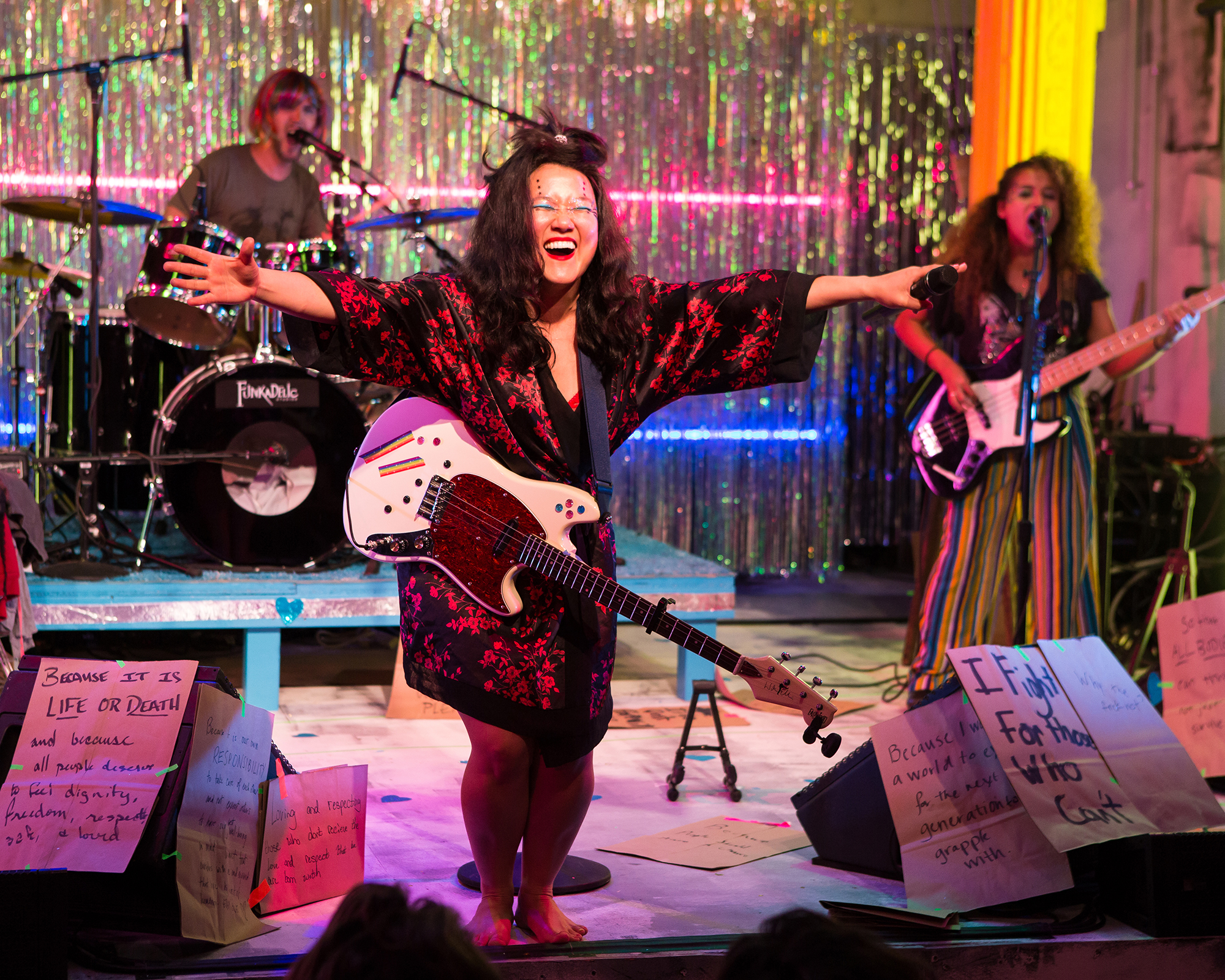
Upon entering Rattlestick Theatre for my scheduled conversation, an air of freeing and loving spirit came over me as I look up to see Orion Stephanie Johnstone ready to greet me. Once in awhile, you connect with someone so inspiring, time flies by, and you forget you’ve only just met this person for the first time an hour before. I sat down with Orion, co-director of Diana Oh’s {my lingerie play} 2017: Installation #9: THE CONCERT AND CALL TO ARMS!!!!!!!!!, The Final Installation for a wide-ranging and impassioned conversation about their influences, their identity, giving power to marginalized voices, and what it means to “queer the world.”


Michelle Tse: Let’s start with your journey with Diana [Oh], and specifically with {my lingerie play}.
 

Orion Stephanie Johnstone: Well, first off, I’d like to clarify: Diana has been doing {my lingerie play} installations since 2014, and what we are talking about here is the 9th installation in 2017: the concert and call to arms!!!!!!!!!, yes, with nine exclamations points.
 

Diana is a brilliant, powerful force in the world and we have circled each other and held each other in huge mutual respect for years, but had not worked together until this project. She came to me and said, “You are the one that I need to co-direct this.” At first I was humbled, and I hesitated, and I asked a lot more questions because I’m a highly collaborative theater artist, not primarily a capital “D” director. I have loads of facilitation experience and other things and I’m very comfortable in leadership positions, but this is a different hat than I’ve ever worn. Diana said, I don’t need this experienced director; I need a spiritual leader of the room. I need someone who I trust will hold a space where we all can transcend shame together. As a sexuality educator, I am passionate about not just inviting individuals to transcend shame, but in deepening all of our understanding of how our personal shame is connected to intersecting and overlapping systems of oppression.
 

After many conversations where I was always honored to be asked but wanted to ask more questions to make sure that this was a fit, I said an enthusiastic, “Hell yes.” And I’m so grateful that I did. We’ve been working together pretty intensely since early summer.
 

Orion Johnstone

(Pedro Aijon Torres)


MT: I have to say that when I was here, I felt like it was the first time in a long time other than a couple things here and there, that I actually had the thought of, “This is what an inclusive space is.” It’s happened a couple times before, but never in theater, honestly. Can you talk about the vision and the preview process?
 

OSJ: The two central questions of my life are: Who and how might we be together, more bravely in light of our collective liberation? And how might I be consistently expanding who I mean when we say “we”? I keep trying to run hard and fast away from theater-making because I have so often run up against the “who and how we are together” being so secondary to hitting certain other marks, or to commodifying the soulfulness of what’s being created.
 

The invitation that Diana posed to me, essentially, is how do we live by those central questions, to embody our commitment to the idea that how we make is as important as what we make. How do we create a robust culture of courage and compassion, and care, and lead with that and trust that in every aspect of the process. There are always going to be things that are beyond our zones of awareness, but I’m done with feeling immobilized by that. I’m always so grateful when something is brought to my attention like, Oh, I haven’t actually been accountable to this person or this community in this. I think it’s easy to feel guilty and overwhelmed and shut down, but my prayer and intention for myself and for all of the work that I make is “May I embrace that we’re all on a continual learning journey about this, and to hear that feedback. Hold that with love and how might we expand, how might we do better, even knowing that nothing is going to be perfect.” I fiercely love Diana in her commitment to that, too!


(Jeremy Daniels)/ ({my lingerie play} 2014: Installation #5: 30 PEOPLE; Emma Pratte)/ (Jeremy Daniels)


MT: Feeding off of that and what we were talking about in an earlier conversation, you have the community choir for queer and trans folks, the dating app for kinky people, your sex and relationships coaching practice, and—
 

OSJ: —The alternative divinity school.
 

MT: Exactly, so a lot of your work centers around giving power to marginalized voices and people, so when you do come across someone that is maybe a straight white folk who considers themselves liberal and progressive, but maybe keeps asking the wrong questions. They want to learn, but you just keep hitting that same roadblock. Do you keep going back to them like, “Hey, that’s not cool, you got to do x, y, and z,” and at what point do you say, “Okay, I need to just maybe walk away from this situation,” focus on marginalized folks, then beam up that space as opposed to the education of that larger “we” that you were talking about?
 

OSJ: Thank you so much for that question and the many, many layers in it.
 

MT: I could’ve been a little more concise, but that’s what keeps me up.
 

OSJ: I share this question so much! First off, I think that I couldn’t get up in the morning if I didn’t believe that every human is capable of transformation. And also, I’m very exhausted. I’m very very angry. I’ve been learning about how to not shy away from expressing my anger and instead to deepen in learning how I might express my anger with love in a way that hopefully doesn’t diminish anybody else’s humanity, and also doesn’t diminish the very real violence and erasure that people I’m in community with and/or myself are experiencing.
 

Capitalism would have us believe the lie that there’s scarcity in terms of who can be liberated. Like, If we’re having racial justice we can’t be focused on trans justice right now. Bullshit. If we’re focused on trans justice, then we can’t be talking about disability rights, and so on and so on. That’s absolutely bullshit.
 

MT: The linear versus intersectionality, basically, right?
 

OSJ: Yeah, and if I truly believe that our liberation is collective, that absolutely must include cis white straight people, too. And also, I keep learning more about how and where I channel my energy day to day. At least right now, my energy is most channeled toward amplifying and co-liberating with marginalized folks, or rather, people who carry power that is not necessarily the most dominantly celebrated kind of power. More and more these days, I get honest about my capacity for conversations that are primarily educational, and I honor that that labor does not always have to be mine to do. I try to see where I can show up to do labor for other folks who can’t, knowing that my liberation is intimately bound with theirs. And I believe that, as a white person, I have a responsibility to have tough conversations with other white people. I realize that my answer is all over the map here. The big answer to your question is, it’s really fucking hard as I know you know, and it’s a continual navigation day to day.
 

MT: For some reason it reminds me of Maya Angelou, who talked about why she doesn’t hate her rapist. That she feels that we all have that within us. That we all have Hitler and Gandhi, basically within us, right?
 

OSJ: Yeah, yeah.
 

MT: It’s just a matter of how your life journey has made you access different nodes of those feelings and those wires within your head. When it’s so violent everyday you can’t help but be like, “Oh.”
 

OSJ: Can I … I want to respond just a little bit more to that other question.
 

MT: Please do.
 

Jeremy Daniel

(Jeremy Daniels)


OSJ: I’m 34 now. Until I was 22, I was a fundamentalist Evangelical Christian. Though I was always acting from a place that I understood to be compassion and care, I perpetuated Christian Supremacy and its ties to patriarchy and homophobia and transphobia and white supremacy. I mean, I still inevitably perpetuate oppression in a way that none of us are separate from. But having had a worldview and paradigm that is so extremely different from what I have now, I now have so much compassion for people’s journeys. At the same time, it’s not easy to hold to that compassion when people I know and love are experiencing such violence on a daily basis and there’s so much to be heavy-hearted about.
 

MT: I now have to take every other day off from watching even Vice news, because the saturation and violence and abuse is so rampant.
 

OSJ: Can I ask how you’re holding that question these days?
 

MT: I’ve now had a few white friends tell me, “Please just send them my way because I’m frustrated just hearing about what you had to deal with.” But lot of these moments come up when you’re not expecting it or when you’re the only person at the table who can answer the question. It’s quite painful to constantly be teaching empathy and essentially telling folks, “Hey, I matter as much as you.” I often come up against the moment of do I just shut up and order a drink, or do I just get up and scream, “Are you seriously only able to relate it back to yourself only?” It’s especially painful when you’re halfway into a conversation and they’ve agreed that, for example, white feminism is a problem, and that they’ve been doing the reading they need to, so you have an expectation. Then later on, they’ll say or mention something that is so exclusionary that my heart will just sink to my feet. Somedays I have to just be okay with, Okay, this is as much as I can affect today, here and now.
 

OSJ: That’s so real. Thank you for sharing that. I think of the times when I’ve been called in around the privileges that I carry as a white person. There have been times when folks have been really patient with me and asked me questions and stuck with me even at the expense of their spirit energy, and I have grown from that. And then there have been times when folks have been really, really angry at me, and me having to sit with that discomfort has also invited some necessary growth and transformation.
 

MT: I think for me, though, I always know that if I show emotion, especially anger and frustration, that other person would shut down completely. I’m exhausted, I can’t deal sometimes, but I can’t be shutting down and angry and not dealing with it because if I tell them to go away, they might never engage with that particular issue again. And that becomes another weight, especially when it comes to racism. That in itself is frustrating. There’s no one else around me that can take this mic right now and … It’s like, “Well, crap, what do I do?”
 

OSJ: Yes, yes. I hear and honor that and I wish that I had a simple answer and response. I think the only thing that I know to be true is how—well, I guess I hope to be true is—I hope that even when you or I, or anyone feels very alone and like they’re the only person that could have this conversation, that actually, that isn’t the case. That we do all hold it together. Whenever any of us can have capacity, that’s a good thing, and none of us has to have capacity all the time.
 

MT: Right, exactly.
 

OSJ: And by us, I mean: folks who have experienced the marginalization, folks who have feared for their literal safety while walking down the street, though that’s not a clear cut binary of those who have and those who haven’t. I feel like this is tricky territory.
 

MT: Those invisible marginalizations.
 

OSJ: It’s just wild.
 

MT: I have friends on a spectrum of disability or differently abled from you can’t see it at all, to being in a motorized scooter. And it’s painfully obvious that this city doesn’t cater to that well what so ever.
 

OSJ: New York City sucks in terms of access.
 

MT: All anyone has to do is spend a couple hours with someone differently abled. It’s bananas.
 

Jeremy Daniel

(Jeremy Daniels)


OSJ: Can I give a shout out?
 

MT: Yes, please do.
 

OSJ: My friend Bri just started a podcast called Power Not Pity—conversations with people about access and disabilities. I think it’s fabulous.
 

MT: Amazing. I’ll have to check that out.
 

OSJ: I have a lot to learn.
 

MT: Yeah, I’m definitely learning too. I don’t see the point in living if we don’t keep learning and challenging ourselves. For inclusion and representation though, my thought is that for a lot of folks, they see progression in the linear format, and our intersectional brains have an easier time seeing the interconnectedness.
 

OSJ: I love the thing that Lilla Watson said, you probably know it already: “If you have come to help me, you’re wasting your time, but if you have come because your liberation is bound with mine, then let us work together.” Thinking in terms of collective liberation doesn’t slow us down or cost us anything, actually it means that we’re on the only possible track to cultural transformation, I believe.
 

MT: There’s that media norm though, the progressions. In my head, the only way I can try to relate, is to try to see it from that other perspective of there’s white feminism, then there’s current day feminism—that’s a little bit intersectional—and then there’s what you’re talking about, which is what I subscribe to, trans-inclusive feminism.
 

OSJ: Or even trans-centered feminism.
 

MT: Oh, that’s even better, yes. Thank you. So I wondered if you could speak about that and the dangers of not being trans-centered, and for it to be happening alongside intersectional conversations, about race, gender and sexuality, about economics … On and on.
 

OSJ: Thank you, and I could go on for days. This is where my major point of exhaustion lies. First and foremost, it’s no secret that our transfeminine sisters and siblings of color face, by far, the highest risk of violence and discrimination out of anybody. And yet, even in so many wonderful, progressive spaces that I move in, there is often not only a learning curve that needs to happen, but an unwillingness to honor the identities of trans folks.
 

It’s so fucking sad and enraging to me when women, or anybody, feels like including transfeminine people in their feminism is taking something away from them. Again, that goes back to the lie of scarcity that capitalism would have us believe. That by including all women, trans and cis, that inclusion doesn’t mean we’re brushing under the rug that different women have different experiences. Women of different backgrounds and identities of all kinds—race, class privilege, ability—have very, very different experiences. And people are dying! It’s so sad to me when folks feel like that’s taking something away to be inclusive there.
 

It also breaks my heart that so much that the world has so very very very far to go in terms of even welcoming and fighting for the basic rights of binary trans men and women. So that in terms of non-binary trans folk across the gender spectrum—as I think you know, I am non-binary—we just brush that conversation under the rug or we just can’t even go there yet.
 

MT: It’s the progression of others versus the self.
 

OSJ: I also don’t believe that that’s linear.
 

MT: It’s not.
 

OSJ: And I truly believe that everyone, trans and cis, binary and non-binary, is more liberated when we hold this more expansive understanding of gender and gender complexity.
Jeremy Daniel

(Jeremy Daniels)


MT: Bringing you back to the show, as related to that point: there’s a phrase you and Diana use that I love so much—
 

OSJ: —Queer The World.
 

MT: Queer The World.
 

OSJ: I love Diana’s specific phrasing in the show. She says something like: “What ‘Queer the World’ means, to me, is not that everyone should be gay. Queer The World is direct confrontation, an unapologetic disruption of the lies that capitalist patriarchal cis heteronormative society would tell us.” That’s from Diana. I was like, “Hell yes!!”
 

MT: Oh, I’m so happy. I was so happy when that moment in the show manifested.
 

OSJ: Queer, to me, contains both ultimate celebratory welcome and wonder, like welcoming all of who you are, and also it simultaneously contains this bold fuck you, this unapologetic disruption. The word “queer” originally meant something that was askew of what is straight or capital “N” normative, and so “queering” is necessarily, by definition, questioning the norm, inviting discomfort. It takes courage to be together in this discomfort, in these big questions which unapologetically disrupt these lies and the pressure of the dominant stories of normativity. And of course then, queer is so much more than just who you are attracted to, queer is who you are accountable to.
 
MT: I do want to get back to something that keeps coming up, capitalism. You mentioned earlier stepping away a little bit from theater arts.
 

OSJ: Stepping away a lot from theater arts.
 

MT: I come from an industry that I saw to be even more oppressive than the theater environment. I was like, “What?” When I first started, I was like, at least this is somewhat fixable. But again, finances play a big role. Do you think that folks aren’t able to work in the theater and become theater artists unless they had some sort of external financial support system? I would guess economics would be—
 

OSJ: —By work in the theater, just to clarify, we’re talking about contemporary North American commercial and non-profit theater.
 

MT: Yeah, exactly. Even off Broadway.
 

Orion Johnstone

(Emma Pratte)


OSJ: I was in a great discussion today with the alternative divinity school that I co-created, and we were naming how we want to celebrate and lift up unpaid labor, the emotional labor that folks are doing on the team. We want to lift that up. And also, we want to acknowledge: Who has the privilege to have space and time do that unpaid labor? Like it’s no secret that so many unpaid internships in the arts are filled by folks who carry the privilege to be able to take that financial risk because of their external support system, and that that then carries over into who moves up beyond intern roles in the art world.
 

What you’ve asked is big and hard and important, and I’m inspired by so many models of community art making and how much I believe that culture and art making is a basic human right. Anything we’re making in this society is going to be navigating the systems that are broken in different ways to greater or lesser degrees. That’s why I’ve been running from theater. Not because I don’t believe in its transformative power, because I really do. I don’t believe that art is a luxury, I believe that art is a human right.
 

Personally, I try to orient by these three questions inspired by this Quaker philosopher, Parker Palmer: “To what extent am I honoring my gifts and capacities and limitations? To what extent am I honoring the needs and hungers in the world, and to what extent am I honoring the intersections between those things?” When I most deeply answer to that question, the answer for me lately is very rarely art making. The answer to me is usually soulful organizing, facilitation, and long term movement building. I love the thing that Grace Lee Boggs said … What a hero she was. One of the many powerful things she said was that we must do more than struggle against existing institutions, we need a philosophical spiritual transformation toward being more human human beings. All of the organizing work I do is leading with that and asking the big questions about what is the widespread cultural healing that needs to go instep in order for widespread systems to change towards more justice that needs to happen. I’ve been running from theater because can’t stomach making art unless the culture of the process honors all of what I’ve articulated here, and I’ve been so lucky lately to be asked to make a few things that do honor all of that, like Primer For a Failed Superpower with the TEAM and this show with Diana.
 

Jeremy Daniel

(Jeremy Daniel)


MT: Which is another huge hurdle, because I often say to people that I didn’t realize how the other half lived until Obama came along and by the fifth or sixth year, I was noticing that my friends of color and I were walking a little taller, talking a little louder, dreaming a little bigger. I remember when Fresh Off the Boat premiered, and after it was over, I thought to myself, “Holy shit, this is how white people watch TV?” It was a different form of soul crushing for me on November 9th and 10th, I think, than a lot of folks. I often say I’m not mad at what happened, I’m mad at how folks were reacting to it because I couldn’t believe they had no idea where they exist. Then it becomes every single day like, “Oh, you didn’t hear this that I said for how many years?” Every time a white friend was disappointed, it was a reminder that nothing I said came through. That’s been every day, I feel like, since November, and I sink a little lower each time.
 

And so with what Grace said, knowing that we need the spirituality but also knowing that for someone like me to know my history, my people’s history, whatever it is, is so hard to find. There’s so much erasure. Especially in the Asian community, where we’re already so different and diverse, yet lumped together. So even when there is representation, it’s not proper representation.
 

OSJ: Yes.
 

MT: So when you’re doing work on how to be spiritually transforming, how do you spiritually identify or go beyond the existing infrastructure, how do you even then discover … Are you actively defining in the moment or how much of it are you trying go back in history and try to reference something and try to … My point is, you’re always going to be referencing something whether you know it or want to or not.
 

OSJ: I bow to that question. I’m thinking of it in terms of what we’re building upon and who are we accountable to from the past as we’re building. We talk about that at the alternative divinity school, what is the intersection between the ancient and the emergent, the old and the new? And I think so much about how there are so many layers to the violence that White Supremacy does to all of us. Including so much violence toward folks who are not white, and also robbing white folks of their humanity and connection to breath and body. I think of my Polish ancestors, and how many Slavic, earth-based traditions were covered over by Catholicism. A lot of my work is listening for what violence White Supremacy has done to all people, and how can we reclaim and support the spirit there. There’s obviously so much, but I think about queer and trans ancestry so much. Like Marsha P. Johnson, may she rest in power.
 

MT: Oh, yes. I love her and the power she brought forth.
 

OSJ: Marsha P — This hat says, “pay it no mind,” and that’s what the P in Marsha P. Johnson, it stands for “pay it no mind.” “Pay it no mind” is what she purportedly said to a judge when the judge asked her about her gender. She’s one of the people I’m proud to call chosen ancestor. She and Silvia Rivera were supporting and holding space for homeless trans youth, even while they were both homeless themselves! I think it is absolutely essential to think about what lineages we are personally coming from and building upon and also in movement sense. And I love geeking out about what we’re building on.
 

MT: I want to do a quick aside here and talk about Alt*Div, since it keeps coming up. Can you tell our readers about it?
 

OSJ: Oh yes, absolutely! Alt*Div is an alternative divinity school for soulful community builders, rooted in anti-oppression and collective liberation. We believe our world is in spiritual and moral crisis, that we are more alone and less connected to what matters, and to each other, than ever before. Because of that, we urgently need communities, and community leaders, which foster, as Grace Lee Boggs says “more human human beings,” in order to meet the urgent crises of our time and be a part of widespread cultural healing and systems shift toward a more just world. In practical terms, it’s a self-directed, de-centralized learning community for folks who are interested in those things. We’re now in our second year, and we’ve got participants from many places around the world. Thanks for asking!
 

Pedro Aijon Torres

L to Right (Back to Front): Rocky Vega, Orion Stephanie Johnstone, Diana Oh, Justin Johnson, Jhanae Bonnick, Matt Park, Ryan McCurdy, Mei Ann Teo, and Corey Ruzicano. (Pedro Aijon Torres)


MT: I am so glad I asked. That’s so inspiring. Now, why should people come see your show? I know, that’s another hour but, maybe a sentence answer.
 

OSJ: For spiritual nourishment! And to catch the contagious aphrodisiac of courage.
 

MT: I love that. I love that so much.
 

OSJ: Aphrodisiac of courage is the primary spell that Diana intends us to cast with this piece. Diana is fucking extraordinary and courageous, and her perspectives are incredibly important … I just want everyone to hear her voice and her story, and see her incredible work. And to leave drenched in glitter and soul sweat!
 

MT: Me too. Thank you.
 

OSJ: Thank you, Michelle.


{my lingerie play} 2017: Installation #9, THE CONCERT AND CALL TO ARMS!!!!!!!!!, The Final Installation is a play, a protest, a concert, and an installation all at once. Through this concert-play, Diana and her band explore mainstream culture’s relationship to the body and the deep and complex dynamics that exist regarding sex and gender politics. This culminates in a genre-bending soulful rock and R&B concert-play and final installation of {my lingerie play} 2017: 10 underground performance installations in lingerie staged in an effort to provide a saner, safer, more courageous world for women, trans, queer, and non-binary humans to live in.
 

Orion Stephanie Johnstone is a theatermaker/organizer/sexuality educator/community minister/composer with a fierce commitment to our collective liberation. Their original music has been at venues including Joe’s Pub, the Bushwick Starr, HERE, 3LD, and CSC. They were the assoc. MD of War Horse (1st nat’l tour), and they are music supervisor for the TEAM’s Primer for a Failed Superpower, alongside director Rachel Chavkin. They co-host the podcast Sex For Smart People, they are the chief director of content for KinkedIn: a new dating app for kinky people, they recently co-created a new alternative divinity school for soulful community builders, and they studied justice ministries at Auburn Seminary. www.orionjohnstone.com

Posted on

A Conversation with Rubén Polendo

Rubén Polendo


Last week, I had the opportunity to speak to Rubén Polendo, the Founding Artistic Director of Theater Mitu to talk about reinventing the classic American play by Arthur Miller, Death of a Salesman, and making theater in a time of change. A look inside his company’s process is a look inside one of the most innovative and creative minds in today’s American theater.


Darrel Alejandro Holnes: Why Death of a Salesman? Why now?
 

Rubén Polendo: I’ll tell you a bit about the arrival of the project, and then connect it to the now. When we first started exploring the piece, it came into the company’s conversation in a really particular way. We had been, as we often are on a yearly basis, in a conversation about what the next works we’ll be doing are. And I realized that as a company, we had fallen into a bit of a rut of saying, oh we don’t like that, oh we don’t do that. So there was an instinct in me to really unpack that. So I told the company — these are members who have been with the company for eight, six, or seven years, so there’s a fluency flowing through the dialogue — to make a list of all the things that we hated, that Theater Mitu “doesn’t do.” From making the list — and Arthur Miller ended up on that list — and it was oh, Arthur Miller. Who cares! It’s boring! It’s old-timey! All these things. After making that list, I told the company that I believe that this must be our next three years of work. If we’re asking audiences to open their hearts, their minds, their conversations, then there’s a kind of arrogance in the artist in then saying we only do that which is comfortable to us. I challenged the company away from saying Theater Mitu doesn’t do, be it Arthur Miller, Shakespeare, or musicals, into how does Theater Mitu wrestle with, or do, or engage with. It was such a wonderful space. So that was step one.
 

That summer, we had one of our training intensives, when we were in Thailand. I had packed my Arthur Miller plays and was reading them. I was gravitating towards The Crucible, just because the thematics I had some interest in and so forth, but I had several of his other plays with me. It happened to be that that moment landed during a company retreat, and in the timeline of the founding and original members, that while we were in Thailand, we started a whole other conversation, which was about really reaching that adult moment in your life as an artist and really coming to terms with who you are as an artist. The way that for me, in my early 20’s, so much was driven by what I was going to be and do, like it was a really conscious shaping of the future. Something really happened on the outset of reaching my late 30’s, which is that kind of realization of so this is who we are, and this is what the company has become, and it was really a celebration and admission to what it is. In some cases, it has become a letting go of what didn’t happen, or what did take shape, and so forth. And so in taking part in this part joyful, part sad conversation, and realize how much external pressure there was for us to be what we thought we were going to be, and do what we thought we were going to do, and so it became a very personal dialogue about aspirations that one has when young, and the realizations of where those land when you are truly an adult. I remember that night I went back to the place where we were staying at in Thailand, picked up Death of a Salesman, and then all of a sudden saw this incredible spectrum around that exact conversation, of Biff, saying, I am who I am, I am proud of it, let go of everything else, right up to Willy saying no, no, no, I am what I was supposed to be, I’m going to keep fighting for it. So there was a kind of entrapment to that, and within it are contradictions and nuances and so forth. I became incredibly moved by the piece. When I was rereading it, the four central characters became very clear to me quite instinctively, and their aloneness became very clear to me. And everybody else in the world of that Miller play felt so pre-recorded somehow, in the way that when you’re in some kind of crisis and you come to somebody and expect them to listen, that person always says, It’s going to be okay! Cheer up! – these kind of pre-recorded clichés. So that propelled a further instinct that all of the other characters would actually be pre-recorded, and the void of the humanity turns into these objects. That’s what started the process.
 

As we developed the piece and continued into the present time, it continues to reveal itself. One of the big revelations was, of course, being in this political moment — we’re in such a, I mean, the most benevolent framing would be to call it a moment of transition — there’s a way in which one of the biggest threads is this constant attempt to rewrite what is to be American. To actually see how literal it is to write people out of what is means to be American. To look back at Miller’s piece and realize he was dealing with the same things, which was revealing with this creature, Willy Loman, whose entire identity is tethered to his function, yet his function is being written out, by nature of industrialization, by nature of his age, and the nature of all of this change that is happening into the 50’s. The world is moving forward to this idea that it’s progress, it’s a new way of thinking, and people are being written out; Willy Loman is being written out. So to me that takes on a kind of Greek Tragedy quality to it, which really sets everything sail to where it is headed. I feel like it becomes a cautionary tale and a reminder of the moment and echoes the words of the play, which is that if we don’t pay attention, this is where it ends, just so everybody knows. The piece reveals itself so vibrantly. Manifesting it now really became important to us as a company.
 

Rubén Polendo
 

DAH: Can you talk about the theatrical approach to Death of a Salesman, and how you’re using the theatrical elements to answer the question of “What happens when you’re written out of the American Dream”?
 

RP: This goes back to that initial instinct. We as a company not only make work together, but we train together as well. One of the big goals is really to lean in and trust the artistic instinct, and to know that following that instinct will actually reveal the reason for that instinct. Often in making theatrical work, the artists have an instinct, and immediately that instinct is interrogated. So as an artist, you see the color blue, and someone says why is that? Why is that in the script? And you think, I don’t know! That was an instinct! We as a company actually feel that the rationale for all of our instincts we usually don’t see or truly understand until the work is complete because you’re being impacted by the text and your own ideas in the moment.
 

The instinct for me as a director became to manifest these four central characters and to really place them in a complete austere aloneness. That already had a kind of aesthetic implication which sort of implied an incredibly bare space, dry and absent of humanity. Once we did the pre-recorded voices, once that started, my instinct was to follow that and make [the supporting characters] these objects. There was also obviously a gravitation towards the time period so they became these objects of the time and they really became about manifesting the metaphorical language one uses for people. So if someone says, “that young man is so bright,” it literally manifests as a bright light that no one can even look at because it’s so bright. It was about taking the poetics of everyday language and manifesting them on stage. There’s something about that clarity that is so fantastic and exciting.
 

The equation that is then created is this world that has somehow stopped paying attention to the changes happening, but in fact, is just very blindly becoming another object or cog or piece in the machinery. We use this emotional focus on the family that is actually trying to stay human and ask questions and explore. The result is this very asphyxiating experience with, say Willy, as he’s sitting surrounded by these other characters that have now become objects, and truly saying, help me, please help me. And the objects are completely inhuman, and out of the recording comes, It’ll get better tomorrow! Willy, what’s going on next Thursday? And they keep ignoring him. It’s really frustrating to watch, because the objects just go about themselves, and it really becomes this cautionary tale of what happens when you ignore.
 

DAH: Thank you for sharing that; I just learned a lot. It makes me really curious about your work with your design team, and how they’ve all come together to create this very unique Theater Mitu aesthetic.
 

RP: One of the things that’s really important to us is to really promote a unified process, which is to move away from creating a kind of space that separates between director, designer, and actor. This makes for a longer process for us in terms of how it long it takes to develop work, but we do this because designer and actor and myself and all the other collaborators go from day one together. We actually don’t have pre-production meetings, we don’t have design meetings, we’re always all together. So what starts happening is that the aesthetic is really shaped in a unified way and links directly to the style. There’s never an aesthetic or design choice that is made and then revealed to one of the actors. It’s really about artists sitting together, having equal voice around this text, and really have it come from a central space; it becomes quite democratic. My job becomes much more curatorial, actually curating those ideas into unison.
 

I think of it as these three moments: First, it’s a really unified collaborative moment around the tables, the other is the moment is which everyone begins to bring out their skillsets, then the last – which is probably the most divided moment – is when we really separate to designer and actor on stage. In many ways that’s the least interesting moment as a director, but obviously is the one that gets us to the result.
 

Rubén Polendo
 

DAH: Can you talk a bit about how music works in this piece? I know you have the fortune of working with Ellen Reid and Ada Westfall.
 

RP: Yeah. So Ellen and Ada are incredible. They were very much in that first moment of sitting around tables. We were still trying to understand the piece and the instincts of it. For me, music played a really key role because it manifests a kind of emotional landscape to the piece. The entire piece is scored beginning to end. It’s a score that’s looking at a lot of source material that at first glance have nothing to do with Arthur Miller, so we did tons of research into funerary chants and songs from different parts of the world. Then of course we did a ton of research into 1930’s and 1940’s jazz, particularly into the 50’s and really begin to transliterate and play in that. Ada and Ellen are and have been in every moment of the piece. Every rehearsal they are there, creating along with the actors. So the score interestingly is really attached to the piece. I don’t know that I’ve even heard many of the scenes without music; I don’t know what that would sound like. What happens is that the rhythm, the emotional space, and the pitching of the actor’s language are really linked to the music. The music is music, but the music is soundscape, in a lot of ways.
 

The other pieces are from Willy’s long monologues. There are about four per act. Well, they’re more soliloquies, not monologues. And I hate them. I think they’re so incredibly boring. [Laughs] I always like it when the company kind of gives in to them. At the beginning we decided that we would not touch the text. So we sat there with this instinct of working around it, and then we started playing with song. With orchestrating and pitching and adding chromality to those moments, they kind of become these song-speak moments. And then I loved them. And then we all loved them.
 

When the character goes into these song-speak moments, it’s like madness. It creates these beautiful moments of madness that’s quite stunning. So the music is not only a score, but is integral to each Willy Loman scene. I can’t imagine it any other way. A couple years ago, I saw another production of Death of a Salesman and it was so confusing to me! [Laughs] He doesn’t sing? What does this mean?! [Laughs] I say that because the instinct I have for it was actually such a clumsy one, where it was not born out of this rigorous dramaturgical map. It was born out of an artist saying, When I hear this monologue, I, the director, disconnect. It’s uninteresting to me. So the music heightens it in many ways. Ultimately there’s a full score, and [Willy] is the only one who sings in this way, because of his state of mind.
 

DAH: The theme of the Lincoln Center Director’s Lab this year, which I am a part of, is “Theater in a Time of Change.” What your play is asking is very timely: What happens when you are written out of the American Dream? Can you expand on what it means to make theater in a time of change, responding to the current political climate? I’m thinking also about increasing diverse representation in theater.
 

RP: Absolutely. The theme behind the lab this year I think is terrific for obvious reasons. As a whole, I actually think oftentimes where there is dialogue or conversations around change, it either vilifies it, or somehow triumphs it too much. I think one of the big things that’s missed is that there is a great amount of responsibility in change in that change is often deeper than the aesthetics of change, but the big change is actually a change in the belief system. I feel that artists are essential in assuring that the process is a healthy and productive one for the great societal space. I feel very deeply that the kind of language we use in our company around the subject of mythology — and I don’t mean mythology as in ancient or western idea of myths, but more of the anthropological definition of mythology, which are the set of stories one tells to make sense of the world around them — I think that as artists, we create the mythology. In creating that mythology, we have this incredible opportunity to celebrate the belief that we have at the moment. So I feel the space of change, and the conversations around change — capital C Change in terms of belief systems — really can be impacted by artists. That’s what makes our work political and spiritual and social.
 

This piece is certainly key in that. But more than that in many ways, Theater Mitu in many ways is constantly looking at this notion of change and how we make art, and how that changes. How do we innovate, collaborate, have ideas of inclusion — how do we truly truly do that, knowing we can lead the conversation in terms of how beliefs develop and change. So that to me I feel is the work at the roots as artists. To me, that becomes an important part of our responsibility, regardless of the piece. I take it on very directly as a company who is interested in that. Forgive me for being a bit esoteric, but when we hear the word “change,” it’s very easy to get caught up in the cosmetics in terms of a change, but I believe it’s key to look at change in terms of belief systems and values. What in that is changing, when is it changing, and do we want it to? If we don’t, we get a chance to speak to it. But that also means we have to look at how we make work, and how we organize, and who we give voice to.
 

Rubén Polendo
 

DAH: That’s incredible. What is next for Theater Mitu? What is next for Rubén Polendo?
 

RP: [Laughs] For Theater Mitu, after we premier Death of a Salesman [at BAM], we begin it’s tour by going to Chile, and that will begin its trajectory in the next year. We’re developing a new piece called Remnant. And Remnant is a piece that’s made up of interviews with soldiers that have gone to combat all over the world — Middle East, Southeast Asia, the United States, Latin America — and interjecting that with sacred text concerning the subject of death. It’s quite an ambitious project. It’s at its very early phase. And then we have another project which will be premiering next year, which is a huge investigation into Hamlet. So it’s not a version of Hamlet, but more a dissecting of Hamlet. Those are our two development projects, but for now Salesman is our focus.
 

For me, I was appointed in September as chair of Tisch Drama, so I will continue doing that and building and shaping and continue to serve the department of drama at Tisch, and really bring a lot of the conversation you and I are having here more into the blood of the department. In many ways it’s already there, but it’s about activating and using innovative ideas of change. So that takes up my time just a little bit.
 

DAH: That’s wonderful. And congratulations on that position. I remember when it was announced.
 

RP: Thanks! It’s been really fun. Everyone keeps asking me, but I’m having a really good time, because I’m approaching it as a director and I love coming together with people and making things. Students have been really key in that. Colleagues have been really key in that. It’s a really great moment to do exactly what you were talking about which is what is the role of the artist in the time of change? It’s key to look at everything in terms of diversity and innovation and sustainability of the artists, so it’s been really cool.
 

Rubén Polendo
 

DAH: Do you have any advice for an artist making theater in a time of change? I’m specifically thinking about a theater director entering this current landscape. How do we make innovative theater today that challenges our audiences but also sells tickets?
 

RP: Again, the root of that kind of goes back to the previous questions. For me, it goes a little bit back to the making of the work. I think that the mindset becomes very important. Something we really believe in in the company and something I’m really trying to espouse at Tisch, is to move away from thinking of theater as an industry, and to begin to look at theater as a field. In a very small part of that field, is the industry, and the rest is this incredibly artistic field. So the job of the artist is to actually navigate that field versus to look at it as an industry space. What that means in the year 2017 is that the artist has agency. We can navigate, propel, make, communicate, on digital spaces, on a range of ideations and create new collaborative models. There’s some of us that are stuck in this 1920’s model that the phone is going to ring, and someone is going to go, I’m going to make you a star! I honestly believe that that is so debilitating to the artist, and absolutely goes against sustainability. I say this because I feel like that 1920’s model is so placed in me in grad school, that even though I kind of knew better, I still was kind of waiting for it. And that waiting is deadly. Waiting won’t create innovation, and in fact will limit you in the shaping of the artist to try to fit into an industry. So it should be the field that changes the industry. I feel like an artist should be doing, say, a large scale project within the industry, and then a global collaboration, and then should be publishing something, and then should be writing a column, and then should be teaching, and then should be doing an experimental piece in Mongolia, and then come back to New York and do something. So this navigation, all of a sudden, impacts the artist, maintains their sustainability, and frees them from this waiting model, which to me is so crazy. And I think we’re inspiring as artists, but also insecure as artists, in that when that phone rings… I mean, you literally feel like Willy Loman, right? They’re not calling him anymore! We make this crazy equation! I always tell my students that things happen in the artistic life, we really have to move away from making things a metaphor, so it doesn’t really mean anything. I say that because, for example, all the folks who are now graduating from Tisch drama, some of them applied to graduate school and didn’t get in. So their first response is, that must mean that I am fill in the blank. So I feel like, stop making your life a metaphor! It doesn’t mean anything! You didn’t get into grad school. So the next question should be, what’s next? You have agency. You’re not in a place where if you don’t get into grad school, forget it. We love making our lives a metaphor, whether it’s grad school, or any opportunity, or an audition. We keep beating ourselves up in that way. I’ve seen too many students who became colleagues who got lost in that. I see them 10, 15 years later, and they’ve left the field, because they believed it was only an industry and they couldn’t find a way to fit into that. It’s a little idealistic, but it’s also the idea behind Theater Mitu.
 

DAH: Wow, that’s incredible and so generous. Thank you for a wonderful conversation. Is there anything else you want to add that you didn’t get a chance to?
 

RP: No, your questions have been great. Thank you so much. It’s really a joy to chat with you.


Rubén Polendo is the founding artistic director of the permanent group of collaborators, Theater Mitu. He and his company work towards expanding the definition of theater through rigorous experimentation with its form. Polendo and his company research and investigate global performance as a source for their training, work, and methodologies. This is all driven by what he calls, “Whole Theater,” a theatrical experience that is rigorously visual, aural, emotional, intellectual and spiritual all in the same moment. His practice investigates trans-global performance; interdisciplinary collaborative models; the performativity of non-violence; the geopolitics of objects; contemporary mythology; artist training and education; investigations of the ritual and the sacred. In addition to his scholarly work, Polendo produces theatrical productions that bring these ideas to life. He has directed, curated and/or written a great many of Theater Mitu’s work, which has premiered in theaters Internationally and in the United States. Internationally, these include: The Cairo Opera House (Cairo, Egypt), Teatro DUOC (Santiago, Chile), Od Nowa (Torun, Poland), Mansion (Beirut, Lebanon), Centro Cultural Paso Del Norte (Mexico), Black Box (Ulaanbaatar, Mongolia), Visthar (Bangalore, India), Patravadi Arts Center (Bangkok, Thailand), Manarat al Saadiyat (UAE) and The NYUAD Arts Center (UAE). In the United States, these include: Mass MoCA (North Adams, MA), Contemporary Arts Center (New Orleans, LA), Los Angeles Theater Center (Los Angeles, CA), Ignite Arts/CaraMia (Dallas, TX), and Z Space (San Francisco, CA). Additionally in the United States, Polendo’s work as been seen at Baruch Performing Arts Center, New York Theater Workshop, CSV, The Public, INTAR, Blue Light, Lincoln Center, A.C.T., McCarter, The Perseverance, NAATCO, Mark Taper, Alliance, ETC and South Coast Rep. His Awards and recognitions include the prestigious MAP Fund Grant, the CEC Arts Link Grant, Mid Atlantic Arts Foundation, NY Cultural Development Fund, National Endowment for the Arts, NEFA’s National Theater Project award, the Rolex Protégé Arts Initiative, Company Residencies at NYUAD Arts Center and at New York Theater Workshop, New York State council for the Arts Grant, The Rosenberg Foundation Grant, Alpert Award, Greenwald Foundation Grant and The Mental Insight Foundation Grant, The Watermill Center Resident Artist, and a Sundance Theater Lab resident artist. Polendo has an MFA in directing from the UCLA School of Theater, an M.A. in non-Western theater from Lancaster University in the U.K., and a B.S. in Biochemistry from Trinity University in Texas. Currently he is Chair of Undergraduate Drama at New York University’s Tisch School of the Arts. Based in New York City, he continues to create, develop and present work in the US and Internationally.

Posted on

A Conversation with Mfoniso Udofia & Ed Sylvanus Iskandar

Mfoniso Udofia & Ed Sylvanus Iskandar


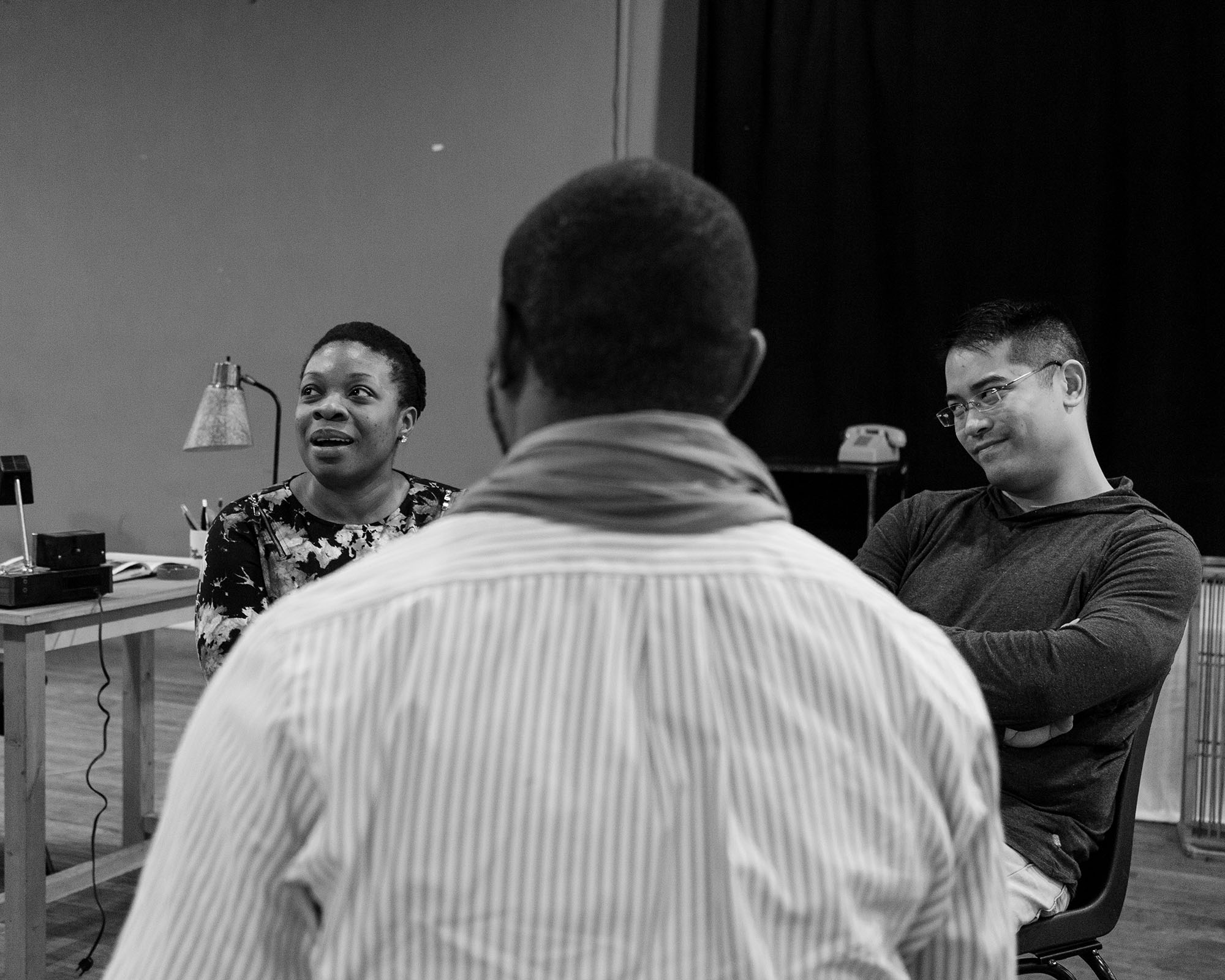
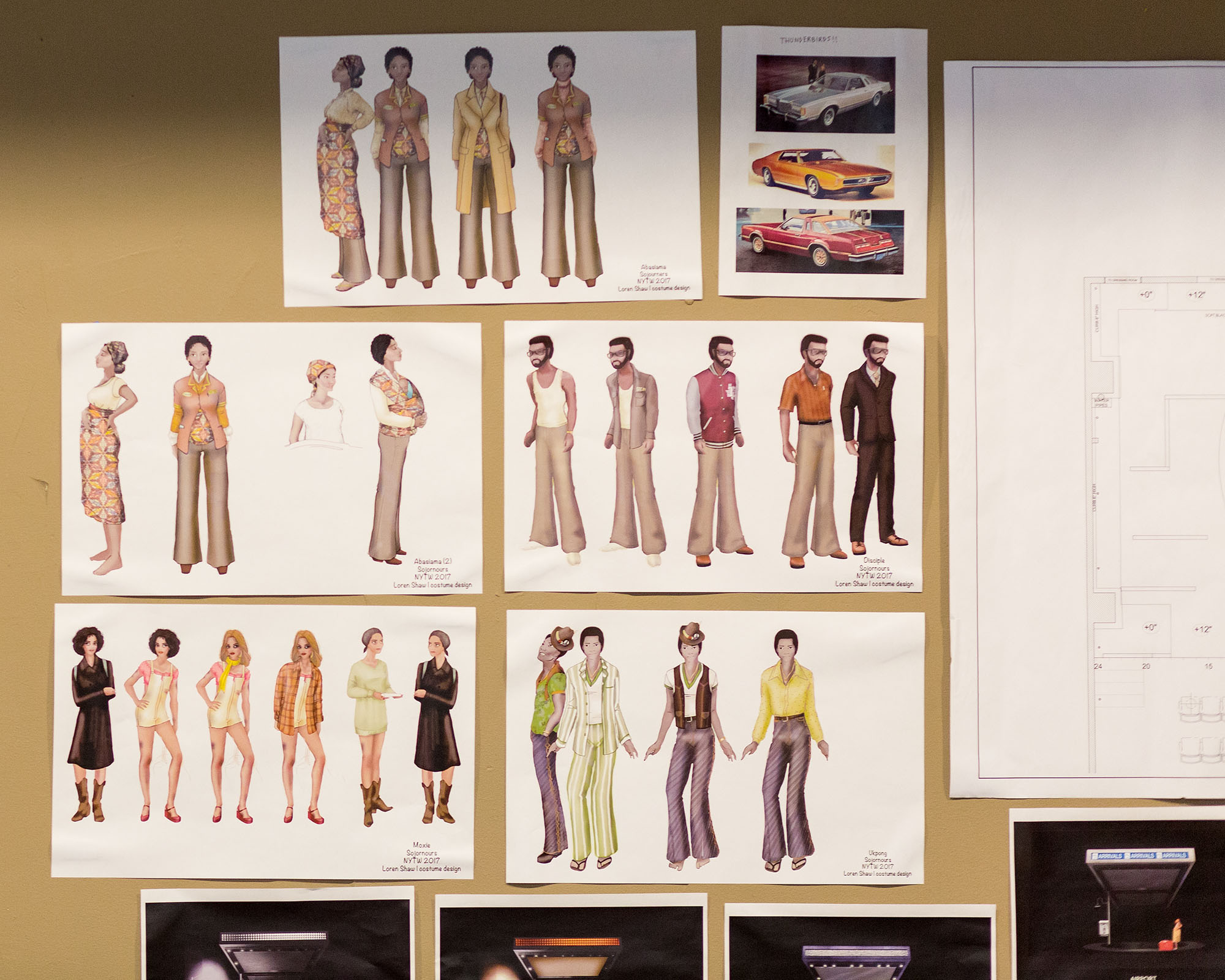
Mfoniso Udofia and Ed Sylvanus Iskandar are the latest dynamite duo to take over New York Theater Workshop, and this time with two plays, Sojourners and Her Portmanteau, two plays in a nine-play cycle Udofia is writing. We sat down with these dynamic, emerging, and important voices in contemporary American theater to talk about time, family, immigration, and history – all essential themes to the play and their overall work.


Darrel Alejandro Holnes: Thank you for sitting down with me.
 

Ed Sylvanus Iskandar: Oh, thank you!
 

DAH: And thank you for having me sit in on your rehearsal today. That was a really great opportunity and privilege. A lot of my first questions are in response to what I saw here in this brief scene that was rehearsed for the last hour. And my first questions is – both of you feel free to jump in – family is essential to the play, so what role does your family play in your process: inspiration, support, obstacle, all of the above?
 

[Ed and Mfoniso laugh]
 

ESI: I think because I left home when I was seven to go to boarding school I have been on a fairly consistent life-long journey in terms of defining and redefining for myself what “family” actually means. And family is…not special for me anymore. I still say I go home to Indonesia because my parents are still there, the home I grew up in is still standing, but I think when I say “family” now it feels like it’s about a community of people that I have been lucky enough to be accepted by. And that includes my biological family, but that seems to define for me not only a space emotionally in my life, but also the way I like to work and the kind of work I like to do with an audience watching. Which is really, I think, more than anything driven by the ability to further social connections – real ones. It’s how I conduct my rehearsal process. It’s how I like to let my companies and my car spawn – I’m constantly cooking. I can’t help it. It’s my nervous tick. It’s not a nervous tick. It’s a thing I like to do in order to keep myself grounded. This is actually kind of amazing here because I love working at New York Theater Workshop. There’s a little kitchen that just feels like a home. I really can settle into the rehearsal process in the way that you normally can’t in self-rented or borrowed rehearsal space. What the general managers do, which is really so amazing, is they literally give you the third floor. And you can figure out a way to make it work. And I do think with a play like that and a process like this – two plays together – that my job is to make family out of the people that are most regularly in the room, and to incorporate the designers who will now start to come in and join us in tech. And you know, I’ve come to the realization that once the play opens my job is actually over. And my real job is about making sure that whatever we’ve built together has a foundation to continue.
 

DAH: Like a family?
 

ESI: Yes.
 

Mfoniso Udofia & Ed Sylvanus Iskandar
 

DAH: Beautiful! And you, Mfoniso?
 

Mfoniso Udofia: I write about immigrants, also I’m the child of immigrants. My family’s been instrumental, at least for me, for the creation of these plays. In that my mother has become my biggest champion. When you talk about the child of immigrants and what trajectory is, there’s so many hopes and dreams. My mother looked at me and she was like, You are going to be a lawyer! Propah! You go do that. And so it was a huge thing when all of a sudden I was like, Mommy I’m an artist, and she’s like, No you’re not. At all. And so to turn around because family for me – it’s not as if I have much spread, you know, it’s quite localized. What my mom thinks, what my father thinks, what my brother, my sister – they’re my people here. So there are not many other people. So when my mother turned around and said, “Aye, daughter you’re an artist” it’s like breathing. And so it makes creating these plays…I mean creation in general is plot. So to have that family support, especially when I was wondering for the longest time if I would get it, is incredible for me. And then yes to what Ed said, you’re also building family. But I’m so lucky to have biological family to go, Oh yes, this is a good thing. as I’m building family and being in relation to some incredible artists, some geniuses in their own right. You know? I also have the core support that I find I need in order to write plays about families.
 

DAH: Sure, sure. And that’s a beautiful thing. Also beautiful, yet just as complicated, is how, in the scene that I observed, love seems to be defined as “mountains of desire, bitter river of burden.” Can you explain what this line means and how that works through the play?
 

MU: “Mountains of desire and a bitter, bitter river.”
 

DAH: Yes, that’s quite a line. Care to elaborate?
 

MU: I’m not sure, and this is where I get … Am I gonna say this? Yea. Sometimes I think American Western love is illogical [laughs]. It’s extraordinarily romantic, and this kind of straight thing. Maybe I’ve watched too many romantic comedies. I probably did and then I went, Ooo this is what love is. And then I was in the middle of it going, This is not love! I don’t know what that thing was. I think love is complicated – is an action, actually. It’s not this thing that just falls on you. And if it does, it doesn’t stay a thing that just falls on you. So, there is, there can be love and burden. I don’t know that it is necessarily a terrible thing. It doesn’t have to be. It doesn’t also have to be a thing that you…You know, you can look at that kind of love, you can go, I choose this. I want it. I walk into it. Or you can look at that and you can be like, I don’t. I can’t do that for now. Because the love I have of myself or my own desire won’t let me carry the burden of the love that I might have for you – it’s complicated. That line of love is complicated and purposefully convoluted. And love and desire, duty and birth date, they went through all my plays and they live side-by-side, because I don’t know if I…I think as an artist myself I’m trying to figure out exactly what the natures of love are. And at any given point, even in my relationship with Ed and relationship with the actors and my relationship with any production company, love is always changing. You know what I mean? So I’m not into the purest feeling of it. And so depending on where you are I think you will hear that line differently.
 

DAH: Interesting. And Ed, in your vision, of this play and of both plays, how do you see the characters negotiating desire and burden. How do you see those themes working throughout the play?
 

ESI: They’re not separate. It’s two flipped sides of the same coin, which is also how I think of both plays. I don’t think of them as two separate plays at all because I think the expression of love causes burden. And I think if love is going to be worth anything, it’s going to require that amount of work. I think that…Yes, I think I can say the experience of working on both plays and getting to know Mfoniso as a collaborator, it’s an amazing thing because I find myself challenging my own definition of what love means from the assumption of what I think I’ve given, and continue to find more that I’ve assumed – that I then need to ingest and choose to give more of, in order to actually continue deepening and building. And I can say that that’s probably the most full love I have given an experience. Because the journey of it has been so full and it’s been so expansive.
 

DAH: I love that word that you used, “journey.” Can you tell us a little about the journey of all nine plays?
 

MU: [laughing] How much time do we have?
 

Mfoniso Udofia & Ed Sylvanus Iskandar
 

DAH: Can you discuss how what people will see in these two plays are paintings that are part of a larger picture?
 

MU: So when I started writing, the first play I ever wrote was The Grove – it’s the youngest play and I was writing about the eldest daughter, some immigrants…And she was in the middle of figuring out what identity and duty and love, you know, where those things shred up against each other. Then I realized that in order to understand Mac you have to actually understand from whence she came. And so then from there came, what is now known as Sojourners, which was first called Towards because I knew I going towards something, but I didn’t know what,so that was the title of it. The Grove, then Towards, and then to understand the parents I had to understand the revolution in country and that’s where you get something like runboyrun – which goes back and forth between the Nigerian homeland and now the American resettlement place that they are in. Then from there came my number of nine, which will be five interior plays that follow Abasiama and Disciple Uffat, and the last four are gonna be love plays which follow their children as first generation youth in America or discovering what blackness is without a certain kind of historicity attached to it. Technically these could go on forever, they’re not. I’m gonna end it at nine. A promise that I’ve given to myself that it has to end at nine, but as I’m writing I’m discovering how concerned I am with lineage and I do think that that is something of a very immigrant mentality too. Like now that I’m here, what does “forward” actually mean on soil that is not my historical soil. So I don’t know if that explains the question, but that is at least the scope of the project.
 

DAH: Yeah. And I think that’s definitely what people need. I’m also an immigrant. So I absolutely understand what you’re saying about lineage. And in thinking about that I recall how the character played by Chinasa has a line about the baby’s name and time. Time must certainly play an important role in this play and in any sort of nine-part series, as you just explained,, that follows this family over generations. Why write about time? And let’s broaden that and also say, why write about lineage? Why bring that to the contemporary American stage?
 

MU: It was particularly important for me to write about West African, Nigerian, Ibibio, migration here and what lineage is. In my culture you actually count where you’re from, you hold it. You come from compound culture. You know your grandparents, you know the history of your great-grandparents, and your great-great – which is very, very, very different somehow, than what I find happening here, and I think we might be in the middle of a change. It’s like more 32-year-olds are staying at home with mom, you know. There’s a shift starting to happen. However, we don’t build community and lineage that way here. I see my people from home being able to count their history. Lineage is important for me, because when you come from that culture and you come into this culture, what do you retain and how? It’s as simple as, in one of the plays, Abasiama and Upem, you know, they’re fighting to figure out how to make fufu here. And they’re going to get products that are not yam in order to do it. So it’s fighting to figure out: How do I make lineage here now that it’s different than the way it was back home and I’m not going back home?
 

DAH: Are those some of the struggles you’ve faced?
 

MU: It’s some of the struggles that I’ve watched my people face. And yes, I can implicate myself here and I am interested in this because I have heard the stories of grandmothers and great-grands and my great-great who is this Big Man. And I wanna be able to pass some of that to my children as well, so I want to answer the question, what is that new tradition that I need to make here, in a different space, for me to carry on that culture?
 

Mfoniso Udofia & Ed Sylvanus Iskandar
 

DAH: And is that something that resonates with you Ed, as to why you were drawn to these projects? Is it also something that you can relate to personally?
 

ESI: What specifically?
 

DAH: This idea of time, lineage, and how it’s negotiated between the characters – what we carry maybe, from one generation to the next.
 

ESI: Yes and no. Because my relationship to time and lineage is very different for all the reasons we chose to work together. I am an incredibly linear person and everything about how I negotiate achievement, finishing, and construction is linear and very logical. And one of the very first things Mfoniso said – I’m paraphrasing – to me in one of our earlier conversations, before we committed to this play together, is the notion that for her time is a spiral and time is relative and your experience of time is completely insular and about how it is you understanding how to listen to yourself and how to contextualize yourself within the definitions of time of those around you. And I can relate to that very deeply. Although it still is interesting because it’s not necessarily natural in my thinking process. But I came to the scene in New York and created many long-form pieces, which is something I’m very interested in. The average run time with a show I’ve done in New York is typically six-plus hours. And I learned over the process of making those plays that an audience’s experience of six hours does not mean the same thing as an actual experience of six hours depending, of course, on your choice of activity within those. To be even more simplistic in that particular analogy, I have sat and watched plays that are sixty minutes that felt much longer and ones that are six hours that can speed by. So that is, I think, where we connect. And it’s also where we differ because my natural instincts normally take me to a place where I want to move forward when Mfoniso is still in a place of thought. And I think that is both our strength and our challenge. And we’re guilty of it in this relationship together.
 

DAH: Considering what we’ve just discussed, what do you hope the audience walks away with after seeing these plays? And I’m sure the list of things is endless, but specifically thinking about time, lineage, maybe time as a spiral, as linear – what are you hoping they walk away with at the end of the day?
 

MU: Multitiered. These plays aren’t just about time and lineage. The subject is something a bit more political. I hope that the audience walks away with a more nuanced imagination regarding the lives immigrant bodies lead on American soil. I also hope that people walk away a little shaken by how quick they are to potentially judge and assess someone’s motivation when they are within that struggle. Like the pairing of Sojourners and Her Portmanteau. Some of the weeping I’ve seen people do about what Abasiama does at the end of that play without understanding what Abasiama is going through to then maybe come back in Her Portmanteau and get even more information. Perhaps we can nuance-out what bodies of color do in moments of struggle. I hope that people will actually get up and go out and read some books. Because people don’t read books.
 

DAH: A couple titles?
 

Mfoniso Udofia & Ed Sylvanus Iskandar
 

MU: Ben Okri’s The Famished Road, Chinua Achebe’s There Was A Country and Things Fall Apart, Helen Oyeyemi’s Icarus Girl and the way in which she’s constructing fairy tale stories from other mythologies, which is part of what’s happening here as well. And then even just researching: exactly where is Nigeria? Where are the Ibibio people? Do I know these people? And why haven’t I even thought to think and ask about who and what and where they were? So, those are some of my hopes.
 

[Everyone laughs]
 

DAH: So, Chinese-Indonesian director with American training, Nigerian-American playwright, is the global perspective an American perspective? This should be a prompt for you to discuss trends in contemporary American theater, perspectives in a contemporary American theater, and what it means to have creators – playwright and director – with these different backgrounds in that space.
 

MU: Do you want to go first before I go? This is a complicated one.
 

ESI: I could try. I might be better able to answer this question by posing a response to the previous one. I’ve been thinking, a lot in the past two weeks especially, about the gift of being able to work on Sojourners a second time. It’s something that I have not had a great deal of experience in doing – having an opportunity to revisit and build upon and advance from and learn through. And what’s most interesting to me is in this second attempt at turning the story of Sojourners, is I find myself continuously letting go everything I imposed upon the play. And I find myself reaffirming the nuance in the text and the nuance in the stage direction.
 

That I was not able to fully comprehend the last time. Which also reveals a level of re-commitment and reveals an actual trust in what’s on the page that I feel I did not have the first time. Because my response to the play initially was, Surely this is a Nigerian A Doll’s House [by Henrik Ibsen], because my cultural framing is Western. And I feel the conversation I had with the play initially, even though I fully believed that I had advanced beyond the conversation that I actually did have was about trying to figure out how it fit within a Western construction. I honored it’s variation, I honored it’s uniqueness, but I do think my basic map in my head, or through my gut, was in comparison to linearity and a Western dramaturgy I have become used to, not just because of training, but because of the way a play looks on the page.
 

And what I feel the gain of this experience has been for me is, a further understanding of A) the basic truth that when we need to write something that it’s all intentional – which is something I fully love so much. And there I think she is similar to Ibsen. You ignore a stage direction and a word or a punctuation mark at your peril. And B) I also then fully understand that the play can only fully do its work and and fully realize its impact if it’s staged from the perspective of that trust.
 

It’s not that I didn’t believe I trusted the play last time. I would never sign on to a play that I don’t trust, or a voice that I don’t trust or a person I don’t trust. But it’s a higher level of trust that I’ve developed in the interim. And it is linked to what I now understand I can be more intentional about on the stage. And I find everything is stripped down in a gorgeous way. There’s just less of everything. There’s less space. I think I’m trying to make, in between scenes, to try and foreground story that is always useful, but may not be necessary because I was afraid that the story that’s in the text, wasn’t enough. And I find myself doing less in the scenes themselves – in a fairly radical way.
 

The scene that you experienced watching in rehearsal, previously does not look a thing like that. It has changed from a scene about a woman moving within her home and negotiating how it is to leave the door, to a scene in which this woman has no inkling to the choice that would take her to the door at all. And so has become a scene in which it’s two people on a couch. And that is also I think the right way to frame what I now believe fundamentally is my job, which is to construct every scene in such a way that the audience can listen.
 

The text is so rich it is outrageous how much work I have to do before rehearsing to actually get fully on top of it. And I suddenly realize that is also the level of attention I’m asking for from an audience. So if I’m not allowing them to tune into the auditory context of the physical picture, I’ve not done my job. I’ve created, successfully, distractions rather than amplifications, which was my original intention. So I do believe my intentions have always been sincere, but I do know how much I have learned.
 

Mfoniso Udofia & Ed Sylvanus Iskandar
 

DAH: Mfoniso, sometimes people say that the United States is a nation of immigrants. This play, and also our conversation so far has also discussed the idea of immigration and what that means and what those stories are. So my question to you now is, is the immigrant story inherently an American story? And is the American story essentially an immigrant story? Are Sojourners and Her Portmanteau inherently American stories?
 

MU: Am I gonna say some of these stigmas out loud? Yes. America has some work to do. And I do think yes, America is a country chocked full of immigrants that after maybe the third or fourth generation develop the worst case of amnesia and forget. And then we’re somehow cycling from an immigrant nation to a violently xenophobic one within the same – it’s a vicious spiral that is almost nonsensical. What kind of peculiar American amnesia is this? And so it’s like we have to constantly teach ourselves to remember, which is part of the plays, what it is to remember to not forget. Because we are a country of immigrants and that makes us special.
 

Ed’s sight is different than my sight; it’s different than your sight; and the way I look at the story is different than the way Ed will, or the way somebody else will. And as a nation of immigrants, we also have to be a nation of plural ideology. And that’s what I feel like America doesn’t do very well. There’s something else that happens as amnesia trips us up and then we become set in this weird non-porose American way. And so we should be. We are a nation of immigrants.
 

And it becomes a real issue for me when I don’t understand why I’m not seeing more plural stories on the American stage. Why me and Ed together – myself creating this play, and Ed setting it up from page to stage is just this radical, amazing thing. When actually that’s the thing. And why haven’t we been taught earlier how we shred up against each other? That our gazes are different? Why is this learning happening in what feels like a very singular narrow way? Why isn’t this the American theater normative, if we are a nation of immigrants and if theater is a representational art form – which we claim theater to be – because what Ed is talking about is true and is particularly salient in our case. There are two different gazes; we have read two different cannons; we have two different histories, none of them – I don’t know that we should be ascribing value to one over the other, but my sight is critically different than Ed’s sight. So the way in which we work together, that is the American theater. But by God, we’re taking photos of it and putting it in an exhibit and going, Look at this beautiful wonderful thing, when it should be the thing!
 

DAH: When it should be the norm.
 

MU: Right.
 

DAH: Right. Last question. I teach dramatic writing at NYU and I always end interviews by asking theater-makers what advice they have for young theater-makers: so student directors, student playwrights, you know. And not just students formally enrolled in the university, but anyone who’s just starting out and in this field and in this industry. Any tips? What do you wish someone had told you ten years ago?
 

ESI: I would say don’t do it unless you must because the theater is far too important a space to be met by anything less than a total commitment of your life. To squander even a single person’s gamble that night, on purchasing a ticket, only to be met by incompetence is the only real crime I can imagine an artist can commit.
 

MU: I second that. I tell some of my students to rigorously pursue their inherent, innate, illogical – the way I write plays, the way I construct plays, makes some people discomforted, some people…There’s a range of emotions when people first meet my play. But I had to. It’s been seven years now. The rigor that’s involved in the playwriting, and then the trying it out and teaching people and then knowing that it works, and then the rigor it’s advocating against a new – I shouldn’t say “new” because then it makes me like, like I was birthed now and there are other people who write like me. The rigor of the education and the teaching into and then the standing behind your work when people might not be able to see through it is a real skillset. And I say “rigor” because there are some students who are like, I did this new thing. It’s great. But they haven’t practiced it and gone through the steps to go, No, does it really work? How do I stand by it? I’m not saying just pursue your illogical passions – it’s like, do so rigorously. And perhaps it’s not illogical, pursue whatever is inherent in you. And I think the keyword is “rigor.” I don’t know that I’d be anywhere without it and I don’t know many artists who are. With the artists that I love, I think about their longevity, the span of their careers. There is rigor attached to it.
 

DAH: Excellent. So previews begin April 22nd and the play opens May 7th. I will be there. Thank you so much!
 

MU & ESI: Thank you!


Mfoniso Udofia, a first generation Nigerian-American storyteller and educator, attended Wellesley College and obtained her MFA from ACT. She co-pioneered the youth initiative, The Nia Project, providing artistic outlets for youth residing in Bayview/Huntspoint. Mfoniso’s Ufot Family Cycle plays, Sojourners and Her Portmanteau, will be produced this coming Spring 2017 as part of New York Theatre Workshop’s season. She is also Playwrights Realm’s 2015-16 Page One Playwright and in Winter 2016 they produced the World Premiere of Sojourners. In Spring 2016, The Magic Theater in San Francisco produced the West Coast Premiere of Sojourners and the World Premiere of the third installation in the Ufot Family Cycle, runboyrun. Mfoniso is currently working on Oregon Shakespeare Festival’s Play On! commission translating Shakespeare’s, Othello. She’s also the Artistic Director of the NOW AFRICA: Playwrights Festival and a proud member of New Dramatists class of 2023. Mfoniso’s plays have been developed, presented and/or produced by Playwrights Realm, The Magic Theatre, Dr. Barbara Ann Teer’s National Black Theatre, Hedgebrook, Sundance Theatre Lab, Space on Ryder Farm, NNPN and New Play Showcase, Makehouse, Soul Productions, terraNOVA, I73, The New Black Fest, Rising Circle’s INKTank, At Hand Theatre Company, The Standard Collective, American Slavery Project, Liberation Theatre Company and more. Mfoniso was a finalist for the 2015 PoNY Prize, the Eugene O’Neill NPC, Bay Area Playwrights Festival, Many Voices Fellowship, Page73 Development Programs, Jerome Fellowship, NYTW’s 2050 Fellowship and Lark Playwrights’ Week.
 

Ed Sylvanus Iskandar has directed over 150 productions globally. NEW YORK: The Mysteries, Restoration Comedy, and These Seven Sicknesses (all NYT Critics’ Picks, The Flea Theater); The Red Umbrella (Drama League); The Golden Dragon (The Play Company at the New Ohio Theatre). REGIONAL: Head Over Heels (Oregon Shakespeare Festival), Don Juan, Translations, and The Collection (Stanford Repertory Theatre); Homemade Fusion (Pittsburgh CLO); Don Carlos, Brand and Miss Julie (CMU); The Dumb Waiter, No Exit, Death and the Maiden and Sexual Perversity in Chicago (Edinburgh Fringe Festival). INTERNATIONAL: Venus in Fur (Singapore); Memphis (Japan) OTHER: As Founding Artistic Director of invite-only NYC collective Exit, Pursued By a Bear (EPBB), Ed has served over 12,000 free home-cooked meals and shared 150 priceless nights of theater over the course of staging 8 Labs and 40 Salons, including NY or world premieres of The Further Adventures of Hedda Gabler, Arok of Java, and the musical Dani Girl, alongside new versions of Don Carlos, The Master Builder, and King Lear. Restoration Comedy and These Seven Sicknesses both began their NYC lives as EPBB Labs, later transferring to critical acclaim as productions at The Flea. EPBB fulfills a vision of theater that deepens the audience’s ability to engage by creating empathy for the human effort behind the art. Ed’s body of work with EPBB was honored with the 2013 National Theatre Conference Emerging Professional Award, conferred by Bill Rauch (Artistic Director of the Oregon Shakespeare Festival).

Posted on

Advocating for Inclusion in Post 11/9 America

Christine Toy Johnson


I’ve been thinking a lot about how we are starting to look at the world as “pre 11/9” and “post 11/9.” That’s not a typo, and is in no way meant to disrespect references to the devastating tragedies that happened in America on September 11, 2001. But I do believe that November 9, 2016 is a date on which many Americans – no matter how they voted in the presidential election the day before – saw a seismic shift in the way certain citizens found permission to express themselves. This, in turn, has created a seismic shift in our understanding of the world in which we have always lived, but are perhaps seeing through a pair of newly shattered glasses.
 

It seems that for some people who have been harboring years, decades, and perhaps generations of hatred and fear towards those who do not look like them or worship like them or speak like them (just to begin), the election has sanctioned expressing their preferred worldview in new and bold ways. Words and actions indicate that some now feel profoundly entitled to demonize (with a certain kind of giddiness) entire populations of other human beings who have been living, working, voting, and paying taxes amongst them. Turning their backs on the principles with which this country was founded, they seem to be intent on rewriting the narrative to say: “Give us your tired, your poor, your huddled masses yearning to breathe free – but not you, you, and certainly not you.”
 

Can the arts influence a wider worldview? The tip of the iceberg of this debate is reflected in the response to the whole Hamilton/Mike Pence situation (if you were hiding under your covers that weekend, here is a link to the New York Times article about it). The incident spurred comments suggesting (among other things) that the show, which casts our founding fathers with people of color to make a statement on the role immigrants had in the forming of the U.S.A, “erases white culture,” but that’s a whole other discussion.
 

What I’d like to talk about here might seem like a simplistic assessment of some of the ways I think the arts can influence a worldview that is diverse, equitable, and inclusive. But it seems to me that the spate of hate crimes that have been occurring post 11/9 are as huge a flashing sign as any that we need to do better in how we reflect the world and our individual diversity on our stages and screens, in the media and in popular culture.
 

Now to be crystal clear: I am not equating in any way, shape or form the arts and media’s portrayal of our gorgeous tapestry to the kind of prejudice we’re seeing across the country right now. And I’m not naïve enough to think that expanding this portrayal could heal the giant schism that is at the heart of our national divide all by itself. But I think it can absolutely play a part. And we need to do better.
 

When journalist Roland Martin recently interviewed Richard Spencer (president of an “alt-right” organization with the seemingly innocuous name of “The National Policy Institute”) about his view of post 11/9 America, Mr. Spencer claimed supremacy founded on an assertion that Europeans invented everything in civilization (no, really, he said this – watch this lengthy but illuminating interview). This, he believes, is why white people deserve to be compensated with all of the opportunities that America has to offer. When Mr. Martin asked if he had ever heard about the pyramids built by the Egyptians, for example (never mind gunpowder, paper, the compass, and printing – all contributed by the Chinese – and other life altering inventions by other cultures), Mr. Spencer countered that “Egyptians are white.” Now, clearly he needs a history lesson. But it could also be argued that the plethora of media images on stage and screen (see “Aida,” “Cleopatra,” “Exodus,” “The Ten Commandments,” etc.) help to tell him that this is so. In addition, the more we (women, Muslims, Asian Americans, African Americans, LGBTQ Americans, people with disabilities, Latino/a, etc.) are viewed as “other” in the media and not portrayed with authenticity or accuracy or sheer inclusion of our stories, the more people who have this kind of skewed view of the world and/or have no contact with actual living humans who are women, Muslim, Asian American, African American, LGBTQ, Latino/a and/or have a disability etc can choose to believe that these images and portrayals reflect the truth of our American landscape. The more we are seen as “other” in the media and the American theater, the more we are seen as “other” in the theater of American culture.
 

In June of 2015, I had the privilege of addressing members of FIA (The International Federation of Actors) about the global impact of diversity on our stages. FIA is made up of performers’ trade unions, guilds and professional associations from more than 60 countries around the world – and as national chair of the Equal Employment Opportunity Committee at Actors’ Equity Association, I had been invited to participate in the conference along with other elected leaders of the union and executive staff. What moved me most, without a doubt, was to see the shared passions that we had for making theater, and the ways in which our commonalities were made more textured and beautifully complex by our differences.
 

When I addressed the delegates, I pointed out that the bridges we were building there and the ways our global perspective had expanded by getting to know each other just over a few short days were prime examples of why inclusion is vital. Without it, you would miss out on a whole lot. I noted how we began introductions to each other by asking what country we were from and whom we represented – but after that, all that mattered was how we connected on a human level: what we cared about, what we were fighting for, and how we were effecting change. And that phenomenon – connecting on a human level once you get a glimpse into someone’s life; someone who might literally live around the world from you, or not even speak the same language as you, or look anything like you — that phenomenon of connecting on a human level is at the heart of how I believe the theater can unite us. It’s a spectacular and singular opportunity. And one that can never be underestimated.
 

I asked them to imagine if the conference delegates had been chosen based solely on the color of our eyes – nothing to do with individual qualities, skills, contributions, or achievements – but only on the color of our eyes. That would be ridiculous. But that’s how many of us feel when we are evaluated or excluded from even having the chance to audition for a role whose cultural specificity is not germane to the story. That’s how we feel when we are excluded based solely on the color of our skin or the shape of our eyes. That’s how we feel when we are told to “go back to where you came from,” based not on actual knowledge of who we are and where we actually did come from, but based on an assumption that our “otherness” makes us “less than” and therefore unworthy to be considered “American.”
 

It seems that this is what is at the core of today’s fractured discourse: the unwillingness to connect on a human level, but rather responding to fear and perceived threats to the status quo. The outright dismissal of individualism, the blanket assumptions attached to race, gender, religious beliefs, presence or absence of a disability, sexual preference, gender identity, and so on, and the belief that the mere existence of entire populations of people can only lead to lack – all add up to form a vicious circle of fear and hate, hate and fear.
 

I acknowledge that this assessment requires me to try to connect on a human level with those who threaten Muslim citizens living in their neighborhoods, those who vandalize synagogues with swastikas, those who beat up LGBTQ Americans for being LGBT or Q, those who tell children they’ll be deported, those who would have me banished from the only country I’ve ever called home, etc. I’m still working on wrapping my head around that one. To follow this line of thinking, I cannot in good faith condemn these people without getting to know them either. But as we disagree, fundamentally, on how to treat one another, I admit that this is a more difficult task than I can currently handle.
 

Still, I contend that now more than ever, we need to find ways to go further in expanding perceptions of who we are and what we can do. At my core, I’ve always firmly believed that the media and media images can help do this. When we find more substantive ways to stop defining our storytellers only by the color of their skin, their presence of a disability, gender, age, creed, sexual identity, etc. and look more at our individual qualities and skills, perhaps we can help to penetrate the national psyche with our individual and then collective humanity, as expressed through our art. Can this really make a dent in the National Hate? Honestly, I don’t know anymore. But I think we have to try. And try harder.
 

The gross display of man’s inhumanity to man over the past few weeks has made me go through the seven stages of grief for my advocacy work – yet I have also been buoyed and inspired by the compassion and empathy of artists. We cannot capitulate and make hate the new normal. We cannot. This is not a statement in favor of “political correctness.” This is a statement in favor of civility and kindness, an appeal to uplift our better angels with the help of the images and stories we share in the arts and media.
 

We must be even louder than those who scream at us to “go back to where we came from.” Because where I really want to go is a place where our open, creative hearts can beat freely and express the many layers of our diverse humanity – with an expectation of celebration, not annihilation. A place where we can help keep the world we want to live in from being bullied to death. I hope we can.


 Christine Toy JohnsonCHRISTINE TOY JOHNSON is an award-winning writer, actor, filmmaker, director and advocate for inclusion. Her plays and musicals have been developed and produced at such places as the Roundabout Theatre Company, The O’Neill Theater Center, The Meryl Streep/IRIS Writers Lab, Crossroads Theatre, The Barrow Group, Prospect Theater Company, CAP21, The Weston Playhouse, Gorilla Rep, Leviathan Lab and Village Theatre. A collection of her written work is included in the Library of Congress Asian Pacific American Performing Arts Collection.
As a performer, she has been breaking the color barrier in non-traditionally cast roles for over 25 years, and has been featured extensively on Broadway, off-Broadway, in regional theatres across the country, in film, television, and concerts worldwide.
Christine is a proud member of the elected leaderships of both the Dramatists Guild (also serving on the Publications Committee) and Actors’ Equity Association (also serving as National chair of the Equal Employment Opportunity Committee and National chair of the Equity News Advisory Committee), an alumna of the BMI Lehman Engel Musical Theatre Writing Workshop, a founding member of AAPAC (Asian American Performers Action Coalition), a board member of Alliance for Inclusion in the Arts and founder of The Asian American Composers & Lyricists Project. She is a graduate of Sarah Lawrence College and the Certificate of Screenwriting Program at NYU.
She was honored by the JACL (the nation’s largest and oldest Asian American civil rights organization) in 2010 for “exemplary leadership and dedication”, the “Wai Look Award for Service in the Arts” from the Asian American Arts Alliance in 2012, and the Rosetta LeNoire Award for “outstanding contributions to the universality of the human spirit” from Actors’ Equity Association, in 2013. For more information, please visit www.christinetoyjohnson.com. Twitter: @CToyJ.

Posted on

A Conversation with Nathan Alan Davis & Megan Sanberg-Zakian

Nathan Alan Davis & Megan Sandberg-Zakian


The story of Nat Turner is going viral these days as the United States continues to confront slavery’s legacy when we witness and respond to police brutality, mass incarceration, and more. Nat Turner’s story is also made current by the premiere of the film, Birth of a Nation by Nate Parker and by the premier of the play, Nat Turner in Jerusalem this season at the New York Theatre Workshop. Since Nat Turner is on everyone’s tongue and mind, I sat down with playwright, Nathan Alan Davis and director, Megan Sandberg-Zakian, the visionaries behind the play at New York Theatre Workshop, to talk to them about all things Nat Turner including their new play, and the continued fight for diversity and inclusion in contemporary American theatre. Here’s what we had to say.


Darrel Alejandro Holnes: Nathan, you’re making your New York debut with what feels like a very timely play. Is it true what they say, that timing is everything?
 

Nathan Alan Davis: Who says that?!
 

Megan Sandberg-Zakian: They!
 

[Everyone laughs]
 

NAD: I mean, yes, timing. I definitely feel like there are forces at work, besides myself, in terms of this play. The way that Megan, myself, Phillip [James Brannon, who plays Nat Turner], and Rowan [Vickers, who plays Thomas R. Gray and Guard], all came together – the way the theater came around to support us and the work has kept us together as a team to continue the process all the way to production. [This] has just been a dream come true. It’s allowed us to, as fully as possible, develop this story and get the play out. So much of the timing and those types of things are out of my control as an artist, so when it all falls into line, it’s a beautiful thing.
 

DAH: Why is Nat Turner in Jerusalem so timely? What does it mean to see the piece produced now as conversations around race in America continue to heat up?
 

MSZ: Well, one of the scholars who writes about Nat Turner – his name is Ken Greenberg – has said that the story of Nat Turner continually resurfaces. There have been these moments over the last couple hundred years where the story suddenly arrives back in the consciousness, and how we’re telling the story this time and why we’re telling the story now probably has a lot to do with where we are right now. So I think the questions that you just asked are the set of questions that we are hoping people will be in conversation about and around the play. Why do we need to hear this story right now? I actually think that in a way, that is what the play is about. The play isn’t about here’s the story, the play is about why do we need to be in a room together and engage with this story at this moment? So I don’t know that I have a really great answer. If I did, I could solve everything.
 

DAH: Thank you for your response.
 

MSZ: Partially, for me, the thing that feels really rich and activated right now, around this story, is the questions [raised] about how we view violence. What is the story we tell around violent acts? What is our understanding of the social violence that is shaping our daily lives and our awareness of it? What is our stake in maintaining ignorance about violence? – Ta-Nehisi Coates calls it “The Dream” – What is our stake in staying ignorant of these really violent social systems? Then, what is our response to violence that resists those systems? For me – for all of us – it’s been a very uncomfortable conversation. When you read about – as we did in development – the shooters in Baton Rouge and Dallas who are taking out cops with sniper rifles… to experience the coverage of those things, and see the families of those people whose lives were taken, our reaction, whether it’s grief or activism or sharing on social media – whatever it is – [must be to] then consider our ongoing reaction of, or ignorance of, or complicity in all of the other kinds of deaths that are going on all around us…
 

DAH: What are the other kinds? To name a few…
 

MSZ: All of the deaths related to poverty and disenfranchisement in this country; the deaths of people who aren’t receiving adequate healthcare; the deaths of people who are in dire types of housing situations; the deaths of people who are wrongfully incarcerated in a system that is strongly biased; and of course, the deaths of people all over this country, particularly black people, gunned down by our police forces. So, it’s really hard, as a human being and a progressive person, to say that the violent taking a human’s life is somehow necessary.
 
In the play, when I hear Thomas Gray talk about all of the people that were killed during Nat Turner’s “insurrection,” as it’s called by Thomas Gray, the lawyer character, when 75% of the deaths were women and children – small children, infants and babies – it’s very hard to hear. It’s very hard to listen to, you know? You think about describing the deaths of those 55 people, and then you think about if you had a play describing all of the violent deaths of people under the system of slavery, it would be a 15 year long play.
 

DAH: Yeah, or a 400 year long play.
 

NAD: It continues.
 

MSZ: It’s just very uncomfortable stuff to engage with. So coming back around to my answer to your question, I wonder if part of the reason that the story comes back is that somehow we’re at a place where we’re more motivated to tolerate that discomfort.
 

NAD: I remember Megan and I had a conversation on the phone after I’d written an initial draft of the play, which barely anybody had seen; it was kind of a dream state type of the play; it didn’t really have a lot of the plot elements that this play has now. Megan read it, and it wasn’t even a complete draft, but Megan was like “I’m really uncomfortable! This makes me feel bad!” And that was the main takeaway for me; this is hard stuff to think about, to process, and to look at. It was actually a very important part of the growth of the play for me. You write something, and you have a response…I had to take a breath and be like, yeah, the territory that this delves into is extremely difficult to handle and it asks so much of the artists who are involved in creating it and carrying it and sharing it. It asks us to give everything to it, to honor it in the right way, and to live in a place of discomfort, and to not hide from it. It’s been extremely challenging and also a rewarding part of this process, staying in that conversation.
 

Nathan Alan Davis & Megan Sandberg-Zakian
 

DAH: So a few of the words I’ve heard you both mention are: difficult, hard, complicated. I have not heard the word contentious, controversial. I’m wondering, is this play about controversy? Is this play a controversy?
 

NAD: I never looked at it that way, and I never defined it that way. I think when I approach a play or a piece of art, I’m not particularly thinking of it attempting to cause a controversy or attempting to respond to a controversy. To me, controversy kind of is in the realm of what people find aesthetically acceptable or what people find can or cannot be spoken, or should or should not be said. I’m not saying that…Megan mentioned, when the Nat Turner story does appear in our consciousness over and over again, controversy does erupt out of it. Probably the most famous example is the William Styron novel about Nat Turner, which caused a lot of controversy, because William Styron is a white author portraying Nat Turner, so there was backlash of that from black writers and scholars and people who just found that that wasn’t a fair or accurate depiction. So it happens. But looking at myself now, as an artist, I feel it is my responsibility to tell as much of the truth of the story as I could see. That means me looking inward, and looking outward, having conversations, and keeping the story moving forward. I think for all of us, we really want to honor the spirit of Nat Turner and the spirits of everybody who was involved in that insurrection, you know? Knowing that that is a real thing, and that this is a thing that happened, and that we just want to do our very best to bring as much light as we can to it. As one of many Nat Turner stories that will be told – I certainly don’t claim to be writing any sort of a definitive interpretation, I don’t think that exists, but we’re just really focused on doing our very best.
 

MSZ: I will say though, that we have a lot more information than William Styron did. I would say pretty much more than anyone else has had, in creating this story, just because there’s been a couple of books published recently and one in particular that is extremely exhaustive in terms of the research. I think that book was published after Nate Parker’s film was already happening. So I think once we read that book, by David Allmendinger, we felt a lot of responsibility not to actually have facts that we knew were wrong. For a play that’s very poetic, and is really an invented event, it’s very factually correct. I can only think of one thing in it that is tiny, that I know is not historically true.
 

DAH: And what is that?
 

MSZ: The lawyer character was disinherited by his father. His father made him the executor of his will where he was disinherited. In the play, the father also wills that lawyer a desk, to be the executor of the will on. I would say that was a poetic, dramatic underscore of that historical fact, but really, I don’t think there’s anything else. And I’ve been very, you know, nope, that’s not right, find another way to do that!
 

DAH: So historical accuracy was a priority for you guys?
 

MSZ: Oh yeah. I mean, it’s more like I don’t want the play to contain something that I know to be a historical inaccuracy. Although, I don’t think that it can be historically accurate, it is a crazy idea anyway.
 

NAD: It actually helps a lot, artistically. I think if I felt limited to “Oh, I can only have hard facts in the play,” or “you’ve got to make sure all the facts will tell the actual story,” that would be a problem. But when you actually get down to real specifics of the story – like if you find the historical truth – it actually brings a specificity to the play, which I think actually makes it more poetic. You also just have to realize these were real people, living real lives, with real problems, who did real things. It’s not this portrait of a distant past.
 

MSZ: Every single new fact that we’ve found, has been like oh, shit! It feels like it drops you deeper and deeper into the truth of what the story was and why we need to tell it. It’s like there’s no inconvenient facts for this play… This is what we do all day, except you guys are not usually here.
 

[Everyone laughs]
 

Nathan Alan Davis & Megan Sandberg-Zakian
 

DAH: You mentioned William Styron and the controversy of who gets to tell Nat Turner’s story. Nathan, can you speak a little to the politics of racial identity and authorship?
 

NAD: Wow, that’s a big question.
 

DAH: I can point the question more if you want me to.
 

NAD: Please do, and I’ll either take the small point or the larger point.
 

DAH: In what ways does your personal experience of race inform your writing of the play, and what kind of responsibility does your unique experience as a person of color give you in telling stories with characters of color?
 

NAD: I guess the first part is that, in every way, being black in America yields full-time internal conflict. What does this country mean to you? How do I reconcile being part of this society? I think that the internal conflict and questioning, naturally, makes its way into all aspects of my life, especially the art that I create and the plays that I write. I don’t know that there is [a specific], identifiable way, it’s just a part of who I am, you know what I mean? The thing about responsibility is a big question because I think one of the biggest difficulties, being a person of any marginalized community, is that you feel the need to represent everybody in your group every time you have a platform, every time you have a chance to speak up. You feel that you’re not just speaking for yourself. I think on one hand, that’s just the truth, and I hope to embrace that responsibility. On the other hand, I need to find room for my own individual voice, my individuality. Who am I? What do I have to say? How do I do things as a person? I think oftentimes, if you get too caught up in representing, what does that mean? It doesn’t mean the same thing to me as everybody else. You can lose you own fire and your own artistic passion if you start to generalize your approach, because you’re repping a group. But at the same time, the need to rep the group is always present, you know? I think it’s a constant balancing act.
 

DAH: Megan, as a female-identifying director, can you speak to the absence of women in the show, and the ways in which their presence might be felt, whether it’s in the writing, or in any decisions you’ve made as the director?
 

MSZ: There’s a physical absence of women in the play. Women are talked about in the play, as the victims of murder, as mothers who die in childbirth or abandoned by their families – helpless victims. I think to some extent the play does a really great job of representing the 19th century view of women. The politics of the time, as we have them recorded, are very male. I am quite sure that there are lots of very interesting female viewpoints on this history that we just don’t have. That would be another really interesting play, but we unfortunately just don’t have it.
 

DAH: Are there any women referenced by the men who played an integral role in this particular history during its time? Someone we should all know about and have never heard of?
 

MSZ: The one woman that stood out to me in the research didn’t make it into the play at all. She was a woman named Elizabeth Harris, I think, who was a slave owning white woman whose house was deliberately skipped by the insurgents as a favor to one of the original core group. We don’t know why, we don’t have any other information on it, but the thing that we do know about her is that there’s a free black man who was living in the household of some of the white folks who were victims of the insurgency. Immediately following it, he sold himself back into slavery to this woman, Elizabeth, for $1, which to me is just the world’s craziest story. It makes you think about – as opposed to women as victims – women as protectors, and what women were actually doing at the time, in the context that they could, with whatever the oppressive and the unjust structures that were in place at that time. How were people resisting them? There isn’t anything about that in the play. The focus is on violent resistance and revolution.
 

DAH: That’s remarkable. She didn’t make it into your play, but has discovering her influenced how you think or dare I say fantasize about history at that time?
 

MSZ: My fantasy is that there were black women and white women – and women in between – who were finding ways to subvert this stuff everyday. But I think I kind of keep that narrative alive, because I need to, working on material that doesn’t really include us.
 

DAH: Would you say that intersectionality is a way for you look closely at mirrors that do not reflect your own face when you polish them? How is intersectionality at work when you work behind the scenes on this play?
 

MSZ: My assistant director is also a woman, a biracial woman, and it’s been incredibly important to have the directorial perspective of two intersectional women. Our design team is predominantly women, and our design team is very intersectional in terms of identity. That kind of multiplicity of holding of different identities and perspectives is incredibly helpful with this story. Working on a story like this, as a 21st century artist, I feel is an asset. If you are an artist that identifies as white working on this play, I think that it may be… More painful? Or harder. It’s like you get stuck in where the racial politics are now and then, somehow you can’t find your way out of it. Rebecca [Frank, assistant director] is black and Jewish; I’m Armenian and Jewish – there’s something about being able to breathe into owning parts of it and not owning other parts of it, and respect parts that I don’t understand. I think it gives it a little bit of the breath, and is maybe useful. As any human being, sometimes you just have to go, “This shit isn’t about me! And it’s okay that there’s a play that isn’t about women.” This play is very important. And it’s not about part of my own identity. It’s not about queerness, which is part of my identity. It’s really not about me or my identity, but in some ways, it really is.
 

Nathan Alan Davis & Megan Sandberg-Zakian
 

DAH: Hmm. Your answer makes me think, Is this history, her story, their story, is this our story?
 

NAD: Yes? I think what Megan said was really poignant – our ability to find ourselves in a story that is relatively narrow and limited in some ways, finding an expanse within that. One of the most beautiful things about this process for me… I think it’s sort of a mark of our maturity. There’s oftentimes talk in and around the theater and in general about who has the right to tell what story. I think those are always going to be ongoing negotiations that we should be involved in, but I feel like being able to collaborate with people who have widely diverse identities and represent the facets of life is so enriching. It’s shaped this production the way that it is. This play is this play because of the people doing it – I have no comparison, but I will say that the way that everybody has been together… Megan came in and said, “Okay, we’re going to pray together every day, we’re each going to bring our own version of prayer, whatever that means to us.” Everyday, somebody would come in, and bring some kind of offering – whether it was a poem, a prayer, or some spiritual practice – and we’d do it together, so we found this collective identity together. It has been really essential for us staying cohesive. Having that foundation has been so key.
 

MSZ: For me, the play is a kind of a dance between history and poetry. Even in just the physical design of it, there’s a kind of dance between the intimate and the epic, the physical shape of it, experience of both the elemental and the apocalyptic, the personal and the interpersonal. To me, that’s what it is – the relationship where you can hold history and watch it become something poetic that can help you come back to it and understand it better. For me, that’s what it is. I think it’s a story that is critically important to all of us, but I wouldn’t say that it is “our story.” I think that we have a responsibility to come together, live, in rooms that have a shared encounter around this story, but I don’t think it’s all of ours.
 

DAH: Megan you talk about how in a way, the play is a story of violence. Thinking about this play as a story of violence and as a story of all male characters, is the story of violence also a story of men?
 

NAD: Yes, very much so. I think one of the things that causes of violence is the imbalance between the masculine and the feminine aspects of society. I think our value of men and of masculinity and that as an ideal – or making everything revolve around it, marginalizing femininity and women and femininity in ourselves – I think this is one of the reasons why we have such imbalance and violence in society. I don’t know that I went into the play attempting to expose that thesis, but I think it’s very much a part of that world, and very much part of the fabric of the world we live in now, but certainly in a more obvious way, in the world of 1831.
 

DAH: Is it also a marginalizing of peace?
 

NAD: Yeah! That’s a great way to put it. I do think in some ways we don’t recognize the peace that we do have. It’s that old story of the more violent, the more extreme things that happen are going to get more attention. Certainly, we shouldn’t ignore [that]– when violence happens, it should be known – but marginalizing peace is an interesting way to look at it because do we honor the peacekeeping, not only of now, but of our history? There’s that book, A People’s History of the United States, that goes into stories of everyday people that often wouldn’t be told. It features more stories about women, of people working together for change than we usually get. To a certain extent, our obsession over the violence or the wrongs can drown out the goodness that’s happening. We have to know what’s working if you want to improve upon it. The play tries to hold some goodness in it, even though the situation and the events of the play are extremely violent. I do think it’s important to hold space for light to come in as well, and for there to be some sense of hope or a possibility of peace, even if it’s distant.
 

DAH: Can you talk a little bit about the poetry that’s in the play? Or perhaps, not “poetry” per se, but please speak about the lyrical language that’s in the play. What are some of your influences? Is the play’s language a mix of southern vernacular and biblical language? How have your aesthetics related to language come together when writing this play?
 

NAD: I do consider myself a poet at heart; I’m not a poet in practice, and I don’t write poems very often, but I’m always looking for and gravitating towards musicality in language and creating poetic images. That’s incredibly important for the kind of theater that I want to make. I think that the experience and the world that’s created in someone’s mind when they’re processing poetry, to co-create a picture, expand the person’s horizons, just by the way the words are put together, is incredibly important. A lot of it also comes from the actual document; “The Confessions of Nat Turner” by Thomas R Gray, is written in this lyrical, biblical, heightened style. When I read that, that sort of ignited me, reading the style of that document. I felt like it was a place where what I do, what I’m attracted to, and what the document has given me kind of met, and I retained some of that style throughout the play. I’m always thinking about language, poetry, hip-hop – I love Shakespeare, I love language, and always have.
 

DAH: Can you talk a little bit about Dontrell Who Kissed the Sea, and in what ways that play prepared you to write this one?
 

NAD: From the purely practical standpoint, that’s the play that helped me get engrossed into the profession. Dontrell was the play that I used to apply to the 2050 Fellowship here at New York Theatre Workshop. I also learned quite a bit from seeing Dontrell produced – it had a National New Play Network Rolling World Premiere, so several small productions in different places. It’s also how I met Megan. Megan directed the production in Cleveland, and I met her through that process. It certainly paved the way. I’d hope that every time I write a play I’d get a little bit more refined in my understanding of the craft, that I get wiser, but I also feel like every play is it’s own puzzle I have to solve, so I can’t necessarily take everything that I might have learned on Dontrell and just apply it to this. I think, everytime I write a play it forces me to grow and transform, and this is no exception.
 

DAH: A favorite moment of mine in the play was a scene where the two lead characters debate whether the lives of the slave owners’ children were more, less, or just as important as the lives of enslaved children. It made me think of the lyric, “I believe that children are the future” from Whitney Houston’s “Greatest Love of All” song. Does that ring true as a key value in Nat Turner in Jerusalem? Can you talk a bit more about the thinking behind that scene in particular?
 

NAD: Wow.
 

MSZ: I think you saw the second time that scene was ever performed, so we’re still working on it.
 

NAD: I mean, for me, I have three children, all girls, and that’s just such a huge part of who I am that it’s always with me. I think it makes its way into my writing in different ways. When I’m around these little people who are just giving this very innocent unfiltered perspective about life – I find constantly refreshing, at times scary, at times challenging. What our children say or do – they mimic and reflect us – they live in the world that we made. I think that that scene is too fresh for me to have perspective that is useful right now.
 

MSZ: I was laughing at directing that scene because we got the scene at night, and these amazing actors memorized it – they must stay up all night or something. We have this tiny little amount of time to rehearse it before they perform it that night, so for that particular performance that you saw, they just did it in rehearsal. The guys have already figured out that at the end of the scene, Thomas kind of collapses, and Nat displays an enormous amount of compassion towards him, and it just felt like such a powerful moment of this white fragility idea that people are talking about now. The white guy falls apart by being overwhelmed by the things in the world that are really hard in his life, and the fact that he’s being asked to come up to this larger truth and be part of the revolution and it’s just overwhelming and intense. The person that’s actually in the oppressed position, in this case actually getting executed momentarily, is required to step in and comfort him and provide compassion. Yet that’s the only way forward. That moment is so real to me. I think that what the rewrite did, which is the text that you’re talking about, provided Nat with some language to say what you feel, what you experience, the things that cause you pain and grief, you can have company in that. You can stand with the rest of humankind and be in the beloved community if you choose to stand with us. I mean this is the poison of privilege. It makes you alone. It doesn’t allow you to be connected with other people. It’s so clear now how much loss there is there. Also, when Nat stands up and says, “The signs of revolution will continue to come until injustice ceases,” that’s one of my favorite moments, and also one of the things we were talking about earlier about what’s so scary about the play. It really does feel like that.
 
One of the things I keep listening to over and over again as we were developing the play is the long outtake interview at the end of To Pimp A Butterfly, that long interview he does with Tupac, and Tupac is like, yeah you’re young, but you’ve got to do what you’ve got to do now before you turn 30 because the world beats brothers down once you turn 30. You have to make your mark. Kendrick is like, yeah, I mean, what do you see for my generation, because things are getting really scary. Tupac says, oh yeah, white America isn’t ready for us. They think that whatever the next thing is is just us looting TVs out of stores. But it’s going to be Nat Turner 1831 up in here.
 

Nathan Alan Davis & Megan Sandberg-Zakian
 

DAH: There’s this beautiful metaphor of crossing the river in the play, where Nat Turner discusses America coming to the river but not yet crossing it as a metaphor for this nation attempting to confront the horrors of slavery yet not engaging in true healing and reparations; thinking about diversity and inclusion in contemporary American Theater, have we come to the river, have we crossed it?
 

NAD: Wow. Great question.
 

MSZ: I don’t think that we cross the river. I think we go in the water. We get baptized, we come out, we go back in and get baptized again. I wish that everyone in the American Theater would let go of the idea that you could cross the river and come out of the other side and be like now we are diverse! That’s not a thing.
 

NAD: I’d answer just like Megan did. That was perfect. I do think that to some extent we look at it as a numbers game. We think if we check this box and that box, we’ve achieved. I do think assessment and numbers and important aspect of assessing progress, but they’re not the thing itself. The thing itself is a revolution of the mind and the reorientation of the way that we interact together, you know? It’s actually much harder and more painstaking, longer work. It’s not that it isn’t happening, but the question is where is it happening, and where isn’t it happening, and are we aware of that?
 

DAH: Any advice for young theater artists of color or who identify with a marginalized group?
 

NAD: I think the most important thing is to find a place where you have unquestioned support, where people know you and support you, and you feel as much as you can able to be yourself and grow. As a young artist, one of the difficulties I had was just being comfortable with my own skin – not that I’ve totally solved that in every way. I think especially for artists of color or marginalized groups, you often feel like you’re the person on the outside looking in, or you’re the odd person out. You just have to find that place where you’re you. People can hold you up and support you. You really have to believe in yourself, like authentically believe that you can do it, which is a very hard thing to do. I think maintaining a sort of somewhat irrational belief in yourself is a good thing, knowing that the mountain is really high, and if I just start climbing, I’m going to get there. There’s no guarantee that you’re going to be affirmed every step of the way, you have to cultivate that belief in yourself.


Nathan Alan Davis’ plays include Nat Turner in Jerusalem, Dontrell Who Kissed the Sea (NNPN Rolling World Premiere; Steinberg/ATCA New Play Citation), The Wind and the Breeze (Blue Ink Playwriting Award; Lorraine Hansberry Award) and The Refuge Plays Trilogy: Protect the Beautiful Place (L. Arnold Weissberger Award Finalist), Walking Man and Early’s House. His work has been produced or developed with New York Theatre Workshop, The Public Theatre, Rattlestick Playwrights Theatre, McCarter Theatre Center, New Neighborhood, Baltimore Center Stage, Merrimack Rep., The Kennedy Center, Theater Alliance, Skylight Theatre, Lower Depth Theatre Ensemble, Oregon Contemporary Theatre, Phoenix Theatre, Cleveland Public Theatre, The Source Festival, Chicago Dramatists and The New Harmony Project. He is a 2016 graduate Juilliard’s Lila Acheson Wallace American Playwrights Program and a recipient of NYTW’s 2050 Fellowship for 2015-16. MFA: Indiana University, BFA: University of Illinois.
 

Megan Sanberg-Zakian is a theater-maker based in Watertown, MA. She is a current recipient of the Princess Grace Foundation Theatre Fellowship, working with Merrimack Repertory Theatre in Lowell, MA, as their Director in Residence – nurturing, developing, and directing work that will premiere in MRT’s and other theatre’s upcoming seasons. Previously, Megan completed a TCG Future Leaders grant at Central Square Theater in Cambridge, MA, aimed at deepening the theater’s engagement with its community. In addition to her directing work, Megan is an activist and consultant supporting theaters to work towards inclusion and equity. She is a member of the Lincoln Center Theater Directors Lab, a Merrimack Repertory Theater “Artistic Patriot” and an Associate member of SDC. Megan is a graduate of Brown University and holds an MFA in Interdisciplinary Arts from Goddard College.

Posted on

A Conversation with Jeff Augustin & Srda Vasiljevic

Srda Vasiljevic and Jeff Augustin have both played instrumental parts in my first year post-grad. Both as artists and as people they surprise me with their warmth, focus and generosity time and time again. Srda and I played in the same playground of college theater and the splash he's made in New York in the short time he's been here has been nothing short of inspiring. His hard work and clarity of vision teach me something every day, but even more than that, his willingness to make space, to pull others up with him has made me more excited than ever about being part of the New York theater community. I was struck first by the quiet precision with which Jeff enters a room, and quickly came to love both the joyful movement and radical thoughtfulness he brings to his work and his relationships. As Jeff closes The Last Tiger in Haiti at La Jolla Playhouse and Srda opens Dust Can’t Kill Me at the June Havoc, I am endlessly excited by the stories they share.


Srda Vasiljevic and Jeff Augustin have both played instrumental parts in my first year post-grad. Both as artists and as people, they surprise me with their warmth, focus and generosity time and time again. Srda and I played in the same playground of college theater and the splash he’s made in New York in the short time he’s been here has been nothing short of inspiring. His hard work and clarity of vision teach me something every day, but even more than that, his willingness to make space, to pull others up with him has made me more excited than ever about being part of the New York theater community. I was struck first by the quiet precision with which Jeff enters a room, and quickly came to love both the joyful movement and radical thoughtfulness he brings to his work and his relationships. As Jeff closes The Last Tiger in Haiti at La Jolla Playhouse and Srda opens Dust Can’t Kill Me at the June Havoc, I am endlessly excited by the stories they share.


Corey Ruzicano: How have you come to tell your origin story, publicly or privately, and has the practice of telling that story informed the way you tell stories as an artist? What is your story and how has it given you a lens to listen to other stories? How did you come to be who you are, and how have you drawn the lines between those points of the constellation for yourself?
 

Srda Vasiljevic: I was born as a refugee. Actually, I was born right before the Bosnian genocide happened, so I guess there was a six month period where I was not a refugee. I think when most people hear the word refugee, they think of women and children wrapped in layers of fabric, people huddled together, decrepit housing, but my understanding of what a refugee was, was based on the community around me. As a young child, I was always with other children – it was for the most part women and children, and I feel like that plays a huge role in the kinds of stories I’m interested in and the kind of relationships I hold dear. I think I’m drawn to telling female stories and have always loved female characters, because I love and appreciate my mom and my sister and my grandmother. I feel very tied to the women in my family.
 

Jeff Augustin: Did you still feel like a refugee, moving around?
 

SV: I actually wrote about this recently for a grant application or something – I don’t think I realized that I was a refugee until I started grade school in Iowa. When you grow up like that, that very, very early, elementary age, you don’t realize that your situation is different from anyone else’s.
 

CR: It’s like a categorization only in hindsight.
 

SV: Exactly, and then we moved to Iowa and lived with refugee families, so I was still surrounded by other people like me. For some reason that cultural smashing of Bosnian and Iowan together was normal, because that’s what everyone else around me was, too. It wasn’t until I met people with other understandings of what a refugee was, that I started to think about what I was or what it meant. That was a big time historically with Clinton’s involvement with Bosnia – specifically in those few years – you would say “refugee” and you would just think of photos shown on the news of the Bosnian Genocide, and think of these horrific stories. So my presence was always defined then by others’ insinuations, their very limited understanding of what this culture actually is. I started grade school and I guess at that point, I decided I needed to start American-izing myself. My name is so weird, I hated it growing up – you have to hate it growing up! Every substitute teacher is scared of it…
 

JA: You know it’s you when they pause…
 

SV: Weirdly, I remember as a seven- or eight-year-old going to the vending machine at the big K-Mart by where we lived that sold these really gaudy fake cross necklaces. I needed one. I thought if I had a cross necklace, that would make me feel so much more American. I’m not really sure why. I remember thinking, I’ll be one of them. I wore it for a couple of days until my family said, “you can’t just wear that, it’s not just a necklace, it’s a symbol that means something.” So I quickly moved on from that, but I do find these little vestiges of needing to become American, subconsciously. It’s always little things, little ways of wanting to acclimate myself to the culture and the art.
 

JA: Yeah, I grew up in Miami, the youngest of seven. So it was a whole lot of people. My sister and I are the two youngest and we’re the only two who were born here and everyone else was born in Haiti. I learned Creole and English at the same time. I remember distinctly in fourth or fifth grade finally figuring out how to say the word “iron”, because it sounded so different in Creole. Things like that stick in my mind even though my Creole is practically gone. But growing up in Miami, it just feels like the Caribbean – it’s just like all these different immigrants. It’s tricky. I also remember going through this whole thing of understanding what black meant – having a phase where I was African American and then reevaluating and realizing I’m very much Haitian American. My roots come from Haitian culture and so a lot of my journey has been exploring where that comes from, all sorts of things like vodou and the Haitian revolution. And I do think very much that the way I first started stories was very influenced by the folklore quality of Haitian culture. I think Haitians are some of the best storytellers. And then I think the first time I really began to understand the cultural difference of what it means to be American or what America looks like didn’t happen until I left Miami and went to college.
 

SV: Because Miami is such a specific pocket of American culture?
 

JA: Yeah. I went to Boston College, and BC is one of the whitest institutions and economically is also so different from where I grew up. That was a culture shock. And that was the first time I really felt like my identity was shaped out of that shock – it was the first time I really felt like “I am a Haitian American.” It’s where I started to understand the significance of place and what home means.
 

CR: What did some of those things mean or look like to you?
 

JA: I think I understood privilege in a very particular way. I understood my place and how I was seen. I was this poor Haitian kid and also very obviously gay, so there were a lot of different lenses to be seen through. A lot of people at Boston College are at least upper middle class and my fashion sense was so different – I think I always had a bit of fashion sense but what I could afford was so different from everyone else.
 

CR: Well especially when so much of the dominant culture only sees color, it doesn’t always see the cultural gradations within it.
 

SV: There’s a strange separation but overlap of race and culture that I think many people don’t really understand. I’m white, obviously I’m caucasian, but I feel such a very specific identity with Eastern European culture, so I don’t necessarily identify with white American culture, although I’m very obviously white. For example, a lot of Bosnian people are Muslim. It’s the predominant religion in Bosnia, especially in the countrysides. A lot of my community and friends and family are Muslim, so when Donald Trump says “let’s ban all Muslims” and focusing his attacks on the Middle East, he doesn’t realize that a lot of Muslims are not what he imagines Muslim people to be. It’s also the language. Anti-Muslim rhetoric is cropping up in schools, but the people that are persecuted for being Muslim are people with brown skin, people who look different, and that’s troublesome, because people are associating religion and a culture with a shade of skin. It’s very intricate, that way of compartmentalizing.
 

CR: And so much of it is informed by external projections from the outside world that aren’t factual, but exist in their own kind of fact because perceptions create reality.
 

SV: If they exist in any world, they exist. We as people need to understand why these biases exist and how to clarify… or do you need to clarify things?
 

CR: It’s an interesting question. I was talking to a writer the other day and he was talking about being a white-presenting biracial person and that for him, he’s gone through so many iterations of understanding and owning his racial identity that he’s begun to think of race as a fluid thing the way we think of gender as a fluid thing. But it doesn’t work like that for everyone because not everyone has the capacity for or is beholden to that fluctuation, or is able to make choices about that journey they’re on. When you’re having to identity yourself as a certain thing, how do you find the license or empathy or understanding, or the ground to stand on, when you’re trying to tell more than your own story?
 

JA: I think it’s tricky. I feel, at least in theater, there’s this mark of “I’m this Haitian playwright.” And I think the expectation, when I walk into a room or a meeting, is that I’m going to pitch you a play about Haitian culture. And I do want to tell those stories, but I shouldn’t feel forced or obligated to. Fundamentally I got into writing because watching TV and movies, I did not see any stories about Haitian culture, or if I did it was horribly exploitative or just wrong. So that’s kind of where I entered and that’s just part of the fabric of who I am, and so I do feel that pressure of having to be a specific type of writer. But the question of the ownership of work… I was born here. And my siblings who spent fifteen, sixteen, twenty years of their lives in Haiti, they are Haitian people.
 

SV: Do they consider themselves Haitian American or Haitian?
 

JA: I think they consider themselves Haitian. I’ve never asked. But for me, that American part of me is important and very much a part of my identity, but there’s also a fear when Haitian people come to my plays to know if I’ve gotten this quote unquote right. Am I telling the story right? And how am I presenting Haitian culture to these majority white audiences? And making sure it’s clear that this is my one experience, my one lens into this and there are many Haitian stories. Please do not make this your one reference.
 

SV: But people do that. People see one thing and just automatically assume that it’s everyone’s experience. Just like you were saying, there’s a such a gradient of white stories, there isn’t one experience. You don’t think all white people think this way, because Willy Loman does.
 

CR: Because white usually means “neutral,” and anything is defined by the negative space that that leaves. There are only these tiny corners made for the non-dominant culture, so it’s made to feel like there’s only room for one or two types of stories within that corner.
 

SV: You look at a theater season and there are six slots and you have to – I hate to say this – but there’s usually a show that caters to a “minority” audience. Why aren’t we focusing on human stories regardless of background for every slot?
 

CR: People are always worrying how you make any story relevant, but the theory of the United States of America should predicate that they’re all relevant. We aren’t carrying out the thesis statement we started with, so of course there’s a lot of gear shifting to be done. And it’s not only a cultural conversation to be had but a capitalist one. Because when there’s a price tag on everything, some things will always be valued more than others. You’re always in a marketplace, you always have to be thinking about how to sell yourself and your stories. So does that change the way you make choices about the pieces that you look for or the collaborators you’re interested in working with?
 

SV: As a refugee I grew up with stories – we didn’t have television to watch. So now as an adult, I want to tell stories that feel larger than life, a deviation from your normal circumstances. Theater is the last art form where you can present something on stage where the audience has the ability to use their imagination to understand the world you’re presenting. I feel like that’s what storytelling is, at it’s basest form, you’re saying “fill in the rest.”
 

CR: Especially when you’re thinking about what it means to own a story… and the word own has such specific, dark roots in this country –
 

SV: Yes, it can be very challenging being a director, directing a work that is outside of your own background.
 

CR: Yeah, I never think about it as much with directors as much as I do with writers.
 

SV: But I also think there is a stigma. August Wilson wanted his plays to only be directed by directors of color, which makes a lot of sense. I think there’s a specific reason why his stories about the African-American condition should be told by directors of colors. But do I, as a gay, Bosnian American director, have the ability to direct an August Wilson play? What is my “ownership” of that – do I have any ownership at all? Am I just the third party observing and trying to make sense of it? I think one of the reasons I love Jeff’s writing is that the cultural aspect of it resonates with me. It feels like our backgrounds are incredibly divergent. Do I have a clear understanding of the Haitian American experience? No. Do I have an understanding of growing up in an immigrant household? Yes. So it depends on what context you’re talking about. You definitely have to make choices about whether or not you have the authority to tell a story and why. You have to be conscious of it, or you aren’t really telling the whole story.
 

CR: Ultimately the idea is that the ideal we’re moving toward is that the playing field is not uneven, so that sharing each other’s stories will not be so fraught with inequity, that no one will be disenfranchised from the platform to tell stories. But that’s not where we are right now, so the choices you make sort of have to be prioritized in that direction. It’s hard because there are times right now when the gear-shifting feels really transparent and uncomfortable and pointed but it’s all about habit forming.
 

SV: You’re making a statement. I think there should be more cross-pollination of ideas and backgrounds, especially between directors and playwrights. A lot of the time we get paired together because of our similarities, rather than our differences.
 

CR: It’s like saying two people of the same culture will automatically have the same thoughts and want to work in the same way.
 

JA: It’s a tricky road. There are certain plays where there is a certain kind of director I would like to work with because of the matter that I’m diving into. I’m working on a play about a bunch of generations of Haitian women working on this farm and there’s this very particular director I want to work with that’s half Haitian, and that’s important because I’m diving into this world and I want that perspective. But other times, back to that idea of the machine of season planning, a company decides to do your show and the directors that they come up with are only people of color and you can feel the pigeon holing. This is our minority play so we’re going to stuff in every minority that we can. In the same way that plays written by straight white men should not only be directed by straight white men.
 

SV: Signature just announced their season and I think five of the six directors are female, and it’s so exciting to see shows written by men being directed by women, because women can and should do more than tell female stories. I do think the pairing thing is really problematic because sometimes the best stories are told by people with completely separate backgrounds. Look at John Doyle and The Color Purple.
 

JA: When I’m writing a play, I’m thinking more about what these characters are going through and what kind of director, what kind of people whose work I’ve seen connects with the heart of that story. We can’t forget that there are people on stage who are acting the way people act.
 

CR: Of course, and some of the circumstances have been informed by a social paradigm, but if I’m coming to your show as an actor, I’m looking for what anxiety or desire or fear would make me say the next line on the page. It’s an endlessly interesting conversation that never has an answer.
 

SV: I don’t know if people talk about it, though.
 

CR: Well it’s a privilege too, to have the time and space and resources to have these conversations. Sometimes I forget that. I also feel like I’m always asking this question, but I’m always trying to define what community is for me and for the people around me. What does community mean to you and how have you found your place in it?
 

SV: I grew up in one culture and then was plopped in another, so I never really felt at home in either. I feel a kinship with both, but do I feel at home in either? I think I finally felt at home in New York. It feels like an island of misfit toys to me. Everyone has weird backgrounds and weird ways they got here. The artist community here that didn’t take the same narrow path to get here but we’ve all sort of hopscotched to it, so it feels like we’re all very similar, yet incredibly different, and that makes me feel at home.
 

JA: I think one of the most important ideas about community for me is a place where I can feel grounded, where I can just be whatever version of myself I want to be, where I can find mental stability. When I work with people who are of both my artistic and my deep friend community, I feel like they carry me creatively and personally, and that always challenges me to be a better person. Community for me is very much about my personal alignment, because as a writer I spend hours and hours alone and feel like I’m in a bubble.
 

CR: And in New York as individual artists who aren’t always working collaboratively or with the same people, there’s also a very practical question of how you find your people.
 

SV: Yeah, finding community in a freelance life is definitely a puzzle. I’m part of an artist board and that introduced me to so many people on similar artistic wavelengths. I think you just have to be open to it. You meet people all the time, so you really have to put the time into finding out what your connection is with them. That’s my job as director – finding the connective tissue. I know that if I were working in an institution and using that as my main throughline to meet people, I wouldn’t have met the same kind of varied groups of people that I have freelancing. They connect the dots for me, make me a more whole person, supplement something in me and make me stronger, and truth be told, your artistic community doesn’t have to just be artists.
 

CR: Absolutely, and I love the idea that your community is the people who make you want to be a better person. I don’t know if I’ve ever thought about it like that, but I think it’s completely true for the people I’m most drawn to–they make me want to show up and be better.
 

SV: But it definitely takes a while. It doesn’t happen immediately. It accumulates, the people and the experiences.
 

JA: And you do make relationships with institutions over time, not just people who will do your play but people who are behind your voice.
 

CR: People do stick their necks out for you every once in awhile. It’s not an industry that supports corporate singularity, it’s totally a word of mouth world.
 

JA: Absolutely, and the more people you meet, the more new experiences you get pulled into, the more you’re stretching as an artist and as a person.
 

SV: I don’t want to say it’s happenstance but a lot of it is just where the chips fall… that’s an expression right? That’s one thing about being Bosnian is that I still don’t know idioms.
 

JA: Oh I know.
 

SV: It’s how the crackers crunch? No.
 

CR: Do you have any Bosnian idioms?
 

SV: No, just curse words. Bosnian language can be vile. And the literal translation of Bosnian curse words can be so much worse than English.
 

CR: Yeah, expressions like that are so cultural.
 

SV: And they translate so differently. I speak English fluently and I speak Serbian-Croatian fluently and there’s such a difference of tone between the two languages.
 

JA: I’ve been thinking a lot lately, talking about language, that so much of understanding my work is understanding the style. So much of the influence of my work is Haitian language and culture, and it’s big and it’s loud. Creole happens to be a lot more poetic than English, so people’s turn of phrase are different, and that has influenced the way I work. Sometimes when I’m writing, I think that’s not going to read or be understood. When you’re directing, do you feel like that ever?
 

SV: I feel like Bosnian, as a language and as a culture, exists in this slightly heightened realm. We would have parties at our house and seeing how Bosnian adults interact…everything is big. There are big screaming fights, big love, big feelings. There’s a lot of emotion. So when I look at a piece of text, I always want to know what happens if you pull this tiny string and elevate it to this almost hyper-heightened sensibility. Did that change the ebb and flow of a scene? How do you dramatize real life? I don’t necessarily consciously try to hyper-dramatize my work, but I guess in my head I see conversations as much more dramatic, because that’s what I grew up with.
 

JA: Right.
 

SV: Nothing is ever easy but it’s also just funny. There’s a lot of joy and laughter in my family and in storytelling, so all that emotion and the fights and the laughter all lead into how I tell stories and how I see characters interact. It has that blood flow.
 

CR: I’m a big believer that often language creates reality. It’s like that John Muir saying, “When we try to pick out anything by itself, we find it hitched to everything else in the Universe,” and I think language is no different especially because it’s man made.
 

JA: I can only think about writing-wise, but sometimes I’ll have a line that feels like, there’s so much acting in that, and yeah, Haitian culture can dig at someone with one word, and it’s very still and very smiley. I do sometimes feel that trickiness of navigating having to unpack that more or figure out a way to sound a bit more American or pull in more Western dramaturgy, whatever that means. Sometimes it feels like it opens up the work, but not always.
 

CR: Where do you draw the line of I want to represent this, this way but I also want it to be understood? It’s a very delicate balancing act. I don’t want people to shut off, but I also don’t want to spoon-feed them.
 

SV: When you’re looking at a piece as a director, sometimes you feel like you understand exactly the intention of the writer in that moment but it may not read to the audience at large, because it’s so specific. So what do you do? Do you keep it specific or do you open it up so that it’s a moment that more people resonate with? Do you adjust?
 

JA: I think there’s also a bigger question about how we watch plays and critique works of groups you don’t have an education about.
 

CR: Totally, how can you engage as an insider and as an outsider or somewhere in between?


Jeff Augustin’s play Little Children Dream of God received its world premiere at the Roundabout Underground, where he was the inaugural Tow Foundation Playwright-in-Residence. His plays have also been produced by Actors Theatre of Louisville (Cry Old Kingdom, Humana 2013; That High Lonesome Sound, Humana Apprentice Anthology 2015), and Western Washington University (Corktown). His work has been developed at the Eugene O’Neill Playwrights Conference, La Jolla Playhouse, The Ground Floor at Berkeley Rep, American Conservatory Theater, and Seattle Rep. He is a member of The Working Farm at SPACE on Ryder Farm and was a New York Theatre Workshop 2050 Fellow. Currently, Jeff is the Shank Playwright-in-Residence at Playwrights Horizons. He is under commission from Manhattan Theatre Club and Roundabout. BA: Boston College, MFA: UCSD.
 

Srda Vasiljevic is a theater director living and working in New York City. Born in Sarajevo, Bosnia a few months before the Bosnian War broke out, Srda spent his childhood living in refugee camps across Europe before moving to the bustling Midwestern metropolis of Des Moines, Iowa, and later on, New York City. Srda has worked on and off Broadway developing new and reinvented works with artists such as Terrence McNally, Jeanine Tesori, Moisés Kaufman, Billy Porter, Leigh Silverman, and Deaf West Theatre Company. Working on the directorial teams of such productions as The Laramie Project Cycle at BAM, 2014 Tony-nominated Mothers and Sons, ENCORES! Off-Center revival of Andrew Lippa’s The Wild Party and the Deaf West Theater’s Broadway revival of Spring Awakening have contributed to Srda’s eclectic and electric style.

Posted on

A Conversation with Anne Kauffman


During intermission at Lorraine Hansberry’s The Sign in Sidney Brustein’s Window, everyone was having a conversation. Not the usual, “Do you have to go to the bathroom?” or “I’m going to get a drink” chatter that generally fills a lobby. As I stood near the doors, I heard a daughter ask her mother what the 60s were like for her, two friends debating their level of empathy for Sidney, and a woman telling a girlfriend about how deeply she understood, on a spiritual level, what Iris was going through in her marriage. The theater was full of vibrant, smart, diverse people engaging with the complicated characters they’d come to know during the first act. And the guiding hand that shaped the beautiful, naturalistic production, running at The Goodman through June 5th, is director Anne Kauffman.


Kelly Wallace: How did you come to be involved in this production with The Goodman?
 

Anne Kauffman: Well, I actually brought it to the Goodman because I’d been wanting to do it for ten years. I originally came into contact with it when I was an undergrad and I was an actress and I was looking for an audition monologue. You know those anthologies of audition monologues. Well I was looking through it and I found this monologue, the Iris monologue about her fear of auditioning. So that was my first encounter with the play. And then several years later, when I was working at NYU (teaching directing) one of my students wanted to do this play for her thesis. I was like, “Really, you want to do this play? It’s so creaky…what do you want to do this old thing for?” But she really wanted to do it and so the faculty agreed to let her. I was her mentor and I sat in and watched rehearsals and I was totally blown away. I was completely blown away. I was first and foremost blown away by the marriage at the center of it and then its immediacy and urgency in terms of the social and political climate. So I started talking to Joi Gresham, who is the Director and Trustee of the Lorraine Hansberry Literary Trust, about doing this. I just fell in love with it. And so I started to pursue a production of it. And finally gave it to Bob [Falls] after Smokefall when we were talking about what we should do together next. And I said, “I really want to do this…” and he was like, “Great, let’s do it.”
 

KW: What made you feel like The Goodman was the right home for it?
 

AK: I feel like Bob and The Goodman are expansive thinkers. They’re interested in the epic, like 2666, and plays that are very ambitious in what they’re trying to do, who they’re trying to reach, what they’re trying to say. I feel like there’s a kind of large embrace that The Goodman has; they are interested in diverse voices and varying styles and eclectic subject matter so this felt like a really good fit in terms of that aesthetic. And also Bob was saying earlier at a board meeting, which I thought was kind of interesting, that he was interested in the lesser-known works of great writers. So, that seemed to be a little bit of a theme with Thornton Wilder this season, with The Matchmaker, and then I brought this to them. A Raisin in the Sun recently had its 50th birthday in 2009, and this had its 50th birthday in 2014. So all the stars aligned and here we are.
 

KW: You’ve worked in New York a lot too, what do you think the differences are between Chicago audiences and New York audiences?
 

AK: Oh gosh. It’s hard. I think that Chicago audiences come at things with their heart and New York audiences come to things with their brain. And neither one is better or worse. I think that they’re both necessary and ways of watching work. That’s where I’m at. That’s my very unprofessional opinion about it.
 

KW: How does doing this play today, in this political climate, affect your perception of the show and your process?
 

AK: Well, it’s really interesting. I think for awhile when I was passing this play around, people were really hesitant to do it because they felt like the issues being explored in it have been somehow resolved in our country. Unfortunately, recently these issues have raised their ugly heads once again. They sort of resurfaced; it’s all been underneath the surface for a while, and now we’re in a moment where all of this rumbling is actually erupting. Trump is really allowing the vitriol and things that have been buried for a while and never went away, that were just sublimated – he’s opening up the floodgates. It’s a little bit…it’s funny, I was reading the Carlyle interview that you did –which was really amazing – and he had said something about how it felt like The Purge, and it does. It has that kind of feel to it. We’re living in a time where gay marriage is…yes, we’ve made some strides, but there are still a lot of issues with sexuality and the fact that people can’t go into the bathroom they feel they have the right to go into, in this country, in this day. Definitely women – pay equity, and the struggle women have to gain the same access that men do…it’s still an issue. And we have a movement called Black Lives Matter, the fact that we actually need to have that in 2016 is pretty astonishing and reprehensible.
 

KW: Black Lives Matter is very close to my heart, I’ve demonstrated with them in New York quite a few times.
 

AK: Oh, that’s really cool.
 

KW: And the energy there in that movement, especially in the aftermath of Eric Garner, was transformative. It’s interesting because Lorraine Hansberry was so in favor of civil disobedience as a means of communication and protest. She’s pretty hard on white America when they don’t accept these kind of “radical” tactics.
 

AK: That’s exactly right, that’s what this play is about. She’s trying to excite the white liberal into action. That’s what The Sign in Sidney Brustein’s Window is all about.
 

KW: What is the heart of the play, for you? What excites you about it?
 

AK: I think the play is about commitment and engagement, and in order to do that you have to really understand who you are at your core, the revelation of your true self, and be honest with yourself. What I really really like about the play is that it’s not just a political statement, it’s a personal statement. This marriage is happening.
 

KW: The politics and the personal are so intertwined in this show.
 

AK: Absolutely. I keep thinking what’s happening is that Sidney has this young wife who is growing and changing right in front of his eyes and he’s still treating her the same way as he always has treated her and he not seeing the change. There’s a rupture that happened with him not being able to recognize the change and address the change. The same thing is happening in his world at that moment, the same thing is happening in our world. We’re very afraid of change and we don’t know how to adapt to change. It’s really crazy. Again, Donald Trump, wanting to send us back to the Dark Ages. For him, it’s not about change; it’s about going back to what it used to be. It’s oppressive. That’s what is exciting to me is that the political is being reflected in the personal, and in the marriage.
 

KW: Do you think it’s possible to separate the two completely?
 

AK: I think a lot of us are able to. I’ve always thought that a certain strata of society can very much separate the personal and political because they don’t have as much at stake, in terms of what laws are being passed. Meaning, there are certain people of a certain class in this country who can live a life unaffected by government policies. The first time I took notice of this was when I went to the Soviet Union when it was still the “Soviet Union.” I come from a very comfortable home and family – suburban Arizona, Jewish. And going to the Soviet Union and seeing how directly the government is mistreating its citizens, it’s like a 1:1 ratio there. It was very clear that the government was the parents who are treating the people, their children, poorly. And you could see it on the street. No one is exempt from it. In our country, there are people who can be exempt, not literally exempt, but they can certainly live in a world where they’re not looking it in the face.
 

KW: Gender issues come up a lot in this show, and in the world. It’s interesting because in theater, which you think of as such a liberal art form, or that the community is such a liberal group of people…but then you look at stats like 10.7% of works in the ’12-13 season on Broadway were written by women, gender parity in theater is not where it should be, even though audiences are 68% women. What has your experience with that been?
 

AK: This is a touchy issue. We talk about this all the time. It’s interesting to hear you say that, and it’s true, you have this liberal art form, this accepting art form, and they’re treating their women not so well, which is exactly what Sidney is. He’s this liberal guy, who thinks of himself as a very experimental, avante garde, forward-thinking person who is ignoring his wife. I mean, it’s true the statistics don’t lie. For me personally, I think it’s dangerous to get caught up in it. I feel like I need to put my head down, and do the work, and I’ll be recognized, and that’s a little bit naive because I don’t think I actually have the access that guys do to certain things. I’m a little myopic when I put my head down and think, “This is actually great, I’m doing my work and I’m getting stuff…” and I look up and around me and I’m like, “Holy fuck.” We’re nowhere near where some of these dudes are. It is difficult to identify, it’s hard to say that if you don’t get a certain job, it’s because I’m a woman. So it’s hard to identify it specifically. And the last thing I’ll say is that this all changed for me when I got back from graduate school in the late 90s. I came back to New York and I was having an interview. I was being interviewed by Zelda Fichandler for a job at NYU. She said to me, “How’s it going?” I said, “Well, you know, it’s hard being a woman in this field.” And she looked at me and she was like, “What?” Zelda Fichandler, who basically started the regional theater movement in the 50s. She translated Russian documents in World War II. She built the Arena Stage, the NYU acting conservatory, she’s responsible for basically a huge movement in the theater. And for me, that was when I decided I’m going to do my work, do it well, hopefully, and be recognized. It’s a very complicated issue.
 

Stage-&-Candor_Anne-Kauffman_Photo1_BW
 

KW: You started as an actor…what made you switch to directing?
 

AK: I’m kind of a control freak, I think. I always was one growing up. I grew up in a family of six children and I was always organizing these little shows with the kids in the neighborhood. But I wanted to be a musical theater star, that was what I really wanted to be. I wasn’t very good. It became really evident in undergrad when I kept being cast as guys. It was because there weren’t a lot of guys in the drama department and they were like, “Well, what’re we gonna do with Annie? Just stick her in some breeches and whatever.” It became very apparent, I knew that I wasn’t good. Someone gave me a play to do in the dorm and so I did it and then I took a directing class and the guy who taught it, Michael Hackett, was like, “You’re a director.” So that’s how I came to it. Also, as an actor, not only was I not very good, I really checked out. When I was in a play and a director was telling me what to do I would sort of pay attention only when he told me what to do and then I would check out. I got bored. I didn’t have an idea of the whole play or any interest in figuring out where I am in the play. I’m actually, by nature, kind of a lazy person. So directing was the only thing that fully engaged all of my faculties in a way that I was interested in. It kept me excited. You’re responsible for so much, it was the only thing that would bring me out of what I think of as my laziness, to activate myself, to get me excited about something.
 

KW: When you direct a show like this, when you start the rehearsal process and start working with actors and putting the pieces together…do you find it helpful to talk to the cast about the outside, real life issues or is it more useful to you to stick close to the text and keep it in the bubble of the show?
 

AK: That’s a very good question. I don’t think I ever talked to the cast; I mean, we all agreed that the play is important to do right now but we actually, all of us, went inside the play. We have a great dramaturg team, so we all immersed ourselves in 1964. I think that the more we immersed ourselves in 1964 and the more expansive our knowledge became, just by being in that world, the parallels became really apparent. But we never said, “Oh, that’s like today!” We were just living inside of that world.
 

KW: As you said, you grew up in Arizona in a fairly comfortable environment. What’s it like to come at this as a white woman from a comfortable background, to look at something that touches on race, and privilege, and all those things?
 

AK: It’s funny because what I like about it, and why I think it’s interesting to have a woman direct it is because it’s Lorraine Hansberry, it’s a woman’s point of view so in a way that’s why I think I’m very attached to Iris. I think she’s the person with the most evident journey in the play from the beginning to the end. And I happen to be a white liberal, so having to take apart the play and understand all the different points of view and to identify where the white liberals’ blind spots are, was a really interesting process. It’s been really incredible. Joi Gresham has come into rehearsal, one of our understudies is very well-versed in the civil rights movement, so it’s been an education. There are so many different points of view, so many different kinds of people in the play, it’s really a community. It’s a motley crew of people. We’ve got politicians, we’ve got artists, we’ve got activists, we’ve got actors. It felt like my way of educating myself about where Lorraine Hansberry was coming from, to be in dialogue with this play.
 

KW: You’ve done a lot of new work, and then you come to a show like this that’s from the past. What’re the differences for you in coming back to a piece like this and doing something new?
 

AK: Since I’m exploring this piece for the first time, and we’re working with several different versions of the play, and again we have the dramaturgs, we have Joi, so in a way…it feels like a new play. We just changed where the intermission is, so it tells a very different story now. The major difference for me is, well, first, there’s a responsibility that feels different. I feel like this is a play that has been done, it’s had a rocky past, I think it’s so important for our communities to see this play, to access Lorraine Hansberry through this particular vantage point and to hear what she had to say and how it’s relevant today. So I feel a responsibility there. Of course I feel a responsibility for new work too, but it’s a different thing. What’s really interesting is I don’t actually have a playwright in the room, so I can and need to answer for myself. I’m so used to the collaboration and asking if something works, or a playwright telling me, “No, we can’t do that.” What’s nice is it feels like it’s all me. It’s generative in terms of the world, and that it’s totally my responsibility.
 

KW: Who are some of your favorite female playwrights? What other plays are you drawn to?
 

AK: Lillian Hellman. Contemporary ones…Anne Washburn, Jenny Schwartz, Annie Baker, Amy Herzog, Sarah Gancher, Sarah Gubbins. Oh god, there’s a million. A bunch of people. Tracy Scott Wilson, Jackie Sibblies Drury, Claire Barron, Lynn Nottage, Quiara Alegria Hudes.
 

KW: What plays did you feel like made you gravitate towards theater? What specifically about live theater is it that you’re drawn to?
 

AK: I grew up on musicals! All the greats. Oklahoma, My Fair Lady, The Sound of Music, Kiss Me Kate, The Wizard of Oz. I mean, those are the things I grew up on. And what’s so great about musicals is that they’re inherently not realistic. They’re really not realistic. So you’re entering another world, and I was always very drawn to these other worlds. As I got older, I got very interested in Eastern European writers who were very, very dark. They were coming out of World War II and so had very desolate points of view on humankind. It’s very stripped down; it’s a very different kind of theatricality. It’s very raw; it’s very real. It’s a really strange journey that I’ve had because then for a while, I was sort of known as the weird new play director in New York. It’s funny because growing up I was much more interested in linear narratives and these musicals, but wait, now that I’m thinking about it out loud, I’m like…of course, there’s nothing weirder than a musical, actually, when you think about it.
 

KW: You have to go in with an inherent suspension of disbelief that other art forms don’t require.
 

AK: Exactly. I think that’s really true.
 

KW: You walk in and you have to immediately accept, for example, that singing is dialogue from the very beginning.
 

AK: Right, it’s absurd!
 

KW: The show talks about idealism and the way we look at people and the ways that people can disappoint us or not disappoint us. How do you feel like political idealism has evolved between the world of this play and where we are now? In an election year where people talk about compromise and the lesser of two evils, is idealism a luxury?
 

AK: You know, this election season generates such a cynicism. And I feel like we’re at a very cynical point in our history. I do feel like there’s a lot of succumbing to the issues. We’re not actually solving them right now. It’s a difficult thing to figure out how to solve. And then you think about Lorraine’s time, where there was a lot of political activity, but then I think she would say that her generation and what was going on then, that they had a lot of cynicism too and I would say the same thing. I actually think not much has changed. What I mean is, I feel like the ratio of idealistic to cynical people probably has not changed. I think this is what I feel like Lorraine Hansberry was trying to say in a way with this play, and what she felt was so important to her, was that we cannot be subsumed by our cynicism. We cannot be subsumed by our failure. We cannot give over to not being able to solve these issues. We cannot acquiesce. Period. She believes that even though there’s a lot of darkness, there are a lot of issues, a lot of problems, a lot of conflicts, she believes in humanity. She believes in humanity triumphing. That’s what I find so moving about the play. Inside the play, there’s a duality. There’s David, there’s Sidney. David is absorbed in the existentialist, the absurdist, “there’s nothing we can do, so let’s give up and acquiesce to the darkness as human beings.” Sidney, weirdly, is the most positive cynic I’ve ever encountered. So the argument is what’s the path we want to take, and Lorraine was having it at her time too. Do not give into thinking we can’t do anything about. We’re all in the same boat. Yes, there’s a lot of darkness and cruelty and human beings are capable of terrible, terrible things but we’re also capable of really great things. I think that remains today. I feel like that’s where we’re at.
 

KW: Lorraine was such a political person. Do you consider yourself to be a political person?
 

AK: No! That’s the thing, I’m really not. How I align with Lorraine is that these plays are tools. These plays are a weapon. These plays are meant to provoke. I feel like, for me, I’m more interested in going inside of them and educating myself. I haven’t marched in years. I haven’t been involved. Her way was writing these plays, my way is directing them and sharing them with people. That’s my political act, my political act is directing, not marching on the street.
 

KW: What was your biggest challenge coming at this play?
 

AK: Stylistically, this is a tricky play. Lorraine was playing with a lot of different styles, so trying to figure out how to approach that was very tricky. I know when I first wanted to do it, I thought I would have to convince people that this was actually a relevant piece of writing. I felt like that was my chore, that it was going to be crazy to make it clear that it’s relevant, but that challenge has become the easiest thing. I didn’t have to really do anything, unfortunately, to have it resonate so deeply with audiences.
 

KW: For audiences, seeing a show like this will, hopefully, start a conversation for them. Do you listen to the audience reaction?
 

AK: It depends on the day. I really do like to eavesdrop. I think it’s important to hear how people are interpreting the story and sometimes I will actually outright say, “This moment, what did it mean to you?” I do canvas the audience sometimes to make sure that the story I want to be telling is actually coming through.
 

KW: Do you read reviews and listen to critics, or is it the audience you’re most interested in hearing from?
 

AK: Critics…I mean, you want them to like the show. I’m much more interested in how audiences are responding to it and receiving it. Unfortunately, after a review comes out, that’s the way the audience sees it. It’s nice to get to them before they’re being told how to react to something.
 

KW: Well, there’s a lack of diversity in criticism too. So when you put such weight on a review, sometimes you don’t realize that you’re only getting a certain point of view, a certain type of person who comes into that job.
 

AK: That’s totally right. And you know, the critics don’t do what they used to do. Critics were actually supposed to contextualize art. Contextualize the plays. Their role wasn’t to say see it or don’t come see it. Their role was to put it in the larger context of our art form, which is sadly, sadly missing these days. I actually think that some of our critics have no idea about theater history. So they criticize something without realizing the etymology of it, the antecedents to it. So yes, it’s very problematic. The diversity and what it’s come to.
 

KW: We don’t necessarily have a Frank Rich or a Brooks Atkinson. There’s this storied history of theatrical criticism, and you see what we have now; it’s a different world.
 

Stage-&-Candor_Anne-Kauffman_Photo2_BW
 

AK: I don’t know if you read Joseph Papp’s biography, which is so amazing that he called up a critic and told him you have to get your ass back here and you have to re-review this, and the critic was like…okay. The same thing happened with this show. There were a couple critics who came back after panning it and re-engaged with it and changed their minds. What we do, it’s sad that it’s still happening, but Lorraine Hansberry wrote A Raisin in the Sun and she was celebrated as a black voice. And then she writes a play about white people. There’s only one black person and he passes for white. So the critics come and they’re looking through these lenses and it’s so crazy for them, they come expecting something. They expect her to stay in the box they created for her, the black culture box.
 

KW: She’s been criticized, in this work, for not representing the African-American experience.
 

AK: Exactly. And we still have that, as a problem. We don’t let black writers write outside their culture. White people can write about anyone’s culture. So we’re still in that place where that’s happening.
 

KW: It’s that same problem of white stories or men’s stories are universal, but it’s always a qualifier for other people. She’s a female playwright, she’s an African-American playwright, you’re attached to a label.
 

AK: And that’s part of the issue that I have talking about women and all that. The New York Times did this piece on female directors and got a bunch of us together and did it. I was actually bummed I said yes to it because the fact that we need to have an article about it means we’re ghettoized. That’s part of my conflict with this issue. If we really give into it, then we’re saying that we’re a ghettoized community. That’s the tricky balance.
 

KW: We don’t do that to white men, we don’t interview them asking them to talk about the white male experience.
 

AK: Exactly.
 

KW: What do you think Lorraine would think if she came into the world now? Would she be horrified, excited?
 

AK: I think she’d be horrified. But I was watching the video for “Formation” recently and I thought…oh my god, she and Beyoncé would be best buds. I feel like she would love Beyoncé. Holy shit, that video totally blew me away. I didn’t realize, was there some controversy about it?
 

KW: Well, there was this reaction to it about this idea that somehow by celebrating black culture she was inciting racial conflict, or that she was inciting violence against police by referencing the Black Lives Matter movement. People saw it as aggressive instead of celebratory.
 

AK: And even so, what if? What if it is a criticism? I think that Lorraine and Beyoncé would be best friends. It’s really sad to me that she didn’t live to meet her. But I do think she’d be horrified. Don’t you?
 

KW: I do. I think she would be on the street in Ferguson.
 

AK: Oh my god, yeah. And then she would criticize Black Lives Matter because it wouldn’t be exactly what she thought when she first joined, or it wasn’t exactly what she wanted it to be. She was a very singular, specific, opinionated, and complex person.
 

KW: And she would be right to say that even that movement has it’s problems. I remember going to the protests and there would be TV cameras, and it would always be these young, white college kids jumping in front of the camera to explain why they were there, instead of saying this isn’t my microphone, this isn’t my place.
 

AK: Exactly.
 

KW: Where do you want to see us in five years, ten years? Where should theater be going?
 

AK: That’s such a good question. Well, I definitely think there needs to be a diversity of voices, and diversity of how to tell a story. We’re still kind of stuck in modern drama and not contemporary drama. I feel like the theater has a responsibility to show its audiences the gray area and contradictions and complexity. We don’t get that in our lives; we have to make these decisions. Politicians are so black and white, and we’re scared to acknowledge the gray area. I think it’s very important that we, working in this art form, address that. To do that, it’s not just a straight narrative, it’s a diversity of style. One thing I will say, I’m very interested in plays that are language heavy, that experiment with language. That’s what theater does best. Language creates the world, unlike TV or film where sets create the world, it’s actually the language in the theater… So I really want us to listen again, in a new way.


Anne Kauffman returns to Goodman Theatre, where she previously directed Smokefall in both the 2014/2015 and 2013/2014 Seasons. Ms. Kauffman is an Obie Award–winning director whose production highlights include You Got Older with P73; The Nether at MCC; Somewhere Fun at Vineyard Theatre; Your Mother’s Copy of the Kama Sutra, Detroit and Maple and Vine at Playwrights Horizons; Belleville at New York Theatre Workshop, Yale Repertory Theatre and Steppenwolf Theatre Company; Tales from My Parents’ Divorce at the Williamstown Theatre Festival and The Flea Theater; This Wide Night at Naked Angels; Becky Shaw, Cherokee and Body Awareness at The Wilma Theater; Slowgirl and Stunning at LCT3; Sixty Miles to Silver Lake with Page 73 Productions at Soho Rep; God’s Ear at Vineyard Theatre and New Georges; The Thugs at Soho Rep and the musical 100 Days at Z Space. Ms. Kauffman is a recipient of the Joan and Joseph F. Cullman Award for Extraordinary Creativity, the Alan Schneider Director Award and several Barrymore awards. She is a Program Associate with Sundance Theater Institute, a New York Theatre Workshop Usual Suspect, a member of Soho Rep’s Artistic Council, on the New Georges’ Kitchen Cabinet, an alumna of the Lincoln Center Directors Lab and the Drama League, a founding member of the Civilians and an associate artist with Clubbed Thumb with whom she created the CT Directing Fellowship.