Posted on

A Conversation with Andrea Prestinario and Royer Bockus of Ring of Keys

Ring of Keys


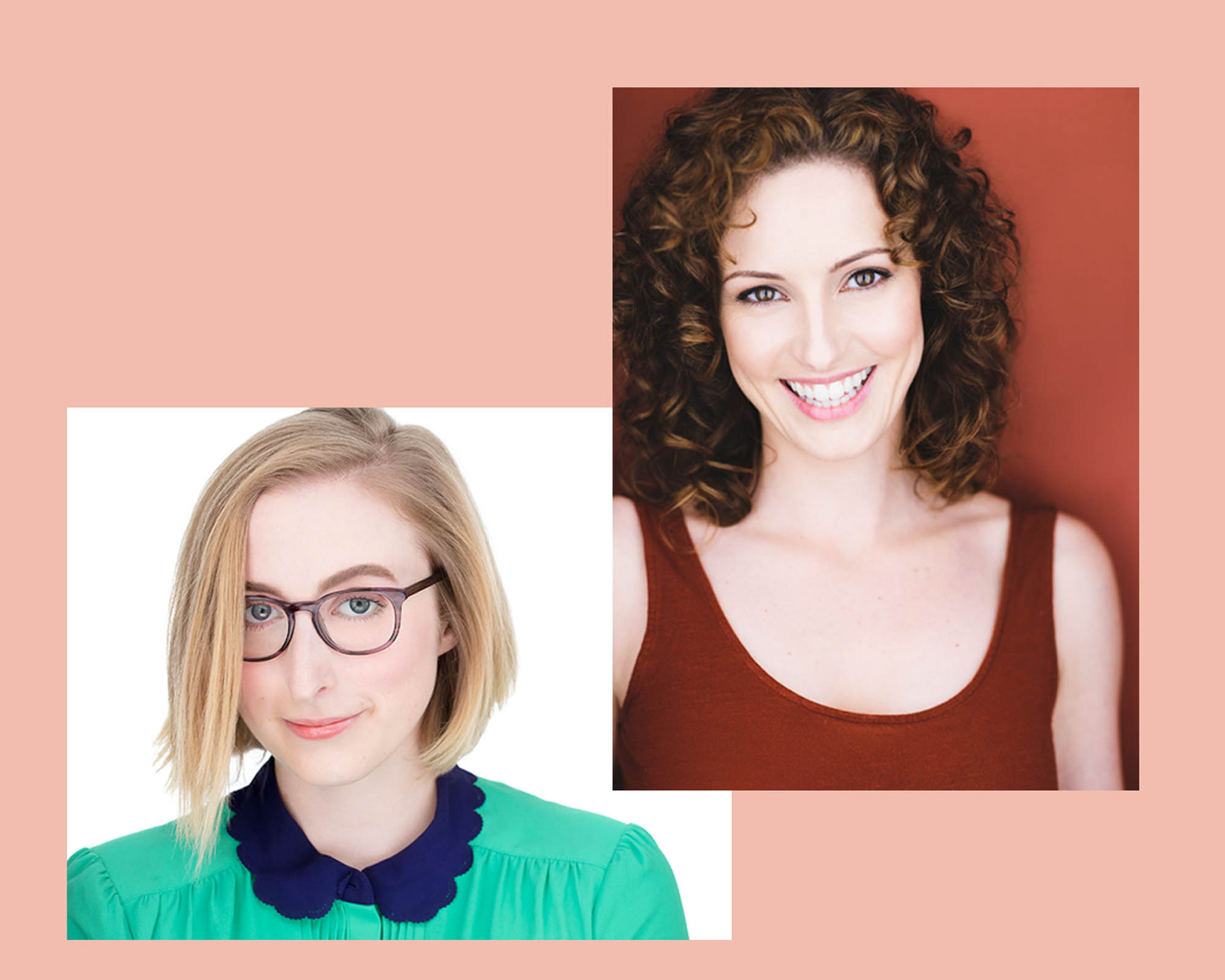
When Jeanine Tesori and Lisa Kron became the first all-female writing team to win Best Score at the Tony Awards, Tesori said: “You have to see it to be it.” Andrea Prestinario and Royer Bockus are hoping their new organization, Ring of Keys, will help queer women+, trans, and gender non-conforming artists be seen a whole lot more often both on and offstage. Ring of Keys seeks to help connect non-cisheterosexual theater professionals connect both with each other and with potential employers. At a time when so many theater companies are talking the talk about commitment to diversity, Ring of Keys is challenging the industry to move beyond lip service and start doing the work.
 
I talked to Andrea and Royer recently and they told me all about how Ring of Keys got started, where they’re going, and why Seven Brides for Seven Brothers is a problem.


Kelly Wallace: Tell me about Ring of Keys. Where did the idea come from? What motivated you to start it?
 
Royer Bockus: I think the story of how we met is basically the story of how the group got started. I was going to do a workshop of an opera that our mutual friend had written the music for. He said, “Oh, Royer, there’s another woman in the cast, she’s an actress and…she’s a lesbian.” Like, he whispered it.
 
Andrea Prestinario: I had the same experience of being whispered at with, “Andrea, I really want you to meet this girl who’s going to be in this reading with us, she’s a lesbian.”
 
Royer: And obviously Andrea has a partner, so it wasn’t about setting us up. He just really wanted us to know each other. What’s crazy is we get to the opera reading and we meet each other and we’re instantly friends and I’m like, “Did the music director tell you that I was a lesbian?” And she said yes and I said, “Oh, great! Well, I guess now we’re friends.” We realized, or at least I realized, that we don’t really know any other queer, female actresses in the community. Gay men have kajillions of people who are out and open and networking with each other and they’re very visible. We had the idea that we wanted to find all of us.
 
Andrea: We needed to find each other!
 
Royer: We needed to be organized and find a way to meet one another. It meant so much to me to meet Andrea. I just felt like I was alone, in a way, in the industry and that I was invisible.
 
Andrea: It feels like we’re the butt of gay mens’ jokes still? We’re not all one team; we’re still the joke. Even though he was kidding, there’s some implication there and we thought that we needed to join and merge and make our own club.
 
Royer: And so we did! After awhile of being just friends, we decided we were going to make our idea into a reality and that’s how we got here.
 

Ring of Keys
 

Kelly: Were there other specific moments in your career where someone made a joke or said something that made you aware of the discrimination that queer women face in this industry?
 
Andrea: I remember a moment of just being in a dressing room and coming out to the other women in my dressing room and they were like, “You can’t be gay, you’re too pretty!” I am straight-presenting and I think that’s also part of the issue in terms of having to come out again and again, obviously, but it being this idea that I felt alone in that world.
 
Royer: I think most of it for me, instead of outright discrimination, I didn’t feel represented in my industry. I remember completely losing my mind the first time I heard the soundtrack to Fun Home because I couldn’t believe that it was my story and my genre. I had never realized that those things had never met before. Also, I just didn’t know anybody else, or if I did, they weren’t out or were keeping it a secret. I felt like I had two identities, in a way: I had my work identity and my personal identity. One of the things that we hope, by creating this group, is that when we all see our collective queerness, and the industry sees our collective queerness, people will want to represent those stories onstage. The stage is one of our society’s pedestals for ideas and people, and we all know how important representation is. I know that’s what Stage & Candor is all about.
 
Andrea: I would add too that Ring of Keys is a collective for queer women, trans, and gender non-conforming artists working on and offstage in musical theater. We want to encompass everything under the umbrella of the queer spectrum that is not cis-men. When we see queerness onstage, they’re primarily cis-male narratives.
 

Kelly: Intersectionality is a big goal you’ve talked about for Ring of Keys; how do you plan to make sure transwomen and nonbinary people feel welcome, especially when there is a lot of trans-exclusive rhetoric in the cis-lesbian community?
 
Royer: I mean, I think the most important thing in that situation is to listen to their concerns and adapt to them. We can say all kinds of stuff about wanting to be inclusive and that we want to make sure you feel welcome here, but we need to listen to people. I hope that anyone would tell us if there were reasons they didn’t feel welcome.
 
Andrea: We also really look forward to having diversified leadership in the future, as our organization grows. We understand that as much as we try, there’s just a perspective that we don’t have. We are absolutely anti trans-exclusive radical feminism. We are not interested in anything that excludes trans and non-binary people.
 
Royer: We’re definitely striving to make space for marginalized voices within our own queer community, and we look forward to a leadership that isn’t just three cis women.
 
Kelly: What has the reaction been so far since you’ve launched?
 
Royer: It’s mostly been overwhelmingly positive from folks who have been seeking and needing this kind of collective. Everyone who has signed up to be a member has been looking for this and their responses in their applications have said so.
 
I had a gay friend who was concerned it would be anti-guys, and I found that to be an interesting comment because we’re making space and asking to have a seat at the table. Gay men set the table. There are all kinds of other humans that are under that queer spectrum, and those narratives aren’t being told. You want those stories onstage but you also want to see queer leadership off the stage as well.


Ring of Keys
 

Kelly: Why did you decide to go with the name “Ring of Keys”?
 
Royer: “Ring of Keys” is a song from the musical Fun Home. It refers to a moment in the character Young Allison’s life when she sees a woman in a diner who is basically like old school butch lesbian, and she has this moment where she recognizes something in herself in that person. It helps her to understand her own identity and grow into it. I think most queer people who you talk to will speak to the truth of this song. It’s so affirming to see yourself in someone else, to feel like you’re not alone in the world. That’s the goal of the organization. We want to be visible so young artists can look at us and think they can do this—they can be in musical theater. It’s really hard to see yourself in musical theater sometimes.
 
Kelly: It feels like it’s almost…not for you, on some level.
 
Royer: I used to wish when I did shows that I could put some sort of asterisk or indicator in the program that I was queer because I know how much it would’ve meant to me as a kid and see there’s somebody like me.
 
Andrea: I also have a friend who’s a very butch, gay woman in her 60s, and when I told her about Ring of Keys, she was so taken by it. She told me about how she used to see shows all the time and thought about doing musical theater. She said, “But I would go see musicals and nobody looked like me.” And so she thought it wasn’t for her. That breaks my heart. You have to see it to be it. She didn’t see her story, or anyone that looked like her, and so she went in another direction.
 
Another thing was when we did a Stage & Candor interview about two years ago, you had asked me why I thought we weren’t in musical theater, and I thought, maybe because our stories aren’t being told. It seems obvious when we think about it through that lens.


Kelly: The offstage representation is something I think a lot about. There are so few trans, NB, queer roles available, and there are mostly cisheterosexual men and women playing those roles. You wish that wasn’t true and that more people got to play “themselves.”
 
Royer: I think that any time somebody plans to profit artistically or financially from a character who is trans, nonbinary, queer, those people should get the opportunity to play that role. Those characters are never onstage, or so rarely onstage, and now that they are starting to be, the idea that we would cast somebody else in those roles, to me, is unfortunate and wrong.
 

Ring of Keys
 

Kelly: One thing I do want to talk about is the discourse around shows like Carousel, My Fair Lady, and Kiss Me Kate, which are all returning to Broadway. Are they sexist? Is it a good idea to produce these shows right now? What’s the line? A lot of older shows don’t align with our goals of representation and equality now.
 
Royer: I don’t see the value anymore in putting museum pieces onstage. If I’m going to see an older piece of our canon, I need to see it through an intersectional feminist lens. I thought Sweet Charity at the Signature did that well. I left that production thinking there is a future for musical theater and there is a future that doesn’t just completely throw away our canon. You can perform old pieces of theater through a lens that demonstrates either how far we’ve come or how far we haven’t come, but I’m not a fan of putting up “purist” revivals that don’t really say anything about the gender politics or racial politics within them. It’ll depend on what these productions do with themselves. If they put women at the forefront of the stories, if they are produced in a way that highlights that, and doesn’t make things sugary and sweet for old school audiences, put that onstage. If it’s behind a piece of museum glass, I’m not interested anymore, personally.
 
Andrea: I had a conversation with a casting director in a casting director session and we were talking about the musical Seven Brides for Seven Brothers. They’re doing it in their season because their audiences demand it. I think we need put more impetus on the chokehold theaters say they’re in with their audiences. Are you sure they “demand” it? I think we’re not exposing them enough to know that. They’re smarter than that. They just can’t know what they don’t know. His comment was about how he would have a hard time with that show “in this day and age,” it’s an example of raising consciousness. He finally looked at a musical and saw women abducted and taken against their consent and saw that was not okay.
 
Kelly: It’s honestly a terrible show.
 
Royer: And if you still want to do it, you need to navigate that. Our current consciousness is not going to be okay with that. And it’s so great that we are having these conversations and saying like, yeah, this is troubling. I just want to see that continue and for all of us to constantly have this lens. I don’t want it to be that you can’t do it because of the #MeToo movement right now and you’re going to do it next summer. It’s not okay. It’s just not okay.
 
Kelly: I think that’s a valid fear that a lot of women have, that this moment is temporary and things will regress to what they were before.
 
Andrea: There’s a fear that it’s just a trend, but we’re pushing the needle. We can never go back.
 
Kelly: I think my concern with something like Carousel, the creative team is pretty much all cis white men.
 
Royer: You can put my groaning in the interview if you want. [laughter]
 
Kelly: It’s just so hard to trust the idea of these shows when the same people are in charge who have always been in charge.
 
Royer: That Sweet Charity I described was directed by Leigh Silverman, who is a queer woman. I didn’t know that when I saw it and was experiencing it, and afterwards I thought, of course. Queer women were at the table; queer women were running the ship.
 
Andrea: Consider the fact that so much of the Golden Age was written by men. Why are most women written in that time period just virgins or mothers? The female perspective and experience wasn’t there.
 
Kelly: And all of this goes back to what you’re doing with Ring of Keys.
 
Andrea: It’s the intersection of queerness and musical theater and not being a white cis man.
 
Kelly: What else do you see in the future for the organization?
 
Andrea: I think the future is unknown, in terms of what potential Ring of Keys has. We’re twofold in our mission. One is to build a community and two is for it to be a hiring resource.
 
Kelly: It’s great that beyond just having this online network, you’re also committed to having in-person events and bringing people together that way. What kind of things will you guys be doing?

Royer: Well, we started with just gathering, which I think is really important. We got to know each other and learn what we’re doing as artists and activists in our own communities. I think of Ring of Keys as a community center. I think it would be great in the future to have readings of people’s work, to go see theater together, to organize politically and artistically. Ring of Keys is the building in which to do that, both online and in-person.
 
We’re looking to produce events too that showcase our members in concert, in cabarets, and in workshops.
 
Kelly: How would you explain to someone why Ring of Keys is important if we want to make change?
 
Andrea: To me, it’s like, just think of how much it would mean to other people for you to be public about your identity in this industry.
 
Royer: This is our diversity; it’s an asset we bring to the theater world. It’s exciting to make room at the table for these stories and drive opportunities for these artists. I think that this is an opportunity to, as we put it, kick-ball-change open the closet door and reveal a vibrant, new musical theater landscape.


Ring of Keys
 
If you are a queer women+, trans, or gender non-conforming artist and would like to apply to be a key, you can find more information at www.ringofkeys.org.

Posted on

Giving Voice to the Body: The Cast of ReconFIGUREd

ReconFIGUREd


Honest Accomplice Theatre tells stories that are rarely brought to light: those that are silenced, pushed aside, or deemed too “fringe” for mainstream theater. Working with an ensemble of artists, the company works to bring these topics into the light; to create dialogue about the things we don’t see onstage when it comes to the lives of female-identified and trans people.
 

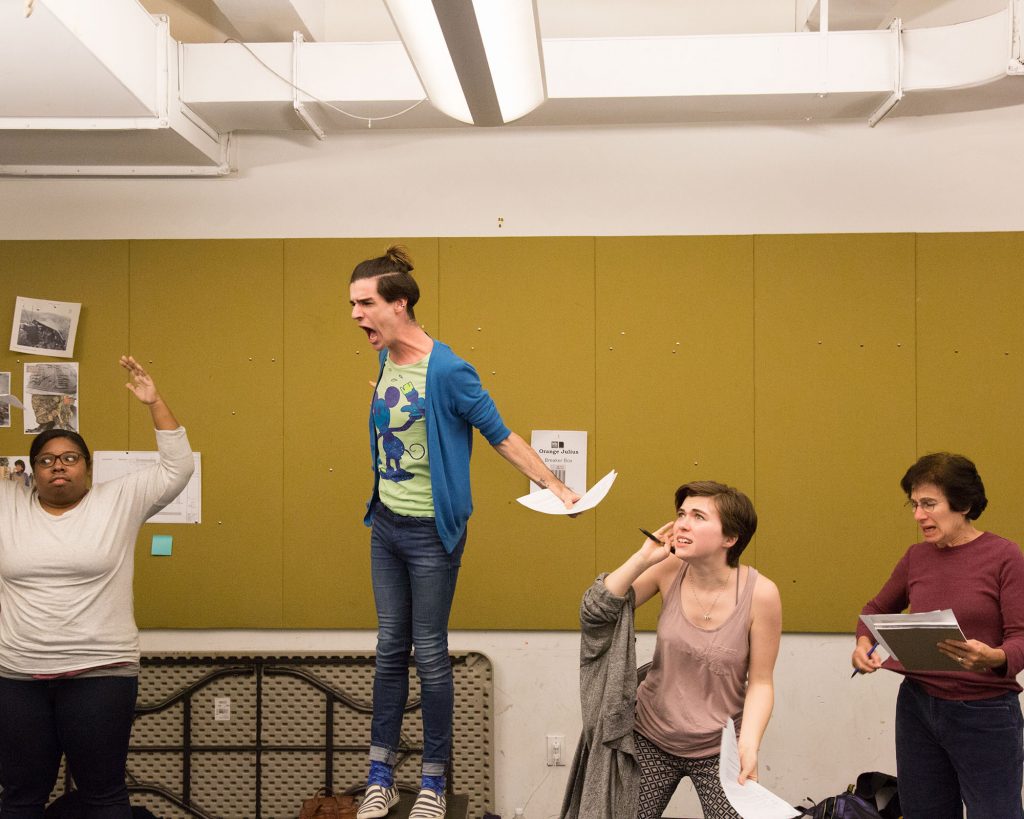
ReconFIGUREd, the company’s latest piece, is a heart-warming devised work about the experience of living in our bodies, and how it feels to inhabit the female and trans identity. We spoke with members of the cast about their process, their characters, and why theater matters.


ReconFIGUREd
 

Helen Schultz: How did you get involved with HAT/ReconFIGUREd?
 

Seth Day (He/Him/His): It’s actually a funny story! Although I had some theater experience growing up, I’m not an actor by trade. I wasn’t actively searching for acting gigs, but I’m a member of this Facebook group that is a forum to share queer-friendly employment opportunities, and I saw the casting call for ReconFIGUREd and thought, “Why not!?” To be honest, I almost chickened out of the audition, but the project seemed so important to me. The subject matter of the show is what really piqued my interest. It was the first time I had seen a casting call that was genuinely interested in the trans experience.
 

HS: Tell me about your character and creative/design role.
 

SD: I’m one of the two actors playing Luke, a trans guy in the first year of his transition, who struggles with feeling the need to perform toxic masculinity in order to be seen as male. He also has some family drama going on and has to balance that with dealing with his masculinity issues. It’s very exciting for me as a transperson to get to play a trans character, and to put a story on stage that feels more authentic than other trans representations in the media.
 

I’m also the prop designer, which was a first for me and a fun challenge! I really tried to give attention to detail to each and every prop in a way that each prop adds something to the story.
 

HS: Why do you think theater is such a powerful medium for telling this kind of story and to help change people’s minds and erase some of the stigmas associated with current identity/body politics?
 

SD: Generally when people see theater it’s for enjoyment, so I think when we go see a show, we let our guard down. If I were to walk up to someone and try to engage in a conversation about the body or gender or any sensitive topic, I think they’d probably be a little guarded. But when we let our guard down and are open, theater can really change us.
 

HS: Tell me about one of the scenes in the play.
 

SD: There is a power ballad sung from the last remaining estrogen in a menopausal body. What more do you need?
 

HS: Tell me about a moment in the development process that surprised or stuck out to you.
 

SD: At the beginning of each devising session, we would go around and introduce our name and pronouns (as these are things that can change!). And one session, one of the ensemble members asked us to use a pronoun I had never even heard of before, which was a really humbling moment for me. Sometimes I think just because I’m trans, I know all there is to know about gender, but that was a great reminder that we all have room to grow and learn!
 

HS: What is one thing you hope people take away from this piece?
 

SD: I suppose I don’t really care what people take away from the show as long as they’re still thinking after it’s over. My hope is that the show starts a conversation!
 

HS: What makes this show unique?
 

SD: I think one of the most unique aspects of this show is its honesty. That and the fact that about a third of the cast is trans! Which is just amazing.


ReconFIGUREd
 

Helen Schultz: How did you get involved with ReconFIGUREd?
 

Jo’Lisa Jones (She/Her/Hers): I saw a posting to audition for the devising portion, not realizing that a friend of mine had actually worked for HAT previously and gave them glowing reviews, so I knew I should go for it! The reason I first wanted to get involved was because I feel like seldom do women and trans folk have an opportunity to truly discuss and express what our bodies go through. I also wanted to share and relate my experiences with other people so that others feel comfortable to speak up and so that I could find some camaraderie.
 

HS: Tell me about your character.
 

JJ: My character’s name is Fiona, and she works in a women’s health clinic that also performs abortions. Despite having fertility issues, she gets pregnant, only to suffer a miscarriage. This character is loosely related to a short movement piece that I created about having an invisible illness, as I have PCOS [Polycystic Ovary Syndrome] and can potentially have fertility issues, so this character is very near and dear to my heart.
 

HS: Why do you think theater is such a powerful medium for telling this kind of story? How does it help change people’s minds and erase some of the stigmas associated with current identity/body politics?
 

JJ: I think it’s a fun way to be educated. You are moved by the characters and gain new perspectives on what others may be going through. People want to have fun, and I think ReconFIGUREd is a really fun show that has a beautifully crafted undercurrent of truth telling and insight – and other times we just let it all hang out because that’s appropriate too!
 

HS: Tell me about a moment in the development process that surprised or stuck out to you.
 

JJ: I think the strongest moment in the development process that stuck out was the day we were embodying mental illness and addictions. It was truly enlightening to me. I have been very fortunate to not suffer from either and, although I may logically understand both, I don’t always physically or emotionally understand what’s happening. It finally clicked that day because, rather than having a verbal scene, I got to see how it wears on the body, and that really struck a cord with me.


ReconFIGUREd
 

Helen Schultz: How did you get involved with HAT/ReconFIGUREd?
 

Jordan Ho (Xe/Xem/Xyr or She/Her/Hers): I started working with HAT in 2015 for the Tank run of The Birds and the Bees: Unabridged and I have been with them ever since. I stayed because this company is like home to me.
 

HS: Tell me about your character.
 

JH: I devised the role of Melanie in the show with castmate Holly Samson. There are many facets to Melanie: having a trans brother and a mother who works in an abortion clinic, on top of figuring out her race, ethnic identity, and coping with mental illness. It’s been a joy getting to create Melanie, and I hope anyone else who is suffering can find comfort in her arc.
 

HS: Why do you think theater is such a powerful medium for telling this kind of story? How does it help change people’s minds and erase some of the stigmas associated with current identity/body politics?
 

JH: When talking about the body academically, it’s easy to desensitize ourselves from actually addressing the issues. Not to say that literature and news articles are telling lies, but written word automatically makes these concepts abstract and not attached to our physical forms. And even if these concepts do manifest inside our bones, the natural next step is to act, which is why we do theater. I think there will be something powerful about seeing actual bodies tell the stories about how we carry and take care of our vessels.
 

HS: Tell me about one of the scenes in the play.
 

JH: There happens to be a musical number called “Gemme Femmes” that is horrifyingly entertaining. I grew up watching shows like Sailor Moon, The Winx Club, and Mew Mew Power, so I have a strong affinity to girl-power television. That being said, it is so, so interesting looking back and seeing just the opening intros and seeing these shallow molds of femininity veiled under the guise of being a cute television show for kids.
 

HS: Tell me about a moment in the development process that surprised or stuck out to you.
 

JH: Honestly, I was most surprised when we learned our character tracks and who was paired with whom. I’m a trans gender fluid actrex, so I just assumed that I would be assigned a trans character. But when I heard that I would be working with Holly to devise the role of a cisgender woman, I was really struck for a moment. And then I had a creative epiphany: because if Hollywood is so dead set on allowing cis people to play trans characters, then why can’t a trans person play a cis character? I will never forget this moment because it gave me such clarity that trans artists are capable of anything. Creating this role has helped me reclaim my femininity, and I’m so glad that Maggie, Rachel, and Holly have trusted me in this creation process.


ReconFIGUREd
 

Helen Schultz: How did you get involved with HAT/ReconFIGUREd?
 

Simona Berman (She/Her/Hers): I came on board this year for ReconFIGUREd and am outrageously happy to now be in the company.
 

HS: Why do you think theater is such a powerful medium for telling this kind of story? How does it help change people’s minds and erase some of the stigmas associated with current identity/body politics?
 

​”​And i said to my body. softly. ‘I want to be your friend.’ it took a long breath. and replied ‘i have been waiting my whole life for this.'”​

When I first read this quote by Nayyirah Waheed, I literally took a deep breath as I was reading, unconsciously wrapped my arms around my body, and started to cry. Or at least dry heave a bit, because I stopped myself from crying long ago when I was bullied growing up and didn’t want to give the bullies anymore fodder for their fire. Much of that bullying was a catalyst in my long continuous battle with my body. Along with a few eating disorders, I also struggle with body dysmorphia: where I look in the mirror and see my arm and where the large muscle from doing gymnastics meets my large breast it triggers my brain to see my body as one big armbreast – much bigger than it actually is.
 

That quote by Nayyirah took me out of my head and separated me from my body and gave my body its own persona, arousing empathy in me for my body. As a self-hating Empath, it is easier for me to be moved to action by others, not so much for myself. I suddenly saw my body as a scared little girl, who opened her arms wide and said, “Please love me, I beg of you!” The quote made me want to take care of that little girl that is my body. This was easier for me to process as opposed to trying to just love me for me.
 

That’s what theater does for certain issues, such as the ones we tackle in ReconFIGUREd. Theater takes an issue and initiates awareness for someone to be able to see outside of themselves. For an audience, if they connect deeply to the story as if it was theirs personally, theater allows for aesthetic distance where the story becomes a safe friend that might help someone feel less alone or less awkward. It also opens up whole new worlds for people who can’t relate at all to the story personally, but being able to see, hear, feel the story played out can now evoke empathy for the characters. Or at least a better understanding, as opposed to just hearing about it or reading about it in a random story.


ReconFIGUREd
 

Helen Schultz: How did you get involved with HAT/ReconFIGUREd?
 

Holly Sansom (She/Her/Hers): I started working with Maggie and Rachel before the Honest Accomplice Theatre company was created, back in 2012. I was an original ensemble member and deviser for the show The Birds and the Bees: Unabridged. When HAT was formed in 2014, I came on as the General Manager as well.
 

HS: Tell me about your character.
 

Holly: I share the role of Melanie with Mx. Jordan Ho. Melanie is a cis woman thinking about her identity as a biracial person in America. She is also dealing with mental illness and how these aspects of her body affect her relationship with the world and the people in her life.


ReconFIGUREd
 

Helen Schultz: How and when did you get involved with HAT/ReconFIGUREd?
 

Jesse Geguzis (Squee/Squer/Squem): I had auditioned for the previous project and then I was asked to be a part of this project about a year ago.
 

HS: Tell me about your character.
 

JG: Luke is a young trans guy in college and struggling to be comfortable in his new body with old friends and family of origin.
 

HS: Why do you think theater is such a powerful medium for telling this kind of story? How does it help change people’s minds and erase some of the stigmas associated with current identity/body politics?
 

JG: I think theater can change the world. Everyone involved in this project is throwing their energy at creating change. I think visual mediums are the strongest vehicle to get into folks’ heads and leave them starting to change their thinking. It plants a seed. This company is gardening a new world by telling new non-heteronormative narratives.
 

HS: Tell me about one of the scenes in the play.
 

JG: My favorite scene is with my character, Luke, and his sister Melanie, fighting and trying to find common ground around identity struggles. The whole scene takes place with both characters wearing the same giant shirt, as a punishment for fighting by their mother.
 

HS: What is one thing you hope people take away from this piece?
 

JG: I hope people leave thinking about how to open up their minds more and more every day.
 

HS: What makes this show unique?
 

JG: It’s a company of only female and trans-identified folks.


reconFIGUREd
 

Helen Schultz: How and when did you get involved with HAT/ ReconFIGUREd?
 

Kat Swanson (She/Her/Hers): I was lucky enough to be involved with HAT early through some of the first Birds and the Bees workshops, which I heard about through Rachel while working with her on another project. I remember being so struck by the questions being asked and by the process. I tried to be involved in whatever way I could from there. I helped out a bit with general support on one of the Birds and the Bees productions, and finally had the chance to be involved from the beginning of this project.
 
 
HS: Tell me about your character.
 

KS: My character is a struggling single mother named Donna. She has an eight-year-old daughter named Ari – short for Ariel – who she’s supporting on her own (the father has been out of the picture for some time now), which creates a lot of financial hardships. She also grapples with lack of self-love, binge eating disorder (BED), and back pain, partially caused by having larger breasts. Donna suffers from the classic single-parent time versus money dilemma: how can she be a good mother to Ari when all she has time to focus on is the next step, the next place to be, the next bill to pay? She’s in survival mode and is realizing the negative impact on her growing daughter.
 

HS: Why do you think theater is such a powerful medium for telling this kind of story and to help change people’s minds and erase some of the stigmas associated with current identity/body politics?
 

KS: I really think that seeing is believing and feeling is understanding. People who aren’t trans or women or disabled and so on don’t really know what gaps exist in their understanding. When you don’t live it, you just don’t know. You can read an article or catch on to all the political and social media buzzwords and think you know something, but you just don’t. People are often afraid to admit, even to themselves, that they don’t understand.
 

Theater is such a unique art form in how it is able to combine all the other art forms to create a true, visceral experience. It is able to make the audience see and feel and have at least the opportunity to start to know. By attending and really opening yourself up to a play that portrays an experience that is not your own, you get a chance to empathize with other people. That empathy, especially when it occurs on a large scale, is – I think – what really has the power to make a difference in people and society as a whole.
 
 
HS: Tell me about one of the scenes in the play.
 

KS: Ooph – tough question! There are so many excellent ones. My favorite scene is one that portrays caretaking for a character whose mobility has been severely impacted by her battle with cancer. It’s really loaded – the daughter is getting ready herself and is helping her mother get ready for the day at the same time. The scene is great because the dialogue is very normal but also tells so much in so little. I think it’s something a lot of families can relate to, [regardless of the] situation they’re in. It hit a chord with me because my mom has been wheelchair-bound her entire life, but growing up, I realized that no one really understood what that meant for her day-to-day life. They had this general, blind pity and were usually kind – all good things – but they had no idea what it took for her just to get out of bed, to use the bathroom, things that able-bodied folk, myself included, often take for granted. I cried when I saw it because it just hit home so hard. I hope it makes able-bodied folks happy to be in their bodies to some degree, and also helps people who are in a similar position as this character for whatever reason feel more understood and represented onstage.
 

HS: Tell me about a moment in the development process that surprised you or stuck out to you.
 

KS: I didn’t realize how tough the development process could be. For a while, I thought I was the only one who was in rehearsal feeling as though I didn’t belong there, like I didn’t have anything to contribute. To Maggie and Rachel’s credit, things kept moving forward because they heard these concerns from several folks in the room and implemented things like a “question box”. [The idea of the box is] to try and help the cast understand each other better, and also understand what they each brought to the room – all while taking the “educator” responsibility on themselves. [Because of that], folks who are often put into that position involuntarily in their day-to-day lives didn’t have to take that role on here. It became such a safe space to discuss really challenging issues with lots of differing viewpoints. While it was tough, the end result and the value of realizing that kind of space is possible was immeasurable to me.
 

As for a specific moment… picking one, I guess I was really surprised to realize that a lot of people don’t view their periods as a negative thing. For some it’s culturally celebrated, for others it’s empowering and magical – it opened my mind because for me, my period had just always been a monthly “Congrats, you’re not pregnant!” notification and a frustrating, painful, messy pain-in-the-ass. It’s hard to explain, but it was a really memorable rehearsal.
 

HS: What is one thing you hope people take away from this piece?
 

KS: I hope people take away a new appreciation for the complexity of a person’s agency over their body, as well as the wide variety of experiences that are different from their own. I hope they see and appreciate something new, and I hope they ask questions and start talking about things they’ve been silent about before.
 

HS: What makes this show unique?
 

KS: It’s people and it’s honesty.


***


ReconFIGUREd is playing at The Tank on January 6 to January 15, 2017. Tickets can be purchased at http://thetanknyc.org. For $10 tickets, use code HATBODY.