Posted on

A Conversation with Christa Scott-Reed

Christa Scott-Reed


Shadowlands tells the touching story of the relationship between C. S. Lewis and Helen Joy Davidman. The Fellowship of Performing Arts is producing the first New York revival of this acclaimed play, which began performances at the Acorn Theater on October 17. We spoke with Christa Scott-Reed, who is making her directorial debut, about what makes the play relevant to modern audiences, and about the relationship between faith and the arts.


Margarita Javier: Could you tell us a little bit about yourself?
 

Christa Scott-Reed: I’m originally from the Pacific Northwest, from a little town called Wenatchee, Washington. It’s actually surprisingly home to a few theater artists in New York. It’s interesting because for a small town kind of in the middle of nowhere, they have a surprising love for theater. And I think it’s because it’s not geographically close to any other cities, so they sort of had to create their own cultural life.
 

MJ: So there’s a lot of theater there?
 

CSR: Yes! I mean, it’s all community theater; it’s not professional. But there’s a real love of it. For an agricultural town and one that’s relatively conservative, it’s remarkable how much they really value theater. I grew up just being immersed in it from a young age. And occasionally we’d get to go over to Seattle—and Dan Sullivan was running Seattle Rep at the time—and saw stuff there, and so that’s where I began. I went to undergrad at Whitman College in Washington, went to grad school at the Denver Center, and then found my way here.
 

MJ: Did you start as a performer?
 

CSR: I was always a performer until this particular job.
 

MJ: This is your first time directing?
 

CSR: This is my first time directing, yes.
 

MJ: How did that come about?
 

CSR: As a performer, I worked for Fellowship of the Performing Arts starting in 2013 on their production of The Great Divorce. And it started as a developmental production Off-Broadway, then we did a two-year national tour, and then we brought it back again to Off-Broadway. So it was a long stretch with them. And while I was working with them on Great Divorce, they started using me because, in my off-time as a performer, I also teach and coach other actors, so they started bringing me in, kind of as an artistic consultant, to maybe work with other actors in other productions, to direct readings, to help cast readings, to give artistic input in certain ways. And they started using me more and more for that. They sort of made it official when they realized that one thing they lacked in the company was a literary manager. And since I had been doing a lot with them in various ways, they said, “How about stepping in for this literary manager job?” I said, “I’m still a performer!” They said, “We get that; let’s call it a part time gig.” And in that role as literary manager, I directed a staged reading of Shadowlands for over a hundred donors and everybody seemed happy with that. Things started rolling and, because they had seen me handle the stage reading and because they had seen me in the room with actors, a couple of which are in the cast now, they said, “Ok you know what? We feel like we trust you. Let’s just have you do it. You’ve been a professional actor for over 20 years—you’ve been in the room. We think you can handle this.”
 

Christa Scott-Reed
 

MJ: Are you taking from directors you’ve worked with?
 

CSR: Absolutely. In fact, the other day my assistant director was noticing how I was doing my notes in the script a certain way, and he said, “Who’d you get that from?” And I said, “Rob Ruggiero” [laughs]. So, absolutely. And in fact, I’ve reached out in this process to several good friends of mine who I respect hugely as directors, and asked for their advice, their wisdom. They’ve put in good words for me. I’ve not been shy to try to humbly learn from those who know better than I do.
 

MJ: Correct me if I’m wrong, but this is the first New York City revival of Shadowlands.
 

CSR: It is.
 

MJ: So it’s a big undertaking as the first project to be directing, right?
 

CSR: It is. When you’re going to direct something for the first time, why not pick a show that’s set in the 1950s England, with 12 cast members, two of which are children, and 35 scene changes—why not? I mean, it’s an easy one. An easy one [laughs].
 

MJ: What can you tell us about the show itself, Shadowlands?
 

CSR: It’s a beautiful show. A lot of people know it because it was not only from Broadway and the West End, but because it was made into a movie with Anthony Hopkins and Debra Winger. People know it from that. They go “Oh right, Shadowlands!” But it’s time for it to come back to remind themselves of it. It’s a beautiful story. It’s known as a little bit of a three-hanky piece, but it’s not just that. Working on it, I’m reminded of how moving and how thought provoking it is. Those are all clichéd words, but really true in this case. And it’s also really nice -I was telling somebody else- it’s really nice to have a show that is a love story, but a love story between people who aren’t 22, who aren’t passionately falling for each other in that first-time way. There’s room for those stories, and those stories are being done, but I like the fact that these are mature people who have lived their lives, who have pain and suffering under their belts, who have past marriages and children and all those kinds of things. Telling that story as a love story is, I think, refreshing, especially for a theater audience who’s not largely 22 year olds. I know I’m not! And then you add to it the layers of what it has to say about the meaning of suffering: Why does God allow suffering in the world? What do we give up in order to gain something? When we gain so much joy and love, what do we give up in the form of pain and suffering? How does that test our faith, our doubt? All universal subjects that really resonate. Even though C. S. Lewis was, I think, a renowned Christian, there are things that resonate for anyone regardless of faith background. It’s about human experience.
 

MJ: And because this is based on a true story, has there been a process of doing research into the lives of C. S. Lewis and Joy Davidman? What has that been like?
 

CSR: Absolutely. And in fact, as somebody who probably in another life would have preferred to be a librarian—and I don’t joke when I say that—I love research. I took my dramaturgical element burden a little bit too far and spent months reading every biography I could get my hands on, and I ended up compiling it into this hefty stack of research about the characters, background about Oxford, everything I could get my hands on. And I presented it to the cast. I said, “There won’t be a test on this, but use this as a resource.” And I remember Danny, who plays C. S. Lewis, said, “Well, I do have a friend in England who had studied with or knew C. S. Lewis, and I was going to contact him. I don’t know that I need to now!” [laughs]. So I went a little crazy. It was also important for me to tell them that this isn’t a documentary. Danny doesn’t look like C. S. Lewis. These are different people—this is a play, it’s not reality. Of course it’s inspired by true events, and we want to maintain a sense of strong connection to those ideas. He may not look exactly like Lewis, but he is Lewis for this story. What are his needs, his wants, his loves?
 

Christa Scott-Reed
 

MJ: Why do you think this play is relevant to today’s audiences, specifically in New York? What do you think it’s telling us?
 

CSR: Touching on what I said before, honestly, look at what happened recently in Las Vegas. One of the first things the character of Lewis does as he walks out onstage is to hold up a newspaper and say, “This tragedy.” In this case, it was the Gillingham bus disaster in the 1950s. He says, “This just happened. How can God allow this to happen? What is the meaning of this kind of suffering?” Obviously, that’s true of any period in time, but I think this is something we’re struggling with constantly. How do we deal with pain? What is the purpose of it? I think it’s true no matter what decade you’re in. It’s always going to be relevant.
 

MJ: And you mentioned this is being produced by the Fellowship of Performing Arts, a not-for-profit company that is interested in delivering theater that has a Christian worldview. So first of all, how did you first become involved with them?
 

CSR: I auditioned like anybody else through their casting director for The Great Divorce. One thing I particularly respect about FPA is they have this mission to deliver theater from a Christian worldview that will engage a diverse audience, so they want to present a piece of art that is executed to its highest level possible. To that end, they want the best artists. They did not ask me when I auditioned what my faith background was or what my beliefs were. I’ve been at talkbacks with the artistic directors, and members of the audience ask, “Well, who in the cast, or designers, or crew—who is Christian?” And he just says, “I don’t know. You’ll have to ask them.” And I really appreciate that. What they require from an artist who works with them is somebody who is willing to do the best job they can, to make the best piece of art that they can, that speaks to that mission. But we have artists of all faith backgrounds or no faith backgrounds. Because so often—and I’m just speaking for myself now—when you hear the term “Christian theater”—and I happen to be a Christian—but even I wince a little bit. You think this is going to be some kind of eye rolling niche theater that’s just … ugh. And that’s really not their purpose. They really want to do a piece of art that’s intellectually challenging, emotionally engaging, something that audience members can come to and, regardless of faith background, be interested or fascinated by, come out of the theater laughing, thinking. They have managed to do that. When we did The Great Divorce, friends of mine came to see it when we were on tour in D.C.—and these are people who firmly have their own faith tradition which is not Christian, and they will never be interested in being Christian, nor should they—but they signed up for the newsletter because they loved the play so much. They all happen to be psychologists and they were all so engaged in the ideas. That’s the kind of thing that they’re interested in. Yes, of course FPA wants to provide theater for practicing Christians who are looking for art that speaks to them, that’s not speaking beneath them, but actually meets them at an intellectual level that’s satisfying. But at the same time, we want to bring other people in. The ideas of C. S. Lewis are interesting to people of all different types and sorts.
 

MJ: Going by what you said, I think we can agree that Christianity as a religion has been hijacked by the political right, definitely in this country, but also other parts of the world. Because of that, there tends to be a negative association with that religion for people of more liberal political leanings, especially in the theater world. What would you say to that end in terms of what this theater company is trying to achieve?
 

CSR: Certainly in our audience, there are conservative people, there are progressive people, there are people who span all parts of the political spectrum, as well as all parts of the faith spectrum. But I think we deliver stories that speak authentically to the human experience and that expand our imaginations rather than limit them. And I think a lot of progressives—and I count myself as progressive—get upset with a too-conservatively imagined Christianity; there’s this idea of limiting thought, of limiting experience of putting up barriers and saying, “This is acceptable and this is not.” And I don’t think that artists are in the business of doing that.
 

MJ: Right, and C. S. Lewis was a perfect example of that: he was very much an intellectual proponent of Christianity.
 

CSR: I know that for Max, our artistic director, his real desire is to do work that is intellectually respected. I think we can get people’s attention that way. You can walk in and be like “Let’s see what these Christians have for us” and then walk out going “That blew my mind a little bit.” We get a lot of reviews like that. Over the course of the last few years, a lot of the reviewers will start by saying, “I expected to be preached at. And that’s not what I got. I started thinking new thoughts.” We’re not in the business of alienating people; we’re not in the business of telling people what to think. We’re in the business of showing a piece of art that hopefully speaks to your body, soul, and mind.
 

Christa Scott-Reed
 

MJ: When you talk about a “Christian worldview,” what is that? What is a Christian worldview?
 

CSR: Well, certainly, it would be one that speaks to the values and the ideas behind a Christ centered life. So it would be love, compassion, what they talk about in Shadowlands. The whole concept of the title of Shadowlands is a Platonic idea—that the world we live in now is really just a shadow of the life to come, that true reality is something that lives beyond. It’s not special just to Christianity, but it’s certainly something that is an important part of Christianity: that there is another world, there is something supernatural that is beyond that. All of our shows have an element of the supernatural for that reason: that there’s something beyond, there’s something more. If we can find how we can best live in the present and be in the best relationship with other people and with God, that’s all part of becoming more real for the realness to come.
 

MJ: I’m fascinated by Joy Davidman.
 

CSR: I know, right? What an amazing character.
 

MJ: And we don’t know as much about her as we do about C. S. Lewis, so I was hoping you can talk about her, in terms of the play.
 

CSR: Yes, it’s interesting when you asked, “How does this play speak to New Yorkers?” because she’s perfect. She is such a New Yorker: from the Bronx, born into a Jewish but non-religious family, an incredible intellectual. She was absolutely C. S. Lewis’ intellectual equal. She was a genius, off the charts.
 

MJ: That’s what drew him to her initially, her intellect.
 

CSR: Oh absolutely, yeah. And she started as a passionate communist and a writer, and then discovered that communism as it was being practiced was just not for her, so she eventually moved away from that. She was always searching for something. At one point she was interested in Dianetics, before it became Scientology, but she eventually came to Christianity herself and, as a result of that, started writing to C. S. Lewis and him to her. As you said, then it was meeting of the minds—this purely intellectual relationship started via letter writing for a couple of years and then once they finally met, everything blew up from there.
 

MJ: What can you tell us about the cast?
 

CSR: Our cast is great. Daniel Gerroll plays C. S. Lewis. He’s a wonderful British and American actor that people will know from years of Broadway and Off-Broadway shows, films, and television. Robin Abramson plays Joy, and she’s a revelation. I’m really excited about showing Robin to New York audiences because she has been sort of the young leading lady of Pittsburgh, which is where she’s from. She only recently moved to New York, this is her New York stage debut. This feels like the way Joy kind of bursts into C. S. Lewis’ life, and, in a way, I feel like Robin is bursting into New York, and I can’t wait for people to see her. It’s just a wonderful group of actors. John C. Vennema, whom audiences have seen in a million wonderful things in New York, is exceptional and hilarious as C. S. Lewis’ brother Warnie. There are excellent actors across the board in this play.
 

MJ: Being a performer yourself, how does that inform your job as a director?
 

CSR: My assistant director, whom I had never worked with before, has worked with lots of directors but never with one who was also an actor, so he keeps saying, “It’s so interesting the things that you focus on that other directors don’t.” Whether it’s concern about how certain actors should carry certain things, or how difficult it will be for an actor to wear a costume, or how the dialogue is going—just little actor-centric things. He says most directors don’t think of that stuff. I think my strength going into the production was knowing how to communicate with actors, not only from teaching and coaching, but also just being in productions and having that relationship. The thing that I’ve had to learn on the job is staging in a way I never had before: blocking, seeing the entire arc of a show in a new way. I was always focused on my part as an actor. So it’s been a learn-on-the-job situation, but it’s been very satisfying.
 

MJ: Who would you say are your biggest influences both as a performer and as a director?
 

CSR: Where to begin? I will have to say Dan Sullivan’s productions on Seattle Rep stage. His productions are what made me love theater. There are so many beautiful directors working today. I saw a production recently that blew me away, Everybody by Branden Jacobs-Jenkins at Signature, directed by Lila Neugebauer. It’s a modern retelling of the medieval Everyman story, and it had this heightened, almost theological, philosophical thing, and it was not coming from a Christian worldview, but it spoke at those levels and it was so deeply affecting. Shadowlands is a little bit of a departure for FPA in the sense that it’s so traditional. They have tended to do very artistically “out there” stuff, whether it’s The Screwtape Letters or The Great Divorce. The show they have right now, Martin Luther on Trial, which is touring, tells the story of Martin Luther in the afterlife; he’s on trial and the devil is the prosecuting attorney. St. Peter is the judge and the witnesses are everyone from Hitler to Freud to Pope Francis to Martin Luther King Jr. They tend to do these highly theatrical pieces, so in a way, Shadowlands is a bit more of a traditional affair for them. But it still has magic in it.
 

Christa Scott-Reed
 

MJ: What do you feel is the relationship between faith and the arts, specifically theater?
 

CSR: It seems like such a natural connection. If you go back in history, theater first evolved from religious expression: the mask works of the Greeks, to the Medieval Churches, the Passion plays. How do you express magic? How do you express the unexpressed? Through art, right? And how does one even begin to articulate what is faith or what is ultimate joy as experienced through faith? Why do they sing in musicals? Because they have no other way of expressing emotions. I think at some point, you have to leave standard expressions and enter into an artistic realm. Even Christ spoke in stories, in parable. A lot of times, it’s difficult when we get too strict in our definitions of biblical text, because we as a society don’t have an understanding of how people thousands of years ago wrote and expressed themselves much more metaphorically. So it seems like the arts are a natural extension of that.
 

MJ: Moving forward, do you want to direct again?
 

CSR: I’m certainly open to it. It’s been a really fun, mind-blowing, and mind-expanding experience. I’ve learned so much more about theater. I thought I kinda knew it; I was like: “I got this! I know all about it!” And then you go into this meeting where they’re discussing set construction, and where and how it gets constructed, and they talk about the electrics, and the light rigging, and I realized I didn’t even begin to know. The amount of marketing material, the thousands of daily e-mails tweaking every little thing. I didn’t realize that when you pull open that wonderful Wizard of Oz curtain, behind there, it’s a mile long. I don’t want to sound too ignorant; I obviously had an idea, but there was more that I had no idea about. So it’s exciting. I’ve just seen behind the curtain. I want to get better at it. I want to learn even more. Let your readers know, though, I am not giving up acting. It is my passion. Please cast me! [laughs]
 

MJ: Is there a play that you would love to direct?
 

CSR: The minute I learned that I was directing this, I was like: “So that my mind doesn’t completely liquefy from being too overwhelmed, I’m just going to focus on this play and think about nothing but this play”. So obviously it hasn’t occurred to me. Other than the fact that as a literary manager I have other scripts for FPA that we’re talking about developing and—no pressure on FPA—but certainly every now and then it occurs to me about whether I’d like to try to convince them to let me do this again.
 

MJ: What about performing wise? Is there any role you’ve always wanted to play and haven’t yet?
 

CSR: It’s interesting how I’ve had to shift those over the course of my life. There would be parts that now I realize “I’ve aged right out of that one, haven’t I?” I did so much classical theater when I was a younger woman, and then I had children and that necessitated staying in New York, so I just started working with more new plays. So now that I’ve skipped forward into a different age range, when can I go back to playing all those classical roles that were always out of my reach? But still please cast me in modern plays and in film and TV [laughs].
 

MJ: Why should people come see this show and what do you hope people will get out of it?
 

CSR: I’ll say the obvious: it’s really good. It’s a really good play. Our sound designer, John Gromada, a wonderful Tony-nominated sound designer, said, “This is a really good play!” It sneaks up on you. You go in and think: I’m going to hear some smart ideas from the mouth of C. S. Lewis that you would expect to hear. And then all of a sudden, you’re crying and you’re not exactly sure why. It just sinks into your bones. There’s something about this play that is deeply affecting in a mature way. Not that you can’t be 22 and see this and enjoy it, but this is a play for someone like me, someone who’s had some life experience and who’s had to ask those tough life questions, deal with pain and loss and love and joy. I was just reading this amazing article about the midlife crisis for women—a subject that’s not much dealt with—and how suddenly there’s this perfect life storm of all these different life things bouncing up against each other. Coming to see a piece of art like this—where someone like me is sorting through those ideas too, but in a way that’s a thousand times more articulate than I could ever be—emotionally organizes those thoughts in a way that makes me go: “Yes. This is actually how prayer works in a way that’s not derivative or simple minded. That is really how we can think of suffering and love in a way that has real genuine, mature thought, but still grabs me by the gut at the same time.” We go see smart plays, witty plays, and we go see emotionally powerful plays that are messy. But to see those worlds meet? I think it’s rarer than we realize.


Broadway: The Pitman Painters.  National Tour: C.S. Lewis’ The Great Divorce. Off-Broadway: Church and State (New World Stages); The Great Divorce (world premiere, Fellowship for Performing Arts); The Talls (world premiere, Second Stage); The Freedom of the City (Irish Repertory Theatre); Celebration and The RoomThe Bald Soprano and the Lesson10×2010×25 (Atlantic Theatre Company); Beasley’s Christmas PartyPullman Car HiawathaMuseum (Keen Company); Deathbed (world premiere, McGinn-Cazale Theatre); Marion Bridge (Urban Stages); The Voysey Inheritance (Mint Theater Company).  Film & Television: 30 RockThe ImpossibilitiesEdenGossip Girl666 Park AvenueLaw & OrderLaw & Order: SVULove LifeNew AmsterdamAs the World Turns. Regional Theater: Mark St. Germain’s Relativity at TheatreWorks (with Richard Dreyfuss); On Golden Pond (with Keir Dullea, Bucks County Playhouse); Argonautika, Honour (with Kathleen Chalfant, Berkeley Repertory Theatre); Restoration ComedyThe Food Chain (The Old Globe); The Little Dog Laughed (Intiman Theatre);  As You Like ItCrimes of the Heart, the world premiere of Charles L. Mee’s Limonade Tous les Jours (Actors Theatre of Louisville).  Other Regional: Papermill Playhouse, Cincinnati Playhouse in the Park, Repertory Theatre of St. Louis, Pioneer Theatre, Barrington Stage, Syracuse Stage, Denver Center Theatre Company, Cleveland Playhouse, Olney Theatre Center, and many more.

Posted on

Line, Please!?

line please


Hi, I’m Liz and I’ll be offering you advice on navigating the tricky situations that can come from working in or being a fan of theater.
I’ve been doing it out on my blog, fyeahgreatplays.com, for a while now, so it seemed only natural to migrate here in a more official Advice Columnist capacity. I’ve freelanced as a stage manager around New York as well as regionally, I’m a member of Actor’s Equity and a total contract junkie, and I occasionally cohost a podcast on theater and performance (Maxamoo).
 

To submit a question, email lineplease@stageandcandor.wpcomstaging.com.


Dear Liz,
 

With all of the warranted criticism about the under-representation of female playwrights, besides producing more female-written plays, do you think the male playwrights should be telling different kinds of stories and focusing on other types of characters?


As I’ve gotten older, I’ve realized “write what you know” is sort of crap. It’s how you end up with 10,000 novels about old white professors with inner turmoil. There’s no benefit to living in a bubble. Our world and the many stories within it are worth exploring. 
 

My first preference would be to just produce more work by women, POC, and other marginalized groups and let them tell their own stories in their own words. They know best, and again, these stories are universal and worth hearing. I also know realistically this is a slow uphill climb (with little victories all the time!), and they shouldn’t bear the burden of being the only voice of their group. So I also believe in “holding the door” for people. As a white woman, I have privilege, so if I’m given an opportunity, it’s my responsibility to hold the door open and bring in others who may not have access to that opportunity. I want to champion people who might not get a voice otherwise. 
 

So the onus is on those male playwrights who are being produced to stop navel-gazing and look beyond their lives for stories. If they can tell these stories in a conscientious way, more power to them. And then they should hold the door open for the firsthand experiences, give them the voice and the opportunity. Nothing’s worse than, for example, a whole bunch of white men working on a show about Muslim-Americans.

Posted on

A Conversation with the Crystal Lucas Perry, Alexandra Henrikson, and Olivia Washington

Crystal Lucas Perry, Alexandra Henrikson, Olivia Washington


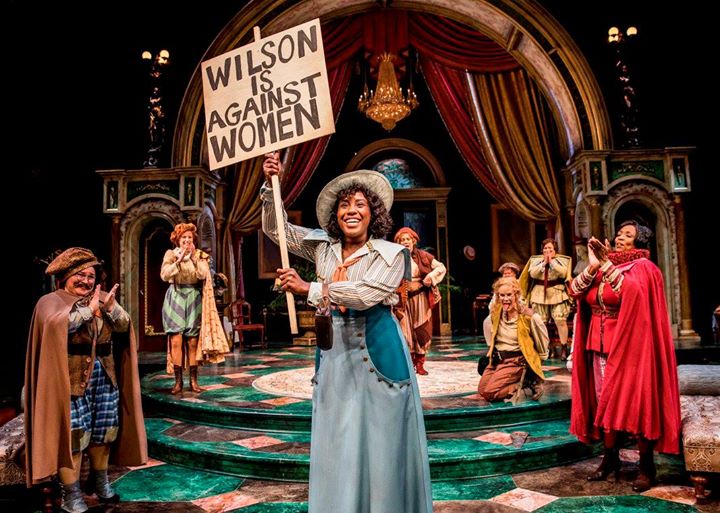
When you think of plays that empower women, The Taming of the Shrew doesn’t come to mind, but Chicago Shakespeare Theatre’s new production is trying to change that. With a cast of thirteen women and a suffragette twist, this Shrew is unlike any production you’ve ever seen before. I sat down with three of the show’s stars, Crystal Lucas Perry, Alexandra Henrikson, and Olivia Washington to talk about voting, feminism and Oregon Trail.


Kelly Wallace: So, you guys have started performances? You started last week, yeah? Let’s start with who you are and who you’re playing—just give me a short description of that character.
 

Crystal Lucas Perry: I’m playing Petruchio as well as Mrs. Van Dyne—Victoria Van Dyne. Mrs. Van Dyne is a suffragette during 1919, and one of the champions of the club. She prides herself on being out and physical with the movement and doing her best to do her part. Any chance she has to express her enthusiasm for the cause and the rights of women, she takes it. She encourages her other suffragettes and members to also take pride in the cause. And then Petruchio, obviously the tamer of the shrew, he’s a man going after what he wants. He will stop at nothing to obtain that.
 

Alex Henrikson: Hello, I’m eating a muffin. When I know I’m being recorded I suddenly get real weird and I apologize. I’ll stop trying to entertain. I play Kate and Mrs. Louise Harrison. What’s so fun is Mrs. Louise Harrison is a woman in 1919 and is an industrialist’s wife and is happy to be so and likes that her husband is in charge. I like to imagine him as a middle-aged Sean Connery…
 

Crystal: Wouldn’t we all like to imagine being married to a middle-aged Sean Connery?
 

Alex: Sean Connery’s where you start. No, but, she’s that woman who has learned to play the world with the set of tools that she has in 1919 to have power, which is her beauty, her being a great host, her gentle voice, and also her diva-level narcissism—which is another part of it that’s a little hard to reconcile sometimes. She doesn’t understand suffrage. She’s come here to act; she wants to be an actress. I think she’s a frustrated actress because she would’ve been a great actress in a different time. Then I get to play Kate, which is just the most fun. It feels like every time we get together is a political act, which feels great at this moment in time. In the beginning, I get to be a woman who goes from being a wildcat and not knowing how to use her words exactly but having all this passion, to a woman who figures out how to use her words by the end. Unfortunately, what she uses her words for is not what me, Alex Henrikson, would want her to stay. That’s what the play wrestles with on that journey.
 

Olivia Washington: I play Emily Ingersoll slash Ms. Ingersoll slash Bianca. Emily is a daughter of the Senator, Senator Sherman, and she’s very loving and supportive and keeps to herself. She has an awakening at the end, and meeting all these women … she’s not an initial supporter of suffrage, but she’s educated on it. She’s learned it more in a book way, not in the way of having seen what it is. So I think she wakes up to the idea of what it means to believe in something, and believe in something for the country and for herself as well. She’s able to have conversations with her mother that she wouldn’t have been able to have without that awakening. And then Bianca … she’s so much fun to play. And in a similar way, she is a loving daughter. But she kind of uses her power in a different way than Kate uses her power. She picks her times to speak and how she speaks to get what she wants, but then still goes behind her dad’s back and gets married. I like that kind of sassy, quiet, sneaky way about her.
 

Kelly: What does it feel like to do a show, which as you mentioned has this political side, right now? This is, undeniably, a very contentious moment in our country, no matter what side you’re on.
 

Crystal: Well, I think about the Women’s March that happened everywhere, I like to imagine Mrs. Van Dyne at the front lines of that march, making all the hilarious yet powerful signs. I can’t help but think of her as one of those women, and the Instagram photos she must have taken [laughter]. That was a day to gain a ton of followers. But, really, that’s the beauty of what I get to witness. I watch how these women choose to fight, seeing how the women of today choose to fight, or choose to push against the barriers we’re facing. It always seems to be the same. They use what they have to get what they want. They take the opportunities that they are able to seize and use that as a platform.
 

During the play, we have our own “votes,” um … what’s it called?
 

Alex: A democratic process? [laughter]
 

Crystal: We do the whole voice voting “ay”/”nay” thing, and that’s what’s so beautiful. This is a chance where we get to demonstrate and recognize our power. It might be something meaningless, but it means something to us. We can make change within our little house and that gives us the power to go and make change elsewhere. That’s something I like, the parallels between those two, of how we choose to fight and how we energize ourselves to make something better.
 

Alex: Yeah, what you just said made me think of how being in high school, there were lots of boys telling me like, during the Gore vote (okay, it was a little past high school, don’t worry about the time), that my vote didn’t mean anything, that it was the lesser of two evils.
 

Crystal: Where’d we hear that again?
 

Alex: Exactly. It comes up every single election, doesn’t even matter who the politicians are, there’s a mistrust of government. To me, I never saw it as a lesser of two evils. I always can see someone I admire, some quality, and only this year—and it’s taken me a long time to get here—but my vote does matter. What I think does matter. I went to the Women’s March and I saw a lot of little girls with a lot of women around them saying, No, this is important. There are more women getting involved in politics. When I was doing research for this show, I read Rebecca Traister’s book, All the Single Ladies. She tells this story of women in Wyoming, where there’s all this trash in the streets and the male politicians and the mayor couldn’t get it together, and the women were like, “Our streets are disgusting.” So they all ran for positions in the town, won, got all this shit done, and then went back to the house all like, see you later. There’s part of me that’s really excited. For me, this has been a huge awakening experience, and I think the same happens for my character, and getting to do The Taming of the Shrew for the third time (I’ve played Gremio and Bianca before) … what’s been nice about this time and this rehearsal process is when we would get to points where it just was never okay with me. You watch these versions and you’re like “…and he probably raped her,” or he’s calling her chattel. It’s dark. It’s so funny, but then it gets really, really dark. You see these two characters smash against each other and fall in love.
 

Kelly: Not the fun Beatrice and Benedick kind of thing.
 

Alex: They’re literally hitting each other.
 

Kelly: It isn’t that contentious, Shakespearean, comedic courtship…
 

Alex: It’s their way of falling in love, and I think they do fall in love, but for me as a modern woman in 2017, playing a woman in 1919, watching this play from the 1590s, I have all these out of body experiences. I’m seeing what’s not okay with me; I’m seeing where my line is. I think that now, as a woman who is 32 (and you can print that, I’m proud of it), I’m finding all these things that aren’t okay for me anymore. I can point to that and say it wasn’t okay when it happened.
 

Olivia: I agree with both of them. To put it so simply, it’s amazing how something so small can birth a bigger movement. I think that was a lovely reminder, not just in this political climate, but in the world. This story of these women, it shows your voice matters, even if people are telling you it does not matter. If you can just get involved, I think that’s what most people of our generation are saying right now. Most millennials are like, you know what, a takeaway from this whole election is that I need to pay more attention to what’s happening. We have to take back our rights, and our voice, because we can. I’m going to educate myself on things about our government that I let go by, because I let people speak for me, or because I assumed it would be okay. Growing up in that way, we have to take responsibility for our actions and our part in making a difference in the world today.
 

Crystal: And what affects one affects us all. Mrs. Van Dyne knows the passing of this, this 19th Amendment, and the right to vote, may not mean mountains are moved for her individually. A move for women is a move for her. A win for women is a win for her. Not until ’65 when the Voting Rights Act passes does she get that, so the barriers are still in the way for her character particularly. But the fact that they’ve been able to come together and be united in this is a complete reflection of what I see with women today. We have been able to set aside our differences and our viewpoints because at some level, we agree this vote is a right that belongs to us all. `
 

Olivia: For the good of the country.
 

Kelly: You’ve had a few performances—do you have any sense of how the audience has been reacting? It’s a show that everyone’s familiar with, but has a wildly different take on.
 

Olivia: I’ll speak up first since they’re onstage most of the time and we’re in the aisles watching it. It’s one of my favorite parts, watching the end of the first act. They get married, and you’re just listening to the audience respond. Everyone is so sucked in. They’re trying to figure out Petruchio like, is that a woman? I don’t know…
 

Alex: Crystal is an incredibly convincing gentleman…
 

Olivia: But really, you watch this man overpower this strong-willed woman and what is she gonna do? What are we gonna do? Can we do anything? The vocal responses coming from the audiences are chilling sometimes. So it doesn’t matter if it’s a man playing this part; it doesn’t matter if it’s a woman. If you’re good at your job, you get the message across. They do it so beautifully and you’re watching it and … it sucks. People realize it’s not that kind of comedy.
 

Alex: And that final “No,” Barbara [Gaines, Artistic Director] was like, “What do you feel in that moment?” And my answer was: “I don’t want to go with him.” So she told me to say that. And I did. And you hear the audience laugh, it’s like this almost impetuous child. Then Crystal takes that impetuous energy away and everyone is silent. I love this play, and I am a feminist, and this is the moment for me that shows why this play is so tricky.
 

Kelly: How is that for you, playing such an aggressive man? Does the gender swap change anything about your onstage interaction?
 

Alex: I feel like I’m actually stronger onstage with her than with any male counterpart because I feel like she can actually match me. Like, as an actress, I’m very tall. I’m 5’10” and I have a very large wingspan and a very big voice. Oftentimes, I felt like I had to diminish myself to make sure the guy looked strong, or at least that’s the traditional gender role. So many shows would say they couldn’t find someone to match me, which, I think, is often code for finding someone as tall as me. When I met Crystal, it was like wow, it’s on. I’m not pulling any punches, she didn’t pull any punches with me. We just kept raising up. I wish every actor could get to work with Crystal Lucas Perry and Olivia Washington at some point. Everyone says yes. No one is diminishing themselves. Now that I know how much power there is, I can see how I wasn’t raising up to that.
 

Crystal: Aside from the physical adjustments I’m trying to show that are more masculine, I honestly don’t turn off my female brain. I really think of him as a woman who thinks differently and who executes from a different place than my other counterparts. As a woman playing this role, it’s incredibly satisfying because I know every move I would make as a woman. I know every tic that would turn me off or on as a woman. So because I know those things, I get to decide if I would be turned off or on by that.
 

Kelly: You know to push those buttons.
 

Crystal: Oh, I get to push the buttons, and I recognize when buttons are being pushed of mine. It’s really lovely and working with Alex has been fun because she does not filter and she goes all in and so we’ve been able to take this scene … I mean, we could show you the wooing scene in a million different ways and keep you on your toes. That’s just been the joy. Previews are helping us figure out what story we want to tell with that. At the end of the day, it’s two people coming together and realizing they can’t just break through the other person, they can’t just go around them, they have to meet—there has to be a collision. It’s exciting. He’s a really strong woman, strong in a different way.
 

Crystal Lucas Perry, Alexandra Hendrikson

(Liz Lauren)


Kelly: Now, the framing of this show is the suffragette movement; you’re all playing these 20th-century suffragettes as well. You’re both people of color, as you brought up, the right to vote wasn’t a “win” at that moment, so what is that like for you as a human and as an actress? This victory, ostensibly, has happened, but not for everyone.
 

Crystal: A win for one of us is a win for all. And we talked a lot about that. We chose to acknowledge who we are in the space and celebrate that, because that’s one more beautiful thing about these women being able to come together because of their social level. They’re here, in this group, choosing to commune with this Shakespeare. Of course, all of these things happen on this day. I think that I’ll speak for Mrs. Van Dyne: she’s a woman who has a vision for the future, and she is able to see that we have to focus on right now, and right now, this is the next step. This is the opportunity. Similar to how Petruchio seizes an opportunity when it’s presented, she’s gonna seize this opportunity as it stands before her. There’s not many times we have to touch on it. It’s there. It’s a part of the play by us being onstage.
 

Kelly: It doesn’t need to be explicit.
 

Olivia: It’s underneath; the undertones are there. And we have different perspectives. You have Mrs. Van Dyne, who is such a clear cut fighter for the cause, and I think for my character, I was raised by a white Senator’s family, so I come from a place of privilege in that family and in that home. And yet, there’s this kind of … Oh, I have to start using my voice in a way outside the safety net of my home that was created for me. I am a woman of color in this world, and I want to effect change in this world, but not just from back here. So, how do I step forward? This is all undertone, of course.
 

Kelly: But that’s the kind of undertone and tension that keeps the show interesting, it draws you in even further.
 

Crystal: There’s a moment in the play where some of us rush out to join a rally and some of the women stay, and you hear some of their reasons. Some people feel they’re too old, some are too afraid, and you get a chance to see that it’s not just because they don’t want that, it’s because they have something to lose themselves. So getting to the core, stripping color, stripping social class, stripping all of those other things, it gets to the human need of wanting to be safe and wanting to make change and wanting to be a part of something great.
 

Olivia: It’s human. You see throughout history—no matter race, gender, whatever—to fight for a bigger cause, you let go of yourself, it’s for the bigger battle.
 

Crystal: And I don’t think these women are done. I feel like they’ve got a taste of change and the ability to make change.
 

Kelly: There’s an optimism in where it ends up. The “tide-turning” feeling is very present. And that one-hundred years ago … not even, really…
 

Olivia: It’s so crazy!
 

Kelly: How recently all of this was for millennials is mind-boggling. The Voting Rights Act, Roe vs. Wade, marriage equality … we feel like these are all a given. Of course, we should have those things. I think the good idea behind the Women’s March is maybe to remind younger generations how much there is to protect, and what we still have to lose.
 

Alex: I was born in the ‘80s, we had the internet, I was playing Oregon Trail on it…
 

Kelly: I’m not sure if the internet was a net positive or not yet.
 

Alex: I’m not sure either, we won’t take a side. But part of it was that I saw all this heroines in Disney movies. I wasn’t seeing Snow White anymore, I was seeing Belle. And she really liked reading. Then it turned into this competition of reading. Or She-Ra princess of power! I think the heroines and the storytelling I had growing up versus what my mother had … it affected what her expectations of me were. She told me if I got pregnant before 30 it would hurt more to give birth to the baby? Which is a lie, of course? She also told me I didn’t need to learn to cook, let’s look into writing more. I think she was doing this very active “you will not be that woman.” By ‘that woman,” she meant the idea of what she was brought up as, and what she was trying to steer me away from. By now we know every woman is every woman. I love cooking. I get turned on when I cook a meal for a man. It is hot! You know? I also get turned on when I cook a meal for all my friends, not turned on in that way. It’s just seeing all the different options that we as women have. When I look at Mrs. Van Dyne and I see her going outside and going into the fray again, I think she is black, she will get double hurt and that’s how brave she is. That’s one of the things I use for my character to move forward. She’s such a brave fucking woman, why am I being a coward over here? You can’t know something until you know it. Because I’m playing Kate, I have a very clear journey through the play of learning that there’s more. And once you know something, you can’t unknow it. I think that’s what’s so exciting about the storytelling in this. I think that our storytelling is powerful—what story we are telling, specifically.
 

Crystal: I definitely have to thank Barbara Gaines and Ron West, our writer and director, for allowing us the time to work through this process. We have a huge play to learn, we didn’t have that much time to do it. We also have two plays to learn, because of the frame of a play within a play. It’s still being developed every day. So to be able to alot for those times where we can have these conversations as we’re having now, and be very specific and clear about the weight of these situations and the way we want to play these things here—it’s a balancing act. Truly, knowing the mothers who have come before us and all of their accomplishments and their sacrifices and their triumphs … all of that is what lies beneath the foundation of this play.
 

Crystal Lucas Perry, Alexandra Hendrikson

(Liz Lauren)


Kelly: What do you hope the audience experiences with this show?
 

Crystal: Always, for me, I hope it starts conversation. I think there are so many things to talk about after you see this show. Whether it’s about how you had so much fun watching these women…
 

Alex: It is funny, it’s really funny!
 

Crystal: Thirteen women onstage at one time. We were just talking about how we’re pretty sure there isn’t another production with thirteen women onstage in America right now. That’s a beautiful thing. All of these characters would be men. So there’s a celebration of that! There’s a celebration over these women playing a part in the 19th Amendment! But also Alex’s character’s journey—not just as Kate, but as Mrs. Harrison—is that she goes through a change. One of her lines is “people change” and again, it’s also what Olivia says. The more we educate ourselves, the more information we have about what is happening and what we can do to be a part of that—how we’re hurting, and how we’re helping. You could say the same about the environment: ultimately, the more we know, the more we can contribute. I believe that everyone who comes to the theater wants to be a part of something.
 

Olivia: Also, I hope the audience sees how things aren’t so black and white. Growing up in our safe millennial bubble, we have to realize things can be confusing and muddy. It won’t always be all good or always bad. Coming away from this production, I’ve laughed, but there are other parts I’m not really okay with. Why is that? You have to realize the world is not so clear-cut, so where do you fit into that? How do you have a conversation about that? I think that’s what I come away looking at.
 

Crystal: You’ll meet this women and see little glimpses of who they are and their backgrounds— whether it be religious, or racial, or a stance—but no matter what, they’ve come together for this cause. No matter what they are, there is something bigger than them. For the audience to see that, to see it was happening during that time, and to have it mirror what’s happening now—to know it’s possible, it still exists, that things do matter. It’s an important reminder for people.
 

Alex: I like looking out into the ground. One night, I was doing the final monologue. I saw this woman elbow her husband at a certain point. I guess I want women to feel seen. I hope men can see their women feel seen and support women talking. It’s just an opportunity to say hi, we see you. There’s one moment where Barbara had given me the direction, to be Kate at the end and do the submission speech, but let Mrs. Harrison push against that. I almost felt like I saw ghosts last night. Because there are posters of suffragettes, but then I saw my mother, and my grandmother, and little me, and the little mess of people in the audience, and their mothers and grandmothers—and I’m wearing my grandmother’s ring in this, so it feels like these generations of women who have supported and loved each other. There’s something beautiful about women from 2017 playing women from 1919, playing men from the 1590s. You feel the ghosts. Theater is a tradition where you feel the ghosts anyway; you feel this communal, tribal vibe of coming together to tell a story at the end. There’s this moment of the campfire and our mothers and our grandmothers holding hands across millennia, and it’s beautiful.


Crystal Lucas-Perry makes her Chicago debut at Chicago Shakespeare Theater. Off-Broadway credits include Bull in a China Shop (Lincoln Center Theater); Little Children Dream of God (Roundabout Theatre); Bastard Jones (The Cell Theatre); The Convent of Pleasure(Cherry Lane Theatre); Storm Still: A King Lear Adaptation (Brooklyn Yard Theatre); Devil Music (Ensemble Studio Theatre); and The Wedding Play (The Tank Theatre). Regional credits include A Sign of the Times (Goodspeed Musicals); Far from Heaven, A Streetcar Named Desire, Finding Robert Hutchens, and When You’re Here (Williamstown Theatre Festival). Film credits include Mimesis 2, Frank and Azalee Austin, and Roulette. Ms. Lucas-Perry is also a solo artist and continues to compose, produce, and perform her original music at venues across the country. She received her BA from Western Michigan University’s College of Fine Arts and her MFA from New York University’s Tisch Graduate Acting Program.
 

Alexandra Henrikson makes her Chicago debut at Chicago Shakespeare Theater. Broadway credits include Larry David’s Fish in the Dark and The Snow Geese (Manhattan Theatre Club). Off-Broadway and her off-off Broadway credits include: We Play for the Gods (Women’s Project Theater); Bones in the Basket (The Araca Group); Hell House (St. Ann’s Warehouse); Commedia dell’Artichoke (Gene Frankel Theatre); The Maids (Impure Artists); and Much Ado About Nothing (Smith Street Stage). Her independent film works include: Towheads, Love Like Gold, and Here We Are in the Present … Again. Regional credits include: the world premiere of Steve Martin’s Meteor Shower (The Old Globe); Ironbound (Helen Hayes nomination, Round House Theatre); Fairytale Lives of Russian Girls (Suzi Bass Award – Best Ensemble, Alliance Theatre); and productions with California Shakespeare Theater and the Eugene O’Neill Theater Center. Ms. Henrikson received a BFA in theater from New York University and an MFA in acting from Yale University.
 

Olivia Washington makes her Chicago debut at Chicago Shakespeare Theater. She has appeared off Broadway as Laura in The Glass Menagerie (Masterworks Theater Company) and in Caucasian Chalk Circle (Stella Adler Studio of Acting). Her regional credits include Clybourne Park (Hangar Theatre). Film and television credits include Lee Daniel’s The Butler and Mr. Robot. Ms. Washington received her BFA in drama from the Tisch School of the Arts at NYU.

Posted on

A Conversation with Orion Stephanie Johnstone

Orion Johnstone


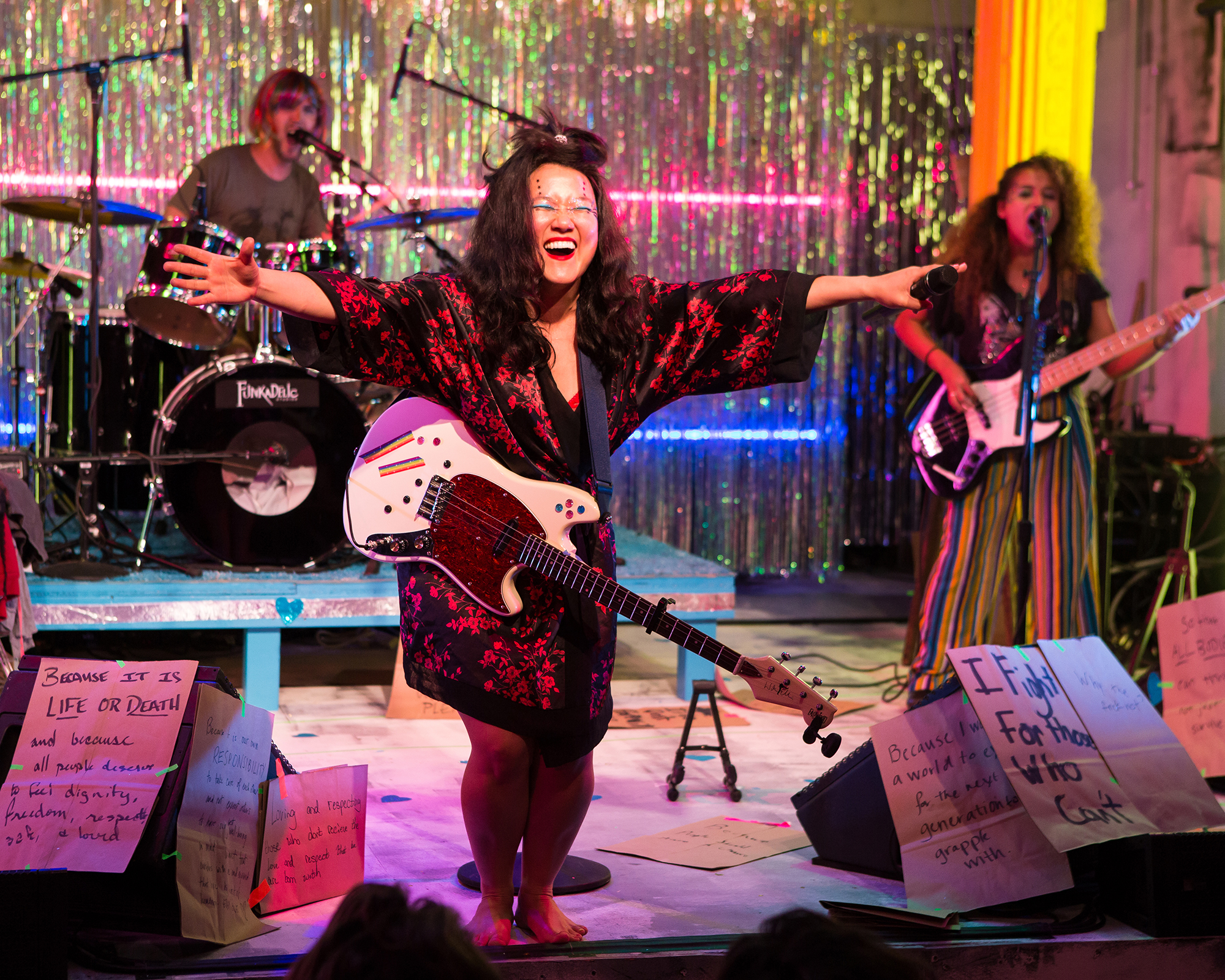
Upon entering Rattlestick Theatre for my scheduled conversation, an air of freeing and loving spirit came over me as I look up to see Orion Stephanie Johnstone ready to greet me. Once in awhile, you connect with someone so inspiring, time flies by, and you forget you’ve only just met this person for the first time an hour before. I sat down with Orion, co-director of Diana Oh’s {my lingerie play} 2017: Installation #9: THE CONCERT AND CALL TO ARMS!!!!!!!!!, The Final Installation for a wide-ranging and impassioned conversation about their influences, their identity, giving power to marginalized voices, and what it means to “queer the world.”


Michelle Tse: Let’s start with your journey with Diana [Oh], and specifically with {my lingerie play}.
 

Orion Stephanie Johnstone: Well, first off, I’d like to clarify: Diana has been doing {my lingerie play} installations since 2014, and what we are talking about here is the 9th installation in 2017: the concert and call to arms!!!!!!!!!, yes, with nine exclamations points.
 

Diana is a brilliant, powerful force in the world and we have circled each other and held each other in huge mutual respect for years, but had not worked together until this project. She came to me and said, “You are the one that I need to co-direct this.” At first I was humbled, and I hesitated, and I asked a lot more questions because I’m a highly collaborative theater artist, not primarily a capital “D” director. I have loads of facilitation experience and other things and I’m very comfortable in leadership positions, but this is a different hat than I’ve ever worn. Diana said, I don’t need this experienced director; I need a spiritual leader of the room. I need someone who I trust will hold a space where we all can transcend shame together. As a sexuality educator, I am passionate about not just inviting individuals to transcend shame, but in deepening all of our understanding of how our personal shame is connected to intersecting and overlapping systems of oppression.
 

After many conversations where I was always honored to be asked but wanted to ask more questions to make sure that this was a fit, I said an enthusiastic, “Hell yes.” And I’m so grateful that I did. We’ve been working together pretty intensely since early summer.
 

Orion Johnstone

(Pedro Aijon Torres)


MT: I have to say that when I was here, I felt like it was the first time in a long time other than a couple things here and there, that I actually had the thought of, “This is what an inclusive space is.” It’s happened a couple times before, but never in theater, honestly. Can you talk about the vision and the preview process?
 

OSJ: The two central questions of my life are: Who and how might we be together, more bravely in light of our collective liberation? And how might I be consistently expanding who I mean when we say “we”? I keep trying to run hard and fast away from theater-making because I have so often run up against the “who and how we are together” being so secondary to hitting certain other marks, or to commodifying the soulfulness of what’s being created.
 

The invitation that Diana posed to me, essentially, is how do we live by those central questions, to embody our commitment to the idea that how we make is as important as what we make. How do we create a robust culture of courage and compassion, and care, and lead with that and trust that in every aspect of the process. There are always going to be things that are beyond our zones of awareness, but I’m done with feeling immobilized by that. I’m always so grateful when something is brought to my attention like, Oh, I haven’t actually been accountable to this person or this community in this. I think it’s easy to feel guilty and overwhelmed and shut down, but my prayer and intention for myself and for all of the work that I make is “May I embrace that we’re all on a continual learning journey about this, and to hear that feedback. Hold that with love and how might we expand, how might we do better, even knowing that nothing is going to be perfect.” I fiercely love Diana in her commitment to that, too!


(Jeremy Daniels)/ ({my lingerie play} 2014: Installation #5: 30 PEOPLE; Emma Pratte)/ (Jeremy Daniels)


MT: Feeding off of that and what we were talking about in an earlier conversation, you have the community choir for queer and trans folks, the dating app for kinky people, your sex and relationships coaching practice, and—
 

OSJ: —The alternative divinity school.
 

MT: Exactly, so a lot of your work centers around giving power to marginalized voices and people, so when you do come across someone that is maybe a straight white folk who considers themselves liberal and progressive, but maybe keeps asking the wrong questions. They want to learn, but you just keep hitting that same roadblock. Do you keep going back to them like, “Hey, that’s not cool, you got to do x, y, and z,” and at what point do you say, “Okay, I need to just maybe walk away from this situation,” focus on marginalized folks, then beam up that space as opposed to the education of that larger “we” that you were talking about?
 

OSJ: Thank you so much for that question and the many, many layers in it.
 

MT: I could’ve been a little more concise, but that’s what keeps me up.
 

OSJ: I share this question so much! First off, I think that I couldn’t get up in the morning if I didn’t believe that every human is capable of transformation. And also, I’m very exhausted. I’m very very angry. I’ve been learning about how to not shy away from expressing my anger and instead to deepen in learning how I might express my anger with love in a way that hopefully doesn’t diminish anybody else’s humanity, and also doesn’t diminish the very real violence and erasure that people I’m in community with and/or myself are experiencing.
 

Capitalism would have us believe the lie that there’s scarcity in terms of who can be liberated. Like, If we’re having racial justice we can’t be focused on trans justice right now. Bullshit. If we’re focused on trans justice, then we can’t be talking about disability rights, and so on and so on. That’s absolutely bullshit.
 

MT: The linear versus intersectionality, basically, right?
 

OSJ: Yeah, and if I truly believe that our liberation is collective, that absolutely must include cis white straight people, too. And also, I keep learning more about how and where I channel my energy day to day. At least right now, my energy is most channeled toward amplifying and co-liberating with marginalized folks, or rather, people who carry power that is not necessarily the most dominantly celebrated kind of power. More and more these days, I get honest about my capacity for conversations that are primarily educational, and I honor that that labor does not always have to be mine to do. I try to see where I can show up to do labor for other folks who can’t, knowing that my liberation is intimately bound with theirs. And I believe that, as a white person, I have a responsibility to have tough conversations with other white people. I realize that my answer is all over the map here. The big answer to your question is, it’s really fucking hard as I know you know, and it’s a continual navigation day to day.
 

MT: For some reason it reminds me of Maya Angelou, who talked about why she doesn’t hate her rapist. That she feels that we all have that within us. That we all have Hitler and Gandhi, basically within us, right?
 

OSJ: Yeah, yeah.
 

MT: It’s just a matter of how your life journey has made you access different nodes of those feelings and those wires within your head. When it’s so violent everyday you can’t help but be like, “Oh.”
 

OSJ: Can I … I want to respond just a little bit more to that other question.
 

MT: Please do.
 

Jeremy Daniel

(Jeremy Daniels)


OSJ: I’m 34 now. Until I was 22, I was a fundamentalist Evangelical Christian. Though I was always acting from a place that I understood to be compassion and care, I perpetuated Christian Supremacy and its ties to patriarchy and homophobia and transphobia and white supremacy. I mean, I still inevitably perpetuate oppression in a way that none of us are separate from. But having had a worldview and paradigm that is so extremely different from what I have now, I now have so much compassion for people’s journeys. At the same time, it’s not easy to hold to that compassion when people I know and love are experiencing such violence on a daily basis and there’s so much to be heavy-hearted about.
 

MT: I now have to take every other day off from watching even Vice news, because the saturation and violence and abuse is so rampant.
 

OSJ: Can I ask how you’re holding that question these days?
 

MT: I’ve now had a few white friends tell me, “Please just send them my way because I’m frustrated just hearing about what you had to deal with.” But lot of these moments come up when you’re not expecting it or when you’re the only person at the table who can answer the question. It’s quite painful to constantly be teaching empathy and essentially telling folks, “Hey, I matter as much as you.” I often come up against the moment of do I just shut up and order a drink, or do I just get up and scream, “Are you seriously only able to relate it back to yourself only?” It’s especially painful when you’re halfway into a conversation and they’ve agreed that, for example, white feminism is a problem, and that they’ve been doing the reading they need to, so you have an expectation. Then later on, they’ll say or mention something that is so exclusionary that my heart will just sink to my feet. Somedays I have to just be okay with, Okay, this is as much as I can affect today, here and now.
 

OSJ: That’s so real. Thank you for sharing that. I think of the times when I’ve been called in around the privileges that I carry as a white person. There have been times when folks have been really patient with me and asked me questions and stuck with me even at the expense of their spirit energy, and I have grown from that. And then there have been times when folks have been really, really angry at me, and me having to sit with that discomfort has also invited some necessary growth and transformation.
 

MT: I think for me, though, I always know that if I show emotion, especially anger and frustration, that other person would shut down completely. I’m exhausted, I can’t deal sometimes, but I can’t be shutting down and angry and not dealing with it because if I tell them to go away, they might never engage with that particular issue again. And that becomes another weight, especially when it comes to racism. That in itself is frustrating. There’s no one else around me that can take this mic right now and … It’s like, “Well, crap, what do I do?”
 

OSJ: Yes, yes. I hear and honor that and I wish that I had a simple answer and response. I think the only thing that I know to be true is how—well, I guess I hope to be true is—I hope that even when you or I, or anyone feels very alone and like they’re the only person that could have this conversation, that actually, that isn’t the case. That we do all hold it together. Whenever any of us can have capacity, that’s a good thing, and none of us has to have capacity all the time.
 

MT: Right, exactly.
 

OSJ: And by us, I mean: folks who have experienced the marginalization, folks who have feared for their literal safety while walking down the street, though that’s not a clear cut binary of those who have and those who haven’t. I feel like this is tricky territory.
 

MT: Those invisible marginalizations.
 

OSJ: It’s just wild.
 

MT: I have friends on a spectrum of disability or differently abled from you can’t see it at all, to being in a motorized scooter. And it’s painfully obvious that this city doesn’t cater to that well what so ever.
 

OSJ: New York City sucks in terms of access.
 

MT: All anyone has to do is spend a couple hours with someone differently abled. It’s bananas.
 

Jeremy Daniel

(Jeremy Daniels)


OSJ: Can I give a shout out?
 

MT: Yes, please do.
 

OSJ: My friend Bri just started a podcast called Power Not Pity—conversations with people about access and disabilities. I think it’s fabulous.
 

MT: Amazing. I’ll have to check that out.
 

OSJ: I have a lot to learn.
 

MT: Yeah, I’m definitely learning too. I don’t see the point in living if we don’t keep learning and challenging ourselves. For inclusion and representation though, my thought is that for a lot of folks, they see progression in the linear format, and our intersectional brains have an easier time seeing the interconnectedness.
 

OSJ: I love the thing that Lilla Watson said, you probably know it already: “If you have come to help me, you’re wasting your time, but if you have come because your liberation is bound with mine, then let us work together.” Thinking in terms of collective liberation doesn’t slow us down or cost us anything, actually it means that we’re on the only possible track to cultural transformation, I believe.
 

MT: There’s that media norm though, the progressions. In my head, the only way I can try to relate, is to try to see it from that other perspective of there’s white feminism, then there’s current day feminism—that’s a little bit intersectional—and then there’s what you’re talking about, which is what I subscribe to, trans-inclusive feminism.
 

OSJ: Or even trans-centered feminism.
 

MT: Oh, that’s even better, yes. Thank you. So I wondered if you could speak about that and the dangers of not being trans-centered, and for it to be happening alongside intersectional conversations, about race, gender and sexuality, about economics … On and on.
 

OSJ: Thank you, and I could go on for days. This is where my major point of exhaustion lies. First and foremost, it’s no secret that our transfeminine sisters and siblings of color face, by far, the highest risk of violence and discrimination out of anybody. And yet, even in so many wonderful, progressive spaces that I move in, there is often not only a learning curve that needs to happen, but an unwillingness to honor the identities of trans folks.
 

It’s so fucking sad and enraging to me when women, or anybody, feels like including transfeminine people in their feminism is taking something away from them. Again, that goes back to the lie of scarcity that capitalism would have us believe. That by including all women, trans and cis, that inclusion doesn’t mean we’re brushing under the rug that different women have different experiences. Women of different backgrounds and identities of all kinds—race, class privilege, ability—have very, very different experiences. And people are dying! It’s so sad to me when folks feel like that’s taking something away to be inclusive there.
 

It also breaks my heart that so much that the world has so very very very far to go in terms of even welcoming and fighting for the basic rights of binary trans men and women. So that in terms of non-binary trans folk across the gender spectrum—as I think you know, I am non-binary—we just brush that conversation under the rug or we just can’t even go there yet.
 

MT: It’s the progression of others versus the self.
 

OSJ: I also don’t believe that that’s linear.
 

MT: It’s not.
 

OSJ: And I truly believe that everyone, trans and cis, binary and non-binary, is more liberated when we hold this more expansive understanding of gender and gender complexity.
Jeremy Daniel

(Jeremy Daniels)


MT: Bringing you back to the show, as related to that point: there’s a phrase you and Diana use that I love so much—
 

OSJ: —Queer The World.
 

MT: Queer The World.
 

OSJ: I love Diana’s specific phrasing in the show. She says something like: “What ‘Queer the World’ means, to me, is not that everyone should be gay. Queer The World is direct confrontation, an unapologetic disruption of the lies that capitalist patriarchal cis heteronormative society would tell us.” That’s from Diana. I was like, “Hell yes!!”
 

MT: Oh, I’m so happy. I was so happy when that moment in the show manifested.
 

OSJ: Queer, to me, contains both ultimate celebratory welcome and wonder, like welcoming all of who you are, and also it simultaneously contains this bold fuck you, this unapologetic disruption. The word “queer” originally meant something that was askew of what is straight or capital “N” normative, and so “queering” is necessarily, by definition, questioning the norm, inviting discomfort. It takes courage to be together in this discomfort, in these big questions which unapologetically disrupt these lies and the pressure of the dominant stories of normativity. And of course then, queer is so much more than just who you are attracted to, queer is who you are accountable to.
 
MT: I do want to get back to something that keeps coming up, capitalism. You mentioned earlier stepping away a little bit from theater arts.
 

OSJ: Stepping away a lot from theater arts.
 

MT: I come from an industry that I saw to be even more oppressive than the theater environment. I was like, “What?” When I first started, I was like, at least this is somewhat fixable. But again, finances play a big role. Do you think that folks aren’t able to work in the theater and become theater artists unless they had some sort of external financial support system? I would guess economics would be—
 

OSJ: —By work in the theater, just to clarify, we’re talking about contemporary North American commercial and non-profit theater.
 

MT: Yeah, exactly. Even off Broadway.
 

Orion Johnstone

(Emma Pratte)


OSJ: I was in a great discussion today with the alternative divinity school that I co-created, and we were naming how we want to celebrate and lift up unpaid labor, the emotional labor that folks are doing on the team. We want to lift that up. And also, we want to acknowledge: Who has the privilege to have space and time do that unpaid labor? Like it’s no secret that so many unpaid internships in the arts are filled by folks who carry the privilege to be able to take that financial risk because of their external support system, and that that then carries over into who moves up beyond intern roles in the art world.
 

What you’ve asked is big and hard and important, and I’m inspired by so many models of community art making and how much I believe that culture and art making is a basic human right. Anything we’re making in this society is going to be navigating the systems that are broken in different ways to greater or lesser degrees. That’s why I’ve been running from theater. Not because I don’t believe in its transformative power, because I really do. I don’t believe that art is a luxury, I believe that art is a human right.
 

Personally, I try to orient by these three questions inspired by this Quaker philosopher, Parker Palmer: “To what extent am I honoring my gifts and capacities and limitations? To what extent am I honoring the needs and hungers in the world, and to what extent am I honoring the intersections between those things?” When I most deeply answer to that question, the answer for me lately is very rarely art making. The answer to me is usually soulful organizing, facilitation, and long term movement building. I love the thing that Grace Lee Boggs said … What a hero she was. One of the many powerful things she said was that we must do more than struggle against existing institutions, we need a philosophical spiritual transformation toward being more human human beings. All of the organizing work I do is leading with that and asking the big questions about what is the widespread cultural healing that needs to go instep in order for widespread systems to change towards more justice that needs to happen. I’ve been running from theater because can’t stomach making art unless the culture of the process honors all of what I’ve articulated here, and I’ve been so lucky lately to be asked to make a few things that do honor all of that, like Primer For a Failed Superpower with the TEAM and this show with Diana.
 

Jeremy Daniel

(Jeremy Daniel)


MT: Which is another huge hurdle, because I often say to people that I didn’t realize how the other half lived until Obama came along and by the fifth or sixth year, I was noticing that my friends of color and I were walking a little taller, talking a little louder, dreaming a little bigger. I remember when Fresh Off the Boat premiered, and after it was over, I thought to myself, “Holy shit, this is how white people watch TV?” It was a different form of soul crushing for me on November 9th and 10th, I think, than a lot of folks. I often say I’m not mad at what happened, I’m mad at how folks were reacting to it because I couldn’t believe they had no idea where they exist. Then it becomes every single day like, “Oh, you didn’t hear this that I said for how many years?” Every time a white friend was disappointed, it was a reminder that nothing I said came through. That’s been every day, I feel like, since November, and I sink a little lower each time.
 

And so with what Grace said, knowing that we need the spirituality but also knowing that for someone like me to know my history, my people’s history, whatever it is, is so hard to find. There’s so much erasure. Especially in the Asian community, where we’re already so different and diverse, yet lumped together. So even when there is representation, it’s not proper representation.
 

OSJ: Yes.
 

MT: So when you’re doing work on how to be spiritually transforming, how do you spiritually identify or go beyond the existing infrastructure, how do you even then discover … Are you actively defining in the moment or how much of it are you trying go back in history and try to reference something and try to … My point is, you’re always going to be referencing something whether you know it or want to or not.
 

OSJ: I bow to that question. I’m thinking of it in terms of what we’re building upon and who are we accountable to from the past as we’re building. We talk about that at the alternative divinity school, what is the intersection between the ancient and the emergent, the old and the new? And I think so much about how there are so many layers to the violence that White Supremacy does to all of us. Including so much violence toward folks who are not white, and also robbing white folks of their humanity and connection to breath and body. I think of my Polish ancestors, and how many Slavic, earth-based traditions were covered over by Catholicism. A lot of my work is listening for what violence White Supremacy has done to all people, and how can we reclaim and support the spirit there. There’s obviously so much, but I think about queer and trans ancestry so much. Like Marsha P. Johnson, may she rest in power.
 

MT: Oh, yes. I love her and the power she brought forth.
 

OSJ: Marsha P — This hat says, “pay it no mind,” and that’s what the P in Marsha P. Johnson, it stands for “pay it no mind.” “Pay it no mind” is what she purportedly said to a judge when the judge asked her about her gender. She’s one of the people I’m proud to call chosen ancestor. She and Silvia Rivera were supporting and holding space for homeless trans youth, even while they were both homeless themselves! I think it is absolutely essential to think about what lineages we are personally coming from and building upon and also in movement sense. And I love geeking out about what we’re building on.
 

MT: I want to do a quick aside here and talk about Alt*Div, since it keeps coming up. Can you tell our readers about it?
 

OSJ: Oh yes, absolutely! Alt*Div is an alternative divinity school for soulful community builders, rooted in anti-oppression and collective liberation. We believe our world is in spiritual and moral crisis, that we are more alone and less connected to what matters, and to each other, than ever before. Because of that, we urgently need communities, and community leaders, which foster, as Grace Lee Boggs says “more human human beings,” in order to meet the urgent crises of our time and be a part of widespread cultural healing and systems shift toward a more just world. In practical terms, it’s a self-directed, de-centralized learning community for folks who are interested in those things. We’re now in our second year, and we’ve got participants from many places around the world. Thanks for asking!
 

Pedro Aijon Torres

L to Right (Back to Front): Rocky Vega, Orion Stephanie Johnstone, Diana Oh, Justin Johnson, Jhanae Bonnick, Matt Park, Ryan McCurdy, Mei Ann Teo, and Corey Ruzicano. (Pedro Aijon Torres)


MT: I am so glad I asked. That’s so inspiring. Now, why should people come see your show? I know, that’s another hour but, maybe a sentence answer.
 

OSJ: For spiritual nourishment! And to catch the contagious aphrodisiac of courage.
 

MT: I love that. I love that so much.
 

OSJ: Aphrodisiac of courage is the primary spell that Diana intends us to cast with this piece. Diana is fucking extraordinary and courageous, and her perspectives are incredibly important … I just want everyone to hear her voice and her story, and see her incredible work. And to leave drenched in glitter and soul sweat!
 

MT: Me too. Thank you.
 

OSJ: Thank you, Michelle.


{my lingerie play} 2017: Installation #9, THE CONCERT AND CALL TO ARMS!!!!!!!!!, The Final Installation is a play, a protest, a concert, and an installation all at once. Through this concert-play, Diana and her band explore mainstream culture’s relationship to the body and the deep and complex dynamics that exist regarding sex and gender politics. This culminates in a genre-bending soulful rock and R&B concert-play and final installation of {my lingerie play} 2017: 10 underground performance installations in lingerie staged in an effort to provide a saner, safer, more courageous world for women, trans, queer, and non-binary humans to live in.
 

Orion Stephanie Johnstone is a theatermaker/organizer/sexuality educator/community minister/composer with a fierce commitment to our collective liberation. Their original music has been at venues including Joe’s Pub, the Bushwick Starr, HERE, 3LD, and CSC. They were the assoc. MD of War Horse (1st nat’l tour), and they are music supervisor for the TEAM’s Primer for a Failed Superpower, alongside director Rachel Chavkin. They co-host the podcast Sex For Smart People, they are the chief director of content for KinkedIn: a new dating app for kinky people, they recently co-created a new alternative divinity school for soulful community builders, and they studied justice ministries at Auburn Seminary. www.orionjohnstone.com

Posted on

A Conversation with Duane Boutté, Michael Laurence and Thom Sesma

Duane Boutté, Michael Laurence, Thom Sesma


Thomas Jefferson, Charles Dickens, and Count Leo Tolstoy are trapped together in a room. That’s the basic premise for Scott Carter’s play, The Gospel According to Thomas Jefferson, Charles Dickens and Count Leo Tolstoy: Discord, which recently opened at the Cherry Lane Theater as part of Primary Stage’s season. I recently sat down for an engaging conversation with the three talented, charming, and intelligent actors who bring Jefferson, Dickens, and Tolstoy to life.


Margarita Javier: I love the title of the play: The Gospel According to Thomas Jefferson, Charles Dickens and Count Leo Tolstoy: Discord. What can you tell us about it?
 

Duane Boutté: Where to begin?
 

Thom Sesma: How much do you know about it, firstly?
 

Margarita: I know the playwright, Scott Carter, found out that these different people had written their versions of the gospels, so he wrote an imagined meeting between the three of them in the afterlife. And then they get into a philosophical discussion, all their ideals clashing.
 

Thom: Thanks for explaining it; now it’s all so much clearer to me! [laughs]
 

Margarita: But how would you describe it?
 

Michael Laurence: That’s a pretty good summary. They’re trapped in a limbo, sort of No Exit style.
 

Duane: And they’re all on a quest to find out why the three of them are together, and that ends up being very, I think, powerful, when they finally do figure it out.
 

Thom: They’re three very cerebral, self-sufficient individuals, and this meeting of the minds is between three very self-sufficient, powerful egos who can’t help but result in conflict, without effort.
 

Michael: And it’s a conflict that’s sort of ignited by the discovery—and I don’t think this is a spoiler because it happens pretty early on, the title kind of sums it up anyway—but it turns out that they all edited a version of the New Testament. And so that sends them hurdling into a clash of ideas around theology.
 

Thom: That’s the premise. But essentially, to reduce it to the most basic idea, it’s about three guys trapped in a room who aren’t getting along.
 

Duane: It’s about an afterlife, it’s about salvation, it’s about Christianity.
 

Thom: It’s about doubt, skepticism, and faith. Faith at work even when you don’t realize it.
 

Duane Boutté, Michael Laurence, Thom Sesma
 

Margarita: How much did you already know about the characters you’re playing—Jefferson, Tolstoy, or Dickens—before you embarked on this project?
 

Duane: I think we all knew a little about these people, as much as anyone else. I think we’re all pretty well-read as individuals. We know about Jefferson from history, we know about Tolstoy because we all saw a miniseries of War and Peace at some point in our life, we’ve all read Christmas Carol or seen Oliver! the Musical. But Scott Carter, the author, in addition to being incredibly read and well-informed and deep into the research for this play, is also the most generous playwright I think I’ve ever worked with in sharing his research. So about three months before we started working, we all started getting packages in the mail.
 

Michael: A tome every week. Giant biographies.
 

Duane: More reading than you could ever do in a lifetime.
 

Margarita: And did you actually read all of it?
 

Duane: We did our best. [laughs]
 

Margarita: Have you read the gospels that they each wrote?
 

All three: Yes.
 

Duane: That was the easy part.
 

Thom: Those are relatively short.
 

Michael: He sent me, I think, six biographies of Jefferson, and each one of them is a doorstopper, a 900-page tome.
 

Thom: I got two biographies of Tolstoy, a stack of essays, several videos, a documentary on Tolstoy’s life, a video adaptation of War and Peace, a new translation of War and Peace, a new translation of Anna Karenina, and a number of other translations of his fiction.
 

Duane: I got about the same. I got two biographies, I got his notes on Dickens’ American tour, I got three novels, short stories, and videos. We just sort of take it from where you are, and pull what to use as your research for that week.
 

Michael: I think he told me in a note after the third or fourth package arrived, he said, “I’m helping you to build the Jefferson pavilion in the Scott Carter wing of the Laurence library.” Just a giant shelf of books and videos. [laughs]
 

Margarita: Is accuracy important to this play in terms of being true to these people or are there liberties taken?
 

Duane: It’s important for a way in, and then the play is the play. Things are taken at face value of the play, but also knowing that people are coming into the experience with maybe some knowledge of perhaps one more than the other two. So there is a responsibility, but when it comes down to it, the play tells you what you need to know.
 

Duane Boutté, Michael Laurence, Thom Sesma
 

Margarita: How has it been working with the director, Kimberly Senior?
 

Thom: Kimberly’s terrific. It’s a great room to be in. First of all, to be with a couple of incredibly generous actors, guys who are fun to spend time with. Kimberly’s the same way. She makes the room a very safe place to do your work. I’ve heard it said that 75% of a director’s job is getting people on the same page and then getting out of the way. And she has done that since day one. She’s just tremendous.
 

Duane: She gives us a lot of room for exploration.
 

Thom: And she challenges us, too, to not take the easy way out.
 

Margarita: You’re currently in previews. How has the audience response been so far?
 

Duane: It’s been good. They’re laughing with us a lot, which is I think part of the hopes for the play: that people are drawn by the characters, and their humor, and then they’re more inclined to follow the more philosophical aspects of the play.
 

Margarita: I’m interested in talking about the casting. I know the casting notice specified that it was open to all ethnicities. Even though these were historically white men, the casting doesn’t necessarily correspond to that. Is this something that Scott has always intended? Was it just for this production? Is it something that makes any difference in the way it’s performed, or does it not matter?
 

Michael: I’m the “necessarily” in that sentence [laughs]. There have been a few other productions of this play, and I think this is the first production that is not three white actors playing three white dead men. And I think that was purposeful; I think that was in line with Kimberly’s vision of the play in New York, in a post-Hamilton theatrical landscape.
 

Duane: Kimberly has expressed that she’s grown tired of seeing and working on plays that don’t reflect the world that she lives in. And along with that, she’s wanted to find opportunities in things that she’s now working on. So this is not just this play, this is something that’s important to her going forward in her work. She wants to find ways for the plays to reflect the people she knows. So she came into this with the desire to have a cast of mixed races and really had to hold out for that. It didn’t turn out for her in the initial casting. She had to really be patient. And she was, and I’m grateful that she was.
 

Thom: You know what’s been really lovely? It’s that we’ve been performing now for a full week, right? A full week of performances. We have an African American playing Dickens, we have an Asian American playing Tolstoy, and a white guy playing Jefferson. I haven’t heard one single comment by anyone about the diverse landscape that’s onstage right now. Which is great, which means it doesn’t matter.
 

Margarita: It doesn’t. And I imagine it’s a more sophisticated audience going to this show. Because there have been comments about that kind of thing in other productions, even Hamilton had a bit of backlash.
 

Duane: I think in Hamilton, and also in this play, it adds relevance for me, because we all have these ideas of Thomas Jefferson now, who in our company is the one role played by a white actor. And he’s now running in relation to actors of a different background, which I feel from the inside, I carry who I am in everything I do. So I think it informs Dicken’s reaction to Jefferson, Dicken’s reaction to America. Dickens did visit America, twice, and had strong opinions about slavery and class. I think that for me as an African American male, it’s easy for me to adopt his perceptions, because I agree with them.
 

Michael: At least one of the themes of the play, one of the major themes, is race relations. I think, in a way, it brings another layer into the room and the experience for the audience watching this play, because the legacy of race relations, the legacy of slavery is threaded into the biography of Jefferson and Dickens, and in a more indirect way Tolstoy as well, because there’s a sort of analog there with Russian serfs and Tolstoy’s relationship to people “who are owned,” as Dickens says in the play. So I think that, whether it’s pointed to or not, there’s an added layer there of some kind.
 

Duane Boutté, Michael Laurence, Thom Sesma
 

Margarita: Why is it okay for a person of color to play a historically white person, but it’s not ok for a white actor to play a historical person of color?
 

Duane: If you look at the canon of American plays, and you’re going to give a ratio of how many roles there are in produced theater that call for white characters, compared to the roles and opportunities available for black characters, or Asian characters, who are more underrepresented, etc., and how many people in this country whose stories aren’t being told. So for that reason, it’s just not time. We’re not there yet. When will we be there? I can’t say. But it’s not time yet.
 

Thom: To put it another way, to use this as a point of departure: To see a white person playing, for instance, the King of Siam, indicates white ownership of that character. Of that role. In other words, it’s an extension of a kind of slavery, if you will, to put it very crudely. That somehow it’s still ok to be colonial. When in fact it’s not. Why is it correct in the other way? Because it’s the only way we can give the public greater exposure. It’s interesting also, the thing about Hamilton, I just have to point this out, in terms of people’s backlash towards Hamilton: Hamilton is about people of color telling the story of the white person. “Who lives, who dies, who tells your story.” That’s what that’s about, so that’s why the backlash of show is missing the point.
 

Margarita: I agree and I feel the same way because I’m Latina and historically a lot of famous Latino roles have been played by white actors and like you say it’s kind of ownership of your role, but it’s also misrepresentation because then it’s portrayed in a way that’s not accurate to our real experience and that furthers the divide and people’s misconceptions about our cultures.
 

Thom: It’s not just ownership of the role; that minimizes what I’m trying to say. It’s ownership of the race. Ownership of the culture. And that’s what perpetuates more than anything else. You know, there’s a huge controversy right now over the casting of a production of Evita. Which is interesting because ethnically, Eva Perón didn’t have any Latina blood in her. She was Basque and French, right? Or Italian. And yet they never even saw Latina women for the role simply on the basis of their talent; they were excluded because they were Latina.
 

Margarita: What do you think this play is telling us, why is it relevant to us now in this moment of time?
 

Michael: For some of the reasons we were just talking about, in terms of how America is haunted by its own past.
 

Duane: Kimberly came into our dressing room a few nights ago, and said that a friend of hers thanked her for this play because it’s about things that we don’t get to see and discuss in the theater. Religion. Christianity. God. Atheism. And for that reason I find it unique, important. It’s a thing that we avoid because it’s a very tender topic for a lot of people. And it’s potentially divisive.
 

Michael: I also think it’s enormously relevant in the sense that America, our country is in the throes of an existential crisis right now. An identity crisis, the culture wars of the ‘80s have reared their heads again. The political divide is deeper than it’s been since the 1960s. More savage, more violent. People are more deeply entrenched and tribal in their thinking and their politics. Not to talk about it only from the Jefferson side of things, but I feel that responsibility every night, of walking out onstage and playing one of the great Presidents in our country’s history who, for all of his flaws, which are unmasked appropriately in this play, bring those questions, even just in terms of separation of Church and state which, again, is something that is also tearing questions around that issue. And here we’re reminded that the origins, the founding of our nation, that there was an experiment there, a new experiment in the world, about separating those things and why that was and how that came about. That’s important to see.
 

Thom: The fact that Christianity has been hijacked by the radical right, has been turned into a truncheon that they can beat anyone with, is frightening. Because it’s not just the origins of our country, it’s the origins of Christianity itself, which is based on charity, which is rooted in thought and kindness and suffering. It goes back to what Duane was saying, what Kimberly told us about her friend. Generally, there are people in the theater who tend to be progressive; left-leaning people don’t want to talk about those things. Don’t want to talk about faith. Don’t want to talk about belief. They will talk about skepticism. And I think that most of those people, like these characters, are more spiritually oriented than they actually realize.
 

Duane: And it’s not a play just for Christians. It really isn’t, you know?
 

Michael: It’s relevant too to how essential it is to see three cerebral, great figures who shaped history, each of them in their prominent ways, discussing religion and politics and being nuanced and thoughtful in ways beyond 140 characters.
 

Thom: And revealing themselves not as icons, but as humans. Deeply flawed, fallible, passionate humans.
 

Duane Boutté, Michael Laurence, Thom Sesma
 

Margarita: What are your personal artistic influences? Anything that moves you or any particular work or artist that has really motivated you throughout your career?
 

Duane: Tough question.
 

Michael: For me there’s almost too many influences to name here, but I will say, something that is very moving to me personally is I have always been steeped in the lore of Off-Broadway. When I was a teenager, I was meeting Beckett and Albee. And the Cherry Lane, which is ground zero for a lot of those early Off-Broadway experiments of the ‘60s and ‘70s, for me, it’s such a joy to be performing there.
 

Thom: I’m so glad to hear you say that because I feel exactly the same way. I was telling someone else about that. You can have a career, for 35, almost 40 years, on Broadway and TV and film, but man, I feel like I’ve arrived. At this extraordinary, legendary place. To “trod these boards,” as they say, where Beckett had his American premiere.
 

Michael: You walk into the stage door and there’s a giant poster of Beckett looming on the wall. And Sam Shepherd and Irene Fornés. Albee.
 

Thom: We just let the ghosts take care of us. [laughs]
 

Margarita: Since you mentioned Beckett, Michael, I wanted to tell you I saw Krapp 39.
 

Michael: You did? Oh my God, wow!
 

Margarita: Yeah, I studied Beckett in grad school.
 

Michael: Did you really?
 

Margarita: Yeah! I saw your play and I loved it.
 

Michael: Oh thank you!
 

Margarita: Are you still writing?
 

Michael: My last play was called Hamlet in Bed, it was at Rattlesnake. And then last summer I took both pieces, Krapp 39 and Hamlet in Bed to the Edinburgh festival, so that was a dream come true. And I’m working on a new play now. Writing—I don’t want to say I love it more than acting, but…
 

Margarita: Does writing inform your acting? Or does your performing inform your writing?
 

Michael: I’m sure it does in many ways I’m not great at articulating. But I’m sure it does.
 

Margarita: And Duane, you’re a composer and a director. What’s it like for you, as a director, when you’re performing for someone else?
 

Duane: I have to turn it off. Absolutely turn it off. One of the things that I always tell myself is “your director is very smart,” no matter who I’m working with. The other person is sitting on the outside looking at things that I’m not. It’s not my job to look at. So listen to your director. Always say yes, and maybe eventually you’ll figure out why you’ve been asked to do what you’ve been asked to do. It’s nice to just focus on one character and that character’s track and journey, and let someone else be responsible for all the rest of it.
 

Duane Boutté, Michael Laurence, Thom Sesma
 

Margarita: What, if anything, is your dream role?
 

Duane: One of my favorite playwrights is August Wilson. I’ve only been in one of his plays.
 

Margarita: Which one?
 

Duane: Joe Turner’s Come and Gone. That was in Denver during graduate school. It was a company production, but I was a student. So I would love to do some of his plays. They, for me, are right up there with O’Neill and the other greats. And I’ve had a good time with Shakespeare; there are certainly a lot of those roles that I hope I don’t outage.
 

Margarita: Which one? Name one.
 

Duane: Hamlet. I’d love to play Hamlet.
 

Margarita: You can still play Hamlet!
 

Thom: You know, I’ve gotten to play a lot of my dream roles. I’ve been very blessed in that way. And I know it sounds like such a cliché, but my dream role is invariably the one I’m working on. It really is. Because it has invariably all the same chewiness—you still have to be truthful, you still have to be naked, eager to work what teaches you. Willing to follow where it leads.
 

Michael: I’ve been lucky to play many dream roles, and there are many more that I’m a little long in the tooth to play as well. I have always wanted to play Jerry in The Zoo Story. I actually auditioned for Albee for a production of that, and I didn’t get it because I think I was trying too hard. But we ended up having a nice long conversation about Beckett. More than anything these days, what I love doing is working on new plays. So my dream role maybe hasn’t been written yet. I can tell you there are so many playwrights that I would love to work with. A couple of years ago in one season I worked with both Branden Jacobs-Jenkins and Sam Hunter, who are two of the most brilliant playwrights I know. So I would eagerly jump into anything, any worlds that they create. Annie Baker, I would love to be in an Annie Baker play. We’re lucky to be living in an era of so many extraordinarily gifted American playwrights. And you know, if none of that works out, I’ll go and write a dream role for myself.
 

Margarita: Discord is currently running through October 22. Why should people come see this play?
 

Duane: Because it’s good. And it has heart.
 

Michael: And funny. It’s very funny.
 

Thom: Because there’s nothing better than a good night at the theater. What are the six most beautiful words in the English language? “We are going to the theater.”


Duane Boutté (Charles Dickens) played Harlem Renaissance artist “Bruce Nugent, young” in Rodney Evans’ film Brother to Brother, and “Bostonia” in Nigel Finch’s Stonewall (’96). Boutté appeared on Broadway in Parade and Carousel (Lincoln Center), and Off-Broadway in The Bubbly Black Girl Sheds Her Chameleon Skin and as “Louis Chauvin” in The Heliotrope Bouquet by Scott Joplin and Louis Chauvin (Playwrights Horizons).

Michael Laurence (Thomas Jefferson) previously appeared at Primary Stages in Opus and The Morini Strad. Also: Talk Radio (Broadway), Hamlet in Bed (playwright/performer,Rattlestick), Appropriate (Signature), The Few (Rattlestick), Genet’s Splendid’s (La Colline, Paris), Poison (Origin), Krapp 39 (playwright/performer, DramaDesk nomination), “John Proctor” in The Crucible (Hartford), Starbuck in The Rainmaker (Arena). TV: “Shades of Blue” (recurring), “Damages,” “The Good Wife,” “Elementary,” others.

Thom Sesma (Count Leo Tolstoy) has appeared in leading roles on and Off-Broadway, and at some of the nation’s leading regional theaters, including The Old Globe, Yale Rep, Cincinnati Playhouse, Arena Stage, McCarter, and Baltimore Centre Stage. Most recent credit: John Doyle’s acclaimed revival of Pacific Overtures (Classic Stage Company.) Television: “Madam Secretary,” “Jessica Jones,” “Gotham,” “The Good Wife,” “Person Of Interest,” “Over/Under,” “Single Ladies,” and more. Proud member AEA and SAG-AFTRA.