Posted on

A Conversation with Mfoniso Udofia & Ed Sylvanus Iskandar

Mfoniso Udofia & Ed Sylvanus Iskandar


Mfoniso Udofia and Ed Sylvanus Iskandar are the latest dynamite duo to take over New York Theater Workshop, and this time with two plays, Sojourners and Her Portmanteau, two plays in a nine-play cycle Udofia is writing. We sat down with these dynamic, emerging, and important voices in contemporary American theater to talk about time, family, immigration, and history – all essential themes to the play and their overall work.


Darrel Alejandro Holnes: Thank you for sitting down with me.
 

Ed Sylvanus Iskandar: Oh, thank you!
 

DAH: And thank you for having me sit in on your rehearsal today. That was a really great opportunity and privilege. A lot of my first questions are in response to what I saw here in this brief scene that was rehearsed for the last hour. And my first questions is – both of you feel free to jump in – family is essential to the play, so what role does your family play in your process: inspiration, support, obstacle, all of the above?
 

[Ed and Mfoniso laugh]
 

ESI: I think because I left home when I was seven to go to boarding school I have been on a fairly consistent life-long journey in terms of defining and redefining for myself what “family” actually means. And family is…not special for me anymore. I still say I go home to Indonesia because my parents are still there, the home I grew up in is still standing, but I think when I say “family” now it feels like it’s about a community of people that I have been lucky enough to be accepted by. And that includes my biological family, but that seems to define for me not only a space emotionally in my life, but also the way I like to work and the kind of work I like to do with an audience watching. Which is really, I think, more than anything driven by the ability to further social connections – real ones. It’s how I conduct my rehearsal process. It’s how I like to let my companies and my car spawn – I’m constantly cooking. I can’t help it. It’s my nervous tick. It’s not a nervous tick. It’s a thing I like to do in order to keep myself grounded. This is actually kind of amazing here because I love working at New York Theater Workshop. There’s a little kitchen that just feels like a home. I really can settle into the rehearsal process in the way that you normally can’t in self-rented or borrowed rehearsal space. What the general managers do, which is really so amazing, is they literally give you the third floor. And you can figure out a way to make it work. And I do think with a play like that and a process like this – two plays together – that my job is to make family out of the people that are most regularly in the room, and to incorporate the designers who will now start to come in and join us in tech. And you know, I’ve come to the realization that once the play opens my job is actually over. And my real job is about making sure that whatever we’ve built together has a foundation to continue.
 

DAH: Like a family?
 

ESI: Yes.
 

Mfoniso Udofia & Ed Sylvanus Iskandar
 

DAH: Beautiful! And you, Mfoniso?
 

Mfoniso Udofia: I write about immigrants, also I’m the child of immigrants. My family’s been instrumental, at least for me, for the creation of these plays. In that my mother has become my biggest champion. When you talk about the child of immigrants and what trajectory is, there’s so many hopes and dreams. My mother looked at me and she was like, You are going to be a lawyer! Propah! You go do that. And so it was a huge thing when all of a sudden I was like, Mommy I’m an artist, and she’s like, No you’re not. At all. And so to turn around because family for me – it’s not as if I have much spread, you know, it’s quite localized. What my mom thinks, what my father thinks, what my brother, my sister – they’re my people here. So there are not many other people. So when my mother turned around and said, “Aye, daughter you’re an artist” it’s like breathing. And so it makes creating these plays…I mean creation in general is plot. So to have that family support, especially when I was wondering for the longest time if I would get it, is incredible for me. And then yes to what Ed said, you’re also building family. But I’m so lucky to have biological family to go, Oh yes, this is a good thing. as I’m building family and being in relation to some incredible artists, some geniuses in their own right. You know? I also have the core support that I find I need in order to write plays about families.
 

DAH: Sure, sure. And that’s a beautiful thing. Also beautiful, yet just as complicated, is how, in the scene that I observed, love seems to be defined as “mountains of desire, bitter river of burden.” Can you explain what this line means and how that works through the play?
 

MU: “Mountains of desire and a bitter, bitter river.”
 

DAH: Yes, that’s quite a line. Care to elaborate?
 

MU: I’m not sure, and this is where I get … Am I gonna say this? Yea. Sometimes I think American Western love is illogical [laughs]. It’s extraordinarily romantic, and this kind of straight thing. Maybe I’ve watched too many romantic comedies. I probably did and then I went, Ooo this is what love is. And then I was in the middle of it going, This is not love! I don’t know what that thing was. I think love is complicated – is an action, actually. It’s not this thing that just falls on you. And if it does, it doesn’t stay a thing that just falls on you. So, there is, there can be love and burden. I don’t know that it is necessarily a terrible thing. It doesn’t have to be. It doesn’t also have to be a thing that you…You know, you can look at that kind of love, you can go, I choose this. I want it. I walk into it. Or you can look at that and you can be like, I don’t. I can’t do that for now. Because the love I have of myself or my own desire won’t let me carry the burden of the love that I might have for you – it’s complicated. That line of love is complicated and purposefully convoluted. And love and desire, duty and birth date, they went through all my plays and they live side-by-side, because I don’t know if I…I think as an artist myself I’m trying to figure out exactly what the natures of love are. And at any given point, even in my relationship with Ed and relationship with the actors and my relationship with any production company, love is always changing. You know what I mean? So I’m not into the purest feeling of it. And so depending on where you are I think you will hear that line differently.
 

DAH: Interesting. And Ed, in your vision, of this play and of both plays, how do you see the characters negotiating desire and burden. How do you see those themes working throughout the play?
 

ESI: They’re not separate. It’s two flipped sides of the same coin, which is also how I think of both plays. I don’t think of them as two separate plays at all because I think the expression of love causes burden. And I think if love is going to be worth anything, it’s going to require that amount of work. I think that…Yes, I think I can say the experience of working on both plays and getting to know Mfoniso as a collaborator, it’s an amazing thing because I find myself challenging my own definition of what love means from the assumption of what I think I’ve given, and continue to find more that I’ve assumed – that I then need to ingest and choose to give more of, in order to actually continue deepening and building. And I can say that that’s probably the most full love I have given an experience. Because the journey of it has been so full and it’s been so expansive.
 

DAH: I love that word that you used, “journey.” Can you tell us a little about the journey of all nine plays?
 

MU: [laughing] How much time do we have?
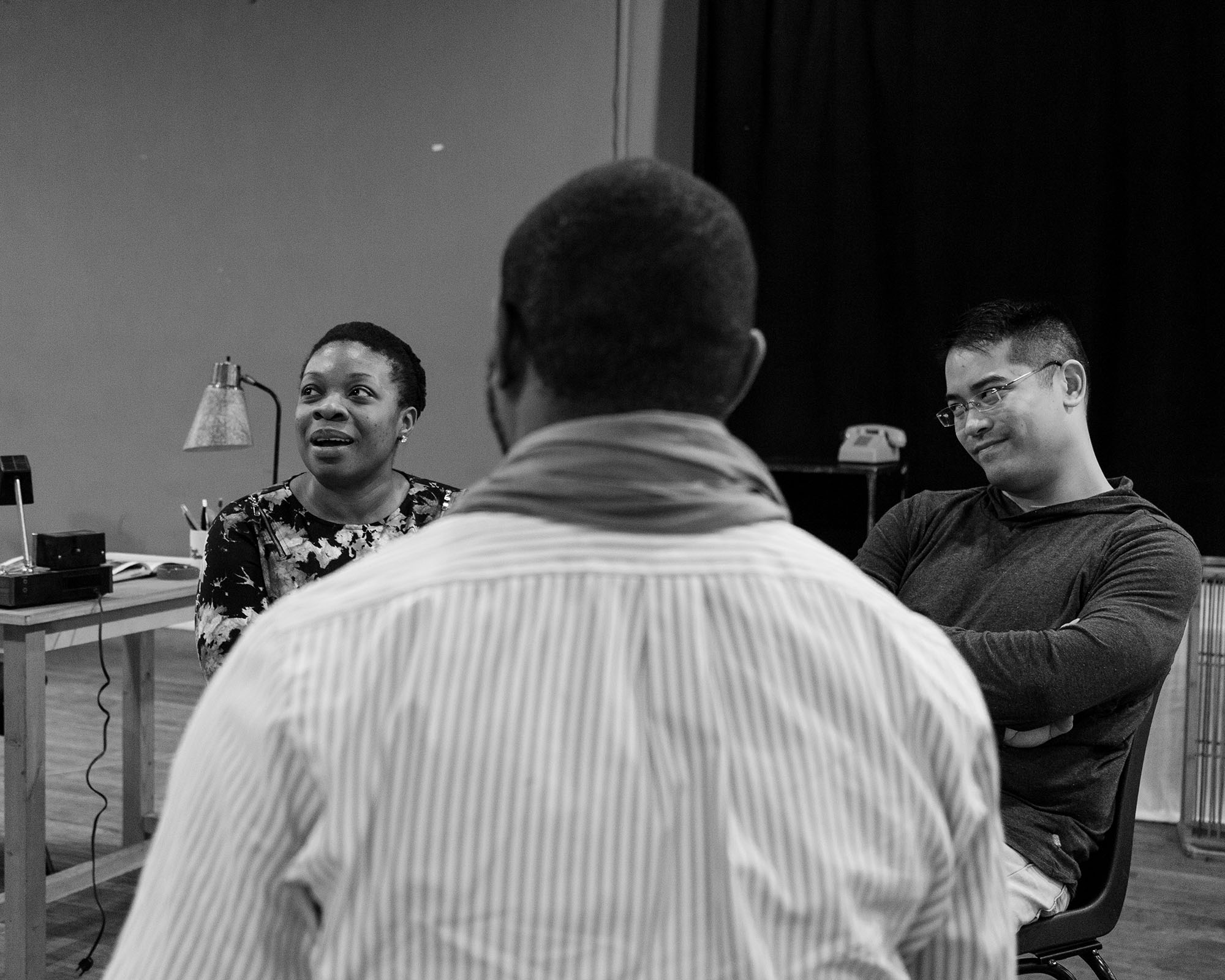
 

Mfoniso Udofia & Ed Sylvanus Iskandar
 

DAH: Can you discuss how what people will see in these two plays are paintings that are part of a larger picture?
 

MU: So when I started writing, the first play I ever wrote was The Grove – it’s the youngest play and I was writing about the eldest daughter, some immigrants…And she was in the middle of figuring out what identity and duty and love, you know, where those things shred up against each other. Then I realized that in order to understand Mac you have to actually understand from whence she came. And so then from there came, what is now known as Sojourners, which was first called Towards because I knew I going towards something, but I didn’t know what,so that was the title of it. The Grove, then Towards, and then to understand the parents I had to understand the revolution in country and that’s where you get something like runboyrun – which goes back and forth between the Nigerian homeland and now the American resettlement place that they are in. Then from there came my number of nine, which will be five interior plays that follow Abasiama and Disciple Uffat, and the last four are gonna be love plays which follow their children as first generation youth in America or discovering what blackness is without a certain kind of historicity attached to it. Technically these could go on forever, they’re not. I’m gonna end it at nine. A promise that I’ve given to myself that it has to end at nine, but as I’m writing I’m discovering how concerned I am with lineage and I do think that that is something of a very immigrant mentality too. Like now that I’m here, what does “forward” actually mean on soil that is not my historical soil. So I don’t know if that explains the question, but that is at least the scope of the project.
 

DAH: Yeah. And I think that’s definitely what people need. I’m also an immigrant. So I absolutely understand what you’re saying about lineage. And in thinking about that I recall how the character played by Chinasa has a line about the baby’s name and time. Time must certainly play an important role in this play and in any sort of nine-part series, as you just explained,, that follows this family over generations. Why write about time? And let’s broaden that and also say, why write about lineage? Why bring that to the contemporary American stage?
 

MU: It was particularly important for me to write about West African, Nigerian, Ibibio, migration here and what lineage is. In my culture you actually count where you’re from, you hold it. You come from compound culture. You know your grandparents, you know the history of your great-grandparents, and your great-great – which is very, very, very different somehow, than what I find happening here, and I think we might be in the middle of a change. It’s like more 32-year-olds are staying at home with mom, you know. There’s a shift starting to happen. However, we don’t build community and lineage that way here. I see my people from home being able to count their history. Lineage is important for me, because when you come from that culture and you come into this culture, what do you retain and how? It’s as simple as, in one of the plays, Abasiama and Upem, you know, they’re fighting to figure out how to make fufu here. And they’re going to get products that are not yam in order to do it. So it’s fighting to figure out: How do I make lineage here now that it’s different than the way it was back home and I’m not going back home?
 

DAH: Are those some of the struggles you’ve faced?
 

MU: It’s some of the struggles that I’ve watched my people face. And yes, I can implicate myself here and I am interested in this because I have heard the stories of grandmothers and great-grands and my great-great who is this Big Man. And I wanna be able to pass some of that to my children as well, so I want to answer the question, what is that new tradition that I need to make here, in a different space, for me to carry on that culture?
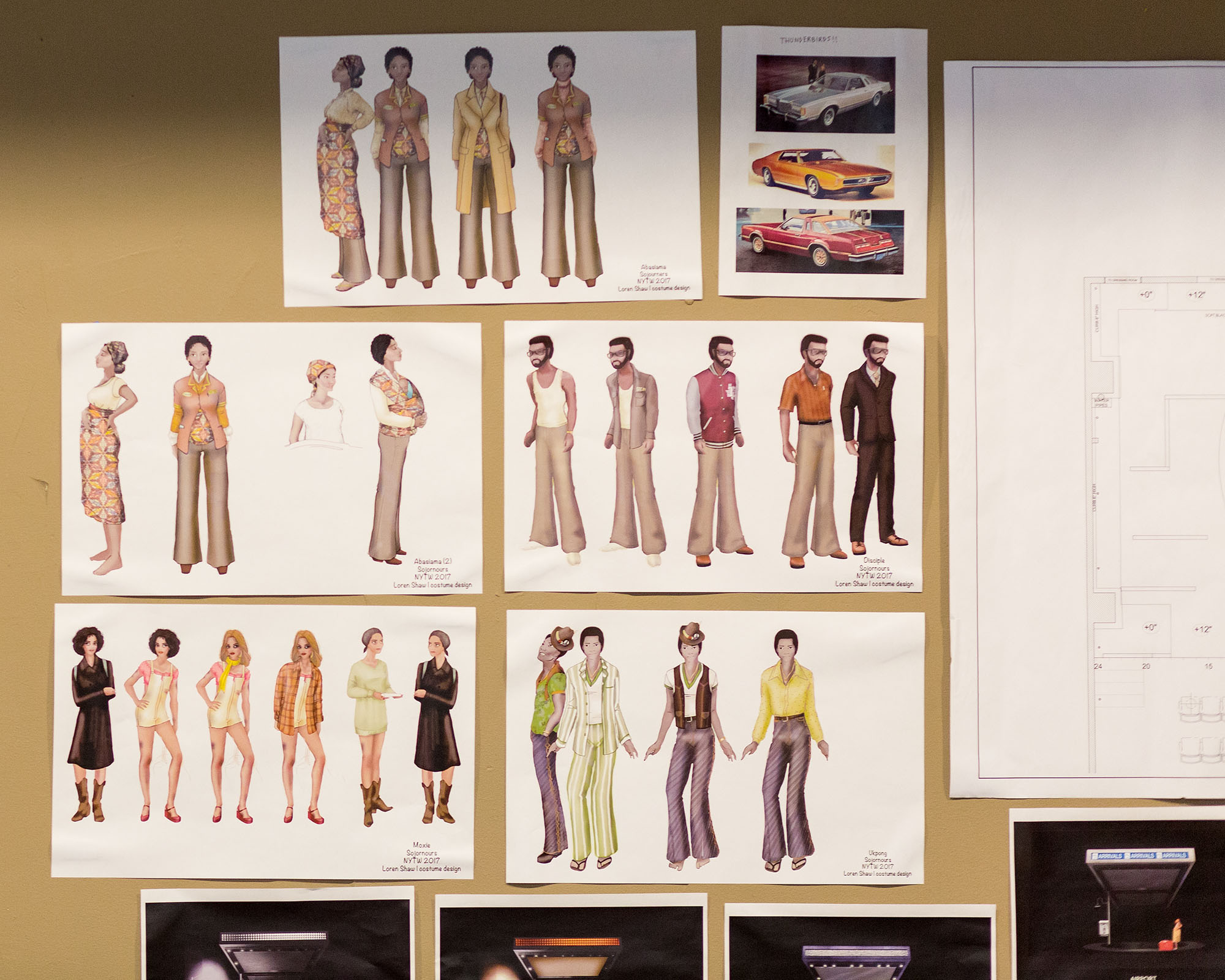
 

Mfoniso Udofia & Ed Sylvanus Iskandar
 

DAH: And is that something that resonates with you Ed, as to why you were drawn to these projects? Is it also something that you can relate to personally?
 

ESI: What specifically?
 

DAH: This idea of time, lineage, and how it’s negotiated between the characters – what we carry maybe, from one generation to the next.
 

ESI: Yes and no. Because my relationship to time and lineage is very different for all the reasons we chose to work together. I am an incredibly linear person and everything about how I negotiate achievement, finishing, and construction is linear and very logical. And one of the very first things Mfoniso said – I’m paraphrasing – to me in one of our earlier conversations, before we committed to this play together, is the notion that for her time is a spiral and time is relative and your experience of time is completely insular and about how it is you understanding how to listen to yourself and how to contextualize yourself within the definitions of time of those around you. And I can relate to that very deeply. Although it still is interesting because it’s not necessarily natural in my thinking process. But I came to the scene in New York and created many long-form pieces, which is something I’m very interested in. The average run time with a show I’ve done in New York is typically six-plus hours. And I learned over the process of making those plays that an audience’s experience of six hours does not mean the same thing as an actual experience of six hours depending, of course, on your choice of activity within those. To be even more simplistic in that particular analogy, I have sat and watched plays that are sixty minutes that felt much longer and ones that are six hours that can speed by. So that is, I think, where we connect. And it’s also where we differ because my natural instincts normally take me to a place where I want to move forward when Mfoniso is still in a place of thought. And I think that is both our strength and our challenge. And we’re guilty of it in this relationship together.
 

DAH: Considering what we’ve just discussed, what do you hope the audience walks away with after seeing these plays? And I’m sure the list of things is endless, but specifically thinking about time, lineage, maybe time as a spiral, as linear – what are you hoping they walk away with at the end of the day?
 

MU: Multitiered. These plays aren’t just about time and lineage. The subject is something a bit more political. I hope that the audience walks away with a more nuanced imagination regarding the lives immigrant bodies lead on American soil. I also hope that people walk away a little shaken by how quick they are to potentially judge and assess someone’s motivation when they are within that struggle. Like the pairing of Sojourners and Her Portmanteau. Some of the weeping I’ve seen people do about what Abasiama does at the end of that play without understanding what Abasiama is going through to then maybe come back in Her Portmanteau and get even more information. Perhaps we can nuance-out what bodies of color do in moments of struggle. I hope that people will actually get up and go out and read some books. Because people don’t read books.
 

DAH: A couple titles?
 

Mfoniso Udofia & Ed Sylvanus Iskandar
 

MU: Ben Okri’s The Famished Road, Chinua Achebe’s There Was A Country and Things Fall Apart, Helen Oyeyemi’s Icarus Girl and the way in which she’s constructing fairy tale stories from other mythologies, which is part of what’s happening here as well. And then even just researching: exactly where is Nigeria? Where are the Ibibio people? Do I know these people? And why haven’t I even thought to think and ask about who and what and where they were? So, those are some of my hopes.
 

[Everyone laughs]
 

DAH: So, Chinese-Indonesian director with American training, Nigerian-American playwright, is the global perspective an American perspective? This should be a prompt for you to discuss trends in contemporary American theater, perspectives in a contemporary American theater, and what it means to have creators – playwright and director – with these different backgrounds in that space.
 

MU: Do you want to go first before I go? This is a complicated one.
 

ESI: I could try. I might be better able to answer this question by posing a response to the previous one. I’ve been thinking, a lot in the past two weeks especially, about the gift of being able to work on Sojourners a second time. It’s something that I have not had a great deal of experience in doing – having an opportunity to revisit and build upon and advance from and learn through. And what’s most interesting to me is in this second attempt at turning the story of Sojourners, is I find myself continuously letting go everything I imposed upon the play. And I find myself reaffirming the nuance in the text and the nuance in the stage direction.
 

That I was not able to fully comprehend the last time. Which also reveals a level of re-commitment and reveals an actual trust in what’s on the page that I feel I did not have the first time. Because my response to the play initially was, Surely this is a Nigerian A Doll’s House [by Henrik Ibsen], because my cultural framing is Western. And I feel the conversation I had with the play initially, even though I fully believed that I had advanced beyond the conversation that I actually did have was about trying to figure out how it fit within a Western construction. I honored it’s variation, I honored it’s uniqueness, but I do think my basic map in my head, or through my gut, was in comparison to linearity and a Western dramaturgy I have become used to, not just because of training, but because of the way a play looks on the page.
 

And what I feel the gain of this experience has been for me is, a further understanding of A) the basic truth that when we need to write something that it’s all intentional – which is something I fully love so much. And there I think she is similar to Ibsen. You ignore a stage direction and a word or a punctuation mark at your peril. And B) I also then fully understand that the play can only fully do its work and and fully realize its impact if it’s staged from the perspective of that trust.
 

It’s not that I didn’t believe I trusted the play last time. I would never sign on to a play that I don’t trust, or a voice that I don’t trust or a person I don’t trust. But it’s a higher level of trust that I’ve developed in the interim. And it is linked to what I now understand I can be more intentional about on the stage. And I find everything is stripped down in a gorgeous way. There’s just less of everything. There’s less space. I think I’m trying to make, in between scenes, to try and foreground story that is always useful, but may not be necessary because I was afraid that the story that’s in the text, wasn’t enough. And I find myself doing less in the scenes themselves – in a fairly radical way.
 

The scene that you experienced watching in rehearsal, previously does not look a thing like that. It has changed from a scene about a woman moving within her home and negotiating how it is to leave the door, to a scene in which this woman has no inkling to the choice that would take her to the door at all. And so has become a scene in which it’s two people on a couch. And that is also I think the right way to frame what I now believe fundamentally is my job, which is to construct every scene in such a way that the audience can listen.
 

The text is so rich it is outrageous how much work I have to do before rehearsing to actually get fully on top of it. And I suddenly realize that is also the level of attention I’m asking for from an audience. So if I’m not allowing them to tune into the auditory context of the physical picture, I’ve not done my job. I’ve created, successfully, distractions rather than amplifications, which was my original intention. So I do believe my intentions have always been sincere, but I do know how much I have learned.
 

Mfoniso Udofia & Ed Sylvanus Iskandar
 

DAH: Mfoniso, sometimes people say that the United States is a nation of immigrants. This play, and also our conversation so far has also discussed the idea of immigration and what that means and what those stories are. So my question to you now is, is the immigrant story inherently an American story? And is the American story essentially an immigrant story? Are Sojourners and Her Portmanteau inherently American stories?
 

MU: Am I gonna say some of these stigmas out loud? Yes. America has some work to do. And I do think yes, America is a country chocked full of immigrants that after maybe the third or fourth generation develop the worst case of amnesia and forget. And then we’re somehow cycling from an immigrant nation to a violently xenophobic one within the same – it’s a vicious spiral that is almost nonsensical. What kind of peculiar American amnesia is this? And so it’s like we have to constantly teach ourselves to remember, which is part of the plays, what it is to remember to not forget. Because we are a country of immigrants and that makes us special.
 

Ed’s sight is different than my sight; it’s different than your sight; and the way I look at the story is different than the way Ed will, or the way somebody else will. And as a nation of immigrants, we also have to be a nation of plural ideology. And that’s what I feel like America doesn’t do very well. There’s something else that happens as amnesia trips us up and then we become set in this weird non-porose American way. And so we should be. We are a nation of immigrants.
 

And it becomes a real issue for me when I don’t understand why I’m not seeing more plural stories on the American stage. Why me and Ed together – myself creating this play, and Ed setting it up from page to stage is just this radical, amazing thing. When actually that’s the thing. And why haven’t we been taught earlier how we shred up against each other? That our gazes are different? Why is this learning happening in what feels like a very singular narrow way? Why isn’t this the American theater normative, if we are a nation of immigrants and if theater is a representational art form – which we claim theater to be – because what Ed is talking about is true and is particularly salient in our case. There are two different gazes; we have read two different cannons; we have two different histories, none of them – I don’t know that we should be ascribing value to one over the other, but my sight is critically different than Ed’s sight. So the way in which we work together, that is the American theater. But by God, we’re taking photos of it and putting it in an exhibit and going, Look at this beautiful wonderful thing, when it should be the thing!
 

DAH: When it should be the norm.
 

MU: Right.
 

DAH: Right. Last question. I teach dramatic writing at NYU and I always end interviews by asking theater-makers what advice they have for young theater-makers: so student directors, student playwrights, you know. And not just students formally enrolled in the university, but anyone who’s just starting out and in this field and in this industry. Any tips? What do you wish someone had told you ten years ago?
 

ESI: I would say don’t do it unless you must because the theater is far too important a space to be met by anything less than a total commitment of your life. To squander even a single person’s gamble that night, on purchasing a ticket, only to be met by incompetence is the only real crime I can imagine an artist can commit.
 

MU: I second that. I tell some of my students to rigorously pursue their inherent, innate, illogical – the way I write plays, the way I construct plays, makes some people discomforted, some people…There’s a range of emotions when people first meet my play. But I had to. It’s been seven years now. The rigor that’s involved in the playwriting, and then the trying it out and teaching people and then knowing that it works, and then the rigor it’s advocating against a new – I shouldn’t say “new” because then it makes me like, like I was birthed now and there are other people who write like me. The rigor of the education and the teaching into and then the standing behind your work when people might not be able to see through it is a real skillset. And I say “rigor” because there are some students who are like, I did this new thing. It’s great. But they haven’t practiced it and gone through the steps to go, No, does it really work? How do I stand by it? I’m not saying just pursue your illogical passions – it’s like, do so rigorously. And perhaps it’s not illogical, pursue whatever is inherent in you. And I think the keyword is “rigor.” I don’t know that I’d be anywhere without it and I don’t know many artists who are. With the artists that I love, I think about their longevity, the span of their careers. There is rigor attached to it.
 

DAH: Excellent. So previews begin April 22nd and the play opens May 7th. I will be there. Thank you so much!
 

MU & ESI: Thank you!


Mfoniso Udofia, a first generation Nigerian-American storyteller and educator, attended Wellesley College and obtained her MFA from ACT. She co-pioneered the youth initiative, The Nia Project, providing artistic outlets for youth residing in Bayview/Huntspoint. Mfoniso’s Ufot Family Cycle plays, Sojourners and Her Portmanteau, will be produced this coming Spring 2017 as part of New York Theatre Workshop’s season. She is also Playwrights Realm’s 2015-16 Page One Playwright and in Winter 2016 they produced the World Premiere of Sojourners. In Spring 2016, The Magic Theater in San Francisco produced the West Coast Premiere of Sojourners and the World Premiere of the third installation in the Ufot Family Cycle, runboyrun. Mfoniso is currently working on Oregon Shakespeare Festival’s Play On! commission translating Shakespeare’s, Othello. She’s also the Artistic Director of the NOW AFRICA: Playwrights Festival and a proud member of New Dramatists class of 2023. Mfoniso’s plays have been developed, presented and/or produced by Playwrights Realm, The Magic Theatre, Dr. Barbara Ann Teer’s National Black Theatre, Hedgebrook, Sundance Theatre Lab, Space on Ryder Farm, NNPN and New Play Showcase, Makehouse, Soul Productions, terraNOVA, I73, The New Black Fest, Rising Circle’s INKTank, At Hand Theatre Company, The Standard Collective, American Slavery Project, Liberation Theatre Company and more. Mfoniso was a finalist for the 2015 PoNY Prize, the Eugene O’Neill NPC, Bay Area Playwrights Festival, Many Voices Fellowship, Page73 Development Programs, Jerome Fellowship, NYTW’s 2050 Fellowship and Lark Playwrights’ Week.
 

Ed Sylvanus Iskandar has directed over 150 productions globally. NEW YORK: The Mysteries, Restoration Comedy, and These Seven Sicknesses (all NYT Critics’ Picks, The Flea Theater); The Red Umbrella (Drama League); The Golden Dragon (The Play Company at the New Ohio Theatre). REGIONAL: Head Over Heels (Oregon Shakespeare Festival), Don Juan, Translations, and The Collection (Stanford Repertory Theatre); Homemade Fusion (Pittsburgh CLO); Don Carlos, Brand and Miss Julie (CMU); The Dumb Waiter, No Exit, Death and the Maiden and Sexual Perversity in Chicago (Edinburgh Fringe Festival). INTERNATIONAL: Venus in Fur (Singapore); Memphis (Japan) OTHER: As Founding Artistic Director of invite-only NYC collective Exit, Pursued By a Bear (EPBB), Ed has served over 12,000 free home-cooked meals and shared 150 priceless nights of theater over the course of staging 8 Labs and 40 Salons, including NY or world premieres of The Further Adventures of Hedda Gabler, Arok of Java, and the musical Dani Girl, alongside new versions of Don Carlos, The Master Builder, and King Lear. Restoration Comedy and These Seven Sicknesses both began their NYC lives as EPBB Labs, later transferring to critical acclaim as productions at The Flea. EPBB fulfills a vision of theater that deepens the audience’s ability to engage by creating empathy for the human effort behind the art. Ed’s body of work with EPBB was honored with the 2013 National Theatre Conference Emerging Professional Award, conferred by Bill Rauch (Artistic Director of the Oregon Shakespeare Festival).
Posted on

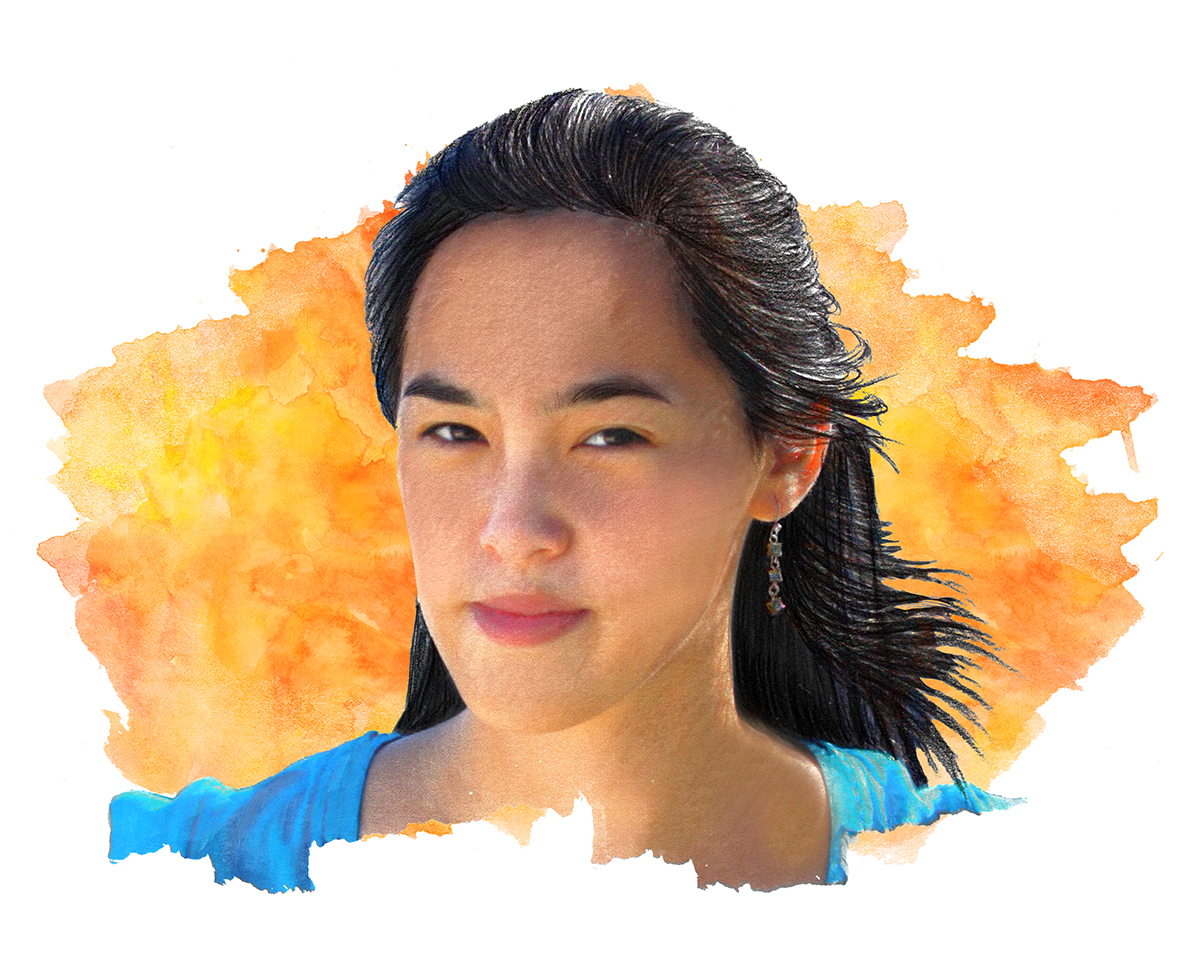
A Conversation with Lauren Yee


When you see King of the Yees, the latest work by playwright Lauren Yee, you’ll either feel like Larry Yee is your father, or you’ll wish he was. Now having its world premiere at The Goodman Theatre in Chicago, the play is a two-hour journey through Lauren’s changing relationship with her dad, imbued with sharp emotional insight and unrelenting joy. It’s hard not to be swept up in the exuberant warmth as we follow Lauren Yee (the character) through San Francisco’s Chinatown, searching for a deeper relationship with her father…and good, cheap liquor.
 

We sat down after the show’s third preview to talk about representation, the future of Chinatown, and being a character in your own play.


Kelly Wallace: This is the first full production of King of the Yees. What’s it like to see that after it being in development for years?
 

Lauren Yee: I feel like it’s been such a joy and privilege to have seen this piece through from the very beginning with The Goodman Theatre and do it all the way up until the world premiere. How often does that happen? We started it when it was just an idea and then they commissioned it…we had a reading, then a workshop. I would say this play has been through the process rather quickly, but at the same time, I think it’s been like three and a half years since I started thinking about it. It’s a reminder of how theater is sometimes not nimble. I feel like theater having the ability to respond to the world it lives in is a great characteristic for theaters to have.
 

KW: When you first started brainstorming this, what was your process like taking this from an idea to a script?
 

LY: I knew I always wanted to write a play about my father. I always thought he deserved to have his own piece. And then when I started writing it, I didn’t really know what the “why now” of it was or what shape it was going to take. Then, coincidentally, some of the real life events that happened in the play happened, just as I was starting to sit down and say, “why now.” My father has been dedicated to this community and these political causes for years and years, what is the “why now”? It’s almost like you sit down to write the play and then the universe rolls out the answer in like a wonderful way.
 

KW: When did you show the script to your father?
 

LY: Late in the process. I think my father first saw it when we did the New Stages workshop production, which is fairly late in the play’s evolution. It had been around for awhile, and I think at first I told him it was a play about Yees. I said it was about the Yee Family Association. And when he heard that, he was like I know how I will help you and put me in touch with all the different Yee branches across the country. I got to meet these very similar men at very similar organizations around the country who were very much like my father but not quite. Like, I got to see the bizarro versions of him. Doing the play was actually my strange way of getting to know my father, in a very roundabout sort of sense. I didn’t say to him, I want to write a play about you and know you better. But I said, I want to write a play about other people named Yee. There was a point at which I told him and that I was writing this play and it’s about him. And I remember his reaction to it. We’re a very non-confrontational family, and I think we were driving in the car, and I was like, Oh, this play is about you, and he said, Oh…okay, and kept on driving. I think, luckily, it’s a portrayal that’s filled with a lot of affection.
 

KW: You can definitely tell it comes from a place of extreme warmth.
 

LY: Yeah, so I felt more comfortable about that. Also, Act II is all of my father’s favorite things in one play. That also feels like a gift I’m giving to him, and hopefully to other people.
 

KW: There’s a frustrating tendency for people to say this is a Chinese show, this is a Black show, this is a gay show…whereas we’re supposed to accept the universality of every play about straight white characters unquestioningly.
 

LY: This play is very definitely set in a very specific world with a very specific aesthetic and in that kind of very specific story…it’s still all of us. This play is a play for anyone who has been through that relationship with their parents where they’re coming of age, have a great relationship with their family, but at the same time, there’s this awkward transition from your parent parenting you to you going out into the world on your own and saying this is who I am, let’s meet each other as adults. I feel like that’s something everyone goes through. What’s also interesting is that this play very clearly refracts Lauren’s, and my, experiences growing up as an American in San Francisco with many different references. The play touches on everything from Sesame Street to Greek mythology to “Thriller” to kung fu movies…it’s kind of a hodgepodge of all the interests I had growing up as a child.
 

KW: Was it hard to write yourself as a character?
 

LY: I think it was kind of fun. The interesting thing is that when I first started I thought that in order to write the play, I needed to make it very dramatic. My first draft was making the relationship between father and daughter much more tense and dysfunctional and I thought I was writing my own August: Osage County where they hate each other and they don’t know one another. I think that the story I’m capable of telling is the story of a father and a daughter who love each other a lot, who have a great relationship, but have never been able to connect in the way that Lauren wants to. I feel like that is so much more reflective of a lot more people.
 

KW: Is it harder to cut and edit things from this as opposed to some of your other work?
 

LY: Yeah, I think so. I think the play always continues to delight me, just because it’s a lot of things that I love and have a very strong relationship to, obviously. But at the same time, it’s been a lot easier for me to separate myself from the story than a lot of people would expect. When actors embody these roles, they worry I’m going to be offended or that they’re doing it wrong, and I feel like we’ve assembled such a lovely, open-hearted group of actors, that I never worried about that. I always believe that they understand what the play is.
 

KW: What was it like to try and cast someone to play your father?
 

LY: We got lucky very early on. One of the first workshops I did of this piece was with Francis Jue, whose background is very similar to mine. His parents were born and raised in San Francisco, they lived in Chinatown, he grew up outside of Chinatown, he’s a Chinese-American kid from San Francisco. In addition to being a really transcendent performer, he also just inherently gets the world that the play is set in because that’s what he experienced growing up. I don’t think that’s necessary to do the part, but I think it gives it this wonderful texture.
 

KW: Have you been to Chinatown here, since you got to Chicago?
 

LY: I have! I went to visit the Chicago Yee Association. It was great, it was the same struggles my father goes through. It’s like…no one wants to join, I didn’t want to join, but they guilted me into it. But once you have the right connection, there’s this incredible generosity that happens. They take you out, you’re like family. I think that’s kind of the two sides of this. Chinatowns are like any other ethnic or specific closed community. To an outsider, it can seem kind of unwelcoming, but as soon as you have the right way in, the world opens up. I find those organizations throughout the United States to be super interesting.
 

KW: Do you still struggle with balancing holding on to the traditional parts of your community while not standing in the way of forward motion?
 

LY: Yeah, I think it’s something I struggle with all the time. Every single human being related to me lives in San Francisco. My brothers, my cousins, my parents, all their siblings. We’ve been in San Francisco for like a hundred or a hundred and fifty years. So, for me, there always is that struggle of living outside of that community and not giving my children the same experience that I grew up with. You couldn’t go into a restaurant without somebody knowing someone else. My father walks through San Francisco and people recognize him on the street. I can’t give them that.
 

KW: Was the play always a “show-within-a-show”?
 

LY: Yeah.
 

KW: What made you decide that was the right way to structure the story?
 

LY: I think the play, thematically, always seemed to be about representation and how to tell a story and how to represent something specific and idiosyncratic and complicated onstage in a nuanced way. It felt like in order to tell the story of Chinatown, viewing it through the lens of wondering how do we tell this story seemed very important.
 

KW: There’s a joke in the show where your dad answers the question about who the show is for with “the Jews”! Who do you think the show is for?
 

LY: I think there’s always joy in seeing audience members who are Asian-American or from San Francisco or have a very specific firsthand knowledge of what’s going on in the play. There’s a joy in that they’ll just get some of it in a way that other audience members don’t. But I am really interested in sharing this story with all different kinds of people. It’s a play for anyone who dearly loves their parent and finds them so totally frustrating. If someone could see the show and think, that’s my father, or at the end of the play, if they leave and want to call their parents and start asking these questions…that would make me happy.
 

KW: The line where the father says “if you don’t vote, you never know what could happen”…was that always in the show? I would imagine it gets a very different reaction now.
 

LY: It didn’t mean anything before!
 

KW: The whole audience had this sort of mournful laugh.
 

LY: Before you didn’t get a reaction to it at all. It was like, oh yeah, of course. But I think that particular joke plays differently. It’s always been a part of who my father is and what he believes in. Whoever we are, we need to represent and exist in the world. If you don’t demand that, you don’t get to exist.
 

KW: Where did you, real Lauren Yee, land on the question of whether or not Chinatown is still something that needs to exist?
 

LY: It’s complicated. I think Chinatown, over the next ten, twenty, thirty years will always be shifting. I’m not one of those people who thinks we have to hang onto something because it has existed before. Theaters die, organizations die, because nobody needs them anymore. But I feel like what we can do, in positive ways, is figure out how to open up those communities and get people whose interests might intersect with it in there. For example, it’s very hard to join the Yee Fong Toy Family Association. I wish that process were more open, it’s just very hard. I feel like the more that we share these stories and the more we’re talking, the more information gets passed down. As far as Chinatowns in particular, you do have more mainland Chinese folks coming in and being part of Chinatown. And then you have new, specific enclaves. Here in Chicago, a lot of the suburbs have a lot of Chinese immigrants moving in. I think Asian-American identity in the United States will continue to evolve and I think it’s just a reality that you have to adjust with it. In ten or twenty years, there’s going to be an even larger mixed-race population. I think it would make me sad if that wasn’t considered a part of what Chinatown and what Chinese identity is.
 

KW: What do you really want to see from plays and playwrights in the future?
 

LY: I want to see plays do what only plays can do. There’s so much good TV and film going on right now, amazing stuff, and I think we could do what they do, but we’re not going to do it as well. That’s not what theater does best. Theater is best when it celebrates the act of live performance and sharing it with this live audience who is assembled here tonight and sharing the space with you. The more we can invest in events or experiences that can only happen in person, the better.


Lauren Yee returns to Goodman Theatre, where her play King of the Yees appeared in the 2015 New Stages Festival. Her plays include Ching Chong Chinaman (Pan Asian Repertory Theatre, Mu Performing Arts, SIS Productions and Impact Theatre), The Hatmaker’s Wife (Playwrights Realm, The Hub, Moxie and AlterTheater), Hookman (Encore Theatre and Company One), in a word (rolling world premiere at San Francisco Playhouse, Cleveland Public Theatre and Strawdog Theatre Company), Samsara (Victory Gardens Theater, Chance Theatre, Eugene O’Neill Theatre Center’s National Playwright Conference and Bay Area Playwrights Festival) and The Tiger Among Us (MAP Fund and Mu Performing Arts). She was born and raised in San Francisco and currently lives in New York.

Posted on

A Conversation with Ethan Lipton

Ethan Lipton


Watching The Outer Space is a little like looking in a telescope and a microscope at the same time, where the mundane is epic and the expansive is accessible. Mad scientist musician-playwright Ethan Lipton and his collaborators have mixed together science fiction, cabaret, twang, heart, humor, and humanity and created a piece that falls into a category all its own, reminding us that the small things in life are often what take up the most space.


Corey Ruzicano: I love the language that you use, I was really drawn to the way you’re telling a story about something so big and fantastic and so small and human at the same time – what has the development of your voice been like? What influences have been part of that journey?
 

Ethan Lipton: I like metaphor and I think one of the reasons why I’m drawn to it a lot of the time is because a lot of what I like to talk about is often quite small, so when you find the right metaphor for an experience, and for me it’s often about how something feels, then it gives you an opportunity to say those things that are the every day and explore them with a sense of awe and wonder. It also helps put everybody in the room on the same footing. When it’s nobody’s actual life, it’s everybody’s life. It opens up an imaginative space that I like. As an audience member, work that I respond to is the work that makes me lean in a little bit and do a little bit of work myself. For me, I guess that’s my expression of that same sort of thing where I’m trying to create a specific image or tell a specific story but one that will call attention to the negative space around it so that they imagine their own world and life. That’s the the best experience for me, when people are deeply engaged with their own life during one of our things.
 

CR: Absolutely, I read one of your other interviews with American Theater and you were talking about this idea of not wanting to let real-life truth get in the way of what feels truest in the telling of the story – how do you create a metric system for that; how you shape or gauge what’s going to be most truthful?
 

EL: I don’t know exactly what that is; I think it’s just a lot of trial and error. Some descriptions of things make it seem smaller – some truth, some details distract and other details or truths invite in or open up, and that’s just a kind of trial and error. Sometimes there’s a way to perform something that leans against what you’ve written a little and that can open it up, sometimes you have to really sell the thing that’s been written directly, and sometimes you have to rewrite. I’m not ever that interested in telling people things about myself or my own life – I do use my own life as material a lot because it comes from a sort of imaginative space mostly but it’s that thing of really wanting people to see a story about themselves, and so there’s some invisible line or where that detail can be positioned where people can get in, and you can kind of feel that. I also feel like theater is a public experience – obviously we’re at the Public Theater which was made to serve the public, but when there’s a sense of service in the words, particularly in a show where there aren’t multiple people talking, it’s really just one person. So if there’s some awareness of the audience’s experience – which is not the same as pandering or giving them what they want, but making sure that you’re communicating to people in a way that they are able to receive it – that’s a sort of compass, I guess.
 

Ethan Lipton
 

CR: Yes, definitely. This is a story about a couple weathering a transition together and I wonder if you could talk a little bit about change – what endures in the story or in art in general and how have you learned to navigate change over the course of your career?
 

EL: Certainly for me, I started off as a playwright and I had a couple of plays produced and was writing plays really from my early 20s, but when I moved to New York I didn’t really know how to access that community. Theater is always local in some way and New York is no different even though it’s the biggest scene of them all. That was really when I started performing, singing songs, which I always just done for my own pleasure and the occasional mildly-stoned friend, but singing publicly for me was initially just for me to have a little bit of a creative outlet while I was trying to be a playwright and find opportunities. Then music became a kind of saving grace for me in some ways, it really was a relief from playwriting, the gestation period of songs is so much shorter, and I started playing with a band and for a long time I kept those things separate – the playwriting and the music – and then at some point it seemed like a danger idea, because I liked them separate, but also a good challenge to combine them. But there wasn’t really…whatever this form is, isn’t really a well-branded form. It’s not like everybody understands exactly what it is, and as a playwright I already come up against this thing all the time where I’m trying to explain my work in ways that people can understand and it’s hard to understand so this was a new thing that people wouldn’t necessarily understand…but it turned out to be a great experience and something that has ended up giving a lot back and in some ways has been––there was a time when having two separate artistic pursuits might be confusing for people or might make people think, Oh is he serious about anything? But now, I feel like the whole world does so many different things. When I started, that was not such an obviously good idea and now it feels like it’s been a very good idea. It’s been fine for the separate careers but it’s also helped create this other world of opportunity, and creatively I feel like songwriting has been good for my playwriting and playwriting is clearly a part of my songwriting. So that has changed, my outlook, however I self identify as a creative person has changed. I also had some fantasy of being some kind of weird hybridy-artist without really knowing what that was, but then it took a long time to actually do that.
 

CR: Yeah, in the program Oskar Eustis says you’ve created your own genre, and I’m sure that’s the kind of observation you can only make looking back, rather than while you’re in the process, but I wonder if you have advice for young people who have similar separated or disconnected creative interests.
 

EL: I have to say, for me it was the only way I could have done it. I really recommend it, again I think it was good for the work itself – it loosened things up, it was more rewarding. I think there is probably a certain period where getting the work recognized is important and you’re building a career there’s a fear that doing many things will confuse people, but I wouldn’t give a shit. I just wouldn’t worry. People in the fine arts do it all the time where you’re working in different mediums. It just seems like you have to be doing work that’s giving you something back, so if that can be just one thing, that’s great, but if you’re a person that has wider interests, you should pursue them. And if you’re a younger person, then you already know that you’re going to have to do a million things in the course of your lifetime because there’s no such thing as single career track anymore. I think it’s awesome and people should double-down.
 

Ethan Lipton
 

CR: I’ll make sure my dad reads this interview.
 

EL: Oh, sure, is he like, what are you doing as a journalist and a director?
 

CR: Well he went to college and then went to med school and now he’s a psychiatrist. He picked his path and then he had the answer, so it’s hard for him to understand that it doesn’t really exist in the same way.
 

EL: Right, well and to some degree in the arts I think it’s kind of always been this way. There’s always been a lot of overlap – Shakespeare was also an actor and Patti Smith was doing theater in the 70s.
 

CR: And you have to know about life to make something about life.
 

EL: Exactly, you have to have broader experiences. And even if you’re only doing one thing, career paths are never linear, especially in our field. So there’s no way to create cause and effect; you can make gestures and best practices and try to push things ahead, but you’re never totally in charge of what’s happening, so you have to do other things.
 

CR: Of course. I don’t know how the program was put together, but in it is that famous Milan Kundera quote that “happiness is the longing for repetition,” and I thought that this piece really spoke to that ache for familiarity we all sort of orbit around and I wonder if you could talk a little bit about that and it’s affect on making work.
 

EL: Yeah, I feel like your well-being in the world is always one of those fluid elements you’re trying to manage. There’s your job, there’s where you live, there’s your relationships – I feel like the piece kind of looks at all your different relationships, like your relationship with your job, with your self, with your career and all these other things. And that relationship with yourself and whether or not you’re feeling fundamentally aligned with yourself or misaligned, that affects all of those other relationships and so for me, as someone who fundamentally – and I don’t know if anybody really likes change, I guess we all like the change that we’re in charge of…but No Place to Go, the previous play, dealt with this in a different way too.I’m not always the most elegant person at going through change and I think that that need to be kind of right with yourself is something that…if you’re okay with yourself, all that other stuff seems a lot easier. If you aren’t, it all seems harder. I like repetition. Even though I don’t live close to the city any more, I don’t come here very often outside of doing this show, but I always have these fantasies about New York, how I could eat so many different things and I basically go to the same two or three places every time I come back because what I really want is this feeling, and repetition lets you access that in a certain way.
 

Ethan Lipton
 

CR: Yeah, and I’d love to hear about how you’ve come to find and create relationships with your collaborators and what you’ve learned from them.
 

EL: That also would have been so hard to predict when I was starting out. The guys in my band I’ve played with for twelve years. When I started, I had a rotating group of people I worked with and I’d play these two- or three-song sets in downtown variety shows and I remember my guiding principle with the musicians I worked with was that I didn’t want drama and I didn’t want to lose a lot of money. I was fine breaking even or losing a little bit of money, but I was not going to gamble my entire whatever part-time job I had at the time on some music thing. And so there was a kind of lightness that I approached that with and the guys I’ve ended up working with for so long had a similar something there, in addition to us having a shared sensibility, we’re all kind of silly but willing to take it seriously. I think they all got the joy, like a lot of my songs even outside of the show have a veneer of sincerity. I mean they are sincere, but they’re also silly or absurd or undercut that in ways, and they all knew how to own that. I think we just enjoy playing together. We never have had the pressure or opportunity to make it like a full-time career and in some ways that has been easier because it has meant that when we do get an opportunity, we’re into it; everybody’s excited and has been able to make time for it over the years which is fairly amazing cause they all have other lives too. And then on the theater side, Leigh [Silverman] saw the band play years and years ago and I met her afterward and she was super sweet and kind and funny, and I knew she was a director and I had just gotten into the emerging writers group at the Public, that was the first year of that, and I was like, I would love to work with you some day, can I send you something? And she said, totally, and I couldn’t believe, I still can’t believe I get to work with her. She is such a great collaborator in all of the ways that a good director is: she’s smart, she’s thoughtful, she’s really hardworking, she’s organized, she’s a fierce advocate, will fight for things that are important, is a good ally, has her own take on the thing, but doesn’t ever make it about that so you really feel like you’re talking to someone who has your best interest. And then beyond that, I do end up working with the same actors as a playwright, ‘cause I like that familiarity and also because there’s a certain approach to the tone that people need to be able to access, so if I find people who can do that, then I tend to go with those people. My fantasy for my band and my theater career is to be able to continue to work with the same people, not exclusively – it is always great to have new people come around a be a part of that mix – but to just have a creative family that you can go back to over and over again. And that includes designers; this is the third time that David Zinn has done something of mine which is crazy that he makes time for us, and Ben Stanton and even our production crew is fantastic – Shelley and Caroline and Hillary, they’re all great, and Dean, who’s our dresser who puts up with us, they’re all great.
 

CR: Yes, that definitely sounds like the dream. Certainly there are always a lot of reasons to move away from the arts – how do you keep sticking with it?
 

EL: At some point, when I was younger, there was a question about discipline, like how do you keep working at it, how do you actually keep putting in the work, and then how do you hang out long enough for stuff to happen – because that’s definitely part of it, just hanging on long enough for opportunities to arise. I was fairly disciplined, but I think I was compelled and I think pretty early on it has to be a compulsion in some way, where it doesn’t really feel like an option not to do it, where you don’t feel good or okay if you’re not in some way making stuff, and if that’s the case, if you’re compelled, you’ll find a way to make it. If you’re not getting the career opportunities, you’ll pivot and make different stuff, or you’ll find different ways to get your voice heard. Because I think if it is a choice, like for me, going to the gym is always a choice, and so I usually choose not to do it. For some people, it’s a compulsion, they have to do it, and I think if anything stays a choice for too long, then eventually I think you’ll choose not to and that’s totally okay. There have definitely been moments in my career where I was at a crossroads, where I was like, do I want to keep doing this enough, or do I have to do it, because maybe having to do it is too hurtful or too frustrating, but somehow you push through those moments and keep going. I do sometimes joke that in my next life I would like to something that didn’t require so much of one’s self, but that’ll have to be the next life because I’m enjoying this life.
 

Ethan Lipton
 

CR: I’m happy to hear that. Later on in the story, there’s sort of a decision to become politically active in the community of the characters, and there’s an introduction of a reference to the Dark Lord, and I just wanted to talk a little bit about that and about making art in our current political climate.
 

EL: Yeah, well most of the piece had been written before the election and that event of a new administration seemed to change just everything in the world, and I thought about different ways to integrate that in the periphery of the piece and what I realized, why it was worthwhile to try to put it in for me, was that the character, the main character that’s being discussed, before then is really a prisoner of his own self-interest, he can’t get out of his own head, his own way. He is situationally or otherwise, despairing and it seemed like by the end of the piece he is less stuck and he’s more aware of the world, so it seemed to fit in that he could be impacted by that event. I feel like if that event had happened earlier in the piece, it wouldn’t have taken, because he’s not really able to be impacted by anything. One of the nice things about doing the show, I feel like everyone I know in a small, understandable, self-centered way, has had this question of: what are we doing right now, how is any of this art relevant and what should we be doing and how does the work I’ve already been doing, look in this light, all these questions. It’s been great to do this show and to experience people needing to feel things, particularly things that are not directly related to the chaos of the world. That is something that art is supposed to do – to make us feel empathy and go on journeys and expand us, and I know that there is going to be a lot of pointed, political, angry, really useful art in the months and years to come and that will be really important, but my experience of doing the show is a reminder that we also need to keep looking at our humanity and accessing that and that’s important. If you’re making stuff that doesn’t feel directly political, that’s going to feel like a risk every time and you won’t ever know until you get it in front of an audience whether it’s something people can use. But that’s sort of always true, you never really know. Theater has such a long gestation period that there’s always that kind of panic when you’re doing something that gets planned 18-24 months ahead that you’ve maybe been working on for five years, the moment always informs it. I feel like if you are true to the project, then you just don’t know when what you’re doing will be something people will really need at that moment. The next project I have is something very outward looking, it’s about the privatization of public education and I’m excited about that because it feels timely in a different way, and this piece was much more inner looking, so it’ll be nice to have that change; but doing this thing has reminded me, or at least made me aware in a certain way, that people still need to feel things, they still need to access their humanity.
 

CR: Yes, absolutely. My final question is about your questions – if you have any that you’re grappling with in your life or in your art these days?
 

EL: Yes. Lots of them. I mean I think that question of how to move forward, where to direct one’s energy. I think there’s always a lot of concern about… you have to have a lot of projects in the hopper once you get a seat at the table. I feel like I have a seat at the table in a way that is satisfying and I feel proud of, but you really have to keep going, so I never know how that’s going to unfold. Whatever sense there is of getting to a place in your career where you feel like you know how it’s going to go from here on end, I just don’t think that ever happens or it hasn’t happened yet, so I am full of questions. I guess that is as it’s always been.


Ethan Lipton’s plays include Tumacho; Red-Handed Otter; Luther; Goodbye April, Hello May; and Meat. His musical No Place to Go (Obie Award) was a New York Voices commission and produced by The Public in Joe’s Pub and has toured widely in the U.S. and Europe. Lipton is an alum of The Public’s Emerging Writers Group, a Clubbed Thumb associate artist, and a Playwrights Realm Page One fellow. Ethan Lipton & his Orchestra (featuring Vito Dieterle, Eben Levy and Ian Riggs) has been a band since 2005 and has released four studio albums.