Posted on

Line, Please!?

line please


Hi, I’m Liz and I’ll be offering you advice on navigating the tricky situations that can come from working in or being a fan of theater.
I’ve been doing it out on my blog, fyeahgreatplays.com, for a while now, so it seemed only natural to migrate here in a more official Advice Columnist capacity. I’ve freelanced as a stage manager around New York as well as regionally, I’m a member of Actor’s Equity and a total contract junkie, and I occasionally cohost a podcast on theater and performance (Maxamoo).
 

To submit a question, email lineplease@stageandcandor.wpcomstaging.com.


Dear Liz,
 

I recently got my first Big Kid Theater Job. I’m very happy at my office, and I’m thrilled to be getting to actually use my degree. It’s a great place to work, and I have no complaints. Except for one.
 

A few weeks into my new position, a male co-worker asked me to get drinks. I wasn’t interested, and so I tried to turn him down without saying an outright “no” (it wasn’t phrased as a date, but a near-stranger asking me to get drinks set off the “DATE” alarm bells in my head). The second time he asked, I gave a more concrete answer of “I really appreciate your asking, but I’m trying to focus on getting adjusted to a new city right now.” But now it’s been five, six times, and he doesn’t seem to be tiring of asking. A mutual friend told me that it is indeed romantic, and that – even after he told him “she’s not interested” – he believes I will “change my mind.”
 

I’m not sure what to do: I feel really uncomfortable with the situation (and with some of his other behavior – trying to hug me, sitting near me at every meeting), but I don’t want to cause a stir with HR. And I don’t want to make a stink: he knows a lot of people, and I don’t want to get a bad rep in a tiny new city.
 

How do I get this guy to leave me alone without burning a bridge?


As I said last month, everyone deserves to feel comfortable in their workplace. It’s hard to focus on your first Big Kid Theater Job (congrats!) with a gnat buzzing around. I’m sure you’ve been kind and polite in your interactions with him thus far, but now it’s time to cut that. He’s clearly not getting the hint, so you’ll need to be direct.
 

Tell him No. Don’t say you’re busy, or you’re not interested “right now,” because that leaves the possibility of something in the future. Don’t make it your issue- that you’re adjusting to the new city or your new job (even if it’s true!). Again, you’re leaving him with an implied “maybe later.”
 

The other part of this is that theater is a social job, and you’ll probably be out to drinks with this guy (and the rest of your office) at some point. I’d make sure you have a friend or two with you that will run interference for you as well as keep you entertained. If he invites you out, invite two friends. Just play it as dense as he actually is and ignore that he wants some one-on-one time.
 

And if it becomes more of an issue, and he really doesn’t get it and becomes more aggressive, take it to HR. Sometimes there’s an attitude that theater jobs are more relaxed than “real jobs,” so you shouldn’t take that sort of harassment seriously. But it is harassment. And you need to keep your focus on bigger things, like taking the theater world by storm.

Posted on

A Conversation with Sigrid Gilmer


Even from 3000 miles away, Sigrid Gilmer’s exuberance, artistic insight, and hilarious writing brightened our days. In this conversation, we discuss why she reimagined Harriet Tubman as an action star in Harry and the Thief, the myth of niche writing, a pesky little thing called the fourth wall, and everything in between.


Esther Cohen: Give me the quick biography of Sigrid Gilmer.
 

Sigrid Gilmer: I was in born in San Francisco and raised out in the ‘burbs in Pittsburg, California–
 

EC: It’s called ‘Pittsburg’?
 

SG: Yeah [laughs]. It doesn’t have an ‘H’ on the end! The town had a steel plant early in its history so they changed the name to ‘Pittsburg.’ So yes, it’s not very original. But that’s where I grew up. 
I went to college at Cal State LA and studied theater, but not playwriting – I did acting and directing and was just a total theater nerd overall. And towards the end of my college career, right before I was about to graduate, I fell out of love with acting. I realized I didn’t have any control, it was high stress, and I wasn’t having fun anymore. You don’t have any agency when it comes to being able to do your art. You’re always dependent on somebody else.
 

EC: How did you make the transition from actor to playwright?
 

SG: I had a playwriting class and an English class to take right before I graduated. And the playwriting class just made sense to me. I found this new way to put myself in another person’s shoes. I could still pretend to be somebody else, something I loved about acting, but in a way that seemed to fit better.
 

EC: So tell me, what is the difference between New York and LA for playwriting? It seems unusual to be a playwright based in LA.
 

SG: So, the caveat here is that I don’t really leave my house that much [laughs]. So the scene that I’m in is a very small community. Most of the theater in LA is very small and company- and actor-driven. Personally, I feel much freer out here than I did in New York. It’s not exactly that nobody is paying attention, but the stakes aren’t as high.
 

EC: Tell me about the spark for this play. It’s a pretty traditional story presented in a really uniquely funny and fast-paced way. How did the base idea and the unusual structure of the play come together?
 

SG: A couple different threads merged to make this play. I joined two writing groups in LA, Center Theatre Group and Skylight Theatre, that involved writing a play over the span of one year. And I was talking to a friend of mine, a playwright who writes a lot of TYA (Theatre for Young Audiences) plays, and he was talking about how a bunch of TYA plays that deal with African Americans experiences – he made this big joke – that all of them were about Harriet Tubman. And I remember saying, “Well, I’m gonna write a Harriet Tubman play!”
 

EC: And it’s gonna be different!
 

SG: Exactly! I’m gonna write my own version of ‘The Harriet Tubman Play’! I had The Thief and The Mad Scientist characters from a previous short play. I started thinking, oh, I have these characters that I really love over here, and I have Harriet Tubman over here. And I just started playing around thinking, how can I mesh these characters together?
 
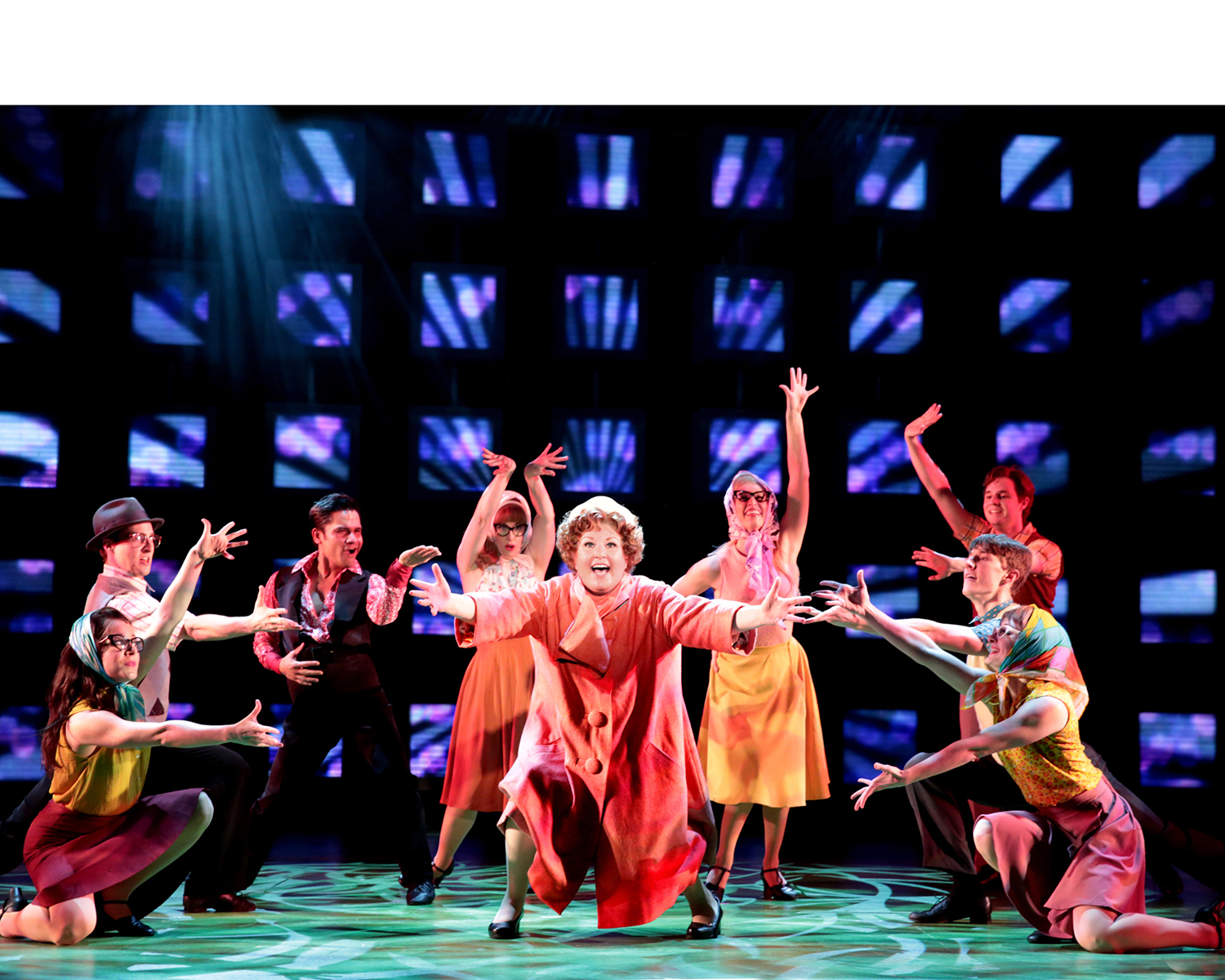
I went into the writing process knowing the basics of Harriet Tubman, but I was poking around on the internet and read that she apparently carried a gun with her. When the people traveling North would get freaked out, she would pull out her gun and she would tell them, “You’re gonna be free or you’re gonna be dead.” I read that and instantly thought it was the coolest, most action-movie badassery I had ever heard in my life. Like, why hasn’t Michael Bay done a big flashy Harriet Tubman action movie? [laughs] And as I was writing, a writer at Skylight said, “You should have a trailer for the play.” He was just being snarky, but I thought, “y’know, I should have a trailer. That feels appropriate for this play.” So the action movie concept kept informing the play’s style.
 

EC: Even outside of the guiding theme of “action movie,” the play has a structure I’ve never seen before. Did you dictate in the script the dance breaks and chase scenes and repeated montages? How much of that did you imagine when you first wrote the play, and how much was developed with the director and actors?
 

SG: The short answer is yes, all of the action sequences and songs are written into the play. Of course the specifics get developed in the room with me and the actors and the director. So the tone is everywhere in the script, but how it looks has been different in each production.
 

EC: What do you hope to achieve by very specifically dictating action in a script? Some playwrights love stage directions; others hate them. What’s your stance?
 

SG:: Theater is a visual medium. As much as it is auditory and linguistic, in the end, it must be visual. Movement informs action – it carries the story. I think you can get a lot of storytelling and emotional punch with gesture and movement as much as you can, and sometimes even more so, than with just language. So I do see the action in my head because it is part of the story I’m telling. What the actors are physically doing, how their bodies carry the story, is important to me. That, to me, is an essential aspect of writing a play.
 

Stage & Candor_Sigrid-Gilmer_Harry and the Thief

EC: The play also breaks the fourth wall a ton. Tell me about that.
 

SG: I enjoy the idea that my plays are really just me and the audience, in my backyard, playing. “Let’s pretend this is a spaceship; let’s pretend this is a horse; let’s pretend the floor is lava!” I like that proverbial play found in all theater. And I like the idea of the form acknowledging that and making the audience complicit in it. Saying, no, we’re not actually going back to the 1800s, no we’re not in somebody’s living room – none of this is real. Because you can see people breathe and spit.
 

EC: And that’s the point!
 

SG: Yes, exactly. That’s the point, and that’s the joy and the fun of it: that we’re all gonna sit here together and say, “Let’s play!” To me, that is one of the great things about theater that other storytelling mediums don’t get to do.
 

EC: And breaking the fourth wall is really just another form of audience engagement.
 

SG: Yeah, it’s “Hey, welcome!” I love that engagement and deciding that on this night, in this space, we’re all together and we’re gonna make some shit happen. For me, that always feels right and juicy and delicious.
Especially with this play, because I’m playing around with subject matter that gets told in a certain way all the time, I felt like I needed to reach out to the audience and acknowledge, no, this isn’t the way we normally tell this.
 

EC: You had to acknowledge the unusual circumstances.
 

SG: And also question “Why do we always tell it the other way?” Why are all stories about people of color always tragic, tragic stories? There’s a set frame around suffering. The play actively butts up against that and says, “We can still tell this story and these people can be happy and have agency and joy.” And at the same time, it still acknowledges – not even the challenges –
 

EC: The bullshit.
 

SG: Right! The insurmountable, horrible, messed-up shit that happens. But that stuff isn’t framed in a way that makes the people tragic. Being born into a situation that is fucked up and tragic is different from being fucked up and tragic because of a situation.
 

EC: This play, along with many of your other works, is chock full of both obvious and not-so-obvious historical and popular culture references. How do those references find their way into your writing? What do you hope to achieve with them?
 

SG: When I write, I’m writing for and from what’s in my head. This sounds so narcissistic and selfish, but my first audience is always myself. Like, naming the band of slaves after the Jolie-Pitt kids literally happened because I was obsessed with Brad Pitt and Angelina Jolie when I was writing it. And all the cultural references from civil war and antebellum-style movies were just what came to mind when I thought about the content of the play.
 
Music also helps me a lot in my writing process, so the soundtracks I make when I write will make it into the play. When I was looking for songs and trying to figure out characters through those songs, Rebel Yell started playing in iTunes. And it just dawned on me: oh, Rebel Yell has roots in the Civil War, and it sends a kind of fucked-up message. So in my mind, that song fit Harry perfectly. Because this show messes with time, it felt super normal to insert, like, a Dawson’s Creek reference. Because why not? Nothing else in this play plays by the rules. Also, I was watching Dawson’s Creek while writing it [laughs]. My writing is just me working through my own feelings and assumptions about the play and the content. I was working through what I’d read about Harriet Tubman and the Civil War in order to write the play. That ends up getting filtered through my own idiosyncratic interests and whatever I connect with.
 

EC: Tell me about the rehearsal process for this play.
 

SG: In this rehearsal process, and in other the rehearsal rooms of other productions, what I’ve found is that the table work, the first week of being with the play, is important for unpacking the themes, the hard stuff, the messed up stuff. So especially in this production, that first week was really remarkable because we just sat and talked about race, and slavery, and what it’s like to be a woman of color, and how we frame history, and how images about people of color and women get disseminated and framed, and how we negotiate those frames. The first week was laying all that stuff out.
 
The rest of the rehearsal process felt really playful. Katie Lindsay, the director, ran such a warm, open, creative, collaborative room. And this cast – I’m shaking my head now because I can’t even find the words. They are talented and facile and just badass. Everyday in that room was a fucking joy. And for me – outside of making an amazing, great, successful show – the process needs to be wonderful and joyful and encouraging so that I’ll actually want to make another play.
 

EC: And as a member of the creative team, your time is really the process.
 

SG: I think the process matters for everybody. Because how miserable and horrible would it be to be in a room and a process where people aren’t giving and generous and kind to one another? That energy filters down into the final product of the play and the audience feels it. I think, and hope, that our joy comes across onstage and informs the play.
 

EC: This play reclaims a story that is usually told in distorted or sanitized ways about people like you. Have you always had an attraction to writing about people of color, about women, about your personal experience, and rewriting those narratives?
 

SG: I mean, it might be super egocentric, but yes, a lot of the time, I’m writing about me.
 

EC: I’ll also go back on my own question and say that it’s not really egocentric. When women or people of color write about themselves, they get told they’re writing for a niche. But when white men write stories about white men they’re never told that.
 

SG: Exactly. There’s an idea that white maleness is somehow universal and everyone else is super specific. It’s just not true. Everyone’s writing is super specific. Tennessee William’s writing was super specific, but because he fit into the dominant power structure, he gets to be universal.
 

EC: Plays about rich white people are not universal.
 

SG: They’re specifically about rich white people. Which is fine! I love a good Noel Coward play, but let’s be real and say that that is a specific cultural viewpoint. And that’s great, and there really is enough room for everyone’s story. There are a ton of people in the world, so why do all the stories we see have to be about one specific, narrow group?
 

EC: And why do stories that are not about that group have to be ‘niche’?
 

SG: Exactly. Because it’s all niche. It’s all one person sitting down and saying, “I’m gonna think about and explore x, y, and z from my point of view, and my point of view is predicated on my race, my gender, my sexuality, where I grew up, how old I am, and all of that goes into it.”
 
So really, to answer your question, I honestly don’t even think about it. I get interested in a topic and it filters through me and what creatively inspires me and what I’m working through in my own life. I just think “I want to see people that look like me.” Because if I can’t be an actor, at least I can make characters that look like me and live through them.
 

EC: As you said at the very beginning of our conversation, acting is not the only part of theater that involves pretending to be someone else, and I think people forget that. Every single part of theater is about projecting yourself onstage.
 

SG: Hopefully we’re bringing ourselves as artists to the work. And if not, why do it? All of who you are informs your writing. So I don’t think of my writing as niche any more than any other writer’s writing is niche. It’s me specifically. Another black woman would write a totally different play. And you’d think I’m stating the obvious there, but unfortunately, that’s not obvious to a lot of people.
 

EC: Have people approached you and said, “you’re a black female writer, write me a play like a black female writer?” Do you feel lumped in with a demographic?
 

SG: I don’t actually. I’ve been very fortunate to not have an experience in which someone says “write blacker,” or you know, “write more ladylike” [laughs].
 

EC: That’s nice.
 

SG: It is nice. And if that does happen, I will cross, and then burn down, that horrible bridge when I come to it.


Sigrid Gilmer makes black comedies that are historically bent, totally perverse, joyfully irreverent and are concerned with issues of identity, pop culture and contemporary American society. Her work has been performed at the Skylight Theatre, Pavement Group, Know Theatre of Cincinnati, Cornerstone Theater Company and Highways Performance Space. She is a winner of the Map Fund Creative Exploration Grant, the James Irving Foundation Fellowship and is an United States Artist Ford Fellow in Theatre.

Posted on

The 7th Annual Lilly Awards – Theater & Activism


The Lilly Awards took place on Monday, May 23rd at Pershing Square Signature Center, honoring extraordinary women artists by promoting gender parity at all levels of theatrical production. This year’s festivities focused on activism, and brought out some of the best and brightest. We had to write out some of the pearls, so the words and deeds of these amazing women can continue to be shared. It was important to see a room full of women celebrating one another; sharing the seeds of these ideas – long-timecoming though they are – is how to push this movement forward.


http://video.irishtimes.com/services/player/bcpid1849334937001?bckey=AQ~~,AAABogn1yyk~,LkRilRH4kedNk-13aFn_KvUuwIQyITxo&bctid=4609036523001

The ceremony started off with a video from Waking The Feminists, who protested in front of The Abbey Theatre. Despite The Abbey being a publicly funded entity in a country with at least 50% females, only one of the ten announced plays was written by a female playwright.


2016 Lilly Awards_Emma Pratte_001
Zoe Sarnak, Georgia Stitt, Amanda Green, and Rebecca Naomi Jones opened the show with “It’s Lilly Time Again,” to the tune of Bob Dylan’s “Blowing in the Wind.”
 
“How many great plays must one woman write
Before she’s as good as a man
Yes and if she directs
But she seldom gets hired
Well if that’s just part of God’s plan
Yes and how can a girl dream of lighting a show
When nobody shows her she can
 
That’s why my friend
It’s Lilly time again
That’s why it’s Lilly time again
 
How much more dough must a man get to make
Before someone calls it unfair
 
Yes and how many gigs must a mother turn down
When theaters won’t help with childcare?
Yes and how many slaps must she take on the ass
When she’d like to complain but won’t dare?
 
For the rights women fought for in decades gone by
Our debts can never be repaid
(Thank you Gloria Steinem!)
 
In the sixties we march and decisions were passed
And we cheered for the progress we made
 
Yes and how many times must we fight for this shit
So they don’t overturn Roe V Wade
(Roe V Wade!)
 
That’s why my friend
It’s Lilly time again
That’s why it’s Lilly time again”


2016 Lilly Awards_Emma Pratte_003
Sarah Durcan and Lisa Tierney Keogh of the Waking The Feminists movement accepted the first ever International Lilly Award. Sarah Durcan and Lisa Tierney Keogh of the Waking The Feminists movement accepted the first ever International Lilly Award.


“…Six months ago, I didn’t know what a hashtag was. I thought Twitter was a weird foreign land where people wrote fortune cookie length brain vomit and Facebook was a place I could post videos of cats attacking toddlers. I never in my wildest dreams imagined that [Twitter] could be used to mobilize an entire movement for equality.
 
Waking The Feminists has awakened a force in Ireland that is spreading globally. Joining hands with the Lilly Awards and the phenomenal work you are doing has been exhilarating. To be part of the ruckus in our corner of the world is personally one of the most rewarding and inspiring experiences of my life…I would like to thank all of you here tonight for not being quiet the next time you see inequality in your theater, in your rehearsal room, or on your set. Thank you for calling it out. Thank you for being the rising tide that is lifting the boats.” – Lisa Tierney Keogh


“…Waking The Feminists’ aim is simple: equality for women in Irish theater. We understand the causes are structural and systemic. The theater community is small but its reach is wide. We hope that what we will achieve will have impact around the world. These two great theatrical islands of ours coexist in a global community, connected together, and we will achieve gender equality faster by working together. Everyone at every level in the theater needs to engage with this movement. We are working with our own sector in Ireland to create policies and from those policies we must see action and from those actions we must see results. Sooner rather than later. Our deadline is five years to achieve full gender equality. Looking out from The Abbey stage that day, I was shocked by the depth of feeling, by the anger expressed with such dignity, by the sheer number of women of all ages who are affected by gender inequality…I was furious at the realization of what we had all lost and what we all continue to lose, artists and audiences alike. Anger burns short but determination burns long and the core group of Waking The Feminists working week on week to drive the campaign is fueled by that determination. Women of the theater whether in Ballinagh, Baltimore, or Berlin will no longer fade into the wings. We will no longer be told, ‘wait,’ ‘not ready,’ ‘not good enough,’ ‘not yet.’ We will not wait. Our audiences will not wait. The time for action, the time for equality is now.” – Sarah Durcan


2016 Lilly Awards_Emma Pratte_013
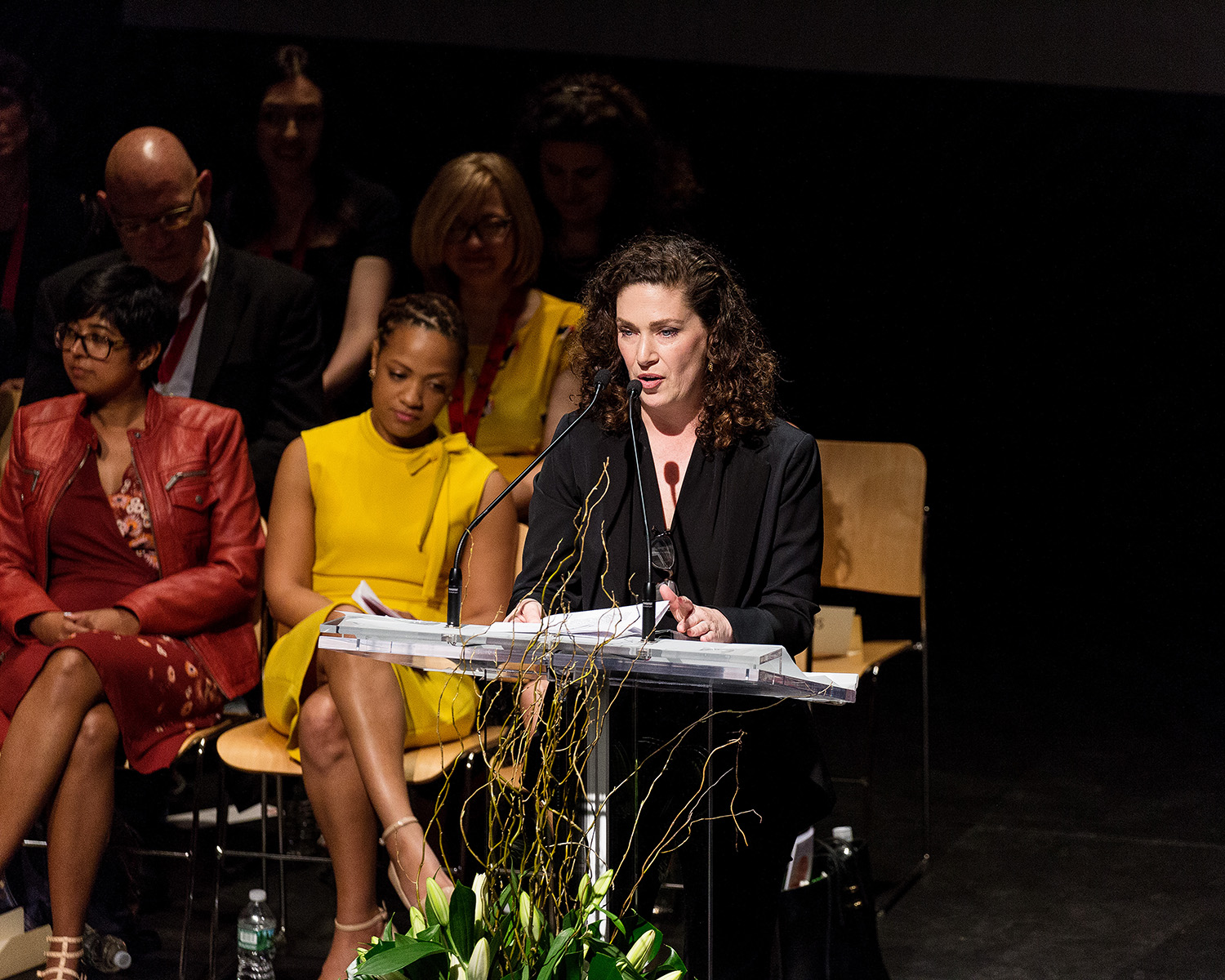
The cast of Eclipsed (Zainah Jah, Pascale Armand, Saycon Sengbloh, Akousa Busia, and Lupita Nyong’o) presents playwright, actor, and founder of Almasi Arts Danai Gurira with the Lilly Award in Playwriting. The women lit up the stage with language and feeling about Danai’s activism, not only in her plays, but also with Girl Be Heard in the United States and in Zimbabwe, where she grew up. “Danai has worked tirelessly to make sure we never forget abducted girls all over the world,” said Akousa Busia. Though two girls have been found, “over 200 girls kidnapped by the Boko Haram are still missing.”
 
 
2016 Lilly Awards_Emma Pratte_016
Danai spoke of staying in the moment, and using the outrage and anger she felt from the Waking The Feminists video to fuel her writing. She brought along two young women, Ebony and Imani, from Girl Be Heard, and gave beautiful advice to young playwrights, encouraging them to keep writing and telling their stories.


“…I remember coming to the Lilly Awards its inaugural year, 7 years ago… Sarah Ruhl was introduced to me and she told me she had just read my play Eclipsed. She told me how she thought it was beautiful and powerful, and important. At the time, I didn’t know that the world thought that way about the work or the effort. I remember being filled with so much hope, inspiration, and fuel to know I was on the right track and I was doing the right thing, even though the world might not tell you so all the time. So what I’ve realized lately is that the spirit of what I feel in me as I’ve been walking through this road with these plays, is that of making sure, as Sarah did that day, that those coming behind me are validated. That those girls coming up behind me that might not know what AD will pick up the phone, or pick up their script. Or those girls who might not know where they’re going to get their next job from or how they’re going to get around that male in front of them who keeps stopping them from getting to their destiny.
I really want to speak to those girls who are coming up behind me, as a way of doing what I think The Lilly Awards does so well, which is really making sure we know we are important, we are vital, we are crucial, we are here…
 
The first thing, young female artist: Have a vision. Identify your outreach. The lack that is unjustifiable in what narratives are yet to be told. Embrace that burden on your heart to get that story to be told. That burden is a blessing. Then get to work. No excuses. No one in the world can do what you can do. Tell the story the way only you can tell it and don’t deprive the world of your uniqueness.
 
This is a big one: Go where you are loved. How many times did I have to learn that? And how often do I meet other young writers who speak about how this avenue and this artistic director and this agent didn’t see something through, didn’t respond the way they hoped and desired.
Don’t let disappointment stop you. Go where you are loved, where your voice is embraced and your vision is respected, it may not be where you expect it or where you had hoped, but it may just be where you grow and are nurtured as an artist. It may just be where your breakthrough comes to pass. Don’t let disappointment take hold. It is really asinine to creativity – it’s poison to your creativity, rather. Stick to your vision and trust the right words will emerge if you keep doing your thing and putting yourself out there.
 
And lastly, be a finisher. Get it done. All the way. Embrace the right collaborators and Get. It. Done. It’s not for you – it’s for all those other young female writers who will be less than inspired by your product. It’s for all the women you will employ. It’s for those whose light will shine as a result of the excellency you pursued when you put those words on the page. And it’s for the legacy you assisted in building that annihilates the concept that women’s concepts are weak, rare, or unprofitable.
 
So, to the young women writers and creators in this room, I speak over you the same validation Sarah [Ruhl] gave me that day and I so look forward to continuing to celebrate you.” – Danai Gurira


2016 Lilly Awards_Emma Pratte_020
Director and Artistic Director of A.R.T Diane Paulus presented Jessie Mueller with the Lilly Award in Acting. The team of Waitress made history earlier this year by having an all-female creative team.


“Jessie Mueller has brought us the stories of two astonishing women in the last five years: Carole King and Adrienne Shelly. The Lillys are proud to recognize the clarity and boldness of her work bringing these pioneers, these women warriors onto the Broadway stage. Adrienne Shelly’s 2000 film Waitress tells the story of Jenna, a working-class waitress and expert pie-maker, stuck in a loveless marriage who finally finds the courage to free herself from an abusive relationship. The story of a woman overcoming domestic violence is a vital and pressing one that affects millions of people each year. According to the National Coalition Against Domestic Violence, one-in-three women and one-in-four [men] in the United States have been physically abused by an intimate partner. The cover of the Arts & Leisure Section two weeks ago was an article entitled The Year Broadway Broke Through, in which New York Times’ theater critics Ben Brantley and Charles Isherwood and editor Scott Heller discussed how it was a strikingly diverse, unusually urgent season. Sexual and domestic violence must not be urgent issues, since in their discussion, there was not one mention of this theme that has been an integral part of our Broadway season of this year, exhibited in many productions including The Color Purple, Eclipsed, Spring Awakening, Bright Star, Blackbird, and Waitress. Furthermore, of the artists working on Broadway this season, their conversation cites ten male artists by name – directors, writers, actors, choreographers – in contrast to only one female artist who is mentioned by name. OK, she’s fierce, Audra McDonald. Female artists are significantly underrepresented on Broadway and female stories are quick to be brushed under the rug by the media. It’s time that we recognize the incredible artists, many of whom are in the room tonight, who are telling these stories in impactful ways. In the opening weekend of Waitress, we found a note pinned to the wall in the lobby installation of the Brooks Atkinson Theatre. It read: “Thank you for saving my life. I left my abusive relationship because of this show.” This was because of your performance, Jessie. You have brought this human story to life with stunning urgency and beautiful authenticity, true to the messiness we all experience in life. The Lilly Awards are grateful for the continuing grace and power of Jessie Mueller’s work on the American stage. ” – Diane Paulus


2016 Lilly Awards_Emma Pratte_021

“I’m really sick of wearing dresses and heels. I’m so humbled. I feel like I have no right to be up here with all the people that are out here and the work that’s being done. I’ve never thought of myself as a feminist or doing anything feminine, and I’m not very good with words which is why I guess I like to pretend to be other people…but I am floored by the response of people who have seen Waitress and the note Diane read. We got to work with a wonderful organization while we were rehearsing through Mt. Sinai Hospital, SAVI, doing sexual violence and assault intervention. They have a team of volunteers. If you have a problem, they can meet you on the street corner. You can say, I have a bag; I just left my home. They work with people that come into emergency rooms, with people who have experienced sexual violence, because a lot of the doctors aren’t equipped to help them with their heads and their hearts at that moment, and these people come in and they save people. The theater is there to help and to heal and everyone’s stories deserve to be heard. Women’s stories can help and heal just as much as men’s. ” – Jessie Mueller


2016 Lilly Awards_Emma Pratte_022
Actor, director, activist, and founder of Blind Spot Russell G Jones presented Kate Whoriskey with the Lilly Award in Directing. Jones was relieved that Whoriskey was finally getting the recognition she deserved for years.


“Directors do not just stand around telling actors where to stand. Directors help writers to see what they have written, they help actors to understand what they’re meant to play, and they help the entire team grasp what we all as one soul want to bring to the audience. Kate Whoriskey is an official, major presence in the world of directing. From Shakespeare to the work of Lynn Nottage, she has brought audiences into close contact with people they would otherwise not even know existed on this planet. It’s as if she’s determined to get American audiences aware of the world. She has been doing this for a long time, and I’m glad to see that she’s getting a little respect because she’s the one.
 
She got a note here from Lynn Nottage, which says, ‘I wish I could be there to fetch you, Kate. Thank you for being such a dear friend, trusted collaborator, and my sister in this artistic marathon. As a director, I appreciate that you bring great clarity and vision to all your projects, and I apologize for dragging you to unusual corners in this creative universe to find inspiration, but I thank you for being so game. You dive into your work with all your heart, and you’re always willing to wade into dark and unruly territory to find truth and beauty, even in the most mundane of moments. Boston tough, uncompromising and generous, you make your collaborators feel safe and cared for as artists, and I feel eternally thankful that our paths crossed at just the right moment in our creative lives. It would’ve been tough finding my way through the thicket without your support. Congratulations, a well deserved honor for a director.'” – Russell G Jones


2016 Lilly Awards_Emma Pratte_026

“…It’s wonderful to be in a room with people who formed this community. I want to have a little conversation with all of you about the nature of community and what women can do for each other. In 2008, I had one of the most difficult conversations I ever had with Lynn Nottage. I took her out to dinner, and I knew I had to tell her something that I felt like would end our working relationship. We agreed to meet uptown, and we spent the time between appetizers and desserts talking about anything that I could think of that was not the subject at hand. [Lynn Nottage] then starts to drive the conversation to notes on Ruined and I stopped her, and I said, ‘Lynn-‘ she said, ‘No, no, no.’ You have to understand that we’ve been working on Ruined for 5 years, and we had travelled to Uganda, and we had done endless workshops and I had to tell her that I couldn’t do it. I blurted out, ‘Lynn, I’m pregnant. The baby is due 5 weeks before we start rehearsal, I can’t.’ She stopped me, interrupted, and says, ‘Well, congratulations. Welcome to the world of working mothers.’ I got home to my husband, and he asked how it went, knowing it was an emotional time for me. I dumbfoundedly said, ‘Well, I think I’m still doing it.’ When I look back over the last decade, I recognize what a defining moment that was for me. In some ways, Lynn made clear that who we love, who we make our family, and what we say on stage is all of a piece. We are responsible to those we love, and responsibility translates to who and what we see on stage. Getting this award is now significant to me, and in this election process where floodgates of hate speech are being unleashed, I’m honored to be a part of a community that is in pursuit of strengthening the underrepresented voice, diminishing the hardening of our culture, and deepening the sense of empathy.” – Kate Whoriskey


2016 Lilly Awards_Emma Pratte_027
Vice President Julia Jordan introduced Emily Simoness from SPACE on Ryder Farm – a program in its second year of partnership with The Lilly Awards that brings child care to writers’ retreats. Most retreats and workshops do not accommodate families, making it difficult for working mothers to afford the same opportunities as their male counterparts. This year’s residency awardees include Beth Nixon, Deepa Purohit, Sarah Ruhl, Georgia Stitt, Louisa Thompson Pregerson, and their children.
 

“Last year, The Lilly Awards began to roll out a childcare initiative. A model camp where women who are both writers and mothers could bring their families and actually get work done and have happy children. We are determined that one day, every colony, play lab, and theater will have a child care policy, so that never again will a woman writer have to choose between advancing her work and taking care of her children.” – Julia Jordan


2016 Lilly Awards_Emma Pratte_029

“…For those of you who don’t know, we are an artist-in-residency program housed on an organic farm an hour north of New York City. Last year, we had the supreme pleasure of partnering with The Lillys on our first ever family residency that aims to 1) give working moms the time and space to work on their art; 2) give their kids time and space to be outdoors, play with other kids, and be supervised by some education professionals; and 3) to have time to be together as a family. It went swimmingly…One of the pervasive threads was this notion that ‘Well, I haven’t applied for an opportunity like this in 3 years, or 5, or 7 years,’ because ‘I’m a mom’, or because ‘I thought I wasn’t invited.’ We’re here to say that that’s not what you need to do going forward. If I could take those applications and make a coffee table book about why this is so important, I would.” – Emily Simoness


2016 Lilly Awards_Emma Pratte_033
Director of Outreach and Leah Ryan Fund Board Member Cusi Cram presented Genne Murphy with the Leah Ryan Prize. She spoke about her late friend Leah Ryan, and her wish to help writers in any way she, her friends, and her family could.
 

“…To my mind Leah embodied what it means to be a modern woman of letters. She was infinitely curious and brave in her work and how she chose to live her life. When she died of leukemia in 2008, her friends and family created a foundation to honor her work and her extraordinarily generous spirit. Each year we award an emerging female playwright with $2,500 and a professional reading of their play. Since the theme of this year’s award is advocacy and activism, I would encourage you all to think about how you can be actively generous to one another in both ways large and small.
 
I am thrilled to present the Leah Ryan Prize to Genne Murphy for her wildly original and theatrical play, Giantess. It is a play about complicated bodies, choices, and leaps of understanding we make when we love someone who is seemingly very different from us. Genne has a truly original and fresh voice and I want to see her plays living and breathing on stages all around the country.” – Cusi Cram


“Like many women playwrights, I have struggled with the not unreasonable fear that my plays might not find a place onstage in the American Theater. At times it’s been hard to quell these fears when writing to keep pushing forward an idea, a character, a world. As an early career writer, I realize it is critical to find real allies and collaborators and I feel so lucky to be connected with the Leah Ryan Fund and for your support and your guidance moving forward […] I also would like to acknowledge those who helped get me here. Philadelphia Young Playwrights, or PYP, is an arts organization – a very dynamic one – in my home city. I wrote my first play for PYP when I was in high school and PYP helped to shape my understanding of theater as an art form that is evocative and deeply human and one that has the potential to engage audiences and communities together in their ideas. I would also like to thank my family – both the family I was born into and my queer family for their love, support, and smart council. You’ve helped to shape my brain, my heart, my spirit, and you’ve encouraged me to engage both the political and the personal in my work. And thanks also to all the teachers in my life. My recent mentors, Jeanie O’Hare and Sarah Ruhl, as well as my college and high school writing teachers, Anton Dudley and Ms. Schroeder, and also my second grade teacher, Teacher Penny, who told me not to worry about my terrible handwriting or my inventive spelling and just to write. I am also the daughter of two very amazing teachers…I am grateful for your faith in me and for your love. ” – Genne Murphy


2016 Lilly Awards_Emma Pratte_040
Howard McGillin presented Martha Plimpton with the Award for Speaking Truth to Power.
 

“Martha Plimpton has been politically active since she was a teenager, marching for women’s reproductive freedom in the 80s, in the 90s, and now. Even now, when the battle is far from over. She has lobbied Congress on behalf of Planned Parenthood and has spoken out for women’s reproductive rights at campuses and rallies all across this country, and I believe she will keep doing this for as long as it takes, goddamnit. When Amanda Green asked me to present this award, I was so delighted and honored to be asked. I’ve known Martha for about fifteen years; we’ve been good friends, shared a lot of birthdays and holidays together, and I know her not only to be an artist of singular quality but also ridiculously funny – her wit and her passion for the world we live in and the causes that are dedicated to making it a better place make her a role model for us all.” – Howard McGillin


2016 Lilly Awards_Emma Pratte_044

“I’m really astonished to be in all these people’s company, some of whom I know, many of whom I don’t, but all of whom I respect and admire and am completely in awe of – some of you I have worked with and some of you I hope to work with, many of you, all of you, if you’ll have me, cause it’s hard out there for a chick.
 
In this particular election year, regardless of where each of us may stand politically, though in this room I have a feeling we’re pretty safe […] I think it’s safe to say that issues of representation and visibility are a central theme in the public discussion over who it is we feel should lead us, who it is we should feel silenced or marginalized by, and how it is that we should go about making our voices heard. Representation of diverse voices in the arts, in culture, and in political and social life is essential to influencing the course we take, not just in this election but in life in general. The stakes are incredibly high for all of us, but particularly for women, people of color, immigrants and refugees, children, LGBTQ Americans and other members of our society whose most basic interests of survival and of equality are under direct and constant threat pretty much daily around the world and unfortunately here at home as well. The voices of women of diverse experiences are necessary to telling these stories and bringing them to the attention of the nation. They develop our understanding of human nature and life and they bring us closer to the empathic and intelligent society we all seek to live in. We can’t afford not to listen to them, to amplify them and to celebrate the courage to do what it takes, what so few others are willing to do, which is to tell the stories without traditionally accepted paths to power.
 
I am astonished and inspired by the creativity and courage of all the women here today and I do take a lesson from each of them – that every heart and mind is capable of reaching into every other heart and mind, those of strangers, and altering, even if only for a moment, the trajectory of a single life. And that is no small accomplishment. It is everything. All each of us has is one voice and this moment. Only this moment. This moment alone which is in fact vast, eternal, and encompasses all of creation.
 
In the advocacy work that we do for the abortion rights organization A is For, we are doing our part to amplify the voices of those who have been silenced and shamed for making choices of their own conscience. From the Rio Grande Valley to the Mississippi Delta to the prisons of El Salvador, where women risk imprisonment for up to forty years for the crime of miscarriage, these voices of the women most severely affected by abortion restrictions and prohibitions are rarely heard. It is our duty to give them a platform, a place to speak out, and in some cases to speak out in their names when there is no other option, so that everyone will know the depth and the truth of their humanity, their dignity, their strength, and their right to live their lives as they see fit. I so appreciate everyone here who is dedicated to this mission of celebrating and encouraging women to speak up, to write from their own experiences, and to share those experiences with an audience that is truly hungry for more.” – Martha Plimpton


2016 Lilly Awards_Emma Pratte_045

“In the words of Lorraine Hansberry, the thing that makes you exceptional, if you are at all, is inevitably that which must also make you lonely. Well, the Lillys are doing their part to make each of us feel a little less lonely, a little more heard, and a great deal more prepared to keep on going.” – Martha Plimpton


2016 Lilly Awards_Emma Pratte_050
Marsha Norman introduced this year’s Miss Lilly Awardee, Norbert Leo Butz. “Sometimes when something awful happens, you see someone set a heroic example.” She honors Norbert Leo Butz with the words: “a man who fights for women is a real man.”
 

Norbert Leo Butz received the Miss Lilly Award for his work with Rachel Ebeling to create The Angel Band Project, a music-based organization dedicated to breaking the silence and providing support for rape survivors.
 

He began his address by saying, “my name is Norbert and I’m a feminist. As honored as I am to be receiving this award, as badly as we need this $5,000, I wish to God, if I have to speak the truth, that I weren’t here tonight. The circumstances that brought me to this podium tonight are unspeakable.”
 

He spoke about losing his sister to a sexual assault hate crime, and the movement to change the culture of violence against women.
 

“This event, the loss of my sister, meant the loss of many things in my life. It’s the nature of sexual violence, these crimes, their far-reaching implications and why we must fight to eradicate crimes against women […] My girls were 13 and 11 when their beloved aunt was taken in their teenage years. They have both suffered through eating disorders, self-harm, and drug issues…within a year I had to seek help because I was drinking myself into a stupor every night, unable to deal with my own trauma. At Teresa’s funeral…we sang. No one could speak. All we did was weep and we sang. We were able to get out these hymns that we’d grown up singing.
Rachel Ebeling had been best friends with Teresa since they were in kindergarten. She and her best friend had a vision after the memorial service of having another memorial service in Seattle where we got out guitars and sang and this amazing thing started happening. People started talking about the event, people started expressing their grief, people started coming together. Rachel proposed the idea of the Angel Band Project and amazing things have started to happen…Not long after my sister died, two interesting events happened in my life. My wife, was a wonderful ingenue and then she started playing moms the way you ladies do at 33, starting to play moms of teenage girls, and then did three roles on three procedurals in which she played moms and then corpses. My wife played three corpses on television before she went into semi-retirement. I was given two scripts that pilot season after Teresa died, one was to participate in a sexual crime against a woman, another to investigate one. Both of my daughters came home from their high school cafeteria saying they couldn’t eat in the cafeteria, they were being too harassed by the boys in their public high school. What the fuck is going on here? And how was I blind to this my whole life? And then it dawned on me. Women have known this all along, right? I was just getting a glimpse into the world and I was horrified by what I saw.” – Norbert Leo Butz


“…He represents the men in this because we cannot stop violence against women until the men start stepping up. All of these wonderful women here are using their voices and it’s so important…and for the young people here – your voices matter the most.” –Rachel Ebeling


2016 Lilly Awards_Emma Pratte_054
Playwright Neena Beber introduced recipient of the Stacey Mindich Go Write A Play Award, Rehana Lew Mirza.
 

“The Stacey Mindich Prize is not just $25,000, it’s an invitation into a group of writers whom Stacey has commanded to go write a play. Someone out there cares and will feed you. Stacey gathers everyone who’s won into her vision of, as Gloria Steinem says, I like to quote, “women who are all linked, not ranked.” This year’s winner is Rehana Lew Mirza. Rehana has had readings everywhere, established Asian American companies everywhere, received awards from everyone, has an MFA in Revolution from Columbia – wait I’m sorry, an MFA in Playwriting from Columbia. She was a co-founder of the Ma-Yi Writers Lab and is a brand new mom. Her baby is one month old, and one thing Stacey wanted to make clear is that writers are moms, [moms] are writers.” – Neena Beber


2016 Lilly Awards_Emma Pratte_055

“When I got the news about this award, I was sitting with my one month old child. One of us was curled up in fetal position; the other was crying that their career was over. We live in a two-playwright household, and my husband, Mike Lew, and I would often joke that we’re doubly fucked: Double the rejections, half the bank account. As the woman, apparently I get â…” of those rejections, and â…“ of the bank account. It’s easy to feel forgotten as a woman of color in the theater, and in a year where politicians are spinning hateful narratives about Muslims and POC’s, it’s easy to feel not just forgotten, but downright unwelcome. So I try to address some of that in my plays, but what I can address is trying to survive in this industry with a baby. When we started this family, I was worried people would assume I’d give up writing for the baby, or that when I’m accompanying Mike to his productions, the theaters would mistake me for the nanny, instead of acknowledge me as a playwright.”

 
She addressed her month-old son, saying:

“You are in a room filled with game-changers, people who understand the power of storytelling and are working to show the full breadth of the human experience, who are making room for complex identities. I want you to be as thankful and grateful to them as I am, especially to the Lillys for creating a different narrative, for firmly saying: We hear you, we see you, you are welcome here.” – Rehana Lew Mirza


2016 Lilly Awards_Emma Pratte_065
Candis Jones was the Recipient of the New York Women’s Foundation Directing Apprenticeship Award. The award comes with a $15,000 check and an apprenticeship with Rachel Chavkin. Candis is a director and founder of Theater YinYin. She speaks candidly about the “badassery” she is a part of in this room. She thanks the Lillys for believing in her and “for teaching young women to believe in themselves.”
 

“I regard the theater as an act of faith, where we ask audiences to believe in the unseen and the theatricality of magic.” – Candis Jones


2016 Lilly Awards_Emma Pratte_067
Legendary producer Daryl Roth announces that from this point forward the home for the annual presentation of the Daryl Roth Creative Spirit Award will be at the Lilly Awards, dedicated to apprenticeship for women in tech or design.
 

“It feels to me that this is the right place to dedicate this award. It will honor emerging women of any age, with the incentive of financial support to nurture her creative spirit in the field of theater design – sets, costume, lighting, or sound. This woman will have the opportunity to work with an accomplished mentor in her chosen field, and together they will create a year long apprenticeship, where she can assist on three professional productions. It’s my hope that more women will think about careers in all areas of theater design, and know that we’re here to encourage them, and help sustain them, and offer an open door to the myriad possibilities available. While my heart is with writers, and directors, and actors, I feel this is a really wonderful area that we have to commit to and support, and so it will be my pleasure to begin doing that, next year.” – Daryl Roth


2016 Lilly Awards_Emma Pratte_071
Playwright and member of the Dramatist’s Guild Council Lloyd Suh presented Mia Katigbak with the Lilly Award in Trailblazing. He eloquently described her as “not only one of the greatest actors in the world, but the Godmother of the movement of Asian American culture.”
 

“When Mia Katigbak was at Barnard, she performed in the only roles that were deemed appropriate for her: maids and hookers. One day she was invited to play the harpsichord in a Moliere play. She thought ‘oh good, they see me.’ But no, she had to play her harpsichord from behind the curtain, because the director said there were no Asians in France at that time. There are too many stories like this that happen, even today. But now, when aspiring Asian American artists look to the stage for a reflection of themselves, when they look for their roles and their role models, they can see Mia, because she ripped that curtain down and she set it on fire. As the founder and artistic director of NAATCO, the National Asian American Theater Company, she has produced over 25 years of visionary and revolutionary work that has nurtured generations of Asian American artists. She is not only one of the greatest actors in the world, but she is godmother to a revolution, and a leading figure in the cultural history of Asian America, and she is one of the most important people in my life.” – Lloyd Suh


2016 Lilly Awards_Emma Pratte_075
Mia Katigbak thanked many women including Lear Debessonet, Kate Whoriskey, Sarah Benson and others who made space for her to play roles outside of the Asian female stereotypes and came to thank her mother, present in the audience, whose unwavering faith has been her guiding light.
 

“[This] has great meaning, especially coming at this sometimes perplexing time of my life. For the past 25 years, NAATCO has been working towards the improvement of Asian American representation in the theater, so that we are insignificant, central, multi-faceted, complex, non-stereotypical roles on our stages. I know that change often happens in painfully slow increments, but I believe that we’re seeing some progress. But for the past five years, there seems to be a huge backslide – an uptick in what I call irresponsible and careless casting when it comes to Asian Americans in theater and in film. Instances of exclusion and yellowface, which to me, point to a severe backlash to our endeavors for equity and diversification, to our efforts to present onstage the accurate picture of what America looks like today. These events will sometimes burden my heart and deflate my spirits. And yet, congruently, I have been given the opportunities outside of NAATCO to portray just the kinds of characters that I advocate for Asian American actors. Almost all of these opportunities have been made possible by women. My recent bout of good fortune came about three years ago, when Melanie Joseph and Lear Debessonet cast me as a God in [Good Person of] Szechwan. And then Maria Striar, Becky Stafford, Portia Krieger […]Then with Kate Ryan, the owner of a card and gift shop somewhere in New Hampshire, without having to explain how an Asian American got there. Next, Kate Benson and Susan Bernfield made me the matriarch of four generations of the most diverse family I’ve ever had the crazy fun to do on stage. Lisa McNulty joined in the fun in the remounting of A Beautiful Day in November [on the Banks of the Greatest of the Great Lakes]. Lisa, Sarah Ruhl, and Kate Whoriskey gave me the most wonderful gift of portraying Elizabeth Bishop. A few months ago, Clare Barron convinced me to play one of her alter egos in I’ll Never Love Again.
 
I implore everyone who is here tonight to get on this bandwagon, band-truck, band-cruiser, or band-jumbo jet. I promise it will catapult the American theater to the 21st century. ” – Mia Katigbak


2016 Lilly Awards_Emma Pratte_078
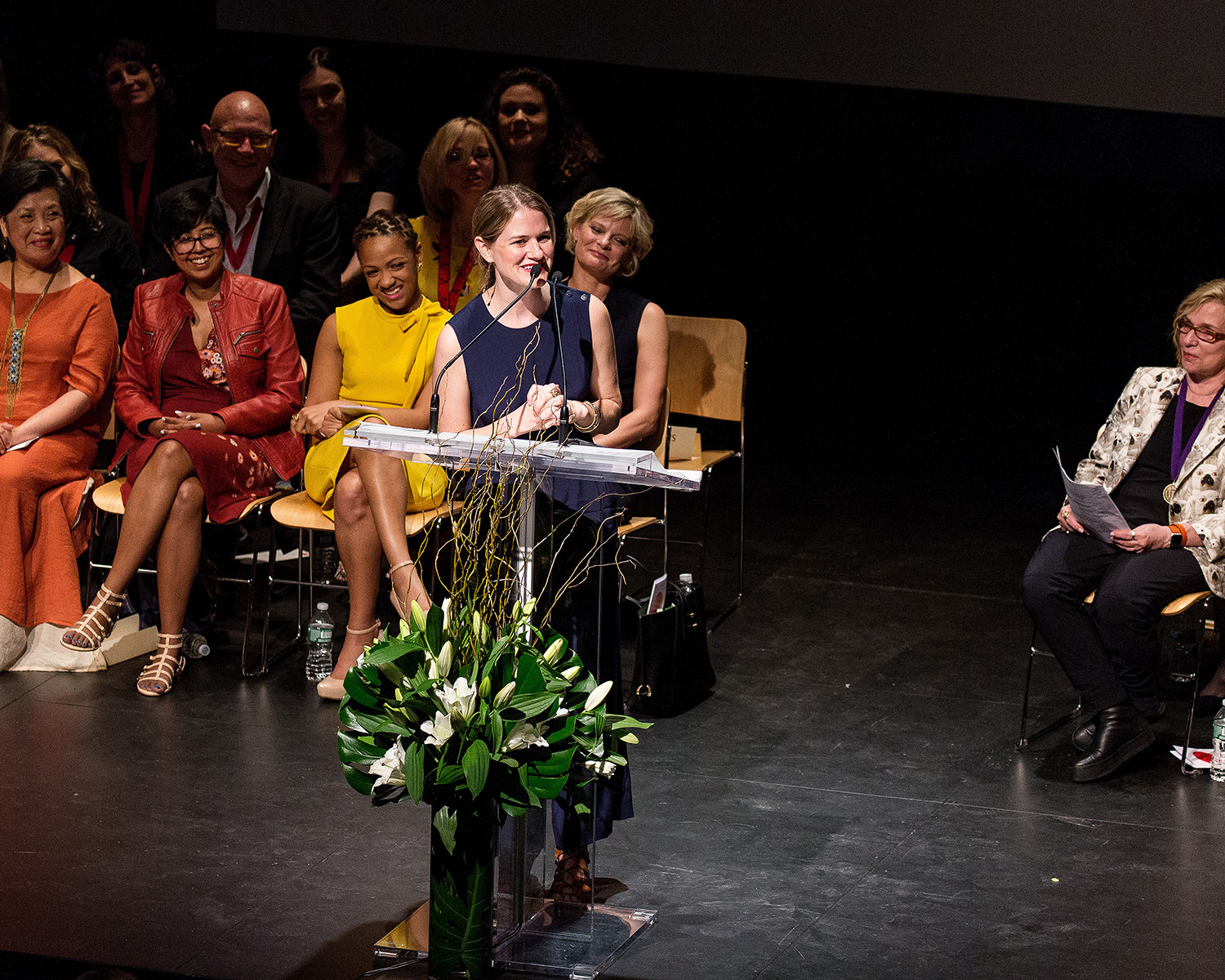
Gloria Steinem took the stage to present the Lilly Award in Activism to Kathy Najimy, but not before giving high praise to The Lilly Awards. “Can we give The Lilly Awards an award?”
 
“This is the ultimate campfire,” Gloria said, “that’s really what we’re doing here, right? Sitting around the campfire telling stories for the last hundred thousand years and unfortunately, some folks have been excluded from the campfire and you are making it complete and I am grateful to you.”
 
 
2016 Lilly Awards_Emma Pratte_088
She describes Kathy as someone who “knew what mattered and got involved.”
 

“I challenge all of you to become activists and advocates for the things that matter to us and to be inspired by Kathy in this. [Her activism is] not only reflected in the producing, writing, directing, all of it, but in the help, the support, the innovation, and the kindness she gives to everyone else…And I want to say one thing about laughter because I think we don’t give it its due. I figured out a couple of years ago: it is the only free emotion. You can compel fear, as we know. You can even compel love – if someone is isolated and dependant long enough they become enmeshed with their captor. But you can’t compel love or laughter. It happens when two things come together and make a third. It happens when you learn something; it’s an orgasm of the mind. It’s a moment of freedom. In Native American and I’m sure other first cultures, there is a God of Laughter, because it is the path into the unknown. They say you cannot pray before you have laughed. Kathy brings us freedom in everything she does, especially in her inspiration of laughter.” – Gloria Steinem


2016 Lilly Awards_Emma Pratte_091
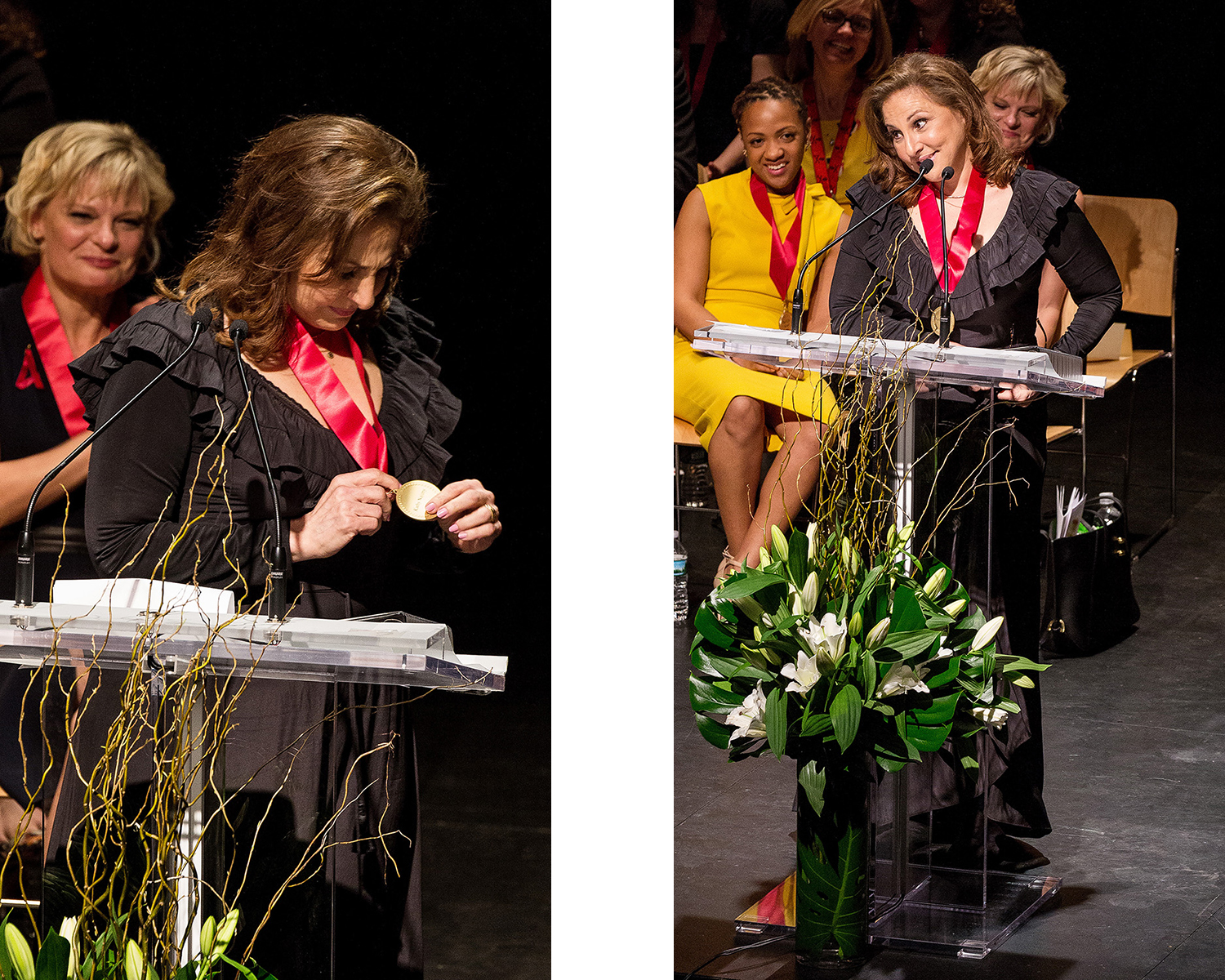
Kathy was true to Gloria’s words, inspiring both laughter and awe throughout her speech. She honors the other awardees, Gloria, the Lillys, and her daughter with her generous, honest, and witty words. She compels us all to keep going, saying: “to believe we might be able to make a difference simply gets us through the fucking day.”
 

“…I’ll tell you what A is for. A is for ‘Are you fucking kidding me?’ To have the courage to say any tiny public opinion is unheard of, let alone be the glooming voice of reproductive rights. This woman is on network TV! She even had the word ‘abortion’ printed on a dress! And she just got picked up for a second season!” – Kathy Najimy on Martha Plimpton


“I was doing a colonic the other day, and between kegels, I was thinking about what really is an activist. After my third release, I said to my colon therapist, ‘so, Svetlana, maybe an activist is someone who just improves the little space that they take up before they split.’ I’m not sure exactly when my activism started, maybe when I refused to take off my ‘Legalize Weed’ button when I got kicked out of junior theater for it. The crazy thing is, I’ve never smoked pot. Or maybe it was when I got them to let women wear pants and change the dress code. Activism is a way to temporarily mute the hideous voices screaming out in your gut at the state of things. It quiets the rage for just a minute – rage of suffering, abuse, violence, rape, inequality, racism, shame, poverty, war, misogyny, homophobia, and hate – the things that just shred our insides. When I see Donald Trump’s face on my AOL feed page, I do one of two things: I either inhale a brownie, or I plan a rally. To believe we might be able to make a difference simply helps us get through the fucking day. Activism [also] means we make a play, a dance, a poem, direct a film, write a book, a speech, a TV show, a song, or in some rare chance we get to perform or create something that leaves this place where we stand a little bit better, a little bit fairer, and a little bit more fun. If we get the chance to even jostle an opinion or an audience to do any of these, that’s a really good day for me. If I get to watch three Wheel of Fortunes in a row, have a bubble tea, and get a grand Lilly prize from Gloria Steinem, it’s a really good day for me.” – Kathy Najimy


2016 Lilly Awards_Emma Pratte_099
The show ended with a closing number from Zoe Sarnak, Georgia Stitt, Amanda Green, and Rebecca Naomi Jones singing “This Stage is Your Stage” to the tune of Woody Guthrie’s “This Land is Your Land.”

“As I went looking through the theater season
I saw no women
And I saw no reason
For the lack of balance
With the wealth of talent
This stage belongs to you and me

This stage is your stage
This stage is my stage
From sets and lighting
To the final script page
From the streets of Ireland
To Manhattan Island
This stage belongs to you and me

If you’re ingenue-ish
If you’re male and Jewish
Christian and Caucasian
Not trans or Asian
Then you might belong here
But there’s something wrong here
This stage belongs to you and me”


The event was produced by Tessa LaNeve and Chelsea Marcantel, and co-produced by Amanda Green. To learn more about The Lilly Awards, click here.
 
Red Carpet photo by Zach Ranson.

Posted on

A Conversation with Anne Kauffman


During intermission at Lorraine Hansberry’s The Sign in Sidney Brustein’s Window, everyone was having a conversation. Not the usual, “Do you have to go to the bathroom?” or “I’m going to get a drink” chatter that generally fills a lobby. As I stood near the doors, I heard a daughter ask her mother what the 60s were like for her, two friends debating their level of empathy for Sidney, and a woman telling a girlfriend about how deeply she understood, on a spiritual level, what Iris was going through in her marriage. The theater was full of vibrant, smart, diverse people engaging with the complicated characters they’d come to know during the first act. And the guiding hand that shaped the beautiful, naturalistic production, running at The Goodman through June 5th, is director Anne Kauffman.


Kelly Wallace: How did you come to be involved in this production with The Goodman?
 

Anne Kauffman: Well, I actually brought it to the Goodman because I’d been wanting to do it for ten years. I originally came into contact with it when I was an undergrad and I was an actress and I was looking for an audition monologue. You know those anthologies of audition monologues. Well I was looking through it and I found this monologue, the Iris monologue about her fear of auditioning. So that was my first encounter with the play. And then several years later, when I was working at NYU (teaching directing) one of my students wanted to do this play for her thesis. I was like, “Really, you want to do this play? It’s so creaky…what do you want to do this old thing for?” But she really wanted to do it and so the faculty agreed to let her. I was her mentor and I sat in and watched rehearsals and I was totally blown away. I was completely blown away. I was first and foremost blown away by the marriage at the center of it and then its immediacy and urgency in terms of the social and political climate. So I started talking to Joi Gresham, who is the Director and Trustee of the Lorraine Hansberry Literary Trust, about doing this. I just fell in love with it. And so I started to pursue a production of it. And finally gave it to Bob [Falls] after Smokefall when we were talking about what we should do together next. And I said, “I really want to do this…” and he was like, “Great, let’s do it.”
 

KW: What made you feel like The Goodman was the right home for it?
 

AK: I feel like Bob and The Goodman are expansive thinkers. They’re interested in the epic, like 2666, and plays that are very ambitious in what they’re trying to do, who they’re trying to reach, what they’re trying to say. I feel like there’s a kind of large embrace that The Goodman has; they are interested in diverse voices and varying styles and eclectic subject matter so this felt like a really good fit in terms of that aesthetic. And also Bob was saying earlier at a board meeting, which I thought was kind of interesting, that he was interested in the lesser-known works of great writers. So, that seemed to be a little bit of a theme with Thornton Wilder this season, with The Matchmaker, and then I brought this to them. A Raisin in the Sun recently had its 50th birthday in 2009, and this had its 50th birthday in 2014. So all the stars aligned and here we are.
 

KW: You’ve worked in New York a lot too, what do you think the differences are between Chicago audiences and New York audiences?
 

AK: Oh gosh. It’s hard. I think that Chicago audiences come at things with their heart and New York audiences come to things with their brain. And neither one is better or worse. I think that they’re both necessary and ways of watching work. That’s where I’m at. That’s my very unprofessional opinion about it.
 

KW: How does doing this play today, in this political climate, affect your perception of the show and your process?
 

AK: Well, it’s really interesting. I think for awhile when I was passing this play around, people were really hesitant to do it because they felt like the issues being explored in it have been somehow resolved in our country. Unfortunately, recently these issues have raised their ugly heads once again. They sort of resurfaced; it’s all been underneath the surface for a while, and now we’re in a moment where all of this rumbling is actually erupting. Trump is really allowing the vitriol and things that have been buried for a while and never went away, that were just sublimated – he’s opening up the floodgates. It’s a little bit…it’s funny, I was reading the Carlyle interview that you did –which was really amazing – and he had said something about how it felt like The Purge, and it does. It has that kind of feel to it. We’re living in a time where gay marriage is…yes, we’ve made some strides, but there are still a lot of issues with sexuality and the fact that people can’t go into the bathroom they feel they have the right to go into, in this country, in this day. Definitely women – pay equity, and the struggle women have to gain the same access that men do…it’s still an issue. And we have a movement called Black Lives Matter, the fact that we actually need to have that in 2016 is pretty astonishing and reprehensible.
 

KW: Black Lives Matter is very close to my heart, I’ve demonstrated with them in New York quite a few times.
 

AK: Oh, that’s really cool.
 

KW: And the energy there in that movement, especially in the aftermath of Eric Garner, was transformative. It’s interesting because Lorraine Hansberry was so in favor of civil disobedience as a means of communication and protest. She’s pretty hard on white America when they don’t accept these kind of “radical” tactics.
 

AK: That’s exactly right, that’s what this play is about. She’s trying to excite the white liberal into action. That’s what The Sign in Sidney Brustein’s Window is all about.
 

KW: What is the heart of the play, for you? What excites you about it?
 

AK: I think the play is about commitment and engagement, and in order to do that you have to really understand who you are at your core, the revelation of your true self, and be honest with yourself. What I really really like about the play is that it’s not just a political statement, it’s a personal statement. This marriage is happening.
 

KW: The politics and the personal are so intertwined in this show.
 

AK: Absolutely. I keep thinking what’s happening is that Sidney has this young wife who is growing and changing right in front of his eyes and he’s still treating her the same way as he always has treated her and he not seeing the change. There’s a rupture that happened with him not being able to recognize the change and address the change. The same thing is happening in his world at that moment, the same thing is happening in our world. We’re very afraid of change and we don’t know how to adapt to change. It’s really crazy. Again, Donald Trump, wanting to send us back to the Dark Ages. For him, it’s not about change; it’s about going back to what it used to be. It’s oppressive. That’s what is exciting to me is that the political is being reflected in the personal, and in the marriage.
 

KW: Do you think it’s possible to separate the two completely?
 

AK: I think a lot of us are able to. I’ve always thought that a certain strata of society can very much separate the personal and political because they don’t have as much at stake, in terms of what laws are being passed. Meaning, there are certain people of a certain class in this country who can live a life unaffected by government policies. The first time I took notice of this was when I went to the Soviet Union when it was still the “Soviet Union.” I come from a very comfortable home and family – suburban Arizona, Jewish. And going to the Soviet Union and seeing how directly the government is mistreating its citizens, it’s like a 1:1 ratio there. It was very clear that the government was the parents who are treating the people, their children, poorly. And you could see it on the street. No one is exempt from it. In our country, there are people who can be exempt, not literally exempt, but they can certainly live in a world where they’re not looking it in the face.
 

KW: Gender issues come up a lot in this show, and in the world. It’s interesting because in theater, which you think of as such a liberal art form, or that the community is such a liberal group of people…but then you look at stats like 10.7% of works in the ’12-13 season on Broadway were written by women, gender parity in theater is not where it should be, even though audiences are 68% women. What has your experience with that been?
 

AK: This is a touchy issue. We talk about this all the time. It’s interesting to hear you say that, and it’s true, you have this liberal art form, this accepting art form, and they’re treating their women not so well, which is exactly what Sidney is. He’s this liberal guy, who thinks of himself as a very experimental, avante garde, forward-thinking person who is ignoring his wife. I mean, it’s true the statistics don’t lie. For me personally, I think it’s dangerous to get caught up in it. I feel like I need to put my head down, and do the work, and I’ll be recognized, and that’s a little bit naive because I don’t think I actually have the access that guys do to certain things. I’m a little myopic when I put my head down and think, “This is actually great, I’m doing my work and I’m getting stuff…” and I look up and around me and I’m like, “Holy fuck.” We’re nowhere near where some of these dudes are. It is difficult to identify, it’s hard to say that if you don’t get a certain job, it’s because I’m a woman. So it’s hard to identify it specifically. And the last thing I’ll say is that this all changed for me when I got back from graduate school in the late 90s. I came back to New York and I was having an interview. I was being interviewed by Zelda Fichandler for a job at NYU. She said to me, “How’s it going?” I said, “Well, you know, it’s hard being a woman in this field.” And she looked at me and she was like, “What?” Zelda Fichandler, who basically started the regional theater movement in the 50s. She translated Russian documents in World War II. She built the Arena Stage, the NYU acting conservatory, she’s responsible for basically a huge movement in the theater. And for me, that was when I decided I’m going to do my work, do it well, hopefully, and be recognized. It’s a very complicated issue.
 

Stage-&-Candor_Anne-Kauffman_Photo1_BW
 

KW: You started as an actor…what made you switch to directing?
 

AK: I’m kind of a control freak, I think. I always was one growing up. I grew up in a family of six children and I was always organizing these little shows with the kids in the neighborhood. But I wanted to be a musical theater star, that was what I really wanted to be. I wasn’t very good. It became really evident in undergrad when I kept being cast as guys. It was because there weren’t a lot of guys in the drama department and they were like, “Well, what’re we gonna do with Annie? Just stick her in some breeches and whatever.” It became very apparent, I knew that I wasn’t good. Someone gave me a play to do in the dorm and so I did it and then I took a directing class and the guy who taught it, Michael Hackett, was like, “You’re a director.” So that’s how I came to it. Also, as an actor, not only was I not very good, I really checked out. When I was in a play and a director was telling me what to do I would sort of pay attention only when he told me what to do and then I would check out. I got bored. I didn’t have an idea of the whole play or any interest in figuring out where I am in the play. I’m actually, by nature, kind of a lazy person. So directing was the only thing that fully engaged all of my faculties in a way that I was interested in. It kept me excited. You’re responsible for so much, it was the only thing that would bring me out of what I think of as my laziness, to activate myself, to get me excited about something.
 

KW: When you direct a show like this, when you start the rehearsal process and start working with actors and putting the pieces together…do you find it helpful to talk to the cast about the outside, real life issues or is it more useful to you to stick close to the text and keep it in the bubble of the show?
 

AK: That’s a very good question. I don’t think I ever talked to the cast; I mean, we all agreed that the play is important to do right now but we actually, all of us, went inside the play. We have a great dramaturg team, so we all immersed ourselves in 1964. I think that the more we immersed ourselves in 1964 and the more expansive our knowledge became, just by being in that world, the parallels became really apparent. But we never said, “Oh, that’s like today!” We were just living inside of that world.
 

KW: As you said, you grew up in Arizona in a fairly comfortable environment. What’s it like to come at this as a white woman from a comfortable background, to look at something that touches on race, and privilege, and all those things?
 

AK: It’s funny because what I like about it, and why I think it’s interesting to have a woman direct it is because it’s Lorraine Hansberry, it’s a woman’s point of view so in a way that’s why I think I’m very attached to Iris. I think she’s the person with the most evident journey in the play from the beginning to the end. And I happen to be a white liberal, so having to take apart the play and understand all the different points of view and to identify where the white liberals’ blind spots are, was a really interesting process. It’s been really incredible. Joi Gresham has come into rehearsal, one of our understudies is very well-versed in the civil rights movement, so it’s been an education. There are so many different points of view, so many different kinds of people in the play, it’s really a community. It’s a motley crew of people. We’ve got politicians, we’ve got artists, we’ve got activists, we’ve got actors. It felt like my way of educating myself about where Lorraine Hansberry was coming from, to be in dialogue with this play.
 

KW: You’ve done a lot of new work, and then you come to a show like this that’s from the past. What’re the differences for you in coming back to a piece like this and doing something new?
 

AK: Since I’m exploring this piece for the first time, and we’re working with several different versions of the play, and again we have the dramaturgs, we have Joi, so in a way…it feels like a new play. We just changed where the intermission is, so it tells a very different story now. The major difference for me is, well, first, there’s a responsibility that feels different. I feel like this is a play that has been done, it’s had a rocky past, I think it’s so important for our communities to see this play, to access Lorraine Hansberry through this particular vantage point and to hear what she had to say and how it’s relevant today. So I feel a responsibility there. Of course I feel a responsibility for new work too, but it’s a different thing. What’s really interesting is I don’t actually have a playwright in the room, so I can and need to answer for myself. I’m so used to the collaboration and asking if something works, or a playwright telling me, “No, we can’t do that.” What’s nice is it feels like it’s all me. It’s generative in terms of the world, and that it’s totally my responsibility.
 

KW: Who are some of your favorite female playwrights? What other plays are you drawn to?
 

AK: Lillian Hellman. Contemporary ones…Anne Washburn, Jenny Schwartz, Annie Baker, Amy Herzog, Sarah Gancher, Sarah Gubbins. Oh god, there’s a million. A bunch of people. Tracy Scott Wilson, Jackie Sibblies Drury, Claire Barron, Lynn Nottage, Quiara Alegria Hudes.
 

KW: What plays did you feel like made you gravitate towards theater? What specifically about live theater is it that you’re drawn to?
 

AK: I grew up on musicals! All the greats. Oklahoma, My Fair Lady, The Sound of Music, Kiss Me Kate, The Wizard of Oz. I mean, those are the things I grew up on. And what’s so great about musicals is that they’re inherently not realistic. They’re really not realistic. So you’re entering another world, and I was always very drawn to these other worlds. As I got older, I got very interested in Eastern European writers who were very, very dark. They were coming out of World War II and so had very desolate points of view on humankind. It’s very stripped down; it’s a very different kind of theatricality. It’s very raw; it’s very real. It’s a really strange journey that I’ve had because then for a while, I was sort of known as the weird new play director in New York. It’s funny because growing up I was much more interested in linear narratives and these musicals, but wait, now that I’m thinking about it out loud, I’m like…of course, there’s nothing weirder than a musical, actually, when you think about it.
 

KW: You have to go in with an inherent suspension of disbelief that other art forms don’t require.
 

AK: Exactly. I think that’s really true.
 

KW: You walk in and you have to immediately accept, for example, that singing is dialogue from the very beginning.
 

AK: Right, it’s absurd!
 

KW: The show talks about idealism and the way we look at people and the ways that people can disappoint us or not disappoint us. How do you feel like political idealism has evolved between the world of this play and where we are now? In an election year where people talk about compromise and the lesser of two evils, is idealism a luxury?
 

AK: You know, this election season generates such a cynicism. And I feel like we’re at a very cynical point in our history. I do feel like there’s a lot of succumbing to the issues. We’re not actually solving them right now. It’s a difficult thing to figure out how to solve. And then you think about Lorraine’s time, where there was a lot of political activity, but then I think she would say that her generation and what was going on then, that they had a lot of cynicism too and I would say the same thing. I actually think not much has changed. What I mean is, I feel like the ratio of idealistic to cynical people probably has not changed. I think this is what I feel like Lorraine Hansberry was trying to say in a way with this play, and what she felt was so important to her, was that we cannot be subsumed by our cynicism. We cannot be subsumed by our failure. We cannot give over to not being able to solve these issues. We cannot acquiesce. Period. She believes that even though there’s a lot of darkness, there are a lot of issues, a lot of problems, a lot of conflicts, she believes in humanity. She believes in humanity triumphing. That’s what I find so moving about the play. Inside the play, there’s a duality. There’s David, there’s Sidney. David is absorbed in the existentialist, the absurdist, “there’s nothing we can do, so let’s give up and acquiesce to the darkness as human beings.” Sidney, weirdly, is the most positive cynic I’ve ever encountered. So the argument is what’s the path we want to take, and Lorraine was having it at her time too. Do not give into thinking we can’t do anything about. We’re all in the same boat. Yes, there’s a lot of darkness and cruelty and human beings are capable of terrible, terrible things but we’re also capable of really great things. I think that remains today. I feel like that’s where we’re at.
 

KW: Lorraine was such a political person. Do you consider yourself to be a political person?
 

AK: No! That’s the thing, I’m really not. How I align with Lorraine is that these plays are tools. These plays are a weapon. These plays are meant to provoke. I feel like, for me, I’m more interested in going inside of them and educating myself. I haven’t marched in years. I haven’t been involved. Her way was writing these plays, my way is directing them and sharing them with people. That’s my political act, my political act is directing, not marching on the street.
 

KW: What was your biggest challenge coming at this play?
 

AK: Stylistically, this is a tricky play. Lorraine was playing with a lot of different styles, so trying to figure out how to approach that was very tricky. I know when I first wanted to do it, I thought I would have to convince people that this was actually a relevant piece of writing. I felt like that was my chore, that it was going to be crazy to make it clear that it’s relevant, but that challenge has become the easiest thing. I didn’t have to really do anything, unfortunately, to have it resonate so deeply with audiences.
 

KW: For audiences, seeing a show like this will, hopefully, start a conversation for them. Do you listen to the audience reaction?
 

AK: It depends on the day. I really do like to eavesdrop. I think it’s important to hear how people are interpreting the story and sometimes I will actually outright say, “This moment, what did it mean to you?” I do canvas the audience sometimes to make sure that the story I want to be telling is actually coming through.
 

KW: Do you read reviews and listen to critics, or is it the audience you’re most interested in hearing from?
 

AK: Critics…I mean, you want them to like the show. I’m much more interested in how audiences are responding to it and receiving it. Unfortunately, after a review comes out, that’s the way the audience sees it. It’s nice to get to them before they’re being told how to react to something.
 

KW: Well, there’s a lack of diversity in criticism too. So when you put such weight on a review, sometimes you don’t realize that you’re only getting a certain point of view, a certain type of person who comes into that job.
 

AK: That’s totally right. And you know, the critics don’t do what they used to do. Critics were actually supposed to contextualize art. Contextualize the plays. Their role wasn’t to say see it or don’t come see it. Their role was to put it in the larger context of our art form, which is sadly, sadly missing these days. I actually think that some of our critics have no idea about theater history. So they criticize something without realizing the etymology of it, the antecedents to it. So yes, it’s very problematic. The diversity and what it’s come to.
 

KW: We don’t necessarily have a Frank Rich or a Brooks Atkinson. There’s this storied history of theatrical criticism, and you see what we have now; it’s a different world.
 

Stage-&-Candor_Anne-Kauffman_Photo2_BW
 

AK: I don’t know if you read Joseph Papp’s biography, which is so amazing that he called up a critic and told him you have to get your ass back here and you have to re-review this, and the critic was like…okay. The same thing happened with this show. There were a couple critics who came back after panning it and re-engaged with it and changed their minds. What we do, it’s sad that it’s still happening, but Lorraine Hansberry wrote A Raisin in the Sun and she was celebrated as a black voice. And then she writes a play about white people. There’s only one black person and he passes for white. So the critics come and they’re looking through these lenses and it’s so crazy for them, they come expecting something. They expect her to stay in the box they created for her, the black culture box.
 

KW: She’s been criticized, in this work, for not representing the African-American experience.
 

AK: Exactly. And we still have that, as a problem. We don’t let black writers write outside their culture. White people can write about anyone’s culture. So we’re still in that place where that’s happening.
 

KW: It’s that same problem of white stories or men’s stories are universal, but it’s always a qualifier for other people. She’s a female playwright, she’s an African-American playwright, you’re attached to a label.
 

AK: And that’s part of the issue that I have talking about women and all that. The New York Times did this piece on female directors and got a bunch of us together and did it. I was actually bummed I said yes to it because the fact that we need to have an article about it means we’re ghettoized. That’s part of my conflict with this issue. If we really give into it, then we’re saying that we’re a ghettoized community. That’s the tricky balance.
 

KW: We don’t do that to white men, we don’t interview them asking them to talk about the white male experience.
 

AK: Exactly.
 

KW: What do you think Lorraine would think if she came into the world now? Would she be horrified, excited?
 

AK: I think she’d be horrified. But I was watching the video for “Formation” recently and I thought…oh my god, she and Beyoncé would be best buds. I feel like she would love Beyoncé. Holy shit, that video totally blew me away. I didn’t realize, was there some controversy about it?
 

KW: Well, there was this reaction to it about this idea that somehow by celebrating black culture she was inciting racial conflict, or that she was inciting violence against police by referencing the Black Lives Matter movement. People saw it as aggressive instead of celebratory.
 

AK: And even so, what if? What if it is a criticism? I think that Lorraine and Beyoncé would be best friends. It’s really sad to me that she didn’t live to meet her. But I do think she’d be horrified. Don’t you?
 

KW: I do. I think she would be on the street in Ferguson.
 

AK: Oh my god, yeah. And then she would criticize Black Lives Matter because it wouldn’t be exactly what she thought when she first joined, or it wasn’t exactly what she wanted it to be. She was a very singular, specific, opinionated, and complex person.
 

KW: And she would be right to say that even that movement has it’s problems. I remember going to the protests and there would be TV cameras, and it would always be these young, white college kids jumping in front of the camera to explain why they were there, instead of saying this isn’t my microphone, this isn’t my place.
 

AK: Exactly.
 

KW: Where do you want to see us in five years, ten years? Where should theater be going?
 

AK: That’s such a good question. Well, I definitely think there needs to be a diversity of voices, and diversity of how to tell a story. We’re still kind of stuck in modern drama and not contemporary drama. I feel like the theater has a responsibility to show its audiences the gray area and contradictions and complexity. We don’t get that in our lives; we have to make these decisions. Politicians are so black and white, and we’re scared to acknowledge the gray area. I think it’s very important that we, working in this art form, address that. To do that, it’s not just a straight narrative, it’s a diversity of style. One thing I will say, I’m very interested in plays that are language heavy, that experiment with language. That’s what theater does best. Language creates the world, unlike TV or film where sets create the world, it’s actually the language in the theater… So I really want us to listen again, in a new way.


Anne Kauffman returns to Goodman Theatre, where she previously directed Smokefall in both the 2014/2015 and 2013/2014 Seasons. Ms. Kauffman is an Obie Award–winning director whose production highlights include You Got Older with P73; The Nether at MCC; Somewhere Fun at Vineyard Theatre; Your Mother’s Copy of the Kama Sutra, Detroit and Maple and Vine at Playwrights Horizons; Belleville at New York Theatre Workshop, Yale Repertory Theatre and Steppenwolf Theatre Company; Tales from My Parents’ Divorce at the Williamstown Theatre Festival and The Flea Theater; This Wide Night at Naked Angels; Becky Shaw, Cherokee and Body Awareness at The Wilma Theater; Slowgirl and Stunning at LCT3; Sixty Miles to Silver Lake with Page 73 Productions at Soho Rep; God’s Ear at Vineyard Theatre and New Georges; The Thugs at Soho Rep and the musical 100 Days at Z Space. Ms. Kauffman is a recipient of the Joan and Joseph F. Cullman Award for Extraordinary Creativity, the Alan Schneider Director Award and several Barrymore awards. She is a Program Associate with Sundance Theater Institute, a New York Theatre Workshop Usual Suspect, a member of Soho Rep’s Artistic Council, on the New Georges’ Kitchen Cabinet, an alumna of the Lincoln Center Directors Lab and the Drama League, a founding member of the Civilians and an associate artist with Clubbed Thumb with whom she created the CT Directing Fellowship.

Posted on

Reflections on the Chicago Spring Season

Chicago Spring


Stage & Candor_Hazel


Hazel
March 31 – May 29, 2016 at the Dury Lane Theatre
Book by Lissa Levin; Lyrics by Chuck Steffan; Music by Ron Abel; Directed and Choreographed by Joshua Bergasse
Photo: Brett Beiner

 
Hazel Burke could easily run a small country with efficiency, grace, and a sense of humor. But in the world of the early 1960s, we meet her as the maid to the Baxter family, at a time where wearing pants is enough to make George Baxter do a double-take at his wife. The show gives us a snapshot of the world as it was –still in the midst of the space-race, on the precipice of drastic change and progress. The new musical, with a sharp book by Lissa Levin, period-appropriate music by George Abel, and lyrics by Chuck Steffan, takes on a myriad of serious issues such as changes in the traditional, Leave it to Beaver world of the 50s; women beginning to enter the workforce; inequalities in class structure and economic status; and the choice women felt forced to make between their careers and their families, to name a few. In our political landscape, these conversations still feel unfortunately relevant.
 
But with Hazel as our guide and North Star, we trust that things truly will change. She handles all manner of crisis and conflict, and remains warm-hearted and convinced of the romantic notion that there is a solution for all problems. In a serious world, a visit with Hazel feels like salve on a wound. It’s impossible not to leave with a smile on your face; her optimism is so contagious and catching. We all need a little help, and thank goodness Hazel is here to lend a hand.


Stage & Candor_Dreamgirls


Dreamgirls
April 8 – May 22, 2016 at Porchlight Music Theater
Book and Lyrics by Tom Eyen; Music by Henry Kreger; Directed and Choreographed by Brenda Didier
Photo: Kelsey Jorissen

 
You don’t necessarily think of Dreamgirls as a show about race. Truthfully, I can’t say that I did either, until I saw Porchlight Music Theatre’s production. One of the biggest laughs of the night was during the cartoonishly neutered recreation of “Cadillac Car” by a white artist, immediately following the electric version performed by Jimmy Early and the Dreams. It’s a little less funny when you start to think about how many white artists built castles with the money they made stealing from black culture.
 
The show is a glorious celebration of music, full of exuberant numbers that shake the walls, sung in impressively tight, perfect harmony. It is also an indictment of an industry that demands endless negotiations between artist and audience, driven by the sinister motive of a white-dominated world’s discomfort with black artists. Instead of seeming like the temper-tantrum of a fading star, Eric Lewis performs Jimmy’s Rap like an explosion of soul that had been building underneath all the desperate attempts to whitewash his aesthetic to get him jobs at the lounges where “even Sammy Davis Jr.” couldn’t perform. It makes you wish that was a piece of the narrative that had stayed in the 60s.


Stage & Candor_The Woen of Lockerbie


The Women of Lockerbie
April 7 – May 8, 2016, Presented by AstonRep Theatre Company at the West Stage at the Raven Theatre Complex
Written by Deborah Brevoort; Directed by Robert Tobin
Photo: Emily Schwartz

 
Revisiting the bombing of Pan Am 103 over Lockerbie, Scotland has a great deal of historical weight in a post-9/11 world. But what The Women of Lockerbie does so brilliantly is marry the importance of the facts of the tragedy to the personal grief of the women at the heart of the show. Sometimes it’s tempting, even easy, to talk about things like this in abstractions. It’s easy to condemn an ideology, an act of violence. It’s harder to get past the platitudes and let people be broken in front of us. Amy and Bill Livingston lost their son in the bombing and have returned to Lockerbie –Amy searching endlessly for some physical, tangible piece of her child to cling to in the absence of his body. She is embraced and aided by the women of the town, even when she doesn’t want to be.
 
It is a show that celebrates the sometimes seemingly small, everyday acts of compassion. The women of Lockerbie are fighting to gain access to the recovered clothes of the victims from the government, so that they may be washed and returned to their families. I don’t think a group of people has ever wept so much watching someone do laundry. That’s the beauty of the show –sometimes there are events that are so earth-shaking they defy human comprehension; they feel completely outside our ability to heal. And it’s true that we may not be able to heal everything, but we can still, always, do something.


Stage & Candor_Dry Land


Dry Land
April 28 – May 28, 2016 at The Rivendell Theatre Ensemble
Written by Ruby Rae Spiegel; Directed by Hallie Gordon
Photo: Michael Brosilow

 
You know these people. You went to school with Amy and Ester. You’ve watched someone like Amy try so desperately to prove how little she cares, hurting anyone who comes close to making her feel like a girl when she wants so badly to be a woman. You’ve watched someone like Ester follow her around, accepting any table scrap of friendship that she can pick up off the ground. What you probably haven’t seen is those same girls you know doing shots, or Amy begging Ester to punch her in the stomach harder and harder and harder, praying that these actions will terminate her unplanned pregnancy.
 
Ruby Rae Spiegel doesn’t let anyone off the hook, including the audience, in her hyper-realistic depiction of teen pregnancy, female friendship, and the many ways that young girls are expected to be women well before they’re prepared for it. In one of the most unexpectedly affecting exchanges of the night, Amy is telling dark jokes about her situation and says to Ester: “What do you call a black woman who’s had 9 abortions? A crime fighter.” The audience at the performance I saw giggled uncomfortably, unsure if they were being given permission to laugh. Ester sat on the chlorine-soaked floor of the locker room in silence. “It’s not funny?” Amy asks. “No.” “Why? Because it’s racist?” “Yeah.” There is such a profound bravery that needs to be exhibited more in today’s world in Ester’s simple decision not to laugh to make Amy comfortable. What would happen in a world where we all stopped laughing to make other people feel comfortable?

Posted on

Hazel, A Musical Maid in America

Lissa Levin


What is the specific challenge of basing a musical on an everyday housekeeper? As a writer who doesn’t cook and has never cleaned a window without making it look worse, the answer is clear. But although Google Chrome can provide no end of housekeeping tips, there is no website, no YouTube tutorial on how to take HAZEL, a housekeeper character in a sixties tv series, based on a 1940’s Saturday Evening Post cartoon, and turn her and her world into a musical for 2016 audiences. But if there were a tutorial…
 

Step One. Getting Started. Examine your source materials.
 

Hazel is not your everyday maid. But she is a maid named Hazel. A lead character with a name from another time (although it’s making a comeback), whose occupation’s title is from another time. How do you feature a female character in a subservient role during a time when Hillary Clinton is running for president?
 

Step Two. Compare Hazel and Hillary Clinton.
 

As it turns out, the similarities are uncanny. Both are servants; one just happens to be public. Hazel serves the Baxter family – conservative, George; his evolving sixties wife, Dorothy, and their intense, impulsive eight year old son, Harold. Hillary serves the interests of not one, but many American families. Both assess what a family needs to feel safe, secure, to be well-fed, healthy. Both are committed problem solvers. Once they identify and address a problem, both are very opinionated about the subject. Both share their opinions with others. Repeatedly. Whether others want to hear it or not. Both wear iconic uniforms reflective of their line of work. Whether a power suit and pearls or a maid’s apron and hat; whether chosen to convey command or for its wash n’ wear capabilities, both women dress for success. Both are emblems of feminism. Running for the ultimate position of executive power, a two hundred year old male-only institution, ain’t the only way to wave your flag. Hazel, too, walks the walk. Never married, fiercely independent, she leads by example, by being true to herself, not driven by other people’s expectations of her as a woman or a domestic, unapologetic for her beliefs or opinions, and not to serve a cause or run a race. It is simply who she is. In so doing, she actually serves as an inspiration and role model for the very wife and mother for whom she works. Plus, she runs a household, traditionally a wife or mother’s domain, and gets paid for it. And in no way did she rely on a husband to get the job. In a death match, Hazel would beat Hillary, hands down. So the character is more than relevant to our times, but is her time relevant to our own, and to its audiences?
 

Step Three. Compare 2016 with 1965.
 

Take, for example, America’s awareness that it’s no longer number one: that other countries are pulling ahead in science and technology, the issues of equal pay and reproductive rights for women, the fear by many that foreigners pose a threat to our shores, or could trigger nuclear war. And now let’s look at 2016. HAZEL, the musical is set in the 1960s not only because the TV series was, (because there are those of you who don’t remember the TV series, let alone network TV) but because the U.S. was suffering a bruised ego not unlike today. Russia had beaten us getting a satellite in space and a man in space, and while we feared we were losing our innovative footing, we also feared a Russian spacecraft not just beating us to the moon, but being able to reach us with a nuclear payload. Our national psychology then as now makes George Baxter as a charmingly competitive, paranoid alpha male relatable and/or recognizable. But while the U.S. was lagging in the Space Race, it was a leader in social and political change – that certainly shaped Hillary Clinton’s future, my future as a comedy writer, and informs the characters and storylines in HAZEL, the musical. For example, a plot wherein the open-minded housekeeper is hired by and runs interference between George and Dorothy Baxter, who grapple with the early burgeoning of feminism and their gender roles as Dorothy decides to return to work. And who don’t necessarily agree on the upbringing of young, impressionable loose-canon Harold Baxter. Paranoia, bruised egos, men behaving badly, conflicted women, battles of the sexes, family dysfunction – do they ever go out of style as fodder for comedy? Particularly when your star is also the observer who comments on them?
 

Step Five. See Step Two.
 

Hilary will never be as funny as Hazel. Because as a politician, she can never be as unflinchingly honest. She can never say what she or what everybody else is really thinking. But Hazel never censors herself. She calls it as she sees it. And as a daily witness and window on to one American family, she sees everything. And comments on it. The dysfunction, the secrets, the clutter. Her charm being, as it was in the TV series and the original cartoon, that she’s as savvy as she is innocent, as wise as she is uneducated. In dialogue or lyric, her perceptions are sophisticated but never her expression of them. “To thine own self be true” in Hazel-speak becomes “A toaster wasn’t meant to bake a chicken.”
 

Step Six. Yes, but does it sing?
 

Unlike Mame, Dolly, or Mama Rose, Hazel is not larger than life, a lead character staple in a musical. But her heart is. Her humanity. Her sense of dignity. Her sense of self. As a housekeeper, Hazel’s station in life may be considered low, but she sees it as a calling. Such character deserves a larger than life talent; say, Klea Blackhurst. A simple maid with a power belt? In a big show with a varied score and dynamic choreography? You can’t help but root for her, and that reaction is what musical theater is all about. In fact, Hazel is pretty much classic musical theater personified: she is funny, charming, optimistic, joyous, and life affirming. Not only relevant to our times, but the answer to our times. 


 Stage-&-Candor_Lissa-Levin_BioLissa Levin is the recipient of the prestigious Kleban Award for her libretto for Twist Of Fate; composer, Ron Abel. The musical comedy won L.A. Weekly’s Musical of the Year and two L.A. Drama Critics Circle Awards, and a Los Angeles Ovation Award nomination for Best Musical. Her play, Sex And Education, first presented at the Kennedy Center’s Page-to-Stage Festival, (New York premiere, Penguin Rep), opens in spring of 2016 at the Laguna Playhouse. She also penned book and lyrics for Jewsical, The Low Bar Mitzvah; Hot Blooded, A Vampire in Rio; and the play, What Would Jesus Do? A twenty-five year veteran of television as a writer producer, Levin’s credits include the Emmy Award winning Mad About You and Cheers; Wkrp In Cincinnati, Family Ties, Brothers, Complete Savages (with Keith Carradine), Thunder Alley (with Ed Asner) and Gloria (with Sally Struthers), amongst many others. Her essay, Pisser, a rant about insufficient stalls in women’s restrooms in theaters, was published by Random House in an anthology of noted female humorists: Life’s A Stitch; later transformed into a theatrical revue co-produced by Levin, a staunch activist, benefiting breast cancer research.