Posted on

Chasing Stages

chasing stages


If you aren’t doing it for the money, the connections, or for the love of the project…why are you doing it?
 

This advice was passed along to me while I was in graduate school. Asking yourself this question can help you decide if a project is worth your time. Navigating the design world is complex, so if an opportunity presented to you fulfills at least one of these things (money, networking, or artistic expression), consider it. This discernment, however, requires practice. The most successful creatives constantly evaluate their professional choices, designing their lives to work for them.
 

Unlike traditional 9-5 employees, artists need to identify their own priorities and make a conscious effort to take care of themselves and their art. New designers may need to take whatever comes along – either to get things started or provide for themselves financially during dry spells – but as their resources and industry contacts expand, they can then focus on projects that will help them thrive personally and professionally. Whether your motive is creative growth, paying the rent, or professional development, be mindful of the projects you choose and why you are choosing them.
 

Here are some more questions to consider before committing to a new project:
 

1. Is the project congruent with my personal values? This is the most important question to ask yourself. Your projects define you as an artist, therefore, your choices are significant. Some personalities live in a black-and-white world, always standing confident – pillars of righteousness and virtue. If you are one of these types, skip the next two paragraphs and to move on to the next discussion point.
 

If you dwell in the gray, reflect on your artistic interests and boundaries before you make a big decision. If you have doubts about a show, even if it is sought-after show, it could be still be a poor fit for you. Trust your instincts. Stand by your choices. Backing out after the contract is signed is unprofessional.
 

For example, I thought art directing a demon movie and set decorating a creepy old Victorian house would be fabulous, so I agreed to do it. The script was good in terms of horror movies, and after spending time in the theater, I was excited about adding a movie to my portfolio. After a day or so, I realized that I just don’t like or relate to horror movies, and I’m uncomfortable with the negativity of the genre. I found a boundary with the genre I didn’t know I had, so I turned it down. However, it opened my schedule up for projects that were much more in-sync with my creative voice. Although I turned it down before any official paperwork was done, I still felt bad about saying yes, then no. Don’t do it.
 

2. Do I have the time and resources to follow through? This is the question I’ve struggled with most often. In the theater, standards are high, fees are low, and deadlines are tight. Time and money management is essential for producing a good show and making a living as a professional designer. Artistry aside, there is some practical information that you need from the company in order to and make an informed decision.
 

If the show is large and you have a professional scene shop build and paint the set,
 

· what is your budget? How is it broken down among set construction, prop, and paint departments?
· when are your final materials due? (Model, renderings, construction drawings, paint elevations, etc.)
· do you have architectural drawings for the theater space?
· what shop is building your set and where is it?
· do you have the time to do all the studio work yourself? If not, is the fee large enough to hire an assistant?
· when is tech and do I have other commitments during this time? (This should be noted for shows of any size)
 

If the show is small and the company’s resources are limited,
 

· can they afford a shop to build?
· do they have petty cash for you to buy materials? (Do. Not. Ever. Agree to be compensated after the shopping trip. Doing this can destroy both your finances and trust in mankind.)
· do you have space and tools to do the work?
· they may want you to do the build the set and props, paint, load-in ect. Do you have the time to take on craft roles and are you being compensated accordingly?
· and if you are working for free, do you have financial support from another source?
 

Be honest about your abilities, and look after your own interests and livelihood. To avoid awkward and angry emails about money or your production role, negotiate these things before committing to the project. When the director or producer calls to discuss the show for the first time, listen to the basic creative concepts first. If it’s something you’re interested in and the budgets, design fees, and job description are not mentioned, tactfully bring up the basics as soon as possible.
 

Walking them through your basic design process and how the contract and payments work in conjunction is a good way to do this. If the fee is larger, some design fees are split into three payments: at the beginning of the project, when the drawings are turned in, and opening night. Establish a written agreement concerning this discussion. Make sure any paperwork the company needs from you is submitted to the appropriate person. Late paperwork can delay your payment by weeks, or even months. Schools and public institutions have lots of red tape and freelancers’ paperwork generally takes much longer to process – for reasons I’ll never fully understand or accept as valid.
 

3. Is this company a good group of people? Theater is a collaborative art, and relationships are important for creating quality work and getting your name out there. While the design concepts are being created, mutual trust, respect, and availability are important between the director and the design team. Ask yourself if these personalities can work towards a common goal. I’m not saying to be overly suspicious and cautious about every person that comes your way – you’ll never work enough that way. However, if the design team and the director can’t collaborate well, even the best written play will be a dumpster fire.
 

Be positive and give people grace, but don’t work on a project if you know you will be mistreated or undervalued. I’m grateful to the design teams I’ve been part of over the past few years that have set my expectations high. Through rewarding experiences, I’ve learned that good-ol’ Sesame Street “cooperation” really does “make it happen.”
 

Your talent is in your choice.
-Stella Adler
 

I first heard the quote from lighting designer F. Mitchell Dana, and it has been a little gem in my pocket ever since. It brings the present moment into focus, steering us away from the myth that some cosmic force is going to make us wake up awesome one day.
 

You may be at home, staring at your model, thinking about how much you want to sleep rather than take this time to decide where Peter Pan’s big entrance window should go. However, what you choose in those mundane moments will help build your career and strengthen (or weaken) your voice. Be mindful, and make your craft meaningful.

Posted on

Chasing Stages

chasing stages


I’ve been involved in theater since 2006. I became brave enough to pursue it professionally when I graduated college at Minnesota State University Moorhead and then enrolled in graduate school at Mason Gross School of the Arts (Rutgers University). Since 2012, I’ve been designing professionally as well as snagging some artistically quirky side jobs. I’m very proud of the work I’ve done, but I recognize that I also have more to learn and I’m hoping this column will allow me to pass along what I know while also sharing my current creative challenges.


I was involved in a more improvisational approach to theater design at the Princeton Festival last month. To designers just starting out, I can’t stress enough the importance of having a step-by-step process that you can adapt for new design projects. Yet, every now and again, designers must throw their process out the window and figure out a new plan as they go along. Depending on your personality type, this second approach can be a bit scary or liberating.
 

Keep in mind, smaller theater groups (i.e. high schools, off-off Broadway, or summer stock theater) make last-minute builds happen ALL THE TIME. I’m a planner, therefore most comfortable with shows that have solid pre-production phases. However, even though these kinds of projects always shake my snow globe, this past month reminded me that it’s valuable to be adaptable.
 

When the producer contacted me about serving as the props craftsperson for A Little Night Music (a musical), I expected to be crafting props, painting furniture, and painting the floor treatment for the set. However, the day before the work call, the producer told me that the project would require more construction than originally thought.
 

When I arrived at the theater, the producer handed me a credit card and told me we needed supplies to build several birch trees to fill the space. Although I was surprised to learn that we were at the beginning of the build during the “load-in,” I was relieved to see a box-truck and driver waiting to whisk me away to Home Depot. The basics had been addressed: transportation and a budget. If these two things can be taken care of ahead of time, much can be accomplished.
 

All theater artisans will eventually get thrown into a last minute project. When this happens, stay positive, stay collected, and ask for what you need to do your job. Not everyone has worked on scenery, so don’t assume that people will be able to discern what is needed for time and materials. Be a good resource to your co-workers, use common sense, and make suggestions to streamline the situation. In this case, I had a proactive hands-on producer that did an impressive job orchestrating all the details of a last-minute, non-union build.
 

Stage & Candor_Gennie Neuman_Chasing Stages_1
 
This kind of strategy was needed to finish these trees on time for opening. For those of you who have never built a tree, let alone a forest (and unless you’re God or an established scenic artist, I’m assuming that’s most of you), building full-scale, realistic trees with leaves and grassy knolls can take a lot of time, alternative materials, and manpower. It’s very easy to underestimate your resources for organic structures because there are so many different ways of making them, and you will have to experiment with your method before you find a way to get the effect you want. Professor Peter Miller at Rutgers University completed a step-by-step instructional article for creating realistic foliage for the stage for USITT in 2012. If you ever need a good resource for taking on theatrical foliage, and you can’t go outside and cut it down yourself like we did for my first summer stock in rural Minnesota, check out this article. Building trees has challenges of its own, but you don’t have to deal with all the bugs and critters that come in with the real ones.
 

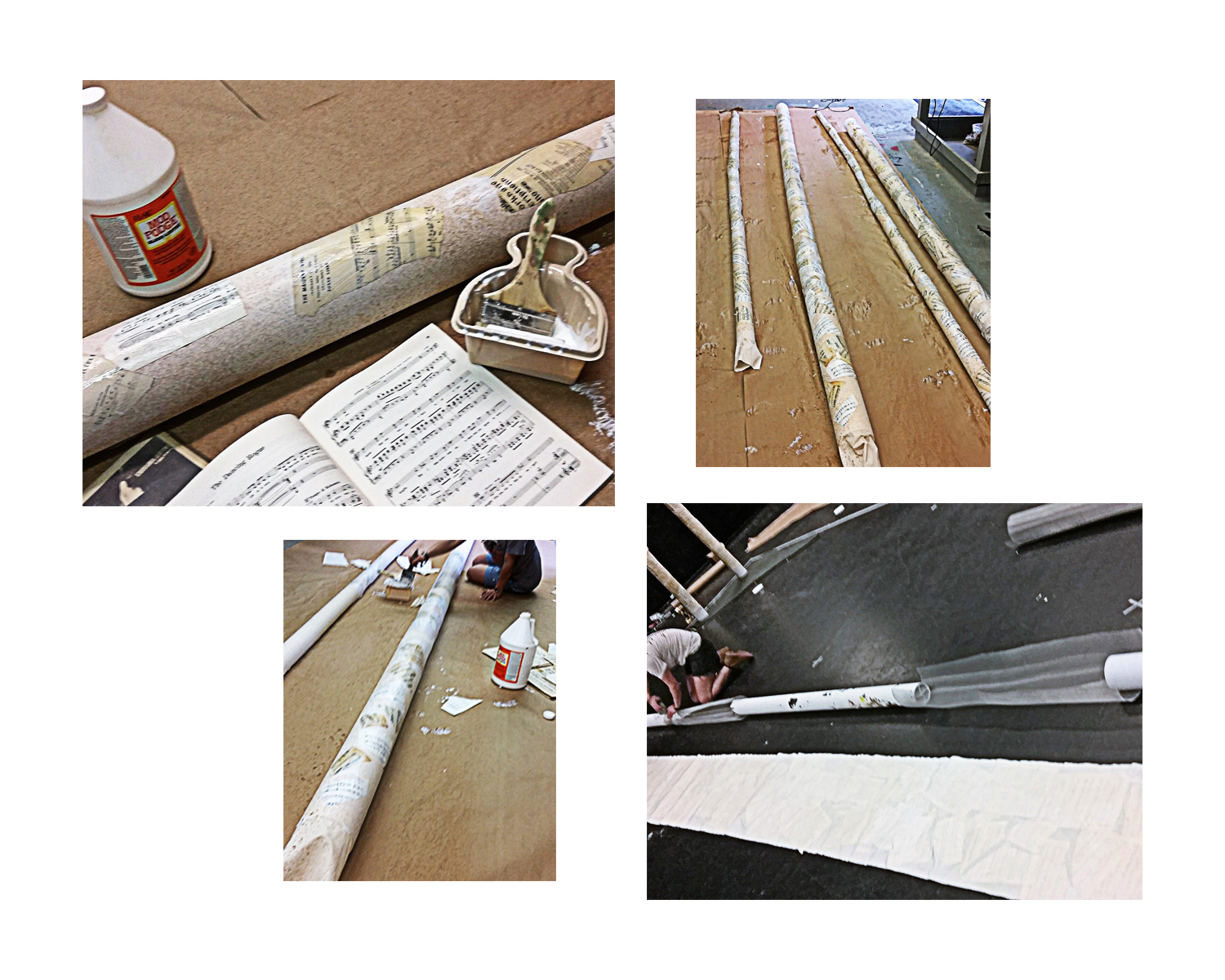
Lucky for us, the trees needed for this production were whimsical, abstract, white birch trees. We needed no heavy armatures or hundreds of synthetic leaves (sigh of relief). The director/designer also took the time to make the bark out of unbleached muslin, antique sheet music, and glossy Mod-Podge. We used these as a sample to make more.
 

Our original plan was to build a three-foot tall wooden armature to give the trees vertical direction and attach a round wooden disk on top for rigging and shape. The muslin bark would have been wrapped around the wooden structures, then hung off the lighting grid to make a semi-hollow, lightweight birch tree.
 

Stage & Candor_Gennie Neuman_Chasing Stages_2
 
For the style of tree we were going for, this method could have worked if we had enough material. However, when my crafty co-conspirator, Brit Bannon, calculated the circumference of the wooden discs needed, she discovered that the muslin bark would only make a five-inch diameter trunk. Given the narrow circumference, the crinkly fabric would not behave well without an inner cylinder.
 

We went back to the drawing board. Luckily, Brit and the director went dumpster diving and salvaged some sturdy shipping tubes from an art project that had been tossed at the end of Princeton’s semester. Additionally, Staples had a sale on five-inch diameter mailing tubes, so we bought them out. With the new tube infrastructure, the trees were slightly narrower than envisioned, but still true to natural birch tree proportions.
 

We achieved the full length of the tree by attaching the shipping tubes together with window screen. Window screen is great to sculpt with and it’s super cheap. This also allowed us to add gaps between each mailing tube, making the trees less rigid. This bendy-straw method made the structures flexible, creating a more naturalistic sway when hung from the grid.
 

Once the structures were complete, we wrapped the fabric around the tube and made more bark so we could have a few more trees. Since the structures were light-weight, we rigged them with tie-line. With the major tree structures attached to the grid, we moved onto making branches. Again, these trees needed a crafty-handmade aesthetic, so they didn’t have to look real, but rather leave the impression of the natural proportion and sway of birch trees. We used a thicker twine with hand-crafted music paper leaves to give the set the graceful gesture of branches.
 

Rigging branches was the most challenging part of this process. We needed three people: a branch-hanging person (situated on top of the scaffolding), a scaffolding mover/hot gluer (situated on the floor level), and an observer to make sure the trees looked good from the audience’s perspective. The three of us took two four-hour work sessions to do this project. This is one of those tasks that sounds like it could be completed quickly, but actually takes some time and finesse. Easy doesn’t necessarily mean fast; this is a lesson I learn over and over again.
 

Stage & Candor_Gennie Neuman_Chasing Stages_3
 
Even with a little scrambling, the show came together to be something truly enjoyable that I would recommend seeing. Designs that need to happen quickly can turn out to be truly innovative and beautiful. When approaching these projects, keep things as simple as possible and take a bit of time to discern which scenic elements will best tell the story.


A Little Night Music at The Princeton Festival
Director/set designer: Diana Basmajian
Lighting designer: Burke Wilmore
Costume Designer: Marie Miller
Scenic artists: Gennie Neuman Lambert & Brit Bannon
Producer: Lauren Parish

Posted on

Chasing Stages

chasing stages


I’ve been involved in theater since 2006. I became brave enough to pursue it professionally when I graduated college at Minnesota State University Moorhead and then enrolled in graduate school at Mason Gross School of the Arts (Rutgers University). Since 2012, I’ve been designing professionally as well as snagging some artistically quirky side jobs. I’m very proud of the work I’ve done, but I recognize that I also have more to learn and I’m hoping this column will allow me to pass along what I know while also sharing my current creative challenges.


Design for the stage, in this case set design, is the process that takes us from the words in a script to a physical experience in a theater. The phrase “page to stage” is often used to describe this journey. I hesitated to use the term “journey” simply because the term is clichéd… spiritual journey…. fitness journey …..creative journey…..2016 Dodge Journey. However, there is no better way to describe what happens between the first design meeting and opening night.
 

Even if the play has been done 1000 times, each production is unique. Telling the story changes everyone involved. You end in a different place than where you started, and therefore design is truly an emotional, intellectual, and (given that you may travel for tech rehearsal) very often a literal journey.
 

For new designers, this journey can easily turn into an acid trip of conceptual and technical demands. However – if up for the challenge – you can create something truly beautiful by working collaboratively, and be a part of something bigger than you could ever accomplish on your own.
 

For those of you considering a career in set design, it will be important to develop a production process. Remember, there are infinite ways to approach design. Many designers use similar processes while others do things differently – which is fine. Most importantly, set designers must clearly communicate their ideas to the director, other designers (costumes, lights, sound, projection, ect.), and technicians within the established deadlines. As you learn, focus on developing your own process and professional skill set. Your process is your recipe; the skill set is your kitchen. You will use these two things in every design that you whip up.


1. Understand the Script:
Thoroughly understand the story. Read the play once with no agenda. Keeping a clear mind can be difficult, but a solid first impression of the story will help you filter your design choices. Most writers are concerned with ideas, not the exact placement of the couch on stage. Don’t worry about those things yet. Story first…furniture later.
 
In addition to the script, read about the playwright, setting, time period, and history of the play itself. If the script is challenging, this will help you find your footing.
 
While designing my first show, Fen by Caryl Churchill, I was staying with my sister, and was eager to jump into my first realized design. Always the good student, I found the play on a dusty corner shelf of the empty university library. No one had checked it out since 1993. Alone on the fourth floor between the stacks, I read the play. Then I panicked. I went back to my sister’s apartment, ugly cried and drank all her wine. Sometimes it takes more than a skim through to really know the play. Once I read a few books about Caryl Churchill and what she was about, the play clicked and I was ready to discuss ideas with the director.
 
Dos: Read the play multiple times and gather good research.
 
Don’ts: Drink all of your sister’s Arbor Mist. This is a procrastination technique that could have given me diabetes. (The best way to cure dread is to move forward and do something useful, even if it’s small, like reading more books.)


2. List the set requirements
Strap in! Now it’s time for furniture! This part is every type “A” personality’s fantasy. You finally get to focus on the details! Go through the script again, this time through the lens of a scenic designer and write down what is required to make the play work. I like to organize the requirements by acts, scenes, or locations.
 
Keep this list broad at first. Does the play mention things like an upstairs? Do you need a phone? Is there a bar? What about doors? Does anything happen outside? What time of day is it in Act 2? What season are they in? Once you organize the major requirements, start a props list. Make a list of mentioned set pieces and how the characters interact with them.
 
Dos: Highlight requirements in the script, make lists, start a folder on your computer, or make a physical binder.
 
Don’ts: Skip this part and accidently forget to design a scene. Try explaining that to a director.


Stage & Candor_Gennie Neuman_1
3. Set up a meeting with the director
Chat with your director after you’ve done the script work. The director guides the production conceptually and ensures the actors are on the right track (by the way, this is a whole different article). In a formal process, this meeting may be scheduled, but usually it’s up to the two of you to connect. Send a friendly email reminder. The sooner you get started, the better.
 
Listen well and ask the director questions. S/he may have a lot of ideas about the concept or s/he may be just getting started. Be accepting of new ideas, ask clarifying questions, and have a voice. If the other designers are present, bounce some ideas off of them. This is the fun part – the time to dream! So start dreaming and get to work!


Stage & Candor_Gennie Neuman_2
4. Gather image research and start sketching
Now that you have a solid direction, research images. This can be anything that will help form your design. Set designers collage shamelessly. There is no such thing as a new idea; you can only make new juxtapositions. Some typical sources are art history, decor magazines from the period, architectural references, illustrations, advertisements…the list goes on and on. The internet really comes in handy. I like using Google Images, Corbis, and New York Image Library, but print references are also good resources that you shouldn’t overlook. Art libraries are a wealth of unique historical images that other people haven’t found by using the same generic keyword. Once images are gathered, examine everything overall to create an atmosphere. This stage is intuitive and poetic – some images may be emotionally-driven while others may be historical references, but everything you pull needs to advance the story and tell your audience what kind of world the play lives in.
 
You may be curious, but don’t look at photos of other productions of the same play. This is like a song writer trying to compose a new love ballade when Whitney’s version of I Will Always Love You is playing in the background. No good will come from this.
 
Once an atmosphere is established, begin sketching thumbnails to weave the emotional and physical elements. I draw small so I don’t commit to an idea simply because the drawing is nice. Make multiple thumbnail sketches then enlarge two or three for the director.
 
Now the director can review the images and sketches and discern if the design is headed in the right direction. Don’t take it personally if you need to start over. Change is a part of life. If the director loves what you did, totally take that personally because you’re awesome!
 
Dos: Collect lots of images and make several sketches.
 
Don’ts: Cling to just one sketch and limit your director’s options.


Stage & Candor_Gennie Neuman_3
5. Models and drafting
Articles about set designers usually feature the designer standing in front of his/her model looking stylish or posing “in-process” while drawing at a drafting table. There is nothing particularly wrong with this, but there’s more to a design process than these two stages. We’ve reached the cream filling stage of design, the part everyone looks forward to – the scale model! However, nobody takes ownership of the constant emailing and choppy skype calls needed to plan the design.
 
Although models can be beautiful, they are essentially communication tools. Set designers in the United States do most of their work in half-inch or quarter-inch scale (about half the size of a doll’s house”¦then half of that). First, make a box that resembles the theater’s architecture in scale. Most set designers will then build a white model, which is a quick way to determine if an idea will work within the context of the theater space. On clean white paper, walls are taped together, rough platforming is made, and tiny paper furniture are used to start defining the playing space. This will help you decide if your brilliant sketch was indeed brilliant, or if it will be a disaster in real space. The technical staff usually doesn’t see the white model. This is a quick way to help the designer and the director make important choices. After the director approves the white model, add the details and begin working in color.
 
Color brings personality to the design. It’s the strongest element of art with the strongest psychological impact. Color is a true diva, and that’s why it’s brought in last. Color does, however, distract from the space, form, and texture, so make sure those elements are going in the right direction in your white model first.
 
To make a color model, I take scale drawings from my drafting software and export them into Photoshop. I then digitally paint the drawings, print the drawings, glue them to illustration board, cut them out, and put them together. Models answer a lot of questions for the whole creative team. They are especially necessary when the designer is not on site, and they are tremendously useful to actors in rehearsal. They can speak in three dimensions, unlike sketches and computer renderings.
 
Once the model is finished and approved, you and your brilliant idea can go public. The drafting package is the scale drawings the technical staff uses to make the set. Although drafting comes easily to some, it is still an acquired skill. The best way to learn is to take a class with someone using technical drafting in the same context, or assist another designer. You can also find a helpful books or online tutorials to help you get started.


Stage & Candor_Gennie Neuman_4
6. Communication!
The best way to communicate your set to the technical director, props master, and paint charge is to finish your model, paint elevations, and drafting on time. This is easier said than done, but it is the best way to ensure that your ideas will be taken seriously and completed at the highest level of craftsmanship. Visit key rehearsals and pass along changes to the art departments. Theater is in a constant state of change and that’s what makes it exciting! The scenic departments take great pride in their crafts. They are your most helpful allies so give them respect and be responsive to questions and feedback. You will likely need to scale back part of your design to make something more doable. When these discussions happen, go back to your requirements and core concept. As the designer, people look to you to discern what is needed to visually tell the story. Make sure cuts are not part of the set’s essential concept or the story’s plot. Suggest other ways to work with the constraints of the situation. This is where experience with stagecraft will serve you well. Always strive for a finished look but meet people halfway when possible.
 
Dos: Finish your materials and answer your phone.
 
Don’ts: Be a mysterious and unavailable (help the whole team make good choices about the final design).


Stage & Candor_Gennie Neuman_7
7. Tech rehearsals!
Technical rehearsals are the last few rehearsals designated to fix the technical elements (set, sound, lights, etc.). Tech is stressful, but seeing all the elements come together is very rewarding. For set designers, it’s a time for final touches, working out scene shifts, and making sure things are finished well. In smaller theaters, set designers may need to complete the final touches on their own. It’s a luxury to have a full set department, so use their powers wisely when you have them.
 
While most of the set designer’s work is complete, designers working on lights, sound, and projection do the majority of their work during this time. As these individuals add layers to the production, conversation in meetings becomes less about the set and more about other production elements and the actors.
 
Dos: Go to tech rehearsals. Be available to help and discuss issues that arise.
 
Don’ts: Disappear for a long time. (Many busy set designers will send a capable assistant in their place if they need to leave tech, and that’s responsible. However, try to be there. No one knows your design better than you.)


8. Opening Night!
Enjoy the show”¦you and your collaborators have earned it. A good show is worth celebrating. Write thank you notes to everyone who helped you!

 
Stage & Candor_Gennie Neuman_8
9. New Beginnings
When you’ve completed a project, it’s time to start the process all over again with a new one!