The Lilly Awards took place on Monday, May 23rd at Pershing Square Signature Center, honoring extraordinary women artists by promoting gender parity at all levels of theatrical production. This year’s festivities focused on activism, and brought out some of the best and brightest. We had to write out some of the pearls, so the words and deeds of these amazing women can continue to be shared. It was important to see a room full of women celebrating one another; sharing the seeds of these ideas – long-timecoming though they are – is how to push this movement forward.
http://video.irishtimes.com/services/player/bcpid1849334937001?bckey=AQ~~,AAABogn1yyk~,LkRilRH4kedNk-13aFn_KvUuwIQyITxo&bctid=4609036523001
The ceremony started off with a video from Waking The Feminists, who protested in front of The Abbey Theatre. Despite The Abbey being a publicly funded entity in a country with at least 50% females, only one of the ten announced plays was written by a female playwright.

Zoe Sarnak, Georgia Stitt, Amanda Green, and Rebecca Naomi Jones opened the show with “It’s Lilly Time Again,” to the tune of Bob Dylan’s “Blowing in the Wind.”
“How many great plays must one woman write
Before she’s as good as a man
Yes and if she directs
But she seldom gets hired
Well if that’s just part of God’s plan
Yes and how can a girl dream of lighting a show
When nobody shows her she can
That’s why my friend
It’s Lilly time again
That’s why it’s Lilly time again
How much more dough must a man get to make
Before someone calls it unfair
Yes and how many gigs must a mother turn down
When theaters won’t help with childcare?
Yes and how many slaps must she take on the ass
When she’d like to complain but won’t dare?
For the rights women fought for in decades gone by
Our debts can never be repaid
(Thank you Gloria Steinem!)
In the sixties we march and decisions were passed
And we cheered for the progress we made
Yes and how many times must we fight for this shit
So they don’t overturn Roe V Wade
(Roe V Wade!)
That’s why my friend
It’s Lilly time again
That’s why it’s Lilly time again”

Sarah Durcan and Lisa Tierney Keogh of the Waking The Feminists movement accepted the first ever International Lilly Award. Sarah Durcan and Lisa Tierney Keogh of the Waking The Feminists movement accepted the first ever International Lilly Award.
“…Six months ago, I didn’t know what a hashtag was. I thought Twitter was a weird foreign land where people wrote fortune cookie length brain vomit and Facebook was a place I could post videos of cats attacking toddlers. I never in my wildest dreams imagined that [Twitter] could be used to mobilize an entire movement for equality.
Waking The Feminists has awakened a force in Ireland that is spreading globally. Joining hands with the Lilly Awards and the phenomenal work you are doing has been exhilarating. To be part of the ruckus in our corner of the world is personally one of the most rewarding and inspiring experiences of my life…I would like to thank all of you here tonight for not being quiet the next time you see inequality in your theater, in your rehearsal room, or on your set. Thank you for calling it out. Thank you for being the rising tide that is lifting the boats.” – Lisa Tierney Keogh
“…Waking The Feminists’ aim is simple: equality for women in Irish theater. We understand the causes are structural and systemic. The theater community is small but its reach is wide. We hope that what we will achieve will have impact around the world. These two great theatrical islands of ours coexist in a global community, connected together, and we will achieve gender equality faster by working together. Everyone at every level in the theater needs to engage with this movement. We are working with our own sector in Ireland to create policies and from those policies we must see action and from those actions we must see results. Sooner rather than later. Our deadline is five years to achieve full gender equality. Looking out from The Abbey stage that day, I was shocked by the depth of feeling, by the anger expressed with such dignity, by the sheer number of women of all ages who are affected by gender inequality…I was furious at the realization of what we had all lost and what we all continue to lose, artists and audiences alike. Anger burns short but determination burns long and the core group of Waking The Feminists working week on week to drive the campaign is fueled by that determination. Women of the theater whether in Ballinagh, Baltimore, or Berlin will no longer fade into the wings. We will no longer be told, ‘wait,’ ‘not ready,’ ‘not good enough,’ ‘not yet.’ We will not wait. Our audiences will not wait. The time for action, the time for equality is now.” – Sarah Durcan

The cast of Eclipsed (Zainah Jah, Pascale Armand, Saycon Sengbloh, Akousa Busia, and Lupita Nyong’o) presents playwright, actor, and founder of Almasi Arts Danai Gurira with the Lilly Award in Playwriting. The women lit up the stage with language and feeling about Danai’s activism, not only in her plays, but also with Girl Be Heard in the United States and in Zimbabwe, where she grew up. “Danai has worked tirelessly to make sure we never forget abducted girls all over the world,” said Akousa Busia. Though two girls have been found, “over 200 girls kidnapped by the Boko Haram are still missing.”

Danai spoke of staying in the moment, and using the outrage and anger she felt from the Waking The Feminists video to fuel her writing. She brought along two young women, Ebony and Imani, from Girl Be Heard, and gave beautiful advice to young playwrights, encouraging them to keep writing and telling their stories.
“…I remember coming to the Lilly Awards its inaugural year, 7 years ago… Sarah Ruhl was introduced to me and she told me she had just read my play Eclipsed. She told me how she thought it was beautiful and powerful, and important. At the time, I didn’t know that the world thought that way about the work or the effort. I remember being filled with so much hope, inspiration, and fuel to know I was on the right track and I was doing the right thing, even though the world might not tell you so all the time. So what I’ve realized lately is that the spirit of what I feel in me as I’ve been walking through this road with these plays, is that of making sure, as Sarah did that day, that those coming behind me are validated. That those girls coming up behind me that might not know what AD will pick up the phone, or pick up their script. Or those girls who might not know where they’re going to get their next job from or how they’re going to get around that male in front of them who keeps stopping them from getting to their destiny.
I really want to speak to those girls who are coming up behind me, as a way of doing what I think The Lilly Awards does so well, which is really making sure we know we are important, we are vital, we are crucial, we are here…
The first thing, young female artist: Have a vision. Identify your outreach. The lack that is unjustifiable in what narratives are yet to be told. Embrace that burden on your heart to get that story to be told. That burden is a blessing. Then get to work. No excuses. No one in the world can do what you can do. Tell the story the way only you can tell it and don’t deprive the world of your uniqueness.
This is a big one: Go where you are loved. How many times did I have to learn that? And how often do I meet other young writers who speak about how this avenue and this artistic director and this agent didn’t see something through, didn’t respond the way they hoped and desired.
Don’t let disappointment stop you. Go where you are loved, where your voice is embraced and your vision is respected, it may not be where you expect it or where you had hoped, but it may just be where you grow and are nurtured as an artist. It may just be where your breakthrough comes to pass. Don’t let disappointment take hold. It is really asinine to creativity – it’s poison to your creativity, rather. Stick to your vision and trust the right words will emerge if you keep doing your thing and putting yourself out there.
And lastly, be a finisher. Get it done. All the way. Embrace the right collaborators and Get. It. Done. It’s not for you – it’s for all those other young female writers who will be less than inspired by your product. It’s for all the women you will employ. It’s for those whose light will shine as a result of the excellency you pursued when you put those words on the page. And it’s for the legacy you assisted in building that annihilates the concept that women’s concepts are weak, rare, or unprofitable.
So, to the young women writers and creators in this room, I speak over you the same validation Sarah [Ruhl] gave me that day and I so look forward to continuing to celebrate you.” – Danai Gurira

Director and Artistic Director of A.R.T Diane Paulus presented Jessie Mueller with the Lilly Award in Acting. The team of Waitress made history earlier this year by having an all-female creative team.
“Jessie Mueller has brought us the stories of two astonishing women in the last five years: Carole King and Adrienne Shelly. The Lillys are proud to recognize the clarity and boldness of her work bringing these pioneers, these women warriors onto the Broadway stage. Adrienne Shelly’s 2000 film Waitress tells the story of Jenna, a working-class waitress and expert pie-maker, stuck in a loveless marriage who finally finds the courage to free herself from an abusive relationship. The story of a woman overcoming domestic violence is a vital and pressing one that affects millions of people each year. According to the National Coalition Against Domestic Violence, one-in-three women and one-in-four [men] in the United States have been physically abused by an intimate partner. The cover of the Arts & Leisure Section two weeks ago was an article entitled The Year Broadway Broke Through, in which New York Times’ theater critics Ben Brantley and Charles Isherwood and editor Scott Heller discussed how it was a strikingly diverse, unusually urgent season. Sexual and domestic violence must not be urgent issues, since in their discussion, there was not one mention of this theme that has been an integral part of our Broadway season of this year, exhibited in many productions including The Color Purple, Eclipsed, Spring Awakening, Bright Star, Blackbird, and Waitress. Furthermore, of the artists working on Broadway this season, their conversation cites ten male artists by name – directors, writers, actors, choreographers – in contrast to only one female artist who is mentioned by name. OK, she’s fierce, Audra McDonald. Female artists are significantly underrepresented on Broadway and female stories are quick to be brushed under the rug by the media. It’s time that we recognize the incredible artists, many of whom are in the room tonight, who are telling these stories in impactful ways. In the opening weekend of Waitress, we found a note pinned to the wall in the lobby installation of the Brooks Atkinson Theatre. It read: “Thank you for saving my life. I left my abusive relationship because of this show.” This was because of your performance, Jessie. You have brought this human story to life with stunning urgency and beautiful authenticity, true to the messiness we all experience in life. The Lilly Awards are grateful for the continuing grace and power of Jessie Mueller’s work on the American stage. ” – Diane Paulus

“I’m really sick of wearing dresses and heels. I’m so humbled. I feel like I have no right to be up here with all the people that are out here and the work that’s being done. I’ve never thought of myself as a feminist or doing anything feminine, and I’m not very good with words which is why I guess I like to pretend to be other people…but I am floored by the response of people who have seen Waitress and the note Diane read. We got to work with a wonderful organization while we were rehearsing through Mt. Sinai Hospital, SAVI, doing sexual violence and assault intervention. They have a team of volunteers. If you have a problem, they can meet you on the street corner. You can say, I have a bag; I just left my home. They work with people that come into emergency rooms, with people who have experienced sexual violence, because a lot of the doctors aren’t equipped to help them with their heads and their hearts at that moment, and these people come in and they save people. The theater is there to help and to heal and everyone’s stories deserve to be heard. Women’s stories can help and heal just as much as men’s. ” – Jessie Mueller

Actor, director, activist, and founder of Blind Spot Russell G Jones presented Kate Whoriskey with the Lilly Award in Directing. Jones was relieved that Whoriskey was finally getting the recognition she deserved for years.
“Directors do not just stand around telling actors where to stand. Directors help writers to see what they have written, they help actors to understand what they’re meant to play, and they help the entire team grasp what we all as one soul want to bring to the audience. Kate Whoriskey is an official, major presence in the world of directing. From Shakespeare to the work of Lynn Nottage, she has brought audiences into close contact with people they would otherwise not even know existed on this planet. It’s as if she’s determined to get American audiences aware of the world. She has been doing this for a long time, and I’m glad to see that she’s getting a little respect because she’s the one.
She got a note here from Lynn Nottage, which says, ‘I wish I could be there to fetch you, Kate. Thank you for being such a dear friend, trusted collaborator, and my sister in this artistic marathon. As a director, I appreciate that you bring great clarity and vision to all your projects, and I apologize for dragging you to unusual corners in this creative universe to find inspiration, but I thank you for being so game. You dive into your work with all your heart, and you’re always willing to wade into dark and unruly territory to find truth and beauty, even in the most mundane of moments. Boston tough, uncompromising and generous, you make your collaborators feel safe and cared for as artists, and I feel eternally thankful that our paths crossed at just the right moment in our creative lives. It would’ve been tough finding my way through the thicket without your support. Congratulations, a well deserved honor for a director.'” – Russell G Jones

“…It’s wonderful to be in a room with people who formed this community. I want to have a little conversation with all of you about the nature of community and what women can do for each other. In 2008, I had one of the most difficult conversations I ever had with Lynn Nottage. I took her out to dinner, and I knew I had to tell her something that I felt like would end our working relationship. We agreed to meet uptown, and we spent the time between appetizers and desserts talking about anything that I could think of that was not the subject at hand. [Lynn Nottage] then starts to drive the conversation to notes on Ruined and I stopped her, and I said, ‘Lynn-‘ she said, ‘No, no, no.’ You have to understand that we’ve been working on Ruined for 5 years, and we had travelled to Uganda, and we had done endless workshops and I had to tell her that I couldn’t do it. I blurted out, ‘Lynn, I’m pregnant. The baby is due 5 weeks before we start rehearsal, I can’t.’ She stopped me, interrupted, and says, ‘Well, congratulations. Welcome to the world of working mothers.’ I got home to my husband, and he asked how it went, knowing it was an emotional time for me. I dumbfoundedly said, ‘Well, I think I’m still doing it.’ When I look back over the last decade, I recognize what a defining moment that was for me. In some ways, Lynn made clear that who we love, who we make our family, and what we say on stage is all of a piece. We are responsible to those we love, and responsibility translates to who and what we see on stage. Getting this award is now significant to me, and in this election process where floodgates of hate speech are being unleashed, I’m honored to be a part of a community that is in pursuit of strengthening the underrepresented voice, diminishing the hardening of our culture, and deepening the sense of empathy.” – Kate Whoriskey
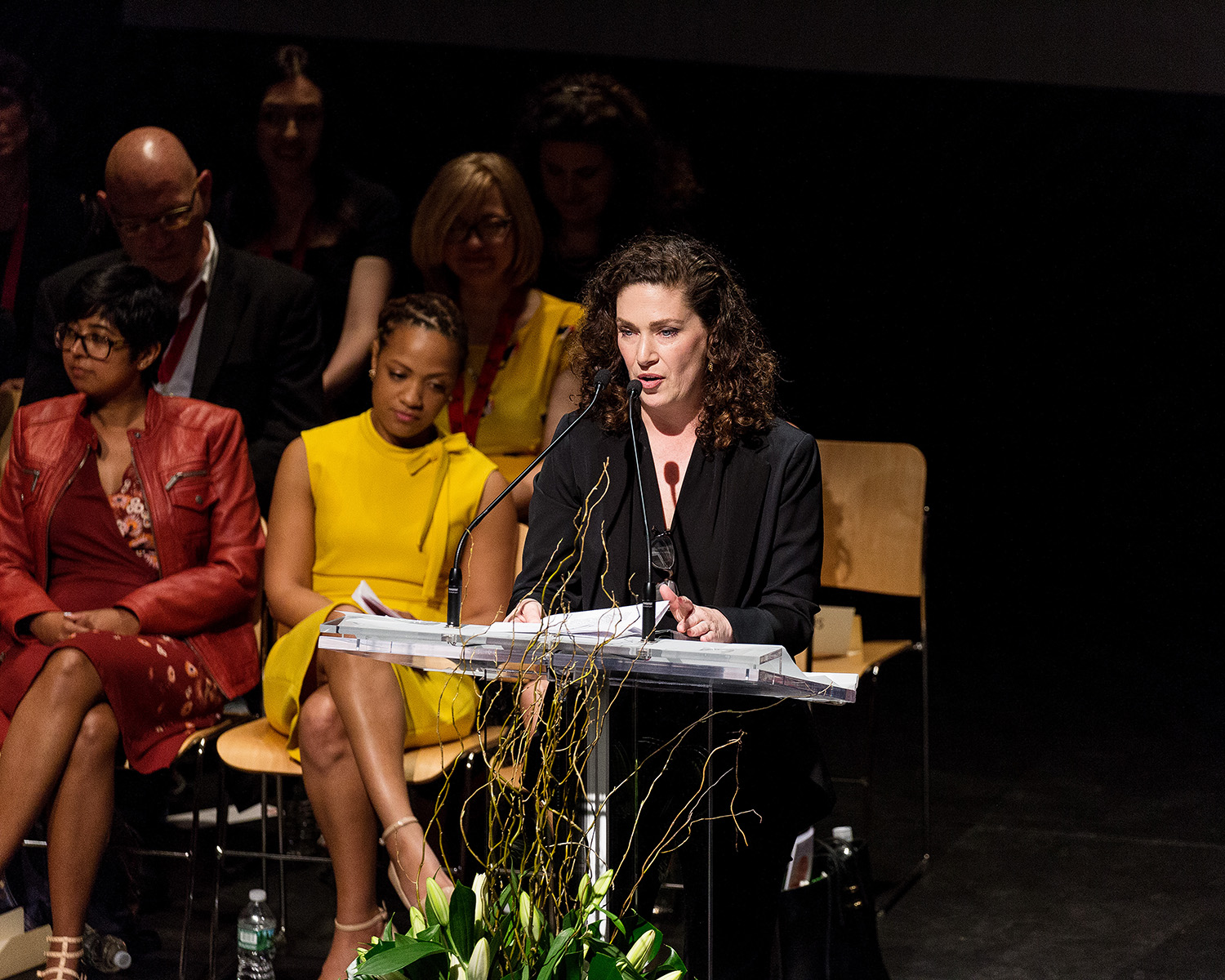
Vice President Julia Jordan introduced Emily Simoness from SPACE on Ryder Farm – a program in its second year of partnership with The Lilly Awards that brings child care to writers’ retreats. Most retreats and workshops do not accommodate families, making it difficult for working mothers to afford the same opportunities as their male counterparts. This year’s residency awardees include Beth Nixon, Deepa Purohit, Sarah Ruhl, Georgia Stitt, Louisa Thompson Pregerson, and their children.
“Last year, The Lilly Awards began to roll out a childcare initiative. A model camp where women who are both writers and mothers could bring their families and actually get work done and have happy children. We are determined that one day, every colony, play lab, and theater will have a child care policy, so that never again will a woman writer have to choose between advancing her work and taking care of her children.” – Julia Jordan
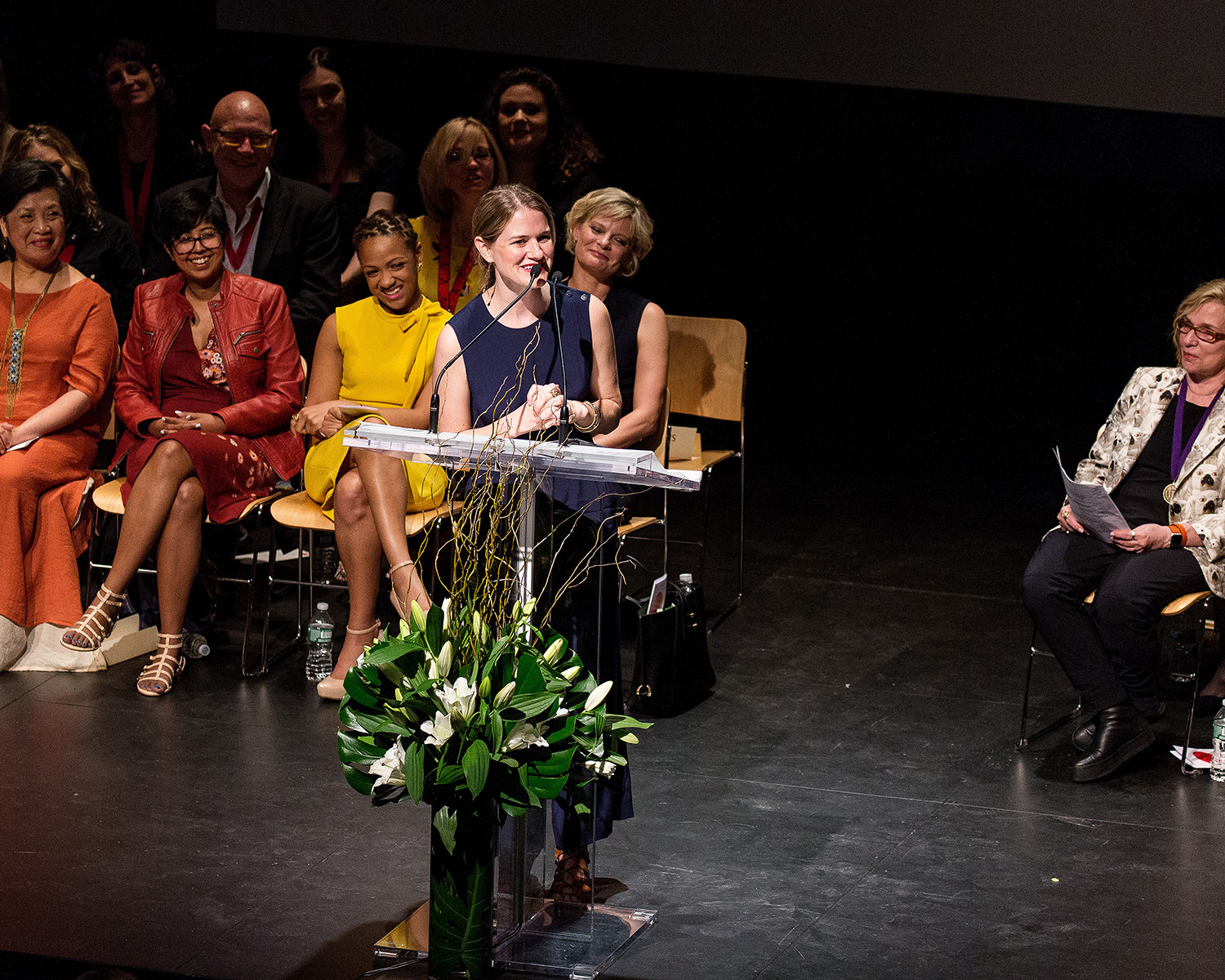
“…For those of you who don’t know, we are an artist-in-residency program housed on an organic farm an hour north of New York City. Last year, we had the supreme pleasure of partnering with The Lillys on our first ever family residency that aims to 1) give working moms the time and space to work on their art; 2) give their kids time and space to be outdoors, play with other kids, and be supervised by some education professionals; and 3) to have time to be together as a family. It went swimmingly…One of the pervasive threads was this notion that ‘Well, I haven’t applied for an opportunity like this in 3 years, or 5, or 7 years,’ because ‘I’m a mom’, or because ‘I thought I wasn’t invited.’ We’re here to say that that’s not what you need to do going forward. If I could take those applications and make a coffee table book about why this is so important, I would.” – Emily Simoness

Director of Outreach and Leah Ryan Fund Board Member Cusi Cram presented Genne Murphy with the Leah Ryan Prize. She spoke about her late friend Leah Ryan, and her wish to help writers in any way she, her friends, and her family could.
“…To my mind Leah embodied what it means to be a modern woman of letters. She was infinitely curious and brave in her work and how she chose to live her life. When she died of leukemia in 2008, her friends and family created a foundation to honor her work and her extraordinarily generous spirit. Each year we award an emerging female playwright with $2,500 and a professional reading of their play. Since the theme of this year’s award is advocacy and activism, I would encourage you all to think about how you can be actively generous to one another in both ways large and small.
I am thrilled to present the Leah Ryan Prize to Genne Murphy for her wildly original and theatrical play, Giantess. It is a play about complicated bodies, choices, and leaps of understanding we make when we love someone who is seemingly very different from us. Genne has a truly original and fresh voice and I want to see her plays living and breathing on stages all around the country.” – Cusi Cram
“Like many women playwrights, I have struggled with the not unreasonable fear that my plays might not find a place onstage in the American Theater. At times it’s been hard to quell these fears when writing to keep pushing forward an idea, a character, a world. As an early career writer, I realize it is critical to find real allies and collaborators and I feel so lucky to be connected with the Leah Ryan Fund and for your support and your guidance moving forward […] I also would like to acknowledge those who helped get me here. Philadelphia Young Playwrights, or PYP, is an arts organization – a very dynamic one – in my home city. I wrote my first play for PYP when I was in high school and PYP helped to shape my understanding of theater as an art form that is evocative and deeply human and one that has the potential to engage audiences and communities together in their ideas. I would also like to thank my family – both the family I was born into and my queer family for their love, support, and smart council. You’ve helped to shape my brain, my heart, my spirit, and you’ve encouraged me to engage both the political and the personal in my work. And thanks also to all the teachers in my life. My recent mentors, Jeanie O’Hare and Sarah Ruhl, as well as my college and high school writing teachers, Anton Dudley and Ms. Schroeder, and also my second grade teacher, Teacher Penny, who told me not to worry about my terrible handwriting or my inventive spelling and just to write. I am also the daughter of two very amazing teachers…I am grateful for your faith in me and for your love. ” – Genne Murphy

Howard McGillin presented Martha Plimpton with the Award for Speaking Truth to Power.
“Martha Plimpton has been politically active since she was a teenager, marching for women’s reproductive freedom in the 80s, in the 90s, and now. Even now, when the battle is far from over. She has lobbied Congress on behalf of Planned Parenthood and has spoken out for women’s reproductive rights at campuses and rallies all across this country, and I believe she will keep doing this for as long as it takes, goddamnit. When Amanda Green asked me to present this award, I was so delighted and honored to be asked. I’ve known Martha for about fifteen years; we’ve been good friends, shared a lot of birthdays and holidays together, and I know her not only to be an artist of singular quality but also ridiculously funny – her wit and her passion for the world we live in and the causes that are dedicated to making it a better place make her a role model for us all.” – Howard McGillin

“I’m really astonished to be in all these people’s company, some of whom I know, many of whom I don’t, but all of whom I respect and admire and am completely in awe of – some of you I have worked with and some of you I hope to work with, many of you, all of you, if you’ll have me, cause it’s hard out there for a chick.
In this particular election year, regardless of where each of us may stand politically, though in this room I have a feeling we’re pretty safe […] I think it’s safe to say that issues of representation and visibility are a central theme in the public discussion over who it is we feel should lead us, who it is we should feel silenced or marginalized by, and how it is that we should go about making our voices heard. Representation of diverse voices in the arts, in culture, and in political and social life is essential to influencing the course we take, not just in this election but in life in general. The stakes are incredibly high for all of us, but particularly for women, people of color, immigrants and refugees, children, LGBTQ Americans and other members of our society whose most basic interests of survival and of equality are under direct and constant threat pretty much daily around the world and unfortunately here at home as well. The voices of women of diverse experiences are necessary to telling these stories and bringing them to the attention of the nation. They develop our understanding of human nature and life and they bring us closer to the empathic and intelligent society we all seek to live in. We can’t afford not to listen to them, to amplify them and to celebrate the courage to do what it takes, what so few others are willing to do, which is to tell the stories without traditionally accepted paths to power.
I am astonished and inspired by the creativity and courage of all the women here today and I do take a lesson from each of them – that every heart and mind is capable of reaching into every other heart and mind, those of strangers, and altering, even if only for a moment, the trajectory of a single life. And that is no small accomplishment. It is everything. All each of us has is one voice and this moment. Only this moment. This moment alone which is in fact vast, eternal, and encompasses all of creation.
In the advocacy work that we do for the abortion rights organization A is For, we are doing our part to amplify the voices of those who have been silenced and shamed for making choices of their own conscience. From the Rio Grande Valley to the Mississippi Delta to the prisons of El Salvador, where women risk imprisonment for up to forty years for the crime of miscarriage, these voices of the women most severely affected by abortion restrictions and prohibitions are rarely heard. It is our duty to give them a platform, a place to speak out, and in some cases to speak out in their names when there is no other option, so that everyone will know the depth and the truth of their humanity, their dignity, their strength, and their right to live their lives as they see fit. I so appreciate everyone here who is dedicated to this mission of celebrating and encouraging women to speak up, to write from their own experiences, and to share those experiences with an audience that is truly hungry for more.” – Martha Plimpton

“In the words of Lorraine Hansberry, the thing that makes you exceptional, if you are at all, is inevitably that which must also make you lonely. Well, the Lillys are doing their part to make each of us feel a little less lonely, a little more heard, and a great deal more prepared to keep on going.” – Martha Plimpton

Marsha Norman introduced this year’s Miss Lilly Awardee, Norbert Leo Butz. “Sometimes when something awful happens, you see someone set a heroic example.” She honors Norbert Leo Butz with the words: “a man who fights for women is a real man.”
Norbert Leo Butz received the Miss Lilly Award for his work with Rachel Ebeling to create The Angel Band Project, a music-based organization dedicated to breaking the silence and providing support for rape survivors.
He began his address by saying, “my name is Norbert and I’m a feminist. As honored as I am to be receiving this award, as badly as we need this $5,000, I wish to God, if I have to speak the truth, that I weren’t here tonight. The circumstances that brought me to this podium tonight are unspeakable.”
He spoke about losing his sister to a sexual assault hate crime, and the movement to change the culture of violence against women.
“This event, the loss of my sister, meant the loss of many things in my life. It’s the nature of sexual violence, these crimes, their far-reaching implications and why we must fight to eradicate crimes against women […] My girls were 13 and 11 when their beloved aunt was taken in their teenage years. They have both suffered through eating disorders, self-harm, and drug issues…within a year I had to seek help because I was drinking myself into a stupor every night, unable to deal with my own trauma. At Teresa’s funeral…we sang. No one could speak. All we did was weep and we sang. We were able to get out these hymns that we’d grown up singing.
Rachel Ebeling had been best friends with Teresa since they were in kindergarten. She and her best friend had a vision after the memorial service of having another memorial service in Seattle where we got out guitars and sang and this amazing thing started happening. People started talking about the event, people started expressing their grief, people started coming together. Rachel proposed the idea of the Angel Band Project and amazing things have started to happen…Not long after my sister died, two interesting events happened in my life. My wife, was a wonderful ingenue and then she started playing moms the way you ladies do at 33, starting to play moms of teenage girls, and then did three roles on three procedurals in which she played moms and then corpses. My wife played three corpses on television before she went into semi-retirement. I was given two scripts that pilot season after Teresa died, one was to participate in a sexual crime against a woman, another to investigate one. Both of my daughters came home from their high school cafeteria saying they couldn’t eat in the cafeteria, they were being too harassed by the boys in their public high school. What the fuck is going on here? And how was I blind to this my whole life? And then it dawned on me. Women have known this all along, right? I was just getting a glimpse into the world and I was horrified by what I saw.” – Norbert Leo Butz
“…He represents the men in this because we cannot stop violence against women until the men start stepping up. All of these wonderful women here are using their voices and it’s so important…and for the young people here – your voices matter the most.” –Rachel Ebeling

Playwright Neena Beber introduced recipient of the Stacey Mindich Go Write A Play Award, Rehana Lew Mirza.
“The Stacey Mindich Prize is not just $25,000, it’s an invitation into a group of writers whom Stacey has commanded to go write a play. Someone out there cares and will feed you. Stacey gathers everyone who’s won into her vision of, as Gloria Steinem says, I like to quote, “women who are all linked, not ranked.” This year’s winner is Rehana Lew Mirza. Rehana has had readings everywhere, established Asian American companies everywhere, received awards from everyone, has an MFA in Revolution from Columbia – wait I’m sorry, an MFA in Playwriting from Columbia. She was a co-founder of the Ma-Yi Writers Lab and is a brand new mom. Her baby is one month old, and one thing Stacey wanted to make clear is that writers are moms, [moms] are writers.” – Neena Beber

“When I got the news about this award, I was sitting with my one month old child. One of us was curled up in fetal position; the other was crying that their career was over. We live in a two-playwright household, and my husband, Mike Lew, and I would often joke that we’re doubly fucked: Double the rejections, half the bank account. As the woman, apparently I get â…” of those rejections, and â…“ of the bank account. It’s easy to feel forgotten as a woman of color in the theater, and in a year where politicians are spinning hateful narratives about Muslims and POC’s, it’s easy to feel not just forgotten, but downright unwelcome. So I try to address some of that in my plays, but what I can address is trying to survive in this industry with a baby. When we started this family, I was worried people would assume I’d give up writing for the baby, or that when I’m accompanying Mike to his productions, the theaters would mistake me for the nanny, instead of acknowledge me as a playwright.”
She addressed her month-old son, saying:
“You are in a room filled with game-changers, people who understand the power of storytelling and are working to show the full breadth of the human experience, who are making room for complex identities. I want you to be as thankful and grateful to them as I am, especially to the Lillys for creating a different narrative, for firmly saying: We hear you, we see you, you are welcome here.” – Rehana Lew Mirza

Candis Jones was the Recipient of the New York Women’s Foundation Directing Apprenticeship Award. The award comes with a $15,000 check and an apprenticeship with Rachel Chavkin. Candis is a director and founder of Theater YinYin. She speaks candidly about the “badassery” she is a part of in this room. She thanks the Lillys for believing in her and “for teaching young women to believe in themselves.”
“I regard the theater as an act of faith, where we ask audiences to believe in the unseen and the theatricality of magic.” – Candis Jones

Legendary producer Daryl Roth announces that from this point forward the home for the annual presentation of the Daryl Roth Creative Spirit Award will be at the Lilly Awards, dedicated to apprenticeship for women in tech or design.
“It feels to me that this is the right place to dedicate this award. It will honor emerging women of any age, with the incentive of financial support to nurture her creative spirit in the field of theater design – sets, costume, lighting, or sound. This woman will have the opportunity to work with an accomplished mentor in her chosen field, and together they will create a year long apprenticeship, where she can assist on three professional productions. It’s my hope that more women will think about careers in all areas of theater design, and know that we’re here to encourage them, and help sustain them, and offer an open door to the myriad possibilities available. While my heart is with writers, and directors, and actors, I feel this is a really wonderful area that we have to commit to and support, and so it will be my pleasure to begin doing that, next year.” – Daryl Roth

Playwright and member of the Dramatist’s Guild Council Lloyd Suh presented Mia Katigbak with the Lilly Award in Trailblazing. He eloquently described her as “not only one of the greatest actors in the world, but the Godmother of the movement of Asian American culture.”
“When Mia Katigbak was at Barnard, she performed in the only roles that were deemed appropriate for her: maids and hookers. One day she was invited to play the harpsichord in a Moliere play. She thought ‘oh good, they see me.’ But no, she had to play her harpsichord from behind the curtain, because the director said there were no Asians in France at that time. There are too many stories like this that happen, even today. But now, when aspiring Asian American artists look to the stage for a reflection of themselves, when they look for their roles and their role models, they can see Mia, because she ripped that curtain down and she set it on fire. As the founder and artistic director of NAATCO, the National Asian American Theater Company, she has produced over 25 years of visionary and revolutionary work that has nurtured generations of Asian American artists. She is not only one of the greatest actors in the world, but she is godmother to a revolution, and a leading figure in the cultural history of Asian America, and she is one of the most important people in my life.” – Lloyd Suh

Mia Katigbak thanked many women including Lear Debessonet, Kate Whoriskey, Sarah Benson and others who made space for her to play roles outside of the Asian female stereotypes and came to thank her mother, present in the audience, whose unwavering faith has been her guiding light.
“[This] has great meaning, especially coming at this sometimes perplexing time of my life. For the past 25 years, NAATCO has been working towards the improvement of Asian American representation in the theater, so that we are insignificant, central, multi-faceted, complex, non-stereotypical roles on our stages. I know that change often happens in painfully slow increments, but I believe that we’re seeing some progress. But for the past five years, there seems to be a huge backslide – an uptick in what I call irresponsible and careless casting when it comes to Asian Americans in theater and in film. Instances of exclusion and yellowface, which to me, point to a severe backlash to our endeavors for equity and diversification, to our efforts to present onstage the accurate picture of what America looks like today. These events will sometimes burden my heart and deflate my spirits. And yet, congruently, I have been given the opportunities outside of NAATCO to portray just the kinds of characters that I advocate for Asian American actors. Almost all of these opportunities have been made possible by women. My recent bout of good fortune came about three years ago, when Melanie Joseph and Lear Debessonet cast me as a God in [Good Person of] Szechwan. And then Maria Striar, Becky Stafford, Portia Krieger […]Then with Kate Ryan, the owner of a card and gift shop somewhere in New Hampshire, without having to explain how an Asian American got there. Next, Kate Benson and Susan Bernfield made me the matriarch of four generations of the most diverse family I’ve ever had the crazy fun to do on stage. Lisa McNulty joined in the fun in the remounting of A Beautiful Day in November [on the Banks of the Greatest of the Great Lakes]. Lisa, Sarah Ruhl, and Kate Whoriskey gave me the most wonderful gift of portraying Elizabeth Bishop. A few months ago, Clare Barron convinced me to play one of her alter egos in I’ll Never Love Again.
I implore everyone who is here tonight to get on this bandwagon, band-truck, band-cruiser, or band-jumbo jet. I promise it will catapult the American theater to the 21st century. ” – Mia Katigbak

Gloria Steinem took the stage to present the Lilly Award in Activism to Kathy Najimy, but not before giving high praise to The Lilly Awards. “Can we give The Lilly Awards an award?”
“This is the ultimate campfire,” Gloria said, “that’s really what we’re doing here, right? Sitting around the campfire telling stories for the last hundred thousand years and unfortunately, some folks have been excluded from the campfire and you are making it complete and I am grateful to you.”

She describes Kathy as someone who “knew what mattered and got involved.”
“I challenge all of you to become activists and advocates for the things that matter to us and to be inspired by Kathy in this. [Her activism is] not only reflected in the producing, writing, directing, all of it, but in the help, the support, the innovation, and the kindness she gives to everyone else…And I want to say one thing about laughter because I think we don’t give it its due. I figured out a couple of years ago: it is the only free emotion. You can compel fear, as we know. You can even compel love – if someone is isolated and dependant long enough they become enmeshed with their captor. But you can’t compel love or laughter. It happens when two things come together and make a third. It happens when you learn something; it’s an orgasm of the mind. It’s a moment of freedom. In Native American and I’m sure other first cultures, there is a God of Laughter, because it is the path into the unknown. They say you cannot pray before you have laughed. Kathy brings us freedom in everything she does, especially in her inspiration of laughter.” – Gloria Steinem
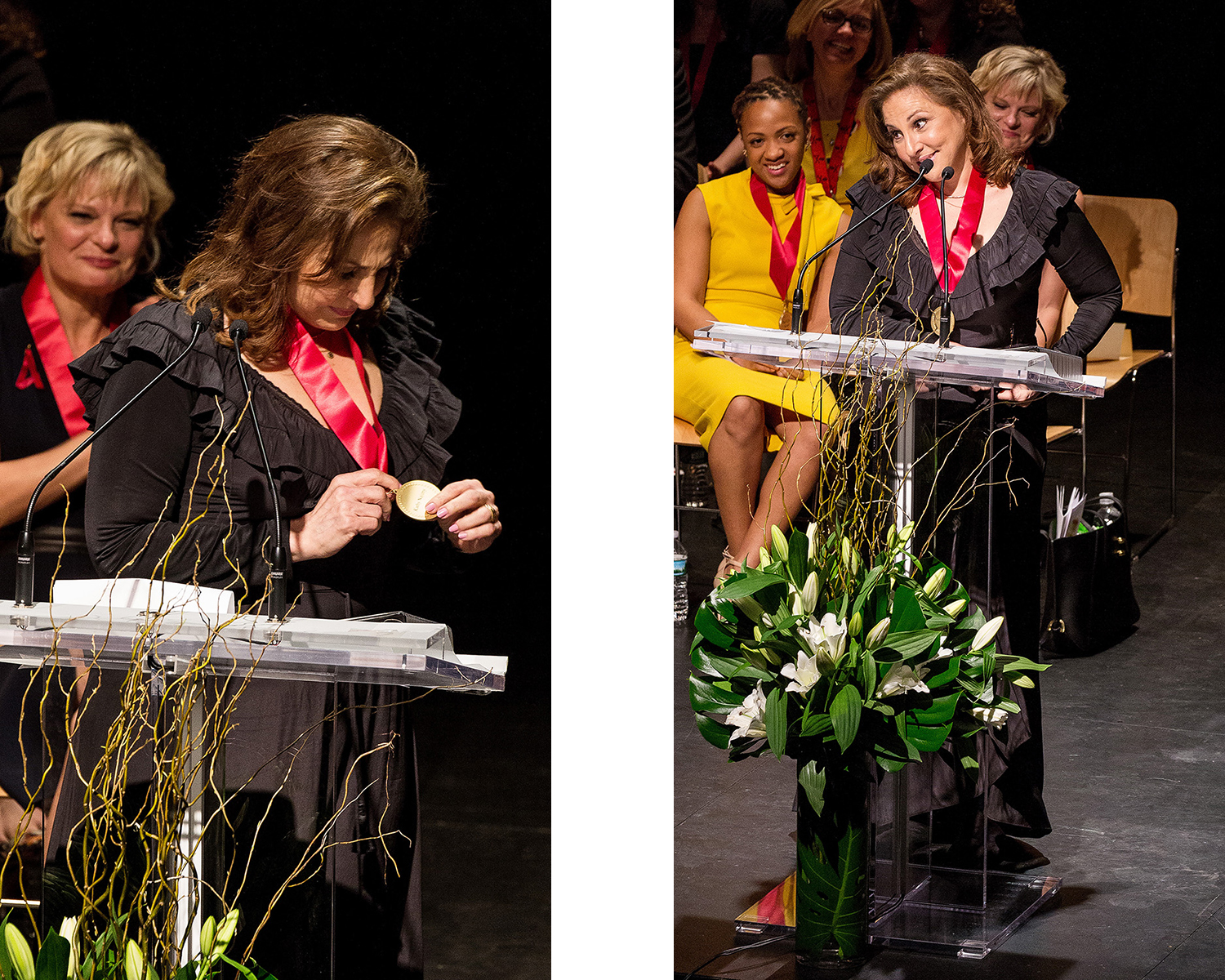
Kathy was true to Gloria’s words, inspiring both laughter and awe throughout her speech. She honors the other awardees, Gloria, the Lillys, and her daughter with her generous, honest, and witty words. She compels us all to keep going, saying: “to believe we might be able to make a difference simply gets us through the fucking day.”
“…I’ll tell you what A is for. A is for ‘Are you fucking kidding me?’ To have the courage to say any tiny public opinion is unheard of, let alone be the glooming voice of reproductive rights. This woman is on network TV! She even had the word ‘abortion’ printed on a dress! And she just got picked up for a second season!” – Kathy Najimy on Martha Plimpton
“I was doing a colonic the other day, and between kegels, I was thinking about what really is an activist. After my third release, I said to my colon therapist, ‘so, Svetlana, maybe an activist is someone who just improves the little space that they take up before they split.’ I’m not sure exactly when my activism started, maybe when I refused to take off my ‘Legalize Weed’ button when I got kicked out of junior theater for it. The crazy thing is, I’ve never smoked pot. Or maybe it was when I got them to let women wear pants and change the dress code. Activism is a way to temporarily mute the hideous voices screaming out in your gut at the state of things. It quiets the rage for just a minute – rage of suffering, abuse, violence, rape, inequality, racism, shame, poverty, war, misogyny, homophobia, and hate – the things that just shred our insides. When I see Donald Trump’s face on my AOL feed page, I do one of two things: I either inhale a brownie, or I plan a rally. To believe we might be able to make a difference simply helps us get through the fucking day. Activism [also] means we make a play, a dance, a poem, direct a film, write a book, a speech, a TV show, a song, or in some rare chance we get to perform or create something that leaves this place where we stand a little bit better, a little bit fairer, and a little bit more fun. If we get the chance to even jostle an opinion or an audience to do any of these, that’s a really good day for me. If I get to watch three Wheel of Fortunes in a row, have a bubble tea, and get a grand Lilly prize from Gloria Steinem, it’s a really good day for me.” – Kathy Najimy

The show ended with a closing number from Zoe Sarnak, Georgia Stitt, Amanda Green, and Rebecca Naomi Jones singing “This Stage is Your Stage” to the tune of Woody Guthrie’s “This Land is Your Land.”
“As I went looking through the theater season
I saw no women
And I saw no reason
For the lack of balance
With the wealth of talent
This stage belongs to you and me
This stage is your stage
This stage is my stage
From sets and lighting
To the final script page
From the streets of Ireland
To Manhattan Island
This stage belongs to you and me
If you’re ingenue-ish
If you’re male and Jewish
Christian and Caucasian
Not trans or Asian
Then you might belong here
But there’s something wrong here
This stage belongs to you and me”
The event was produced by Tessa LaNeve and Chelsea Marcantel, and co-produced by Amanda Green. To learn more about The Lilly Awards, click here.
Red Carpet photo by Zach Ranson.