Posted on

A Conversation with Donna Couteau, Joe Cross, Gloria Miguel, Muriel Miguel, Soni Moreno and Sheldon Raymore

Fear of Oatmeal


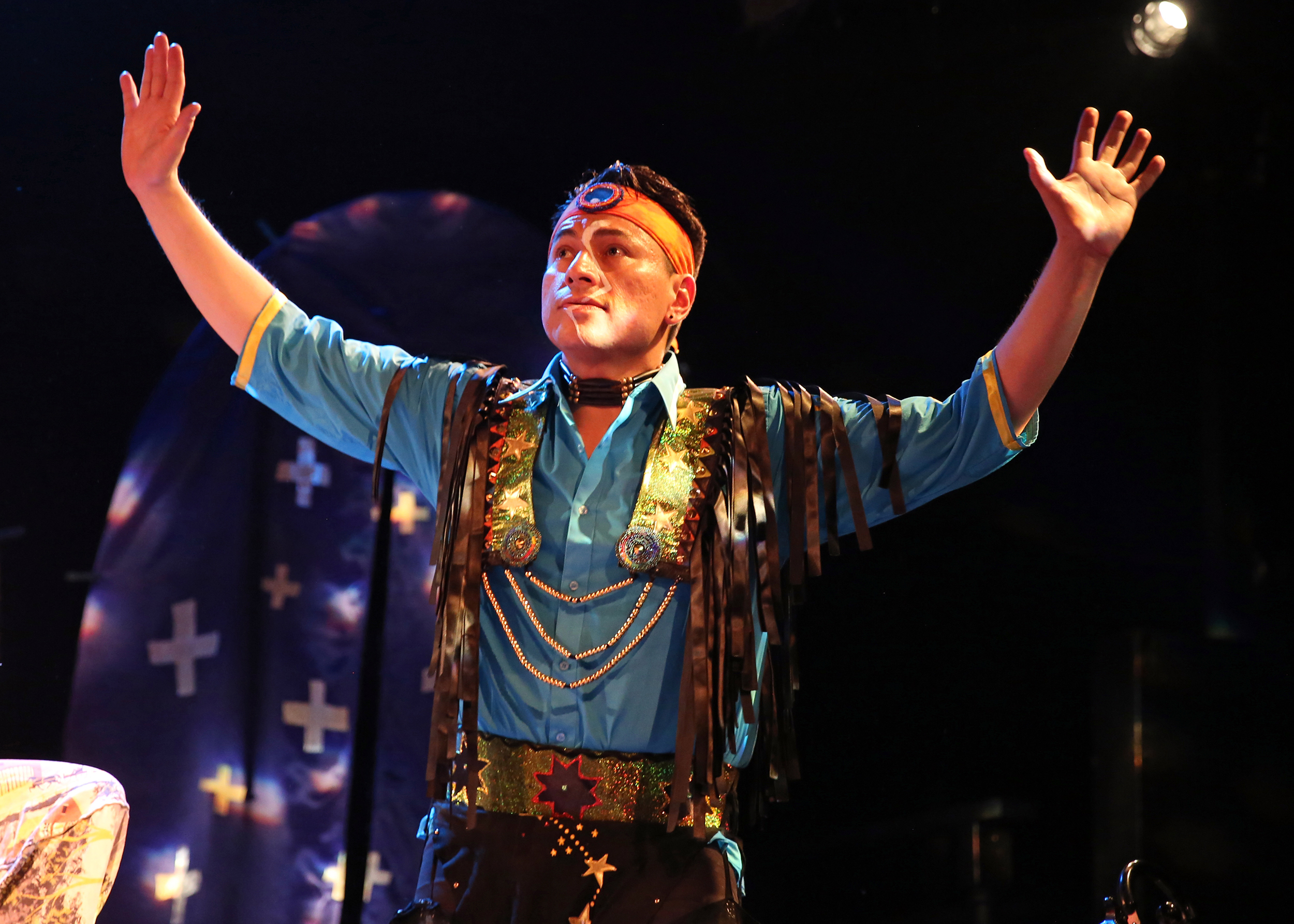
In 1976, three sisters – Gloria Miguel, Muriel Miguel and Lisa Mayo (née Elizabeth Miguel) from Kuna and Rappahannock ancestry – formed the legendary Spiderwoman Theater, the first indigenous feminist theater group in the United States. Their plays have been produced all over the world and published in numerous anthologies. Muriel Miguel’s latest piece as writer and director, Fear of Oatmeal, is playing through June 24 at Theater for a New City. An elder Native woman (played by Muriel’s sister Gloria) sits at her colorful Brooklyn apartment as the spirits of her ancestors – ever present – materialize with stories that illuminate her past, present, and future. The play features an entirely Native cast, and is a vibrant, funny, and heartfelt tribute to heritage, memory, family, and the perseverance of culture. We sat down with Gloria and Muriel, as well as the remaining cast members – Donna Couteau, Joe Cross, Soni Moreno and Sheldon Raymore – to discuss the play and the importance of Native representation in the arts.


Margarita Javier: Could you please introduce yourselves and tell us which character you play?
 

Soni Moreno: I play the part of Nita Matariki, and I’m from Pleiades.
 

Joe Cross: The seeum that I play is Bear and it says “Knotsititi” on my shield. From the Caddo Tribe. Knotsi is bear, titi is little/small.So it means Little Bear. It also refers to Ursa Minor as a constellation.
 

Sheldon Reymore: I’m the other seeum. I play Thunder and I’m from the Pleiades as well.
 

Muriel Miguel: Could everyone please mention where they’re from?
 

Soni: I’m from California, and I’m Maya, Apache, and Yaqui. And I live in Staten Island.
 

Joe: I’m Caddo and Pottawatomie and I live in New York City.
 

Sheldon: I’m from the Cheyenne River Sioux tribe.
 

Gloria Miguel: I’m from Brooklyn, New York, and my character is Nelly.
 

Muriel: Where are you from, Gloria?
 

Gloria: My native background is Kuna Yala and Rappahanock.
 

Donna Couteau: My character is Henny. I call her Henny Penny cause every penny helps [laughs]. And I’m from the Sac and Fox Nation of Oklahoma.
 

Muriel Miguel: I’m Kuna Rappahanock. I live in Brooklyn. And I’m the writer and director.
 

Fear of Oatmeal
 

Margarita: Is there a terminology you prefer when referring to your heritage?
 

Joe: I’ll say it’s a question that’s been going on for some decades. All kinds of names have been passed around, which I don’t care to go into. One thing I liked 40 years ago was the term “indigenous.” I liked that. Now Native people and indigenous kind of has a connection with other people all around the world.
 

Soni: I like that, too.
 

Margarita: This production is from Theater for the New City in collaboration with Amerinda and Spiderwoman Theater. What can you tell us about Amerinda and Spiderwoman Theater, since we have two founders of Spiderwoman right here?
 

Gloria: Spiderwoman, we’ve been together since 1975. I think we had our first rehearsal then. We’ve performed all over the world. We got together because we were three sisters, and we were all in theater. We decided that we didn’t see ourselves represented and that if we did get together and use all our different backgrounds we would be able to do that. I think we were successful in that. We changed attitudes. I mean, we were still fighting…
 

Joe: Just with each other! [laughs]
 

Gloria: No, well, yes, with each other, but one of us passed away. We’re still fighting in our dreams, I guess. No, but fighting for certain rights.
 

Muriel: We are the oldest Native feminist theater in the world, as far as we know. That’s important. The stories that we tell are from many nations, but mostly from the spirit, which is really important to us.
 

Gloria: We were performing for a few years before the cross country to go to reservations, etc. And that was one of the reasons we wanted the young people to see that we can be on stage. We didn’t have to be just in John Wayne movies and stuff like that. Sheldon said that he saw us when he was in high school and it had an effect on him. And here he is working with us! I think it’s so exciting.
 

Margarita: Do you want to talk about when you saw them?
 

Sheldon: They’re legends in the Native Theater world. So it’s an honor to have this opportunity and to be mentored. It’s just really cool.
 

Margarita: What can you tell us about this play, Fear of Oatmeal?
 

Gloria: I feel my family when we are on the stage. I’m wearing my mother’s dress, you know. There are stories from way back there. I wasn’t always with my sister. I know the story and I know her feelings. And mine, also, all of which are connected to our house. It just occurred to me that we use the word “mound” without connecting it to the Native world. We used to have a mound, and used to put things in there and cover it up with flowers of asphalt or whatever for years and underneath our house we have a mound. So it’s like we are sitting on all this history.
 

Donna: I was just going to say that their house is also legendary. I’ve been around a very long time, but their family has been here for over a hundred years, so Native people that would come to this area would find themselves over at their home, and you could stay there. They would take care of you. And so they had these incredible stories, and it’s so wonderful to see this play and I just feel so blessed to be a part of this because when I came to New York, I was a dancer and a ballerina. I had a very brief career because I injured myself. I was so fortunate to have met them and then be able to have another career which went into theater. There are so many stories, and this is such a great one – the thing with the spirits and everything – and I really feel that we’re really encountering that every single night [laughs].
 

Fear of Oatmeal
 

Margarita: I was very struck by the set design by Dedalus Wainwright and the costumes by Gabriekke Amelia Marino. Do you have any insight about that process and did you have any input in the design of the costumes and set design?
 

Soni: We did have input and we were given the freedom to design our own space pod, or the shield.
 

Margarita: So you each designed your own shield?
 

Joe: Pretty much.
 

Soni: Yes, and they’re a part of the character. I knew I wanted this skirt [laughs]. It’s like reverting back to my childhood, but also, this is who I am, too, you know. I believe in magic and I believe in seeums. We do encounter them every day and every culture has them. And so this play in particular sings and speaks to me.
 

Muriel: I try when I’m directing to make an ensemble, that’s really the important thing, to make the ensemble. I really want to work with Native actors. So I’m very fortunate that I have five Native actors who are talented and can work. I’m also fortunate because they followed me [laughs].
 

Joe: I think confidence is something that comes out. It’s a process. It may not be something you understand in your scene or even in your monologue or dialogue at that time. You just have to feel that the changes that you’re experiencing are going to be for the best. I think everybody’s worked with Muriel before, except for Sheldon, so we have experienced that directoral comradery that comes with this. You’ve got to have a lot of giving and you’re going to go do a lot of taking.
 

Margarita: It actually shows. You’re very comfortable with each other and there’s something about it that when you’re in the audience and you’re seeing it, you can tell there’s trust, that you know each other that you understand the work in a way that’s pretty unique.
 

Muriel: We’re all pretty good friends. There’s a lot of generosity.
 

Fear of Oatmeal
 

Margarita: I’m fascinated with using theater as a tool for social change. Is there a political motivation or is there some activism into what you do as performers and as creators and artists?
 

Sheldon: Muriel says, if it’s Native theater, if it’s about us, it should be for us and by us. Right? No red face!
 

Donna: And don’t do side shows! [laughs]
 

Soni: We don’t do circus acts! [laughs]
 

Joe: Hashtag no red face.
 

Margarita: Muriel, you mentioned in your artistic statement the importance of having not just Native people on stage but also behind the scenes as, and I think it’s really great that you are doing that. I think of a lot of companies in New York City that always make the excuse whenever they don’t cast authentically and claim it’s impossible, and here you are proving that it’s possible. It can be done.
 

Suni: It’s difficult.
 

Muriel: We are many generations here. Also you have to think about what you do when you have someone over 70 working. What do you have to do to be accommodating to them?
 

Fear of Oatmeal
 

Gloria: And that’s me [laughs]. I’m going to be 92 next month, and that’s old [laughs].
 

Donna: I don’t think you’re going to find a lot of 92-year-old performers, period. And that’s why I think it’s so important to be so inclusive, to have all the generations represented. I think it’s a very rare and wonderful thing.
 

Muriel: It’s also what Native people really think of, in the families and talking about their elders. We have to keep them really close. We have to teach the other generations how to be generous and how to work. That’s really important. That goes both ways.
 

Margarita: Is there a younger generation of Native artists that you work with, thinking of the future of companies like this one?
 

Muriel: It’s all Sheldon [laughs]. I have actually. With our family, theater is a business.
 

Gloria: My daughter’s an actress, my grandson’s a performer. I don’t have great-grandkids yet, but…
 

Muriel: My daughter is a performer and writer, my granddaughter is also a singer and a dancer. I think of working other younger actors. For a long time, I worked at the Centre for Indigenous Theater, which is in Toronto. I’m going to do an intensive workshop with young people in July.
 

Gloria: Our father was a performer. He did a lot carnival work too. That’s how we met Native people since we were young.
 

Muriel: Many years ago in New York City, it was really snake oil time, and showbiz Indian time. A lot of people don’t like to admit it, but that’s what we were. And that’s how a lot of us made money for our families.
 

Julia: We found an old photograph of my father performing way back from 1936.
 

Margarita: Sheldon, I have a question for you. You are also a dancer, choreographer, right? Did you do the choreography for the show or did you have any input on it?
 

Sheldon: No, I was directed by Muriel. We worked that out together. I’m a grass dancer and Native dancer.
 

Fear of Oatmeal
 

Margarita: For those of you who are performers, what is your dream role?
 

Muriel: Sheldon wants to play Pagliacci [laughs].
 

Sheldon: Disney World! [laughs]
 

Donna: I always wanted to go on Broadway. I had always wanted to do a musical and be a triple threat. One of my very favorite performers, and I love to see her, is Chita Rivera.
 

Margarita: I am obsessed with Chita Rivera.
 

Donna: Me too! I was sitting in the front row. She had this like black and red feather boa, and a feather flew out and right in my lap.
 

Margarita: What do you hope audiences – Native and non-Native alike – take away from this play?
 

Donna: I want audiences to do their own thinking. I don’t like to say and the moral is in an Aesop’s fable-y way. I’m not like that. I guess just to know that we’re here and we continue to be here and we’re going to be here. Like Nelly says at the end of the play: “I’m still here.”
 

Soni: I kind of feel the same way, it’s up to the audience. Think a little bit.
 

Muriel: I guess I feel that way too. I had a lot in mind when I started to write. A lot of it came from dialogue and seeing if I could write dialogue. That’s how it started. And then I started to think about all the people that I knew and how they talk and, and then it just kept on going. Someone said to me Well, you know, your house is a mound and that started a whole other direction. This thing about oatmeal was something in my family since I was seven or eight years old. All of that started to come together and I really wanted to know if I could write a play rather than working on people’s bodies and working together on their stories. I wanted to tell my stories. That’s how it had its birth, with those thoughts in mind. I don’t know what I want anyone to come away with because I just write, and if I’m not writing, I’m working with people. I really don’t know how they come out of it and what they’re saying. I’m really interested in what people say. I want to know what you think.
 

Margarita: I’m curious about your thoughts on this current administration’s immigration policies.
 

Muriel: I’ve been thinking a lot about this thing with the children. What do we do about leaving children at the border? What is that? You can’t say, “Give me your tired, your poor, your huddled masses yearning to breathe free,” but then leave your children and put them in concentration camps, almost. It does remind me of the old regime. This is 1492 again. Now it’s 2018 and here we are doing the same thing again. And it’s brown people. What are we doing about it? What are we doing about that, that’s what I want to know. What are we doing about it? We have to do something. I’ve been thinking about this because I feel like we have to do something. And so what are you doing? You’re going to get rid of all the brown people in the United States? Anyway, that’s what I’ve been thinking of. I was thinking about it last night and I was thinking about it today. What, what are we going to do? We have to do something. We have to say something.
 

Fear of Oatmeal


Joe Cross (Caddo Nation of Oklahoma) Television: ONE LIFE TO LIVE, SNL, CBS SUNDAY MORNING, THE JURY, DAVID LETTERMAN, SPIN CITY, CHRIS ROCK, THE WHITEST KIDS I KNOW, LA LAW, ESPN. Film credits include LUCKY DOG, AFFLUENZA, AIMLESS, CREATING KARMA, THE STORYTELLER, NATIVES (NYU), SMOKE BREAK (NYU), BUZZKILL, THE WAR THAT MADE AMERICA, THE STORY OF THE PEQUOT WAR, ROYAL TANENBAUM, KINSEY, A THOUSAND ROADS (signature piece for NMAI, Smithso¬nian). Theater: MACBETH (AMERINDA), POWWOW HIGHWAY (YELLOWROBE), THE HISTORY OF ASKING THE WRONG QUESTION (NORTH FOURTH ST THEATRE), WHITE WOMAN STREET (DAELAUS), INKTOMI (Public), HARVEST CEREMONY (director, Smithsonian), EARTH, SUN & MOON (Lincoln Center), and Broadway Melody 1492 (Ohio Theater). Awards: Silvercloud Outstanding Service, Metro Caddo Cultural Club, SAG Cultural Award, Fort Monmouth Heritage Award, Bergen County Community College Historic Award, Lower Manhattan Cultural Council (Wiping Away the Tears-WTC). SAG/AFTRA


Gloria Miguel (Kuna/Rappahannock) Gloria studied drama at Oberlin College and is a founding member of Spiderwoman Theater. She is an actor, playwright, and educator. She has toured throughout Europe, Australia, New Zealand and performed in Beijing, China at the 4th World Woman’s Conference. She received an Honorary DFA from Miami University and is a lifetime member of the Lee Strasberg Institute. Selected acting credits include Du Tu Kapsus MATERIAL WITNESS; Hanay Geiogamah GRANDMA; Tomson Highway THE REZ SISTERS; JESSICA in Edmonton, AB-nominated for a Sterling Award for Best Supporting Actress; CHOCOLATE WOMAN DREAMS THE MILKYWAY with Monique Mojica, MATERIAL WITNESS and the film CAOTIOA ANA. She was a visiting professor of drama at Brandon University in Canada and has taught drama workshops at the Navajo Nation Reservation. Her one woman show, SOMETHING OLD, SOMETHING NEW, SOME-THING BORROWED, SOMETHING BLUE, has been performed at the Weesageechak Begins to Dance Festival in Toronto.


Soni Moreno (Maya/Apache/Yaqui) is originally from the Bay Area in California and studied at the American Conservatory Theatre in San Francisco. She started her career in original San Francisco production of HAIR in be the role of Chrissy. Theatre Credits: HAIR (The Revival), THE LEAF PEOPLE – INNER CITY — AMERICA SMITH — THE TRAVELS OF ALADDIN, SMOKE, DAUGHTER OF THE HILLS by Martha Redbone and Aaron Whitby as part of The Public Theatre’s Under the Radar Festival 2016. She is the Co-founder of First Nations acappella woman’s trio, ULALI, The group toured with Buffy Sainte-Marie and recorded with the Indigo Girls and Robbie Robertson the Red Road Ensemble. Soundtrack credits for film and television include THE L WORD I THE NATIVE AMERICANS / SMOKE SIGNALS / FOLLOW ME HOME / HOMELAND / THE GIFT / ROCKS WITH WINGS / ONE GIANT LEAP / ALCATRAZ IN NOT AN ISLAND. She was one of the artists in the Collaborative Art Installation of THIS PATH WE TRAVEL at the National Museum of the American Indian in New York City. Designer credits – Costumes / Sets / Story Quilts for MATERIAL WITNESS / Costumes for Spiderwoman Theatre Company. She is currently recording an Album with longtime writing partner and friend, Charley Buckland.


Shelson Raymore (Cheyenne River Sioux) is a member of the Cheyenne River Sioux Nation, a Native American Storyteller, Visual Artist, Actor, Choreographer, Cultural Consultant, and an award-winning Grass Dancer. The South Dakota Native recently finished touring with Heather Henson’s AJIJAAK ON TURTLE ISLAND theatre production (2015-2018). Captivating and moving, Sheldon also starred in ABC’s Born to Explore, LEGEND OF THE DANCE with Richard Weiss, where they were the featured grass dancer at the Smithsonian’s National Museum of the American Indian. Ever the consummate keeper of tradition, they continue to cultivate their artistry, with the utmost integrity, humility, and authenticity, letting the love for their culture shine through in all that they do.


Muriel Miguel (Kuna/Rappahannock) is a choreographer, director, and actor. She is a founding member and Artistic Director of Spiderwoman Theater, the longest running Indigenous feminist theater in North America. Muriel is a 2016 John S. Guggenheim Fellow; has an Honorary DFA from Miami University in Ohio; is a member of the National Theatre Conference and attended the Rauschenberg Residency in 2015. She has pioneered Spiderwoman Theater’s story weaving methodology and the development of a culturally – based Indigenous performance methodology. Choreography: THROW AWAY KIDS – Banff Centre for Arts and Creativity; Director (Selected) MATERIAL WITNESS – Spiderwoman Theater; THE SCRUBBING PROJECT – Turtle Gals Performance Ensemble and EVENING IN PARIS – Raven Spirit Dance Company. Acting: Off-Broadway – Taylor Mac’s LILY’S REVENGE; Philomena Moosetail- THE REZ SISTERS; Aunt Shadie – THE UNNATURAL AND ACCIDENTAL WOMEN; One woman shows – HOT N SOFT, TRAIL.

Posted on

A Conversation with Ramiro Antonio Sandoval

Ramiro Antonio Sandoval


On a rainy Monday, I stopped by Teatro LaTea, located on the second floor of the Clemente Soto Velez Cultural Center on the Lower East Side. LaTea is hosting a residency of the international theater collective Tabula Rasa whose mission statement is, among other things, to foster dialogue on an international level through artistic expression. We were invited to sit at a run through of their latest piece, In the Eye of the Needle, a funny, inventive, and ultimately poignant look at communication in the modern age. We sat down with Ramiro Antonio Sandoval, the founder and artistic director, who in the middle of an arduous day full of rehearsal was gracious enough to share his thoughts on theater, social change, diversity, and the importance of interpersonal communication.


Margarita Javier: What can you tell us about Tabula RaSa?
 

Ramiro Antonio Sandoval: Tabula Rasa is an international theater collective, an ensemble of artists from different countries. It started with mainly Latino artists from different countries like Colombia, Ecuador, Mexico, Spain, Ecuador, Argentina. Our last production also included artists from The United States, Korea, and The Dominican Republic. In a broad sense, our aim is to reflect what New York is like and what we think the world is like nowadays, to visualize how being inclusive and diverse in our society can create interesting works of art. One could go out to the community and teach a bit of what we have discovered, go to other countries, bring that to other countries and exchange and build bridges of communication between the United States and other cultures.
 

We have also built within Tabula Rasa, the Theatre For Peace Project, which came from an agreement we have with Hye Ja Ju, a director from a theater company in South Korea. She is one of the very few female directors in a predominantly male dominant society, even within the arts. We knew we had in our work topics and a passion for peace, so we created the Theatre For Peace Project which brought us to Korea, where we presented our last show in a production in which half the cast was from the United States –– including people from different countries –– and the other half was Korean. The show was presented in both English and Korean in a festival as part of a month and a half residency. The idea was bringing the message of peace.
 

After that we went to Columbia, to the Women on Stage for Peace Festival, a very important theater festival in Colombia. We had a great experience going to the mountains to work with ex-combatants, ex-guerrilla people. We did some work with them, they’re very creative and they have developed great things. They shared their vision, and then they came to a university where I was teaching a workshop, and it was a great exercise of rejoining them with the society from which they had been separated for a long time. Some of them are now going to school for theater, for arts. We were very happy to be part of that process. Later they created a theater company and did a show on their own along with students from the university. That relationship is ongoing. Then we went to an even more dangerous zone in south Colombia bordering Ecuador, where recently people had been killed. It was very dangerous, but we thought that Theatre for Peace should be there where it’s needed. And we spent about three weeks doing theater with ex-combatants and people from the community, trying to bridge those relationships between these folks that had suffered from a lot of different factors during the war in Colombia. We created a show there with them, listening to their own manifestations, to their own will, and we put something together that was shown in their community. And we came back to NYC to bring our third large production, which is In the Eye of the Needle, after The Winter of April, which is about human trafficking, and Where There was Fire, which talks about the women who are left behind. They’re also victims of war who are left behind when their partners go to war for many, many years at a time. And then they reunite after they have grown and they meet up with different people. These are victims of the war as well.
 

Ramiro Antonio Sandoval
 

MJ: You mentioned In the Eye of the Needle, which is the piece you’re presenting during your residency at LaTea. Can you tell us about that?
 

RAS: We started working on In the Eye of the Needle after the experience in Colombia. Two years ago, a couple of the actresses from the company decided they wanted to do a show that talks about communication, about conflict resolution, about gender, about a lot of different things. And I was wondering, Why so many things? And they said it’s because that’s what’s happening nowadays. Everything all at once. It’s not one topic that people are concerned about, but many topics that are intertwined. How communication, the manipulation of communication and manipulation of knowledge is creating attachments or detachments within this society.
 

MJ: Right, both interpersonal and also the way the media handles communication.
 

RAS: Exactly. When there’s a big illusion about living a wonderful life when the basic needs for an individual to survive are denied. So we wanted to portray these characters as being in an in-between kind of situation. We don’t know where they’re coming from, where they’re going, or what’s happening. What we do know is that they’re being taken, that they’re missing, they’re disappearing. One of the key points along the way is let’s not talk about them because we’ll forget.
 

MJ: Was that a collaborative process?
 

RAS: Yes. We’re experimenting in different ways. I come from an experience of working 12 years with another company that I had founded here in New York working with immigrant communities, based on their experiences. And then you put together the dramaturgy and everything around it. In starting Tabula Rasa, I wanted to stay close to that process, but open it to celebrating the diversity of New York, of our world and the fact that we’re stronger when we add more, we’re putting more heads together. And also, we welcome conflict, which is something that is touched upon in this show. We welcome conflicts and we treat it as important, within a theatrical perspective. It’s key. I think I believe in that democratic way of doing theater, of collecting everybody else’s creative inspiration and putting it together, because every actor has something to say. I feel that because I grew up in that environment, maybe I’m biased that way, but I do see actors who are like, I wish this was more like this than like that. I mean, yeah, I understand where they’re coming from. It’s like a level of creativity can be expressed because you’re tied to “here’s text that someone wrote.” You become trained to execute. You’re an executioner of, more than a creative individual. One of the questions I ask my actors is: What do you want to tell the world as an artist? With that we start having lots of material to play with. There are many ways of doing it. For this piece, I adapted a few of the actresses’ stories. The story line helped weave their stories and their own expression. The experience we had with collective creation in The Window of April was different. We spent a lot more time in the research. We watched documentaries. We wanted to know, wanted to talk about social pathologies –– pathologies in the relationships nowadays, how people relate and how some pathologies get us to not relate to each other or to just put a value to those relationships. And little by little we started getting into human trafficking. We focused on sex trafficking for several reasons. We interviewed victims, police officers who have been involved in investigations. And then Ricardo Sarmiento Gaffurri, a great playwright and director who was my professor in college and part of the advisory board said Hey, this is great. Would it help if I write it? I said By all means, please. He took it over and did amazing job. He’s a very thorough and integral artist. For In Winter of April, we wanted to focus on drama, so we did a police thriller. Now we’re working in comedy. What do we laugh about? Do we laugh at the same things we used to laugh at? Why is that? We’re discovering that a lot of times we laugh about nothing new, which other very important and famous playwrights have posited. Somebody else’s tragedy becomes our biggest laugh.
 

MJ: Right. And it’s also a coping mechanism.
 

RAS: Exactly. So we took that kind of scenic route.
 

MJ: So In The Eye of the Needle is a comedy?
 

RAS: We hope so [laughs].
 

Ramiro Antonio Sandoval
 

MJ: And how did you become involved with LaTea?
 

RAS: I had come in the past, but they’re busy doing their things. This time when we came back from Korea, a close friend of one of the actresses from the company and the director Miguel Trelles connected us with LaTea. We had things to talk about and it was our fifth anniversary in September. So we said Hey, it would be great if we could get to collaborate. When we set a date to the premiere of In the Eye of the Needle, Miguel said Why don’t you guys come and not just do the premiere, but also a residency here with us –– sit in a desk and do your things here, have an exhibit, do workshops so people know what kind of techniques you use, have a Q and A afterwards? So that’s what we’re doing! We’ll be here, open to like sit down with people and talk about theater, about Theatre for Peace Project, and do interesting things like that.
 

MJ: What kind of workshops are you doing while you’re here?
 

RAS: We picked four different ones that are pillars of the kind of work we do. One that’s just a fun game and theater for people who are curious about how we get to do that. We really wanted to do that. Let’s play, let’s have fun. Let’s play some games that will allow us to create a structure about something meaningful, and then maybe turn it into a theater piece. There is another workshop called “The Body in Power,” which is based on the Feldenkrais technique of movement. It’s great for actors, for dancers, even for non-performers because it’s discovering the amazing energetic potential of a human body. How we use that, how to administer, how to manage that energy, how to be efficient with our bodies on stage, but on the day to day tasks as well. So it is great because it opens the creativity that we have in the innate captivity of the body to express ourselves through this amazing organ like this. Along the lines of the Feldenkrais work, we have another one called “The Semantic Embodiment,” which has to do with how we incorporate experiences in our life, how we get to reflect in our bodies. From a theater standpoint, characters embody conflicts, traumas, and a lot of different things in their body. It happens in our lives as well. I will also be holding a space related creativity workshop where I use the technique of a neutral mask and exercises to explore the creative potential of the empty space, the “tabula rasa.” It’s a nonverbal type of a creative work, movement work, which is not dance either. We get to see how the body can create many things that can be molded into artistic pieces. Those encompass the type of things that we do. Also, it’s not in the program, but we have a singer collaborating with us, an amazing singer, who’s also an actor. He’s offering a workshop on voice technique, techniques to warm up your voice, which is very key.
 

Ramiro Antonio Sandoval
 

MJ: I’m always fascinated by the idea of theater as a tool for social change. What is it about theater specifically as an art form that contributes to actually making a difference in the world?
 

RAS: I think that theater in that sense is above all arts. The direct contact with the audience is something that can’t be replaced, because the farther we steer from everybody, the more we appreciate when we can get together around one idea, one thought, one feeling, one sound. Through theater, and these are not my words, I’m paraphrasing Peter Brooks, who acknowledges that in society, those dynamics that break up society because we cannot see each other dismembers all of the parts, and they find in theater a place where all those members get together to become one big organ, if you will. So because of that you can go beyond ideologies, religion. You can go beyond many borders that are created by men to supposedly evolve and to solve problems, but end up separating us, isolating us from even ourselves. When we don’t even go out to see and feel what the weather’s like today, but we just ask our phones; we’re losing that level of awareness, the human touch. Theater breaks through that and sheds light on those issues that will come together, and we have something in common now that we’ve seen this and when we have something in common, then we can do things together. Ideas may generate from that.
 

MJ: Yeah, and that shared experience when you’re in the audience, even if you’re not part of the creative process, you’re just in the audience and having that collective experience of everybody laughing at the same time, sharing in this experience; it’s a very powerful thing. You don’t get that in any other art form.
 

RAS: Exactly.
 

Ramiro Antonio Sandoval
 

MJ: You talked about wanting to create theater that actually represents the diverse landscape of New York, but I feel like the theatrical landscape in New York is still very homogenous. It’s still dominated by white males. There’s a lack of diversity even in the city that has so many cultures, so many talented people. There is still a very big problem with diversity and obviously there are projects like yours and there are a lot of things that are being done, but I always like to ask artists in the theatrical community: What more needs to be done to improve the theatrical landscape in New York City to make it more diverse?
 

RAS: Yeah, exactly that, to take a big bet to be diverse. It’s my impression that we have been confusing “being diverse” with “ghettoizing” as an artist, or as a social or religious being. I once went to see a discussion about diversity in a university, and I walked out because I didn’t think it was diverse. There were 12 people from different groups, all segregated: the Latino Group, the Korean group, Indian group, African-American, etc. They were each focused on their own group. That doesn’t create diversity. I didn’t hear anyone say Hey, we would like to open up to work with anybody who wants to come and do the experience and collaborate. Bring their own creativity, learn from us, teach us things. We need to open up and stop thinking that we’re being discriminated upon in the arts landscape. Come and have dialogues with people who are looking to talk to other people. It’s like here at LaTea, where you have Puerto Rican, Latino plays and you see that people come from all over the world. That’s one of the things I like. There’s a genuine cultural exchange in this place, you know? Good things happen when we start sharing our cultures, even if we’re in the same building. We’re presenting the play in English, and we have someone from Switzerland, from Germany, Mexico, Colombia. And then we do the Spanish version. And then you hear accents. I think accents are important and they’re beautiful. They’re welcome. We need to understand what they’re saying but they are absolutely welcome and we pay tribute to that diversity with different languages. We’re in a context where we hear all of these things and so you can go off script for a bit.
 

MJ: Why do you want people to come see this play?
 

RAS: Because I think this is a good opportunity for a dialogue with artists, just by watching this kind of show which has all this creative energy from all of these artists, from people who are creating through music, the acting, the writing, the production. Everybody is contributing. They’re saying something to the world, so if you really want to have a kind of a dialogue there, it will be great to see this because it’s a relevant play.


Ramiro Antonio Sandoval has lived in New York for over two decades and he is the founder and Artistic Director of Tabula RaSa NYC Theater and Performance Lab –– an international artistic ensemble based in New York City, where he has been developing his own vision of theater and acting around the relationship actor-space (acting-design). His work has been presented in both English and Spanish in the US and abroad. He studied acting, directing, and staging at the National School for Drama in his native city Bogotá, Colombia; where he was also resident actor of one of the most important theater companies in Colombian contemporary theater. He has trained with professors from Teatro La Candelaria, the International School of Jacques Lecoq, the Piccolo Teatro di Milano, and the Workcenter of Jerzy Grotowski. He has also appeared in several film productions and tv series. In 2001, Ramiro co-founded ID Studio Theater where he was co-artistic director, actor, and manager of the permanent workshop for actors’ development, a space for research and education specializing in work with actors and non-actors from New York’s immigrant communities. Besides his award winning work as an actor, director, and producer for more than a decade, Ramiro was the creative director of the Medical and Scientific communications division of Ogilvy & Mather New York, where he was able to unite his research and artistic passions working with immersive technologies as well as directing and producing educational programs, live and online. He is a director of the Theatre For Peace Project, a global initiative to build cultural bridges around peace and human rights discussions. The project has brought Ramiro’s vision to Asia and South America as well as the new peace-building communities (former guerrilla communities) in Colombia building bridges of reconciliation through theater. Ramiro has been invited to be part of judging panels for important film festivals such as the Ícaro International Film Festival of Central America, the Americas International Film Festival, and the Havana Film Festival of New York. He is a board member of the Spanish Benevolent Society and member of the organization committee of the Lower East Side Festival of The Arts in New York City. He has been a guest lecturer at important schools such as the New School For Drama; the New York HB Studio; New York University; the Universidad del Valle in Cali, Colombia; the Universidad de los Andes post-graduate faculty of Design in Bogotá; the La Guardia Community College-City University of New York (CUNY); and recently participated at the 11th International Congress of Education Universidad 2018 in Havana, Cuba. He is an active member of the Red de Colombianos por La Paz NY and the International Agendas of Citizen’s Initiatives for Peace and collaborates with the Colombian Studies Group of Graduate Center at CUNY. In 2017, Ramiro received proclamations from the Westchester, New York County Executive and a New York State Senatorial proclamation for his outstanding work on peace and human rights through the arts.